Eavan Boland War Horse The violence in Northern Ireland escalated during the 1970s. It was a time when, as Eavan Boland herself says, the sounds of death from the television were heard almost daily. It seemed possible that the conflict
"Eavan Boland – War Horse The violence in Northern" is the property of its rightful owner. Permission is granted to
download and print the materials on this website for personal, non-commercial use only, and to display it
on your personal computer provided you do not modify the materials and that you retain all copyright
notices contained in the materials. By downloading content from our website, you accept the terms of this
agreement.
Presentation Transcript
01
Eavan Boland – War Horse<br>
02
The violence in Northern Ireland escalated during the 1970s. It was a time when, as Eavan Boland herself says, “the sounds of death from the television were heard almost daily”.
It seemed possible that the conflict might also spread to the Republic, as indeed happened in the Dublin-Monaghan bombing in 1974.<br>
03
Attitudes at the time could be said to have been ambivalent, with some people in the Republic expressing a desire to remain detached from the conflict and others accepting an involvement and even responsibility.
This sense of ambivalence is expressed in the poem – it portrays an awareness of collective responsibility even as it describes an attitude of indifference.<br>
04
Summary The event described in the poem is ‘nothing unusual’. A runaway horse from “the tinker camp on the Enniskerry road” is making his way down the suburban street, damaging lawns and flowers as he goes.
The alliteration of “clip, clop, casual” echoes the rhythmic sound of his hooves.
The normality of the poem’s setting is established in a series of concrete images: the speaker herself, watching the horse in a seemingly detached way from the window, the cultivated flowers – climbing roses, crocuses, a laurel hedge – in the gardens and the neighbours peering curiously from behind the curtains.<br>
05
From the outset, however, even in the title itself, the horse is invested with a weightier symbolic significance than the situation or the speaker’s reaction might suggest.
His progress is described in terms of violence and war. The destruction of war is suggested in the image of his shoes, which stamp “death like a mint on the innocent coinage of earth”; the simile also suggests the deeply etched consequences of violence.
Juxtaposed with this idea, in using the word “loosed”, the poet implies the random, uncontrollable nature of violence, an idea suggested by the word “casual” in the second line.<br>
06
Further images of suffering follow, in which the rose, the hedge and the crocus become emblems of human pain in the similes “Like a Maimed limb” and “like corpses”. The military metaphors used underline the idea further: the rose is “a mere/ Line of defence against him”; the horse is a “volunteer”.<br>
07
The vulnerability and powerlessness of human beings in the face of war are suggested in words such as “blown”, “crushed”, and “mutilated”, and in a vivid image of death’s finality where a crocus is seen as one of the “screamless dead”.<br>
08
The insistent tone of the repeated “our” house, “our” laurel hedge and the selfishness implicit in the repetition of “we, we are safe” now take on connotations of insularity and even denial. Phrases like “Of distant interest” and words like “expendable” and “remote” signify an unwillingness to become involved.<br>
09
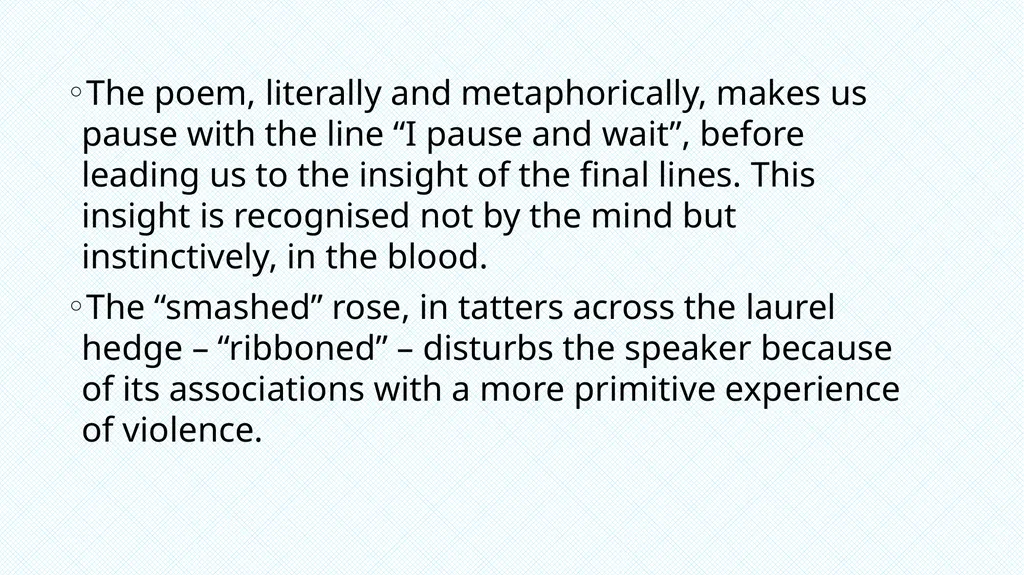
The poem, literally and metaphorically, makes us pause with the line “I pause and wait”, before leading us to the insight of the final lines. This insight is recognised not by the mind but instinctively, in the blood.
The “smashed” rose, in tatters across the laurel hedge – “ribboned” – disturbs the speaker because of its associations with a more primitive experience of violence.<br>
10
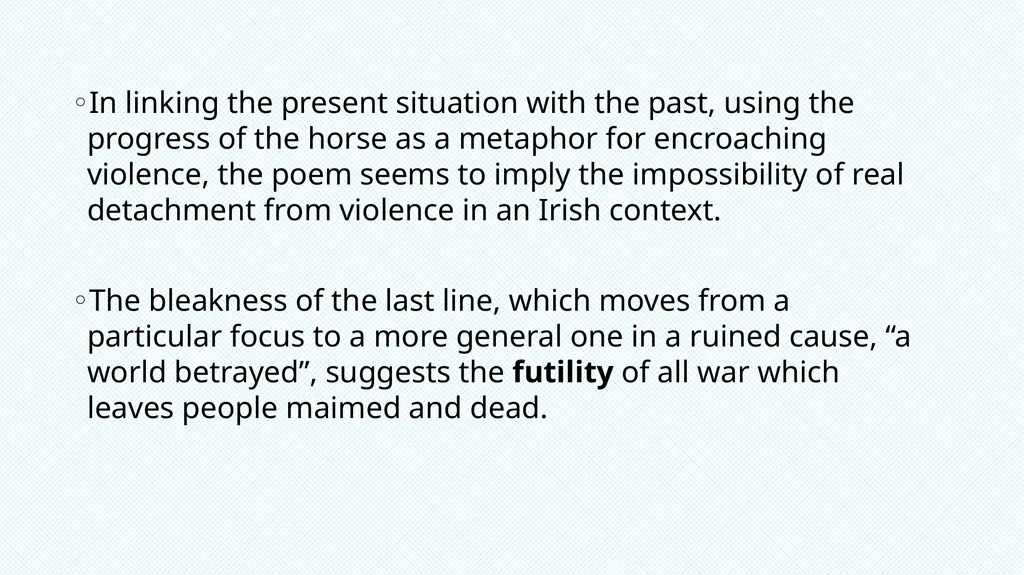
In linking the present situation with the past, using the progress of the horse as a metaphor for encroaching violence, the poem seems to imply the impossibility of real detachment from violence in an Irish context.
The bleakness of the last line, which moves from a particular focus to a more general one in a ruined cause, “a world betrayed”, suggests the futility of all war which leaves people maimed and dead.<br>
11
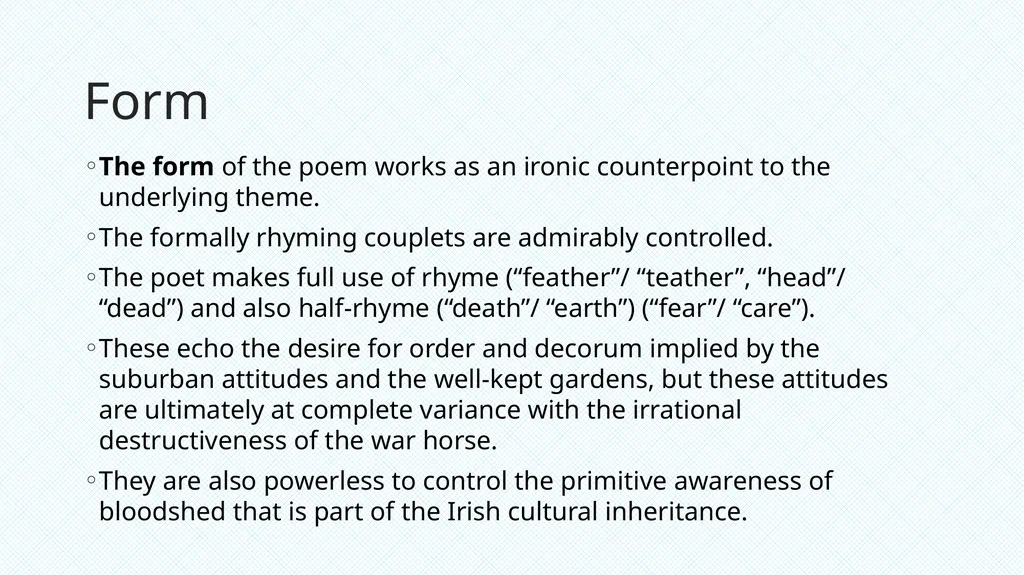
Form The form of the poem works as an ironic counterpoint to the underlying theme.
The formally rhyming couplets are admirably controlled.
The poet makes full use of rhyme (“feather”/ “teather”, “head”/ “dead”) and also half-rhyme (“death”/ “earth”) (“fear”/ “care”).
These echo the desire for order and decorum implied by the suburban attitudes and the well-kept gardens, but these attitudes are ultimately at complete variance with the irrational destructiveness of the war horse.
They are also powerless to control the primitive awareness of bloodshed that is part of the Irish cultural inheritance.<br>
12
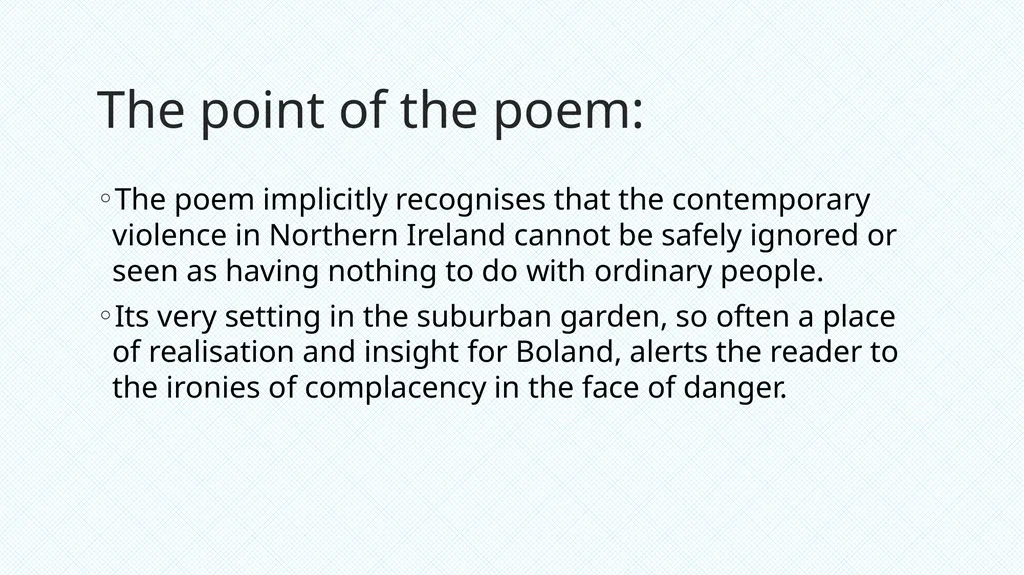
The point of the poem: The poem implicitly recognises that the contemporary violence in Northern Ireland cannot be safely ignored or seen as having nothing to do with ordinary people.
Its very setting in the suburban garden, so often a place of realisation and insight for Boland, alerts the reader to the ironies of complacency in the face of danger.<br>