
ElasticSearch and the ELK stack for monitoring and
LD
Published · 46 slides · 0 views

1 / 1



Description
ElasticSearch and the ELK stack for monitoring and data analysis Clemens Düpmeier (KIT IAI) Overview Introduction to the ELK stack Use Cases Summary Research group Web based Information Systems Elasticsearch ELK Software Stack ELK
Related Topics
Share
Embed code
Download this presentation From Below
"ElasticSearch and the ELK stack for monitoring and" is the property of its rightful owner. Permission is granted to download and print the materials on this website for personal, non-commercial use only, and to display it on your personal computer provided you do not modify the materials and that you retain all copyright notices contained in the materials. By downloading content from our website, you accept the terms of this agreement.
Presentation Transcript
01
ElasticSearch and the ELK stack for monitoring and data analysis Clemens Düpmeier (KIT / IAI)<br>
02
Overview Introduction to the ELK stack
Use Cases
Summary Research group “ Web based Information Systems“<br>
Use Cases
Summary Research group “ Web based Information Systems“<br>
03
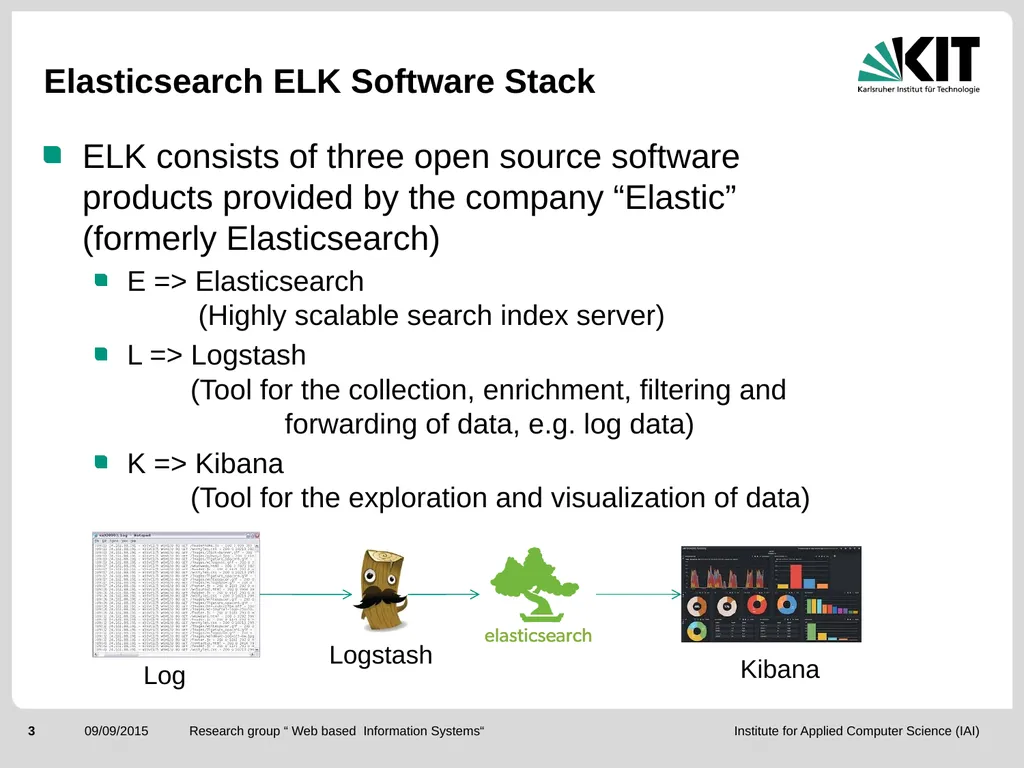
Elasticsearch ELK Software Stack ELK consists of three open source software products provided by the company “Elastic” (formerly Elasticsearch)
E => Elasticsearch (Highly scalable search index server)
L => Logstash (Tool for the collection, enrichment, filtering and forwarding of data, e.g. log data)
K => Kibana (Tool for the exploration and visualization of data) Research group “ Web based Information Systems“ Logstash Log Kibana<br>
E => Elasticsearch (Highly scalable search index server)
L => Logstash (Tool for the collection, enrichment, filtering and forwarding of data, e.g. log data)
K => Kibana (Tool for the exploration and visualization of data) Research group “ Web based Information Systems“ Logstash Log Kibana<br>
04
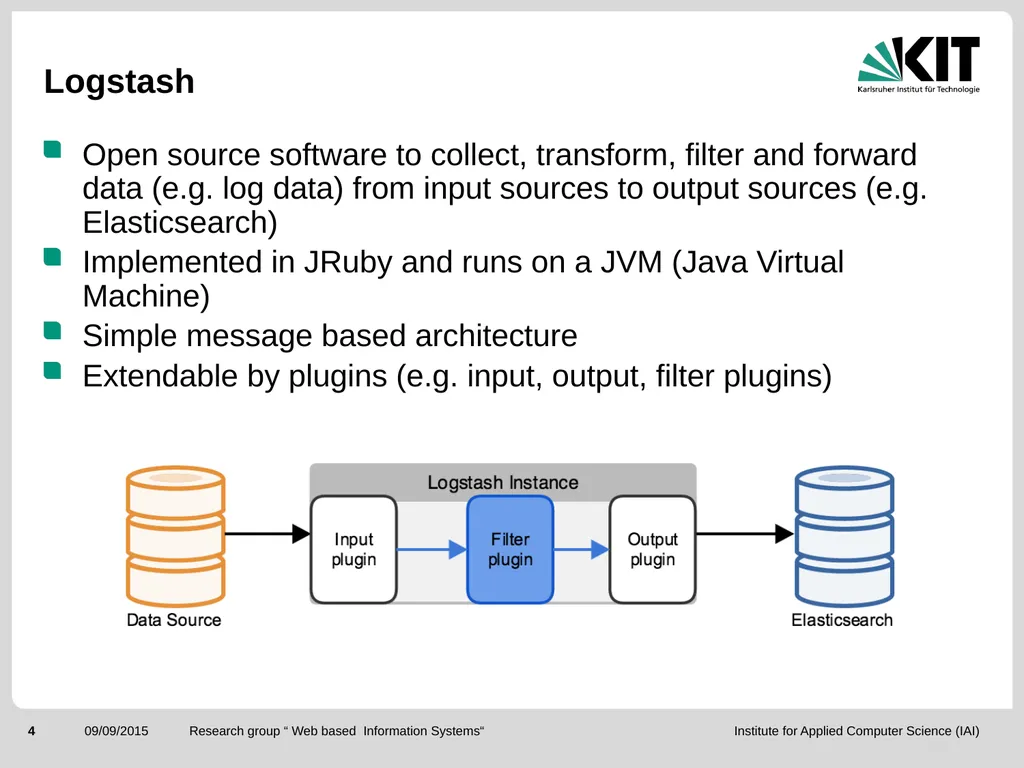
Logstash Open source software to collect, transform, filter and forward data (e.g. log data) from input sources to output sources (e.g. Elasticsearch)
Implemented in JRuby and runs on a JVM (Java Virtual Machine)
Simple message based architecture
Extendable by plugins (e.g. input, output, filter plugins) Research group “ Web based Information Systems“<br>
Implemented in JRuby and runs on a JVM (Java Virtual Machine)
Simple message based architecture
Extendable by plugins (e.g. input, output, filter plugins) Research group “ Web based Information Systems“<br>
05
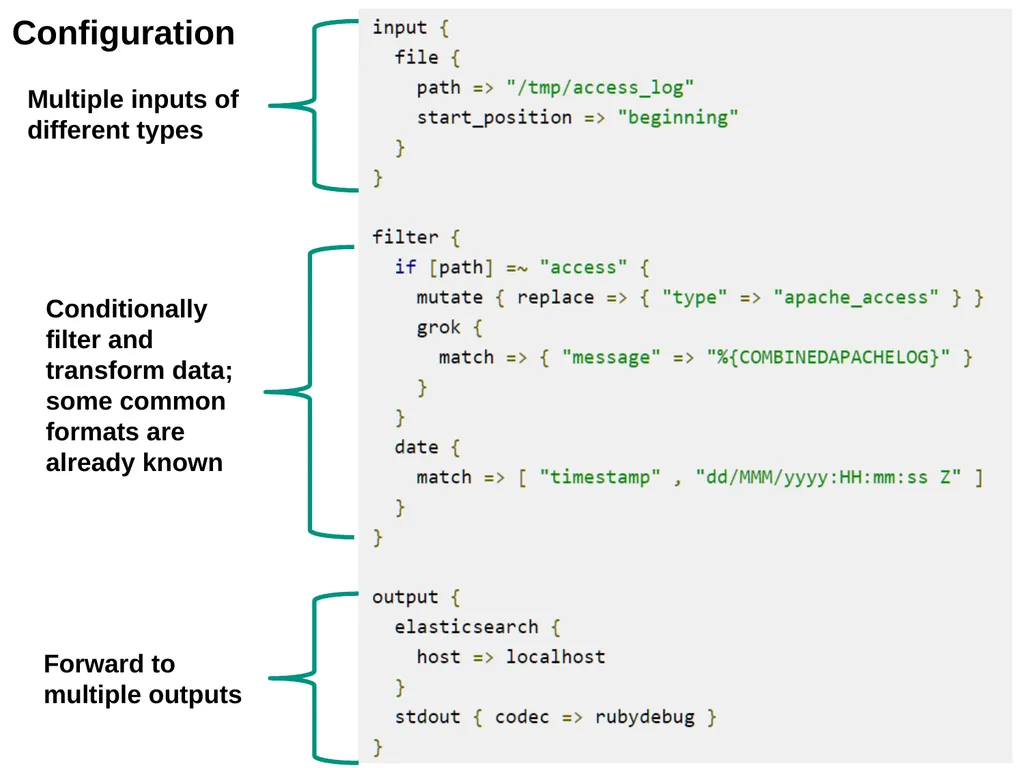
Configuration Multiple inputs of different types Forward to multiple outputs Conditionally filter and transform data;
some common formats are already known<br>
06
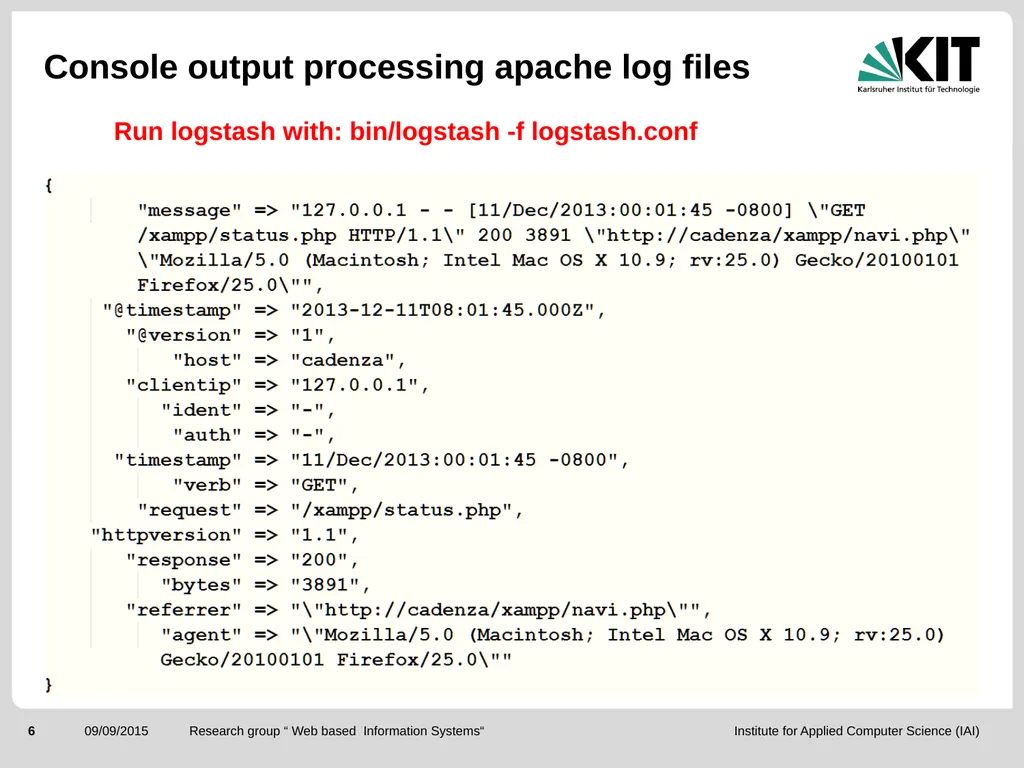
Console output processing apache log files Research group “ Web based Information Systems“ Run logstash with: bin/logstash -f logstash.conf<br>
07
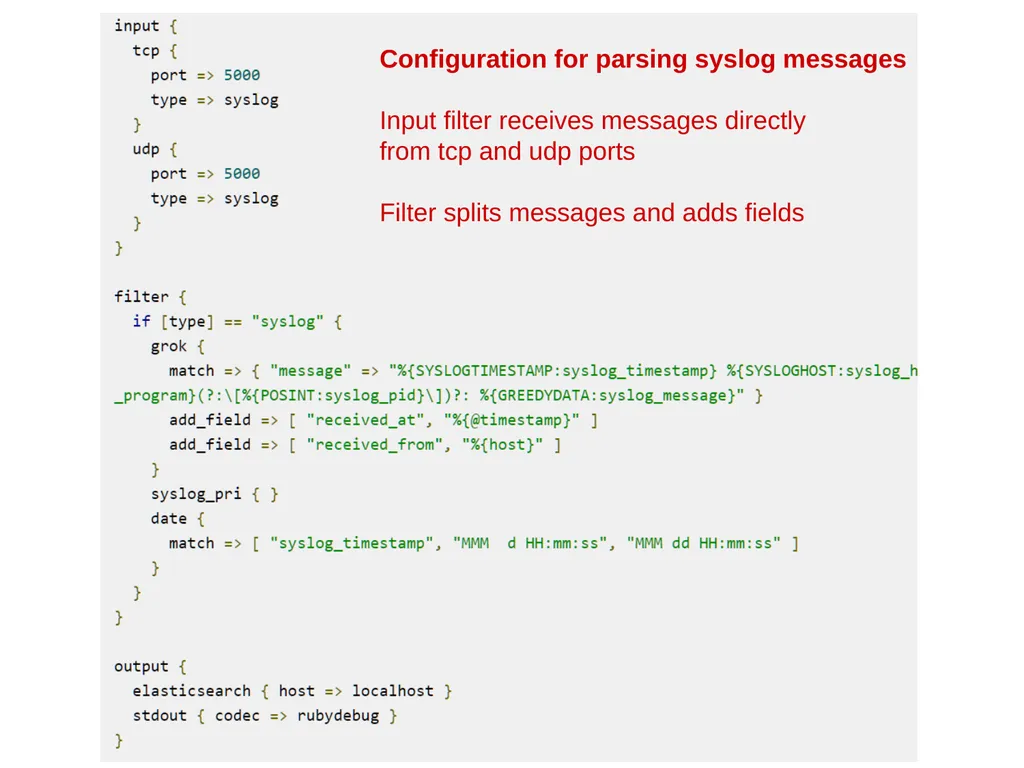
Configuration for parsing syslog messages
Input filter receives messages directly from tcp and udp ports
Filter splits messages and adds fields<br>
Input filter receives messages directly from tcp and udp ports
Filter splits messages and adds fields<br>
08
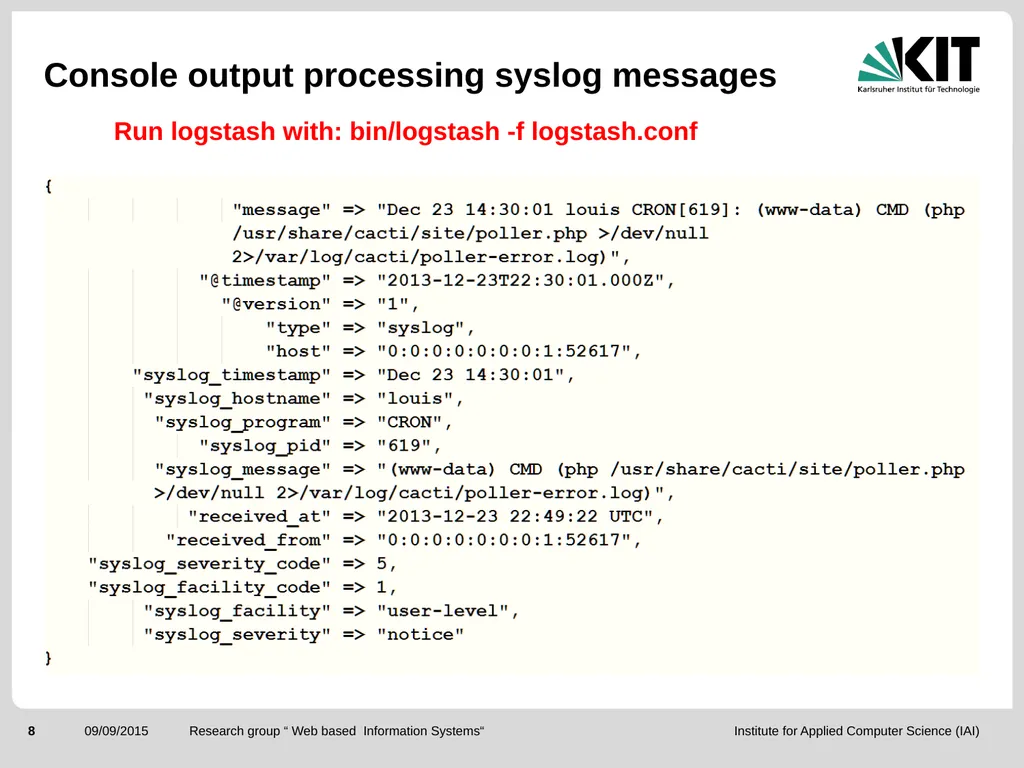
Console output processing syslog messages Research group “ Web based Information Systems“ Run logstash with: bin/logstash -f logstash.conf<br>
09
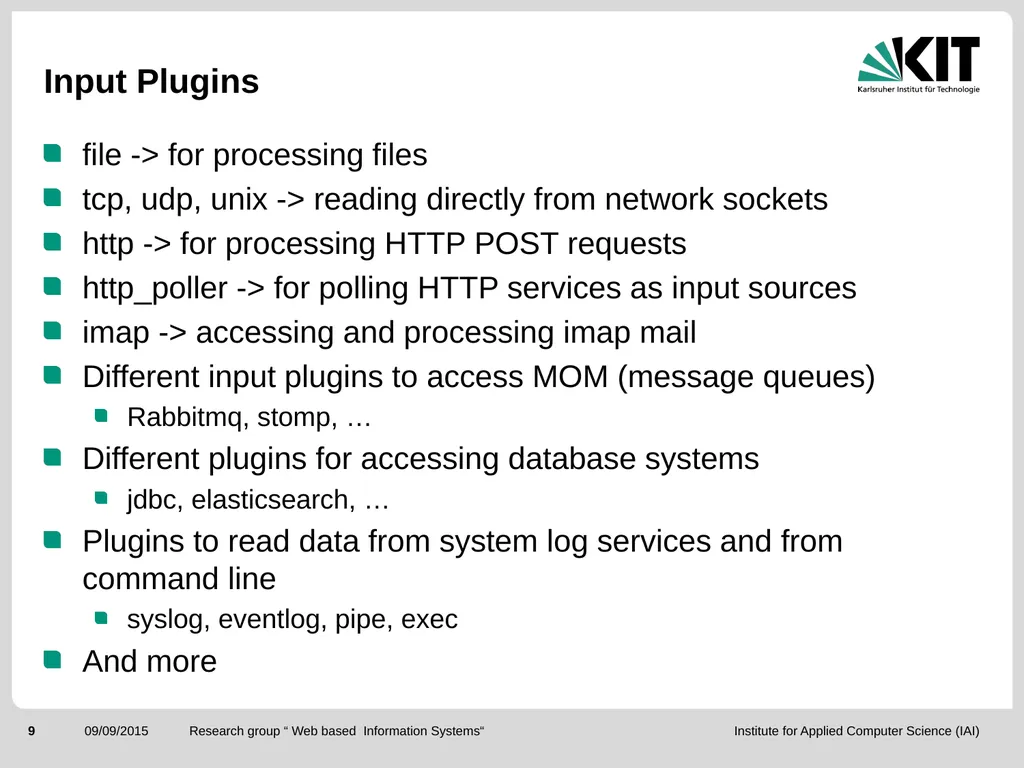
Input Plugins file -> for processing files
tcp, udp, unix -> reading directly from network sockets
http -> for processing HTTP POST requests
http_poller -> for polling HTTP services as input sources
imap -> accessing and processing imap mail
Different input plugins to access MOM (message queues)
Rabbitmq, stomp, …
Different plugins for accessing database systems
jdbc, elasticsearch, …
Plugins to read data from system log services and from command line
syslog, eventlog, pipe, exec
And more Research group “ Web based Information Systems“<br>
10
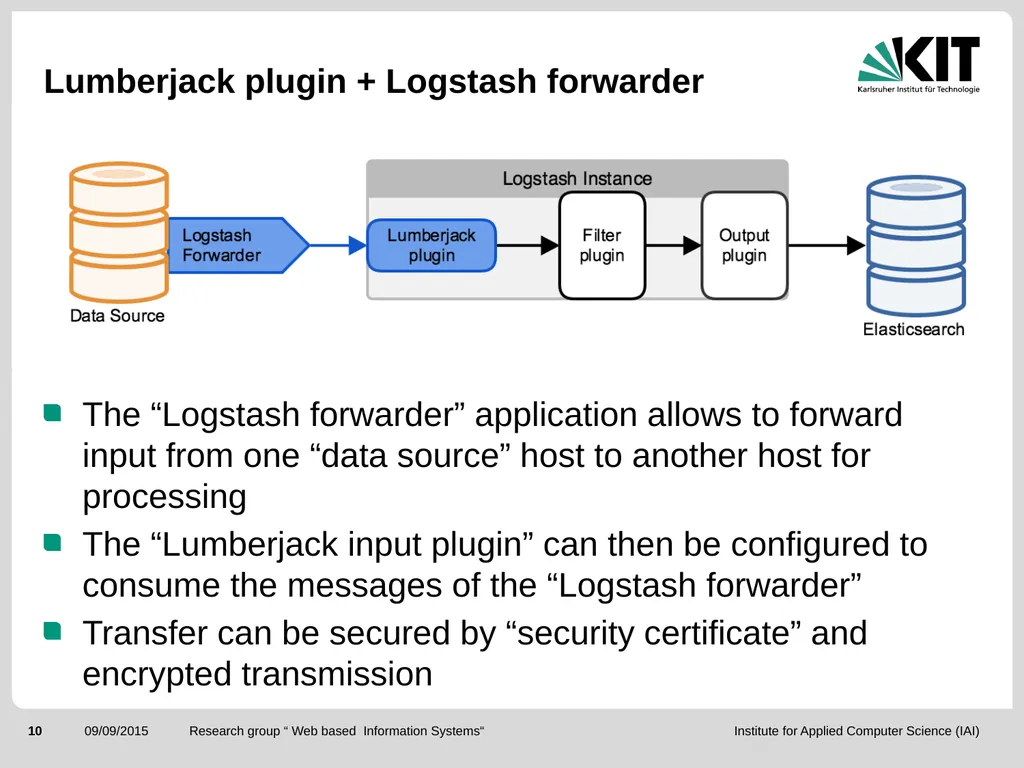
Lumberjack plugin + Logstash forwarder The “Logstash forwarder” application allows to forward input from one “data source” host to another host for processing
The “Lumberjack input plugin” can then be configured to consume the messages of the “Logstash forwarder”
Transfer can be secured by “security certificate” and encrypted transmission Research group “ Web based Information Systems“<br>
The “Lumberjack input plugin” can then be configured to consume the messages of the “Logstash forwarder”
Transfer can be secured by “security certificate” and encrypted transmission Research group “ Web based Information Systems“<br>
11
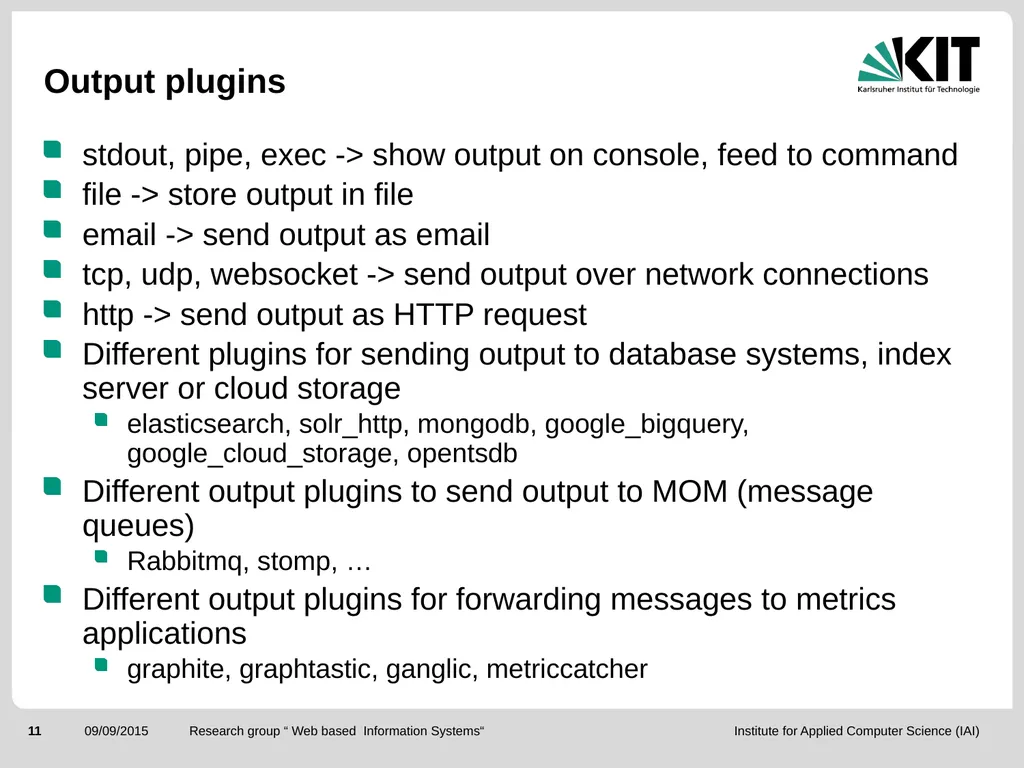
Output plugins stdout, pipe, exec -> show output on console, feed to command
file -> store output in file
email -> send output as email
tcp, udp, websocket -> send output over network connections
http -> send output as HTTP request
Different plugins for sending output to database systems, index server or cloud storage
elasticsearch, solr_http, mongodb, google_bigquery, google_cloud_storage, opentsdb
Different output plugins to send output to MOM (message queues)
Rabbitmq, stomp, …
Different output plugins for forwarding messages to metrics applications
graphite, graphtastic, ganglic, metriccatcher Research group “ Web based Information Systems“<br>
12
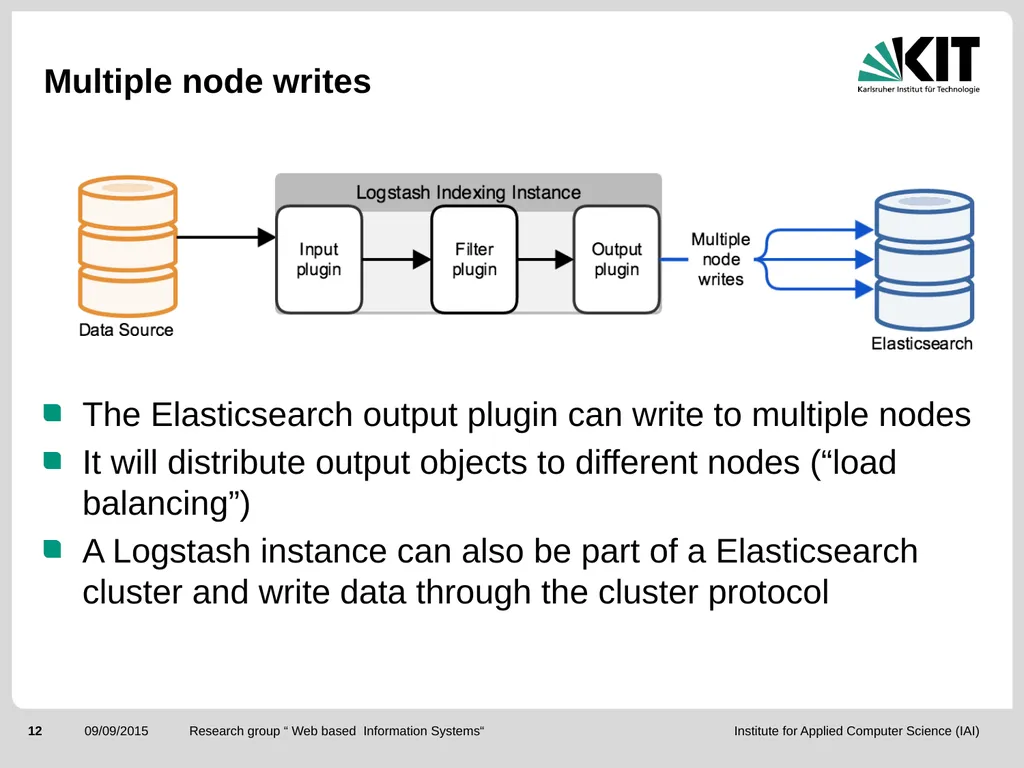
Multiple node writes The Elasticsearch output plugin can write to multiple nodes
It will distribute output objects to different nodes (“load balancing”)
A Logstash instance can also be part of a Elasticsearch cluster and write data through the cluster protocol Research group “ Web based Information Systems“<br>
It will distribute output objects to different nodes (“load balancing”)
A Logstash instance can also be part of a Elasticsearch cluster and write data through the cluster protocol Research group “ Web based Information Systems“<br>
13
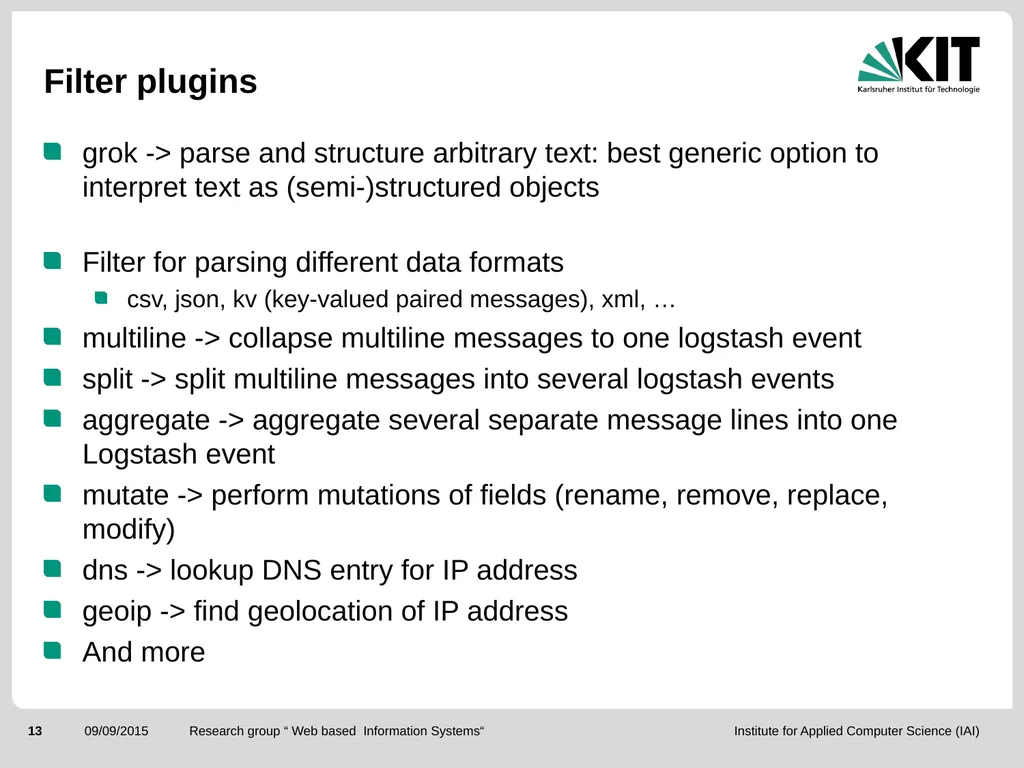
Filter plugins grok -> parse and structure arbitrary text: best generic option to interpret text as (semi-)structured objects
Filter for parsing different data formats
csv, json, kv (key-valued paired messages), xml, …
multiline -> collapse multiline messages to one logstash event
split -> split multiline messages into several logstash events
aggregate -> aggregate several separate message lines into one Logstash event
mutate -> perform mutations of fields (rename, remove, replace, modify)
dns -> lookup DNS entry for IP address
geoip -> find geolocation of IP address
And more Research group “ Web based Information Systems“<br>
14
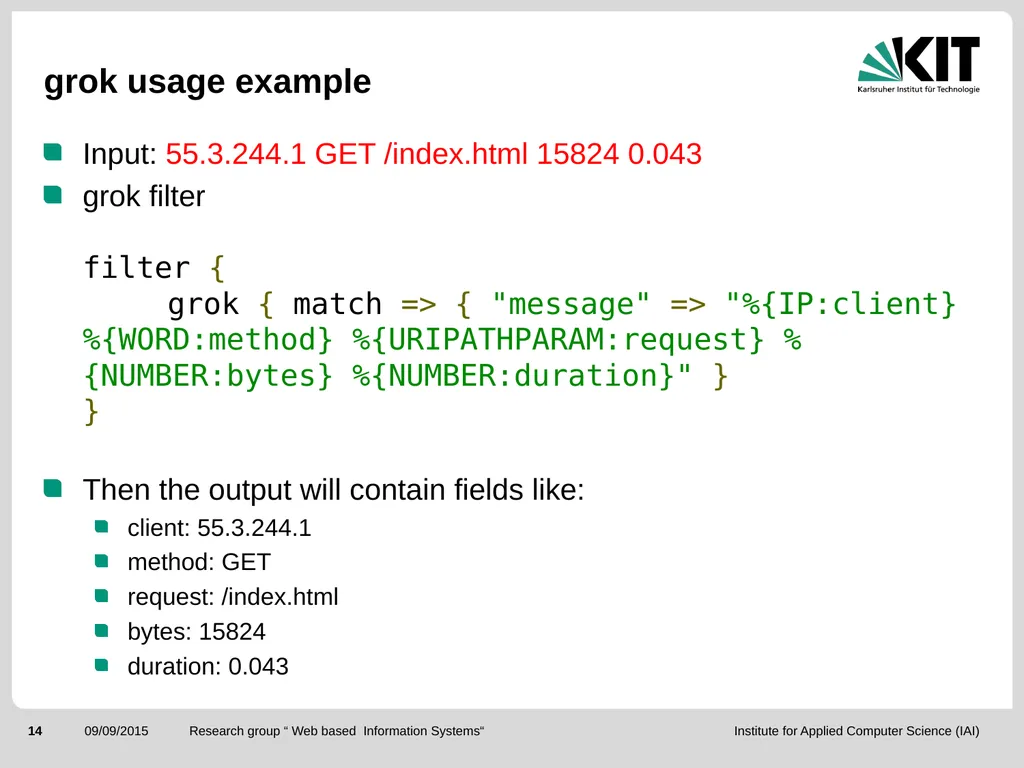
grok usage example Input: 55.3.244.1 GET /index.html 15824 0.043
grok filter filter { grok { match => { "message" => "%{IP:client} %{WORD:method} %{URIPATHPARAM:request} %{NUMBER:bytes} %{NUMBER:duration}" } }
Then the output will contain fields like:
client: 55.3.244.1
method: GET
request: /index.html
bytes: 15824
duration: 0.043 Research group “ Web based Information Systems“<br>
15
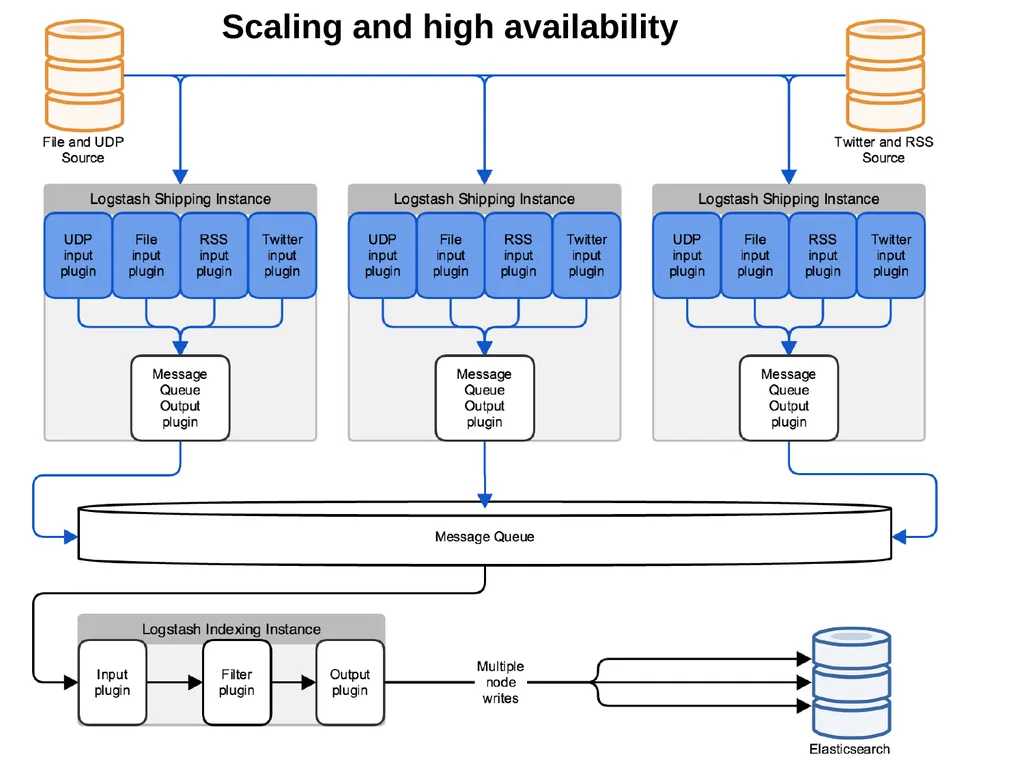
Scaling and high availability<br>
16
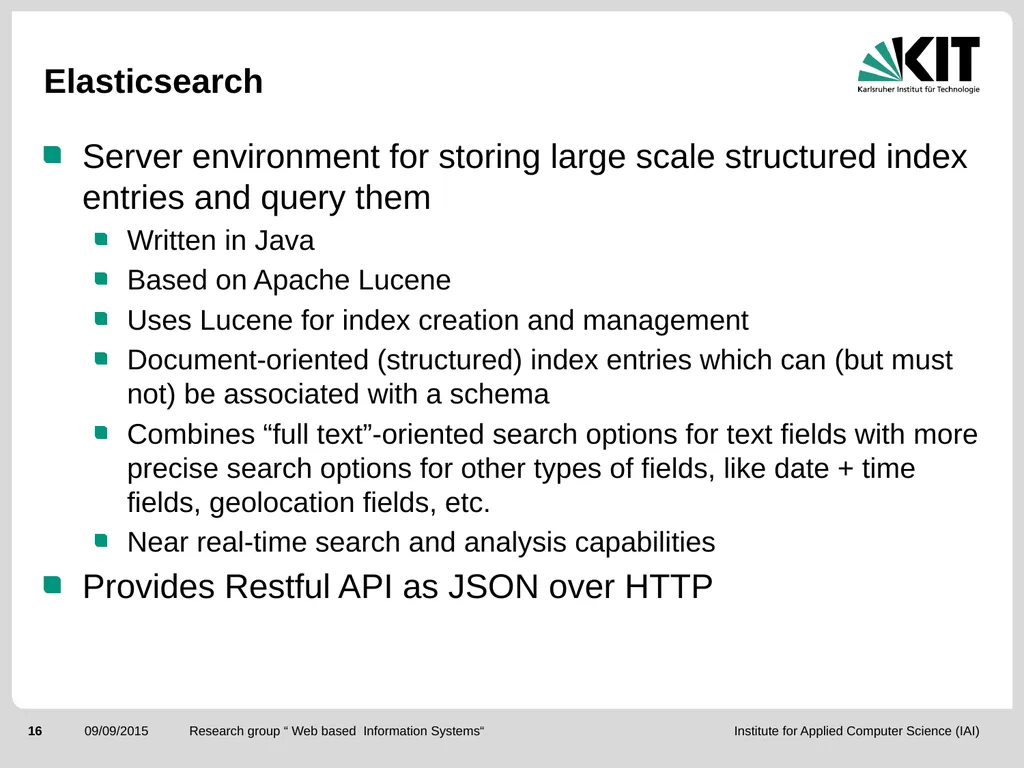
Elasticsearch Server environment for storing large scale structured index entries and query them
Written in Java
Based on Apache Lucene
Uses Lucene for index creation and management
Document-oriented (structured) index entries which can (but must not) be associated with a schema
Combines “full text”-oriented search options for text fields with more precise search options for other types of fields, like date + time fields, geolocation fields, etc.
Near real-time search and analysis capabilities
Provides Restful API as JSON over HTTP Research group “ Web based Information Systems“<br>
17
Scalability of Elasticsearch Elasticsearch can run as one integrated application on multiple nodes of a cluster
Indexes are stored in Lucene instances called “Shards” which can be distributed over several nodes
There a two types of “Shards”
Primary Shards
Replica
Replicas of “Primary Shards” provide
Failure tolerance and therefore protect data
Make queries (search faster) faster Research group “ Web based Information Systems“<br>
18
Indexing data with Elasticsearch Send JSON documents to server, e.g. use REST API
No schema necessary => ElasticSearch determines type of attributes
But’s possible to explicitly specify schema, i.e. types for attributes
Like string, byte, short, integer, long, float, double, boolean, date
Analysis of text attributes for “full text”-oriented search
Word extraction, reduction of words to their base form (stemming)
Stop words
Support for multiple languages
Automatically generate identifier for data sets or specify them while indexing Research group “ Web based Information Systems“<br>
19
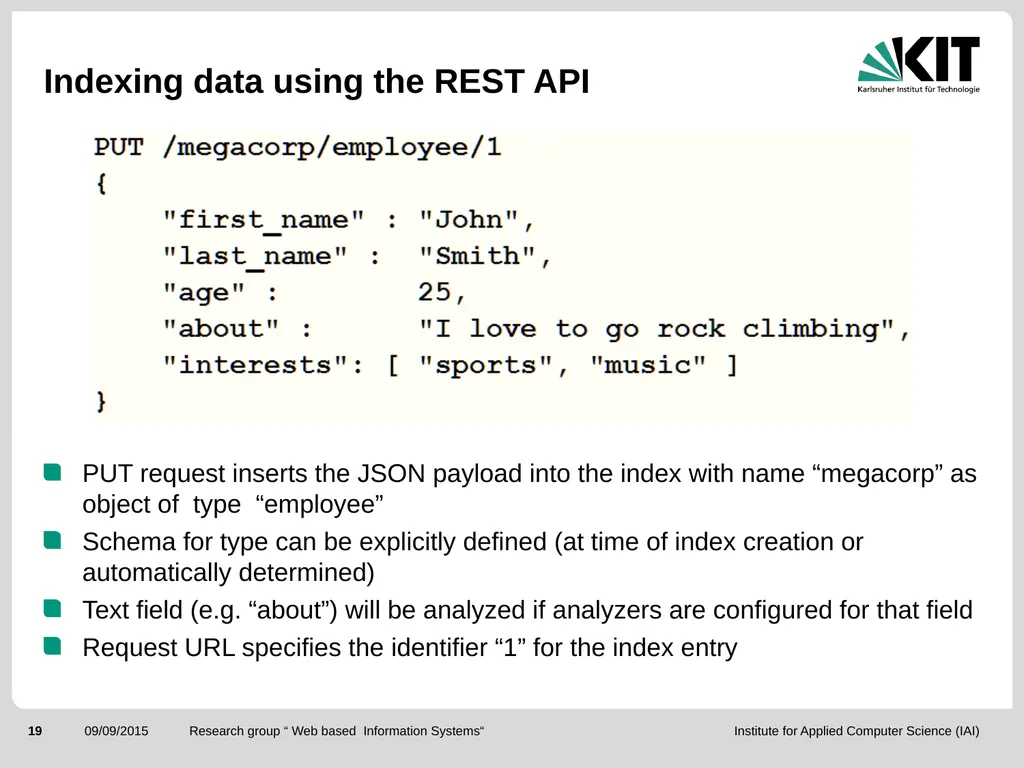
Indexing data using the REST API PUT request inserts the JSON payload into the index with name “megacorp” as object of type “employee”
Schema for type can be explicitly defined (at time of index creation or automatically determined)
Text field (e.g. “about”) will be analyzed if analyzers are configured for that field
Request URL specifies the identifier “1” for the index entry Research group “ Web based Information Systems“<br>
Schema for type can be explicitly defined (at time of index creation or automatically determined)
Text field (e.g. “about”) will be analyzed if analyzers are configured for that field
Request URL specifies the identifier “1” for the index entry Research group “ Web based Information Systems“<br>
20
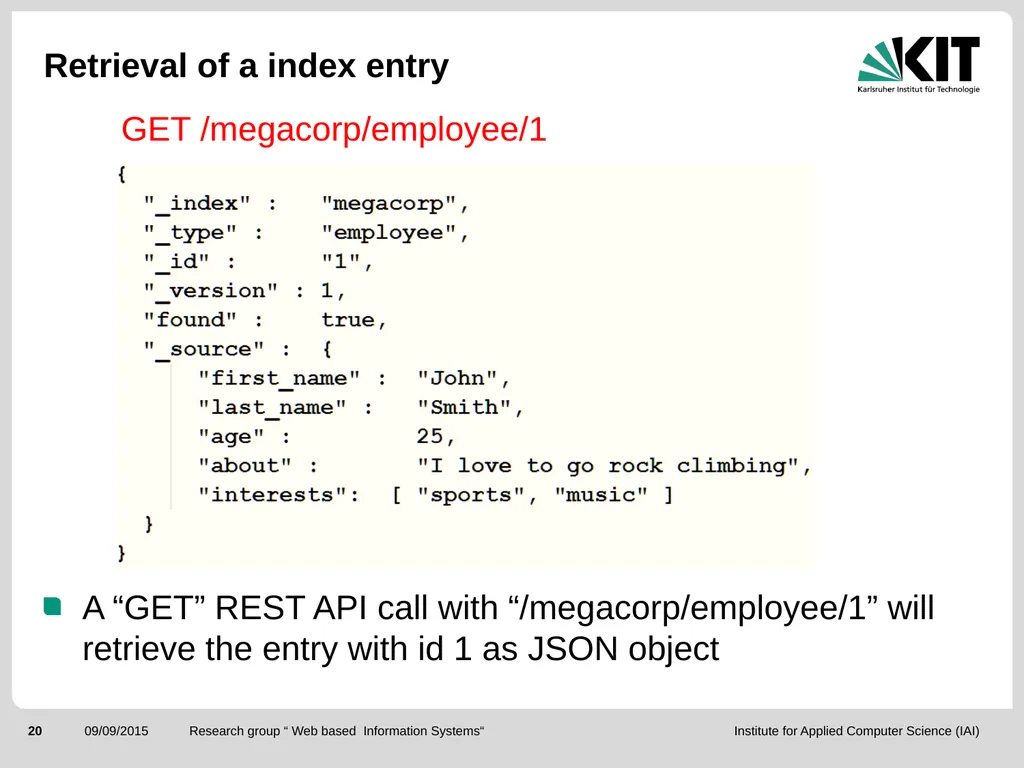
Retrieval of a index entry A “GET” REST API call with “/megacorp/employee/1” will retrieve the entry with id 1 as JSON object Research group “ Web based Information Systems“ GET /megacorp/employee/1<br>
21
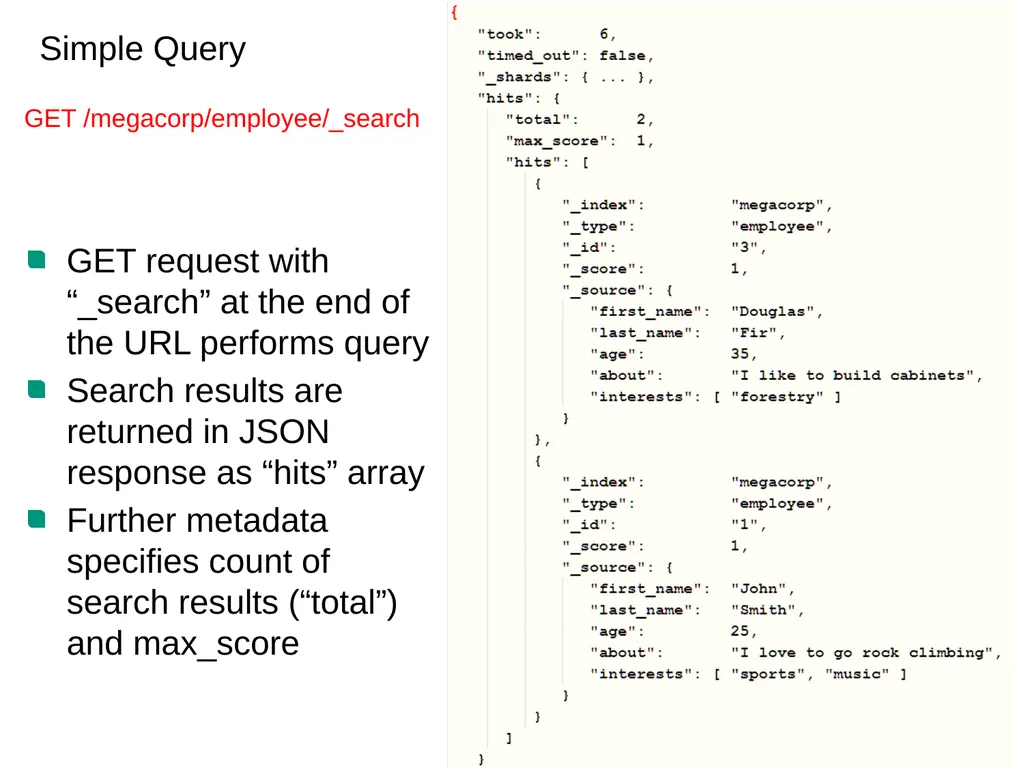
GET request with “_search” at the end of the URL performs query
Search results are returned in JSON response as “hits” array
Further metadata specifies count of search results (“total”) and max_score Simple Query GET /megacorp/employee/_search<br>
Search results are returned in JSON response as “hits” array
Further metadata specifies count of search results (“total”) and max_score Simple Query GET /megacorp/employee/_search<br>
22
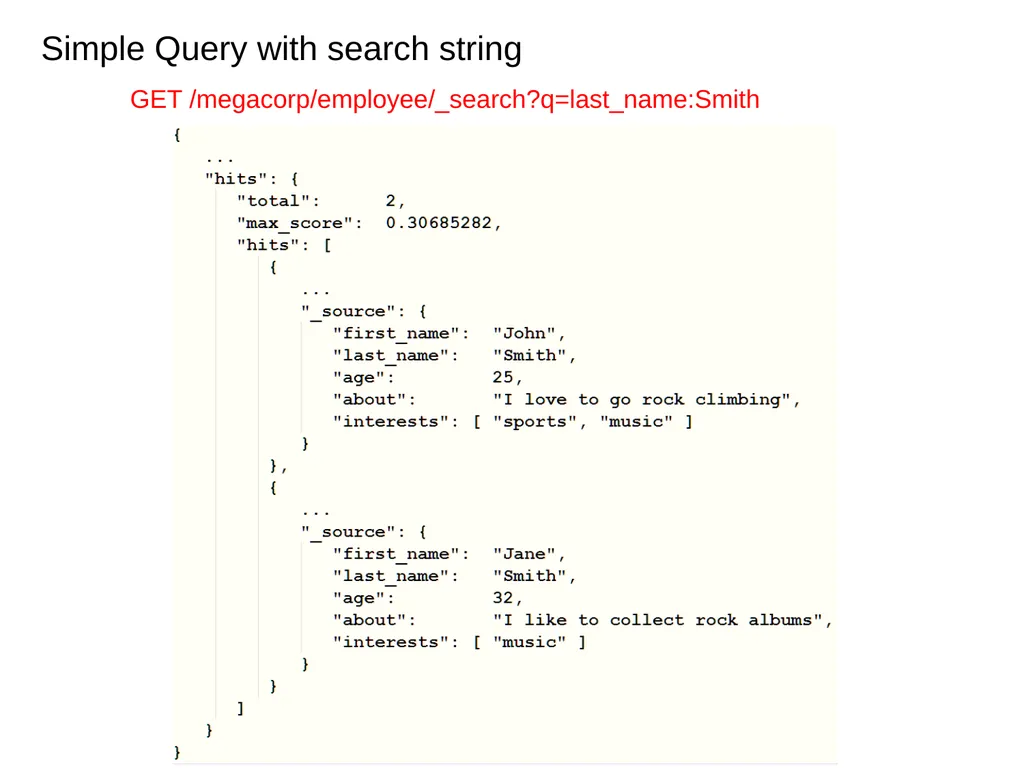
Simple Query with search string GET /megacorp/employee/_search?q=last_name:Smith<br>
23
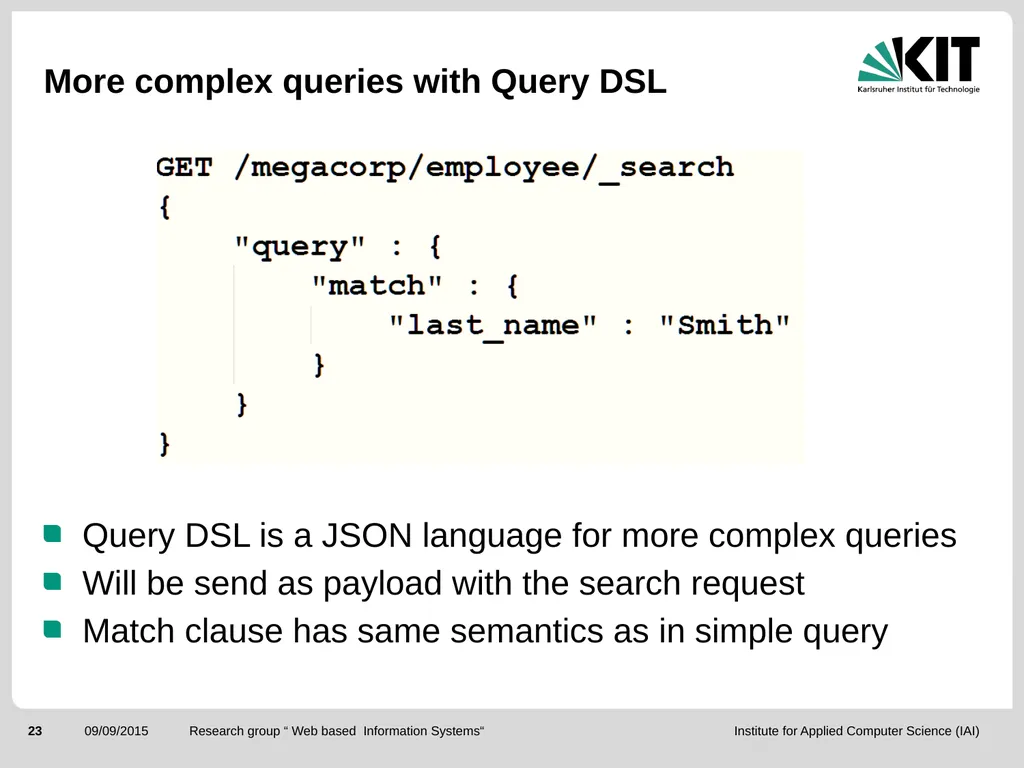
More complex queries with Query DSL Query DSL is a JSON language for more complex queries
Will be send as payload with the search request
Match clause has same semantics as in simple query Research group “ Web based Information Systems“<br>
Will be send as payload with the search request
Match clause has same semantics as in simple query Research group “ Web based Information Systems“<br>
24
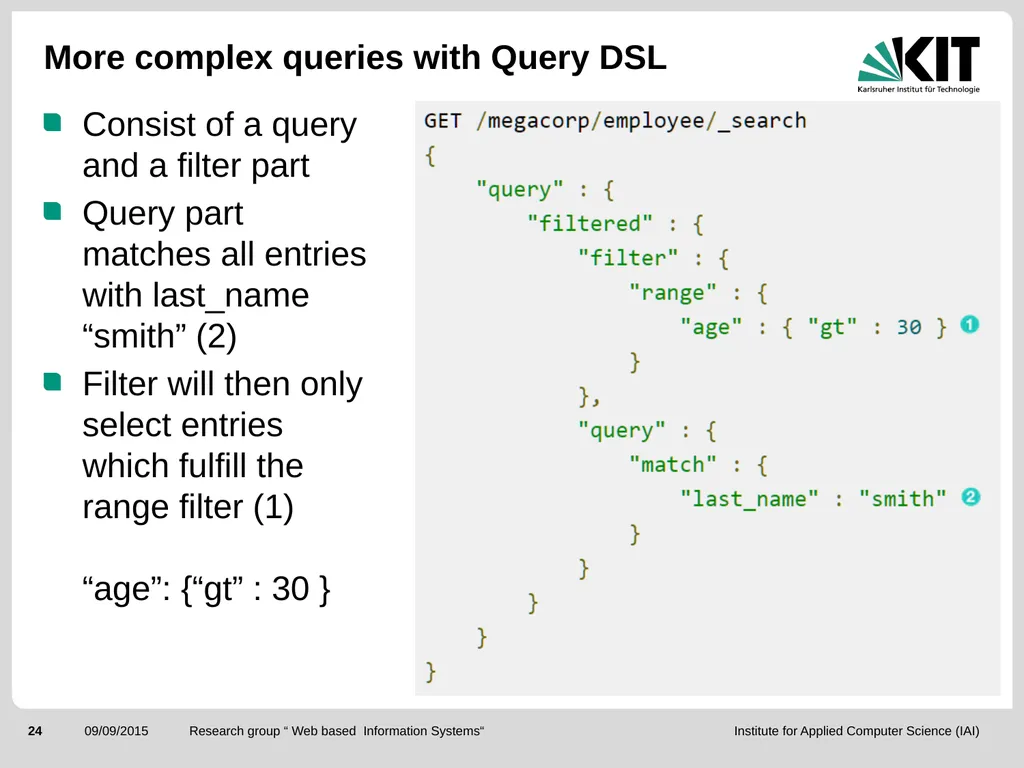
More complex queries with Query DSL Consist of a query and a filter part
Query part matches all entries with last_name “smith” (2)
Filter will then only select entries which fulfill the range filter (1) “age”: {“gt” : 30 } Research group “ Web based Information Systems“<br>
Query part matches all entries with last_name “smith” (2)
Filter will then only select entries which fulfill the range filter (1) “age”: {“gt” : 30 } Research group “ Web based Information Systems“<br>
25
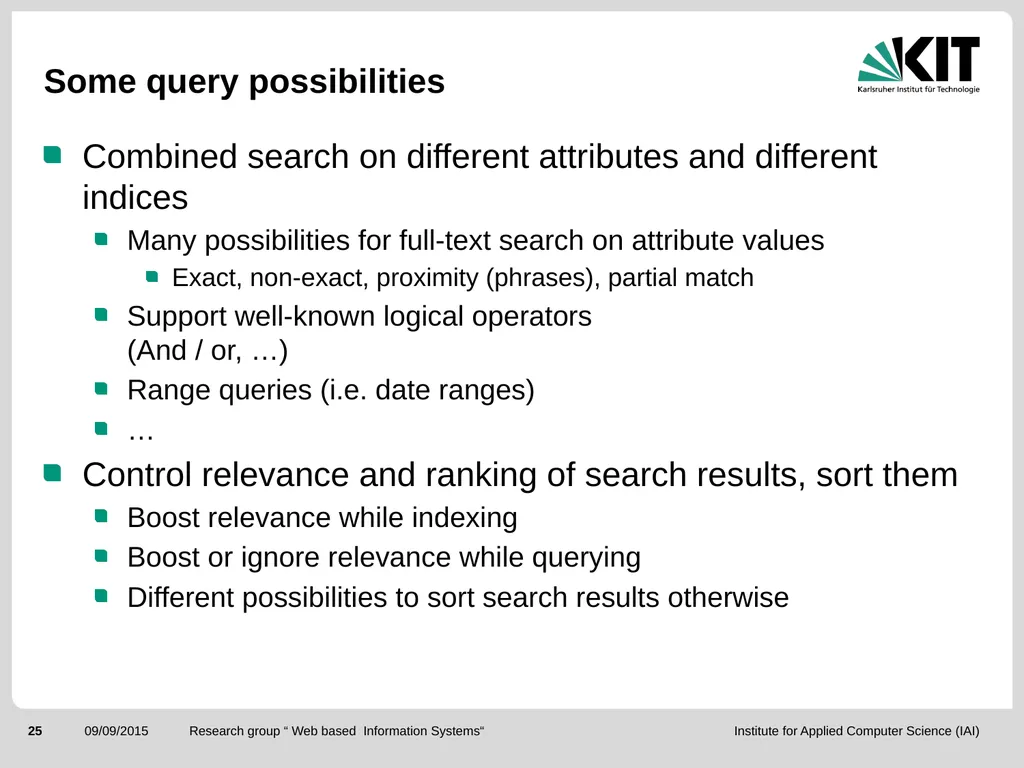
Some query possibilities Combined search on different attributes and different indices
Many possibilities for full-text search on attribute values
Exact, non-exact, proximity (phrases), partial match
Support well-known logical operators (And / or, …)
Range queries (i.e. date ranges)
…
Control relevance and ranking of search results, sort them
Boost relevance while indexing
Boost or ignore relevance while querying
Different possibilities to sort search results otherwise Research group “ Web based Information Systems“<br>
26
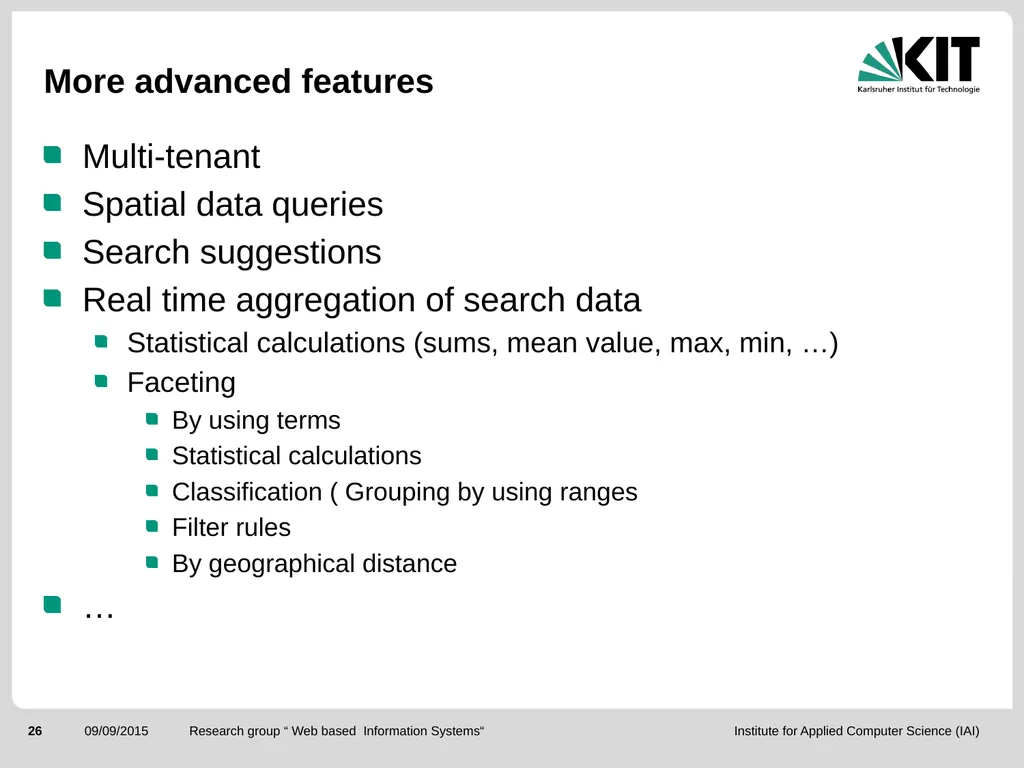
More advanced features Multi-tenant
Spatial data queries
Search suggestions
Real time aggregation of search data
Statistical calculations (sums, mean value, max, min, …)
Faceting
By using terms
Statistical calculations
Classification ( Grouping by using ranges
Filter rules
By geographical distance
… Research group “ Web based Information Systems“<br>
27
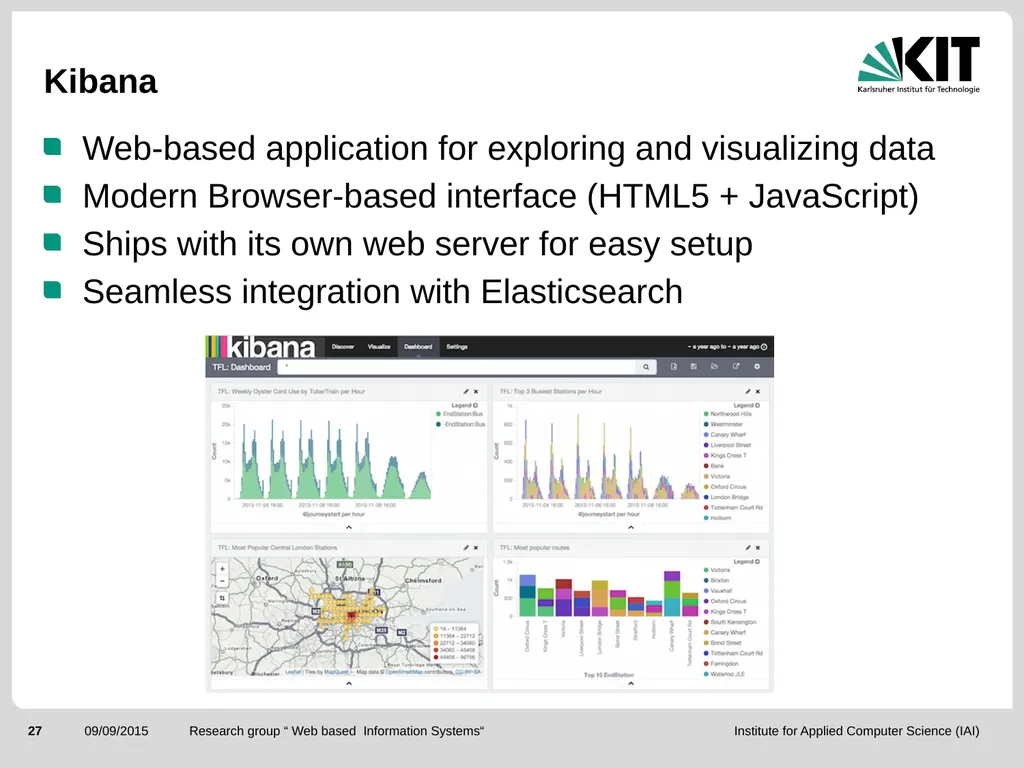
Kibana Web-based application for exploring and visualizing data
Modern Browser-based interface (HTML5 + JavaScript)
Ships with its own web server for easy setup
Seamless integration with Elasticsearch Research group “ Web based Information Systems“<br>
Modern Browser-based interface (HTML5 + JavaScript)
Ships with its own web server for easy setup
Seamless integration with Elasticsearch Research group “ Web based Information Systems“<br>
28
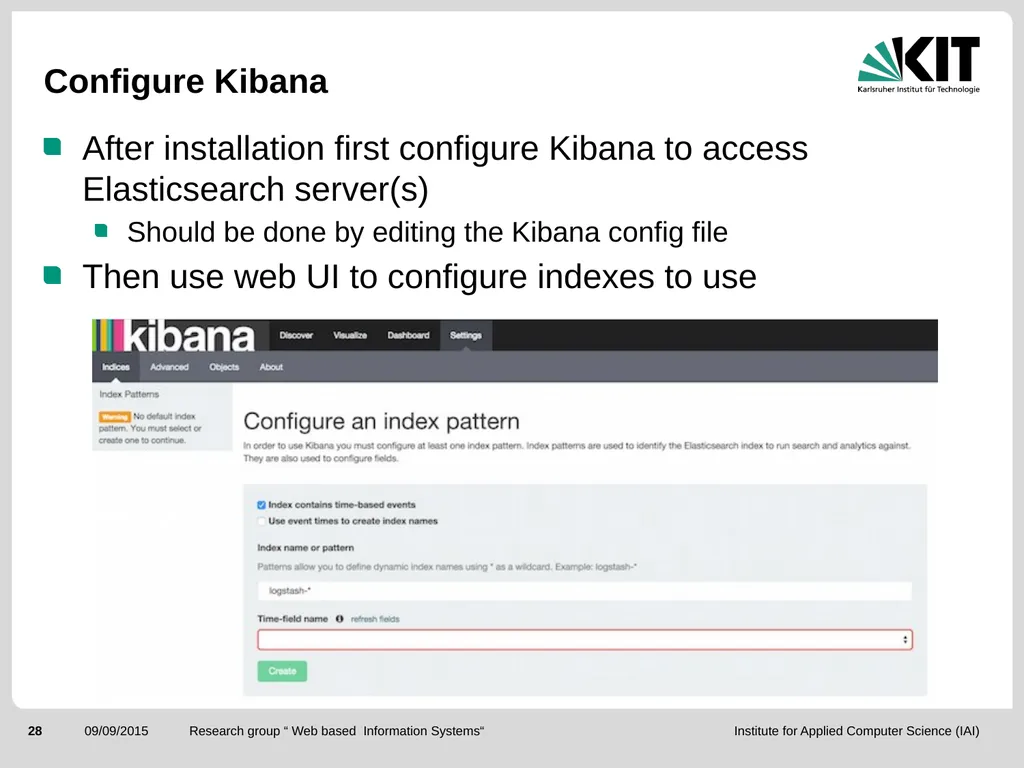
Configure Kibana After installation first configure Kibana to access Elasticsearch server(s)
Should be done by editing the Kibana config file
Then use web UI to configure indexes to use Research group “ Web based Information Systems“<br>
Should be done by editing the Kibana config file
Then use web UI to configure indexes to use Research group “ Web based Information Systems“<br>
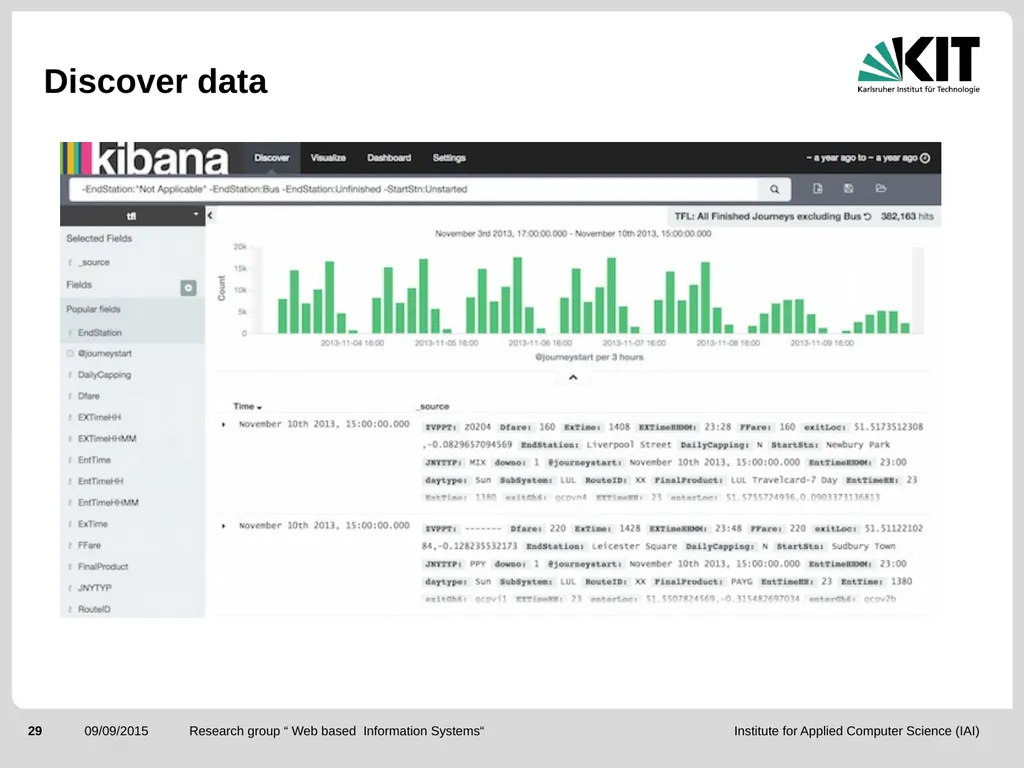
29
Discover data Research group “ Web based Information Systems“<br>
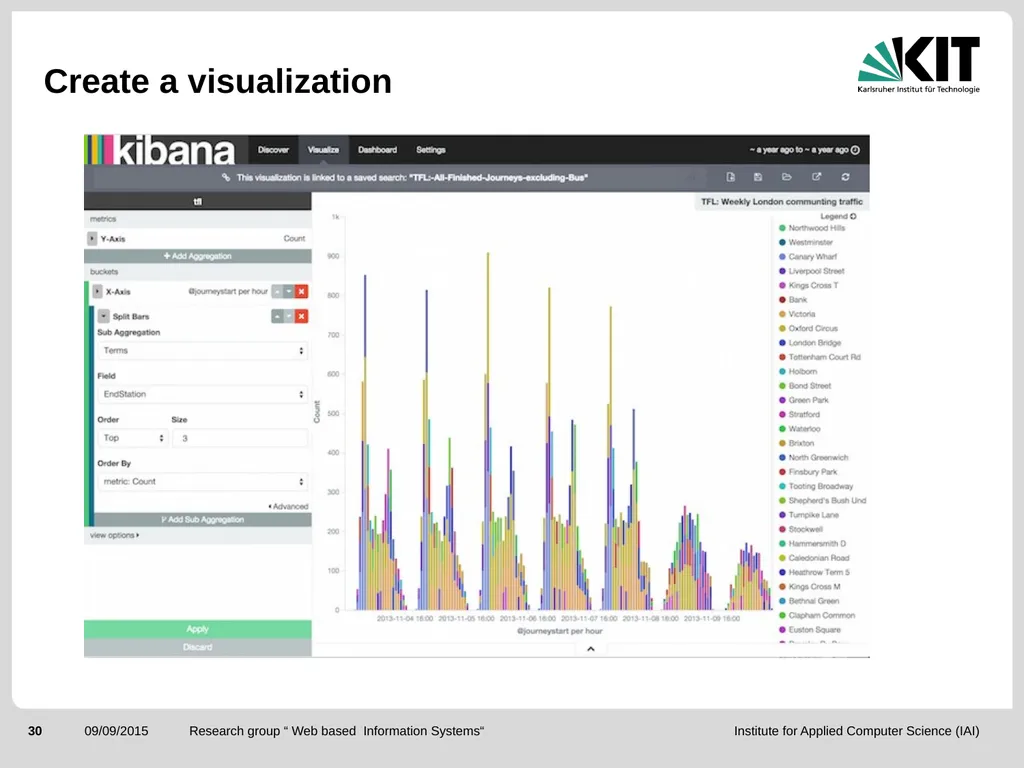
30
Create a visualization Research group “ Web based Information Systems“<br>
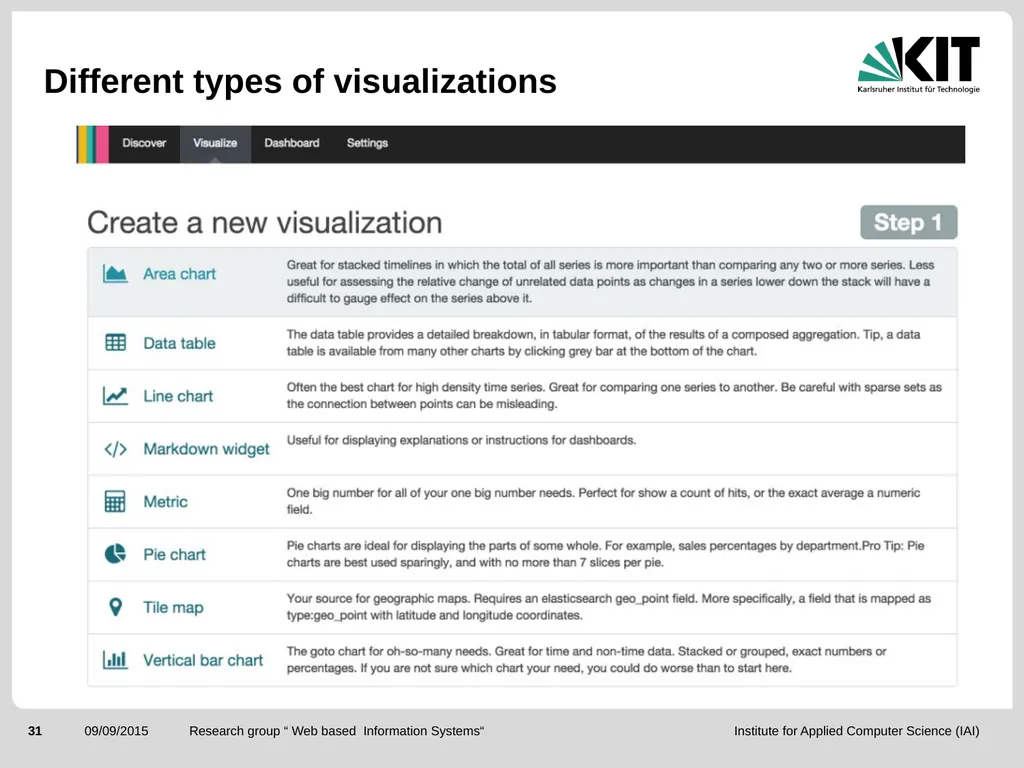
31
Different types of visualizations Research group “ Web based Information Systems“<br>
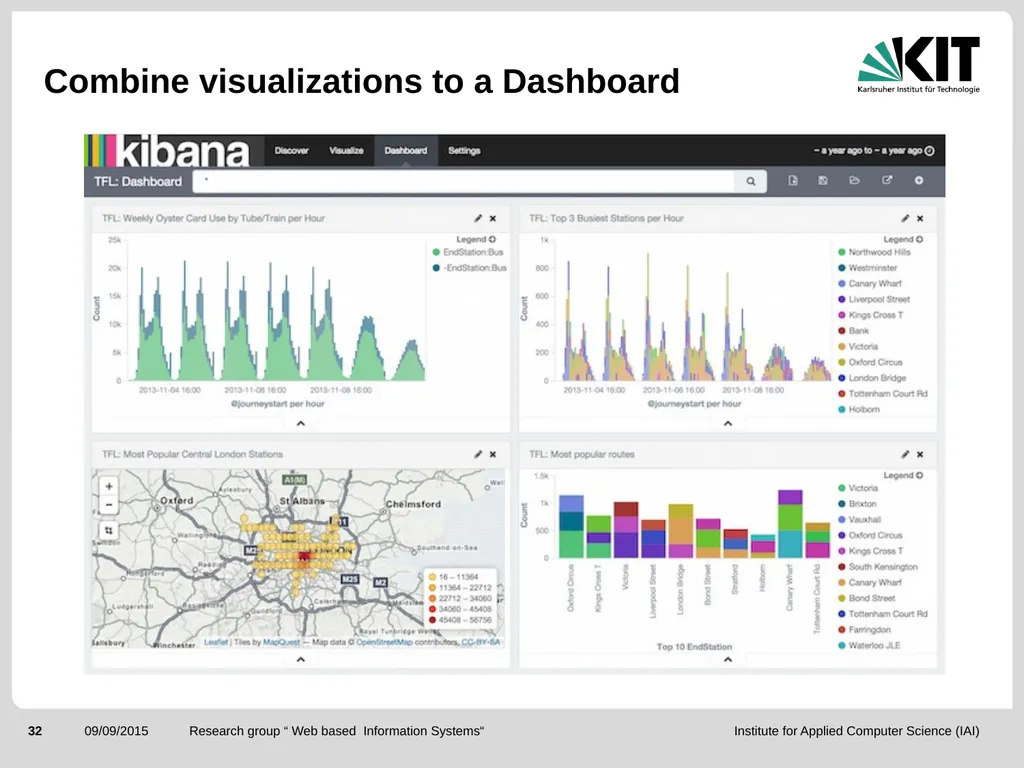
32
Combine visualizations to a Dashboard Research group “ Web based Information Systems“<br>
33
Use CASEs Research group “ Web based Information Systems“<br>
34
Some use cases of the ELK stack Log data management and analysis
Monitor systems and / or applications and notify operators about critical events
Collect and analyze other (mass) data
i.e. business data for business analytics
Energy management data or event data from smart grids
Environmental data
Use the ELK stack for search driven access to mass data in web based information systems Research group “ Web based Information Systems“<br>
35
Log data management and analysis Many different types of logs
Application logs
Operating system logs
Network traffic logs from routers, etc.
Different goals for analysis
Detect errors at runtime or while testing applications
Find and analyze security threats
Aggregate statistical data / metrics Research group “ Web based Information Systems“<br>
Application logs
Operating system logs
Network traffic logs from routers, etc.
Different goals for analysis
Detect errors at runtime or while testing applications
Find and analyze security threats
Aggregate statistical data / metrics Research group “ Web based Information Systems“<br>
36
Problems of log data analysis No centralization
Log data could be everywhere
on different servers and different places within the same server
Accessibility Problems
Logs can be difficult to find
Access to server / device is often difficult for analyst
High expertise for accessing logs on different platforms necessary
Logs can be big and therefore difficult to copy
SSH access and grep on logs doesn’t scale or reach
No Consistency
Structure of log entries is different for each app, system, or device
Specific knowledge is necessary for interpreting different log types
Variation in formats makes it challenging to search
Many different types of time formats Research group “ Web based Information Systems“<br>
37
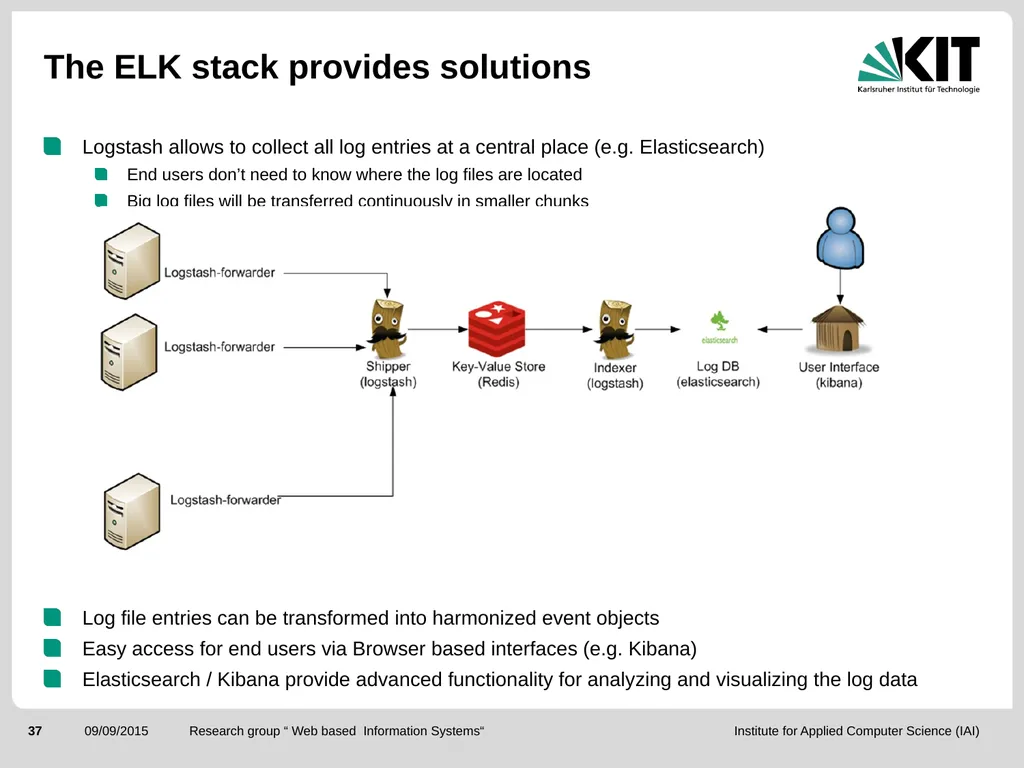
The ELK stack provides solutions Logstash allows to collect all log entries at a central place (e.g. Elasticsearch)
End users don’t need to know where the log files are located
Big log files will be transferred continuously in smaller chunks
Log file entries can be transformed into harmonized event objects
Easy access for end users via Browser based interfaces (e.g. Kibana)
Elasticsearch / Kibana provide advanced functionality for analyzing and visualizing the log data Research group “ Web based Information Systems“<br>
38
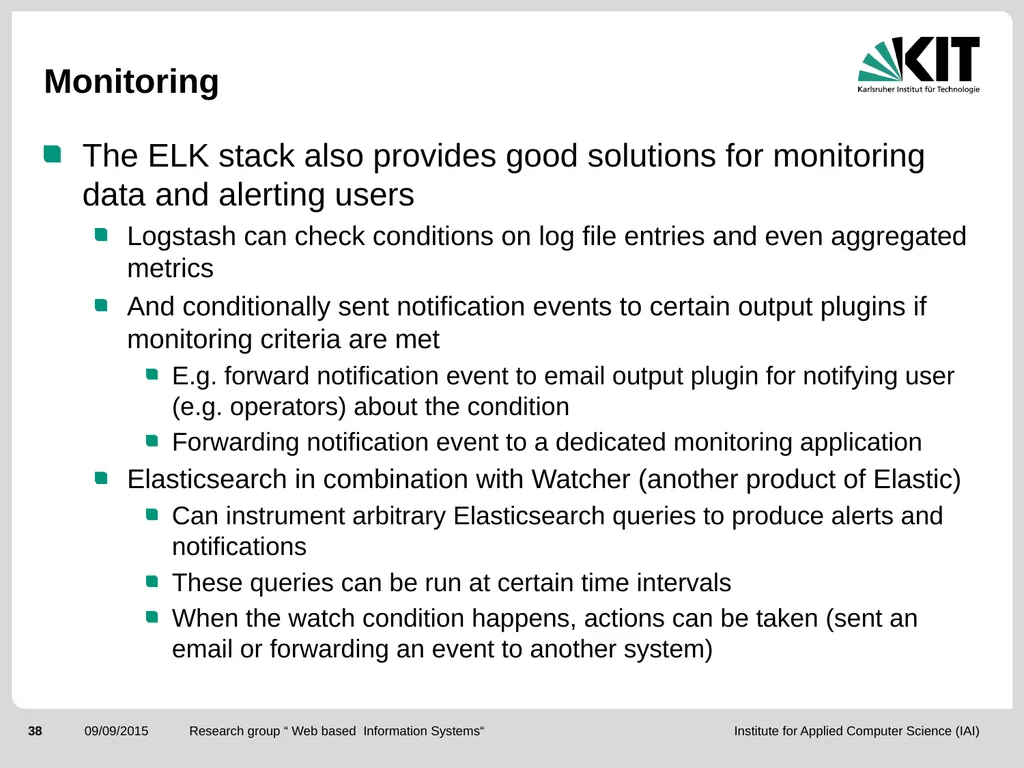
Monitoring The ELK stack also provides good solutions for monitoring data and alerting users
Logstash can check conditions on log file entries and even aggregated metrics
And conditionally sent notification events to certain output plugins if monitoring criteria are met
E.g. forward notification event to email output plugin for notifying user (e.g. operators) about the condition
Forwarding notification event to a dedicated monitoring application
Elasticsearch in combination with Watcher (another product of Elastic)
Can instrument arbitrary Elasticsearch queries to produce alerts and notifications
These queries can be run at certain time intervals
When the watch condition happens, actions can be taken (sent an email or forwarding an event to another system) Research group “ Web based Information Systems“<br>
39
Log analysis examples from the Internet Logging and analyzing network traffic http://www.networkassassin.com/elk-stack-for-network-operations-reloaded/
How to Use ELK to Monitor Performance http://logz.io/blog/elk-monitor-platform-performance/
How Blueliv Uses the Elastic Stack to Combat Cyber Threats https://www.elastic.co/blog/how-blueliv-uses-the-elastic-stack-to-combat-cyber-threats
Centralized System and Docker Logging with ELK Stack http://www.javacodegeeks.com/2015/05/centralized-system-and-docker-logging-with-elk-stack.html Research group “ Web based Information Systems“<br>
40
Summary The ELK stack is easy to use and has many use cases
Log data management and analysis
Monitor systems and / or applications and notify operators about critical events
Collect and analyze other (mass) data
Providing access to big data in large scale web applications
Thereby solving many problems with these types of use cases compared to “hand-made”-solutions
Because of its service orientation and cluster readiness it fits nicely into bigger service (microservice) oriented applications Research group “ Web based Information Systems“<br>
41
Backup Slides Research group “ Web based Information Systems“<br>
42
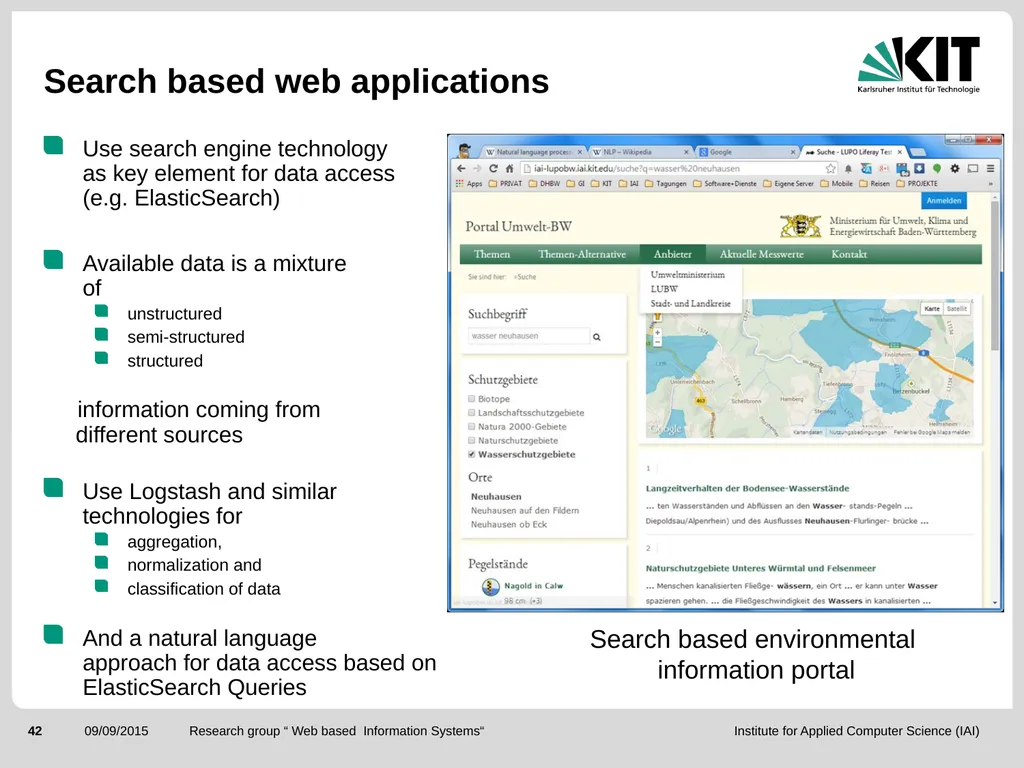
Search based web applications Use search engine technology
as key element for data access
(e.g. ElasticSearch)
Available data is a mixture of
unstructured
semi-structured
structured
information coming from different sources
Use Logstash and similar technologies for
aggregation,
normalization and
classification of data
And a natural language approach for data access based on ElasticSearch Queries Research group “ Web based Information Systems“ Search based environmental information portal<br>
43
The openTA portal: www.openta.net DfG project with partners
(IAI, ITAS, KIT library)
from KIT
Web portal for the Network Technology Assessment (NTA)
Aggregates and provides information about
members, organizations
news and events
scientific publications
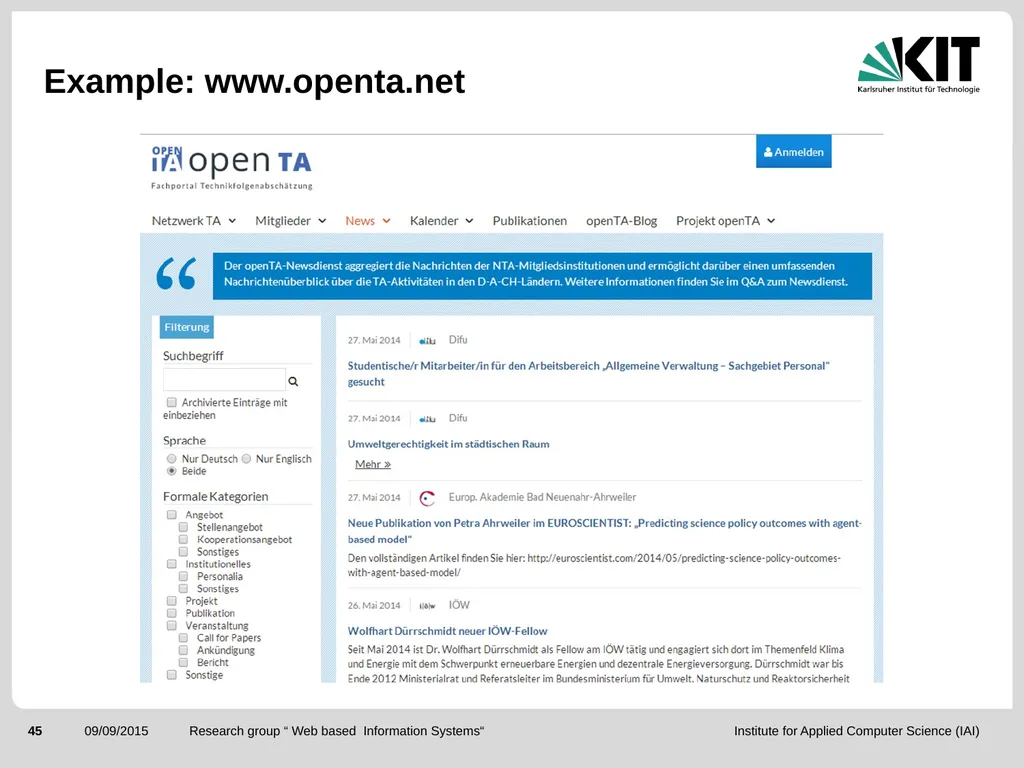
Provides services and web technology (widgets) to use the aggregated information remotely Research group “ Web based Information Systems“ Homepage of openTA with aggregated news feed and calendar<br>
44
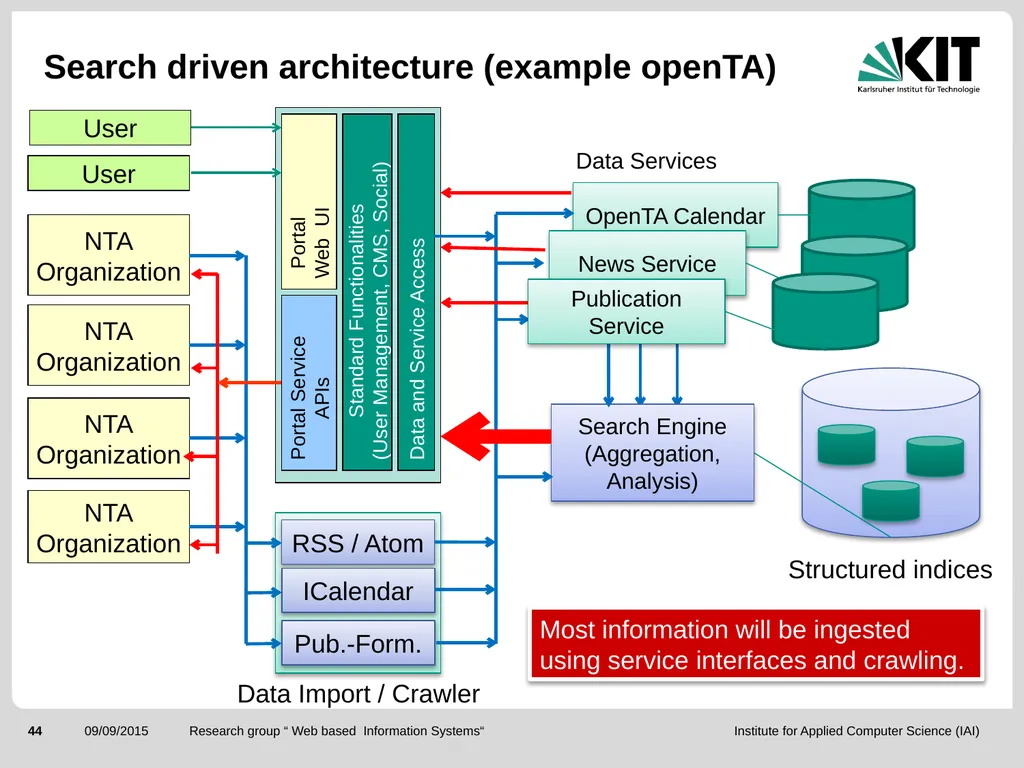
Search driven architecture (example openTA) Research group “ Web based Information Systems“ Search Engine
(Aggregation,
Analysis) Structured indices OpenTA Calendar News Service Data Services NTA
Organization NTA
Organization NTA
Organization NTA
Organization User User Most information will be ingested
using service interfaces and crawling. Data Import / Crawler Publication Service<br>
45
Example: www.openta.net Research group “ Web based Information Systems“<br>
46
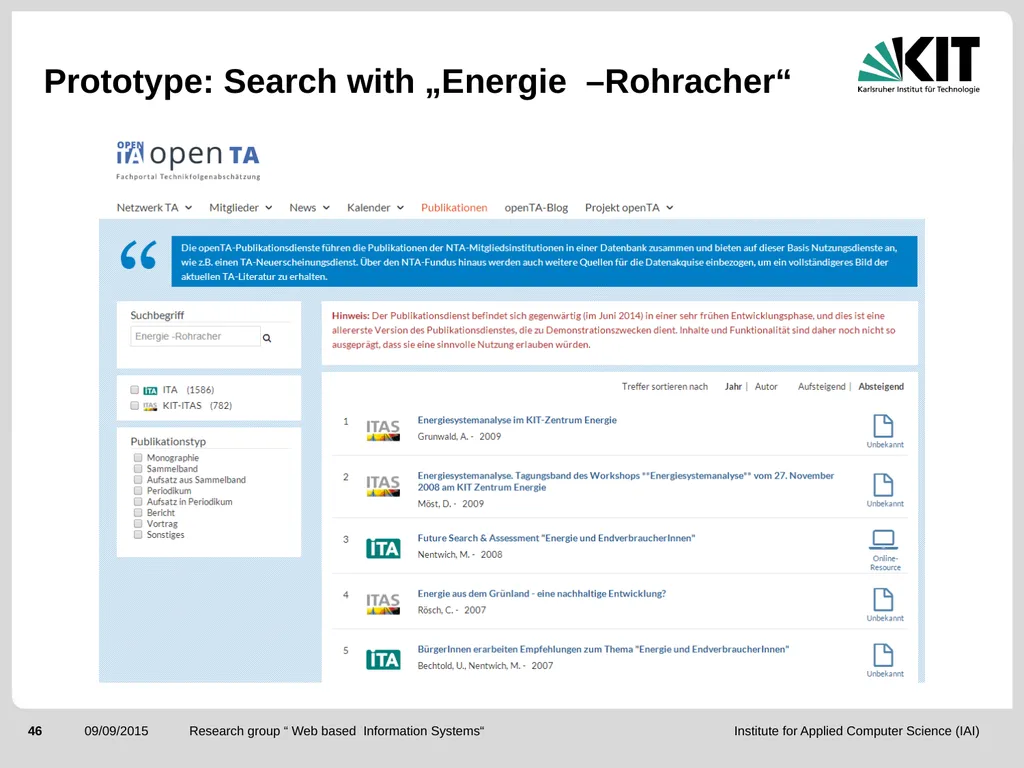
Prototype: Search with „Energie –Rohracher“ Research group “ Web based Information Systems“<br>