
Emancipation of Serfs, 1861 Definition of Serf: A
JO
Published · 11 slides · 0 views

1 / 1


Description
Emancipation of Serfs, 1861 Definition of Serf: A serf is an indentured peasant worker. (bound by a contract to work for landowners without pay to pay off a debt). Serfs in the middle ages: In Europe, early evidence of serfdom can be found
Related Topics
Share
Embed code
Download this presentation From Below
"Emancipation of Serfs, 1861 Definition of Serf: A" is the property of its rightful owner. Permission is granted to download and print the materials on this website for personal, non-commercial use only, and to display it on your personal computer provided you do not modify the materials and that you retain all copyright notices contained in the materials. By downloading content from our website, you accept the terms of this agreement.
Presentation Transcript
01
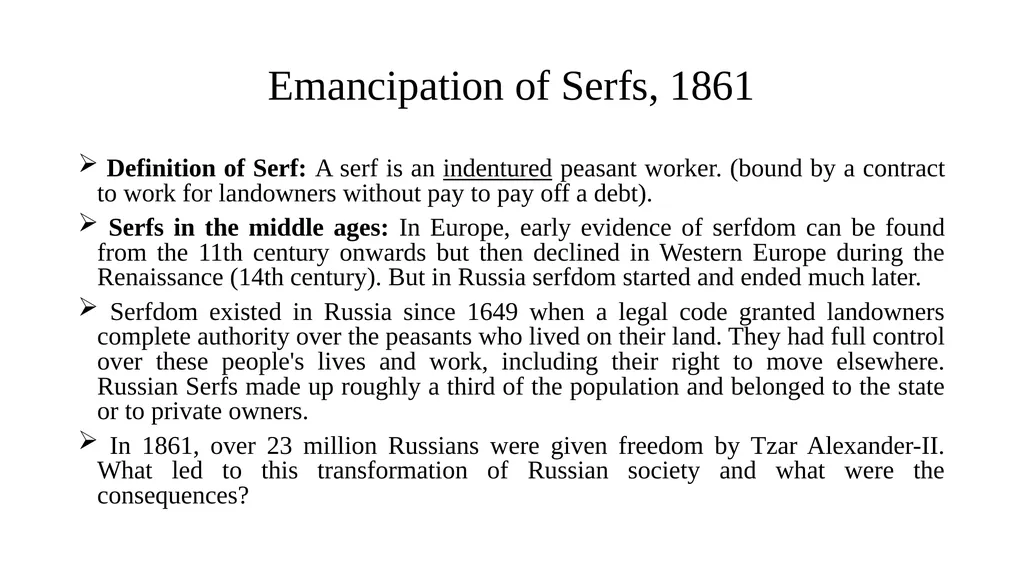
Emancipation of Serfs, 1861 Definition of Serf: A serf is an indentured peasant worker. (bound by a contract to work for landowners without pay to pay off a debt).
Serfs in the middle ages: In Europe, early evidence of serfdom can be found from the 11th century onwards but then declined in Western Europe during the Renaissance (14th century). But in Russia serfdom started and ended much later.
Serfdom existed in Russia since 1649 when a legal code granted landowners complete authority over the peasants who lived on their land. They had full control over these people's lives and work, including their right to move elsewhere. Russian Serfs made up roughly a third of the population and belonged to the state or to private owners.
In 1861, over 23 million Russians were given freedom by Tzar Alexander-II. What led to this transformation of Russian society and what were the consequences?<br>
02
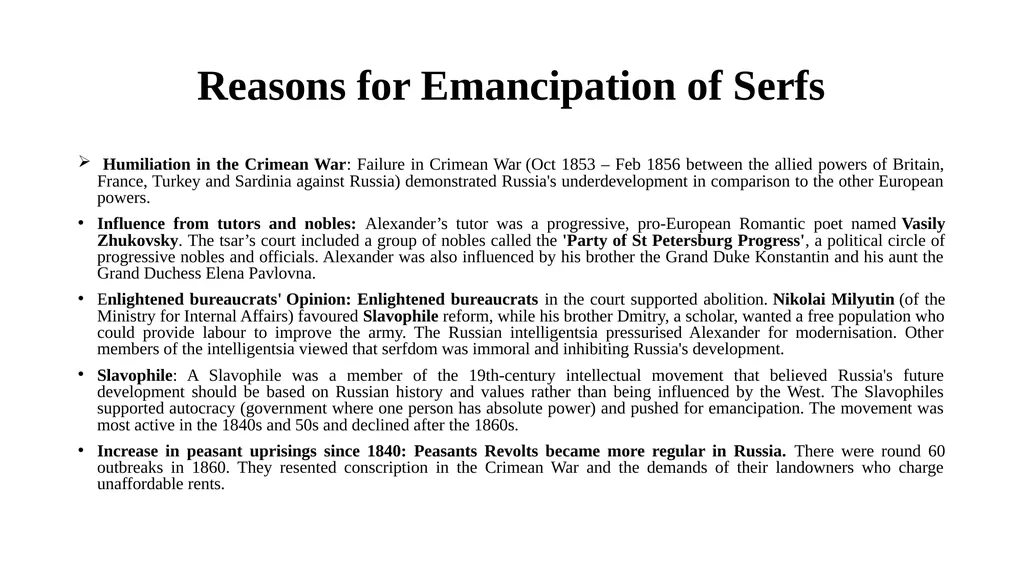
Reasons for Emancipation of Serfs Humiliation in the Crimean War: Failure in Crimean War (Oct 1853 – Feb 1856 between the allied powers of Britain, France, Turkey and Sardinia against Russia) demonstrated Russia's underdevelopment in comparison to the other European powers.
Influence from tutors and nobles: Alexander’s tutor was a progressive, pro-European Romantic poet named Vasily Zhukovsky. The tsar’s court included a group of nobles called the 'Party of St Petersburg Progress', a political circle of progressive nobles and officials. Alexander was also influenced by his brother the Grand Duke Konstantin and his aunt the Grand Duchess Elena Pavlovna.
Enlightened bureaucrats' Opinion: Enlightened bureaucrats in the court supported abolition. Nikolai Milyutin (of the Ministry for Internal Affairs) favoured Slavophile reform, while his brother Dmitry, a scholar, wanted a free population who could provide labour to improve the army. The Russian intelligentsia pressurised Alexander for modernisation. Other members of the intelligentsia viewed that serfdom was immoral and inhibiting Russia's development.
Slavophile: A Slavophile was a member of the 19th-century intellectual movement that believed Russia's future development should be based on Russian history and values rather than being influenced by the West. The Slavophiles supported autocracy (government where one person has absolute power) and pushed for emancipation. The movement was most active in the 1840s and 50s and declined after the 1860s.
Increase in peasant uprisings since 1840: Peasants Revolts became more regular in Russia. There were round 60 outbreaks in 1860. They resented conscription in the Crimean War and the demands of their landowners who charge unaffordable rents.<br>
03
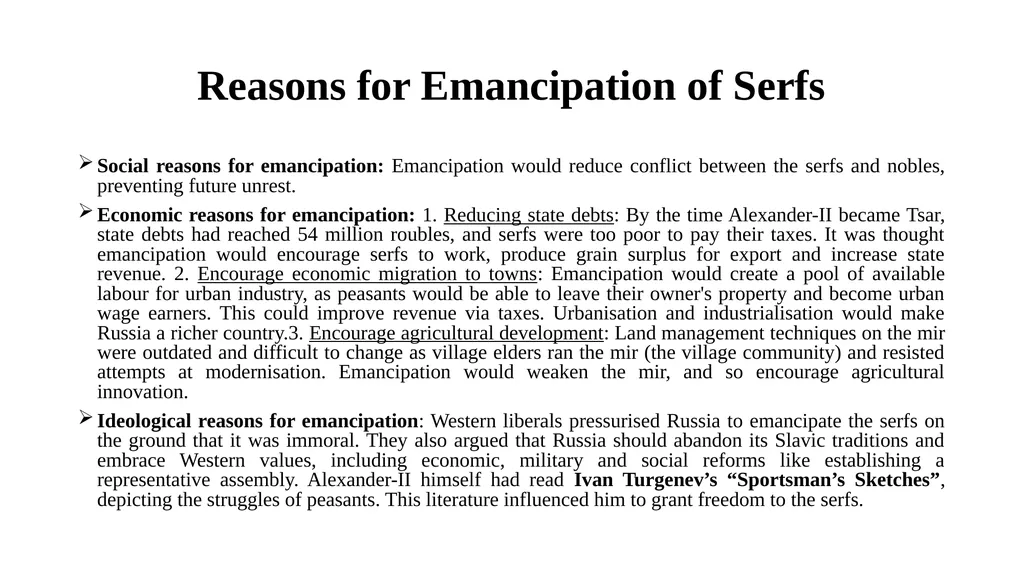
Reasons for Emancipation of Serfs Social reasons for emancipation: Emancipation would reduce conflict between the serfs and nobles, preventing future unrest.
Economic reasons for emancipation: 1. Reducing state debts: By the time Alexander-II became Tsar, state debts had reached 54 million roubles, and serfs were too poor to pay their taxes. It was thought emancipation would encourage serfs to work, produce grain surplus for export and increase state revenue. 2. Encourage economic migration to towns: Emancipation would create a pool of available labour for urban industry, as peasants would be able to leave their owner's property and become urban wage earners. This could improve revenue via taxes. Urbanisation and industrialisation would make Russia a richer country.3. Encourage agricultural development: Land management techniques on the mir were outdated and difficult to change as village elders ran the mir (the village community) and resisted attempts at modernisation. Emancipation would weaken the mir, and so encourage agricultural innovation.
Ideological reasons for emancipation: Western liberals pressurised Russia to emancipate the serfs on the ground that it was immoral. They also argued that Russia should abandon its Slavic traditions and embrace Western values, including economic, military and social reforms like establishing a representative assembly. Alexander-II himself had read Ivan Turgenev’s “Sportsman’s Sketches”, depicting the struggles of peasants. This literature influenced him to grant freedom to the serfs.<br>
04
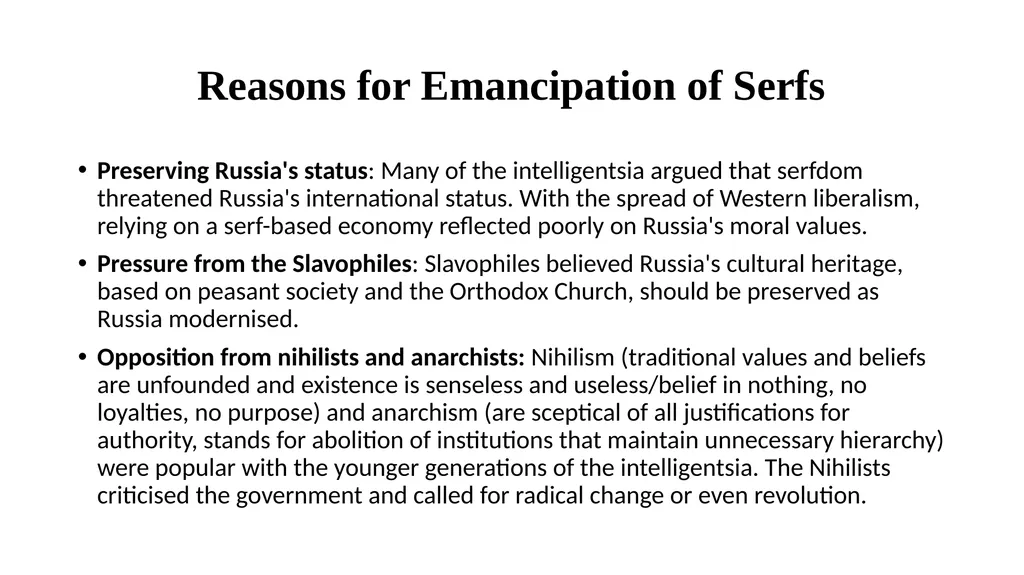
Reasons for Emancipation of Serfs Preserving Russia's status: Many of the intelligentsia argued that serfdom threatened Russia's international status. With the spread of Western liberalism, relying on a serf-based economy reflected poorly on Russia's moral values.
Pressure from the Slavophiles: Slavophiles believed Russia's cultural heritage, based on peasant society and the Orthodox Church, should be preserved as Russia modernised.
Opposition from nihilists and anarchists: Nihilism (traditional values and beliefs are unfounded and existence is senseless and useless/belief in nothing, no loyalties, no purpose) and anarchism (are sceptical of all justifications for authority, stands for abolition of institutions that maintain unnecessary hierarchy) were popular with the younger generations of the intelligentsia. The Nihilists criticised the government and called for radical change or even revolution.<br>
05
Who were emancipated The Emancipation applied to:
Private-owned serfs
State-owned serfs<br>
Private-owned serfs
State-owned serfs<br>
06
The Emancipation Edict Serfs were granted freedom and land allotment
Open fields were granted to the mirs, landowners kept woodland, meadows, pasture, and a personal holding
Landowners were given government bonds as compensation
Freed serfs had to pay 'redemption payments' to the government for 49-years
Freed serfs could not leave the mir until the redemption payments were fully paid
The mirs were responsible for distributing serfs' land allotments, controlling farming, and collecting and paying the peasants' taxes
Volosts (administrative area made up of 200-3000 peasants) were established to supervise the mirs. They were run by representatives from their respective mirs.
From 1863, volosts ran their own courts under management from government officials and a noble 'peace officer'. This replaced the landlords' jurisdiction over serfs.<br>
07
Positive & Negative Impacts of Emancipation Positive Peasants were freed.
Wealthy peasants (kulaks) profited, buought land and exporting surplus grain.
Some peasants’ standard of living improved after migration and becoming urban workers.
Some landowners paid off their debts using their compensation.
Some landowners profited by investing in industrial enterprises. Negative In theory, serfs had a 2-yrs of 'temporary obligation' while land allocation was worked out. In practice, around 15% of serfs were still 'temporarily obligated' to their landlords by 1881. Peasants’ rights were often theoretical.
Land allocations were unfair-some too small to adopt new farming methods
Land holdings became smaller as population grew- they had to be divided among all male peasants.
The new agricultural system was traditional and inefficient- dominated by the mir.
Redemption payments and travel restrictions made rural life hard. Land prices often above market value-serfs in debt. Some worked for their old masters for survival.
Disagreements over money and land led to outbreaks of violence.
Some landowners struggled to make a living without the use of open fields.
Landowners resented their loss of influence, with protests and riots in St Petersburg, Moscow, and Kazan.<br>
08
Different opinion regarding Emancipation Historical interpretations of the Emancipation of the Serfs: As discussed in the articles, ‘Social developments 1861-95’ and ‘Economic developments 1860-95’, historians have different interpretations of the impact of emancipation. There are two main interpretations of the Emancipation:
1) It was a product of Alexander's liberal ideas: To many historians, the Emancipation was a humanitarian project led by Alexander out of benevolence. He challenged convention and set Russia on the path to reform.
2) It was an attempt to improve social and political stability: Some writers say that the Emancipation was a state-directed attempt to maintain tsarist authority, which ultimately backfired. Alexander's reforms produced short and long-term political and social problems. The Emancipation led many to believe that reform was impossible inside an autocratic system.<br>
09
Different opinion regarding Emancipation 1) Emancipation was a turning point for Russia: In ‘The Industrialisation of Russia 1700-1914’, the historian Malcolm Falkus argues that emancipation ‘removed a considerable barrier to industrial growth’. He suggests that serfdom restricted the domestic market, prevented labour mobility, stifled agricultural innovation, and most significantly encouraged attitudes that were harmful towards modernisation. On Falkus’ account, emancipation led peasants to market more crops and supply industrial labour.
2) Russian society and economy were not significantly changed by the emancipation: The historian Christopher Read offers a different view in his book ‘From Tsar to Soviets’, arguing that the attitudes and institutions of serfdom survived emancipation. He claims that Russia ‘remained essentially a serf owners’ state’, with peasants inefficient and hostile towards their masters, and a continuing reliance on the police and army to govern peasants.<br>
2) Russian society and economy were not significantly changed by the emancipation: The historian Christopher Read offers a different view in his book ‘From Tsar to Soviets’, arguing that the attitudes and institutions of serfdom survived emancipation. He claims that Russia ‘remained essentially a serf owners’ state’, with peasants inefficient and hostile towards their masters, and a continuing reliance on the police and army to govern peasants.<br>
10
nbff hhgftfd<br>
11
nhgf nhgfd<br>