
English Dept. / College of Education for
SN
Published · 13 slides · 0 views

1 / 1
Description
English Dept. College of Education for Humanities Basrah University Iraq Course: Translation: 4th Year: 2019-2020 1 ST SEMESTER Textbook: Translation as Problems Solutions: A course book for University Students Trainee
Related Topics
Share
Embed code
Download this presentation From Below
"English Dept. / College of Education for" is the property of its rightful owner. Permission is granted to download and print the materials on this website for personal, non-commercial use only, and to display it on your personal computer provided you do not modify the materials and that you retain all copyright notices contained in the materials. By downloading content from our website, you accept the terms of this agreement.
Presentation Transcript
01
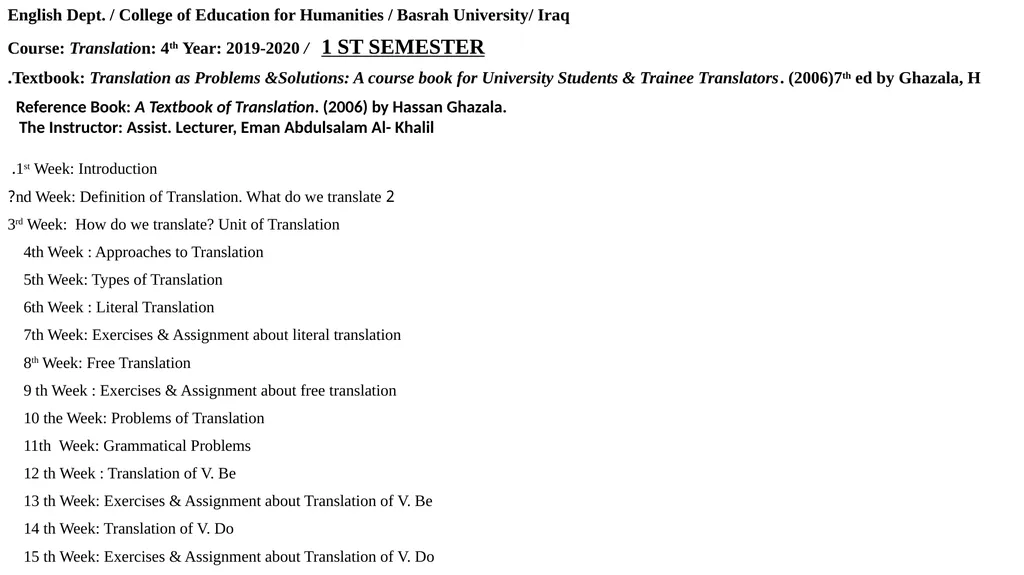
English Dept. / College of Education for Humanities / Basrah University/ Iraq
Course: Translation: 4th Year: 2019-2020 / 1 ST SEMESTER
Textbook: Translation as Problems &Solutions: A course book for University Students & Trainee Translators. (2006)7th ed by Ghazala, H.
Reference Book: A Textbook of Translation. (2006) by Hassan Ghazala.
The Instructor: Assist. Lecturer, Eman Abdulsalam Al- Khalil
1st Week: Introduction.
2 nd Week: Definition of Translation. What do we translate?
3rd Week: How do we translate? Unit of Translation
4th Week : Approaches to Translation
5th Week: Types of Translation
6th Week : Literal Translation
7th Week: Exercises & Assignment about literal translation
8th Week: Free Translation
9 th Week : Exercises & Assignment about free translation
10 the Week: Problems of Translation
11th Week: Grammatical Problems
12 th Week : Translation of V. Be
13 th Week: Exercises & Assignment about Translation of V. Be
14 th Week: Translation of V. Do
15 th Week: Exercises & Assignment about Translation of V. Do<br>
02
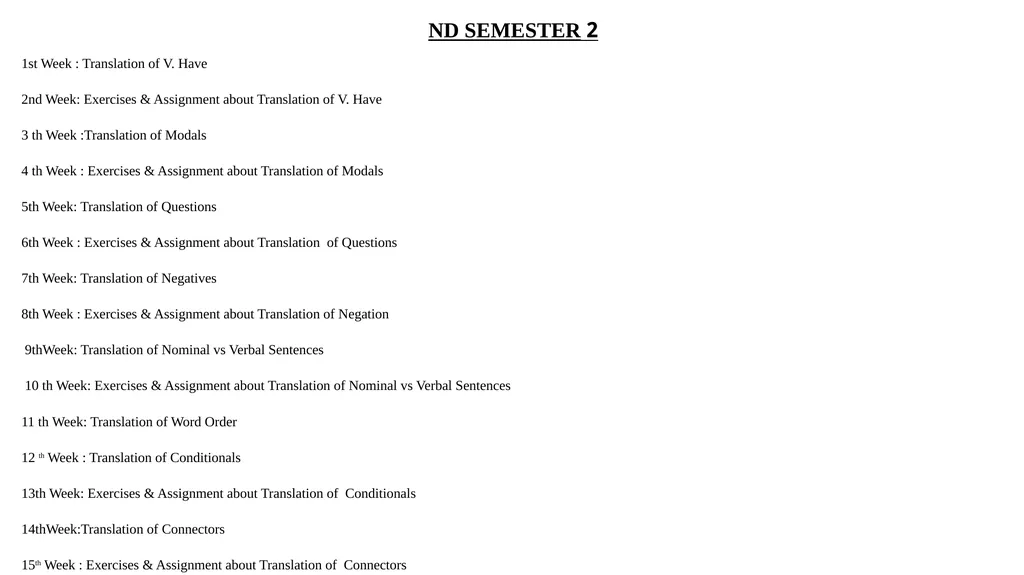
2 ND SEMESTER 1st Week : Translation of V. Have
2nd Week: Exercises & Assignment about Translation of V. Have
3 th Week :Translation of Modals
4 th Week : Exercises & Assignment about Translation of Modals
5th Week: Translation of Questions
6th Week : Exercises & Assignment about Translation of Questions
7th Week: Translation of Negatives
8th Week : Exercises & Assignment about Translation of Negation
9thWeek: Translation of Nominal vs Verbal Sentences
10 th Week: Exercises & Assignment about Translation of Nominal vs Verbal Sentences
11 th Week: Translation of Word Order
12 th Week : Translation of Conditionals
13th Week: Exercises & Assignment about Translation of Conditionals
14thWeek:Translation of Connectors
15th Week : Exercises & Assignment about Translation of Connectors<br>
03
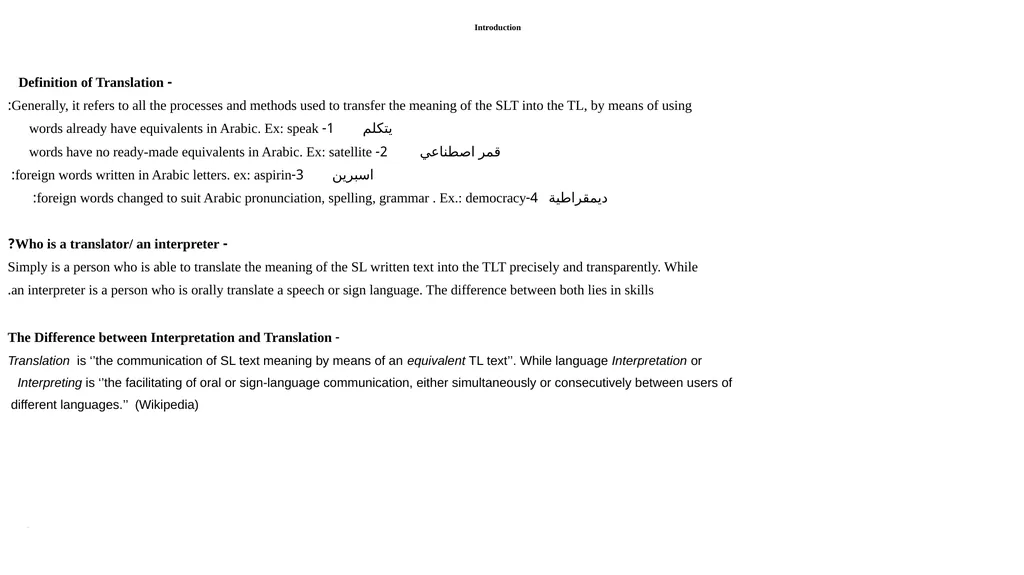
Introduction - Definition of Translation
Generally, it refers to all the processes and methods used to transfer the meaning of the SLT into the TL, by means of using:
يتكلم 1- words already have equivalents in Arabic. Ex: speak
قمر اصطناعي 2- words have no ready-made equivalents in Arabic. Ex: satellite
اسبرين 3-foreign words written in Arabic letters. ex: aspirin:
ديمقراطية 4-foreign words changed to suit Arabic pronunciation, spelling, grammar . Ex.: democracy:
- Who is a translator/ an interpreter?
Simply is a person who is able to translate the meaning of the SL written text into the TLT precisely and transparently. While
an interpreter is a person who is orally translate a speech or sign language. The difference between both lies in skills.
- The Difference between Interpretation and Translation
Translation is ‘’the communication of SL text meaning by means of an equivalent TL text’’. While language Interpretation or
Interpreting is ‘’the facilitating of oral or sign-language communication, either simultaneously or consecutively between users of
different languages.’’ (Wikipedia)<br>
04
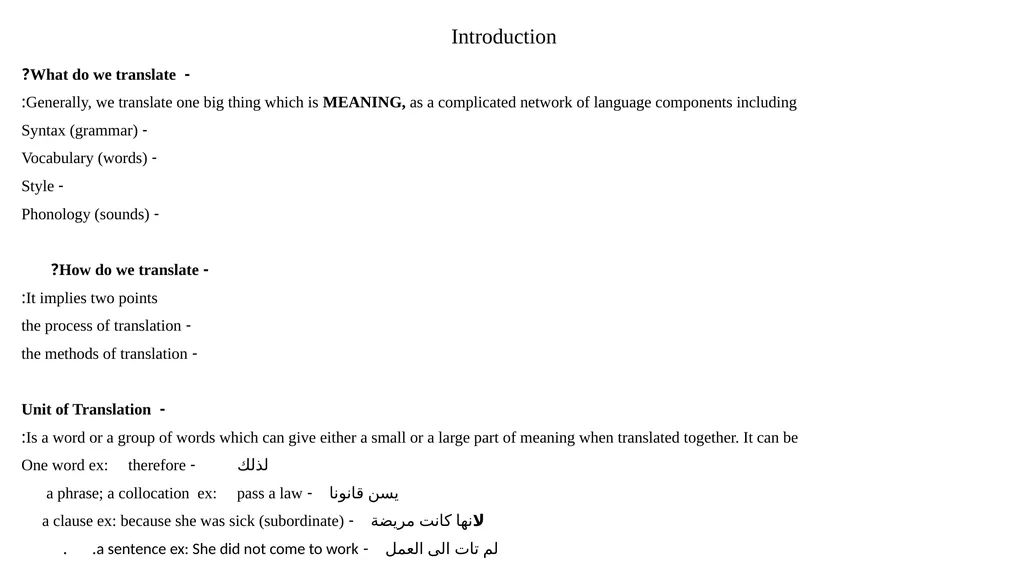
Introduction - What do we translate?
Generally, we translate one big thing which is MEANING, as a complicated network of language components including:
- Syntax (grammar)
- Vocabulary (words)
- Style
- Phonology (sounds)
- How do we translate?
It implies two points:
- the process of translation
- the methods of translation
- Unit of Translation
Is a word or a group of words which can give either a small or a large part of meaning when translated together. It can be:
لذلك - One word ex: therefore
يسن قانونا - a phrase; a collocation ex: pass a law
لانها كانت مريضة - a clause ex: because she was sick (subordinate)
لم تات الى العمل - a sentence ex: She did not come to work. .<br>
05
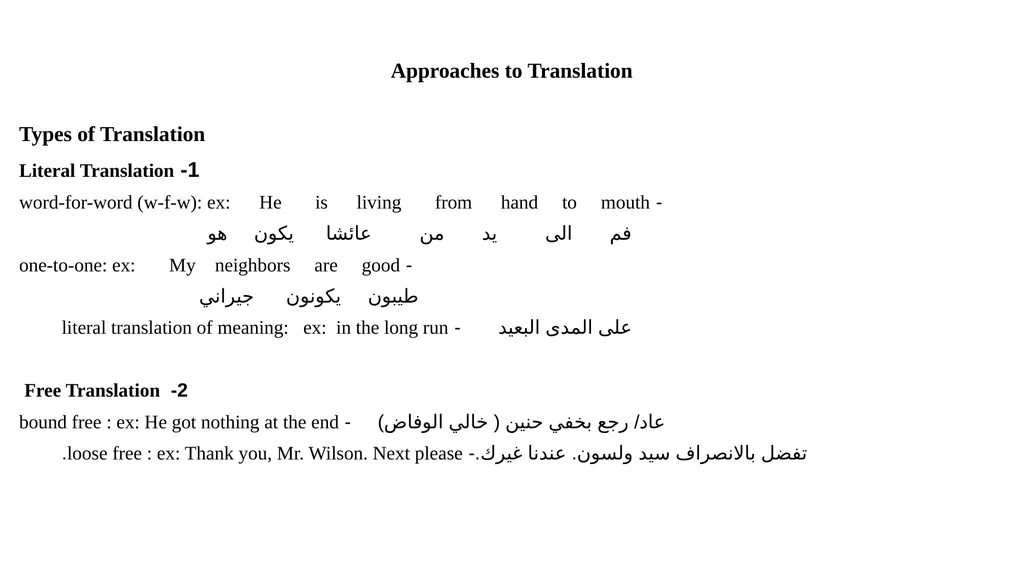
Approaches to Translation Types of Translation
1- Literal Translation
- word-for-word (w-f-w): ex: He is living from hand to mouth
فم الى يد من عائشا يكون هو
- one-to-one: ex: My neighbors are good
طيبون يكونون جيراني
على المدى البعيد - literal translation of meaning: ex: in the long run
2- Free Translation
عاد/ رجع بخفي حنين ( خالي الوفاض) - bound free : ex: He got nothing at the end
تفضل بالانصراف سيد ولسون. عندنا غيرك.- loose free : ex: Thank you, Mr. Wilson. Next please.<br>
06
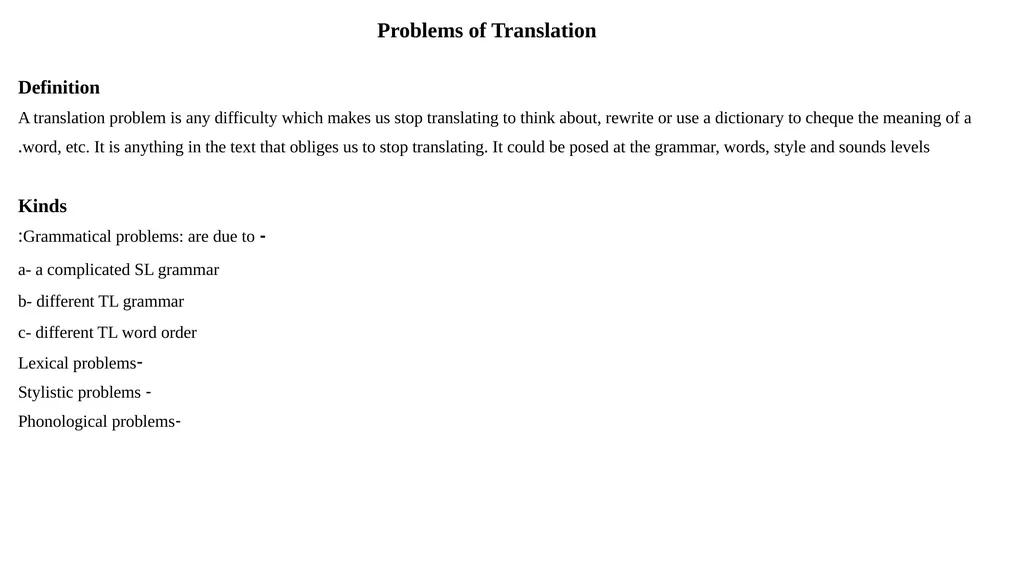
Problems of Translation Definition
A translation problem is any difficulty which makes us stop translating to think about, rewrite or use a dictionary to cheque the meaning of a
word, etc. It is anything in the text that obliges us to stop translating. It could be posed at the grammar, words, style and sounds levels.
Kinds
- Grammatical problems: are due to:
a- a complicated SL grammar
b- different TL grammar
c- different TL word order
-Lexical problems
- Stylistic problems
-Phonological problems<br>
07
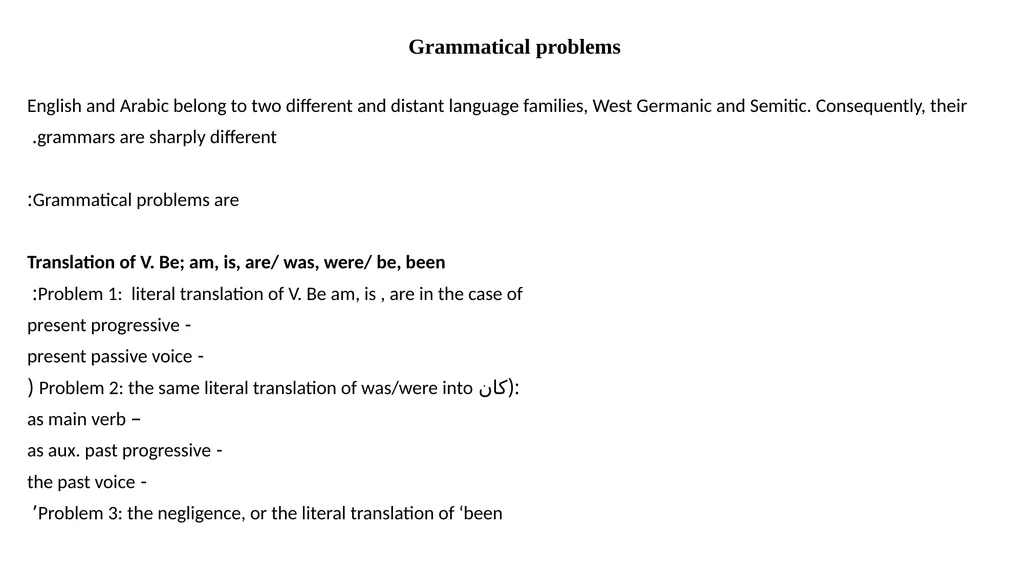
Grammatical problems English and Arabic belong to two different and distant language families, West Germanic and Semitic. Consequently, their
grammars are sharply different.
Grammatical problems are:
Translation of V. Be; am, is, are/ was, were/ be, been
Problem 1: literal translation of V. Be am, is , are in the case of:
- present progressive
- present passive voice
:(كان Problem 2: the same literal translation of was/were into (
– as main verb
- as aux. past progressive
- the past voice
Problem 3: the negligence, or the literal translation of ‘been’<br>
08
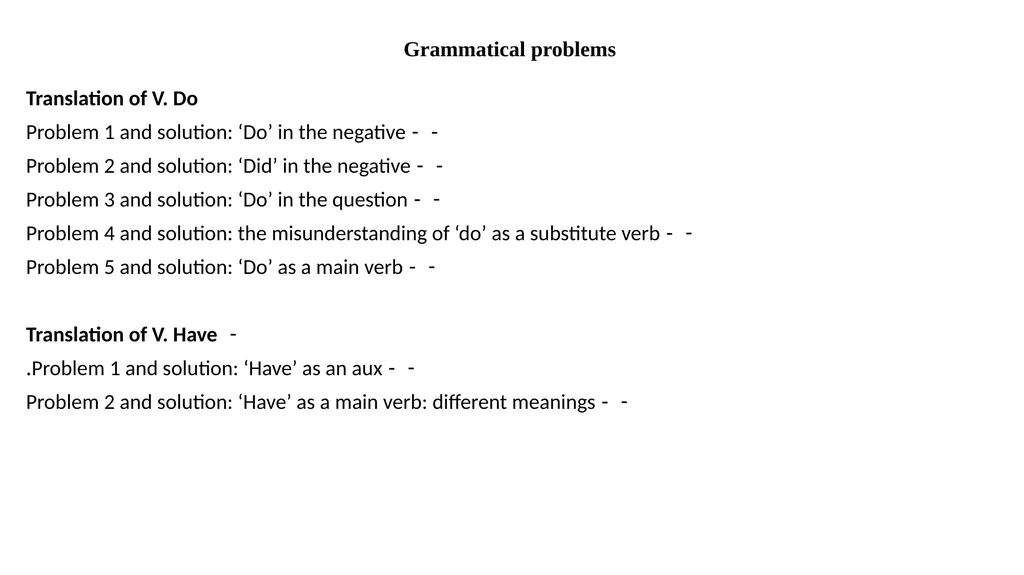
Grammatical problems Translation of V. Do
- Problem 1 and solution: ‘Do’ in the negative
- Problem 2 and solution: ‘Did’ in the negative
- Problem 3 and solution: ‘Do’ in the question
- Problem 4 and solution: the misunderstanding of ‘do’ as a substitute verb
- Problem 5 and solution: ‘Do’ as a main verb
Translation of V. Have
- Problem 1 and solution: ‘Have’ as an aux.
- Problem 2 and solution: ‘Have’ as a main verb: different meanings<br>
09
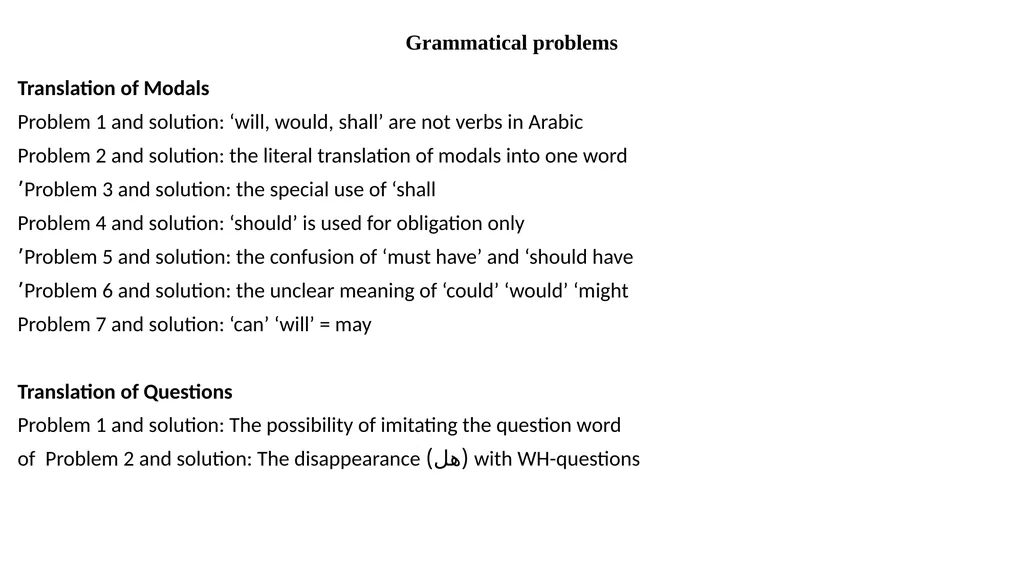
Grammatical problems Translation of Modals
Problem 1 and solution: ‘will, would, shall’ are not verbs in Arabic
Problem 2 and solution: the literal translation of modals into one word
Problem 3 and solution: the special use of ‘shall’
Problem 4 and solution: ‘should’ is used for obligation only
Problem 5 and solution: the confusion of ‘must have’ and ‘should have’
Problem 6 and solution: the unclear meaning of ‘could’ ‘would’ ‘might’
Problem 7 and solution: ‘can’ ‘will’ = may
Translation of Questions
Problem 1 and solution: The possibility of imitating the question word
with WH-questions (هل) of Problem 2 and solution: The disappearance<br>
10
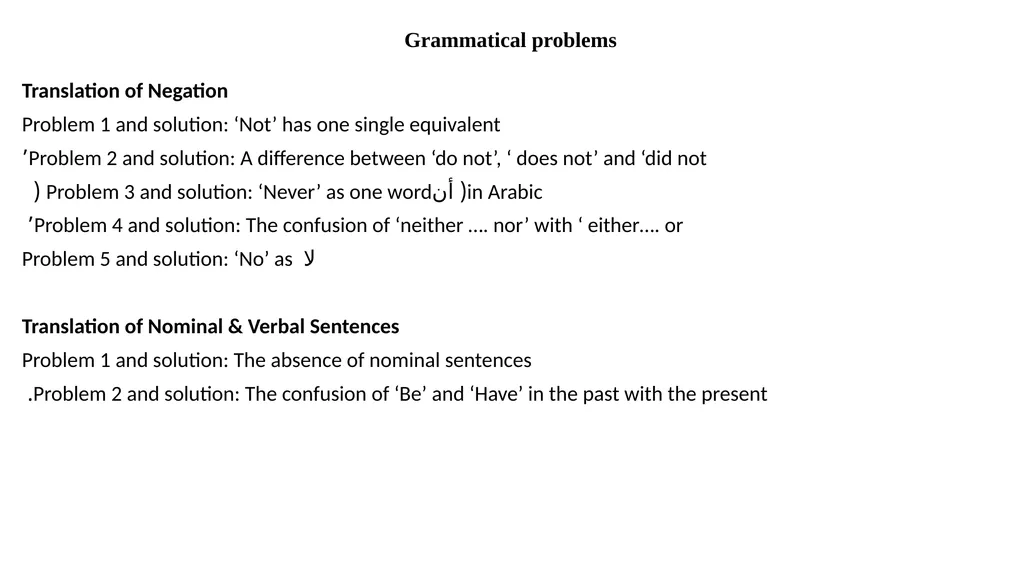
Grammatical problems Translation of Negation
Problem 1 and solution: ‘Not’ has one single equivalent
Problem 2 and solution: A difference between ‘do not’, ‘ does not’ and ‘did not’
in Arabic( أنProblem 3 and solution: ‘Never’ as one word (
Problem 4 and solution: The confusion of ‘neither …. nor’ with ‘ either…. or’
لا Problem 5 and solution: ‘No’ as
Translation of Nominal & Verbal Sentences
Problem 1 and solution: The absence of nominal sentences
Problem 2 and solution: The confusion of ‘Be’ and ‘Have’ in the past with the present.<br>
11
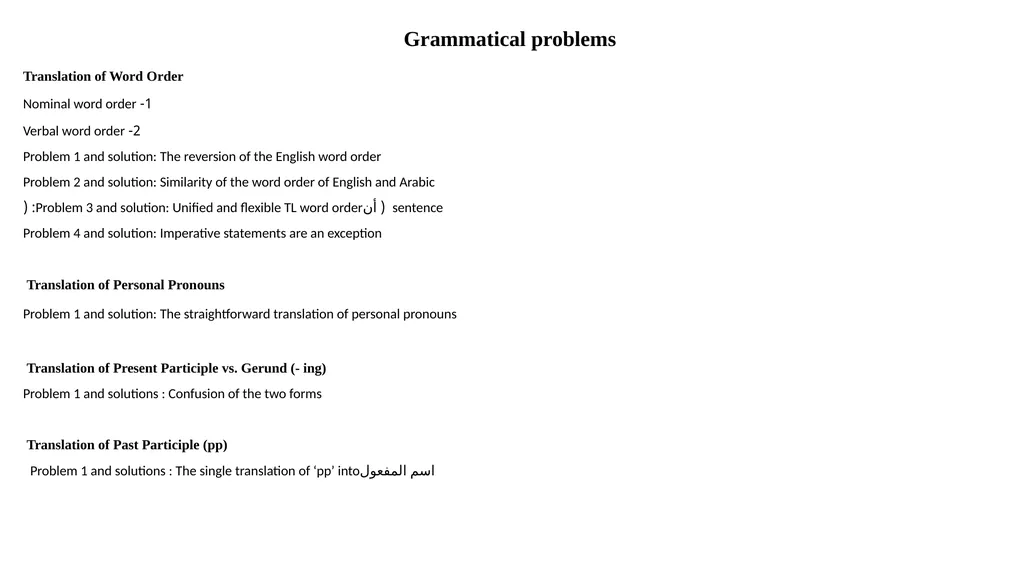
Grammatical problems Translation of Word Order
1- Nominal word order
2- Verbal word order
Problem 1 and solution: The reversion of the English word order
Problem 2 and solution: Similarity of the word order of English and Arabic
sentence ( أنProblem 3 and solution: Unified and flexible TL word order: (
Problem 4 and solution: Imperative statements are an exception
Translation of Personal Pronouns
Problem 1 and solution: The straightforward translation of personal pronouns
Translation of Present Participle vs. Gerund (- ing)
Problem 1 and solutions : Confusion of the two forms
Translation of Past Participle (pp)
اسم المفعولProblem 1 and solutions : The single translation of ‘pp’ into<br>
12
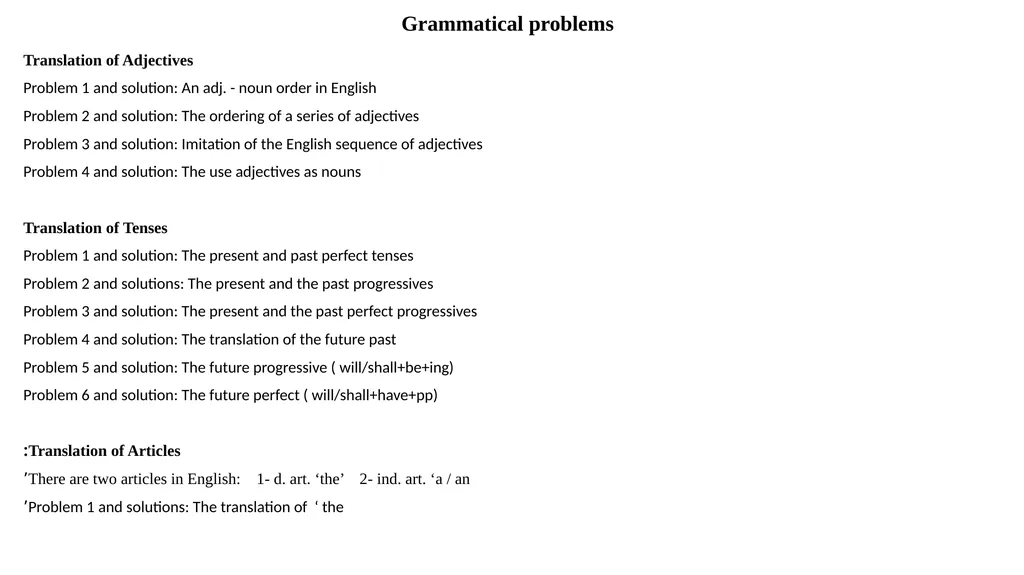
Grammatical problems Translation of Adjectives
Problem 1 and solution: An adj. - noun order in English
Problem 2 and solution: The ordering of a series of adjectives
Problem 3 and solution: Imitation of the English sequence of adjectives
Problem 4 and solution: The use adjectives as nouns
Translation of Tenses
Problem 1 and solution: The present and past perfect tenses
Problem 2 and solutions: The present and the past progressives
Problem 3 and solution: The present and the past perfect progressives
Problem 4 and solution: The translation of the future past
Problem 5 and solution: The future progressive ( will/shall+be+ing)
Problem 6 and solution: The future perfect ( will/shall+have+pp)
Translation of Articles:
There are two articles in English: 1- d. art. ‘the’ 2- ind. art. ‘a / an’
Problem 1 and solutions: The translation of ‘ the’<br>
13
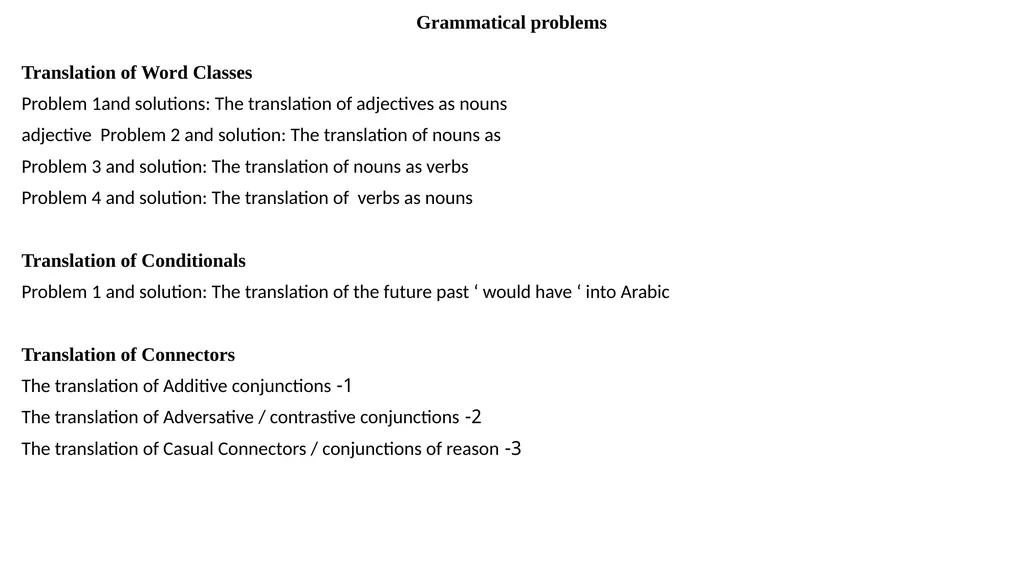
Grammatical problems Translation of Word Classes
Problem 1and solutions: The translation of adjectives as nouns
adjective Problem 2 and solution: The translation of nouns as
Problem 3 and solution: The translation of nouns as verbs
Problem 4 and solution: The translation of verbs as nouns
Translation of Conditionals
Problem 1 and solution: The translation of the future past ‘ would have ‘ into Arabic
Translation of Connectors
1- The translation of Additive conjunctions
2- The translation of Adversative / contrastive conjunctions
3- The translation of Casual Connectors / conjunctions of reason<br>