
ERI SILK WORM Silk production has a long history.
FD
Published · 11 slides · 0 views

1 / 1


Description
ERI SILK WORM Silk production has a long history. Silk was discovered by Xilingji (Hsi-ling-chi), wife of Chinas 3rd Emperor, Huangdi (Hoang-Ti), in 2640 B.C. While making tea, Xilingji accidentally dropped a silkworm cocoon into a cup of
Related Topics
Share
Embed code
Download this presentation From Below
"ERI SILK WORM Silk production has a long history." is the property of its rightful owner. Permission is granted to download and print the materials on this website for personal, non-commercial use only, and to display it on your personal computer provided you do not modify the materials and that you retain all copyright notices contained in the materials. By downloading content from our website, you accept the terms of this agreement.
Presentation Transcript
01
ERI SILK WORM<br>
02
Silk production has a long history. Silk was discovered by Xilingji (Hsi-ling-chi), wife of China’s 3rd Emperor, Huangdi (Hoang-Ti), in 2640 B.C. While making tea, Xilingji accidentally dropped a silkworm cocoon into a cup of hot water and found that the silk fiber could be loosened and unwound. Fibers from several cocoons could be twisted together to make a thread that was strong enough to be woven into cloth.
Thereafter, Hsiling chi discovered not only the means of raising silk worms, but also the manners of reeling silk and of employing it to make garments. Later sericulture spread throughout China, and silk became a precious commodity, highly sought after by other countries.
Demand for this exotic fabric eventually created the lucrative trade route, the historically famous Silk Road or Silk Route named after its most important commodity. This road helped in taking silk westward and bringing gold, silver and wool to the East. With the mulberry silk moth native to China, the Chinese had a monopoly on the world's silk production.<br>
03
Silk and Its Use:
1. Properties of the silk: Silk contains 70-75% fibroin and 25-30% sericin protein. The biochemical composition of fibroin can be represented by the formula C15H23N5O6. It has the characteristic appearance of pure silk with pearly lustre. It is insoluble in water, ether or alcohol, but dissolves in concentrated alkaline solutions, mineral acids, and glacial acetic acid and in ammoniacal solution of oxides of copper. Sericin, a gummy covering of the fiber is a gelatinous body which dissolves readily in warm soapy solutions and in hot water, which on cooling forms a jelly with even as little as 1% of the substance. It is precipitated as a white powder from hot solutions by alcohol. Its chemical formula is C15H25N5O8. It can be dyed before or after it has been woven into a cloth. The weight in gram of 900m long silk filaments is called a denier which represents size of silk filament.
Silk has following peculiar properties: -
1. Natural colour of Mulberry silk is white , yellow or yellowish green; that of Tasar brown; of Muga, light brown or golden; and of Eri, brick red or creamy white or light brown
. 2. Silk has all desirable qualities of textile fibres, viz. strength, elasticity, softness, coolness, and affinity to dyes. The silk fibre is exceptionally strong having a breaking strength of 65,000-lbs/sq. inch.
3. Silk fibre can elongate 20% of original length before breaking.
4. Density is 1.3-1.37g/cm3
5. Natural silk is hygroscopic and gains moisture up to 11%.
6. Silk is poor conductor of heat and electricity. However, under friction, it produces static electricity. Silk is sensitive to light and UV- rays.
7. Silk fibre can be heated to higher temperature without damage. It becomes pale yellow at 110o C in 15 minutes and disintegrates at 165 degree C.
8. On burning it produces a deadly hydrocyanic gas.<br>
04
Use of silk:
Silk is used in the manufacture of following articles: Garments in various weaves like plain, crepe, georgette and velvet. Knitted goods such as vests, gloves, socks, stockings. Silk is dyed and printed to prepare ornamented fabrics for saries, ghagras, lehengas and dupattas. Jackets, shawls and wrappers. Caps, handkerchiefs, scarves, dhotis, turbans. Quilts, bedcovers, cushions, table-cloths and curtains generally from Erisilk or spun silk. Parachutes and parachute cords. Fishing lines. Sieve for flour mills. Insulation coil for electric and telephone wire. Tyres of racing cars. Artillery gunpowder. Surgical sutures.
The silk produced by Philosamia ricini is called Eri silk.
The distribution of Eri silk worm is confined to Assam and bordering districts of West Bengal. The Eri silkworm is multivoltine and reared indoors 5-6 times a year. Optimum conditions required are 24- 28o C temperature and 85-90% humidity. Adult moths emerge from morning to mid day; males emerge earlier than the females. After an hour of emergence mating occurs and continues till evening. Males are then separated. Both male and female have brown (chocolate), black or green coloured wings with white crescent markings and woolly white abdomen. The male is smaller than female and bear bushy antennae and narrow abdomen. Eri worms are polyphagous having primary as well as secondary food plants (hosts). Primary food plants are Ricinus communis (Vern. Castor) and Heteropenax fragrans (Vern. Kasseru). Castor plants are of two varieties; the green leaved and violet leaved. Both are equally suitable for feeding the Eri silkworms. These plants are grown by seed sowing. Kasseru grows wild but may be cultivated as regular plantations on embankments around homestead land. It is grown by seed sowing and also vegetatively by stem cuttings. The secondary food plants are Manihot utilissima (Vern. Tapioca), Evodia flaxinifola (Vern. Payam), Plumeria acutifolia (Vern. Plum) and Carica papaya (Vern. Papaya)<br>
05
Life history:
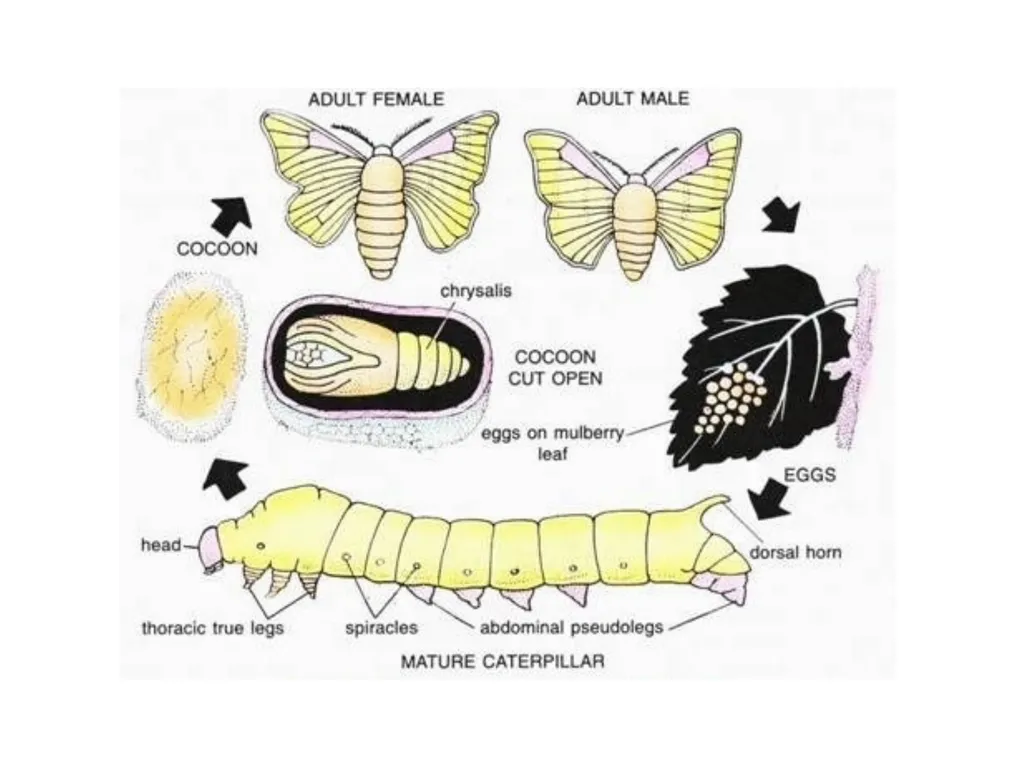
The eri moth is multivoltine in nature and can pass 6 life cycles in a year. These worms are totally domesticated and are reared indoors.
Life cycle:
Its life cycle consists of 4 stages as follows.
Adult:
Adult moths are large with wings spanning about 10 cm. The wings are greyish brown in colour with prominent eye spot [Fig. 3.26(a)]. When the adult moth emerges from a cocoon it makes a hole to get out. Like other silk moths, eri moths also start mating activities following their emergence from pupal stage.<br>
06
Egg:
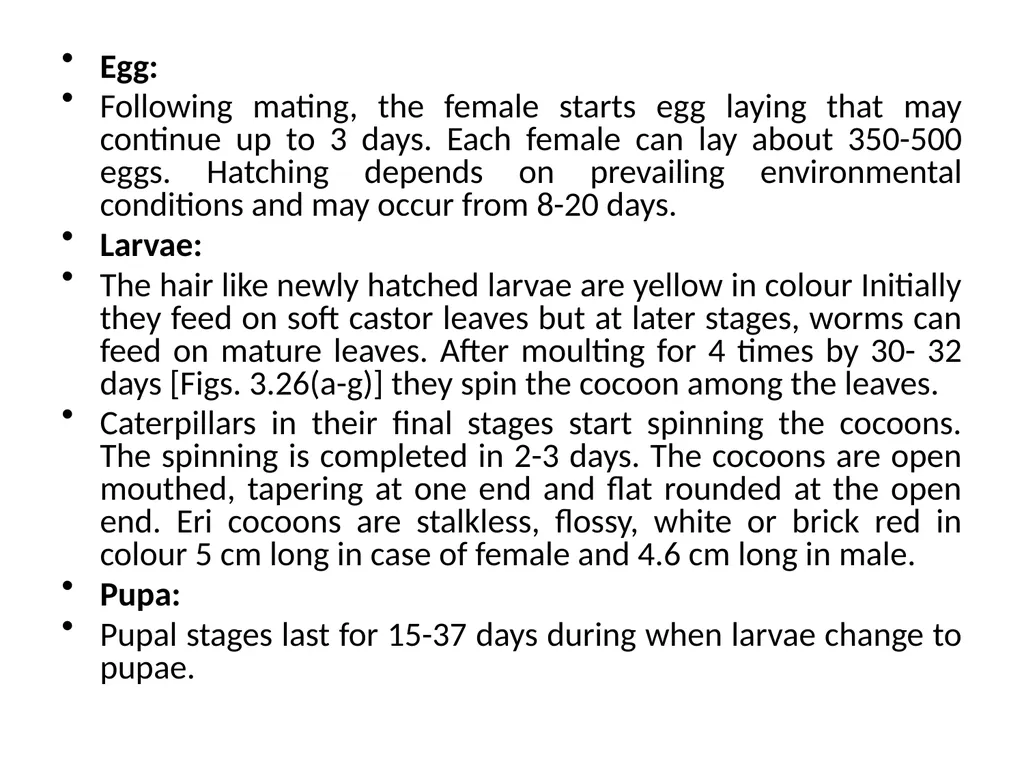
Following mating, the female starts egg laying that may continue up to 3 days. Each female can lay about 350-500 eggs. Hatching depends on prevailing environmental conditions and may occur from 8-20 days.
Larvae:
The hair like newly hatched larvae are yellow in colour Initially they feed on soft castor leaves but at later stages, worms can feed on mature leaves. After moulting for 4 times by 30- 32 days [Figs. 3.26(a-g)] they spin the cocoon among the leaves.
Caterpillars in their final stages start spinning the cocoons. The spinning is completed in 2-3 days. The cocoons are open mouthed, tapering at one end and flat rounded at the open end. Eri cocoons are stalkless, flossy, white or brick red in colour 5 cm long in case of female and 4.6 cm long in male.
Pupa:
Pupal stages last for 15-37 days during when larvae change to pupae.<br>
07
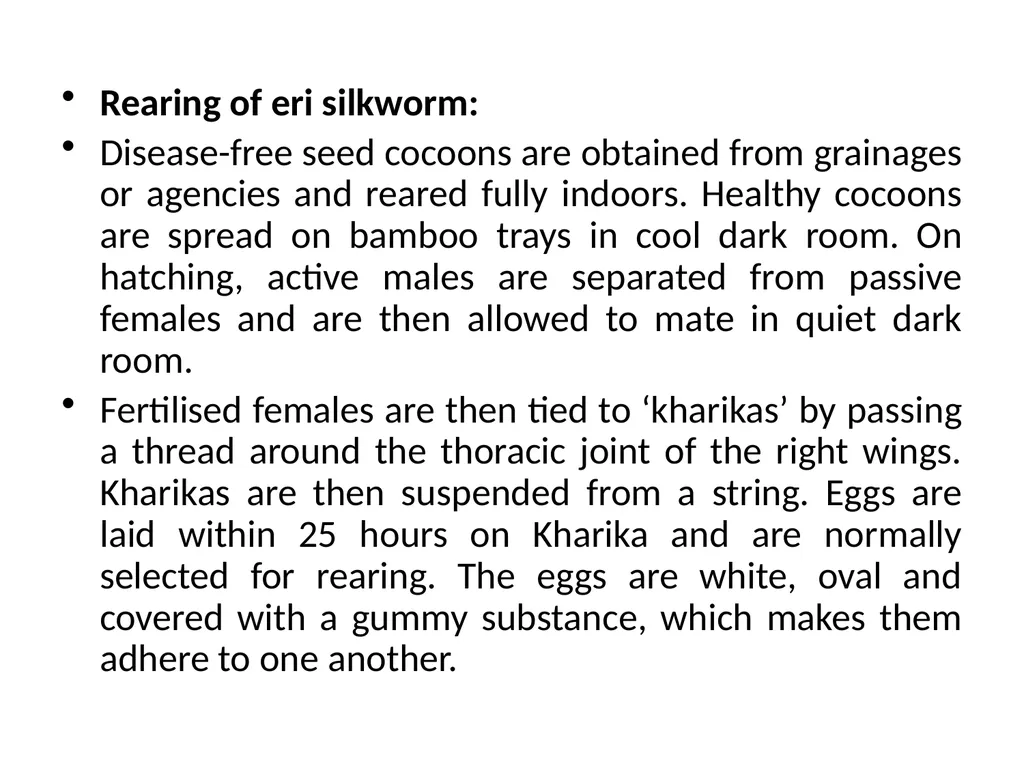
Rearing of eri silkworm:
Disease-free seed cocoons are obtained from grainages or agencies and reared fully indoors. Healthy cocoons are spread on bamboo trays in cool dark room. On hatching, active males are separated from passive females and are then allowed to mate in quiet dark room.
Fertilised females are then tied to ‘kharikas’ by passing a thread around the thoracic joint of the right wings. Kharikas are then suspended from a string. Eggs are laid within 25 hours on Kharika and are normally selected for rearing. The eggs are white, oval and covered with a gummy substance, which makes them adhere to one another.<br>
08
The eggs are disinfected with 2% formalin solution and then washed thoroughly with water. Eggs are incubated at 26°C, the colour changes to blue on the day prior to hatching. Hatching takes place in the morning after ten days of incubation. The newly hatched larvae are yellow with black segments.
These larvae are brushed to rearing trays over which few tender food leaves are spread, and crowding is avoided. As the worms advance in age, older leaves can be given as food at 2-hour interval for four to five times.
Bed cleaning is carried out at regular interval in the same way as for the mulberry silkworm. The growing worms undergo four moults and have five instar stages. Total larval period lasts for 30-35 days. The 5th instar, mature larvae stop feeding and start searching for a proper place to spin the cocoon.
At this stage, the mature worms are picked up and transferred to mountages (Chandri-kas). In wild, cocoons are spun between folds of leaves.
Post cocoon processing:
Stifling is done by spreading and exposing the cocoons to the sun for 1 -2 days. For degumming, cocoons are tied in a cloth sac and dipped in boiling soda solution. After sufficient boiling, the cocoons are taken out washed with water several times to remove soda, squeezed to remove water and then spread on mats to dry.
Being open mouthed, the thread of the cocoons is discontinuous. So, the thread can only be spun and not reeled. Traditionally, spinning is done in wet condition on takli and in semidried condition on a charkha. Improved spinning machines like N.R. Das type charkha and Chaudhury type charkha are also available for spinning of silk from eri cocoons.
Eri Silk:
The silk produced by eri moths is referred to as eri and endi or errandi silk by local people. This silk is collected from pierced cocoons, so it is spun silk. The fibres in the cocoon are like a tiny bale of cotton, all wound together and tangled. So when eri silk is spun, it forms a lower grade of silk of unusual quality.
Depending on how it is spun and woven it can give a very woolly result and as with poorly made wools, eri can feel like cheap acrylic. But it can also give a tight, strong fibre-like linen. This is what makes eri textiles amazing — they can have the drape and weight of linen but are warm and insulating like cotton or wool Eri silk is less glossy and wrinkleless.<br>
09
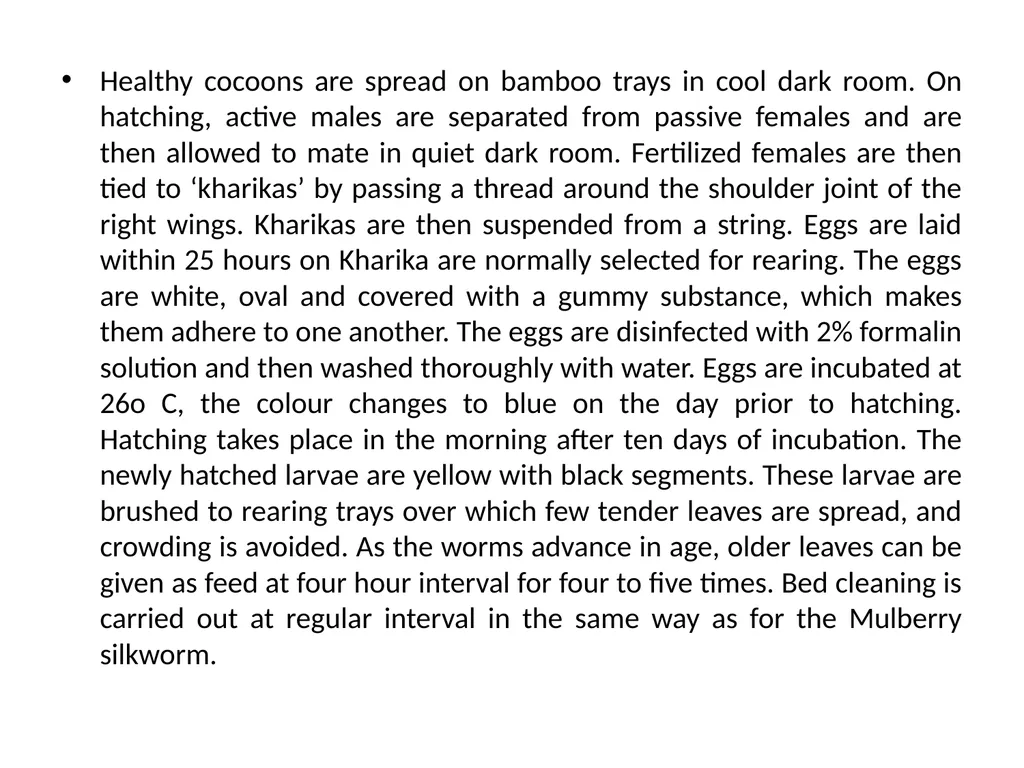
Healthy cocoons are spread on bamboo trays in cool dark room. On hatching, active males are separated from passive females and are then allowed to mate in quiet dark room. Fertilized females are then tied to ‘kharikas’ by passing a thread around the shoulder joint of the right wings. Kharikas are then suspended from a string. Eggs are laid within 25 hours on Kharika are normally selected for rearing. The eggs are white, oval and covered with a gummy substance, which makes them adhere to one another. The eggs are disinfected with 2% formalin solution and then washed thoroughly with water. Eggs are incubated at 26o C, the colour changes to blue on the day prior to hatching. Hatching takes place in the morning after ten days of incubation. The newly hatched larvae are yellow with black segments. These larvae are brushed to rearing trays over which few tender leaves are spread, and crowding is avoided. As the worms advance in age, older leaves can be given as feed at four hour interval for four to five times. Bed cleaning is carried out at regular interval in the same way as for the Mulberry silkworm.<br>
10
The growing worms undergo four moults and have five instar stages. Total larval period lasts for 30-35 days. The 5th instar mature larvae stop feeding and start searching for a proper place to spin the cocoon. At this stage, the mature worms are picked up and transferred to mountages (Chandrikes). In wild, cocoons are spun between folds of leaves. The spinning is completed in 2-3 days. The cocoons are open mouthed, white or brick red, 5 cm long in case of female and 4.6 cm in male, tapering at one end and flat rounded at open end, flossy and without a peduncle. The silk filaments are not continuous.
Post Cocoon Processing Stifling is done by spreading and exposing the cocoons to sun for 1-2 days. For degumming, cocoons are tied in a cloth sac and dipped in boiling soda solution. After sufficient boiling, the cocoons are taken out, washed with water several times to remove soda, squeezed to remove water and then spread on mats to dry. Being open mouthed, the thread of the cocoons is discontinuous. So, the thread can only be spun and not reeled. Traditionally spinning is done in wet condition on takli and in semi dried condition on a charkha. Improved spinning machines like N.R. Das type charkha and Chaudhury type charkha are also available for spinning of silk from Eri cocoons.<br>
Post Cocoon Processing Stifling is done by spreading and exposing the cocoons to sun for 1-2 days. For degumming, cocoons are tied in a cloth sac and dipped in boiling soda solution. After sufficient boiling, the cocoons are taken out, washed with water several times to remove soda, squeezed to remove water and then spread on mats to dry. Being open mouthed, the thread of the cocoons is discontinuous. So, the thread can only be spun and not reeled. Traditionally spinning is done in wet condition on takli and in semi dried condition on a charkha. Improved spinning machines like N.R. Das type charkha and Chaudhury type charkha are also available for spinning of silk from Eri cocoons.<br>