
Estimands at ICH . Rob Hemmings, Statistics and PK
EM
Published · 34 slides · 0 views

1 / 1

Description
Estimands at ICH . Rob Hemmings, Statistics and PK Unit manager, MHRA CHMP member, SAWP chair, BSWP MSWG member Contents Need for a new framework Why ICH? How? Who? When? What? What next? Example to support discussion 2 Disclaimer
Related Topics
Share
Embed code
Download this presentation From Below
"Estimands at ICH . Rob Hemmings, Statistics and PK" is the property of its rightful owner. Permission is granted to download and print the materials on this website for personal, non-commercial use only, and to display it on your personal computer provided you do not modify the materials and that you retain all copyright notices contained in the materials. By downloading content from our website, you accept the terms of this agreement.
Presentation Transcript
01
Estimands at ICH .
Rob Hemmings, Statistics and PK Unit manager, MHRA
CHMP member, SAWP chair, BSWP / MSWG member<br>
Rob Hemmings, Statistics and PK Unit manager, MHRA
CHMP member, SAWP chair, BSWP / MSWG member<br>
02
Contents Need for a new framework
Why ICH?
How?
Who?
When?
What?
What next?
Example to support discussion 2<br>
Why ICH?
How?
Who?
When?
What?
What next?
Example to support discussion 2<br>
03
Disclaimer Obligatory disclaimer: The views expressed in this presentation are my own and do not necessarily reflect those of MHRA or EMA.
Acknowledgements: In fact the views are, at least in part, from the (excellent) E9(R1) Expert Working Group. 3<br>
Acknowledgements: In fact the views are, at least in part, from the (excellent) E9(R1) Expert Working Group. 3<br>
04
Need for a new framework Long-standing approaches for the handling of missing data were (appropriately) challenged and a long conversation ensued....
perhaps the wrong conversation.
We started to talk about methods … LOCF vs MMRM, then MMRM vs others. 4<br>
perhaps the wrong conversation.
We started to talk about methods … LOCF vs MMRM, then MMRM vs others. 4<br>
05
Need for a new framework MMRM in majority of industry-sponsored trials.
because it is most appropriate, or because it is easy?
Regulators not yet sold…
‘MMRM appears to answer the question of what would have happened if patients had stayed on randomised treatment.’
They didn’t, and some won’t. 5<br>
because it is most appropriate, or because it is easy?
Regulators not yet sold…
‘MMRM appears to answer the question of what would have happened if patients had stayed on randomised treatment.’
They didn’t, and some won’t. 5<br>
06
Need for a new framework So what do we want to know?
EMA guideline on ‘missing data’ states:
“The justification for selecting a particular method should not be based primarily on the properties of the method under particular assumptions but on whether it is likely that it will provide an appropriate estimate for the comparison of primary regulatory interest in the circumstances of the trial under consideration” 6<br>
07
Need for a new framework So what do we want to know?
E9: Intention-To-Treat Principle: “The principle that asserts that the effect of a treatment policy can be best assessed by evaluating on the basis of the intention to treat a subject (i.e. the planned treatment regimen) rather than the actual treatment given. It has the consequence that subjects allocated to a treatment group should be followed up, assessed and analysed as members of that group irrespective of their compliance to the planned course of treatment.” 7<br>
E9: Intention-To-Treat Principle: “The principle that asserts that the effect of a treatment policy can be best assessed by evaluating on the basis of the intention to treat a subject (i.e. the planned treatment regimen) rather than the actual treatment given. It has the consequence that subjects allocated to a treatment group should be followed up, assessed and analysed as members of that group irrespective of their compliance to the planned course of treatment.” 7<br>
08
Need for a new framework “Preservation of the initial randomisation in analysis is important in preventing bias and in providing a secure foundation for statistical tests.”
Not only ‘analyse as randomise’
anything else will be harder…
“When the full analysis set of subjects is used, violations of the protocol that occur after randomisation may have an impact on the data and conclusions, particularly if their occurrence is related to treatment assignment. In most respects it is appropriate to include the data from such subjects in the analysis, consistent with the intention-to-treat principle.” 8<br>
09
Need for a new framework From E9R(1) Concept Paper:
“Remarkably, despite many years of clinical trials being the primary support for regulatory decision making, no definitive guidance is available on what constitutes an appropriate primary estimand for a confirmatory clinical trial. The absence of regulatory guidance leads to uncertainties and inconsistencies in methodological approach across trial designs supporting regulatory decisions.” 9<br>
“Remarkably, despite many years of clinical trials being the primary support for regulatory decision making, no definitive guidance is available on what constitutes an appropriate primary estimand for a confirmatory clinical trial. The absence of regulatory guidance leads to uncertainties and inconsistencies in methodological approach across trial designs supporting regulatory decisions.” 9<br>
10
Need for a new framework From E9R(1) Concept Paper:
“Furthermore, similar submissions may lead to different inferences being drawn by different regulatory authorities for reasons that appear to have nothing to do either with actual regional differences or even with clear differences of opinion in benefit-risk appraisal, but rather with a lack of what could be a common understanding of trial objectives and of what constitutes an appropriate quantification of the effects of an experimental treatment.” 10<br>
“Furthermore, similar submissions may lead to different inferences being drawn by different regulatory authorities for reasons that appear to have nothing to do either with actual regional differences or even with clear differences of opinion in benefit-risk appraisal, but rather with a lack of what could be a common understanding of trial objectives and of what constitutes an appropriate quantification of the effects of an experimental treatment.” 10<br>
11
Need for a new framework So what do we want to know?
Depends on context?
What is done at present?
Not really specified (‘ITT’ is said, but its not)
Statistical section determines the precise trial objective
How should we handle missing data? …became … What question are we really interested to answer?
If we’re going to try to sort this out, let’s do it globally = ICH 11<br>
12
Why ICH? Unique harmonisation project involving the Regulators and research-based Industries of US, EU and Japan
started in 1990
WHO, Canada, and EFTA are observers
Well-defined objectives:
To improve efficiency of new drug development and registration process
To promote public health, prevent duplication of clinical trials in humans and minimise the use of animal testing without compromising safety and effectiveness
Accomplished through the development and implementation of harmonised Guidelines and standards 12<br>
13
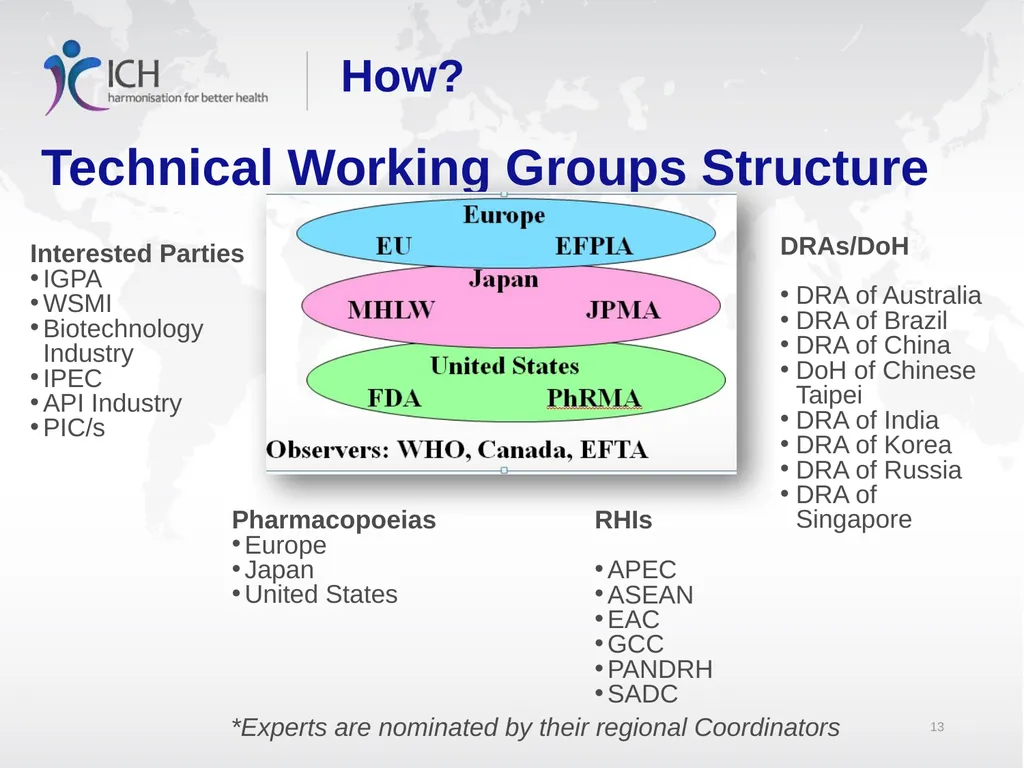
Technical Working Groups Structure How? Interested Parties
IGPA
WSMI
Biotechnology Industry
IPEC
API Industry
PIC/s Pharmacopoeias
Europe
Japan
United States RHIs
APEC
ASEAN
EAC
GCC
PANDRH
SADC DRAs/DoH
DRA of Australia
DRA of Brazil
DRA of China
DoH of Chinese Taipei
DRA of India
DRA of Korea
DRA of Russia
DRA of Singapore *Experts are nominated by their regional Coordinators<br>
14
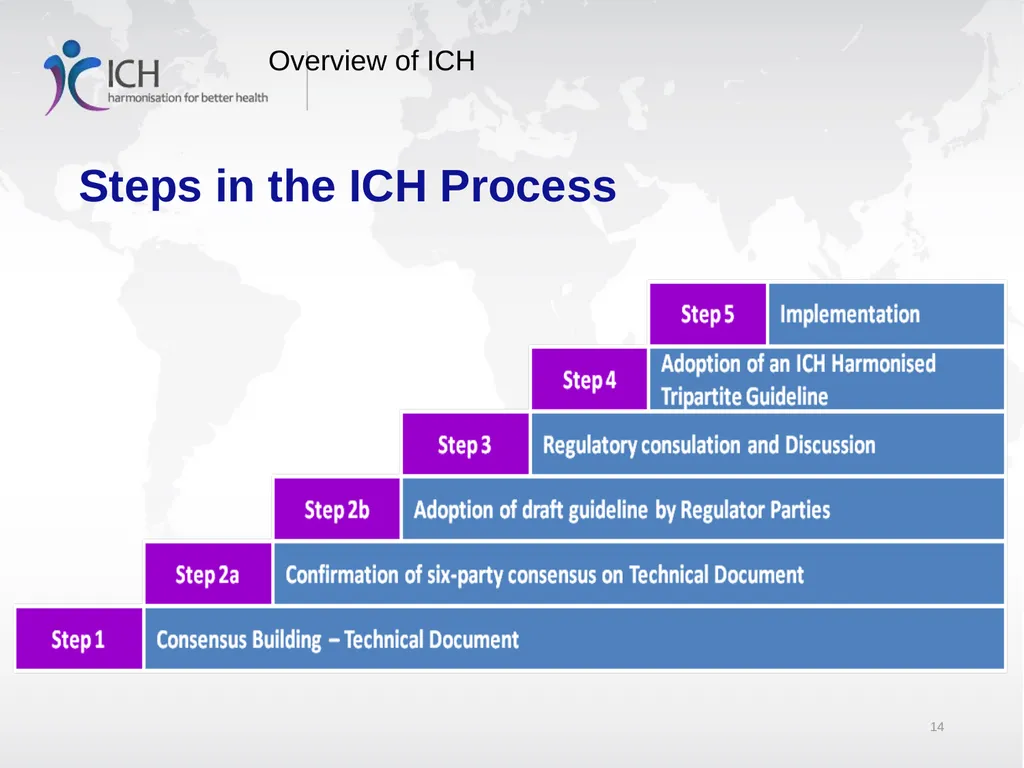
Overview of ICH Steps in the ICH Process<br>
15
Overview of ICH A formal sign-off can be achieved only when consensus is reached within the 6 ICH Parties. (*** exceptionally regulators only)
The Secretariat should be contacted to initiate the sign-off process.
When consensus is reached among all six-party expert on the technical Document, the Topic Leaders in the EWG will sign the Step 1 Experts Sign-off sheet.
The Step 1 Experts Document with EWG signatures is submitted to the Steering Committee to request adoption under Step 2a of the ICH process .
At Step 2a, the six Parties are requested to sign-off the consensus technical document.
At Step 2b, the consensus text approved by the three regulatory ICH Parties is signed-off by the three regulatory ICH Parties as Step 2b draft Guideline with a view to releasing it for public consultation. The technical document is made public on the ICH website alongside the draft Guideline. Steps in the ICH Process<br>
16
Overview of ICH A formal sign-off can be achieved only when consensus is reached within the 6 ICH Parties.
At Step 3, the comments received by each of the three Regulatory Parties shall be consolidated. The Step 3 experts document is signed-off by the regulatory Topic Leaders.
At Step 4, the Steering Committee Regulatory Parties are signing-off the final document.
Upon reaching Step 2b or Step 4, the Rapporteur shall develop a presentation to be published along the Guideline on the ICH website, as support documentation. Steps in the ICH Process<br>
17
Who? EU: Rob Hemmings, Frank Petavy
FDA: Tom Permutt, Estelle Russek-Cohen
MHLW: (PMDA): Yuki Ando, Hirofumi Minami, Ayako Hara
EFPIA: Christine Fletcher, Frank Bretz
PhRMA: Devan Mehrotra, Vladamir Dragalin
JPMA: Satoru Tsuchiya, Satoru Fukinbara, Hideki Suganami
Health Canada, Brazil, Australia, Chinese Taipei / Taiwan 17<br>
FDA: Tom Permutt, Estelle Russek-Cohen
MHLW: (PMDA): Yuki Ando, Hirofumi Minami, Ayako Hara
EFPIA: Christine Fletcher, Frank Bretz
PhRMA: Devan Mehrotra, Vladamir Dragalin
JPMA: Satoru Tsuchiya, Satoru Fukinbara, Hideki Suganami
Health Canada, Brazil, Australia, Chinese Taipei / Taiwan 17<br>
18
When? Concept Paper approved mid 2014
Expert Working Group met in Lisbon, Nov 2014 and Fukuoka, June 2015
Next meeting Jacksonville, Dec 2015 or Europe mid-2016.
Step 1 ??? 18<br>
Expert Working Group met in Lisbon, Nov 2014 and Fukuoka, June 2015
Next meeting Jacksonville, Dec 2015 or Europe mid-2016.
Step 1 ??? 18<br>
19
What? Technical document → Draft addendum to ICH E9
Appendix
Update (additions / clarifications) to ICH E9 19<br>
Appendix
Update (additions / clarifications) to ICH E9 19<br>
20
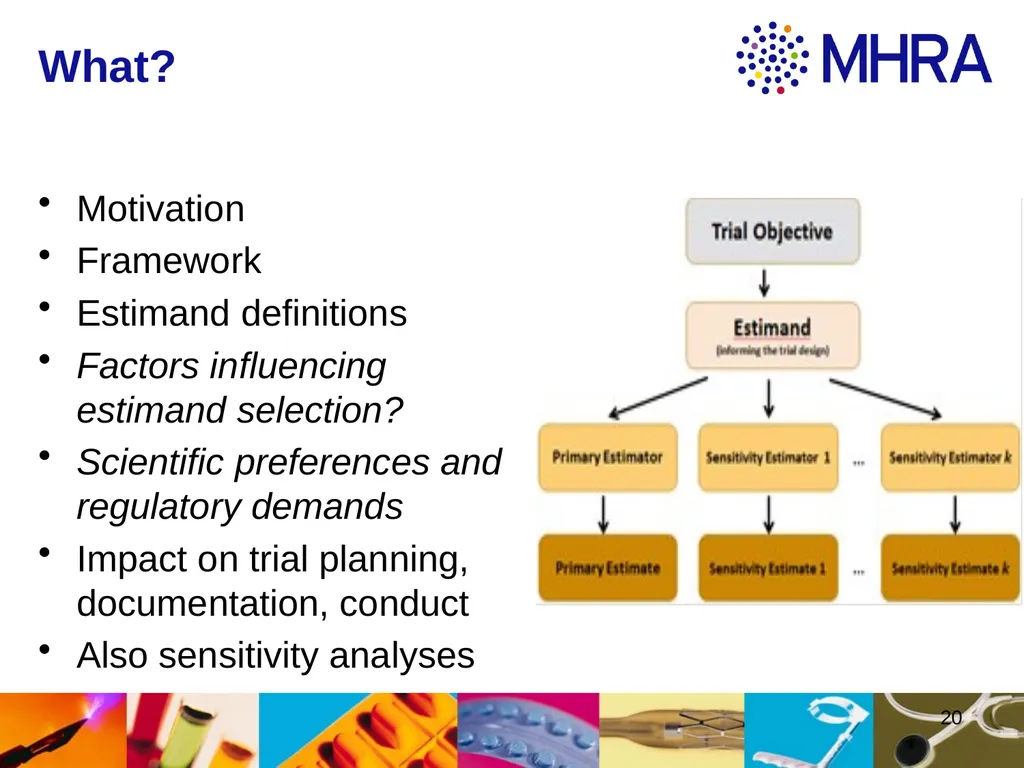
What? Motivation
Framework
Estimand definitions
Factors influencing estimand selection?
Scientific preferences and regulatory demands
Impact on trial planning, documentation, conduct
Also sensitivity analyses 20<br>
Framework
Estimand definitions
Factors influencing estimand selection?
Scientific preferences and regulatory demands
Impact on trial planning, documentation, conduct
Also sensitivity analyses 20<br>
21
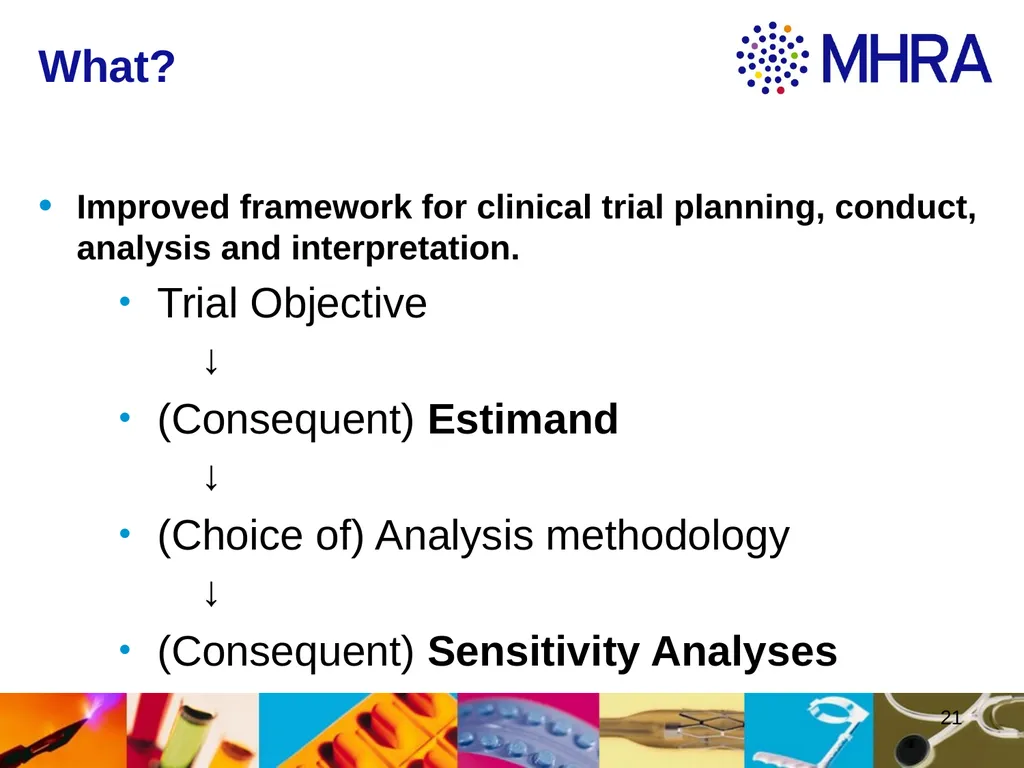
What? Improved framework for clinical trial planning, conduct, analysis and interpretation.
Trial Objective
↓
(Consequent) Estimand
↓
(Choice of) Analysis methodology
↓
(Consequent) Sensitivity Analyses 21<br>
Trial Objective
↓
(Consequent) Estimand
↓
(Choice of) Analysis methodology
↓
(Consequent) Sensitivity Analyses 21<br>
22
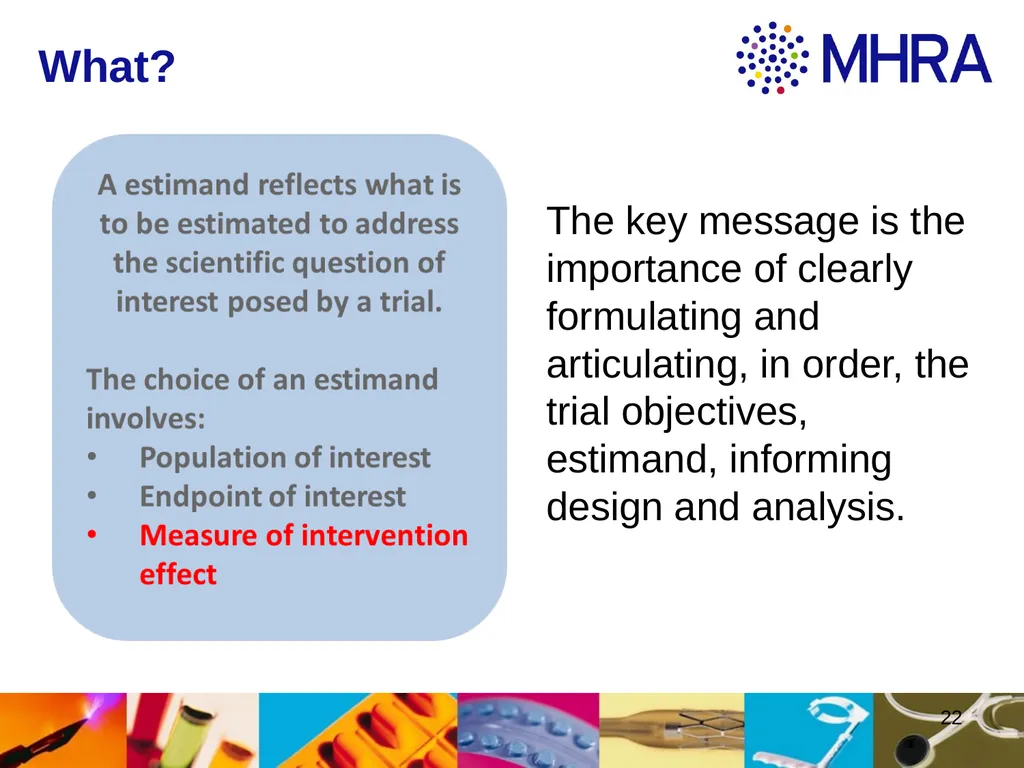
What? 22 The key message is the importance of clearly formulating and articulating, in order, the trial objectives, estimand, informing design and analysis.<br>
23
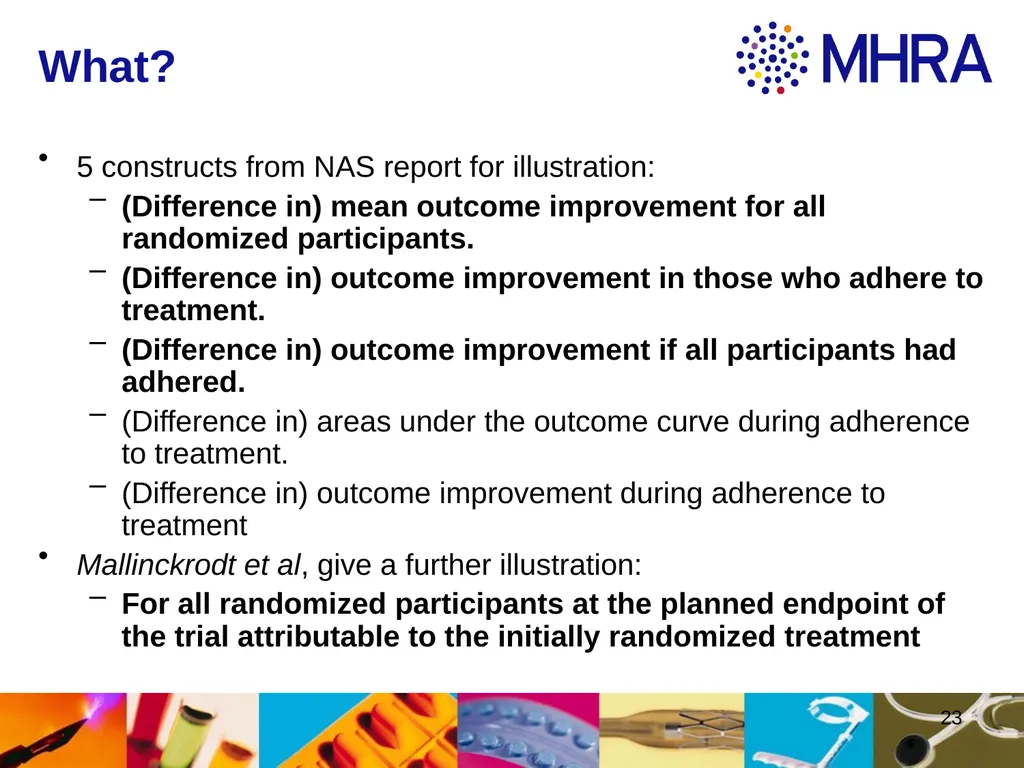
What? 5 constructs from NAS report for illustration:
(Difference in) mean outcome improvement for all randomized participants.
(Difference in) outcome improvement in those who adhere to treatment.
(Difference in) outcome improvement if all participants had adhered.
(Difference in) areas under the outcome curve during adherence to treatment.
(Difference in) outcome improvement during adherence to treatment
Mallinckrodt et al, give a further illustration:
For all randomized participants at the planned endpoint of the trial attributable to the initially randomized treatment 23<br>
24
What? Are reliable estimators / estimates available?
Factors influencing estimand selection?
therapeutic setting?
most focus on chronic treatments, repeated measures.
clinical use?
pharmacology?
intent of treatment?
toxicity?
availability of other treatments, possibility for rescue / monitoring?
what else? 24<br>
Factors influencing estimand selection?
therapeutic setting?
most focus on chronic treatments, repeated measures.
clinical use?
pharmacology?
intent of treatment?
toxicity?
availability of other treatments, possibility for rescue / monitoring?
what else? 24<br>
25
A word on sensitivity analyses EU proposed ‘estimand’. This was born out of the ‘missing data’ discussions, but became a broader, more fundamental question.
FDA proposed ‘sensitivity analysis’. This was always broader than only a missing data problem, and seeks to improve structure.
The topics are related to the extent that harmonisation may improve trial planning, conduct, analysis, reporting and decision making. 25<br>
FDA proposed ‘sensitivity analysis’. This was always broader than only a missing data problem, and seeks to improve structure.
The topics are related to the extent that harmonisation may improve trial planning, conduct, analysis, reporting and decision making. 25<br>
26
What next? Drafting and discussion
Consultations in local stakeholder groups
More drafting and discussion
Step 1, 2a, 2b
Public consultation 26<br>
Consultations in local stakeholder groups
More drafting and discussion
Step 1, 2a, 2b
Public consultation 26<br>
27
Motivating example, Selincro The efficacy and tolerability of nalmefene in the treatment of alcohol dependence were evaluated in three randomised, double-blind, placebo-controlled phase III studies (two confirmatory 6-month efficacy studies and one 1-year safety study)
Primary Objectives: The overall objective of the study was to evaluate the effect of as-needed dosing of 18.06 mg nalmefene on alcohol consumption in patients with alcohol dependence during a 24-week treatment period. 27<br>
Primary Objectives: The overall objective of the study was to evaluate the effect of as-needed dosing of 18.06 mg nalmefene on alcohol consumption in patients with alcohol dependence during a 24-week treatment period. 27<br>
28
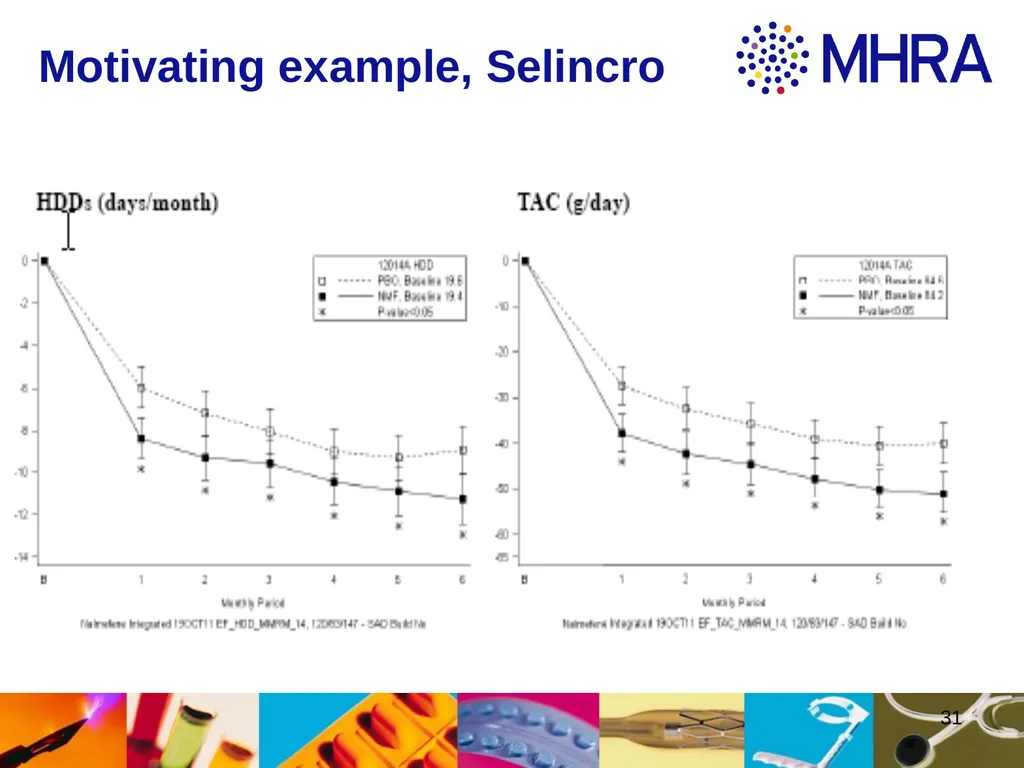
Motivating example, Selincro Primary endpoints:
The changes from baseline to Month 6 in number of Heavy Drinking Days (HDDs) and Total alcohol consumption (TAC) were defined as the two co-primary efficacy endpoints, as follows:
1. Number of HDDs (defined as a day with alcohol consumption ≥60g for men and ≥40g for women)
2. Total alcohol consumption (TAC, defined as mean daily alcohol consumption in g/day over a month (= 28 days)
Both co-primary efficacy variables concerned the treatment effect at Month 6.
Efficacy analyses were conducted on all treated patients who had at least one valid post-baseline assessment. 28<br>
29
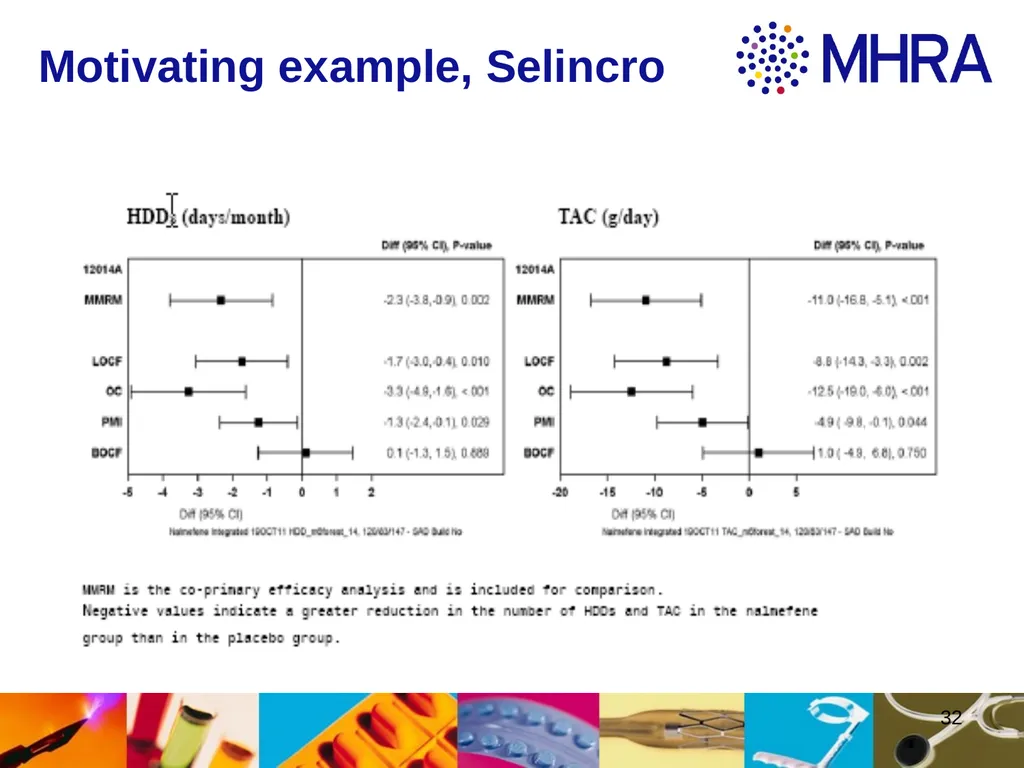
Motivating example, Selincro The primary analysis pre-specified for both co-primary efficacy variables was a mixed model repeated measures (MMRM) analysis using all available data measured over each month during the treatment period using a model with baseline score as covariate, site, sex, time and treatment as fixed effects, baseline-by-time and treatment-by-time interaction and an unstructured covariance matrix.
Sensitivity analyses were pre-specified including placebo mean imputation (PMI) and multiple imputation with a pattern mixture model. 29<br>
Sensitivity analyses were pre-specified including placebo mean imputation (PMI) and multiple imputation with a pattern mixture model. 29<br>
30
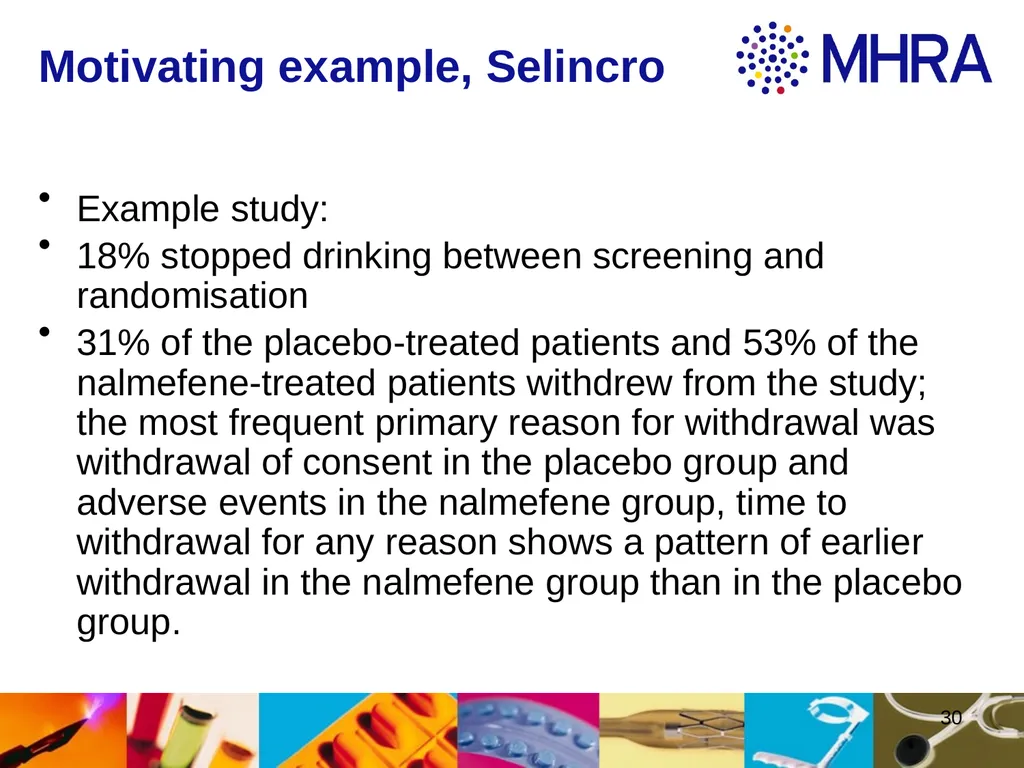
Motivating example, Selincro 30 Example study:
18% stopped drinking between screening and randomisation
31% of the placebo-treated patients and 53% of the nalmefene-treated patients withdrew from the study; the most frequent primary reason for withdrawal was withdrawal of consent in the placebo group and adverse events in the nalmefene group, time to withdrawal for any reason shows a pattern of earlier withdrawal in the nalmefene group than in the placebo group.<br>
31
Motivating example, Selincro 31<br>
32
Motivating example, Selincro 32<br>
33
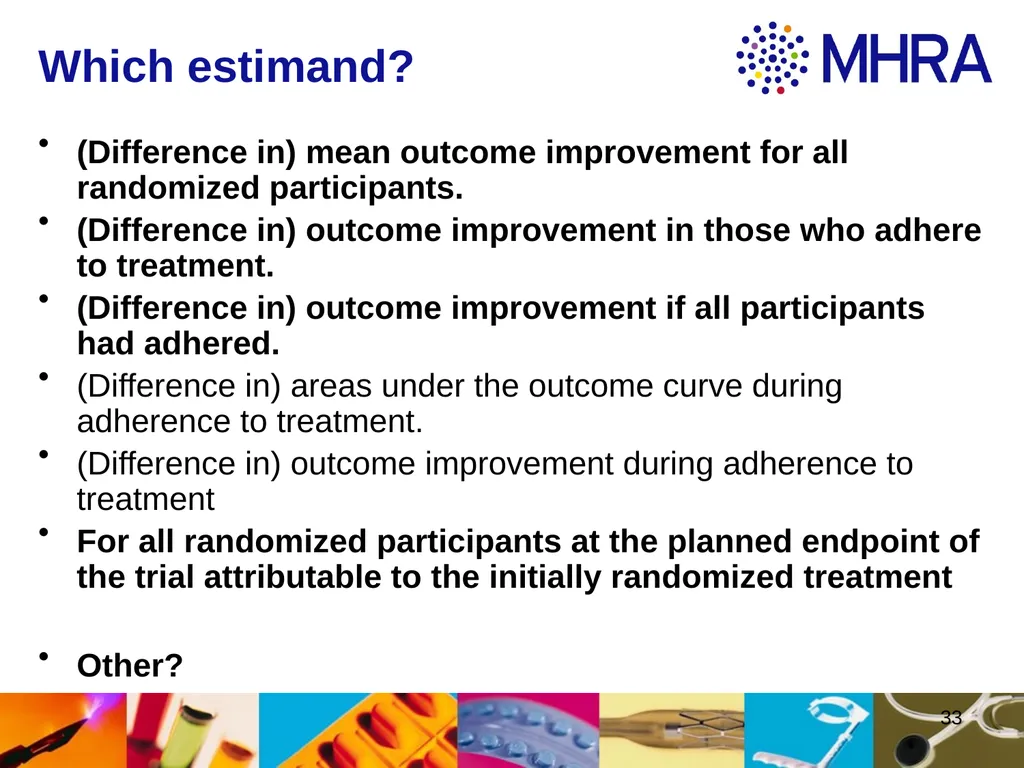
Which estimand? (Difference in) mean outcome improvement for all randomized participants.
(Difference in) outcome improvement in those who adhere to treatment.
(Difference in) outcome improvement if all participants had adhered.
(Difference in) areas under the outcome curve during adherence to treatment.
(Difference in) outcome improvement during adherence to treatment
For all randomized participants at the planned endpoint of the trial attributable to the initially randomized treatment
Other? 33<br>
34
Conclusions The work seems to be important.
The framework seems to have been well received.
The work is continuing.
Views are welcome. 34<br>
The framework seems to have been well received.
The work is continuing.
Views are welcome. 34<br>