EVOLUTION OF HORSE PRESENTED BY KAVITA PRAJAPATI SYNOPSIS INTRODUCATION PLACE OF ORIGIN AND TIME EVOLUTIONARY TRENDS PHYLOGENY OF HORSE EOCENE EPOCH OLIGOCENE EPOCH MIOCENE EPOCH PLIOCENE EPOCH CONCLUSION REFERENCE INTRODUCATION The
"EVOLUTION OF HORSE PRESENTED BY KAVITA PRAJAPATI" is the property of its rightful owner. Permission is granted to
download and print the materials on this website for personal, non-commercial use only, and to display it
on your personal computer provided you do not modify the materials and that you retain all copyright
notices contained in the materials. By downloading content from our website, you accept the terms of this
agreement.
Presentation Transcript
01
EVOLUTION OF HORSE PRESENTED BY
KAVITA PRAJAPATI<br>
02
SYNOPSIS INTRODUCATION
PLACE OF ORIGIN AND TIME
EVOLUTIONARY TRENDS
PHYLOGENY OF HORSE
EOCENE EPOCH
OLIGOCENE EPOCH
MIOCENE EPOCH
PLIOCENE EPOCH<br>
03
CONCLUSION
REFERENCE<br>
04
INTRODUCATION The evolution of the horse, a mammal of the family Equidae, occurred over a geologic time scale of 50 million years, transforming the small, dog-sized,[1] forest-dwelling Eohippus into the modern horse. Paleozoologists have been able to piece together a more complete outline of the evolutionary lineage of the modern horse than of any other animal. Much of this evolution took place in North America, where horses originated but became extinct about 10,000 years ago.[2]
The horse belongs to the order Perissodactyla (odd-toed ungulates), the members of which all share hooved feet and an odd number of toes on each foot, as well as mobile upper lips and a similar tooth structure<br>
05
PLACE OF ORIGIN AND TIME The horse was domesticated only 5.5 KYA, thousands of years after dogs, cattle, pigs, sheep, and goats. The horse nonetheless represents the domestic animal that most impacted human history; providing us with rapid transportation, which has considerably changed the speed and magnitude of the circulation of goods and people, as well as their cultures and diseases. By revolutionizing warfare and agriculture, horses also deeply influenced the politico-economic trajectory of human societies. Reciprocally, human activities have circled back on the recent evolution of the horse, by creating hundreds of domestic breeds through selective programs, while leading all wild populations to near extinction. Despite being tightly associated with humans, several aspects in the evolution of the domestic horse remain controversial. Here, we review recent advances in comparative genomics and paleogenomics that helped advance our understanding of the genetic foundation of domestic horses.<br>
06
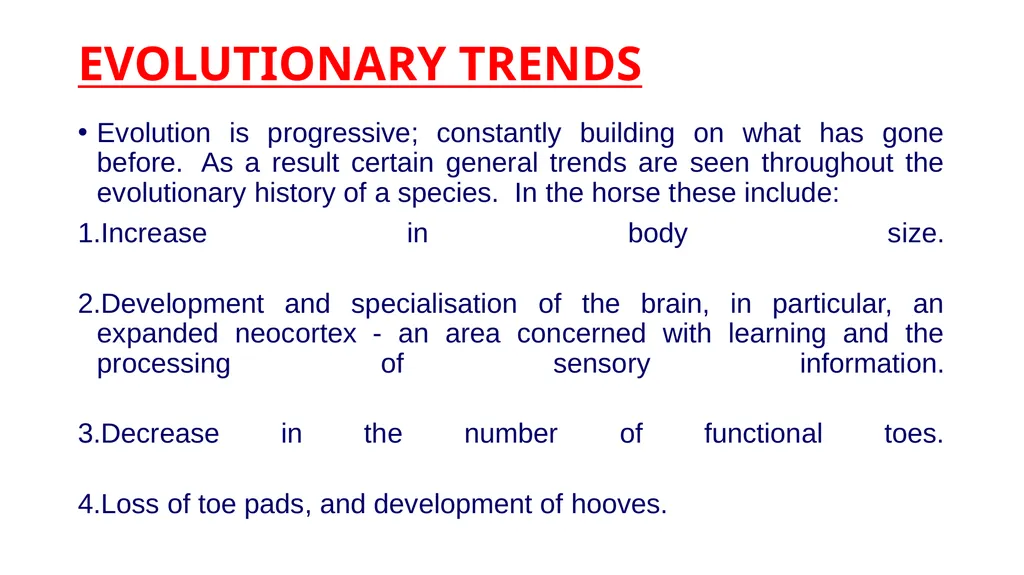
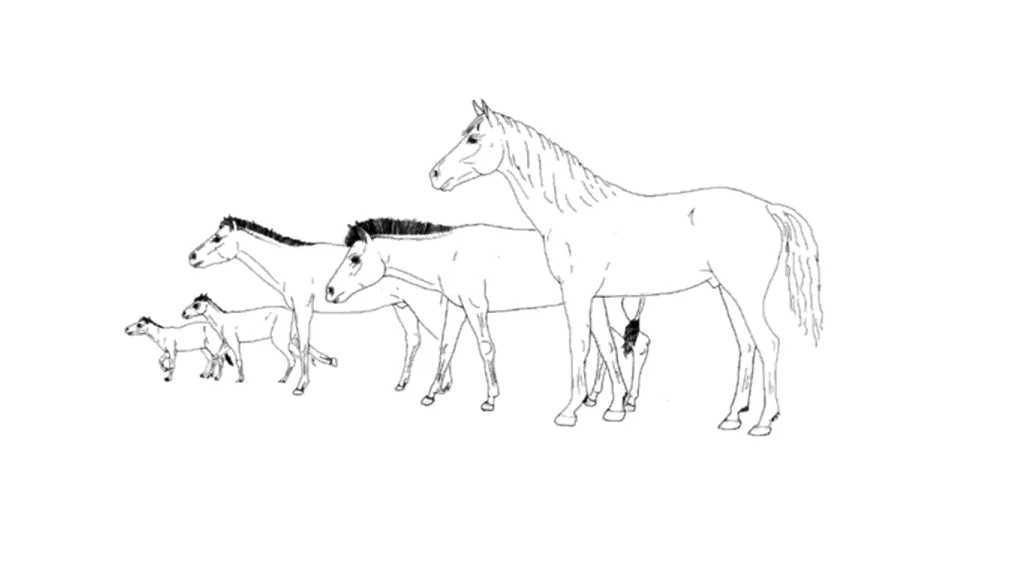
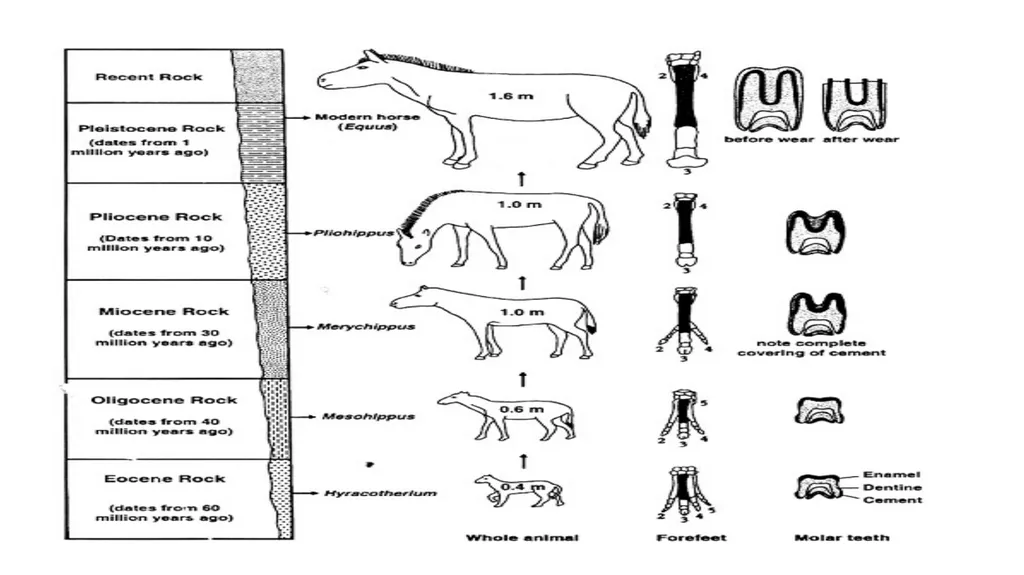
EVOLUTIONARY TRENDS Evolution is progressive; constantly building on what has gone before. As a result certain general trends are seen throughout the evolutionary history of a species. In the horse these include:
Increase in body size.
Development and specialisation of the brain, in particular, an expanded neocortex - an area concerned with learning and the processing of sensory information.
Decrease in the number of functional toes.
Loss of toe pads, and development of hooves.<br>
07
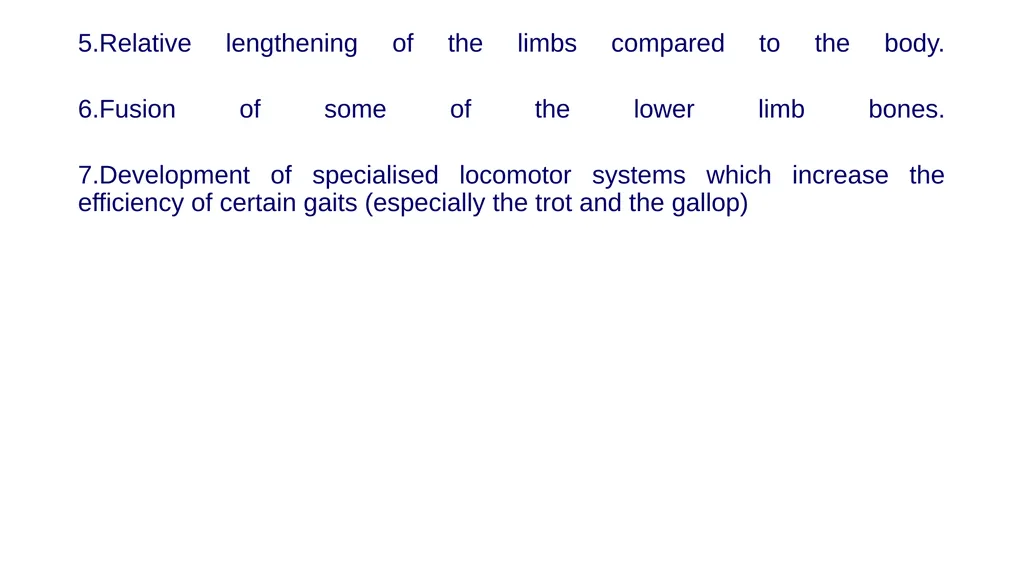
5.Relative lengthening of the limbs compared to the body.
6.Fusion of some of the lower limb bones.
7.Development of specialised locomotor systems which increase the efficiency of certain gaits (especially the trot and the gallop)<br>
08
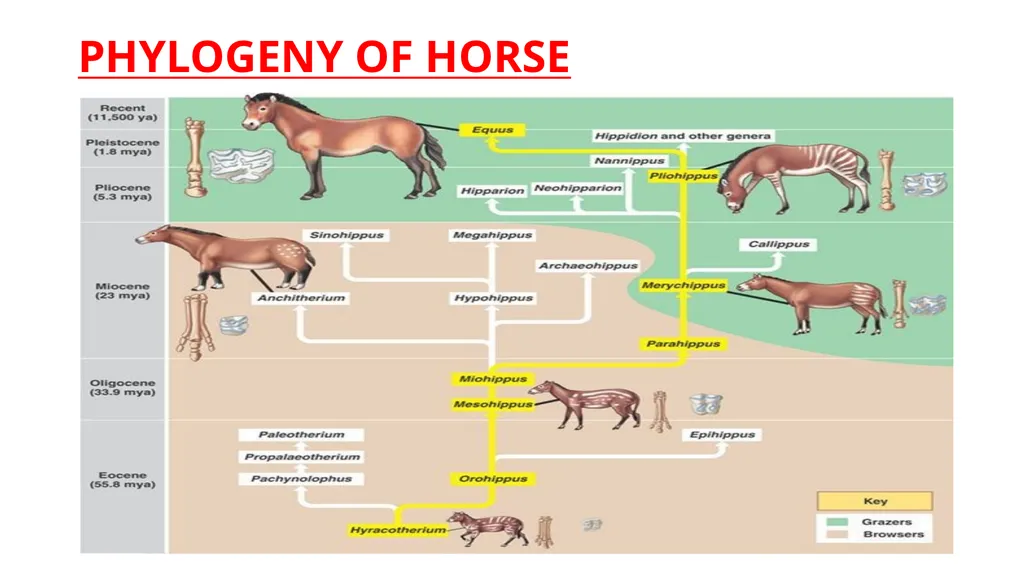
PHYLOGENY OF HORSE<br>
09
CONCLUSION :- In the 50 million years of its evolution, the horse became more and more a horse, more and more specialized. It lost general characteristics of mammals, such as a foot with five toes and teeth with incisors, canines and molars, Its diet became more difficult to digest and more one-sided. The horse specialized its limbs and digestion. Horses were three-toed for most of the time. In the time that horses flourished, some species went on three toes, while in others they were more or less reduced. The three toed horses disappeared and horses have had one toe only since Merychippus. Although their heyday is over, horses took their specialization even further.<br>