
Fabio R. Aricò University of East Anglia Paola
KL
Published · 34 slides · 0 views

1 / 1


Description
Fabio R. Aricò University of East Anglia Paola Iannone Loughborough University Manchester April 2023 Introducing and Developing Familiarity with Viva Voce Assessment in Undergraduate Education 2 YOUR PRESENTER Fabio Aricò UK National
Related Topics
Share
Embed code
Download this presentation From Below
"Fabio R. Aricò University of East Anglia Paola" is the property of its rightful owner. Permission is granted to download and print the materials on this website for personal, non-commercial use only, and to display it on your personal computer provided you do not modify the materials and that you retain all copyright notices contained in the materials. By downloading content from our website, you accept the terms of this agreement.
Presentation Transcript
01
Fabio R. Aricò
University of East Anglia
Paola Iannone Loughborough University Manchester – April 2023 Introducing and Developing Familiarity with Viva Voce Assessment in Undergraduate Education<br>
Paola Iannone Loughborough University Manchester – April 2023 Introducing and Developing Familiarity with Viva Voce Assessment in Undergraduate Education<br>
02
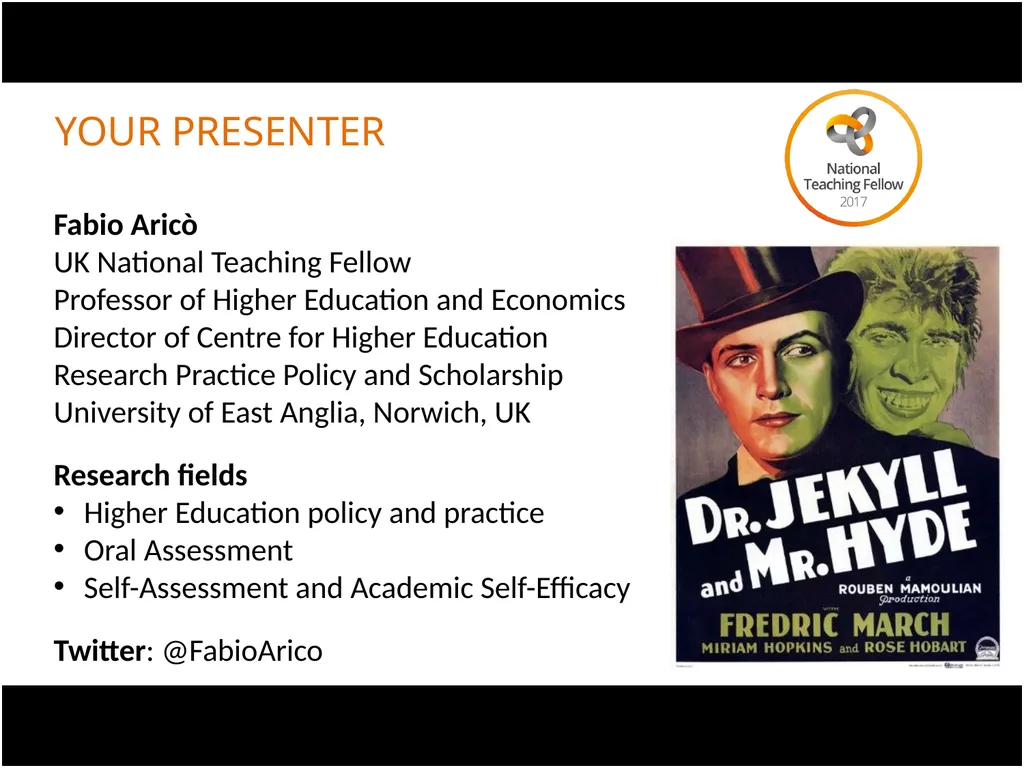
2 YOUR PRESENTER Fabio Aricò
UK National Teaching Fellow Professor of Higher Education and Economics
Director of Centre for Higher Education Research Practice Policy and Scholarship University of East Anglia, Norwich, UK
Research fields
Higher Education policy and practice
Oral Assessment
Self-Assessment and Academic Self-Efficacy
Twitter: @FabioArico<br>
03
OUTLINE Introduction to viva voce assessment
and wider context
Implementing viva voce assessment: how to do it?
Research and Evaluation 3<br>
Implementing viva voce assessment: how to do it?
Research and Evaluation 3<br>
04
Introduction to viva voce assessment: wider context 4<br>
05
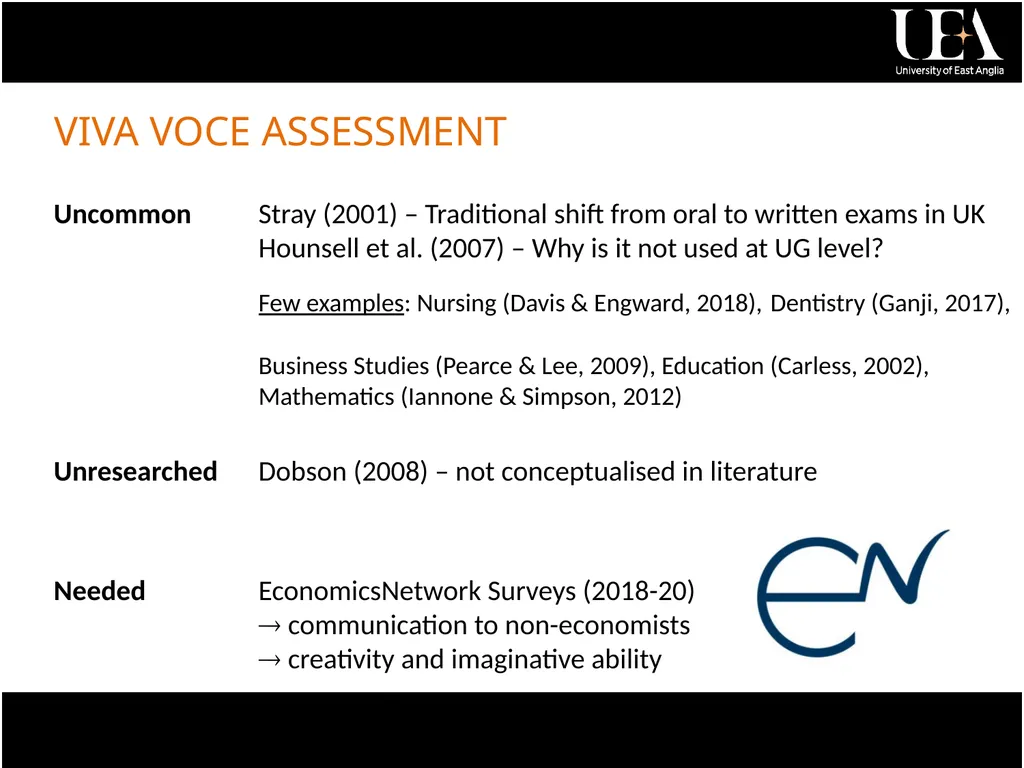
VIVA VOCE ASSESSMENT Uncommon Stray (2001) – Traditional shift from oral to written exams in UK
Hounsell et al. (2007) – Why is it not used at UG level?
Few examples: Nursing (Davis & Engward, 2018), Dentistry (Ganji, 2017), Business Studies (Pearce & Lee, 2009), Education (Carless, 2002), Mathematics (Iannone & Simpson, 2012)
Unresearched Dobson (2008) – not conceptualised in literature
Needed EconomicsNetwork Surveys (2018-20)
communication to non-economists
creativity and imaginative ability 5<br>
06
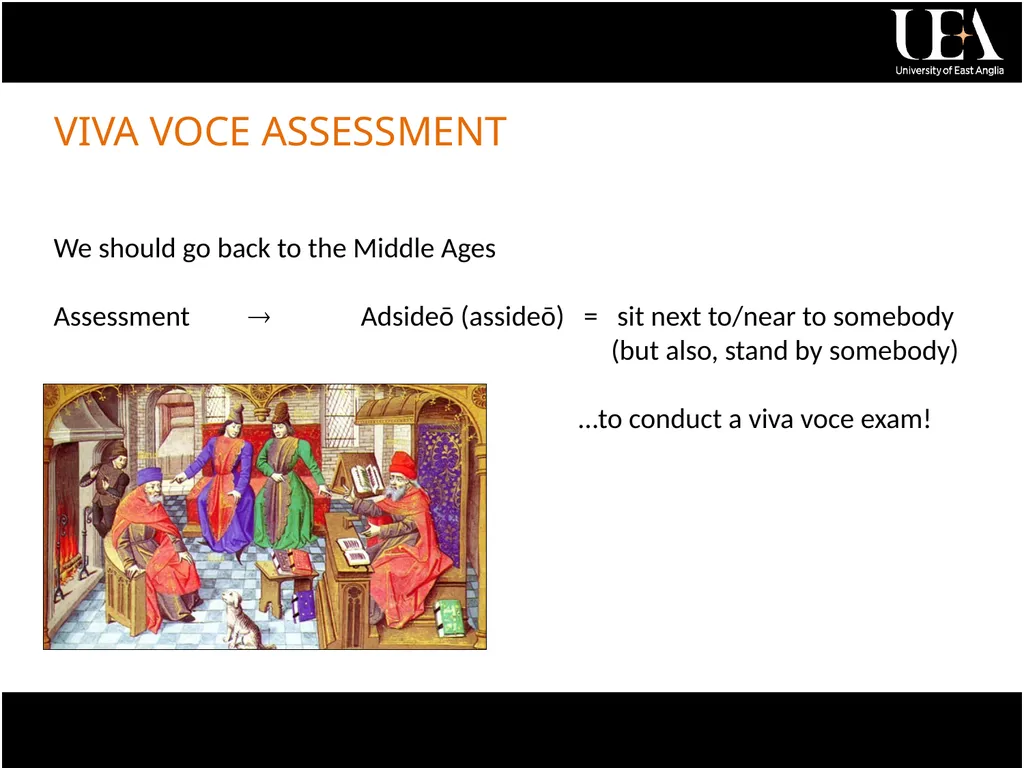
VIVA VOCE ASSESSMENT We should go back to the Middle Ages
Assessment Adsideō (assideō) = sit next to/near to somebody (but also, stand by somebody)
…to conduct a viva voce exam! 6<br>
Assessment Adsideō (assideō) = sit next to/near to somebody (but also, stand by somebody)
…to conduct a viva voce exam! 6<br>
07
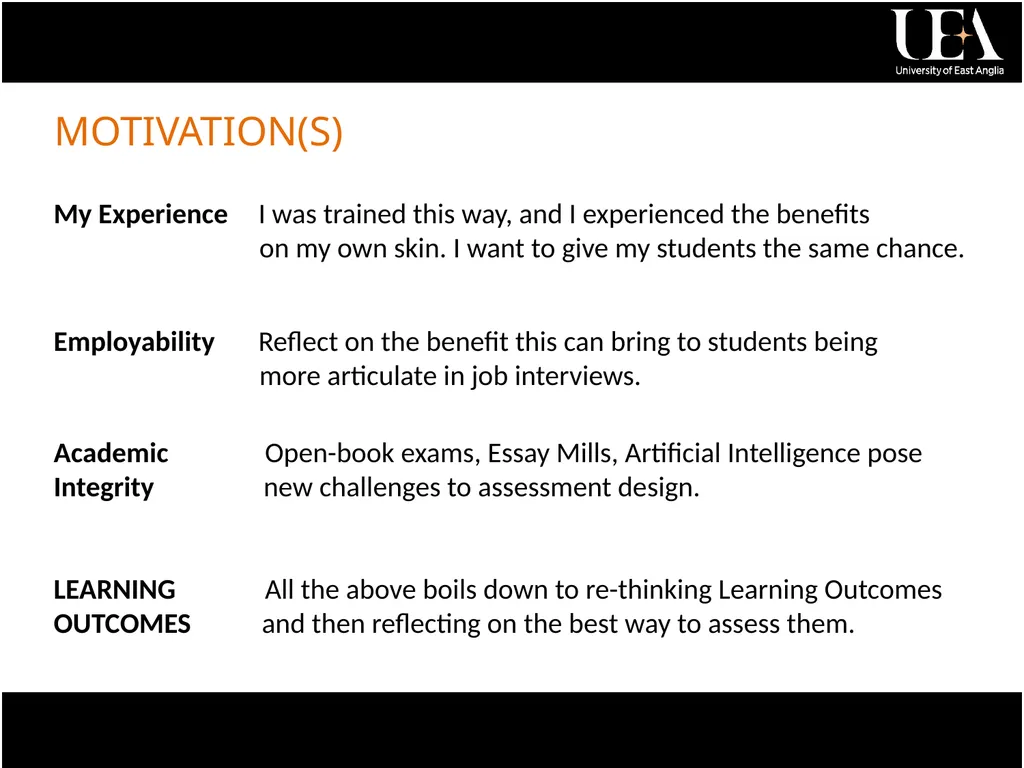
MOTIVATION(S) My Experience I was trained this way, and I experienced the benefits
on my own skin. I want to give my students the same chance.
Employability Reflect on the benefit this can bring to students being more articulate in job interviews.
Academic Open-book exams, Essay Mills, Artificial Intelligence pose Integrity new challenges to assessment design.
LEARNING All the above boils down to re-thinking Learning Outcomes
OUTCOMES and then reflecting on the best way to assess them. 7<br>
08
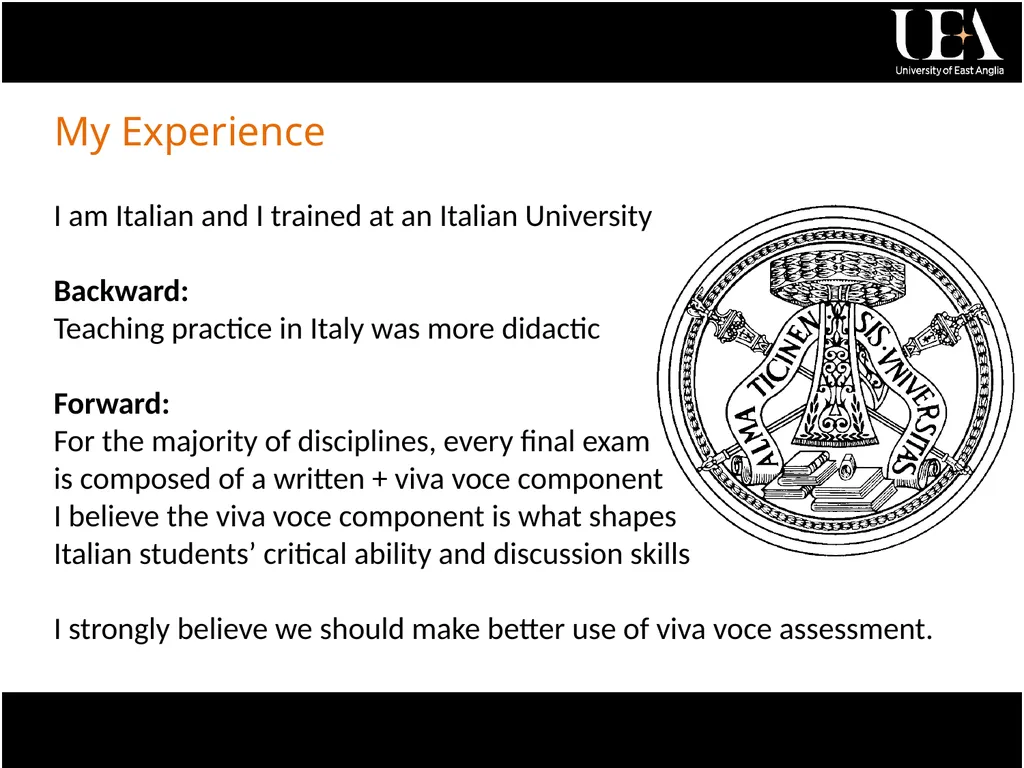
My Experience I am Italian and I trained at an Italian University
Backward:
Teaching practice in Italy was more didactic
Forward:
For the majority of disciplines, every final exam
is composed of a written + viva voce component
I believe the viva voce component is what shapes Italian students’ critical ability and discussion skills
I strongly believe we should make better use of viva voce assessment. 8<br>
09
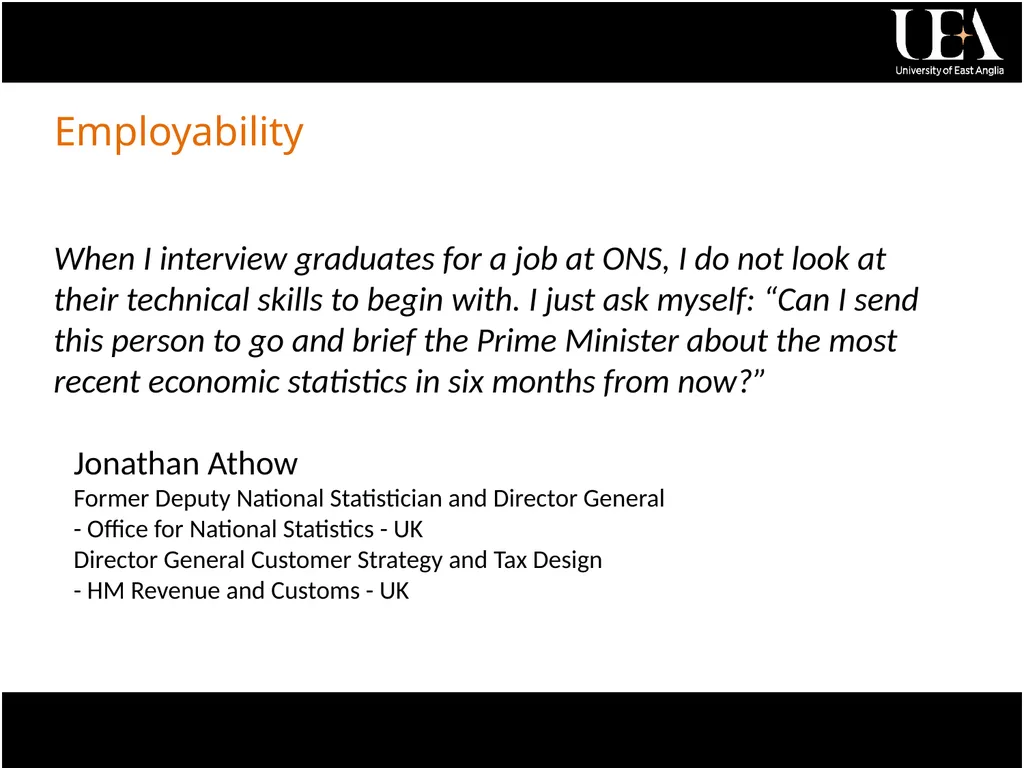
Employability When I interview graduates for a job at ONS, I do not look at their technical skills to begin with. I just ask myself: “Can I send this person to go and brief the Prime Minister about the most recent economic statistics in six months from now?”
Jonathan Athow
Former Deputy National Statistician and Director General
- Office for National Statistics - UK
Director General Customer Strategy and Tax Design
- HM Revenue and Customs - UK 9<br>
Jonathan Athow
Former Deputy National Statistician and Director General
- Office for National Statistics - UK
Director General Customer Strategy and Tax Design
- HM Revenue and Customs - UK 9<br>
10
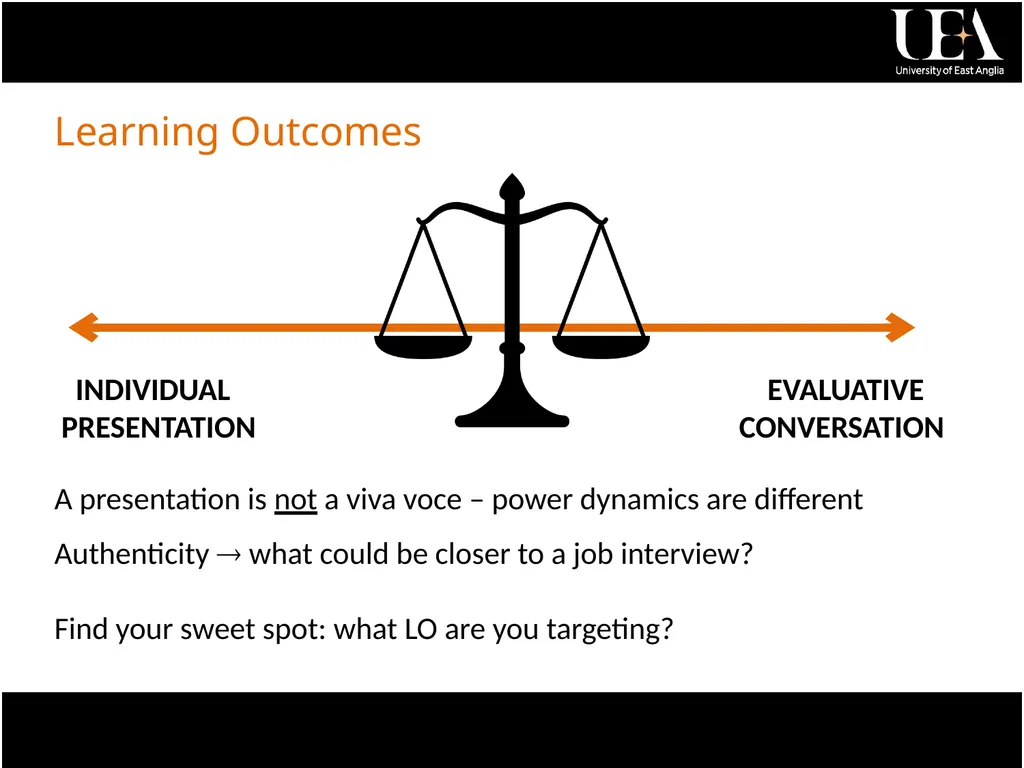
Learning Outcomes INDIVIDUAL EVALUATIVE
PRESENTATION CONVERSATION
A presentation is not a viva voce – power dynamics are different
Authenticity what could be closer to a job interview?
Find your sweet spot: what LO are you targeting? 10<br>
PRESENTATION CONVERSATION
A presentation is not a viva voce – power dynamics are different
Authenticity what could be closer to a job interview?
Find your sweet spot: what LO are you targeting? 10<br>
11
Implementing viva voce assessment: how to do it? 11<br>
12
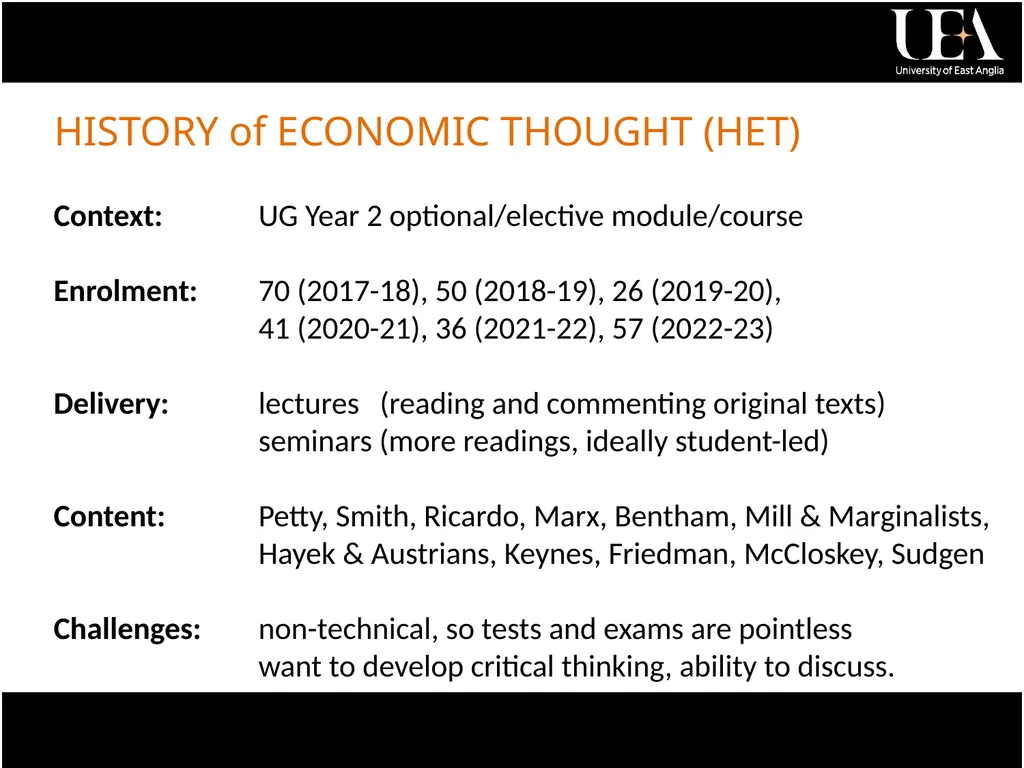
HISTORY of ECONOMIC THOUGHT (HET) Context: UG Year 2 optional/elective module/course
Enrolment: 70 (2017-18), 50 (2018-19), 26 (2019-20),
41 (2020-21), 36 (2021-22), 57 (2022-23)
Delivery: lectures (reading and commenting original texts)
seminars (more readings, ideally student-led)
Content: Petty, Smith, Ricardo, Marx, Bentham, Mill & Marginalists, Hayek & Austrians, Keynes, Friedman, McCloskey, Sudgen
Challenges: non-technical, so tests and exams are pointless
want to develop critical thinking, ability to discuss. 12<br>
13
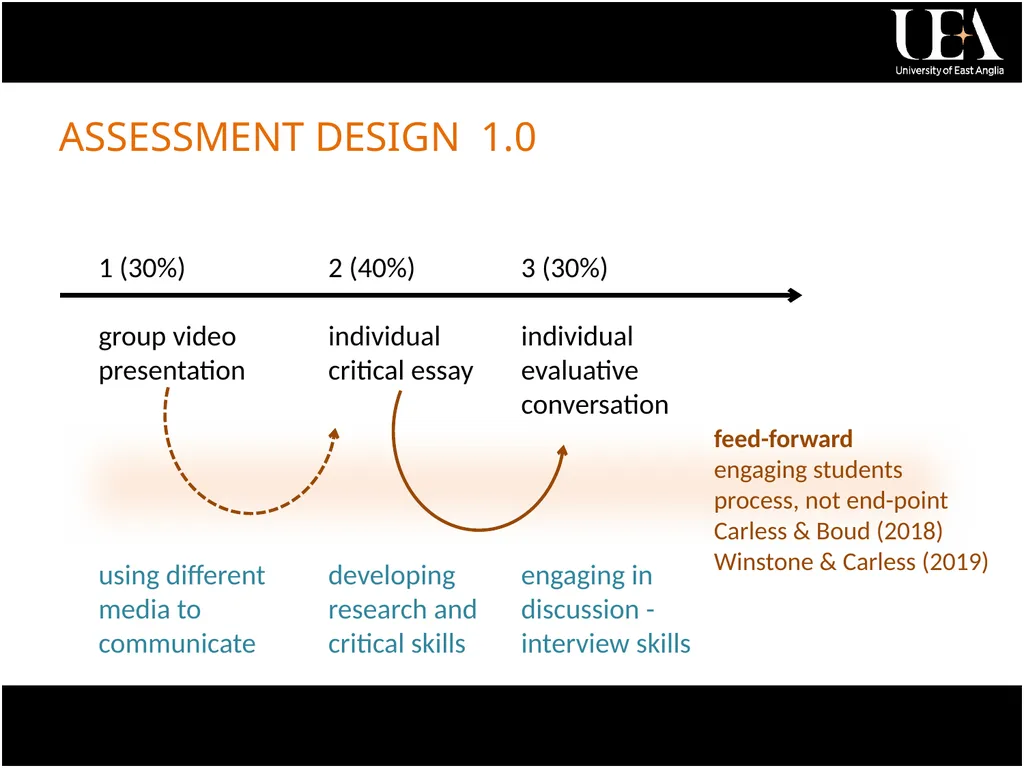
ASSESSMENT DESIGN 1.0 13 1 (30%)
group video presentation
using different media to communicate 2 (40%)
individual
critical essay
developing research and critical skills 3 (30%)
individual evaluative conversation
engaging in discussion -
interview skills feed-forward
engaging students process, not end-point
Carless & Boud (2018)
Winstone & Carless (2019)<br>
14
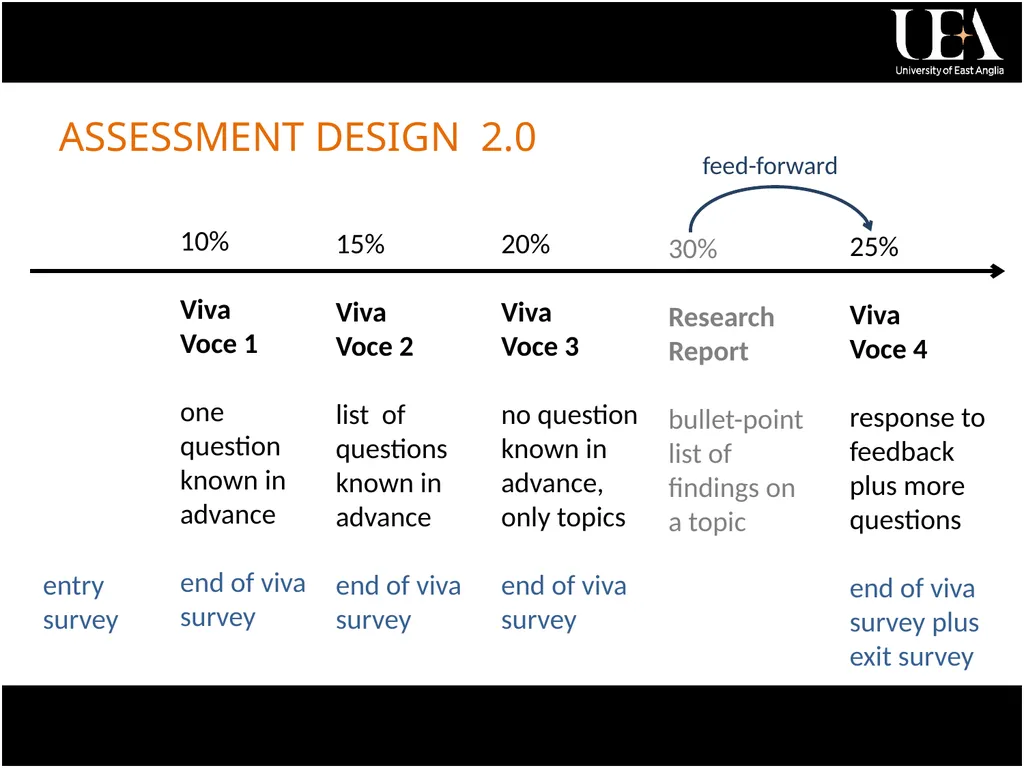
ASSESSMENT DESIGN 2.0 14 10%
Viva
Voce 1
one question known in advance
end of viva survey 15%
Viva
Voce 2
list of questions known in advance
end of viva survey 20%
Viva
Voce 3
no question known in advance, only topics
end of viva survey 30%
Research Report
bullet-point list of findings on a topic 25%
Viva
Voce 4
response to feedback plus more questions
end of viva survey plus
exit survey feed-forward entry
survey<br>
Viva
Voce 1
one question known in advance
end of viva survey 15%
Viva
Voce 2
list of questions known in advance
end of viva survey 20%
Viva
Voce 3
no question known in advance, only topics
end of viva survey 30%
Research Report
bullet-point list of findings on a topic 25%
Viva
Voce 4
response to feedback plus more questions
end of viva survey plus
exit survey feed-forward entry
survey<br>
15
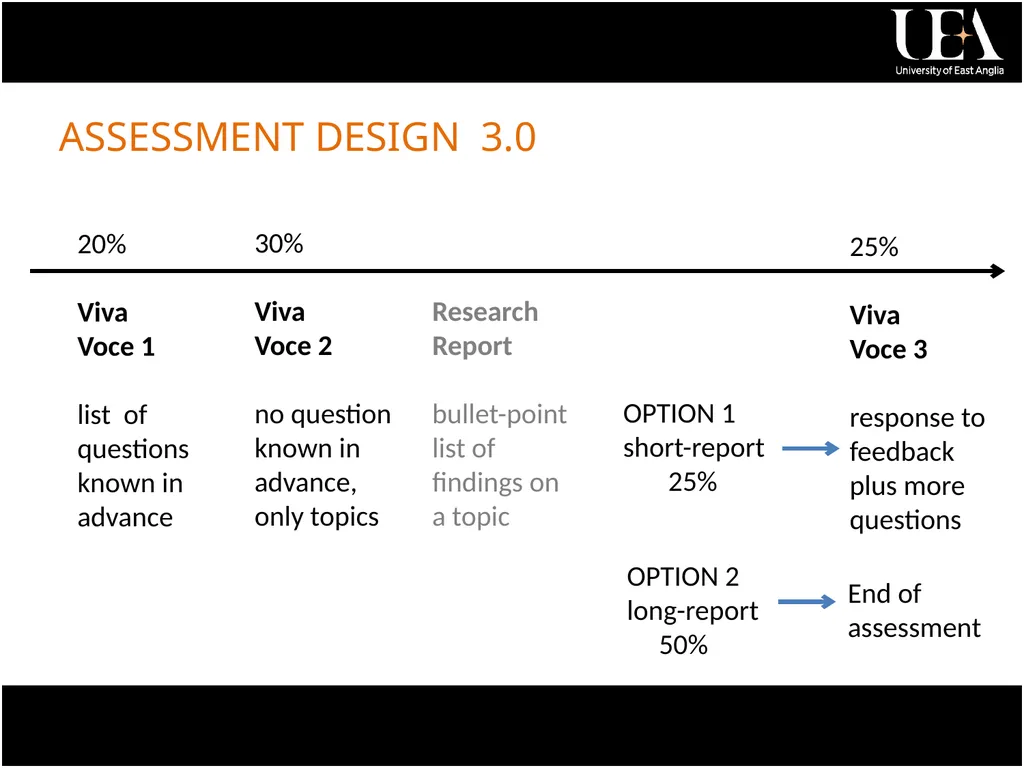
ASSESSMENT DESIGN 3.0 15 30%
Viva
Voce 2
no question known in advance, only topics Research Report
bullet-point list of findings on a topic 25%
Viva
Voce 3
response to feedback plus more questions 20%
Viva
Voce 1
list of questions known in advance OPTION 1 short-report
25% OPTION 2 long-report
50% End of assessment<br>
Viva
Voce 2
no question known in advance, only topics Research Report
bullet-point list of findings on a topic 25%
Viva
Voce 3
response to feedback plus more questions 20%
Viva
Voce 1
list of questions known in advance OPTION 1 short-report
25% OPTION 2 long-report
50% End of assessment<br>
16
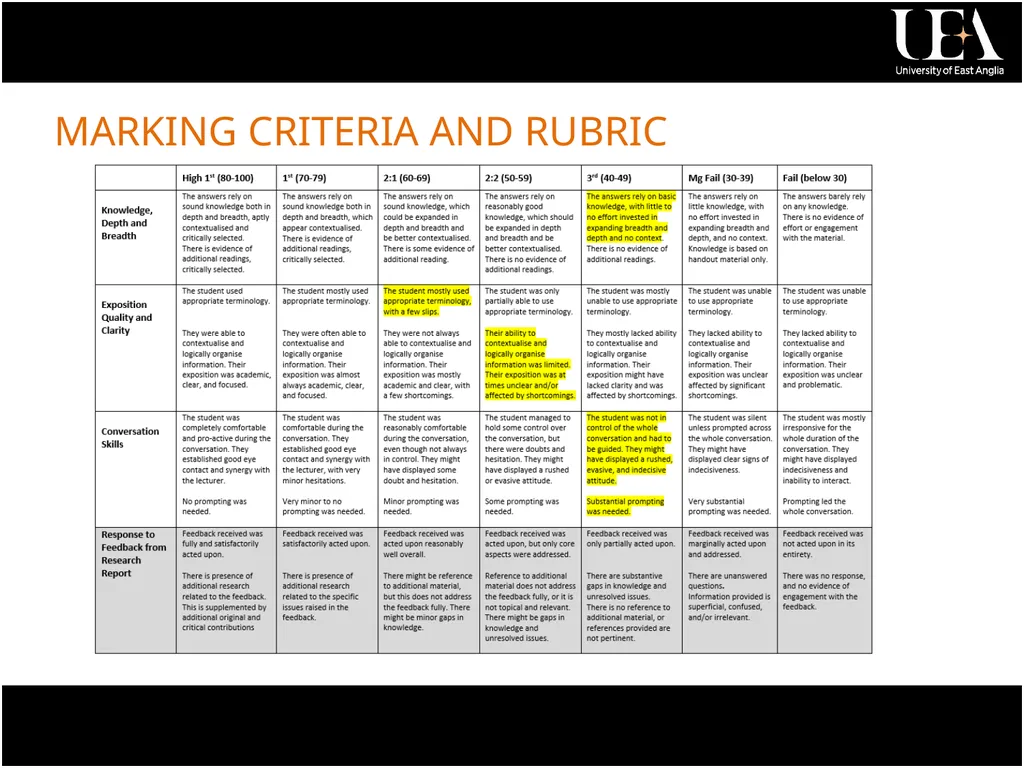
MARKING CRITERIA AND RUBRIC 16<br>
17
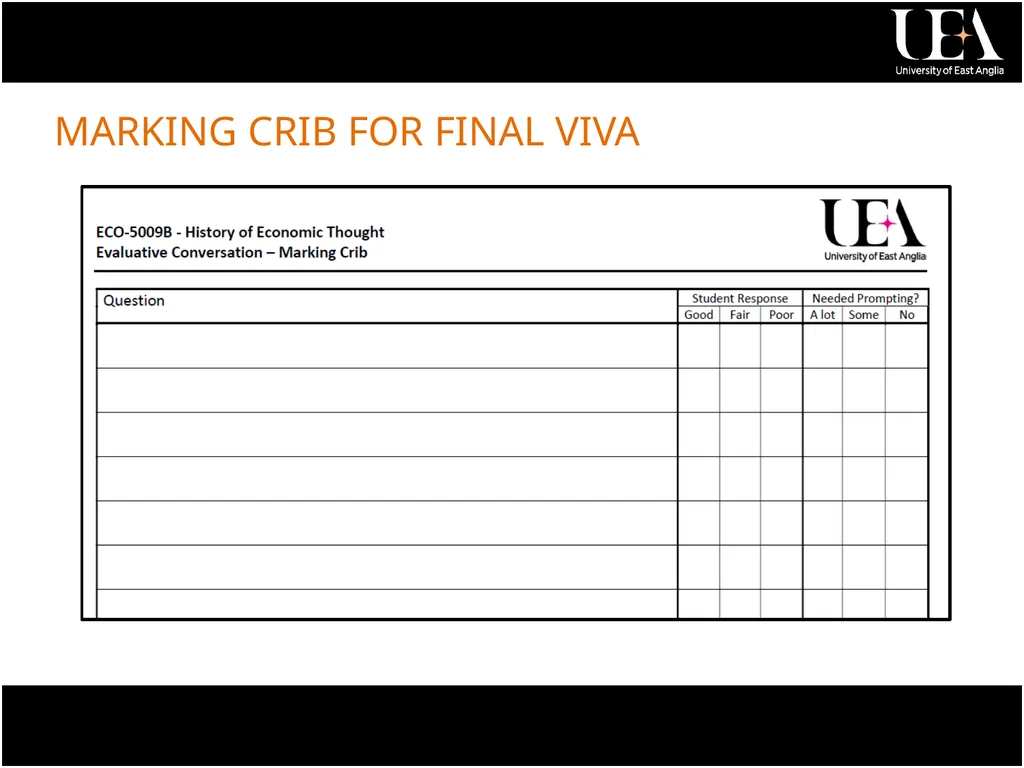
MARKING CRIB FOR FINAL VIVA 17<br>
18
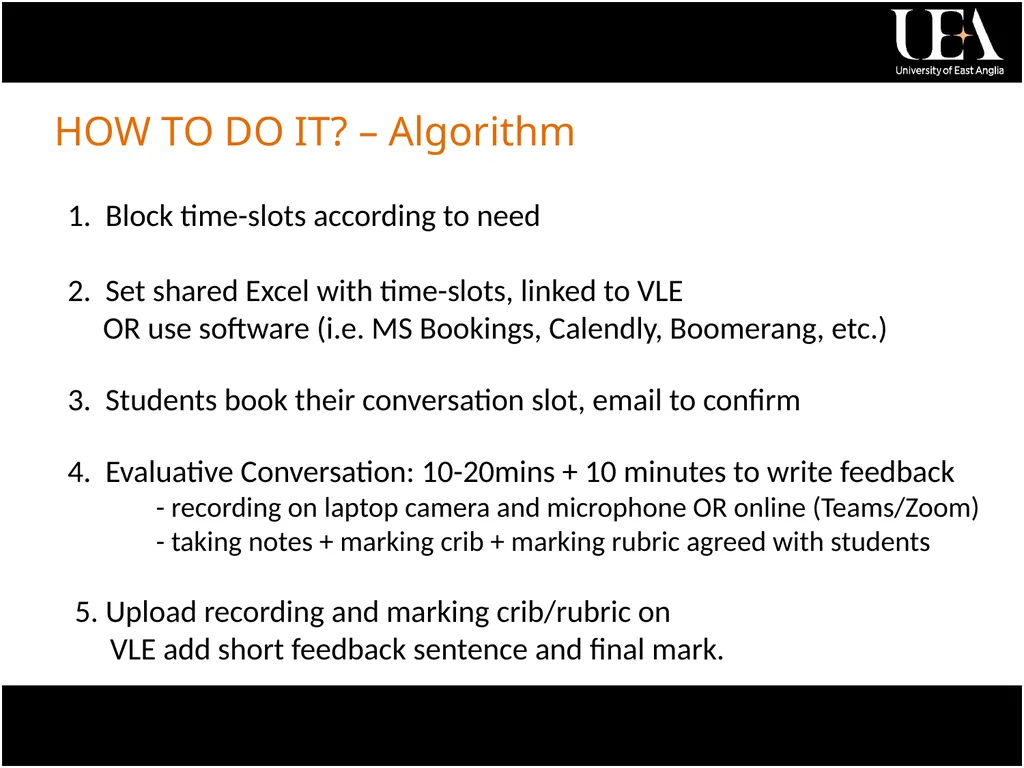
HOW TO DO IT? – Algorithm 1. Block time-slots according to need
2. Set shared Excel with time-slots, linked to VLE OR use software (i.e. MS Bookings, Calendly, Boomerang, etc.)
3. Students book their conversation slot, email to confirm
4. Evaluative Conversation: 10-20mins + 10 minutes to write feedback
- recording on laptop camera and microphone OR online (Teams/Zoom)
- taking notes + marking crib + marking rubric agreed with students
5. Upload recording and marking crib/rubric on VLE add short feedback sentence and final mark. 18<br>
19
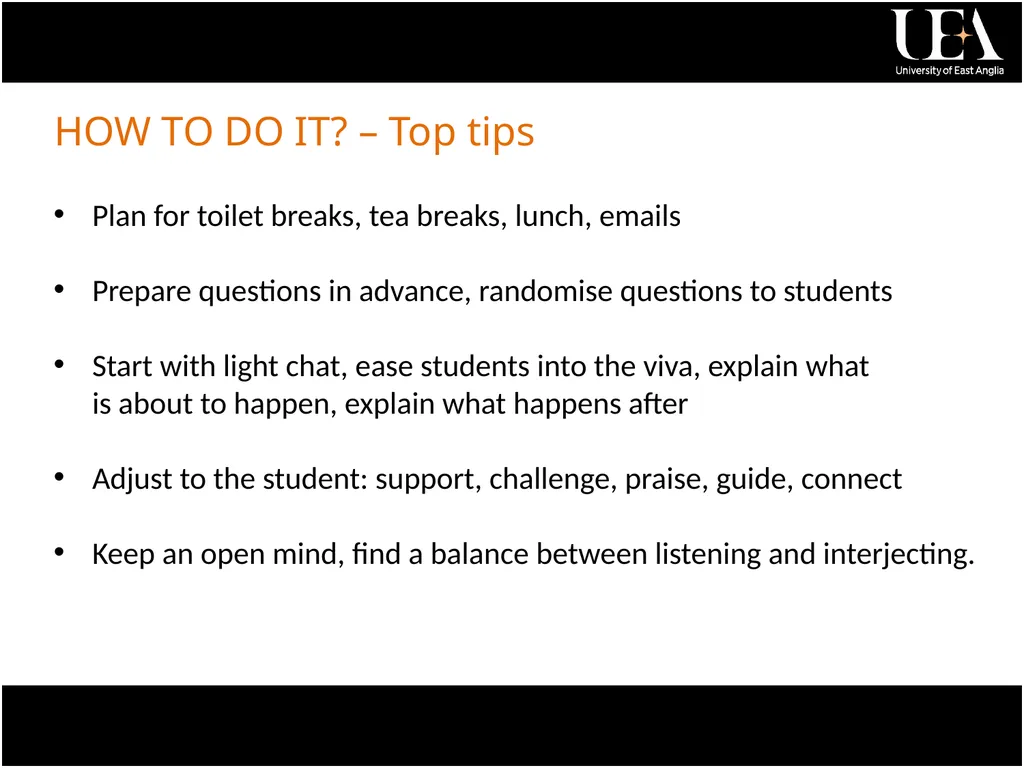
HOW TO DO IT? – Top tips Plan for toilet breaks, tea breaks, lunch, emails
Prepare questions in advance, randomise questions to students
Start with light chat, ease students into the viva, explain what is about to happen, explain what happens after
Adjust to the student: support, challenge, praise, guide, connect
Keep an open mind, find a balance between listening and interjecting. 19<br>
20
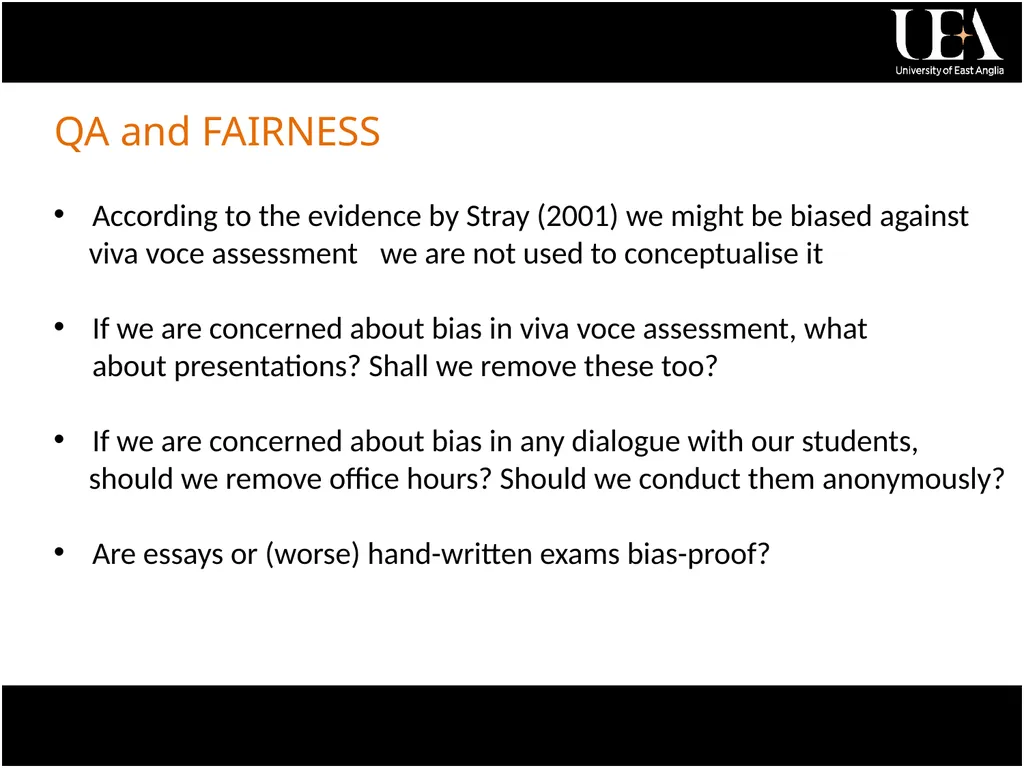
QA and FAIRNESS According to the evidence by Stray (2001) we might be biased against
viva voce assessment we are not used to conceptualise it
If we are concerned about bias in viva voce assessment, what about presentations? Shall we remove these too?
If we are concerned about bias in any dialogue with our students,
should we remove office hours? Should we conduct them anonymously?
Are essays or (worse) hand-written exams bias-proof? 20<br>
21
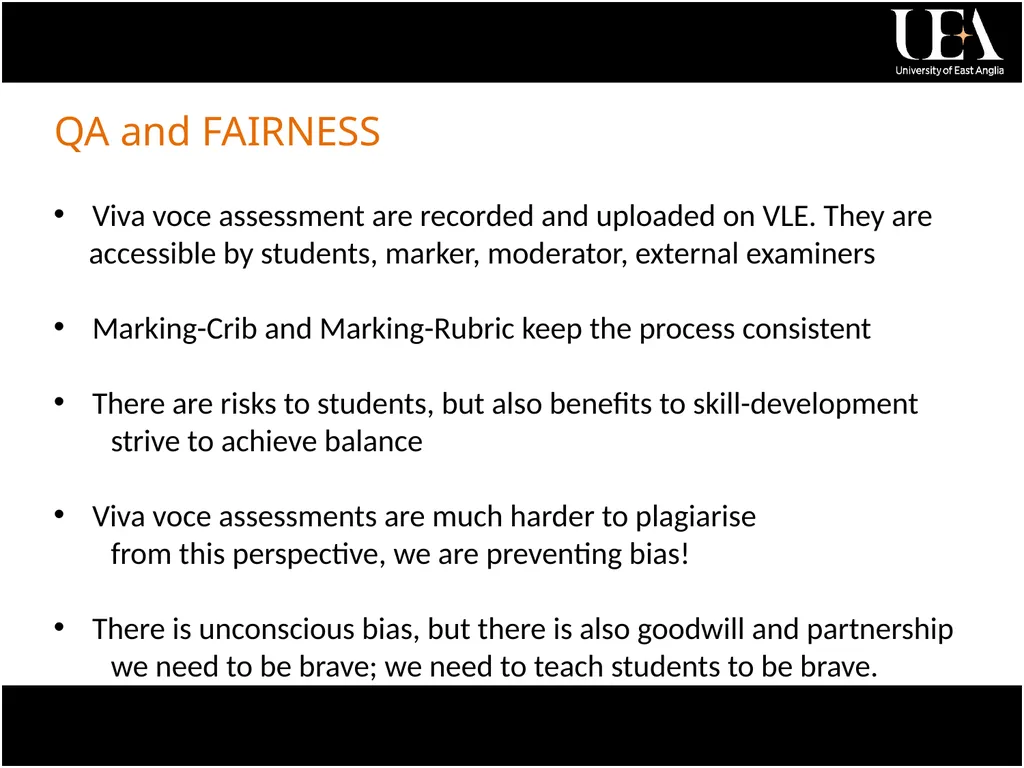
QA and FAIRNESS Viva voce assessment are recorded and uploaded on VLE. They are
accessible by students, marker, moderator, external examiners
Marking-Crib and Marking-Rubric keep the process consistent
There are risks to students, but also benefits to skill-development
strive to achieve balance
Viva voce assessments are much harder to plagiarise
from this perspective, we are preventing bias!
There is unconscious bias, but there is also goodwill and partnership
we need to be brave; we need to teach students to be brave. 21<br>
22
Research
and
Evaluation 22<br>
23
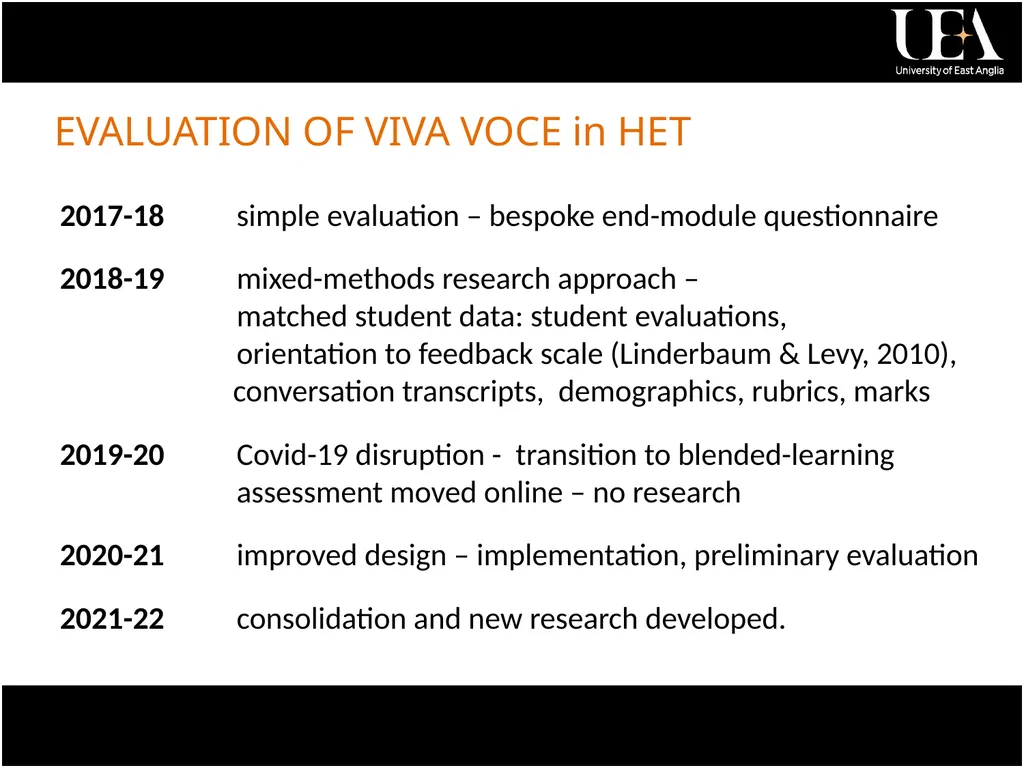
EVALUATION OF VIVA VOCE in HET 2017-18 simple evaluation – bespoke end-module questionnaire
2018-19 mixed-methods research approach – matched student data: student evaluations, orientation to feedback scale (Linderbaum & Levy, 2010),
conversation transcripts, demographics, rubrics, marks
2019-20 Covid-19 disruption - transition to blended-learning assessment moved online – no research
2020-21 improved design – implementation, preliminary evaluation
2021-22 consolidation and new research developed. 23<br>
24
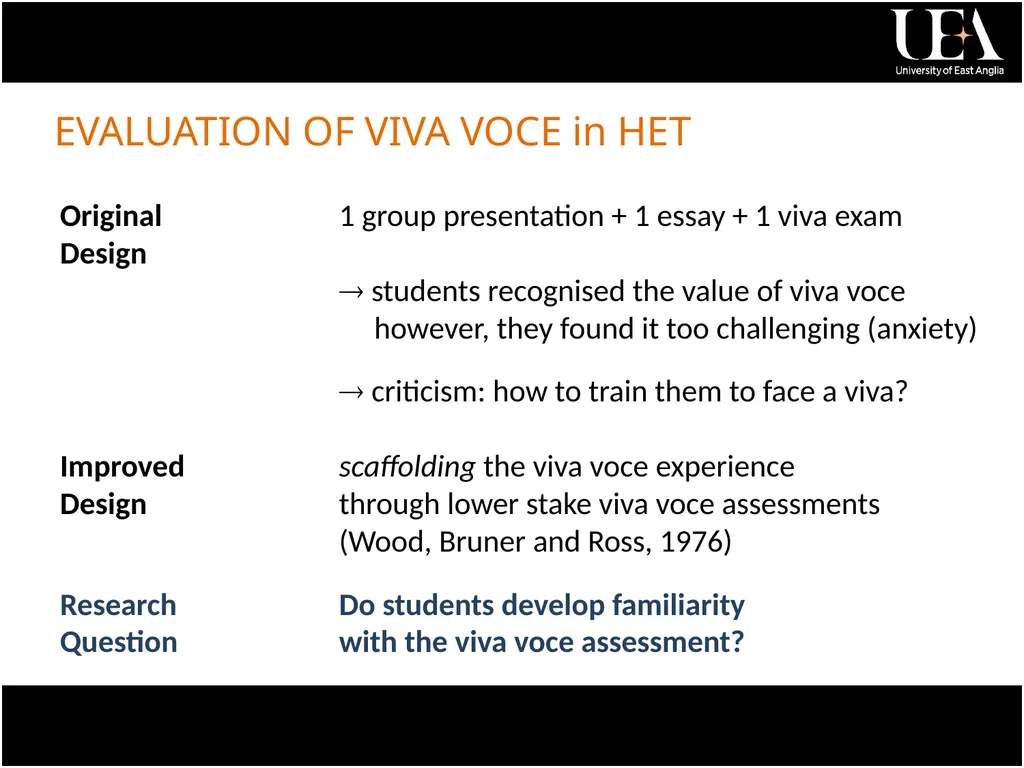
EVALUATION OF VIVA VOCE in HET Original 1 group presentation + 1 essay + 1 viva exam
Design
students recognised the value of viva voce
however, they found it too challenging (anxiety)
criticism: how to train them to face a viva?
Improved scaffolding the viva voce experience
Design through lower stake viva voce assessments
(Wood, Bruner and Ross, 1976)
Research Do students develop familiarity
Question with the viva voce assessment? 24<br>
25
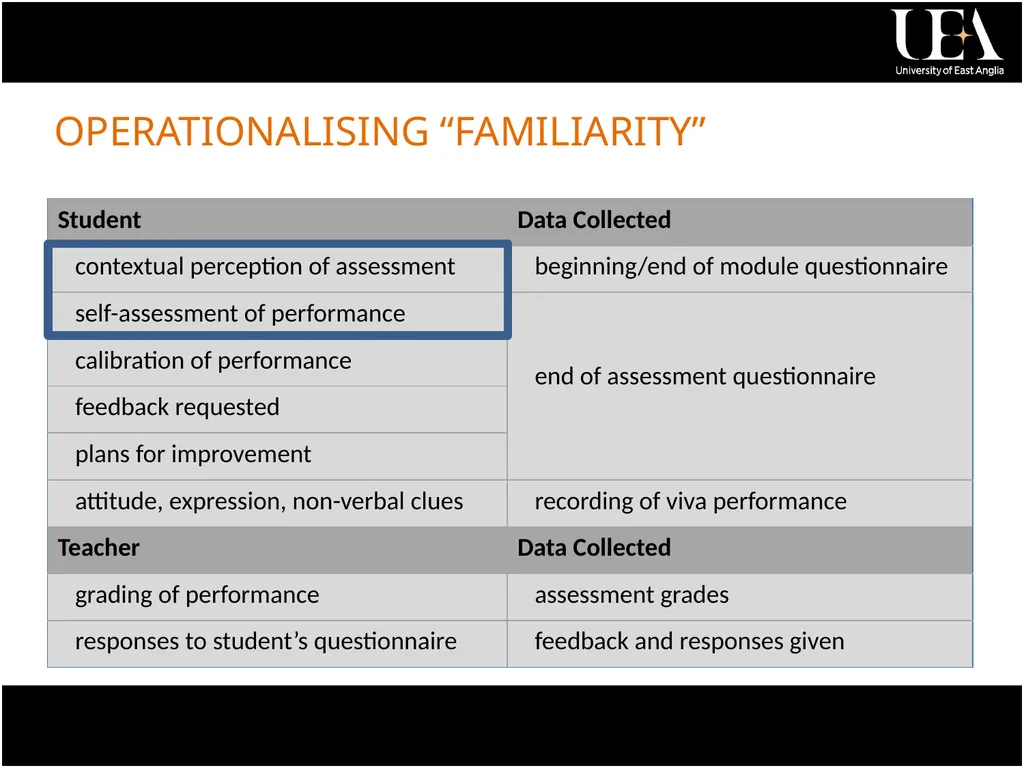
OPERATIONALISING “FAMILIARITY” 25<br>
26
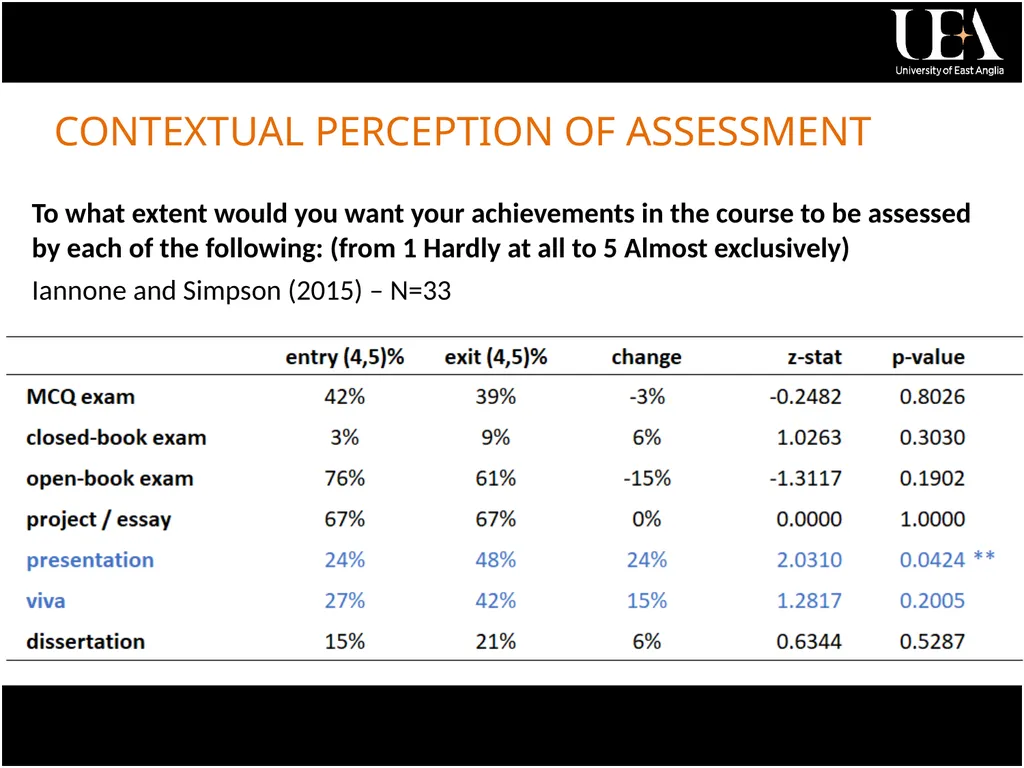
CONTEXTUAL PERCEPTION OF ASSESSMENT To what extent would you want your achievements in the course to be assessed by each of the following: (from 1 Hardly at all to 5 Almost exclusively)
Iannone and Simpson (2015) – N=33 26<br>
Iannone and Simpson (2015) – N=33 26<br>
27
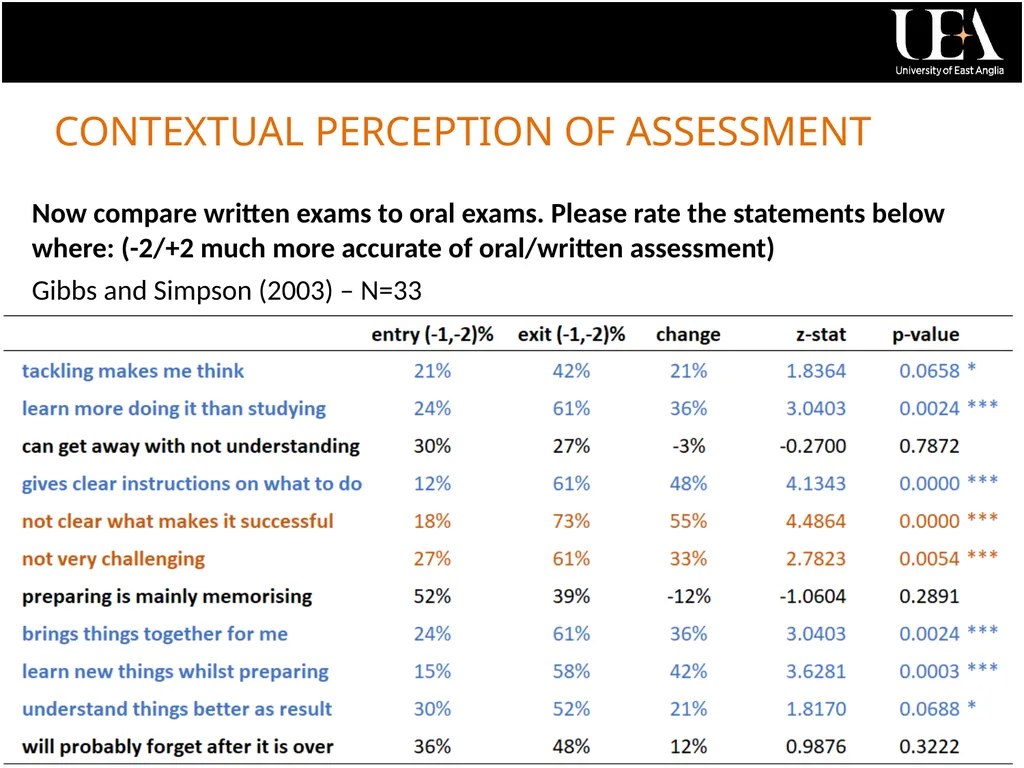
CONTEXTUAL PERCEPTION OF ASSESSMENT Now compare written exams to oral exams. Please rate the statements below where: (-2/+2 much more accurate of oral/written assessment)
Gibbs and Simpson (2003) – N=33 27<br>
Gibbs and Simpson (2003) – N=33 27<br>
28
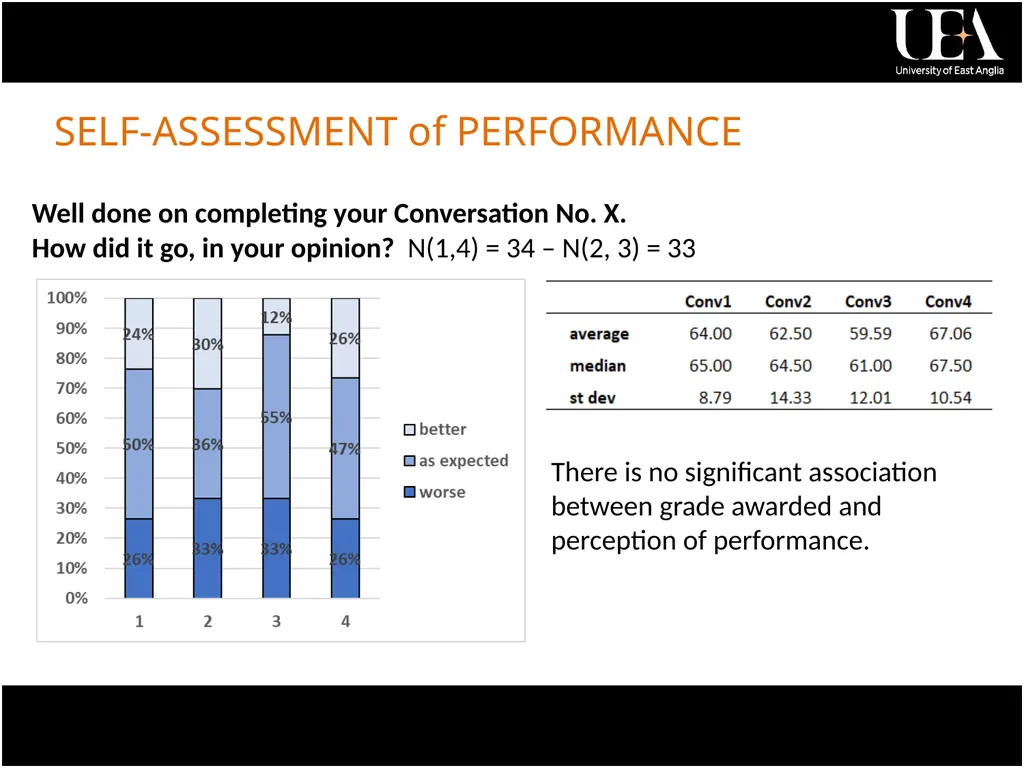
SELF-ASSESSMENT of PERFORMANCE Well done on completing your Conversation No. X.
How did it go, in your opinion? N(1,4) = 34 – N(2, 3) = 33 28 There is no significant association between grade awarded and perception of performance.<br>
29
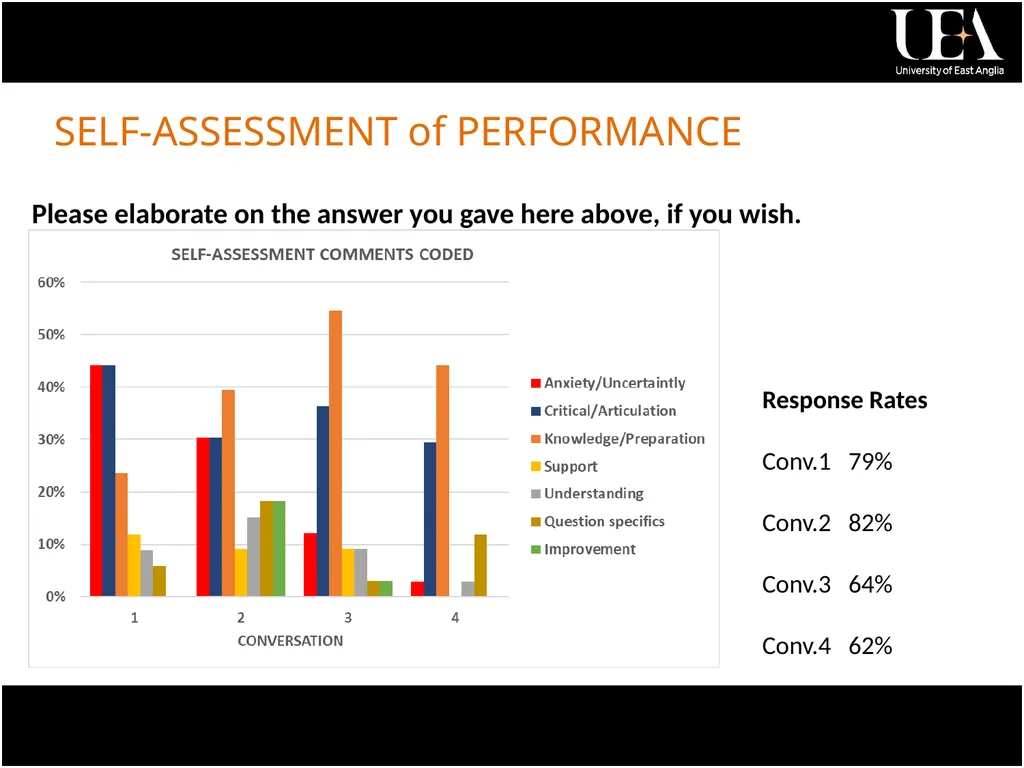
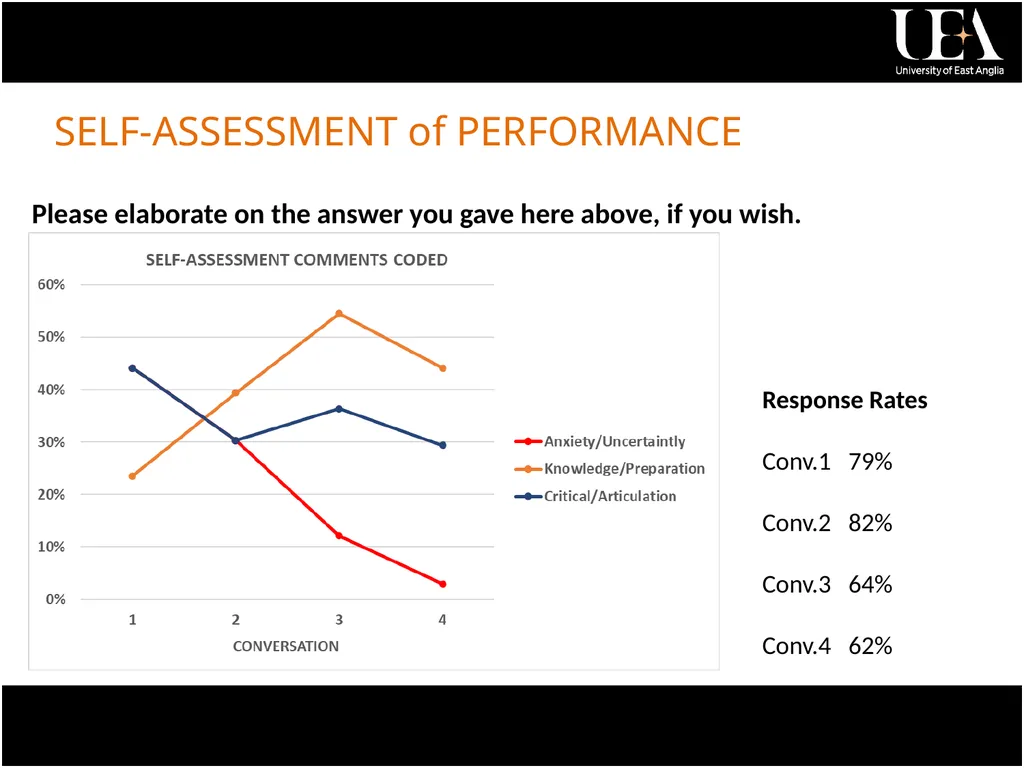
SELF-ASSESSMENT of PERFORMANCE Please elaborate on the answer you gave here above, if you wish. 29 Response Rates
Conv.1 79%
Conv.2 82%
Conv.3 64%
Conv.4 62%<br>
Conv.1 79%
Conv.2 82%
Conv.3 64%
Conv.4 62%<br>
30
SELF-ASSESSMENT of PERFORMANCE Please elaborate on the answer you gave here above, if you wish. 30 Response Rates
Conv.1 79%
Conv.2 82%
Conv.3 64%
Conv.4 62%<br>
Conv.1 79%
Conv.2 82%
Conv.3 64%
Conv.4 62%<br>
31
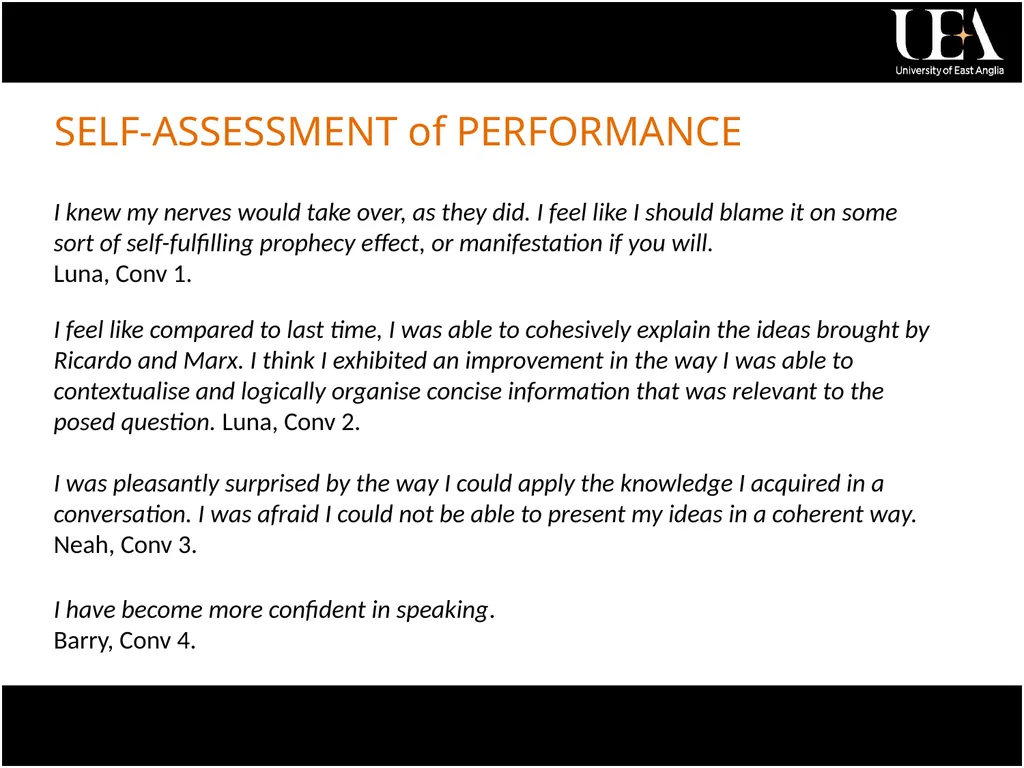
SELF-ASSESSMENT of PERFORMANCE 31 I knew my nerves would take over, as they did. I feel like I should blame it on some sort of self-fulfilling prophecy effect, or manifestation if you will.
Luna, Conv 1. I feel like compared to last time, I was able to cohesively explain the ideas brought by Ricardo and Marx. I think I exhibited an improvement in the way I was able to contextualise and logically organise concise information that was relevant to the posed question. Luna, Conv 2. I was pleasantly surprised by the way I could apply the knowledge I acquired in a conversation. I was afraid I could not be able to present my ideas in a coherent way.
Neah, Conv 3. I have become more confident in speaking.
Barry, Conv 4.<br>
32
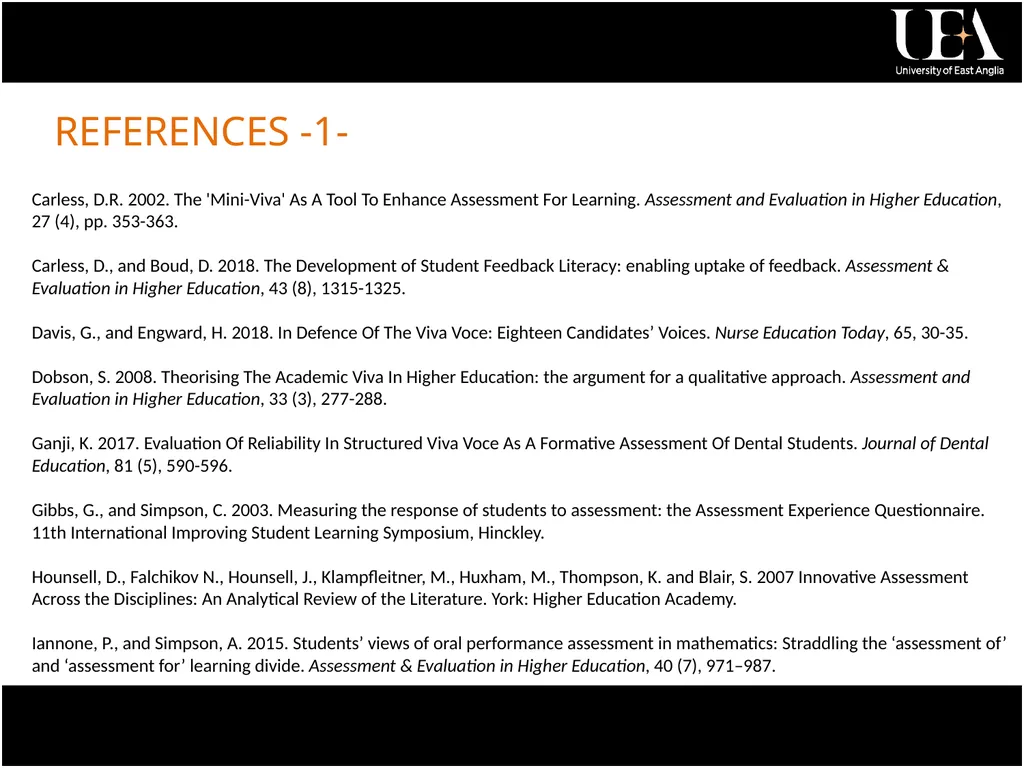
REFERENCES -1- Carless, D.R. 2002. The 'Mini-Viva' As A Tool To Enhance Assessment For Learning. Assessment and Evaluation in Higher Education, 27 (4), pp. 353-363.
Carless, D., and Boud, D. 2018. The Development of Student Feedback Literacy: enabling uptake of feedback. Assessment & Evaluation in Higher Education, 43 (8), 1315-1325.
Davis, G., and Engward, H. 2018. In Defence Of The Viva Voce: Eighteen Candidates’ Voices. Nurse Education Today, 65, 30-35.
Dobson, S. 2008. Theorising The Academic Viva In Higher Education: the argument for a qualitative approach. Assessment and Evaluation in Higher Education, 33 (3), 277-288.
Ganji, K. 2017. Evaluation Of Reliability In Structured Viva Voce As A Formative Assessment Of Dental Students. Journal of Dental Education, 81 (5), 590-596.
Gibbs, G., and Simpson, C. 2003. Measuring the response of students to assessment: the Assessment Experience Questionnaire. 11th International Improving Student Learning Symposium, Hinckley.
Hounsell, D., Falchikov N., Hounsell, J., Klampfleitner, M., Huxham, M., Thompson, K. and Blair, S. 2007 Innovative Assessment Across the Disciplines: An Analytical Review of the Literature. York: Higher Education Academy.
Iannone, P., and Simpson, A. 2015. Students’ views of oral performance assessment in mathematics: Straddling the ‘assessment of’ and ‘assessment for’ learning divide. Assessment & Evaluation in Higher Education, 40 (7), 971–987. 32<br>
33
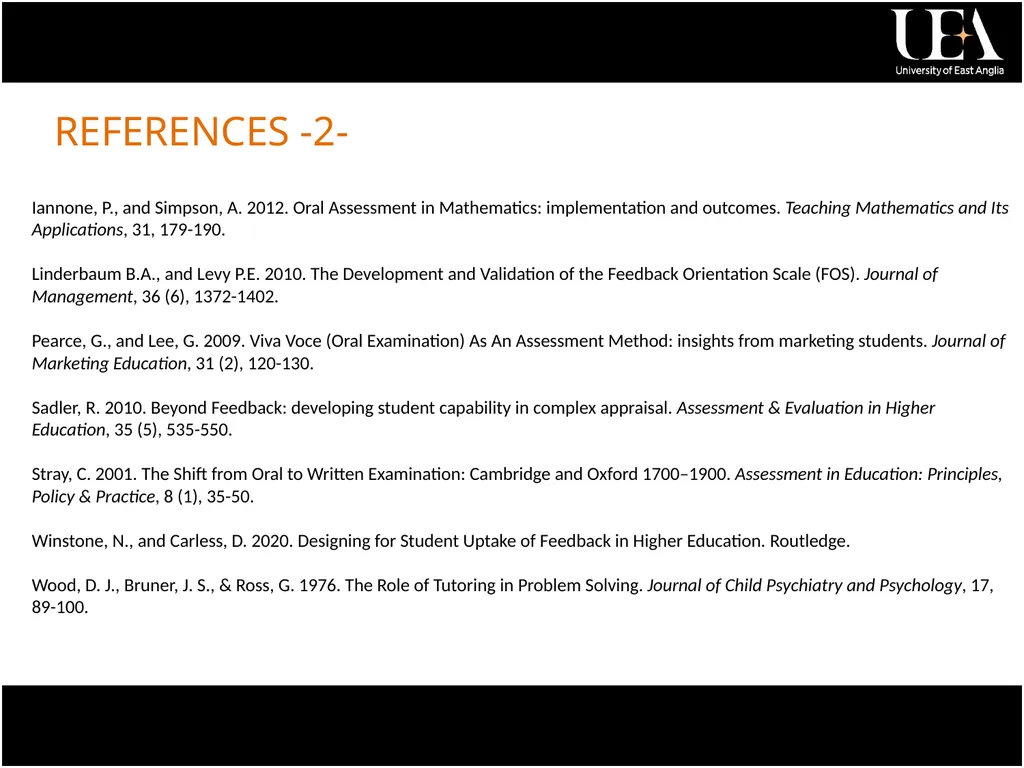
REFERENCES -2- Iannone, P., and Simpson, A. 2012. Oral Assessment in Mathematics: implementation and outcomes. Teaching Mathematics and Its Applications, 31, 179-190.
Linderbaum B.A., and Levy P.E. 2010. The Development and Validation of the Feedback Orientation Scale (FOS). Journal of Management, 36 (6), 1372-1402.
Pearce, G., and Lee, G. 2009. Viva Voce (Oral Examination) As An Assessment Method: insights from marketing students. Journal of Marketing Education, 31 (2), 120-130.
Sadler, R. 2010. Beyond Feedback: developing student capability in complex appraisal. Assessment & Evaluation in Higher Education, 35 (5), 535-550.
Stray, C. 2001. The Shift from Oral to Written Examination: Cambridge and Oxford 1700–1900. Assessment in Education: Principles, Policy & Practice, 8 (1), 35-50.
Winstone, N., and Carless, D. 2020. Designing for Student Uptake of Feedback in Higher Education. Routledge.
Wood, D. J., Bruner, J. S., & Ross, G. 1976. The Role of Tutoring in Problem Solving. Journal of Child Psychiatry and Psychology, 17, 89-100. 33<br>
34
Fabio R. Aricò
University of East Anglia
Paola Iannone Loughborough University Manchester – April 2023 Introducing and Developing Familiarity with Viva Voce Assessment in Undergraduate Education<br>
Paola Iannone Loughborough University Manchester – April 2023 Introducing and Developing Familiarity with Viva Voce Assessment in Undergraduate Education<br>