
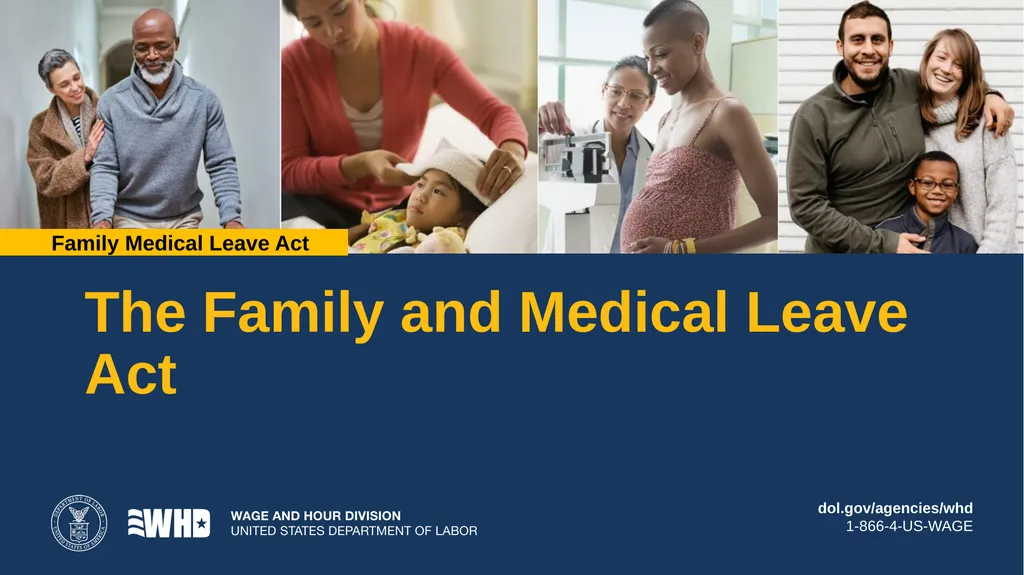
Family Medical Leave Act The Family and Medical
GB
Published · 64 slides · 0 views

1 / 1





Description
Family Medical Leave Act The Family and Medical Leave Act Disclaimer This presentation is intended as general information only and does not carry the force of legal opinion. The Department of Labor is providing this information as a public
Related Topics
Share
Embed code
Download this presentation From Below
"Family Medical Leave Act The Family and Medical" is the property of its rightful owner. Permission is granted to download and print the materials on this website for personal, non-commercial use only, and to display it on your personal computer provided you do not modify the materials and that you retain all copyright notices contained in the materials. By downloading content from our website, you accept the terms of this agreement.
Presentation Transcript
01
Family Medical Leave Act The Family and Medical Leave Act<br>
02
Disclaimer This presentation is intended as general information only and does not carry the force of legal opinion.
The Department of Labor is providing this information as a public service. This information and related materials are presented to give the public access to information on Department of Labor programs. You should be aware that, while we try to keep the information timely and accurate, there will often be a delay between official publications of the materials and the modification of these pages. Therefore, we make no express or implied guarantees. The Federal Register and the Code of Federal Regulations remain the official source for regulatory information published by the Department of Labor. We will make every effort to keep this information current and to correct errors brought to our attention.<br>
The Department of Labor is providing this information as a public service. This information and related materials are presented to give the public access to information on Department of Labor programs. You should be aware that, while we try to keep the information timely and accurate, there will often be a delay between official publications of the materials and the modification of these pages. Therefore, we make no express or implied guarantees. The Federal Register and the Code of Federal Regulations remain the official source for regulatory information published by the Department of Labor. We will make every effort to keep this information current and to correct errors brought to our attention.<br>
03
Presentation Topics Introduction to the FMLA
Family Relationships under the FMLA
FMLA-Protected Leave Reasons
Taking FMLA Leave
Administering FMLA Leave
Employee Rights
Helpful Resources<br>
Family Relationships under the FMLA
FMLA-Protected Leave Reasons
Taking FMLA Leave
Administering FMLA Leave
Employee Rights
Helpful Resources<br>
04
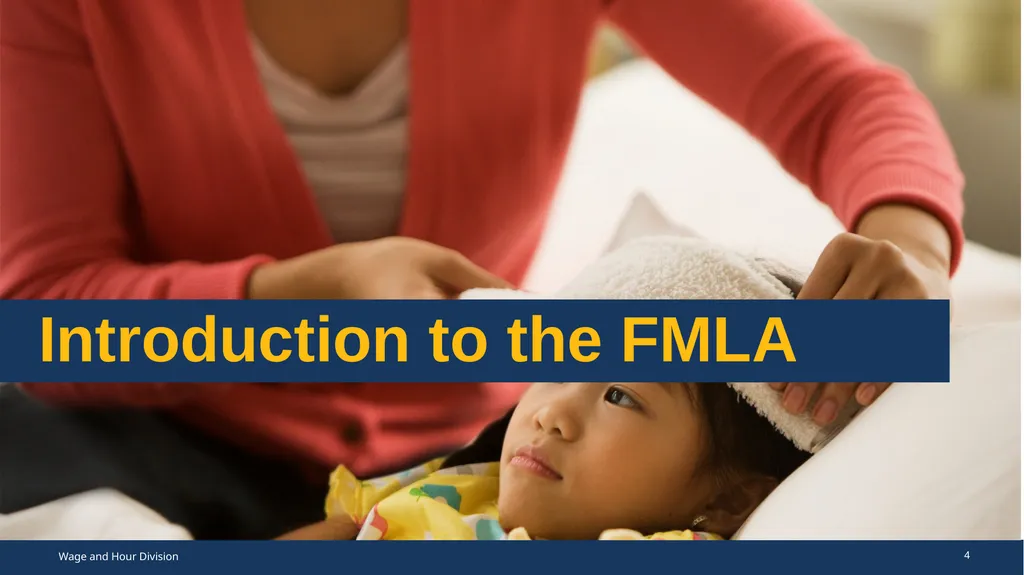
Introduction to the FMLA<br>
05
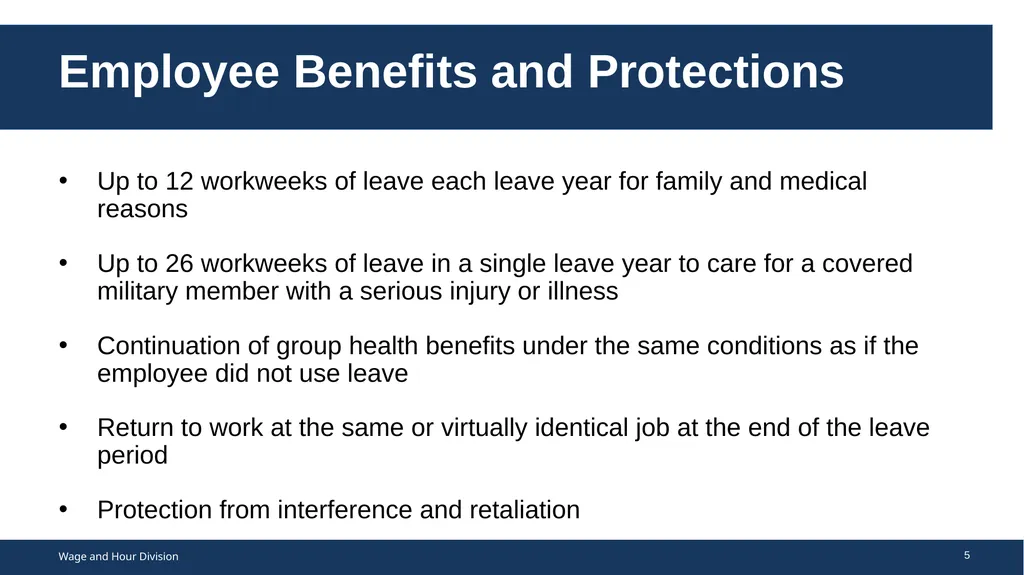
Employee Benefits and Protections Up to 12 workweeks of leave each leave year for family and medical reasons
Up to 26 workweeks of leave in a single leave year to care for a covered military member with a serious injury or illness
Continuation of group health benefits under the same conditions as if the employee did not use leave
Return to work at the same or virtually identical job at the end of the leave period
Protection from interference and retaliation<br>
06
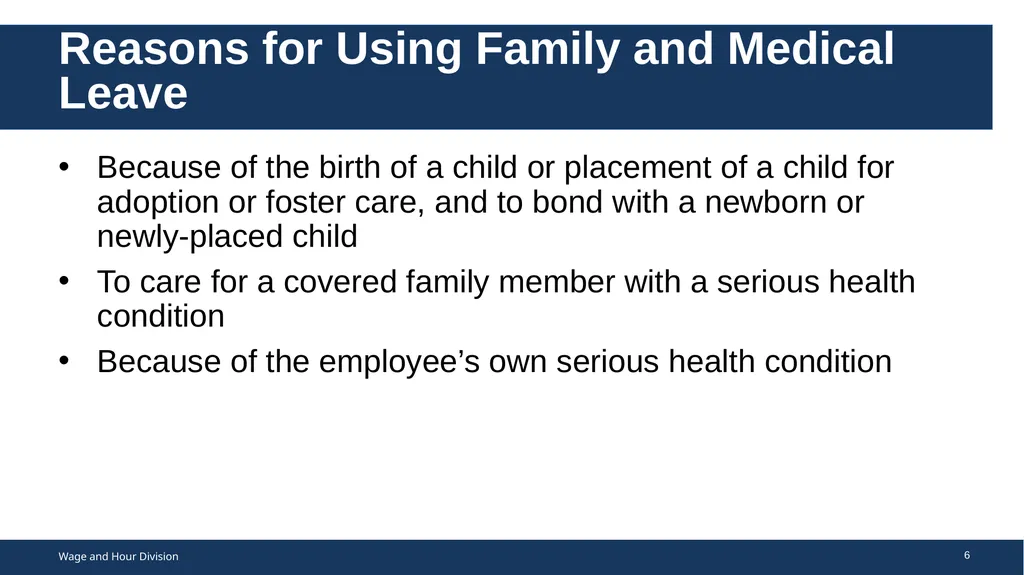
Reasons for Using Family and Medical Leave Because of the birth of a child or placement of a child for adoption or foster care, and to bond with a newborn or newly-placed child
To care for a covered family member with a serious health condition
Because of the employee’s own serious health condition<br>
To care for a covered family member with a serious health condition
Because of the employee’s own serious health condition<br>
07
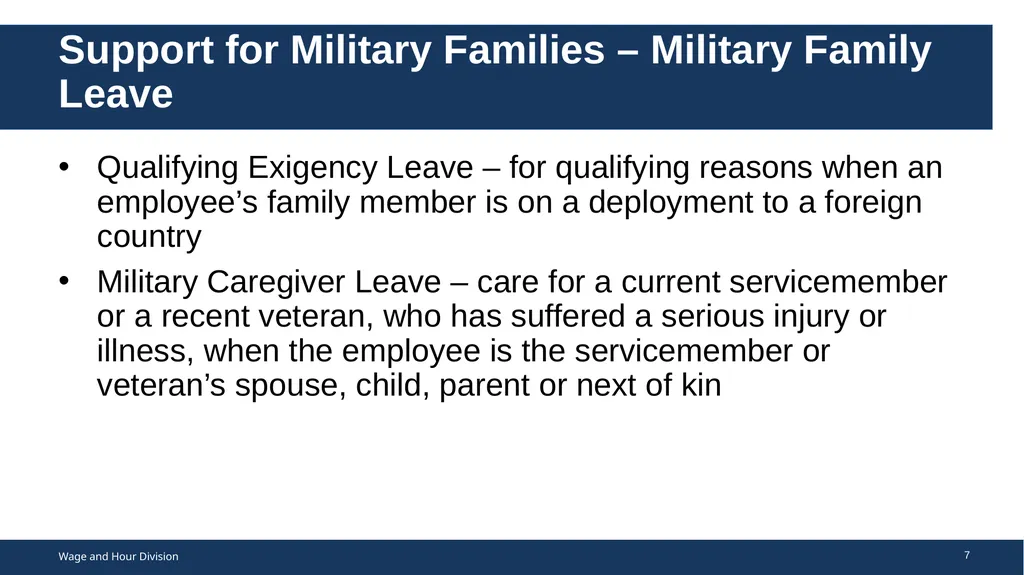
Support for Military Families – Military Family Leave Qualifying Exigency Leave – for qualifying reasons when an employee’s family member is on a deployment to a foreign country
Military Caregiver Leave – care for a current servicemember or a recent veteran, who has suffered a serious injury or illness, when the employee is the servicemember or veteran’s spouse, child, parent or next of kin<br>
Military Caregiver Leave – care for a current servicemember or a recent veteran, who has suffered a serious injury or illness, when the employee is the servicemember or veteran’s spouse, child, parent or next of kin<br>
08
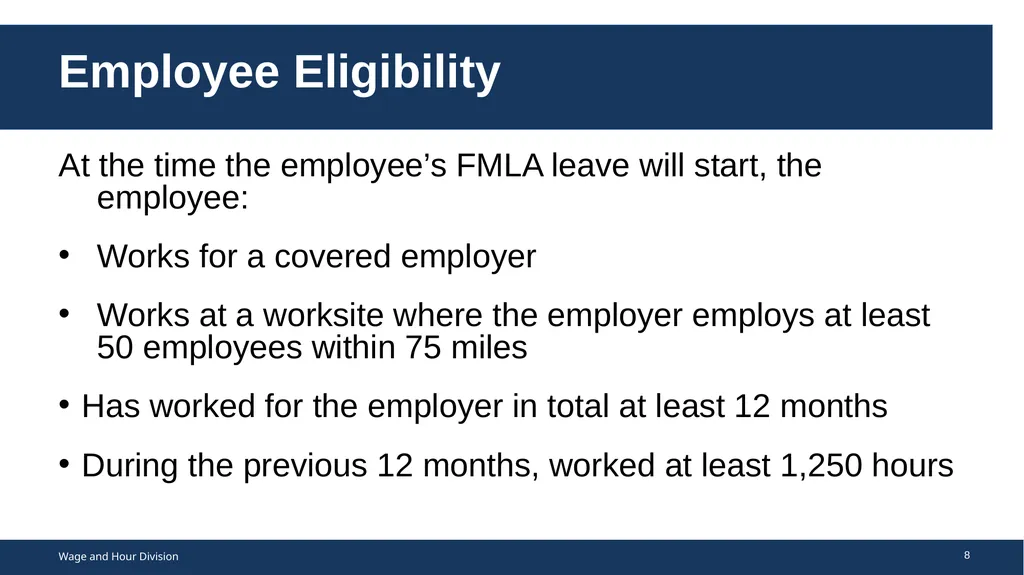
Employee Eligibility At the time the employee’s FMLA leave will start, the employee:
Works for a covered employer
Works at a worksite where the employer employs at least 50 employees within 75 miles
Has worked for the employer in total at least 12 months
During the previous 12 months, worked at least 1,250 hours<br>
Works for a covered employer
Works at a worksite where the employer employs at least 50 employees within 75 miles
Has worked for the employer in total at least 12 months
During the previous 12 months, worked at least 1,250 hours<br>
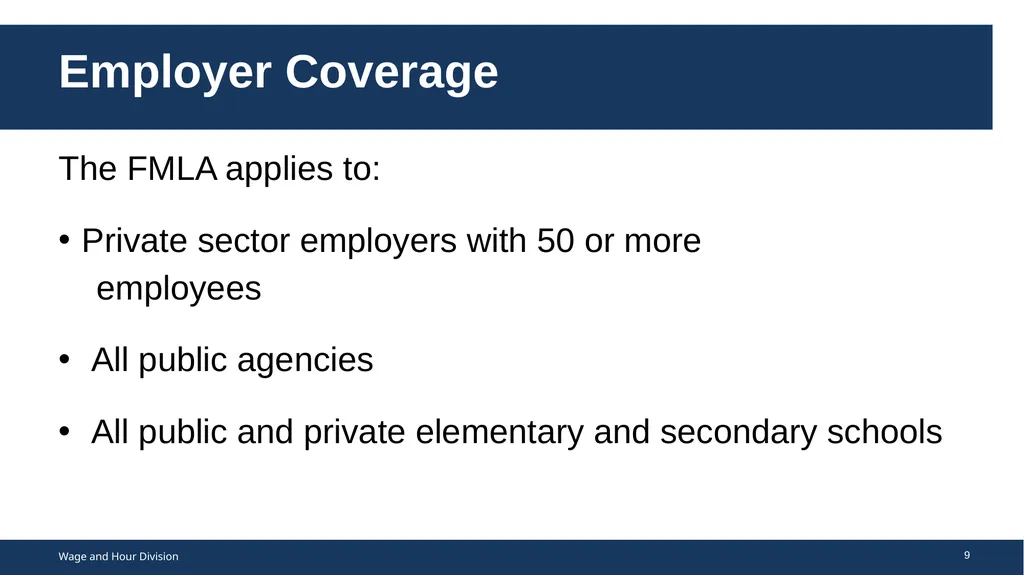
09
Employer Coverage The FMLA applies to:
Private sector employers with 50 or more
employees
All public agencies
All public and private elementary and secondary schools<br>
Private sector employers with 50 or more
employees
All public agencies
All public and private elementary and secondary schools<br>
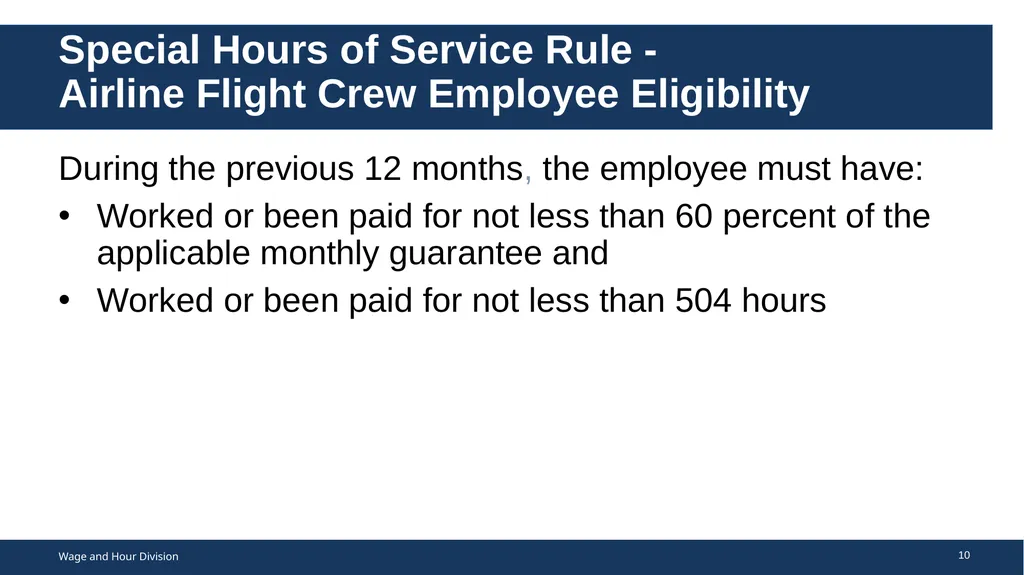
10
Special Hours of Service Rule -
Airline Flight Crew Employee Eligibility During the previous 12 months, the employee must have:
Worked or been paid for not less than 60 percent of the applicable monthly guarantee and
Worked or been paid for not less than 504 hours<br>
Worked or been paid for not less than 60 percent of the applicable monthly guarantee and
Worked or been paid for not less than 504 hours<br>
11
Family Relationships under the FMLA<br>
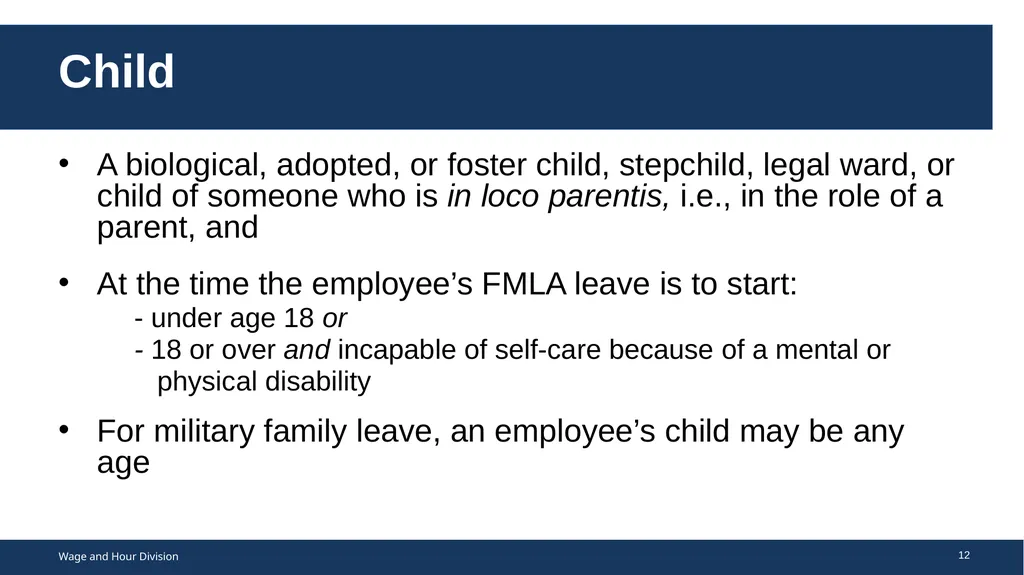
12
Child A biological, adopted, or foster child, stepchild, legal ward, or child of someone who is in loco parentis, i.e., in the role of a parent, and
At the time the employee’s FMLA leave is to start:
- under age 18 or
- 18 or over and incapable of self-care because of a mental or
physical disability
For military family leave, an employee’s child may be any age<br>
At the time the employee’s FMLA leave is to start:
- under age 18 or
- 18 or over and incapable of self-care because of a mental or
physical disability
For military family leave, an employee’s child may be any age<br>
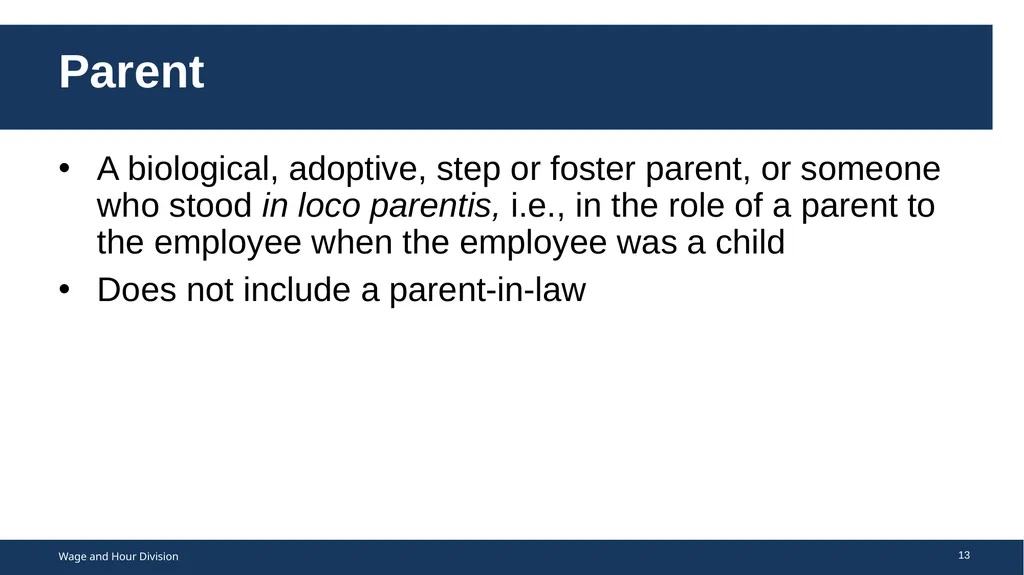
13
Parent A biological, adoptive, step or foster parent, or someone who stood in loco parentis, i.e., in the role of a parent to the employee when the employee was a child
Does not include a parent-in-law<br>
Does not include a parent-in-law<br>
14
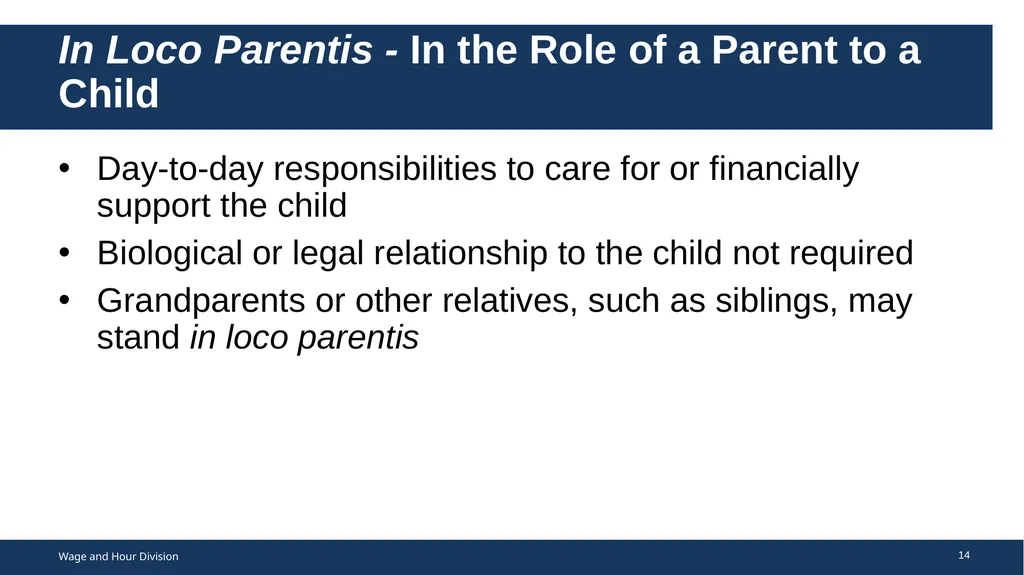
In Loco Parentis - In the Role of a Parent to a Child Day-to-day responsibilities to care for or financially support the child
Biological or legal relationship to the child not required
Grandparents or other relatives, such as siblings, may stand in loco parentis<br>
Biological or legal relationship to the child not required
Grandparents or other relatives, such as siblings, may stand in loco parentis<br>
15
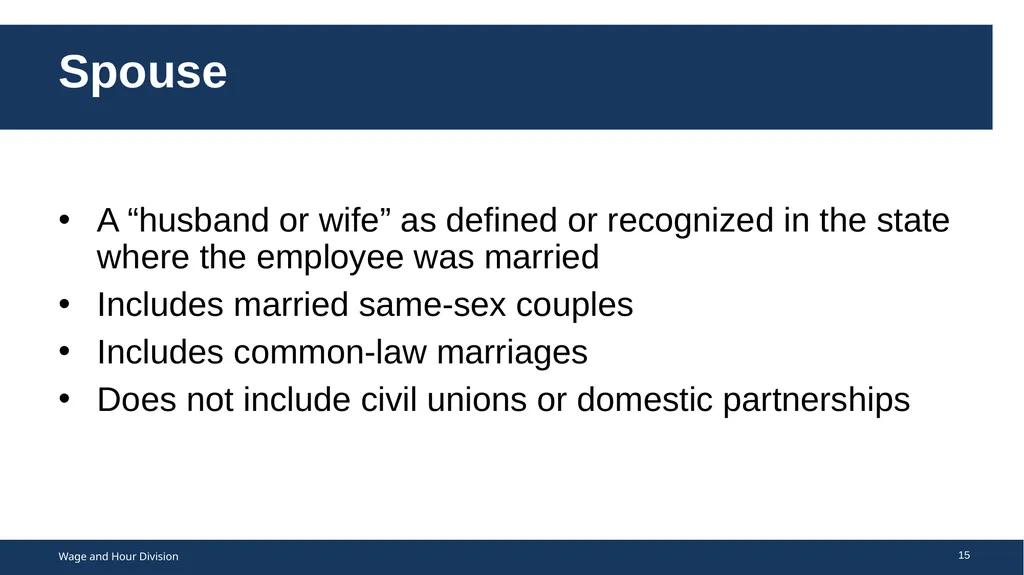
Spouse A “husband or wife” as defined or recognized in the state where the employee was married
Includes married same-sex couples
Includes common-law marriages
Does not include civil unions or domestic partnerships<br>
Includes married same-sex couples
Includes common-law marriages
Does not include civil unions or domestic partnerships<br>
16
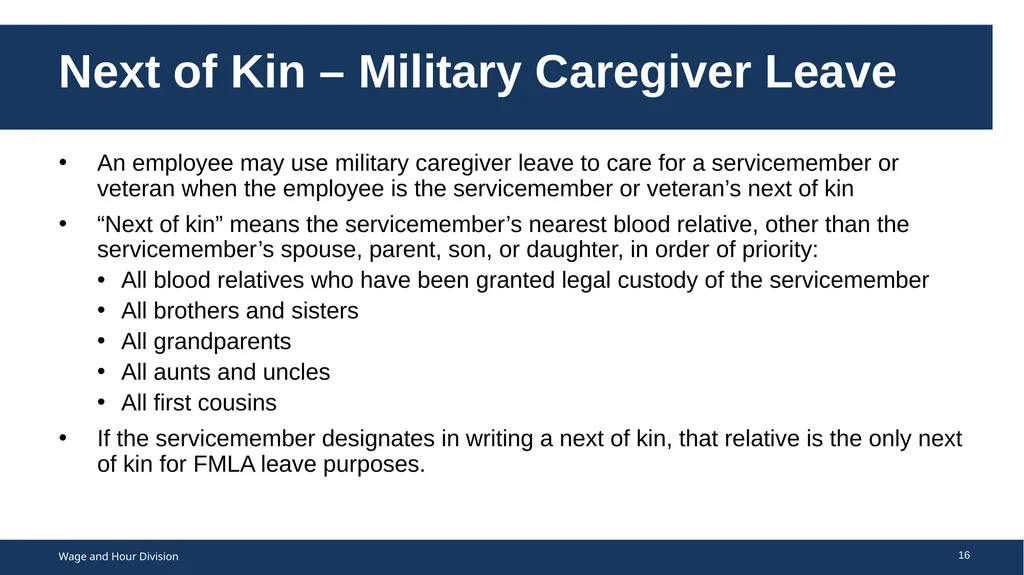
Next of Kin – Military Caregiver Leave An employee may use military caregiver leave to care for a servicemember or veteran when the employee is the servicemember or veteran’s next of kin
“Next of kin” means the servicemember’s nearest blood relative, other than the servicemember’s spouse, parent, son, or daughter, in order of priority:
All blood relatives who have been granted legal custody of the servicemember
All brothers and sisters
All grandparents
All aunts and uncles
All first cousins
If the servicemember designates in writing a next of kin, that relative is the only next of kin for FMLA leave purposes.<br>
17
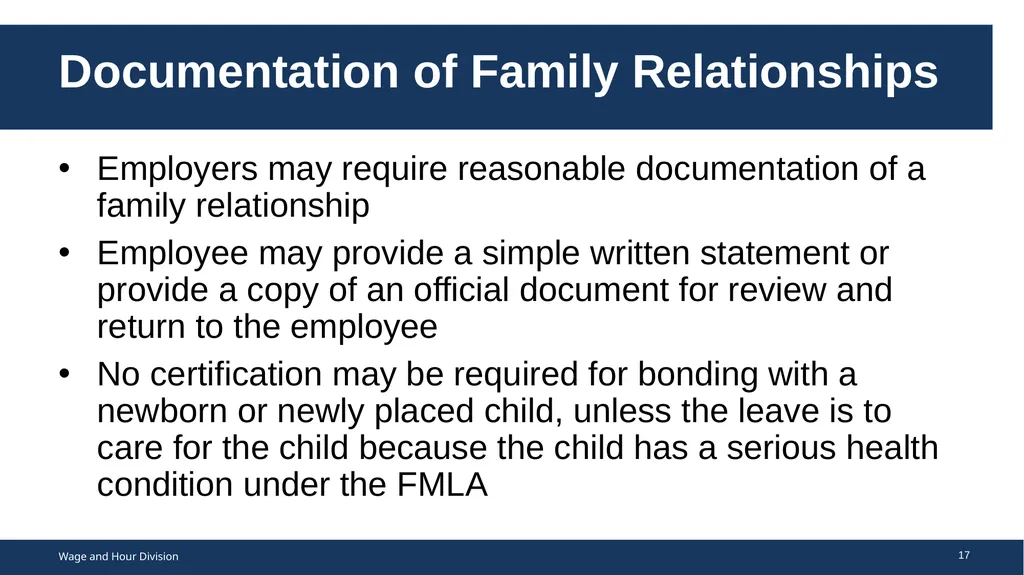
Documentation of Family Relationships Employers may require reasonable documentation of a family relationship
Employee may provide a simple written statement or provide a copy of an official document for review and return to the employee
No certification may be required for bonding with a newborn or newly placed child, unless the leave is to care for the child because the child has a serious health condition under the FMLA<br>
18
FMLA-protected Leave Reasons<br>
19
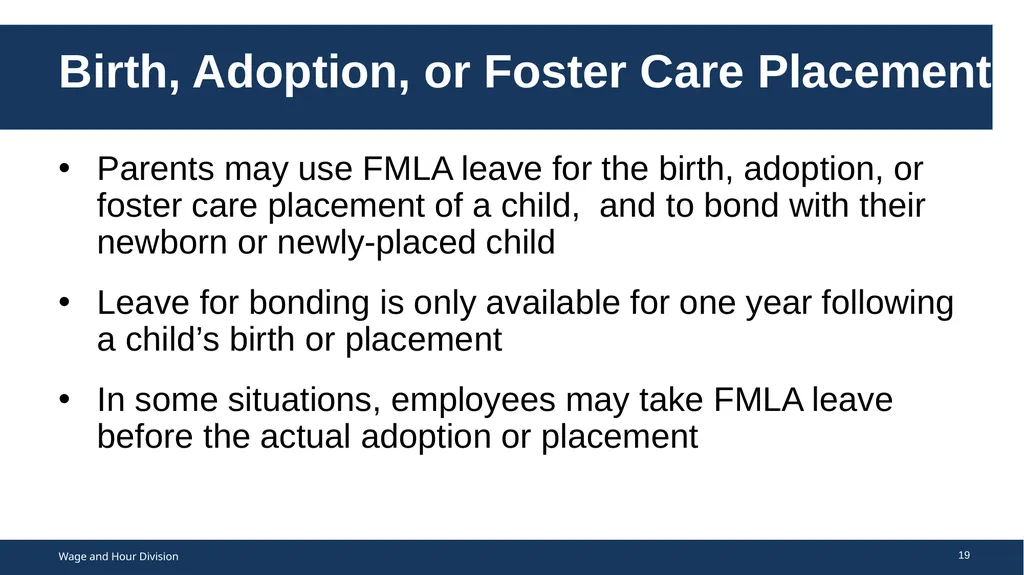
Birth, Adoption, or Foster Care Placement Parents may use FMLA leave for the birth, adoption, or foster care placement of a child, and to bond with their newborn or newly-placed child
Leave for bonding is only available for one year following a child’s birth or placement
In some situations, employees may take FMLA leave before the actual adoption or placement<br>
Leave for bonding is only available for one year following a child’s birth or placement
In some situations, employees may take FMLA leave before the actual adoption or placement<br>
20
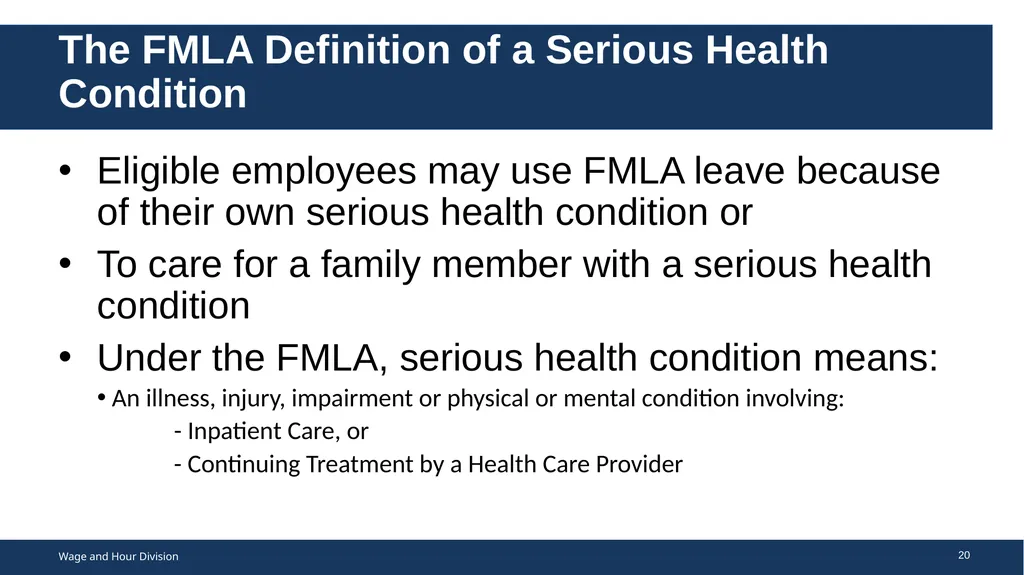
The FMLA Definition of a Serious Health Condition Eligible employees may use FMLA leave because of their own serious health condition or
To care for a family member with a serious health condition
Under the FMLA, serious health condition means:
An illness, injury, impairment or physical or mental condition involving:
- Inpatient Care, or
- Continuing Treatment by a Health Care Provider<br>
To care for a family member with a serious health condition
Under the FMLA, serious health condition means:
An illness, injury, impairment or physical or mental condition involving:
- Inpatient Care, or
- Continuing Treatment by a Health Care Provider<br>
21
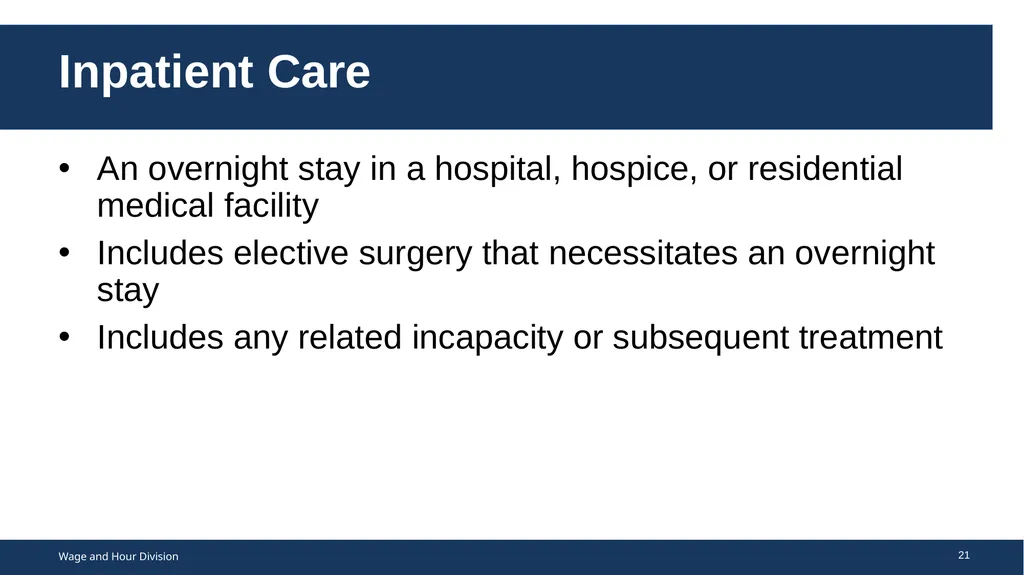
Inpatient Care An overnight stay in a hospital, hospice, or residential medical facility
Includes elective surgery that necessitates an overnight stay
Includes any related incapacity or subsequent treatment<br>
Includes elective surgery that necessitates an overnight stay
Includes any related incapacity or subsequent treatment<br>
22
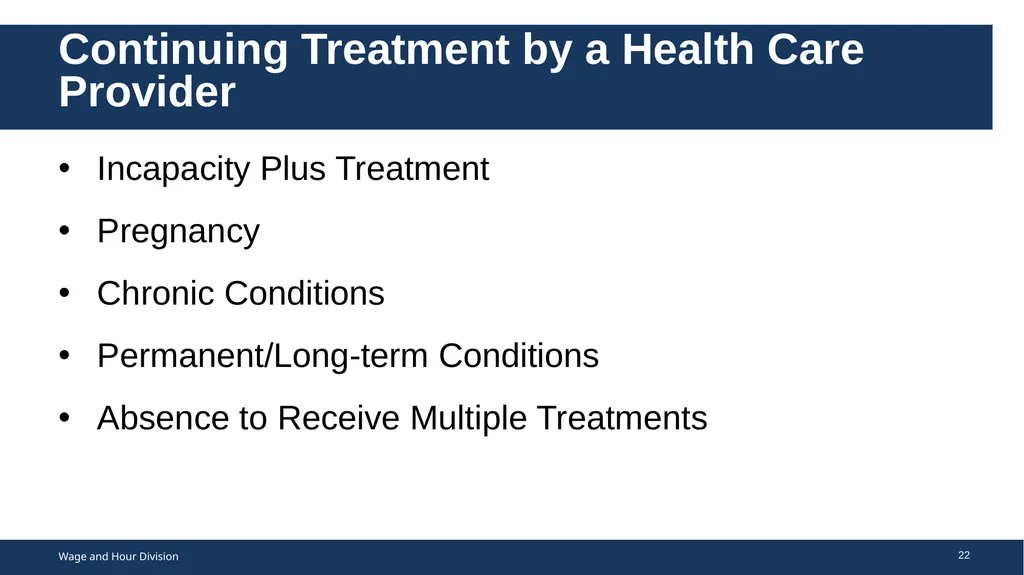
Continuing Treatment by a Health Care Provider Incapacity Plus Treatment
Pregnancy
Chronic Conditions
Permanent/Long-term Conditions
Absence to Receive Multiple Treatments<br>
Pregnancy
Chronic Conditions
Permanent/Long-term Conditions
Absence to Receive Multiple Treatments<br>
23
Mental Health and the FMLA Mental health conditions are serious health conditions under the FMLA if they require inpatient care or continuing treatment by a health care provider
Examples:
An overnight stay in a treatment center for addiction or eating disorders
Chronic conditions such as anxiety, depression, or dissociative disorders<br>
Examples:
An overnight stay in a treatment center for addiction or eating disorders
Chronic conditions such as anxiety, depression, or dissociative disorders<br>
24
Incapacity Inability to work, attend school or perform other regular daily activities due to the serious health condition
Employee is unable to work if unable to perform any one of the essential functions of the employee’s position due to the serious health condition
Incapacity includes treatment or recovery from the serious health condition<br>
Employee is unable to work if unable to perform any one of the essential functions of the employee’s position due to the serious health condition
Incapacity includes treatment or recovery from the serious health condition<br>
25
Physical or Psychological Care Leave to care for a family member includes providing physical care and psychological comfort
The employee need not be the only individual or family member able to provide care<br>
The employee need not be the only individual or family member able to provide care<br>
26
Health Care Provider Licensed M.D.s and osteopaths
Podiatrists, dentists, clinical psychologists, optometrists, chiropractors - with limitations
Clinical social workers, nurse practitioners, nurse-midwives, and physician assistants
Christian Science Practitioners
Any health care provider from whom the employer’s group health plan will accept certification
Health care providers authorized to practice in a country other than the United States<br>
27
Qualifying Exigency Leave Employee’s spouse, child, or parent
In the Regular Armed Forces
Deployed to a foreign country
In the Reserve components of the Armed Forces (National Guard and Reserves)
Deployed to a foreign country under a call or order to active duty in support of a contingency operation<br>
In the Regular Armed Forces
Deployed to a foreign country
In the Reserve components of the Armed Forces (National Guard and Reserves)
Deployed to a foreign country under a call or order to active duty in support of a contingency operation<br>
28
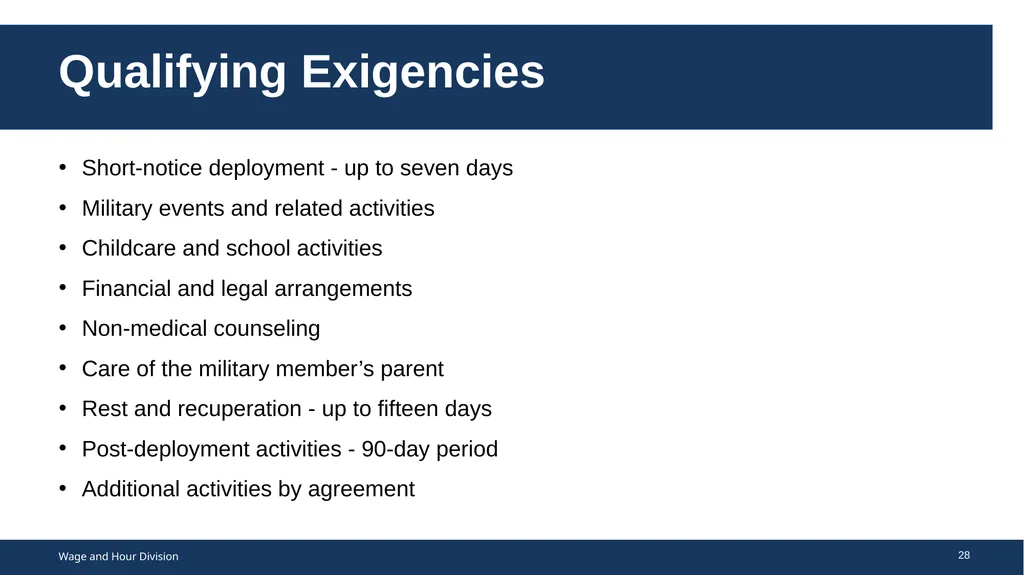
Qualifying Exigencies Short-notice deployment - up to seven days
Military events and related activities
Childcare and school activities
Financial and legal arrangements
Non-medical counseling
Care of the military member’s parent
Rest and recuperation - up to fifteen days
Post-deployment activities - 90-day period
Additional activities by agreement<br>
Military events and related activities
Childcare and school activities
Financial and legal arrangements
Non-medical counseling
Care of the military member’s parent
Rest and recuperation - up to fifteen days
Post-deployment activities - 90-day period
Additional activities by agreement<br>
29
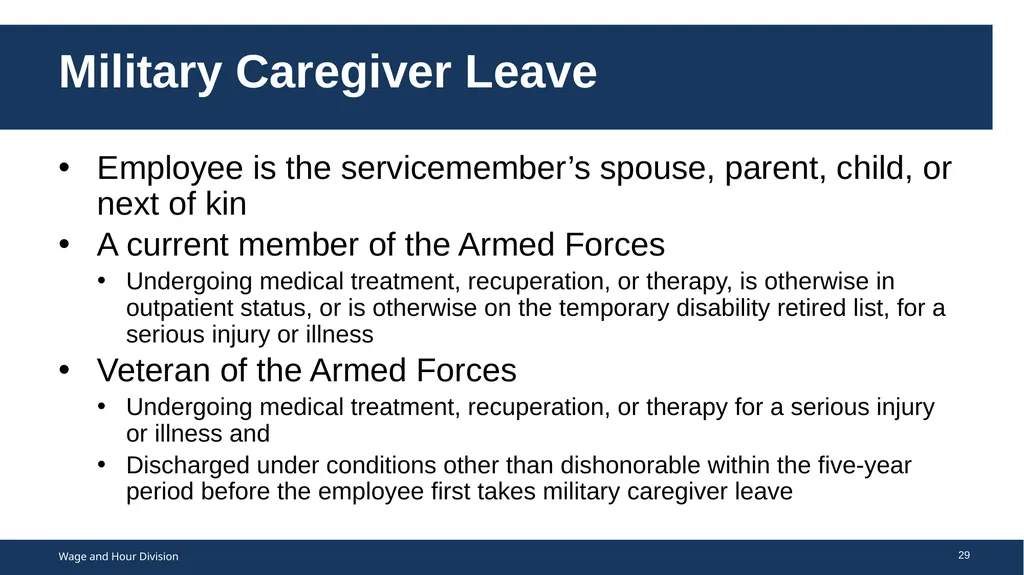
Military Caregiver Leave Employee is the servicemember’s spouse, parent, child, or next of kin
A current member of the Armed Forces
Undergoing medical treatment, recuperation, or therapy, is otherwise in outpatient status, or is otherwise on the temporary disability retired list, for a serious injury or illness
Veteran of the Armed Forces
Undergoing medical treatment, recuperation, or therapy for a serious injury or illness and
Discharged under conditions other than dishonorable within the five-year period before the employee first takes military caregiver leave<br>
30
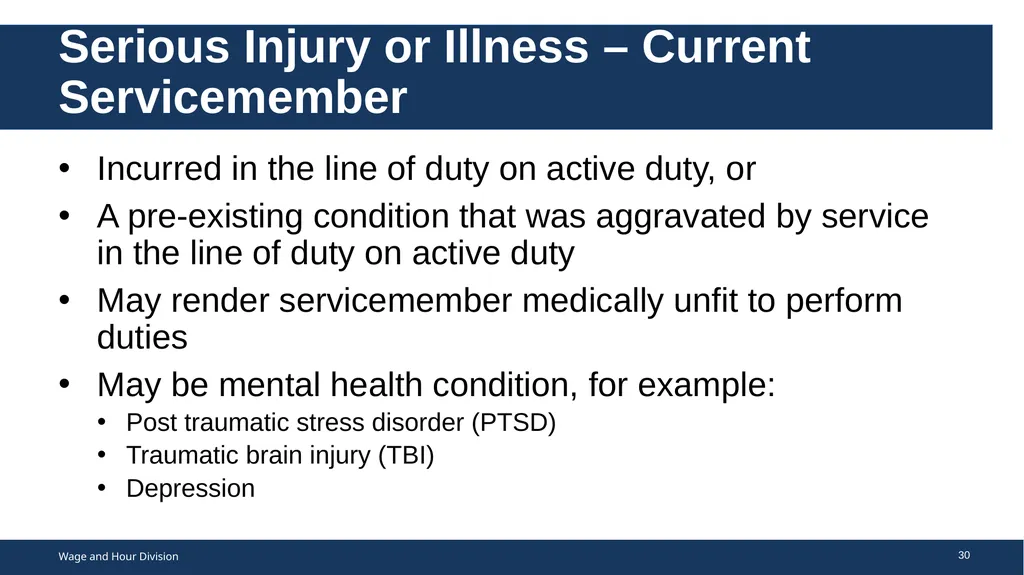
Serious Injury or Illness – Current Servicemember Incurred in the line of duty on active duty, or
A pre-existing condition that was aggravated by service in the line of duty on active duty
May render servicemember medically unfit to perform duties
May be mental health condition, for example:
Post traumatic stress disorder (PTSD)
Traumatic brain injury (TBI)
Depression<br>
A pre-existing condition that was aggravated by service in the line of duty on active duty
May render servicemember medically unfit to perform duties
May be mental health condition, for example:
Post traumatic stress disorder (PTSD)
Traumatic brain injury (TBI)
Depression<br>
31
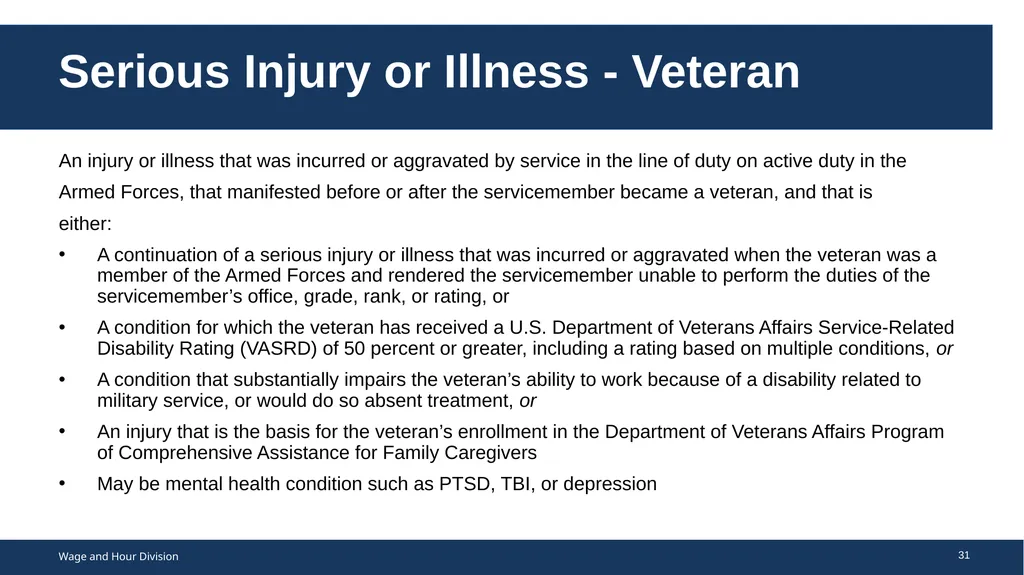
Serious Injury or Illness - Veteran An injury or illness that was incurred or aggravated by service in the line of duty on active duty in the
Armed Forces, that manifested before or after the servicemember became a veteran, and that is
either:
A continuation of a serious injury or illness that was incurred or aggravated when the veteran was a member of the Armed Forces and rendered the servicemember unable to perform the duties of the servicemember’s office, grade, rank, or rating, or
A condition for which the veteran has received a U.S. Department of Veterans Affairs Service-Related Disability Rating (VASRD) of 50 percent or greater, including a rating based on multiple conditions, or
A condition that substantially impairs the veteran’s ability to work because of a disability related to military service, or would do so absent treatment, or
An injury that is the basis for the veteran’s enrollment in the Department of Veterans Affairs Program of Comprehensive Assistance for Family Caregivers
May be mental health condition such as PTSD, TBI, or depression<br>
32
Taking FMLA Leave<br>
33
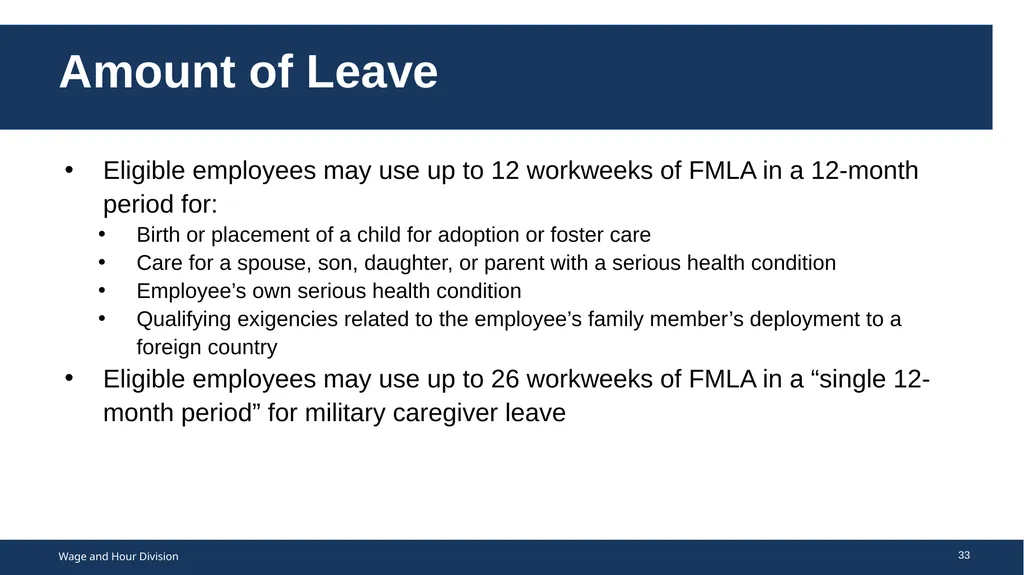
Amount of Leave Eligible employees may use up to 12 workweeks of FMLA in a 12-month period for:
Birth or placement of a child for adoption or foster care
Care for a spouse, son, daughter, or parent with a serious health condition
Employee’s own serious health condition
Qualifying exigencies related to the employee’s family member’s deployment to a foreign country
Eligible employees may use up to 26 workweeks of FMLA in a “single 12-month period” for military caregiver leave<br>
34
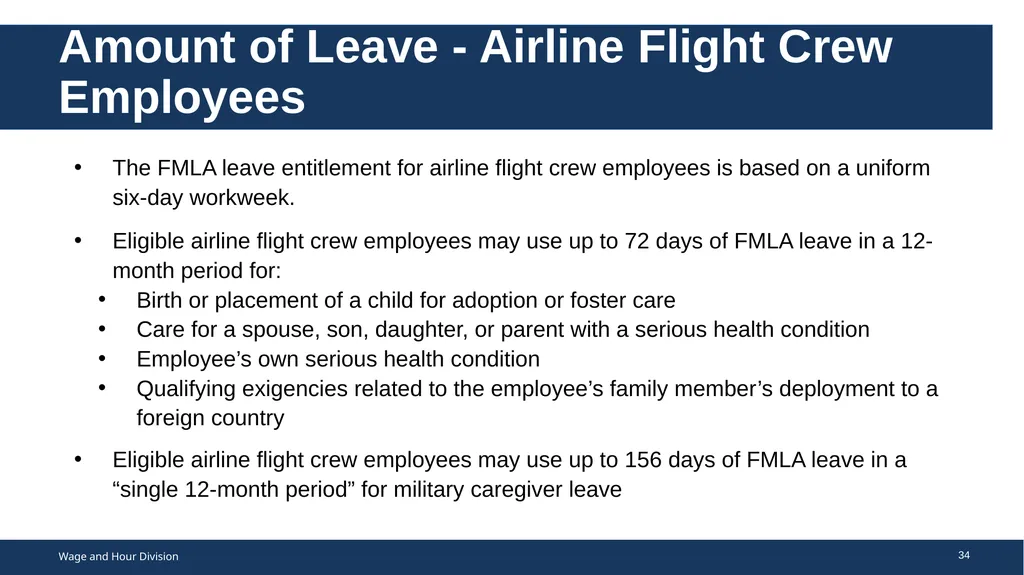
Amount of Leave - Airline Flight Crew Employees The FMLA leave entitlement for airline flight crew employees is based on a uniform six-day workweek.
Eligible airline flight crew employees may use up to 72 days of FMLA leave in a 12-month period for:
Birth or placement of a child for adoption or foster care
Care for a spouse, son, daughter, or parent with a serious health condition
Employee’s own serious health condition
Qualifying exigencies related to the employee’s family member’s deployment to a foreign country
Eligible airline flight crew employees may use up to 156 days of FMLA leave in a “single 12-month period” for military caregiver leave<br>
35
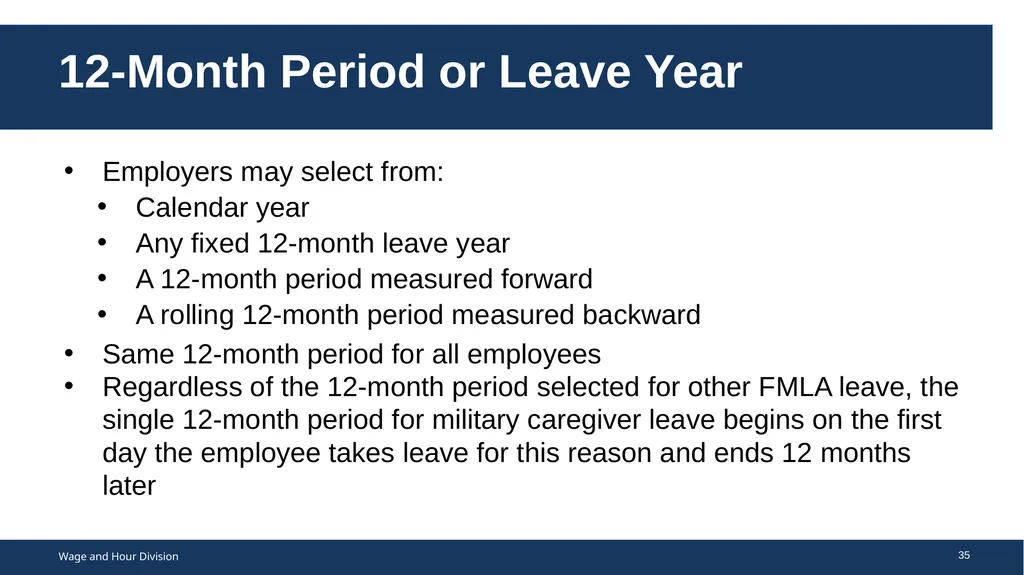
12-Month Period or Leave Year Employers may select from:
Calendar year
Any fixed 12-month leave year
A 12-month period measured forward
A rolling 12-month period measured backward
Same 12-month period for all employees
Regardless of the 12-month period selected for other FMLA leave, the single 12-month period for military caregiver leave begins on the first day the employee takes leave for this reason and ends 12 months later<br>
36
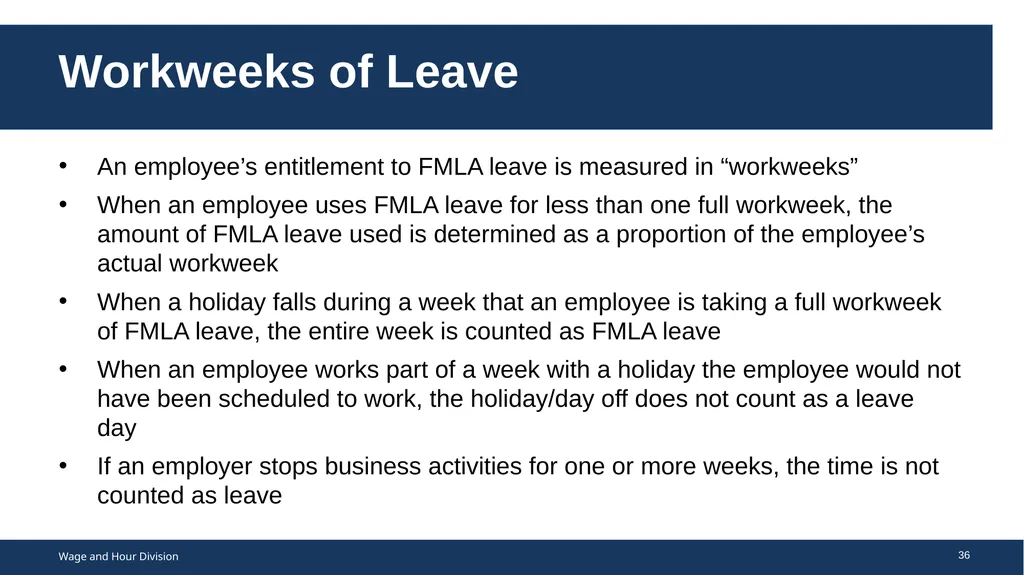
Workweeks of Leave An employee’s entitlement to FMLA leave is measured in “workweeks”
When an employee uses FMLA leave for less than one full workweek, the amount of FMLA leave used is determined as a proportion of the employee’s actual workweek
When a holiday falls during a week that an employee is taking a full workweek of FMLA leave, the entire week is counted as FMLA leave
When an employee works part of a week with a holiday the employee would not have been scheduled to work, the holiday/day off does not count as a leave day
If an employer stops business activities for one or more weeks, the time is not counted as leave<br>
37
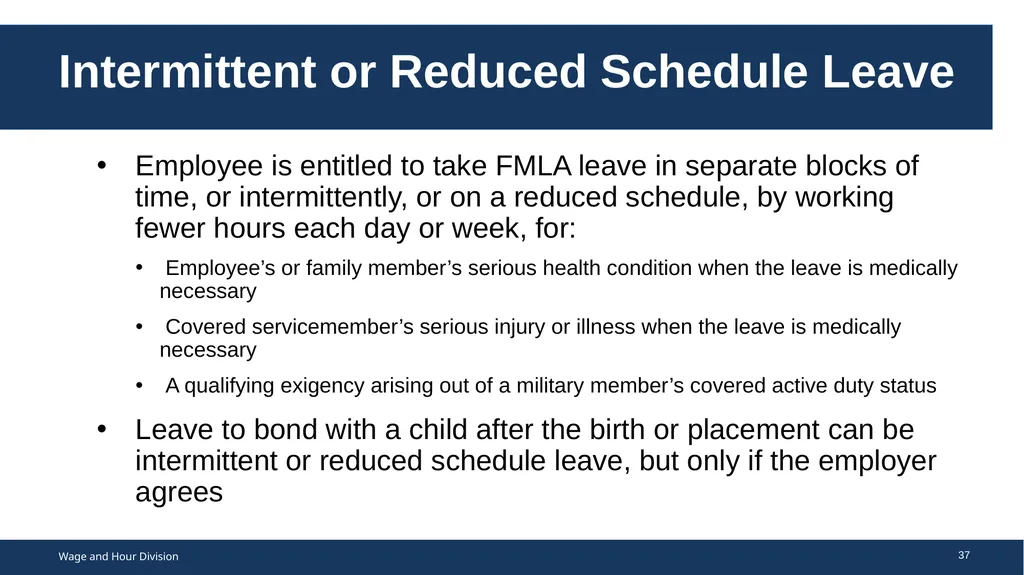
Intermittent or Reduced Schedule Leave Employee is entitled to take FMLA leave in separate blocks of time, or intermittently, or on a reduced schedule, by working fewer hours each day or week, for:
Employee’s or family member’s serious health condition when the leave is medically necessary
Covered servicemember’s serious injury or illness when the leave is medically necessary
A qualifying exigency arising out of a military member’s covered active duty status
Leave to bond with a child after the birth or placement can be intermittent or reduced schedule leave, but only if the employer agrees<br>
38
Planned Medical Treatment Employee should generally make a reasonable effort to schedule planned medical treatments to minimize disruption to employer operations
Employer may temporarily transfer employee to alternative job with equivalent pay and benefits when the employee needs intermittent or reduced schedule leave that is foreseeable based on planned medical treatment, if the position better accommodates recurring periods of leave<br>
Employer may temporarily transfer employee to alternative job with equivalent pay and benefits when the employee needs intermittent or reduced schedule leave that is foreseeable based on planned medical treatment, if the position better accommodates recurring periods of leave<br>
39
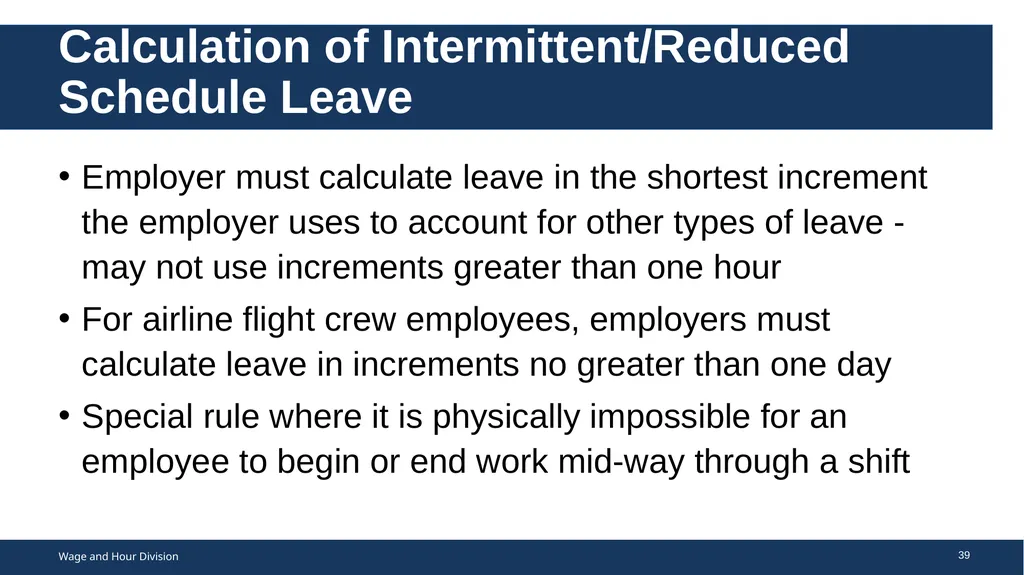
Calculation of Intermittent/Reduced Schedule Leave Employer must calculate leave in the shortest increment the employer uses to account for other types of leave - may not use increments greater than one hour
For airline flight crew employees, employers must calculate leave in increments no greater than one day
Special rule where it is physically impossible for an employee to begin or end work mid-way through a shift<br>
For airline flight crew employees, employers must calculate leave in increments no greater than one day
Special rule where it is physically impossible for an employee to begin or end work mid-way through a shift<br>
40
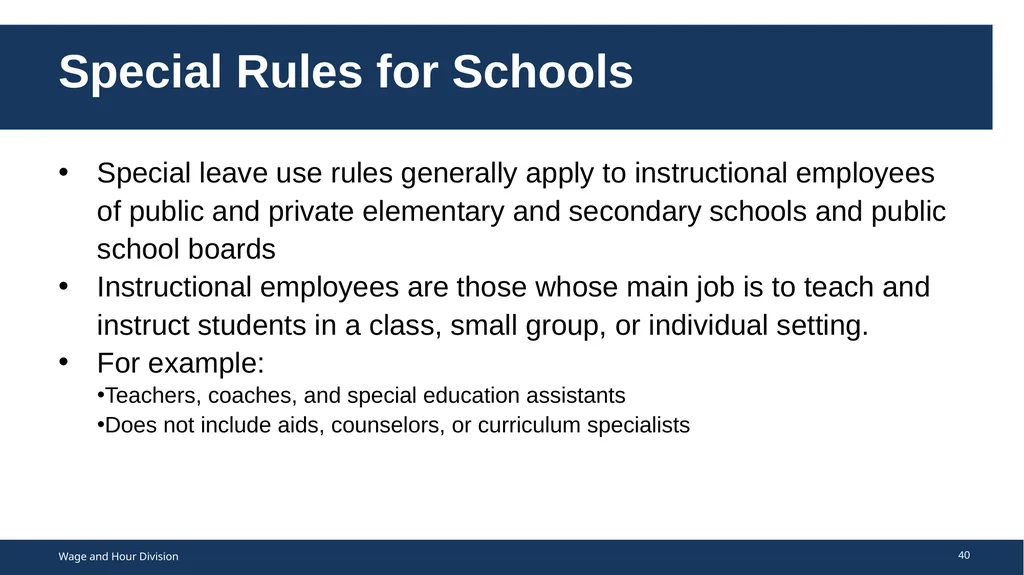
Special Rules for Schools Special leave use rules generally apply to instructional employees of public and private elementary and secondary schools and public school boards
Instructional employees are those whose main job is to teach and instruct students in a class, small group, or individual setting.
For example:
Teachers, coaches, and special education assistants
Does not include aids, counselors, or curriculum specialists<br>
Instructional employees are those whose main job is to teach and instruct students in a class, small group, or individual setting.
For example:
Teachers, coaches, and special education assistants
Does not include aids, counselors, or curriculum specialists<br>
41
Schools - Intermittent or Reduced Schedule Leave When an instructional employee needs to use a substantial amount of intermittent or reduced schedule FMLA leave that is foreseeable based on planned medical treatment, the employee may be required to choose between:
Taking leave for a set period not greater than the duration of the leave need, rather than intermittently, or
Transferring temporarily to an available alternative position<br>
Taking leave for a set period not greater than the duration of the leave need, rather than intermittently, or
Transferring temporarily to an available alternative position<br>
42
Schools - Leave Near the End
of an Academic Term Instructional employees starting leave near the end of an academic term may be required to continue taking leave until the end of the term under certain circumstances
Generally, whether the employee may be required to continue leave depends upon how close to the end of the term the leave begins and how much leave the employee needs<br>
Generally, whether the employee may be required to continue leave depends upon how close to the end of the term the leave begins and how much leave the employee needs<br>
43
Use of Paid Leave Benefits During FMLA Leave Employees may choose or employers may require employees to use accrued paid leave, such as vacation or sick leave, if applicable, at the same time FMLA leave is used
Employees may be eligible to use other benefits while they are using FMLA leave, including:
Workers’ compensation
Short-term disability
Leave provided as an accommodation under the Americans with Disabilities Act (ADA)
Paid leave mandated under state or local law<br>
Employees may be eligible to use other benefits while they are using FMLA leave, including:
Workers’ compensation
Short-term disability
Leave provided as an accommodation under the Americans with Disabilities Act (ADA)
Paid leave mandated under state or local law<br>
44
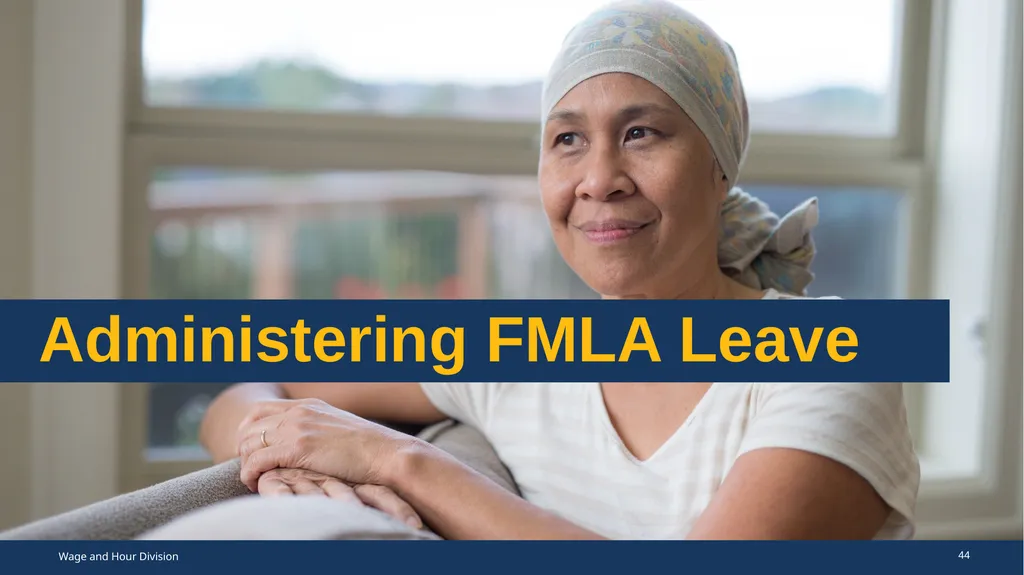
Administering FMLA Leave<br>
45
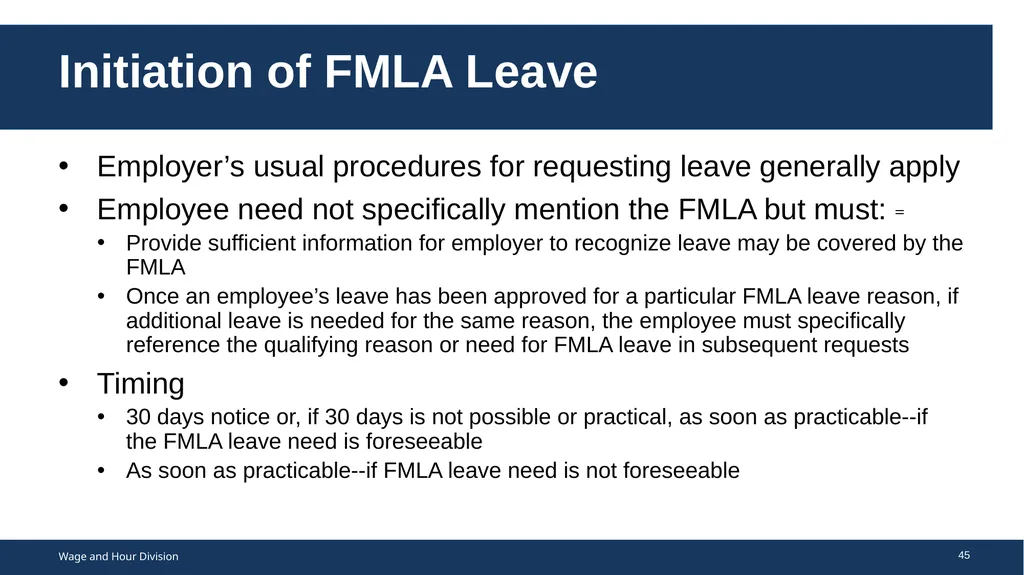
Initiation of FMLA Leave Employer’s usual procedures for requesting leave generally apply
Employee need not specifically mention the FMLA but must:
Provide sufficient information for employer to recognize leave may be covered by the FMLA
Once an employee’s leave has been approved for a particular FMLA leave reason, if additional leave is needed for the same reason, the employee must specifically reference the qualifying reason or need for FMLA leave in subsequent requests
Timing
30 days notice or, if 30 days is not possible or practical, as soon as practicable--if the FMLA leave need is foreseeable
As soon as practicable--if FMLA leave need is not foreseeable<br>
46
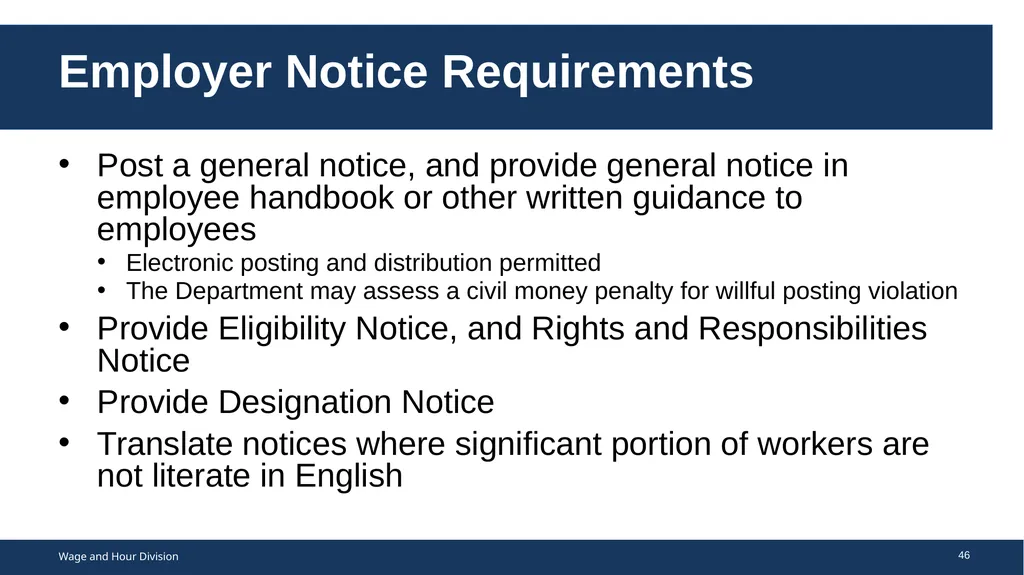
Employer Notice Requirements Post a general notice, and provide general notice in employee handbook or other written guidance to employees
Electronic posting and distribution permitted
The Department may assess a civil money penalty for willful posting violation
Provide Eligibility Notice, and Rights and Responsibilities Notice
Provide Designation Notice
Translate notices where significant portion of workers are not literate in English<br>
47
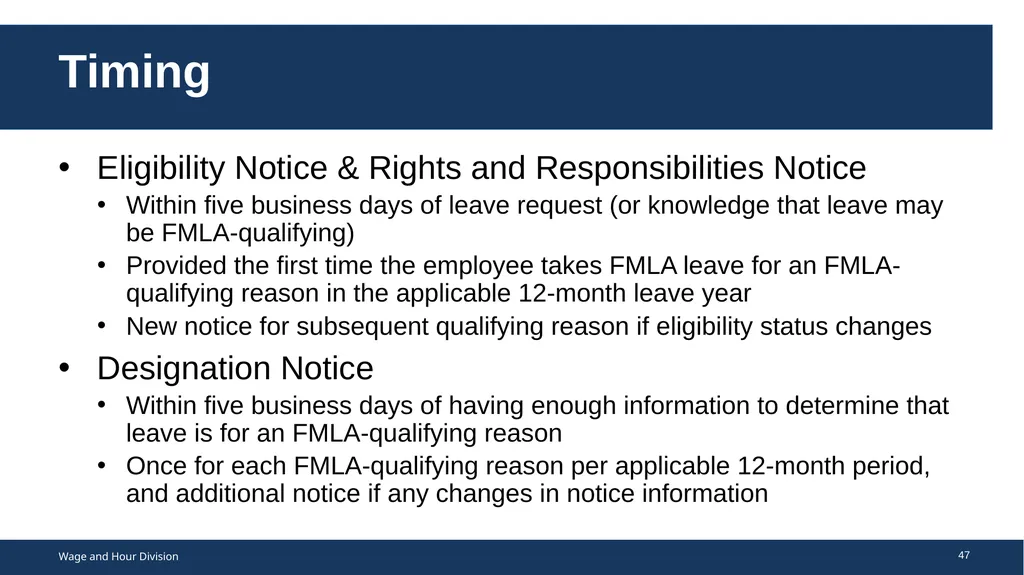
Timing Eligibility Notice & Rights and Responsibilities Notice
Within five business days of leave request (or knowledge that leave may be FMLA-qualifying)
Provided the first time the employee takes FMLA leave for an FMLA-qualifying reason in the applicable 12-month leave year
New notice for subsequent qualifying reason if eligibility status changes
Designation Notice
Within five business days of having enough information to determine that leave is for an FMLA-qualifying reason
Once for each FMLA-qualifying reason per applicable 12-month period, and additional notice if any changes in notice information<br>
48
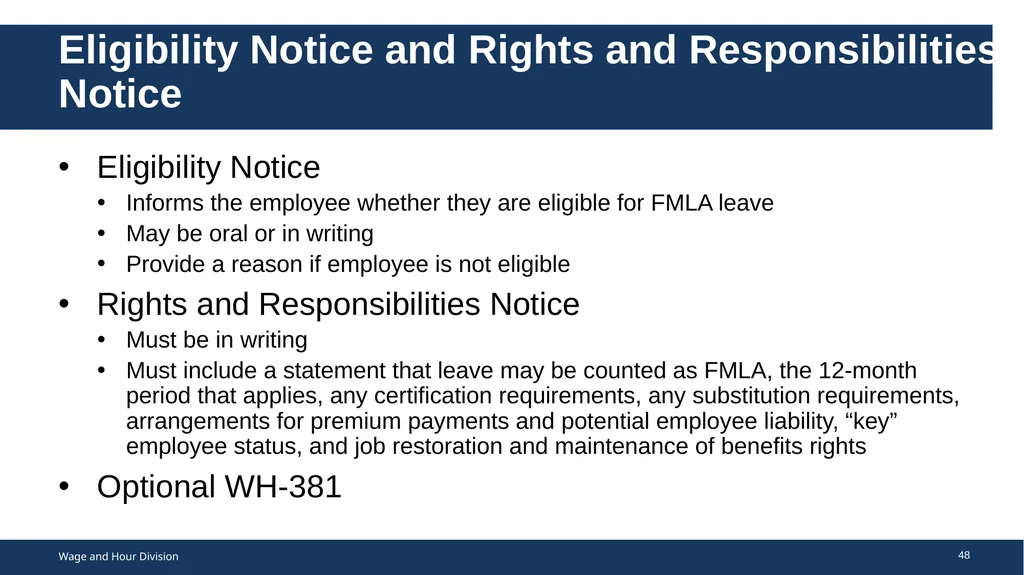
Eligibility Notice and Rights and Responsibilities Notice Eligibility Notice
Informs the employee whether they are eligible for FMLA leave
May be oral or in writing
Provide a reason if employee is not eligible
Rights and Responsibilities Notice
Must be in writing
Must include a statement that leave may be counted as FMLA, the 12-month period that applies, any certification requirements, any substitution requirements, arrangements for premium payments and potential employee liability, “key” employee status, and job restoration and maintenance of benefits rights
Optional WH-381<br>
49
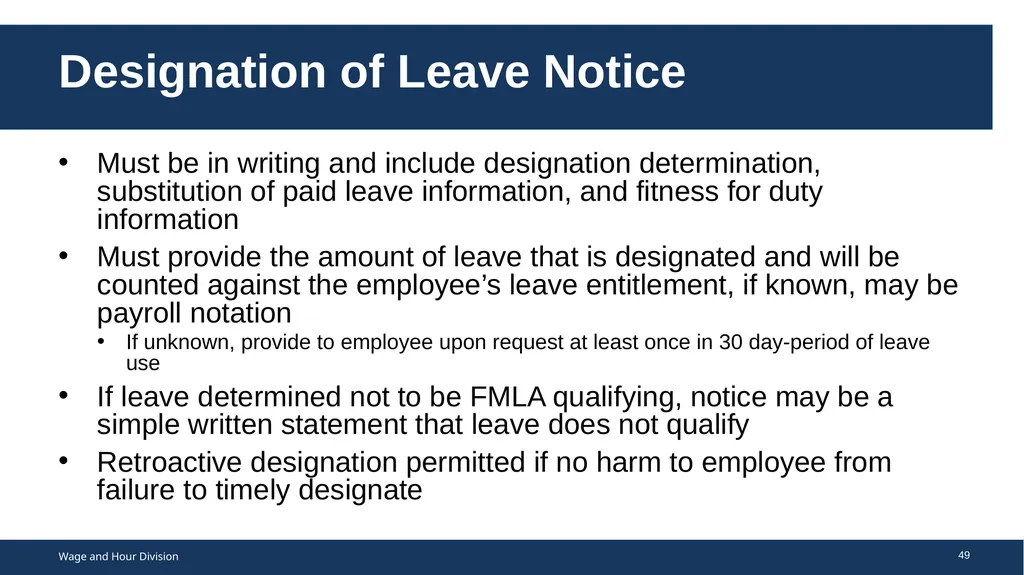
Designation of Leave Notice Must be in writing and include designation determination, substitution of paid leave information, and fitness for duty information
Must provide the amount of leave that is designated and will be counted against the employee’s leave entitlement, if known, may be payroll notation
If unknown, provide to employee upon request at least once in 30 day-period of leave use
If leave determined not to be FMLA qualifying, notice may be a simple written statement that leave does not qualify
Retroactive designation permitted if no harm to employee from failure to timely designate<br>
50
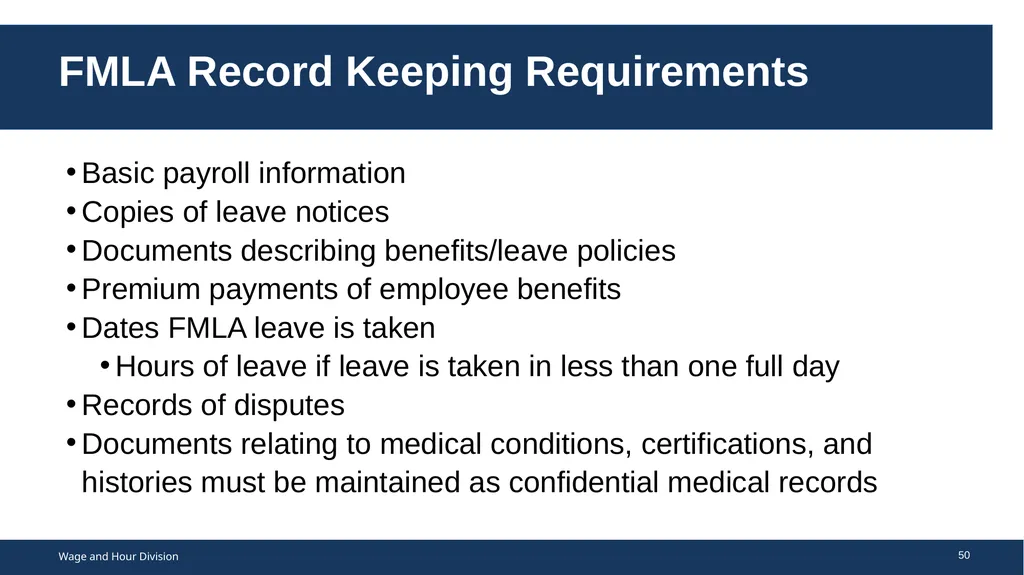
FMLA Record Keeping Requirements Basic payroll information
Copies of leave notices
Documents describing benefits/leave policies
Premium payments of employee benefits
Dates FMLA leave is taken
Hours of leave if leave is taken in less than one full day
Records of disputes
Documents relating to medical conditions, certifications, and histories must be maintained as confidential medical records<br>
51
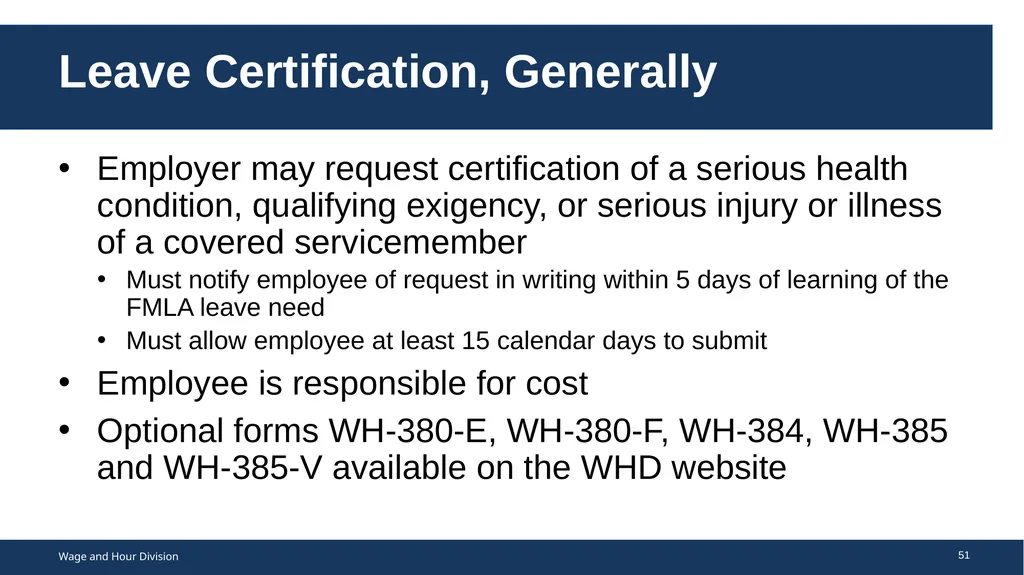
Leave Certification, Generally Employer may request certification of a serious health condition, qualifying exigency, or serious injury or illness of a covered servicemember
Must notify employee of request in writing within 5 days of learning of the FMLA leave need
Must allow employee at least 15 calendar days to submit
Employee is responsible for cost
Optional forms WH-380-E, WH-380-F, WH-384, WH-385 and WH-385-V available on the WHD website<br>
Must notify employee of request in writing within 5 days of learning of the FMLA leave need
Must allow employee at least 15 calendar days to submit
Employee is responsible for cost
Optional forms WH-380-E, WH-380-F, WH-384, WH-385 and WH-385-V available on the WHD website<br>
52
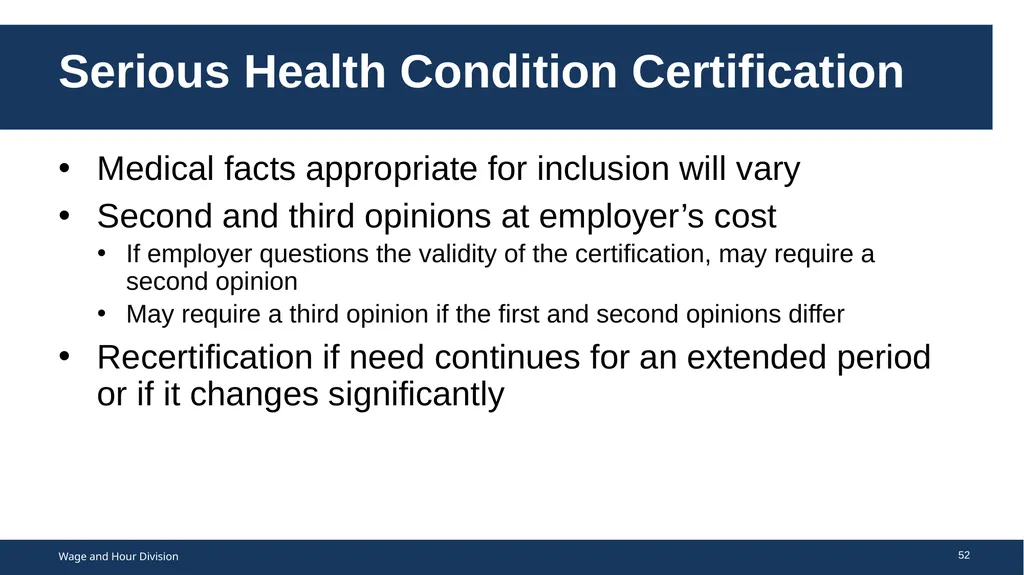
Serious Health Condition Certification Medical facts appropriate for inclusion will vary
Second and third opinions at employer’s cost
If employer questions the validity of the certification, may require a second opinion
May require a third opinion if the first and second opinions differ
Recertification if need continues for an extended period or if it changes significantly<br>
Second and third opinions at employer’s cost
If employer questions the validity of the certification, may require a second opinion
May require a third opinion if the first and second opinions differ
Recertification if need continues for an extended period or if it changes significantly<br>
53
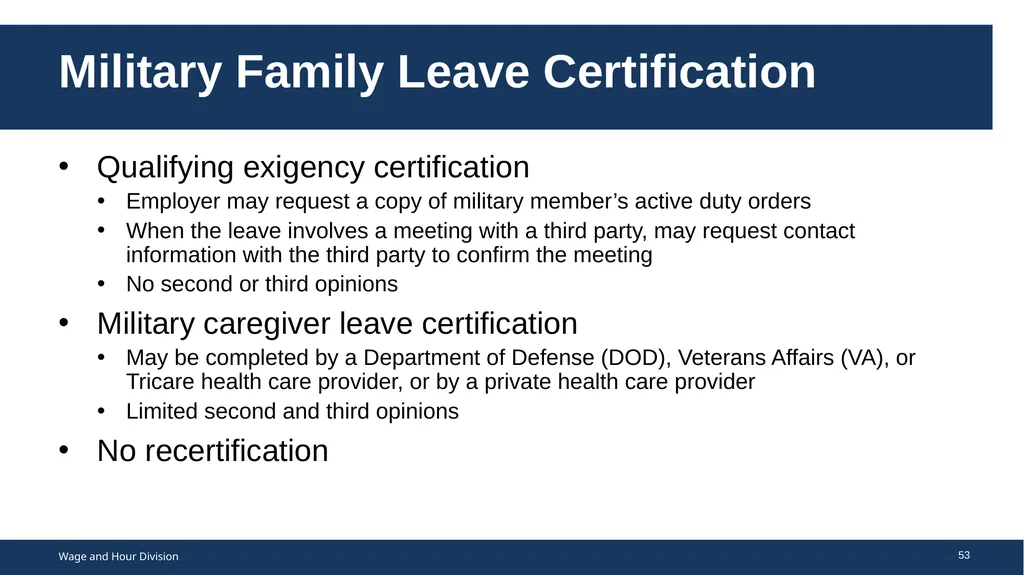
Military Family Leave Certification Qualifying exigency certification
Employer may request a copy of military member’s active duty orders
When the leave involves a meeting with a third party, may request contact information with the third party to confirm the meeting
No second or third opinions
Military caregiver leave certification
May be completed by a Department of Defense (DOD), Veterans Affairs (VA), or Tricare health care provider, or by a private health care provider
Limited second and third opinions
No recertification<br>
54
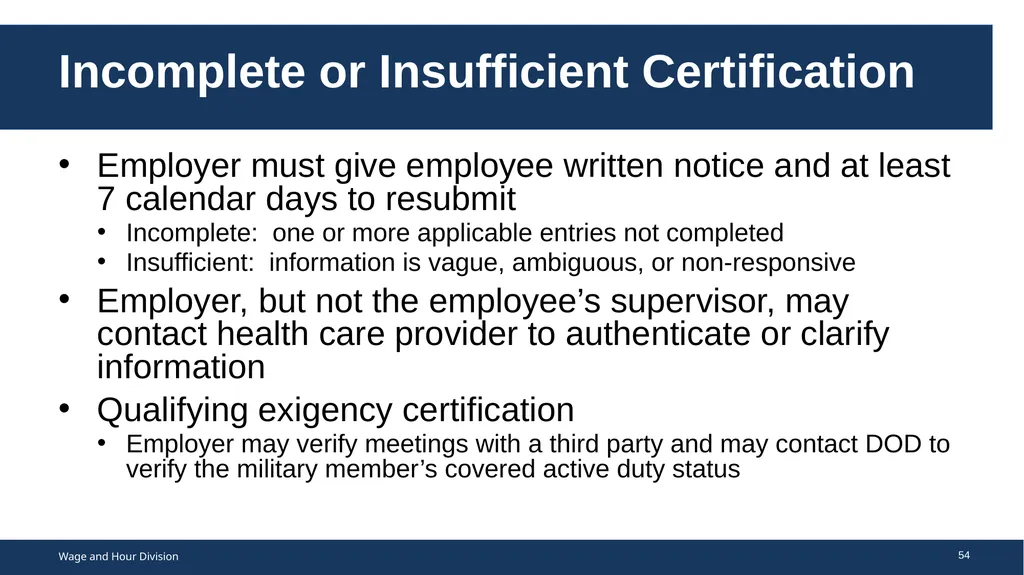
Incomplete or Insufficient Certification Employer must give employee written notice and at least 7 calendar days to resubmit
Incomplete: one or more applicable entries not completed
Insufficient: information is vague, ambiguous, or non-responsive
Employer, but not the employee’s supervisor, may contact health care provider to authenticate or clarify information
Qualifying exigency certification
Employer may verify meetings with a third party and may contact DOD to verify the military member’s covered active duty status<br>
55
Fitness-for-Duty Certification For an employee’s own serious health condition, employers may require certification that the employee is able to resume work
Employer must have a uniformly-applied policy or practice of requiring fitness-for-duty certification for all similarly-situated employees
If state or local law or collective bargaining agreement is in place, it governs the return to work
Not permitted for intermittent or reduced schedule leave unless reasonable safety concerns exist
Authentication and clarification
Employee responsible for any cost<br>
56
Employee Rights<br>
57
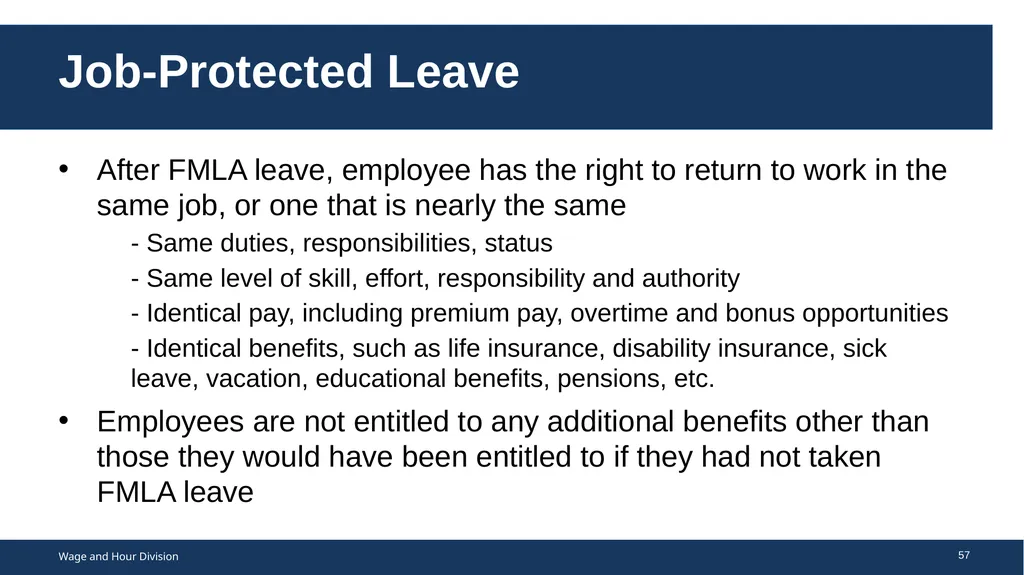
Job-Protected Leave After FMLA leave, employee has the right to return to work in the same job, or one that is nearly the same
- Same duties, responsibilities, status
- Same level of skill, effort, responsibility and authority
- Identical pay, including premium pay, overtime and bonus opportunities
- Identical benefits, such as life insurance, disability insurance, sick leave, vacation, educational benefits, pensions, etc.
Employees are not entitled to any additional benefits other than those they would have been entitled to if they had not taken FMLA leave<br>
58
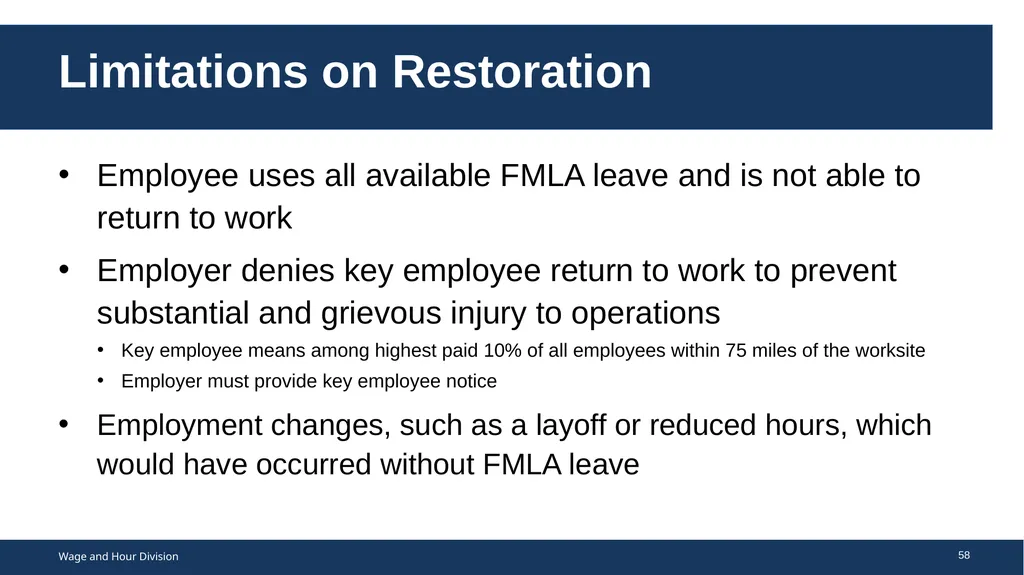
Limitations on Restoration Employee uses all available FMLA leave and is not able to return to work
Employer denies key employee return to work to prevent substantial and grievous injury to operations
Key employee means among highest paid 10% of all employees within 75 miles of the worksite
Employer must provide key employee notice
Employment changes, such as a layoff or reduced hours, which would have occurred without FMLA leave<br>
59
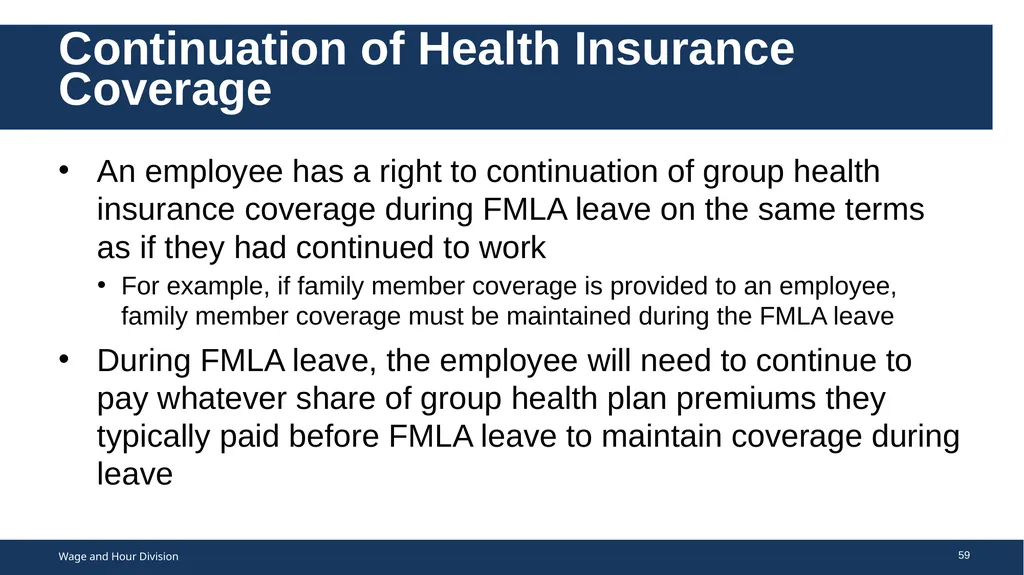
Continuation of Health Insurance Coverage An employee has a right to continuation of group health insurance coverage during FMLA leave on the same terms as if they had continued to work
For example, if family member coverage is provided to an employee, family member coverage must be maintained during the FMLA leave
During FMLA leave, the employee will need to continue to pay whatever share of group health plan premiums they typically paid before FMLA leave to maintain coverage during leave<br>
60
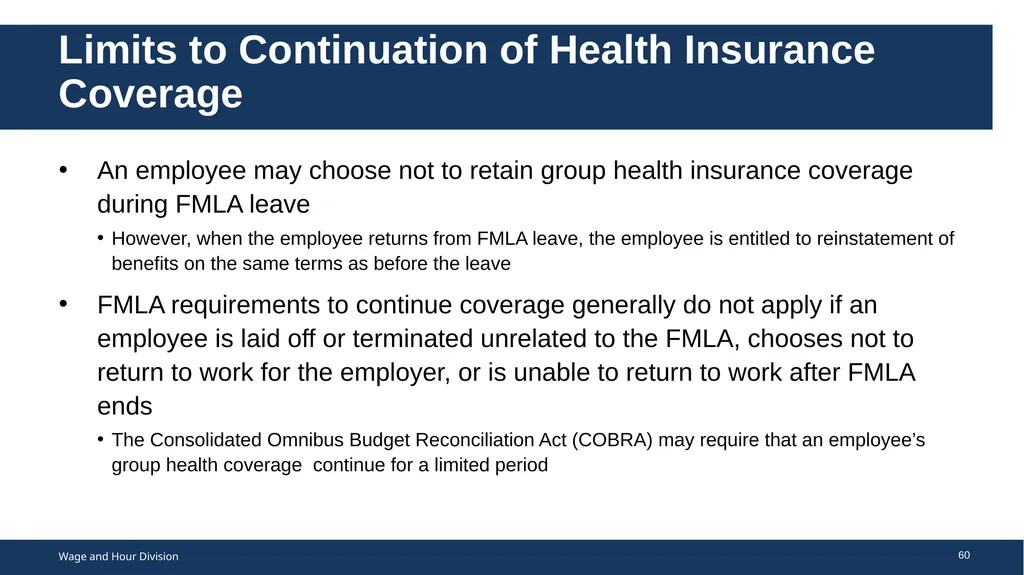
Limits to Continuation of Health Insurance Coverage An employee may choose not to retain group health insurance coverage during FMLA leave
However, when the employee returns from FMLA leave, the employee is entitled to reinstatement of benefits on the same terms as before the leave
FMLA requirements to continue coverage generally do not apply if an employee is laid off or terminated unrelated to the FMLA, chooses not to return to work for the employer, or is unable to return to work after FMLA ends
The Consolidated Omnibus Budget Reconciliation Act (COBRA) may require that an employee’s group health coverage continue for a limited period<br>
61
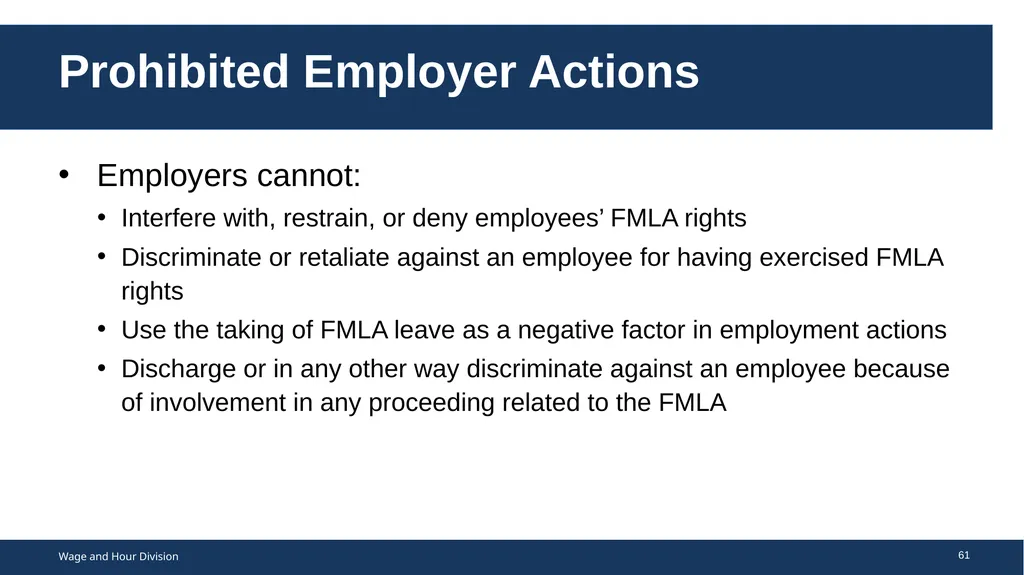
Prohibited Employer Actions Employers cannot:
Interfere with, restrain, or deny employees’ FMLA rights
Discriminate or retaliate against an employee for having exercised FMLA rights
Use the taking of FMLA leave as a negative factor in employment actions
Discharge or in any other way discriminate against an employee because of involvement in any proceeding related to the FMLA<br>
62
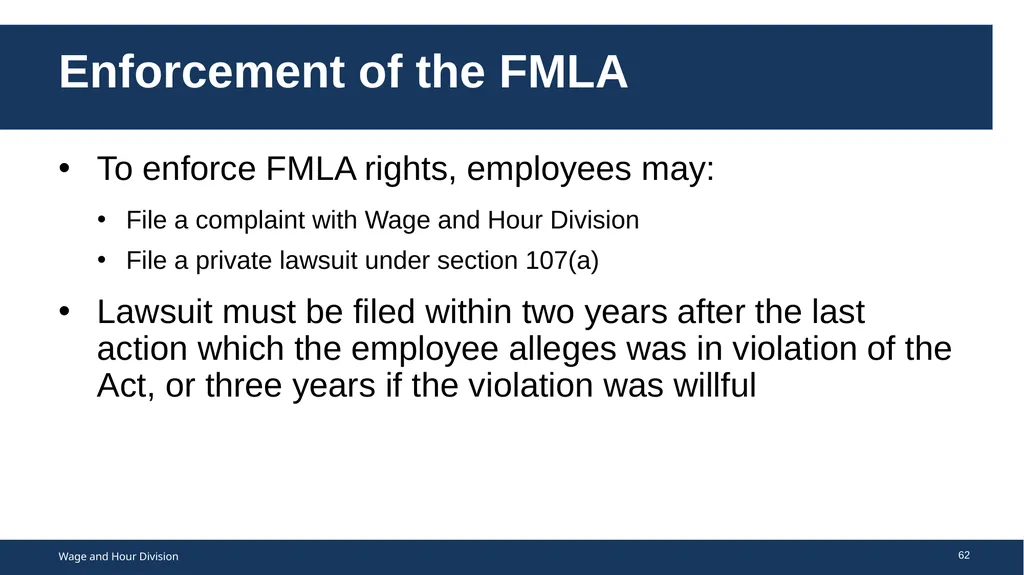
Enforcement of the FMLA To enforce FMLA rights, employees may:
File a complaint with Wage and Hour Division
File a private lawsuit under section 107(a)
Lawsuit must be filed within two years after the last action which the employee alleges was in violation of the Act, or three years if the violation was willful<br>
File a complaint with Wage and Hour Division
File a private lawsuit under section 107(a)
Lawsuit must be filed within two years after the last action which the employee alleges was in violation of the Act, or three years if the violation was willful<br>
63
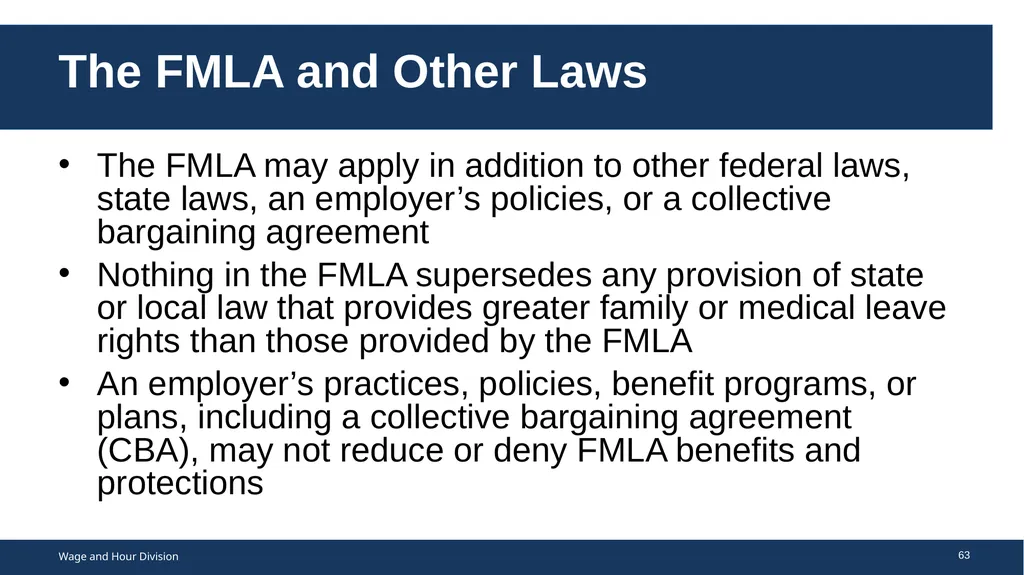
The FMLA and Other Laws The FMLA may apply in addition to other federal laws, state laws, an employer’s policies, or a collective bargaining agreement
Nothing in the FMLA supersedes any provision of state or local law that provides greater family or medical leave rights than those provided by the FMLA
An employer’s practices, policies, benefit programs, or plans, including a collective bargaining agreement (CBA), may not reduce or deny FMLA benefits and protections<br>
64
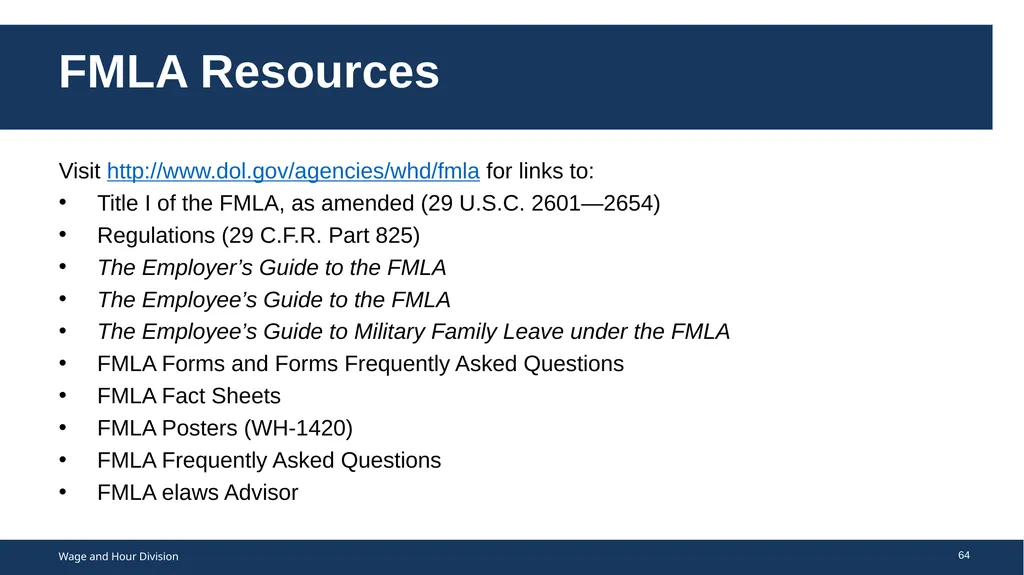
FMLA Resources Visit http://www.dol.gov/agencies/whd/fmla for links to:
Title I of the FMLA, as amended (29 U.S.C. 2601—2654)
Regulations (29 C.F.R. Part 825)
The Employer’s Guide to the FMLA
The Employee’s Guide to the FMLA
The Employee’s Guide to Military Family Leave under the FMLA
FMLA Forms and Forms Frequently Asked Questions
FMLA Fact Sheets
FMLA Posters (WH-1420)
FMLA Frequently Asked Questions
FMLA elaws Advisor<br>