Feelings in Motherhood Pregnant and Postpartum Mood and Anxiety Disorders Affect the Whole Family Supported by funds received from the California Department of Public Health, Maternal, Child and Adolescent Health Division. Introduction Moms
"Feelings in Motherhood Pregnant and Postpartum" is the property of its rightful owner. Permission is granted to
download and print the materials on this website for personal, non-commercial use only, and to display it
on your personal computer provided you do not modify the materials and that you retain all copyright
notices contained in the materials. By downloading content from our website, you accept the terms of this
agreement.
Presentation Transcript
01
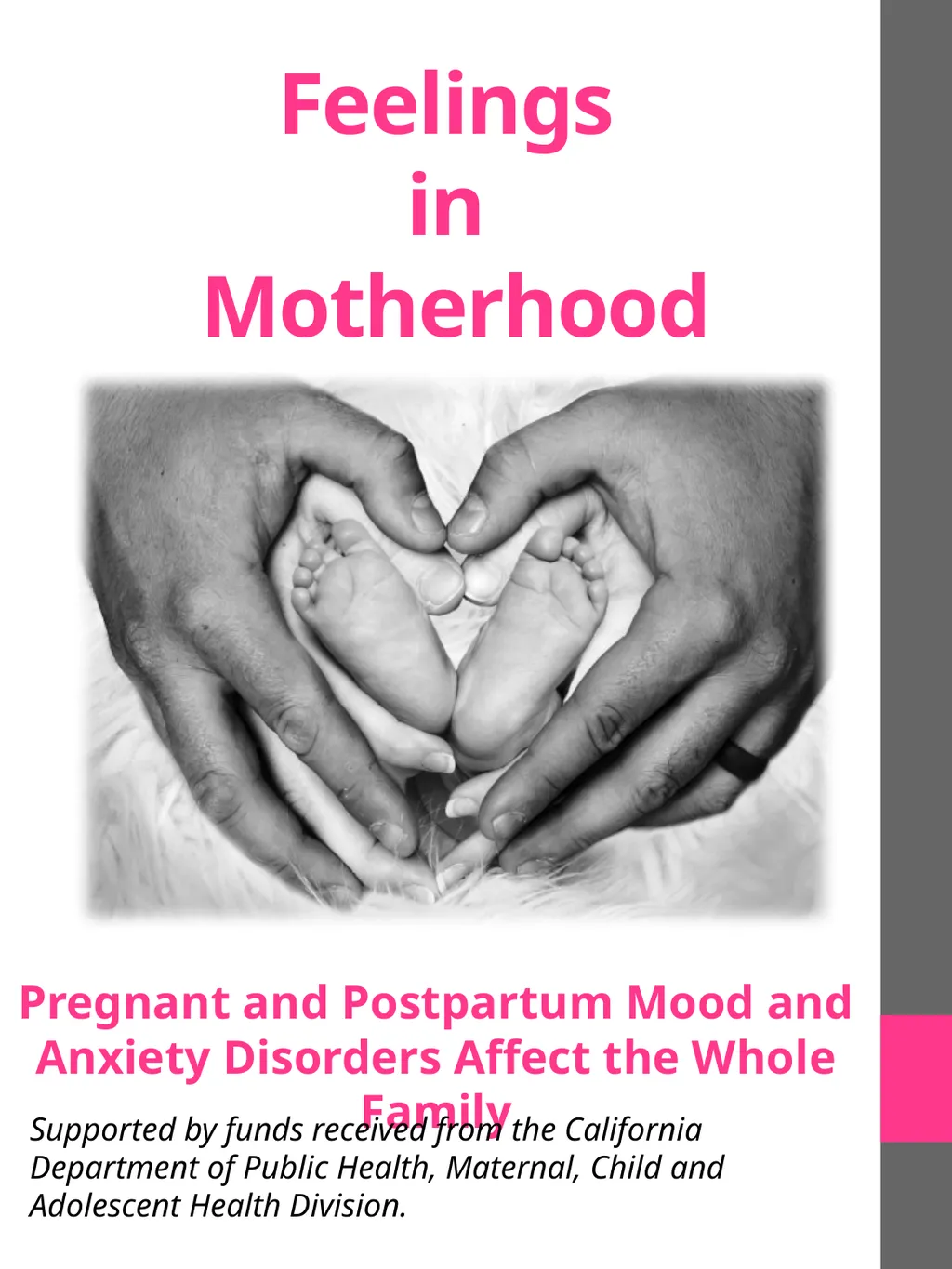
Feelings in Motherhood Pregnant and Postpartum Mood and Anxiety Disorders Affect the Whole Family Supported by funds received from the California Department of Public Health, Maternal, Child and Adolescent Health Division.<br>
02
Introduction Moms may start to feel changes in their emotions anytime during the pregnancy and up to 12 months after they have their baby.
It is normal for moms to have high hormone levels during a healthy pregnancy. 24 hours after delivery, hormone levels drop back to where they were before becoming pregnant.
Moms may feel different emotions during these times that can be from changes in hormone levels, uneven body chemicals, or simply from things happening in a mom’s life.
Moms can feel more sensitive and have mood swings that are high and low.
Moms need to know when they may need help, so let’s review some common things to watch for during and after pregnancy. Postpartum Support International Helpline: 800.944.4PPD(4773) www.postpartum.net<br>
03
Baby Blues How Many Moms…
About 8 out of 10 moms get “baby blues” which are mild mood swings and crying because of the stress of caring for a new baby and hormonal changes in your body.
What are the things to watch for?
Feeling worried
Feeling unhappy
Feeling tired or low on energy
What to do?
Baby blues are normal and no treatment is needed. Baby blues can last up to 2-3 weeks after you have your baby.
This is an important time to ask for support from your friends and family.
If it does not go away or you are not able to care for yourself and your baby, you may have something more serious and need treatment. Postpartum Support International Helpline: 800.944.4PPD(4773) www.postpartum.net<br>
04
Depression Depression is the most common problem during and after pregnancy.
How Many Moms…
About 2 out of 10 moms get depression during pregnancy and/or after they have their baby.
What are the things to watch for?
Feeling angry or irritable
Lack of interest in the baby
Changes in appetite
Sleeping too much or not enough
Crying and sadness
Feelings of guilt, shame, or hopelessness
Loss of interest or pleasure in things you used to enjoy
Possible thoughts of harming the baby or yourself
These things can start during pregnancy or during the first year after you have your baby
What to do?
Depression can be treated.
If these things are happening or you experience
them in the future, please tell your doctor right
away. Postpartum Support International Helpline: 800.944.4PPD(4773) www.postpartum.net<br>
05
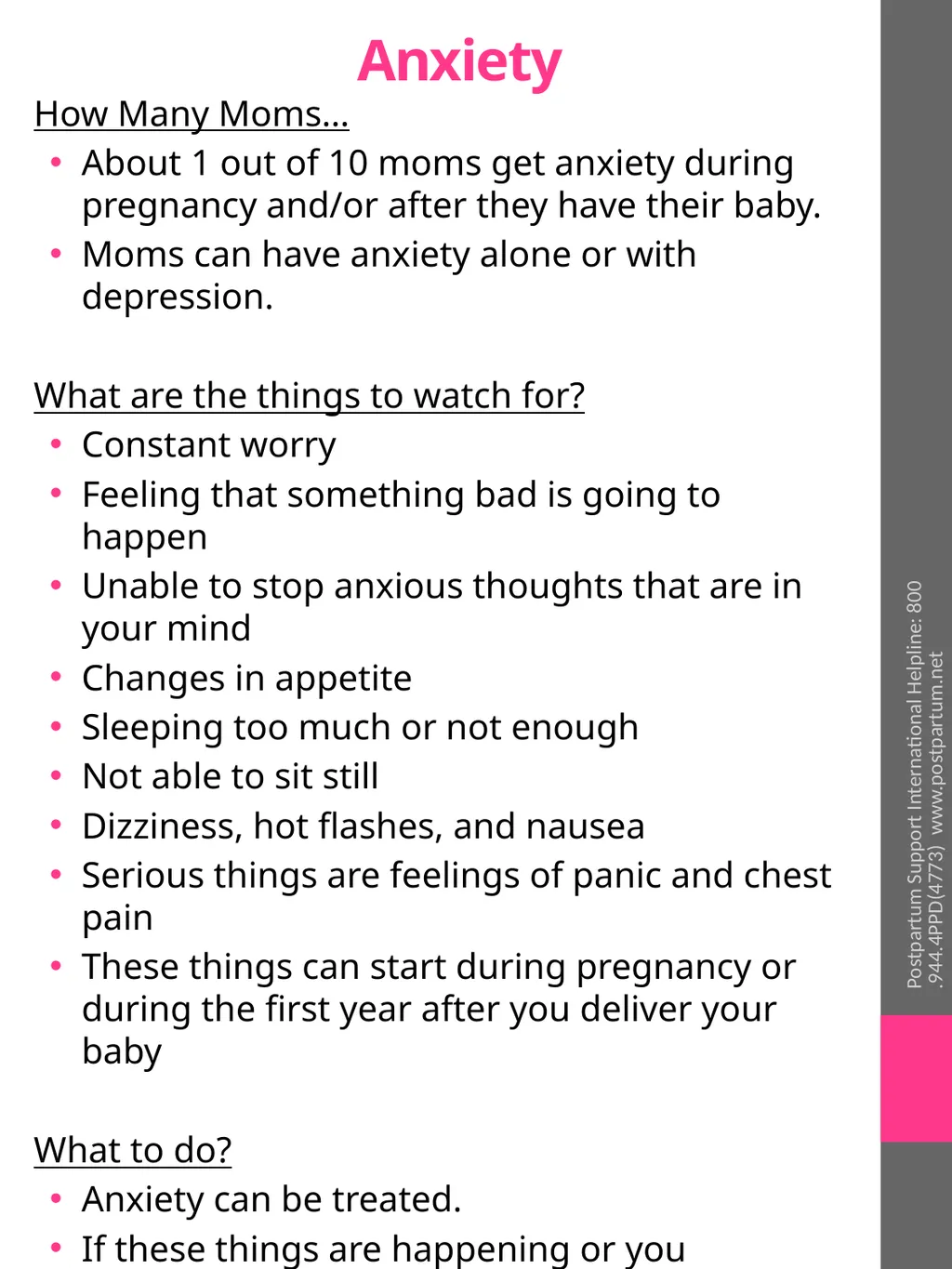
Anxiety How Many Moms…
About 1 out of 10 moms get anxiety during pregnancy and/or after they have their baby.
Moms can have anxiety alone or with depression.
What are the things to watch for?
Constant worry
Feeling that something bad is going to happen
Unable to stop anxious thoughts that are in your mind
Changes in appetite
Sleeping too much or not enough
Not able to sit still
Dizziness, hot flashes, and nausea
Serious things are feelings of panic and chest pain
These things can start during pregnancy or during the first year after you deliver your baby
What to do?
Anxiety can be treated.
If these things are happening or you experience them in the future, please tell your doctor right away. Postpartum Support International Helpline: 800.944.4PPD(4773) www.postpartum.net<br>
06
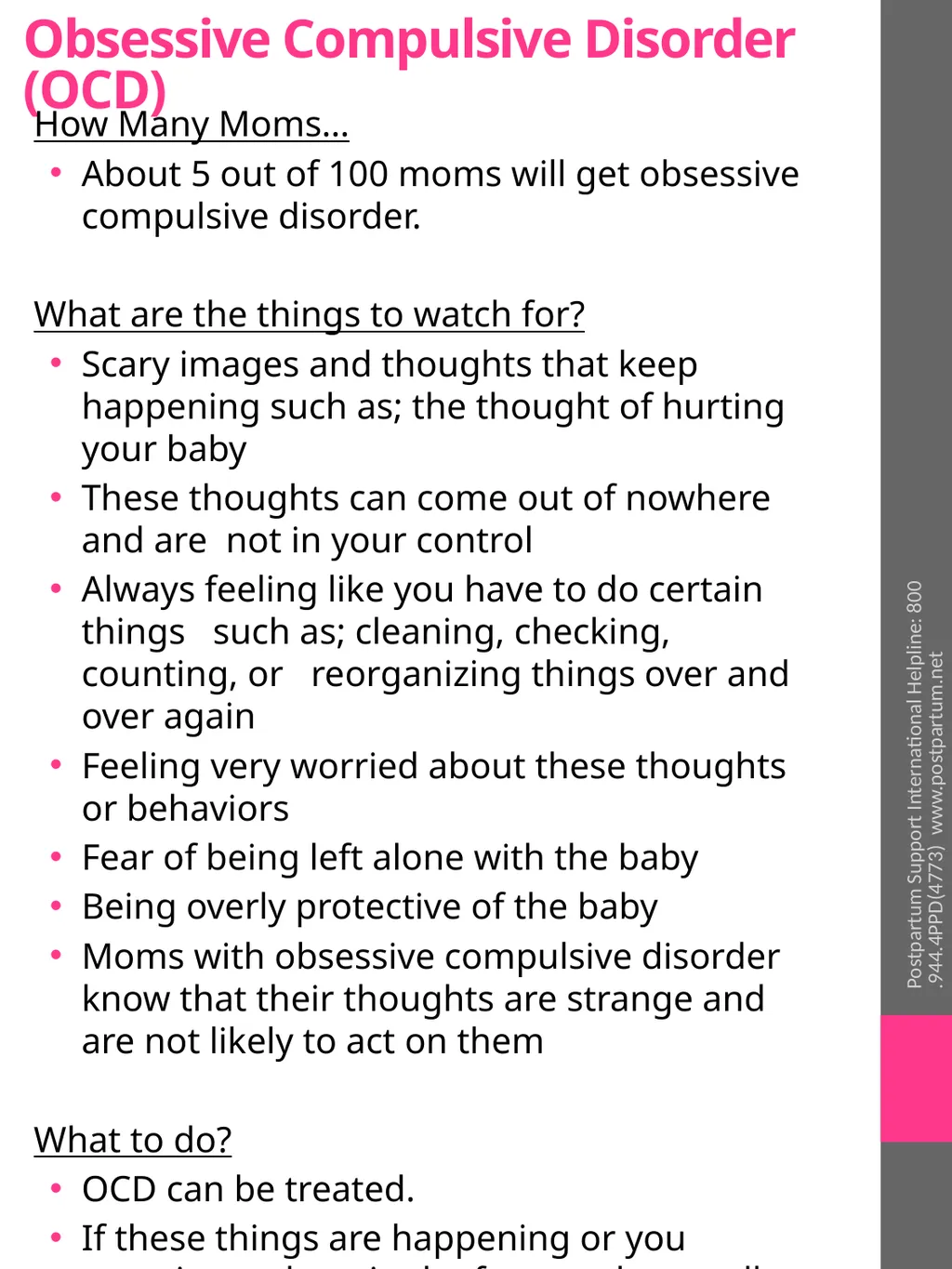
Obsessive Compulsive Disorder (OCD) How Many Moms…
About 5 out of 100 moms will get obsessive compulsive disorder.
What are the things to watch for?
Scary images and thoughts that keep happening such as; the thought of hurting your baby
These thoughts can come out of nowhere and are not in your control
Always feeling like you have to do certain things such as; cleaning, checking, counting, or reorganizing things over and over again
Feeling very worried about these thoughts or behaviors
Fear of being left alone with the baby
Being overly protective of the baby
Moms with obsessive compulsive disorder know that their thoughts are strange and are not likely to act on them
What to do?
OCD can be treated.
If these things are happening or you experience them in the future, please tell your doctor right away. Postpartum Support International Helpline: 800.944.4PPD(4773) www.postpartum.net<br>
07
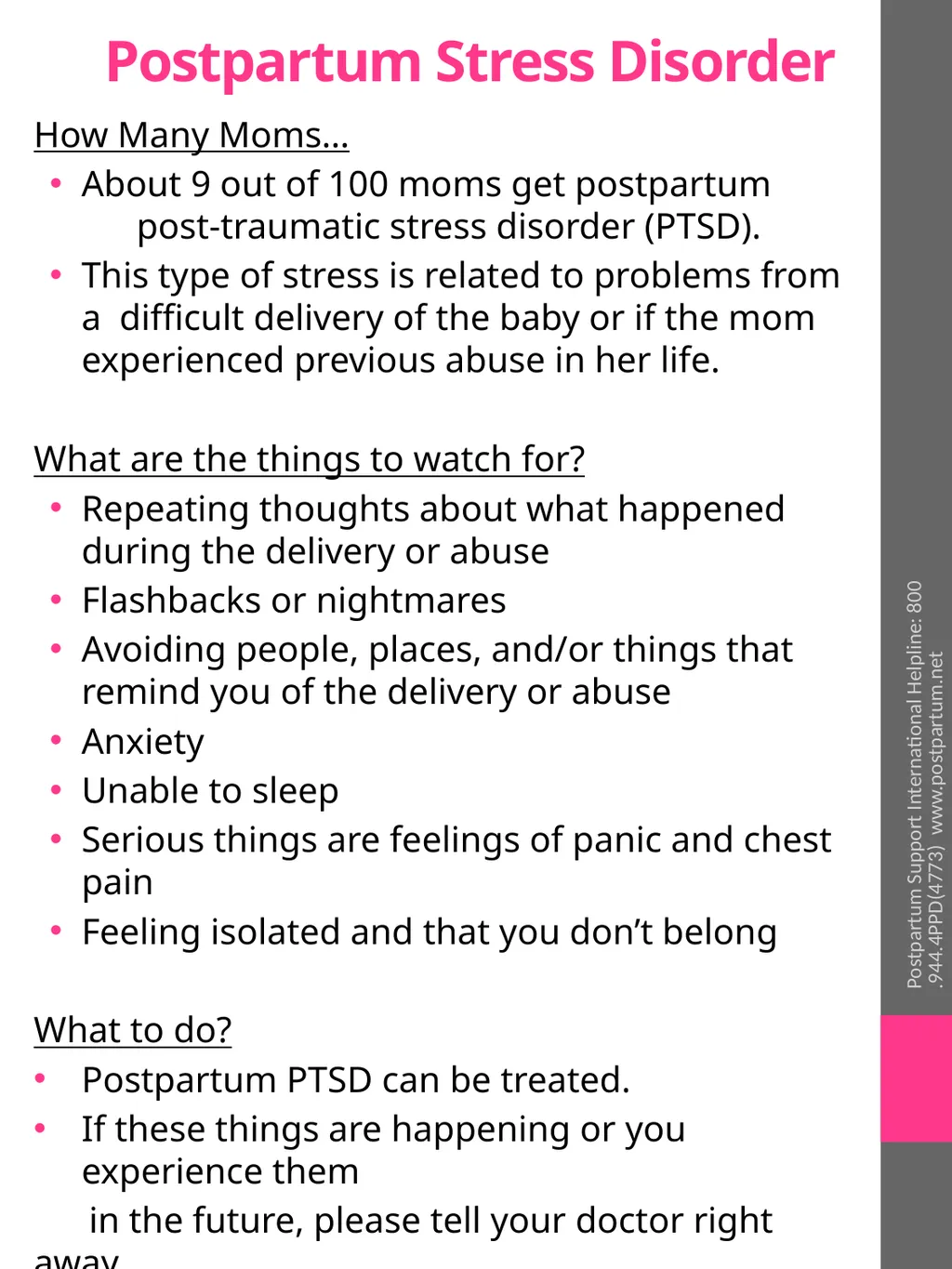
Postpartum Stress Disorder How Many Moms…
About 9 out of 100 moms get postpartum post-traumatic stress disorder (PTSD).
This type of stress is related to problems from a difficult delivery of the baby or if the mom experienced previous abuse in her life.
What are the things to watch for?
Repeating thoughts about what happened during the delivery or abuse
Flashbacks or nightmares
Avoiding people, places, and/or things that remind you of the delivery or abuse
Anxiety
Unable to sleep
Serious things are feelings of panic and chest pain
Feeling isolated and that you don’t belong
What to do?
Postpartum PTSD can be treated.
If these things are happening or you experience them
in the future, please tell your doctor right away. Postpartum Support International Helpline: 800.944.4PPD(4773) www.postpartum.net<br>
08
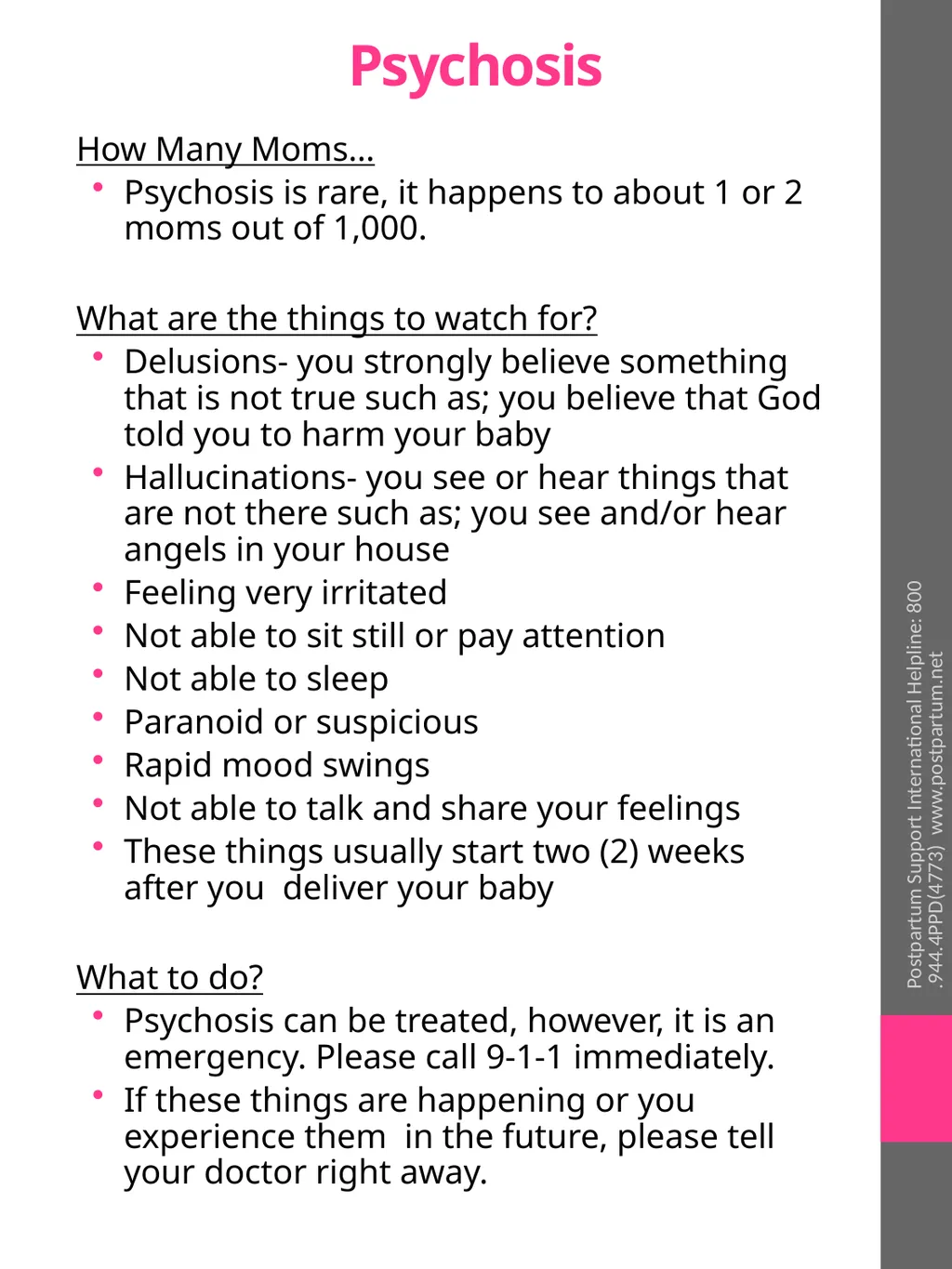
Psychosis How Many Moms…
Psychosis is rare, it happens to about 1 or 2 moms out of 1,000.
What are the things to watch for?
Delusions- you strongly believe something that is not true such as; you believe that God told you to harm your baby
Hallucinations- you see or hear things that are not there such as; you see and/or hear angels in your house
Feeling very irritated
Not able to sit still or pay attention
Not able to sleep
Paranoid or suspicious
Rapid mood swings
Not able to talk and share your feelings
These things usually start two (2) weeks after you deliver your baby
What to do?
Psychosis can be treated, however, it is an emergency. Please call 9-1-1 immediately.
If these things are happening or you experience them in the future, please tell your doctor right away. Postpartum Support International Helpline: 800.944.4PPD(4773) www.postpartum.net<br>
09
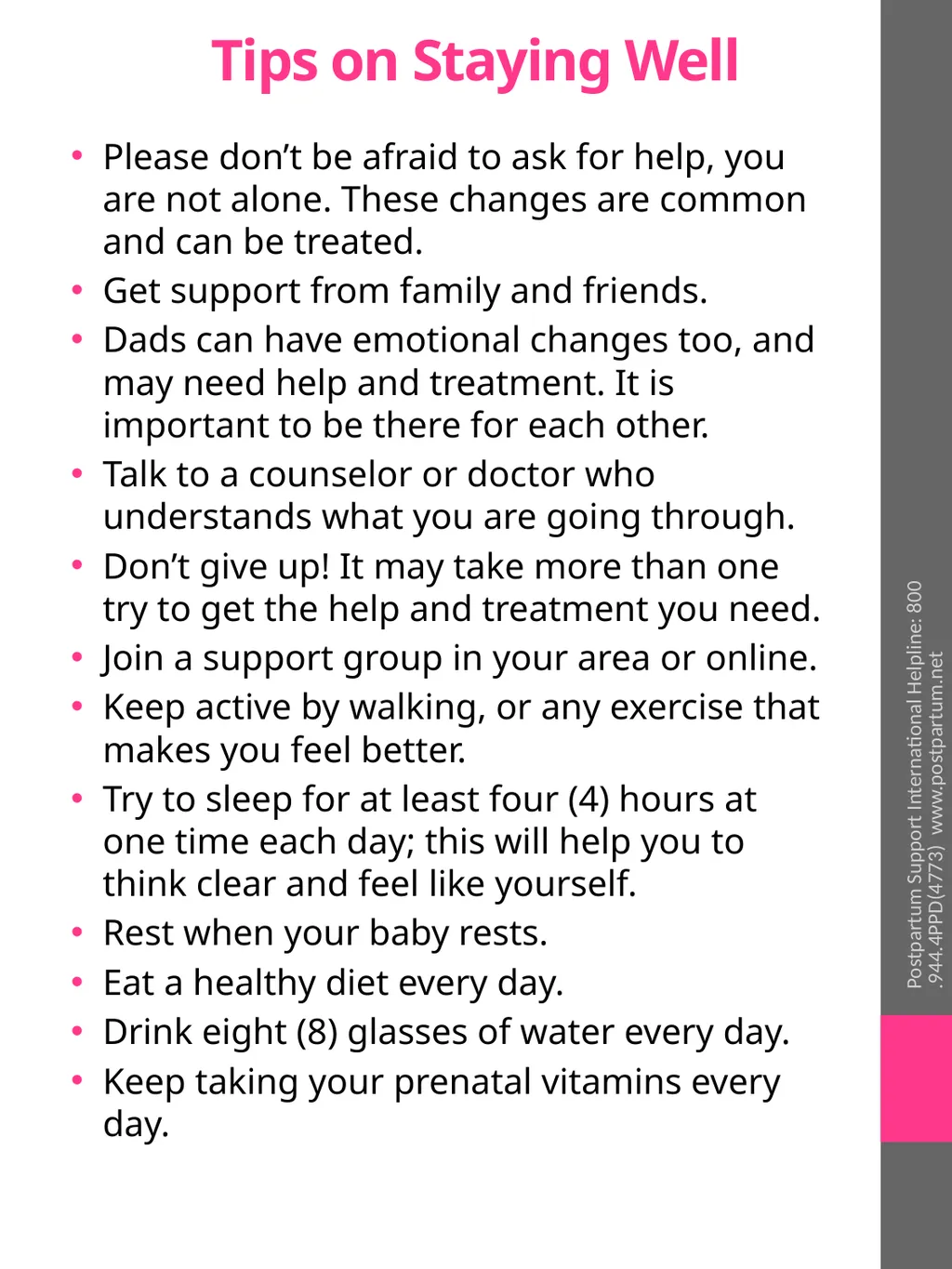
Tips on Staying Well Please don’t be afraid to ask for help, you are not alone. These changes are common and can be treated.
Get support from family and friends.
Dads can have emotional changes too, and may need help and treatment. It is important to be there for each other.
Talk to a counselor or doctor who understands what you are going through.
Don’t give up! It may take more than one try to get the help and treatment you need.
Join a support group in your area or online.
Keep active by walking, or any exercise that makes you feel better.
Try to sleep for at least four (4) hours at one time each day; this will help you to think clear and feel like yourself.
Rest when your baby rests.
Eat a healthy diet every day.
Drink eight (8) glasses of water every day.
Keep taking your prenatal vitamins every day. Postpartum Support International Helpline: 800.944.4PPD(4773) www.postpartum.net<br>
10
Riverside University Health System
Public Health Department
Public Health Nursing/Maternal Child & Adolescent Health Department Postpartum Support International Helpline: 800.944.4PPD(4773) www.postpartum.net<br>