
Foodborne Illnesses A foodborne illness is a
TD
Published · 118 slides · 0 views

1 / 1


Description
Foodborne Illnesses A foodborne illness is a disease transmitted to people through food. An illness is considered an outbreak when: Two or more people have the same symptoms after eating the same food An investigation is conducted by state
Related Topics
Share
Embed code
Download this presentation From Below
"Foodborne Illnesses A foodborne illness is a" is the property of its rightful owner. Permission is granted to download and print the materials on this website for personal, non-commercial use only, and to display it on your personal computer provided you do not modify the materials and that you retain all copyright notices contained in the materials. By downloading content from our website, you accept the terms of this agreement.
Presentation Transcript
01
Foodborne Illnesses A foodborne illness is a disease transmitted to people through food.
An illness is considered an outbreak when:
Two or more people have the same symptoms after eating the same food
An investigation is conducted by state and local regulatory authorities
The outbreak is confirmed by laboratory analysis 1-2<br>
An illness is considered an outbreak when:
Two or more people have the same symptoms after eating the same food
An investigation is conducted by state and local regulatory authorities
The outbreak is confirmed by laboratory analysis 1-2<br>
02
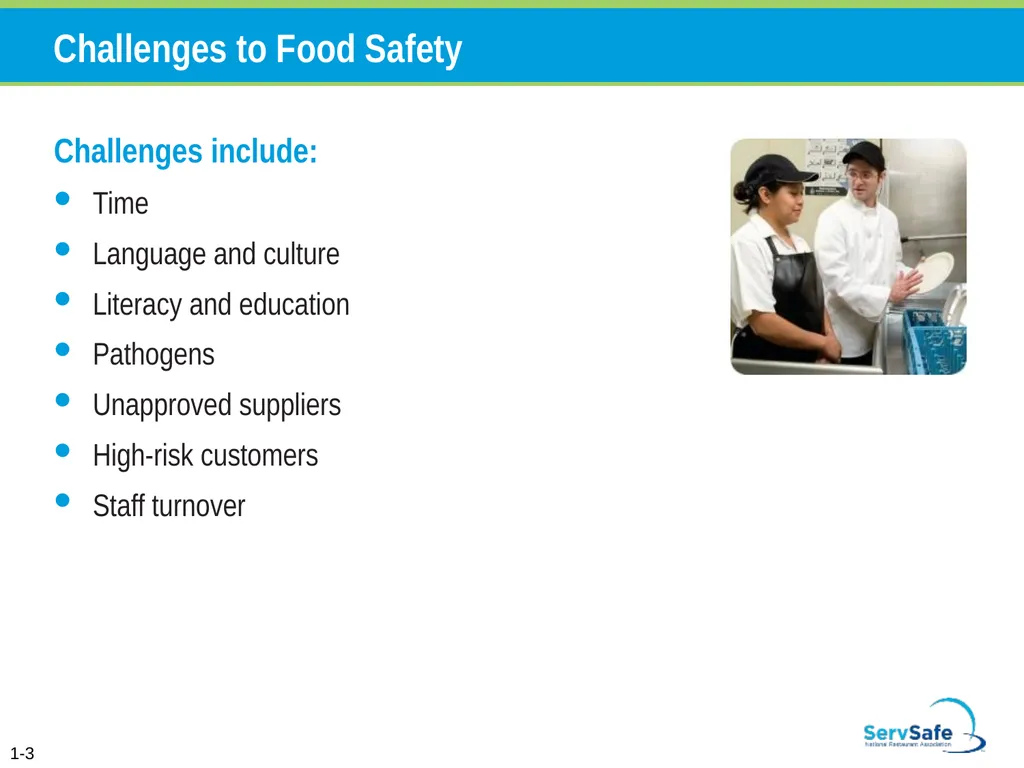
Challenges to Food Safety Challenges include:
Time
Language and culture
Literacy and education
Pathogens
Unapproved suppliers
High-risk customers
Staff turnover 1-3<br>
Time
Language and culture
Literacy and education
Pathogens
Unapproved suppliers
High-risk customers
Staff turnover 1-3<br>
03
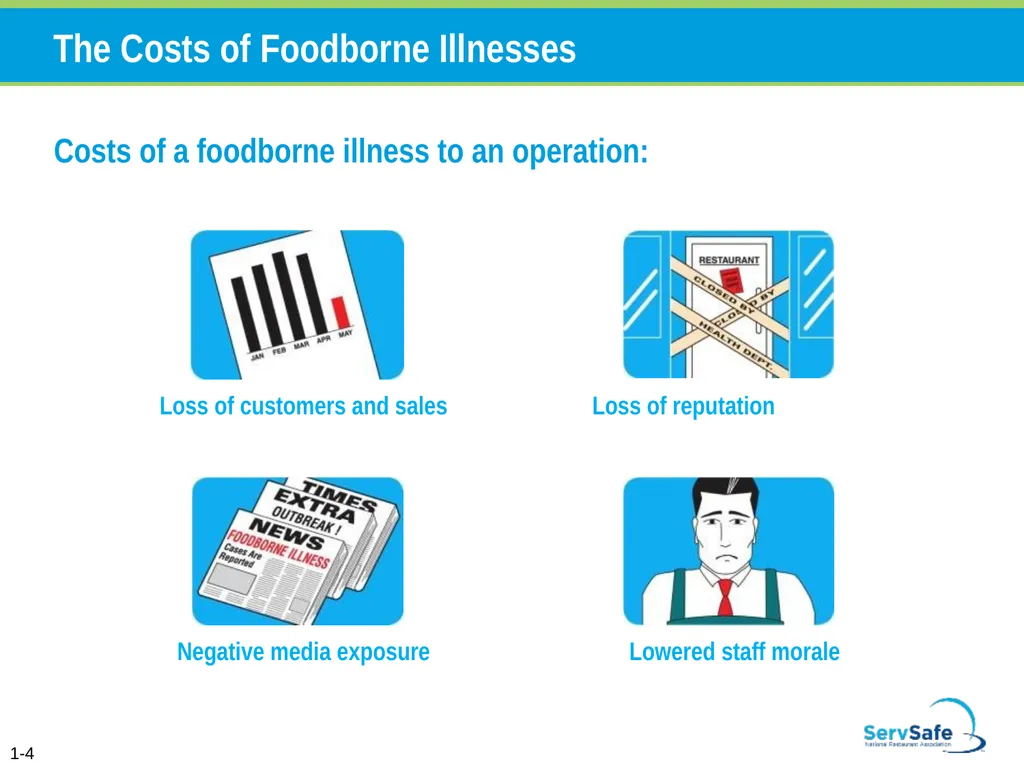
The Costs of Foodborne Illnesses Costs of a foodborne illness to an operation: 1-4 Loss of customers and sales Loss of reputation Negative media exposure Lowered staff morale<br>
04
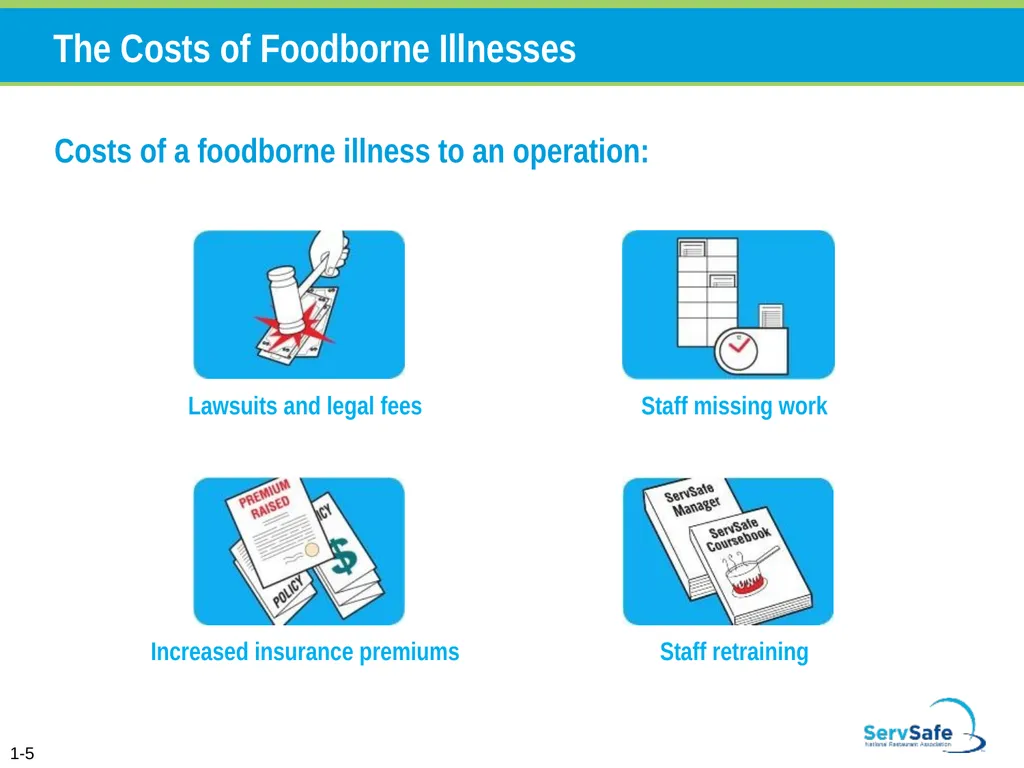
1-5 The Costs of Foodborne Illnesses Costs of a foodborne illness to an operation: Lawsuits and legal fees Staff missing work Increased insurance premiums Staff retraining<br>
05
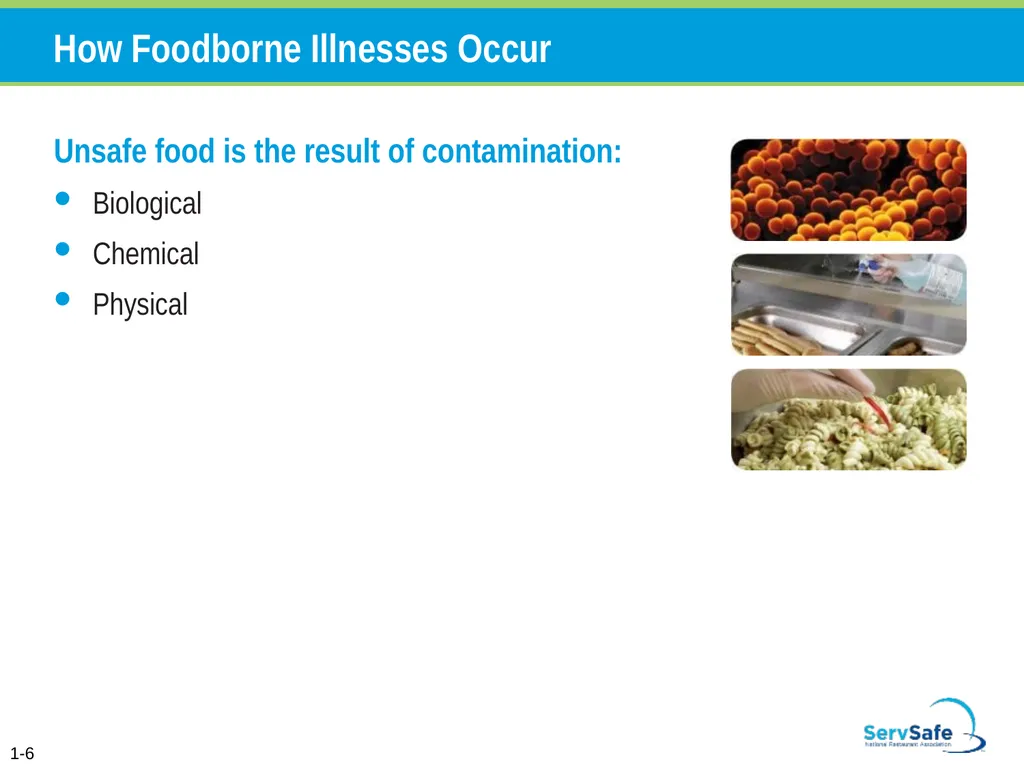
How Foodborne Illnesses Occur Unsafe food is the result of contamination:
Biological
Chemical
Physical 1-6<br>
Biological
Chemical
Physical 1-6<br>
06
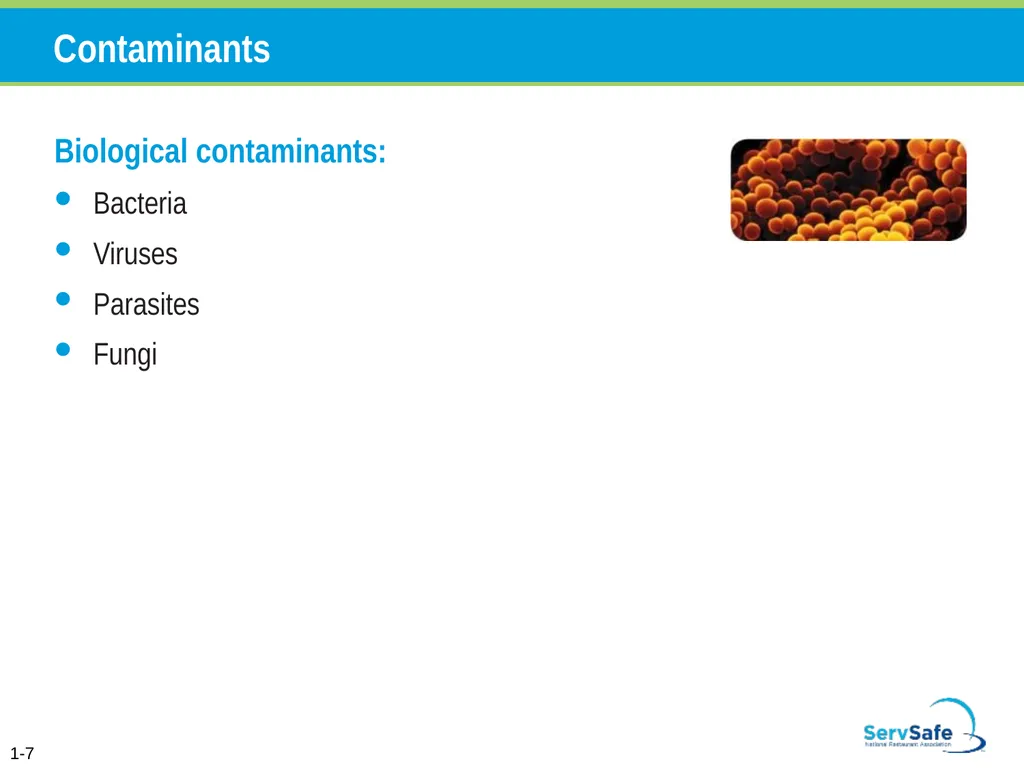
Contaminants Biological contaminants:
Bacteria
Viruses
Parasites
Fungi 1-7<br>
Bacteria
Viruses
Parasites
Fungi 1-7<br>
07
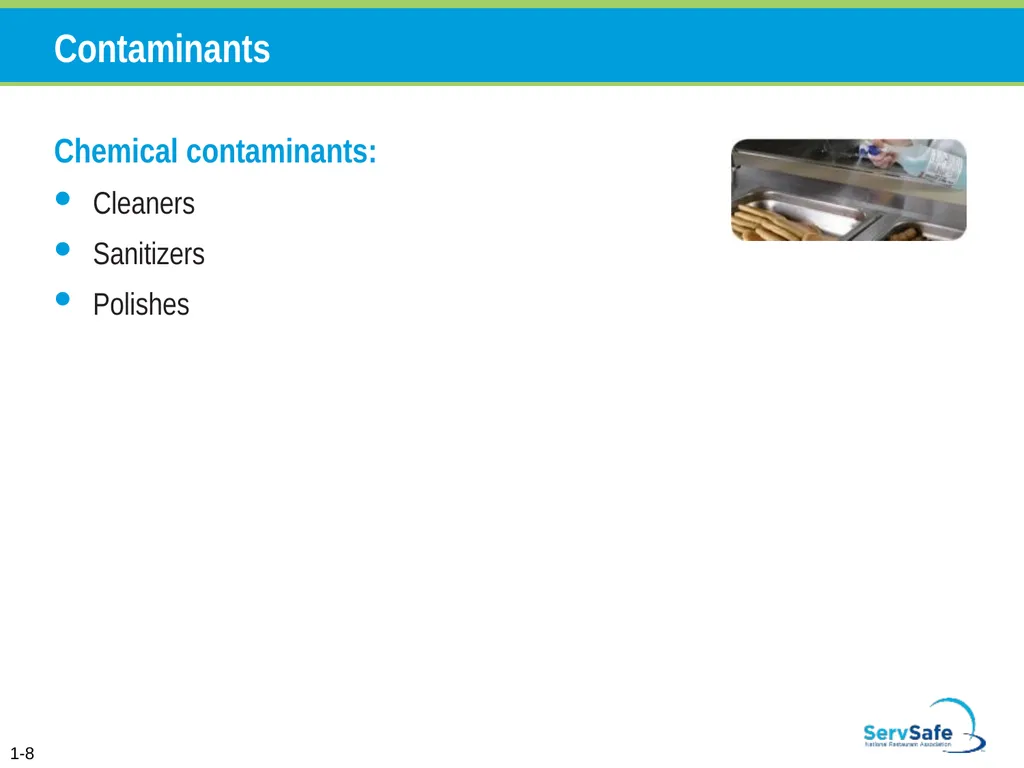
Contaminants Chemical contaminants:
Cleaners
Sanitizers
Polishes 1-8<br>
Cleaners
Sanitizers
Polishes 1-8<br>
08
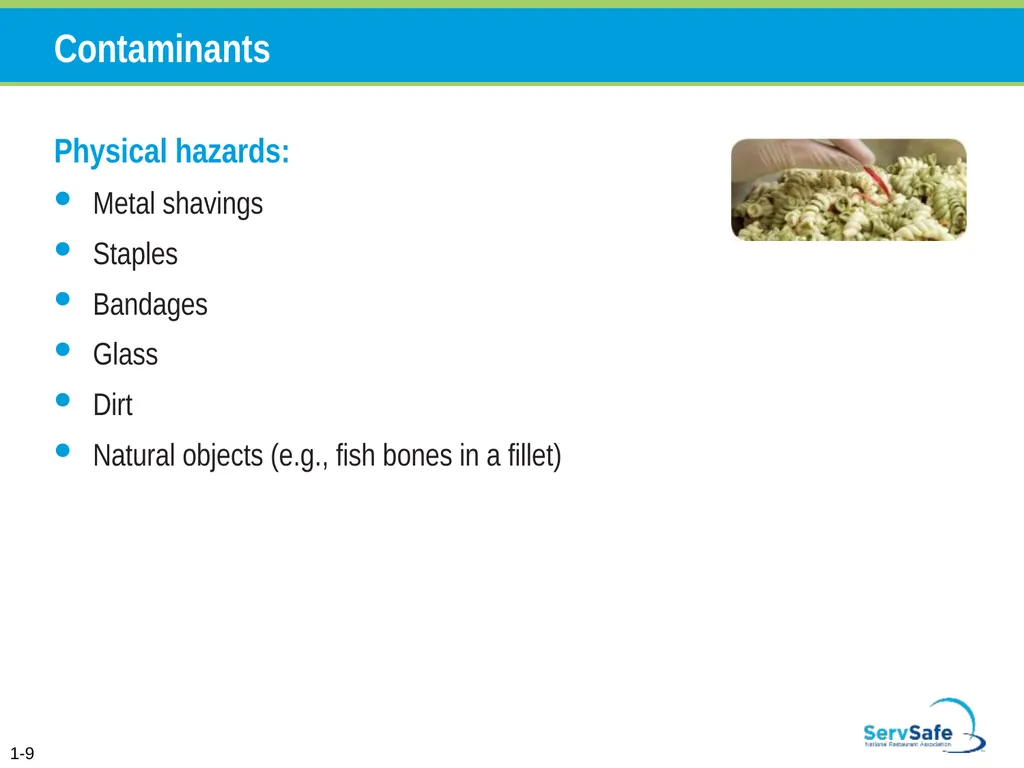
Contaminants Physical hazards:
Metal shavings
Staples
Bandages
Glass
Dirt
Natural objects (e.g., fish bones in a fillet) 1-9<br>
Metal shavings
Staples
Bandages
Glass
Dirt
Natural objects (e.g., fish bones in a fillet) 1-9<br>
09
How Food Becomes Unsafe Five risk factors for foodborne illness:
Purchasing food from unsafe sources
Failing to cook food correctly
Holding food at incorrect temperatures
Using contaminated equipment
Practicing poor personal hygiene 1-10<br>
Purchasing food from unsafe sources
Failing to cook food correctly
Holding food at incorrect temperatures
Using contaminated equipment
Practicing poor personal hygiene 1-10<br>
10
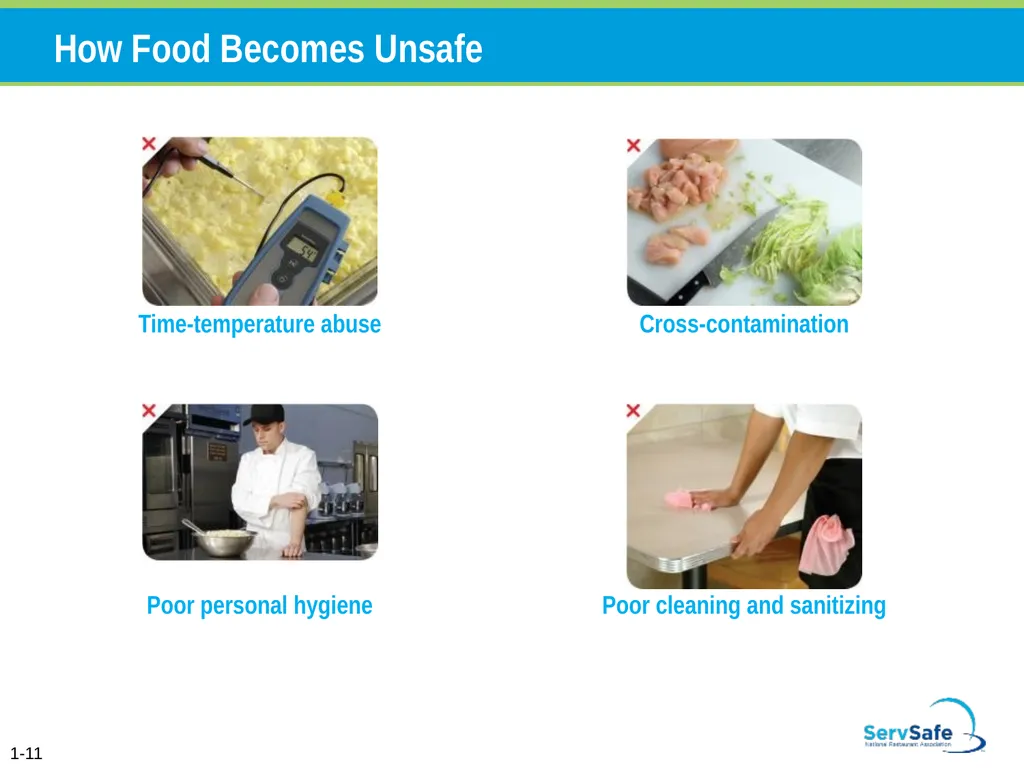
How Food Becomes Unsafe 1-11 Time-temperature abuse Cross-contamination Poor personal hygiene Poor cleaning and sanitizing<br>
11
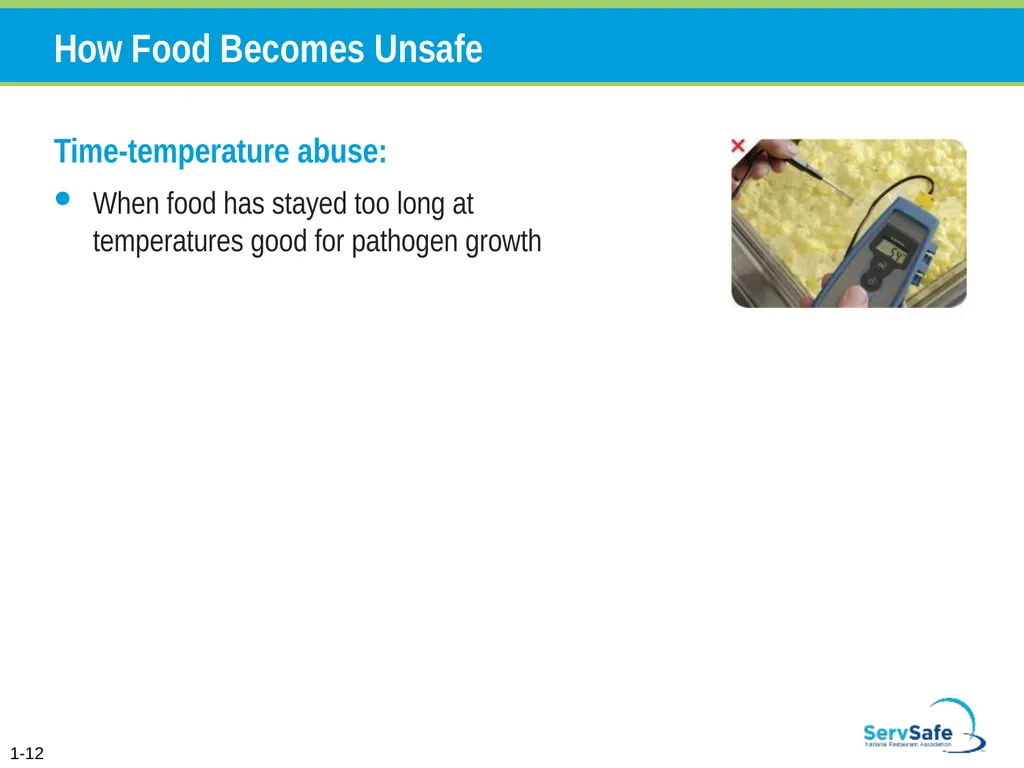
How Food Becomes Unsafe Time-temperature abuse:
When food has stayed too long at temperatures good for pathogen growth 1-12<br>
When food has stayed too long at temperatures good for pathogen growth 1-12<br>
12
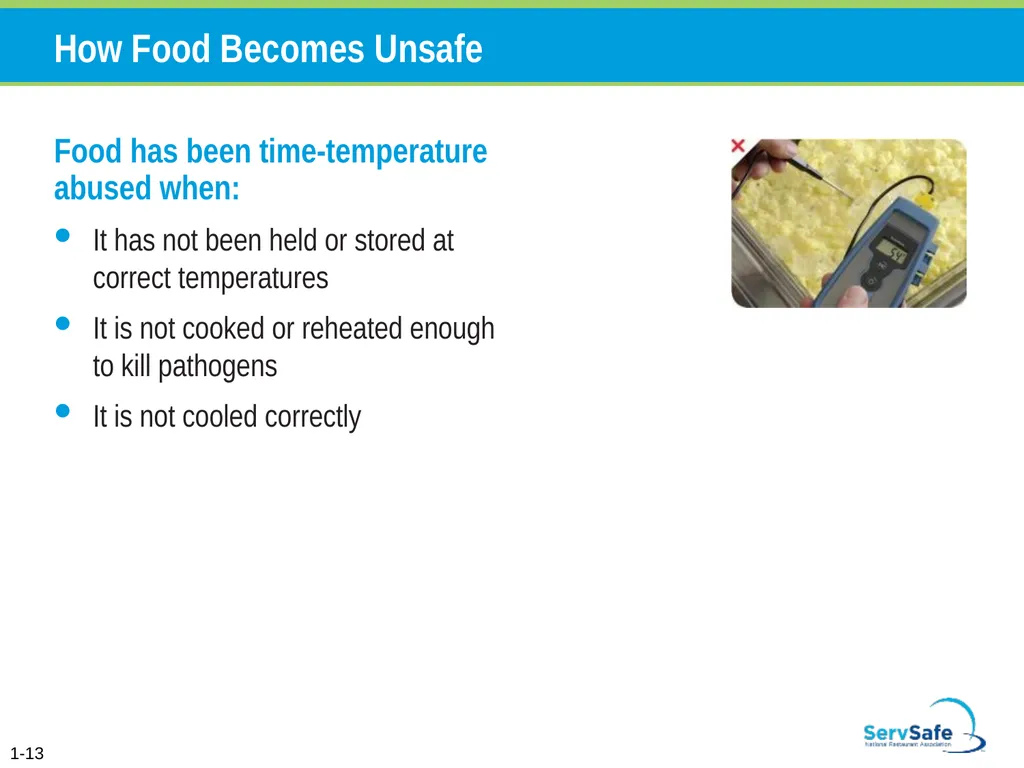
How Food Becomes Unsafe Food has been time-temperature abused when:
It has not been held or stored at correct temperatures
It is not cooked or reheated enough to kill pathogens
It is not cooled correctly 1-13 Pg 1.5 SSF 6e Pg 1.5 SSF 6e Pg 1.5 SSF 6e<br>
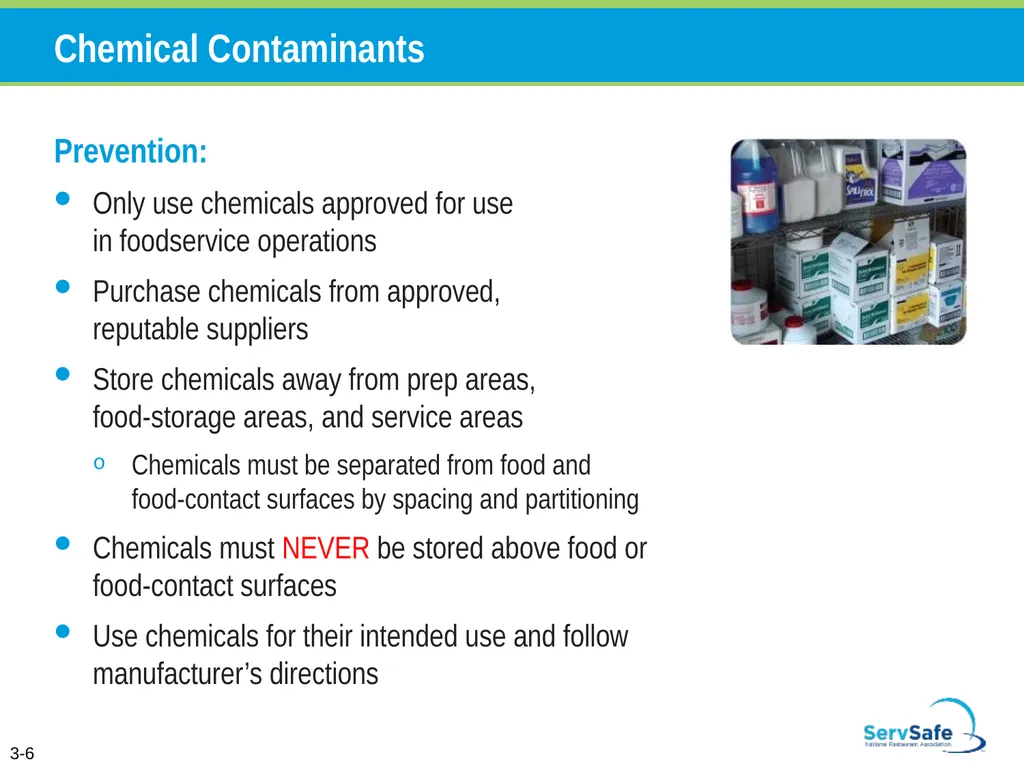
It has not been held or stored at correct temperatures
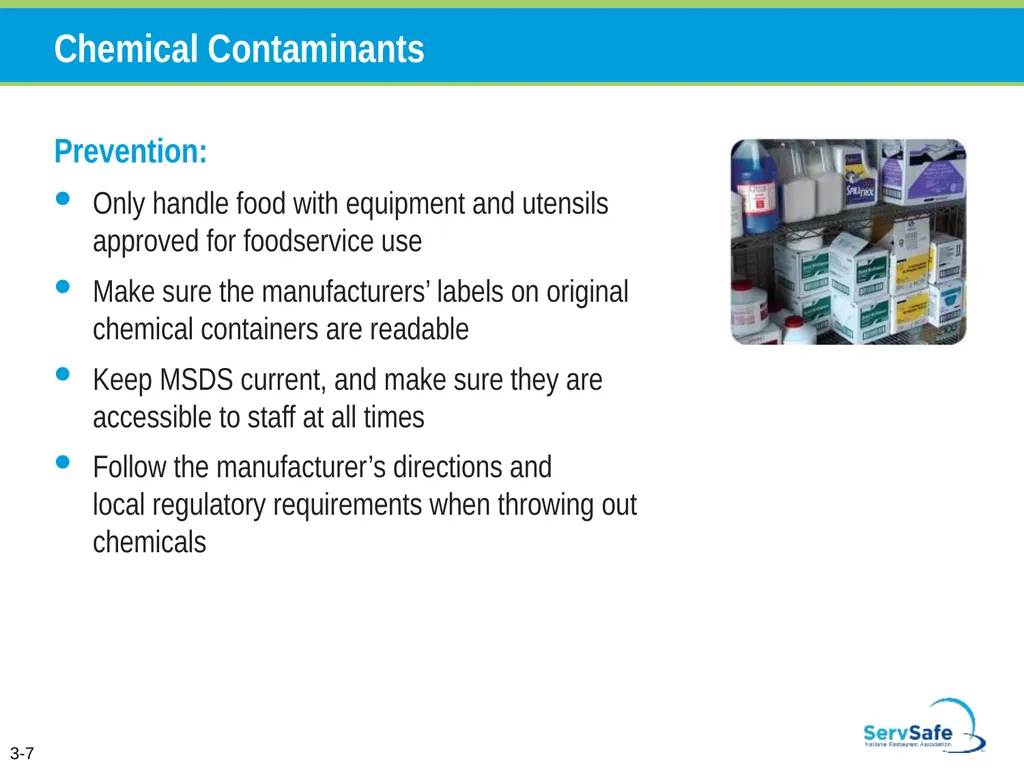
It is not cooked or reheated enough to kill pathogens
It is not cooled correctly 1-13 Pg 1.5 SSF 6e Pg 1.5 SSF 6e Pg 1.5 SSF 6e<br>
13
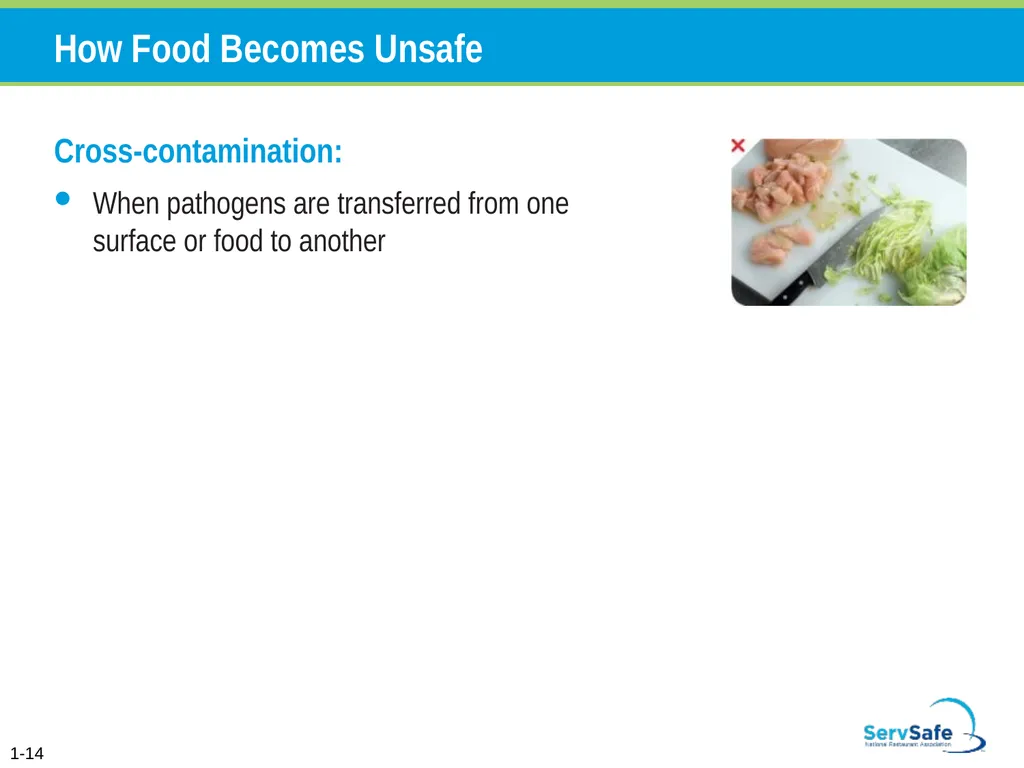
How Food Becomes Unsafe Cross-contamination:
When pathogens are transferred from one surface or food to another 1-14 Pg 1.5 SSF 6e<br>
When pathogens are transferred from one surface or food to another 1-14 Pg 1.5 SSF 6e<br>
14
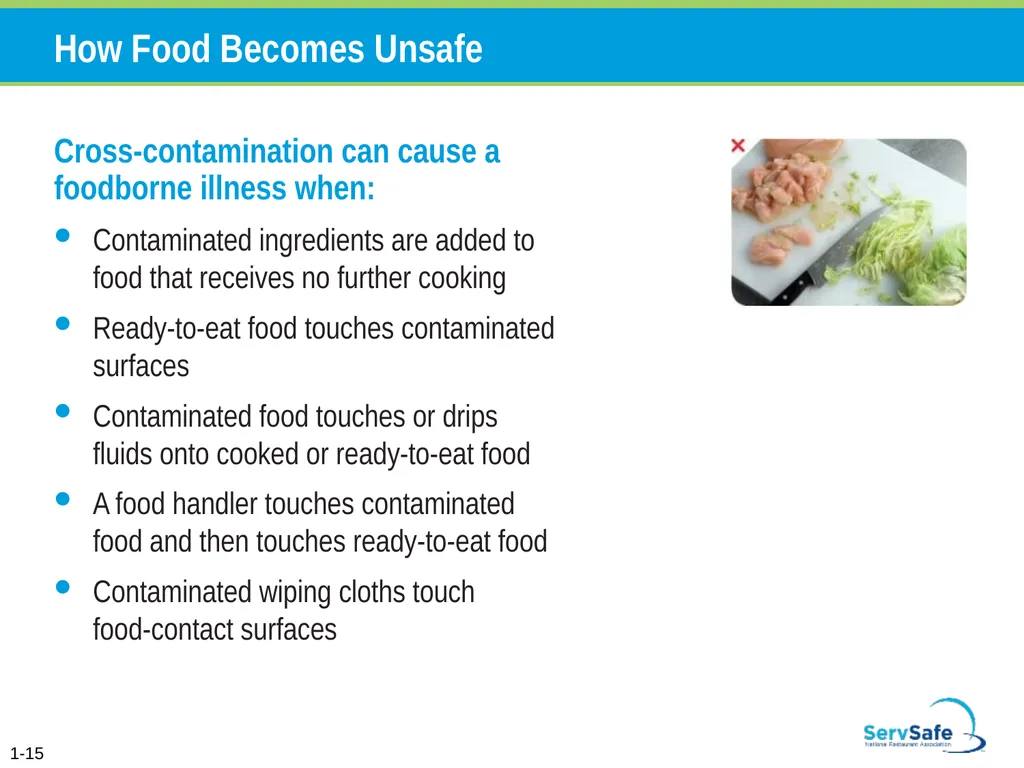
How Food Becomes Unsafe Cross-contamination can cause a foodborne illness when:
Contaminated ingredients are added to food that receives no further cooking
Ready-to-eat food touches contaminated surfaces
Contaminated food touches or drips fluids onto cooked or ready-to-eat food
A food handler touches contaminated food and then touches ready-to-eat food
Contaminated wiping cloths touch food-contact surfaces 1-15 Pg 1.5 SSF 6e<br>
15
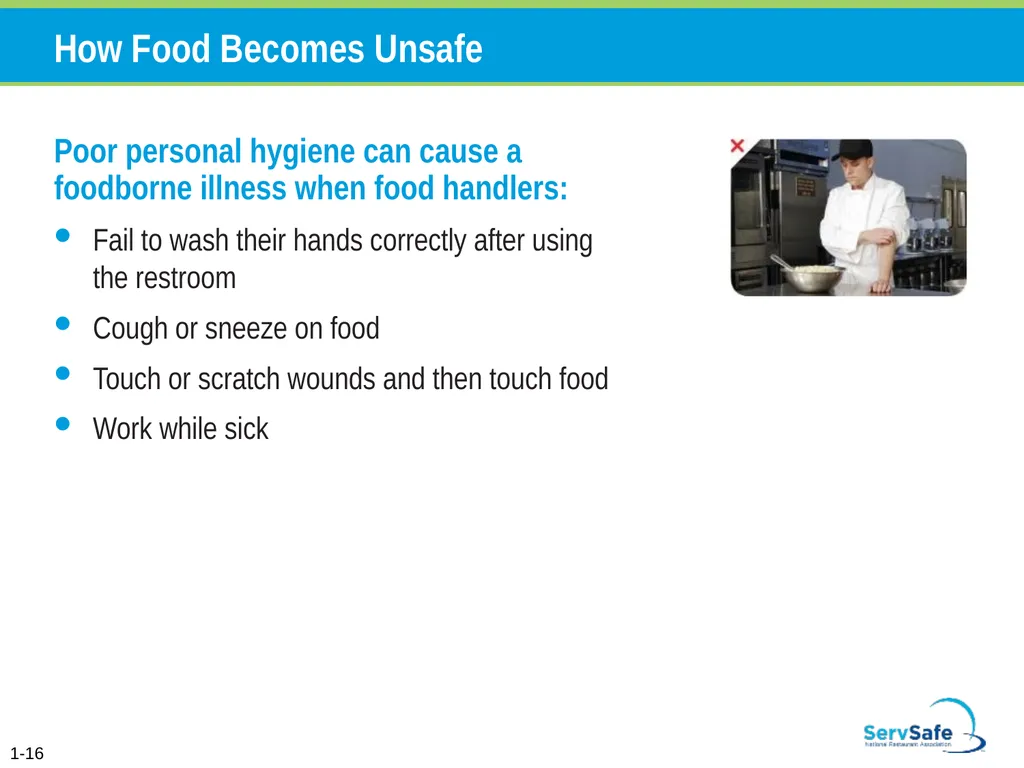
How Food Becomes Unsafe Poor personal hygiene can cause a foodborne illness when food handlers:
Fail to wash their hands correctly after using the restroom
Cough or sneeze on food
Touch or scratch wounds and then touch food
Work while sick 1-16 Pg 1.5 SSF 6e<br>
Fail to wash their hands correctly after using the restroom
Cough or sneeze on food
Touch or scratch wounds and then touch food
Work while sick 1-16 Pg 1.5 SSF 6e<br>
16
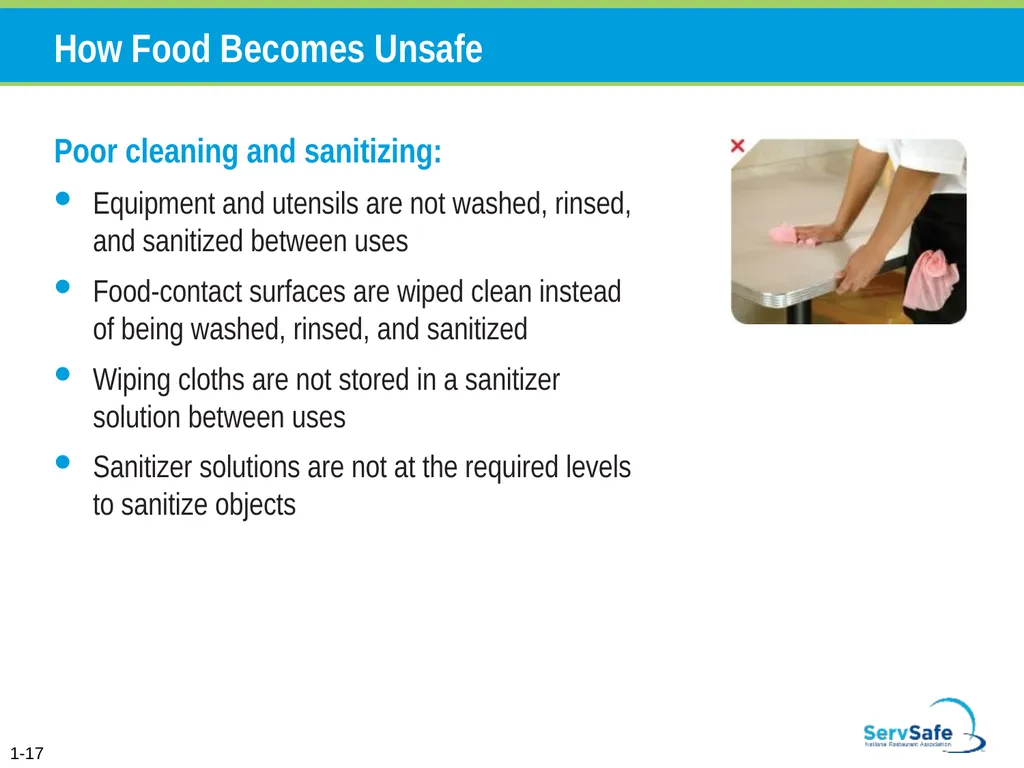
How Food Becomes Unsafe Poor cleaning and sanitizing:
Equipment and utensils are not washed, rinsed, and sanitized between uses
Food-contact surfaces are wiped clean instead of being washed, rinsed, and sanitized
Wiping cloths are not stored in a sanitizer solution between uses
Sanitizer solutions are not at the required levels to sanitize objects 1-17 Pg 1.5 SSF 6e<br>
17
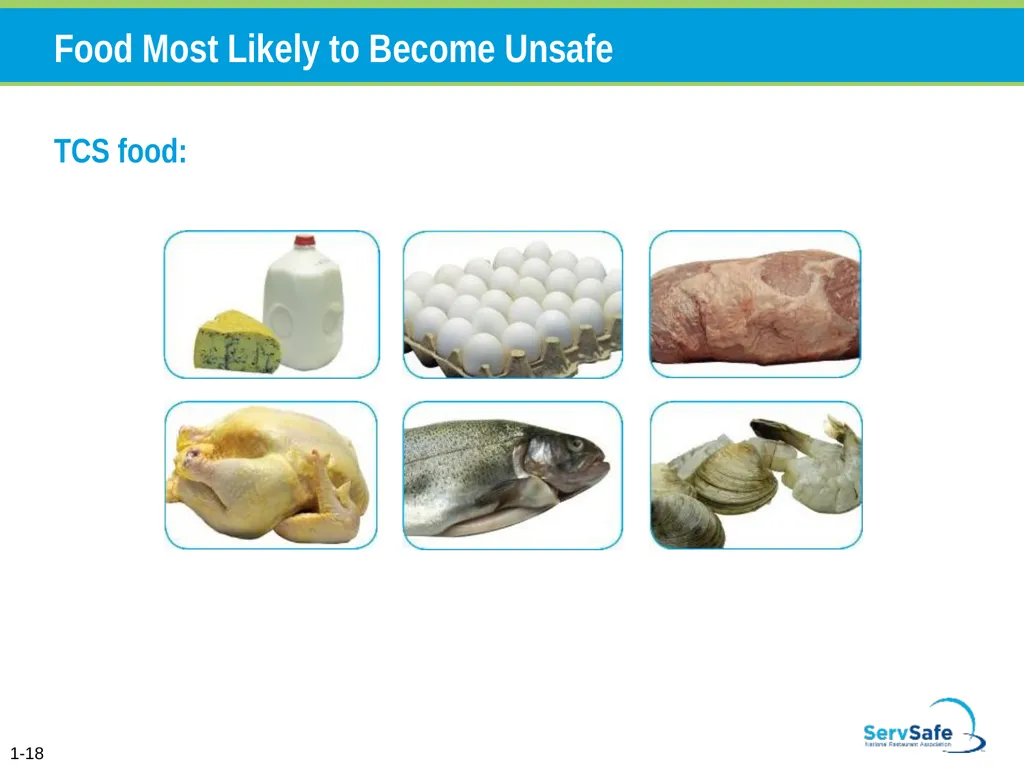
Food Most Likely to Become Unsafe TCS food: 1-18<br>
18
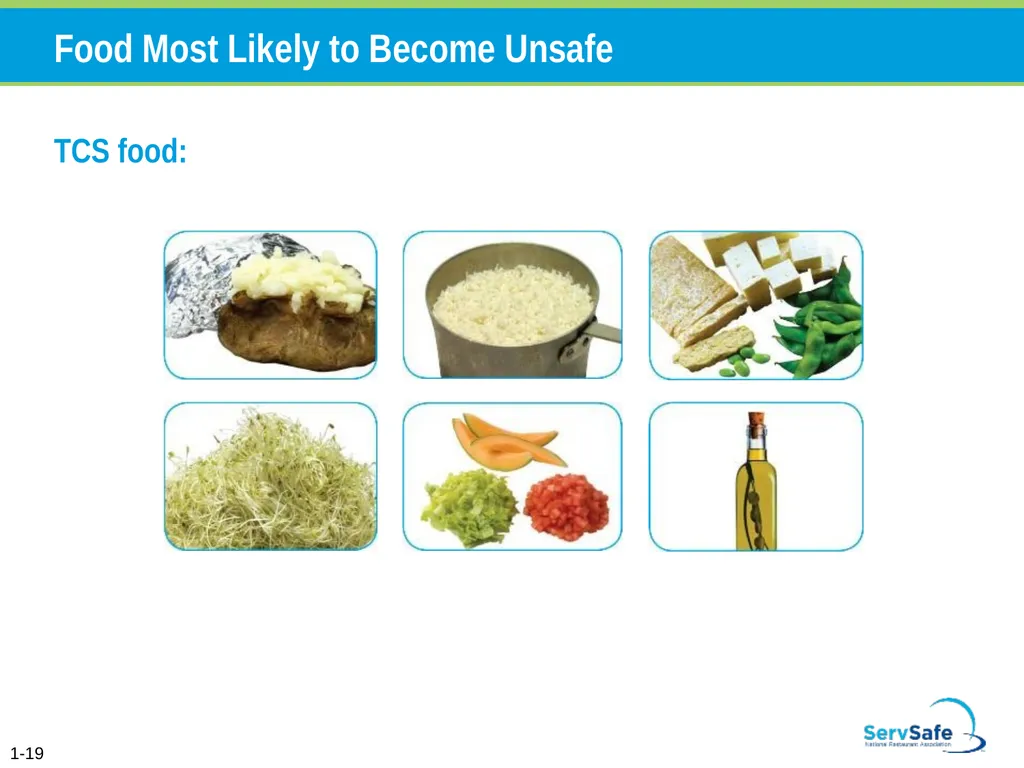
Food Most Likely to Become Unsafe TCS food: 1-19<br>
19
Ready-to-Eat Food Ready-to-eat food is food that can be eaten without further:
Preparation
Washing
Cooking
Ready-to-eat food includes:
Cooked food
Washed fruit and vegetables (whole and cut)
Deli meat
Bakery items
Sugar, spices, and seasonings 1-20<br>
Preparation
Washing
Cooking
Ready-to-eat food includes:
Cooked food
Washed fruit and vegetables (whole and cut)
Deli meat
Bakery items
Sugar, spices, and seasonings 1-20<br>
20
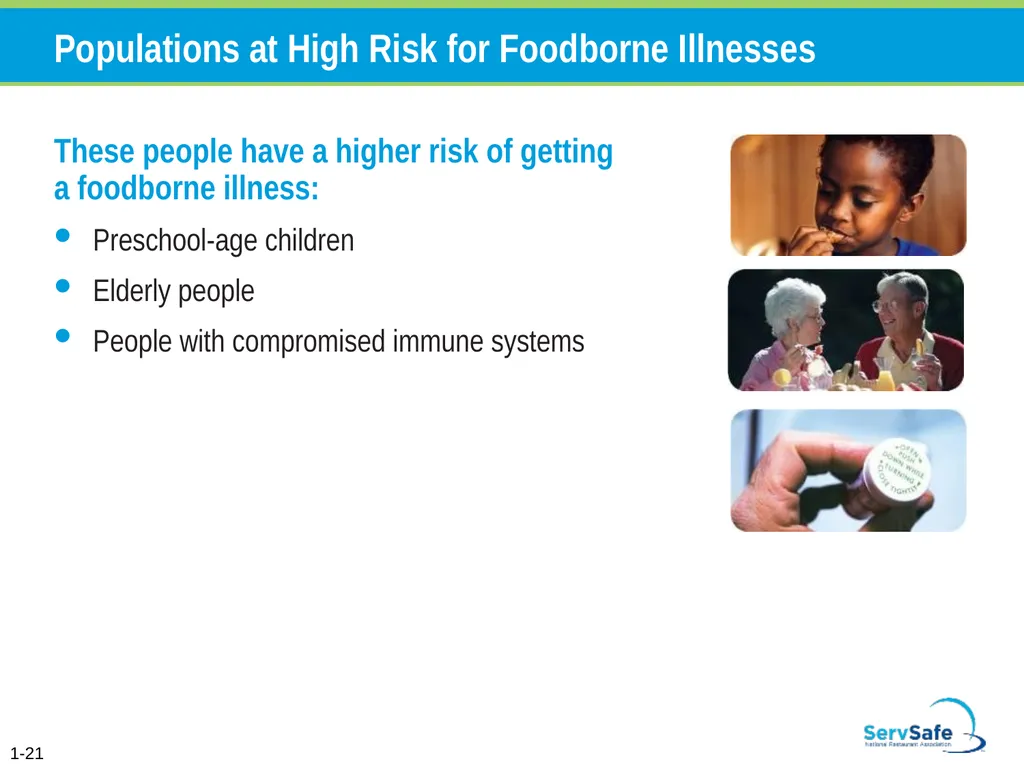
Populations at High Risk for Foodborne Illnesses These people have a higher risk of getting a foodborne illness:
Preschool-age children
Elderly people
People with compromised immune systems 1-21<br>
Preschool-age children
Elderly people
People with compromised immune systems 1-21<br>
21
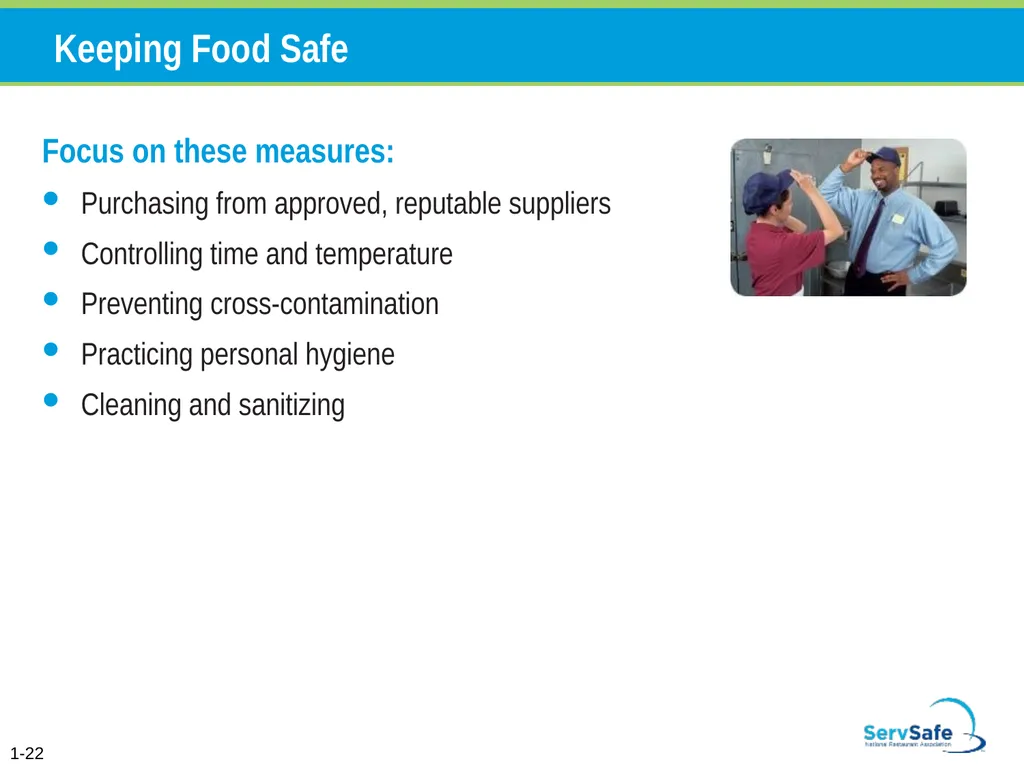
Keeping Food Safe 1-22 Focus on these measures:
Purchasing from approved, reputable suppliers
Controlling time and temperature
Preventing cross-contamination
Practicing personal hygiene
Cleaning and sanitizing<br>
Purchasing from approved, reputable suppliers
Controlling time and temperature
Preventing cross-contamination
Practicing personal hygiene
Cleaning and sanitizing<br>
22
Biological Contamination 2-2 Microorganism:
Small, living organism that can be seen only with a microscope
Pathogen:
Harmful microorganism
Makes people sick when eaten or produces toxins that cause illness
Toxin:
Poison<br>
Small, living organism that can be seen only with a microscope
Pathogen:
Harmful microorganism
Makes people sick when eaten or produces toxins that cause illness
Toxin:
Poison<br>
23
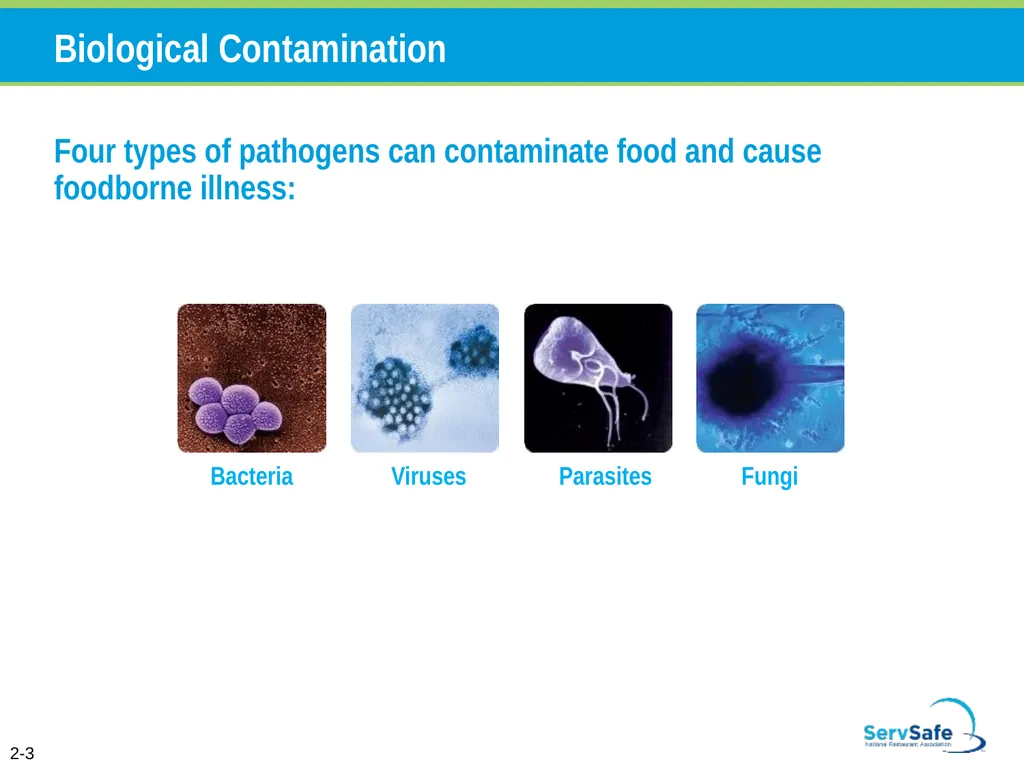
Biological Contamination Four types of pathogens can contaminate food and cause foodborne illness: Viruses Parasites Fungi 2-3 Bacteria<br>
24
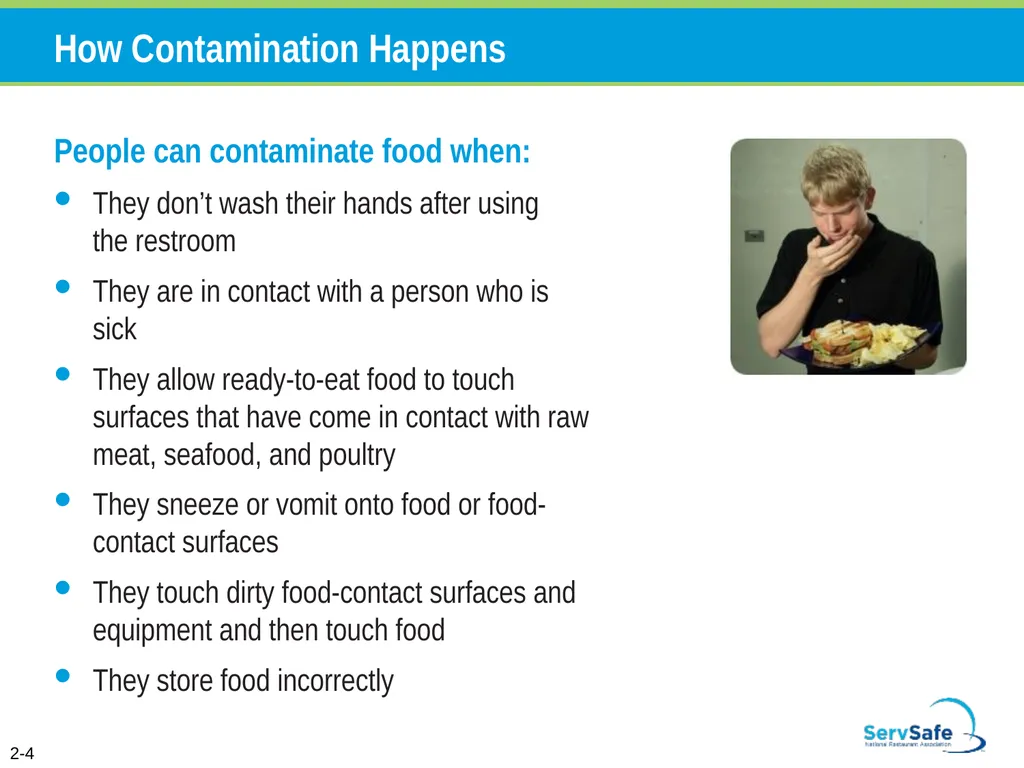
How Contamination Happens People can contaminate food when:
They don’t wash their hands after using the restroom
They are in contact with a person who is sick
They allow ready-to-eat food to touch surfaces that have come in contact with raw meat, seafood, and poultry
They sneeze or vomit onto food or food-contact surfaces
They touch dirty food-contact surfaces and equipment and then touch food
They store food incorrectly 2-4<br>
25
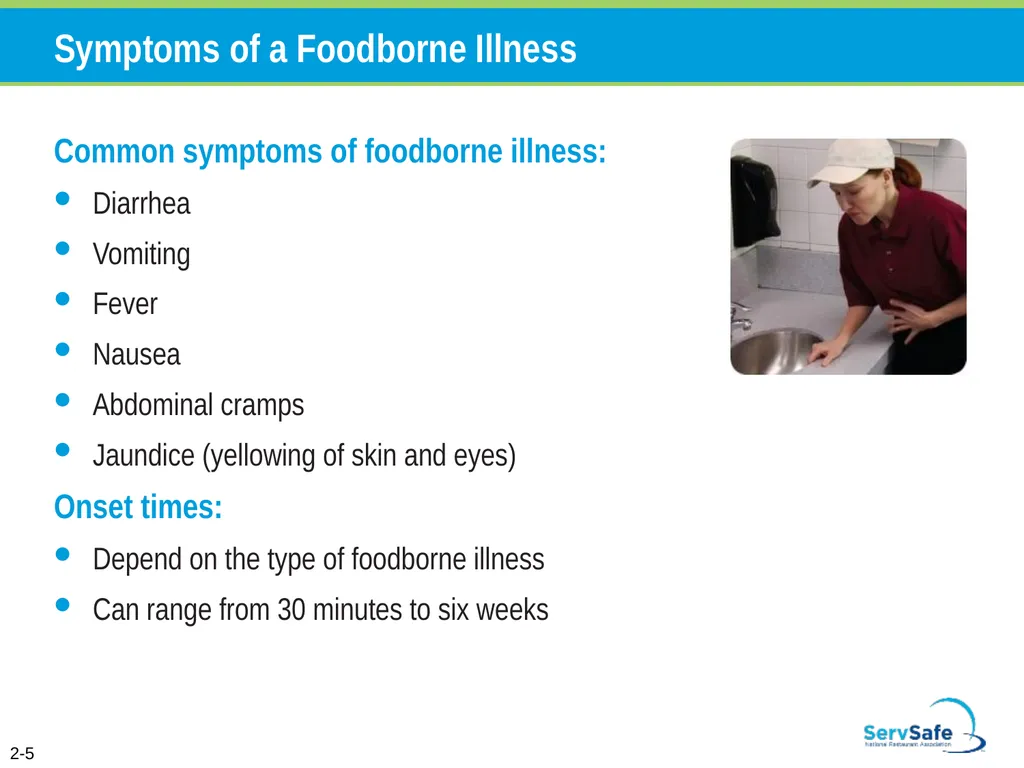
Symptoms of a Foodborne Illness 2-5 Common symptoms of foodborne illness:
Diarrhea
Vomiting
Fever
Nausea
Abdominal cramps
Jaundice (yellowing of skin and eyes)
Onset times:
Depend on the type of foodborne illness
Can range from 30 minutes to six weeks<br>
Diarrhea
Vomiting
Fever
Nausea
Abdominal cramps
Jaundice (yellowing of skin and eyes)
Onset times:
Depend on the type of foodborne illness
Can range from 30 minutes to six weeks<br>
26
The Big Six These pathogens are highly infectious and can cause severe illness:
Salmonella Typhi
Shigella spp.
Nontyphoidal Salmonella (NTS)
Shiga toxin-producing Escherichia coli (STEC), also knows as E.coli
Hepatitis A
Norovirus
The “Big Six”:
Are often found in very high numbers in an infected person’s feces
Can be transferred to food easily
Can make a person sick in small doses 2-6<br>
27
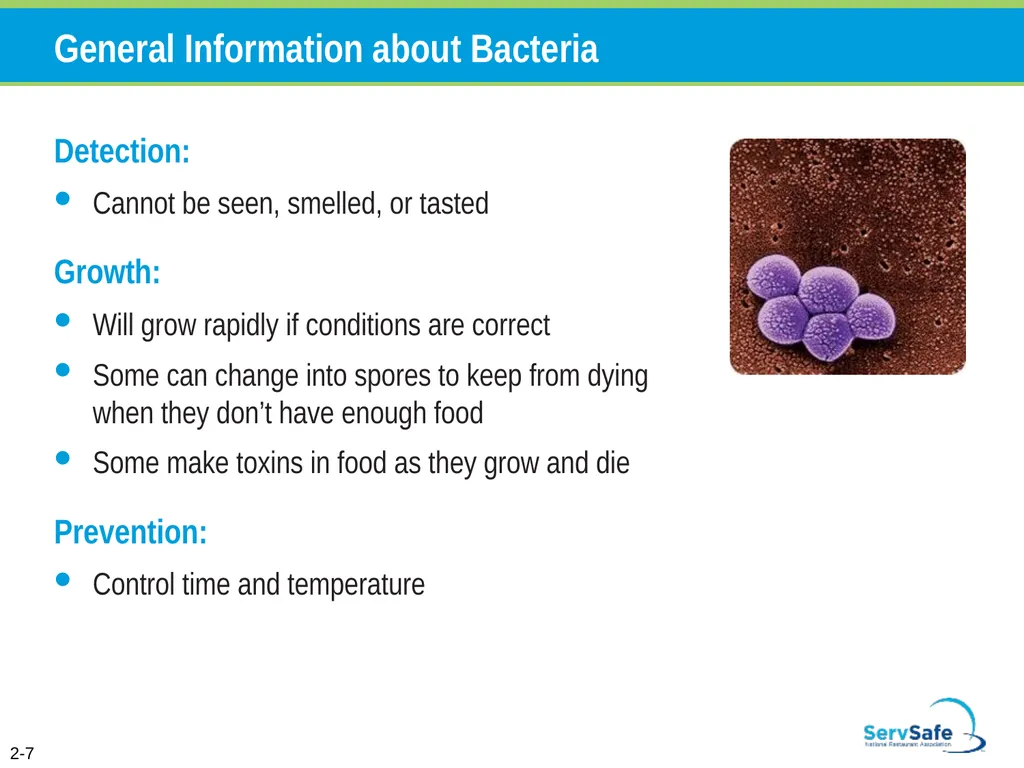
General Information about Bacteria Detection:
Cannot be seen, smelled, or tasted
Growth:
Will grow rapidly if conditions are correct
Some can change into spores to keep from dying when they don’t have enough food
Some make toxins in food as they grow and die
Prevention:
Control time and temperature 2-7<br>
Cannot be seen, smelled, or tasted
Growth:
Will grow rapidly if conditions are correct
Some can change into spores to keep from dying when they don’t have enough food
Some make toxins in food as they grow and die
Prevention:
Control time and temperature 2-7<br>
28
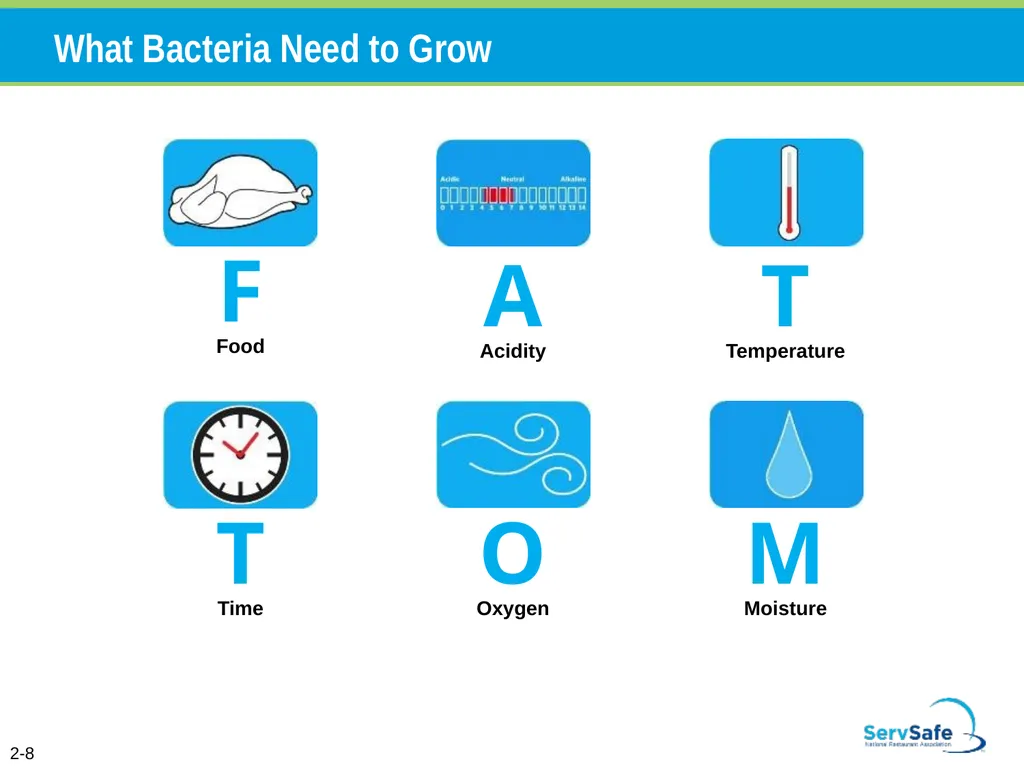
What Bacteria Need to Grow F
Food 2-8 A
Acidity T
Temperature T
Time O
Oxygen M
Moisture<br>
Food 2-8 A
Acidity T
Temperature T
Time O
Oxygen M
Moisture<br>
29
What Bacteria Need to Grow Food:
Most bacteria need nutrients to survive
TCS food supports the growth of bacteria better than other types of food
This includes meat, poultry, dairy products, and eggs 2-9 F
Food<br>
Most bacteria need nutrients to survive
TCS food supports the growth of bacteria better than other types of food
This includes meat, poultry, dairy products, and eggs 2-9 F
Food<br>
30
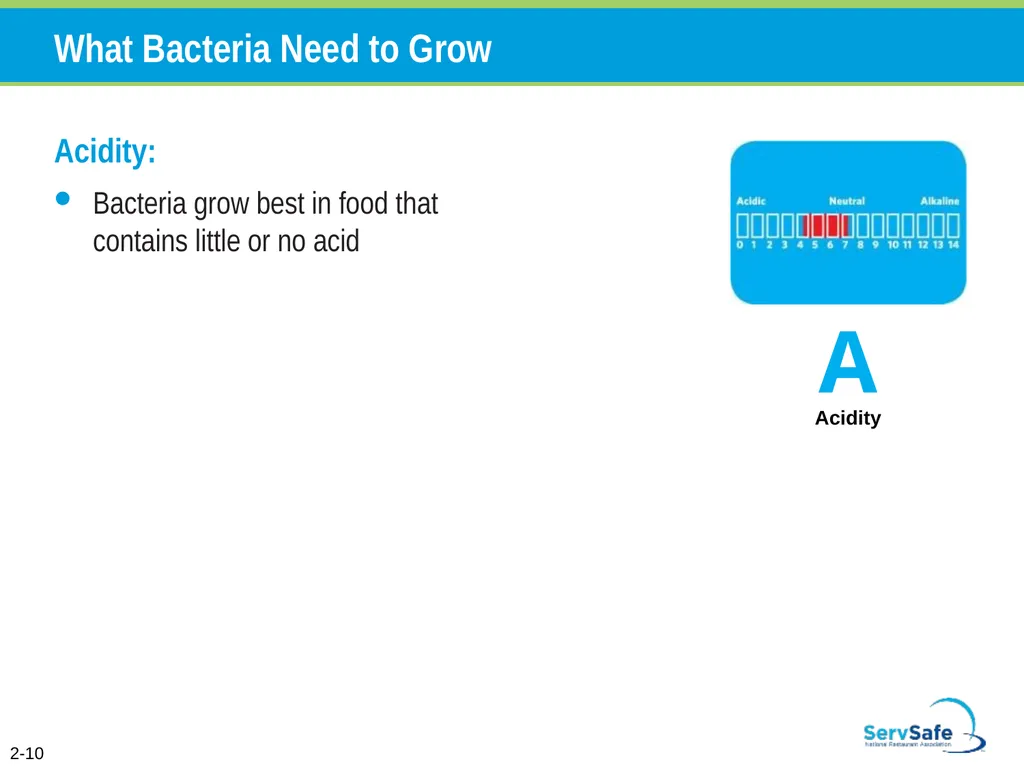
What Bacteria Need to Grow Acidity:
Bacteria grow best in food that contains little or no acid 2-10 A
Acidity<br>
Bacteria grow best in food that contains little or no acid 2-10 A
Acidity<br>
31
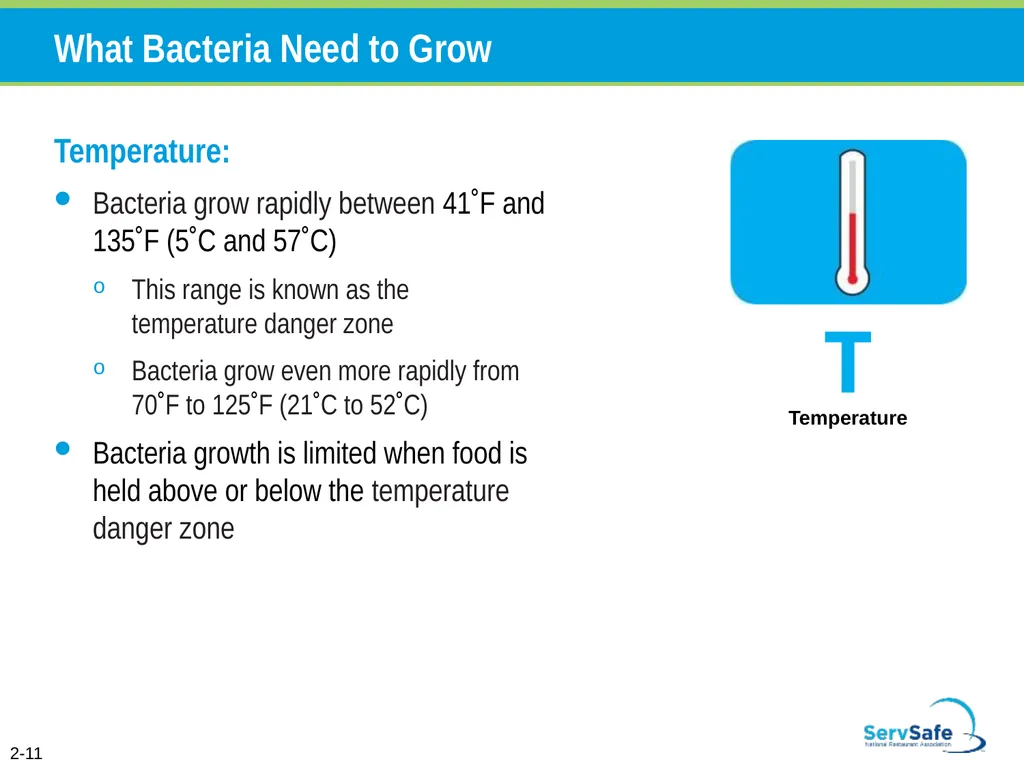
What Bacteria Need to Grow Temperature:
Bacteria grow rapidly between 41˚F and 135˚F (5˚C and 57˚C)
This range is known as the temperature danger zone
Bacteria grow even more rapidly from 70˚F to 125˚F (21˚C to 52˚C)
Bacteria growth is limited when food is held above or below the temperature danger zone 2-11 T
Temperature<br>
Bacteria grow rapidly between 41˚F and 135˚F (5˚C and 57˚C)
This range is known as the temperature danger zone
Bacteria grow even more rapidly from 70˚F to 125˚F (21˚C to 52˚C)
Bacteria growth is limited when food is held above or below the temperature danger zone 2-11 T
Temperature<br>
32
Time:
Bacteria need time to grow
The more time bacteria spend in the temperature danger zone, the more opportunity they have to grow to unsafe levels What Bacteria Need to Grow 2-12 T
Time<br>
Bacteria need time to grow
The more time bacteria spend in the temperature danger zone, the more opportunity they have to grow to unsafe levels What Bacteria Need to Grow 2-12 T
Time<br>
33
What Bacteria Need to Grow Oxygen:
Some bacteria need oxygen to grow, while others grow when oxygen isn’t there 2-13 O
Oxygen<br>
Some bacteria need oxygen to grow, while others grow when oxygen isn’t there 2-13 O
Oxygen<br>
34
What Bacteria Need to Grow Moisture:
Bacteria grow well in food with high levels of moisture
aw = water activity; the amount of moisture available in food for bacterial growth
aw scale ranges from 0.0 to 1.0
Water has a water activity of 1.0 2-14 M
Moisture<br>
Bacteria grow well in food with high levels of moisture
aw = water activity; the amount of moisture available in food for bacterial growth
aw scale ranges from 0.0 to 1.0
Water has a water activity of 1.0 2-14 M
Moisture<br>
35
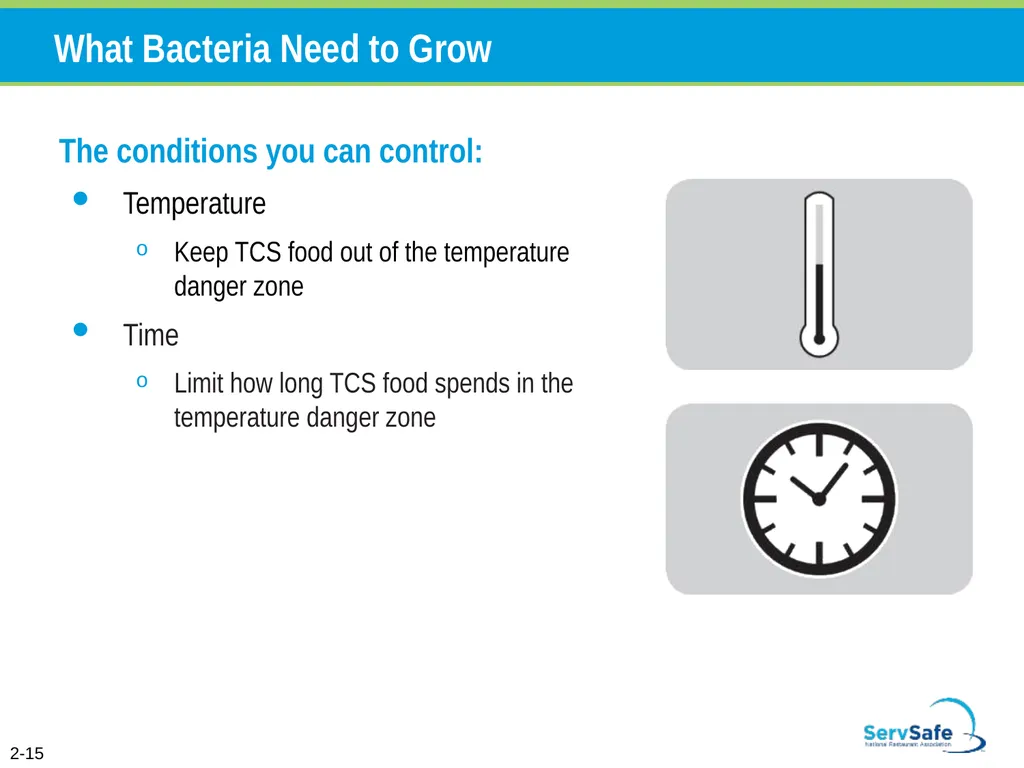
What Bacteria Need to Grow The conditions you can control:
Temperature
Keep TCS food out of the temperature danger zone
Time
Limit how long TCS food spends in the temperature danger zone 2-15<br>
Temperature
Keep TCS food out of the temperature danger zone
Time
Limit how long TCS food spends in the temperature danger zone 2-15<br>
36
Major Foodborne Bacteria Bacteria:
Bacillus cereus
Listeria monocytogenes
Shiga toxin-producing E. coli
Campylobacter jejuni
Clostridium perfringens
Clostridium botulinum
Nontyphoidal Salmonella
Shigella spp.
Staphylococcus aureus
Vibrio vulnificus 2-16<br>
Bacillus cereus
Listeria monocytogenes
Shiga toxin-producing E. coli
Campylobacter jejuni
Clostridium perfringens
Clostridium botulinum
Nontyphoidal Salmonella
Shigella spp.
Staphylococcus aureus
Vibrio vulnificus 2-16<br>
37
2-17 Major Foodborne Bacteria Controlling time and temperature can keep these bacteria from causing a foodborne illness:
Bacillus cereus
Listeria monocytogenes
Shiga toxin-producing E. coli
Campylobacter jejuni
Clostridium perfringens
Clostridium botulinum<br>
Bacillus cereus
Listeria monocytogenes
Shiga toxin-producing E. coli
Campylobacter jejuni
Clostridium perfringens
Clostridium botulinum<br>
38
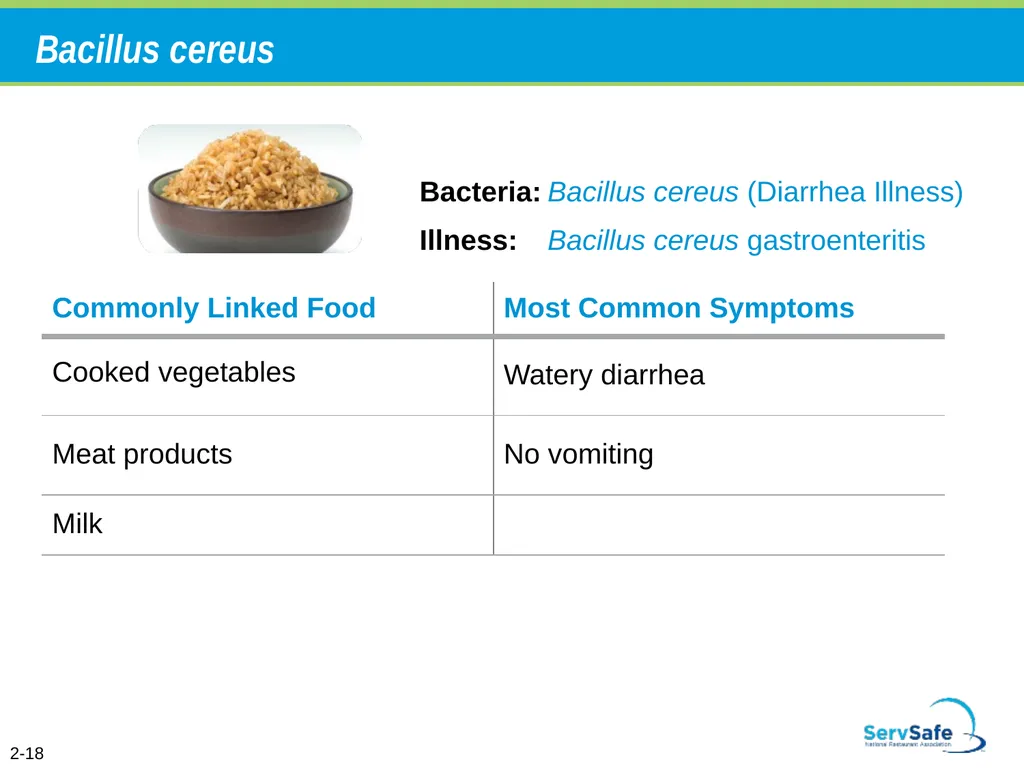
Bacillus cereus Bacteria: Bacillus cereus (Diarrhea Illness)
Illness: Bacillus cereus gastroenteritis 2-18<br>
Illness: Bacillus cereus gastroenteritis 2-18<br>
39
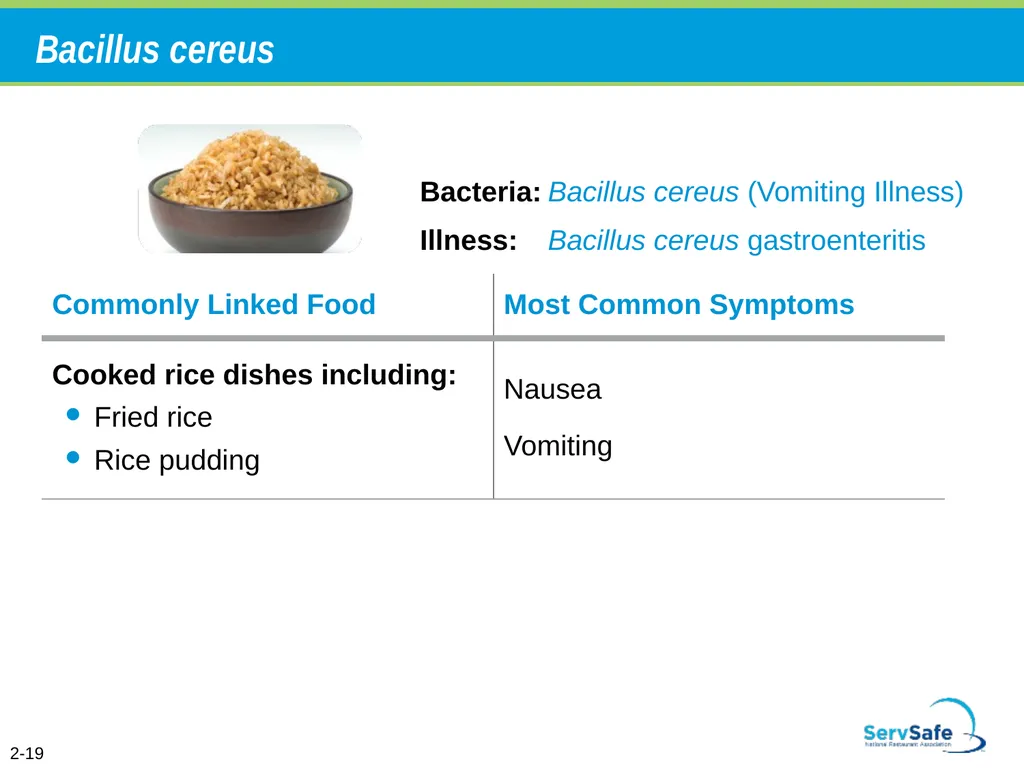
Bacillus cereus Bacteria: Bacillus cereus (Vomiting Illness)
Illness: Bacillus cereus gastroenteritis 2-19<br>
Illness: Bacillus cereus gastroenteritis 2-19<br>
40
Bacillus cereus Most important prevention measure:
Control time and temperature
Other prevention measures:
Cook food to minimum internal temperatures
Hold food at the correct temperatures
Cool food correctly 2-20<br>
Control time and temperature
Other prevention measures:
Cook food to minimum internal temperatures
Hold food at the correct temperatures
Cool food correctly 2-20<br>
41
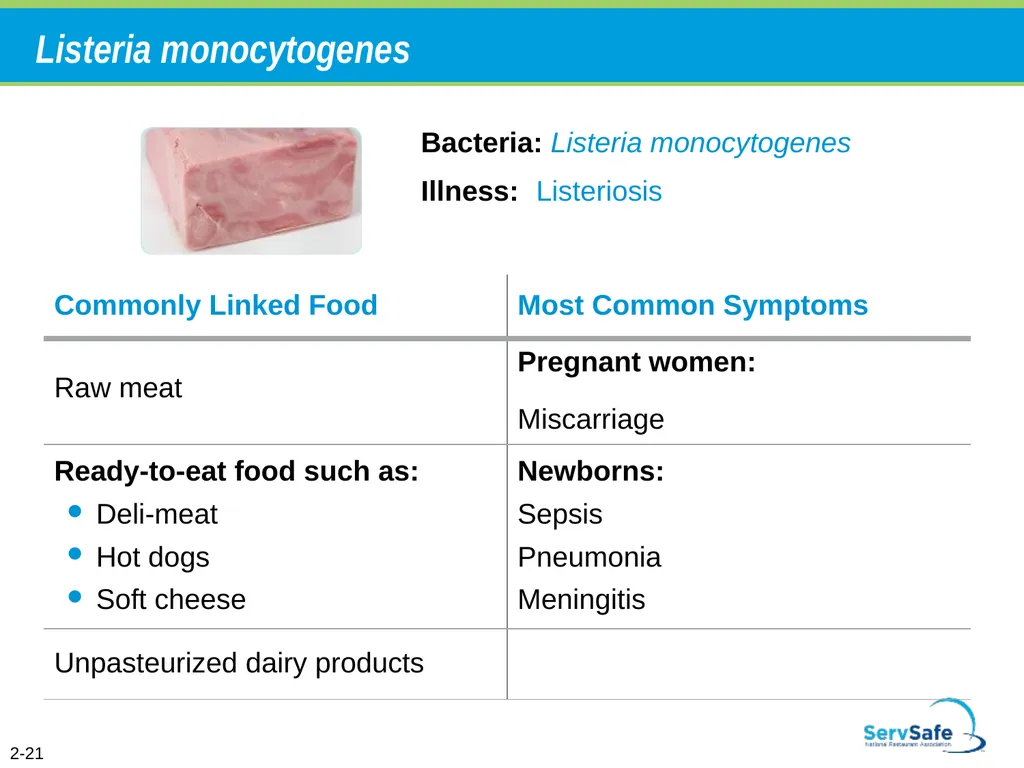
Bacteria: Listeria monocytogenes
Illness: Listeriosis 2-21 Listeria monocytogenes<br>
Illness: Listeriosis 2-21 Listeria monocytogenes<br>
42
Listeria monocytogenes Most important prevention measure:
Control time and temperature
Other prevention measures:
Throw out any product that has passed its use-by or expiration date
Cook raw meat to minimum internal temperatures
Prevent cross-contamination between raw or undercooked food and ready-to-eat food
Avoid using unpasteurized dairy products 2-22<br>
43
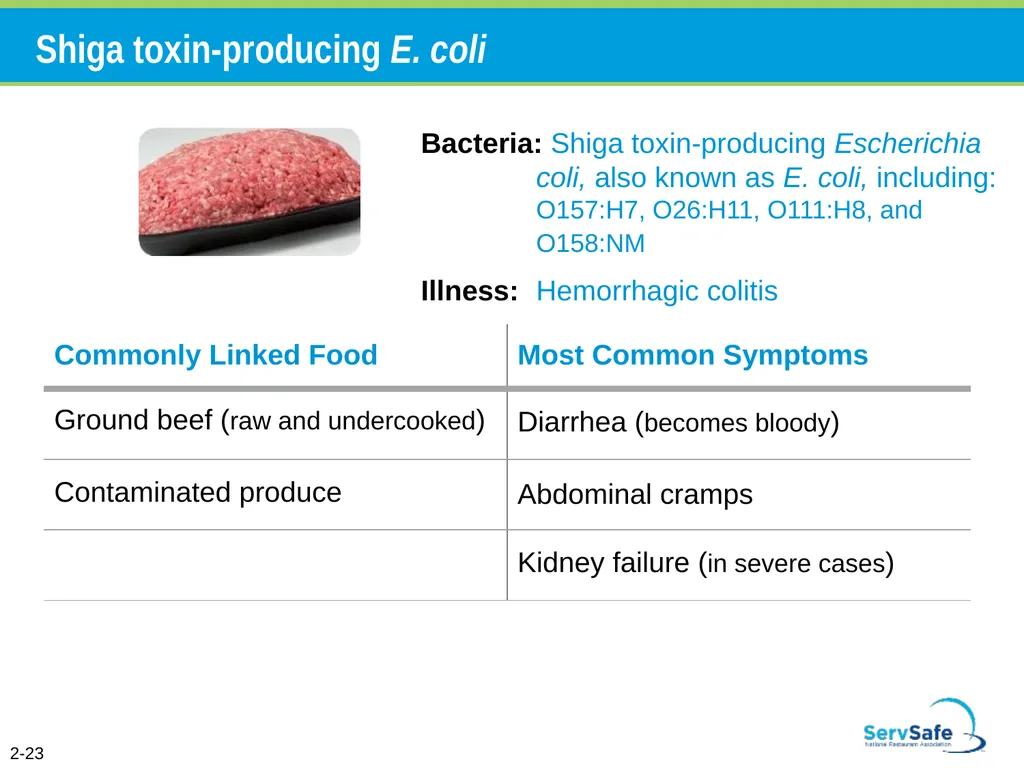
Shiga toxin-producing E. coli 2-23 Bacteria: Shiga toxin-producing Escherichia coli, also known as E. coli, including: O157:H7, O26:H11, O111:H8, and O158:NM
Illness: Hemorrhagic colitis<br>
Illness: Hemorrhagic colitis<br>
44
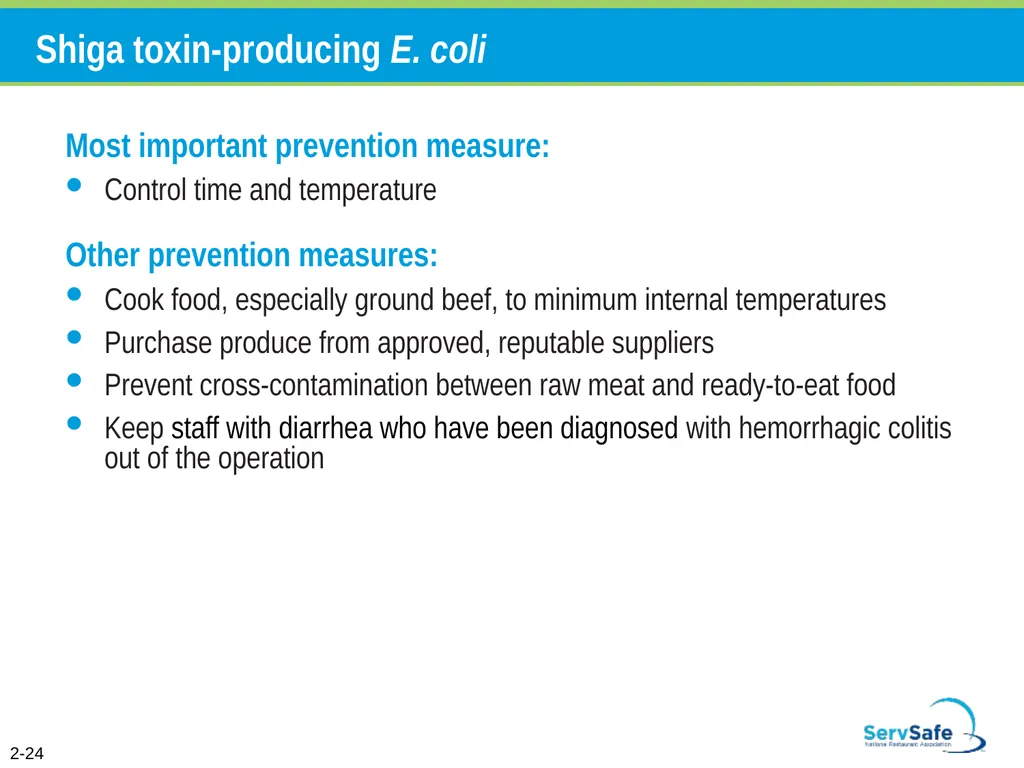
Shiga toxin-producing E. coli Most important prevention measure:
Control time and temperature
Other prevention measures:
Cook food, especially ground beef, to minimum internal temperatures
Purchase produce from approved, reputable suppliers
Prevent cross-contamination between raw meat and ready-to-eat food
Keep staff with diarrhea who have been diagnosed with hemorrhagic colitis out of the operation 2-24<br>
45
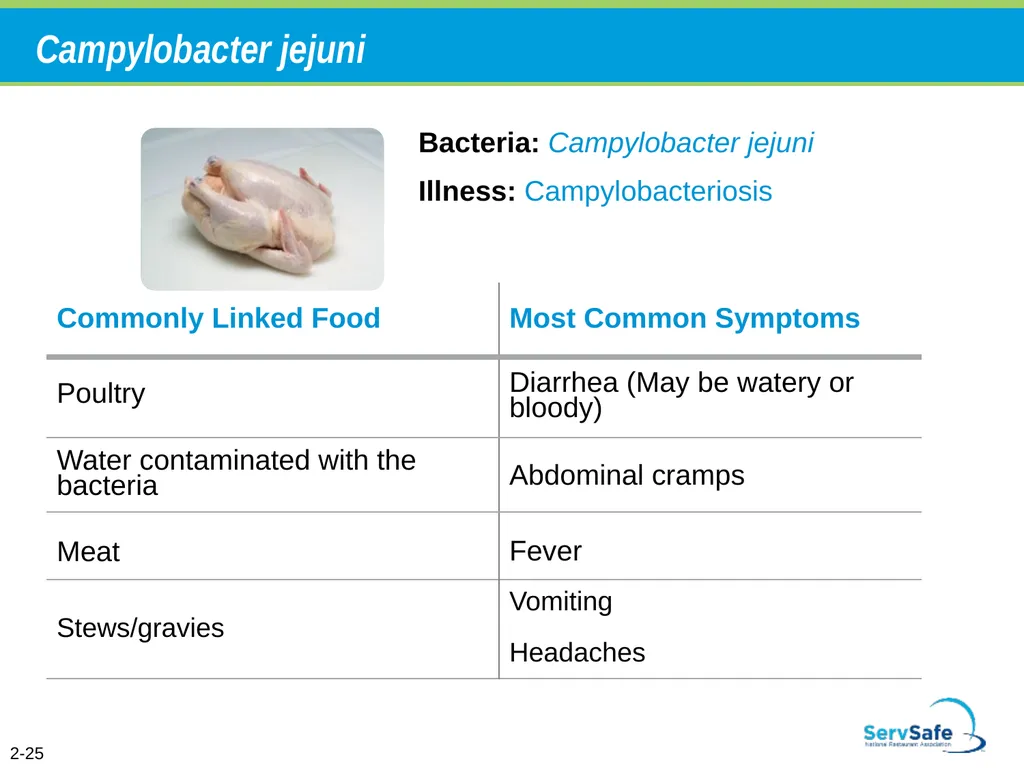
Campylobacter jejuni Bacteria: Campylobacter jejuni
Illness: Campylobacteriosis 2-25<br>
Illness: Campylobacteriosis 2-25<br>
46
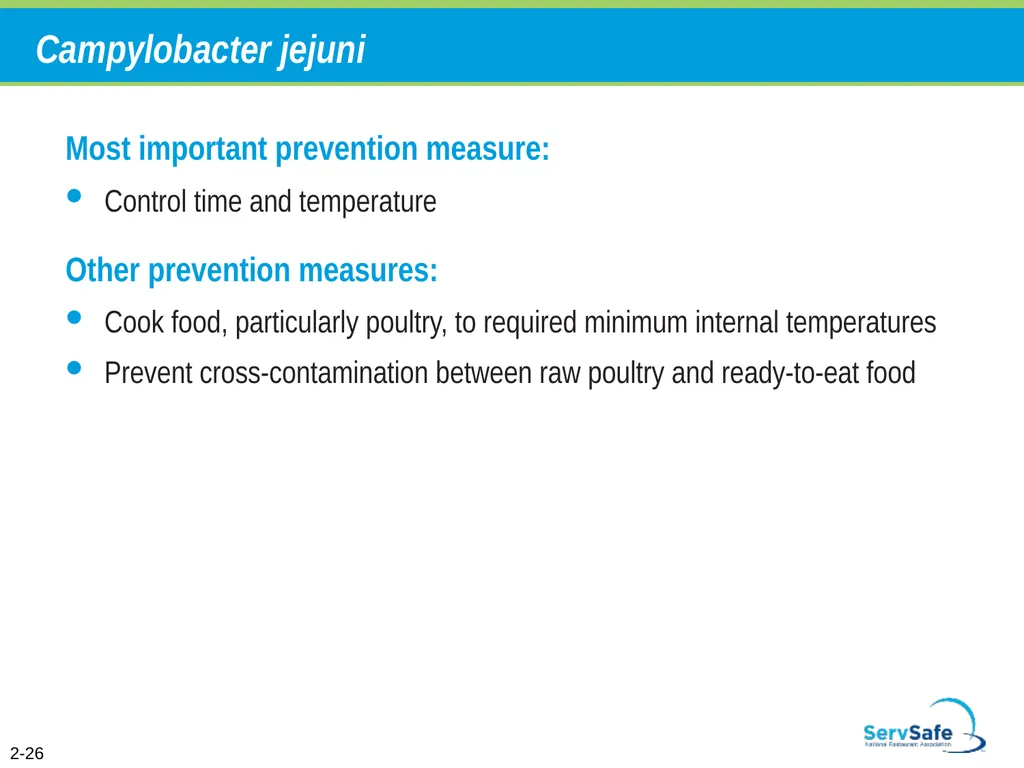
Campylobacter jejuni Most important prevention measure:
Control time and temperature
Other prevention measures:
Cook food, particularly poultry, to required minimum internal temperatures
Prevent cross-contamination between raw poultry and ready-to-eat food 2-26<br>
Control time and temperature
Other prevention measures:
Cook food, particularly poultry, to required minimum internal temperatures
Prevent cross-contamination between raw poultry and ready-to-eat food 2-26<br>
47
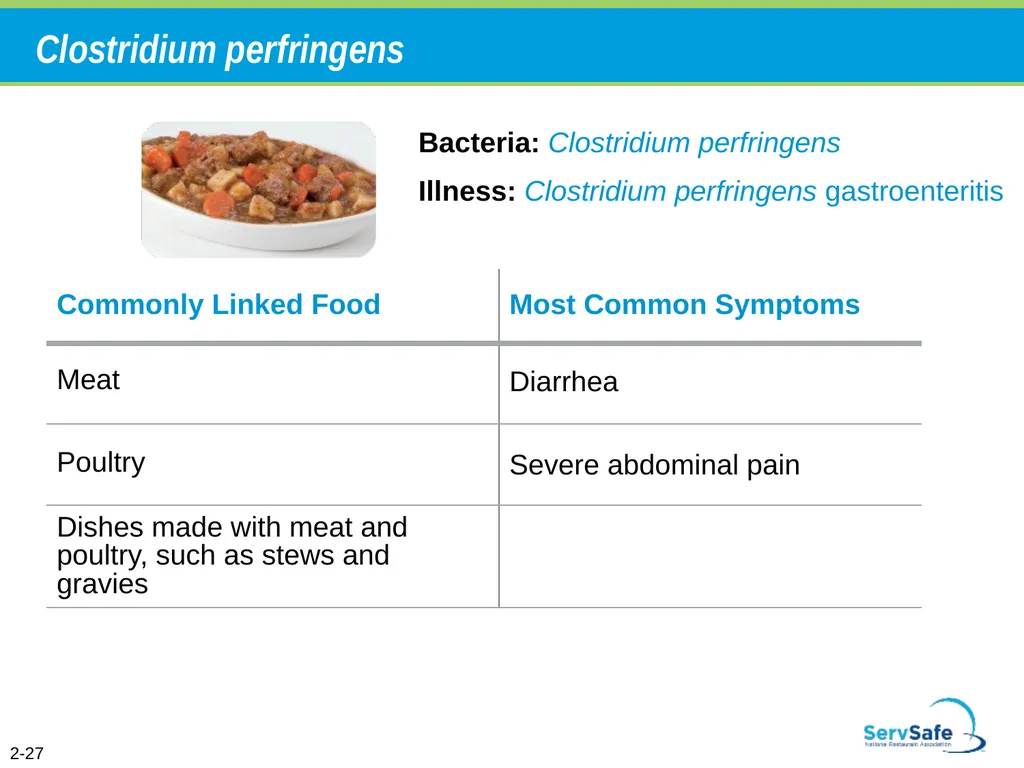
Clostridium perfringens Bacteria: Clostridium perfringens
Illness: Clostridium perfringens gastroenteritis 2-27<br>
Illness: Clostridium perfringens gastroenteritis 2-27<br>
48
Clostridium perfringens Most important prevention measure:
Control time and temperature
Other prevention measures:
Cool and reheat food correctly
Hold food at the correct temperatures 2-28<br>
Control time and temperature
Other prevention measures:
Cool and reheat food correctly
Hold food at the correct temperatures 2-28<br>
49
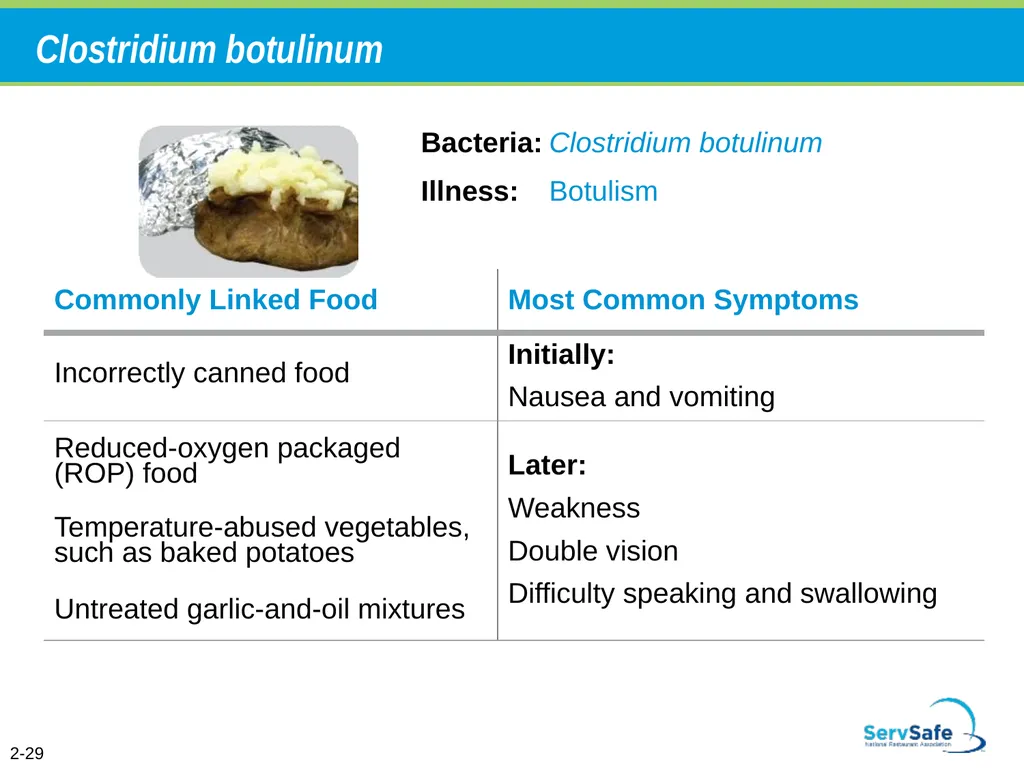
Clostridium botulinum Bacteria: Clostridium botulinum
Illness: Botulism 2-29<br>
Illness: Botulism 2-29<br>
50
Clostridium botulinum Most important prevention measure:
Control time and temperature
Other prevention measures:
Hold, cool, and reheat food correctly
Inspect canned food for damage 2-30<br>
Control time and temperature
Other prevention measures:
Hold, cool, and reheat food correctly
Inspect canned food for damage 2-30<br>
51
Major Foodborne Bacteria Preventing cross-contamination can keep these bacteria from causing a foodborne illness:
Nontyphoidal Salmonella
Salmonella Typhi 2-31<br>
Nontyphoidal Salmonella
Salmonella Typhi 2-31<br>
52
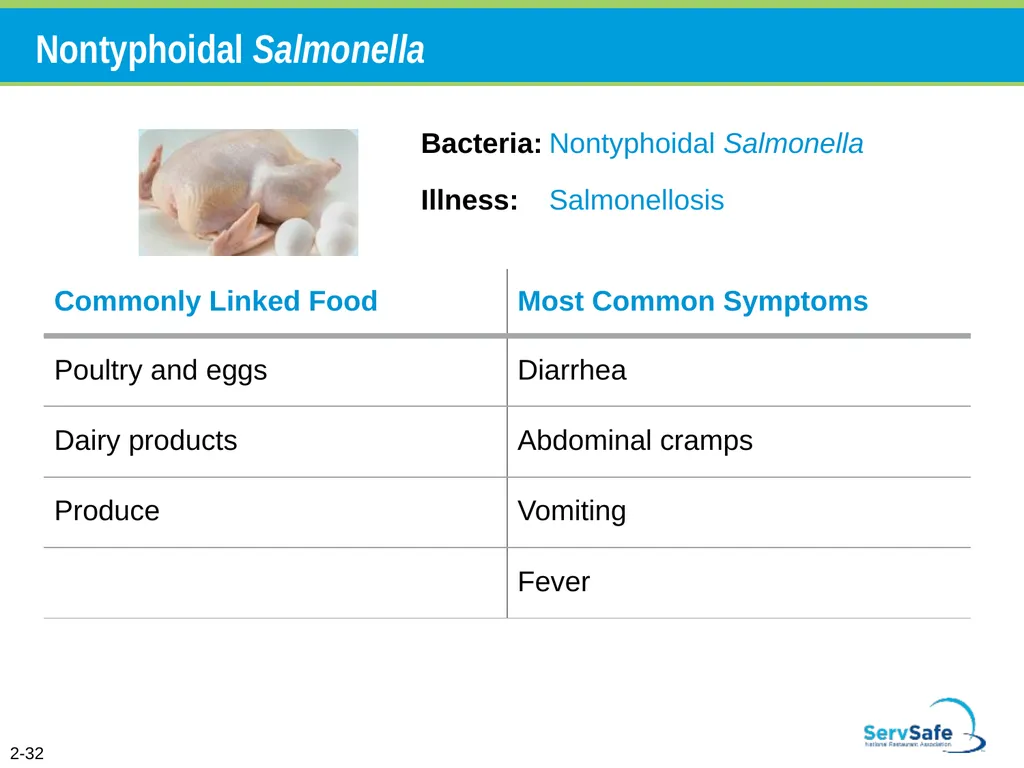
Nontyphoidal Salmonella Bacteria: Nontyphoidal Salmonella
Illness: Salmonellosis 2-32<br>
Illness: Salmonellosis 2-32<br>
53
Nontyphoidal Salmonella Most important prevention measure:
Prevent cross-contamination
Other prevention measures:
Cook poultry and eggs to minimum internal temperatures
Prevent cross-contamination between poultry and ready-to-eat food
Keep food handlers who are vomiting or have diarrhea and have been diagnosed with salmonellosis out of the operation 2-33<br>
54
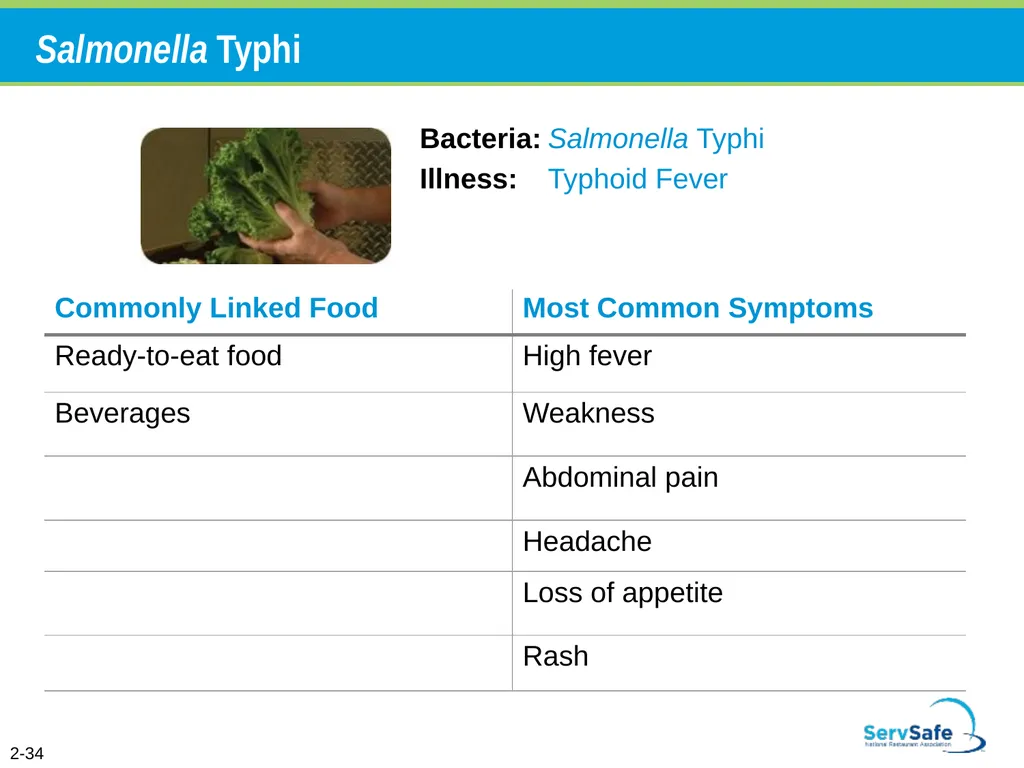
Salmonella Typhi 2-34 Bacteria: Salmonella Typhi
Illness: Typhoid Fever<br>
Illness: Typhoid Fever<br>
55
Salmonella Typhi Most important prevention measure:
Prevent cross-contamination
Other prevention measures:
Exclude food handlers who have been diagnosed with an illness caused by Salmonella Typhi from the operation
Wash hands
Cook food to minimum internal temperatures 2-35<br>
Prevent cross-contamination
Other prevention measures:
Exclude food handlers who have been diagnosed with an illness caused by Salmonella Typhi from the operation
Wash hands
Cook food to minimum internal temperatures 2-35<br>
56
2-36 Major Foodborne Bacteria Practicing personal hygiene can keep these bacteria from causing a foodborne illness:
Shigella spp.
Staphylococcus aureus<br>
Shigella spp.
Staphylococcus aureus<br>
57
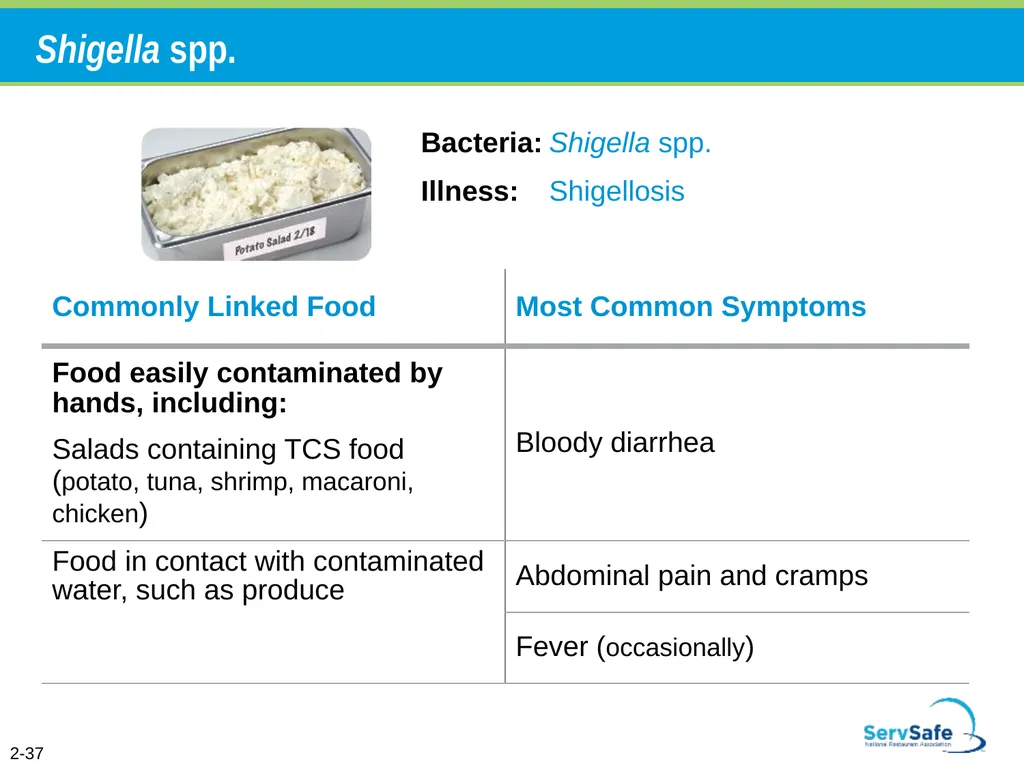
Shigella spp. Bacteria: Shigella spp.
Illness: Shigellosis 2-37<br>
Illness: Shigellosis 2-37<br>
58
2-38 Shigella spp. Most important prevention measure:
Practice personal hygiene
Other prevention measures:
Exclude food handlers who have diarrhea and have been diagnosed with an illness caused by Shigella spp. from the operation
Wash hands
Control flies inside and outside the operation<br>
Practice personal hygiene
Other prevention measures:
Exclude food handlers who have diarrhea and have been diagnosed with an illness caused by Shigella spp. from the operation
Wash hands
Control flies inside and outside the operation<br>
59
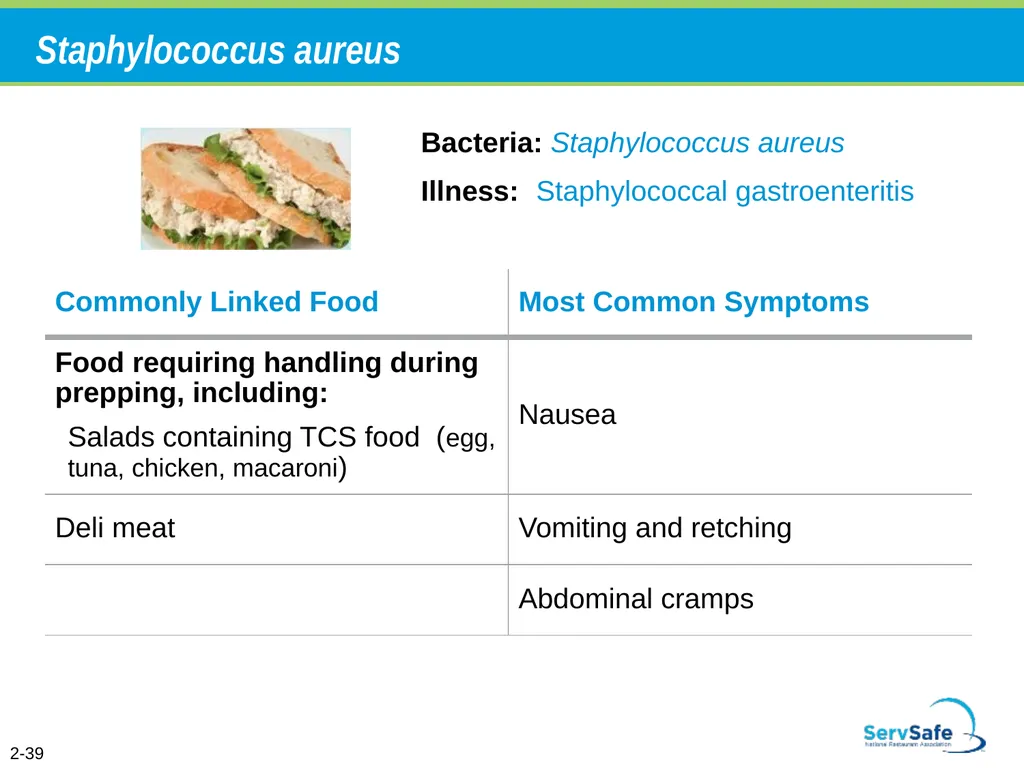
Staphylococcus aureus 2-39 Bacteria: Staphylococcus aureus
Illness: Staphylococcal gastroenteritis<br>
Illness: Staphylococcal gastroenteritis<br>
60
2-40 Staphylococcus aureus Most important prevention measure:
Practice personal hygiene
Other prevention measures:
Wash hands, particularly after touching the hair, face, or body
Cover wounds on hands and arms
Hold, cool, and reheat food correctly<br>
Practice personal hygiene
Other prevention measures:
Wash hands, particularly after touching the hair, face, or body
Cover wounds on hands and arms
Hold, cool, and reheat food correctly<br>
61
Major Foodborne Bacteria Purchasing food from approved, reputable suppliers can keep these bacteria from causing a foodborne illness:
Vibrio vulnificus
Vibrio parahaemolyticus 2-41<br>
Vibrio vulnificus
Vibrio parahaemolyticus 2-41<br>
62
Vibrio vulnificus & Vibrio parahaemolyticus Bacteria: Vibrio vulnificus Illness: Vibrio gastroenteritis Vibrio vulnificus primary septicimia 2-42<br>
63
Vibrio vulnificus & Vibrio parahaemolyticus Most important prevention measure:
Purchase from approved, reputable suppliers
Other prevention measures:
Cook oysters to minimum internal temperatures 2-43<br>
Purchase from approved, reputable suppliers
Other prevention measures:
Cook oysters to minimum internal temperatures 2-43<br>
64
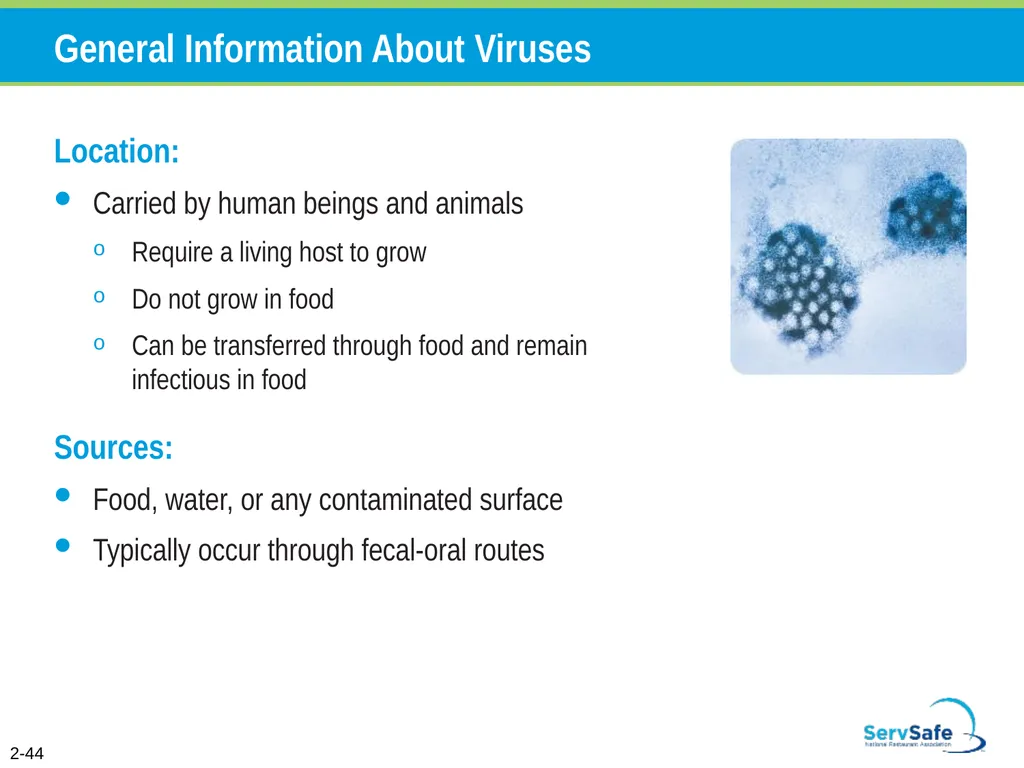
General Information About Viruses Location:
Carried by human beings and animals
Require a living host to grow
Do not grow in food
Can be transferred through food and remain infectious in food
Sources:
Food, water, or any contaminated surface
Typically occur through fecal-oral routes 2-44<br>
Carried by human beings and animals
Require a living host to grow
Do not grow in food
Can be transferred through food and remain infectious in food
Sources:
Food, water, or any contaminated surface
Typically occur through fecal-oral routes 2-44<br>
65
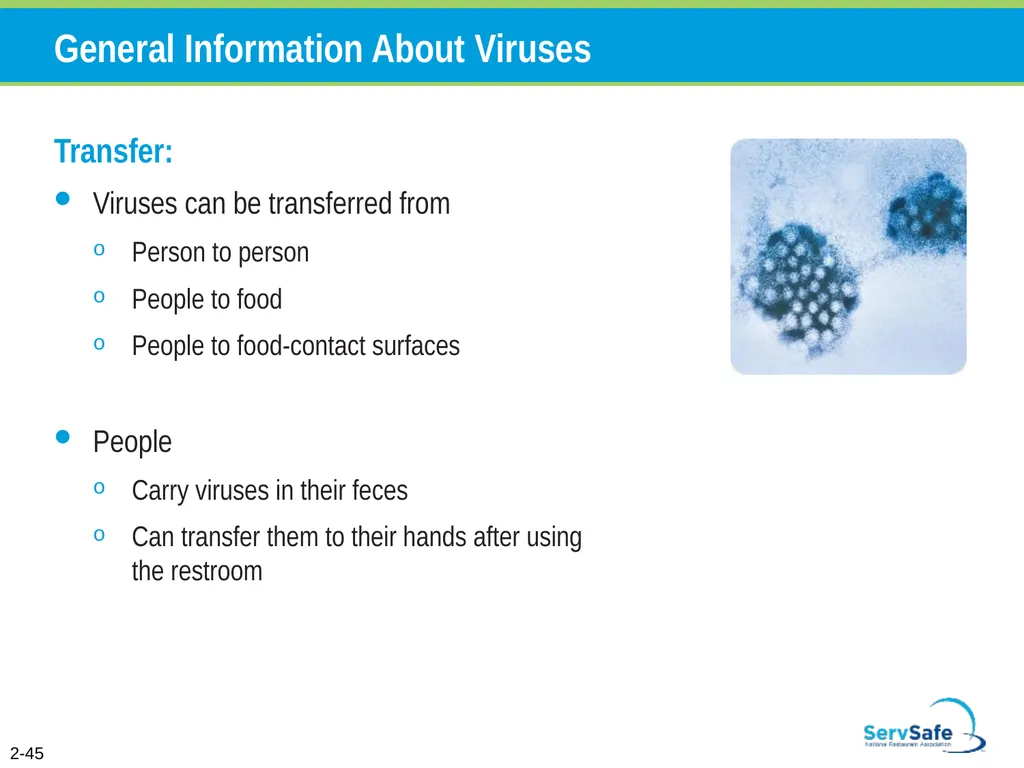
General Information About Viruses Transfer:
Viruses can be transferred from
Person to person
People to food
People to food-contact surfaces
People
Carry viruses in their feces
Can transfer them to their hands after using the restroom 2-45<br>
Viruses can be transferred from
Person to person
People to food
People to food-contact surfaces
People
Carry viruses in their feces
Can transfer them to their hands after using the restroom 2-45<br>
66
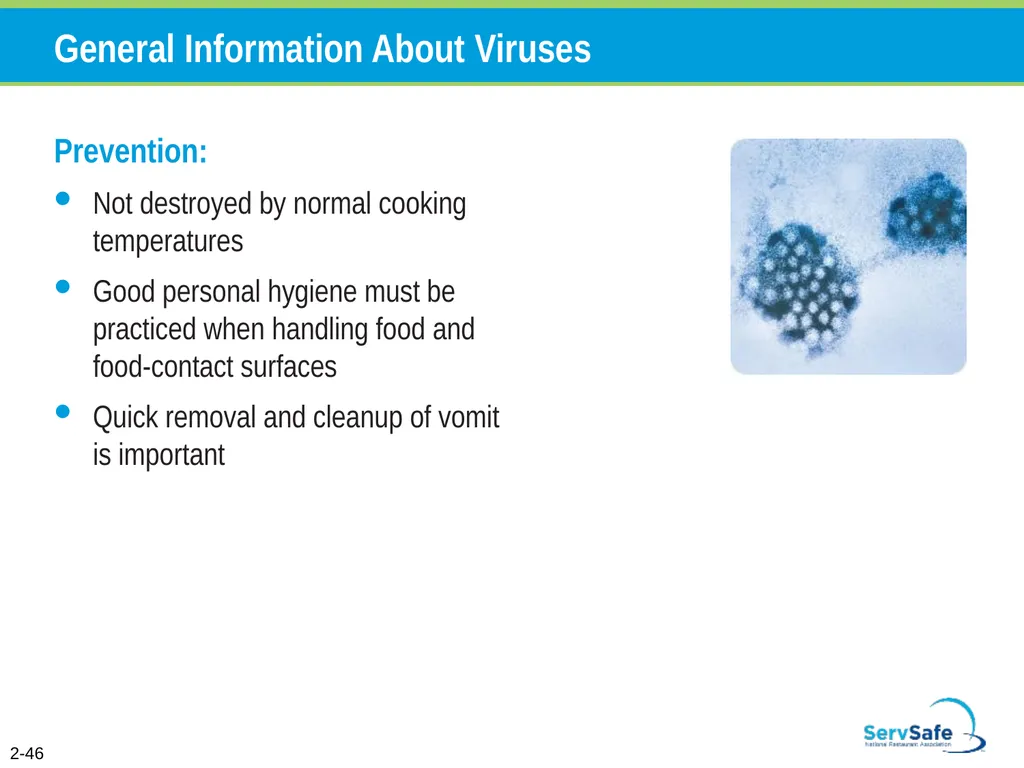
General Information About Viruses Prevention:
Not destroyed by normal cooking temperatures
Good personal hygiene must be practiced when handling food and food-contact surfaces
Quick removal and cleanup of vomit is important 2-46<br>
Not destroyed by normal cooking temperatures
Good personal hygiene must be practiced when handling food and food-contact surfaces
Quick removal and cleanup of vomit is important 2-46<br>
67
2-47 Major Foodborne Viruses Practicing personal hygiene can keep these viruses from causing a foodborne illness:
Hepatitis A
Norovirus<br>
Hepatitis A
Norovirus<br>
68
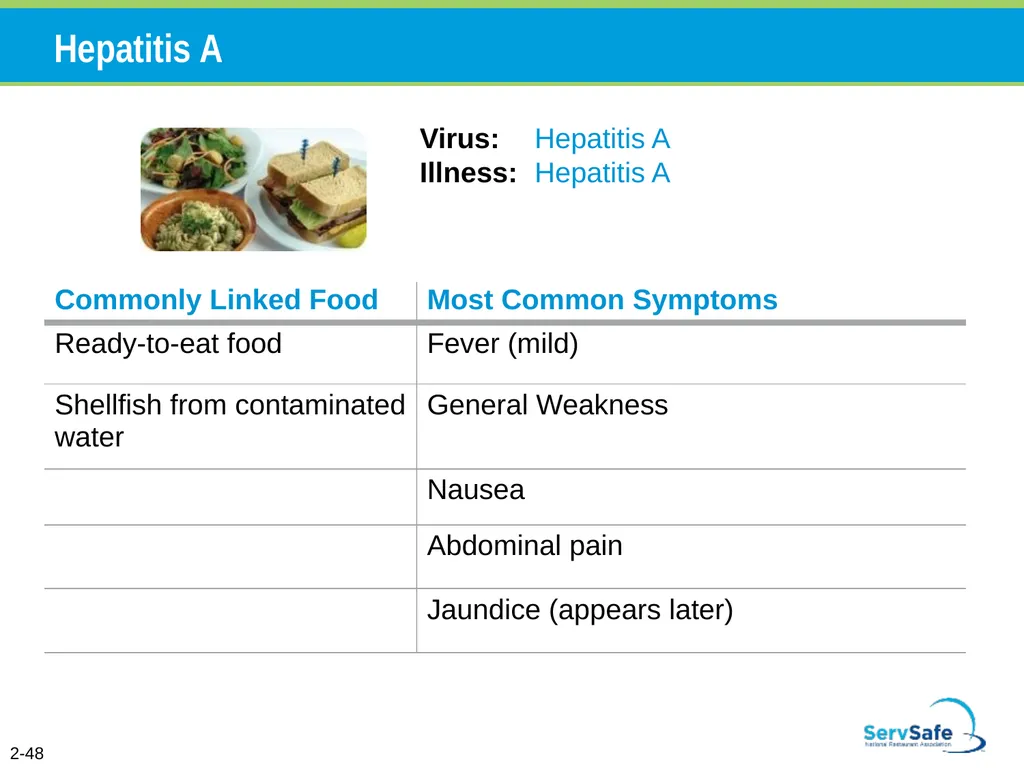
2-48 Hepatitis A Virus: Hepatitis A
Illness: Hepatitis A<br>
Illness: Hepatitis A<br>
69
Hepatitis A Most important prevention measure:
Practicing personal hygiene
Other prevention measures:
Exclude staff who have been diagnosed with hepatitis A from the operation
Exclude staff who have jaundice from the operation
Wash hands
Avoid bare-hand contact with ready-to-eat food
Purchase shellfish from approved, reputable suppliers 2-49<br>
70
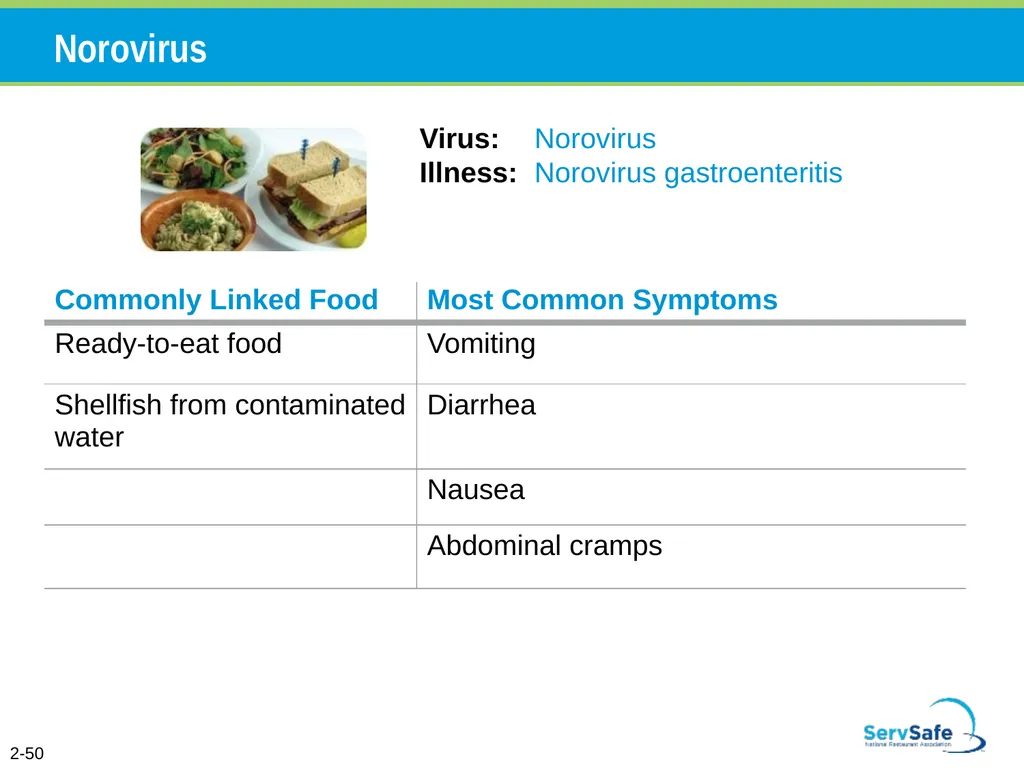
2-50 Norovirus Virus: Norovirus
Illness: Norovirus gastroenteritis<br>
Illness: Norovirus gastroenteritis<br>
71
Norovirus Most important prevention measure:
Practicing personal hygiene
Other prevention measures:
Exclude staff who are vomiting or have diarrhea and have been diagnosed with Norovirus from the operation
Wash hands
Avoid bare-hand contact with ready-to-eat food
Purchase shellfish from approved, reputable suppliers 2-51<br>
Practicing personal hygiene
Other prevention measures:
Exclude staff who are vomiting or have diarrhea and have been diagnosed with Norovirus from the operation
Wash hands
Avoid bare-hand contact with ready-to-eat food
Purchase shellfish from approved, reputable suppliers 2-51<br>
72
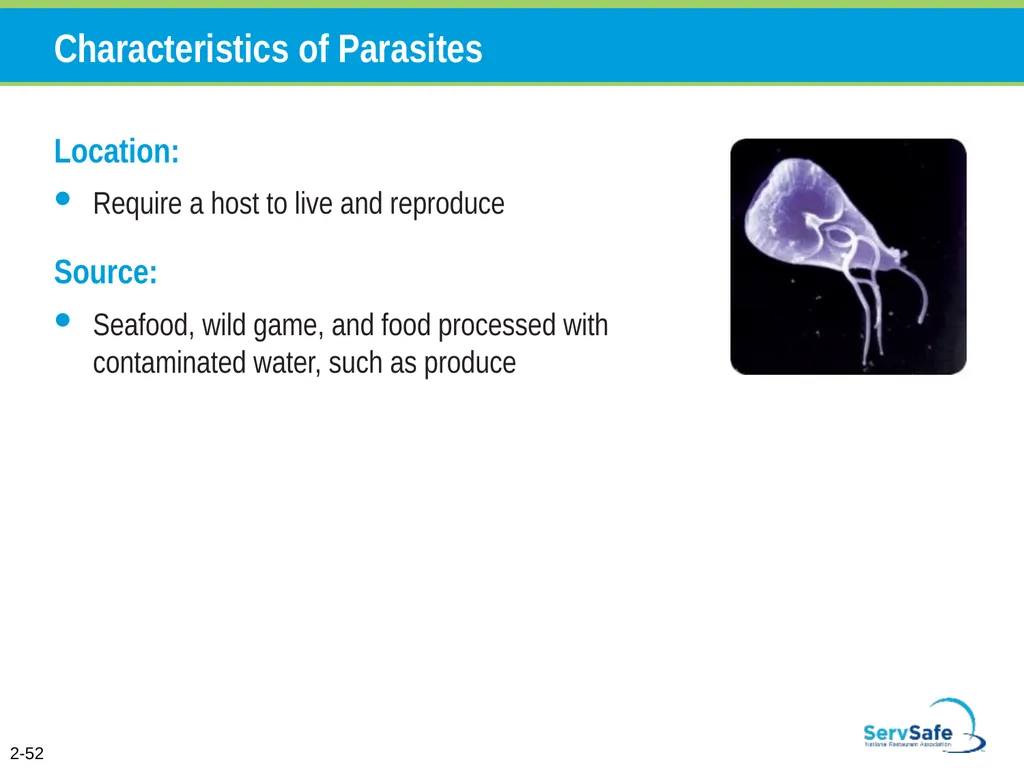
Characteristics of Parasites Location:
Require a host to live and reproduce
Source:
Seafood, wild game, and food processed with contaminated water, such as produce 2-52<br>
Require a host to live and reproduce
Source:
Seafood, wild game, and food processed with contaminated water, such as produce 2-52<br>
73
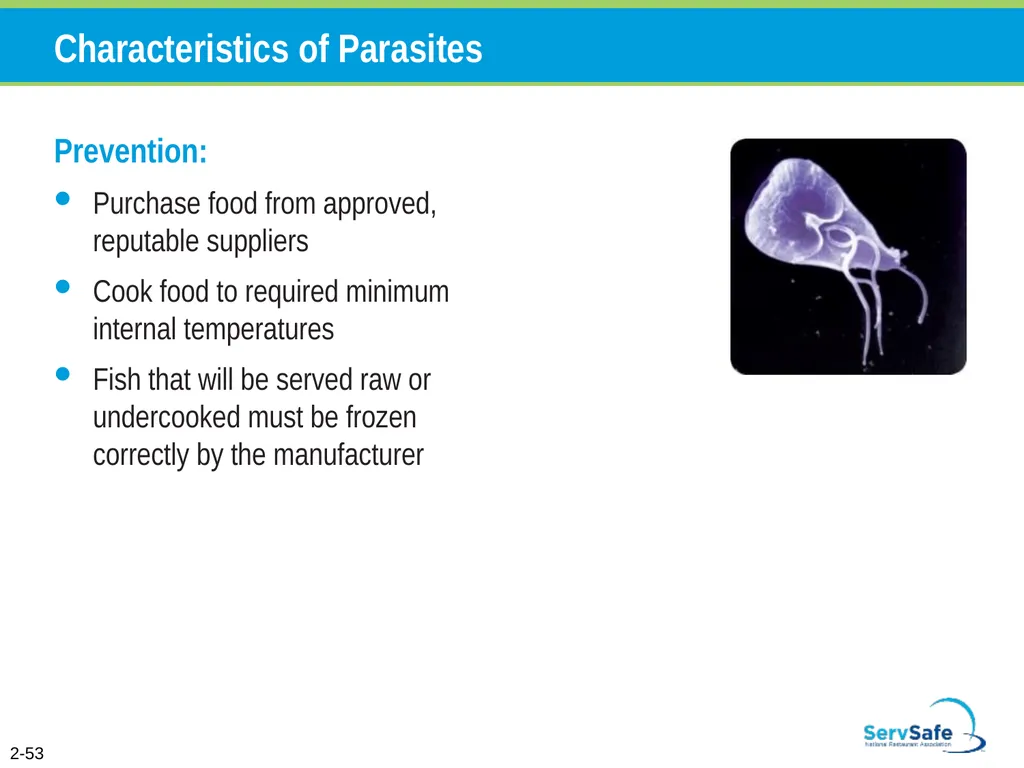
Characteristics of Parasites Prevention:
Purchase food from approved, reputable suppliers
Cook food to required minimum internal temperatures
Fish that will be served raw or undercooked must be frozen correctly by the manufacturer 2-53<br>
Purchase food from approved, reputable suppliers
Cook food to required minimum internal temperatures
Fish that will be served raw or undercooked must be frozen correctly by the manufacturer 2-53<br>
74
Major Foodborne Parasites Purchasing from approved, reputable suppliers can keep these parasites from causing a foodborne illness:
Anisakis simplex
Cryptosporidium parvum
Giardia duodenalis
Cyclospora cayetanensis 2-54<br>
Anisakis simplex
Cryptosporidium parvum
Giardia duodenalis
Cyclospora cayetanensis 2-54<br>
75
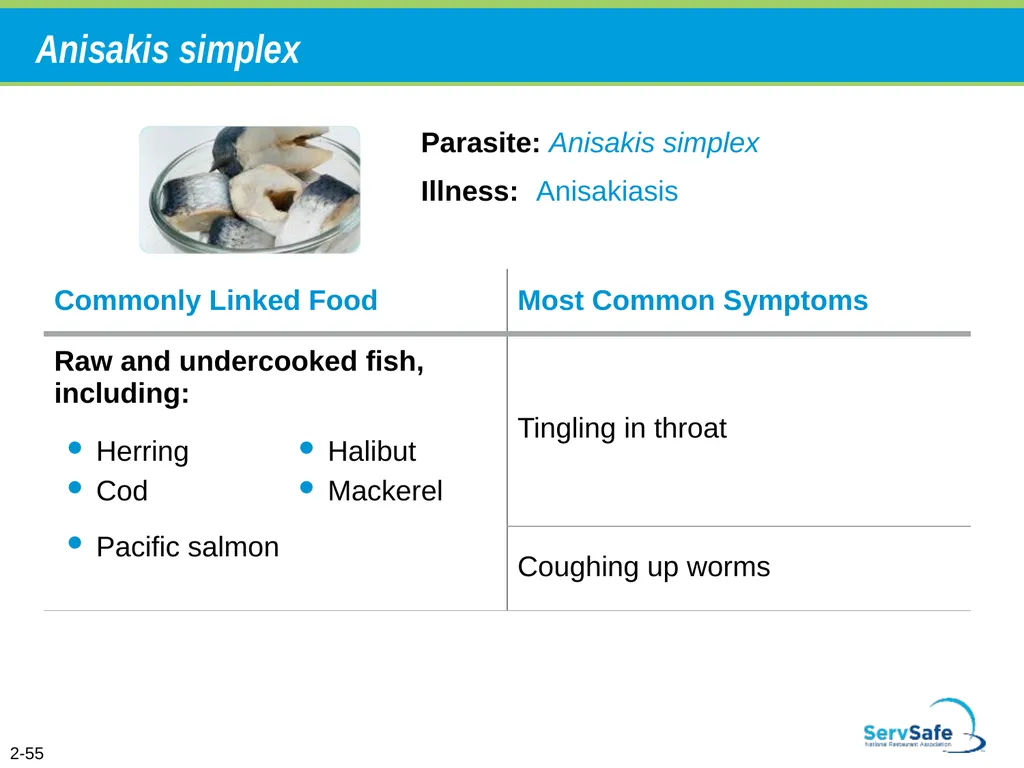
Anisakis simplex Parasite: Anisakis simplex
Illness: Anisakiasis 2-55<br>
Illness: Anisakiasis 2-55<br>
76
Anisakis simplex Most important prevention measure:
Purchase from approved, reputable suppliers
Other prevention measures:
Cook fish to minimum internal temperatures
If serving raw or undercooked fish, purchase sushi-grade fish that has been frozen to the correct time-temperature requirements 2-56<br>
Purchase from approved, reputable suppliers
Other prevention measures:
Cook fish to minimum internal temperatures
If serving raw or undercooked fish, purchase sushi-grade fish that has been frozen to the correct time-temperature requirements 2-56<br>
77
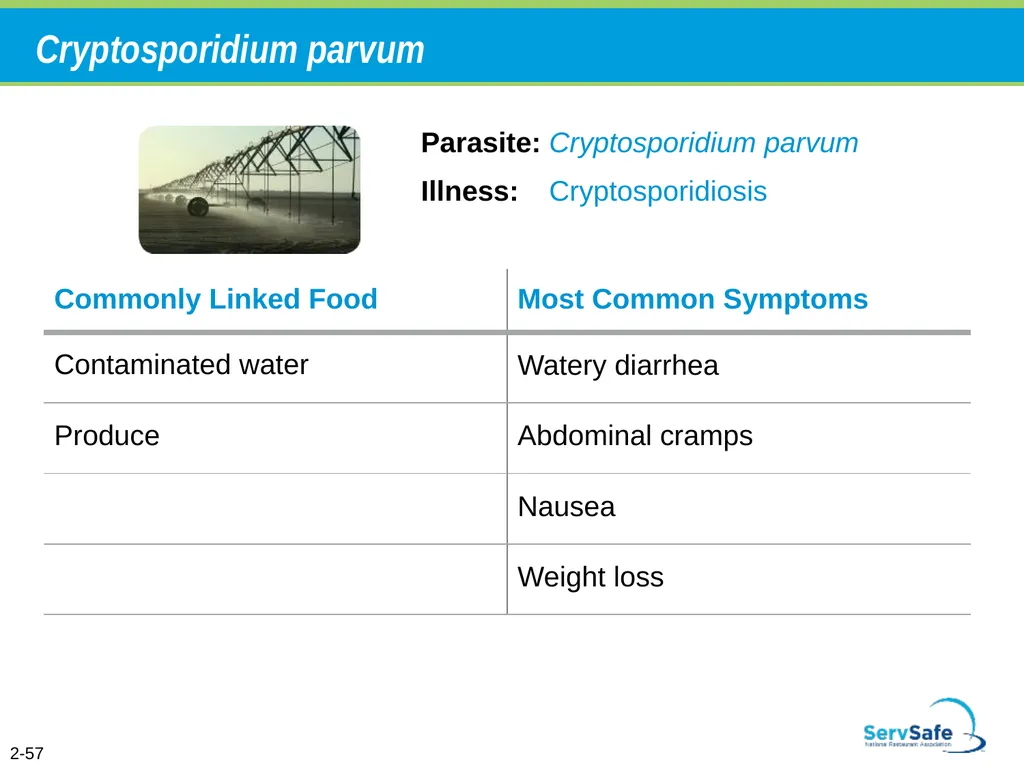
Cryptosporidium parvum Parasite: Cryptosporidium parvum
Illness: Cryptosporidiosis 2-57<br>
Illness: Cryptosporidiosis 2-57<br>
78
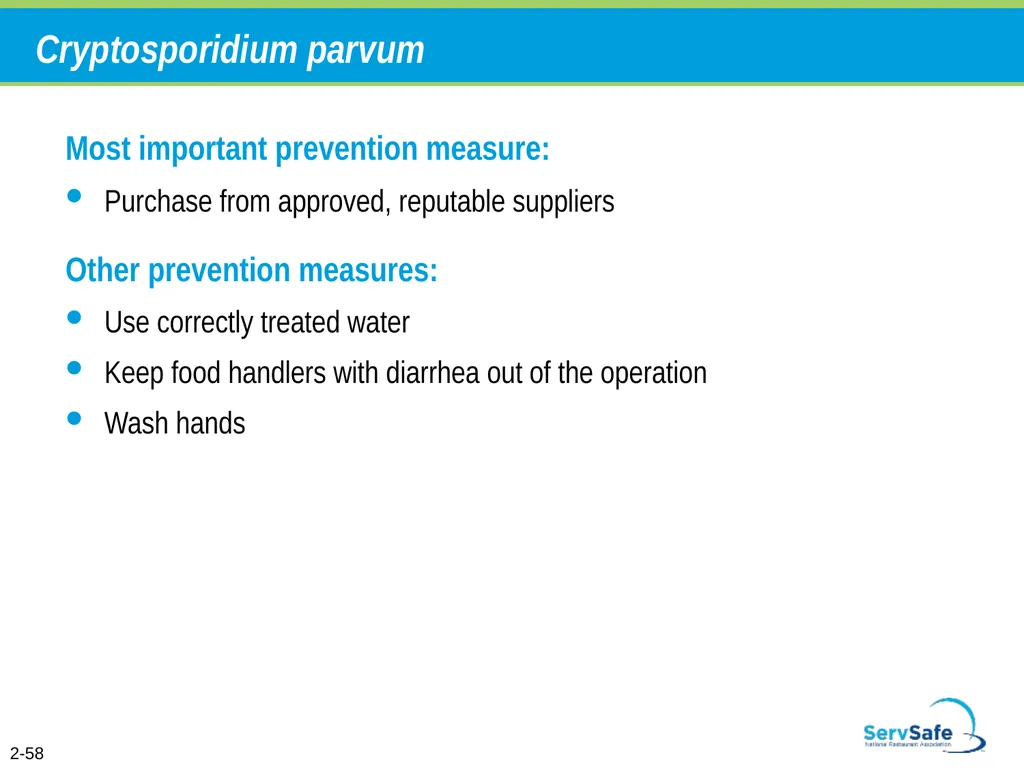
Cryptosporidium parvum Most important prevention measure:
Purchase from approved, reputable suppliers
Other prevention measures:
Use correctly treated water
Keep food handlers with diarrhea out of the operation
Wash hands 2-58<br>
Purchase from approved, reputable suppliers
Other prevention measures:
Use correctly treated water
Keep food handlers with diarrhea out of the operation
Wash hands 2-58<br>
79
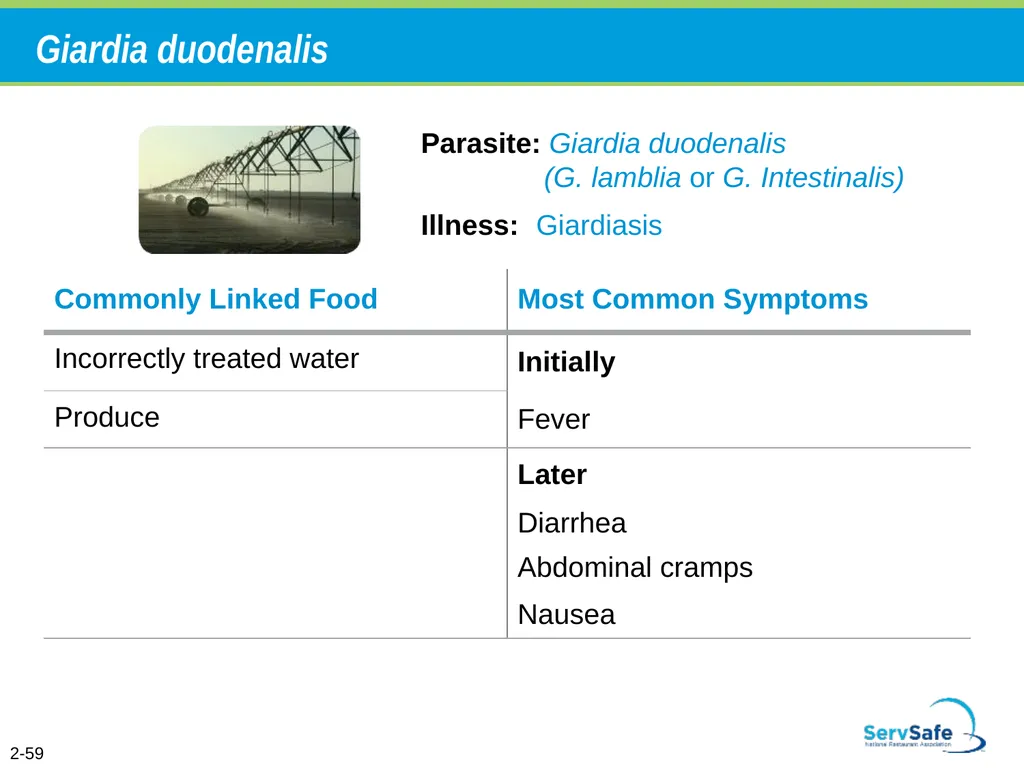
Giardia duodenalis Parasite: Giardia duodenalis (G. lamblia or G. Intestinalis)
Illness: Giardiasis 2-59<br>
Illness: Giardiasis 2-59<br>
80
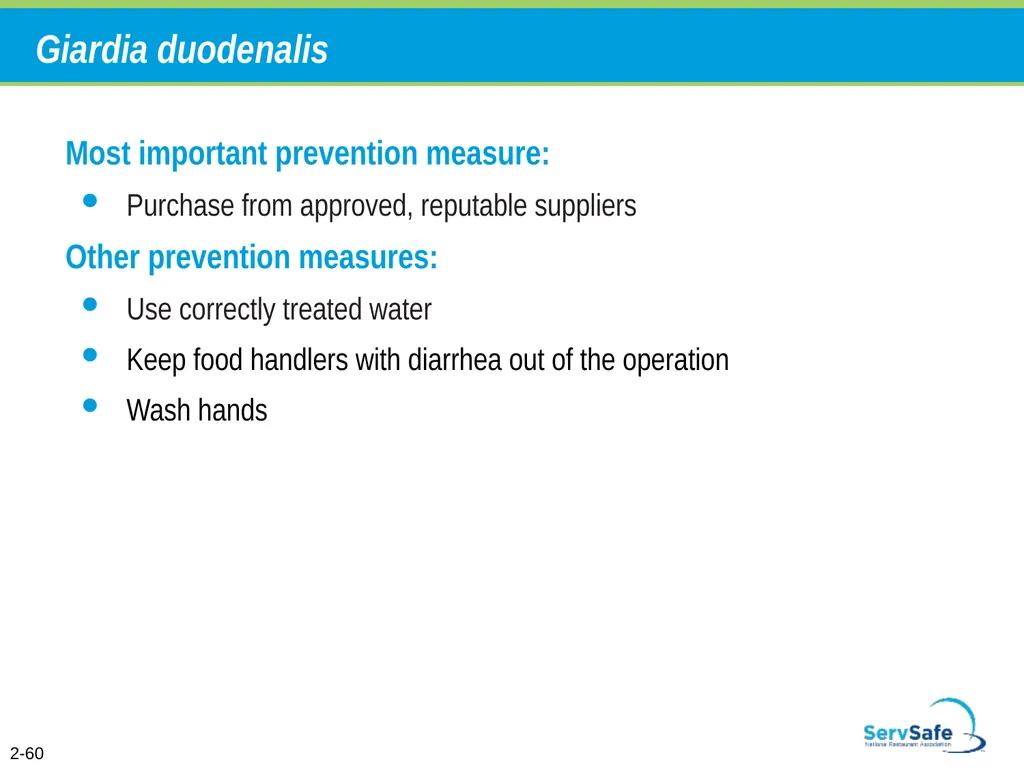
Giardia duodenalis Most important prevention measure:
Purchase from approved, reputable suppliers
Other prevention measures:
Use correctly treated water
Keep food handlers with diarrhea out of the operation
Wash hands 2-60<br>
Purchase from approved, reputable suppliers
Other prevention measures:
Use correctly treated water
Keep food handlers with diarrhea out of the operation
Wash hands 2-60<br>
81
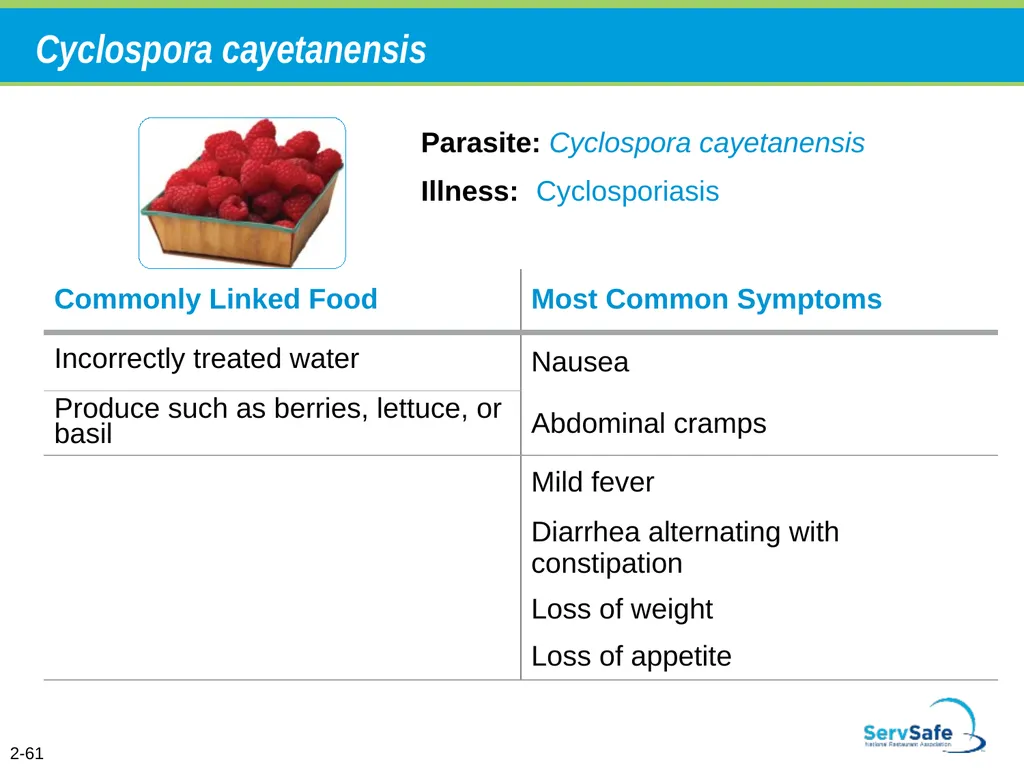
Cyclospora cayetanensis Parasite: Cyclospora cayetanensis
Illness: Cyclosporiasis 2-61<br>
Illness: Cyclosporiasis 2-61<br>
82
Cyclospora cayetanensis Most important prevention measure:
Purchase from approved, reputable suppliers
Other prevention measures:
Purchase produce from approved, reputable suppliers
Keep food handlers with diarrhea out of the operation
Wash hands 2-62<br>
Purchase from approved, reputable suppliers
Other prevention measures:
Purchase produce from approved, reputable suppliers
Keep food handlers with diarrhea out of the operation
Wash hands 2-62<br>
83
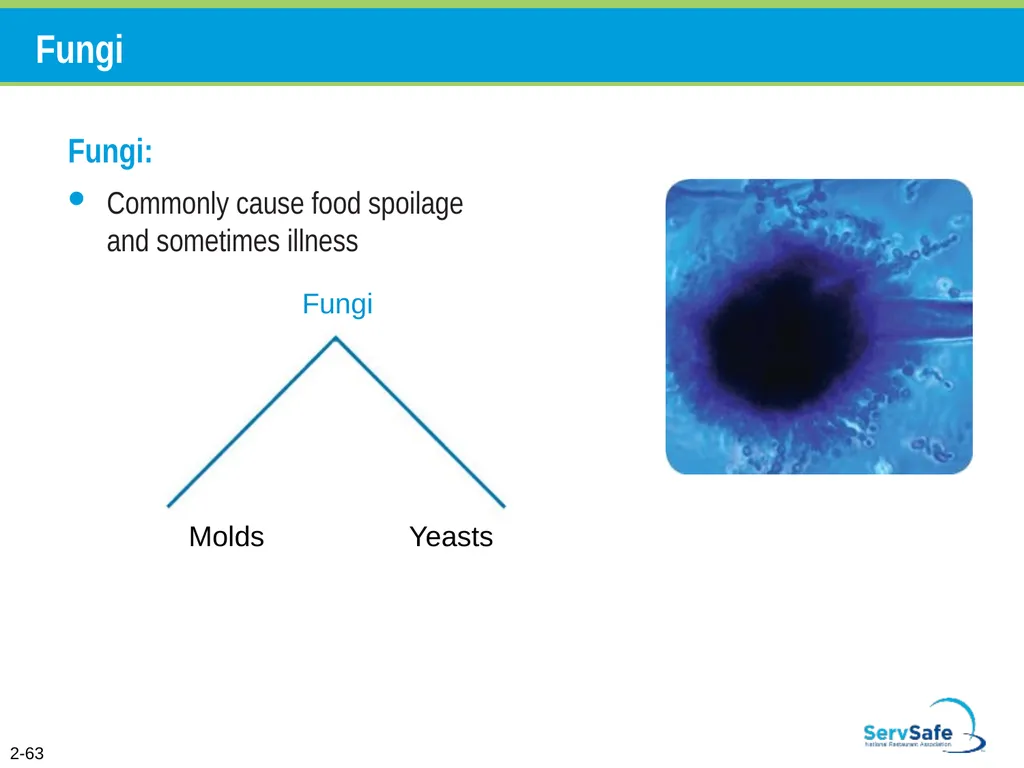
Fungi Fungi:
Commonly cause food spoilage and sometimes illness Molds Yeasts Fungi 2-63<br>
Commonly cause food spoilage and sometimes illness Molds Yeasts Fungi 2-63<br>
84
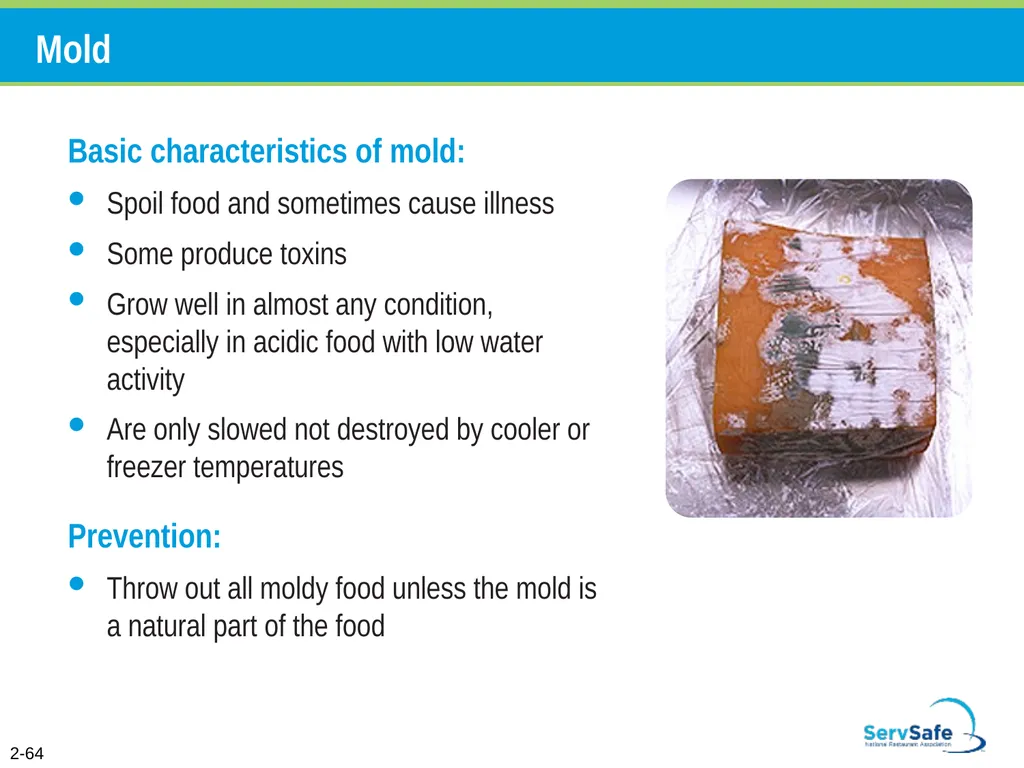
Mold Basic characteristics of mold:
Spoil food and sometimes cause illness
Some produce toxins
Grow well in almost any condition, especially in acidic food with low water activity
Are only slowed not destroyed by cooler or freezer temperatures
Prevention:
Throw out all moldy food unless the mold is a natural part of the food 2-64<br>
Spoil food and sometimes cause illness
Some produce toxins
Grow well in almost any condition, especially in acidic food with low water activity
Are only slowed not destroyed by cooler or freezer temperatures
Prevention:
Throw out all moldy food unless the mold is a natural part of the food 2-64<br>
85
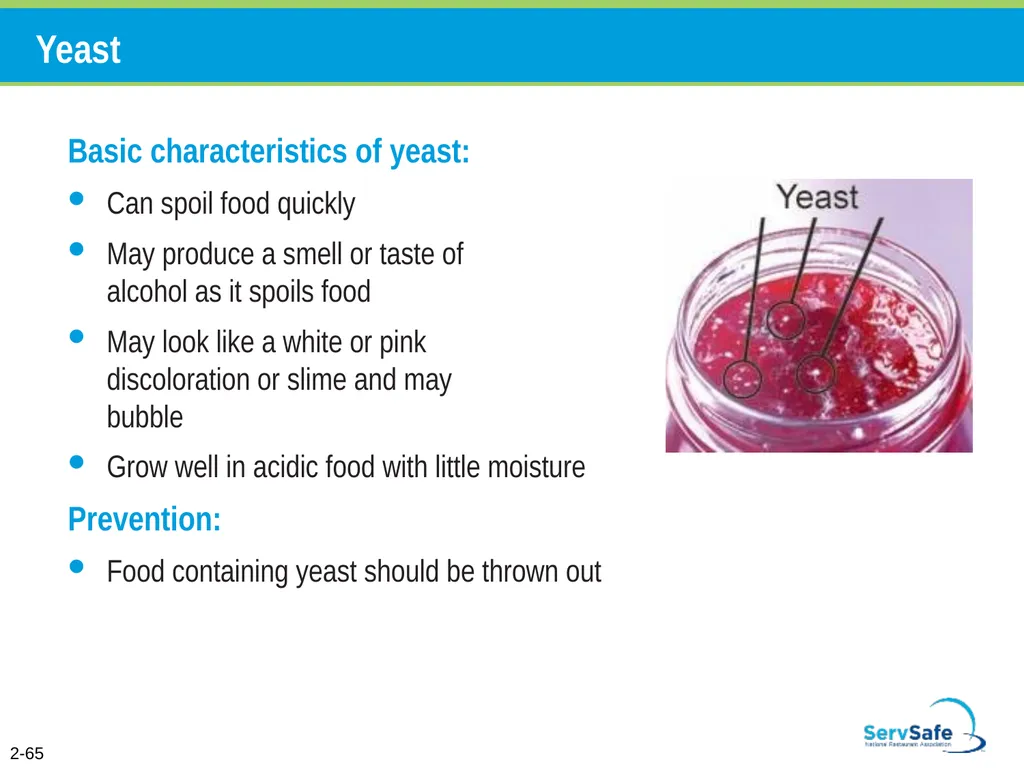
Yeast Basic characteristics of yeast:
Can spoil food quickly
May produce a smell or taste of alcohol as it spoils food
May look like a white or pink discoloration or slime and may bubble
Grow well in acidic food with little moisture
Prevention:
Food containing yeast should be thrown out 2-65<br>
Can spoil food quickly
May produce a smell or taste of alcohol as it spoils food
May look like a white or pink discoloration or slime and may bubble
Grow well in acidic food with little moisture
Prevention:
Food containing yeast should be thrown out 2-65<br>
86
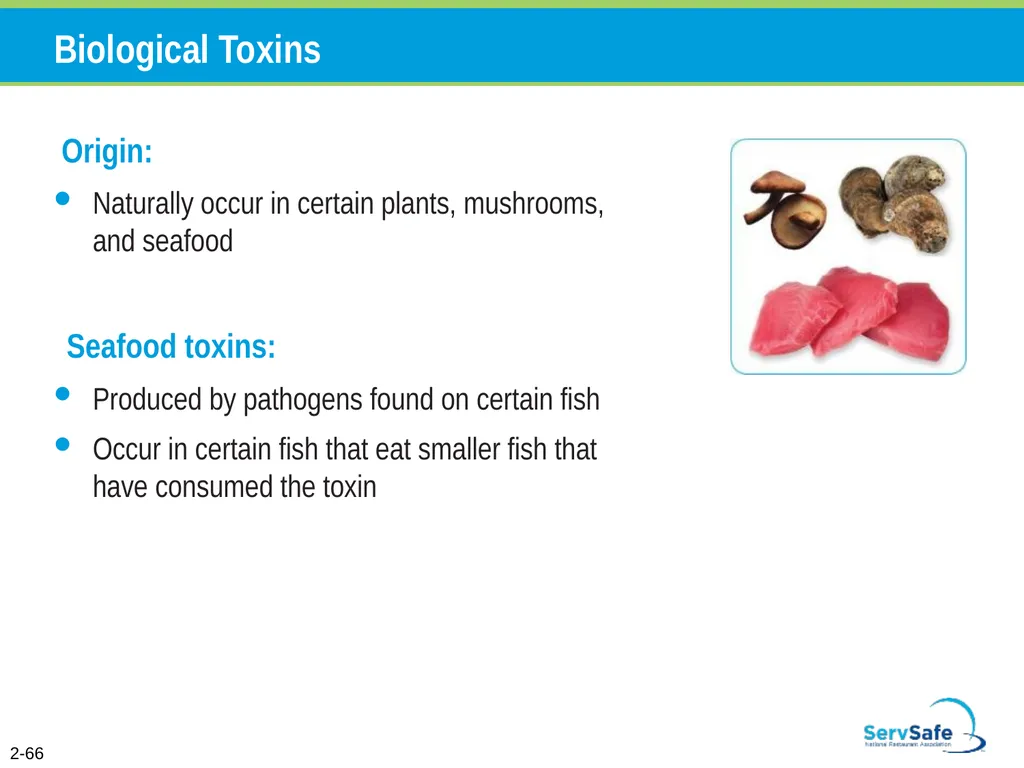
2-66 Biological Toxins Origin:
Naturally occur in certain plants, mushrooms, and seafood
Seafood toxins:
Produced by pathogens found on certain fish
Occur in certain fish that eat smaller fish that have consumed the toxin<br>
Naturally occur in certain plants, mushrooms, and seafood
Seafood toxins:
Produced by pathogens found on certain fish
Occur in certain fish that eat smaller fish that have consumed the toxin<br>
87
Major Fish Toxins Purchasing from approved, reputable suppliers can keep these fish toxins from causing a foodborne illness:
Histamine
Ciguatoxin 2-67<br>
Histamine
Ciguatoxin 2-67<br>
88
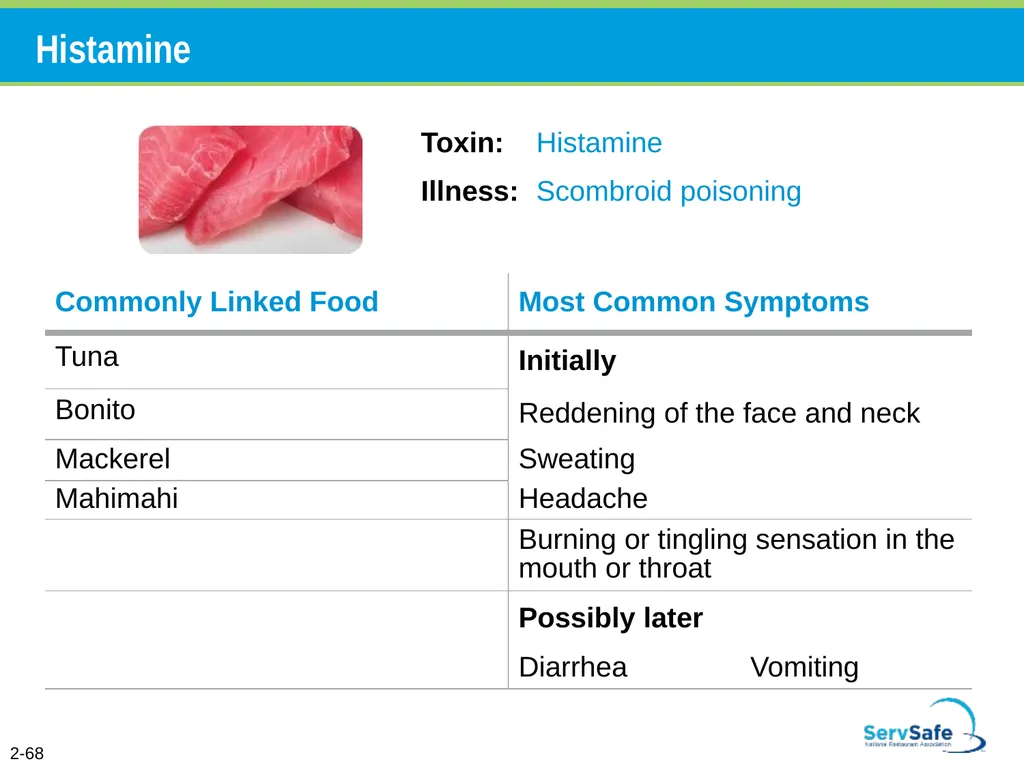
Toxin: Histamine
Illness: Scombroid poisoning 2-68 Histamine<br>
Illness: Scombroid poisoning 2-68 Histamine<br>
89
Histamine Most important prevention measure:
Purchase from approved, reputable suppliers
Other prevention measures:
Prevent time-temperature abuse during storage and preparation 2-69<br>
Purchase from approved, reputable suppliers
Other prevention measures:
Prevent time-temperature abuse during storage and preparation 2-69<br>
90
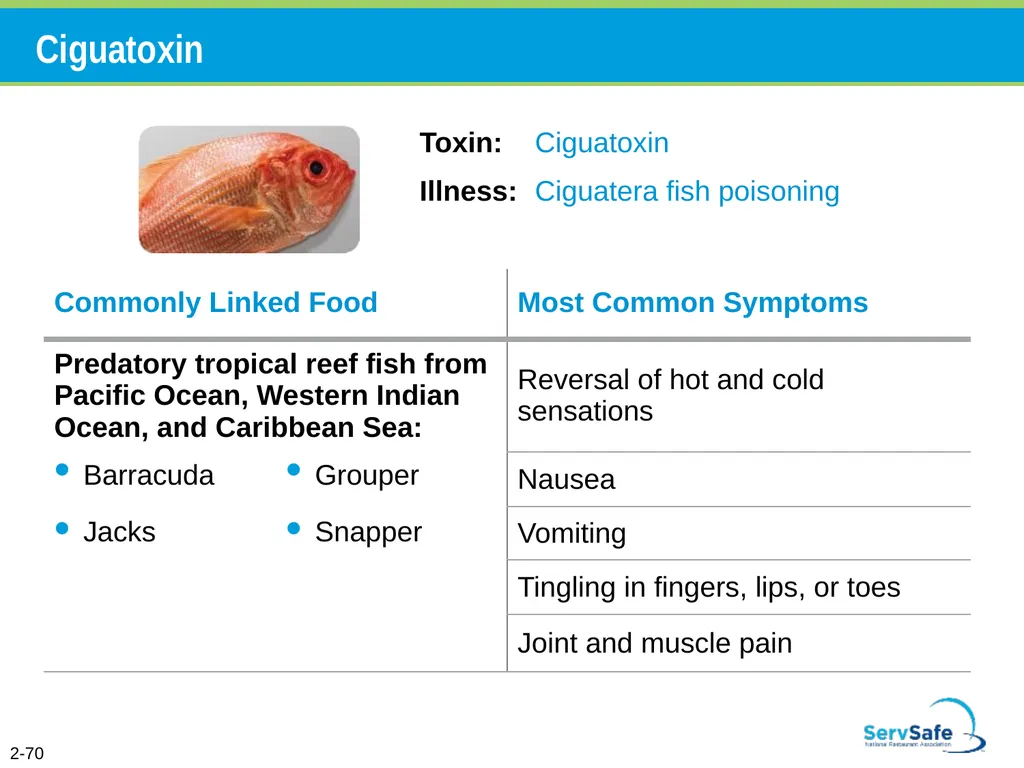
Toxin: Ciguatoxin
Illness: Ciguatera fish poisoning Ciguatoxin 2-70<br>
Illness: Ciguatera fish poisoning Ciguatoxin 2-70<br>
91
2-71 Ciguatoxin Most important prevention measure:
Purchase predatory tropical reef fish from approved, reputable suppliers<br>
Purchase predatory tropical reef fish from approved, reputable suppliers<br>
92
Major Shellfish Toxins Purchasing from approved, reputable suppliers can keep these shellfish toxins from causing a foodborne illness:
Saxitoxin
Brevetoxin
Domoic acid 2-72<br>
Saxitoxin
Brevetoxin
Domoic acid 2-72<br>
93
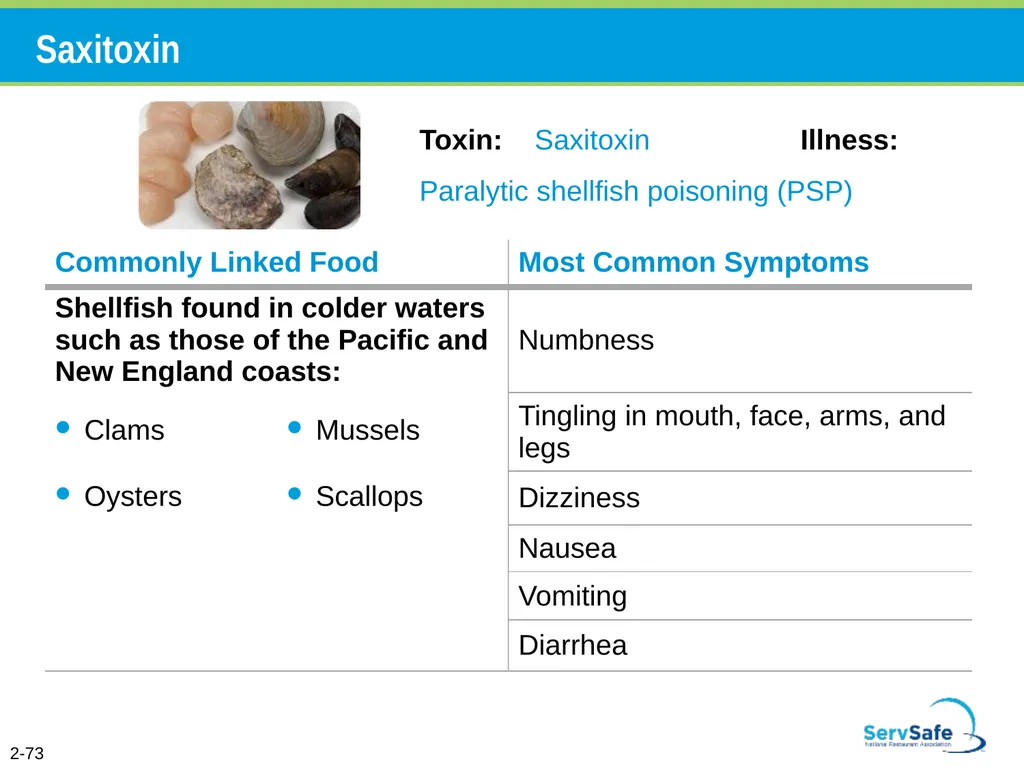
Toxin: Saxitoxin Illness: Paralytic shellfish poisoning (PSP) Saxitoxin 2-73<br>
94
Saxitoxin Most important prevention measure:
Purchase shellfish from approved, reputable suppliers 2-74<br>
Purchase shellfish from approved, reputable suppliers 2-74<br>
95
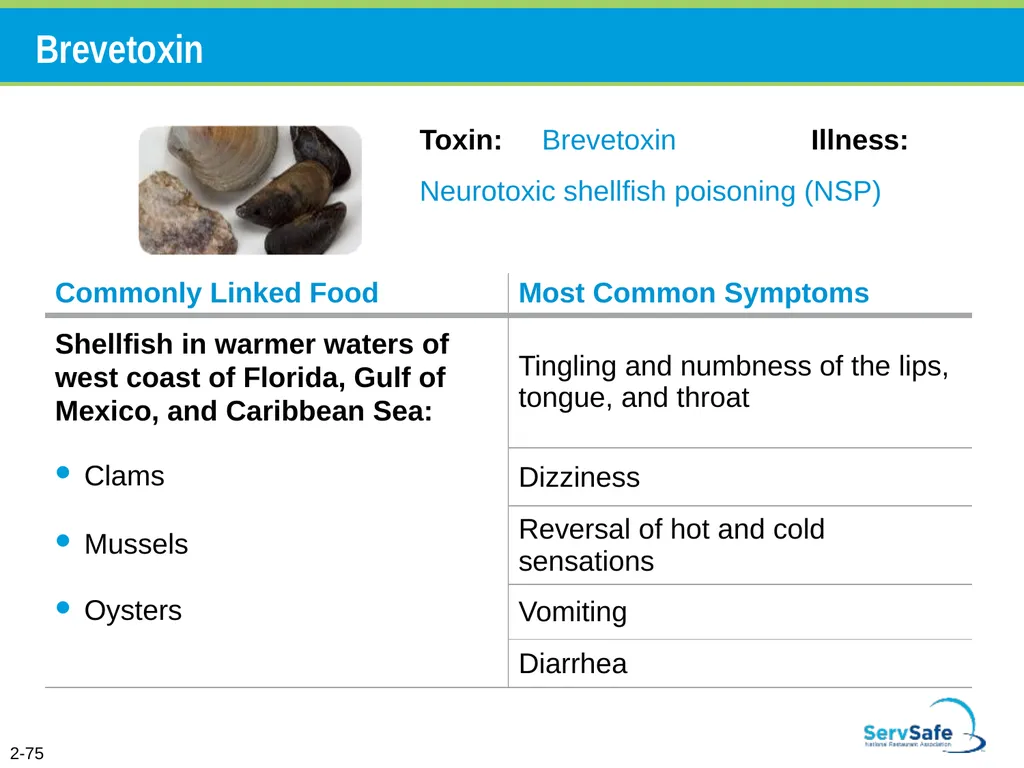
Brevetoxin 2-75 Toxin: Brevetoxin Illness: Neurotoxic shellfish poisoning (NSP)<br>
96
Brevetoxin Most important prevention measure:
Purchase shellfish from approved, reputable suppliers 2-76<br>
Purchase shellfish from approved, reputable suppliers 2-76<br>
97
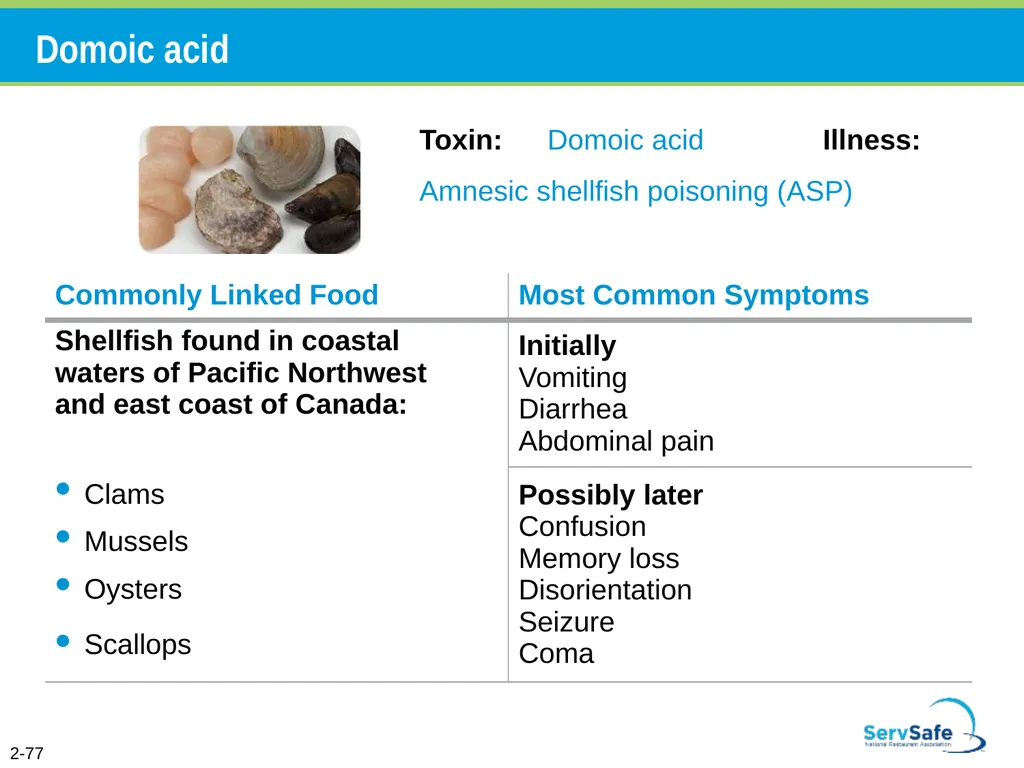
Toxin: Domoic acid Illness: Amnesic shellfish poisoning (ASP) Domoic acid 2-77<br>
98
Domoic acid Most important prevention measure:
Purchase shellfish from approved, reputable suppliers 2-78<br>
Purchase shellfish from approved, reputable suppliers 2-78<br>
99
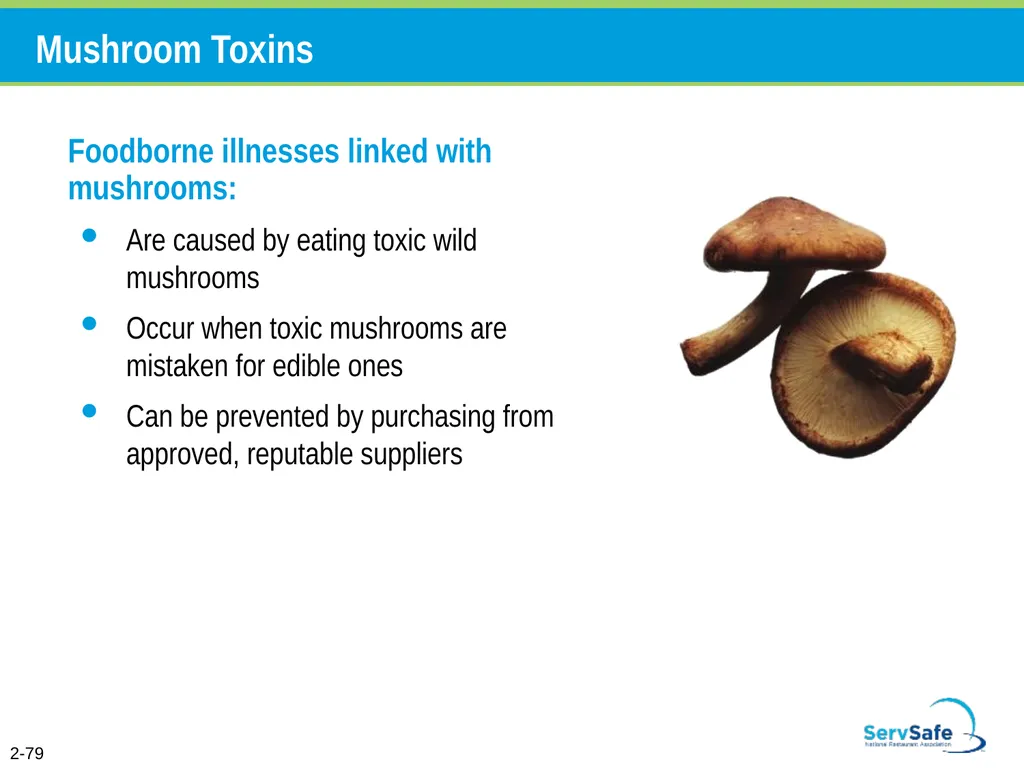
Mushroom Toxins Foodborne illnesses linked with mushrooms:
Are caused by eating toxic wild mushrooms
Occur when toxic mushrooms are mistaken for edible ones
Can be prevented by purchasing from approved, reputable suppliers 2-79<br>
Are caused by eating toxic wild mushrooms
Occur when toxic mushrooms are mistaken for edible ones
Can be prevented by purchasing from approved, reputable suppliers 2-79<br>
100
Plant Toxins Foodborne illnesses linked with plant toxins:
Usually happen when plants are purchased from unapproved suppliers
Can happen when certain plants aren’t cooked correctly (i.e., undercooked kidney beans)
Can be prevented by purchasing plants from approved, reputable suppliers 2-80<br>
Usually happen when plants are purchased from unapproved suppliers
Can happen when certain plants aren’t cooked correctly (i.e., undercooked kidney beans)
Can be prevented by purchasing plants from approved, reputable suppliers 2-80<br>
101
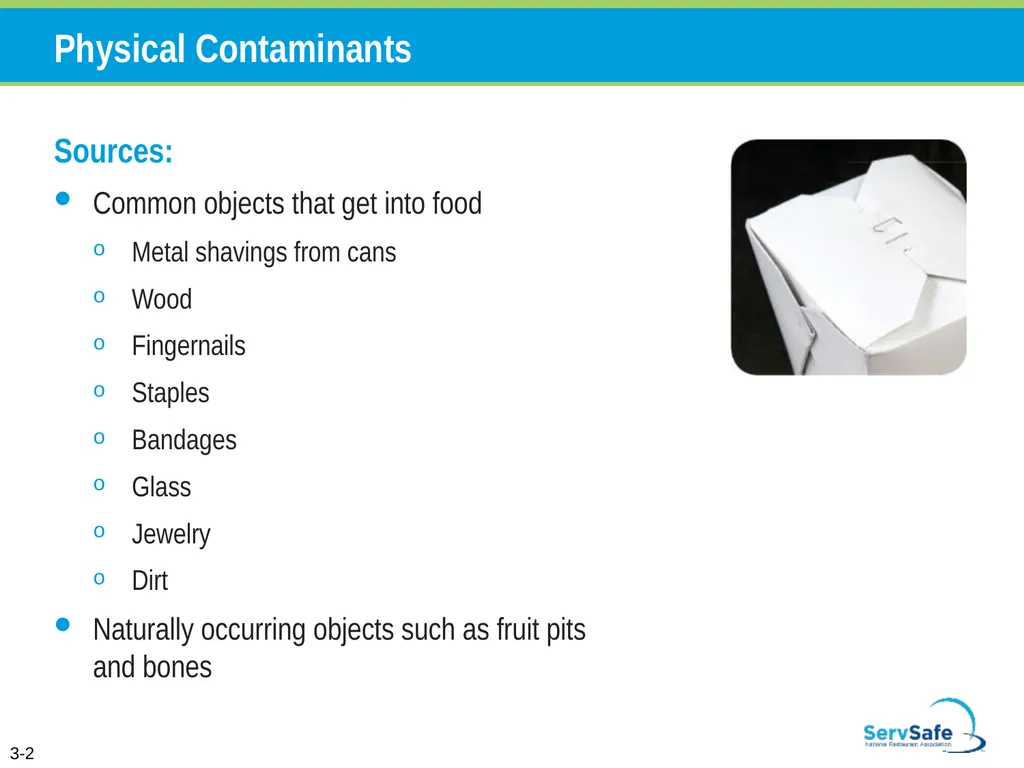
Physical Contaminants Sources:
Common objects that get into food
Metal shavings from cans
Wood
Fingernails
Staples
Bandages
Glass
Jewelry
Dirt
Naturally occurring objects such as fruit pits and bones 3-2<br>
Common objects that get into food
Metal shavings from cans
Wood
Fingernails
Staples
Bandages
Glass
Jewelry
Dirt
Naturally occurring objects such as fruit pits and bones 3-2<br>
102
Physical Contaminants Symptoms:
Mild to fatal injuries are possible
Cuts, dental damage, and choking
Bleeding and pain
Prevention:
Purchase food from approved, reputable suppliers
Closely inspect food received
Take steps to prevent physical contamination, including practicing good personal hygiene 3-3<br>
Mild to fatal injuries are possible
Cuts, dental damage, and choking
Bleeding and pain
Prevention:
Purchase food from approved, reputable suppliers
Closely inspect food received
Take steps to prevent physical contamination, including practicing good personal hygiene 3-3<br>
103
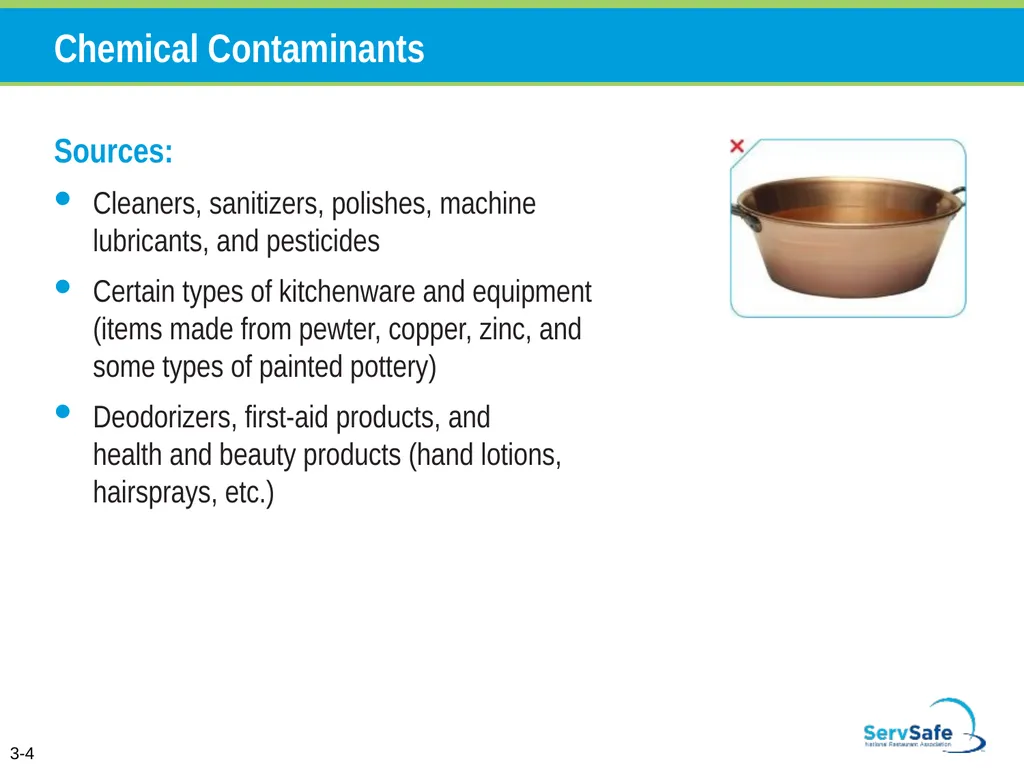
Chemical Contaminants Sources:
Cleaners, sanitizers, polishes, machine lubricants, and pesticides
Certain types of kitchenware and equipment (items made from pewter, copper, zinc, and some types of painted pottery)
Deodorizers, first-aid products, and health and beauty products (hand lotions, hairsprays, etc.) 3-4<br>
Cleaners, sanitizers, polishes, machine lubricants, and pesticides
Certain types of kitchenware and equipment (items made from pewter, copper, zinc, and some types of painted pottery)
Deodorizers, first-aid products, and health and beauty products (hand lotions, hairsprays, etc.) 3-4<br>
104
Chemical Contaminants Symptoms:
Vary depending on chemical consumed
Most illnesses occur within minutes
Vomiting and diarrhea are typical
If an illness is suspected:
Call the emergency number in your area
Call the Poison Control number
Consult the chemical’s MSDS 3-5<br>
Vary depending on chemical consumed
Most illnesses occur within minutes
Vomiting and diarrhea are typical
If an illness is suspected:
Call the emergency number in your area
Call the Poison Control number
Consult the chemical’s MSDS 3-5<br>
105
Chemical Contaminants Prevention:
Only use chemicals approved for use in foodservice operations
Purchase chemicals from approved, reputable suppliers
Store chemicals away from prep areas, food-storage areas, and service areas
Chemicals must be separated from food and food-contact surfaces by spacing and partitioning
Chemicals must NEVER be stored above food or food-contact surfaces
Use chemicals for their intended use and follow manufacturer’s directions 3-6<br>
106
Chemical Contaminants Prevention:
Only handle food with equipment and utensils approved for foodservice use
Make sure the manufacturers’ labels on original chemical containers are readable
Keep MSDS current, and make sure they are accessible to staff at all times
Follow the manufacturer’s directions and local regulatory requirements when throwing out chemicals 3-7<br>
107
The Deliberate Contamination of Food Groups who may attempt to contaminate food:
Terrorists or activists
Disgruntled current or former staff
Vendors
Competitors
FDA defense tool:
A.L.E.R.T. 3-8<br>
Terrorists or activists
Disgruntled current or former staff
Vendors
Competitors
FDA defense tool:
A.L.E.R.T. 3-8<br>
108
The Deliberate Contamination of Food Assure Make sure products received are from safe sources
Look Monitor the security of products in the facility
Employees Know who is in your facility
Reports Keep information related to food defense accessible
Threat Develop a plan for responding to suspicious activity or a threat to the operation 3-9<br>
Look Monitor the security of products in the facility
Employees Know who is in your facility
Reports Keep information related to food defense accessible
Threat Develop a plan for responding to suspicious activity or a threat to the operation 3-9<br>
109
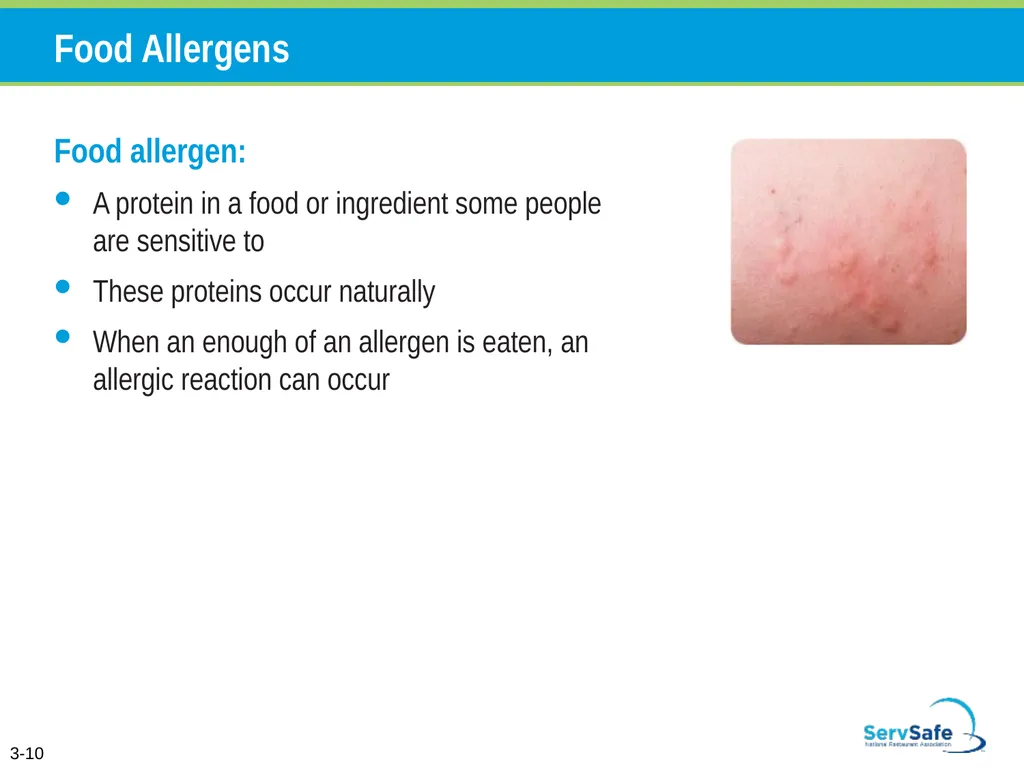
Food Allergens Food allergen:
A protein in a food or ingredient some people are sensitive to
These proteins occur naturally
When an enough of an allergen is eaten, an allergic reaction can occur 3-10<br>
A protein in a food or ingredient some people are sensitive to
These proteins occur naturally
When an enough of an allergen is eaten, an allergic reaction can occur 3-10<br>
110
Allergy Symptoms Allergy symptoms:
Nausea
Wheezing or shortness of breath
Hives or itchy rashes
Swelling of various parts of the body, including the face, eyes, hands, or feet
Vomiting and/or diarrhea
Abdominal pain
Allergic reactions:
Symptoms can become serious quickly
A severe reaction, called anaphylaxis, can lead to death 3-11<br>
111
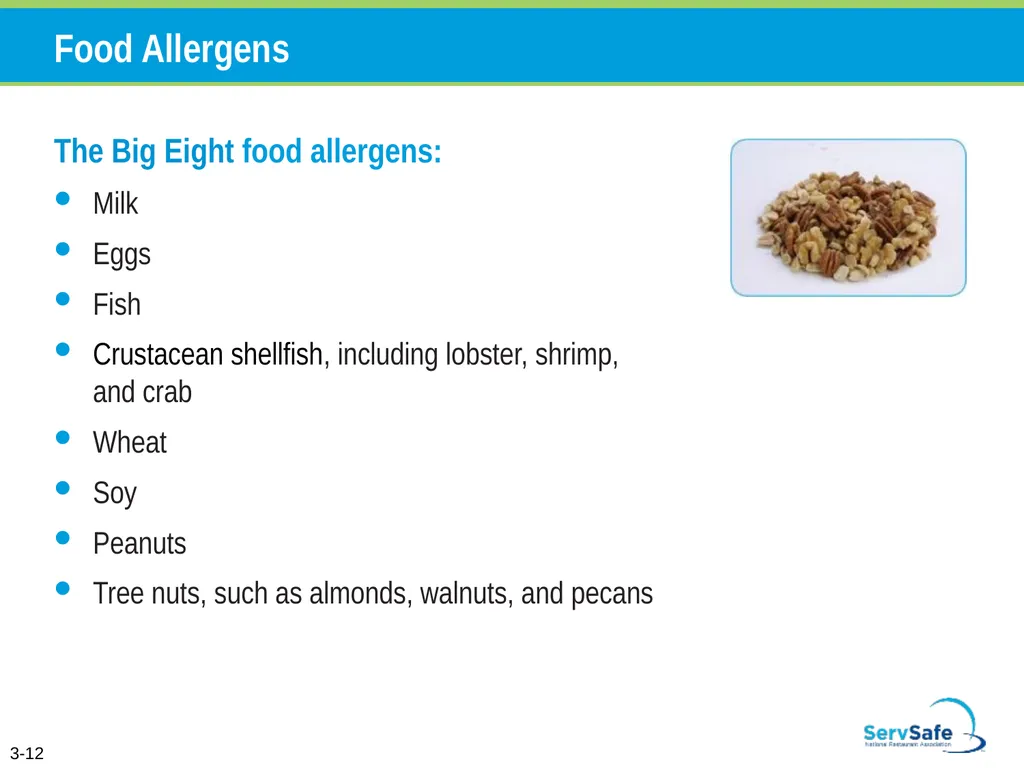
Food Allergens The Big Eight food allergens:
Milk
Eggs
Fish
Crustacean shellfish, including lobster, shrimp, and crab
Wheat
Soy
Peanuts
Tree nuts, such as almonds, walnuts, and pecans 3-12<br>
Milk
Eggs
Fish
Crustacean shellfish, including lobster, shrimp, and crab
Wheat
Soy
Peanuts
Tree nuts, such as almonds, walnuts, and pecans 3-12<br>
112
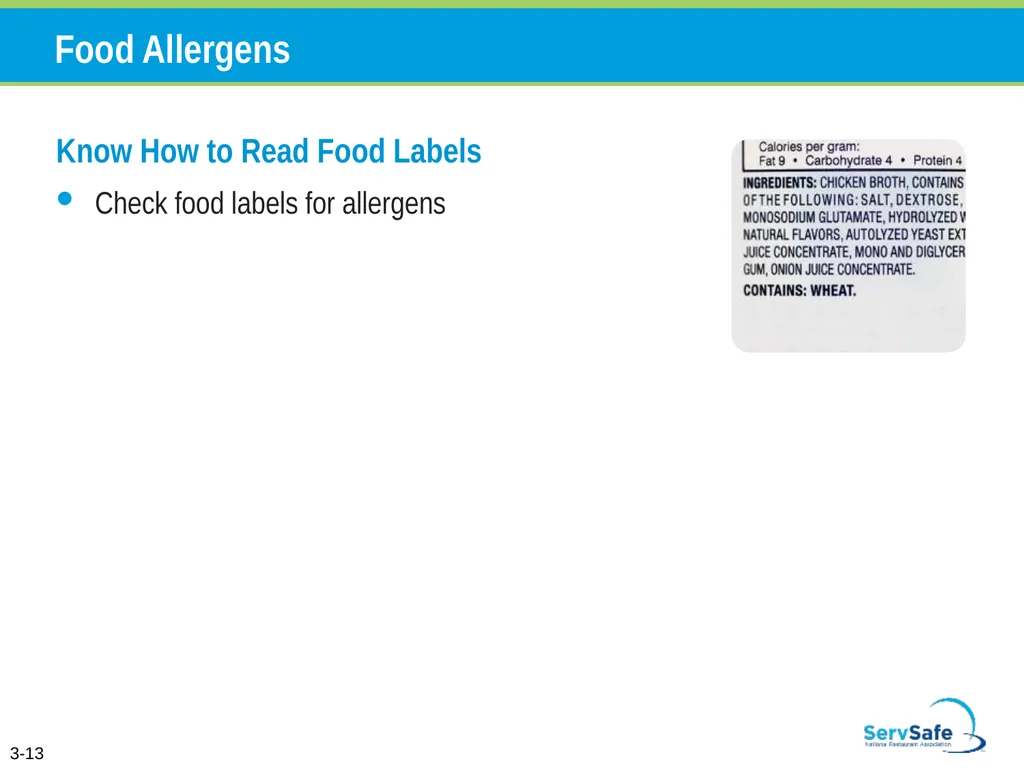
Food Allergens Know How to Read Food Labels
Check food labels for allergens 3-13<br>
Check food labels for allergens 3-13<br>
113
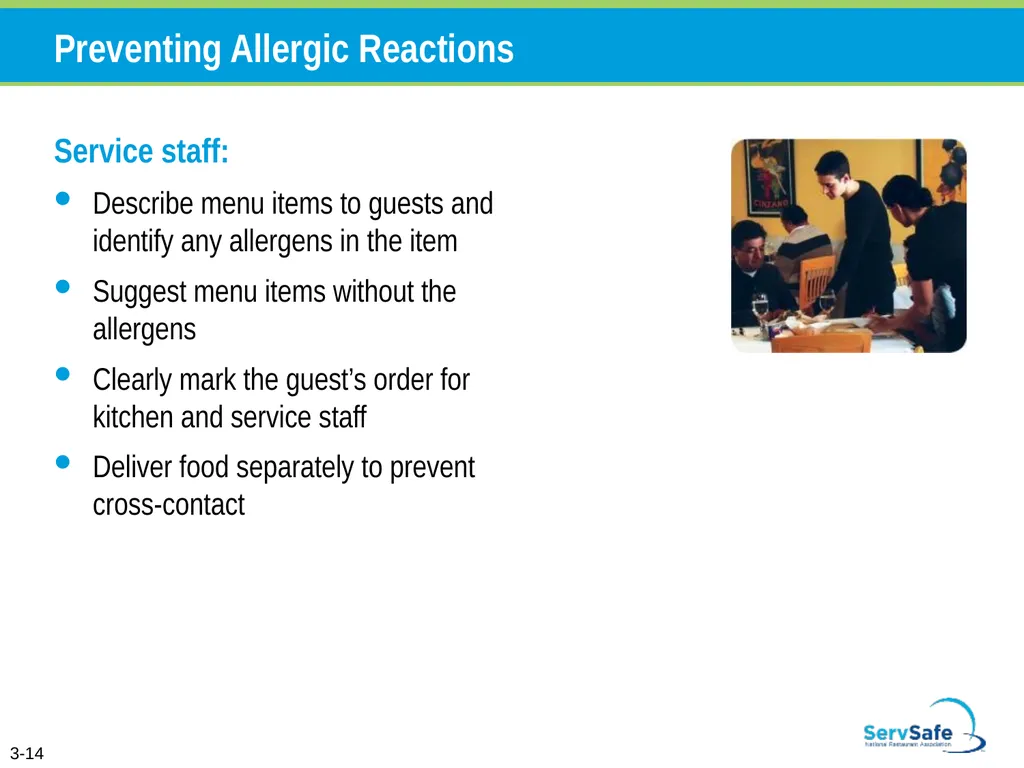
Preventing Allergic Reactions Service staff:
Describe menu items to guests and identify any allergens in the item
Suggest menu items without the allergens
Clearly mark the guest’s order for kitchen and service staff
Deliver food separately to prevent cross-contact 3-14<br>
Describe menu items to guests and identify any allergens in the item
Suggest menu items without the allergens
Clearly mark the guest’s order for kitchen and service staff
Deliver food separately to prevent cross-contact 3-14<br>
114
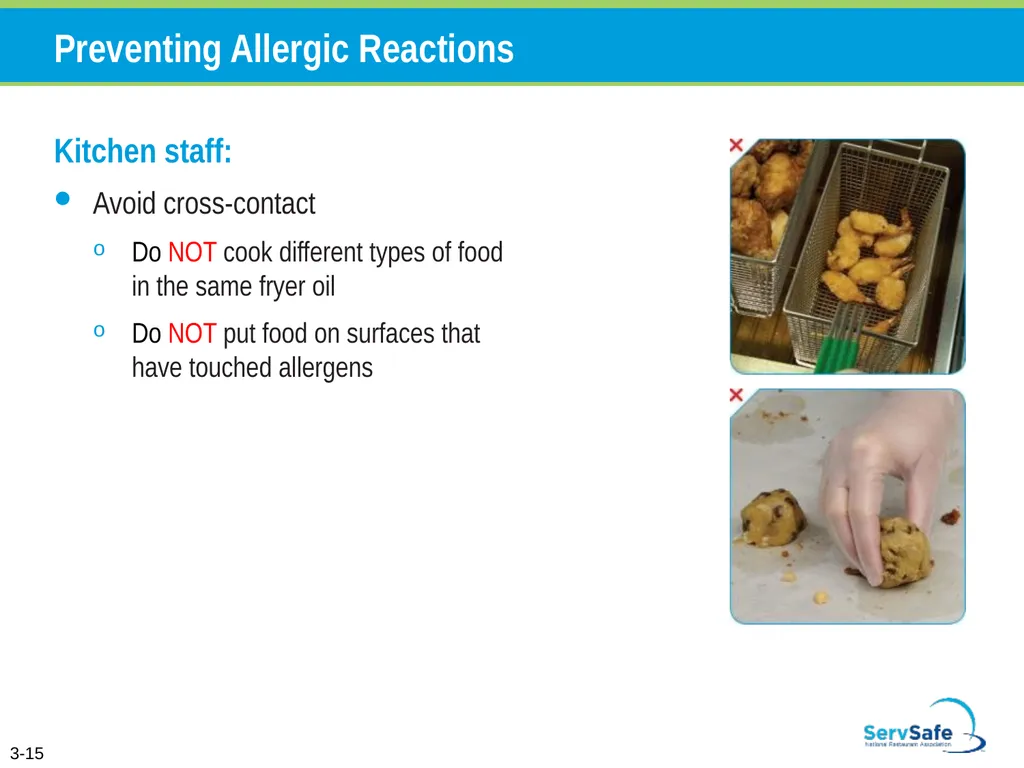
Preventing Allergic Reactions Kitchen staff:
Avoid cross-contact
Do NOT cook different types of food in the same fryer oil
Do NOT put food on surfaces that have touched allergens 3-15<br>
Avoid cross-contact
Do NOT cook different types of food in the same fryer oil
Do NOT put food on surfaces that have touched allergens 3-15<br>
115
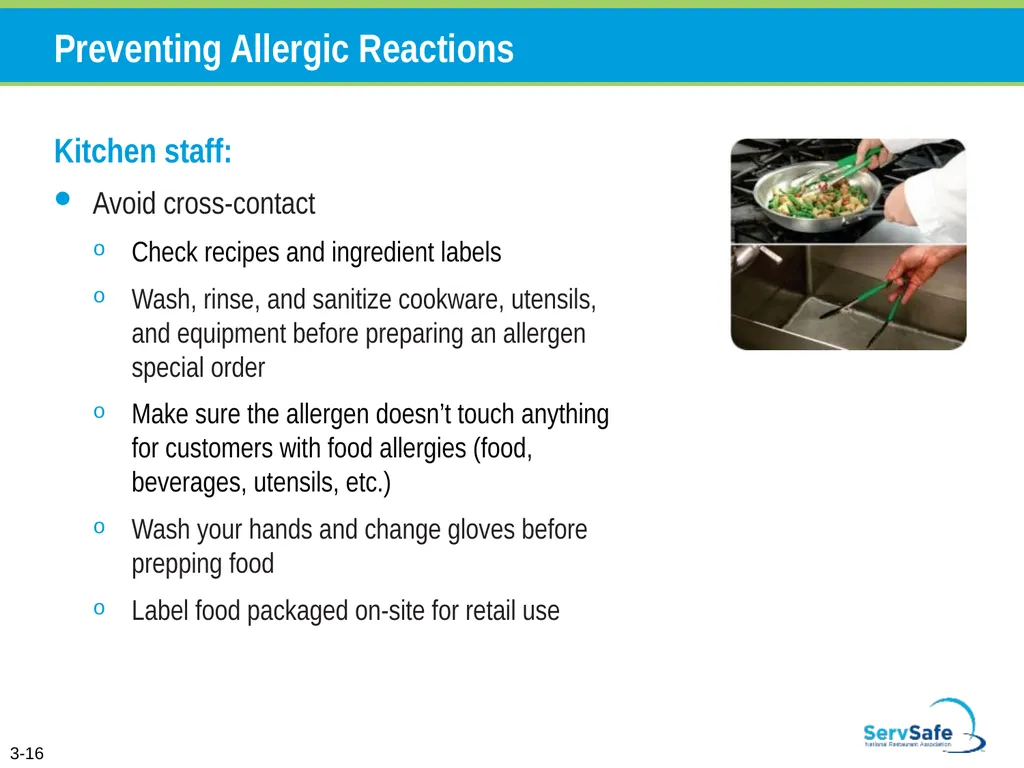
Preventing Allergic Reactions Kitchen staff:
Avoid cross-contact
Check recipes and ingredient labels
Wash, rinse, and sanitize cookware, utensils, and equipment before preparing an allergen special order
Make sure the allergen doesn’t touch anything for customers with food allergies (food, beverages, utensils, etc.)
Wash your hands and change gloves before prepping food
Label food packaged on-site for retail use 3-16<br>