
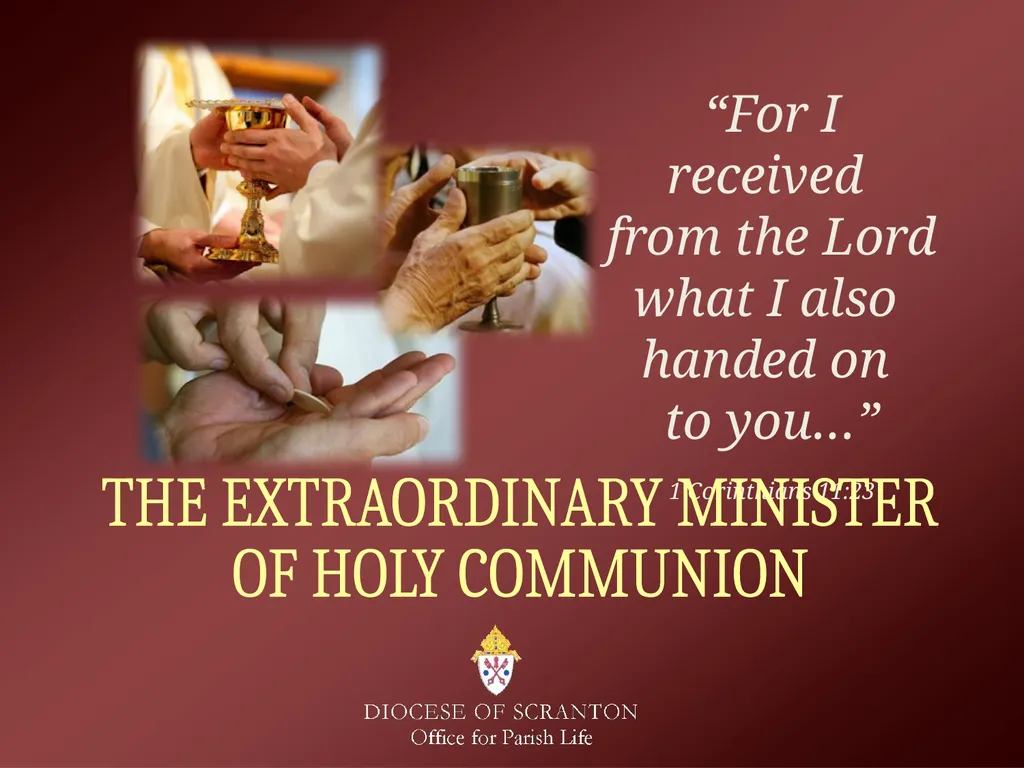
“For I received from the Lord what I also handed
MJ
Published · 46 slides · 0 views

1 / 1




Description
For I received from the Lord what I also handed on to you 1 Corinthians 11:23 THE EXTRAORDINARY MINISTER OF HOLY COMMUNION Outline PART I Understanding of Ministry Role of the Extraordinary Minister of Communion Requirements of the
Related Topics
Share
Embed code
Download this presentation From Below
"“For I received from the Lord what I also handed" is the property of its rightful owner. Permission is granted to download and print the materials on this website for personal, non-commercial use only, and to display it on your personal computer provided you do not modify the materials and that you retain all copyright notices contained in the materials. By downloading content from our website, you accept the terms of this agreement.
Presentation Transcript
01
“For I received
from the Lord
what I also
handed on
to you…”
1 Corinthians 11:23 THE EXTRAORDINARY MINISTER
OF HOLY COMMUNION<br>
from the Lord
what I also
handed on
to you…”
1 Corinthians 11:23 THE EXTRAORDINARY MINISTER
OF HOLY COMMUNION<br>
02
Outline PART I
Understanding of Ministry
Role of the Extraordinary Minister of Communion
Requirements of the Extraordinary Minister of Communion<br>
Understanding of Ministry
Role of the Extraordinary Minister of Communion
Requirements of the Extraordinary Minister of Communion<br>
03
Outline PART II
The Liturgy
The Eucharist
Understanding of the sacrament
Walk through the Mass
Theology of the Real Presence
Practicum<br>
The Liturgy
The Eucharist
Understanding of the sacrament
Walk through the Mass
Theology of the Real Presence
Practicum<br>
04
Outline PART III
Serving as an Extraordinary Minister of Communion at Mass
Serving as an Extraordinary Minister of Communion to the Sick & Homebound
Serving as an Extraordinary Minister of Exposition
Other aspects of the Ministry<br>
Serving as an Extraordinary Minister of Communion at Mass
Serving as an Extraordinary Minister of Communion to the Sick & Homebound
Serving as an Extraordinary Minister of Exposition
Other aspects of the Ministry<br>
05
Materials Used Power Point presentation
Handouts
Sacred Linens,Chalices, ciboria and unconsecrated hosts during practicum<br>
Handouts
Sacred Linens,Chalices, ciboria and unconsecrated hosts during practicum<br>
06
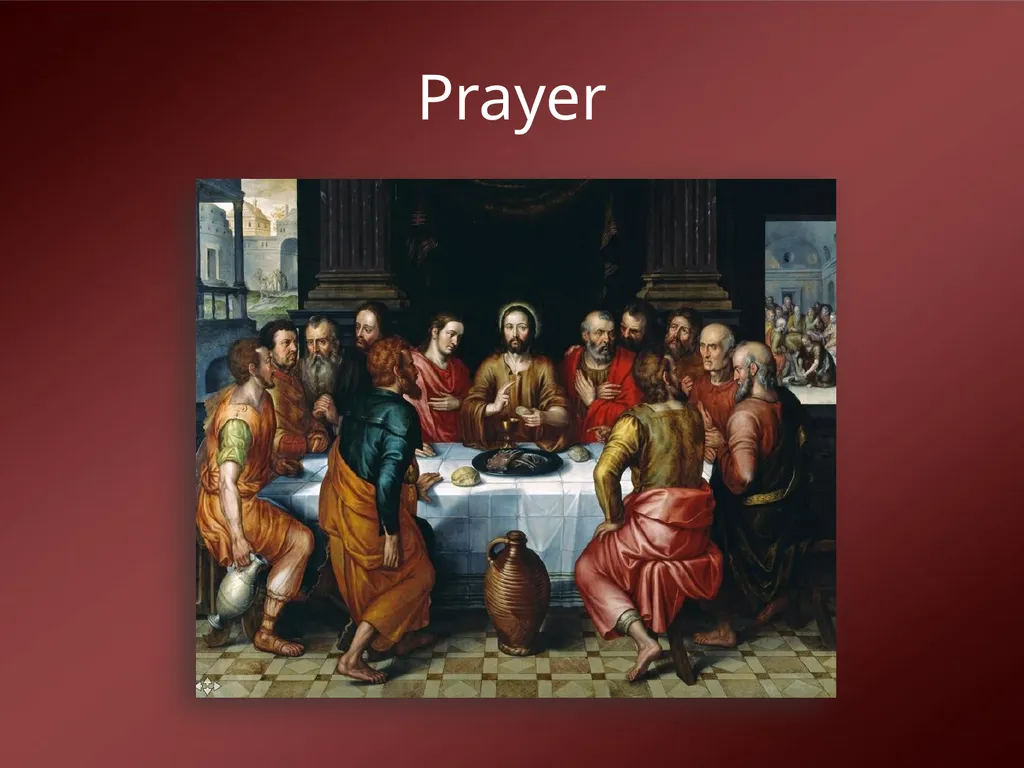
Prayer<br>
07
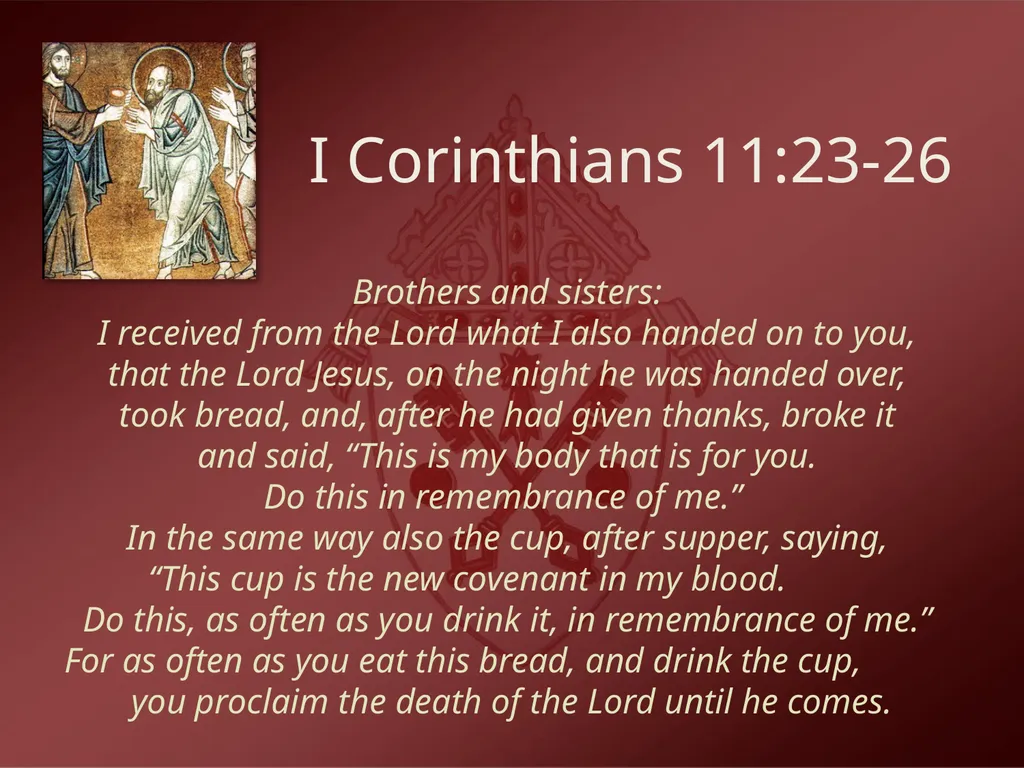
I Corinthians 11:23-26 Brothers and sisters:
I received from the Lord what I also handed on to you,
that the Lord Jesus, on the night he was handed over,
took bread, and, after he had given thanks, broke it
and said, “This is my body that is for you.
Do this in remembrance of me.”
In the same way also the cup, after supper, saying,
“This cup is the new covenant in my blood.
Do this, as often as you drink it, in remembrance of me.”
For as often as you eat this bread, and drink the cup,
you proclaim the death of the Lord until he comes.<br>
08
Understanding
of
Ministry<br>
of
Ministry<br>
09
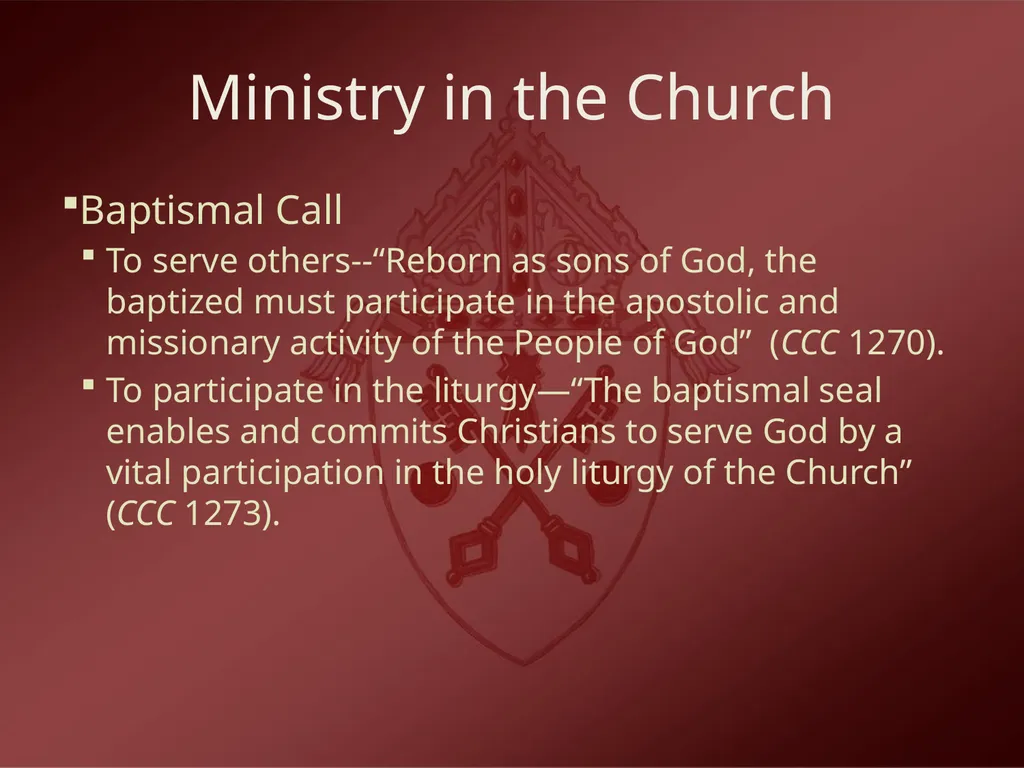
Ministry in the Church Baptismal Call
To serve others--“Reborn as sons of God, the baptized must participate in the apostolic and missionary activity of the People of God” (CCC 1270).
To participate in the liturgy—“The baptismal seal enables and commits Christians to serve God by a vital participation in the holy liturgy of the Church” (CCC 1273).<br>
10
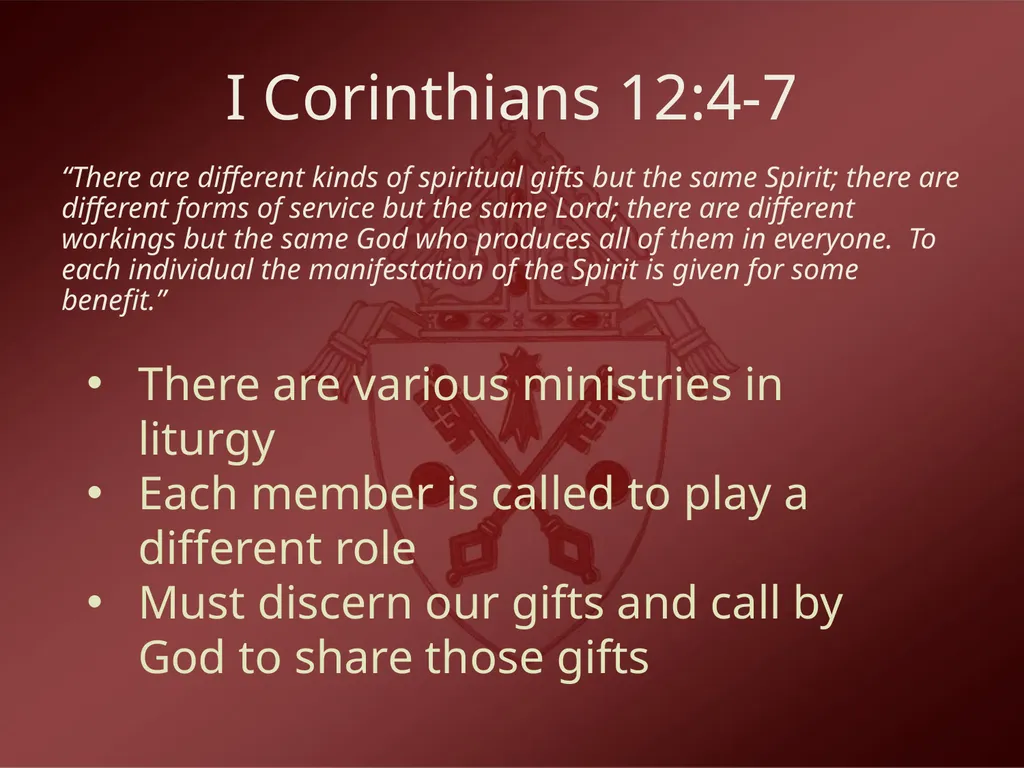
I Corinthians 12:4-7 “There are different kinds of spiritual gifts but the same Spirit; there are different forms of service but the same Lord; there are different workings but the same God who produces all of them in everyone. To each individual the manifestation of the Spirit is given for some benefit.” There are various ministries in liturgy
Each member is called to play a different role
Must discern our gifts and call by God to share those gifts<br>
Each member is called to play a different role
Must discern our gifts and call by God to share those gifts<br>
11
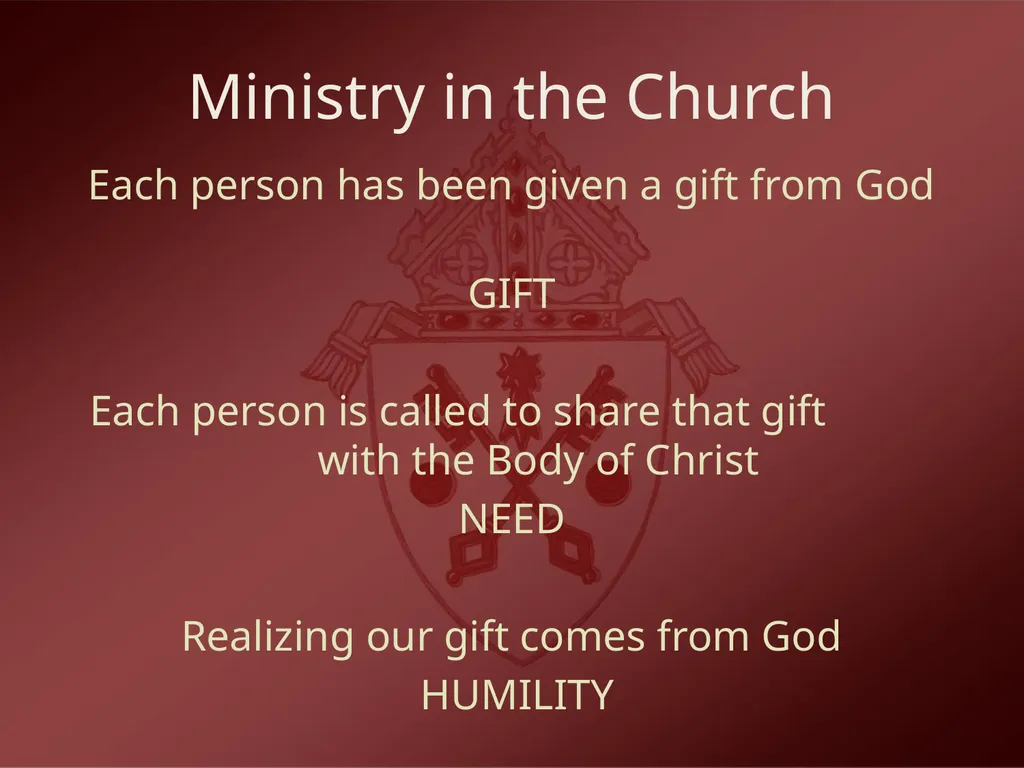
Ministry in the Church Each person has been given a gift from God
GIFT
Each person is called to share that gift with the Body of Christ
NEED
Realizing our gift comes from God
HUMILITY<br>
GIFT
Each person is called to share that gift with the Body of Christ
NEED
Realizing our gift comes from God
HUMILITY<br>
12
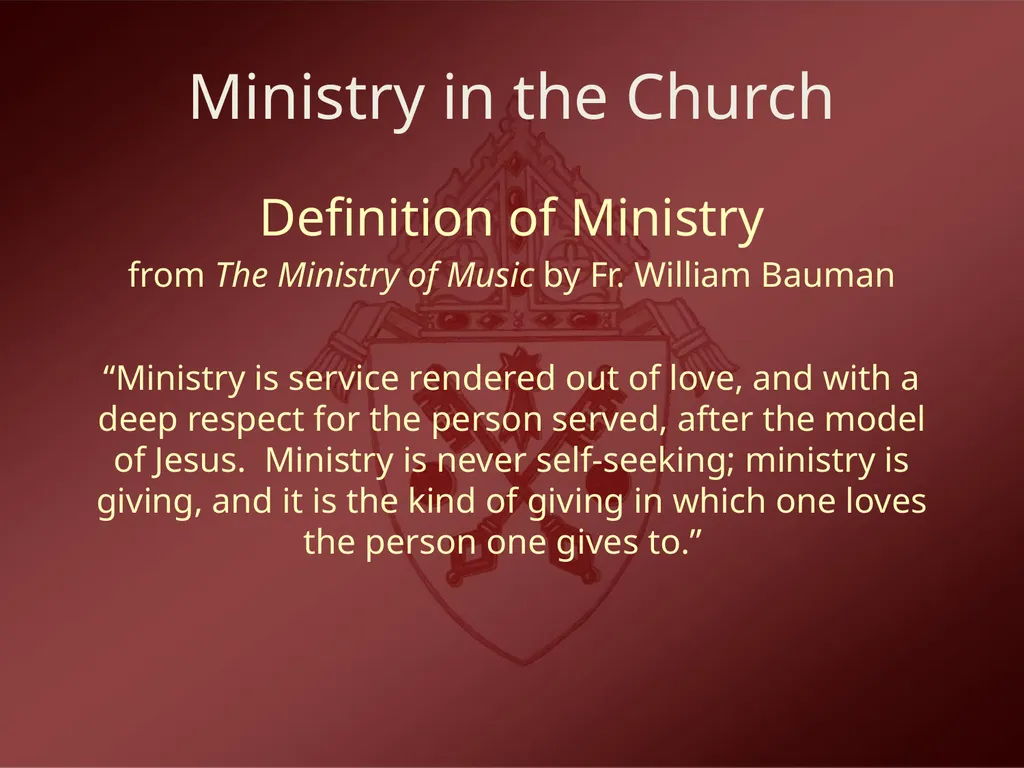
Ministry in the Church Definition of Ministry
from The Ministry of Music by Fr. William Bauman
“Ministry is service rendered out of love, and with a deep respect for the person served, after the model of Jesus. Ministry is never self-seeking; ministry is giving, and it is the kind of giving in which one loves the person one gives to.”<br>
from The Ministry of Music by Fr. William Bauman
“Ministry is service rendered out of love, and with a deep respect for the person served, after the model of Jesus. Ministry is never self-seeking; ministry is giving, and it is the kind of giving in which one loves the person one gives to.”<br>
13
Ministry in the Church Ministry is not:
Acting better or holier than another
Creating an elite in the parish
Rewarding someone
Self-gratifying performance
Ministry is:
Humility
Using the gifts God has given us
Helping others move toward the Lord.<br>
Acting better or holier than another
Creating an elite in the parish
Rewarding someone
Self-gratifying performance
Ministry is:
Humility
Using the gifts God has given us
Helping others move toward the Lord.<br>
14
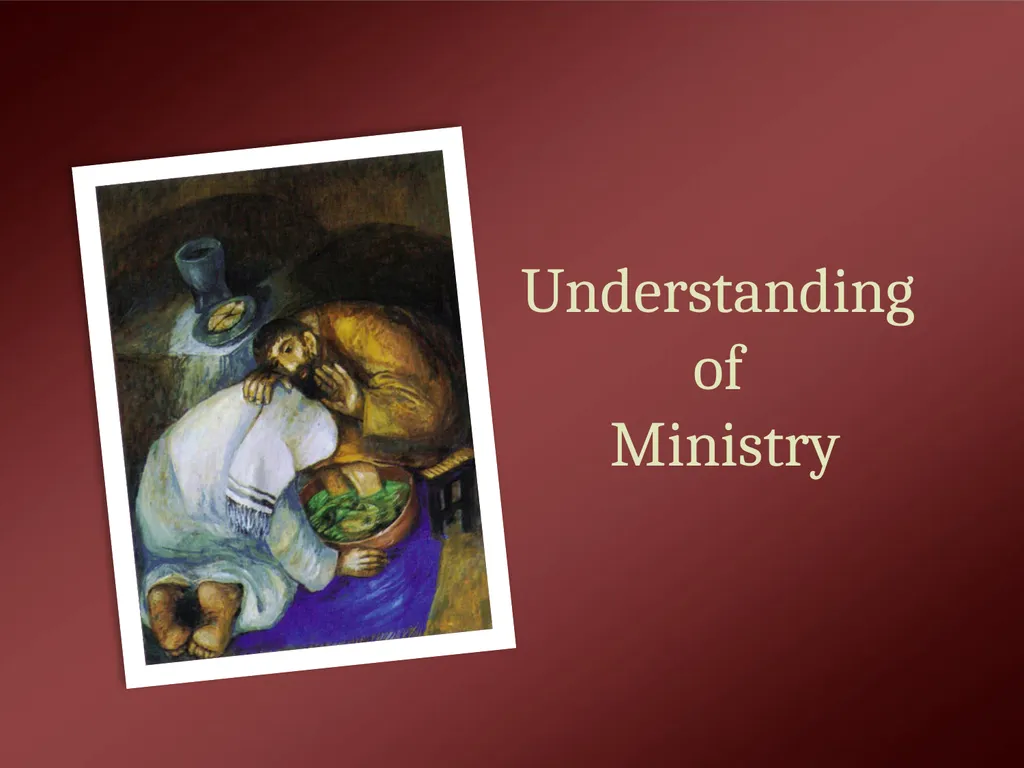
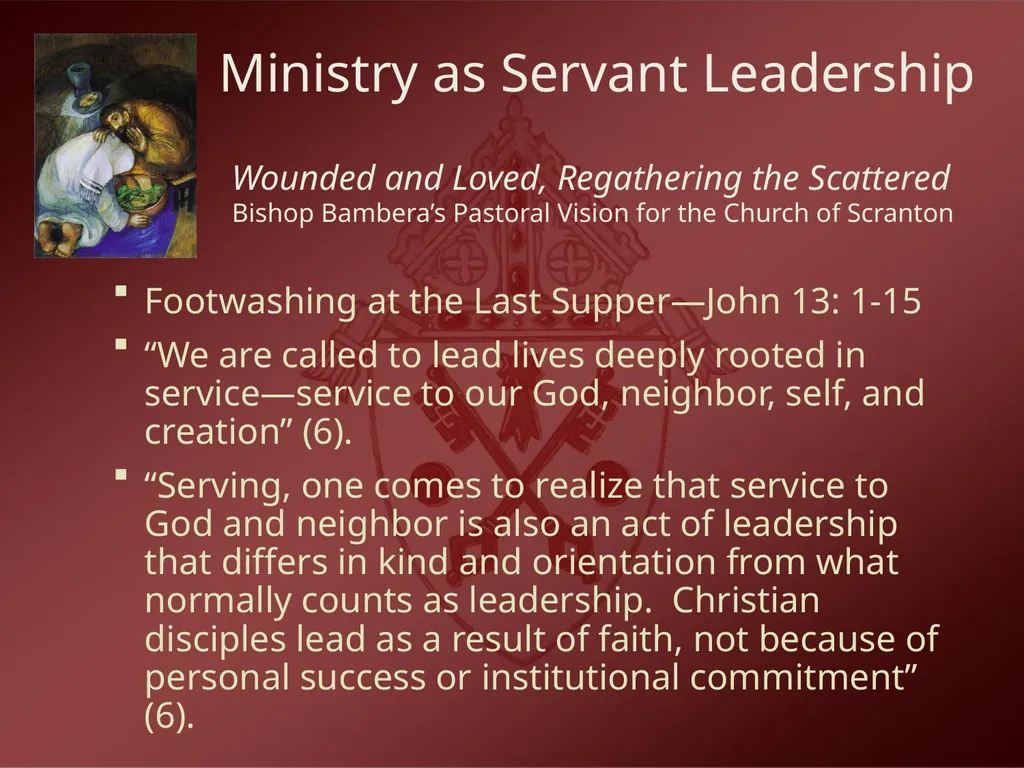
Footwashing at the Last Supper—John 13: 1-15
“We are called to lead lives deeply rooted in service—service to our God, neighbor, self, and creation” (6).
“Serving, one comes to realize that service to God and neighbor is also an act of leadership that differs in kind and orientation from what normally counts as leadership. Christian disciples lead as a result of faith, not because of personal success or institutional commitment” (6). Ministry as Servant Leadership Wounded and Loved, Regathering the Scattered Bishop Bambera’s Pastoral Vision for the Church of Scranton<br>
15
One of Bishop Bambera’s goals for servant leaders who worship is “Find ways to promote: liturgical catechesis in the parish, and improved quality of participation by parishioners of all ages in Sunday Mass, the calling of men and women to liturgical ministries, the training of liturgical ministers, both spiritually and functionally, and improved use of music and art to enhance liturgical celebrations in a way that the world can comprehend” (10). Ministry as Servant Leadership Wounded and Loved, Regathering the Scattered
Bishop Bambera’s Pastoral Vision for the Church of Scranton<br>
16
Beginning Your Ministry Examine how your gifts can best be shared
Take into consideration the preparation and time required
Attend theological and practical training necessary for this ministry
Be commissioned by the pastor for that particular ministry
Embrace forms of personal prayer that connect you to your particular area of service
Receive ongoing formation in that ministry
Prayer
Study
Attendance at parish or diocesan periods of reflection<br>
17
Discussion Why have you agreed to serve
as an Extraordinary Minister of Communion?<br>
as an Extraordinary Minister of Communion?<br>
18
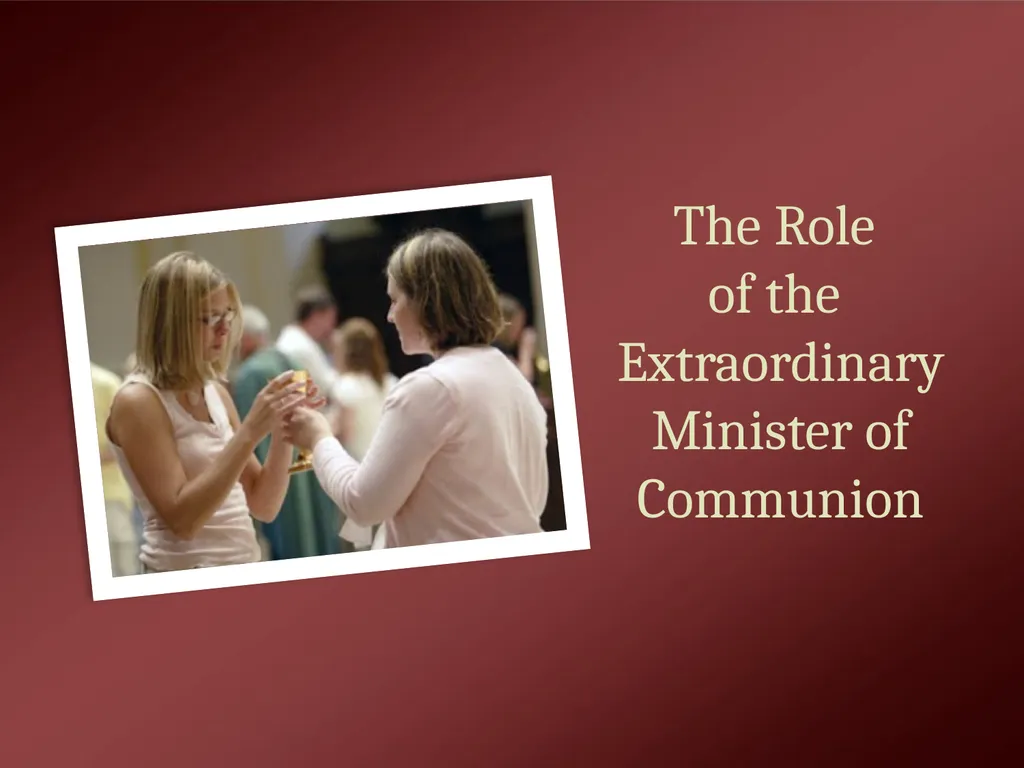
The Role
of the
Extraordinary Minister of Communion<br>
of the
Extraordinary Minister of Communion<br>
19
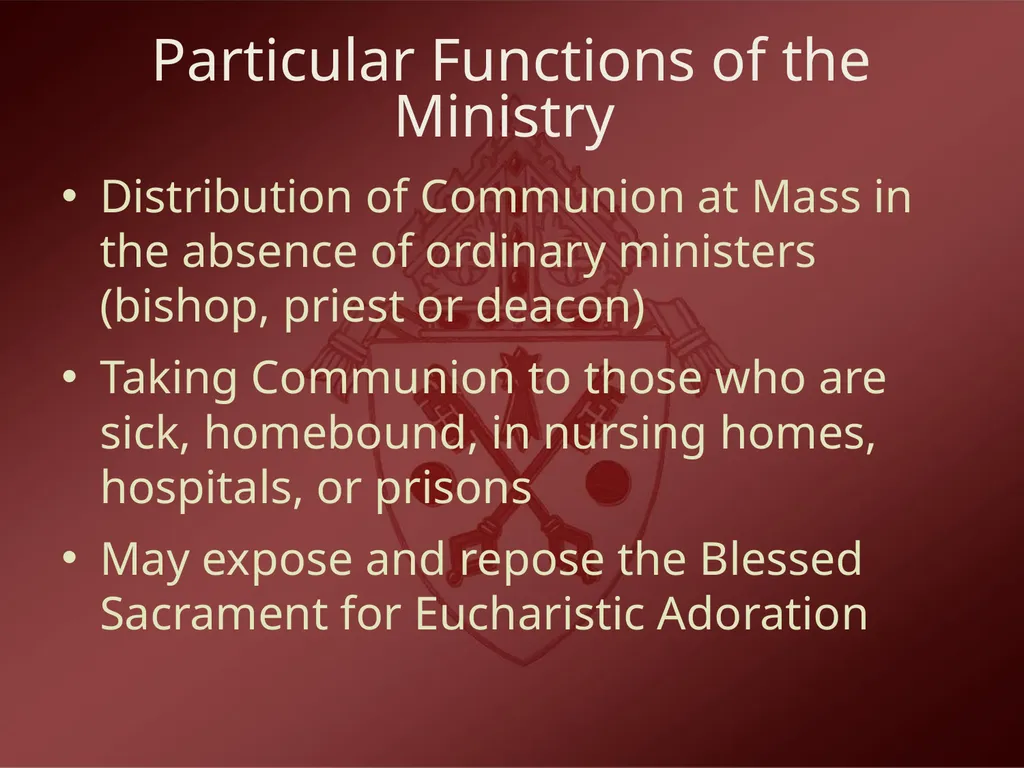
Particular Functions of the Ministry Distribution of Communion at Mass in the absence of ordinary ministers (bishop, priest or deacon)
Taking Communion to those who are sick, homebound, in nursing homes, hospitals, or prisons
May expose and repose the Blessed Sacrament for Eucharistic Adoration<br>
Taking Communion to those who are sick, homebound, in nursing homes, hospitals, or prisons
May expose and repose the Blessed Sacrament for Eucharistic Adoration<br>
20
The Priesthood of the Laity Baptism is the foundation of all ministry
Anointed as a member of Christ’s Body, who is priest, prophet and king
Receive the right and duty to participate in the sacramental life of the Church, especially the Eucharist
The baptized take part in the sacrifice that Christ eternally offers to God the Father through the Holy Spirit.<br>
Anointed as a member of Christ’s Body, who is priest, prophet and king
Receive the right and duty to participate in the sacramental life of the Church, especially the Eucharist
The baptized take part in the sacrifice that Christ eternally offers to God the Father through the Holy Spirit.<br>
21
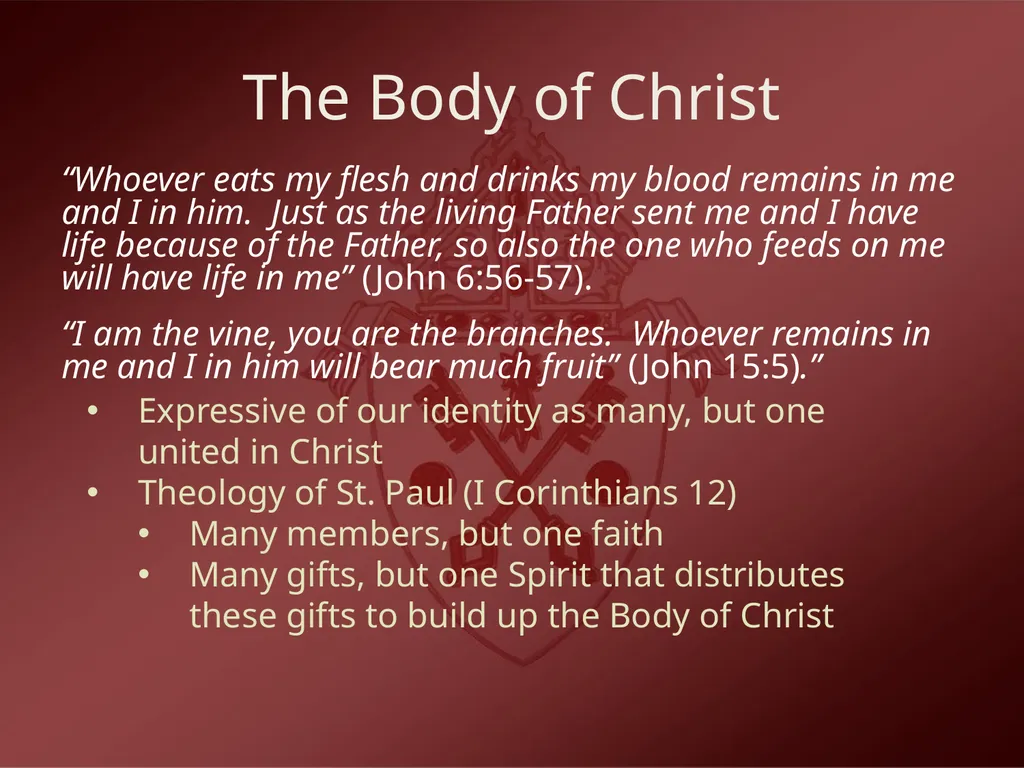
The Body of Christ “Whoever eats my flesh and drinks my blood remains in me and I in him. Just as the living Father sent me and I have life because of the Father, so also the one who feeds on me will have life in me” (John 6:56-57).
“I am the vine, you are the branches. Whoever remains in me and I in him will bear much fruit” (John 15:5).” Expressive of our identity as many, but one united in Christ
Theology of St. Paul (I Corinthians 12)
Many members, but one faith
Many gifts, but one Spirit that distributes these gifts to build up the Body of Christ<br>
22
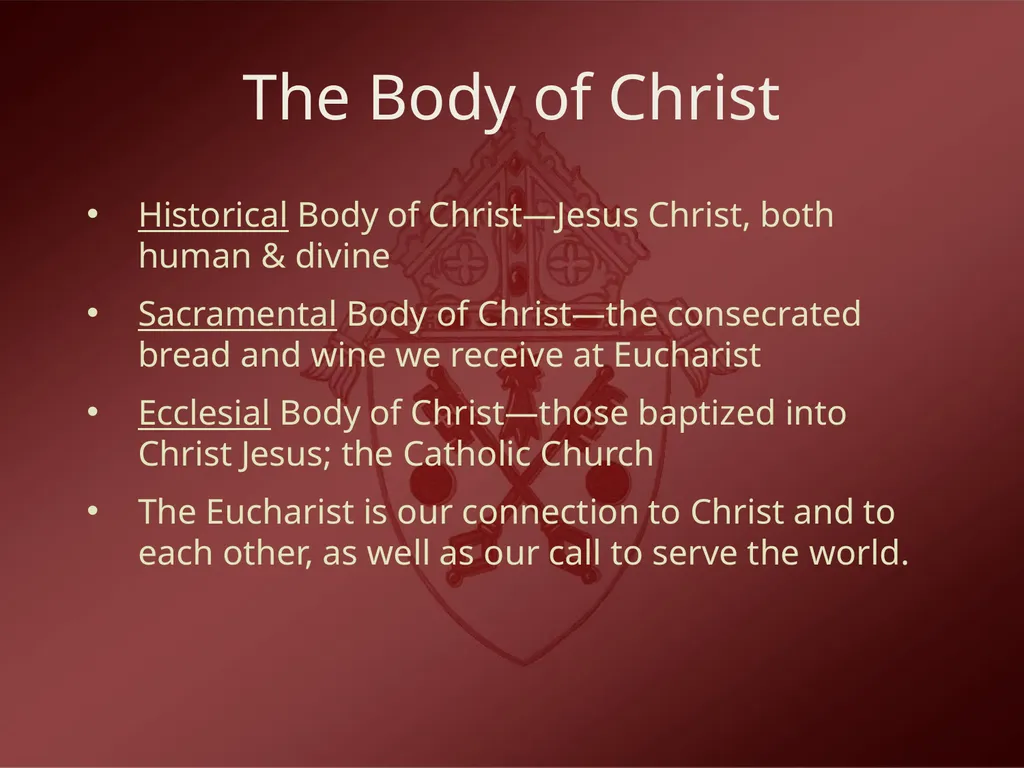
The Body of Christ Historical Body of Christ—Jesus Christ, both human & divine
Sacramental Body of Christ—the consecrated bread and wine we receive at Eucharist
Ecclesial Body of Christ—those baptized into Christ Jesus; the Catholic Church
The Eucharist is our connection to Christ and to each other, as well as our call to serve the world.<br>
Sacramental Body of Christ—the consecrated bread and wine we receive at Eucharist
Ecclesial Body of Christ—those baptized into Christ Jesus; the Catholic Church
The Eucharist is our connection to Christ and to each other, as well as our call to serve the world.<br>
23
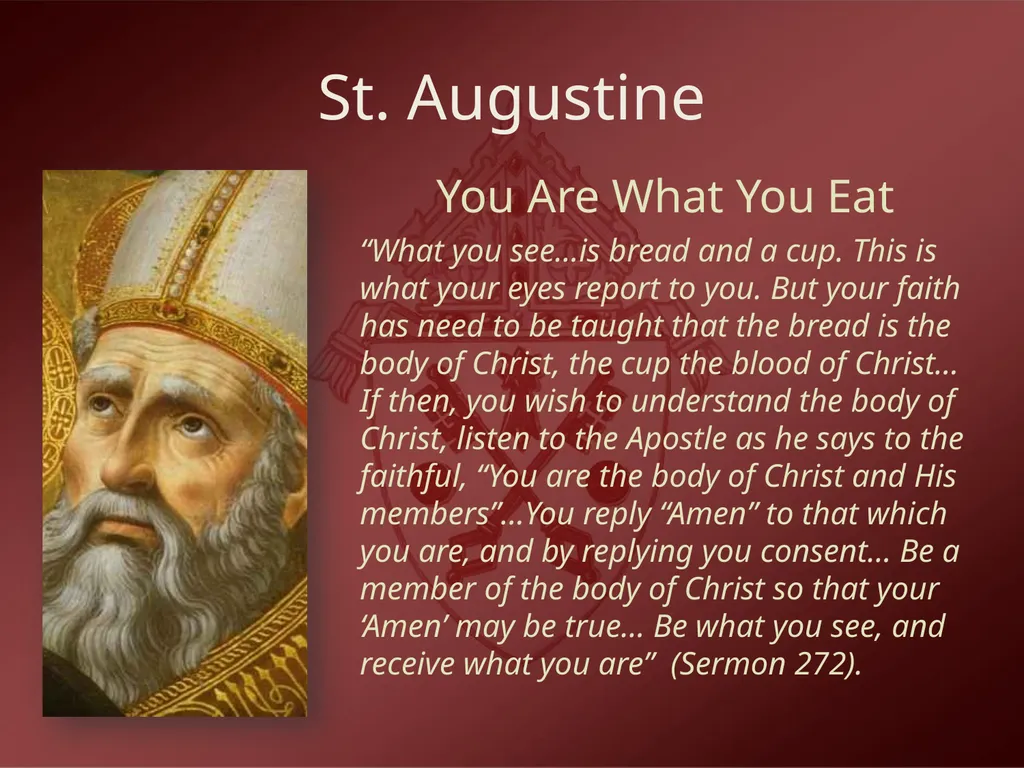
St. Augustine You Are What You Eat
“What you see…is bread and a cup. This is what your eyes report to you. But your faith has need to be taught that the bread is the body of Christ, the cup the blood of Christ…If then, you wish to understand the body of Christ, listen to the Apostle as he says to the faithful, “You are the body of Christ and His members”…You reply “Amen” to that which you are, and by replying you consent… Be a member of the body of Christ so that your ‘Amen’ may be true… Be what you see, and receive what you are” (Sermon 272).<br>
“What you see…is bread and a cup. This is what your eyes report to you. But your faith has need to be taught that the bread is the body of Christ, the cup the blood of Christ…If then, you wish to understand the body of Christ, listen to the Apostle as he says to the faithful, “You are the body of Christ and His members”…You reply “Amen” to that which you are, and by replying you consent… Be a member of the body of Christ so that your ‘Amen’ may be true… Be what you see, and receive what you are” (Sermon 272).<br>
24
Discussion How does your parish affirm this important insight that “we become what we receive”?<br>
25
History of the Ministry Eucharist in the Early Church
Jewish meal traditions of blessing God at the breaking of the bread is the context in which specific Christian rituals emerged
Not confined to a certain building, but any sheltered place where the community could gather around a table
The Greek term ekklesia or “Church” did not refer to a building but to believers
No separate understanding of Eucharist and the whole Christian way of life<br>
26
History of the Ministry Eucharist in the Early Church
When the Church gathered, members did not feel complete if anyone is missing.
Anyone missing was remembered in prayer
Family members or others would take the Eucharist from the gathering to those who were absent
Taking part in Christian worship was grounds for arrest, imprisonment, torture or execution
Taking Eucharist to those absent carried the same consequences<br>
27
Early Description of Eucharist “The records of the apostles or writings of the prophets are read for as long as time allows. Then, when the reader has finished, the president in a discourse admonishes [us] to imitate these good things. Then we all stand up together and offer prayers; and as we said before, when we have finished praying, bread and wine and water are brought up, and the president likewise offers prayers and thanksgiving to the best of his ability, and the people assent, saying the Amen; and there is a distribution, and everyone participates in [the elements] over which thanks have been given; and they are sent through the deacons to those who are not present” (67:3-5). St. Justin Martyr (d. ca. 165); First Apology<br>
28
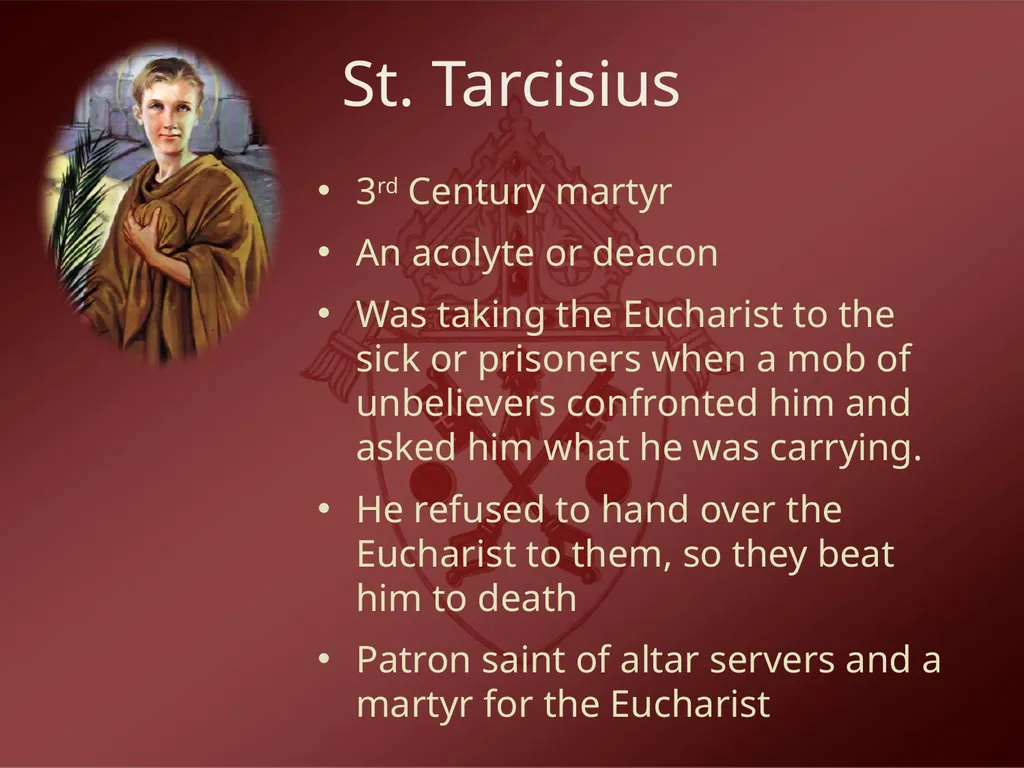
St. Tarcisius 3rd Century martyr
An acolyte or deacon
Was taking the Eucharist to the sick or prisoners when a mob of unbelievers confronted him and asked him what he was carrying.
He refused to hand over the Eucharist to them, so they beat him to death
Patron saint of altar servers and a martyr for the Eucharist<br>
An acolyte or deacon
Was taking the Eucharist to the sick or prisoners when a mob of unbelievers confronted him and asked him what he was carrying.
He refused to hand over the Eucharist to them, so they beat him to death
Patron saint of altar servers and a martyr for the Eucharist<br>
29
History of the Ministry Growth of Christianity in the Roman Empire
Constantine legalized Christianity in 313
Theodosius I made Christianity the official religion of the Roman Empire in 380
Christianity flourished but led to changes in worship<br>
Constantine legalized Christianity in 313
Theodosius I made Christianity the official religion of the Roman Empire in 380
Christianity flourished but led to changes in worship<br>
30
History of the Ministry Middle Ages
Deacons were considered as the “extraordinary” ministers of Communion
Concept of Eucharist as a “meal” is lost, More emphasis on the Eucharist as a sacrifice
Separation between priests and laity in worship
Active participation becomes passive
Communion received infrequently<br>
Deacons were considered as the “extraordinary” ministers of Communion
Concept of Eucharist as a “meal” is lost, More emphasis on the Eucharist as a sacrifice
Separation between priests and laity in worship
Active participation becomes passive
Communion received infrequently<br>
31
History of the Ministry St. Thomas Aquinas
doctrine of transubstantiation
the “accidents” (visible reality) of bread and wine remain, but the “substance” is changed into Christ’s Body and Blood.
Has become the Catholic understanding of “Real Presence” of Christ in the Eucharist<br>
doctrine of transubstantiation
the “accidents” (visible reality) of bread and wine remain, but the “substance” is changed into Christ’s Body and Blood.
Has become the Catholic understanding of “Real Presence” of Christ in the Eucharist<br>
32
History of the Ministry Pope Saint Pius X (1835-1914)
Called for active participation of people at Mass
Promoted more frequent reception of Communion and Confession
Lowered the age for the reception of Communion to 7 (age of reason).
Bringing children to receive from the altar led to the regular reception of Communion by parents and grandparents, thus the practice caught on.<br>
33
History of the Ministry Second Vatican Council (1962-1965)
Return to the understanding of Eucharist as a meal and sacrifice
Looking at Eucharist both vertically and horizontally
Restored deacons as “ordinary” ministers of Communion
Encouraged the faithful to receive Communion more
Renewed sense of ritual and structure of the Mass
Full, conscious and active participation of the assembly
Increased liturgical roles of the laity<br>
34
History of the Ministry Memoriale Domini (1969)
Document that gave permission for the faithful to return to the practice of receiving Communion in the hand
St. Cyril of Jerusalem (ca. 313-386): “Make your left hand a throne for your right, because your right is going to receive the King; make a hollow of your palm and receive the body of Christ, saying after it: ‘Amen!”…Then, after you have partaken of the body of Christ, come forward to the chalice of His blood…”<br>
35
History of the Ministry Fidei custos (1969) and Immensae Caritas (1973)
Allowed the diocesan bishop to designate lay people as extraordinary ministers to assist with the distribution of Communion
Outside of Mass when an ordinary minister is not available, especially as Viaticum to the sick and those in danger of death
Usual minister is impeded by poor health, advanced age, or demands of pastoral ministry
When the number of faithful wishing to receive Communion is so great that it would unduly prolong the liturgy
Extraordinary ministers of Communion “should be outstanding in Christian life, in faith, and in morals” (FC 5).<br>
36
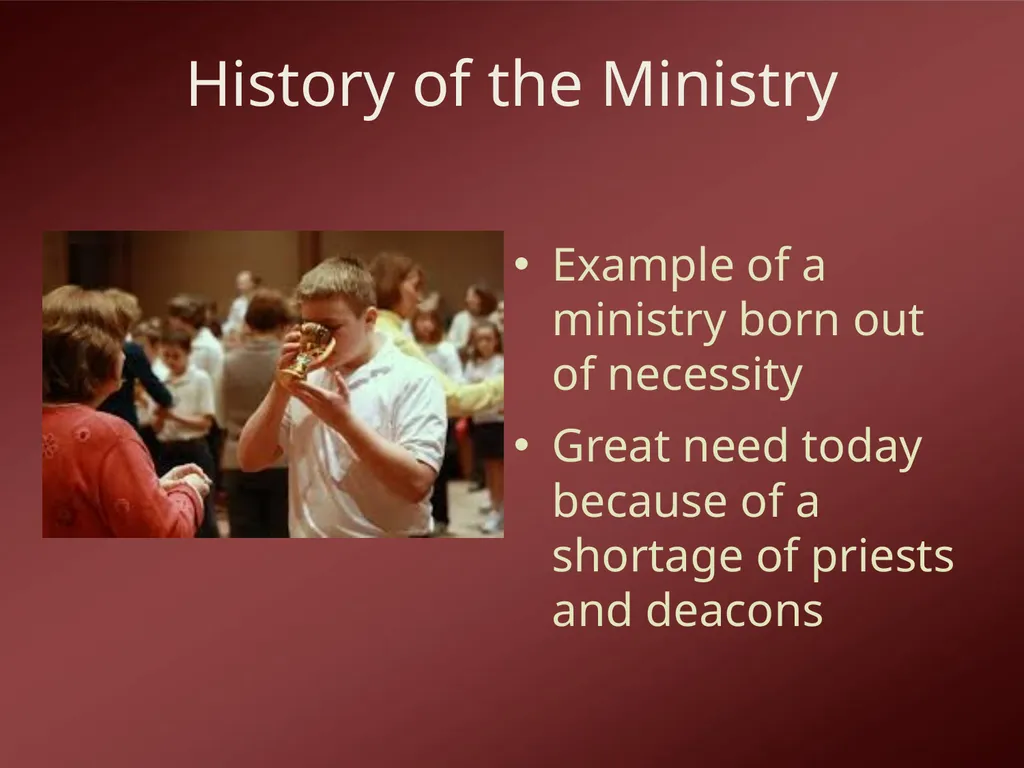
History of the Ministry Example of a ministry born out of necessity
Great need today because of a shortage of priests and deacons<br>
Great need today because of a shortage of priests and deacons<br>
37
Deputed by the Bishop and Pastor Bishops, priests and deacons are the “ordinary” ministers by virtue of their ordination
Extraordinary ministers typically not used at Masses with many concelebrants (Confirmations, Chrism Mass etc.)
Don’t be offended if “bumped” from service because of the presence of a deacon or a concelebrating priest<br>
Extraordinary ministers typically not used at Masses with many concelebrants (Confirmations, Chrism Mass etc.)
Don’t be offended if “bumped” from service because of the presence of a deacon or a concelebrating priest<br>
38
Deputed by the Bishop and Pastor Supplementing and filling a need that arises
Deputed for a particular parish, not the entire diocese or other areas
Collaborate with the pastor
Assist in the smooth and reverent distribution of Holy Communion
If needed, a priest can commission someone to serve as an Extraordinary Minister of Communion on the spot using the ritual provided in the Roman Missal<br>
39
Discussion Who are your models for this ministry?
Whom have you seen perform this ministry well?
What have you noticed about their lives?<br>
Whom have you seen perform this ministry well?
What have you noticed about their lives?<br>
40
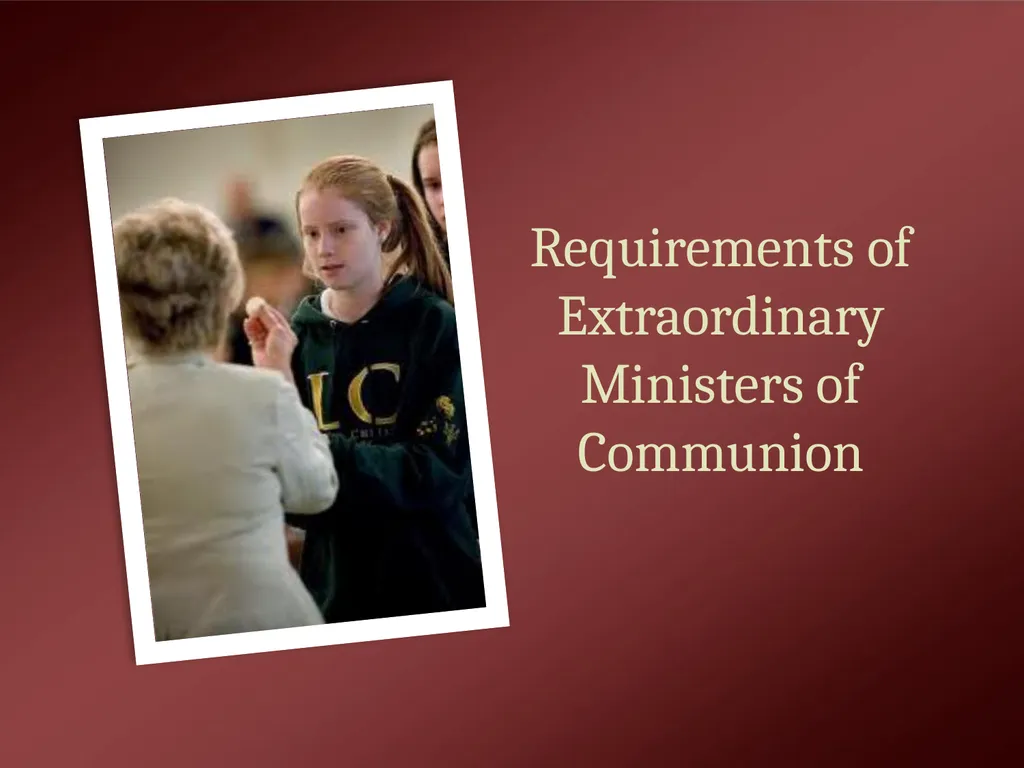
Requirements of Extraordinary Ministers of Communion<br>
41
Basic Requirements Pastors should invite parishioners to this ministry or candidates should have the recommendation of their pastor
Must be at least18 years of age
Must be a fully initiated Catholic in good standing
Must be registered and active members of the parish
If married, must be in a valid marriage.
Life must be led according to the values and morals of the Catholic Church<br>
Must be at least18 years of age
Must be a fully initiated Catholic in good standing
Must be registered and active members of the parish
If married, must be in a valid marriage.
Life must be led according to the values and morals of the Catholic Church<br>
42
Living the Sacramental Life Goal is individuals whose exemplary Catholic life and morals reflect well upon the Catholic Church (Fidei custos #5)
Spiritual attributes needed or be willing to develop:
Humility
Radical hospitality
Gratitude
Reverence—both to the Eucharistic elements and the ecclesial Body of Christ
Avoiding:
Grave sin
failure to attend Mass
A choice not to maintain communion with the teachings of the Church<br>
Spiritual attributes needed or be willing to develop:
Humility
Radical hospitality
Gratitude
Reverence—both to the Eucharistic elements and the ecclesial Body of Christ
Avoiding:
Grave sin
failure to attend Mass
A choice not to maintain communion with the teachings of the Church<br>
43
Living the Sacramental Life Take advantage of the Sacrament of Reconciliation
Not just about fulfilling a function on Sunday morning, but sharing the very life of the Body of Christ
You are called to help feed those who come to the Sacred Banquet<br>
Not just about fulfilling a function on Sunday morning, but sharing the very life of the Body of Christ
You are called to help feed those who come to the Sacred Banquet<br>
44
Real Presence Extraordinary Ministers of Communion need a firm understanding of the Real Presence in the consecrated bread and wine
Have a recent education in the Church’s teaching on this mystery
Be able to articulate to others the Church’s teaching on the Real Presence<br>
Have a recent education in the Church’s teaching on this mystery
Be able to articulate to others the Church’s teaching on the Real Presence<br>
45
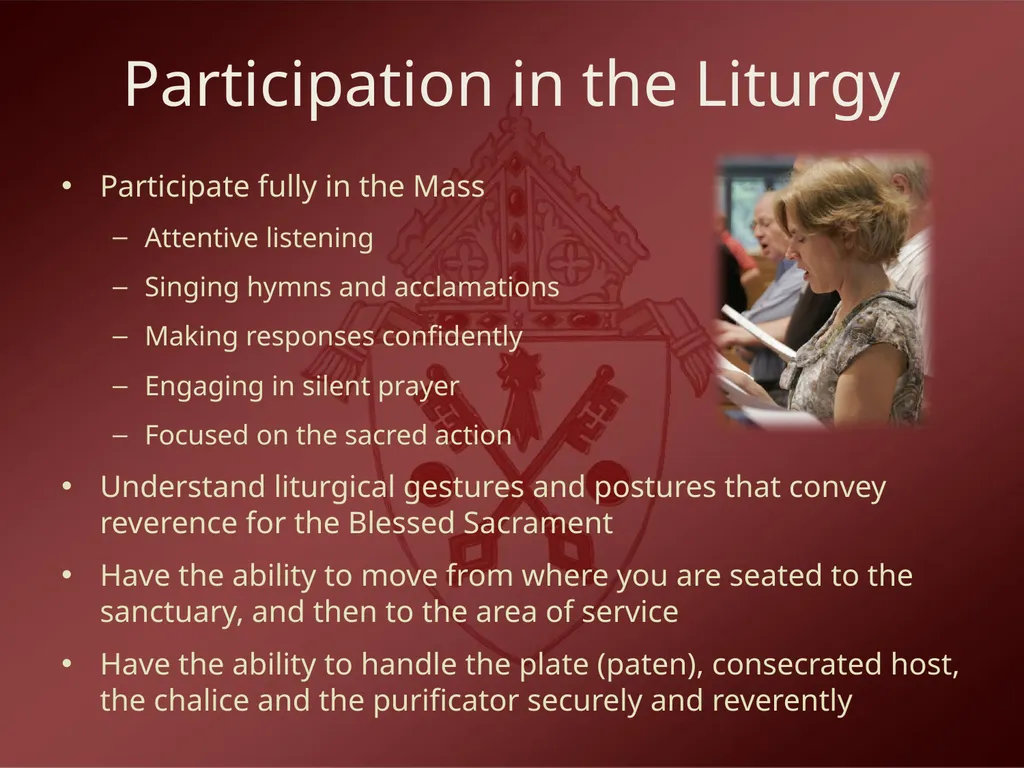
Participation in the Liturgy Participate fully in the Mass
Attentive listening
Singing hymns and acclamations
Making responses confidently
Engaging in silent prayer
Focused on the sacred action
Understand liturgical gestures and postures that convey reverence for the Blessed Sacrament
Have the ability to move from where you are seated to the sanctuary, and then to the area of service
Have the ability to handle the plate (paten), consecrated host, the chalice and the purificator securely and reverently<br>
46
Ongoing Prayer and Formation Develop your own person spirituality
Spiritual reading, especially on the Eucharist
Popular and personal devotions
Allow time for quiet and reflection
Offer prayers outside of Mass for the community or parish you serve
Participate in ongoing and communal formation for your ministry<br>
Spiritual reading, especially on the Eucharist
Popular and personal devotions
Allow time for quiet and reflection
Offer prayers outside of Mass for the community or parish you serve
Participate in ongoing and communal formation for your ministry<br>