
GCSE History Knowledge Organiser: Henry VIII and
PM
Published · 13 slides · 0 views

1 / 1
Description
GCSE History Knowledge Organiser: Henry VIII and his Ministers Henry and his Kingdom 1509 Key Terms: Accession: Becoming king or queen. Betrothed: Formal engagement promise to be married. Renaissance: Revival of European art and culture
Related Topics
Share
Embed code
Download this presentation From Below
"GCSE History Knowledge Organiser: Henry VIII and" is the property of its rightful owner. Permission is granted to download and print the materials on this website for personal, non-commercial use only, and to display it on your personal computer provided you do not modify the materials and that you retain all copyright notices contained in the materials. By downloading content from our website, you accept the terms of this agreement.
Presentation Transcript
01
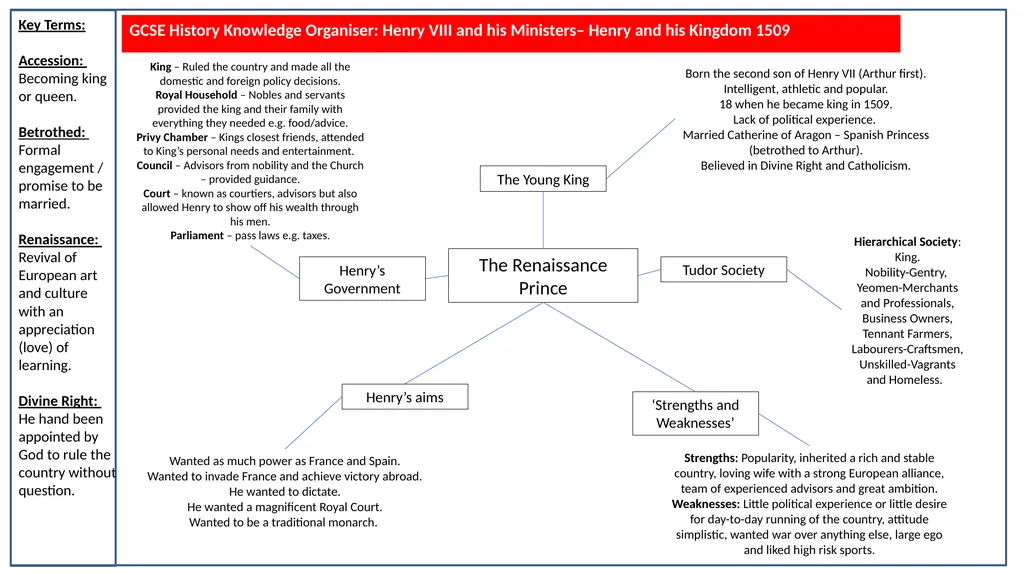
GCSE History Knowledge Organiser: Henry VIII and his Ministers– Henry and his Kingdom 1509 Key Terms:
Accession:
Becoming king or queen.
Betrothed:
Formal engagement / promise to be married.
Renaissance:
Revival of European art and culture with an appreciation (love) of learning.
Divine Right:
He hand been appointed by God to rule the country without question. The Renaissance Prince Tudor Society Henry’s Government Henry’s aims ‘Strengths and Weaknesses’ The Young King King – Ruled the country and made all the domestic and foreign policy decisions.
Royal Household – Nobles and servants provided the king and their family with everything they needed e.g. food/advice.
Privy Chamber – Kings closest friends, attended to King’s personal needs and entertainment.
Council – Advisors from nobility and the Church – provided guidance.
Court – known as courtiers, advisors but also allowed Henry to show off his wealth through his men.
Parliament – pass laws e.g. taxes. Wanted as much power as France and Spain.
Wanted to invade France and achieve victory abroad.
He wanted to dictate.
He wanted a magnificent Royal Court.
Wanted to be a traditional monarch. Strengths: Popularity, inherited a rich and stable country, loving wife with a strong European alliance, team of experienced advisors and great ambition.
Weaknesses: Little political experience or little desire for day-to-day running of the country, attitude simplistic, wanted war over anything else, large ego and liked high risk sports. Hierarchical Society:
King.
Nobility-Gentry,
Yeomen-Merchants and Professionals,
Business Owners, Tennant Farmers,
Labourers-Craftsmen,
Unskilled-Vagrants and Homeless. Born the second son of Henry VII (Arthur first).
Intelligent, athletic and popular.
18 when he became king in 1509.
Lack of political experience.
Married Catherine of Aragon – Spanish Princess (betrothed to Arthur).
Believed in Divine Right and Catholicism.<br>
02
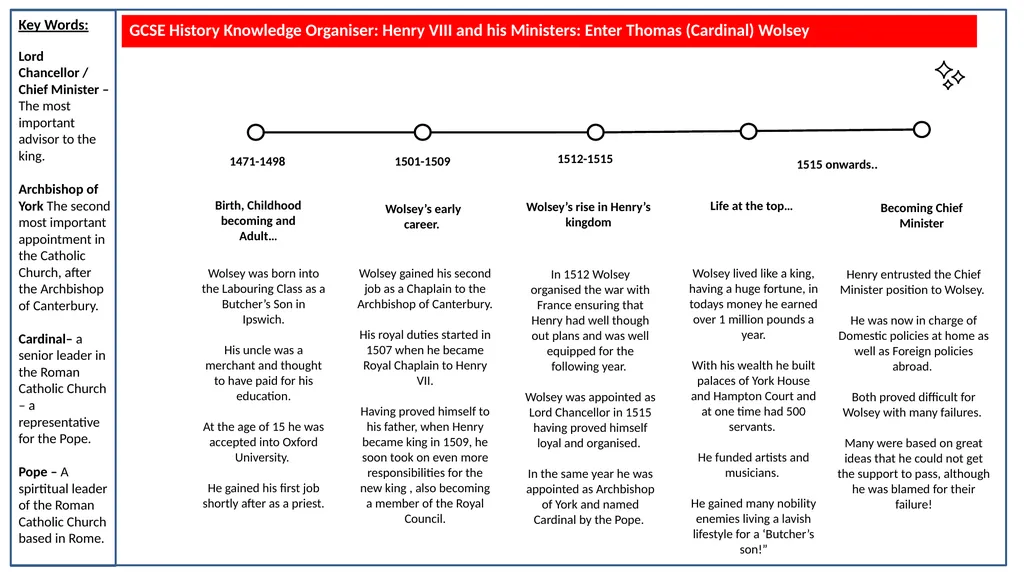
GCSE History Knowledge Organiser: Henry VIII and his Ministers: Enter Thomas (Cardinal) Wolsey Key Words:
Lord Chancellor / Chief Minister – The most important advisor to the king.
Archbishop of York The second most important appointment in the Catholic Church, after the Archbishop of Canterbury.
Cardinal– a senior leader in the Roman Catholic Church – a representative for the Pope.
Pope – A spirtitual leader of the Roman Catholic Church based in Rome. 1471-1498 Birth, Childhood becoming and Adult… Wolsey was born into the Labouring Class as a Butcher’s Son in Ipswich.
His uncle was a merchant and thought to have paid for his education.
At the age of 15 he was accepted into Oxford University.
He gained his first job shortly after as a priest. 1501-1509 Wolsey’s early career. 1512-1515 Wolsey’s rise in Henry’s kingdom Becoming Chief Minister Wolsey gained his second job as a Chaplain to the Archbishop of Canterbury.
His royal duties started in 1507 when he became Royal Chaplain to Henry VII.
Having proved himself to his father, when Henry became king in 1509, he soon took on even more responsibilities for the new king , also becoming a member of the Royal Council. In 1512 Wolsey organised the war with France ensuring that Henry had well though out plans and was well equipped for the following year.
Wolsey was appointed as Lord Chancellor in 1515 having proved himself loyal and organised.
In the same year he was appointed as Archbishop of York and named Cardinal by the Pope. Henry entrusted the Chief Minister position to Wolsey.
He was now in charge of Domestic policies at home as well as Foreign policies abroad.
Both proved difficult for Wolsey with many failures.
Many were based on great ideas that he could not get the support to pass, although he was blamed for their failure! 1515 onwards.. Life at the top… Wolsey lived like a king, having a huge fortune, in todays money he earned over 1 million pounds a year.
With his wealth he built palaces of York House and Hampton Court and at one time had 500 servants.
He funded artists and musicians.
He gained many nobility enemies living a lavish lifestyle for a ‘Butcher’s son!”<br>
03
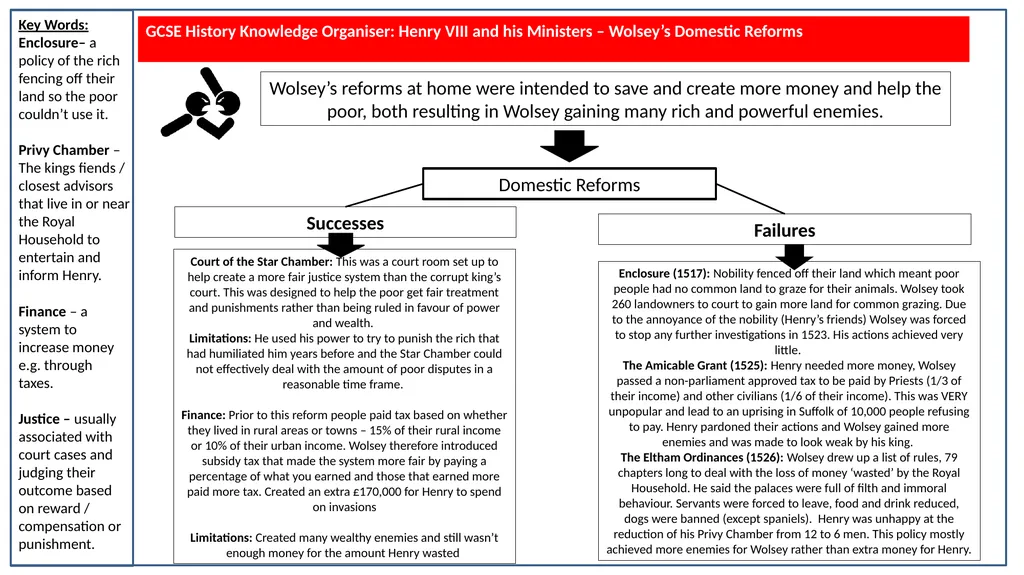
GCSE History Knowledge Organiser: Henry VIII and his Ministers – Wolsey’s Domestic Reforms Key Words:
Enclosure– a policy of the rich fencing off their land so the poor couldn’t use it.
Privy Chamber – The kings fiends / closest advisors that live in or near the Royal Household to entertain and inform Henry.
Finance – a system to increase money e.g. through taxes.
Justice – usually associated with court cases and judging their outcome based on reward / compensation or punishment. Wolsey’s reforms at home were intended to save and create more money and help the poor, both resulting in Wolsey gaining many rich and powerful enemies. Domestic Reforms Successes Failures Court of the Star Chamber: This was a court room set up to help create a more fair justice system than the corrupt king’s court. This was designed to help the poor get fair treatment and punishments rather than being ruled in favour of power and wealth.
Limitations: He used his power to try to punish the rich that had humiliated him years before and the Star Chamber could not effectively deal with the amount of poor disputes in a reasonable time frame.
Finance: Prior to this reform people paid tax based on whether they lived in rural areas or towns – 15% of their rural income or 10% of their urban income. Wolsey therefore introduced subsidy tax that made the system more fair by paying a percentage of what you earned and those that earned more paid more tax. Created an extra £170,000 for Henry to spend on invasions
Limitations: Created many wealthy enemies and still wasn’t enough money for the amount Henry wasted Enclosure (1517): Nobility fenced off their land which meant poor people had no common land to graze for their animals. Wolsey took 260 landowners to court to gain more land for common grazing. Due to the annoyance of the nobility (Henry’s friends) Wolsey was forced to stop any further investigations in 1523. His actions achieved very little.
The Amicable Grant (1525): Henry needed more money, Wolsey passed a non-parliament approved tax to be paid by Priests (1/3 of their income) and other civilians (1/6 of their income). This was VERY unpopular and lead to an uprising in Suffolk of 10,000 people refusing to pay. Henry pardoned their actions and Wolsey gained more enemies and was made to look weak by his king.
The Eltham Ordinances (1526): Wolsey drew up a list of rules, 79 chapters long to deal with the loss of money ‘wasted’ by the Royal Household. He said the palaces were full of filth and immoral behaviour. Servants were forced to leave, food and drink reduced, dogs were banned (except spaniels). Henry was unhappy at the reduction of his Privy Chamber from 12 to 6 men. This policy mostly achieved more enemies for Wolsey rather than extra money for Henry.<br>
04
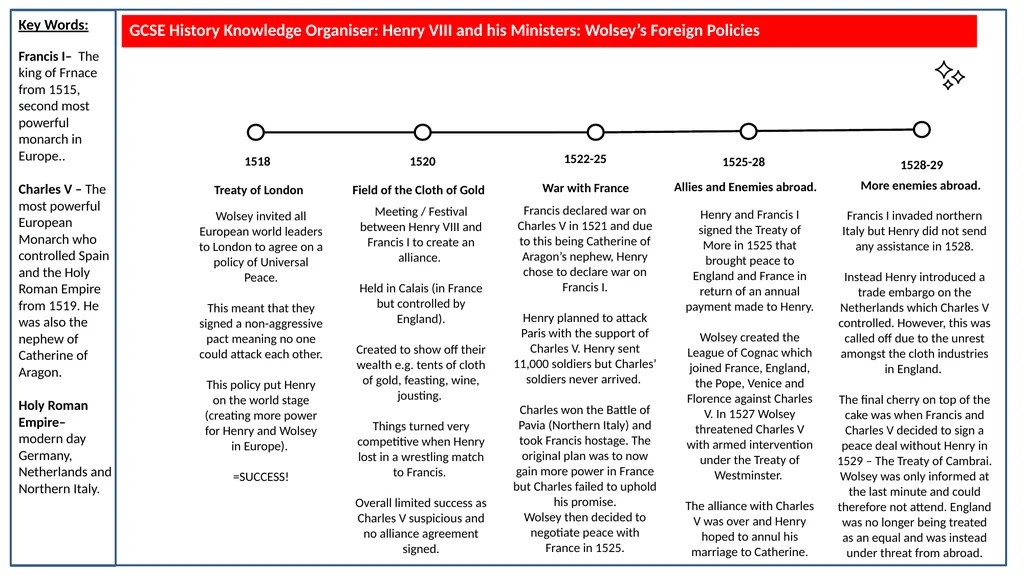
GCSE History Knowledge Organiser: Henry VIII and his Ministers: Wolsey’s Foreign Policies Key Words:
Francis I– The king of Frnace from 1515, second most powerful monarch in Europe..
Charles V – The most powerful European Monarch who controlled Spain and the Holy Roman Empire from 1519. He was also the nephew of Catherine of Aragon.
Holy Roman Empire– modern day Germany, Netherlands and Northern Italy. 1518 Treaty of London Wolsey invited all European world leaders to London to agree on a policy of Universal Peace.
This meant that they signed a non-aggressive pact meaning no one could attack each other.
This policy put Henry on the world stage (creating more power for Henry and Wolsey in Europe).
=SUCCESS! 1520 Field of the Cloth of Gold 1522-25 War with France More enemies abroad. Meeting / Festival between Henry VIII and Francis I to create an alliance.
Held in Calais (in France but controlled by England).
Created to show off their wealth e.g. tents of cloth of gold, feasting, wine, jousting.
Things turned very competitive when Henry lost in a wrestling match to Francis.
Overall limited success as Charles V suspicious and no alliance agreement signed. Francis declared war on Charles V in 1521 and due to this being Catherine of Aragon’s nephew, Henry chose to declare war on Francis I.
Henry planned to attack Paris with the support of Charles V. Henry sent 11,000 soldiers but Charles’ soldiers never arrived.
Charles won the Battle of Pavia (Northern Italy) and took Francis hostage. The original plan was to now gain more power in France but Charles failed to uphold his promise.
Wolsey then decided to negotiate peace with France in 1525. Francis I invaded northern Italy but Henry did not send any assistance in 1528.
Instead Henry introduced a trade embargo on the Netherlands which Charles V controlled. However, this was called off due to the unrest amongst the cloth industries in England.
The final cherry on top of the cake was when Francis and Charles V decided to sign a peace deal without Henry in 1529 – The Treaty of Cambrai. Wolsey was only informed at the last minute and could therefore not attend. England was no longer being treated as an equal and was instead under threat from abroad. 1528-29 Allies and Enemies abroad. Henry and Francis I signed the Treaty of More in 1525 that brought peace to England and France in return of an annual payment made to Henry.
Wolsey created the League of Cognac which joined France, England, the Pope, Venice and Florence against Charles V. In 1527 Wolsey threatened Charles V with armed intervention under the Treaty of Westminster.
The alliance with Charles V was over and Henry hoped to annul his marriage to Catherine. 1525-28<br>
05
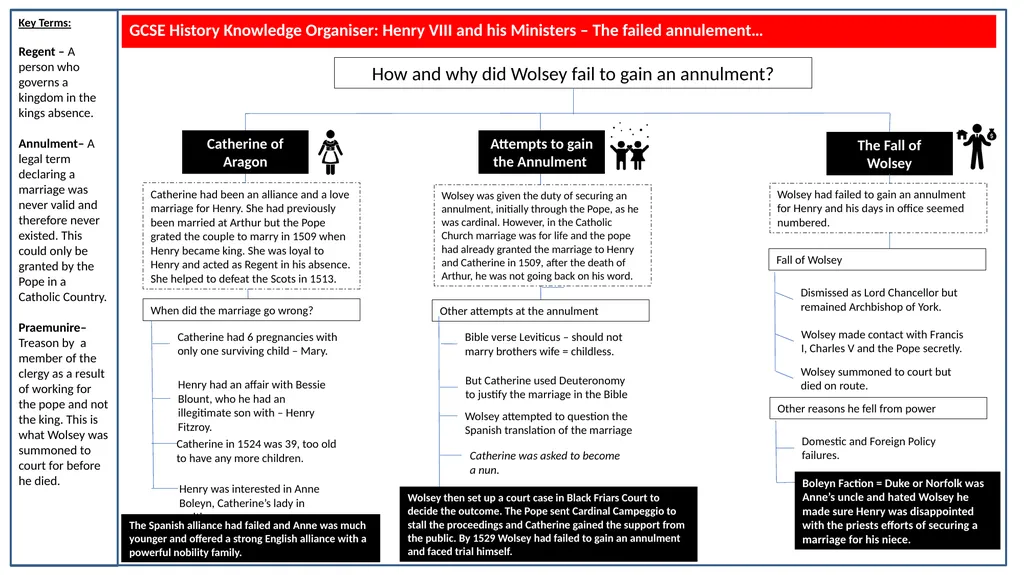
GCSE History Knowledge Organiser: Henry VIII and his Ministers – The failed annulement… Key Terms:
Regent – A person who governs a kingdom in the kings absence.
Annulment– A legal term declaring a marriage was never valid and therefore never existed. This could only be granted by the Pope in a Catholic Country.
Praemunire–Treason by a member of the clergy as a result of working for the pope and not the king. This is what Wolsey was summoned to court for before he died. How and why did Wolsey fail to gain an annulment? Catherine of Aragon Attempts to gain the Annulment The Fall of Wolsey Catherine had been an alliance and a love marriage for Henry. She had previously been married at Arthur but the Pope grated the couple to marry in 1509 when Henry became king. She was loyal to Henry and acted as Regent in his absence. She helped to defeat the Scots in 1513. Wolsey was given the duty of securing an annulment, initially through the Pope, as he was cardinal. However, in the Catholic Church marriage was for life and the pope had already granted the marriage to Henry and Catherine in 1509, after the death of Arthur, he was not going back on his word. Wolsey had failed to gain an annulment for Henry and his days in office seemed numbered. Other attempts at the annulment Fall of Wolsey Other reasons he fell from power The Spanish alliance had failed and Anne was much younger and offered a strong English alliance with a powerful nobility family. Wolsey then set up a court case in Black Friars Court to decide the outcome. The Pope sent Cardinal Campeggio to stall the proceedings and Catherine gained the support from the public. By 1529 Wolsey had failed to gain an annulment and faced trial himself.<br>
06
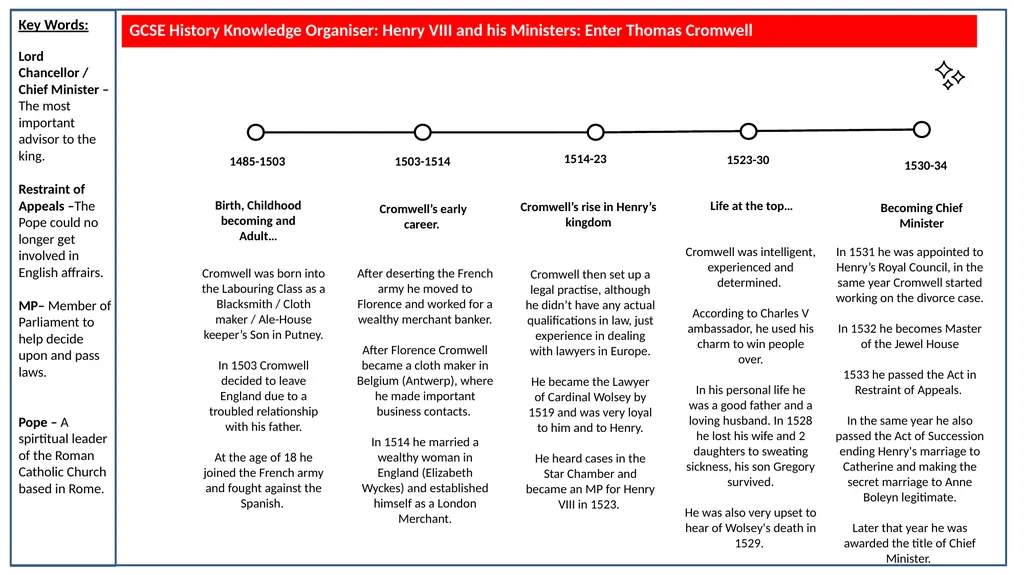
GCSE History Knowledge Organiser: Henry VIII and his Ministers: Enter Thomas Cromwell Key Words:
Lord Chancellor / Chief Minister – The most important advisor to the king.
Restraint of Appeals –The Pope could no longer get involved in English affrairs.
MP– Member of Parliament to help decide upon and pass laws.
Pope – A spirtitual leader of the Roman Catholic Church based in Rome. 1485-1503 Birth, Childhood becoming and Adult… Cromwell was born into the Labouring Class as a Blacksmith / Cloth maker / Ale-House keeper’s Son in Putney.
In 1503 Cromwell decided to leave England due to a troubled relationship with his father.
At the age of 18 he joined the French army and fought against the Spanish. 1503-1514 Cromwell’s early career. 1514-23 Cromwell’s rise in Henry’s kingdom Becoming Chief Minister After deserting the French army he moved to Florence and worked for a wealthy merchant banker.
After Florence Cromwell became a cloth maker in Belgium (Antwerp), where he made important business contacts.
In 1514 he married a wealthy woman in England (Elizabeth Wyckes) and established himself as a London Merchant. Cromwell then set up a legal practise, although he didn’t have any actual qualifications in law, just experience in dealing with lawyers in Europe.
He became the Lawyer of Cardinal Wolsey by 1519 and was very loyal to him and to Henry.
He heard cases in the Star Chamber and became an MP for Henry VIII in 1523. In 1531 he was appointed to Henry’s Royal Council, in the same year Cromwell started working on the divorce case.
In 1532 he becomes Master of the Jewel House
1533 he passed the Act in Restraint of Appeals.
In the same year he also passed the Act of Succession ending Henry's marriage to Catherine and making the secret marriage to Anne Boleyn legitimate.
Later that year he was awarded the title of Chief Minister. 1523-30 Life at the top… Cromwell was intelligent, experienced and determined.
According to Charles V ambassador, he used his charm to win people over.
In his personal life he was a good father and a loving husband. In 1528 he lost his wife and 2 daughters to sweating sickness, his son Gregory survived.
He was also very upset to hear of Wolsey's death in 1529. 1530-34<br>
07
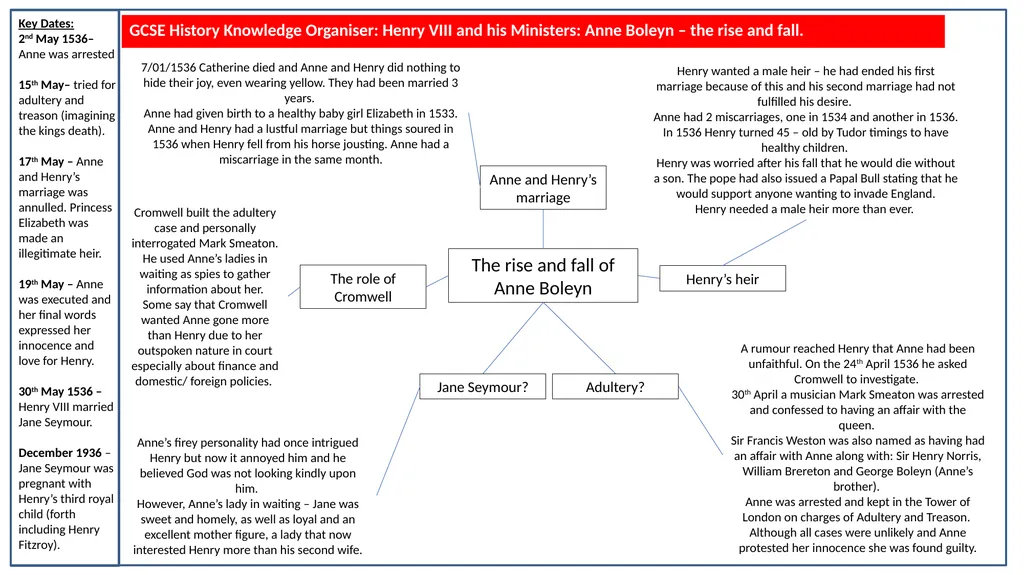
GCSE History Knowledge Organiser: Henry VIII and his Ministers: Anne Boleyn – the rise and fall. Key Dates:
2nd May 1536– Anne was arrested
15th May– tried for adultery and treason (imagining the kings death).
17th May – Anne and Henry’s marriage was annulled. Princess Elizabeth was made an illegitimate heir.
19th May – Anne was executed and her final words expressed her innocence and love for Henry.
30th May 1536 – Henry VIII married Jane Seymour.
December 1936 – Jane Seymour was pregnant with Henry’s third royal child (forth including Henry Fitzroy). The rise and fall of Anne Boleyn Henry’s heir The role of Cromwell Jane Seymour? Adultery? Anne and Henry’s marriage Cromwell built the adultery case and personally interrogated Mark Smeaton.
He used Anne’s ladies in waiting as spies to gather information about her.
Some say that Cromwell wanted Anne gone more than Henry due to her outspoken nature in court especially about finance and domestic/ foreign policies. Anne’s firey personality had once intrigued Henry but now it annoyed him and he believed God was not looking kindly upon him.
However, Anne’s lady in waiting – Jane was sweet and homely, as well as loyal and an excellent mother figure, a lady that now interested Henry more than his second wife. A rumour reached Henry that Anne had been unfaithful. On the 24th April 1536 he asked Cromwell to investigate.
30th April a musician Mark Smeaton was arrested and confessed to having an affair with the queen.
Sir Francis Weston was also named as having had an affair with Anne along with: Sir Henry Norris, William Brereton and George Boleyn (Anne’s brother).
Anne was arrested and kept in the Tower of London on charges of Adultery and Treason.
Although all cases were unlikely and Anne protested her innocence she was found guilty. Henry wanted a male heir – he had ended his first marriage because of this and his second marriage had not fulfilled his desire.
Anne had 2 miscarriages, one in 1534 and another in 1536.
In 1536 Henry turned 45 – old by Tudor timings to have healthy children.
Henry was worried after his fall that he would die without a son. The pope had also issued a Papal Bull stating that he would support anyone wanting to invade England.
Henry needed a male heir more than ever. 7/01/1536 Catherine died and Anne and Henry did nothing to hide their joy, even wearing yellow. They had been married 3 years.
Anne had given birth to a healthy baby girl Elizabeth in 1533.
Anne and Henry had a lustful marriage but things soured in 1536 when Henry fell from his horse jousting. Anne had a miscarriage in the same month.<br>
08
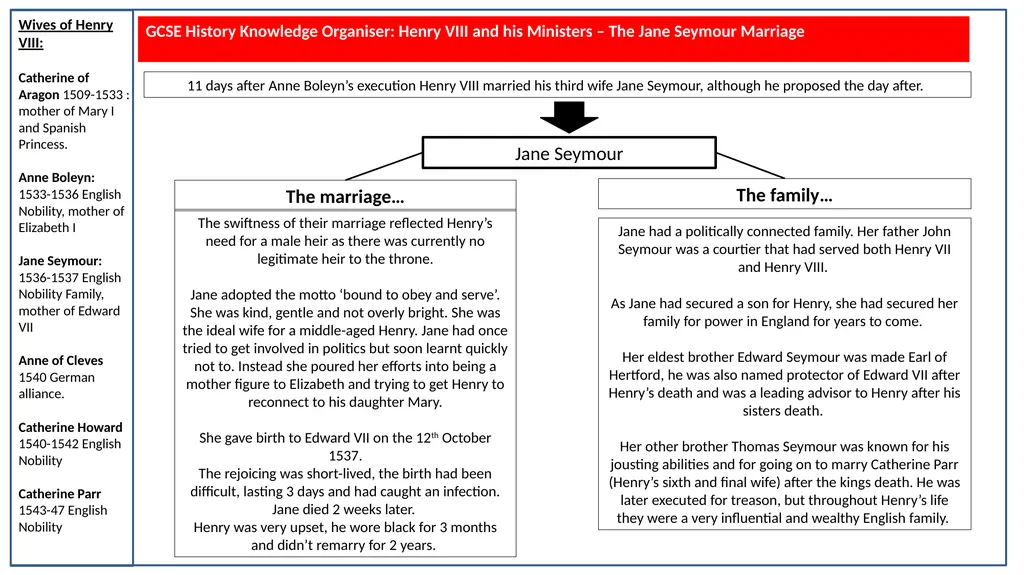
GCSE History Knowledge Organiser: Henry VIII and his Ministers – The Jane Seymour Marriage Wives of Henry VIII:
Catherine of Aragon 1509-1533 : mother of Mary I and Spanish Princess.
Anne Boleyn: 1533-1536 English Nobility, mother of Elizabeth I
Jane Seymour: 1536-1537 English Nobility Family, mother of Edward VII
Anne of Cleves 1540 German alliance.
Catherine Howard 1540-1542 English Nobility
Catherine Parr 1543-47 English Nobility 11 days after Anne Boleyn’s execution Henry VIII married his third wife Jane Seymour, although he proposed the day after. Jane Seymour The marriage… The family… The swiftness of their marriage reflected Henry’s need for a male heir as there was currently no legitimate heir to the throne.
Jane adopted the motto ‘bound to obey and serve’.
She was kind, gentle and not overly bright. She was the ideal wife for a middle-aged Henry. Jane had once tried to get involved in politics but soon learnt quickly not to. Instead she poured her efforts into being a mother figure to Elizabeth and trying to get Henry to reconnect to his daughter Mary.
She gave birth to Edward VII on the 12th October 1537.
The rejoicing was short-lived, the birth had been difficult, lasting 3 days and had caught an infection. Jane died 2 weeks later.
Henry was very upset, he wore black for 3 months and didn’t remarry for 2 years. Jane had a politically connected family. Her father John Seymour was a courtier that had served both Henry VII and Henry VIII.
As Jane had secured a son for Henry, she had secured her family for power in England for years to come.
Her eldest brother Edward Seymour was made Earl of Hertford, he was also named protector of Edward VII after Henry’s death and was a leading advisor to Henry after his sisters death.
Her other brother Thomas Seymour was known for his jousting abilities and for going on to marry Catherine Parr (Henry’s sixth and final wife) after the kings death. He was later executed for treason, but throughout Henry’s life they were a very influential and wealthy English family.<br>
09
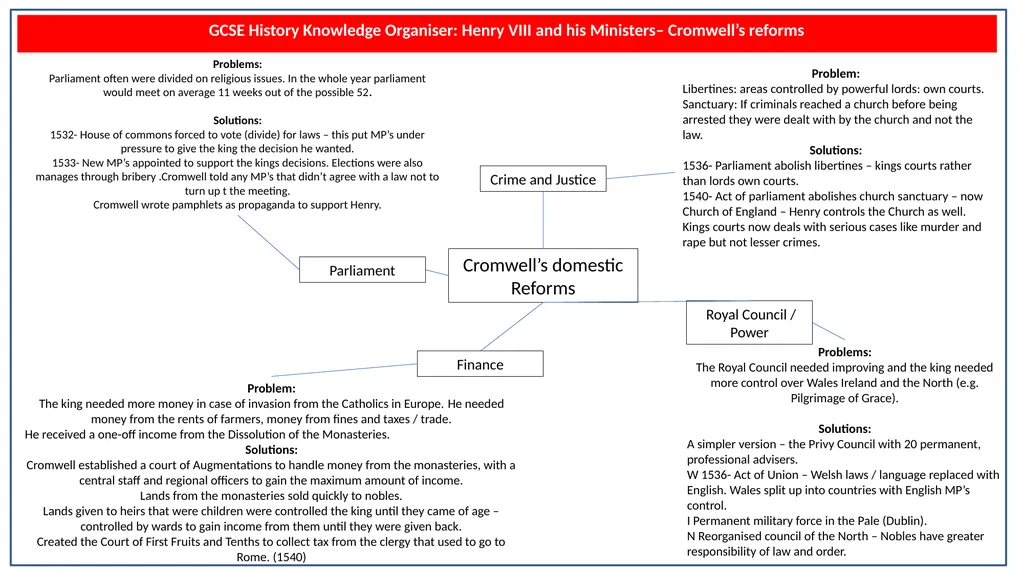
GCSE History Knowledge Organiser: Henry VIII and his Ministers– Cromwell’s reforms Cromwell’s domestic Reforms Parliament Finance Royal Council / Power Crime and Justice Problems:
Parliament often were divided on religious issues. In the whole year parliament would meet on average 11 weeks out of the possible 52.
Solutions:
1532- House of commons forced to vote (divide) for laws – this put MP’s under pressure to give the king the decision he wanted.
1533- New MP’s appointed to support the kings decisions. Elections were also manages through bribery .Cromwell told any MP’s that didn’t agree with a law not to turn up t the meeting.
Cromwell wrote pamphlets as propaganda to support Henry. Problem:
The king needed more money in case of invasion from the Catholics in Europe. He needed money from the rents of farmers, money from fines and taxes / trade.
He received a one-off income from the Dissolution of the Monasteries.
Solutions:
Cromwell established a court of Augmentations to handle money from the monasteries, with a central staff and regional officers to gain the maximum amount of income.
Lands from the monasteries sold quickly to nobles.
Lands given to heirs that were children were controlled the king until they came of age – controlled by wards to gain income from them until they were given back.
Created the Court of First Fruits and Tenths to collect tax from the clergy that used to go to Rome. (1540) Problems:
The Royal Council needed improving and the king needed more control over Wales Ireland and the North (e.g. Pilgrimage of Grace).
Solutions:
A simpler version – the Privy Council with 20 permanent, professional advisers.
W 1536- Act of Union – Welsh laws / language replaced with English. Wales split up into countries with English MP’s control.
I Permanent military force in the Pale (Dublin).
N Reorganised council of the North – Nobles have greater responsibility of law and order. Problem:
Libertines: areas controlled by powerful lords: own courts.
Sanctuary: If criminals reached a church before being arrested they were dealt with by the church and not the law.
Solutions:
1536- Parliament abolish libertines – kings courts rather than lords own courts.
1540- Act of parliament abolishes church sanctuary – now Church of England – Henry controls the Church as well. Kings courts now deals with serious cases like murder and rape but not lesser crimes.<br>
10
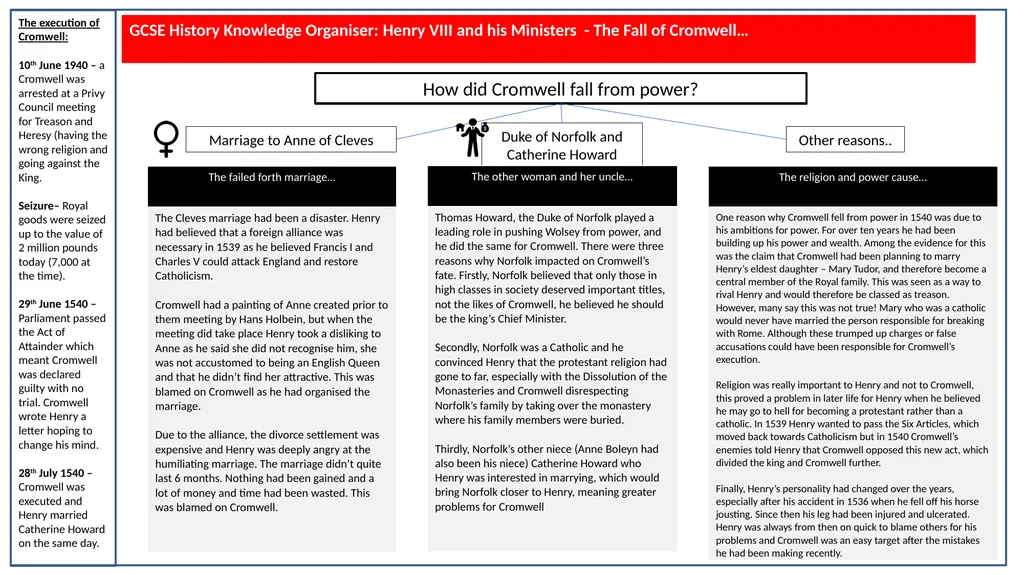
GCSE History Knowledge Organiser: Henry VIII and his Ministers - The Fall of Cromwell… The execution of Cromwell:
10th June 1940 – a Cromwell was arrested at a Privy Council meeting for Treason and Heresy (having the wrong religion and going against the King.
Seizure– Royal goods were seized up to the value of 2 million pounds today (7,000 at the time).
29th June 1540 – Parliament passed the Act of Attainder which meant Cromwell was declared guilty with no trial. Cromwell wrote Henry a letter hoping to change his mind.
28th July 1540 – Cromwell was executed and Henry married Catherine Howard on the same day. How did Cromwell fall from power? Marriage to Anne of Cleves Duke of Norfolk and Catherine Howard Other reasons..<br>
11
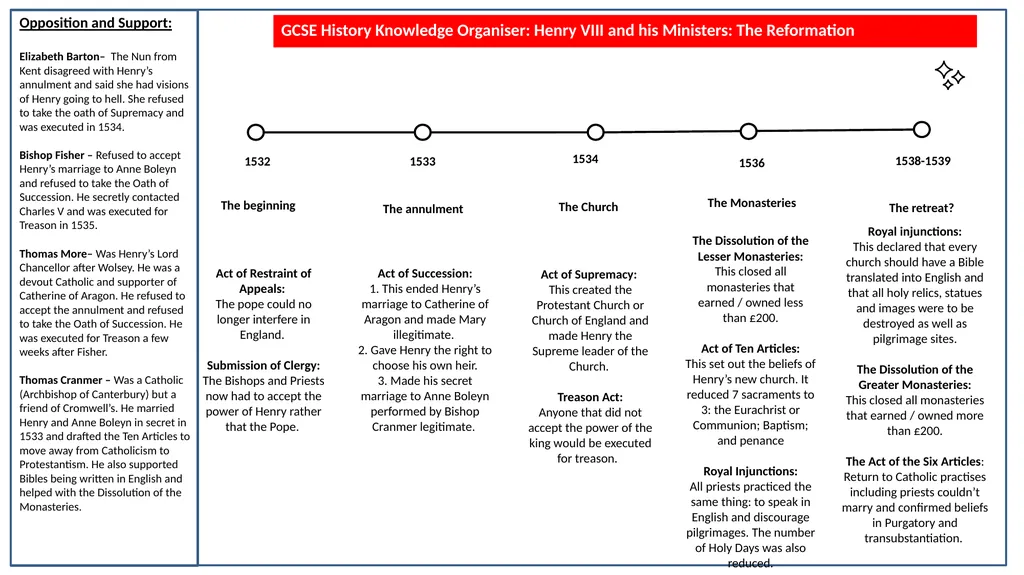
GCSE History Knowledge Organiser: Henry VIII and his Ministers: The Reformation Opposition and Support:
Elizabeth Barton– The Nun from Kent disagreed with Henry’s annulment and said she had visions of Henry going to hell. She refused to take the oath of Supremacy and was executed in 1534.
Bishop Fisher – Refused to accept Henry’s marriage to Anne Boleyn and refused to take the Oath of Succession. He secretly contacted Charles V and was executed for Treason in 1535.
Thomas More– Was Henry’s Lord Chancellor after Wolsey. He was a devout Catholic and supporter of Catherine of Aragon. He refused to accept the annulment and refused to take the Oath of Succession. He was executed for Treason a few weeks after Fisher.
Thomas Cranmer – Was a Catholic (Archbishop of Canterbury) but a friend of Cromwell’s. He married Henry and Anne Boleyn in secret in 1533 and drafted the Ten Articles to move away from Catholicism to Protestantism. He also supported Bibles being written in English and helped with the Dissolution of the Monasteries. 1532 The beginning Act of Restraint of Appeals:
The pope could no longer interfere in England.
Submission of Clergy:
The Bishops and Priests now had to accept the power of Henry rather that the Pope. 1533 The annulment 1534 The Church The retreat? Act of Succession:
1. This ended Henry’s marriage to Catherine of Aragon and made Mary illegitimate.
2. Gave Henry the right to choose his own heir.
3. Made his secret marriage to Anne Boleyn performed by Bishop Cranmer legitimate. Act of Supremacy:
This created the Protestant Church or Church of England and made Henry the Supreme leader of the Church.
Treason Act:
Anyone that did not accept the power of the king would be executed for treason. Royal injunctions:
This declared that every church should have a Bible translated into English and that all holy relics, statues and images were to be destroyed as well as pilgrimage sites.
The Dissolution of the Greater Monasteries:
This closed all monasteries that earned / owned more than £200.
The Act of the Six Articles:
Return to Catholic practises including priests couldn’t marry and confirmed beliefs in Purgatory and transubstantiation. 1536 The Monasteries The Dissolution of the Lesser Monasteries:
This closed all monasteries that earned / owned less than £200.
Act of Ten Articles:
This set out the beliefs of Henry’s new church. It reduced 7 sacraments to 3: the Eurachrist or Communion; Baptism; and penance
Royal Injunctions:
All priests practiced the same thing: to speak in English and discourage pilgrimages. The number of Holy Days was also reduced. 1538-1539<br>
12
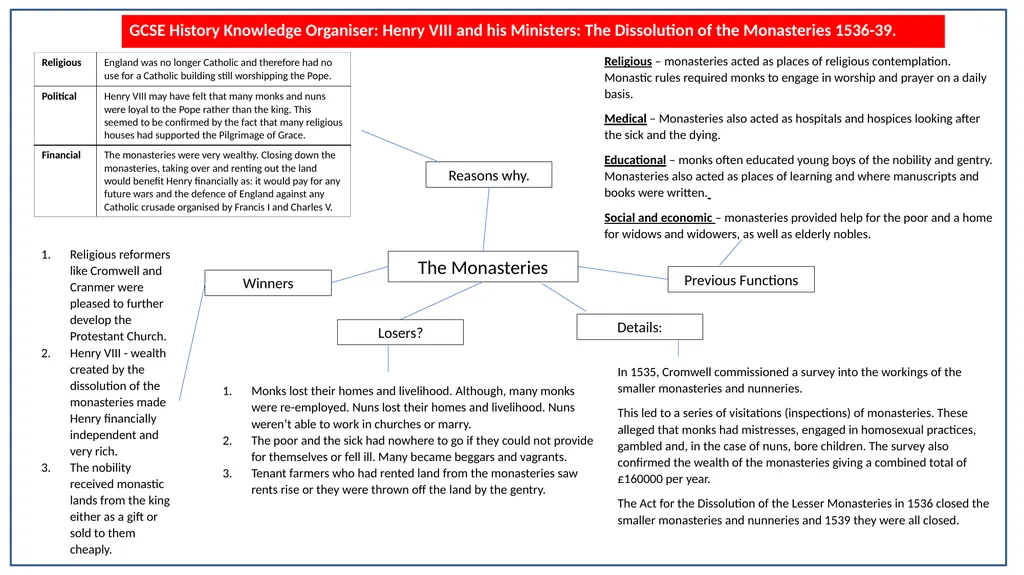
GCSE History Knowledge Organiser: Henry VIII and his Ministers: The Dissolution of the Monasteries 1536-39. The Monasteries Previous Functions Winners Losers? Details: Reasons why. Religious reformers like Cromwell and Cranmer were pleased to further develop the Protestant Church.
Henry VIII - wealth created by the dissolution of the monasteries made Henry financially independent and very rich.
The nobility received monastic lands from the king either as a gift or sold to them cheaply. Monks lost their homes and livelihood. Although, many monks were re-employed. Nuns lost their homes and livelihood. Nuns weren’t able to work in churches or marry.
The poor and the sick had nowhere to go if they could not provide for themselves or fell ill. Many became beggars and vagrants.
Tenant farmers who had rented land from the monasteries saw rents rise or they were thrown off the land by the gentry. In 1535, Cromwell commissioned a survey into the workings of the smaller monasteries and nunneries.
This led to a series of visitations (inspections) of monasteries. These alleged that monks had mistresses, engaged in homosexual practices, gambled and, in the case of nuns, bore children. The survey also confirmed the wealth of the monasteries giving a combined total of £160000 per year.
The Act for the Dissolution of the Lesser Monasteries in 1536 closed the smaller monasteries and nunneries and 1539 they were all closed. Religious – monasteries acted as places of religious contemplation. Monastic rules required monks to engage in worship and prayer on a daily basis.
Medical – Monasteries also acted as hospitals and hospices looking after the sick and the dying.
Educational – monks often educated young boys of the nobility and gentry. Monasteries also acted as places of learning and where manuscripts and books were written.
Social and economic – monasteries provided help for the poor and a home for widows and widowers, as well as elderly nobles.<br>
13
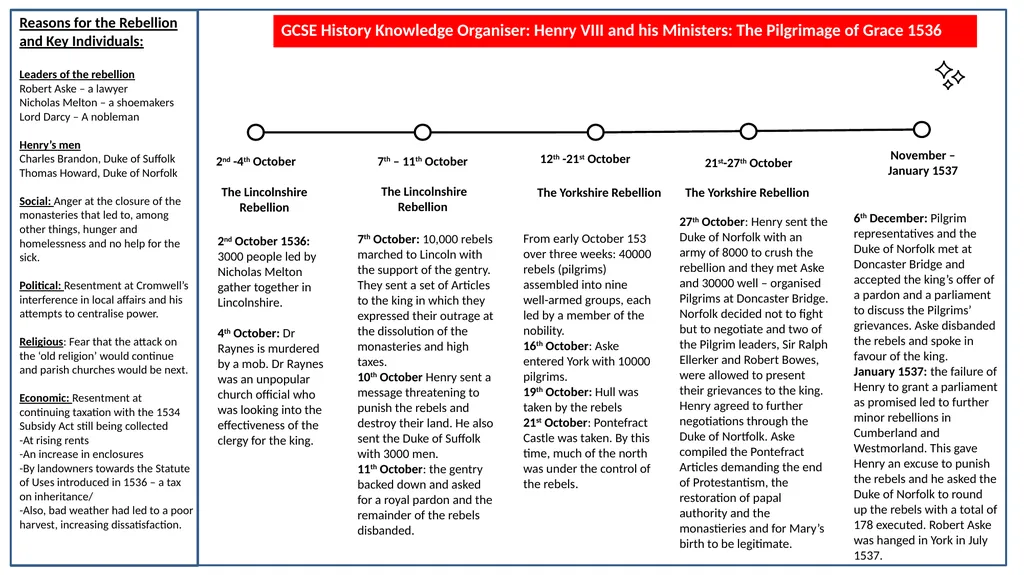
GCSE History Knowledge Organiser: Henry VIII and his Ministers: The Pilgrimage of Grace 1536 Reasons for the Rebellion and Key Individuals:
Leaders of the rebellion
Robert Aske – a lawyer
Nicholas Melton – a shoemakers
Lord Darcy – A nobleman
Henry’s men
Charles Brandon, Duke of Suffolk
Thomas Howard, Duke of Norfolk
Social: Anger at the closure of the monasteries that led to, among other things, hunger and homelessness and no help for the sick.
Political: Resentment at Cromwell’s interference in local affairs and his attempts to centralise power.
Religious: Fear that the attack on the ‘old religion’ would continue and parish churches would be next.
Economic: Resentment at continuing taxation with the 1534 Subsidy Act still being collected -At rising rents -An increase in enclosures -By landowners towards the Statute of Uses introduced in 1536 – a tax on inheritance/ -Also, bad weather had led to a poor harvest, increasing dissatisfaction. 2nd -4th October The Lincolnshire Rebellion 2nd October 1536: 3000 people led by Nicholas Melton gather together in Lincolnshire.
4th October: Dr Raynes is murdered by a mob. Dr Raynes was an unpopular church official who was looking into the effectiveness of the clergy for the king. 7th – 11th October The Lincolnshire Rebellion 12th -21st October The Yorkshire Rebellion 7th October: 10,000 rebels marched to Lincoln with the support of the gentry. They sent a set of Articles to the king in which they expressed their outrage at the dissolution of the monasteries and high taxes.
10th October Henry sent a message threatening to punish the rebels and destroy their land. He also sent the Duke of Suffolk with 3000 men.
11th October: the gentry backed down and asked for a royal pardon and the remainder of the rebels disbanded. From early October 153 over three weeks: 40000 rebels (pilgrims) assembled into nine well-armed groups, each led by a member of the nobility.
16th October: Aske entered York with 10000 pilgrims.
19th October: Hull was taken by the rebels
21st October: Pontefract Castle was taken. By this time, much of the north was under the control of the rebels. 6th December: Pilgrim representatives and the Duke of Norfolk met at Doncaster Bridge and accepted the king’s offer of a pardon and a parliament to discuss the Pilgrims’ grievances. Aske disbanded the rebels and spoke in favour of the king.
January 1537: the failure of Henry to grant a parliament as promised led to further minor rebellions in Cumberland and Westmorland. This gave Henry an excuse to punish the rebels and he asked the Duke of Norfolk to round up the rebels with a total of 178 executed. Robert Aske was hanged in York in July 1537. 21st-27th October 27th October: Henry sent the Duke of Norfolk with an army of 8000 to crush the rebellion and they met Aske and 30000 well – organised Pilgrims at Doncaster Bridge. Norfolk decided not to fight but to negotiate and two of the Pilgrim leaders, Sir Ralph Ellerker and Robert Bowes, were allowed to present their grievances to the king.
Henry agreed to further negotiations through the Duke of Nortfolk. Aske compiled the Pontefract Articles demanding the end of Protestantism, the restoration of papal authority and the monastieries and for Mary’s birth to be legitimate. November – January 1537 The Yorkshire Rebellion<br>