
Gender and social inclusion Assessing people’s
FD
Published · 30 slides · 0 views

1 / 1

Description
Gender and social inclusion Assessing peoples climate risks and resilience Image: Kenya; from ICCAD CDKN Voices from the Frontline In this module you will learn A conceptual overview of how we understand and measure peoples
Related Topics
Share
Embed code
Download this presentation From Below
"Gender and social inclusion Assessing people’s" is the property of its rightful owner. Permission is granted to download and print the materials on this website for personal, non-commercial use only, and to display it on your personal computer provided you do not modify the materials and that you retain all copyright notices contained in the materials. By downloading content from our website, you accept the terms of this agreement.
Presentation Transcript
01
Gender and social inclusion
Assessing people’s climate risks and resilience
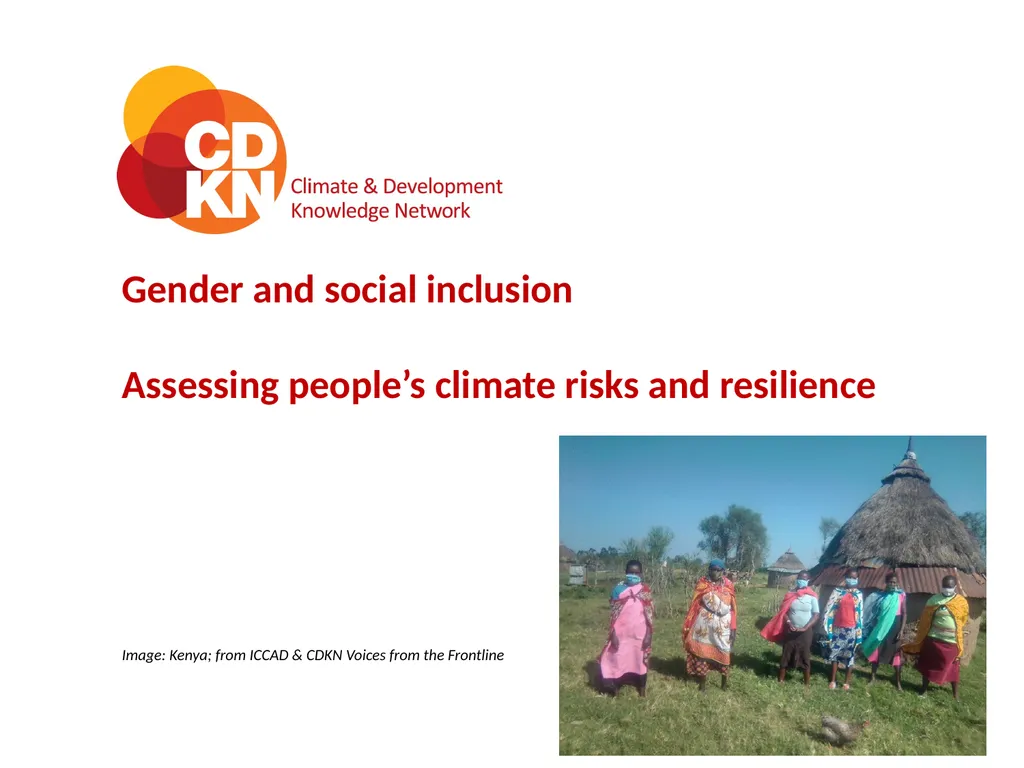
Image: Kenya; from ICCAD & CDKN Voices from the Frontline<br>
02
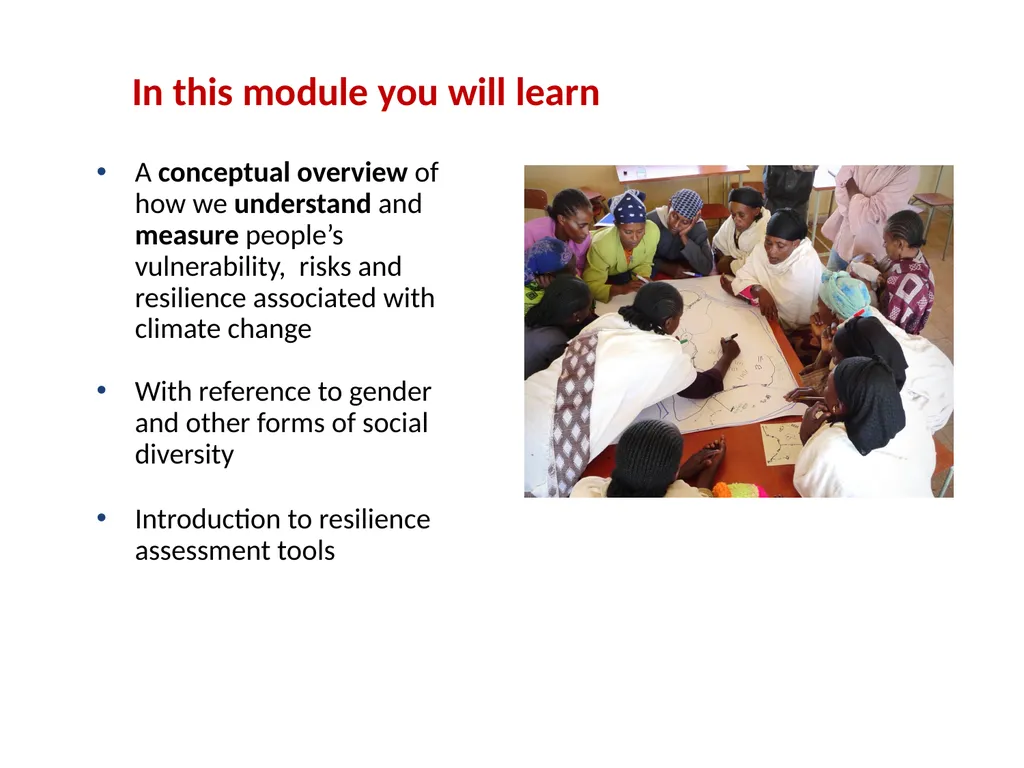
In this module you will learn A conceptual overview of how we understand and measure people’s vulnerability, risks and resilience associated with climate change
With reference to gender and other forms of social diversity
Introduction to resilience assessment tools<br>
With reference to gender and other forms of social diversity
Introduction to resilience assessment tools<br>
03
Recap: Why gender and social inclusion matters
(Highlights from training module 2) The poorest are disproportionately female
Climate change impacts women and girls disproportionately
Empowering women is the right thing to do
Empowering women is also the way to get better climate results
Gender-based forms of discrimination hold back women and girls from contributing their talents fully to society including their knowledge, skills and potential to tackle the climate crisis 3<br>
04
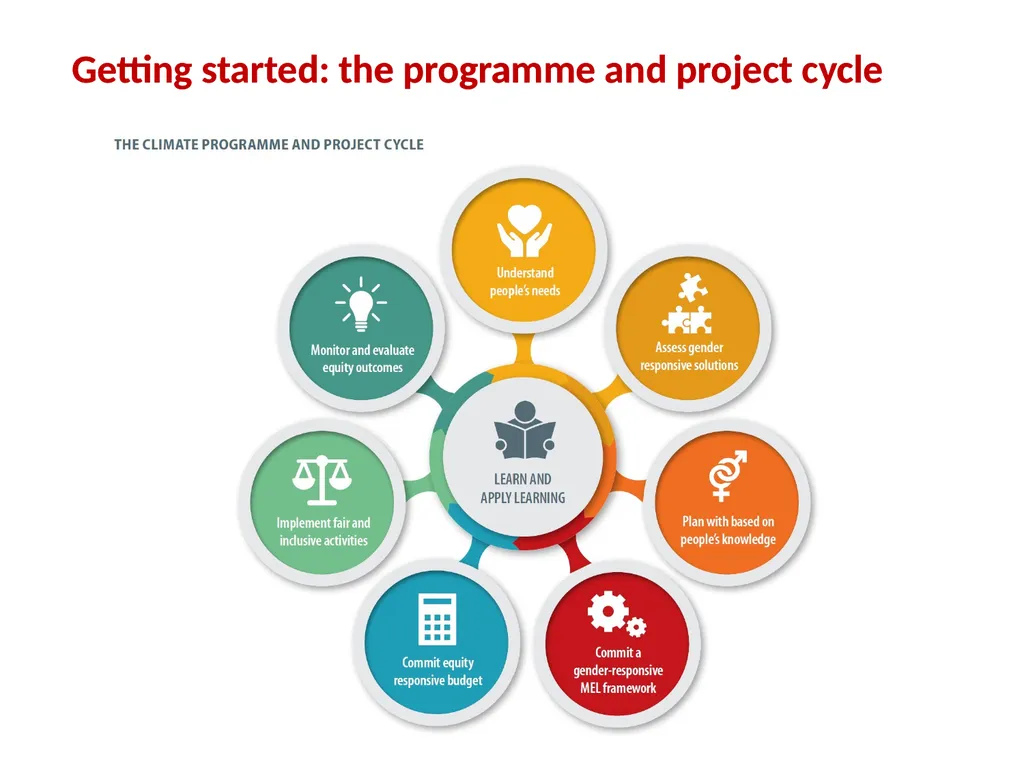
Getting started: the programme and project cycle Getting started: the programme and project cycle<br>
05
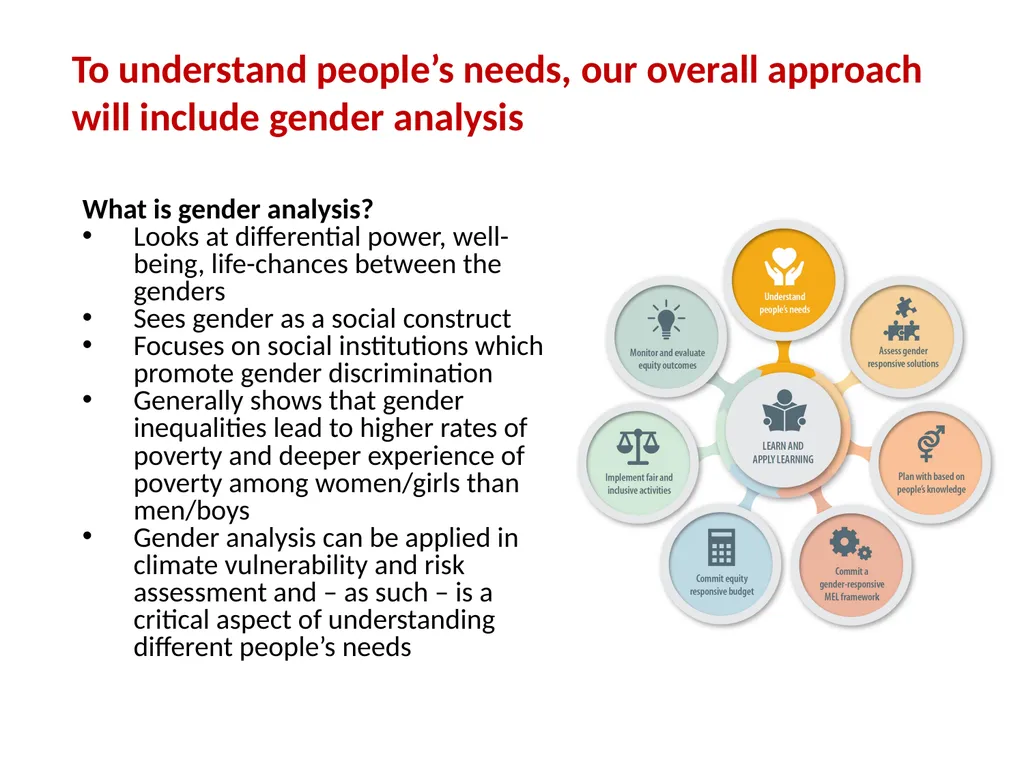
To understand people’s needs, our overall approach will include gender analysis What is gender analysis?
Looks at differential power, well-being, life-chances between the genders
Sees gender as a social construct
Focuses on social institutions which promote gender discrimination
Generally shows that gender inequalities lead to higher rates of poverty and deeper experience of poverty among women/girls than men/boys
Gender analysis can be applied in climate vulnerability and risk assessment and – as such – is a critical aspect of understanding different people’s needs<br>
06
Scope of this training
There are approaches of varying complexity to ‘understanding people’s needs’ in the development of climate projects/actions.
We focus in this training
on the first 3 columns:
-impact assessment
-vulnerability assessment
-adaptation / mitigation actions
rather than on integrated assessment modelling (IAM) but the tools and tactics we suggest could be applied to IAM approaches.<br>
07
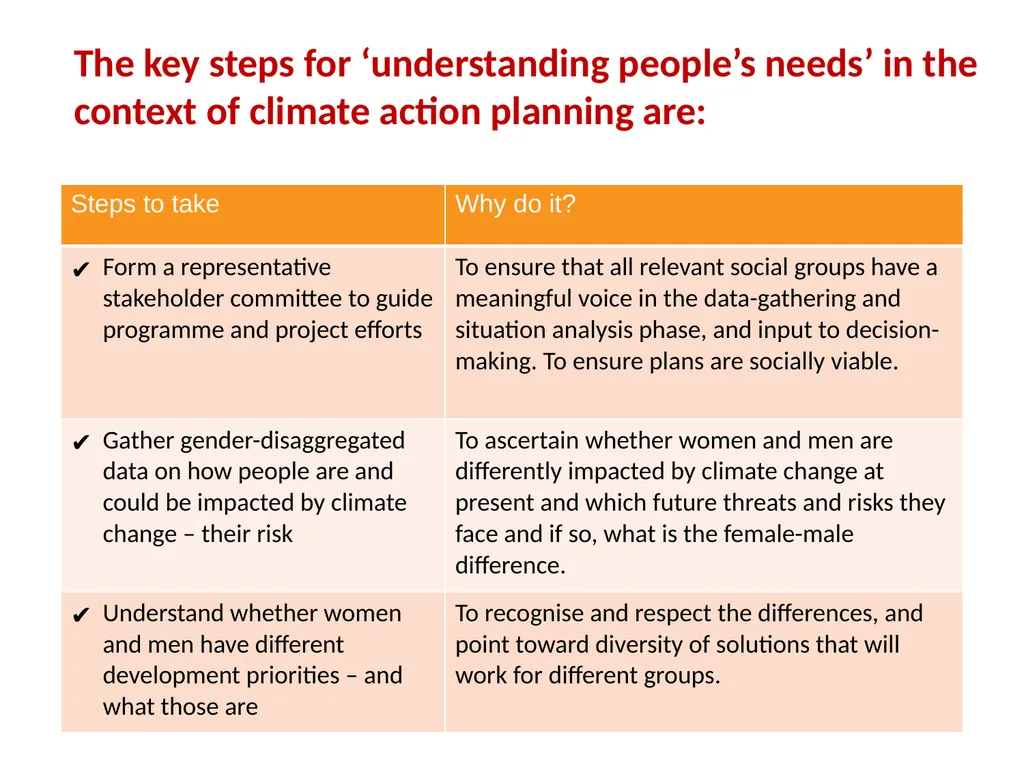
The key steps for ‘understanding people’s needs’ in the context of climate action planning are:<br>
08
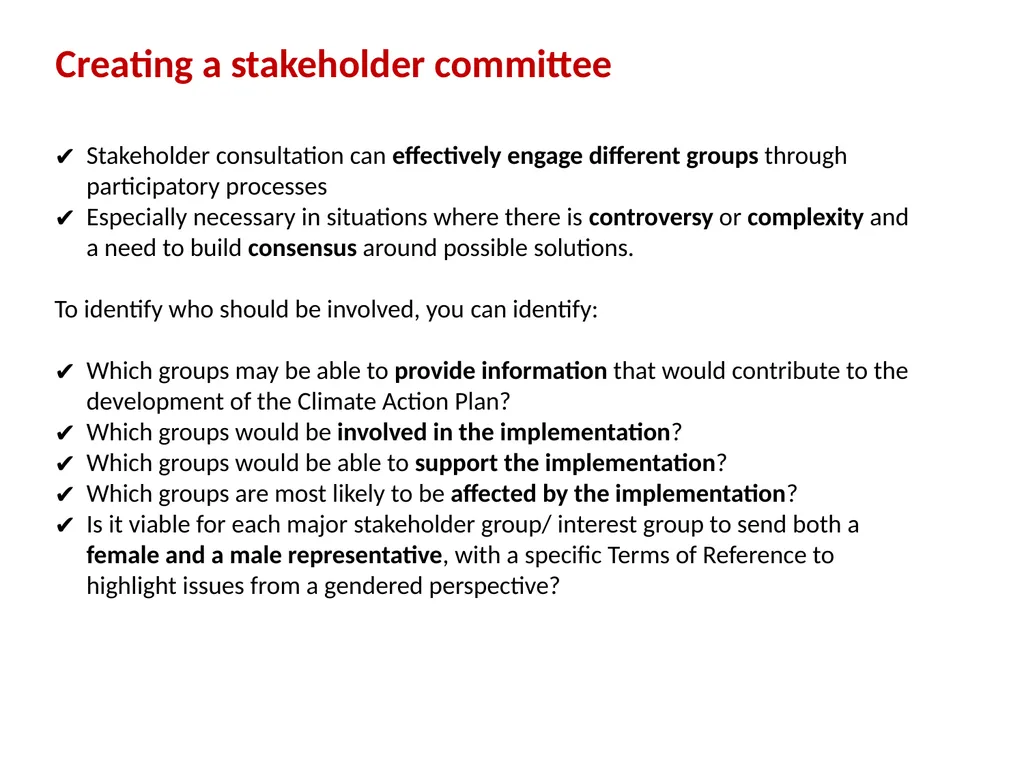
Creating a stakeholder committee Stakeholder consultation can effectively engage different groups through participatory processes
Especially necessary in situations where there is controversy or complexity and a need to build consensus around possible solutions.
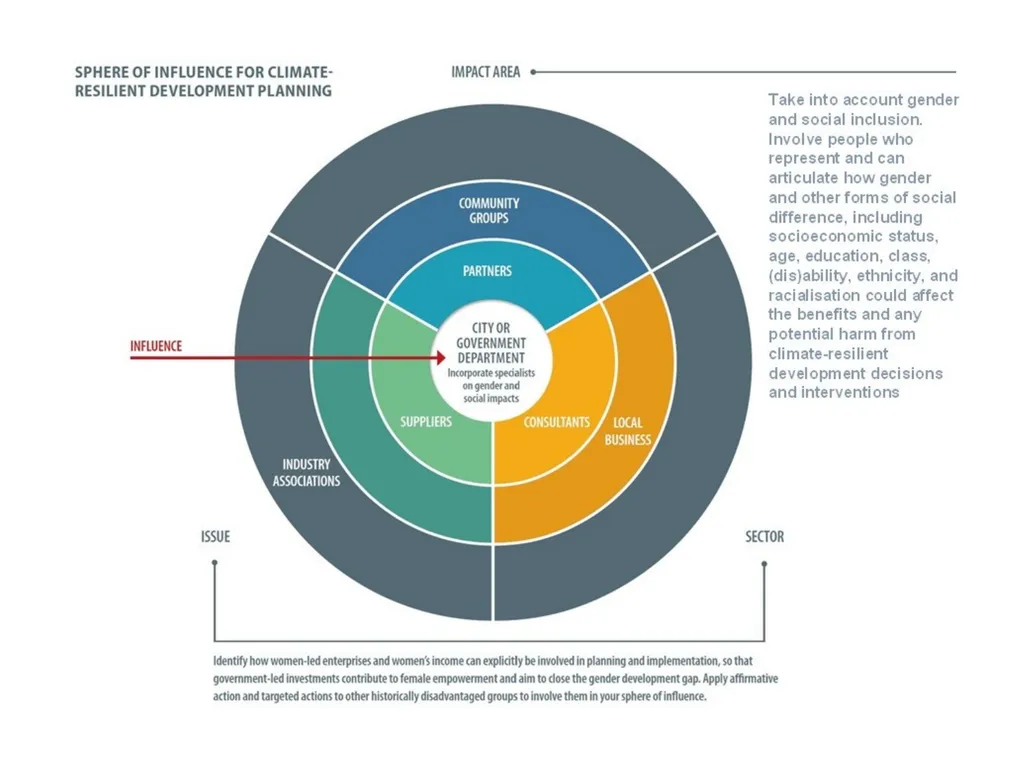
To identify who should be involved, you can identify:
Which groups may be able to provide information that would contribute to the development of the Climate Action Plan?
Which groups would be involved in the implementation?
Which groups would be able to support the implementation?
Which groups are most likely to be affected by the implementation?
Is it viable for each major stakeholder group/ interest group to send both a female and a male representative, with a specific Terms of Reference to highlight issues from a gendered perspective?<br>
09
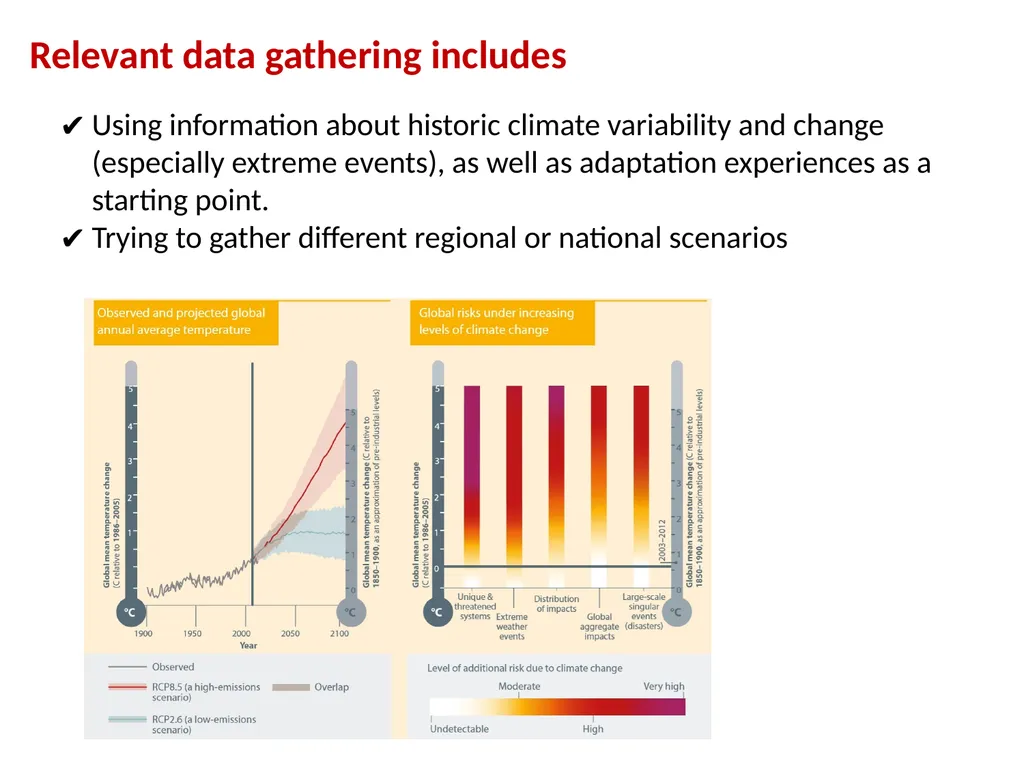
Relevant data gathering includes Using information about historic climate variability and change (especially extreme events), as well as adaptation experiences as a starting point.
Trying to gather different regional or national scenarios<br>
Trying to gather different regional or national scenarios<br>
10
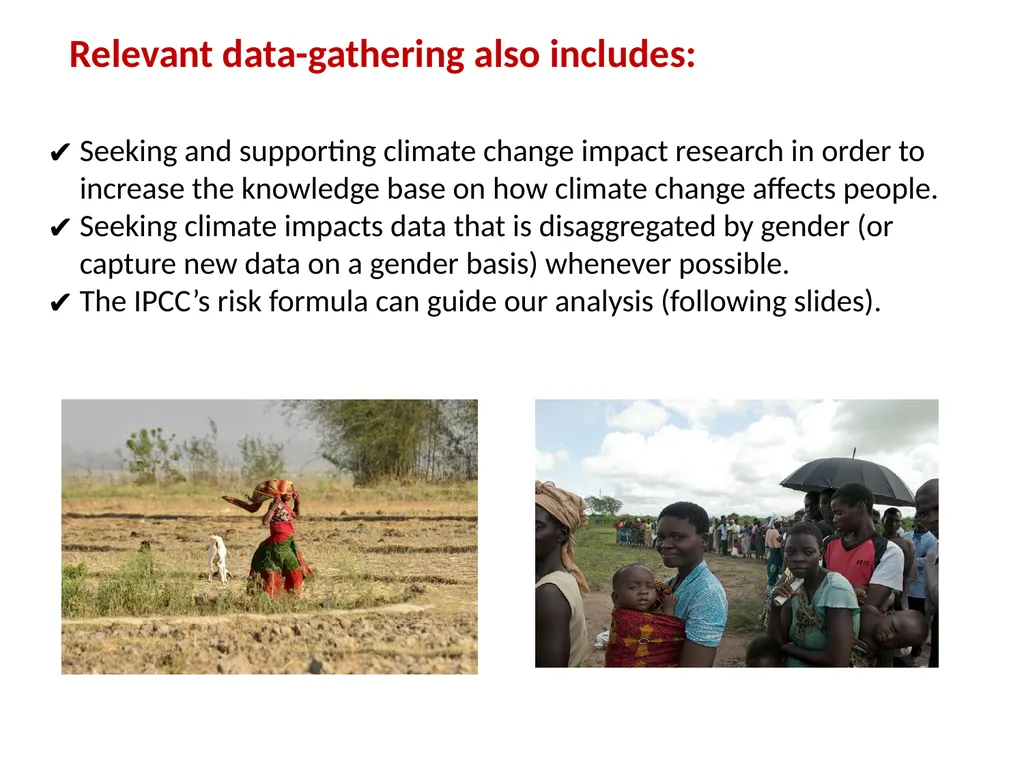
Relevant data-gathering also includes: Seeking and supporting climate change impact research in order to increase the knowledge base on how climate change affects people.
Seeking climate impacts data that is disaggregated by gender (or capture new data on a gender basis) whenever possible.
The IPCC’s risk formula can guide our analysis (following slides).<br>
Seeking climate impacts data that is disaggregated by gender (or capture new data on a gender basis) whenever possible.
The IPCC’s risk formula can guide our analysis (following slides).<br>
11
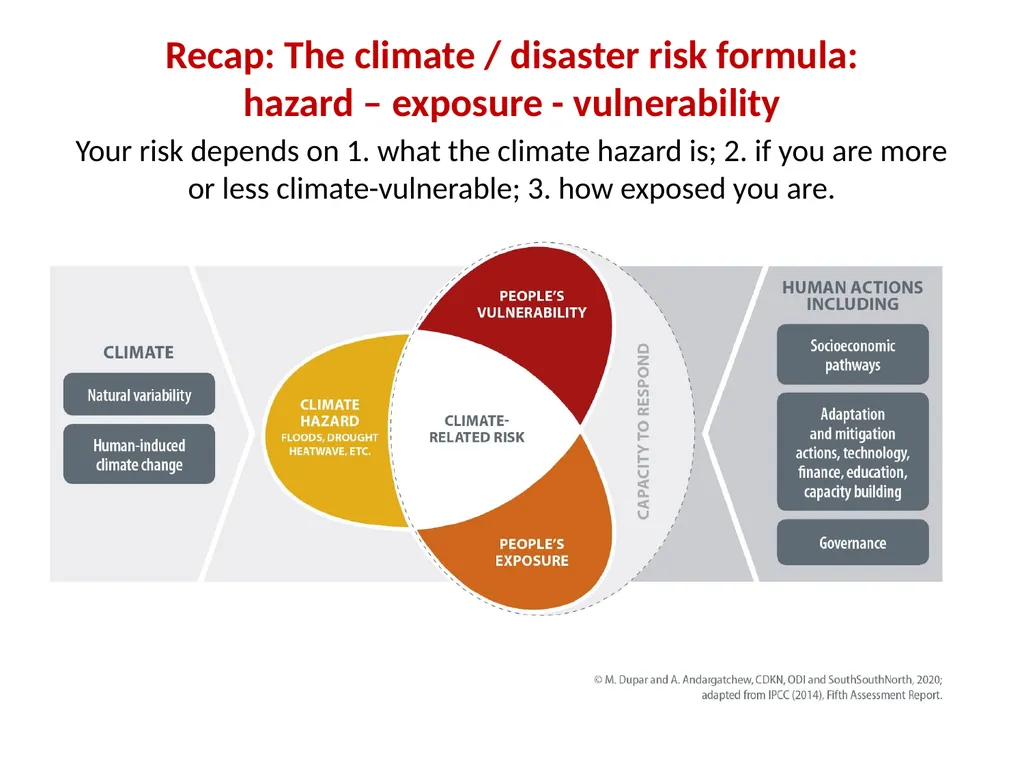
Recap: The climate / disaster risk formula:
hazard – exposure - vulnerability Your risk depends on 1. what the climate hazard is; 2. if you are more or less climate-vulnerable; 3. how exposed you are.<br>
12
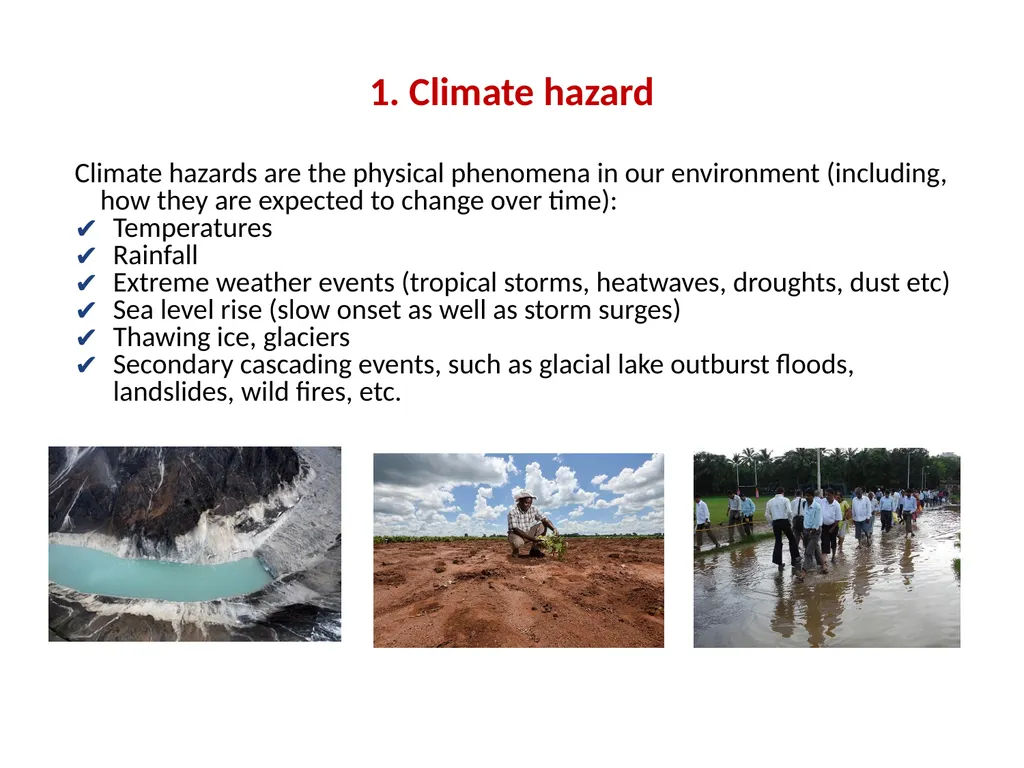
1. Climate hazard Climate hazards are the physical phenomena in our environment (including, how they are expected to change over time):
Temperatures
Rainfall
Extreme weather events (tropical storms, heatwaves, droughts, dust etc)
Sea level rise (slow onset as well as storm surges)
Thawing ice, glaciers
Secondary cascading events, such as glacial lake outburst floods, landslides, wild fires, etc.<br>
Temperatures
Rainfall
Extreme weather events (tropical storms, heatwaves, droughts, dust etc)
Sea level rise (slow onset as well as storm surges)
Thawing ice, glaciers
Secondary cascading events, such as glacial lake outburst floods, landslides, wild fires, etc.<br>
13
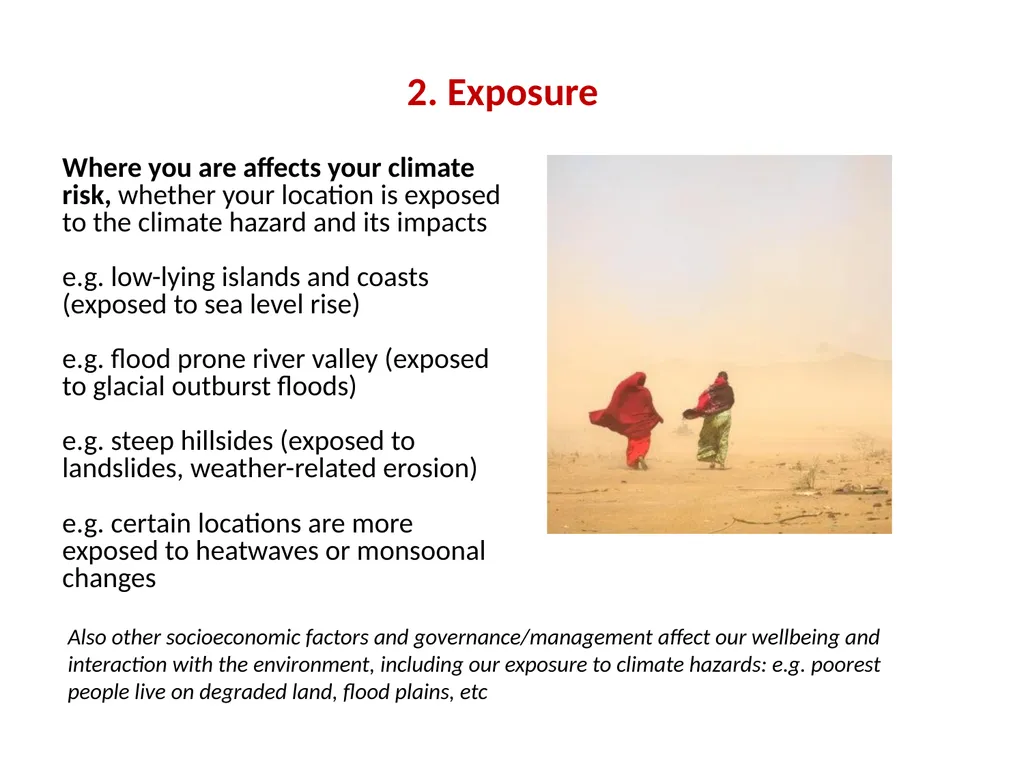
2. Exposure Where you are affects your climate risk, whether your location is exposed to the climate hazard and its impacts
e.g. low-lying islands and coasts (exposed to sea level rise)
e.g. flood prone river valley (exposed to glacial outburst floods)
e.g. steep hillsides (exposed to landslides, weather-related erosion)
e.g. certain locations are more exposed to heatwaves or monsoonal changes Also other socioeconomic factors and governance/management affect our wellbeing and interaction with the environment, including our exposure to climate hazards: e.g. poorest people live on degraded land, flood plains, etc<br>
14
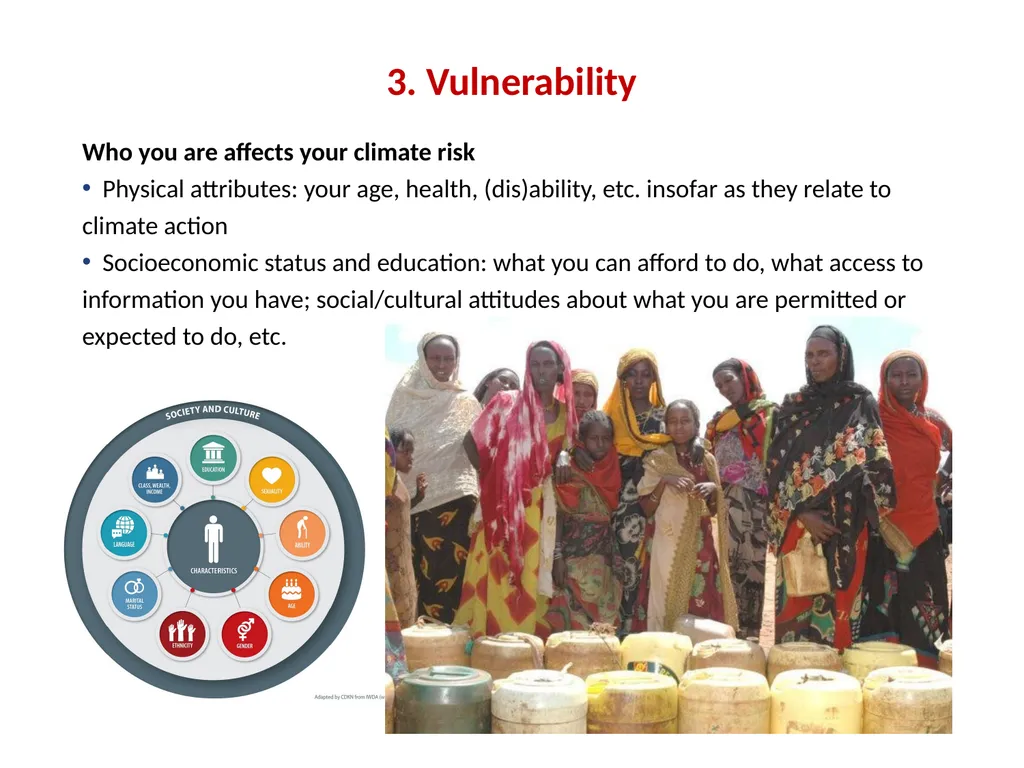
3. Vulnerability Who you are affects your climate risk
Physical attributes: your age, health, (dis)ability, etc. insofar as they relate to climate action
Socioeconomic status and education: what you can afford to do, what access to information you have; social/cultural attitudes about what you are permitted or expected to do, etc.<br>
Physical attributes: your age, health, (dis)ability, etc. insofar as they relate to climate action
Socioeconomic status and education: what you can afford to do, what access to information you have; social/cultural attitudes about what you are permitted or expected to do, etc.<br>
15
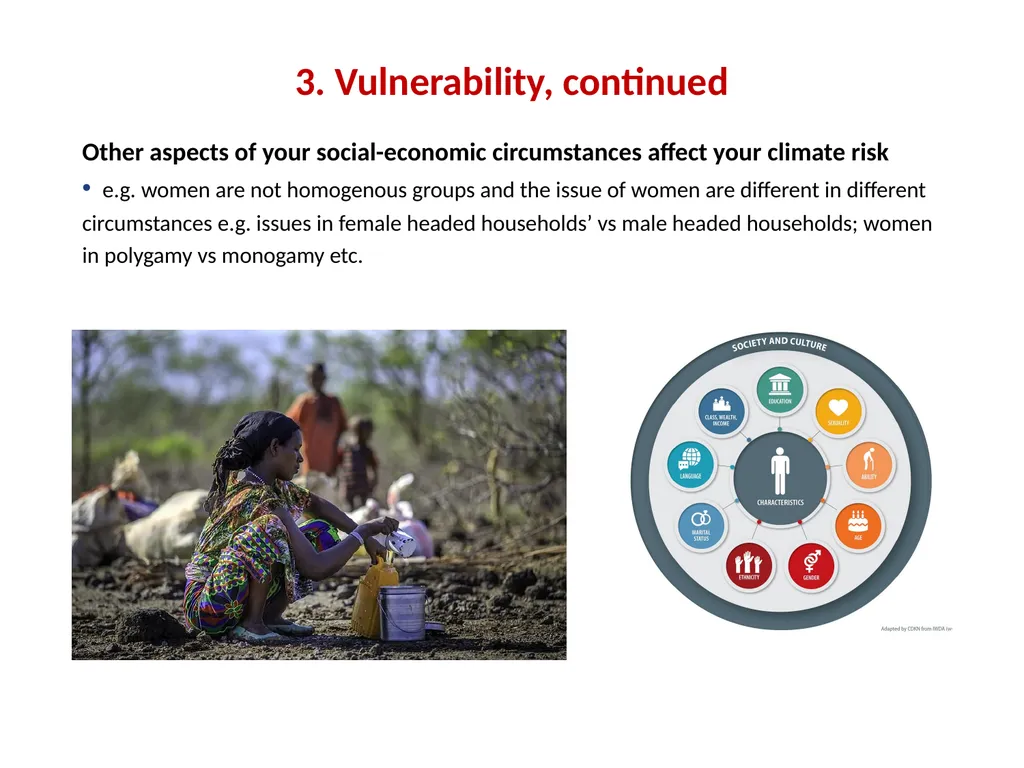
3. Vulnerability, continued Other aspects of your social-economic circumstances affect your climate risk
e.g. women are not homogenous groups and the issue of women are different in different circumstances e.g. issues in female headed households’ vs male headed households; women in polygamy vs monogamy etc.<br>
e.g. women are not homogenous groups and the issue of women are different in different circumstances e.g. issues in female headed households’ vs male headed households; women in polygamy vs monogamy etc.<br>
16
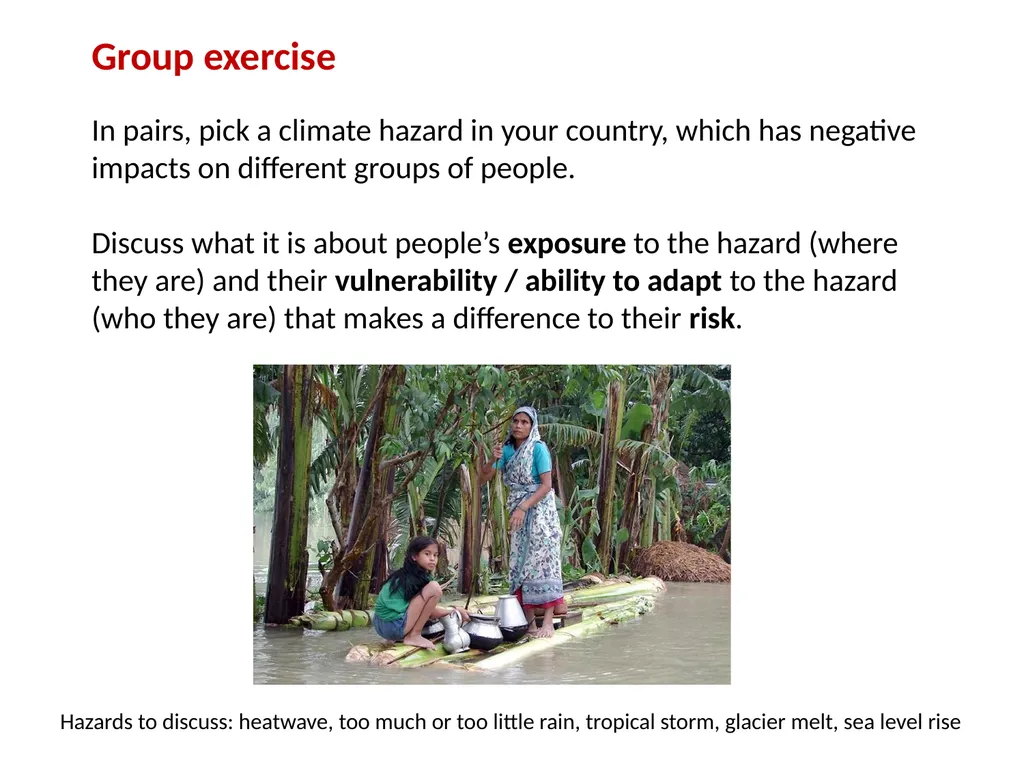
Group exercise In pairs, pick a climate hazard in your country, which has negative impacts on different groups of people.
Discuss what it is about people’s exposure to the hazard (where they are) and their vulnerability / ability to adapt to the hazard (who they are) that makes a difference to their risk. Hazards to discuss: heatwave, too much or too little rain, tropical storm, glacier melt, sea level rise<br>
Discuss what it is about people’s exposure to the hazard (where they are) and their vulnerability / ability to adapt to the hazard (who they are) that makes a difference to their risk. Hazards to discuss: heatwave, too much or too little rain, tropical storm, glacier melt, sea level rise<br>
17
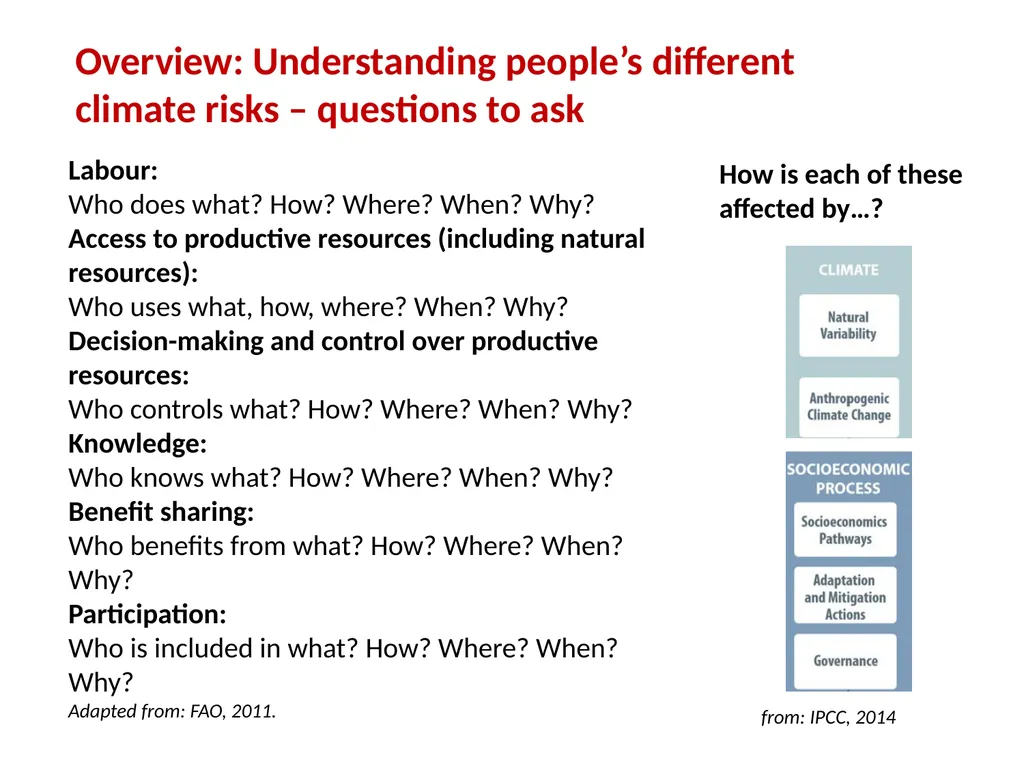
Overview: Understanding people’s different climate risks – questions to ask Labour:
Who does what? How? Where? When? Why?
Access to productive resources (including natural resources):
Who uses what, how, where? When? Why?
Decision-making and control over productive resources:
Who controls what? How? Where? When? Why?
Knowledge:
Who knows what? How? Where? When? Why?
Benefit sharing:
Who benefits from what? How? Where? When? Why?
Participation:
Who is included in what? How? Where? When? Why?
Adapted from: FAO, 2011. How is each of these affected by…? from: IPCC, 2014<br>
18
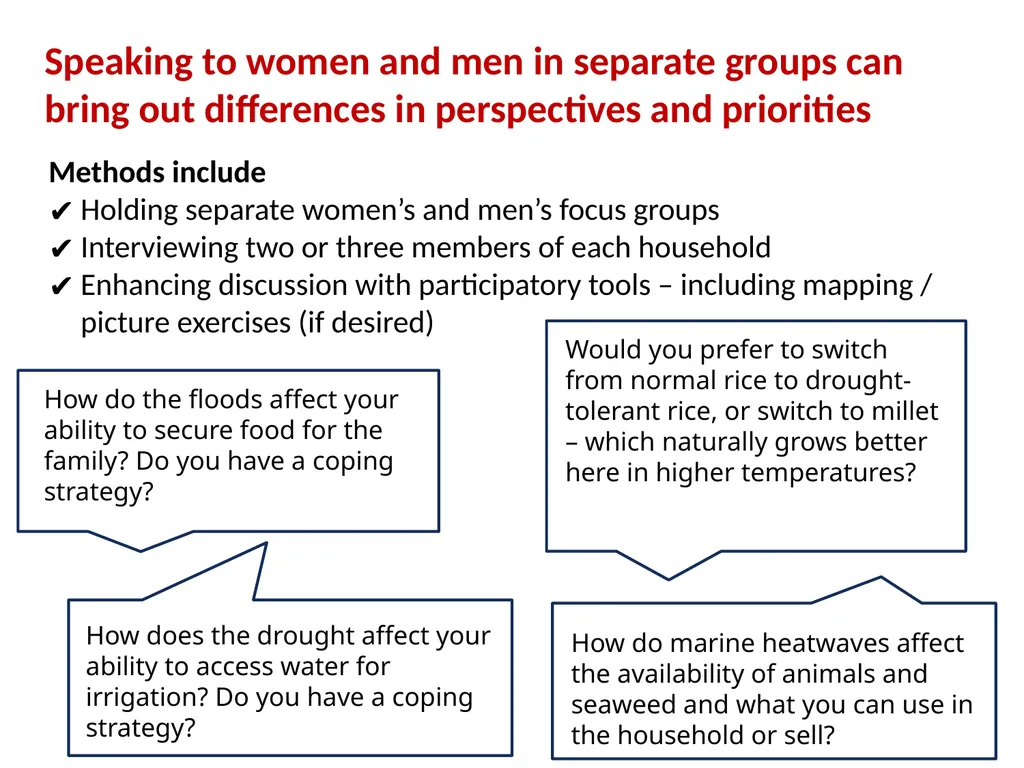
Speaking to women and men in separate groups can bring out differences in perspectives and priorities Methods include
Holding separate women’s and men’s focus groups
Interviewing two or three members of each household
Enhancing discussion with participatory tools – including mapping / picture exercises (if desired) How do the floods affect your ability to secure food for the family? Do you have a coping strategy? How does the drought affect your ability to access water for irrigation? Do you have a coping strategy? Would you prefer to switch from normal rice to drought-tolerant rice, or switch to millet – which naturally grows better here in higher temperatures? How do marine heatwaves affect the availability of animals and seaweed and what you can use in the household or sell?<br>
19
How one study unveiled women’s and men’s different values and priorities Coastal Kenya, Tanzania ESPA study
Culturally defined gender roles mean women are confined to low income opportunities.
Men are more likely to fish, women are more likely to collect seaweed.
Lesser access to funds, transportation (women), skills and knowledge (both women and men) act as barriers in different activities.
Formal and informal agreements reinforce gender divides e.g. trade is dominated by men.
Understanding difference can lead to gender-responsive development proposals.<br>
20
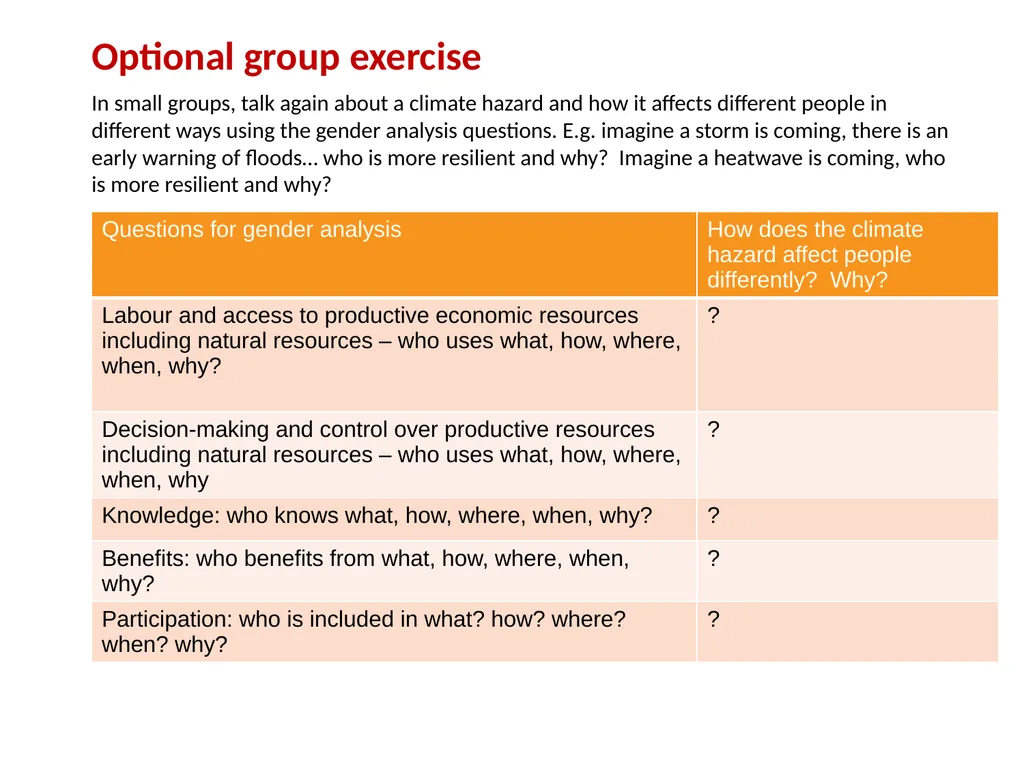
Optional group exercise In small groups, talk again about a climate hazard and how it affects different people in different ways using the gender analysis questions. E.g. imagine a storm is coming, there is an early warning of floods… who is more resilient and why? Imagine a heatwave is coming, who is more resilient and why?<br>
21
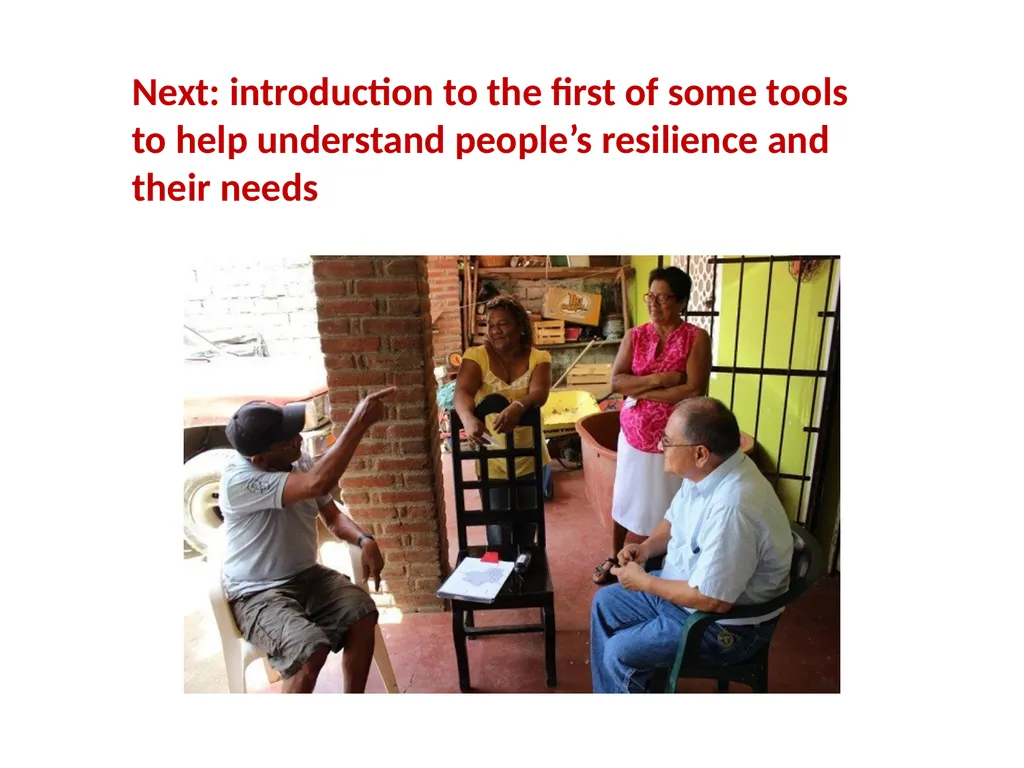
Next: introduction to the first of some tools to help understand people’s resilience and their needs<br>
22
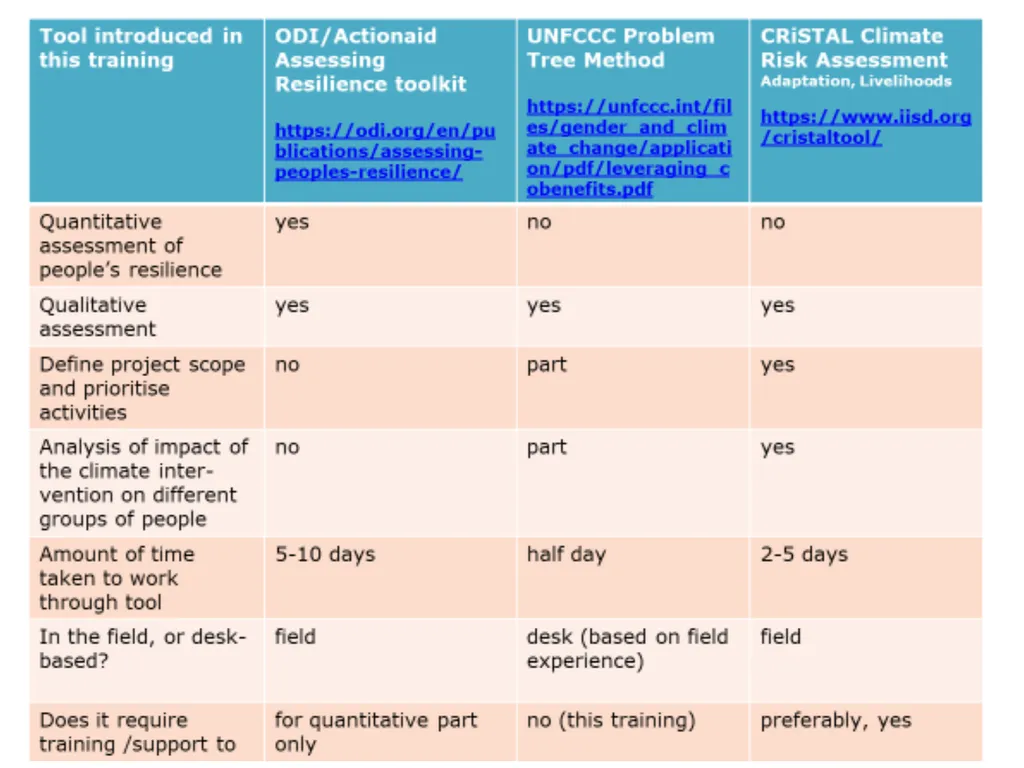
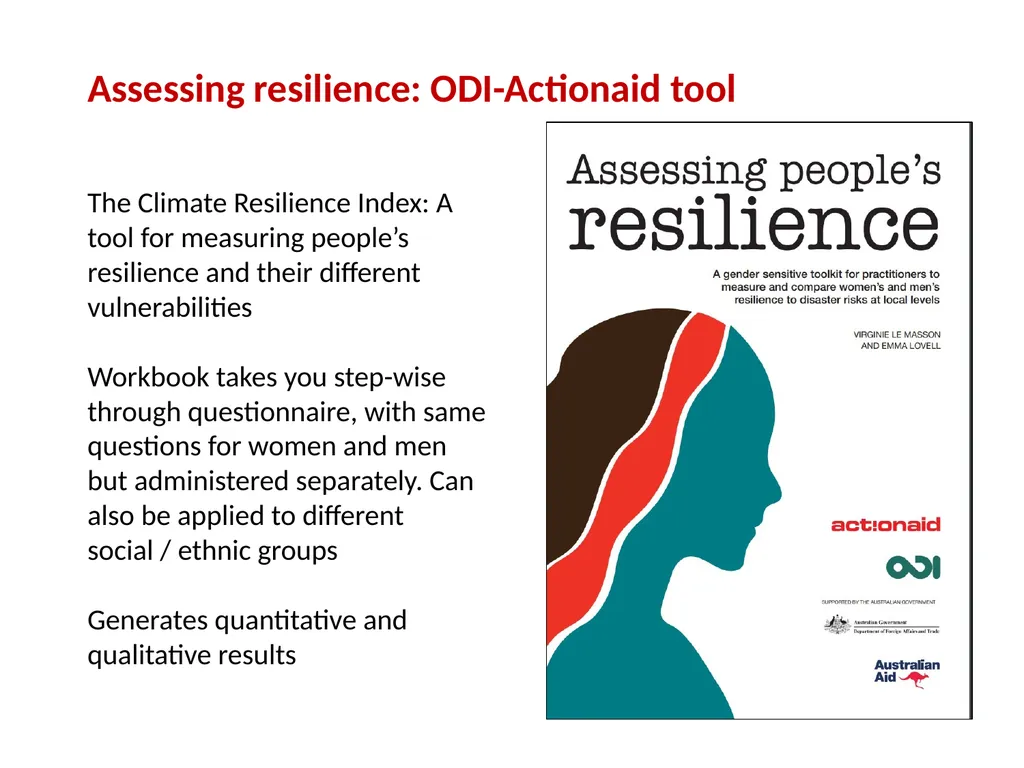
Assessing resilience: ODI-Actionaid tool The Climate Resilience Index: A tool for measuring people’s resilience and their different vulnerabilities
Workbook takes you step-wise through questionnaire, with same questions for women and men but administered separately. Can also be applied to different social / ethnic groups
Generates quantitative and qualitative results<br>
Workbook takes you step-wise through questionnaire, with same questions for women and men but administered separately. Can also be applied to different social / ethnic groups
Generates quantitative and qualitative results<br>
23
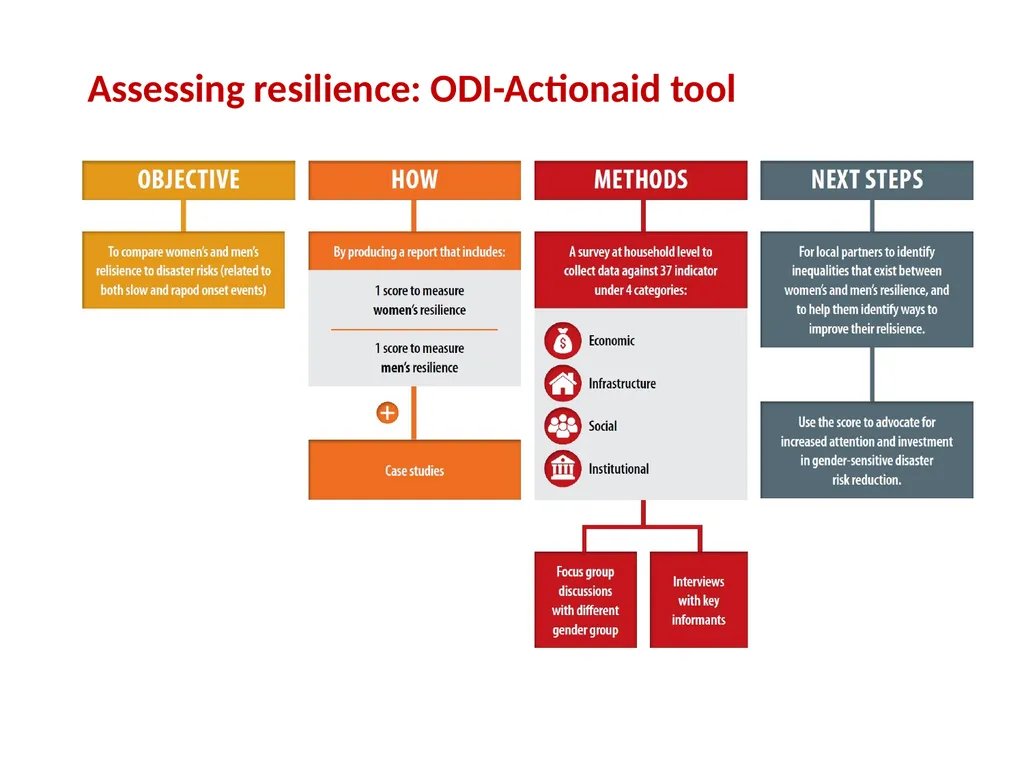
Assessing resilience: ODI-Actionaid tool<br>
24
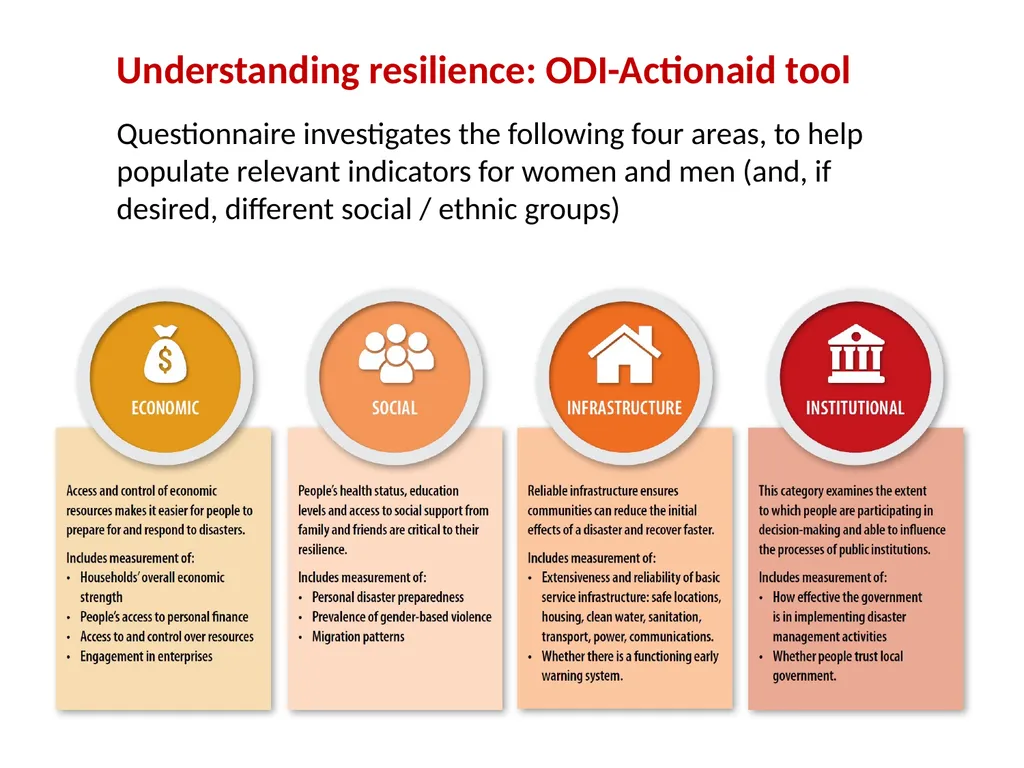
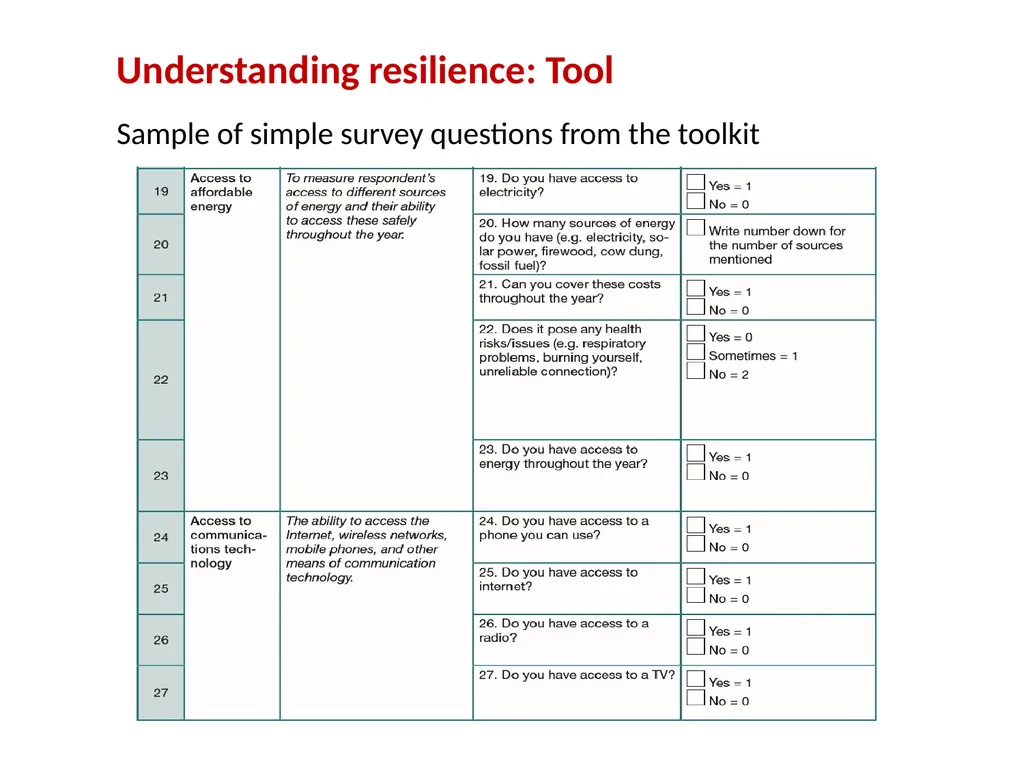
Understanding resilience: ODI-Actionaid tool Questionnaire investigates the following four areas, to help populate relevant indicators for women and men (and, if desired, different social / ethnic groups)<br>
25
Understanding resilience: Tool Sample of simple survey questions from the toolkit<br>
26
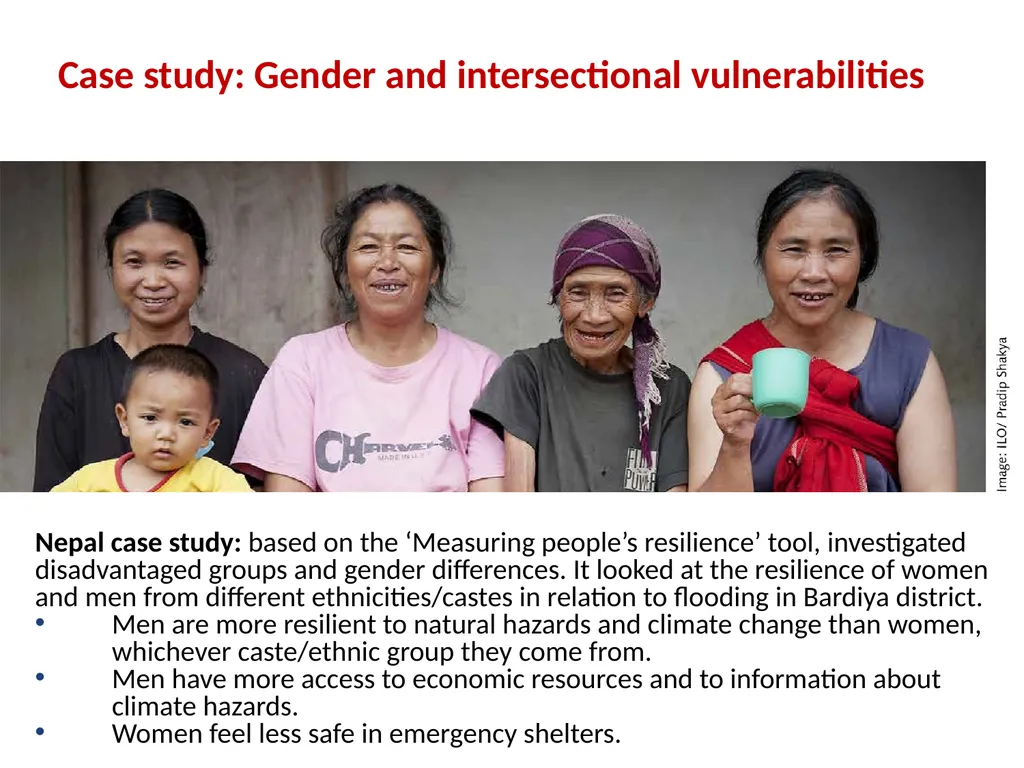
Case study: Gender and intersectional vulnerabilities Nepal case study: based on the ‘Measuring people’s resilience’ tool, investigated disadvantaged groups and gender differences. It looked at the resilience of women and men from different ethnicities/castes in relation to flooding in Bardiya district.
Men are more resilient to natural hazards and climate change than women, whichever caste/ethnic group they come from.
Men have more access to economic resources and to information about climate hazards.
Women feel less safe in emergency shelters.<br>
Men are more resilient to natural hazards and climate change than women, whichever caste/ethnic group they come from.
Men have more access to economic resources and to information about climate hazards.
Women feel less safe in emergency shelters.<br>
27
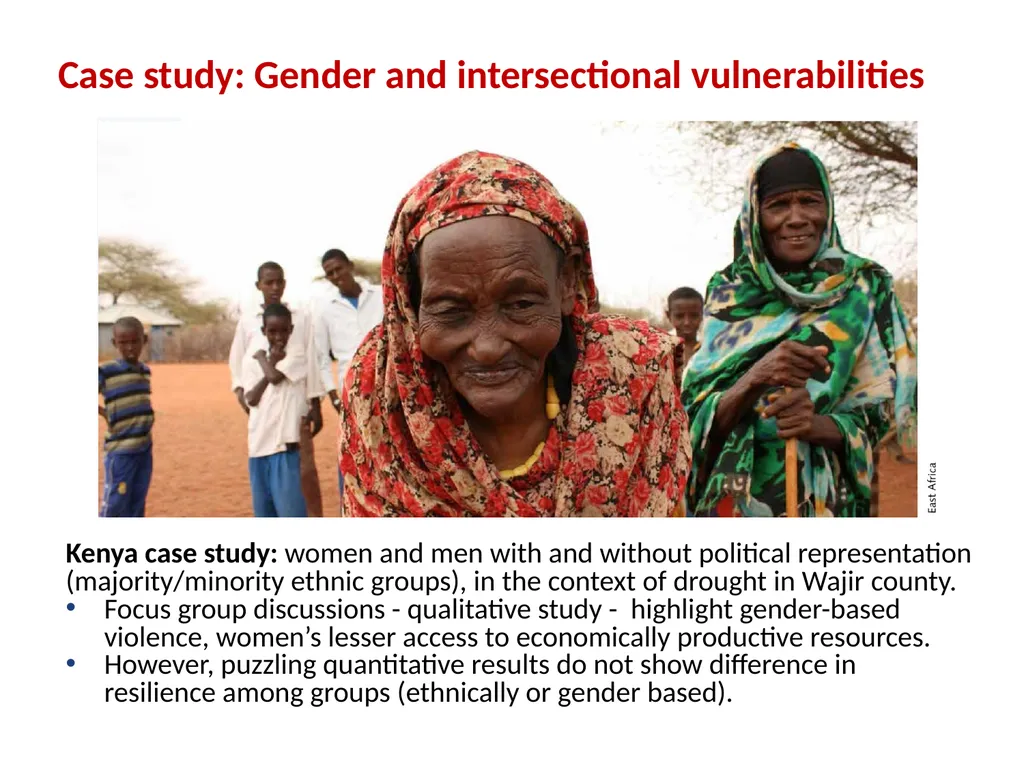
Case study: Gender and intersectional vulnerabilities Kenya case study: women and men with and without political representation (majority/minority ethnic groups), in the context of drought in Wajir county.
Focus group discussions - qualitative study - highlight gender-based violence, women’s lesser access to economically productive resources.
However, puzzling quantitative results do not show difference in resilience among groups (ethnically or gender based).<br>
Focus group discussions - qualitative study - highlight gender-based violence, women’s lesser access to economically productive resources.
However, puzzling quantitative results do not show difference in resilience among groups (ethnically or gender based).<br>
28
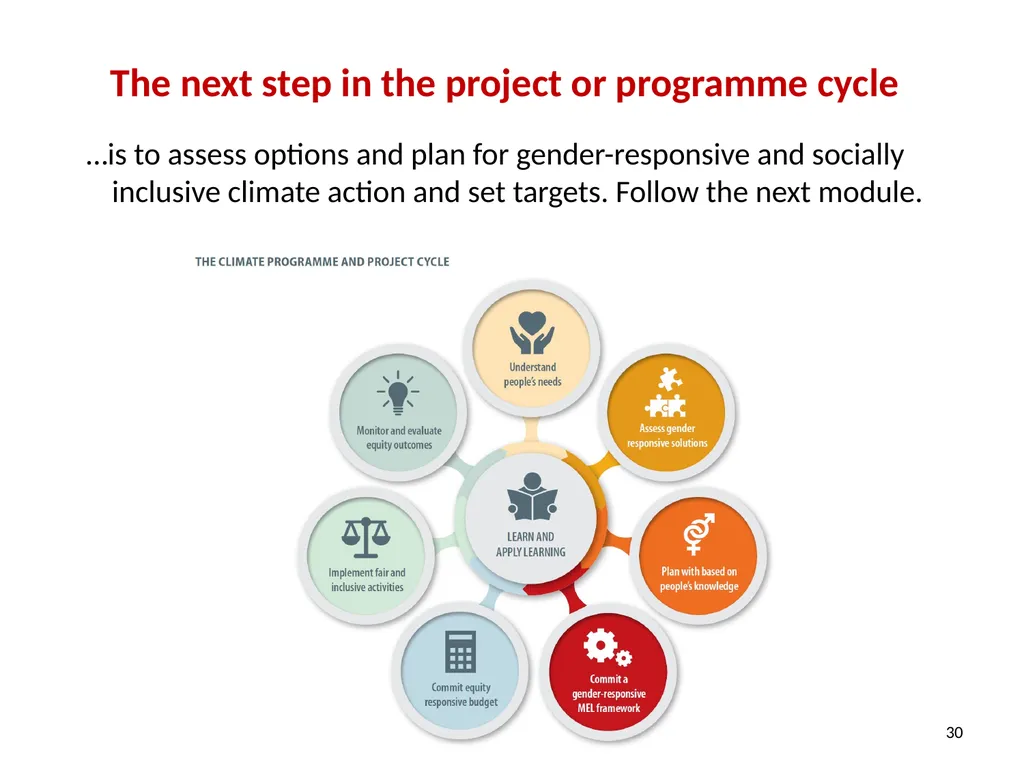
The next step in the project or programme cycle …is to assess options and plan for gender-responsive and socially inclusive climate action and set targets. Follow the next module. 30<br>
29
@cdknetwork www.cdkn.org<br>