General Assembly item VII. 2nd EDITION OF THE EUROPEAN BUSINESS VALUATION STANDARDS Ivars Strautiņš REV REV-BV (LĪVA), Chairman of the European Business Valuation Standards Board Thessaloniki, October 4, 2025 Change in the format of the
"General Assembly item VII. 2nd EDITION OF THE" is the property of its rightful owner. Permission is granted to
download and print the materials on this website for personal, non-commercial use only, and to display it
on your personal computer provided you do not modify the materials and that you retain all copyright
notices contained in the materials. By downloading content from our website, you accept the terms of this
agreement.
Presentation Transcript
01
General Assembly item VII. 2nd EDITION OF THE EUROPEAN BUSINESS VALUATION STANDARDS Ivars Strautiņš REV REV-BV (LĪVA), Chairman of the European Business Valuation Standards Board
Thessaloniki, October 4, 2025<br>
02
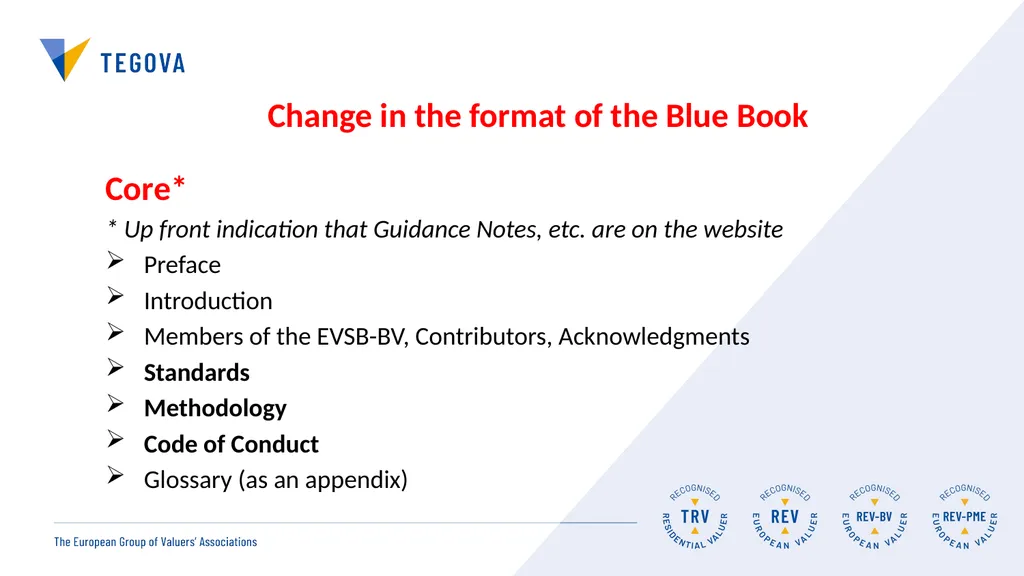
Change in the format of the Blue Book Core*
* Up front indication that Guidance Notes, etc. are on the website
Preface
Introduction
Members of the EVSB-BV, Contributors, Acknowledgments
Standards
Methodology
Code of Conduct
Glossary (as an appendix)<br>
03
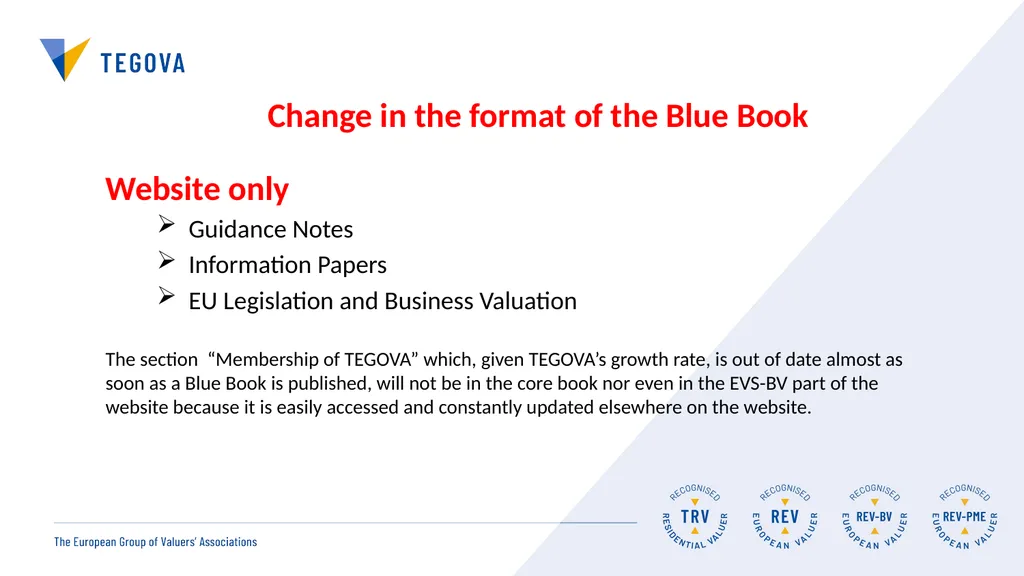
Change in the format of the Blue Book Website only
Guidance Notes
Information Papers
EU Legislation and Business Valuation
The section “Membership of TEGOVA” which, given TEGOVA’s growth rate, is out of date almost as soon as a Blue Book is published, will not be in the core book nor even in the EVS-BV part of the website because it is easily accessed and constantly updated elsewhere on the website.<br>
04
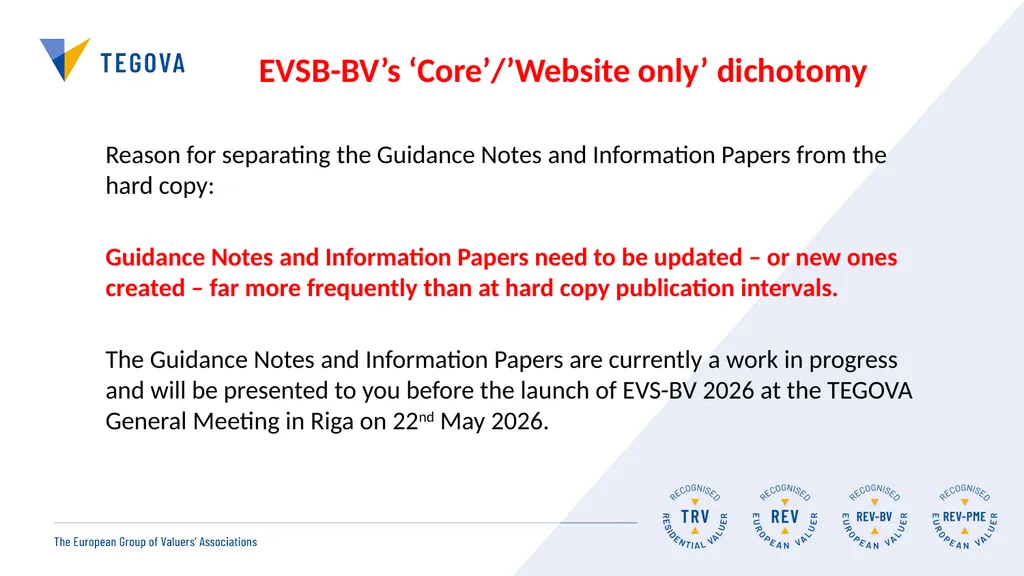
EVSB-BV’s ‘Core’/’Website only’ dichotomy Reason for separating the Guidance Notes and Information Papers from the hard copy:
Guidance Notes and Information Papers need to be updated – or new ones created – far more frequently than at hard copy publication intervals.
The Guidance Notes and Information Papers are currently a work in progress and will be presented to you before the launch of EVS-BV 2026 at the TEGOVA General Meeting in Riga on 22nd May 2026.<br>
05
The main novelty Change of acronym for the Book and the Standards:
‘EBVS’ becomes ‘EVS-BV’, because the Board and Assembly have decided to constantly focus on the ‘EVS family’.<br>
06
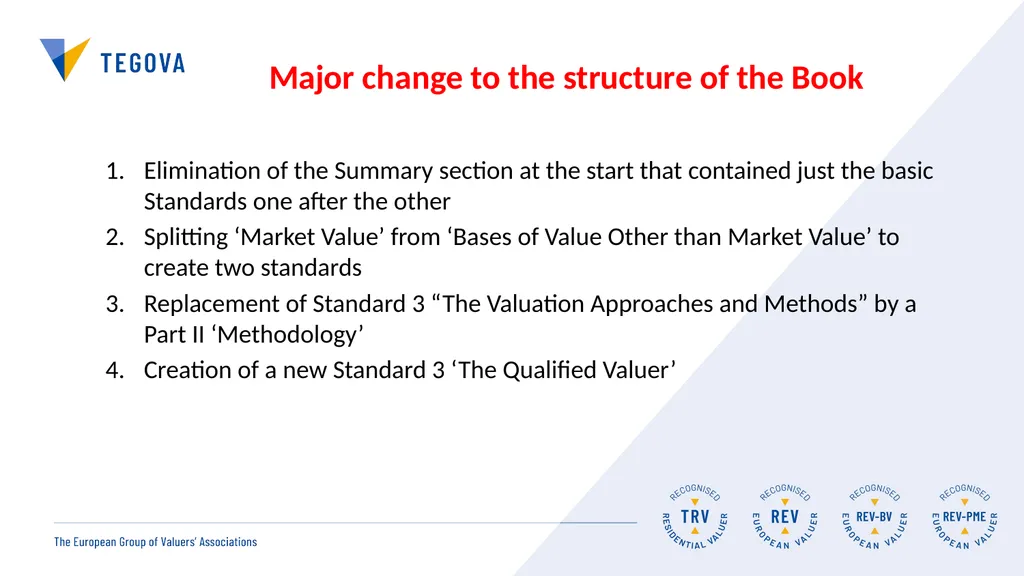
Major change to the structure of the Book Elimination of the Summary section at the start that contained just the basic Standards one after the other
Splitting ‘Market Value’ from ‘Bases of Value Other than Market Value’ to create two standards
Replacement of Standard 3 “The Valuation Approaches and Methods” by a Part II ‘Methodology’
Creation of a new Standard 3 ‘The Qualified Valuer’<br>
07
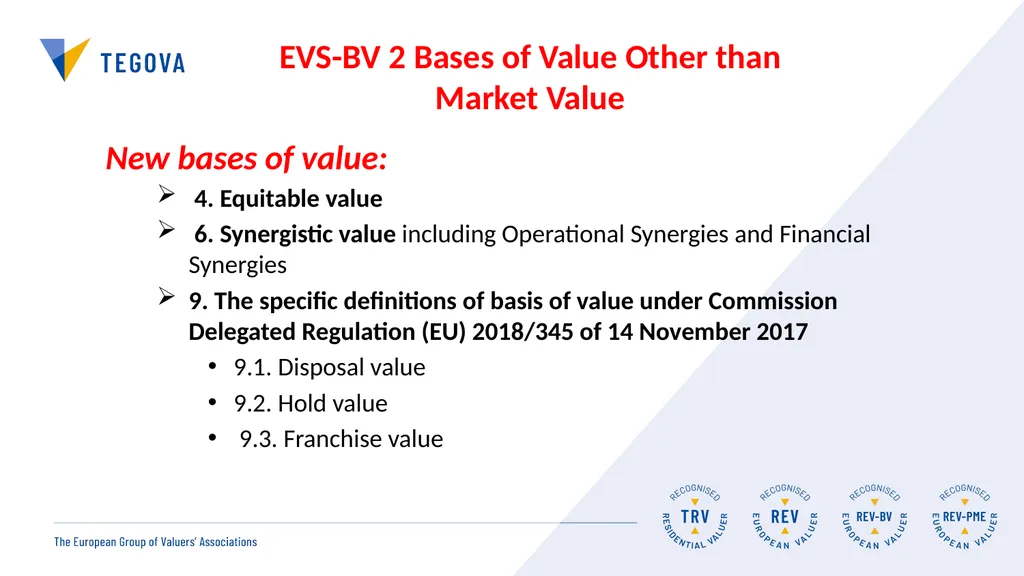
EVS-BV 2 Bases of Value Other than Market Value New bases of value:
4. Equitable value
6. Synergistic value including Operational Synergies and Financial Synergies
9. The specific definitions of basis of value under Commission Delegated Regulation (EU) 2018/345 of 14 November 2017
9.1. Disposal value
9.2. Hold value
9.3. Franchise value<br>
08
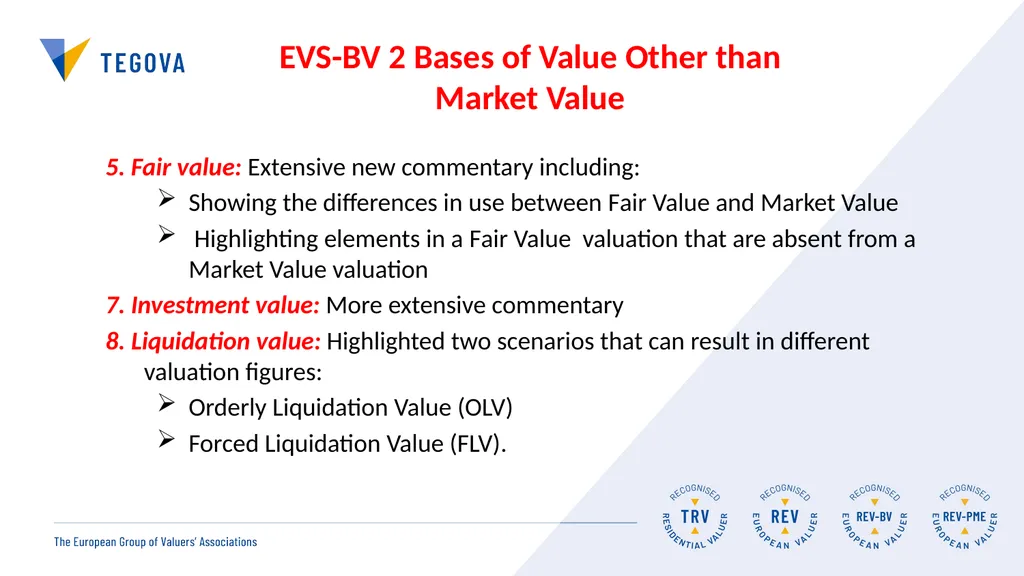
EVS-BV 2 Bases of Value Other than Market Value 5. Fair value: Extensive new commentary including:
Showing the differences in use between Fair Value and Market Value
Highlighting elements in a Fair Value valuation that are absent from a Market Value valuation
7. Investment value: More extensive commentary
8. Liquidation value: Highlighted two scenarios that can result in different valuation figures:
Orderly Liquidation Value (OLV)
Forced Liquidation Value (FLV).<br>
09
EVS-BV 3 The Qualified Valuer A new Standard setting qualification criteria in line with TEGOVA’s Educational Requirements for Business Valuers (TER-BV).
Other highlighted aspects :
Enhanced competence (CPD)
Independence of the valuer and conflicts of interest
The business valuer’s liability.<br>
10
EVS-BV 4 The Valuation Process A new section on the purposes for which the valuation of a company is required
Following the other Blue Books, a section on external environment (i.e. Market) analysis.
New sections:
9.2. Valuation uncertainty
9.3. Risk and discount/capitalisation rates (principles)
9.4. Allocation across complex capital structures
9.6. General statement on Intangible assets valuation.
11. Supporting the valuation (completely rewritten).<br>
11
EVS-BV 5 Reporting the Valuation Aligns with the other Blue Books with a Valuation Report definition.
Aligns with the other Blue Books and transfers ‘Valuation Review’ from EVS-BV 4 ‘The Valuation Process’ to EVS-BV 5 ‘The Valuation Report’ because a valuation review is not a valuation.
Aligns with other Books with an annex “Content of the Valuation Report”.
See in particular:
Section B. Internal and External Environment Analysis including a subsection on ESG materiality statement
Section C Business Modelling<br>
12
Part II Valuation Methodology Contains much of what was in the first edition’s now defunct standard 3 ‘The Valuation Approaches and Methods’ but is more extensive.
Some examples of new or substantially reviewed elements are:
DCF valuation (5.2.2.9. Free cash flow and Free cash flow to equity)
Increased coverage of sensitivity analysis (5.2.2.15.)
Valuation methods within the Asset-based Approach (5.4.)<br>
13
What will come the next? EVSB-BV will continue the work on the part of the standards, to be published on the TEGOVA website, i.e. :
Review and updating the 3 existing European Business Valuation Guidance Notes (EBVGN)
Preparation of new EBVGNs (e.g. Choice of multiples in the Market (Comparable) Approach, Financial assets valuation, Start-up valuation, Business modeling)
Preparation of Valuation Information Papers (e.g. Valuation uncertainty, ESG and business valuation)
Introducing a new chapter on TEGOVA education requirements for business valuers (TER-BV) and REV-BV qualification requirements
Update of the chapter European Union Legislation and Business Valuation<br>
14
On behalf of the EVSB-BV, I thank you for your attention and look forward to your approval of the 2nd EDITION OF THE EUROPEAN BUSINESS VALUATION STANDARDS EVS-BV 2026<br>