
Giving Content to Investor Sentiment: The Role of
AS
Published · 17 slides · 0 views

1 / 1


Description
Giving Content to Investor Sentiment: The Role of Media in the Stock Market Paper Author: Paul C. Tetlock Presenter: Yutong Xiong Overview Based on a casual observation that the content of news about the stock market could be linked to
Related Topics
Share
Embed code
Download this presentation From Below
"Giving Content to Investor Sentiment: The Role of" is the property of its rightful owner. Permission is granted to download and print the materials on this website for personal, non-commercial use only, and to display it on your personal computer provided you do not modify the materials and that you retain all copyright notices contained in the materials. By downloading content from our website, you accept the terms of this agreement.
Presentation Transcript
01
Giving Content to Investor Sentiment: The Role of Media in the Stock Market Paper Author: Paul C. Tetlock
Presenter: Yutong Xiong<br>
Presenter: Yutong Xiong<br>
02
Overview Based on a casual observation that the content of news about the stock market could be linked to investor psychology and sociology (how?)
Attempts to quantitatively characterize the relationship between the content of media reports and daily stock market activity, focusing on the immediate influence of the WSJ’s “Abreast of the Market” column on U.S. stock market returns
Conclusions:
a) high media pessimism predicts downward pressure on market prices followed by a reversion to fundamentals,
b) unusually high or low pessimism predicts high market trading volume,
c) consistency with theoretical models of noise and liquidity traders,
d) inconsistency with theories of media content as a proxy for new information about fundamental asset values, as a proxy for market volatility, or as a sideshow with no relationship to asset markets.<br>
03
Theory and Models Most theoretical models of investor sentiment (e.g. DeLong et al.) have 2 key assumptions:
a) 2 types of traders: noise traders with random beliefs about future dividends; rational arbitrageurs with Bayesian beliefs (in this paper level of noise traders’ beliefs relative to Bayesian beliefs is investor sentiment)
b) both types of traders have downward-sloping demand for risky assets because they are risk averse, capital constrained or impaired from freely buying and selling risky assets
An equilibrium in which noise traders’ random beliefs about future dividends influence prices
Models of investor sentiment predict that low sentiment will generate downward price pressure and unusually high or low values of sentiment will generate high volume
Models of trade for noninformational reasons such as liquidity needs make same prediction
Campbell, Grossman and Wang (1993) model how changes in level of risk aversion for large subset of investors can affect short-term returns<br>
04
Theory and Hypothesis<br>
05
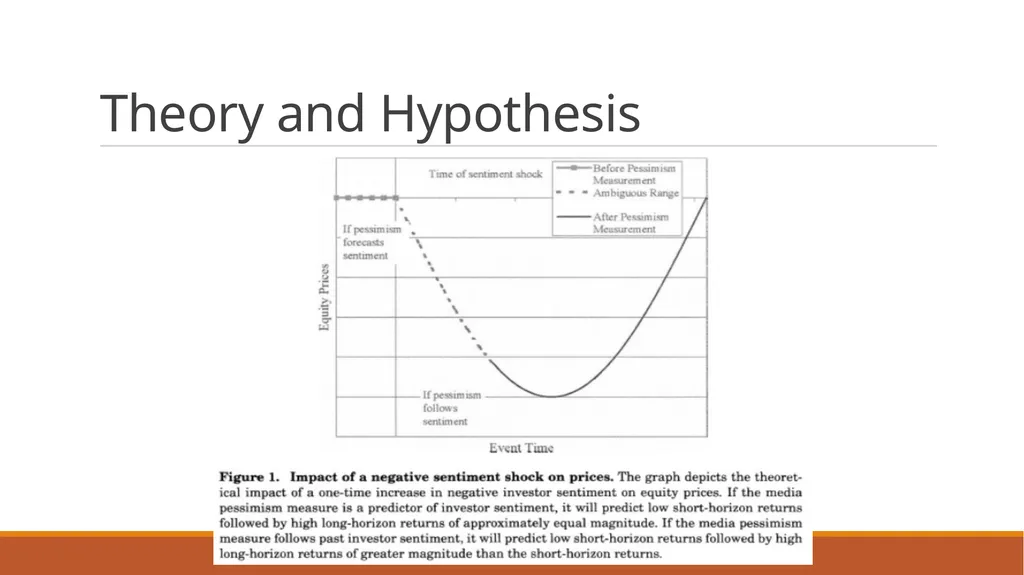
Theory and Hypothesis The media pessimism measure is a proxy for negative information about the fundamental values of equities that is not currently incorporated into prices; negative relationship between media pessimism and short-horizon returns
Sentiment theory: short-horizon returns will be reversed in long run; Information theory: short horizon returns will persist indefinitely
Theory of media pessimism that it is a proxy for negative information about dividends that is already incorporated into prices, so pessimism has no effect on future market activity
Sentiment theory also predicts that if media pessimism either reflects past or predicts future investor sentiment, unusually high or low levels of pessimism should be associated with increases in trading volume<br>
06
Quantitative Analysis – Generating Pessimism Media Factor Using General Inquirer (GI) to convert the WSJ column into numeric values, i.e. it counts the number of words in each day’s column that fall within various word categories
To minimize semantic and stylistic noise in the column, recenter all GI categories so that their conditional means are equal across different days of the week
Employ a principal components factor analysis to extract the most important semantic component from the variance-covariance matrix of the categories
Choose the vector in the GI category space with the greatest variance which is the single factor that captures the maximum variation in GI categories
Construct media factor using only information available to traders, by estimating the factor loading in year t-1 using principal components analysis and use those loadings and daily word counts in year t to calculate the values of the factor throughout year t
Pessimism factor (first media factor): the average of the first eigenvalue in each yearly factor analysis in terms of the underlying GI categories. On days when the WSJ column loads highly on this factor, it probably contains negative interpretations of market events<br>
07
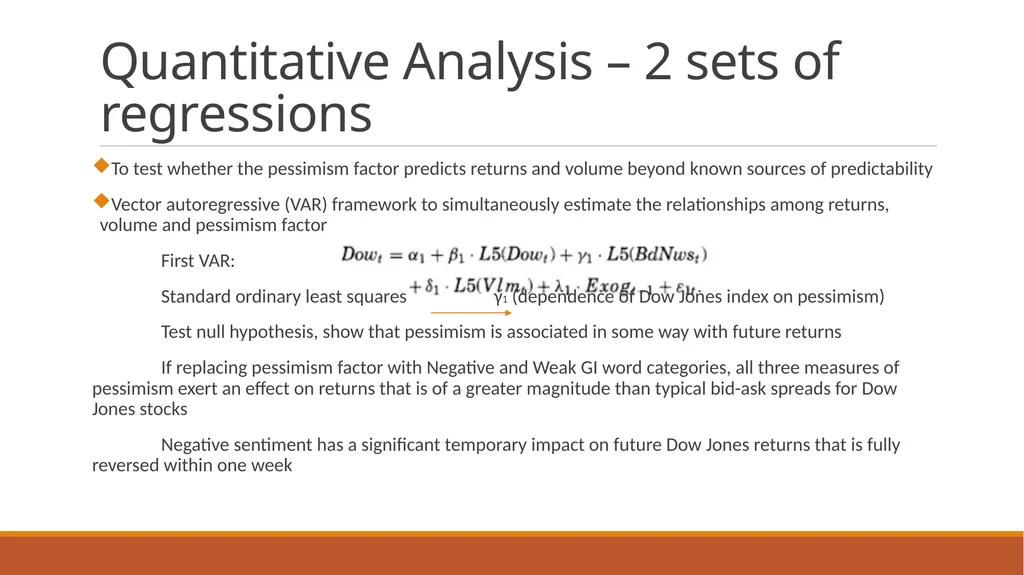
Quantitative Analysis – 2 sets of regressions To test whether the pessimism factor predicts returns and volume beyond known sources of predictability
Vector autoregressive (VAR) framework to simultaneously estimate the relationships among returns, volume and pessimism factor
First VAR:
Standard ordinary least squares γ1 (dependence of Dow Jones index on pessimism)
Test null hypothesis, show that pessimism is associated in some way with future returns
If replacing pessimism factor with Negative and Weak GI word categories, all three measures of pessimism exert an effect on returns that is of a greater magnitude than typical bid-ask spreads for Dow Jones stocks
Negative sentiment has a significant temporary impact on future Dow Jones returns that is fully reversed within one week<br>
08
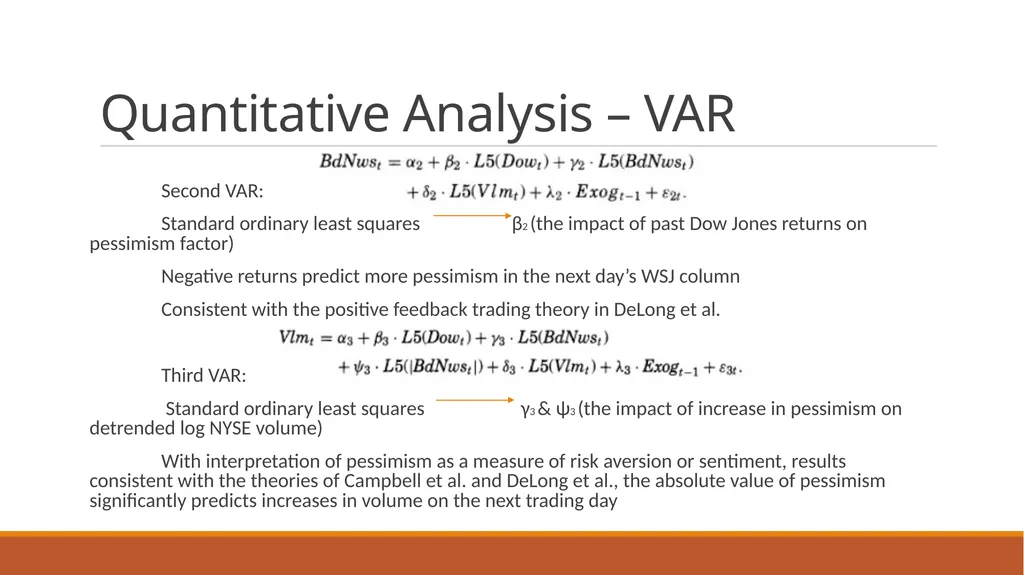
Quantitative Analysis – VAR Second VAR:
Standard ordinary least squares β2 (the impact of past Dow Jones returns on pessimism factor)
Negative returns predict more pessimism in the next day’s WSJ column
Consistent with the positive feedback trading theory in DeLong et al.
Third VAR:
Standard ordinary least squares γ3 & ψ3 (the impact of increase in pessimism on detrended log NYSE volume)
With interpretation of pessimism as a measure of risk aversion or sentiment, results consistent with the theories of Campbell et al. and DeLong et al., the absolute value of pessimism significantly predicts increases in volume on the next trading day<br>
09
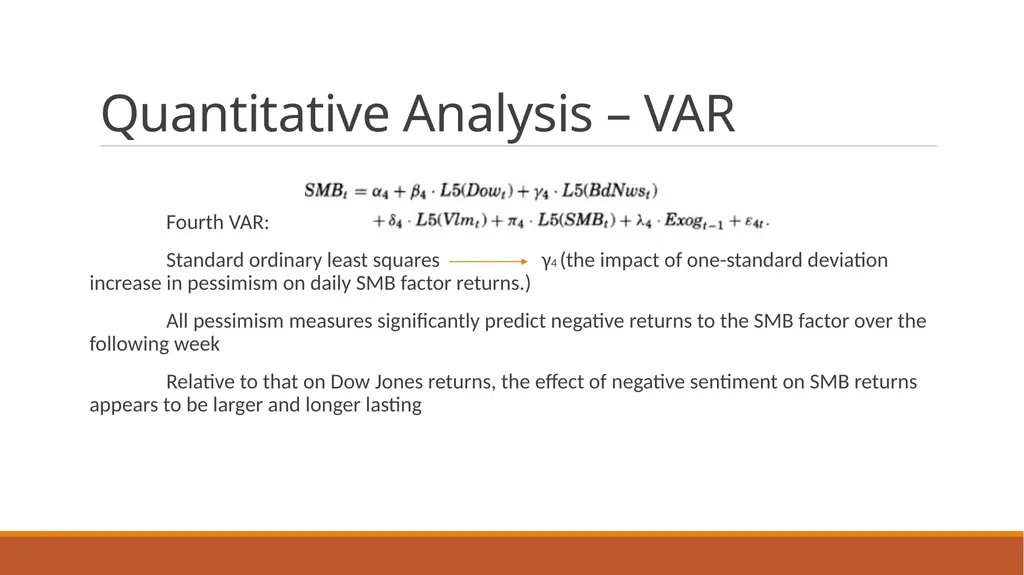
Quantitative Analysis – VAR Fourth VAR:
Standard ordinary least squares γ4 (the impact of one-standard deviation increase in pessimism on daily SMB factor returns.)
All pessimism measures significantly predict negative returns to the SMB factor over the following week
Relative to that on Dow Jones returns, the effect of negative sentiment on SMB returns appears to be larger and longer lasting<br>
10
Quantitative Analysis – Robustness & Sensitivity Analysis Investigate the possibility that some previous regression results could be consistent with theories of media content as a proxy for information about fundamental asset values
Is it possible that a slight time lag between the release of WSJ column and its incorporation into prices is driving the return and volume predictability results?
Whether the predictive power of the pessimism factor is concentrated in after-hours and opening hours returns, or is dispersed uniformly throughout the trading day?<br>
11
Quantitative Analysis – Robustness & Sensitivity Analysis Reestimate the regressions with a return window that allows traders more time to react to any information released in the afternoon
Allow traders some time to react to the same information reprinted in WSJ the next morning
The measures of negative sentiment have their largest impact later in the trading day
Changes in market returns that follow pessimistic media content are dispersed throughout the trading day rather than concentrated after the release of information
The impact of negative sentiment on returns is either fully or mostly reversed over the next few day<br>
12
Quantitative Analysis – Robustness & Sensitivity Analysis Sentiment plays a significant role in forecasting temporary market-wide declines in valuation
Sentiment predicts especially large and persistent declines in the returns of small stocks, suggesting sentiment measures individual traders’ views
Sentiment has a much larger and more sudden impact on returns during the 1990s, suggesting sentiment affected valuations more during this time periods
Identify return and volume patterns consistent with the hypothesis that the 3 variables selected by a factor analysis of words in the WSJ are valid sentiment indicators<br>
13
Economic Importance Success of pessimism in forecasting returns suggests that investors who read the Dow Jones Newswires can devise profitable trading strategies based on daily variation in pessimism
A straightforward computer program that can automatically process the electronic text of the Dow Jones Newswires column
The program can calculate the daily value of pessimism and use predetermined coefficients to forecast future returns
Depending on whether the forecast is positive or negative, the media-based trading strategy would go long or short on the Dow Jones Index
Important disclaimer: any daily trading strategy will incur transaction costs, price impact costs, and capital gains taxes that may be prohibitive
Depending on the size of transaction, costs attributable to bid-ask spreads and finite market depth may exceed the cutoff value for eliminating the profitability of a pessimism-based trading strategy<br>
14
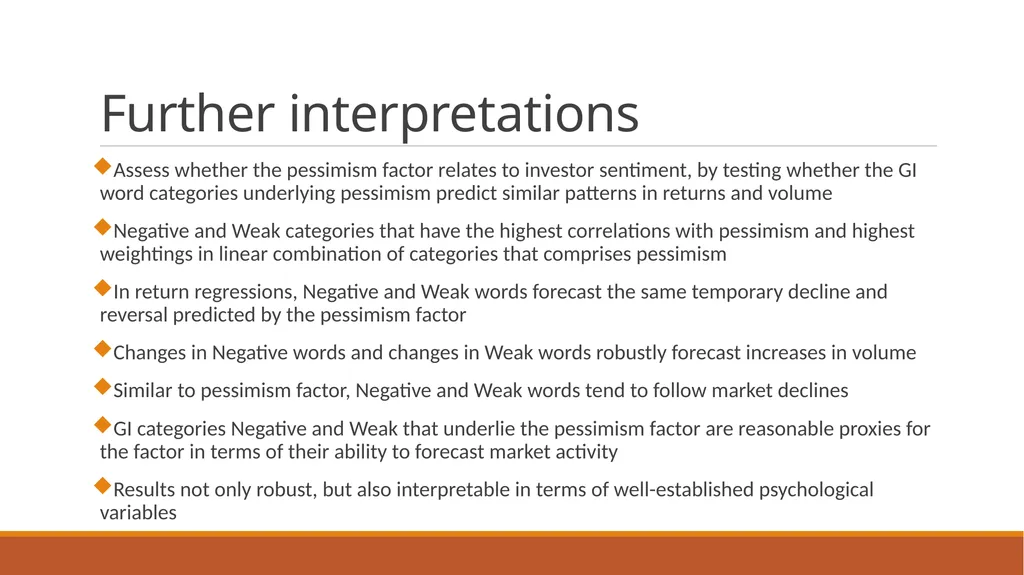
Further interpretations Assess whether the pessimism factor relates to investor sentiment, by testing whether the GI word categories underlying pessimism predict similar patterns in returns and volume
Negative and Weak categories that have the highest correlations with pessimism and highest weightings in linear combination of categories that comprises pessimism
In return regressions, Negative and Weak words forecast the same temporary decline and reversal predicted by the pessimism factor
Changes in Negative words and changes in Weak words robustly forecast increases in volume
Similar to pessimism factor, Negative and Weak words tend to follow market declines
GI categories Negative and Weak that underlie the pessimism factor are reasonable proxies for the factor in terms of their ability to forecast market activity
Results not only robust, but also interpretable in terms of well-established psychological variables<br>
15
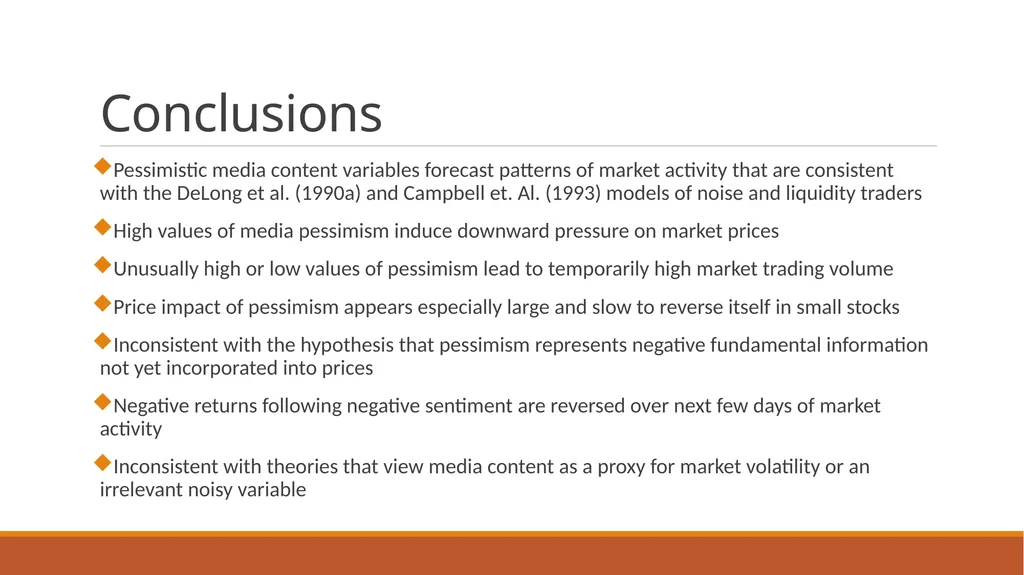
Conclusions Pessimistic media content variables forecast patterns of market activity that are consistent with the DeLong et al. (1990a) and Campbell et. Al. (1993) models of noise and liquidity traders
High values of media pessimism induce downward pressure on market prices
Unusually high or low values of pessimism lead to temporarily high market trading volume
Price impact of pessimism appears especially large and slow to reverse itself in small stocks
Inconsistent with the hypothesis that pessimism represents negative fundamental information not yet incorporated into prices
Negative returns following negative sentiment are reversed over next few days of market activity
Inconsistent with theories that view media content as a proxy for market volatility or an irrelevant noisy variable<br>
16
My Thoughts Links psychological issues with financial market
Provides practical suggestion on a type of trading strategy
Thorough robustness and sensitivity tests
Involves data mining concepts and methods
Quantitative and qualitative
Well-structured<br>
Provides practical suggestion on a type of trading strategy
Thorough robustness and sensitivity tests
Involves data mining concepts and methods
Quantitative and qualitative
Well-structured<br>
17
Citation Paul C. Tetlock. “Giving Content to Investor Sentiment: The Role of Media in the Stock Market.” The Journal of Finance, vol. 62, no. 3, 2007, pp. 1139–1168. JSTOR, www.jstor.org/stable/4622297.<br>