Glasgow Rent Strikes, 1915 By the end of the lesson you will be able to: Explain why the Glasgow Rent Strikes occurred Describe what happened during the strikes Explain why the strikes were so significant Write a newspaper report to show
"Glasgow Rent Strikes, 1915 By the end of the" is the property of its rightful owner. Permission is granted to
download and print the materials on this website for personal, non-commercial use only, and to display it
on your personal computer provided you do not modify the materials and that you retain all copyright
notices contained in the materials. By downloading content from our website, you accept the terms of this
agreement.
Presentation Transcript
01
Glasgow Rent Strikes, 1915<br>
02
By the end of the lesson you will be able to: Explain why the Glasgow Rent Strikes occurred
Describe what happened during the strikes
Explain why the strikes were so significant
Write a newspaper report to show your understanding
Peer assess an article<br>
03
Background By 1915 Glasgow’s houses were full of munitions workers
Housing was poor quality, and made worse by lack of materials/workers during wartime
Landlords did not help – instead, they increased rents e.g. in Govan, rents increased by 14-23%
Landlords thought people would pay as they needed somewhere to live
Women were threatened with eviction if they did not pay up<br>
04
Fighting Back Feb 1915 – Helen Crawfurd, Mary Barbour, Agnes Dollan & Jessie Stephens formed the Glasgow Women’s Housing Association
By Nov 1915, 20,000 tenants were refusing to pay rent increases
Women tried to stop evictions by blocking tenement entrances & throwing bags of flour at eviction officers
Drums, bells or trumpets would be used as a warning sound to let people know that eviction officers were in the area<br>
05
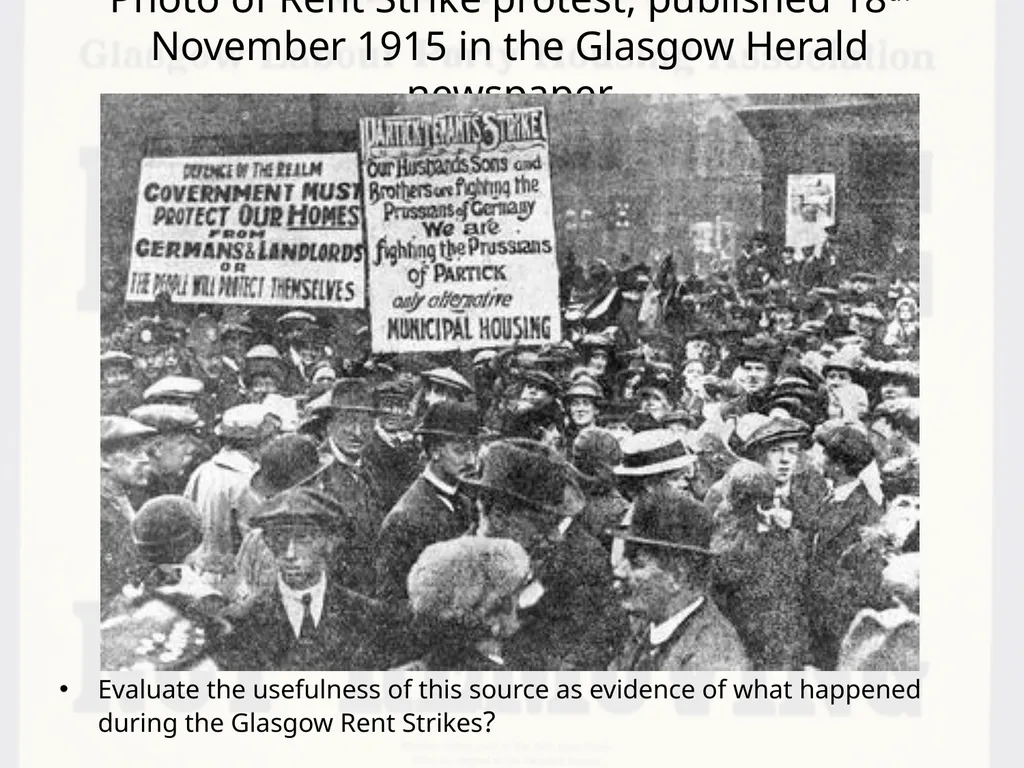
Photo of Rent Strike protest, published 18th November 1915 in the Glasgow Herald newspaper Evaluate the usefulness of this source as evidence of what happened during the Glasgow Rent Strikes?<br>
06
Government Response Government worried that vital war effort on Clyde would be interrupted by strikes – employers began supporting the strikes e.g. Fairfields shipbuilding stated none of their workers would move into a house of an evicted person
17th Nov – Demonstration at George Square to protest against arrest of 18 tenants for not paying rent increases
Government very worried<br>
07
A Solution? 1915 Rent Restriction Act – rents were frozen at 1st Aug 1914 levels
This act was to last for 6 months after the war
BUT rent increases occurred after war
More protests – demo and Glasgow Green & tenants putting signs in their windows to state that they would not pay rent increases
1920 Rent Restriction Act – rents could not be increased without giving tenant choice to leave first
1925 – end of Rent Strike movement<br>
08
Significance of Rent Strikes Showed how ordinary people could organised themselves to protest against authority
Proved that women were politically aware
Proved that change could be brought about by public protest – ‘power of the people’<br>
09
Anti-war movement Not all agreed with the war.
Helen Crawfurd, one of the leaders of the rent strikes, on 10 June 1916, launched the Women’s Peace Crusade: the first concerted attempt to involve people in all social classes to oppose the war.
By summer 1917 there were branches all over Scotland and it attracted 14,000 protesters to a mass meeting held on Glasgow Green.
Other organisations included the Women’s International League for Peace and Freedom, founded by Chrystal Macmillan, a graduate of Edinburgh University.<br>