Global Citizenship and New Educational Agenda Gwang-Chol Chang Education Policy and Reform Unit UNESCO Bangkok Regional Consultative Meetings on SEA-BES and SEA-PLM Penang, Malaysia, November 4-5, 2014 Outline Growing interest in Global
"Global Citizenship and New Educational Agenda" is the property of its rightful owner. Permission is granted to
download and print the materials on this website for personal, non-commercial use only, and to display it
on your personal computer provided you do not modify the materials and that you retain all copyright
notices contained in the materials. By downloading content from our website, you accept the terms of this
agreement.
Presentation Transcript
01
Global Citizenship and New Educational Agenda Gwang-Chol Chang
Education Policy and Reform Unit
UNESCO Bangkok Regional Consultative Meetings on SEA-BES and SEA-PLM
Penang, Malaysia,
November 4-5, 2014<br>
02
Outline Growing interest in Global Citizenship Education (GCED)
What is GCED and its core competencies?
Monitoring and measuring
Way forward<br>
03
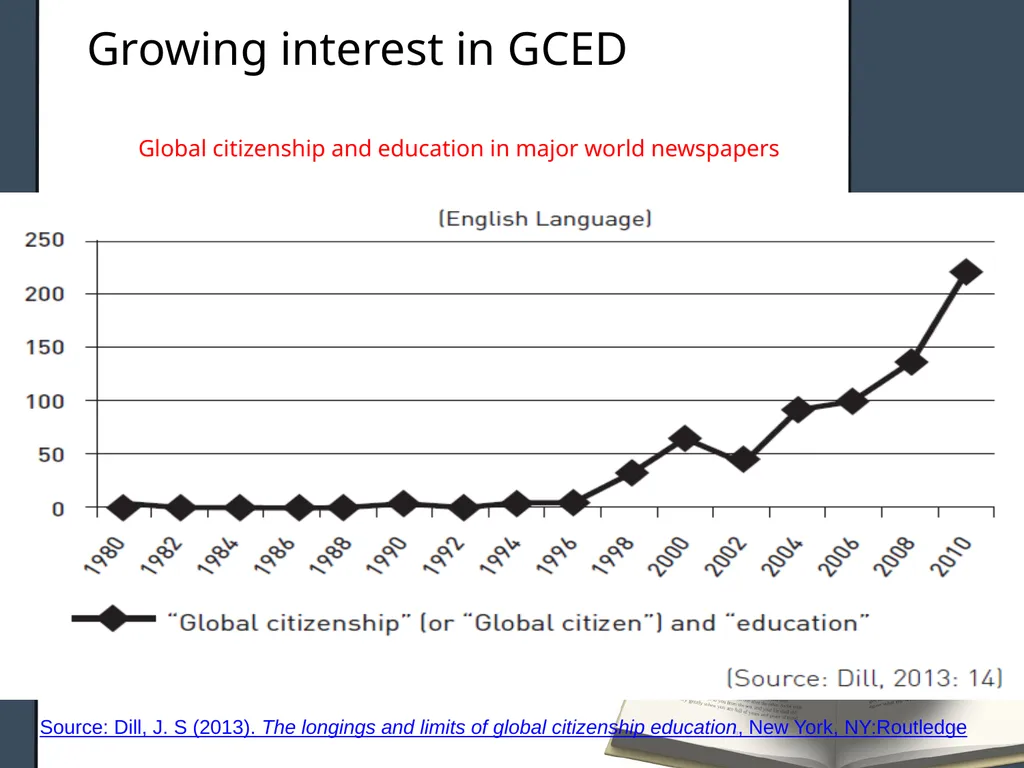
Growing interest in GCED Global citizenship and education in major world newspapers Source: Dill, J. S (2013). The longings and limits of global citizenship education, New York, NY:Routledge<br>
04
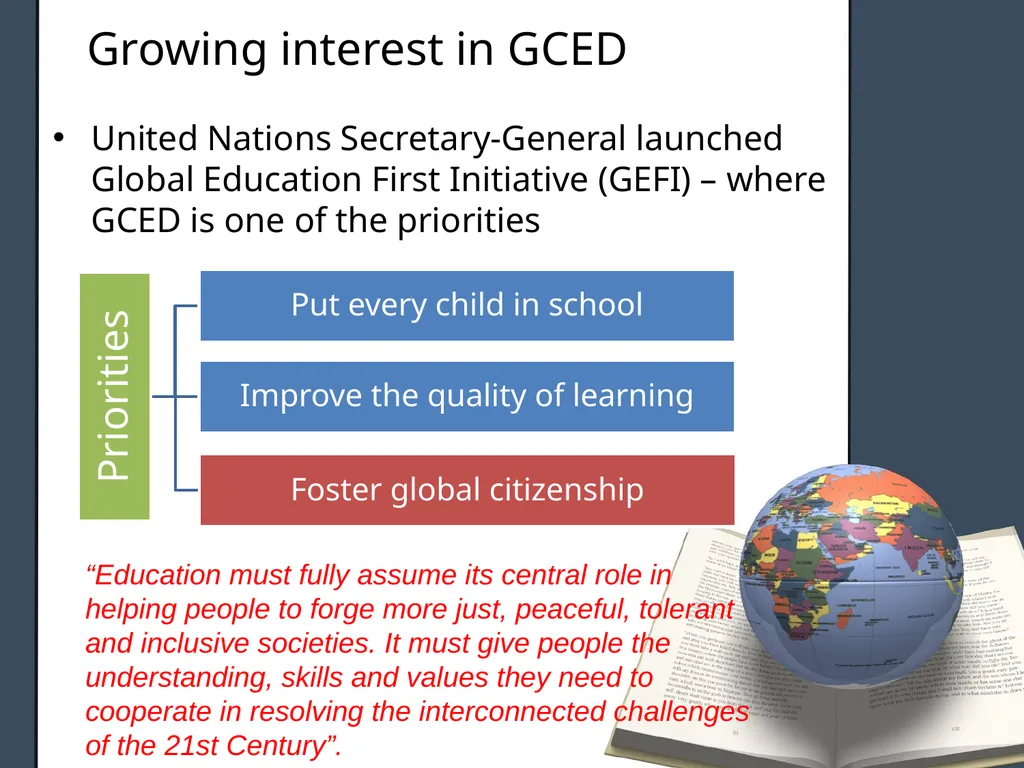
Growing interest in GCED United Nations Secretary-General launched Global Education First Initiative (GEFI) – where GCED is one of the priorities “Education must fully assume its central role in helping people to forge more just, peaceful, tolerant and inclusive societies. It must give people the understanding, skills and values they need to cooperate in resolving the interconnected challenges of the 21st Century”.<br>
05
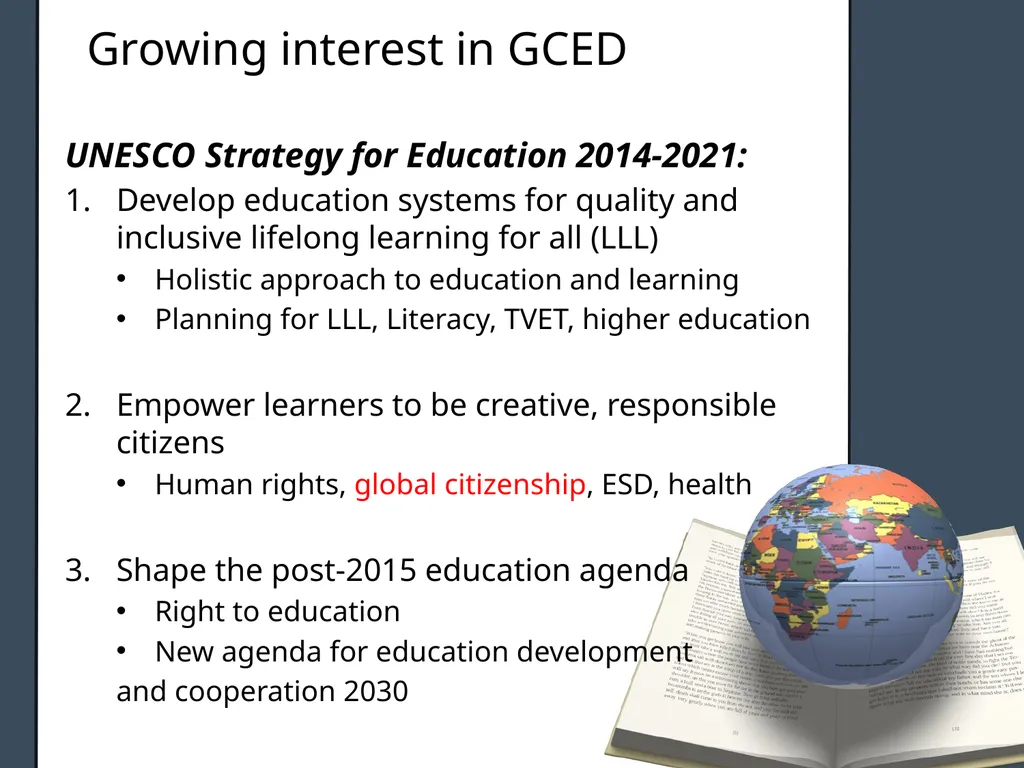
UNESCO Strategy for Education 2014-2021:
Develop education systems for quality and inclusive lifelong learning for all (LLL)
Holistic approach to education and learning
Planning for LLL, Literacy, TVET, higher education
Empower learners to be creative, responsible citizens
Human rights, global citizenship, ESD, health
Shape the post-2015 education agenda
Right to education
New agenda for education development
and cooperation 2030 Growing interest in GCED<br>
06
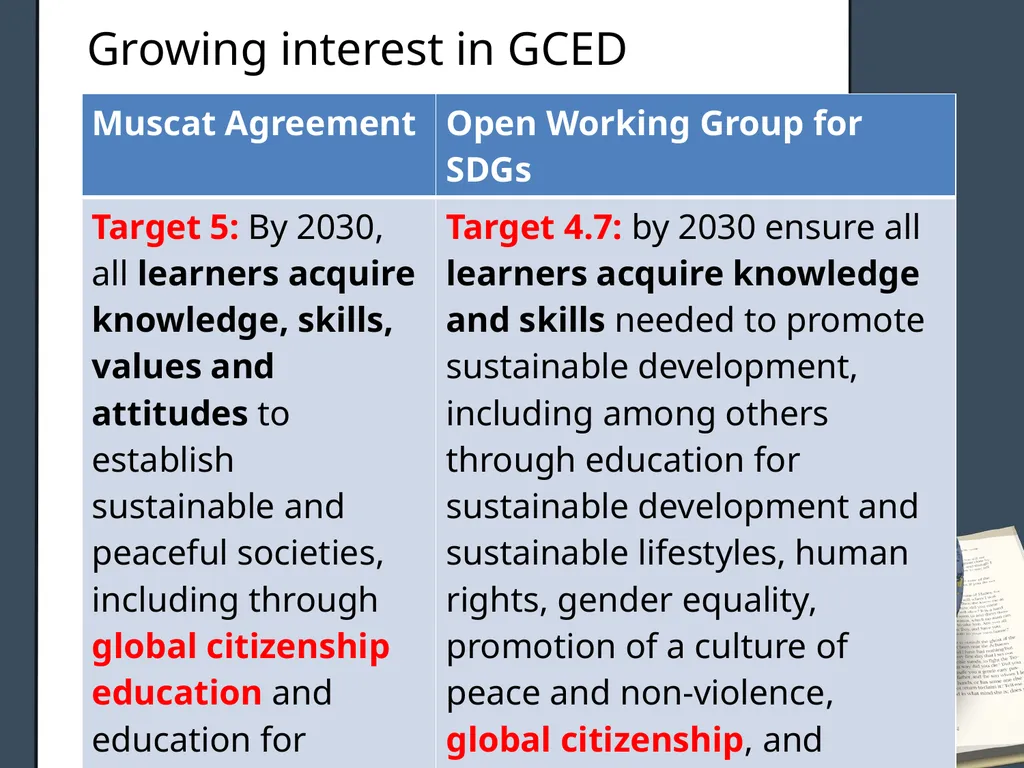
Growing interest in GCED<br>
07
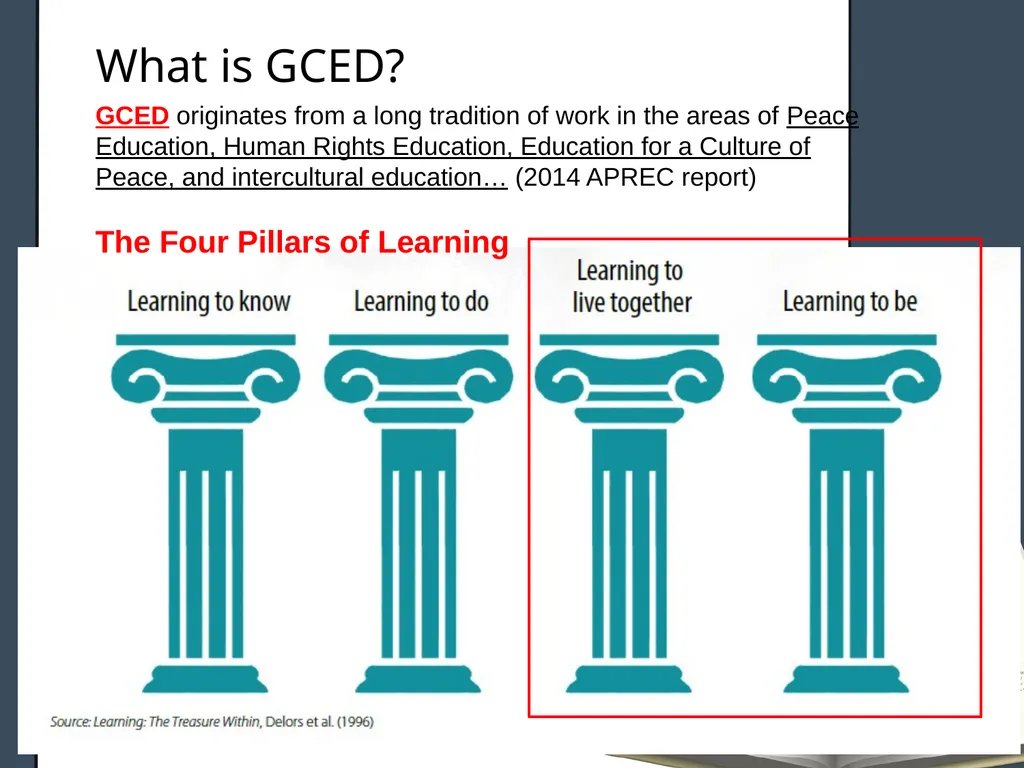
The Four Pillars of Learning What is GCED? GCED originates from a long tradition of work in the areas of Peace Education, Human Rights Education, Education for a Culture of Peace, and intercultural education… (2014 APREC report)<br>
08
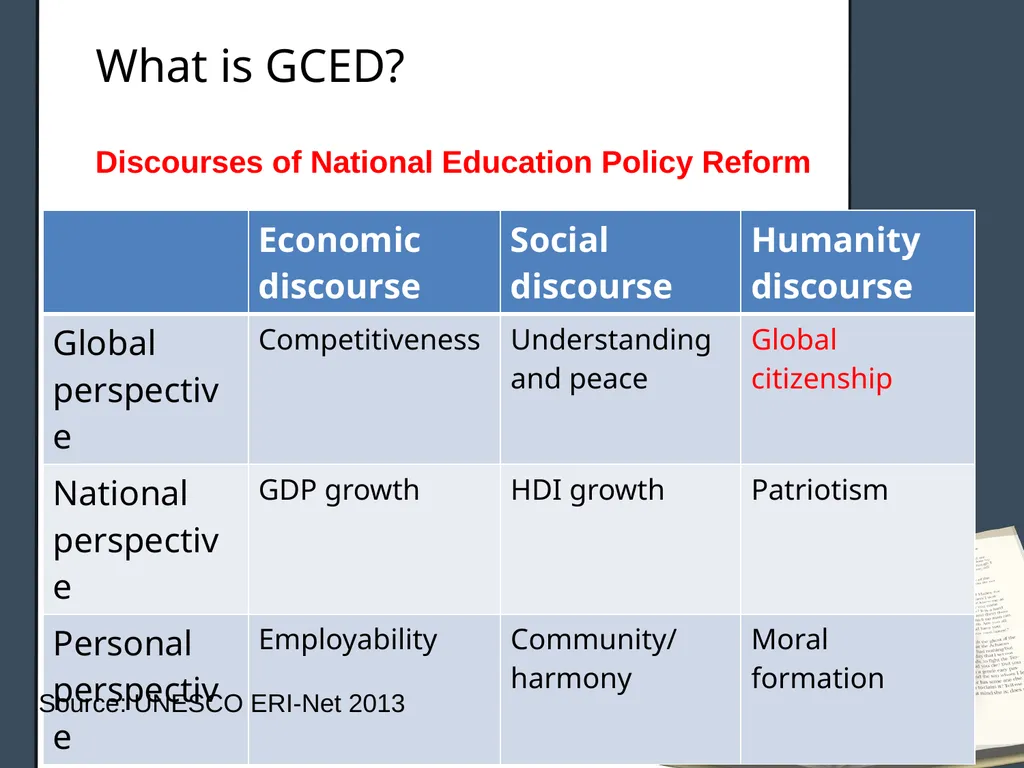
Discourses of National Education Policy Reform What is GCED? Source: UNESCO ERI-Net 2013<br>
09
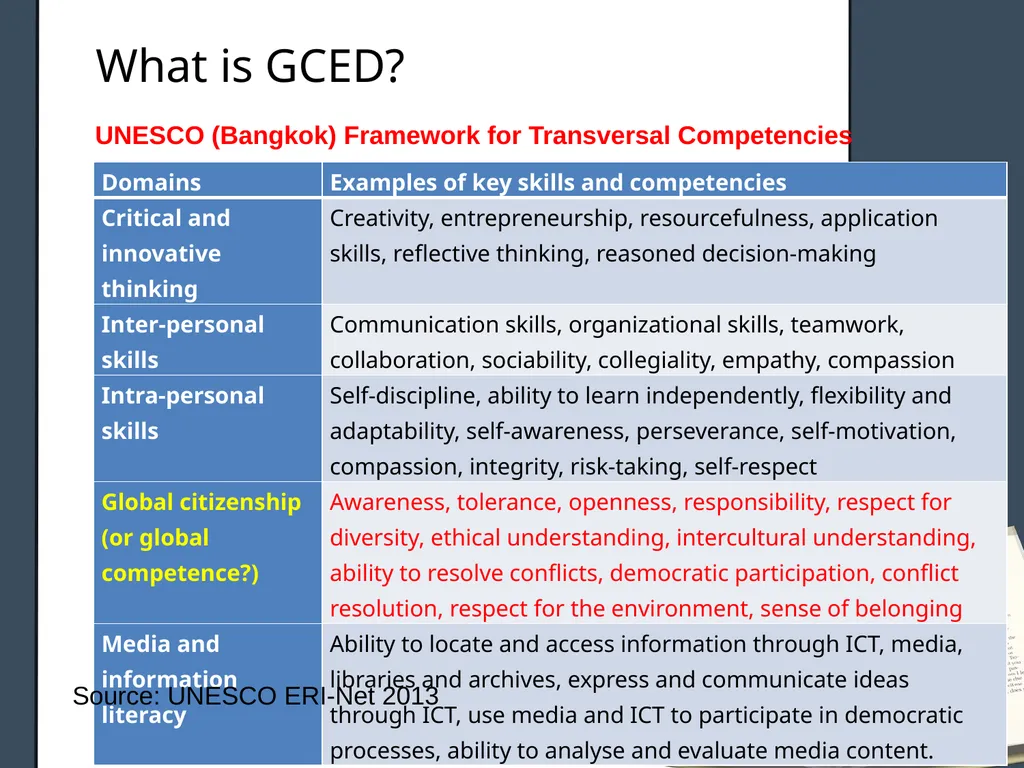
What is GCED? UNESCO (Bangkok) Framework for Transversal Competencies Source: UNESCO ERI-Net 2013<br>
10
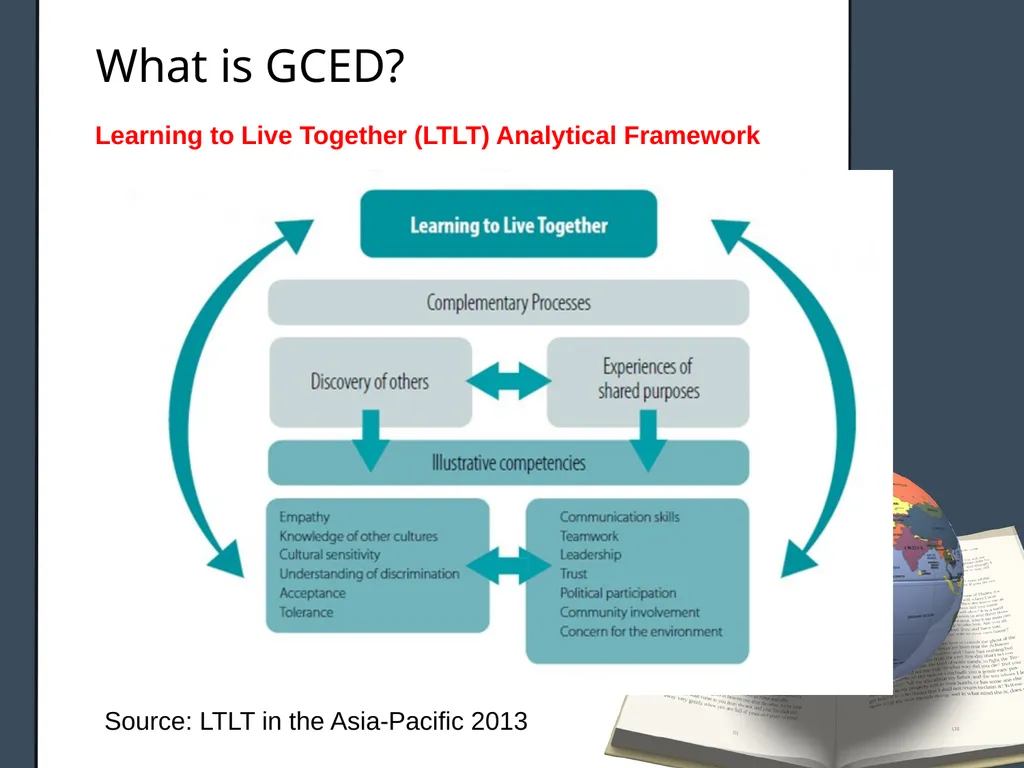
What is GCED? Learning to Live Together (LTLT) Analytical Framework Source: LTLT in the Asia-Pacific 2013<br>
11
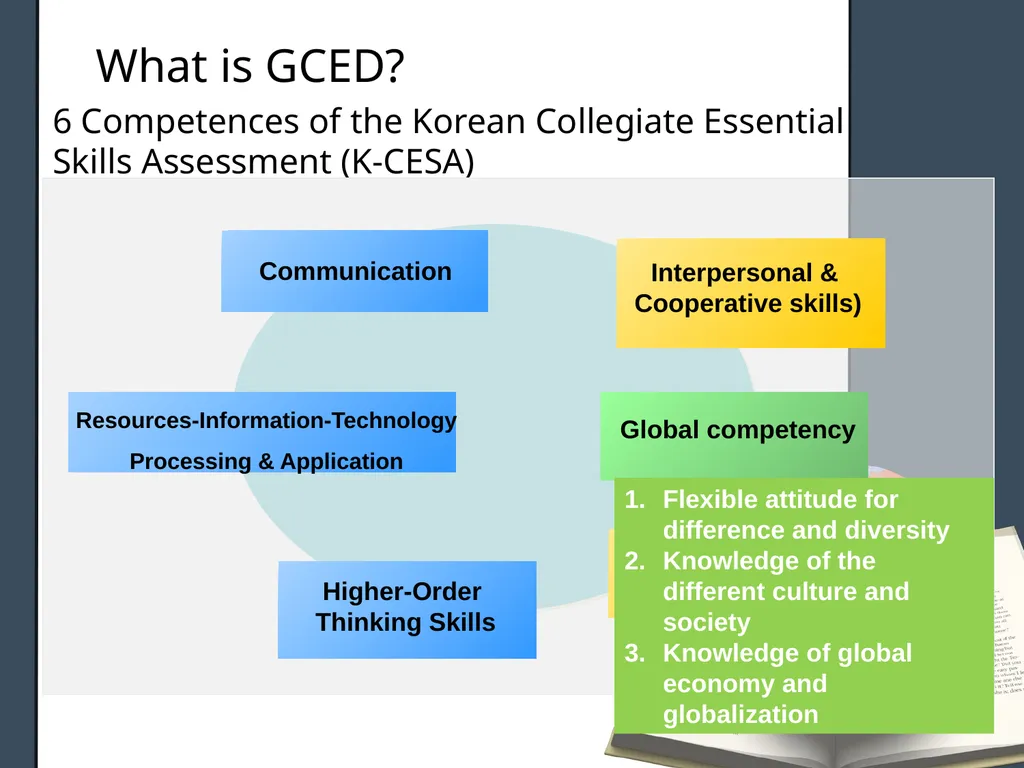
6 Competences of the Korean Collegiate Essential Skills Assessment (K-CESA) Self-Management What is GCED? Flexible attitude for difference and diversity
Knowledge of the different culture and society
Knowledge of global economy and globalization<br>
12
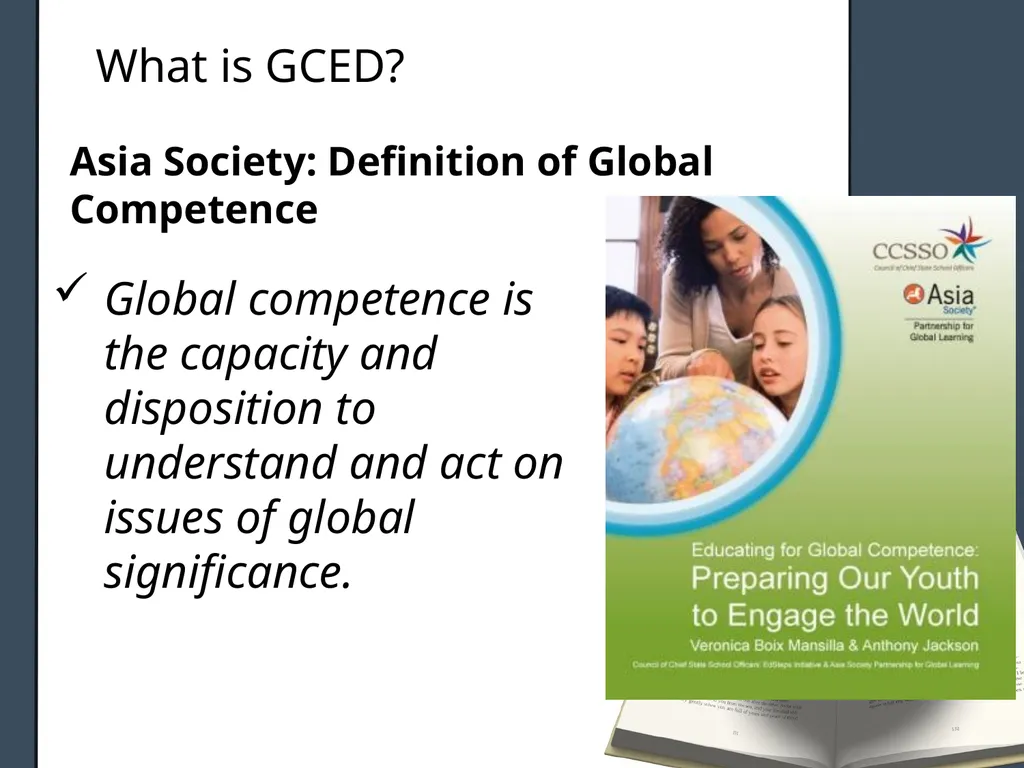
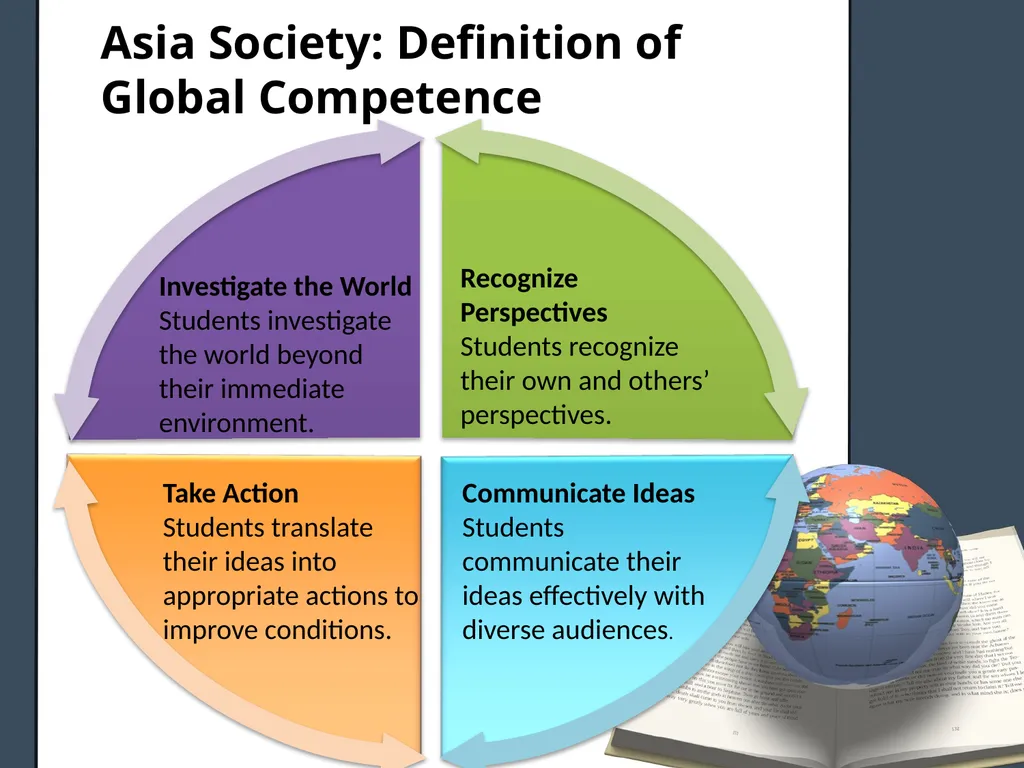
Asia Society: Definition of Global Competence Global competence is the capacity and disposition to understand and act on issues of global significance. What is GCED?<br>
13
Asia Society: Definition of Global Competence<br>
14
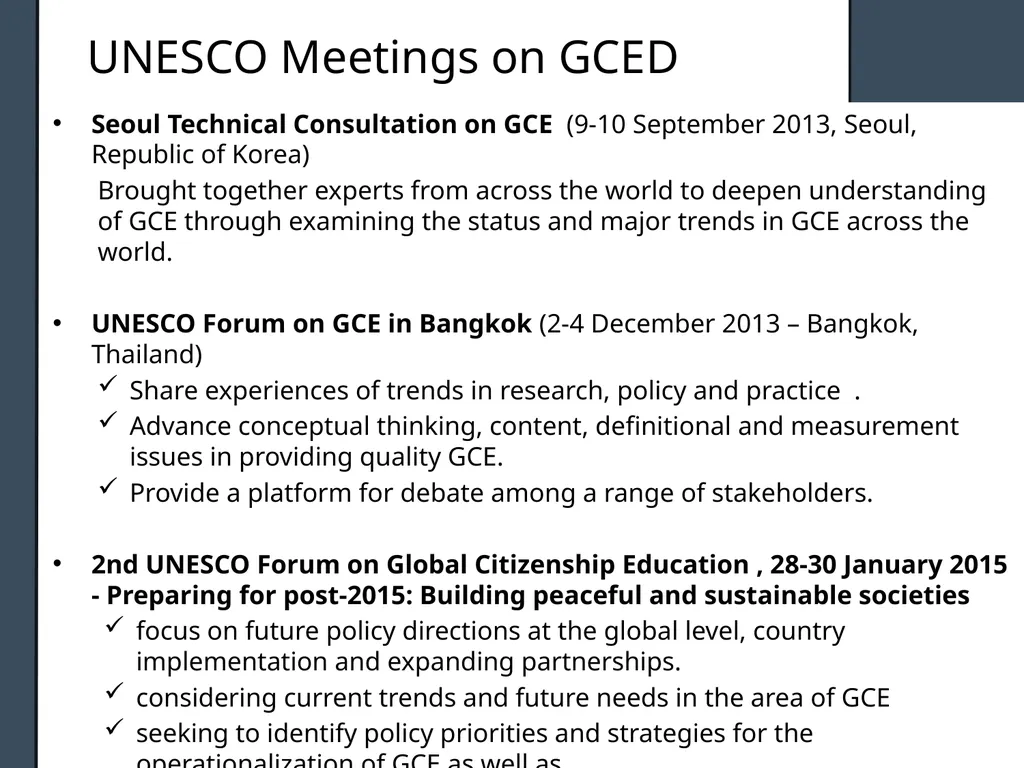
UNESCO Meetings on GCED Seoul Technical Consultation on GCE (9-10 September 2013, Seoul, Republic of Korea)
Brought together experts from across the world to deepen understanding of GCE through examining the status and major trends in GCE across the world.
UNESCO Forum on GCE in Bangkok (2-4 December 2013 – Bangkok, Thailand)
Share experiences of trends in research, policy and practice .
Advance conceptual thinking, content, definitional and measurement issues in providing quality GCE.
Provide a platform for debate among a range of stakeholders.
2nd UNESCO Forum on Global Citizenship Education , 28-30 January 2015 - Preparing for post-2015: Building peaceful and sustainable societies
focus on future policy directions at the global level, country implementation and expanding partnerships.
considering current trends and future needs in the area of GCE
seeking to identify policy priorities and strategies for the operationalization of GCE as well as
provide inputs to the Framework for Action on Education post-2015.<br>
15
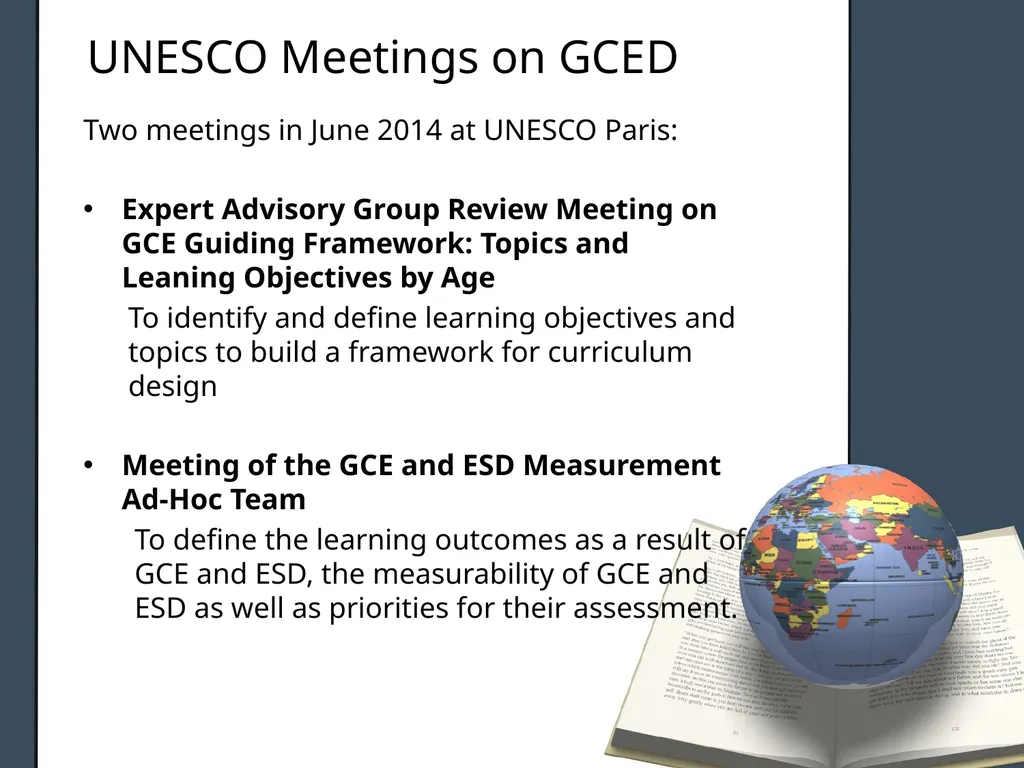
Two meetings in June 2014 at UNESCO Paris:
Expert Advisory Group Review Meeting on GCE Guiding Framework: Topics and Leaning Objectives by Age
To identify and define learning objectives and topics to build a framework for curriculum design
Meeting of the GCE and ESD Measurement Ad-Hoc Team
To define the learning outcomes as a result of GCE and ESD, the measurability of GCE and ESD as well as priorities for their assessment. UNESCO Meetings on GCED<br>
16
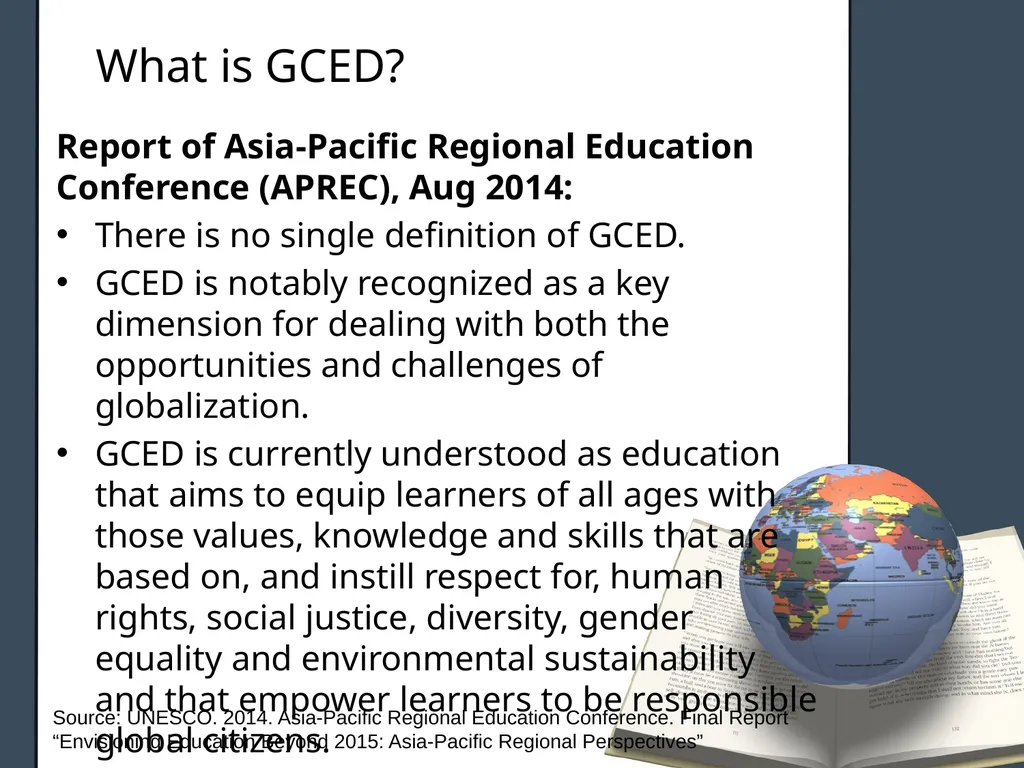
What is GCED? Report of Asia-Pacific Regional Education Conference (APREC), Aug 2014:
There is no single definition of GCED.
GCED is notably recognized as a key dimension for dealing with both the opportunities and challenges of globalization.
GCED is currently understood as education that aims to equip learners of all ages with those values, knowledge and skills that are based on, and instill respect for, human rights, social justice, diversity, gender equality and environmental sustainability and that empower learners to be responsible global citizens. Source: UNESCO. 2014. Asia-Pacific Regional Education Conference. Final Report “Envisioning Education Beyond 2015: Asia-Pacific Regional Perspectives”<br>
17
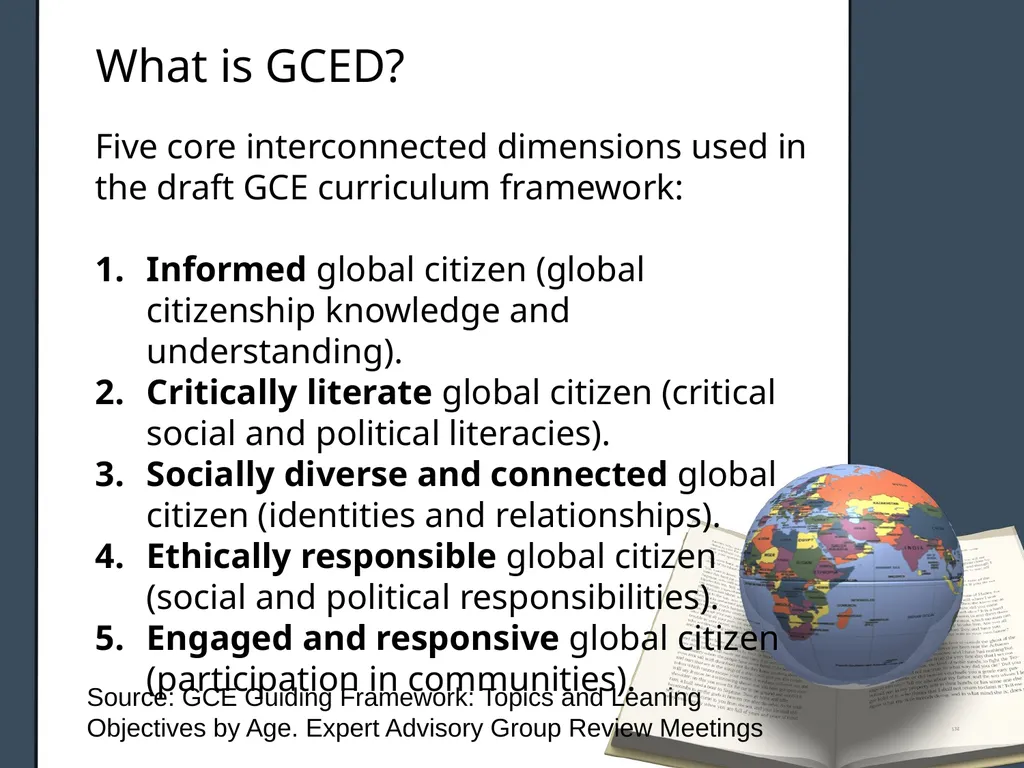
What is GCED? Five core interconnected dimensions used in the draft GCE curriculum framework:
Informed global citizen (global citizenship knowledge and understanding).
Critically literate global citizen (critical social and political literacies).
Socially diverse and connected global citizen (identities and relationships).
Ethically responsible global citizen (social and political responsibilities).
Engaged and responsive global citizen (participation in communities). Source: GCE Guiding Framework: Topics and Leaning Objectives by Age. Expert Advisory Group Review Meetings<br>
18
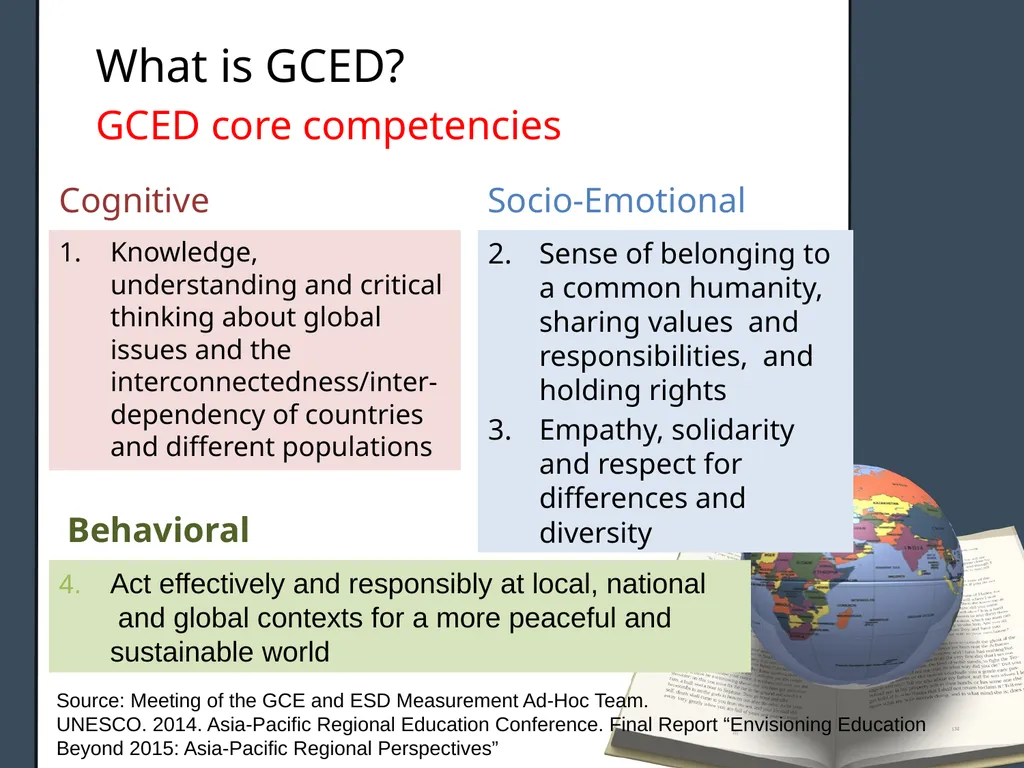
GCED core competencies Cognitive Knowledge, understanding and critical thinking about global issues and the interconnectedness/inter-dependency of countries and different populations Socio-Emotional Sense of belonging to a common humanity, sharing values and responsibilities, and holding rights
Empathy, solidarity and respect for differences and diversity Behavioral Act effectively and responsibly at local, national and global contexts for a more peaceful and sustainable world Source: Meeting of the GCE and ESD Measurement Ad-Hoc Team.
UNESCO. 2014. Asia-Pacific Regional Education Conference. Final Report “Envisioning Education Beyond 2015: Asia-Pacific Regional Perspectives” What is GCED?<br>
19
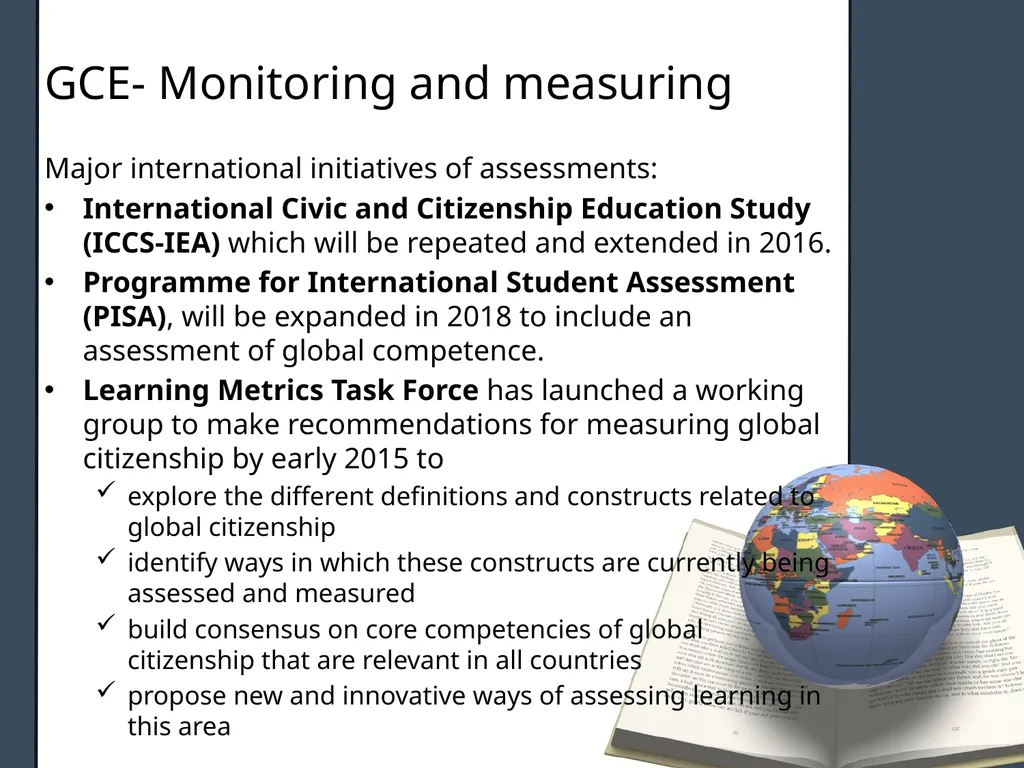
GCE- Monitoring and measuring Major international initiatives of assessments:
International Civic and Citizenship Education Study (ICCS-IEA) which will be repeated and extended in 2016.
Programme for International Student Assessment (PISA), will be expanded in 2018 to include an assessment of global competence.
Learning Metrics Task Force has launched a working group to make recommendations for measuring global citizenship by early 2015 to
explore the different definitions and constructs related to global citizenship
identify ways in which these constructs are currently being assessed and measured
build consensus on core competencies of global citizenship that are relevant in all countries
propose new and innovative ways of assessing learning in this area<br>
20
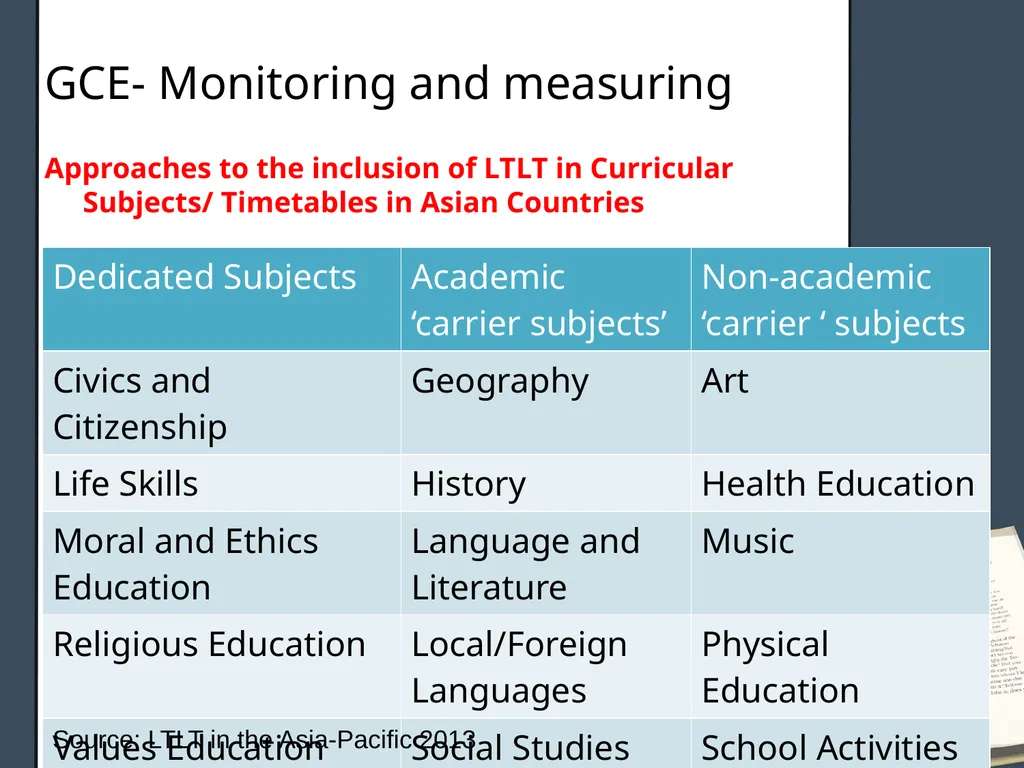
GCE- Monitoring and measuring Approaches to the inclusion of LTLT in Curricular Subjects/ Timetables in Asian Countries Source: LTLT in the Asia-Pacific 2013<br>
21
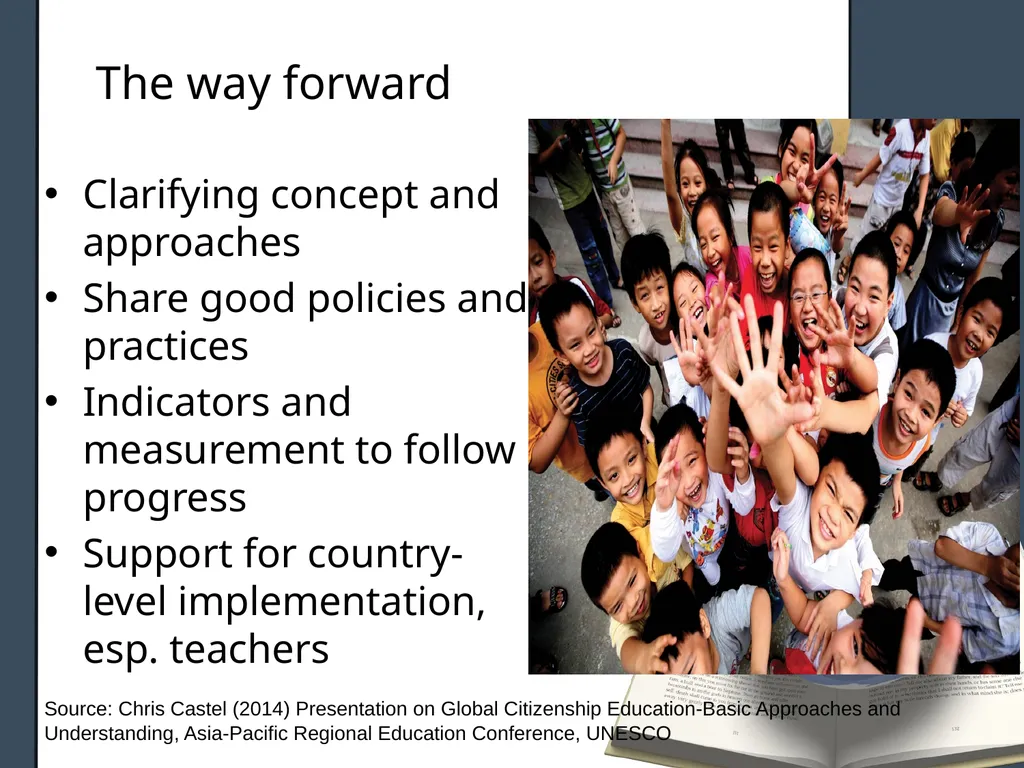
The way forward Clarifying concept and approaches
Share good policies and practices
Indicators and measurement to follow progress
Support for country-level implementation, esp. teachers Source: Chris Castel (2014) Presentation on Global Citizenship Education-Basic Approaches and Understanding, Asia-Pacific Regional Education Conference, UNESCO<br>