
Global Initiative for Asthma (GINA) What’s new in
AS
Published · 32 slides · 0 views

1 / 1
Description
Global Initiative for Asthma (GINA) Whats new in GINA 2019? This slide set is restricted for academic and educational purposes only. No additions or changes may be made to slides. Use of the slide set or of individual slides for commercial
Related Topics
Share
Embed code
Download this presentation From Below
"Global Initiative for Asthma (GINA) What’s new in" is the property of its rightful owner. Permission is granted to download and print the materials on this website for personal, non-commercial use only, and to display it on your personal computer provided you do not modify the materials and that you retain all copyright notices contained in the materials. By downloading content from our website, you accept the terms of this agreement.
Presentation Transcript
01
Global Initiative for Asthma (GINA)
What’s new in GINA 2019? This slide set is restricted for academic and educational purposes only. No additions or changes may be made to slides. Use of the slide set or of individual slides for commercial or promotional purposes requires approval from GINA.<br>
02
The GINA report is not a guideline, but an integrated evidence-based strategy focusing on translation into clinical practice
Recommendations are framed, not as answers to isolated PICOT questions, but as part of an integrated strategy, in relation to:
The GINA goals of preventing asthma deaths and exacerbations, as well as improving symptom control
Current understanding of underlying disease processes
Human behavior (of health professionals and patients/carers)
Implementation in clinical practice
Global variation in populations, health systems and medication access
For new therapies, 2 good quality studies + indication by EMA/FDA are required
For existing medications with established safety profile, GINA may sometimes make off-label recommendations for new indications (e.g. macrolides for severe asthma) About the GINA strategy<br>
03
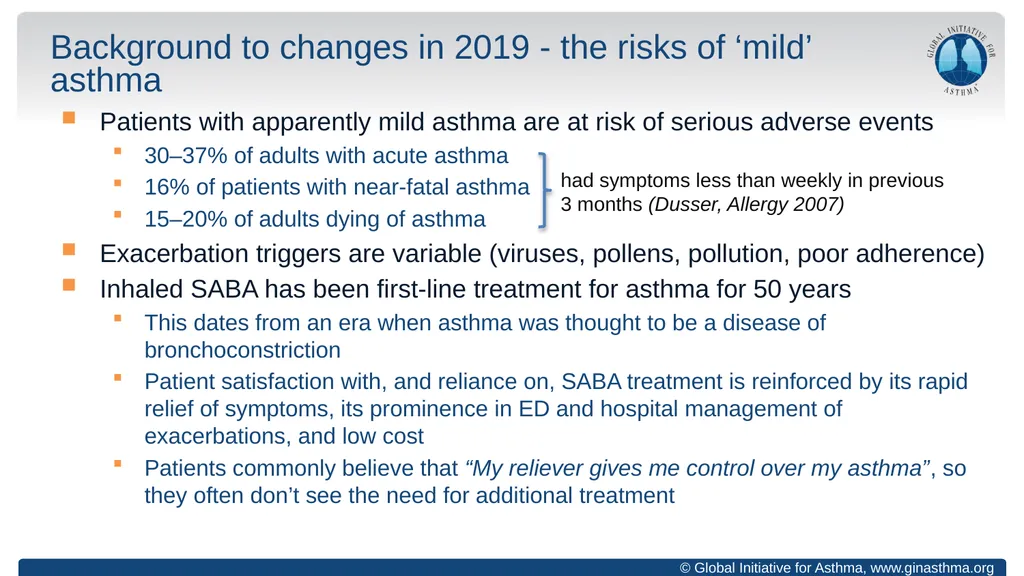
Patients with apparently mild asthma are at risk of serious adverse events
30–37% of adults with acute asthma
16% of patients with near-fatal asthma
15–20% of adults dying of asthma
Exacerbation triggers are variable (viruses, pollens, pollution, poor adherence)
Inhaled SABA has been first-line treatment for asthma for 50 years
This dates from an era when asthma was thought to be a disease of bronchoconstriction
Patient satisfaction with, and reliance on, SABA treatment is reinforced by its rapid relief of symptoms, its prominence in ED and hospital management of exacerbations, and low cost
Patients commonly believe that “My reliever gives me control over my asthma”, so they often don’t see the need for additional treatment Background to changes in 2019 - the risks of ‘mild’ asthma had symptoms less than weekly in previous 3 months (Dusser, Allergy 2007)<br>
04
Background to changes in 2019 - the risks of SABA-only treatment Regular or frequent use of SABA is associated with adverse effects
b-receptor downregulation, decreased bronchoprotection, rebound hyperresponsiveness, decreased bronchodilator response (Hancox, Respir Med 2000)
Increased allergic response, and increased eosinophilic airway inflammation (Aldridge, AJRCCM 2000)
Higher use of SABA is associated with adverse clinical outcomes
Dispensing of ≥3 canisters per year (average 1.7 puffs/day) is associated with higher risk of emergency department presentations (Stanford, AAAI 2012)
Dispensing of ≥12 canisters per year is associated with higher risk of death (Suissa, AJRCCM 1994)<br>
05
Since 2007, GINA has been actively seeking interventions for mild asthma
to reduce the risk of asthma-related exacerbations and death
to provide consistent messaging about the goals of asthma treatment, including prevention of exacerbations, across the spectrum of asthma severity
to avoid establishing patient reliance on SABA early in the course of the disease
GINA emphasized poor adherence as a modifiable risk factor for exacerbations
When the reliever is SABA, poor adherence with maintenance controller exposes the patient to risks of SABA-only treatment
GINA members repeatedly sought funding for RCTs of as-needed ICS-formoterol for risk reduction in mild asthma
Eventually culminated in 2014 with the initiation of the SYGMA studies, published in 2018 (O’Byrne NEJMed 2018; Bateman NEJMed 2018) The 12-year history behind changes in GINA 2019<br>
06
In the meantime, GINA challenged conventional criteria for initiation of ICS
During preparation for 2014 GINA revision, we identified no evidence for the recommendation to withhold ICS until symptoms were more than twice weekly
This was investigated in data from the START study (Pauwels, Lancet 2003). A post hoc analysis found that ICS halved the risk of serious exacerbations even in patients with symptoms 0-1 days a week at entry (Reddel, Lancet 2017)
GINA found no evidence to support a Step 1 SABA-only recommendation
The lack of evidence for SABA-only treatment contrasted with the strong evidence for safety, efficacy and effectiveness of treatments recommended in Steps 2-5
In 2014, as an interim safety measure, GINA restricted SABA-only treatment to patients with symptoms less than twice a month and no risk factors for exacerbations
2018: Review of evidence for mild asthma, including SYGMA studies
A careful review of GINA conflict of interest processes was undertaken first The 12-year history behind changes in GINA 2019<br>
07
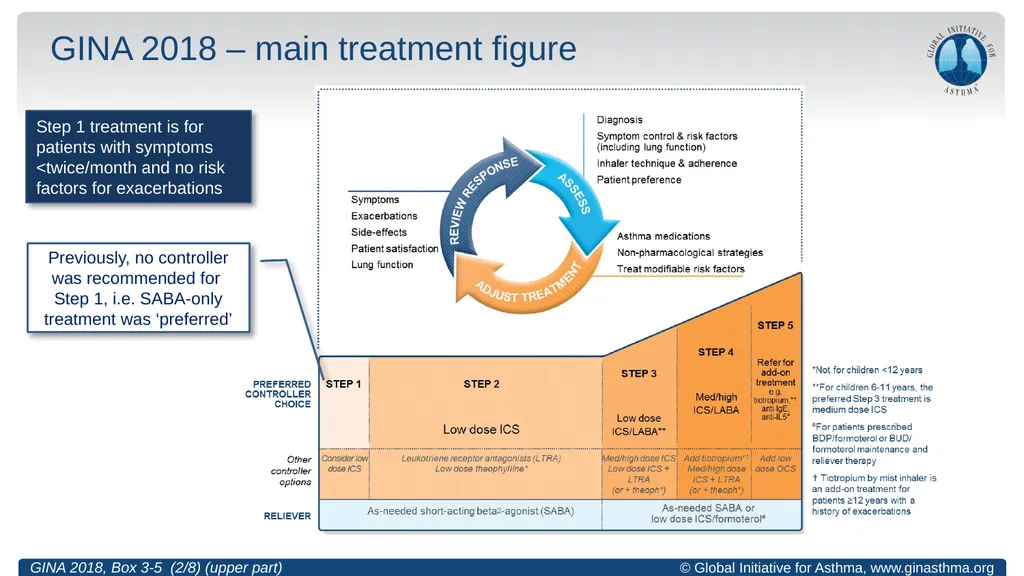
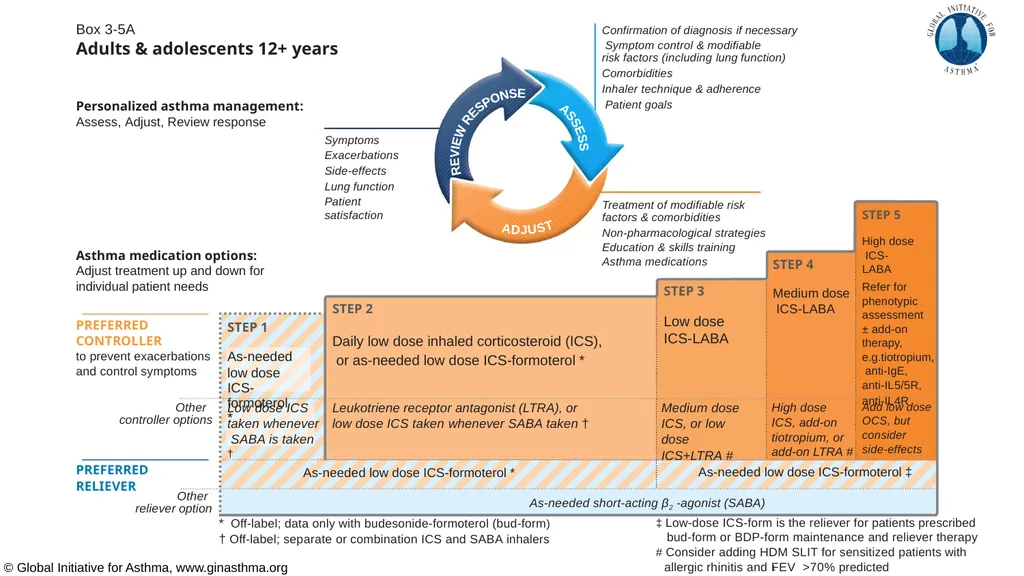
GINA 2018 – main treatment figure GINA 2018, Box 3-5 (2/8) (upper part) Previously, no controller was recommended for
Step 1, i.e. SABA-only treatment was ‘preferred’ Step 1 treatment is for patients with symptoms <twice/month and no risk factors for exacerbations<br>
08
For safety, GINA no longer recommends SABA-only treatment for Step 1
This decision was based on evidence that SABA-only treatment increases the risk of severe exacerbations, and that adding any ICS significantly reduces the risk
GINA now recommends that all adults and adolescents with asthma should receive symptom-driven or regular low dose ICS-containing controller treatment, to reduce the risk of serious exacerbations
This is a population-level risk reduction strategy, e.g. statins, anti-hypertensives GINA 2019 – landmark changes in asthma management<br>
09
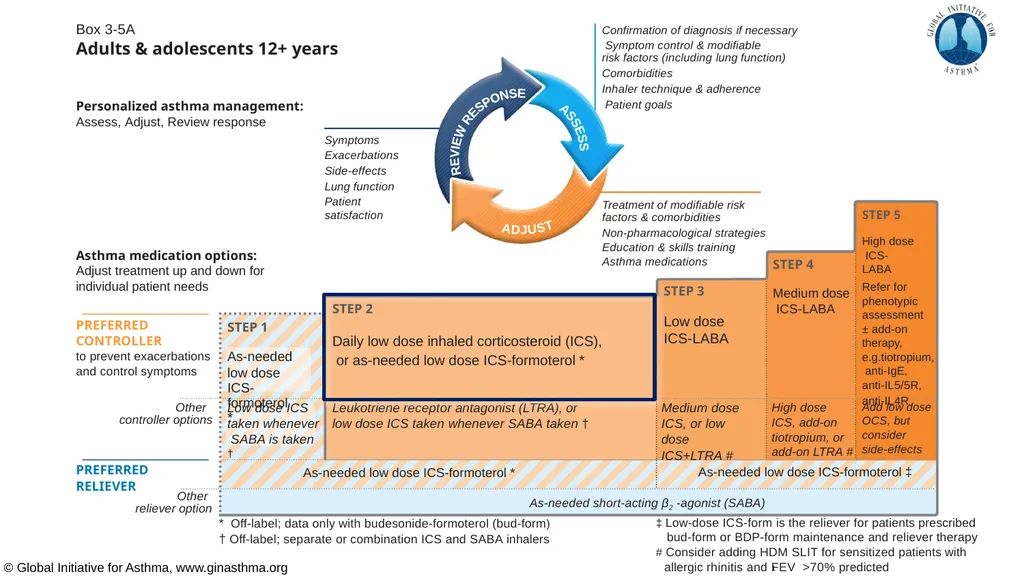
REVIEW RESPONSE ASSESS ADJUST * Off-label; data only with budesonide-formoterol (bud-form)
† Off-label; separate or combination ICS and SABA inhalers PREFERRED CONTROLLER
to prevent exacerbations and control symptoms Other controller options Other reliever option PREFERRED RELIEVER STEP 2
Daily low dose inhaled corticosteroid (ICS), or as-needed low dose ICS-formoterol * STEP 3
Low dose ICS-LABA STEP 4
Medium dose ICS-LABA Leukotriene receptor antagonist (LTRA), or low dose ICS taken whenever SABA taken † As-needed low dose ICS-formoterol * As-needed short-acting β2 -agonist (SABA) Medium dose ICS, or low dose ICS+LTRA # High dose ICS, add-on tiotropium, or add-on LTRA # Add low dose OCS, but consider
side-effects As-needed low dose ICS-formoterol ‡ Box 3-5A
Adults & adolescents 12+ years Personalized asthma management:
Assess, Adjust, Review response Asthma medication options: Adjust treatment up and down for individual patient needs STEP 5
High dose ICS-LABA
Refer for phenotypic assessment
± add-on therapy, e.g.tiotropium, anti-IgE,
anti-IL5/5R,
anti-IL4R Symptoms Exacerbations Side-effects Lung function
Patient satisfaction Confirmation of diagnosis if necessary Symptom control & modifiable
risk factors (including lung function)
Comorbidities
Inhaler technique & adherence Patient goals Treatment of modifiable risk factors & comorbidities
Non-pharmacological strategies Education & skills training Asthma medications 1 © Global Initiative for Asthma, www.ginasthma.org STEP 1
As-needed low dose
ICS-formoterol * Low dose ICS taken whenever SABA is taken † ‡ Low-dose ICS-form is the reliever for patients prescribed bud-form or BDP-form maintenance and reliever therapy
# Consider adding HDM SLIT for sensitized patients with allergic rhinitis and FEV >70% predicted<br>
10
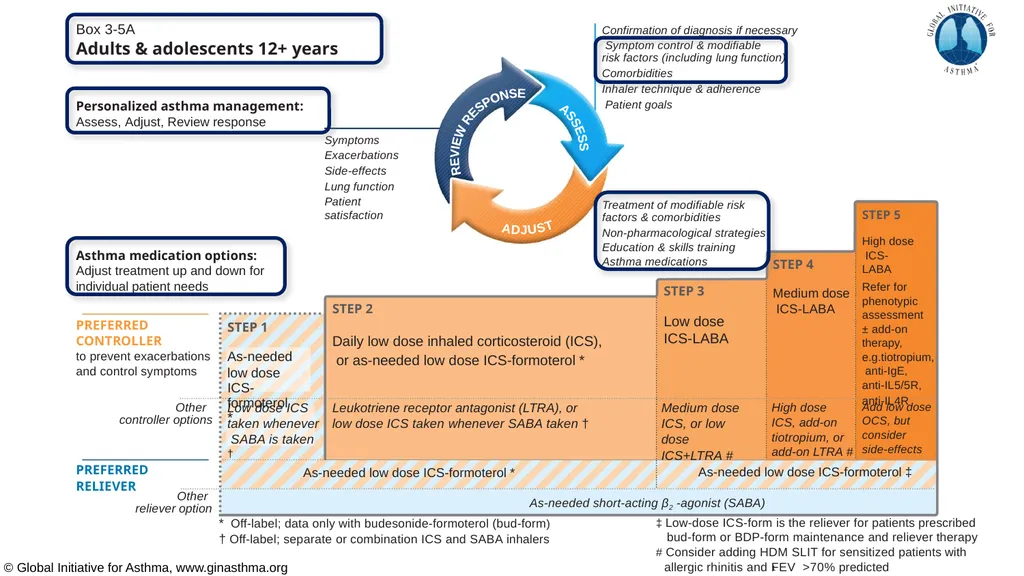
REVIEW RESPONSE ASSESS ADJUST * Off-label; data only with budesonide-formoterol (bud-form)
† Off-label; separate or combination ICS and SABA inhalers PREFERRED CONTROLLER
to prevent exacerbations and control symptoms Other controller options Other reliever option PREFERRED RELIEVER STEP 2
Daily low dose inhaled corticosteroid (ICS), or as-needed low dose ICS-formoterol * STEP 3
Low dose ICS-LABA STEP 4
Medium dose ICS-LABA Leukotriene receptor antagonist (LTRA), or low dose ICS taken whenever SABA taken † As-needed low dose ICS-formoterol * As-needed short-acting β2 -agonist (SABA) Medium dose ICS, or low dose ICS+LTRA # High dose ICS, add-on tiotropium, or add-on LTRA # Add low dose OCS, but consider
side-effects As-needed low dose ICS-formoterol ‡ Box 3-5A
Adults & adolescents 12+ years Personalized asthma management:
Assess, Adjust, Review response Asthma medication options: Adjust treatment up and down for individual patient needs STEP 5
High dose ICS-LABA
Refer for phenotypic assessment
± add-on therapy, e.g.tiotropium, anti-IgE,
anti-IL5/5R,
anti-IL4R Symptoms Exacerbations Side-effects Lung function
Patient satisfaction Confirmation of diagnosis if necessary Symptom control & modifiable
risk factors (including lung function)
Comorbidities
Inhaler technique & adherence Patient goals Treatment of modifiable risk factors & comorbidities
Non-pharmacological strategies Education & skills training Asthma medications 1 © Global Initiative for Asthma, www.ginasthma.org STEP 1
As-needed low dose
ICS-formoterol * Low dose ICS taken whenever SABA is taken † ‡ Low-dose ICS-form is the reliever for patients prescribed bud-form or BDP-form maintenance and reliever therapy
# Consider adding HDM SLIT for sensitized patients with allergic rhinitis and FEV >70% predicted<br>
† Off-label; separate or combination ICS and SABA inhalers PREFERRED CONTROLLER
to prevent exacerbations and control symptoms Other controller options Other reliever option PREFERRED RELIEVER STEP 2
Daily low dose inhaled corticosteroid (ICS), or as-needed low dose ICS-formoterol * STEP 3
Low dose ICS-LABA STEP 4
Medium dose ICS-LABA Leukotriene receptor antagonist (LTRA), or low dose ICS taken whenever SABA taken † As-needed low dose ICS-formoterol * As-needed short-acting β2 -agonist (SABA) Medium dose ICS, or low dose ICS+LTRA # High dose ICS, add-on tiotropium, or add-on LTRA # Add low dose OCS, but consider
side-effects As-needed low dose ICS-formoterol ‡ Box 3-5A
Adults & adolescents 12+ years Personalized asthma management:
Assess, Adjust, Review response Asthma medication options: Adjust treatment up and down for individual patient needs STEP 5
High dose ICS-LABA
Refer for phenotypic assessment
± add-on therapy, e.g.tiotropium, anti-IgE,
anti-IL5/5R,
anti-IL4R Symptoms Exacerbations Side-effects Lung function
Patient satisfaction Confirmation of diagnosis if necessary Symptom control & modifiable
risk factors (including lung function)
Comorbidities
Inhaler technique & adherence Patient goals Treatment of modifiable risk factors & comorbidities
Non-pharmacological strategies Education & skills training Asthma medications 1 © Global Initiative for Asthma, www.ginasthma.org STEP 1
As-needed low dose
ICS-formoterol * Low dose ICS taken whenever SABA is taken † ‡ Low-dose ICS-form is the reliever for patients prescribed bud-form or BDP-form maintenance and reliever therapy
# Consider adding HDM SLIT for sensitized patients with allergic rhinitis and FEV >70% predicted<br>
11
REVIEW RESPONSE ASSESS ADJUST * Off-label; data only with budesonide-formoterol (bud-form)
† Off-label; separate or combination ICS and SABA inhalers PREFERRED CONTROLLER
to prevent exacerbations and control symptoms Other controller options Other reliever option PREFERRED RELIEVER STEP 2
Daily low dose inhaled corticosteroid (ICS), or as-needed low dose ICS-formoterol * STEP 3
Low dose ICS-LABA STEP 4
Medium dose ICS-LABA Leukotriene receptor antagonist (LTRA), or low dose ICS taken whenever SABA taken † As-needed low dose ICS-formoterol * As-needed short-acting β2 -agonist (SABA) Medium dose ICS, or low dose ICS+LTRA # High dose ICS, add-on tiotropium, or add-on LTRA # Add low dose OCS, but consider
side-effects As-needed low dose ICS-formoterol ‡ Box 3-5A
Adults & adolescents 12+ years Personalized asthma management:
Assess, Adjust, Review response Asthma medication options: Adjust treatment up and down for individual patient needs STEP 5
High dose ICS-LABA
Refer for phenotypic assessment
± add-on therapy, e.g.tiotropium, anti-IgE,
anti-IL5/5R,
anti-IL4R Symptoms Exacerbations Side-effects Lung function
Patient satisfaction Confirmation of diagnosis if necessary Symptom control & modifiable
risk factors (including lung function)
Comorbidities
Inhaler technique & adherence Patient goals Treatment of modifiable risk factors & comorbidities
Non-pharmacological strategies Education & skills training Asthma medications 1 © Global Initiative for Asthma, www.ginasthma.org STEP 1
As-needed low dose
ICS-formoterol * Low dose ICS taken whenever SABA is taken † ‡ Low-dose ICS-form is the reliever for patients prescribed bud-form or BDP-form maintenance and reliever therapy
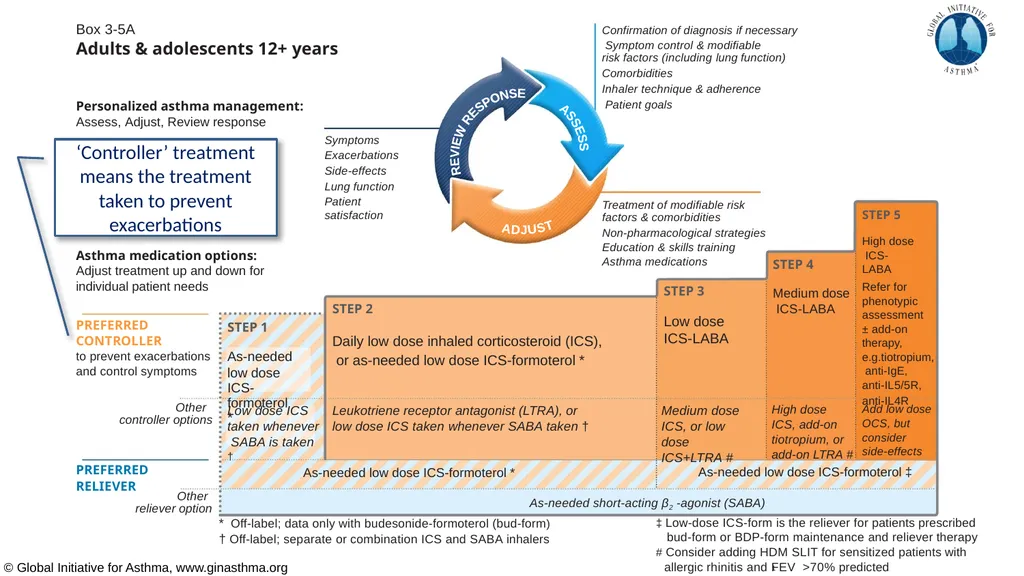
# Consider adding HDM SLIT for sensitized patients with allergic rhinitis and FEV >70% predicted ‘Controller’ treatment means the treatment taken to prevent exacerbations<br>
12
Step 2 – rationale for changes
in GINA 2019<br>
13
REVIEW RESPONSE ASSESS ADJUST * Off-label; data only with budesonide-formoterol (bud-form)
† Off-label; separate or combination ICS and SABA inhalers STEP 2
Daily low dose inhaled corticosteroid (ICS), or as-needed low dose ICS-formoterol * STEP 3
Low dose ICS-LABA STEP 4
Medium dose ICS-LABA Leukotriene receptor antagonist (LTRA), or low dose ICS taken whenever SABA taken † As-needed low dose ICS-formoterol * As-needed short-acting β2 -agonist (SABA) Medium dose ICS, or low dose ICS+LTRA # High dose ICS, add-on tiotropium, or add-on LTRA # Add low dose OCS, but consider
side-effects As-needed low dose ICS-formoterol ‡ STEP 5
High dose ICS-LABA
Refer for phenotypic assessment
± add-on therapy, e.g.tiotropium, anti-IgE,
anti-IL5/5R,
anti-IL4R Symptoms Exacerbations Side-effects Lung function
Patient satisfaction Confirmation of diagnosis if necessary Symptom control & modifiable
risk factors (including lung function)
Comorbidities
Inhaler technique & adherence Patient goals Treatment of modifiable risk factors & comorbidities
Non-pharmacological strategies Education & skills training Asthma medications 1 © Global Initiative for Asthma, www.ginasthma.org STEP 1
As-needed low dose
ICS-formoterol * Low dose ICS taken whenever SABA is taken † ‡ Low-dose ICS-form is the reliever for patients prescribed bud-form or BDP-form maintenance and reliever therapy
# Consider adding HDM SLIT for sensitized patients with allergic rhinitis and FEV >70% predicted PREFERRED CONTROLLER
to prevent exacerbations and control symptoms Other controller options Other reliever option PREFERRED RELIEVER Box 3-5A
Adults & adolescents 12+ years Personalized asthma management:
Assess, Adjust, Review response Asthma medication options: Adjust treatment up and down for individual patient needs<br>
14
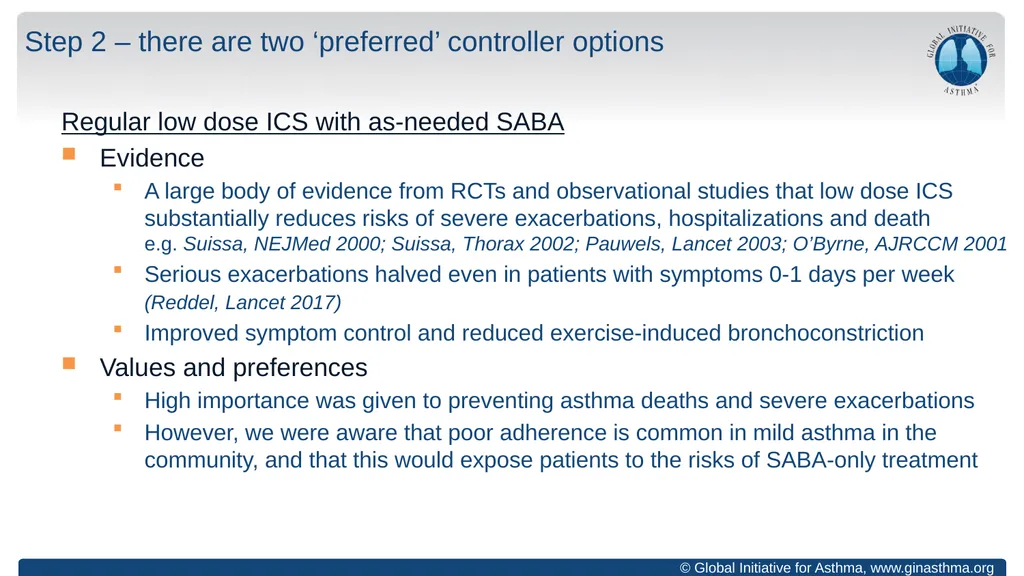
Regular low dose ICS with as-needed SABA
Evidence
A large body of evidence from RCTs and observational studies that low dose ICS substantially reduces risks of severe exacerbations, hospitalizations and death e.g. Suissa, NEJMed 2000; Suissa, Thorax 2002; Pauwels, Lancet 2003; O’Byrne, AJRCCM 2001
Serious exacerbations halved even in patients with symptoms 0-1 days per week (Reddel, Lancet 2017)
Improved symptom control and reduced exercise-induced bronchoconstriction
Values and preferences
High importance was given to preventing asthma deaths and severe exacerbations
However, we were aware that poor adherence is common in mild asthma in the community, and that this would expose patients to the risks of SABA-only treatment Step 2 – there are two ‘preferred’ controller options<br>
15
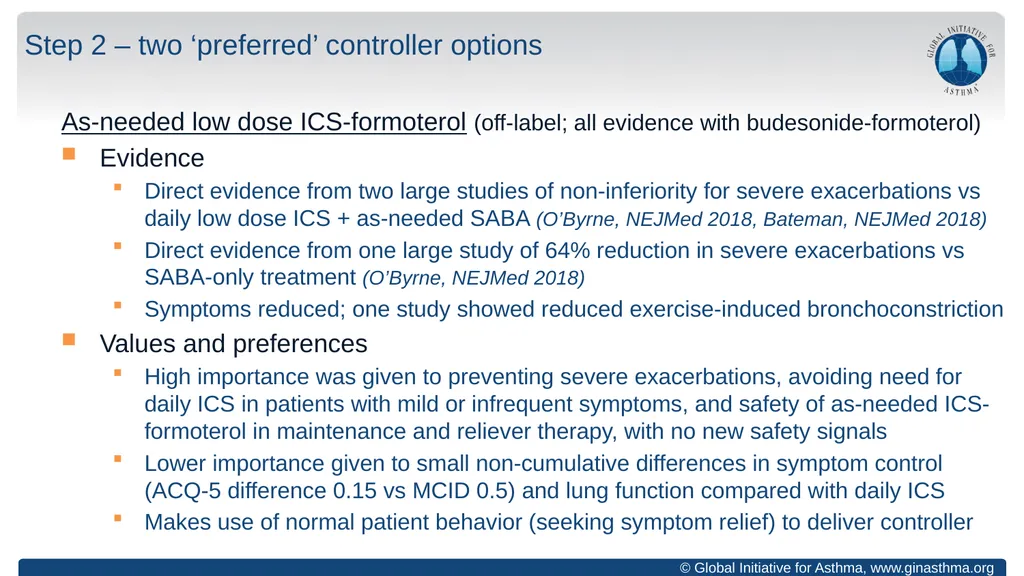
As-needed low dose ICS-formoterol (off-label; all evidence with budesonide-formoterol)
Evidence
Direct evidence from two large studies of non-inferiority for severe exacerbations vs daily low dose ICS + as-needed SABA (O’Byrne, NEJMed 2018, Bateman, NEJMed 2018)
Direct evidence from one large study of 64% reduction in severe exacerbations vs SABA-only treatment (O’Byrne, NEJMed 2018)
Symptoms reduced; one study showed reduced exercise-induced bronchoconstriction
Values and preferences
High importance was given to preventing severe exacerbations, avoiding need for daily ICS in patients with mild or infrequent symptoms, and safety of as-needed ICS-formoterol in maintenance and reliever therapy, with no new safety signals
Lower importance given to small non-cumulative differences in symptom control (ACQ-5 difference 0.15 vs MCID 0.5) and lung function compared with daily ICS
Makes use of normal patient behavior (seeking symptom relief) to deliver controller Step 2 – two ‘preferred’ controller options<br>
16
REVIEW RESPONSE ASSESS ADJUST * Off-label; data only with budesonide-formoterol (bud-form)
† Off-label; separate or combination ICS and SABA inhalers STEP 2
Daily low dose inhaled corticosteroid (ICS), or as-needed low dose ICS-formoterol * STEP 3
Low dose ICS-LABA STEP 4
Medium dose ICS-LABA Leukotriene receptor antagonist (LTRA), or low dose ICS taken whenever SABA taken † As-needed low dose ICS-formoterol * As-needed short-acting β2 -agonist (SABA) Medium dose ICS, or low dose ICS+LTRA # High dose ICS, add-on tiotropium, or add-on LTRA # Add low dose OCS, but consider
side-effects As-needed low dose ICS-formoterol ‡ STEP 5
High dose ICS-LABA
Refer for phenotypic assessment
± add-on therapy, e.g.tiotropium, anti-IgE,
anti-IL5/5R,
anti-IL4R Symptoms Exacerbations Side-effects Lung function
Patient satisfaction Confirmation of diagnosis if necessary Symptom control & modifiable
risk factors (including lung function)
Comorbidities
Inhaler technique & adherence Patient goals Treatment of modifiable risk factors & comorbidities
Non-pharmacological strategies Education & skills training Asthma medications 1 © Global Initiative for Asthma, www.ginasthma.org STEP 1
As-needed low dose
ICS-formoterol * Low dose ICS taken whenever SABA is taken † ‡ Low-dose ICS-form is the reliever for patients prescribed bud-form or BDP-form maintenance and reliever therapy
# Consider adding HDM SLIT for sensitized patients with allergic rhinitis and FEV >70% predicted PREFERRED CONTROLLER
to prevent exacerbations and control symptoms Other controller options Other reliever option PREFERRED RELIEVER Box 3-5A
Adults & adolescents 12+ years Personalized asthma management:
Assess, Adjust, Review response Asthma medication options: Adjust treatment up and down for individual patient needs<br>
† Off-label; separate or combination ICS and SABA inhalers STEP 2
Daily low dose inhaled corticosteroid (ICS), or as-needed low dose ICS-formoterol * STEP 3
Low dose ICS-LABA STEP 4
Medium dose ICS-LABA Leukotriene receptor antagonist (LTRA), or low dose ICS taken whenever SABA taken † As-needed low dose ICS-formoterol * As-needed short-acting β2 -agonist (SABA) Medium dose ICS, or low dose ICS+LTRA # High dose ICS, add-on tiotropium, or add-on LTRA # Add low dose OCS, but consider
side-effects As-needed low dose ICS-formoterol ‡ STEP 5
High dose ICS-LABA
Refer for phenotypic assessment
± add-on therapy, e.g.tiotropium, anti-IgE,
anti-IL5/5R,
anti-IL4R Symptoms Exacerbations Side-effects Lung function
Patient satisfaction Confirmation of diagnosis if necessary Symptom control & modifiable
risk factors (including lung function)
Comorbidities
Inhaler technique & adherence Patient goals Treatment of modifiable risk factors & comorbidities
Non-pharmacological strategies Education & skills training Asthma medications 1 © Global Initiative for Asthma, www.ginasthma.org STEP 1
As-needed low dose
ICS-formoterol * Low dose ICS taken whenever SABA is taken † ‡ Low-dose ICS-form is the reliever for patients prescribed bud-form or BDP-form maintenance and reliever therapy
# Consider adding HDM SLIT for sensitized patients with allergic rhinitis and FEV >70% predicted PREFERRED CONTROLLER
to prevent exacerbations and control symptoms Other controller options Other reliever option PREFERRED RELIEVER Box 3-5A
Adults & adolescents 12+ years Personalized asthma management:
Assess, Adjust, Review response Asthma medication options: Adjust treatment up and down for individual patient needs<br>
17
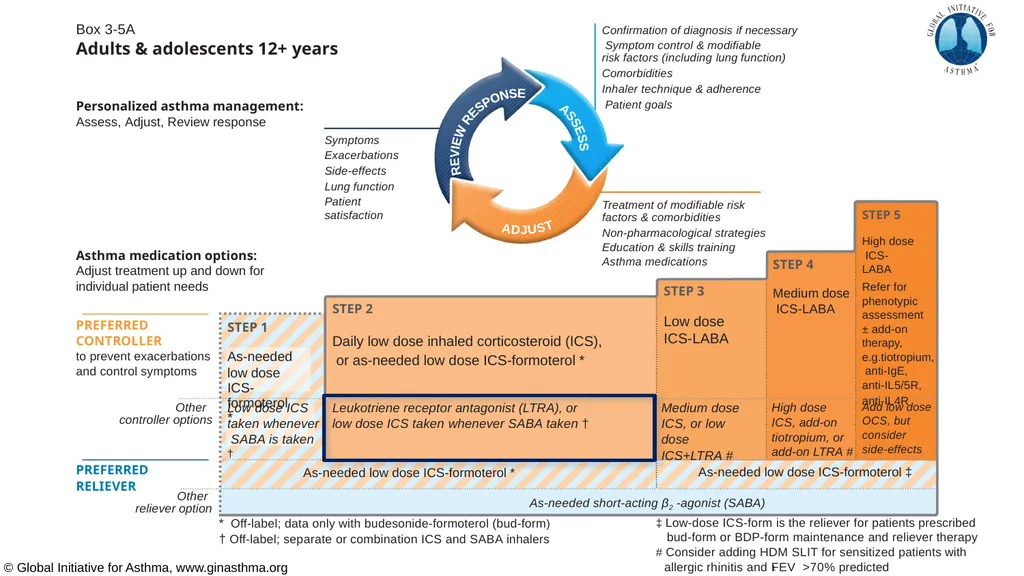
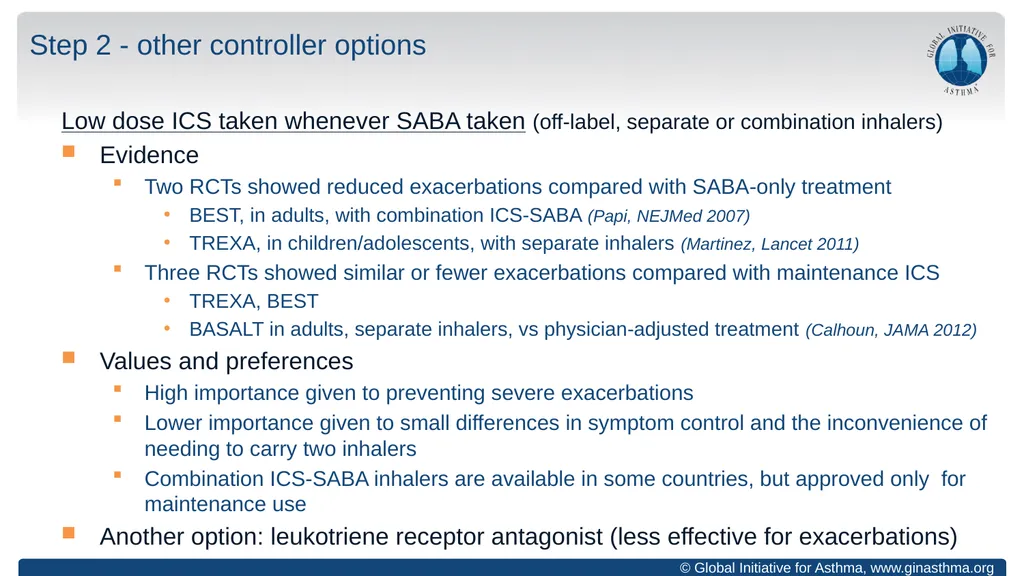
Low dose ICS taken whenever SABA taken (off-label, separate or combination inhalers)
Evidence
Two RCTs showed reduced exacerbations compared with SABA-only treatment
BEST, in adults, with combination ICS-SABA (Papi, NEJMed 2007)
TREXA, in children/adolescents, with separate inhalers (Martinez, Lancet 2011)
Three RCTs showed similar or fewer exacerbations compared with maintenance ICS
TREXA, BEST
BASALT in adults, separate inhalers, vs physician-adjusted treatment (Calhoun, JAMA 2012)
Values and preferences
High importance given to preventing severe exacerbations
Lower importance given to small differences in symptom control and the inconvenience of needing to carry two inhalers
Combination ICS-SABA inhalers are available in some countries, but approved only for maintenance use
Another option: leukotriene receptor antagonist (less effective for exacerbations) Step 2 - other controller options<br>
18
Step 1 – rationale for changes
in GINA 2019<br>
19
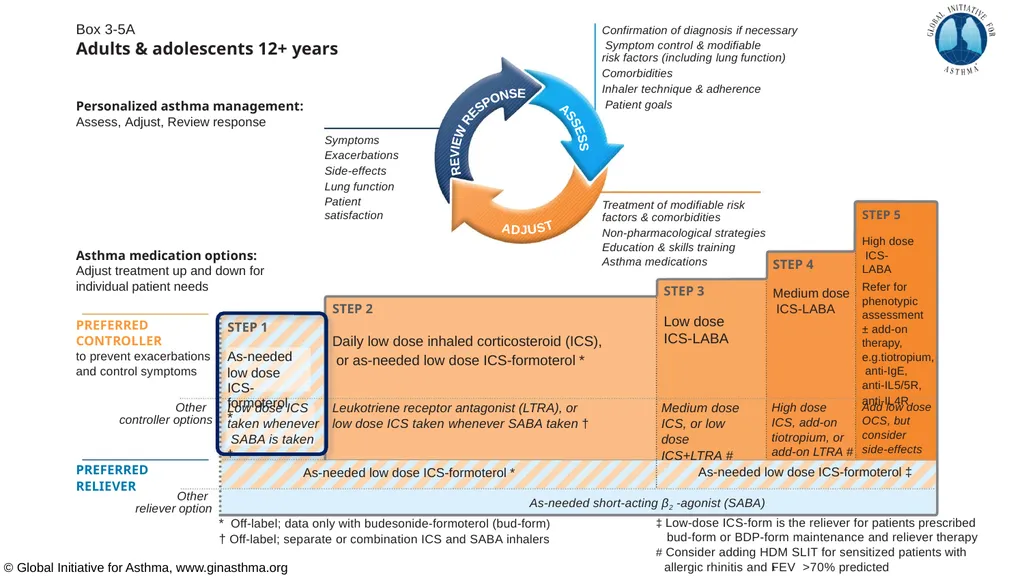
REVIEW RESPONSE ASSESS ADJUST * Off-label; data only with budesonide-formoterol (bud-form)
† Off-label; separate or combination ICS and SABA inhalers STEP 2
Daily low dose inhaled corticosteroid (ICS), or as-needed low dose ICS-formoterol * STEP 3
Low dose ICS-LABA STEP 4
Medium dose ICS-LABA Leukotriene receptor antagonist (LTRA), or low dose ICS taken whenever SABA taken † As-needed low dose ICS-formoterol * As-needed short-acting β2 -agonist (SABA) Medium dose ICS, or low dose ICS+LTRA # High dose ICS, add-on tiotropium, or add-on LTRA # Add low dose OCS, but consider
side-effects As-needed low dose ICS-formoterol ‡ STEP 5
High dose ICS-LABA
Refer for phenotypic assessment
± add-on therapy, e.g.tiotropium, anti-IgE,
anti-IL5/5R,
anti-IL4R Symptoms Exacerbations Side-effects Lung function
Patient satisfaction Confirmation of diagnosis if necessary Symptom control & modifiable
risk factors (including lung function)
Comorbidities
Inhaler technique & adherence Patient goals Treatment of modifiable risk factors & comorbidities
Non-pharmacological strategies Education & skills training Asthma medications 1 © Global Initiative for Asthma, www.ginasthma.org STEP 1
As-needed low dose
ICS-formoterol * Low dose ICS taken whenever SABA is taken † ‡ Low-dose ICS-form is the reliever for patients prescribed bud-form or BDP-form maintenance and reliever therapy
# Consider adding HDM SLIT for sensitized patients with allergic rhinitis and FEV >70% predicted PREFERRED CONTROLLER
to prevent exacerbations and control symptoms Other controller options Other reliever option PREFERRED RELIEVER Box 3-5A
Adults & adolescents 12+ years Personalized asthma management:
Assess, Adjust, Review response Asthma medication options: Adjust treatment up and down for individual patient needs<br>
† Off-label; separate or combination ICS and SABA inhalers STEP 2
Daily low dose inhaled corticosteroid (ICS), or as-needed low dose ICS-formoterol * STEP 3
Low dose ICS-LABA STEP 4
Medium dose ICS-LABA Leukotriene receptor antagonist (LTRA), or low dose ICS taken whenever SABA taken † As-needed low dose ICS-formoterol * As-needed short-acting β2 -agonist (SABA) Medium dose ICS, or low dose ICS+LTRA # High dose ICS, add-on tiotropium, or add-on LTRA # Add low dose OCS, but consider
side-effects As-needed low dose ICS-formoterol ‡ STEP 5
High dose ICS-LABA
Refer for phenotypic assessment
± add-on therapy, e.g.tiotropium, anti-IgE,
anti-IL5/5R,
anti-IL4R Symptoms Exacerbations Side-effects Lung function
Patient satisfaction Confirmation of diagnosis if necessary Symptom control & modifiable
risk factors (including lung function)
Comorbidities
Inhaler technique & adherence Patient goals Treatment of modifiable risk factors & comorbidities
Non-pharmacological strategies Education & skills training Asthma medications 1 © Global Initiative for Asthma, www.ginasthma.org STEP 1
As-needed low dose
ICS-formoterol * Low dose ICS taken whenever SABA is taken † ‡ Low-dose ICS-form is the reliever for patients prescribed bud-form or BDP-form maintenance and reliever therapy
# Consider adding HDM SLIT for sensitized patients with allergic rhinitis and FEV >70% predicted PREFERRED CONTROLLER
to prevent exacerbations and control symptoms Other controller options Other reliever option PREFERRED RELIEVER Box 3-5A
Adults & adolescents 12+ years Personalized asthma management:
Assess, Adjust, Review response Asthma medication options: Adjust treatment up and down for individual patient needs<br>
20
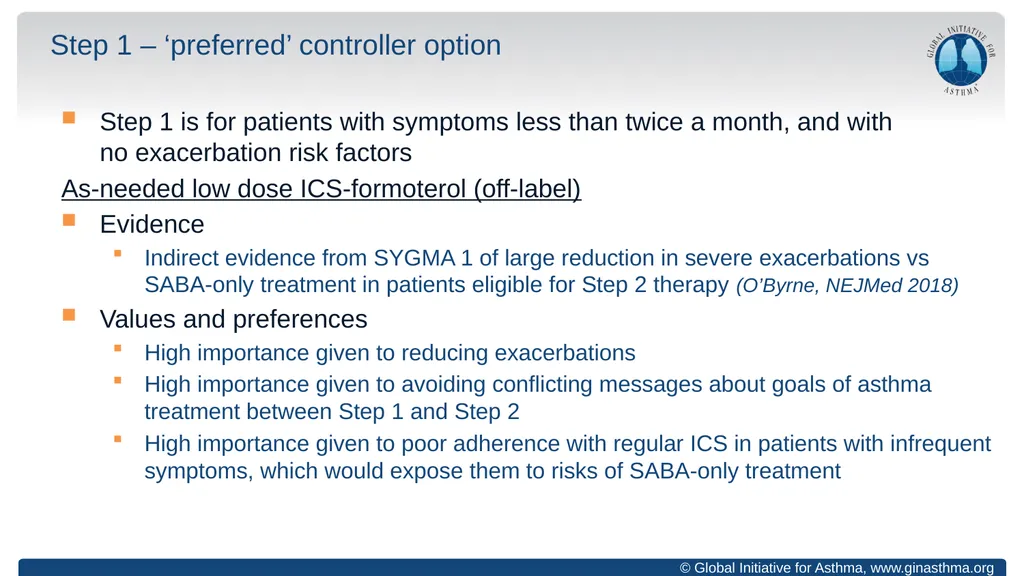
Step 1 is for patients with symptoms less than twice a month, and with
no exacerbation risk factors
As-needed low dose ICS-formoterol (off-label)
Evidence
Indirect evidence from SYGMA 1 of large reduction in severe exacerbations vs SABA-only treatment in patients eligible for Step 2 therapy (O’Byrne, NEJMed 2018)
Values and preferences
High importance given to reducing exacerbations
High importance given to avoiding conflicting messages about goals of asthma treatment between Step 1 and Step 2
High importance given to poor adherence with regular ICS in patients with infrequent symptoms, which would expose them to risks of SABA-only treatment Step 1 – ‘preferred’ controller option<br>
21
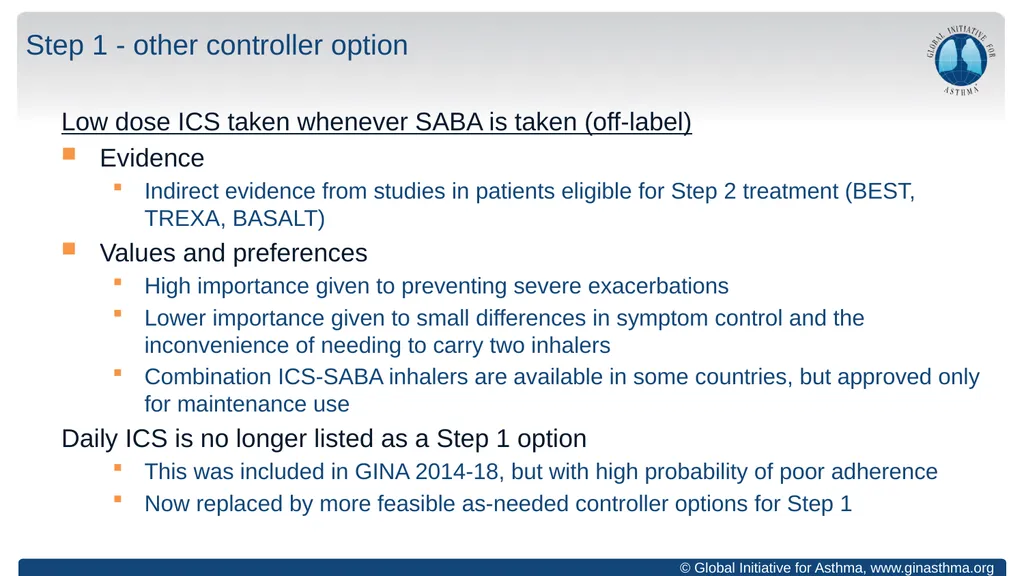
Low dose ICS taken whenever SABA is taken (off-label)
Evidence
Indirect evidence from studies in patients eligible for Step 2 treatment (BEST, TREXA, BASALT)
Values and preferences
High importance given to preventing severe exacerbations
Lower importance given to small differences in symptom control and the inconvenience of needing to carry two inhalers
Combination ICS-SABA inhalers are available in some countries, but approved only for maintenance use
Daily ICS is no longer listed as a Step 1 option
This was included in GINA 2014-18, but with high probability of poor adherence
Now replaced by more feasible as-needed controller options for Step 1 Step 1 - other controller option<br>
22
Other changes in GINA 2019 -
Steps 3-5 for adults and adolescents<br>
23
REVIEW RESPONSE ASSESS ADJUST * Off-label; data only with budesonide-formoterol (bud-form)
† Off-label; separate or combination ICS and SABA inhalers STEP 2
Daily low dose inhaled corticosteroid (ICS), or as-needed low dose ICS-formoterol * STEP 3
Low dose ICS-LABA STEP 4
Medium dose ICS-LABA Leukotriene receptor antagonist (LTRA), or low dose ICS taken whenever SABA taken † As-needed low dose ICS-formoterol * As-needed short-acting β2 -agonist (SABA) Medium dose ICS, or low dose ICS+LTRA # High dose ICS, add-on tiotropium, or add-on LTRA # Add low dose OCS, but consider
side-effects As-needed low dose ICS-formoterol ‡ STEP 5
High dose ICS-LABA
Refer for phenotypic assessment
± add-on therapy, e.g.tiotropium, anti-IgE,
anti-IL5/5R,
anti-IL4R Symptoms Exacerbations Side-effects Lung function
Patient satisfaction Confirmation of diagnosis if necessary Symptom control & modifiable
risk factors (including lung function)
Comorbidities
Inhaler technique & adherence Patient goals Treatment of modifiable risk factors & comorbidities
Non-pharmacological strategies Education & skills training Asthma medications 1 © Global Initiative for Asthma, www.ginasthma.org STEP 1
As-needed low dose
ICS-formoterol * Low dose ICS taken whenever SABA is taken † ‡ Low-dose ICS-form is the reliever for patients prescribed bud-form or BDP-form maintenance and reliever therapy
# Consider adding HDM SLIT for sensitized patients with allergic rhinitis and FEV >70% predicted PREFERRED CONTROLLER
to prevent exacerbations and control symptoms Other controller options Other reliever option PREFERRED RELIEVER Box 3-5A
Adults & adolescents 12+ years Personalized asthma management:
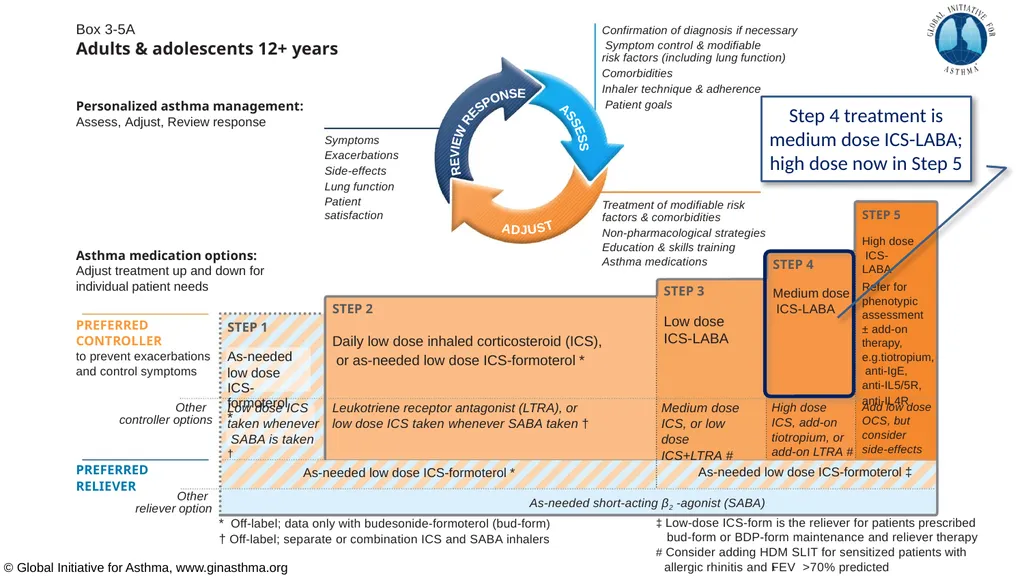
Assess, Adjust, Review response Asthma medication options: Adjust treatment up and down for individual patient needs Step 4 treatment is medium dose ICS-LABA; high dose now in Step 5<br>
24
REVIEW RESPONSE ASSESS ADJUST * Off-label; data only with budesonide-formoterol (bud-form)
† Off-label; separate or combination ICS and SABA inhalers STEP 2
Daily low dose inhaled corticosteroid (ICS), or as-needed low dose ICS-formoterol * STEP 3
Low dose ICS-LABA STEP 4
Medium dose ICS-LABA Leukotriene receptor antagonist (LTRA), or low dose ICS taken whenever SABA taken † As-needed low dose ICS-formoterol * As-needed short-acting β2 -agonist (SABA) Medium dose ICS, or low dose ICS+LTRA # High dose ICS, add-on tiotropium, or add-on LTRA # Add low dose OCS, but consider
side-effects As-needed low dose ICS-formoterol ‡ STEP 5
High dose ICS-LABA
Refer for phenotypic assessment
± add-on therapy, e.g.tiotropium, anti-IgE,
anti-IL5/5R,
anti-IL4R Symptoms Exacerbations Side-effects Lung function
Patient satisfaction Confirmation of diagnosis if necessary Symptom control & modifiable
risk factors (including lung function)
Comorbidities
Inhaler technique & adherence Patient goals Treatment of modifiable risk factors & comorbidities
Non-pharmacological strategies Education & skills training Asthma medications 1 © Global Initiative for Asthma, www.ginasthma.org STEP 1
As-needed low dose
ICS-formoterol * Low dose ICS taken whenever SABA is taken † ‡ Low-dose ICS-form is the reliever for patients prescribed bud-form or BDP-form maintenance and reliever therapy
# Consider adding HDM SLIT for sensitized patients with allergic rhinitis and FEV >70% predicted PREFERRED CONTROLLER
to prevent exacerbations and control symptoms Other controller options Other reliever option PREFERRED RELIEVER Box 3-5A
Adults & adolescents 12+ years Personalized asthma management:
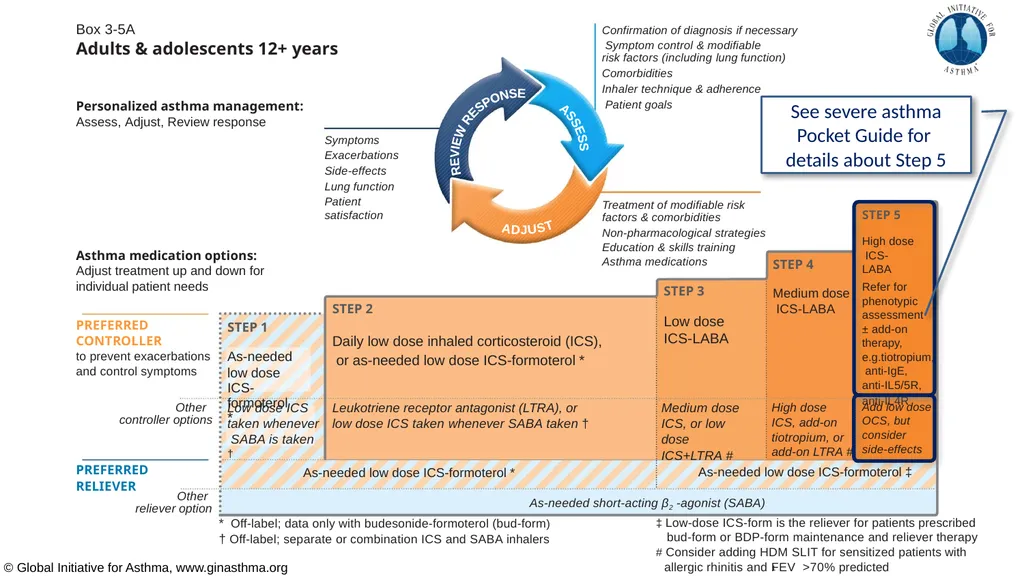
Assess, Adjust, Review response Asthma medication options: Adjust treatment up and down for individual patient needs See severe asthma Pocket Guide for details about Step 5<br>
25
Changes in GINA 2019 –
children 6-11 years<br>
26
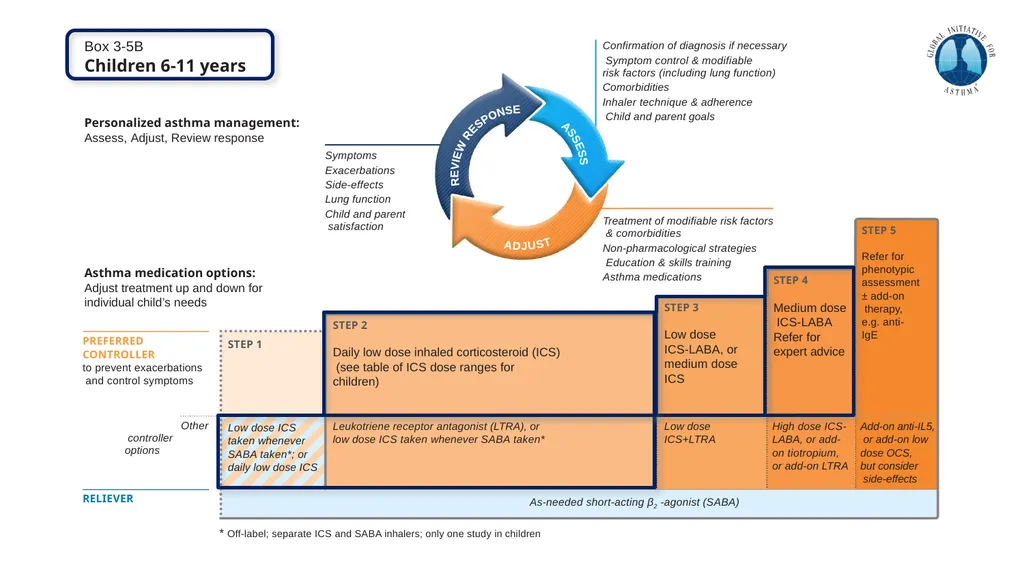
REVIEW RESPONSE ASSESS ADJUST Other controller options Leukotriene receptor antagonist (LTRA), or low dose ICS taken whenever SABA taken* Low dose ICS+LTRA High dose ICS- LABA, or add- on tiotropium, or add-on LTRA Add-on anti-IL5, or add-on low dose OCS,
but consider side-effects Low dose ICS taken whenever SABA taken*; or daily low dose ICS RELIEVER * Off-label; separate ICS and SABA inhalers; only one study in children PREFERRED CONTROLLER
to prevent exacerbations and control symptoms STEP 1 STEP 2 Daily low dose inhaled corticosteroid (ICS) (see table of ICS dose ranges for children) STEP 3
Low dose ICS-LABA, or medium dose ICS Box 3-5B
Children 6-11 years Personalized asthma management:
Assess, Adjust, Review response Asthma medication options: Adjust treatment up and down for individual child’s needs STEP 5
Refer for phenotypic assessment
± add-on therapy,
e.g. anti-IgE STEP 4
Medium dose ICS-LABA
Refer for expert advice Symptoms Exacerbations Side-effects Lung function
Child and parent satisfaction Confirmation of diagnosis if necessary Symptom control & modifiable
risk factors (including lung function)
Comorbidities
Inhaler technique & adherence Child and parent goals Treatment of modifiable risk factors & comorbidities
Non-pharmacological strategies Education & skills training Asthma medications As-needed short-acting β2 -agonist (SABA)<br>
27
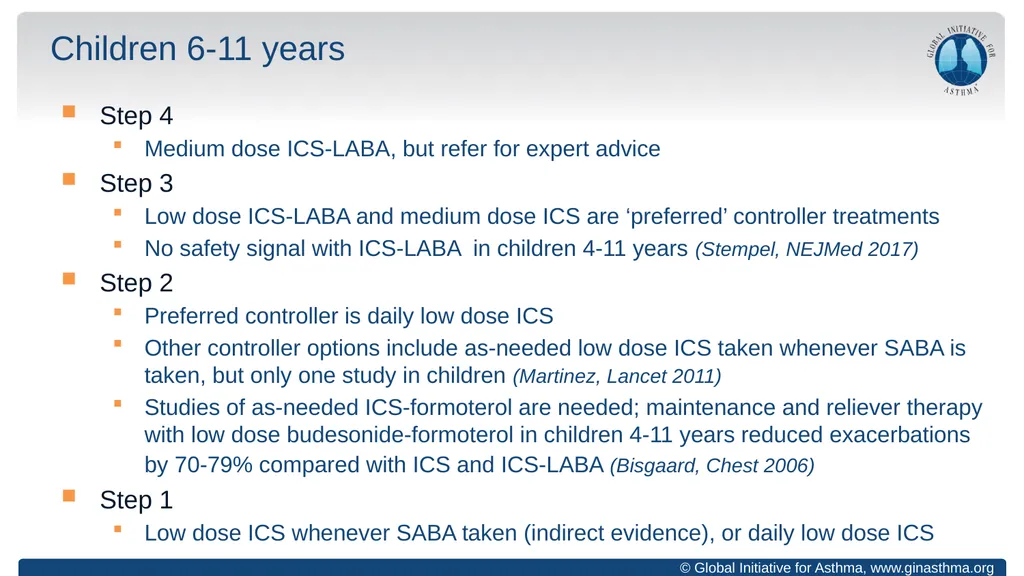
Step 4
Medium dose ICS-LABA, but refer for expert advice
Step 3
Low dose ICS-LABA and medium dose ICS are ‘preferred’ controller treatments
No safety signal with ICS-LABA in children 4-11 years (Stempel, NEJMed 2017)
Step 2
Preferred controller is daily low dose ICS
Other controller options include as-needed low dose ICS taken whenever SABA is taken, but only one study in children (Martinez, Lancet 2011)
Studies of as-needed ICS-formoterol are needed; maintenance and reliever therapy with low dose budesonide-formoterol in children 4-11 years reduced exacerbations by 70-79% compared with ICS and ICS-LABA (Bisgaard, Chest 2006)
Step 1
Low dose ICS whenever SABA taken (indirect evidence), or daily low dose ICS Children 6-11 years<br>
28
Other changes in GINA 2019<br>
29
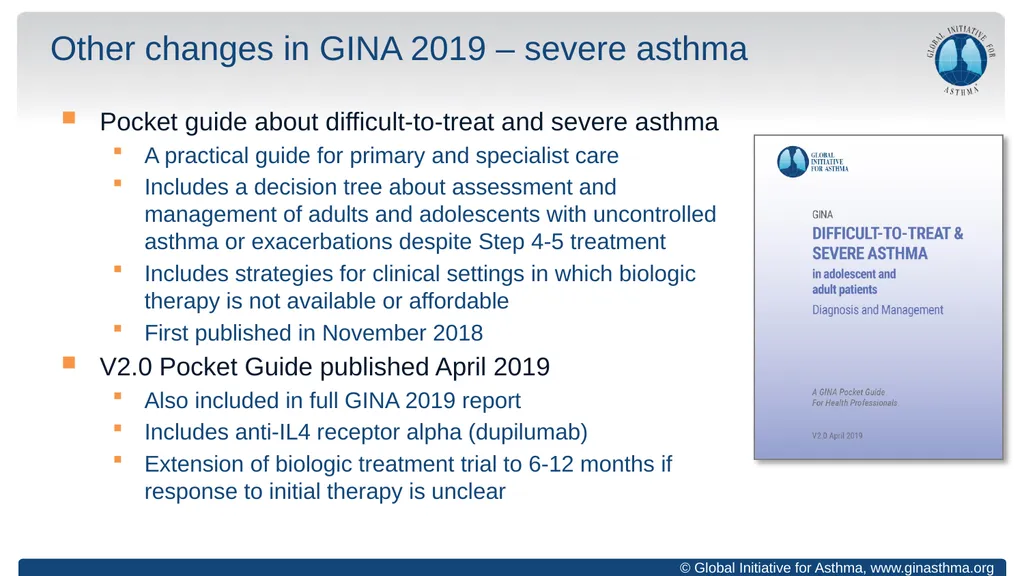
Pocket guide about difficult-to-treat and severe asthma
A practical guide for primary and specialist care
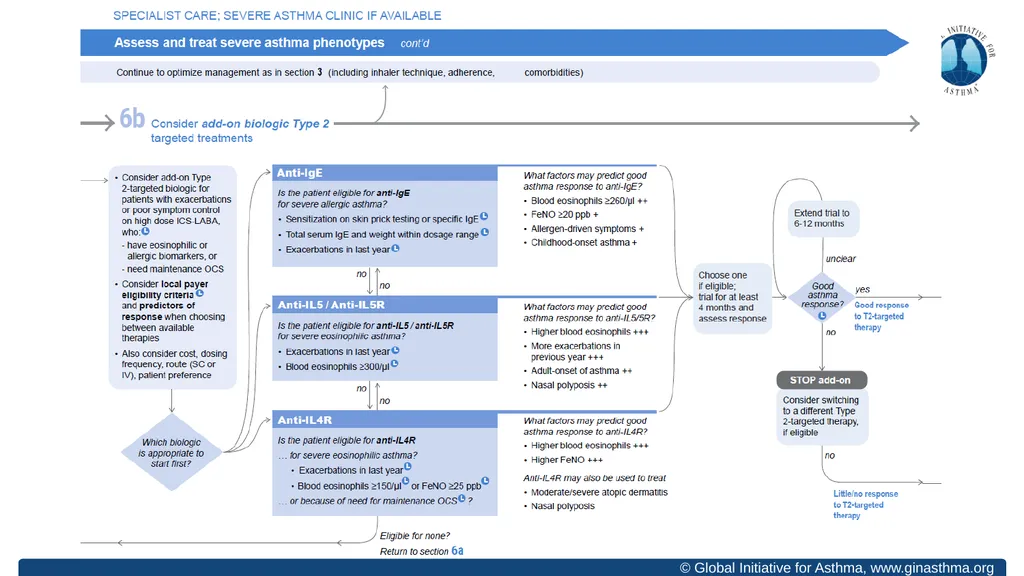
Includes a decision tree about assessment and management of adults and adolescents with uncontrolled asthma or exacerbations despite Step 4-5 treatment
Includes strategies for clinical settings in which biologic therapy is not available or affordable
First published in November 2018
V2.0 Pocket Guide published April 2019
Also included in full GINA 2019 report
Includes anti-IL4 receptor alpha (dupilumab)
Extension of biologic treatment trial to 6-12 months if response to initial therapy is unclear Other changes in GINA 2019 – severe asthma<br>
30
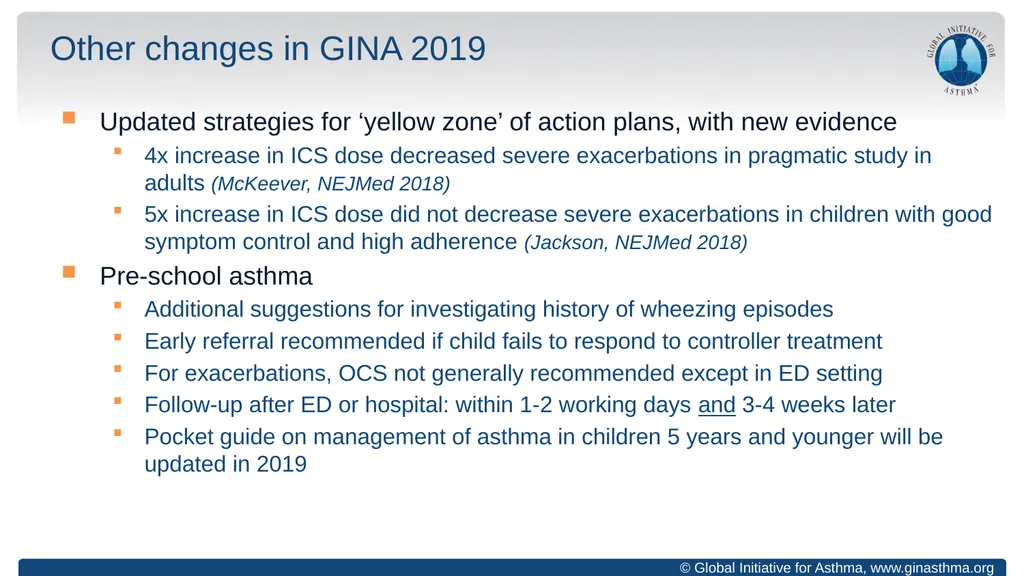
Updated strategies for ‘yellow zone’ of action plans, with new evidence
4x increase in ICS dose decreased severe exacerbations in pragmatic study in adults (McKeever, NEJMed 2018)
5x increase in ICS dose did not decrease severe exacerbations in children with good symptom control and high adherence (Jackson, NEJMed 2018)
Pre-school asthma
Additional suggestions for investigating history of wheezing episodes
Early referral recommended if child fails to respond to controller treatment
For exacerbations, OCS not generally recommended except in ED setting
Follow-up after ED or hospital: within 1-2 working days and 3-4 weeks later
Pocket guide on management of asthma in children 5 years and younger will be updated in 2019 Other changes in GINA 2019<br>
31
Questions?<br>