04
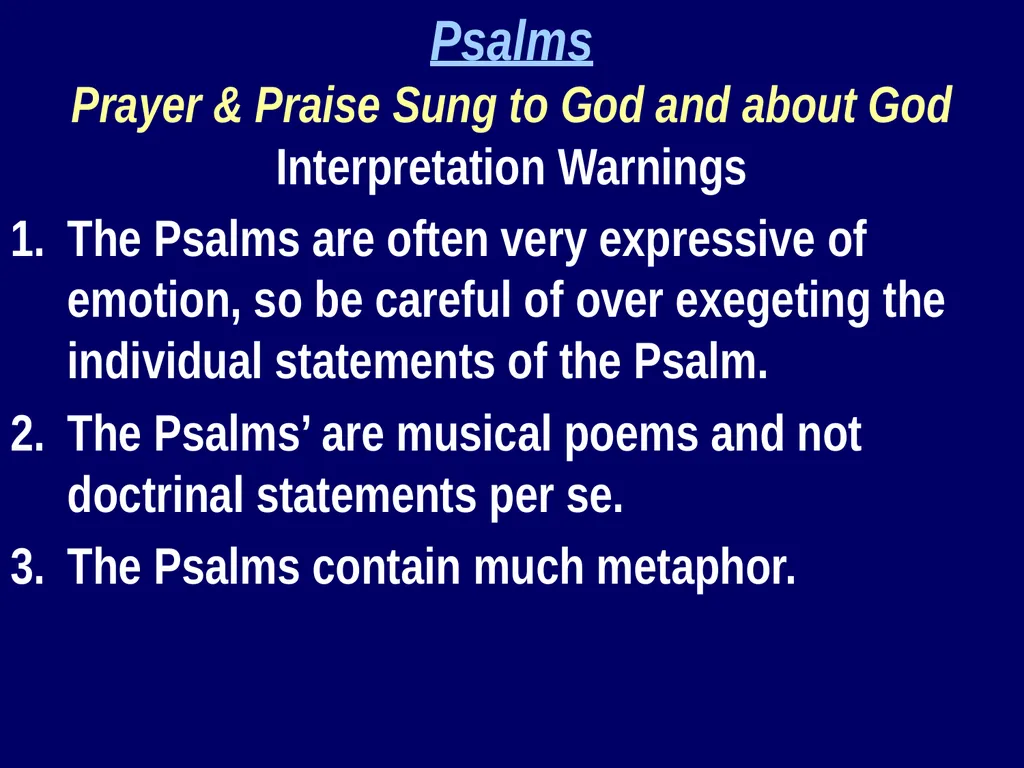
Psalms�Prayer & Praise Sung to God and about God Interpretation Warnings
The Psalms are often very expressive of emotion, so be careful of over exegeting the individual statements of the Psalm.
The Psalms’ are musical poems and not doctrinal statements per se.
The Psalms contain much metaphor.<br>
05
Psalms�Prayer & Praise Sung to God and about God Interpretation Warnings
Care must be taken not to push Psalms into allegory.
If a superscription references an historical event, the Psalm should be interpreted accordingly.<br>
06
Psalms�History Individual Psalms & small collections gradually collected into larger books and eventually into the Five Books of Psalms over many centuries. Those involved in the editing of the Psalms into these books include David (1 Chronicles 15:16), Hezekiah (2 Chronicles 29:30); Proverbs 25:1) and Ezra (Nehemiah 8).<br>
07
Psalms�Functions The Psalms were used to aide in Temple worship, individual prayer and worship.
They can currently be used to guide worship, prayer, and response to God.
The Psalms open our hearts to be real with God and help us to reflect and meditate upon the things of God.<br>
08
Types of Psalms�Lament – Over 60 Community Laments (national) (Psalms 44, 60,74, 79-80, 83, 85, 90, 123)
Individual Laments (Psalms 3-7,12, 13, 22, 25-28, 35, 38-40, 42, 43, 51, 54-57, 59, 61, 63, 64, 69-71, 86, 88, 102, 109, 120, 130, 140-143)
Penitential Laments (Psalms 6, 51)
Imprecatory Laments (Psalms 7, 35, 40, 55, 58, 59, 69, 79, 109, 137, 139, 144)<br>
09
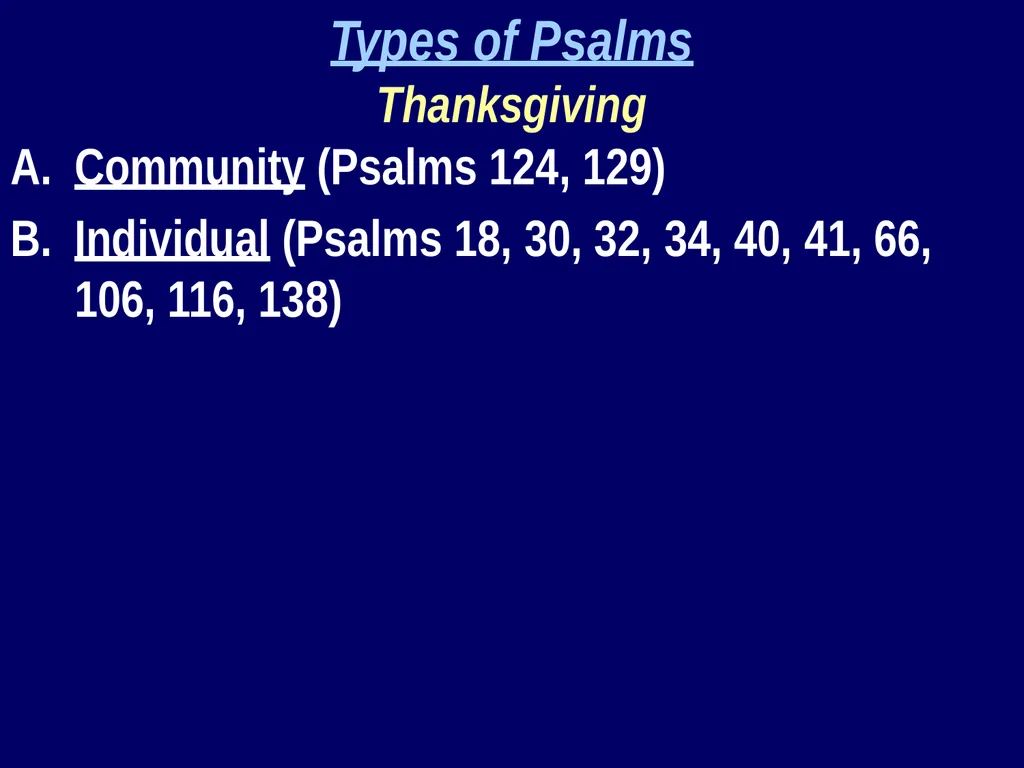
Types of Psalms�Thanksgiving Community (Psalms 124, 129)
Individual (Psalms 18, 30, 32, 34, 40, 41, 66, 106, 116, 138)<br>
10
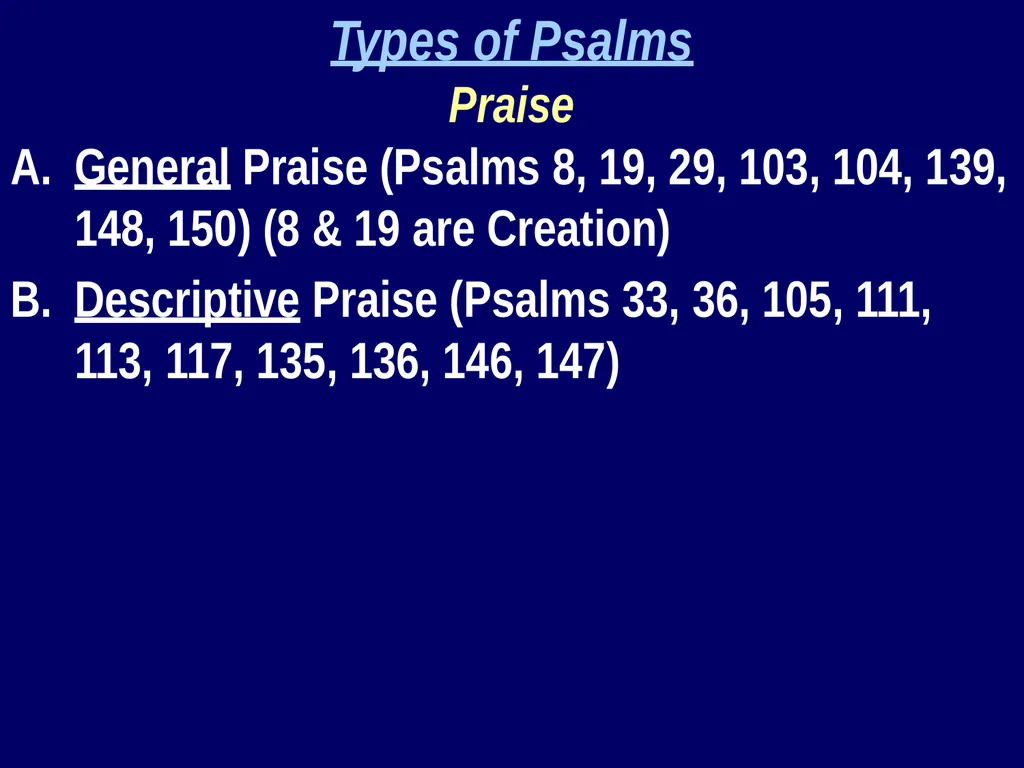
Types of Psalms�Praise General Praise (Psalms 8, 19, 29, 103, 104, 139, 148, 150) (8 & 19 are Creation)
Descriptive Praise (Psalms 33, 36, 105, 111, 113, 117, 135, 136, 146, 147)<br>
11
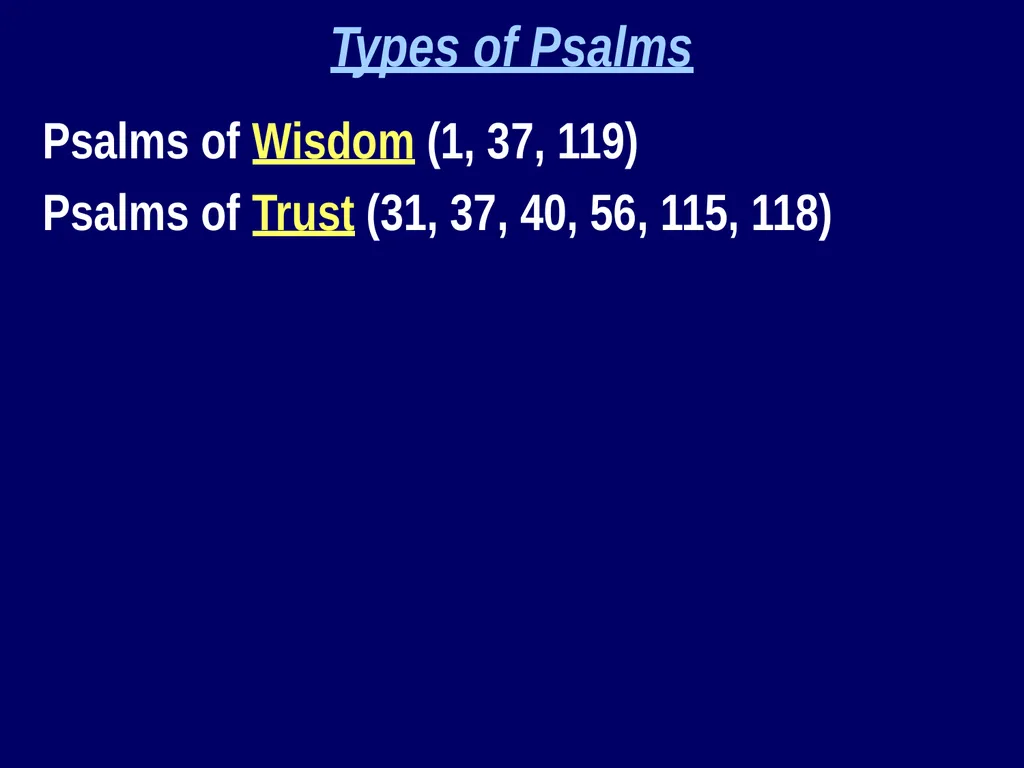
Types of Psalms Psalms of Wisdom (1, 37, 119)
Psalms of Trust (31, 37, 40, 56, 115, 118)<br>
12
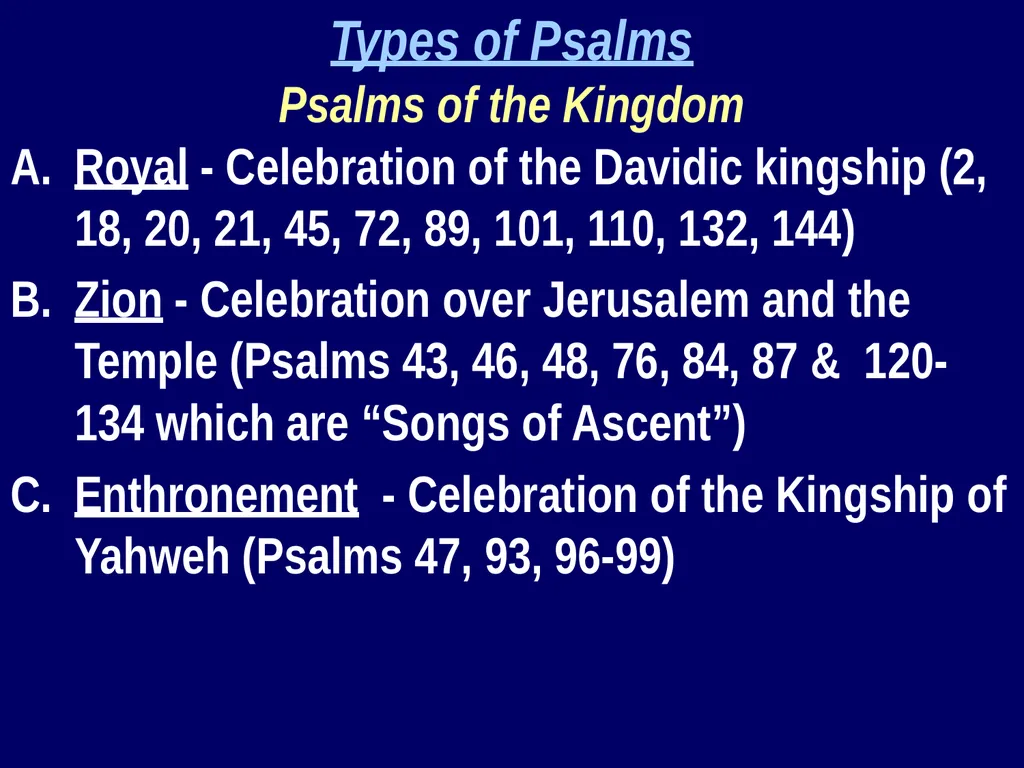
Types of Psalms�Psalms of the Kingdom Royal - Celebration of the Davidic kingship (2, 18, 20, 21, 45, 72, 89, 101, 110, 132, 144)
Zion - Celebration over Jerusalem and the Temple (Psalms 43, 46, 48, 76, 84, 87 & 120-134 which are “Songs of Ascent”)
Enthronement - Celebration of the Kingship of Yahweh (Psalms 47, 93, 96-99)<br>
13
Terms in Titles of Psalms Maskil (13) - Contemplative poem. (Psalms 32; 42; 44; 45; 52; 53; 54; 55; 74; 78; 88; 89; 142) also used in 47:8
Mikhtam (6) (Miktam or Michtam) musical or liturgical term in title of Psalms 16 & 56-60. All of these are poems of lament, so may have reference to the type of Psalm<br>
14
Terms in Titles of Psalms Mizmor (57) Usually translated as “Song.” Rooted in the verb “Zamar” meaning “to make or produce music in praise to God” Examples: Psalm 30; 45, 65-69; 76; 88; 98; 120-134; 149)
Selah (71) - may mark a pause, musical interlude or a cresendo. From a word meaning “lift up”<br>
15
Terms in Titles of Psalms Shir (31) - translated as “song” in titles, and within text, also as music, sing, singers. Psalms 18; 30, 45, 46, 48, 65-68; 75, 76, 83, 87, 88, 92, 108, 120-134. Also in Psalm 28:7; 33:3, 40:4; 42:9; 69:31; 137:3-4; 144:9.
Tephillah (5) - prayer. Psalms 17, 86; 90; 102; 142. Also in Psalm 72:20
Tehillah (1) - praise. Psalm 145<br>
16
Hebrew Poetry Meter: Not agreed upon. No exegetical significance. A subject in textual criticism.
Grammatical Issues: Poetical writings differ from prose. The article, the conjunction “and,” & the sign of the direct object may often be absent.
Structure: Hebrew poetry is generally parallel in nature and usually in couplets (AB), but sometimes triplets (ABC).<br>
17
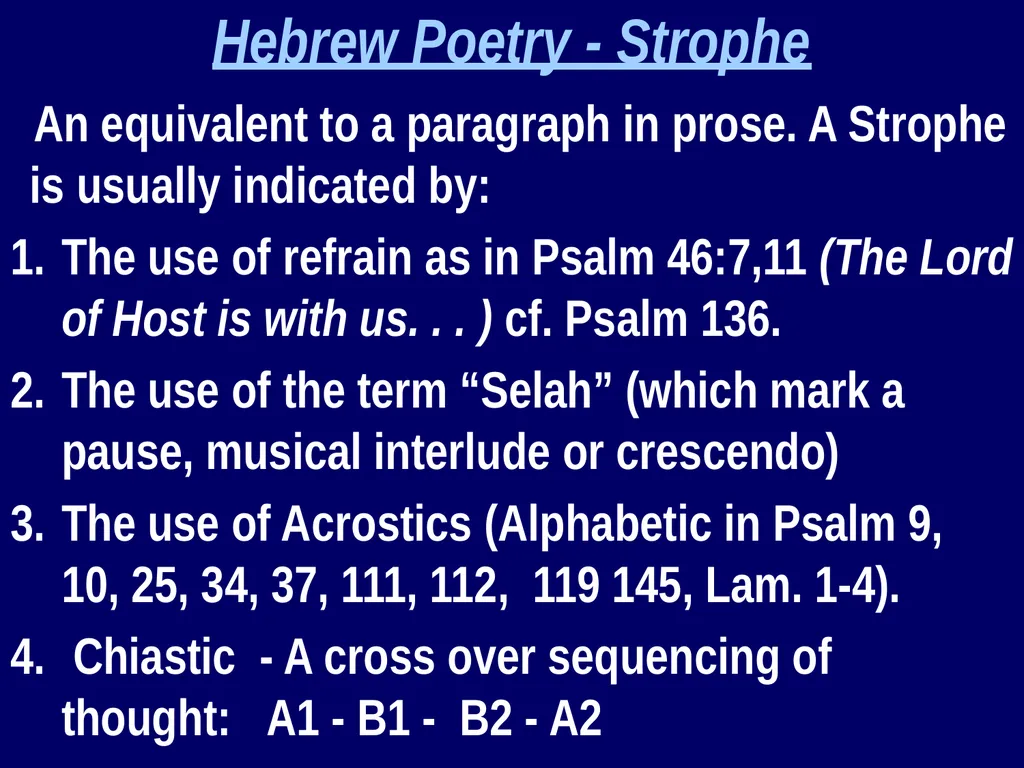
Hebrew Poetry - Strophe An equivalent to a paragraph in prose. A Strophe is usually indicated by:
The use of refrain as in Psalm 46:7,11 (The Lord of Host is with us. . . ) cf. Psalm 136.
The use of the term “Selah” (which mark a pause, musical interlude or crescendo)
The use of Acrostics (Alphabetic in Psalm 9, 10, 25, 34, 37, 111, 112, 119 145, Lam. 1-4).
Chiastic - A cross over sequencing of thought: A1 - B1 - B2 - A2<br>
18
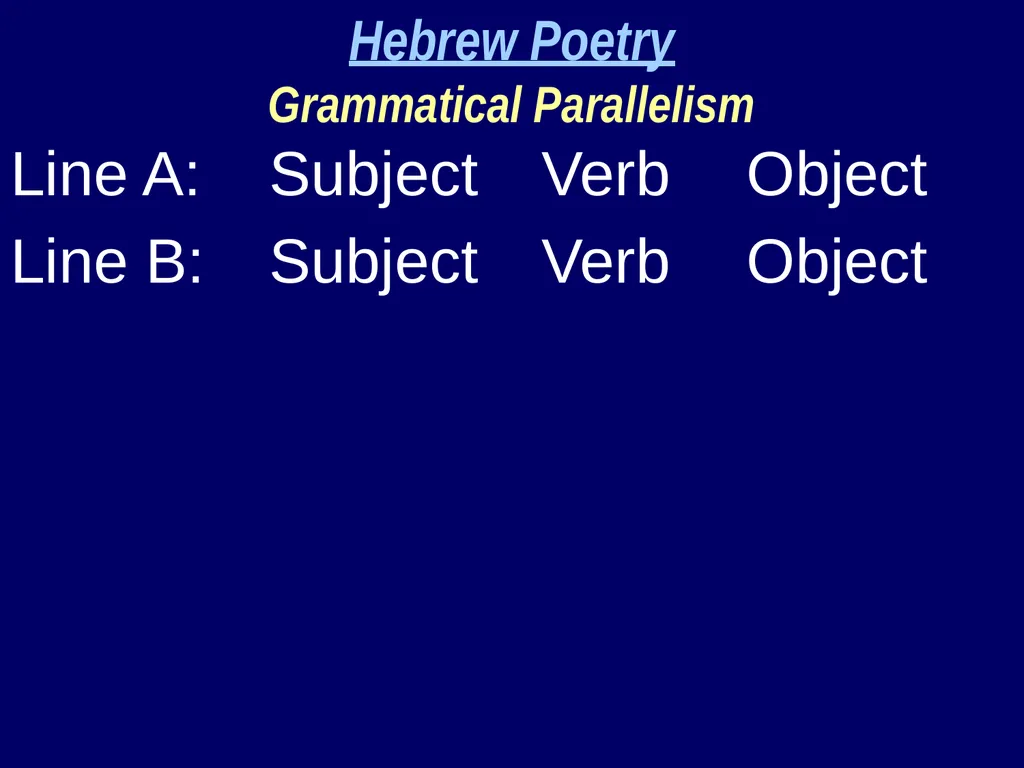
Hebrew Poetry�Grammatical Parallelism Line A: Subject Verb Object
Line B: Subject Verb Object<br>
19
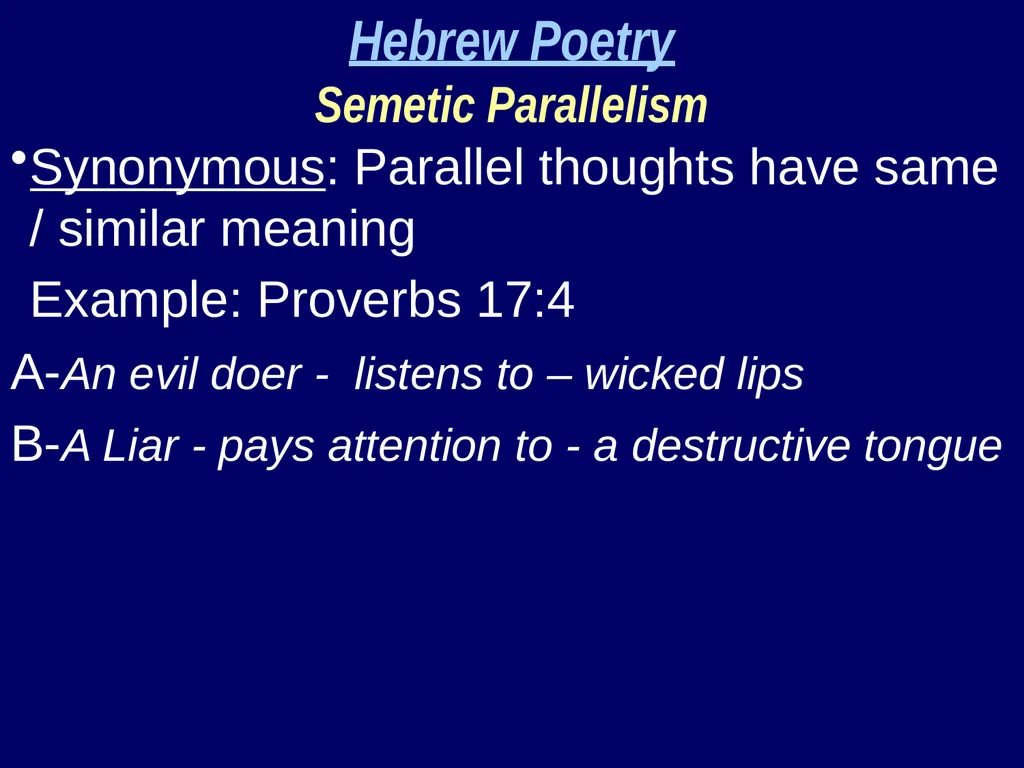
Hebrew Poetry�Semetic Parallelism Synonymous: Parallel thoughts have same / similar meaning
Example: Proverbs 17:4
A-An evil doer - listens to – wicked lips
B-A Liar - pays attention to - a destructive tongue<br>
20
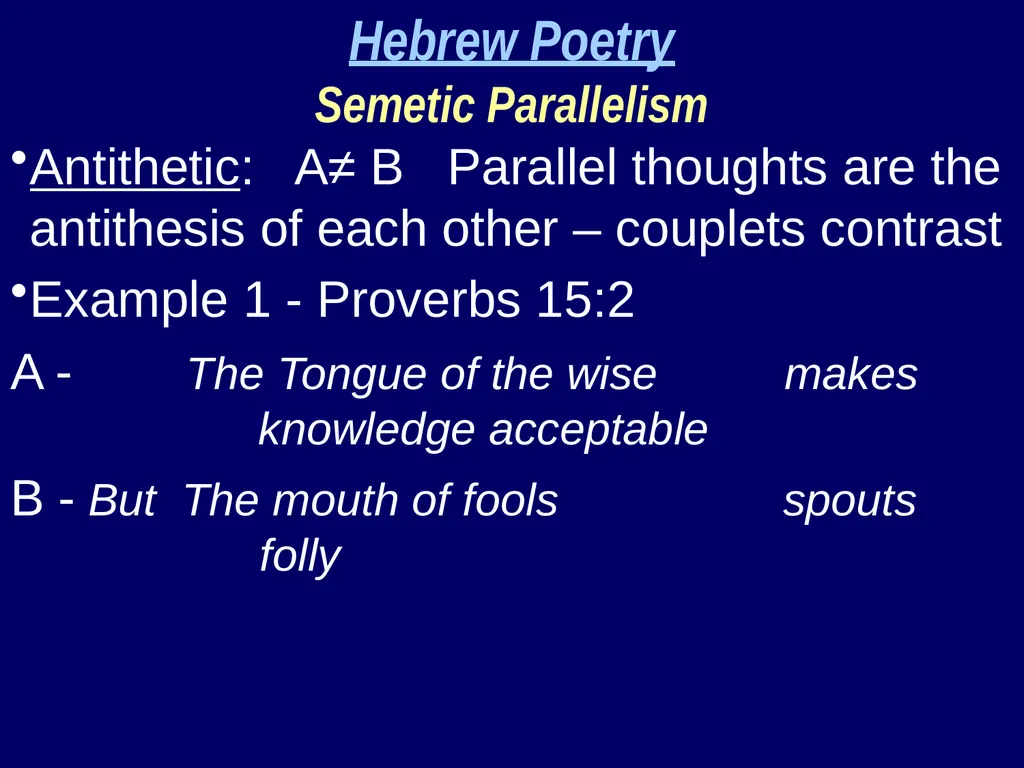
Hebrew Poetry�Semetic Parallelism Antithetic: A≠ B Parallel thoughts are the antithesis of each other – couplets contrast
Example 1 - Proverbs 15:2
A - The Tongue of the wise makes knowledge acceptable
B - But The mouth of fools spouts folly<br>
21
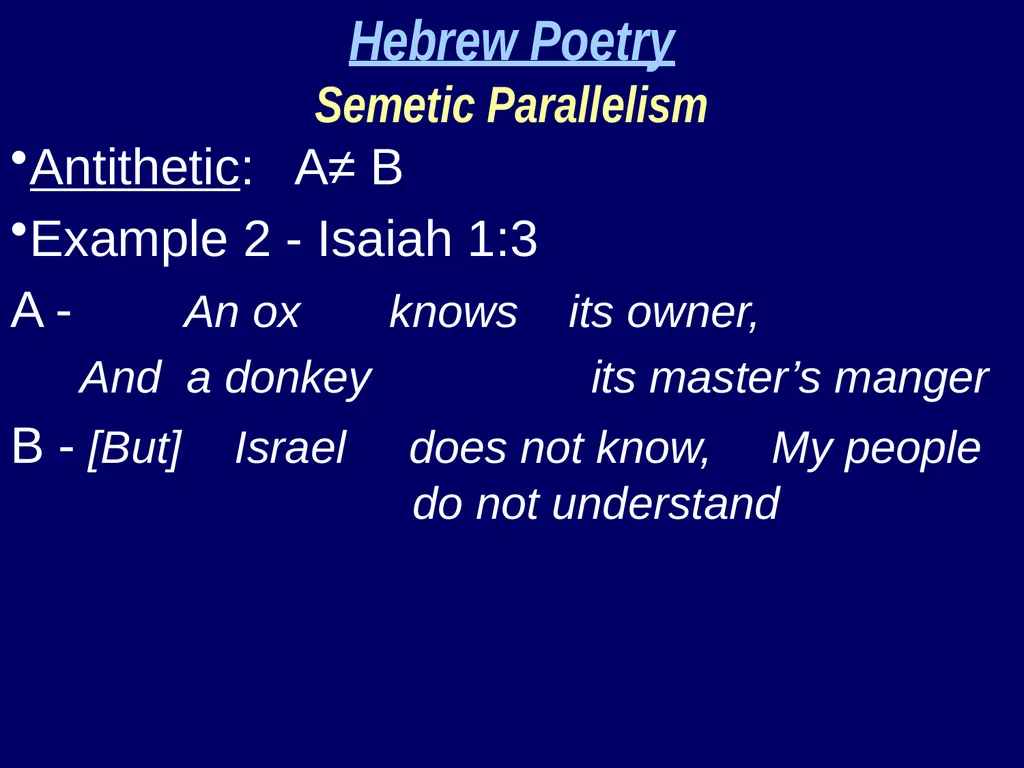
Hebrew Poetry�Semetic Parallelism Antithetic: A≠ B
Example 2 - Isaiah 1:3
A - An ox knows its owner,
And a donkey its master’s manger
B - [But] Israel does not know, My people do not understand<br>
22
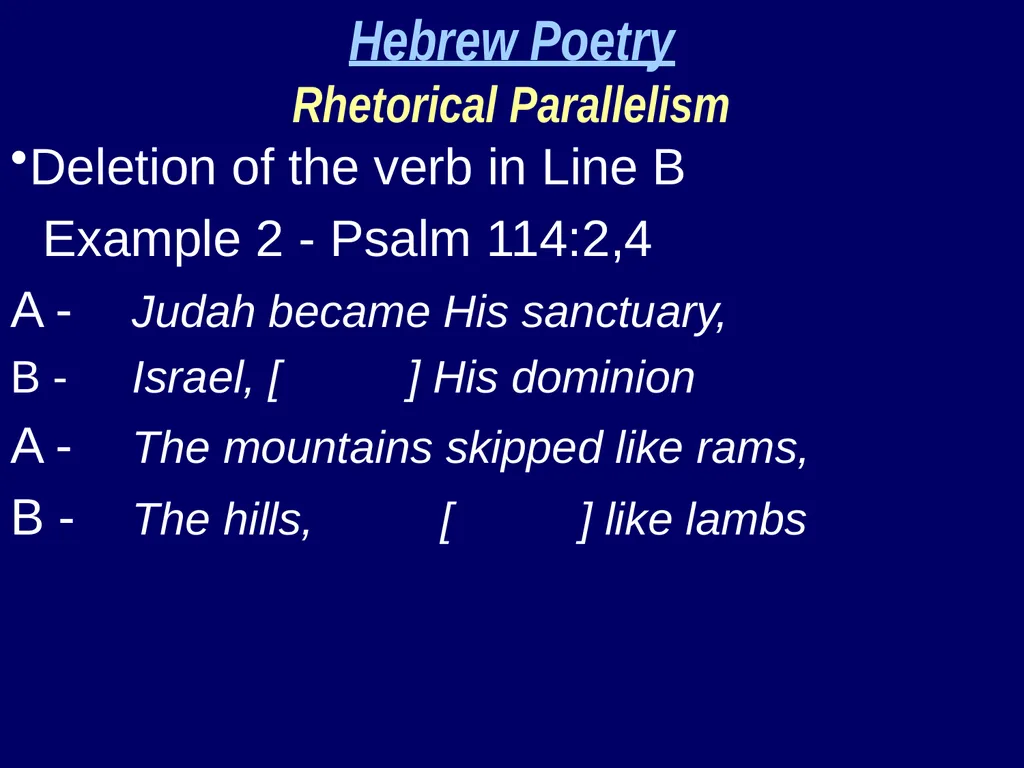
Hebrew Poetry�Rhetorical Parallelism Deletion of the verb in Line B
Example 2 - Psalm 114:2,4
A - Judah became His sanctuary,
B - Israel, [ ] His dominion
A - The mountains skipped like rams,
B - The hills, [ ] like lambs<br>
23
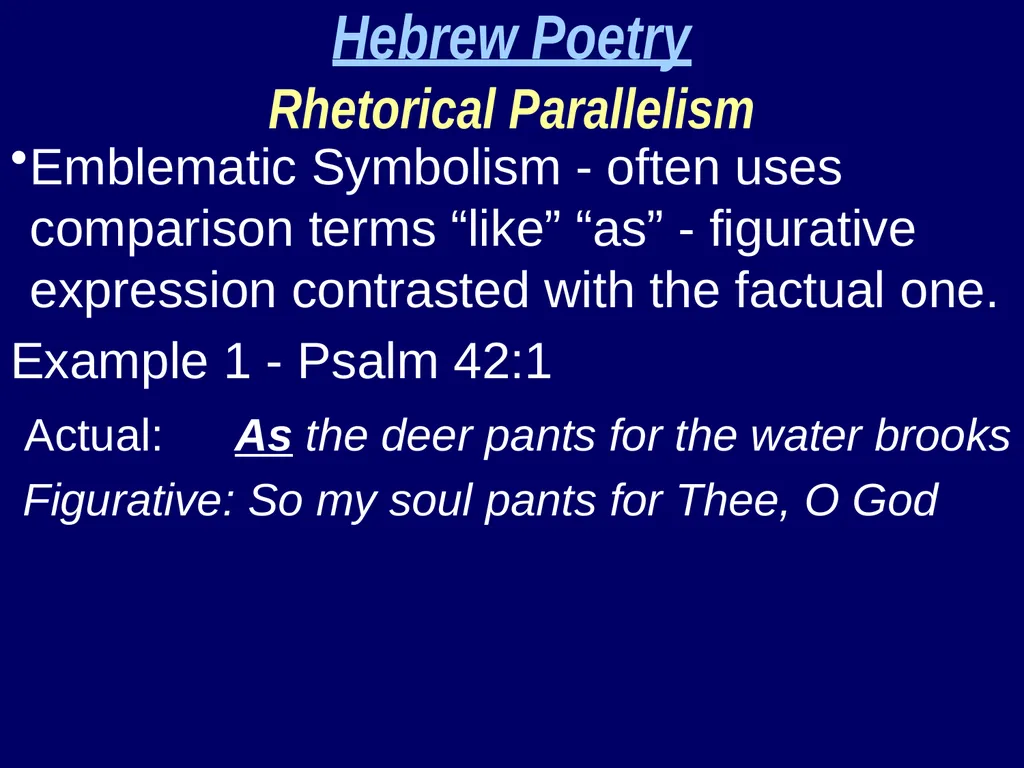
Hebrew Poetry�Rhetorical Parallelism Emblematic Symbolism - often uses comparison terms “like” “as” - figurative expression contrasted with the factual one.
Example 1 - Psalm 42:1
Actual: As the deer pants for the water brooks
Figurative: So my soul pants for Thee, O God<br>
24
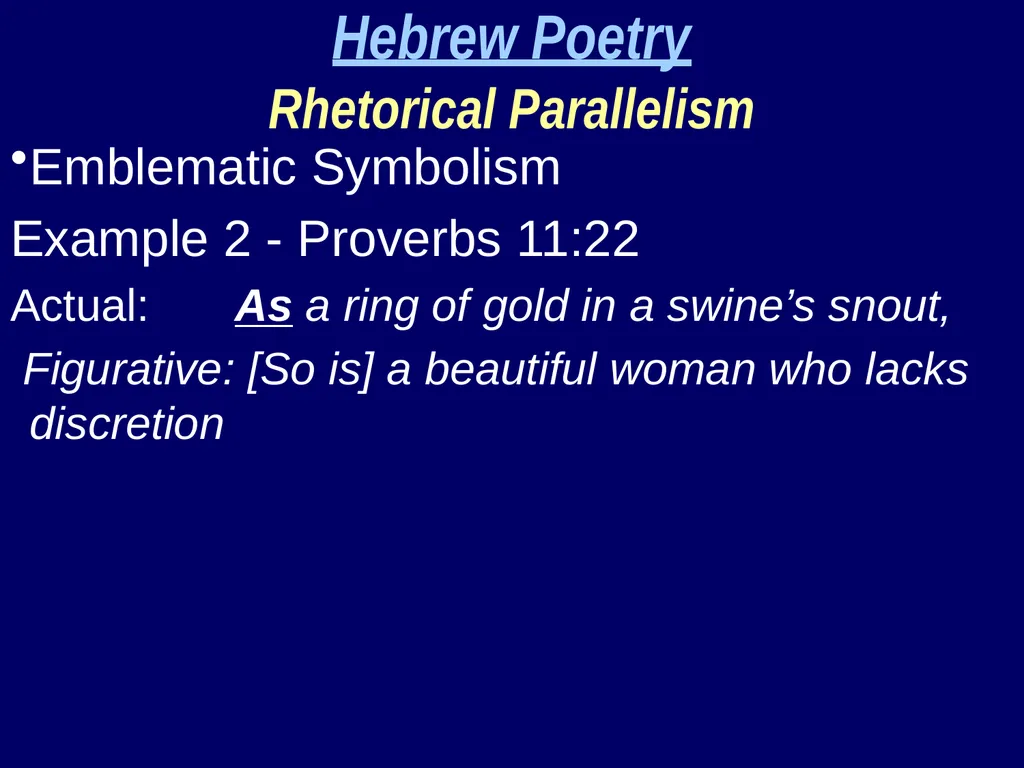
Hebrew Poetry�Rhetorical Parallelism Emblematic Symbolism
Example 2 - Proverbs 11:22
Actual: As a ring of gold in a swine’s snout,
Figurative: [So is] a beautiful woman who lacks discretion<br>
25
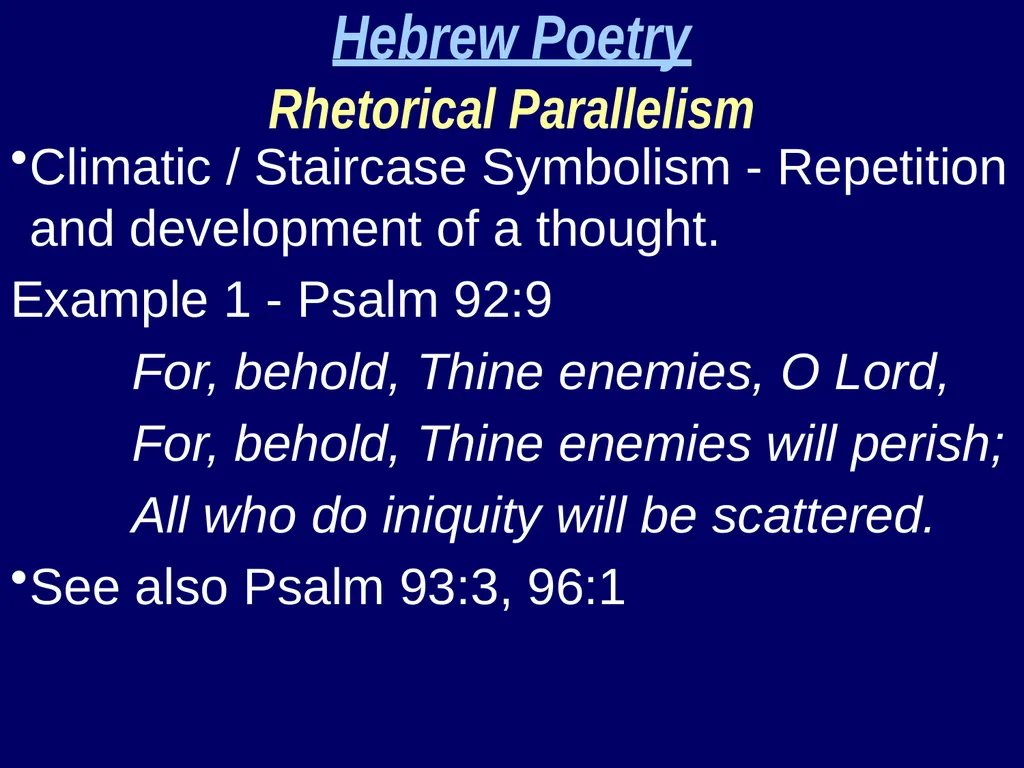
Hebrew Poetry�Rhetorical Parallelism Climatic / Staircase Symbolism - Repetition and development of a thought.
Example 1 - Psalm 92:9
For, behold, Thine enemies, O Lord,
For, behold, Thine enemies will perish;
All who do iniquity will be scattered.
See also Psalm 93:3, 96:1<br>
26
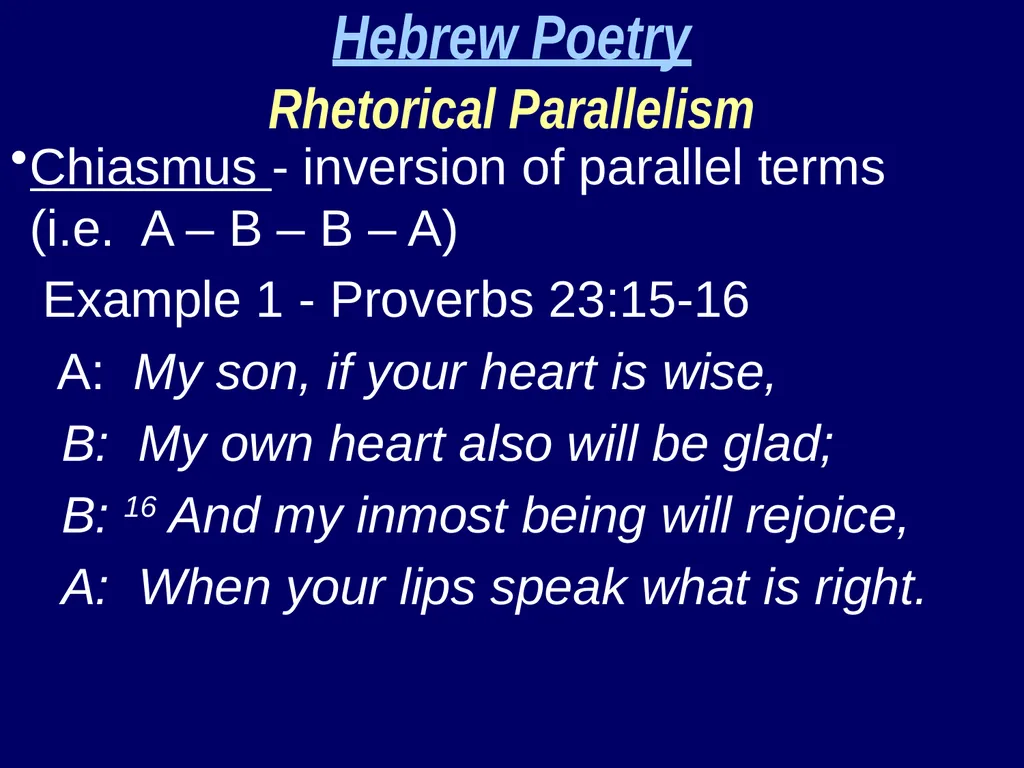
Hebrew Poetry�Rhetorical Parallelism Chiasmus - inversion of parallel terms (i.e. A – B – B – A)
Example 1 - Proverbs 23:15-16
A: My son, if your heart is wise,
B: My own heart also will be glad;
B: 16 And my inmost being will rejoice,
A: When your lips speak what is right.<br>
27
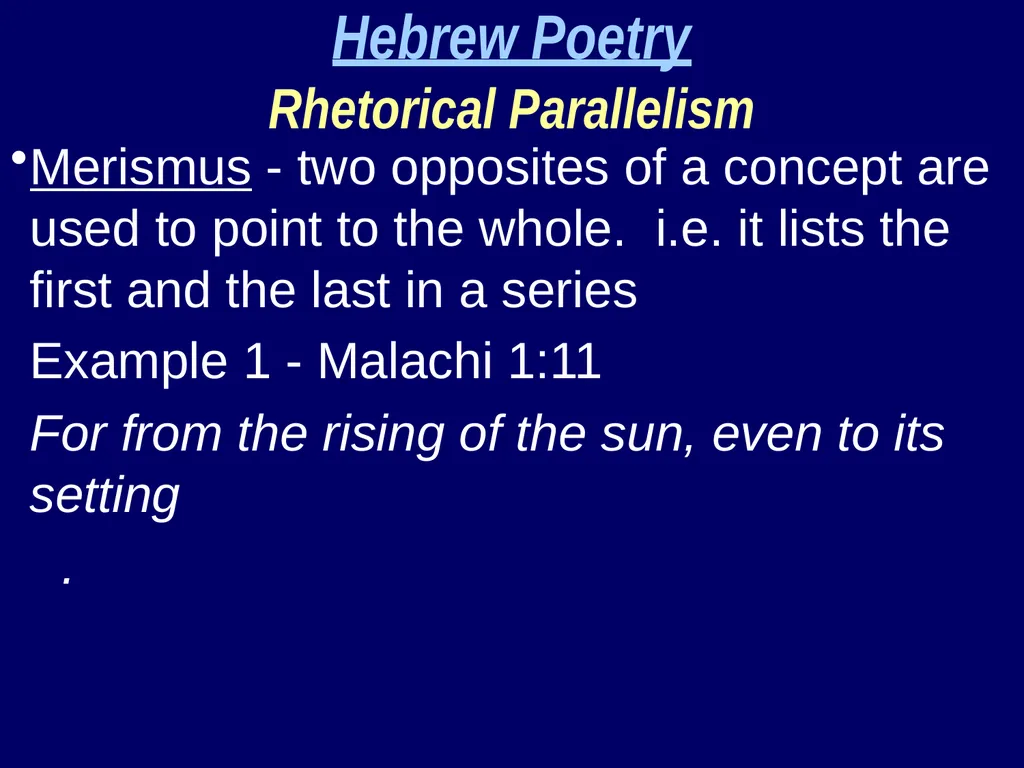
Hebrew Poetry�Rhetorical Parallelism Merismus - two opposites of a concept are used to point to the whole. i.e. it lists the first and the last in a series
Example 1 - Malachi 1:11
For from the rising of the sun, even to its setting
.<br>
28
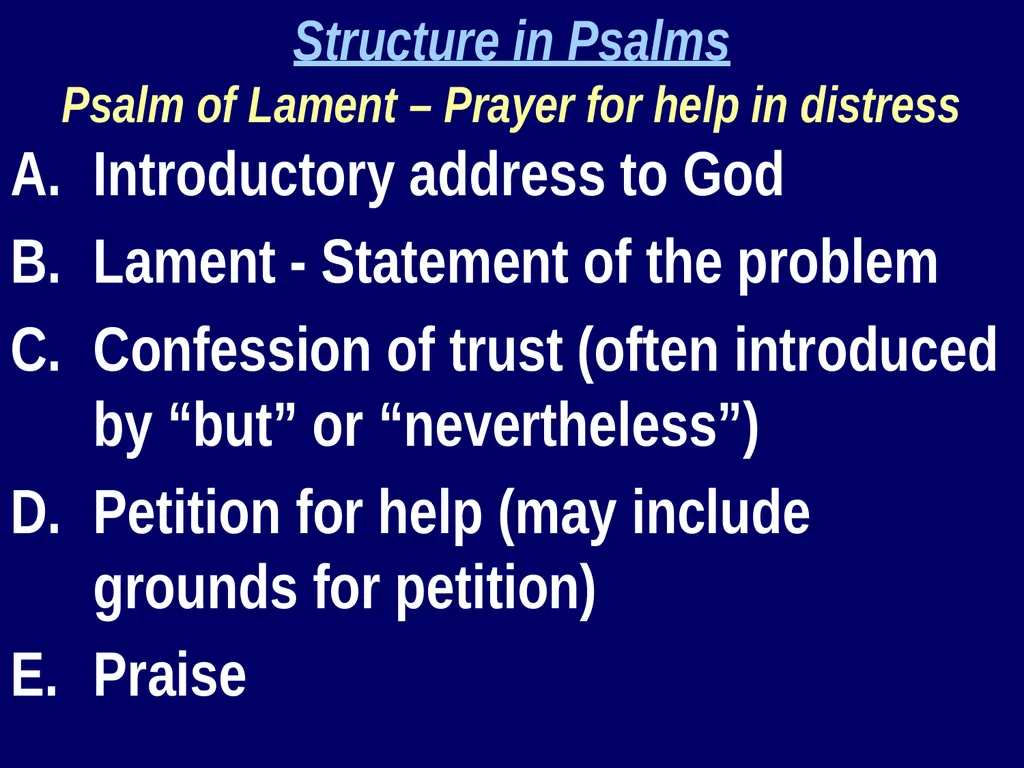
Structure in Psalms�Psalm of Lament – Prayer for help in distress Introductory address to God
Lament - Statement of the problem
Confession of trust (often introduced by “but” or “nevertheless”)
Petition for help (may include grounds for petition)
Praise<br>
29
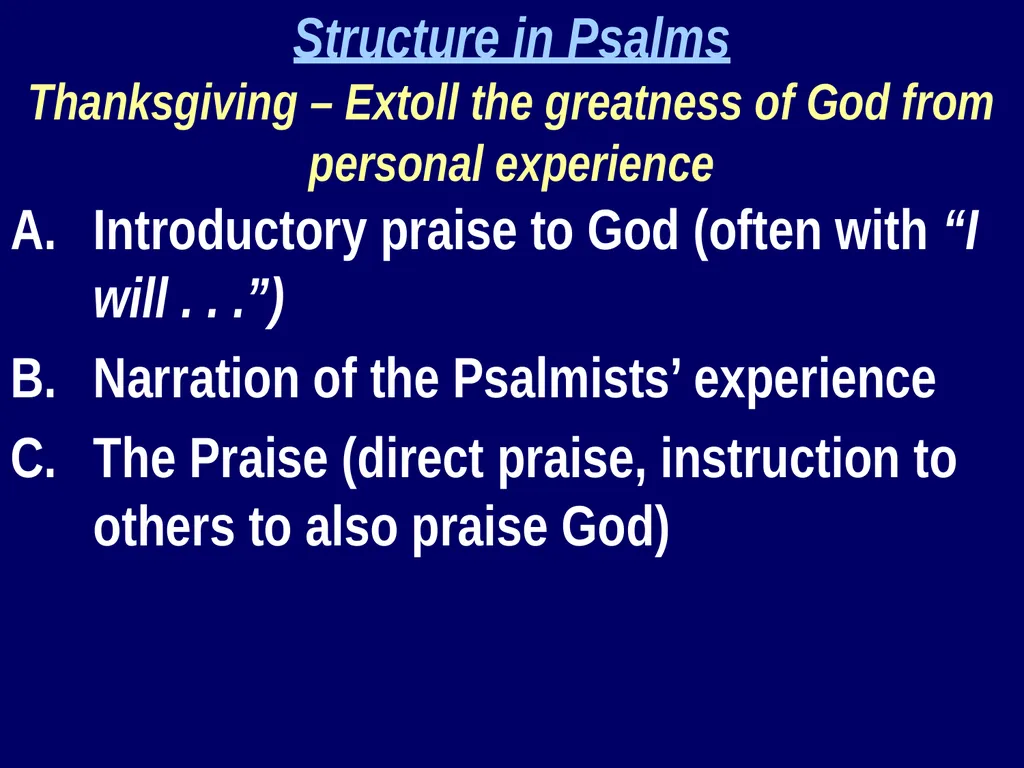
Structure in Psalms�Thanksgiving – Extoll the greatness of God from personal experience Introductory praise to God (often with “I will . . .”)
Narration of the Psalmists’ experience
The Praise (direct praise, instruction to others to also praise God)<br>
30
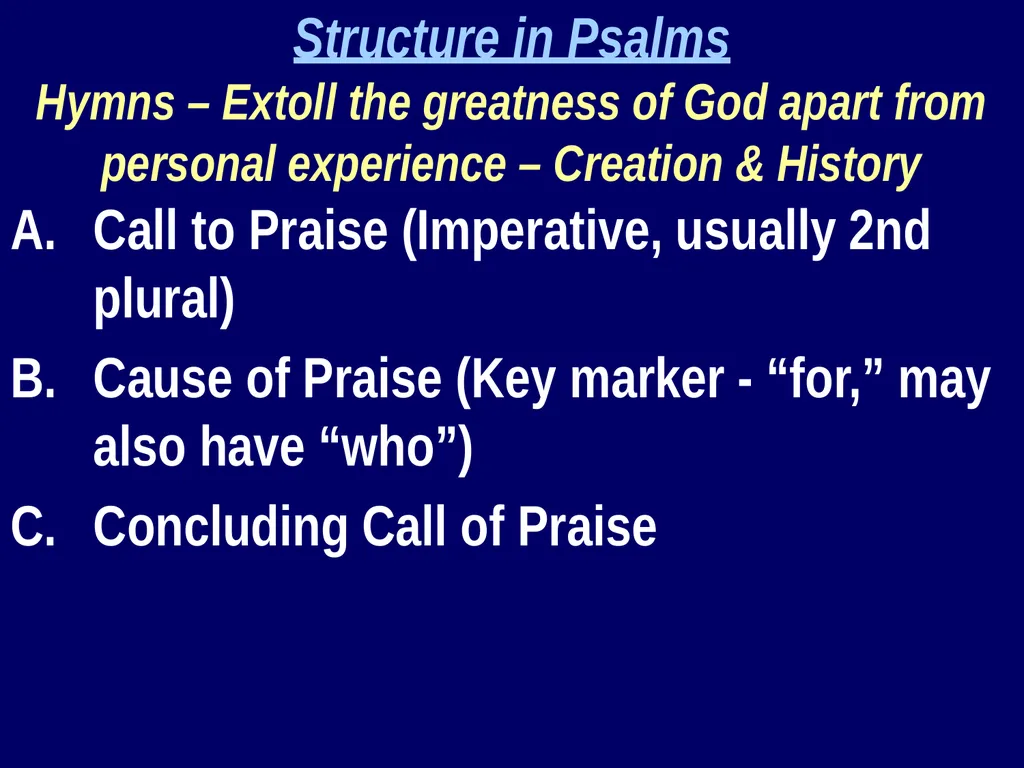
Structure in Psalms�Hymns – Extoll the greatness of God apart from personal experience – Creation & History Call to Praise (Imperative, usually 2nd plural)
Cause of Praise (Key marker - “for,” may also have “who”)
Concluding Call of Praise<br>
31
Messianic Psalms Many Psalm anticipated the life and ministry of Jesus Christ. Psalms is quoted more in the New Testament than any other book - many of the quotes are Messianic
See handout list<br>
32
Grace Bible Church� Glorifying God �by Making Disciples of Jesus Christ<br>