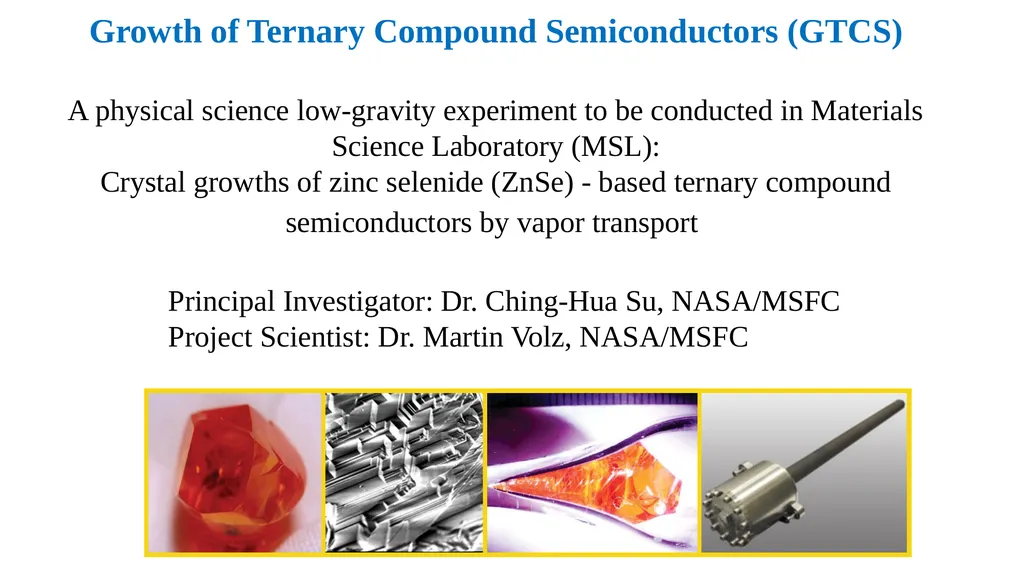
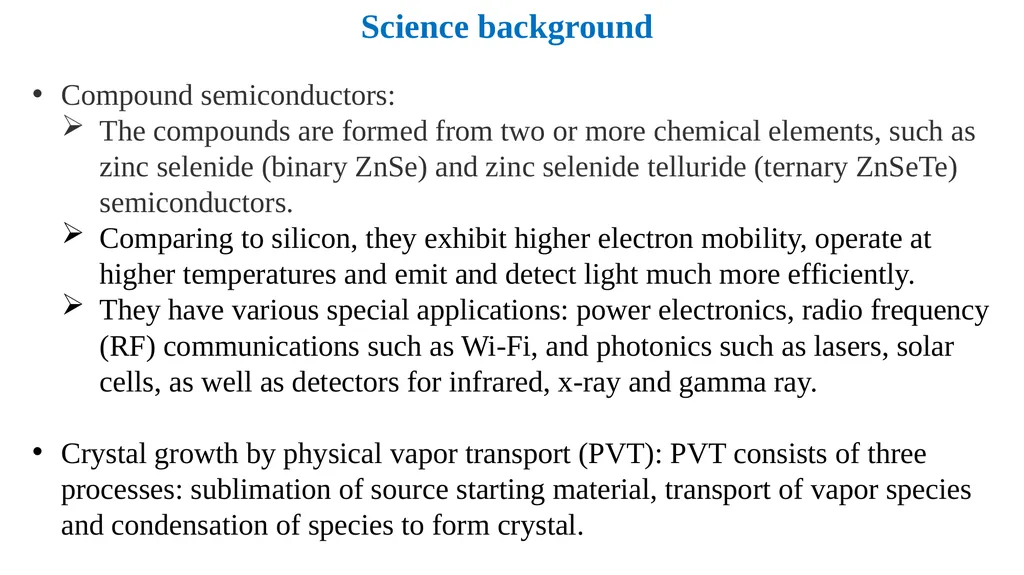
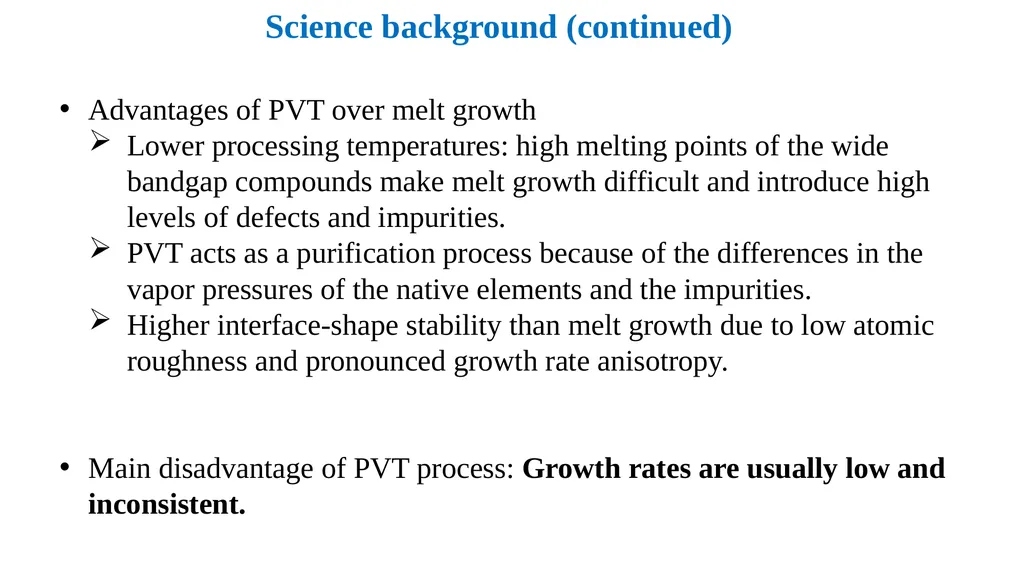
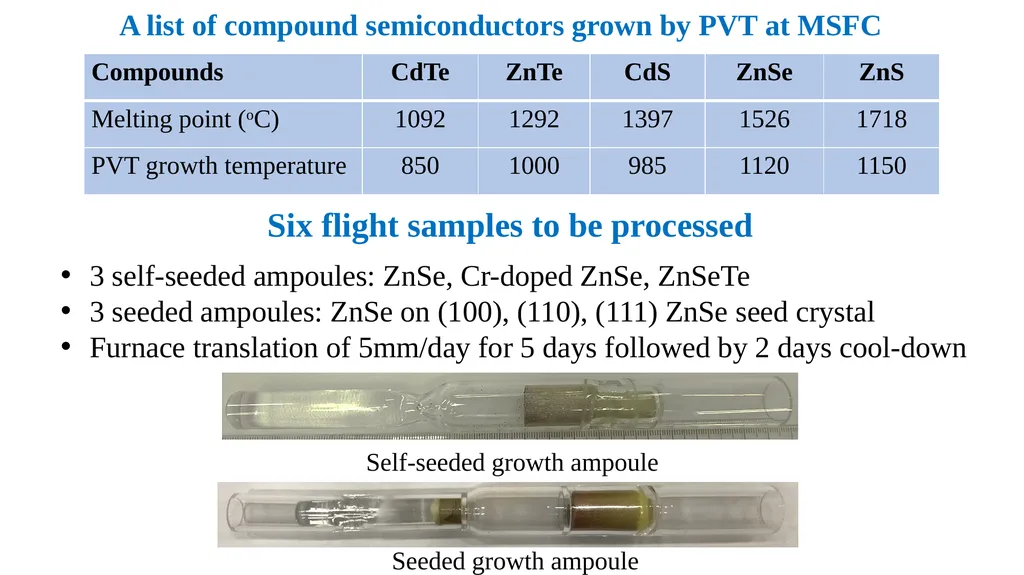
Growth of Ternary Compound Semiconductors (GTCS) A physical science low-gravity experiment to be conducted in Materials Science Laboratory (MSL): Crystal growths of zinc selenide (ZnSe) - based ternary compound semiconductors by vapor
"Growth of Ternary Compound Semiconductors (GTCS) A" is the property of its rightful owner. Permission is granted to
download and print the materials on this website for personal, non-commercial use only, and to display it
on your personal computer provided you do not modify the materials and that you retain all copyright
notices contained in the materials. By downloading content from our website, you accept the terms of this
agreement.
Presentation Transcript
01
Growth of Ternary Compound Semiconductors (GTCS)
A physical science low-gravity experiment to be conducted in Materials Science Laboratory (MSL):
Crystal growths of zinc selenide (ZnSe) - based ternary compound semiconductors by vapor transport Principal Investigator: Dr. Ching-Hua Su, NASA/MSFC
Project Scientist: Dr. Martin Volz, NASA/MSFC<br>
02
Science background
Compound semiconductors:
The compounds are formed from two or more chemical elements, such as zinc selenide (binary ZnSe) and zinc selenide telluride (ternary ZnSeTe) semiconductors.
Comparing to silicon, they exhibit higher electron mobility, operate at higher temperatures and emit and detect light much more efficiently.
They have various special applications: power electronics, radio frequency (RF) communications such as Wi-Fi, and photonics such as lasers, solar cells, as well as detectors for infrared, x-ray and gamma ray.
Crystal growth by physical vapor transport (PVT): PVT consists of three processes: sublimation of source starting material, transport of vapor species and condensation of species to form crystal.<br>
03
Advantages of PVT over melt growth
Lower processing temperatures: high melting points of the wide bandgap compounds make melt growth difficult and introduce high levels of defects and impurities.
PVT acts as a purification process because of the differences in the vapor pressures of the native elements and the impurities.
Higher interface-shape stability than melt growth due to low atomic roughness and pronounced growth rate anisotropy.
Main disadvantage of PVT process: Growth rates are usually low and inconsistent. Science background (continued)<br>
04
A list of compound semiconductors grown by PVT at MSFC Six flight samples to be processed
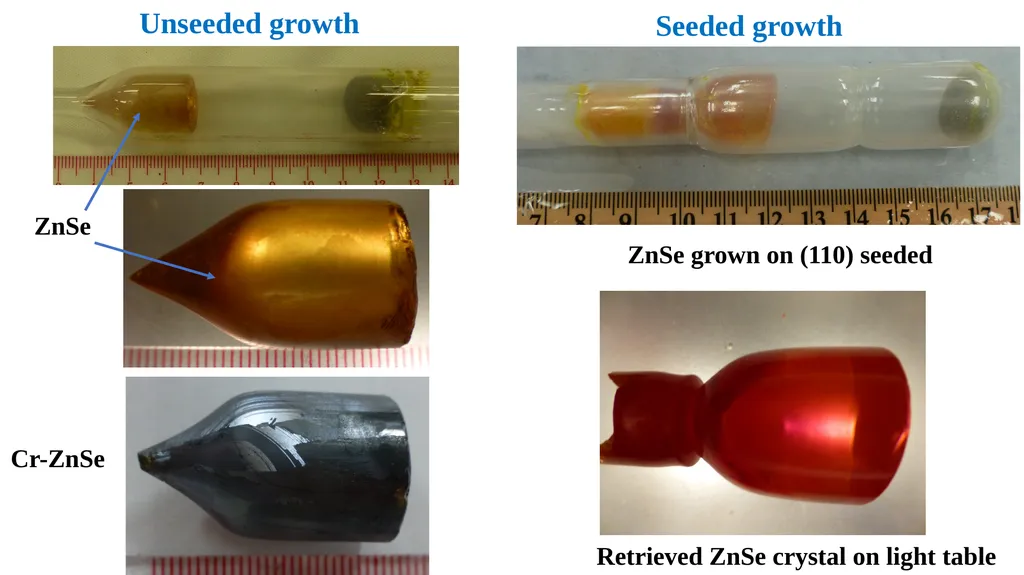
3 self-seeded ampoules: ZnSe, Cr-doped ZnSe, ZnSeTe
3 seeded ampoules: ZnSe on (100), (110), (111) ZnSe seed crystal
Furnace translation of 5mm/day for 5 days followed by 2 days cool-down Self-seeded growth ampoule Seeded growth ampoule<br>
05
ZnSe grown on (110) seeded Unseeded growth Seeded growth Retrieved ZnSe crystal on light table ZnSe Cr-ZnSe<br>
06
Scientific objectives
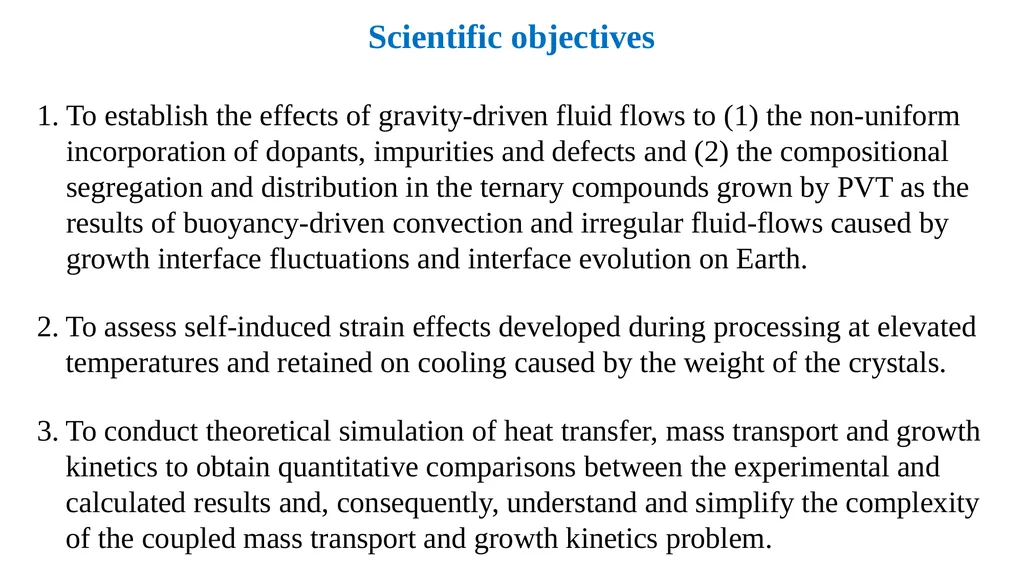
To establish the effects of gravity-driven fluid flows to (1) the non-uniform incorporation of dopants, impurities and defects and (2) the compositional segregation and distribution in the ternary compounds grown by PVT as the results of buoyancy-driven convection and irregular fluid-flows caused by growth interface fluctuations and interface evolution on Earth.
To assess self-induced strain effects developed during processing at elevated temperatures and retained on cooling caused by the weight of the crystals.
To conduct theoretical simulation of heat transfer, mass transport and growth kinetics to obtain quantitative comparisons between the experimental and calculated results and, consequently, understand and simplify the complexity of the coupled mass transport and growth kinetics problem.<br>
07
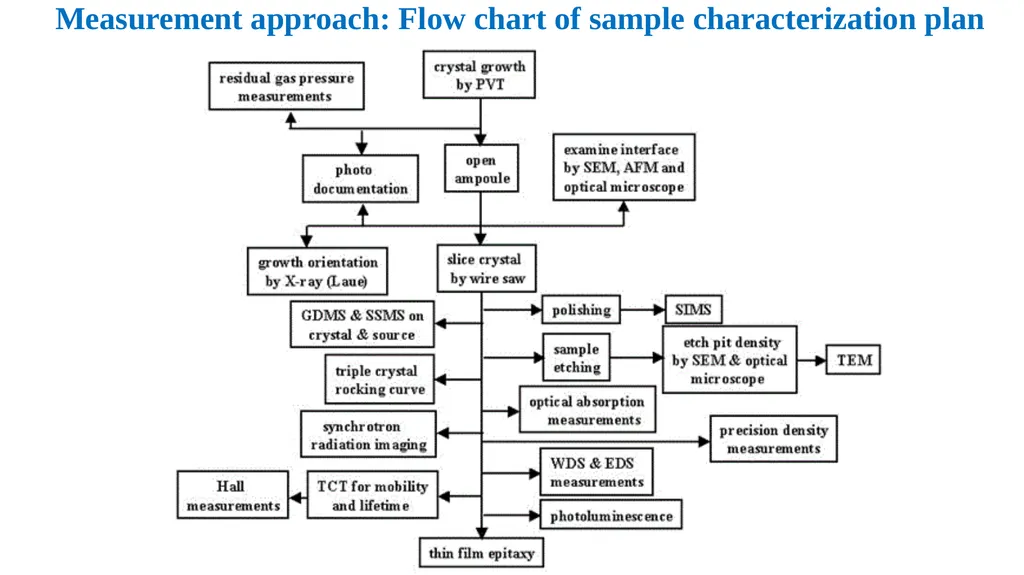
Measurement approach: Flow chart of sample characterization plan<br>
08
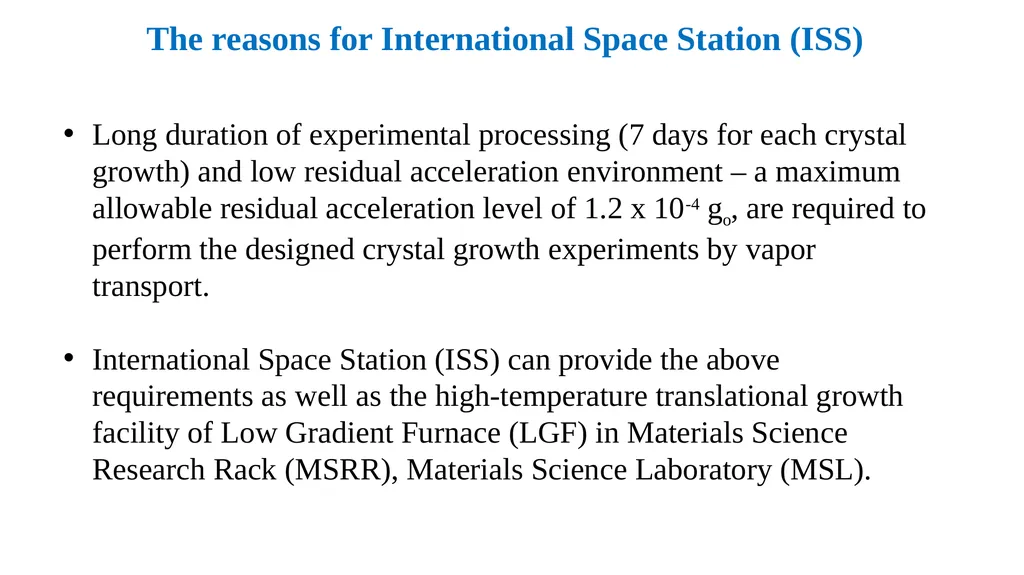
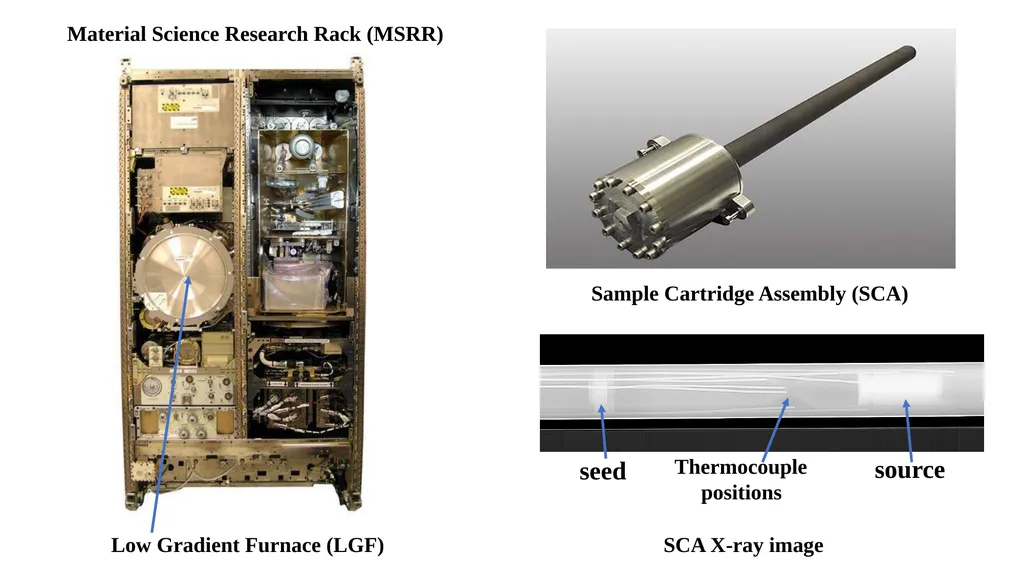
The reasons for International Space Station (ISS) Long duration of experimental processing (7 days for each crystal growth) and low residual acceleration environment – a maximum allowable residual acceleration level of 1.2 x 10⁻⁴ go, are required to perform the designed crystal growth experiments by vapor transport.
International Space Station (ISS) can provide the above requirements as well as the high-temperature translational growth facility of Low Gradient Furnace (LGF) in Materials Science Research Rack (MSRR), Materials Science Laboratory (MSL).<br>
09
Low Gradient Furnace (LGF) Material Science Research Rack (MSRR) Sample Cartridge Assembly (SCA) Thermocouple
positions source seed SCA X-ray image<br>
10
Expected results from experiments The following physical phenomena will occur in the low-gravity environment of ISS: (1) reduction in buoyancy-driven convection in the vapor phase (2) absence of any possible sedimentation and Stokes migration in fluids and (3) elimination of gravitational weight and its influence on the defect formation in the grown crystals at elevated temperature.
By performing experiments in a reduced gravity environment on ISS, the influence of gravity will be studied from the following characteristics of the grown crystals (1) the morphology of the as-grown crystals (2) the distribution of impurities, dopant and defects in ZnSe and Cr-doped crystals (3) the segregation in the grown ZnSeTe crystals and (4) the structural quality of grown crystals.
The experimental results will be correlated with the above phenomena to understand the coupled mass transport, heat transfer and growth kinetics problem.<br>
11
An improved comparison between the experimental results and the concurrent theoretical simulations of heat transfer, mass transport and growth kinetics will establish the quantitative contribution of gravitational effects on the axial and radial segregation of impurities and native point defects in the grown crystals.
The results from the absence of convective contamination by performing experiments in a reduced gravity environment will help to simplify the complexity of the coupled mass transport and growth kinetics problem.
The understanding will be beneficial to any growth processes involving vapor mass transport or vapor-crystal interface growth kinetics. Expected advancements in the field<br>
12
Earth benefits/spin-off applications Routine production of high-quality single crystals of high melting point semiconducting compounds requires a fundamental and in-depth understanding of the overall vapor growth processes.
Cr-doped ZnSe as efficient, tunable, diode-pumpable, mid-IR lasers operating at room temperature in the 2000-3000 nm range.
The growth of thick ZnSe film on GaAs substrate as quasi-phase matching media for the frequency converters of lasers.
Optical bistable characteristics of ZnSe for digital optical computer with bandgap tunability of ternary alloys of ZnSeTe and ZnSeS.<br>