GWAS Meta-Analysis Sarah Medland The 2021 Virtual Workshop on Statistical Genetic Methods for Human Complex Traits Combining data across studies Aims: Estimate the overall, or combined effect Explore differences between cohorts
"GWAS Meta-Analysis Sarah Medland The 2021 Virtual" is the property of its rightful owner. Permission is granted to
download and print the materials on this website for personal, non-commercial use only, and to display it
on your personal computer provided you do not modify the materials and that you retain all copyright
notices contained in the materials. By downloading content from our website, you accept the terms of this
agreement.
Presentation Transcript
01
GWAS Meta-Analysis Sarah Medland
The 2021 Virtual Workshop on Statistical Genetic Methods for Human Complex Traits<br>
02
Combining data across studies Aims:
Estimate the overall, or combined effect
Explore differences between cohorts – heterogeneity
Improve power
Replicate effects<br>
03
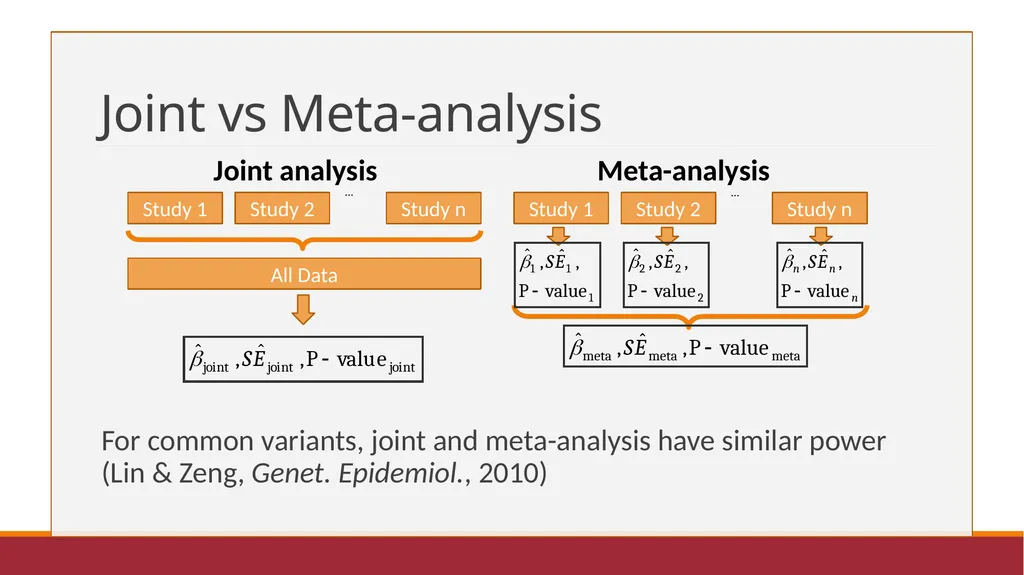
Joint vs Meta-analysis For common variants, joint and meta-analysis have similar power (Lin & Zeng, Genet. Epidemiol., 2010)<br>
04
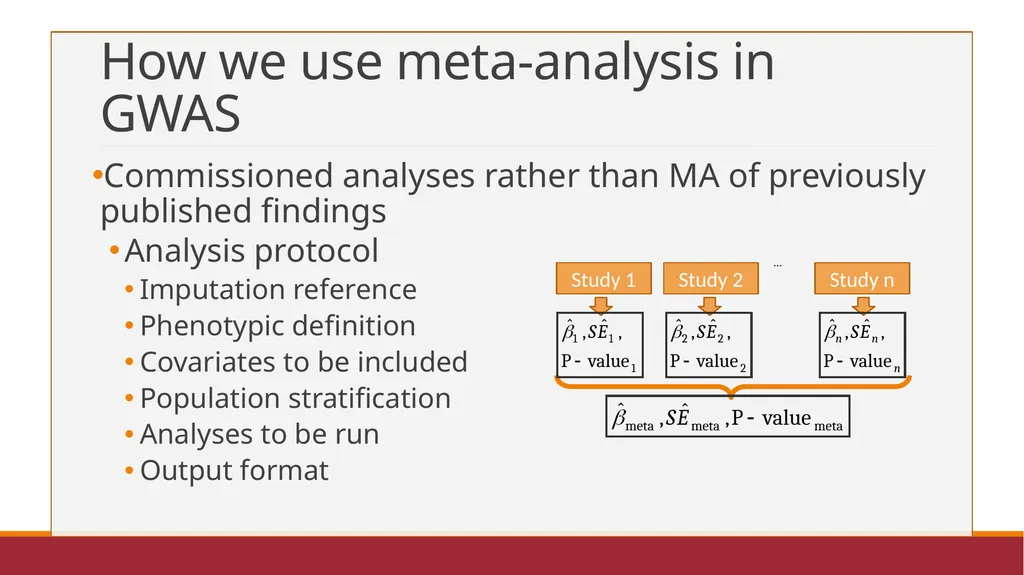
How we use meta-analysis in GWAS Commissioned analyses rather than MA of previously published findings
Analysis protocol
Imputation reference
Phenotypic definition
Covariates to be included
Population stratification
Analyses to be run
Output format<br>
05
Types of meta-analysis – Fixed Effect Each SNP has a “true effect size” on the trait.
This effect is shared by all cohorts.
The observed effect sizes in the different cohorts will be distributed around the “true effect size” with a variance that depends on the precision of the different cohorts<br>
06
Types of meta-analysis – Fixed Effect We weight each cohorts effect size by it’s precision
Error in our estimate is due to random error within studies
The combined effect = the meta-analytic estimate<br>
07
Types of meta-analysis – Random Effect The true effect for a SNP varies between cohorts.
The studies included in the meta-analysis are assumed to be a random sample reflecting the distribution of true effects<br>
08
Types of meta-analysis – Random Effect Error in our estimate is due to random error within AND between studies
Weights reflect these two sources of error and are less dependent on sample size
The mean effect in this distribution = the meta-analytic estimate<br>
09
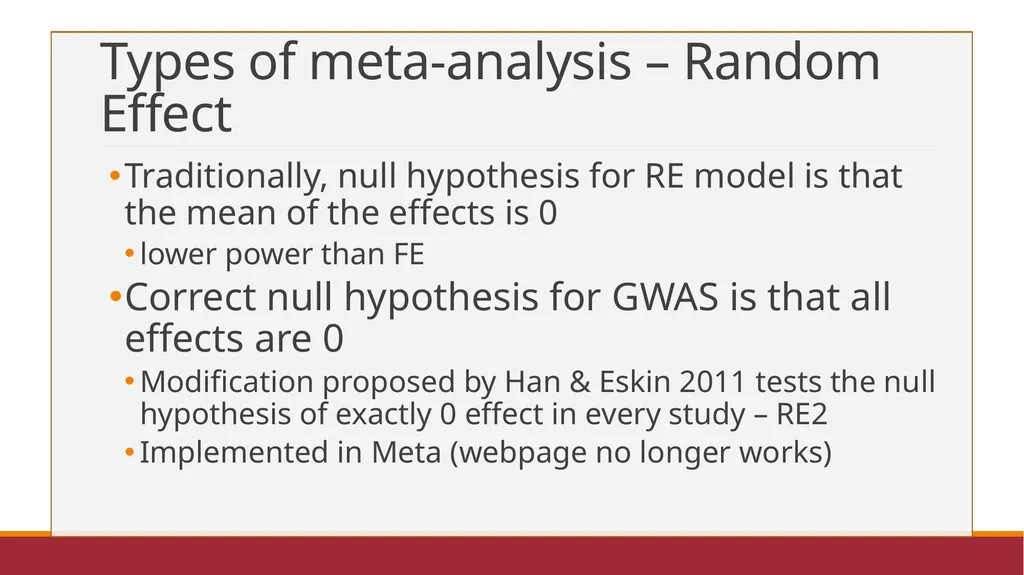
Types of meta-analysis – Random Effect Traditionally, null hypothesis for RE model is that the mean of the effects is 0
lower power than FE
Correct null hypothesis for GWAS is that all effects are 0
Modification proposed by Han & Eskin 2011 tests the null hypothesis of exactly 0 effect in every study – RE2
Implemented in Meta (webpage no longer works)<br>
10
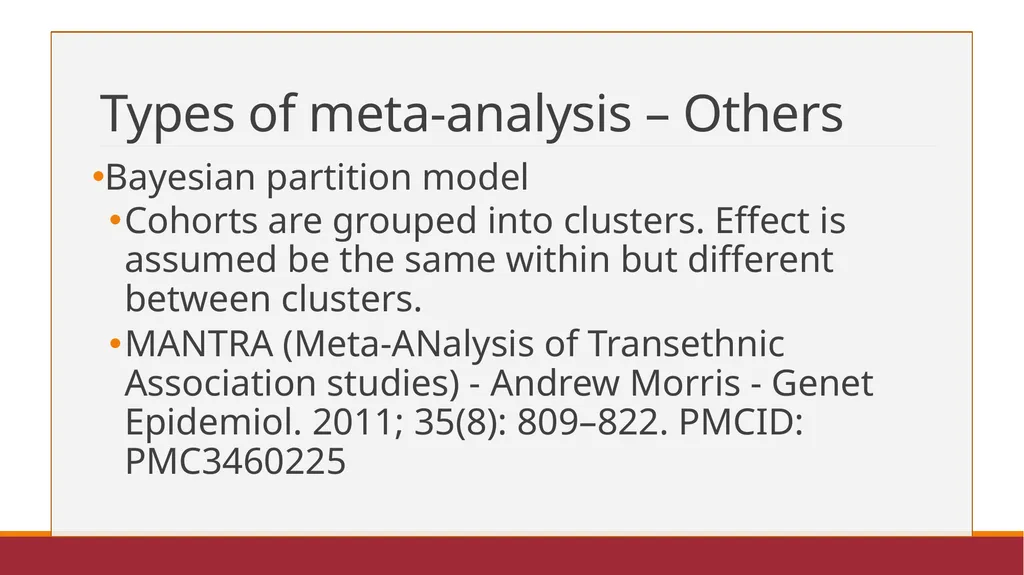
Types of meta-analysis – Others Bayesian partition model
Cohorts are grouped into clusters. Effect is assumed be the same within but different between clusters.
MANTRA (Meta-ANalysis of Transethnic Association studies) - Andrew Morris - Genet Epidemiol. 2011; 35(8): 809–822. PMCID: PMC3460225<br>
11
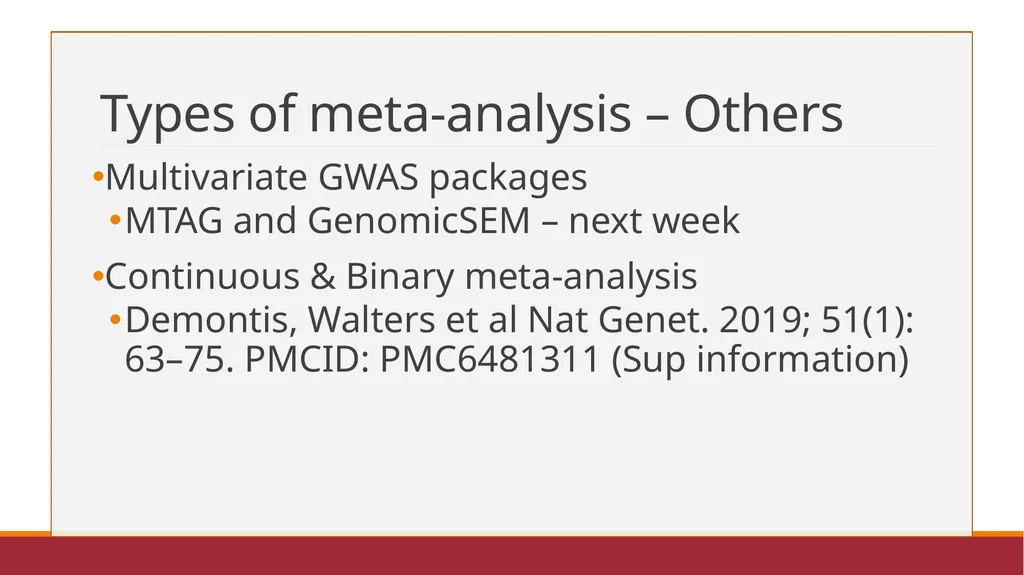
Types of meta-analysis – Others Multivariate GWAS packages
MTAG and GenomicSEM – next week
Continuous & Binary meta-analysis
Demontis, Walters et al Nat Genet. 2019; 51(1): 63–75. PMCID: PMC6481311 (Sup information)<br>
12
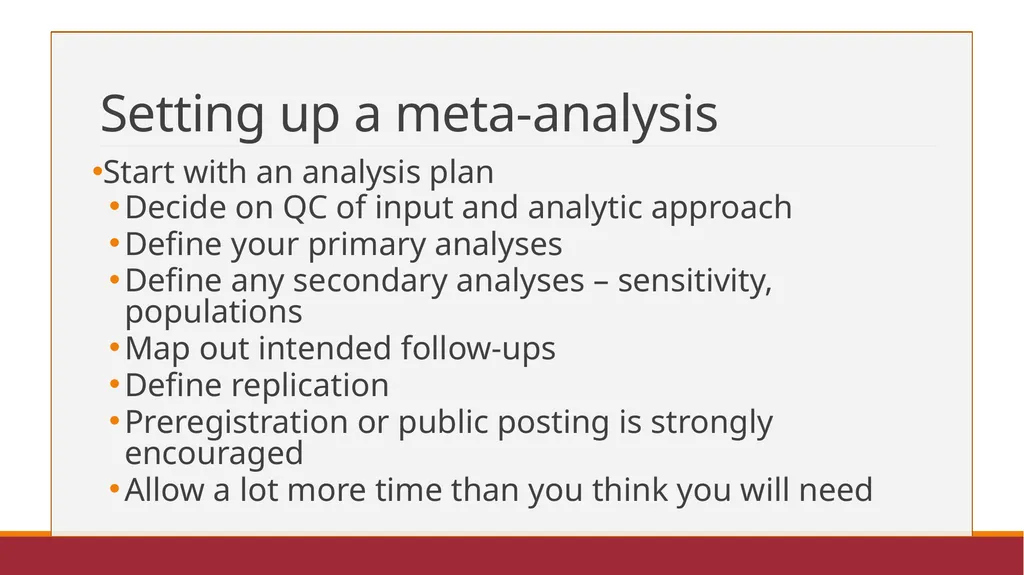
Setting up a meta-analysis Start with an analysis plan
Decide on QC of input and analytic approach
Define your primary analyses
Define any secondary analyses – sensitivity, populations
Map out intended follow-ups
Define replication
Preregistration or public posting is strongly encouraged
Allow a lot more time than you think you will need<br>
13
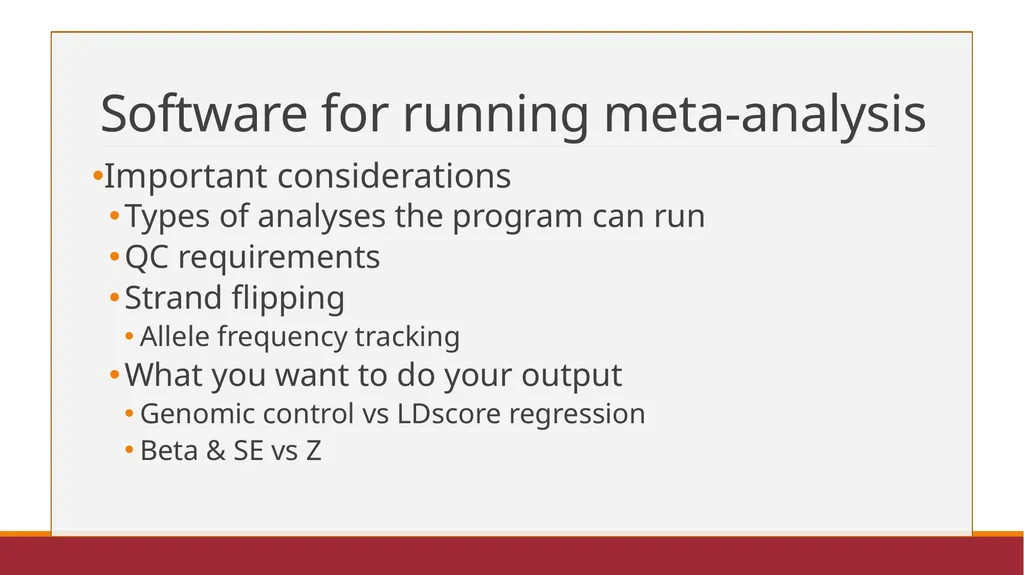
Software for running meta-analysis Important considerations
Types of analyses the program can run
QC requirements
Strand flipping
Allele frequency tracking
What you want to do your output
Genomic control vs LDscore regression
Beta & SE vs Z<br>
14
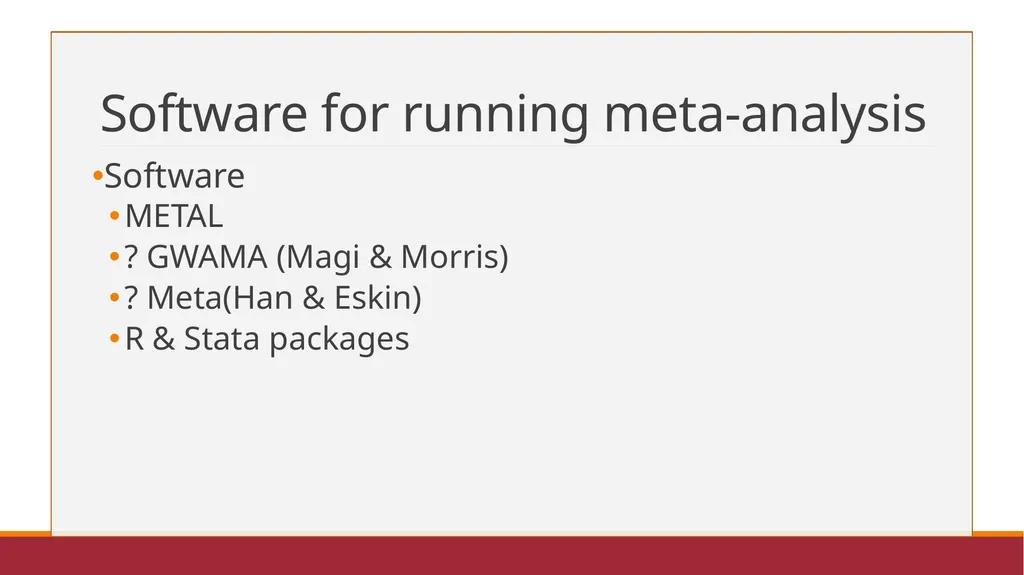
Software for running meta-analysis Software
METAL
? GWAMA (Magi & Morris)
? Meta(Han & Eskin)
R & Stata packages<br>
15
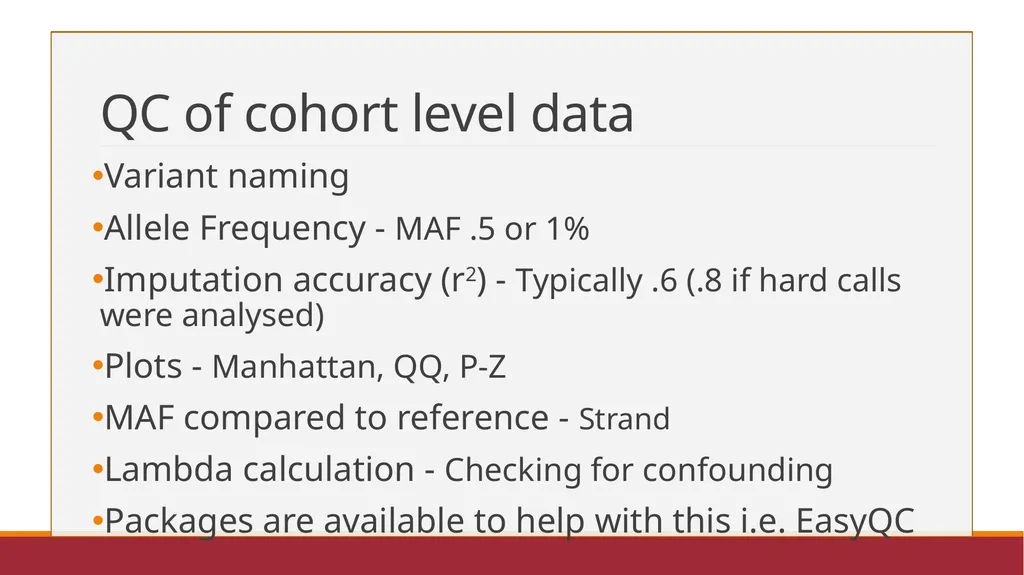
QC of cohort level data Variant naming
Allele Frequency - MAF .5 or 1%
Imputation accuracy (r2) - Typically .6 (.8 if hard calls were analysed)
Plots - Manhattan, QQ, P-Z
MAF compared to reference - Strand
Lambda calculation - Checking for confounding
Packages are available to help with this i.e. EasyQC<br>
16
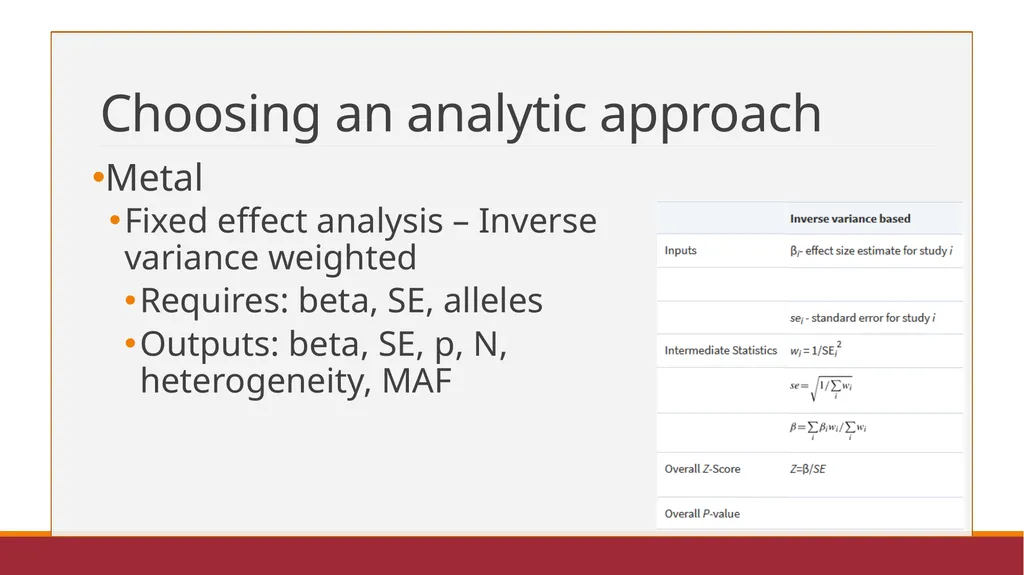
Choosing an analytic approach Metal
Fixed effect analysis – Inverse variance weighted
Requires: beta, SE, alleles
Outputs: beta, SE, p, N, heterogeneity, MAF<br>
17
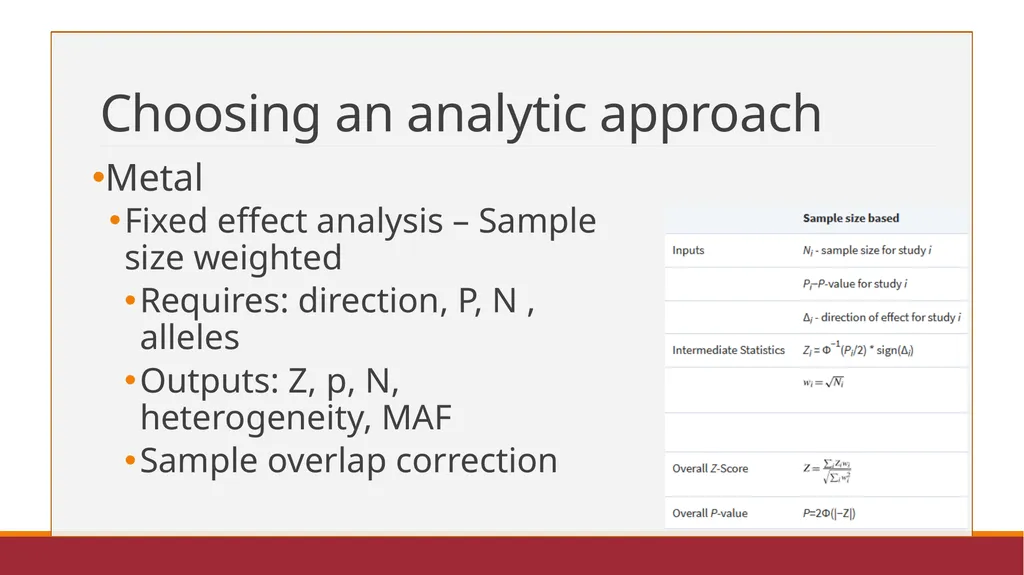
Choosing an analytic approach Metal
Fixed effect analysis – Sample size weighted
Requires: direction, P, N , alleles
Outputs: Z, p, N, heterogeneity, MAF
Sample overlap correction<br>
18
Choosing an analytic approach Random Metal
Requires: beta, SE, p, N, alleles
Outputs: Both FE and RE results beta, SE, p, heterogeneity, tau2<br>
19
Why would you chose N weighted or RE? Inverse variance FE meta-analysis are sensitive to deviations in scaling between studies
N weighted FE meta-analyses are less sensitive to this
RE meta-analyses are more appropriate for situations where the effect size differs between cohorts<br>