
Health & Social Care Knowledge Organisers Unit 2:
TD
Published · 22 slides · 0 views

1 / 1

Description
Health Social Care Knowledge Organisers Unit 2: Equality Diversity LO1: Concepts of equality, diversity and rights, and how these are applied in the context of health, social care and child care environments. What is the meaning of
Related Topics
Share
Embed code
Download this presentation From Below
"Health & Social Care Knowledge Organisers Unit 2:" is the property of its rightful owner. Permission is granted to download and print the materials on this website for personal, non-commercial use only, and to display it on your personal computer provided you do not modify the materials and that you retain all copyright notices contained in the materials. By downloading content from our website, you accept the terms of this agreement.
Presentation Transcript
01
Health & Social Care
Knowledge Organisers Unit 2: Equality & Diversity
LO1: Concepts of equality, diversity and rights, and how these are applied in the context of health, social care and child care environments.<br>
LO1: Concepts of equality, diversity and rights, and how these are applied in the context of health, social care and child care environments.<br>
02
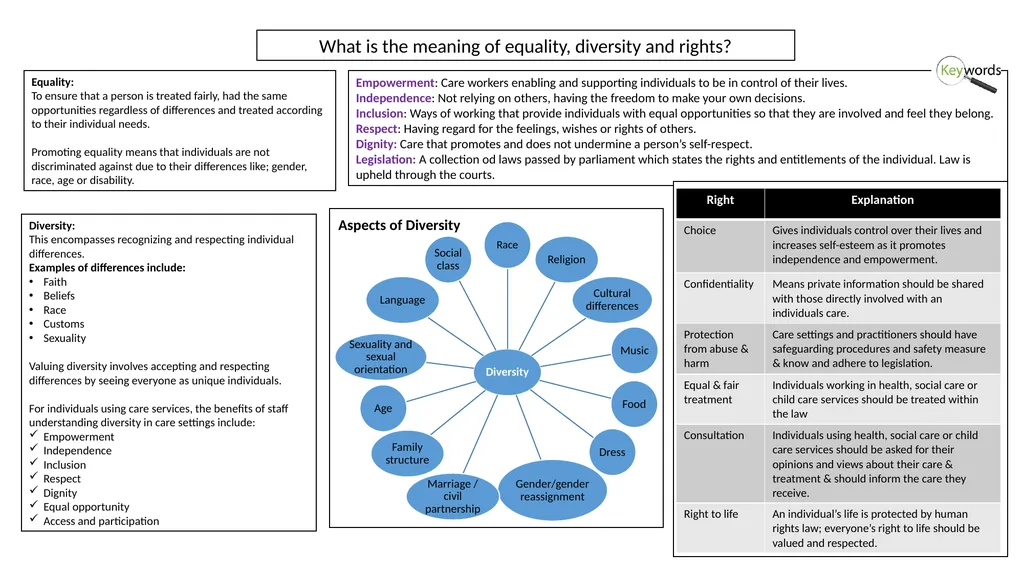
What is the meaning of equality, diversity and rights? Equality:
To ensure that a person is treated fairly, had the same opportunities regardless of differences and treated according to their individual needs.
Promoting equality means that individuals are not discriminated against due to their differences like; gender, race, age or disability. Diversity:
This encompasses recognizing and respecting individual differences.
Examples of differences include:
Faith
Beliefs
Race
Customs
Sexuality
Valuing diversity involves accepting and respecting differences by seeing everyone as unique individuals.
For individuals using care services, the benefits of staff understanding diversity in care settings include:
Empowerment
Independence
Inclusion
Respect
Dignity
Equal opportunity
Access and participation Empowerment: Care workers enabling and supporting individuals to be in control of their lives.
Independence: Not relying on others, having the freedom to make your own decisions.
Inclusion: Ways of working that provide individuals with equal opportunities so that they are involved and feel they belong.
Respect: Having regard for the feelings, wishes or rights of others.
Dignity: Care that promotes and does not undermine a person’s self-respect.
Legislation: A collection od laws passed by parliament which states the rights and entitlements of the individual. Law is upheld through the courts. Aspects of Diversity<br>
03
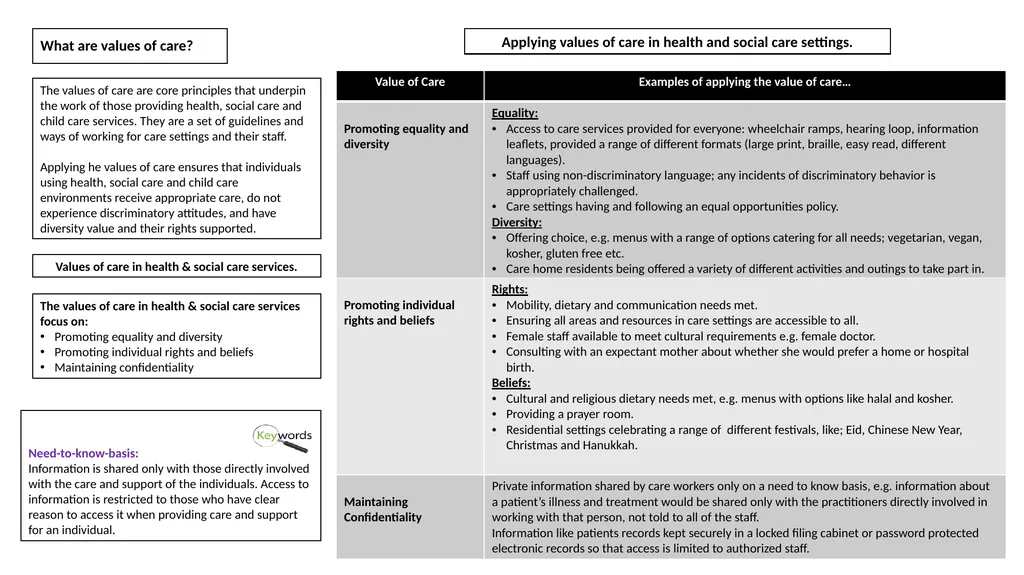
What are values of care? The values of care are core principles that underpin the work of those providing health, social care and child care services. They are a set of guidelines and ways of working for care settings and their staff.
Applying he values of care ensures that individuals using health, social care and child care environments receive appropriate care, do not experience discriminatory attitudes, and have diversity value and their rights supported. Values of care in health & social care services. The values of care in health & social care services focus on:
Promoting equality and diversity
Promoting individual rights and beliefs
Maintaining confidentiality Need-to-know-basis:
Information is shared only with those directly involved with the care and support of the individuals. Access to information is restricted to those who have clear reason to access it when providing care and support for an individual. Applying values of care in health and social care settings.<br>
04
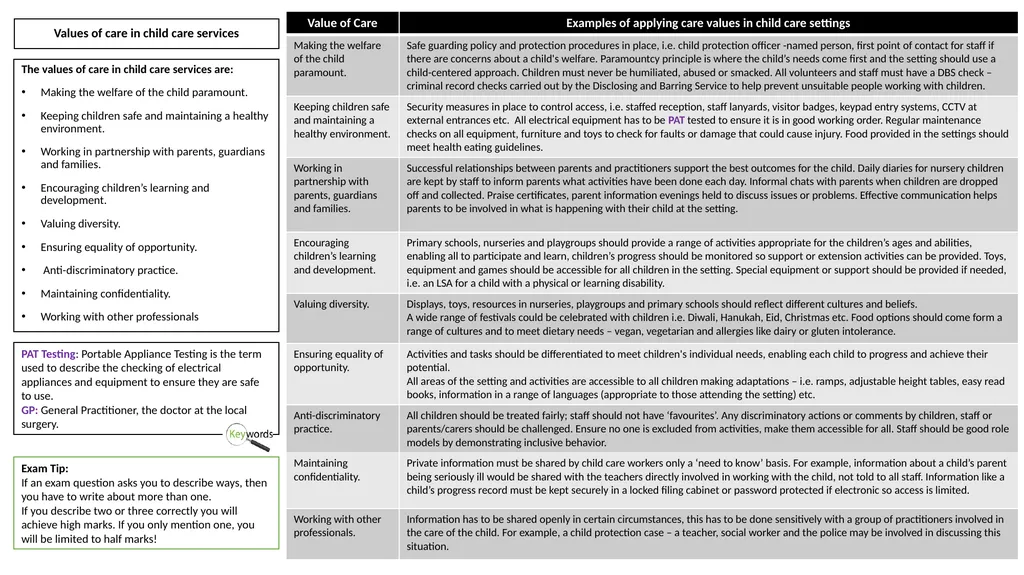
Values of care in child care services The values of care in child care services are:
Making the welfare of the child paramount.
Keeping children safe and maintaining a healthy environment.
Working in partnership with parents, guardians and families.
Encouraging children’s learning and development.
Valuing diversity.
Ensuring equality of opportunity.
Anti-discriminatory practice.
Maintaining confidentiality.
Working with other professionals PAT Testing: Portable Appliance Testing is the term used to describe the checking of electrical appliances and equipment to ensure they are safe to use.
GP: General Practitioner, the doctor at the local surgery. Exam Tip:
If an exam question asks you to describe ways, then you have to write about more than one.
If you describe two or three correctly you will achieve high marks. If you only mention one, you will be limited to half marks!<br>
05
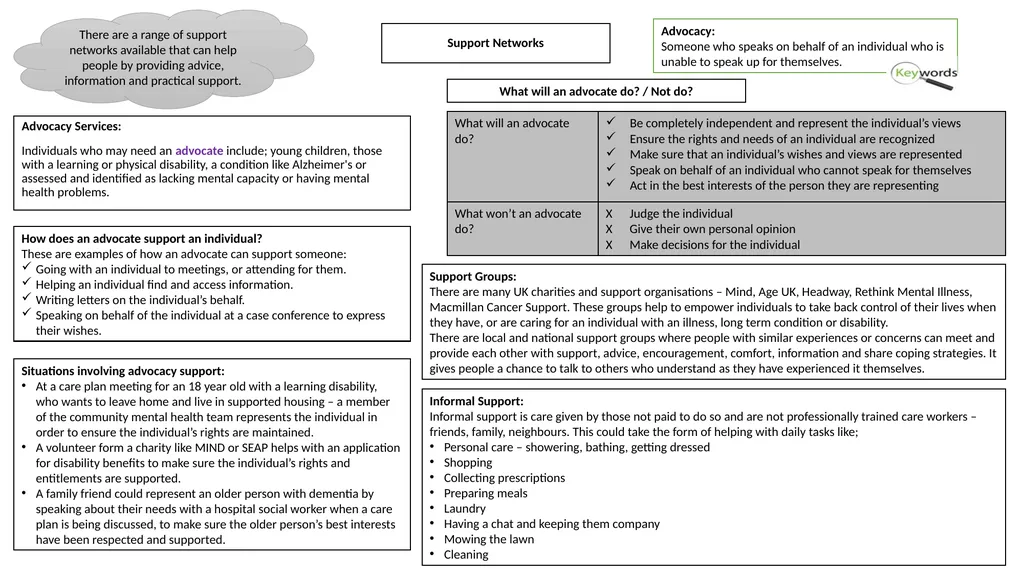
Support Networks Advocacy Services:
Individuals who may need an advocate include; young children, those with a learning or physical disability, a condition like Alzheimer's or assessed and identified as lacking mental capacity or having mental health problems. There are a range of support networks available that can help people by providing advice, information and practical support. Advocacy:
Someone who speaks on behalf of an individual who is unable to speak up for themselves. How does an advocate support an individual?
These are examples of how an advocate can support someone:
Going with an individual to meetings, or attending for them.
Helping an individual find and access information.
Writing letters on the individual’s behalf.
Speaking on behalf of the individual at a case conference to express their wishes. Situations involving advocacy support:
At a care plan meeting for an 18 year old with a learning disability, who wants to leave home and live in supported housing – a member of the community mental health team represents the individual in order to ensure the individual’s rights are maintained.
A volunteer form a charity like MIND or SEAP helps with an application for disability benefits to make sure the individual’s rights and entitlements are supported.
A family friend could represent an older person with dementia by speaking about their needs with a hospital social worker when a care plan is being discussed, to make sure the older person’s best interests have been respected and supported. What will an advocate do? / Not do? Support Groups:
There are many UK charities and support organisations – Mind, Age UK, Headway, Rethink Mental Illness, Macmillan Cancer Support. These groups help to empower individuals to take back control of their lives when they have, or are caring for an individual with an illness, long term condition or disability.
There are local and national support groups where people with similar experiences or concerns can meet and provide each other with support, advice, encouragement, comfort, information and share coping strategies. It gives people a chance to talk to others who understand as they have experienced it themselves. Informal Support:
Informal support is care given by those not paid to do so and are not professionally trained care workers – friends, family, neighbours. This could take the form of helping with daily tasks like;
Personal care – showering, bathing, getting dressed
Shopping
Collecting prescriptions
Preparing meals
Laundry
Having a chat and keeping them company
Mowing the lawn
Cleaning<br>
06
LO2: Understand the impact of discriminatory practices on individuals in health, social care and child care environments.<br>
07
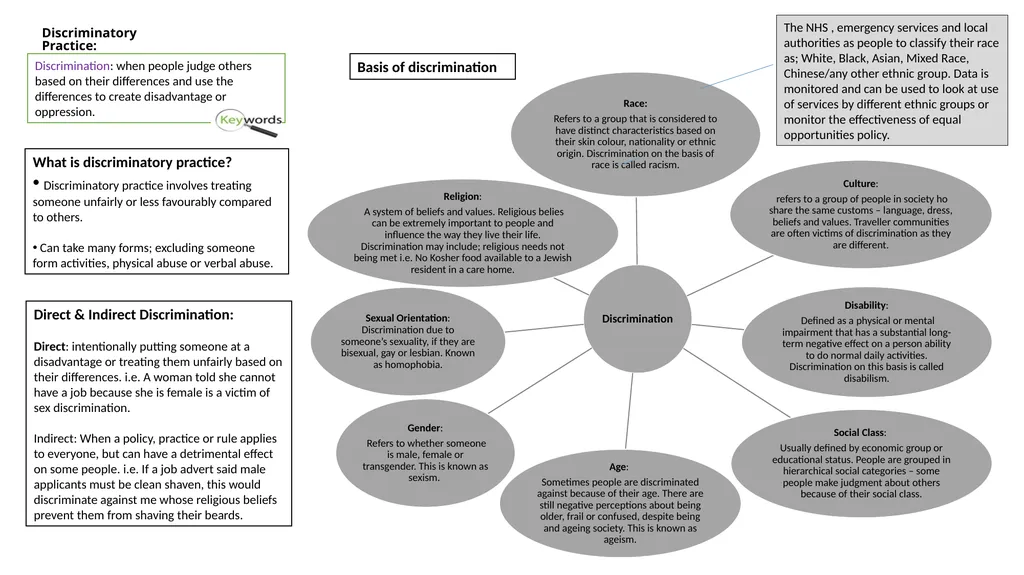
Discriminatory Practice: Discrimination: when people judge others based on their differences and use the differences to create disadvantage or oppression. What is discriminatory practice?
Discriminatory practice involves treating someone unfairly or less favourably compared to others.
Can take many forms; excluding someone form activities, physical abuse or verbal abuse. The NHS , emergency services and local authorities as people to classify their race as; White, Black, Asian, Mixed Race, Chinese/any other ethnic group. Data is monitored and can be used to look at use of services by different ethnic groups or monitor the effectiveness of equal opportunities policy. Direct & Indirect Discrimination:
Direct: intentionally putting someone at a disadvantage or treating them unfairly based on their differences. i.e. A woman told she cannot have a job because she is female is a victim of sex discrimination.
Indirect: When a policy, practice or rule applies to everyone, but can have a detrimental effect on some people. i.e. If a job advert said male applicants must be clean shaven, this would discriminate against me whose religious beliefs prevent them from shaving their beards. Basis of discrimination<br>
08
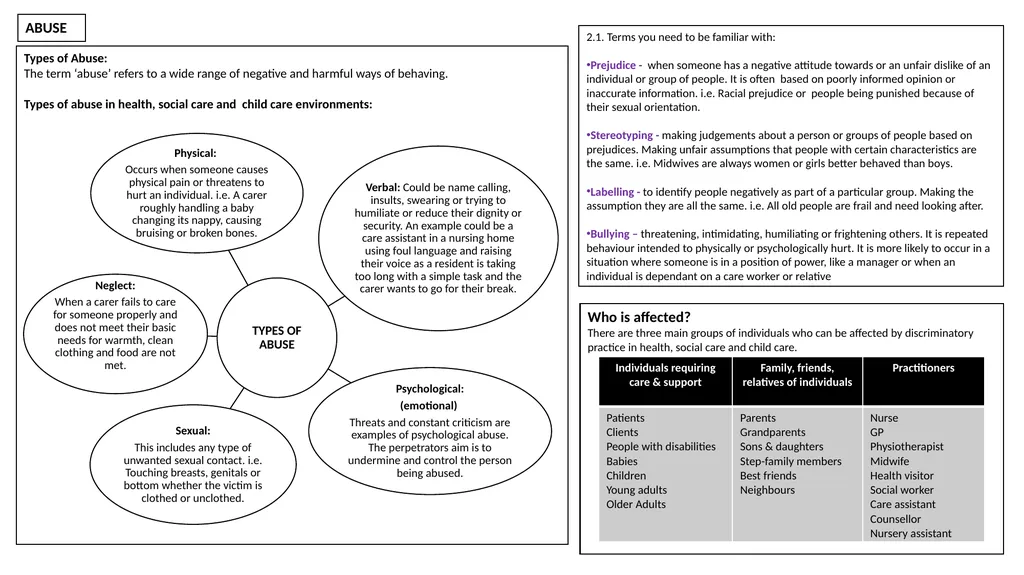
ABUSE Types of Abuse:
The term ‘abuse’ refers to a wide range of negative and harmful ways of behaving.
Types of abuse in health, social care and child care environments: 2.1. Terms you need to be familiar with:
Prejudice - when someone has a negative attitude towards or an unfair dislike of an individual or group of people. It is often based on poorly informed opinion or inaccurate information. i.e. Racial prejudice or people being punished because of their sexual orientation.
Stereotyping - making judgements about a person or groups of people based on prejudices. Making unfair assumptions that people with certain characteristics are the same. i.e. Midwives are always women or girls better behaved than boys.
Labelling - to identify people negatively as part of a particular group. Making the assumption they are all the same. i.e. All old people are frail and need looking after.
Bullying – threatening, intimidating, humiliating or frightening others. It is repeated behaviour intended to physically or psychologically hurt. It is more likely to occur in a situation where someone is in a position of power, like a manager or when an individual is dependant on a care worker or relative Who is affected?
There are three main groups of individuals who can be affected by discriminatory practice in health, social care and child care.<br>
09
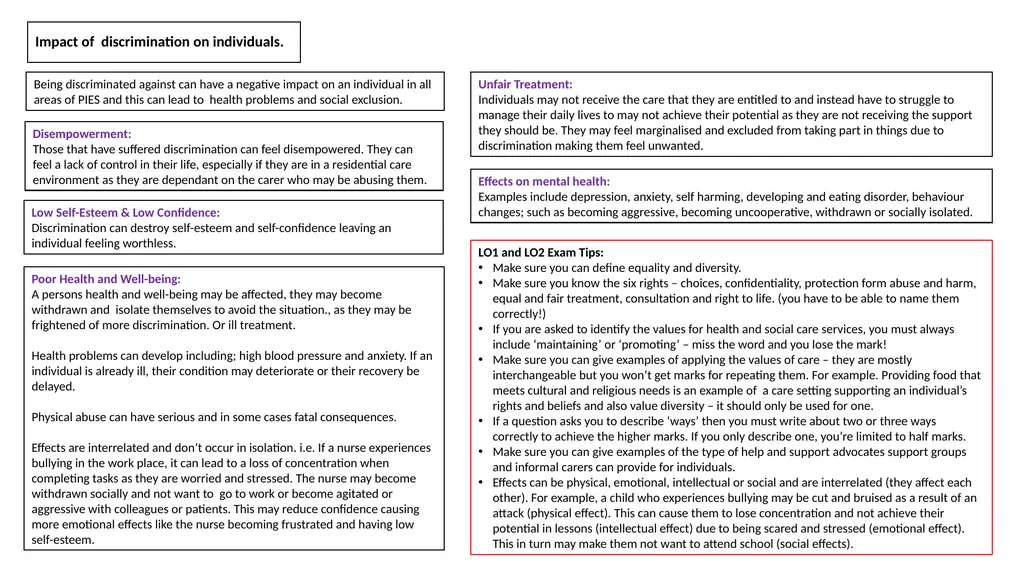
Impact of discrimination on individuals. Being discriminated against can have a negative impact on an individual in all areas of PIES and this can lead to health problems and social exclusion. Disempowerment:
Those that have suffered discrimination can feel disempowered. They can feel a lack of control in their life, especially if they are in a residential care environment as they are dependant on the carer who may be abusing them. Low Self-Esteem & Low Confidence:
Discrimination can destroy self-esteem and self-confidence leaving an individual feeling worthless. Poor Health and Well-being:
A persons health and well-being may be affected, they may become withdrawn and isolate themselves to avoid the situation., as they may be frightened of more discrimination. Or ill treatment.
Health problems can develop including; high blood pressure and anxiety. If an individual is already ill, their condition may deteriorate or their recovery be delayed.
Physical abuse can have serious and in some cases fatal consequences.
Effects are interrelated and don’t occur in isolation. i.e. If a nurse experiences bullying in the work place, it can lead to a loss of concentration when completing tasks as they are worried and stressed. The nurse may become withdrawn socially and not want to go to work or become agitated or aggressive with colleagues or patients. This may reduce confidence causing more emotional effects like the nurse becoming frustrated and having low self-esteem. Unfair Treatment:
Individuals may not receive the care that they are entitled to and instead have to struggle to manage their daily lives to may not achieve their potential as they are not receiving the support they should be. They may feel marginalised and excluded from taking part in things due to discrimination making them feel unwanted. Effects on mental health:
Examples include depression, anxiety, self harming, developing and eating disorder, behaviour changes; such as becoming aggressive, becoming uncooperative, withdrawn or socially isolated. LO1 and LO2 Exam Tips:
Make sure you can define equality and diversity.
Make sure you know the six rights – choices, confidentiality, protection form abuse and harm, equal and fair treatment, consultation and right to life. (you have to be able to name them correctly!)
If you are asked to identify the values for health and social care services, you must always include ‘maintaining’ or ‘promoting’ – miss the word and you lose the mark!
Make sure you can give examples of applying the values of care – they are mostly interchangeable but you won’t get marks for repeating them. For example. Providing food that meets cultural and religious needs is an example of a care setting supporting an individual’s rights and beliefs and also value diversity – it should only be used for one.
If a question asks you to describe ‘ways’ then you must write about two or three ways correctly to achieve the higher marks. If you only describe one, you’re limited to half marks.
Make sure you can give examples of the type of help and support advocates support groups and informal carers can provide for individuals.
Effects can be physical, emotional, intellectual or social and are interrelated (they affect each other). For example, a child who experiences bullying may be cut and bruised as a result of an attack (physical effect). This can cause them to lose concentration and not achieve their potential in lessons (intellectual effect) due to being scared and stressed (emotional effect). This in turn may make them not want to attend school (social effects).<br>
10
LO3:
Understand how current legislation and national initiatives promote anti-discriminatory practice in health, social care and child care environments.<br>
11
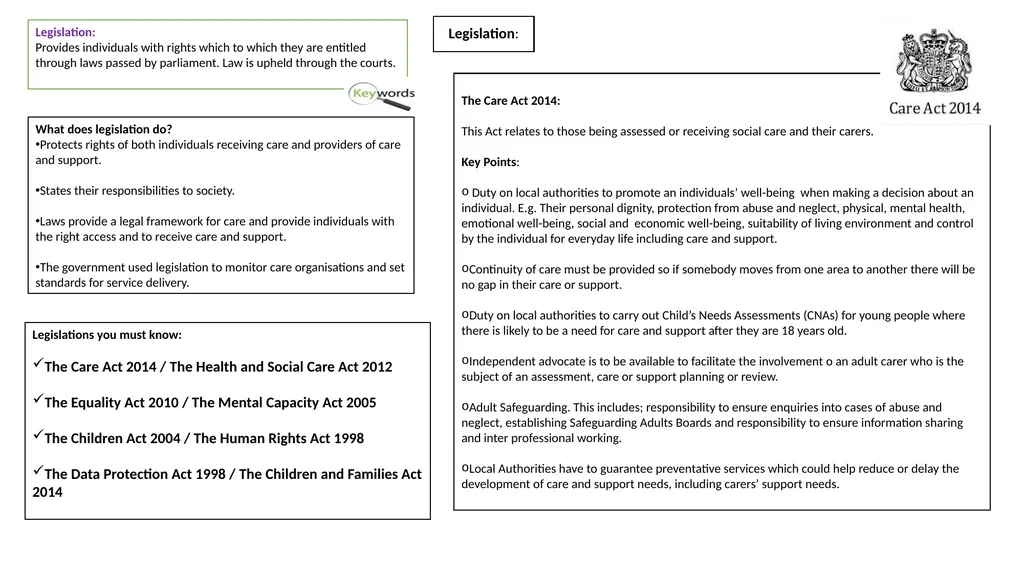
Legislation: Legislation:
Provides individuals with rights which to which they are entitled through laws passed by parliament. Law is upheld through the courts. What does legislation do?
Protects rights of both individuals receiving care and providers of care and support.
States their responsibilities to society.
Laws provide a legal framework for care and provide individuals with the right access and to receive care and support.
The government used legislation to monitor care organisations and set standards for service delivery. Legislations you must know:
The Care Act 2014 / The Health and Social Care Act 2012
The Equality Act 2010 / The Mental Capacity Act 2005
The Children Act 2004 / The Human Rights Act 1998
The Data Protection Act 1998 / The Children and Families Act 2014 The Care Act 2014:
This Act relates to those being assessed or receiving social care and their carers.
Key Points:
Duty on local authorities to promote an individuals’ well-being when making a decision about an individual. E.g. Their personal dignity, protection from abuse and neglect, physical, mental health, emotional well-being, social and economic well-being, suitability of living environment and control by the individual for everyday life including care and support.
Continuity of care must be provided so if somebody moves from one area to another there will be no gap in their care or support.
Duty on local authorities to carry out Child’s Needs Assessments (CNAs) for young people where there is likely to be a need for care and support after they are 18 years old.
Independent advocate is to be available to facilitate the involvement o an adult carer who is the subject of an assessment, care or support planning or review.
Adult Safeguarding. This includes; responsibility to ensure enquiries into cases of abuse and neglect, establishing Safeguarding Adults Boards and responsibility to ensure information sharing and inter professional working.
Local Authorities have to guarantee preventative services which could help reduce or delay the development of care and support needs, including carers’ support needs.<br>
12
The Health and Social Care Act 2012 There are 2 main principles:
Enabling patients to have more control over the care they receive
Those responsible for their care – doctors, nurses and other professionals within the NHS and social care – have the freedom and power to commission care that meets local needs.
Key aspects include;
No Decision About Me Without Me is mean to be the guiding principle by which patients are treated. Patients will be able to choose their GP, consultant, treatment and hospital or other local health services.
Clinical Commissioning Groups are GP led bodies that commission most health services like GP’s, dentists and pharmacies as well as secondary care services that are provided by hospitals.
Health and well-being boards that bring together health and social care commissioners, councillors and a lay representative to promote joined up working and tackle inequalities in people’s health an dwell-being.
Public health with an increased focus on prevention and local councils taking responsibility or public health services and population health improvement, such as obesity, anti-smoking, screening and vaccinations.
Healthwatch – an independent service created by the Act, this aims to protect the interests of all who use health and social care services. It has a role of communicating the views of patients to commissioning bodies and regulators. The Equality Act 2010 The Equality Act simplified existing discrimination laws when it came into force. For example the Sex Discrimination Act, Race Relations Act and Disability Discrimination Act, putting them altogether in one piece of legislation.
Key aspects include:
Makes direct and indirect discrimination on the basis of protected characteristics illegal.
The 9 protected characteristics are; age, disability, gender reassignment, marriage and civil partnership, pregnancy and maternity, race, religion, sex and sexual orientation.
Prohibits discrimination in education, employment, access to goods and services and housing.
Covers victimisation and harassment on the basis of a protected characteristic.
Reasonable adjustments have to be made by employers, providers of goods or services for those with disabilities. For example, installing a ramp to access a building etc.
Women have the right to breastfeed in public and it is against the law for women to get less favourable treatment because they are breastfeeding when receiving services. There is no right to breastfeed at work.
The Act encourages positive action. One form of positive action is encouraging or training people to apply for jobs or take art in an activity in which people with a protected characteristic are underrepresented.
Discrimination due to association is now and offence, this means there is now protection for carers of an individual who has a protected characteristic.
Pay secrecy clauses are now illegal.<br>
13
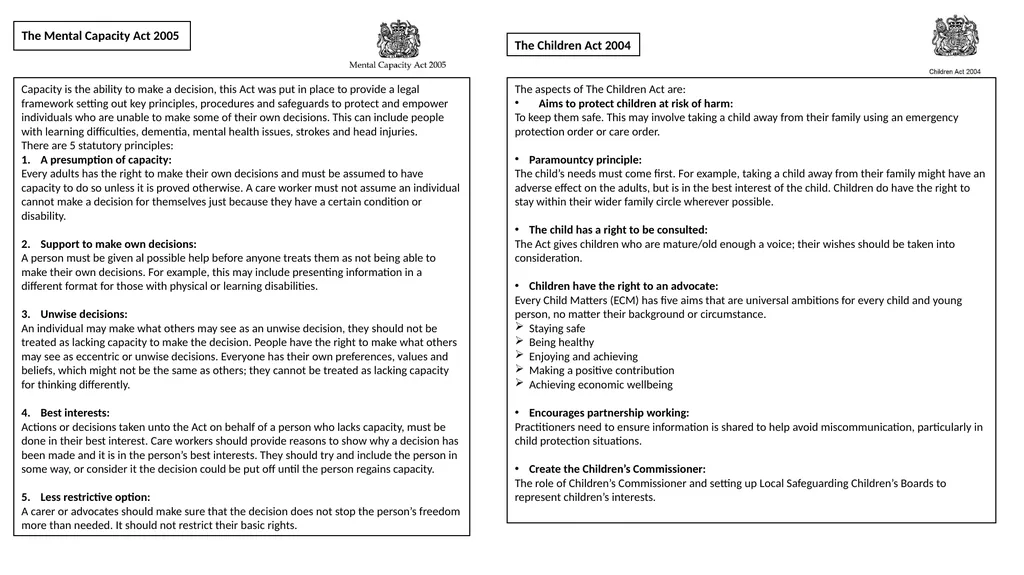
The Mental Capacity Act 2005 Capacity is the ability to make a decision, this Act was put in place to provide a legal framework setting out key principles, procedures and safeguards to protect and empower individuals who are unable to make some of their own decisions. This can include people with learning difficulties, dementia, mental health issues, strokes and head injuries.
There are 5 statutory principles:
A presumption of capacity:
Every adults has the right to make their own decisions and must be assumed to have capacity to do so unless it is proved otherwise. A care worker must not assume an individual cannot make a decision for themselves just because they have a certain condition or disability.
Support to make own decisions:
A person must be given al possible help before anyone treats them as not being able to make their own decisions. For example, this may include presenting information in a different format for those with physical or learning disabilities.
Unwise decisions:
An individual may make what others may see as an unwise decision, they should not be treated as lacking capacity to make the decision. People have the right to make what others may see as eccentric or unwise decisions. Everyone has their own preferences, values and beliefs, which might not be the same as others; they cannot be treated as lacking capacity for thinking differently.
Best interests:
Actions or decisions taken unto the Act on behalf of a person who lacks capacity, must be done in their best interest. Care workers should provide reasons to show why a decision has been made and it is in the person’s best interests. They should try and include the person in some way, or consider it the decision could be put off until the person regains capacity.
Less restrictive option:
A carer or advocates should make sure that the decision does not stop the person’s freedom more than needed. It should not restrict their basic rights. The Children Act 2004 The aspects of The Children Act are:
Aims to protect children at risk of harm:
To keep them safe. This may involve taking a child away from their family using an emergency protection order or care order.
Paramountcy principle:
The child’s needs must come first. For example, taking a child away from their family might have an adverse effect on the adults, but is in the best interest of the child. Children do have the right to stay within their wider family circle wherever possible.
The child has a right to be consulted:
The Act gives children who are mature/old enough a voice; their wishes should be taken into consideration.
Children have the right to an advocate:
Every Child Matters (ECM) has five aims that are universal ambitions for every child and young person, no matter their background or circumstance.
Staying safe
Being healthy
Enjoying and achieving
Making a positive contribution
Achieving economic wellbeing
Encourages partnership working:
Practitioners need to ensure information is shared to help avoid miscommunication, particularly in child protection situations.
Create the Children’s Commissioner:
The role of Children’s Commissioner and setting up Local Safeguarding Children’s Boards to represent children’s interests.<br>
14
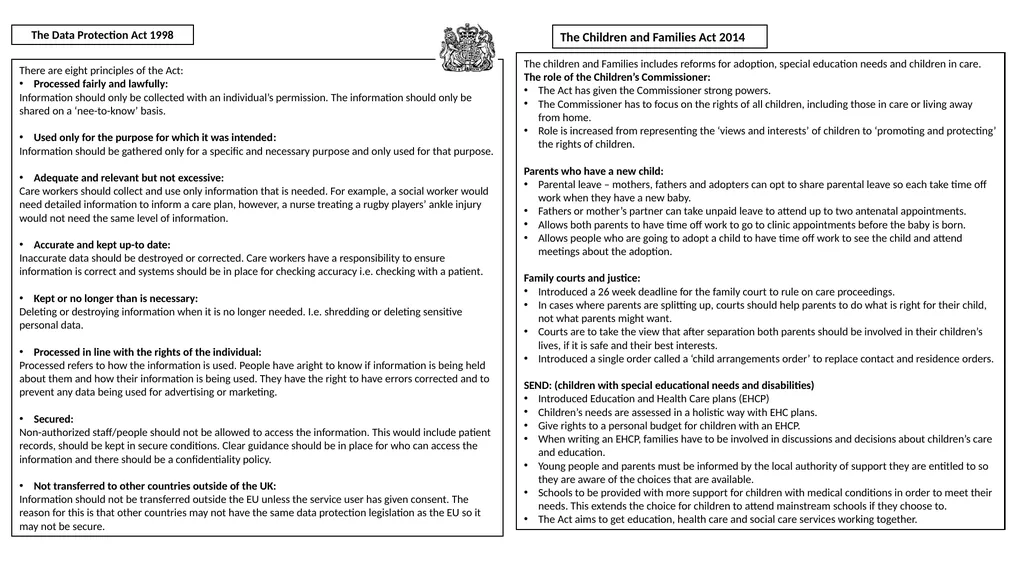
The Data Protection Act 1998 There are eight principles of the Act:
Processed fairly and lawfully:
Information should only be collected with an individual’s permission. The information should only be shared on a ‘nee-to-know’ basis.
Used only for the purpose for which it was intended:
Information should be gathered only for a specific and necessary purpose and only used for that purpose.
Adequate and relevant but not excessive:
Care workers should collect and use only information that is needed. For example, a social worker would need detailed information to inform a care plan, however, a nurse treating a rugby players’ ankle injury would not need the same level of information.
Accurate and kept up-to date:
Inaccurate data should be destroyed or corrected. Care workers have a responsibility to ensure information is correct and systems should be in place for checking accuracy i.e. checking with a patient.
Kept or no longer than is necessary:
Deleting or destroying information when it is no longer needed. I.e. shredding or deleting sensitive personal data.
Processed in line with the rights of the individual:
Processed refers to how the information is used. People have aright to know if information is being held about them and how their information is being used. They have the right to have errors corrected and to prevent any data being used for advertising or marketing.
Secured:
Non-authorized staff/people should not be allowed to access the information. This would include patient records, should be kept in secure conditions. Clear guidance should be in place for who can access the information and there should be a confidentiality policy.
Not transferred to other countries outside of the UK:
Information should not be transferred outside the EU unless the service user has given consent. The reason for this is that other countries may not have the same data protection legislation as the EU so it may not be secure. The Children and Families Act 2014 The children and Families includes reforms for adoption, special education needs and children in care.
The role of the Children’s Commissioner:
The Act has given the Commissioner strong powers.
The Commissioner has to focus on the rights of all children, including those in care or living away from home.
Role is increased from representing the ‘views and interests’ of children to ‘promoting and protecting’ the rights of children.
Parents who have a new child:
Parental leave – mothers, fathers and adopters can opt to share parental leave so each take time off work when they have a new baby.
Fathers or mother’s partner can take unpaid leave to attend up to two antenatal appointments.
Allows both parents to have time off work to go to clinic appointments before the baby is born.
Allows people who are going to adopt a child to have time off work to see the child and attend meetings about the adoption.
Family courts and justice:
Introduced a 26 week deadline for the family court to rule on care proceedings.
In cases where parents are splitting up, courts should help parents to do what is right for their child, not what parents might want.
Courts are to take the view that after separation both parents should be involved in their children’s lives, if it is safe and their best interests.
Introduced a single order called a ‘child arrangements order’ to replace contact and residence orders.
SEND: (children with special educational needs and disabilities)
Introduced Education and Health Care plans (EHCP)
Children’s needs are assessed in a holistic way with EHC plans.
Give rights to a personal budget for children with an EHCP.
When writing an EHCP, families have to be involved in discussions and decisions about children’s care and education.
Young people and parents must be informed by the local authority of support they are entitled to so they are aware of the choices that are available.
Schools to be provided with more support for children with medical conditions in order to meet their needs. This extends the choice for children to attend mainstream schools if they choose to.
The Act aims to get education, health care and social care services working together.<br>
15
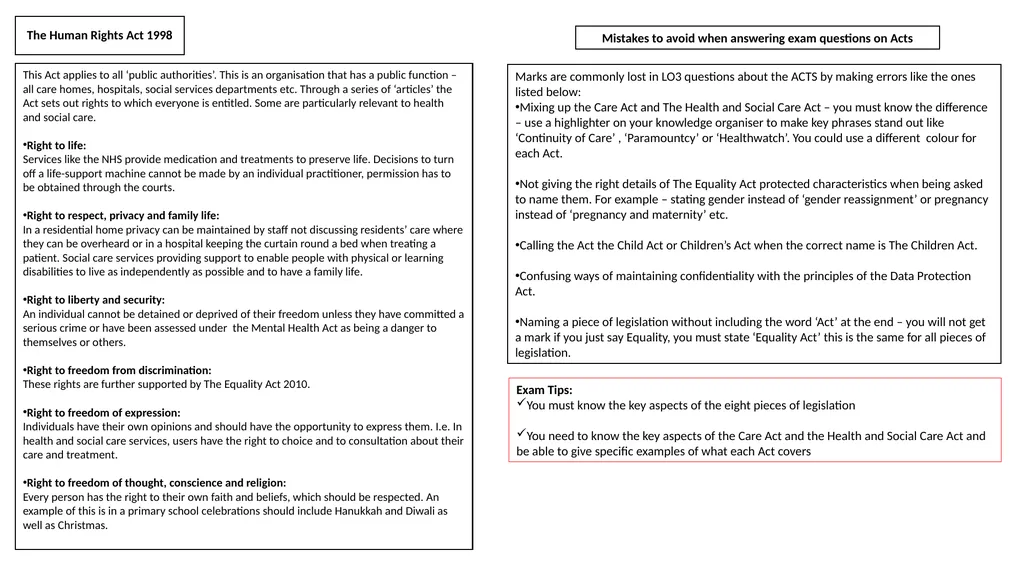
The Human Rights Act 1998 This Act applies to all ‘public authorities’. This is an organisation that has a public function – all care homes, hospitals, social services departments etc. Through a series of ‘articles’ the Act sets out rights to which everyone is entitled. Some are particularly relevant to health and social care.
Right to life:
Services like the NHS provide medication and treatments to preserve life. Decisions to turn off a life-support machine cannot be made by an individual practitioner, permission has to be obtained through the courts.
Right to respect, privacy and family life:
In a residential home privacy can be maintained by staff not discussing residents’ care where they can be overheard or in a hospital keeping the curtain round a bed when treating a patient. Social care services providing support to enable people with physical or learning disabilities to live as independently as possible and to have a family life.
Right to liberty and security:
An individual cannot be detained or deprived of their freedom unless they have committed a serious crime or have been assessed under the Mental Health Act as being a danger to themselves or others.
Right to freedom from discrimination:
These rights are further supported by The Equality Act 2010.
Right to freedom of expression:
Individuals have their own opinions and should have the opportunity to express them. I.e. In health and social care services, users have the right to choice and to consultation about their care and treatment.
Right to freedom of thought, conscience and religion:
Every person has the right to their own faith and beliefs, which should be respected. An example of this is in a primary school celebrations should include Hanukkah and Diwali as well as Christmas. Mistakes to avoid when answering exam questions on Acts Marks are commonly lost in LO3 questions about the ACTS by making errors like the ones listed below:
Mixing up the Care Act and The Health and Social Care Act – you must know the difference – use a highlighter on your knowledge organiser to make key phrases stand out like ‘Continuity of Care’ , ‘Paramountcy’ or ‘Healthwatch’. You could use a different colour for each Act.
Not giving the right details of The Equality Act protected characteristics when being asked to name them. For example – stating gender instead of ‘gender reassignment’ or pregnancy instead of ‘pregnancy and maternity’ etc.
Calling the Act the Child Act or Children’s Act when the correct name is The Children Act.
Confusing ways of maintaining confidentiality with the principles of the Data Protection Act.
Naming a piece of legislation without including the word ‘Act’ at the end – you will not get a mark if you just say Equality, you must state ‘Equality Act’ this is the same for all pieces of legislation. Exam Tips:
You must know the key aspects of the eight pieces of legislation
You need to know the key aspects of the Care Act and the Health and Social Care Act and be able to give specific examples of what each Act covers<br>
16
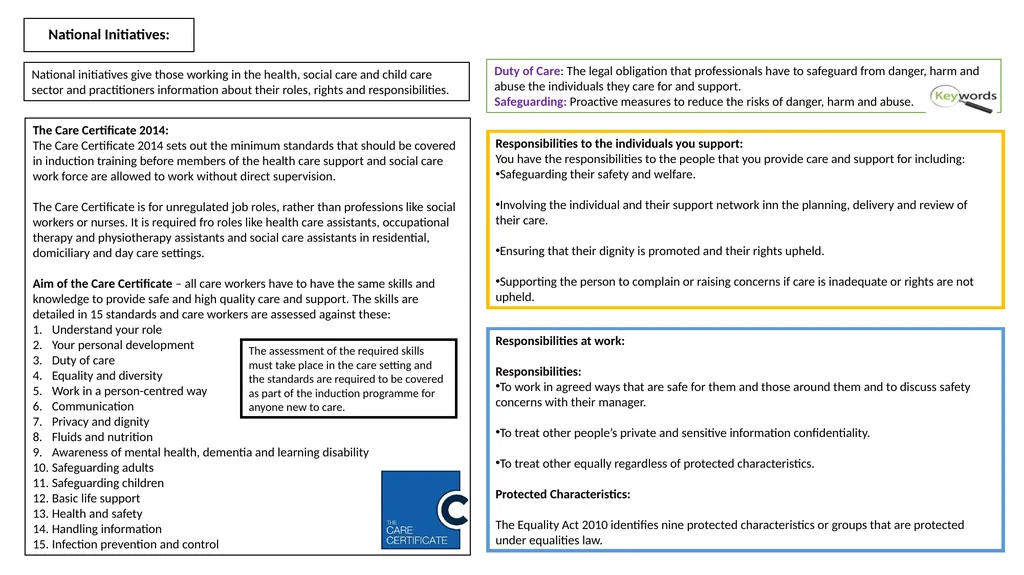
National Initiatives: National initiatives give those working in the health, social care and child care sector and practitioners information about their roles, rights and responsibilities. The Care Certificate 2014:
The Care Certificate 2014 sets out the minimum standards that should be covered in induction training before members of the health care support and social care work force are allowed to work without direct supervision.
The Care Certificate is for unregulated job roles, rather than professions like social workers or nurses. It is required fro roles like health care assistants, occupational therapy and physiotherapy assistants and social care assistants in residential, domiciliary and day care settings.
Aim of the Care Certificate – all care workers have to have the same skills and knowledge to provide safe and high quality care and support. The skills are detailed in 15 standards and care workers are assessed against these:
Understand your role
Your personal development
Duty of care
Equality and diversity
Work in a person-centred way
Communication
Privacy and dignity
Fluids and nutrition
Awareness of mental health, dementia and learning disability
Safeguarding adults
Safeguarding children
Basic life support
Health and safety
Handling information
Infection prevention and control Duty of Care: The legal obligation that professionals have to safeguard from danger, harm and abuse the individuals they care for and support.
Safeguarding: Proactive measures to reduce the risks of danger, harm and abuse. The assessment of the required skills must take place in the care setting and the standards are required to be covered as part of the induction programme for anyone new to care. Responsibilities to the individuals you support:
You have the responsibilities to the people that you provide care and support for including:
Safeguarding their safety and welfare.
Involving the individual and their support network inn the planning, delivery and review of their care.
Ensuring that their dignity is promoted and their rights upheld.
Supporting the person to complain or raising concerns if care is inadequate or rights are not upheld. Responsibilities at work:
Responsibilities:
To work in agreed ways that are safe for them and those around them and to discuss safety concerns with their manager.
To treat other people’s private and sensitive information confidentiality.
To treat other equally regardless of protected characteristics.
Protected Characteristics:
The Equality Act 2010 identifies nine protected characteristics or groups that are protected under equalities law.<br>
17
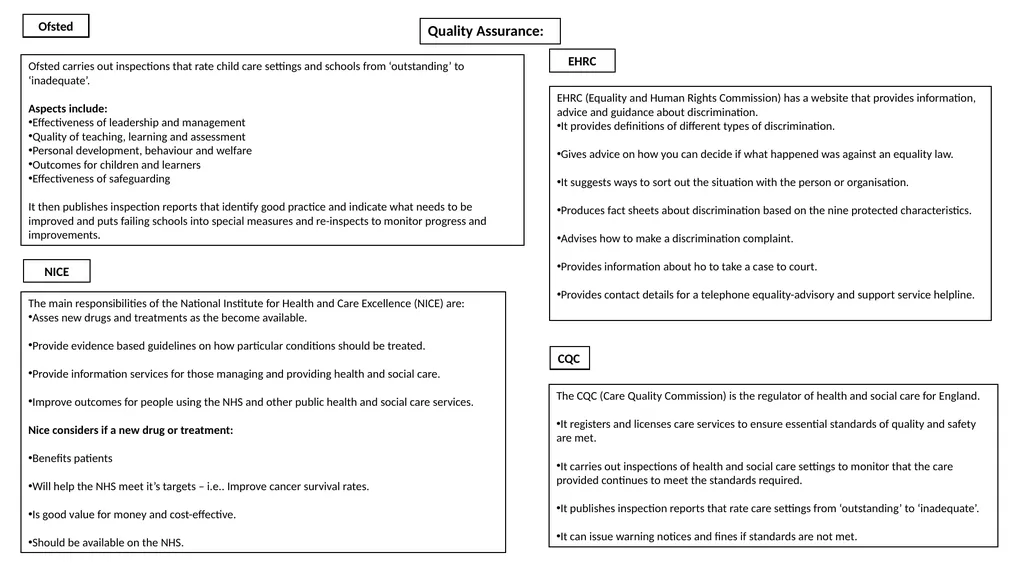
Quality Assurance: Ofsted Ofsted carries out inspections that rate child care settings and schools from ‘outstanding’ to ‘inadequate’.
Aspects include:
Effectiveness of leadership and management
Quality of teaching, learning and assessment
Personal development, behaviour and welfare
Outcomes for children and learners
Effectiveness of safeguarding
It then publishes inspection reports that identify good practice and indicate what needs to be improved and puts failing schools into special measures and re-inspects to monitor progress and improvements. CQC The CQC (Care Quality Commission) is the regulator of health and social care for England.
It registers and licenses care services to ensure essential standards of quality and safety are met.
It carries out inspections of health and social care settings to monitor that the care provided continues to meet the standards required.
It publishes inspection reports that rate care settings from ‘outstanding’ to ‘inadequate’.
It can issue warning notices and fines if standards are not met. EHRC EHRC (Equality and Human Rights Commission) has a website that provides information, advice and guidance about discrimination.
It provides definitions of different types of discrimination.
Gives advice on how you can decide if what happened was against an equality law.
It suggests ways to sort out the situation with the person or organisation.
Produces fact sheets about discrimination based on the nine protected characteristics.
Advises how to make a discrimination complaint.
Provides information about ho to take a case to court.
Provides contact details for a telephone equality-advisory and support service helpline. NICE The main responsibilities of the National Institute for Health and Care Excellence (NICE) are:
Asses new drugs and treatments as the become available.
Provide evidence based guidelines on how particular conditions should be treated.
Provide information services for those managing and providing health and social care.
Improve outcomes for people using the NHS and other public health and social care services.
Nice considers if a new drug or treatment:
Benefits patients
Will help the NHS meet it’s targets – i.e.. Improve cancer survival rates.
Is good value for money and cost-effective.
Should be available on the NHS.<br>
18
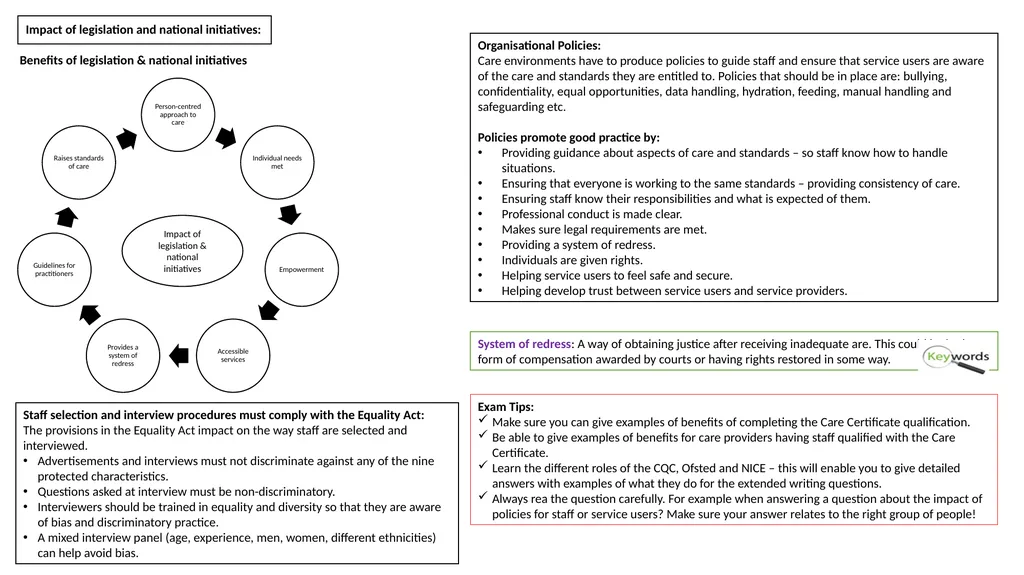
Impact of legislation and national initiatives: Impact of legislation & national initiatives Benefits of legislation & national initiatives Staff selection and interview procedures must comply with the Equality Act:
The provisions in the Equality Act impact on the way staff are selected and interviewed.
Advertisements and interviews must not discriminate against any of the nine protected characteristics.
Questions asked at interview must be non-discriminatory.
Interviewers should be trained in equality and diversity so that they are aware of bias and discriminatory practice.
A mixed interview panel (age, experience, men, women, different ethnicities) can help avoid bias. Organisational Policies:
Care environments have to produce policies to guide staff and ensure that service users are aware of the care and standards they are entitled to. Policies that should be in place are: bullying, confidentiality, equal opportunities, data handling, hydration, feeding, manual handling and safeguarding etc.
Policies promote good practice by:
Providing guidance about aspects of care and standards – so staff know how to handle situations.
Ensuring that everyone is working to the same standards – providing consistency of care.
Ensuring staff know their responsibilities and what is expected of them.
Professional conduct is made clear.
Makes sure legal requirements are met.
Providing a system of redress.
Individuals are given rights.
Helping service users to feel safe and secure.
Helping develop trust between service users and service providers. System of redress: A way of obtaining justice after receiving inadequate are. This could be in the form of compensation awarded by courts or having rights restored in some way. Exam Tips:
Make sure you can give examples of benefits of completing the Care Certificate qualification.
Be able to give examples of benefits for care providers having staff qualified with the Care Certificate.
Learn the different roles of the CQC, Ofsted and NICE – this will enable you to give detailed answers with examples of what they do for the extended writing questions.
Always rea the question carefully. For example when answering a question about the impact of policies for staff or service users? Make sure your answer relates to the right group of people!<br>
19
Equality & Diversity
Knowledge Organiser LO4: How equality, diversity and rights in health, social care and child care environments are promoted.<br>
20
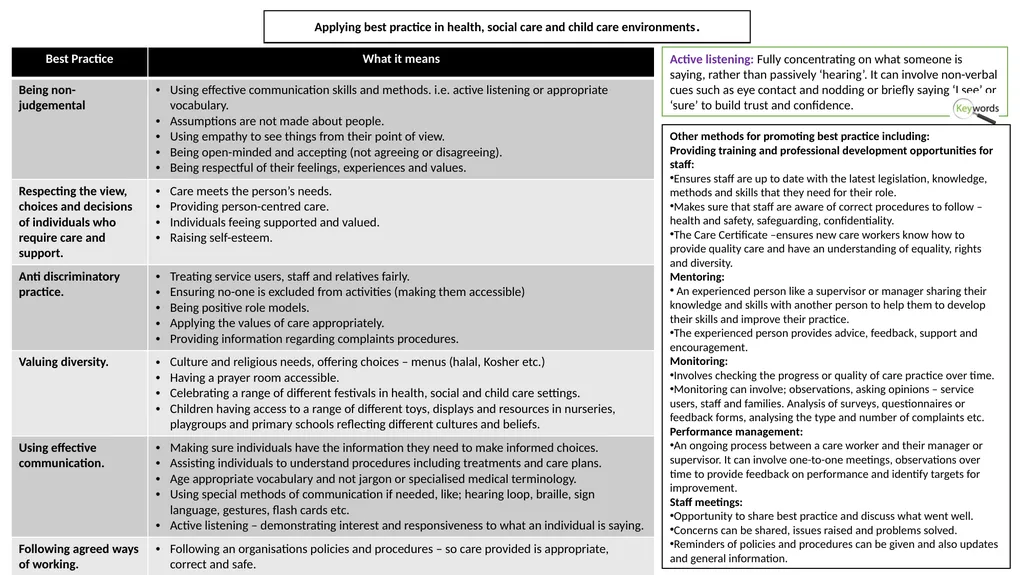
Applying best practice in health, social care and child care environments. Active listening: Fully concentrating on what someone is saying, rather than passively ‘hearing’. It can involve non-verbal cues such as eye contact and nodding or briefly saying ‘I see’ or ‘sure’ to build trust and confidence. Other methods for promoting best practice including:
Providing training and professional development opportunities for staff:
Ensures staff are up to date with the latest legislation, knowledge, methods and skills that they need for their role.
Makes sure that staff are aware of correct procedures to follow – health and safety, safeguarding, confidentiality.
The Care Certificate –ensures new care workers know how to provide quality care and have an understanding of equality, rights and diversity.
Mentoring:
An experienced person like a supervisor or manager sharing their knowledge and skills with another person to help them to develop their skills and improve their practice.
The experienced person provides advice, feedback, support and encouragement.
Monitoring:
Involves checking the progress or quality of care practice over time.
Monitoring can involve; observations, asking opinions – service users, staff and families. Analysis of surveys, questionnaires or feedback forms, analysing the type and number of complaints etc.
Performance management:
An ongoing process between a care worker and their manager or supervisor. It can involve one-to-one meetings, observations over time to provide feedback on performance and identify targets for improvement.
Staff meetings:
Opportunity to share best practice and discuss what went well.
Concerns can be shared, issues raised and problems solved.
Reminders of policies and procedures can be given and also updates and general information.<br>
21
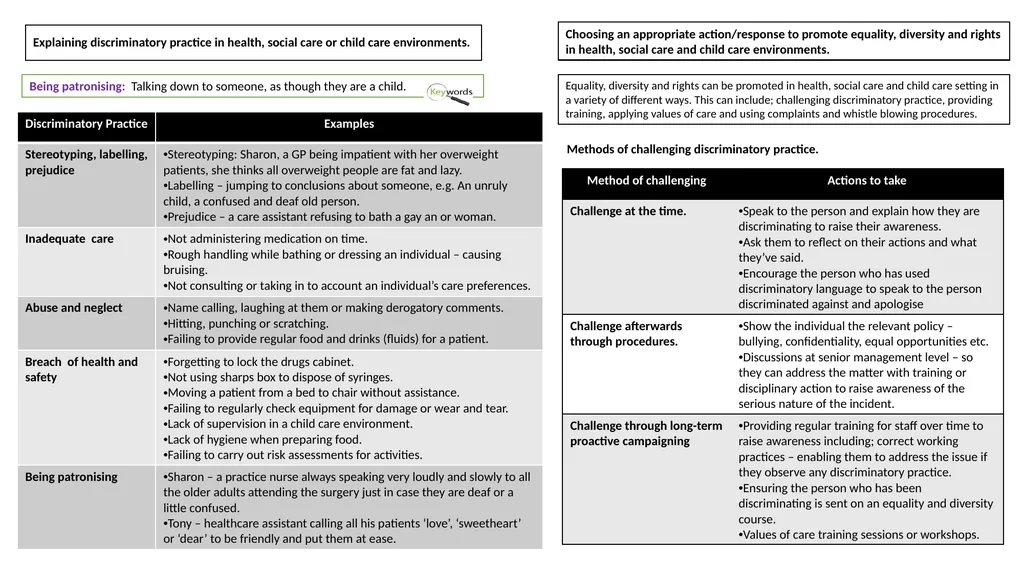
Explaining discriminatory practice in health, social care or child care environments. Being patronising: Talking down to someone, as though they are a child. Choosing an appropriate action/response to promote equality, diversity and rights in health, social care and child care environments. Equality, diversity and rights can be promoted in health, social care and child care setting in a variety of different ways. This can include; challenging discriminatory practice, providing training, applying values of care and using complaints and whistle blowing procedures. Methods of challenging discriminatory practice.<br>
22
Other methods for challenging discrimination can include: Applying the values of care:
This ensures that individuals using health, social care and child care environments receive appropriate care, do not experience discriminatory attitudes and have their rights supported and their diversity is valued.
Providing information on complaints procedures and whistleblowing:
Having a complaints procedure in place means that service users will know what to do and who to speak to if they feel their rights or care needs are not being met.
Reassures service users, their families and practitioners that their concerns will be taken seriously.
In extremely serious circumstances, whistleblowing involves raising concerns about poor practice with an outside authority such as the CQC or Ofsted – they will then launch an investigation and ensure appropriate actions are taken. Actions may include; closing a setting down or prosecuting staff
Advocacy services information provided:
An advocate is independent and represents an individual’s wishes and views to make sure that their rights and needs are recognized. They act in the best interest of the individual and speak on their behalf id they cannot speak for themselves.
Implementing legislation, codes of practice and policies:
Promoting good practice by providing guidance regarding the aspects of care in the codes of practice, policies and legislation ensuring staff are able to respond and act appropriately in any situation.
Professional conduct and expectations are clear.
Ensures service users, families, practitioners and staff are reassured and feel safe and secure and makes sure that there is a system of redress.
Dealing with conflict:
Needs to be handled in a manner that involves active listening, remaining calm, objective and showing empathy. Situations should be approached positively and actively seek to find solutions.
Training, mentoring and monitoring:
See examples of best practice in the table ‘Other methods for promoting best practice’ on the first page of this KO. Exam Tips:
You need to be able to explain how aspects of good practice like mentoring, monitoring and following agreed ways of working can improve standards of care.
Be able to recognize and explain examples of discriminatory practice using the correct terminology - page 2 of this KO - Explaining discriminatory practice in health, social care or child care environments table.
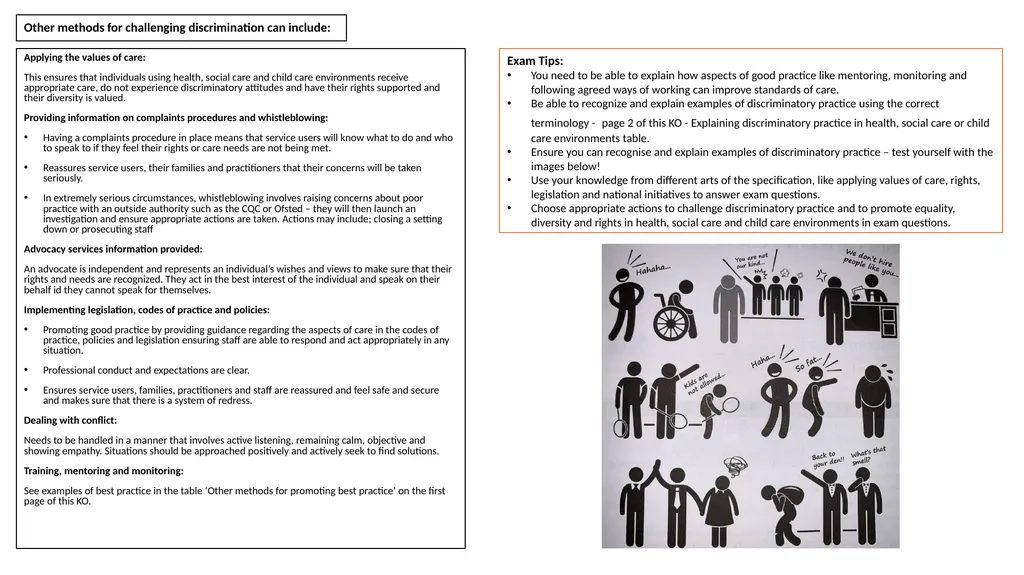
Ensure you can recognise and explain examples of discriminatory practice – test yourself with the images below!
Use your knowledge from different arts of the specification, like applying values of care, rights, legislation and national initiatives to answer exam questions.
Choose appropriate actions to challenge discriminatory practice and to promote equality, diversity and rights in health, social care and child care environments in exam questions.<br>