History 172 Modern France Enlightenment Political Ideas and the Public Sphere Right: Model of Diamond Necklace for Marie-Antoinette Enlightenment Political Ideas The Social Contract Thomas Hobbes (1588-1679) Leviathan (1651) Fled English
"History 172 Modern France Enlightenment Political" is the property of its rightful owner. Permission is granted to
download and print the materials on this website for personal, non-commercial use only, and to display it
on your personal computer provided you do not modify the materials and that you retain all copyright
notices contained in the materials. By downloading content from our website, you accept the terms of this
agreement.
Presentation Transcript
01
History 172 Modern France Enlightenment
Political Ideas and
the Public Sphere
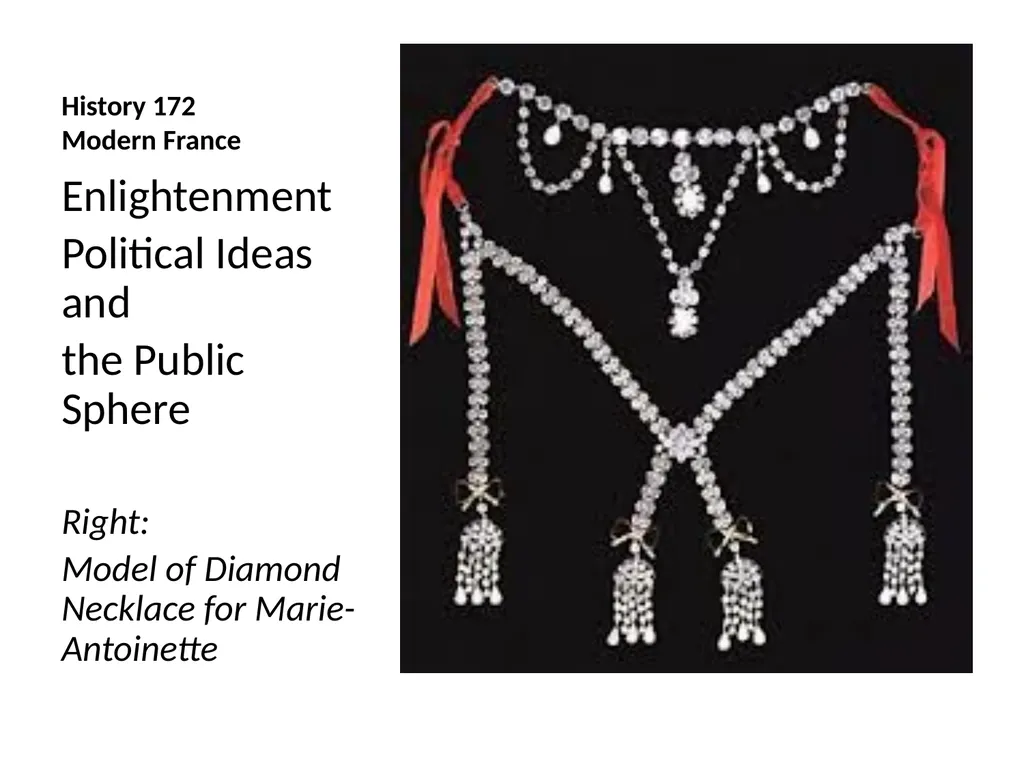
Right:
Model of Diamond Necklace for Marie-Antoinette<br>
02
Enlightenment Political Ideas – The Social Contract Thomas Hobbes (1588-1679)
Leviathan (1651)
Fled English Civil War, to Paris
Witnessed the Fronde in France (also a civil war)
European Thirty Years War, deadliest until WWI
Violence everywhere!!
‘Life is nasty, brutish and short’
Struggle of all against all
Social contract: consent to confer absolute power, sovereignty, to a single person (monarch)
Dark and secular justification for absolutism; differed from divine-right justifications
Coercion in his philosophy of society is taken for granted<br>
03
Rousseau’s Du contrat social (1762) Replaces coercion with morality
Republicanism (obsessed with virtue and decline)
Can’t return to state of nature, so how shall we live together in society?
Collective sovereignty and the ‘general will’
How to harmonize particular wills with the general will?
Prioritise the ‘general interest’ over particular ones
Civic morality, education, festivals, civil religion
Teach people to see the general interest
Alternative to the Leviathan
Social bonds are moral, not coerced<br>
04
Enlightened absolutism Voltaire
Hated noble privilege, religious fanaticism, censorship
Replace divine-right absolutism with enlightened absolutism
Militated for universal taxes (since nobles did not pay as many as others)
Rational government (not democratic)<br>
05
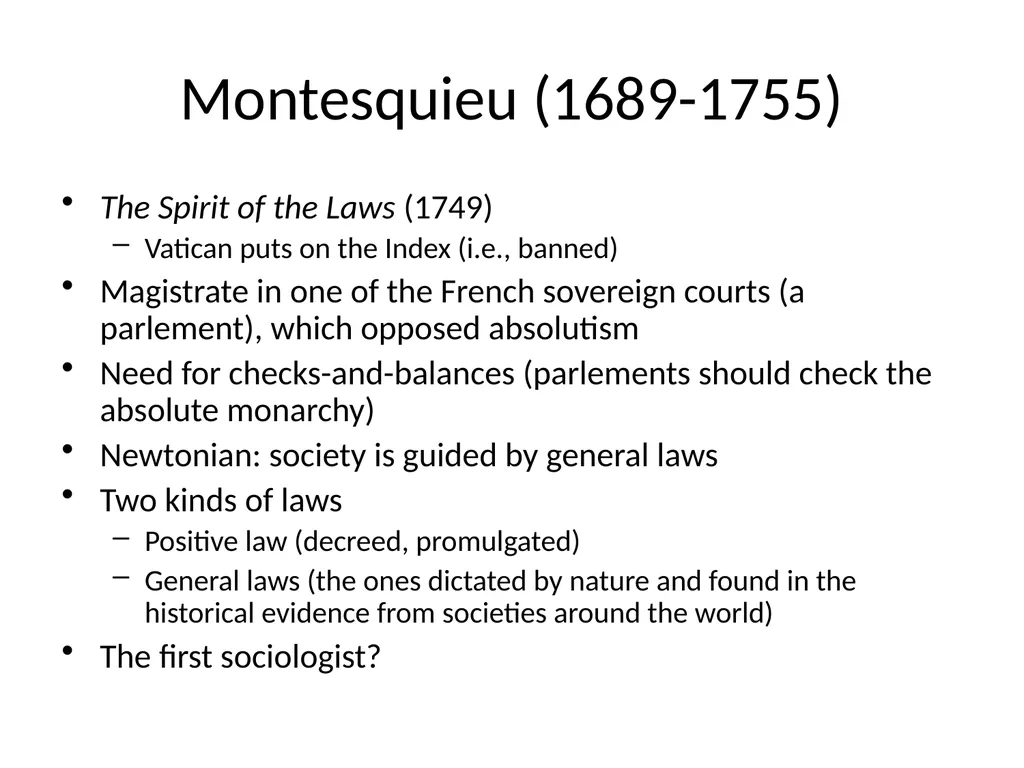
Montesquieu (1689-1755) The Spirit of the Laws (1749)
Vatican puts on the Index (i.e., banned)
Magistrate in one of the French sovereign courts (a parlement), which opposed absolutism
Need for checks-and-balances (parlements should check the absolute monarchy)
Newtonian: society is guided by general laws
Two kinds of laws
Positive law (decreed, promulgated)
General laws (the ones dictated by nature and found in the historical evidence from societies around the world)
The first sociologist?<br>
06
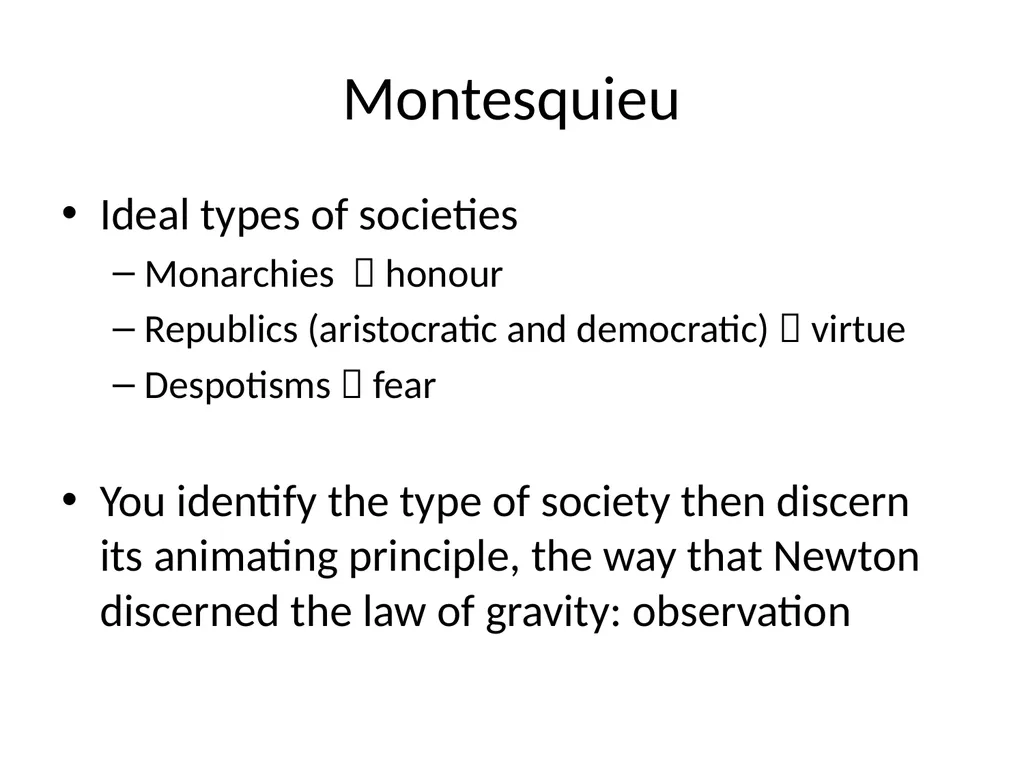
Montesquieu Ideal types of societies
Monarchies honour
Republics (aristocratic and democratic) virtue
Despotisms fear
You identify the type of society then discern its animating principle, the way that Newton discerned the law of gravity: observation<br>
07
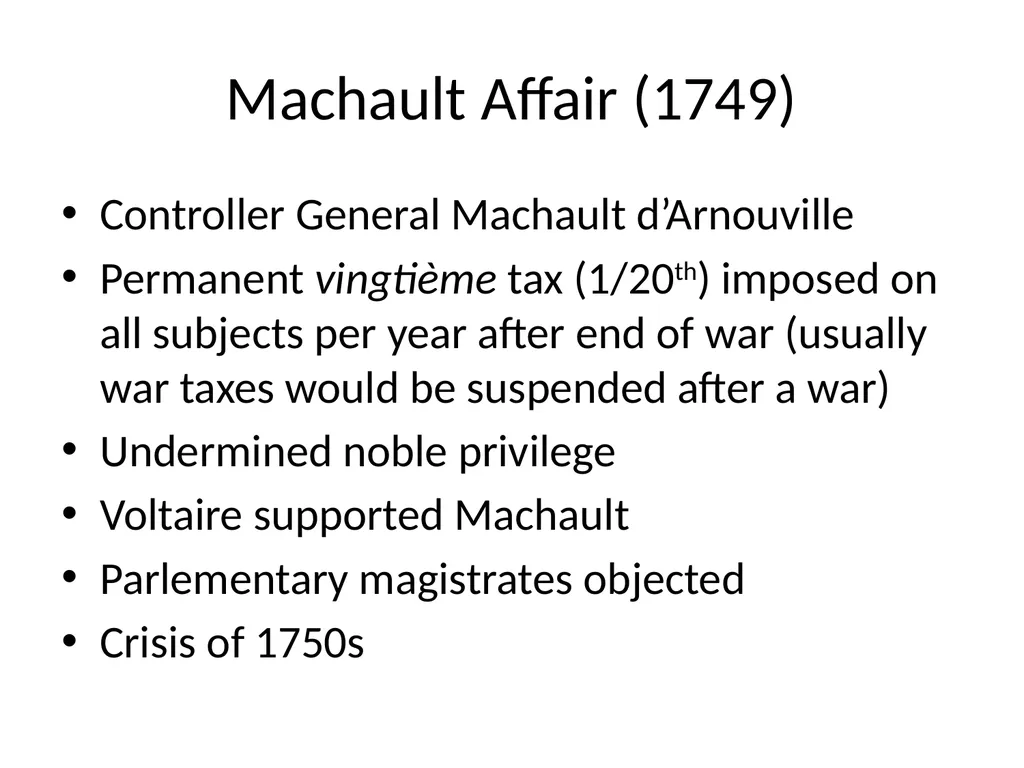
Machault Affair (1749) Controller General Machault d’Arnouville
Permanent vingtième tax (1/20th) imposed on all subjects per year after end of war (usually war taxes would be suspended after a war)
Undermined noble privilege
Voltaire supported Machault
Parlementary magistrates objected
Crisis of 1750s<br>
08
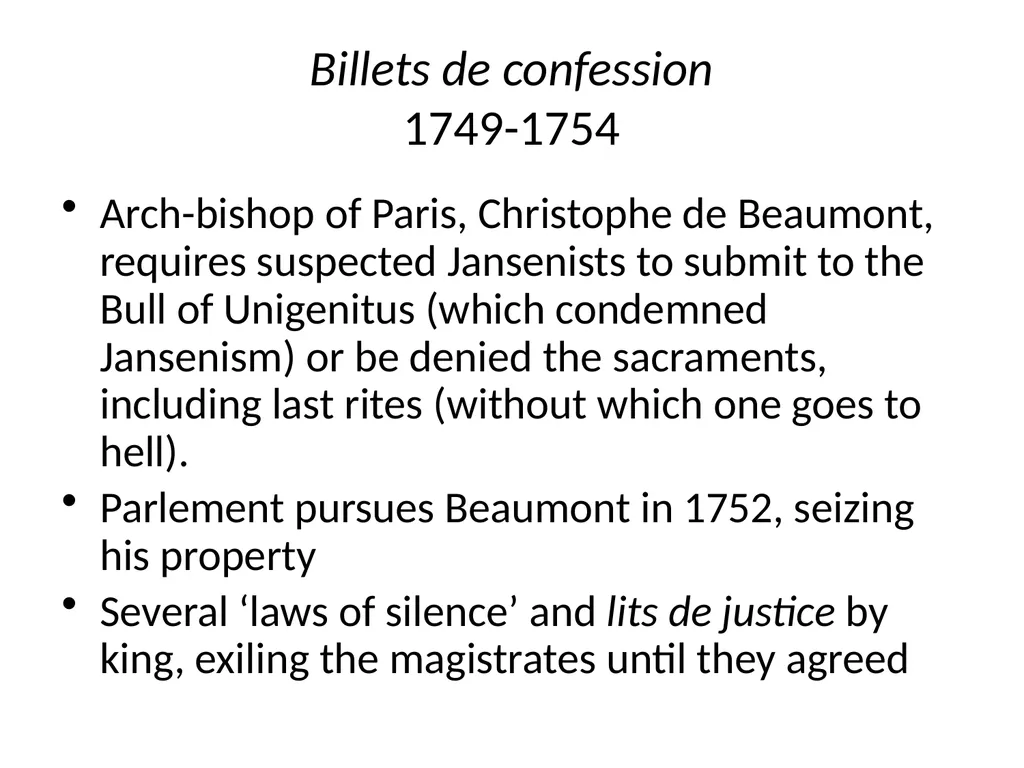
Billets de confession 1749-1754 Arch-bishop of Paris, Christophe de Beaumont, requires suspected Jansenists to submit to the Bull of Unigenitus (which condemned Jansenism) or be denied the sacraments, including last rites (without which one goes to hell).
Parlement pursues Beaumont in 1752, seizing his property
Several ‘laws of silence’ and lits de justice by king, exiling the magistrates until they agreed<br>
09
Damiens Affair Attempted assassination of Louis XV in 1757
Damiens: servant for a parlementary magistrate (risked making the Parlement and Jansenists look like regicides)
Spectacular execution of Damiens – attitudes about punishment change. Being drawn and quartered begins to look barbarous
Encyclopédie goes underground<br>
Created new non-venal courts
Puts magistrates on the state payroll
Resistance
Parlements draw on Montesquieuian language:
Checks and balances
Representing the nation<br>
11
Physiocrats Rise of political economy
Invention of a science of ‘the economy’
Attempt to de-personalise it and make it seem like the produce of natural market forces
Physiocrats
Believed that agriculture was the basis of all productivity and wealth
Tax land, not people; spur agricultural production
Free markets
Adam Smith took inspiration from them but differed: didn’t think agriculture was the sole basis of national wealth. Importance of trade and commerce.<br>
12
Economy Attempts to implement free-market economy between 1760s and 1780s
Often resisted by officials and policing forces, who often sympathised with the plight of the hungry and believed in market regulations
Revolts
Attempts to implement free-market policies led to backpedaling into paternalistic regulation between 1760s and 1780s
Erratic and reversed policies weaken the bonds between governing elite and the population… agitation, criticism.<br>
13
The Enlightenment and Modernity Epistemological Shifts (discussed)
Campaign to reform state and society (discussed)
Rational governance; liberal economic reforms; effort to replace influence of Church with Enlightenment knowledge producers; equality of taxation
Climate of Opinion
The Tribunal of ‘public opinion’<br>
14
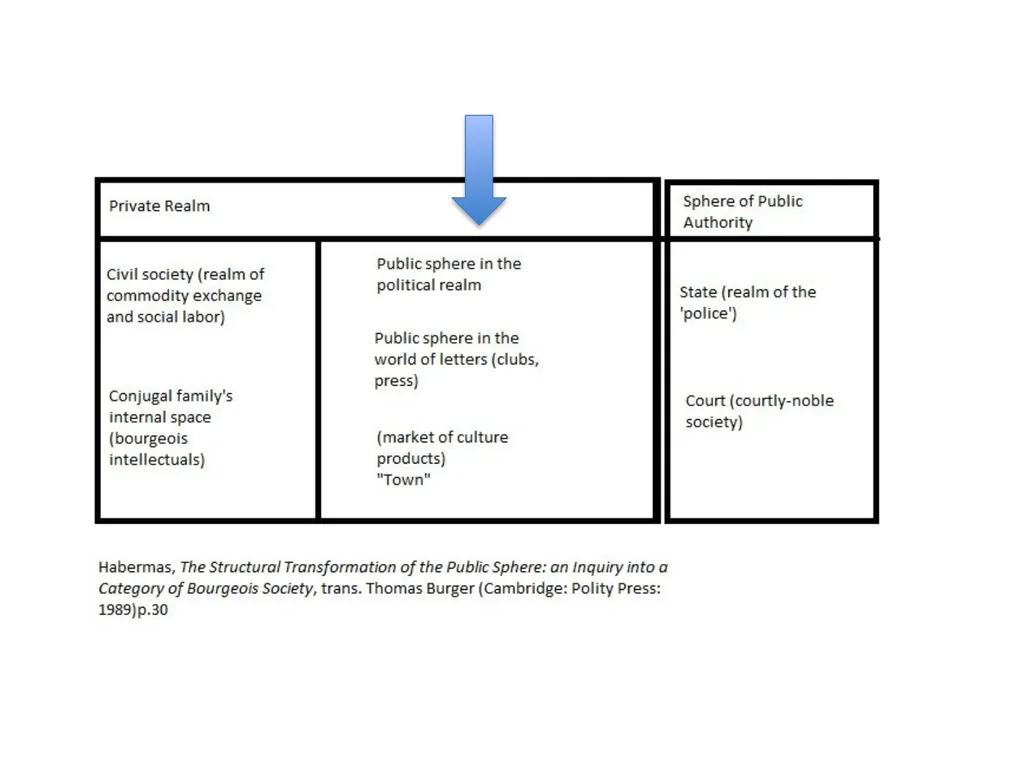
What is the public sphere? Jürgen Habermas
The Structural Transformation of the Bourgeois Public Sphere (1962)<br>
15
The public sphere a space of rational-critical debate
where private individuals come together to form a ‘public’
where ‘public opinion’ is formed and expressed, often in critical opposition to the state or ruling elite.<br>
16
By the ‘public sphere’ we mean first of all a realm of our social life in which something approaching public opinion can be formed. Access is guaranteed to all citizens. A portion of the public sphere comes into being in every conversation in which private individuals assemble to form a public body. They then behave neither like business or professional people transacting private affairs, nor like members of a constitutional order subject to the legal constraints of a state bureaucracy. Citizens behave as a public body when they confer in an unrestricted fashion -- that is, with the guarantee of assembly and association and the freedom to express and publish their opinions -- about matters of general interest. (Habermas ,’The Public Sphere: An Encyclopedia Article’, New German Critique 3 (1974): 49)<br>
17
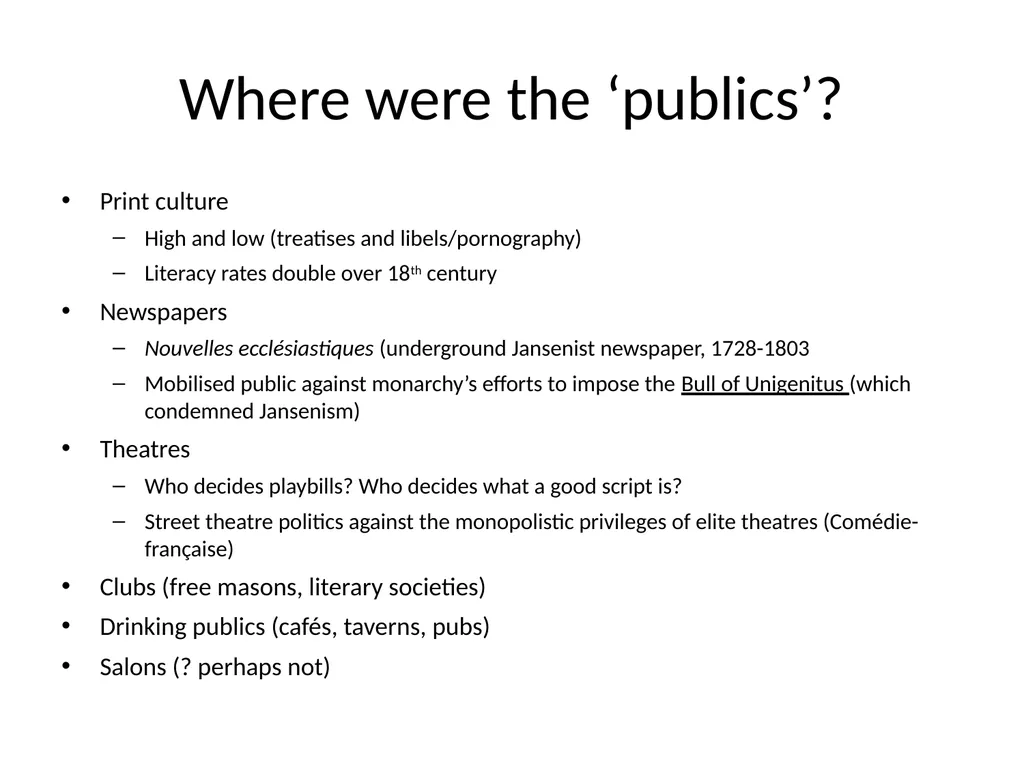
Where were the ‘publics’? Print culture
High and low (treatises and libels/pornography)
Literacy rates double over 18th century
Newspapers
Nouvelles ecclésiastiques (underground Jansenist newspaper, 1728-1803
Mobilised public against monarchy’s efforts to impose the Bull of Unigenitus (which condemned Jansenism)
Theatres
Who decides playbills? Who decides what a good script is?
Street theatre politics against the monopolistic privileges of elite theatres (Comédie-française)
Clubs (free masons, literary societies)
Drinking publics (cafés, taverns, pubs)
Salons (? perhaps not)<br>
18
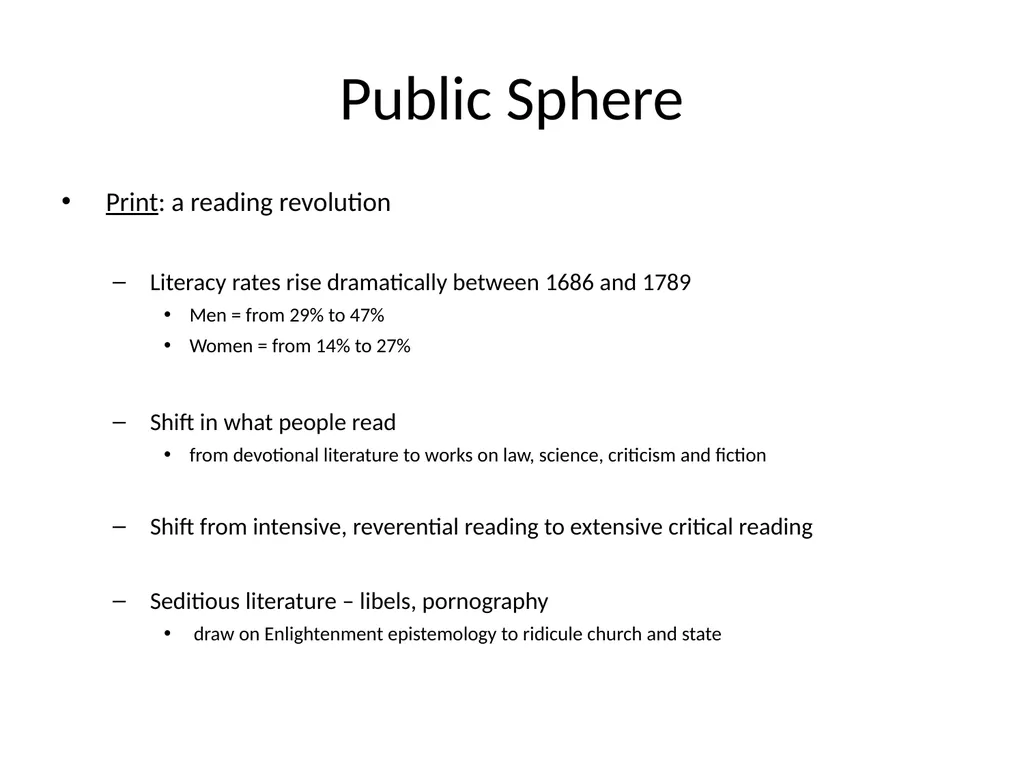
Public Sphere Print: a reading revolution
Literacy rates rise dramatically between 1686 and 1789
Men = from 29% to 47%
Women = from 14% to 27%
Shift in what people read
from devotional literature to works on law, science, criticism and fiction
Shift from intensive, reverential reading to extensive critical reading
Seditious literature – libels, pornography
draw on Enlightenment epistemology to ridicule church and state<br>
19
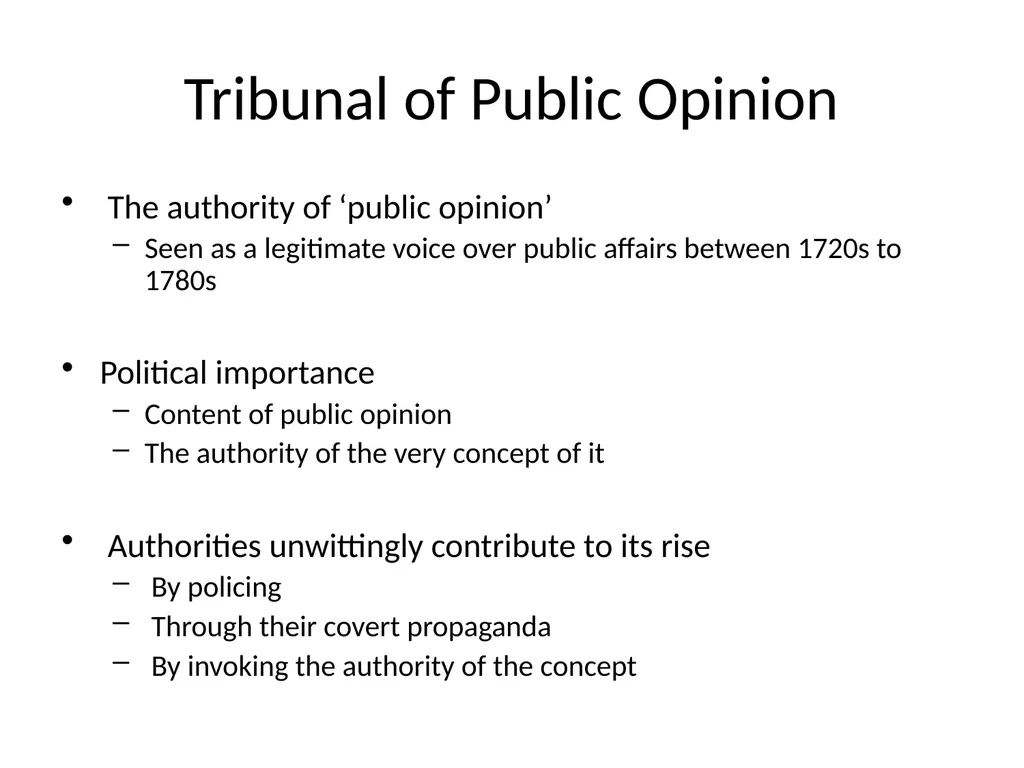
Tribunal of Public Opinion The authority of ‘public opinion’
Seen as a legitimate voice over public affairs between 1720s to 1780s
Political importance
Content of public opinion
The authority of the very concept of it
Authorities unwittingly contribute to its rise
By policing
Through their covert propaganda
By invoking the authority of the concept<br>
20
The ‘public’ vs. the ‘people' Rise of popular agitation in late 18th century
peasant revolts
urban rebellions
Fear of the masses intensifies
Transform the people into a public
How? More enlightenment!<br>