04
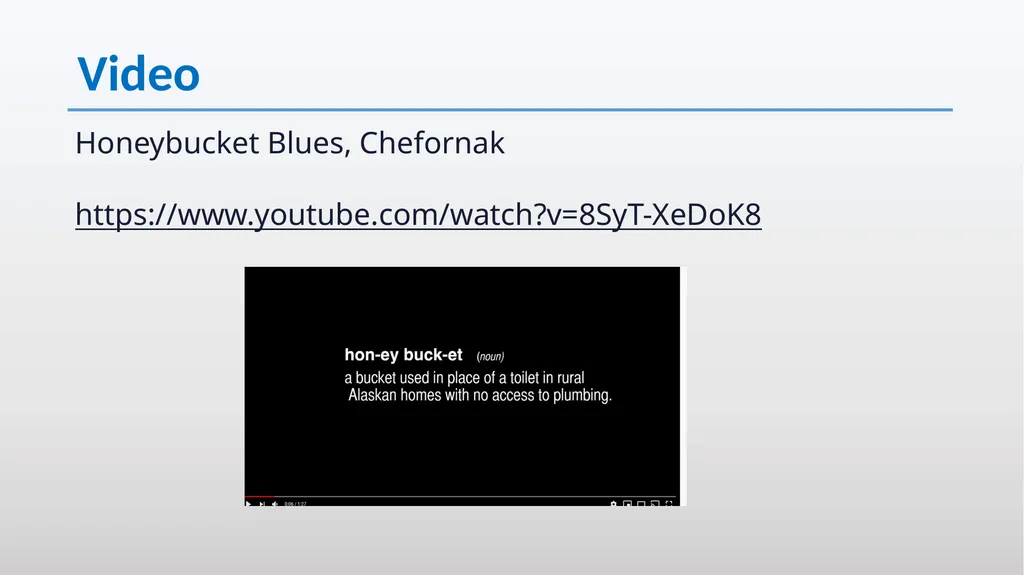
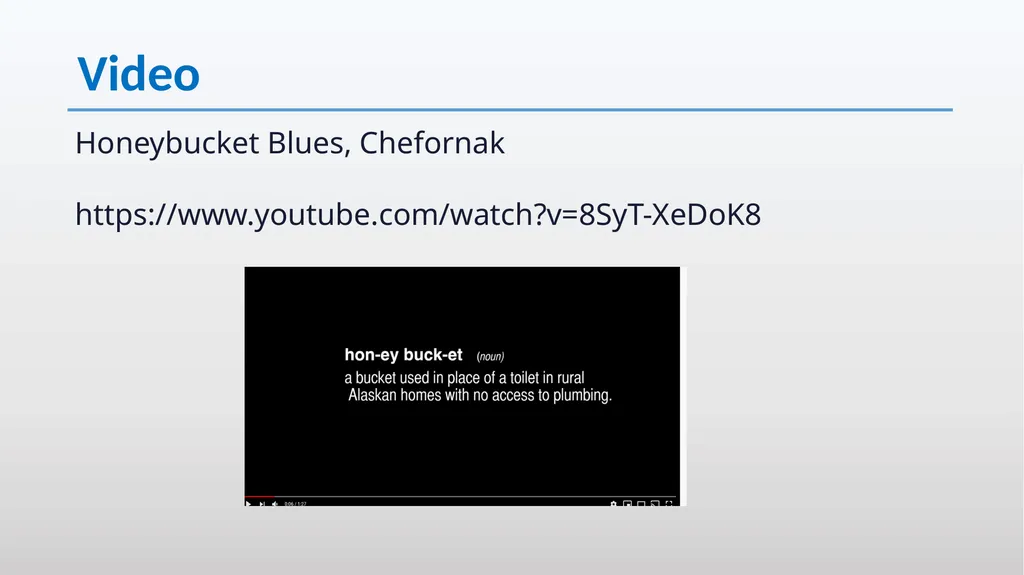
Video Honeybucket Blues, Chefornak
https://www.youtube.com/watch?v=8SyT-XeDoK8<br>
05
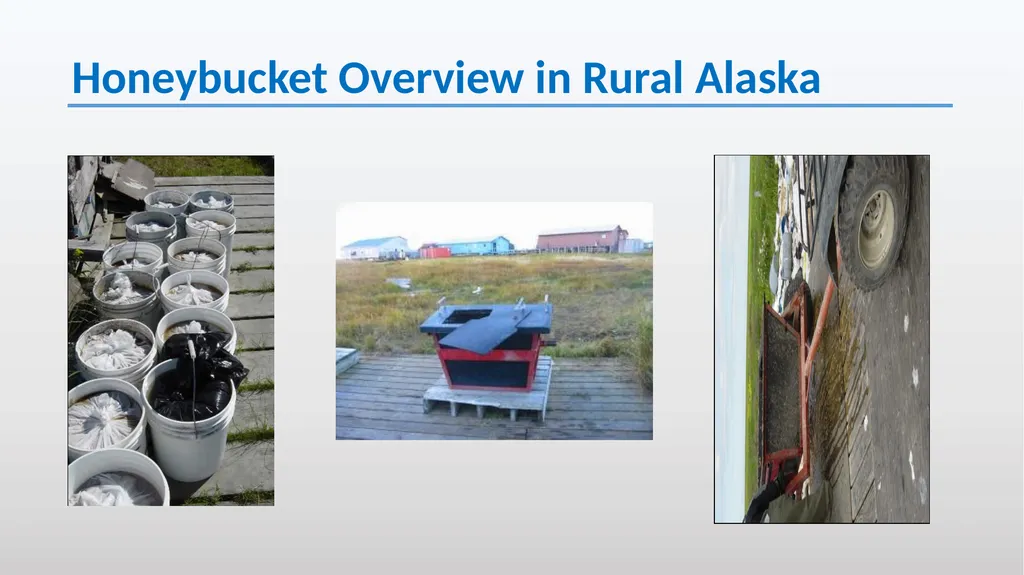
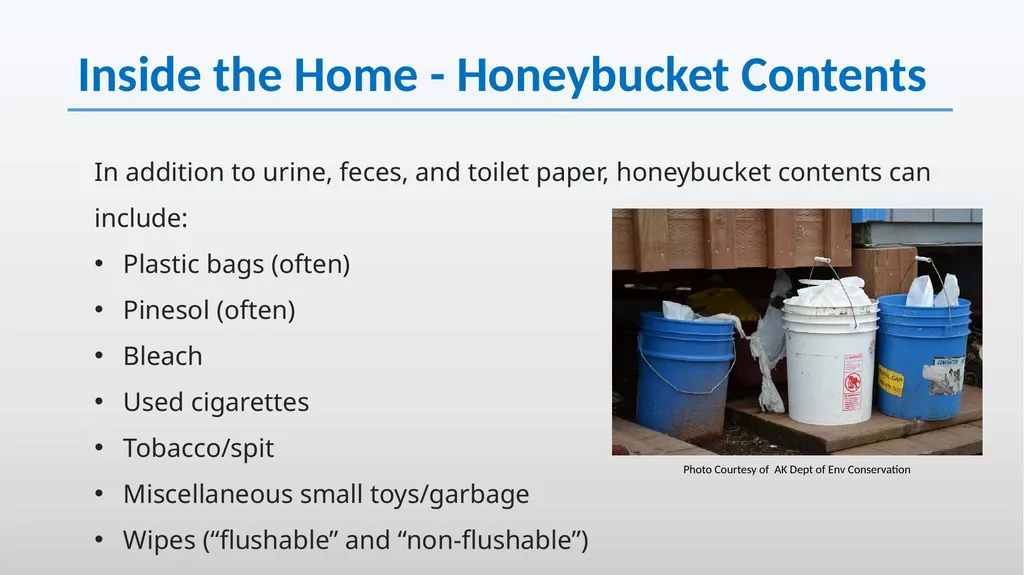
Inside the Home - Honeybucket Contents In addition to urine, feces, and toilet paper, honeybucket contents can include:
Plastic bags (often)
Pinesol (often)
Bleach
Used cigarettes
Tobacco/spit
Miscellaneous small toys/garbage
Wipes (“flushable” and “non-flushable”) Photo Courtesy of AK Dept of Env Conservation<br>
06
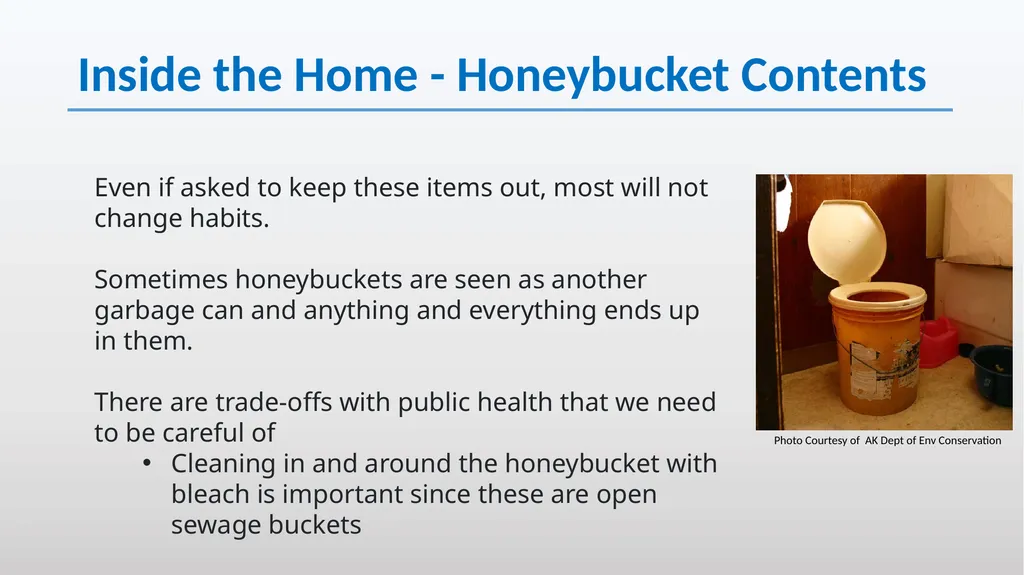
Inside the Home - Honeybucket Contents Even if asked to keep these items out, most will not change habits.
Sometimes honeybuckets are seen as another garbage can and anything and everything ends up in them.
There are trade-offs with public health that we need to be careful of
Cleaning in and around the honeybucket with bleach is important since these are open sewage buckets Photo Courtesy of AK Dept of Env Conservation<br>
07
Outside the Home - Scenarios Unserved communities
Served or “piped” communities
Tank haul systems
Urine diversion toilet systems<br>
08
Outside the Home - Scenarios Served or “piped” communities
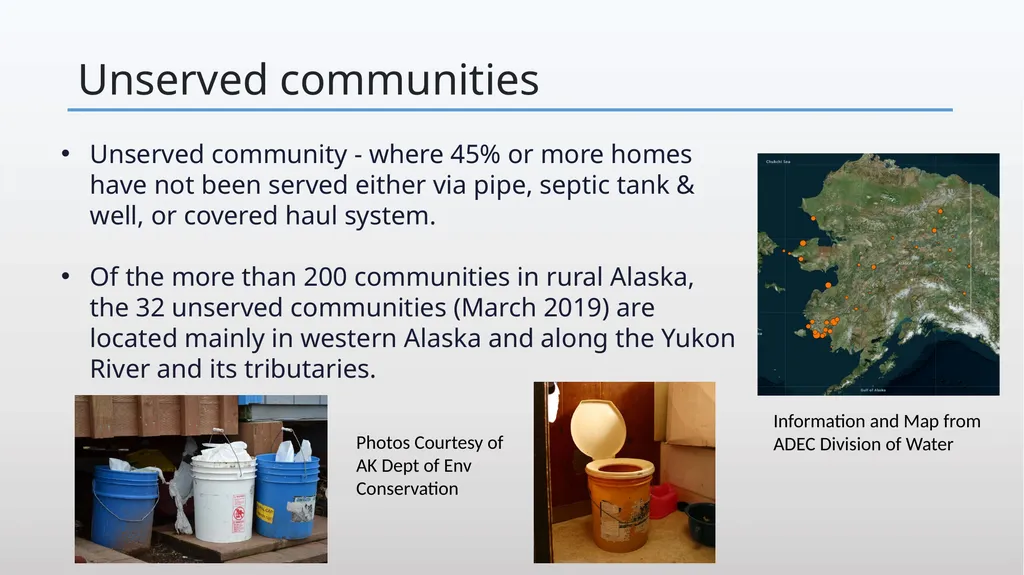
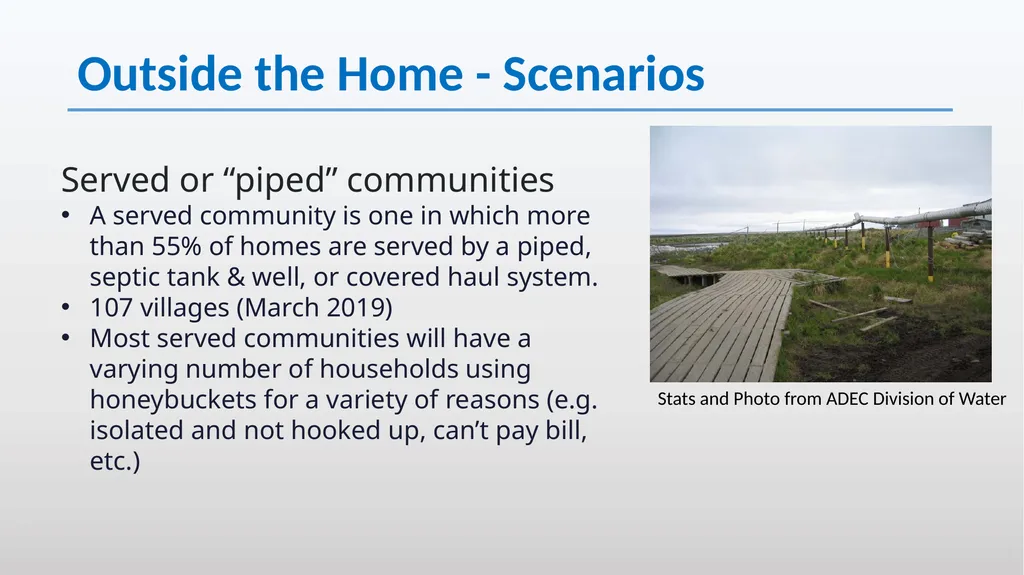
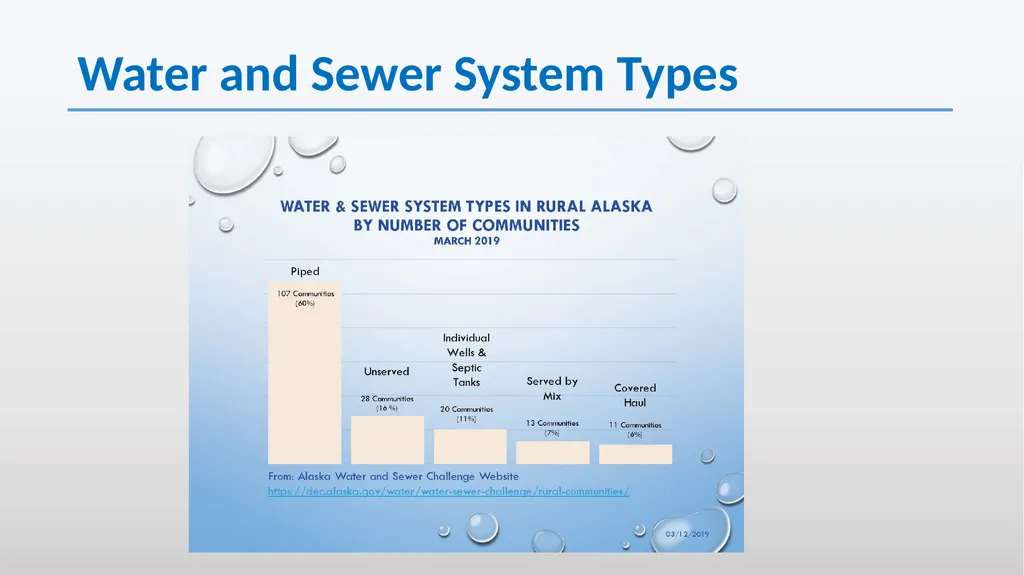
A served community is one in which more than 55% of homes are served by a piped, septic tank & well, or covered haul system.
107 villages (March 2019)
Most served communities will have a varying number of households using honeybuckets for a variety of reasons (e.g. isolated and not hooked up, can’t pay bill, etc.) Stats and Photo from ADEC Division of Water<br>
09
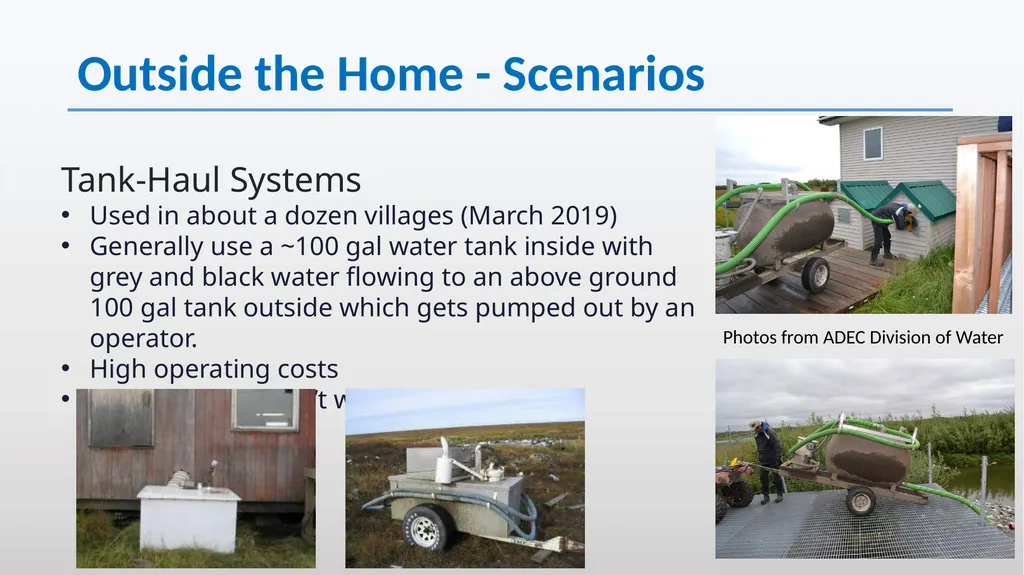
Outside the Home - Scenarios Tank-Haul Systems
Used in about a dozen villages (March 2019)
Generally use a ~100 gal water tank inside with grey and black water flowing to an above ground 100 gal tank outside which gets pumped out by an operator.
High operating costs
Many systems don’t work anymore Photos from ADEC Division of Water<br>
10
Water and Sewer System Types<br>
11
Honeybucket Disposal Scenarios Self-haul
Community hoppers
House-to-house collection<br>
12
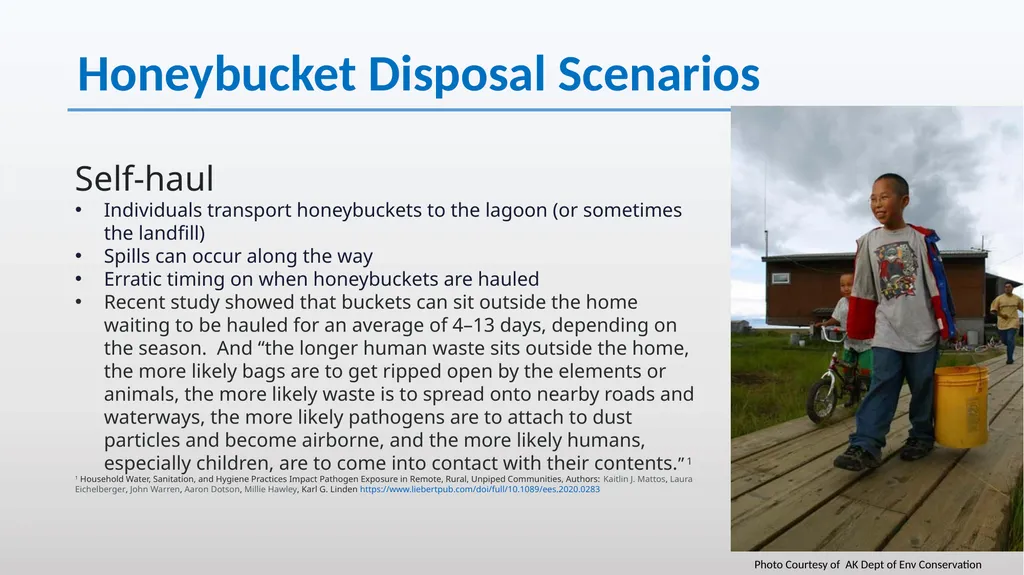
Honeybucket Disposal Scenarios Self-haul
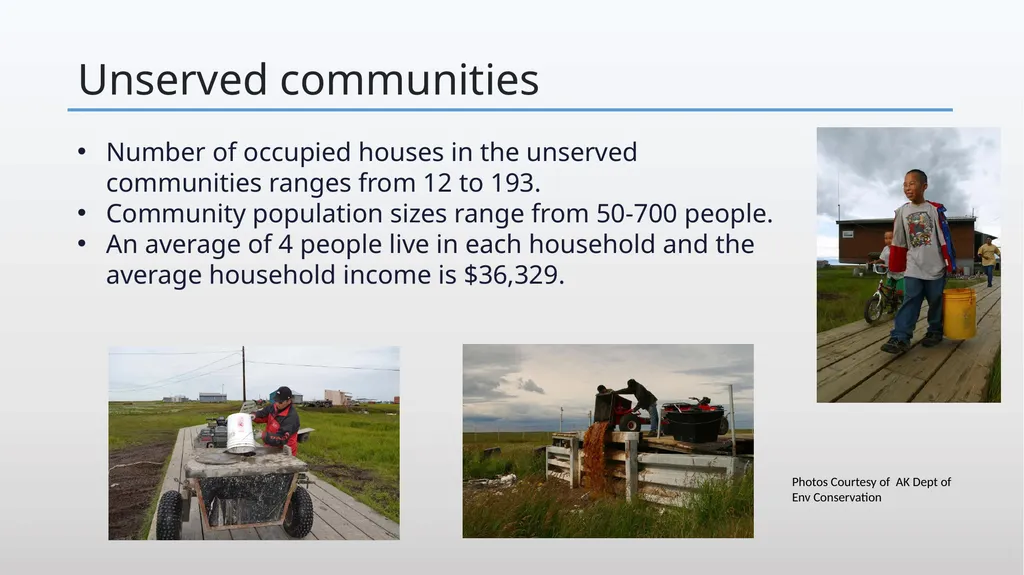
Individuals transport honeybuckets to the lagoon (or sometimes the landfill)
Spills can occur along the way
Erratic timing on when honeybuckets are hauled
Recent study showed that buckets can sit outside the home waiting to be hauled for an average of 4–13 days, depending on the season. And “the longer human waste sits outside the home, the more likely bags are to get ripped open by the elements or animals, the more likely waste is to spread onto nearby roads and waterways, the more likely pathogens are to attach to dust particles and become airborne, and the more likely humans, especially children, are to come into contact with their contents.” 1
1 Household Water, Sanitation, and Hygiene Practices Impact Pathogen Exposure in Remote, Rural, Unpiped Communities, Authors: Kaitlin J. Mattos, Laura Eichelberger, John Warren, Aaron Dotson, Millie Hawley, Karl G. Linden https://www.liebertpub.com/doi/full/10.1089/ees.2020.0283 Photo Courtesy of AK Dept of Env Conservation<br>
13
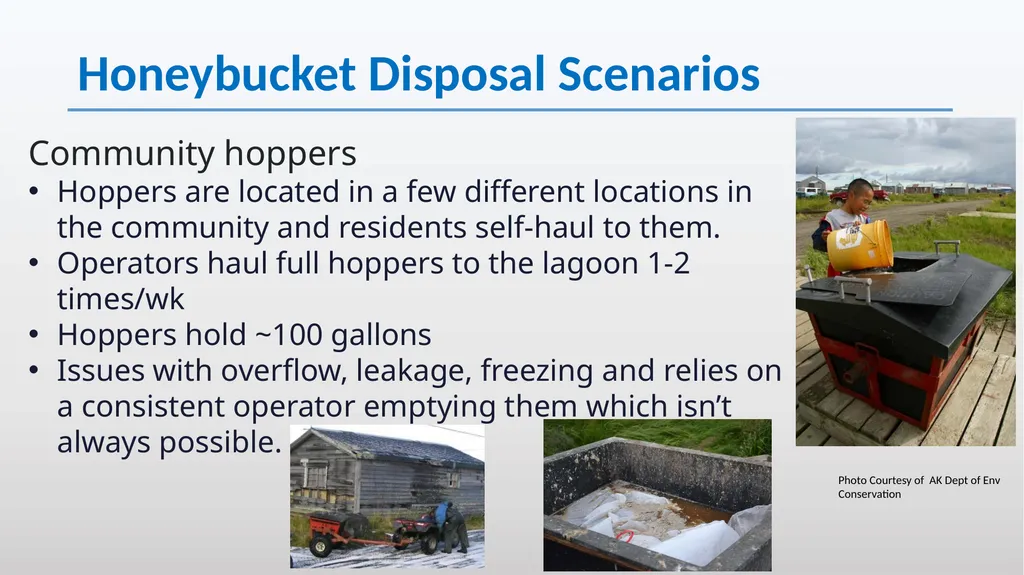
Honeybucket Disposal Scenarios Community hoppers
Hoppers are located in a few different locations in the community and residents self-haul to them.
Operators haul full hoppers to the lagoon 1-2 times/wk
Hoppers hold ~100 gallons
Issues with overflow, leakage, freezing and relies on a consistent operator emptying them which isn’t always possible. Photo Courtesy of AK Dept of Env Conservation<br>
14
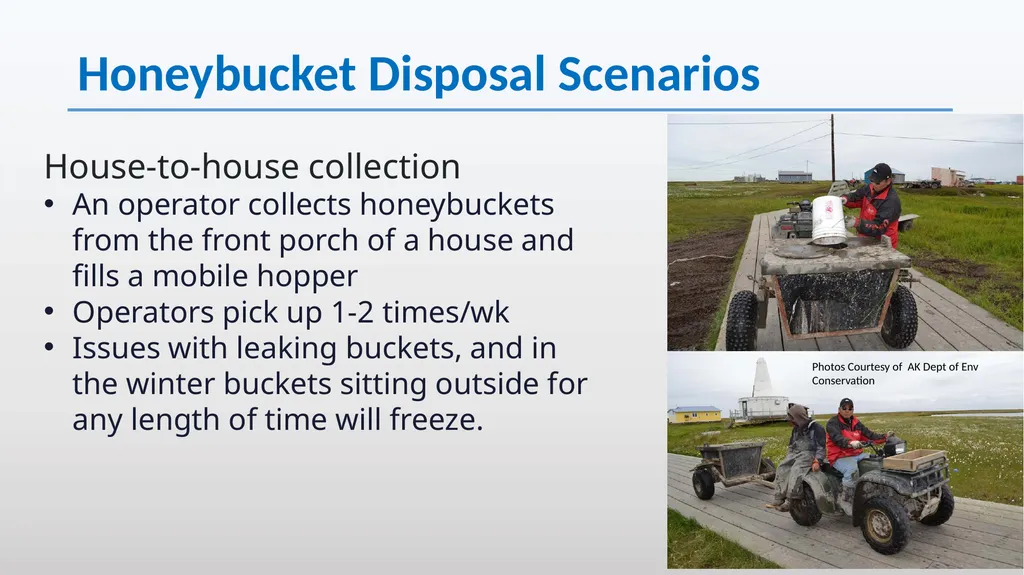
Honeybucket Disposal Scenarios House-to-house collection
An operator collects honeybuckets from the front porch of a house and fills a mobile hopper
Operators pick up 1-2 times/wk
Issues with leaking buckets, and in the winter buckets sitting outside for any length of time will freeze. Photos Courtesy of AK Dept of Env Conservation<br>
15
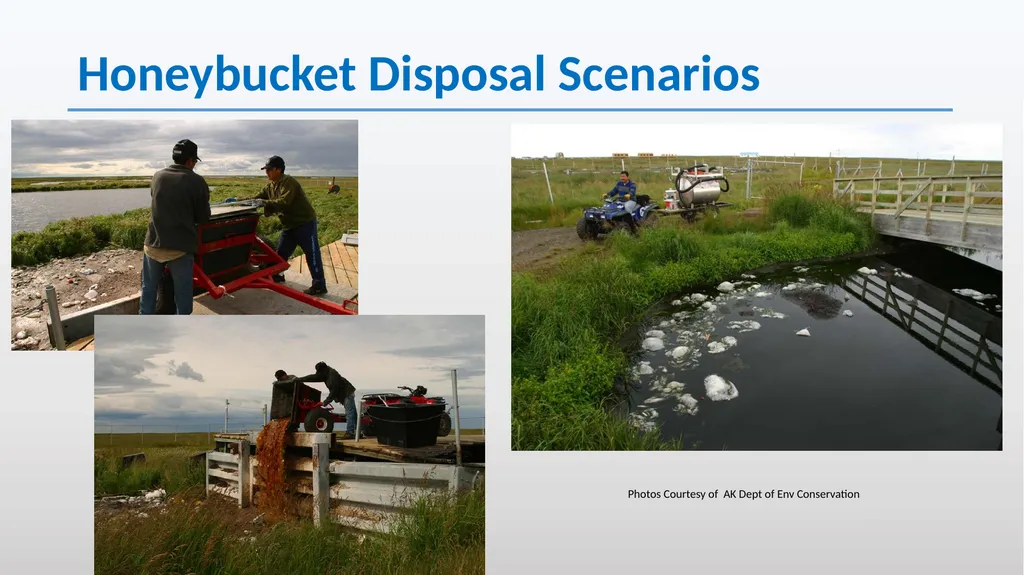
Honeybucket Disposal Scenarios Photos Courtesy of AK Dept of Env Conservation<br>
16
Notes on Digester Location If placed in a central location in a village (likely less expensive, electricity/water nearby, etc) issues could be:
Odors (close to school, clinics, homes etc)
Kids will play by it
People self-hauling will treat it like the hoppers.
Public health issues
If placed further from town near the lagoon or landfill (likely more expensive, no electricity/water, generator needed?) positives could be:
Less odor worries
If by the lagoon people are used to hauling there
Maintenance could be easier if not in town?<br>
17
Notes on operation and costs Plan to have an operating fund for the project.
Arrange for backup (or even backup to backup) operators
Job turnover is extremely high (in almost every village)
Have a plan to shut down the digester and lock it up if needed
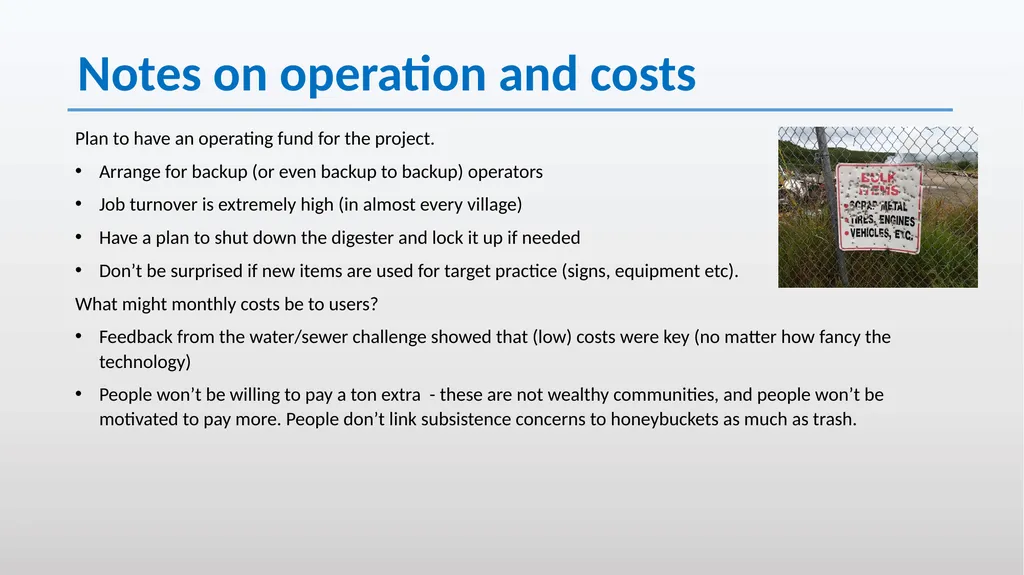
Don’t be surprised if new items are used for target practice (signs, equipment etc).
What might monthly costs be to users?
Feedback from the water/sewer challenge showed that (low) costs were key (no matter how fancy the technology)
People won’t be willing to pay a ton extra - these are not wealthy communities, and people won’t be motivated to pay more. People don’t link subsistence concerns to honeybuckets as much as trash.<br>
18
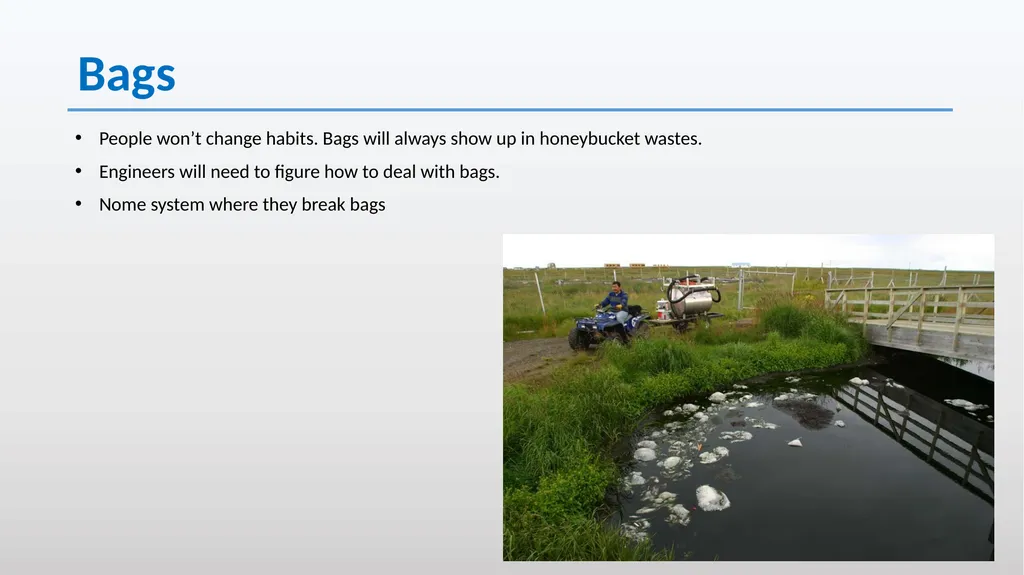
Bags People won’t change habits. Bags will always show up in honeybucket wastes.
Engineers will need to figure how to deal with bags.
Nome system where they break bags<br>
19
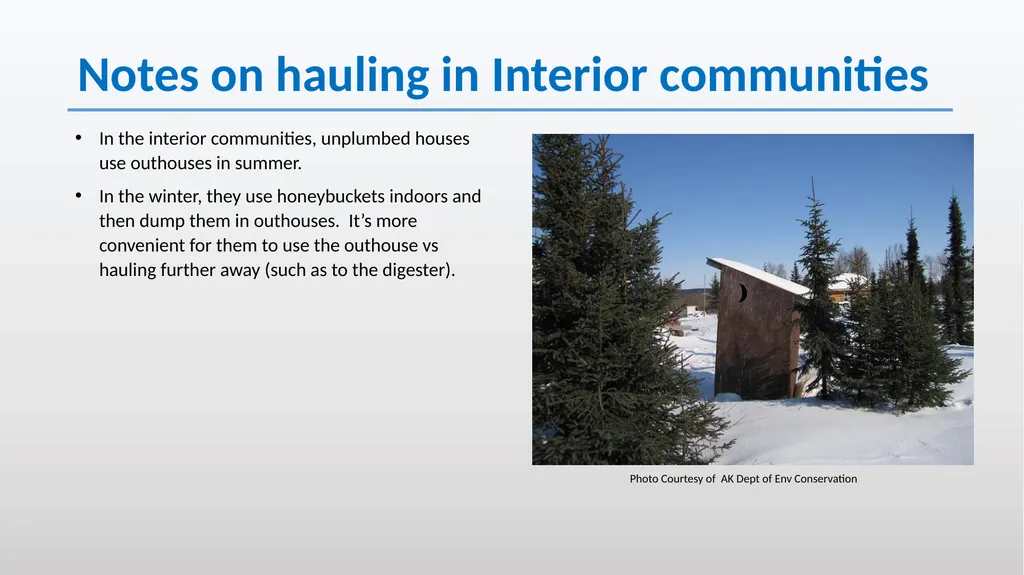
Notes on hauling in Interior communities In the interior communities, unplumbed houses use outhouses in summer.
In the winter, they use honeybuckets indoors and then dump them in outhouses. It’s more convenient for them to use the outhouse vs hauling further away (such as to the digester). Photo Courtesy of AK Dept of Env Conservation<br>
20
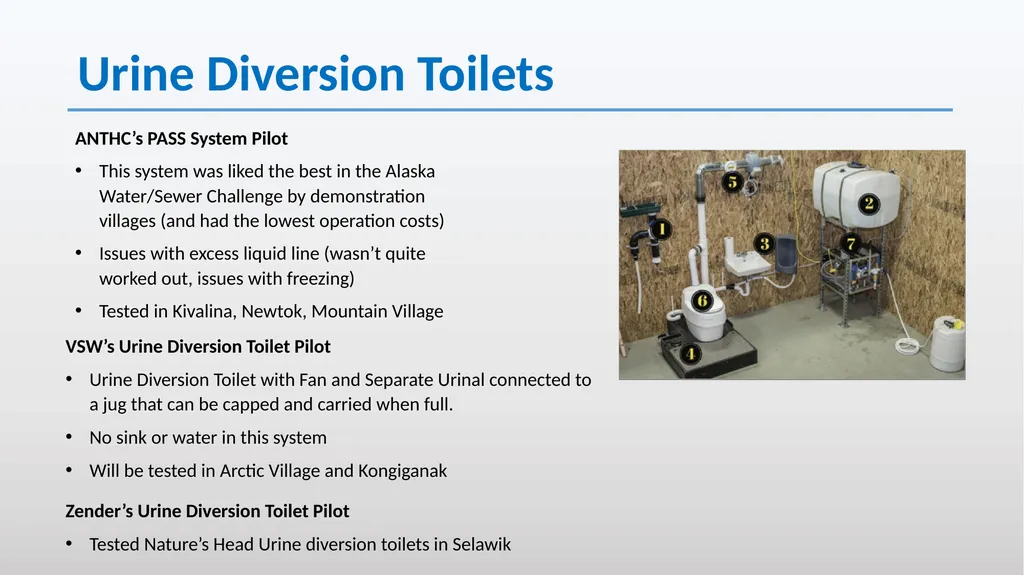
Urine Diversion Toilets ANTHC’s PASS System Pilot
This system was liked the best in the Alaska Water/Sewer Challenge by demonstration villages (and had the lowest operation costs)
Issues with excess liquid line (wasn’t quite worked out, issues with freezing)
Tested in Kivalina, Newtok, Mountain Village VSW’s Urine Diversion Toilet Pilot
Urine Diversion Toilet with Fan and Separate Urinal connected to a jug that can be capped and carried when full.
No sink or water in this system
Will be tested in Arctic Village and Kongiganak Zender’s Urine Diversion Toilet Pilot
Tested Nature’s Head Urine diversion toilets in Selawik<br>
21
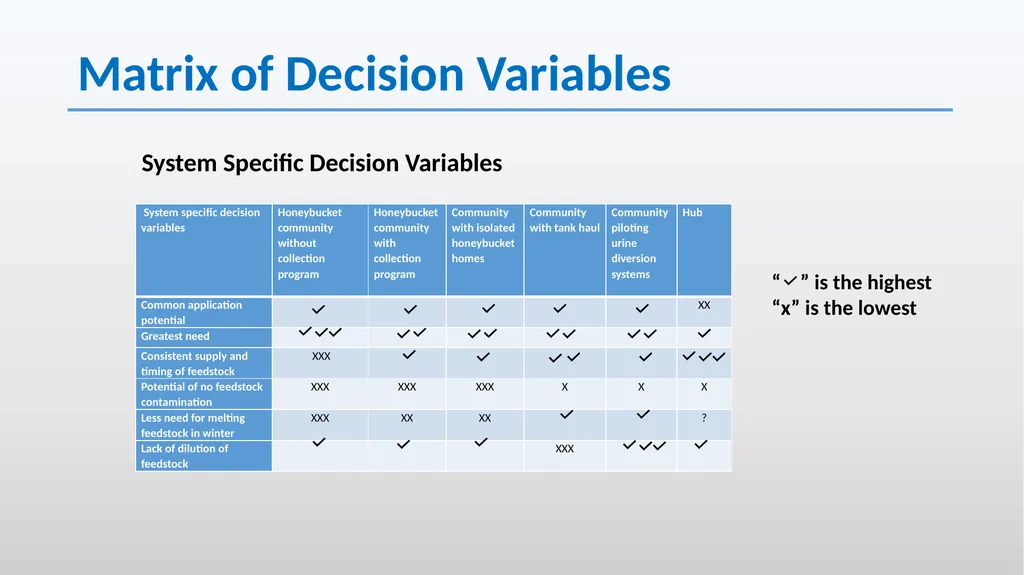
Matrix of Decision Variables “ ” is the highest
“x” is the lowest System Specific Decision Variables<br>
22
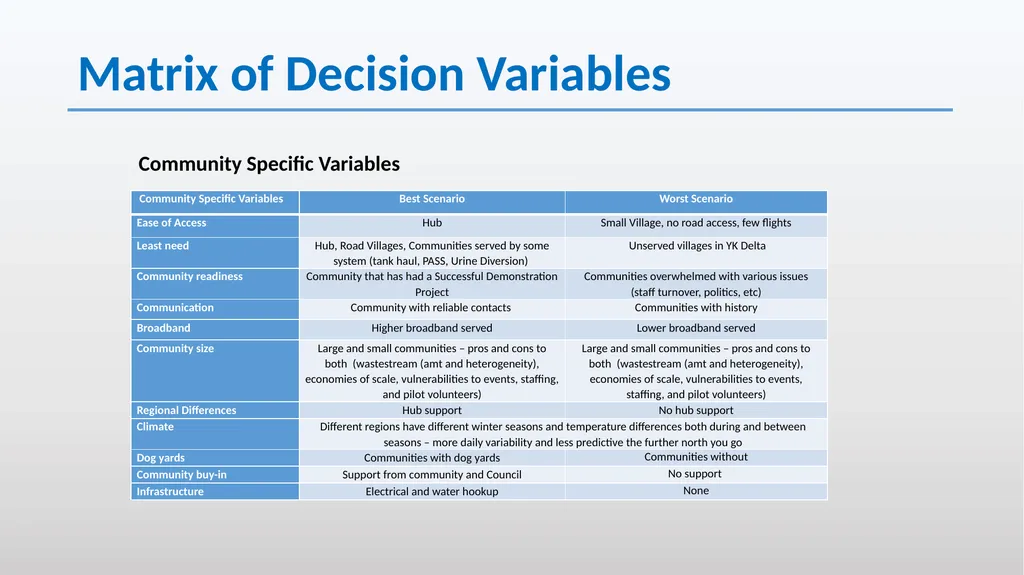
Matrix of Decision Variables Community Specific Variables<br>
23
Video Honeybucket Blues, Chefornak
https://www.youtube.com/watch?v=8SyT-XeDoK8<br>