How do stock markets work? 1 Review: What is a stock? A stock, aka share, represents ownership in the company. Companies list shares on exchanges to raise capital. At some point every company needs to raise money. Companies can either
"How do stock markets work? 1 Review: What is a" is the property of its rightful owner. Permission is granted to
download and print the materials on this website for personal, non-commercial use only, and to display it
on your personal computer provided you do not modify the materials and that you retain all copyright
notices contained in the materials. By downloading content from our website, you accept the terms of this
agreement.
Presentation Transcript
01
How do stock markets work? 1<br>
02
Review: What is a stock? A stock, aka share, represents ownership in the company.
Companies list shares on exchanges to raise capital.
At some point every company needs to raise money. Companies can either borrow it from somebody or raise it by selling part of the company.
By issuing stock, the company does not have to pay back the money or make interest payments. 2<br>
03
Review: Why invest in stocks? If the company does well, the stock will probably increase in value. If the shares go up in price, you earn capital gains.
If the company does not do well, the shareholder may lose the money he or she invested. 3<br>
04
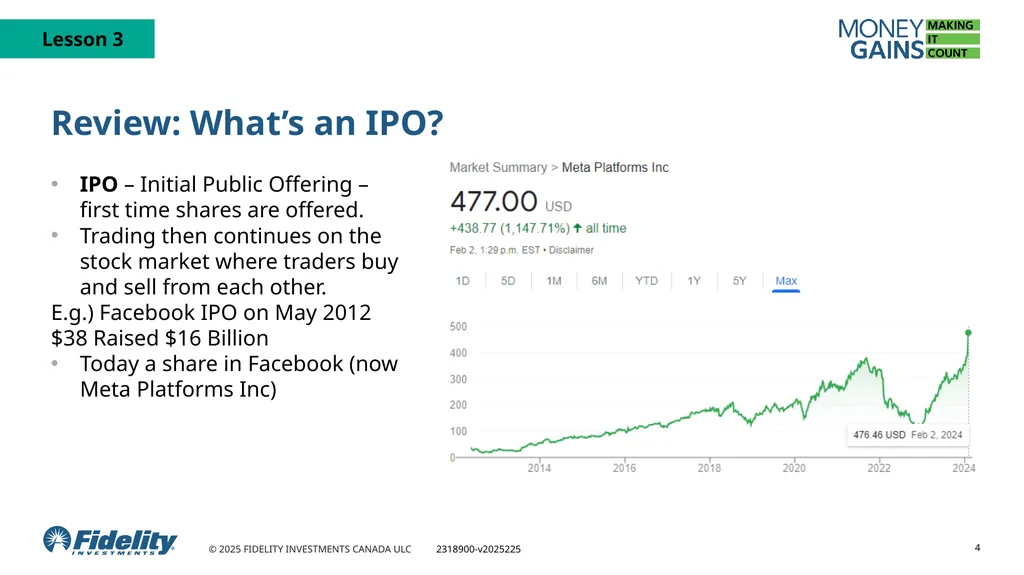
Review: What’s an IPO? IPO – Initial Public Offering – first time shares are offered.
Trading then continues on the stock market where traders buy and sell from each other.
E.g.) Facebook IPO on May 2012 $38 Raised $16 Billion
Today a share in Facebook (now Meta Platforms Inc) 4<br>
05
How do stocks trade? The stock market is a public marketplace where stocks, or shares of ownership in companies, are bought and sold.
Most stocks are traded on exchanges such as the New York Stock Exchange or NASDAQ. The NYSE is a physical location, whereas NASDAQ is a virtual market.
Exchanges are simply places where buyers and sellers meet and decide on a price for a stock (like a market). 5<br>
06
Stock indexes A stock index is a measurement of a section of the stock market. It is calculated from the prices of selected stocks (typically a weighted average). It's used by investors to describe the market's performance and to compare the return on specific investments.
The largest stock index in Canada is the S&P/TSX Composite Index, which represents the performance of the largest companies listed on the Toronto Stock Exchange (TSX). It includes various sectors, providing a comprehensive overview of Canada's stock market health.
The largest indexes in the U.S are the Dow Jones Industrial Average (top 30 U.S. companies), S&P 500, and the NASDAQ composite.
The S&P 500, Dow Jones Industrial Average, capitalized weighted index, NASDAQ Composite, etc, are all examples of stock indexes. 6<br>
07
How are stock prices determined? Share prices can fluctuate due to various factors affecting the company and the stock market.
Stock prices are determined by supply (available shares) and demand (buyers).
If more people want to buy a stock (demand) than sell it (supply), the price goes up.
If more people want to sell than buy, the price goes down.
Company information (earnings, reputation, profits, etc.), global events and market sentiment influence share prices. 7<br>
08
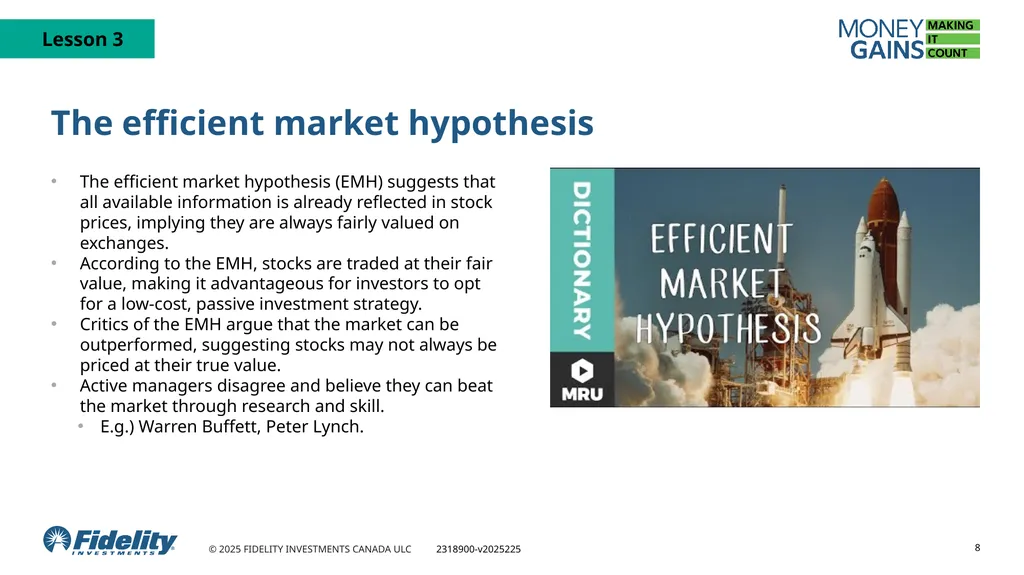
The efficient market hypothesis The efficient market hypothesis (EMH) suggests that all available information is already reflected in stock prices, implying they are always fairly valued on exchanges.
According to the EMH, stocks are traded at their fair value, making it advantageous for investors to opt for a low-cost, passive investment strategy.
Critics of the EMH argue that the market can be outperformed, suggesting stocks may not always be priced at their true value.
Active managers disagree and believe they can beat the market through research and skill.
E.g.) Warren Buffett, Peter Lynch. 8<br>
09
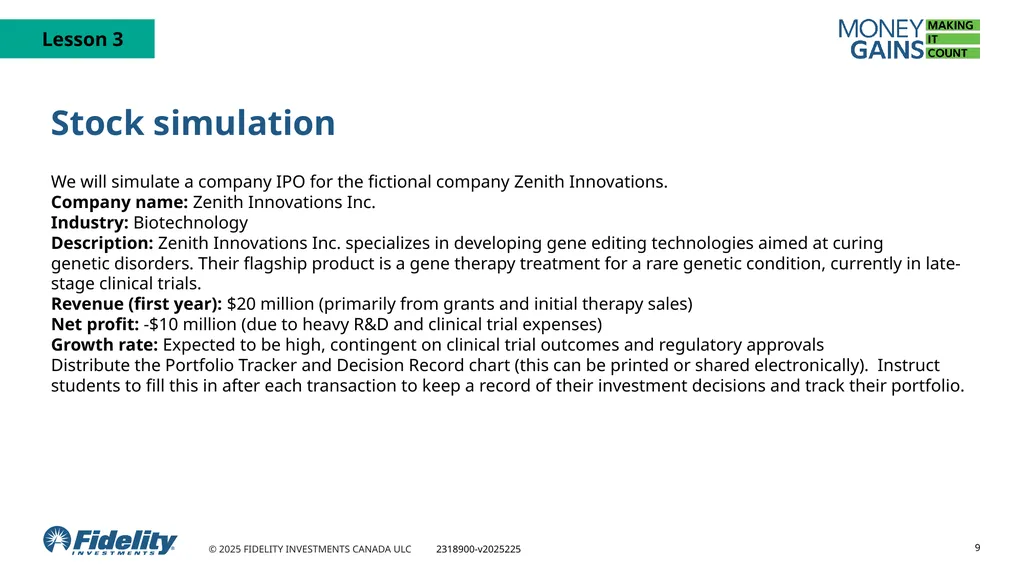
Stock simulation 9 We will simulate a company IPO for the fictional company Zenith Innovations.
Company name: Zenith Innovations Inc.
Industry: Biotechnology
Description: Zenith Innovations Inc. specializes in developing gene editing technologies aimed at curing genetic disorders. Their flagship product is a gene therapy treatment for a rare genetic condition, currently in late-stage clinical trials.
Revenue (first year): $20 million (primarily from grants and initial therapy sales)
Net profit: -$10 million (due to heavy R&D and clinical trial expenses)
Growth rate: Expected to be high, contingent on clinical trial outcomes and regulatory approvals
Distribute the Portfolio Tracker and Decision Record chart (this can be printed or shared electronically). Instruct students to fill this in after each transaction to keep a record of their investment decisions and track their portfolio.<br>
10
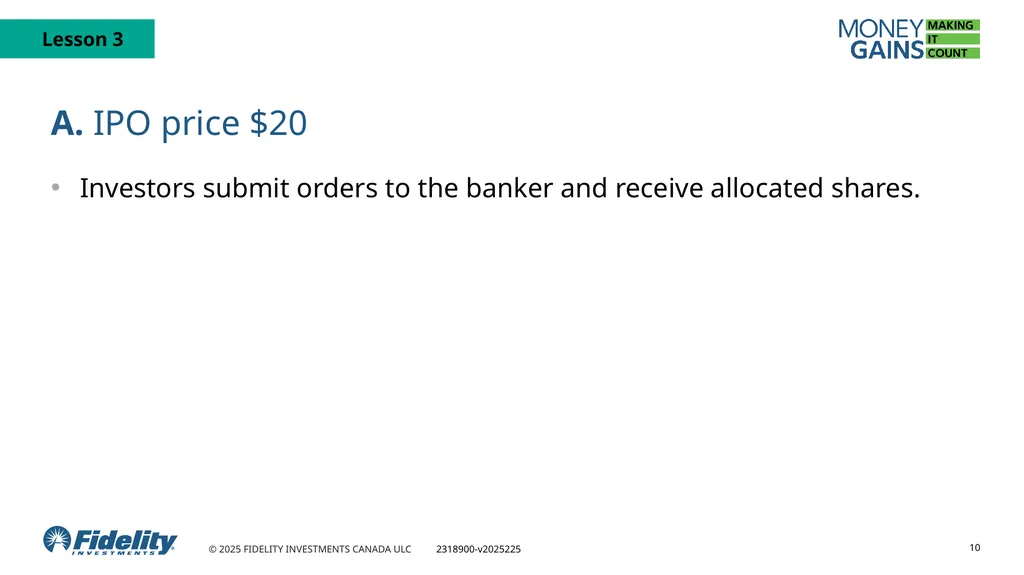
A. IPO price $20 Investors submit orders to the banker and receive allocated shares. 10<br>
11
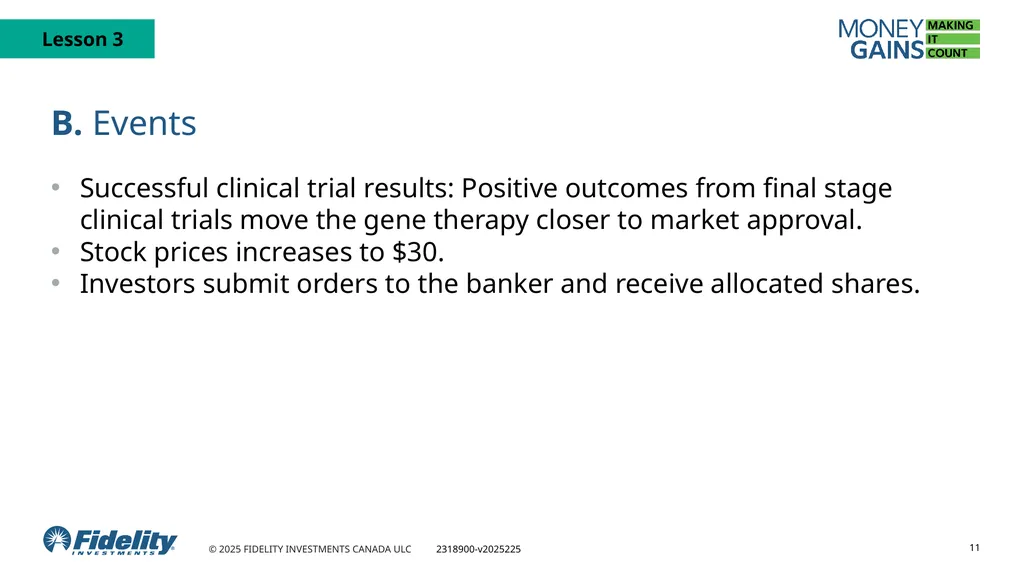
B. Events Successful clinical trial results: Positive outcomes from final stage clinical trials move the gene therapy closer to market approval.
Stock prices increases to $30.
Investors submit orders to the banker and receive allocated shares. 11<br>
12
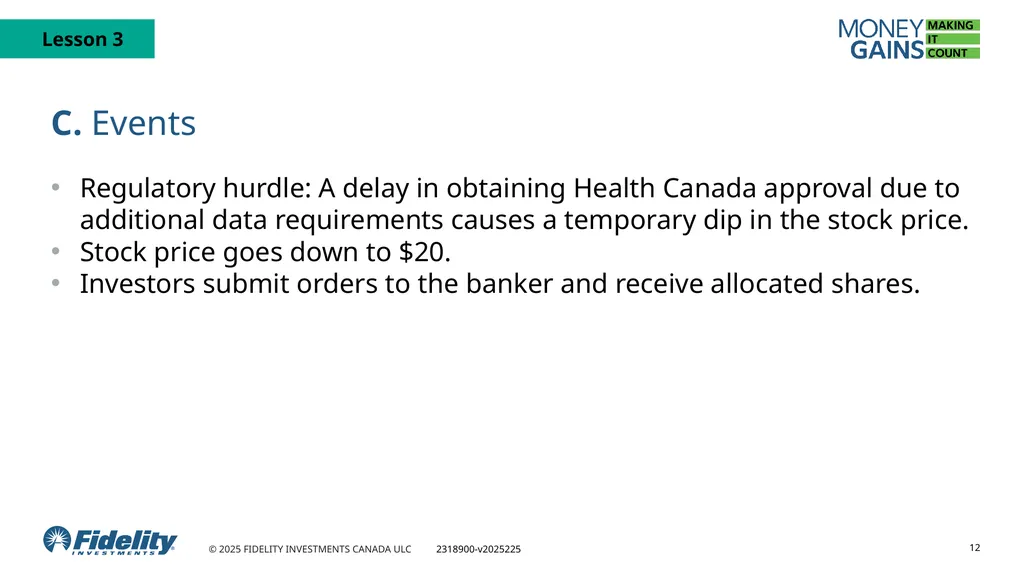
C. Events Regulatory hurdle: A delay in obtaining Health Canada approval due to additional data requirements causes a temporary dip in the stock price.
Stock price goes down to $20.
Investors submit orders to the banker and receive allocated shares. 12<br>
13
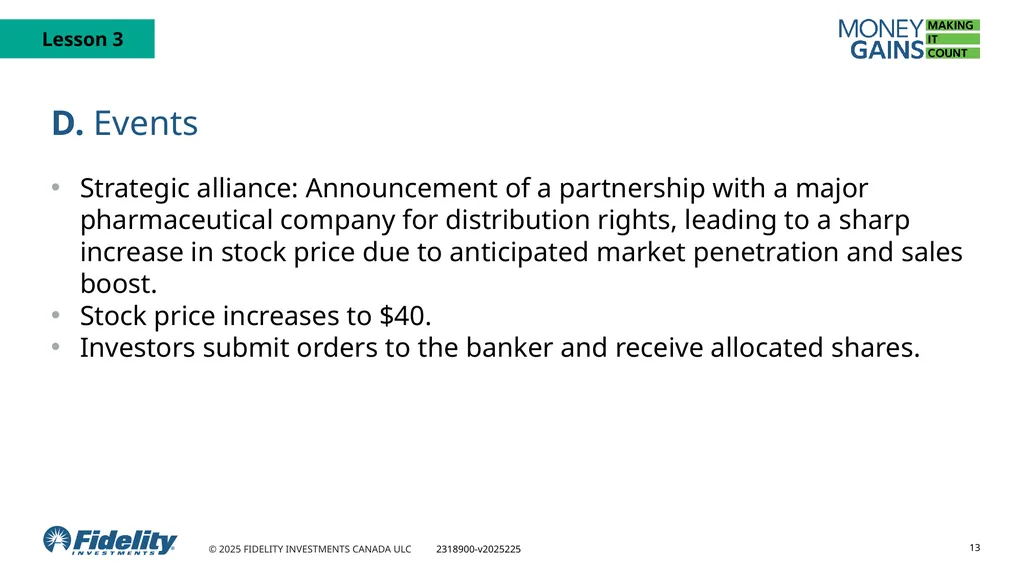
D. Events Strategic alliance: Announcement of a partnership with a major pharmaceutical company for distribution rights, leading to a sharp increase in stock price due to anticipated market penetration and sales boost.
Stock price increases to $40.
Investors submit orders to the banker and receive allocated shares. 13<br>
14
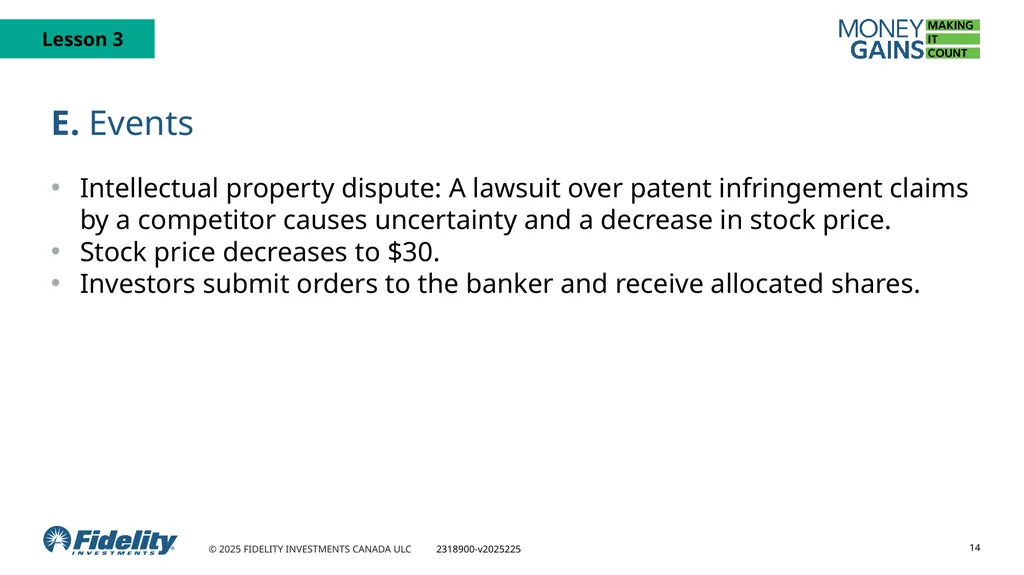
E. Events Intellectual property dispute: A lawsuit over patent infringement claims by a competitor causes uncertainty and a decrease in stock price.
Stock price decreases to $30.
Investors submit orders to the banker and receive allocated shares. 14<br>
15
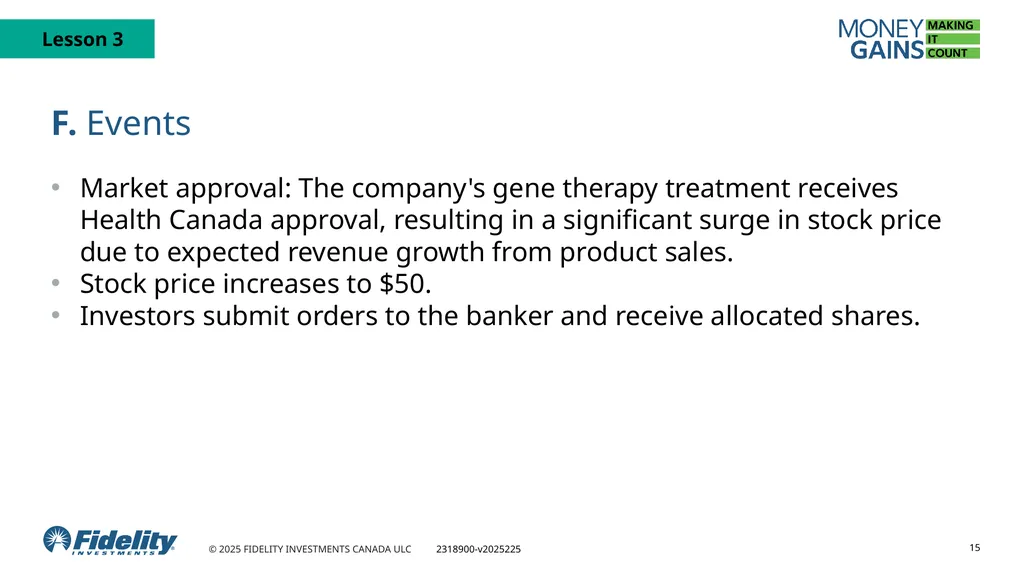
F. Events Market approval: The company's gene therapy treatment receives Health Canada approval, resulting in a significant surge in stock price due to expected revenue growth from product sales.
Stock price increases to $50.
Investors submit orders to the banker and receive allocated shares. 15<br>
16
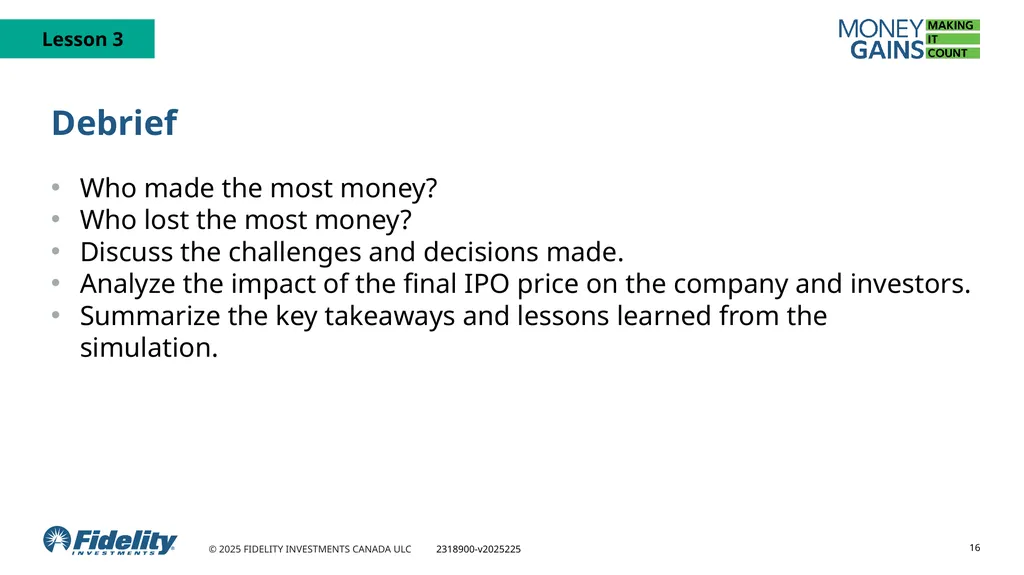
Debrief Who made the most money?
Who lost the most money?
Discuss the challenges and decisions made.
Analyze the impact of the final IPO price on the company and investors.
Summarize the key takeaways and lessons learned from the simulation. 16<br>