How to Read a Physics PaperThe Four is 1 Celia M. Elliott and Brian DeMarco Department of Physics University of Illinois at Urbana-Champaign with thanks to Igor Roshchin, Texas AM, who first gave me the idea, and Lance Cooper, Laura
"How to Read a Physics Paper—The Four i’s +1 Celia" is the property of its rightful owner. Permission is granted to
download and print the materials on this website for personal, non-commercial use only, and to display it
on your personal computer provided you do not modify the materials and that you retain all copyright
notices contained in the materials. By downloading content from our website, you accept the terms of this
agreement.
Presentation Transcript
01
How to Read a Physics Paper—The Four i’s +1 Celia M. Elliott and Brian DeMarco Department of Physics
University of Illinois at Urbana-Champaign
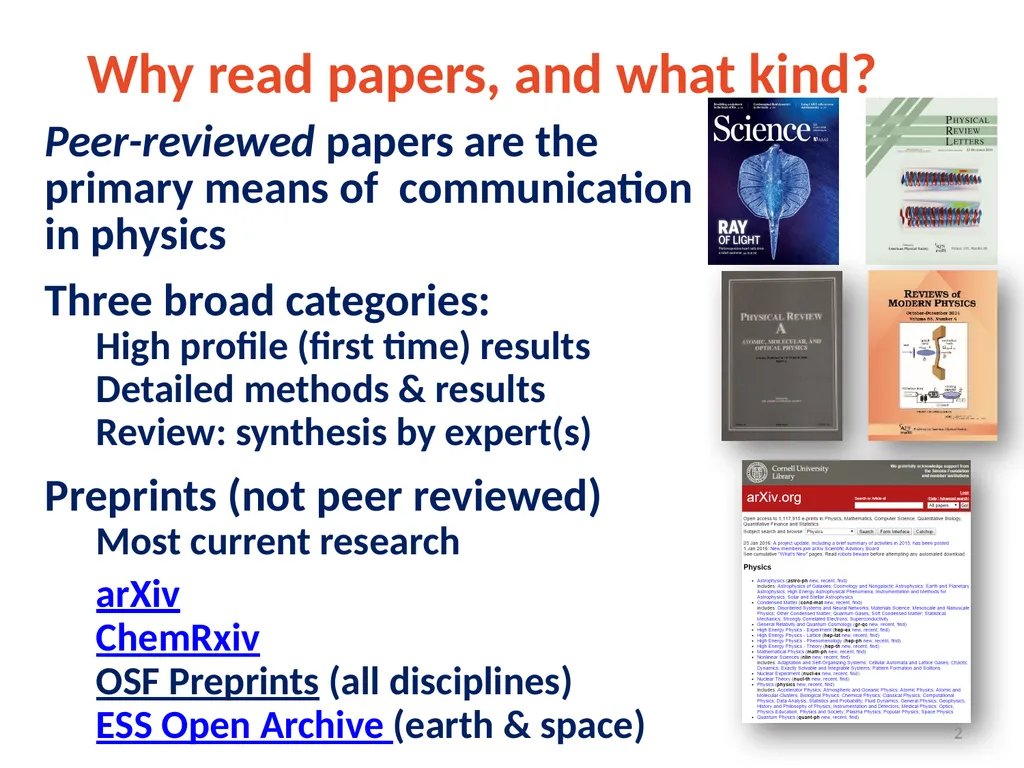
Why read papers, and what kind? Peer-reviewed papers are the primary means of communication in physics
Three broad categories:
High profile (first time) results
Detailed methods & results
Review: synthesis by expert(s)
Preprints (not peer reviewed)
Most current research
arXiv ChemRxiv OSF Preprints (all disciplines) ESS Open Archive (earth & space) 2<br>
03
How do you decide on what to read? Learn about a new development in your area:
Focus on results in PRL or PRA (BCDE)- like journals
New formalism or methods are in methods & formalisms (or in the supplement) 3<br>
04
How do you decide on what to read? Learn about a new development in your area:
Focus on results in PRL or PRA (BCDE)- like journals
New formalism or methods are in methods & formalisms (or in the supplement)
Learn something new (physics is interconnected):
Start with review papers, books, and theses
First focus on broad understanding
Then pick up on details concerning the physics, methods, and results! 4<br>
05
A screening and reading method Importance
Iteration
Interpretation
Integration The four i’s (+1) 5<br>
06
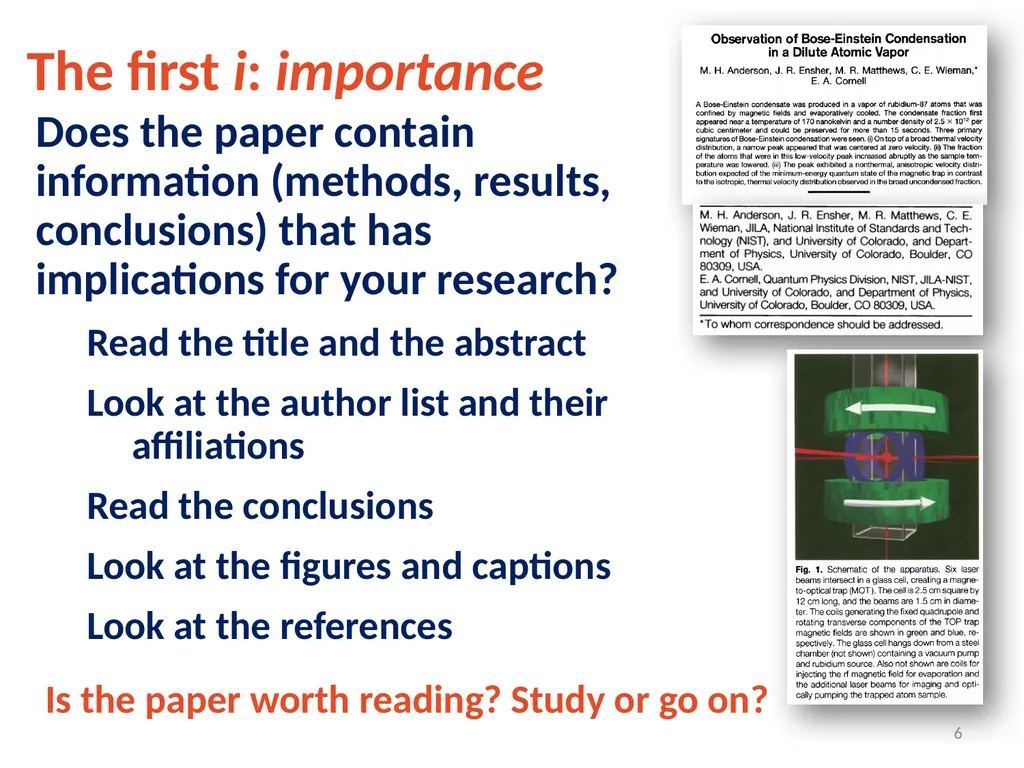
The first i: importance Does the paper contain information (methods, results, conclusions) that has implications for your research?
Read the title and the abstract
Look at the author list and their affiliations
Read the conclusions
Look at the figures and captions
Look at the references Is the paper worth reading? Study or go on? 6<br>
07
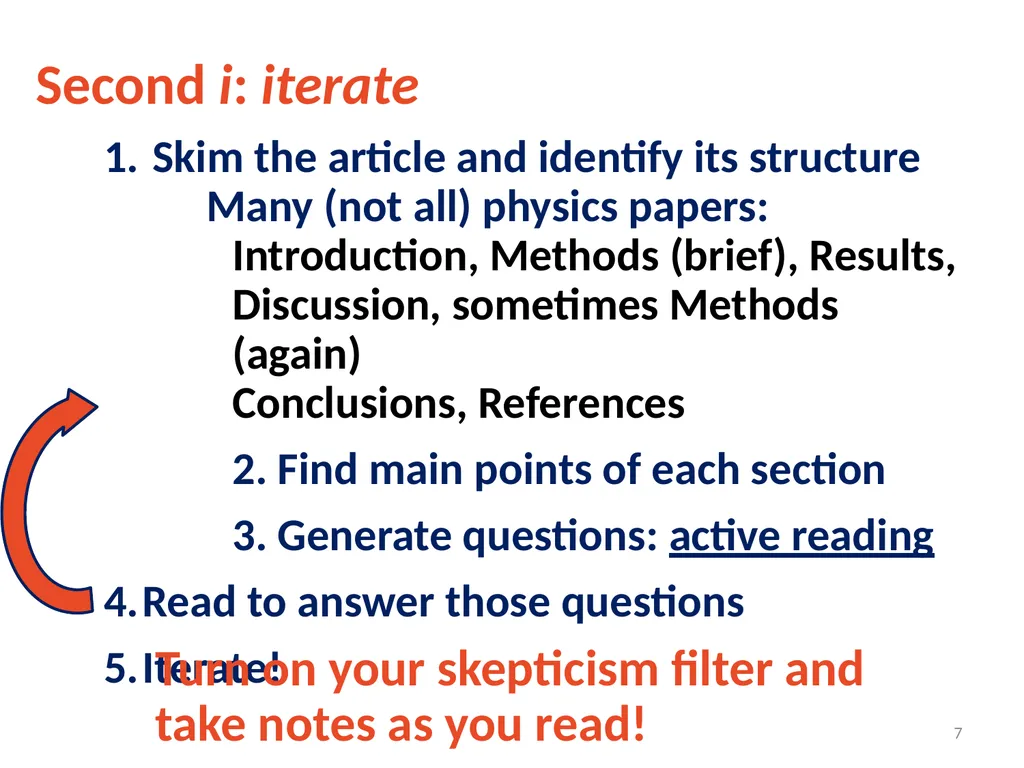
Second i: iterate Skim the article and identify its structure
Many (not all) physics papers:
Introduction, Methods (brief), Results, Discussion, sometimes Methods (again) Conclusions, References
2. Find main points of each section
3. Generate questions: active reading
Read to answer those questions
Iterate! Turn on your skepticism filter and take notes as you read! 7<br>
08
Second i: iterate (continued) Take the paper apart, section by section, and identify the key ideas
Highlight anything you don’t understand
Cross-check the narrative with the figures and tables
Go back and re-read your highlighted sections; refer to the references or supplementary info
Repeat until you thoroughly understand the parts of interest to you 8<br>
09
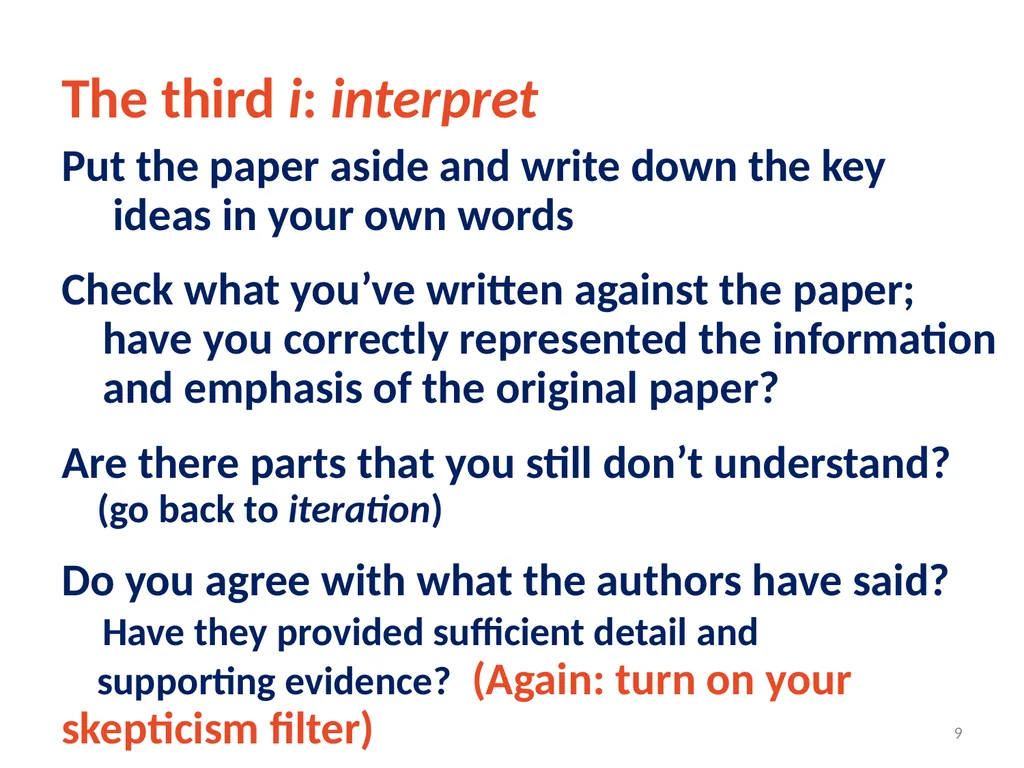
The third i: interpret Put the paper aside and write down the key ideas in your own words
Check what you’ve written against the paper; have you correctly represented the information and emphasis of the original paper?
Are there parts that you still don’t understand? (go back to iteration)
Do you agree with what the authors have said? Have they provided sufficient detail and supporting evidence? (Again: turn on your skepticism filter) 9<br>
10
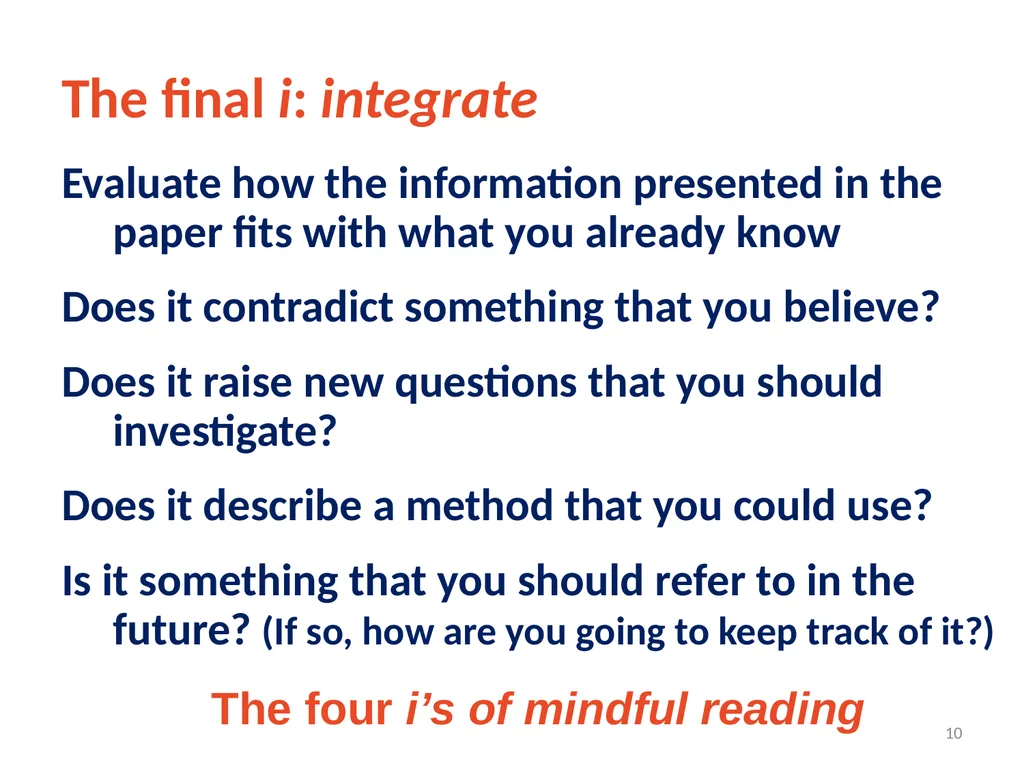
The final i: integrate Evaluate how the information presented in the paper fits with what you already know
Does it contradict something that you believe?
Does it raise new questions that you should investigate?
Does it describe a method that you could use?
Is it something that you should refer to in the future? (If so, how are you going to keep track of it?) The four i’s of mindful reading 10<br>
11
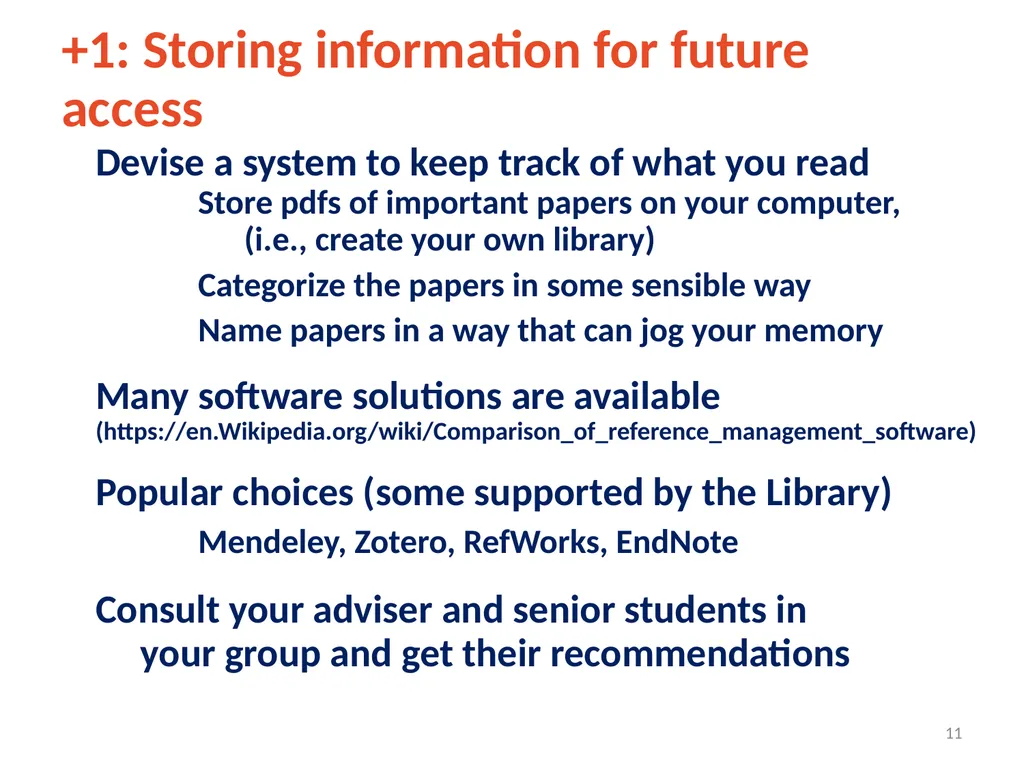
Devise a system to keep track of what you read
Store pdfs of important papers on your computer, (i.e., create your own library)
Categorize the papers in some sensible way
Name papers in a way that can jog your memory
Many software solutions are available (https://en.Wikipedia.org/wiki/Comparison_of_reference_management_software)
Popular choices (some supported by the Library) Mendeley, Zotero, RefWorks, EndNote
Consult your adviser and senior students in your group and get their recommendations +1: Storing information for future access 11<br>
12
Now for the practical bits... 12<br>
13
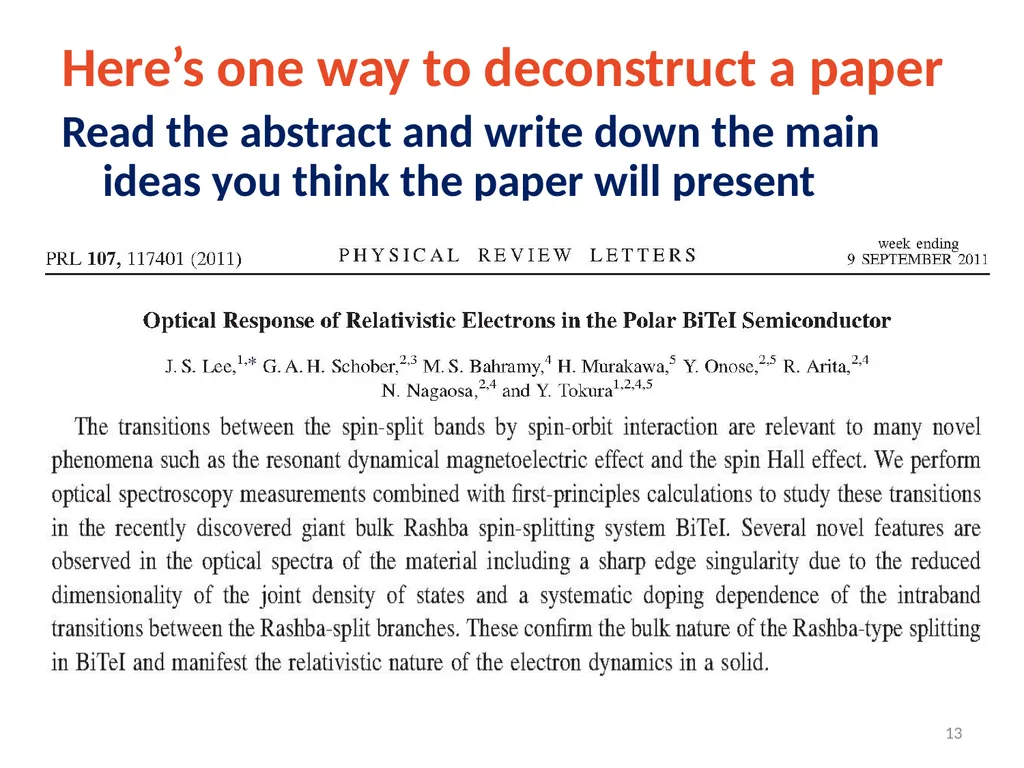
Here’s one way to deconstruct a paper Read the abstract and write down the main ideas you think the paper will present 13<br>
14
Next, look at the figures and tables Write down a one-sentence description of each Crystal structure of BiTeI; red is Bi, blue is Te, and yellow is I.
Band dispersion points in the H and L directions; possible optical transitions indicated by arrows with an index of α, β, γ, and δ.
Reflectivity spectra were taken for one sample (Q) at different incident angles, as shown by variations in photon energy (eV).
Optical conductivity spectra were obtained by polarizing light directed normal to the c axis (solid line) and compared with a theoretical curve (open squares) based on the Drude model. J.S. Lee et al., Phys. Rev. Lett. 107, 117401 (2011). 14<br>
15
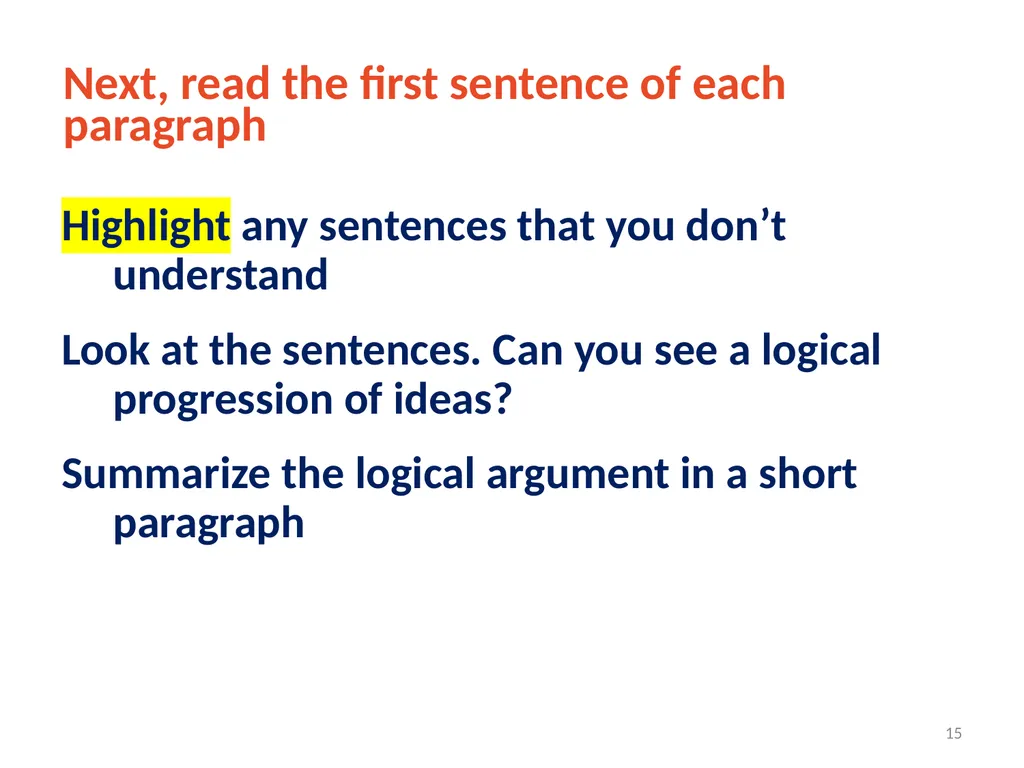
Next, read the first sentence of each paragraph Highlight any sentences that you don’t understand
Look at the sentences. Can you see a logical progression of ideas?
Summarize the logical argument in a short paragraph 15<br>
16
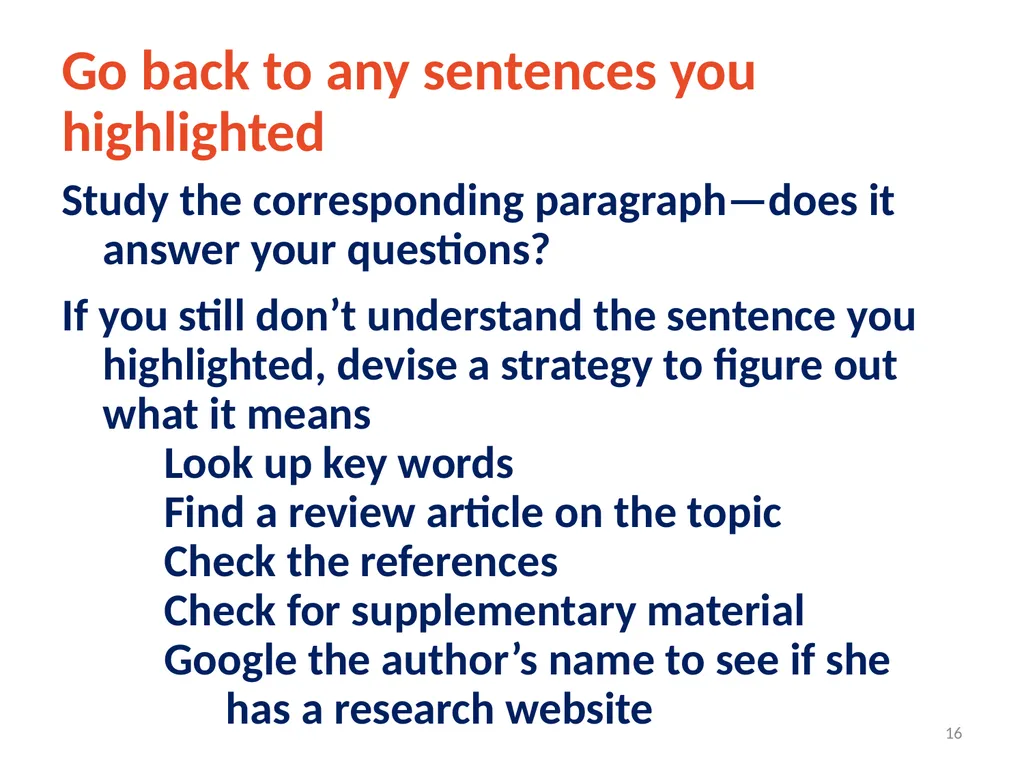
Go back to any sentences you highlighted Study the corresponding paragraph—does it answer your questions?
If you still don’t understand the sentence you highlighted, devise a strategy to figure out what it means
Look up key words Find a review article on the topic Check the references Check for supplementary material Google the author’s name to see if she has a research website 16<br>
17
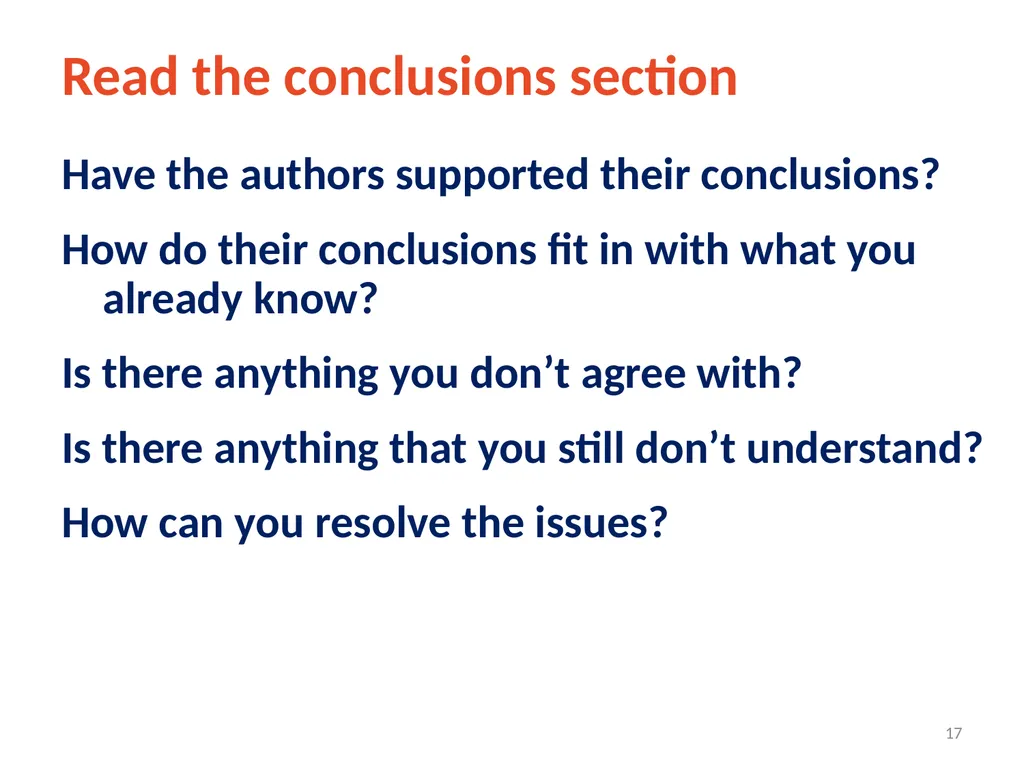
Read the conclusions section Have the authors supported their conclusions?
How do their conclusions fit in with what you already know?
Is there anything you don’t agree with?
Is there anything that you still don’t understand?
How can you resolve the issues? 17<br>
18
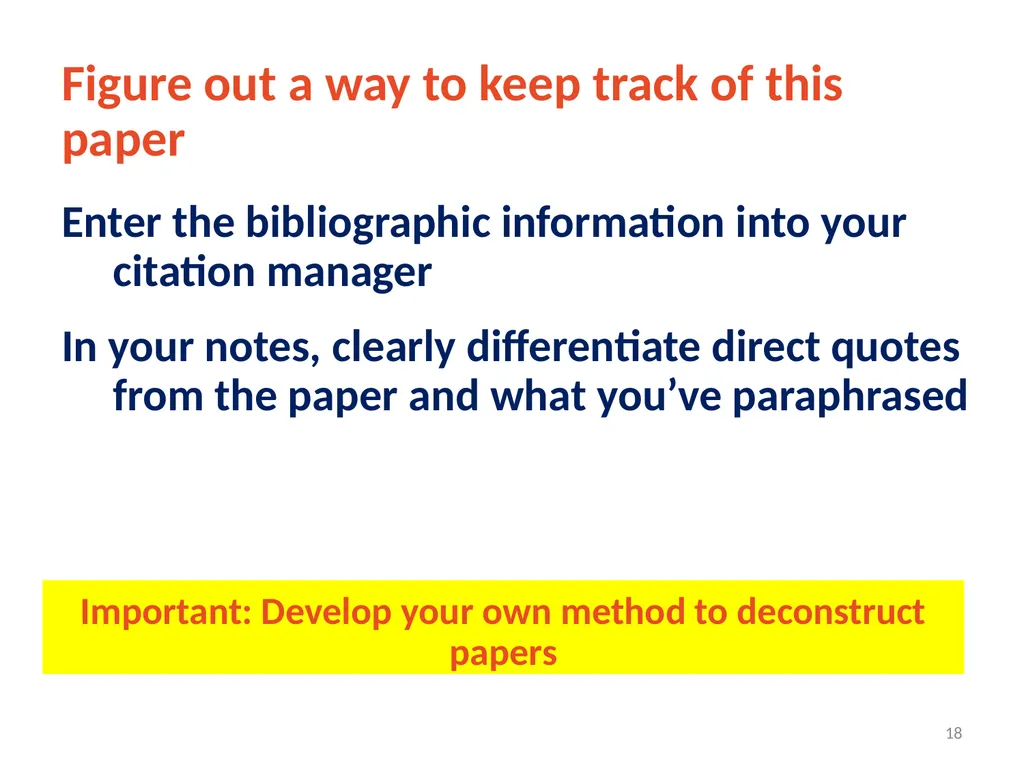
Figure out a way to keep track of this paper Enter the bibliographic information into your citation manager
In your notes, clearly differentiate direct quotes from the paper and what you’ve paraphrased Important: Develop your own method to deconstruct papers 18<br>
19
To recap: Importance—first determine if the paper is worth reading
Iterate—go back over sections of the paper until you understand it; consult other sources if necessary
Interpret—summarize the main points in your own words
Integrate—synthesize the ideas with what you already know and believe
Investigate a citation management system to keep track of what you read 19<br>
20
Pro tip: Scan the arXiv each week via RSS feed!
Physics ideas are interconnected— intentionally break out of you silo periodically and read something different
Strive for mindful reading; not a linear process, takes practice Final words: 20 cmelliot@illinois.edu<br>