
Important ATI Legal Notice and Permitted Uses End
KL
Published · 38 slides · 0 views

1 / 1





Description
Important ATI Legal Notice and Permitted Uses End of Life Review Activities Navigate to Engage Fundamentals. Open End-of-Life Care (under Physiological Concepts for Nursing Practice) and complete the following (60 min): Lesson content
Related Topics
Share
Embed code
Download this presentation From Below
"Important ATI Legal Notice and Permitted Uses End" is the property of its rightful owner. Permission is granted to download and print the materials on this website for personal, non-commercial use only, and to display it on your personal computer provided you do not modify the materials and that you retain all copyright notices contained in the materials. By downloading content from our website, you accept the terms of this agreement.
Presentation Transcript
01
Important ATI Legal Notice and Permitted Uses<br>
02
End of Life<br>
03
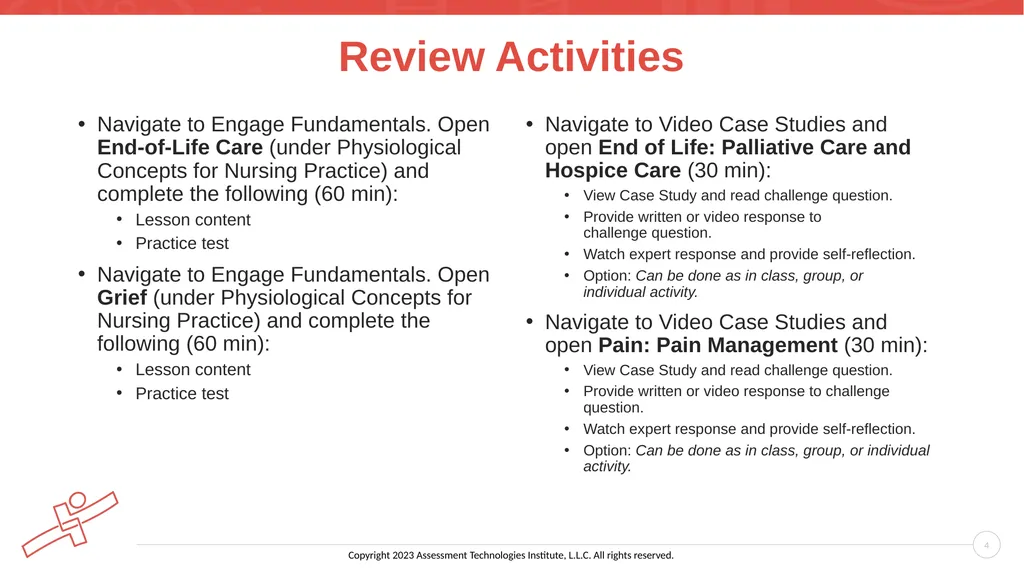
Review Activities Navigate to Engage Fundamentals. Open End-of-Life Care (under Physiological Concepts for Nursing Practice) and complete the following (60 min):
Lesson content
Practice test
Navigate to Engage Fundamentals. Open Grief (under Physiological Concepts for Nursing Practice) and complete the following (60 min):
Lesson content
Practice test Navigate to Video Case Studies and open End of Life: Palliative Care and Hospice Care (30 min):
View Case Study and read challenge question.
Provide written or video response to challenge question.
Watch expert response and provide self-reflection.
Option: Can be done as in class, group, or individual activity.
Navigate to Video Case Studies and open Pain: Pain Management (30 min):
View Case Study and read challenge question.
Provide written or video response to challenge question.
Watch expert response and provide self-reflection.
Option: Can be done as in class, group, or individual activity.<br>
Lesson content
Practice test
Navigate to Engage Fundamentals. Open Grief (under Physiological Concepts for Nursing Practice) and complete the following (60 min):
Lesson content
Practice test Navigate to Video Case Studies and open End of Life: Palliative Care and Hospice Care (30 min):
View Case Study and read challenge question.
Provide written or video response to challenge question.
Watch expert response and provide self-reflection.
Option: Can be done as in class, group, or individual activity.
Navigate to Video Case Studies and open Pain: Pain Management (30 min):
View Case Study and read challenge question.
Provide written or video response to challenge question.
Watch expert response and provide self-reflection.
Option: Can be done as in class, group, or individual activity.<br>
04
Learning Objectives Explain the pathophysiology for the dying process.
Compare the differences between hospice and palliative care.
Discuss strategies to meet the cultural and spiritual needs of the dying client.
Examine the legal-ethical considerations of the nurse regarding end-of-life care.
Explain the differences in code status.
Discuss evidence-based standards for end-of-life withdrawal of care.
Describe the role of the nurse in end-of-life care.<br>
05
Pathophysiology (1 of 2) Death
Manifested by cessation of breath and pulse
Typical signs and symptoms follow a characteristic pattern
Brain death
Clinical death<br>
Manifested by cessation of breath and pulse
Typical signs and symptoms follow a characteristic pattern
Brain death
Clinical death<br>
06
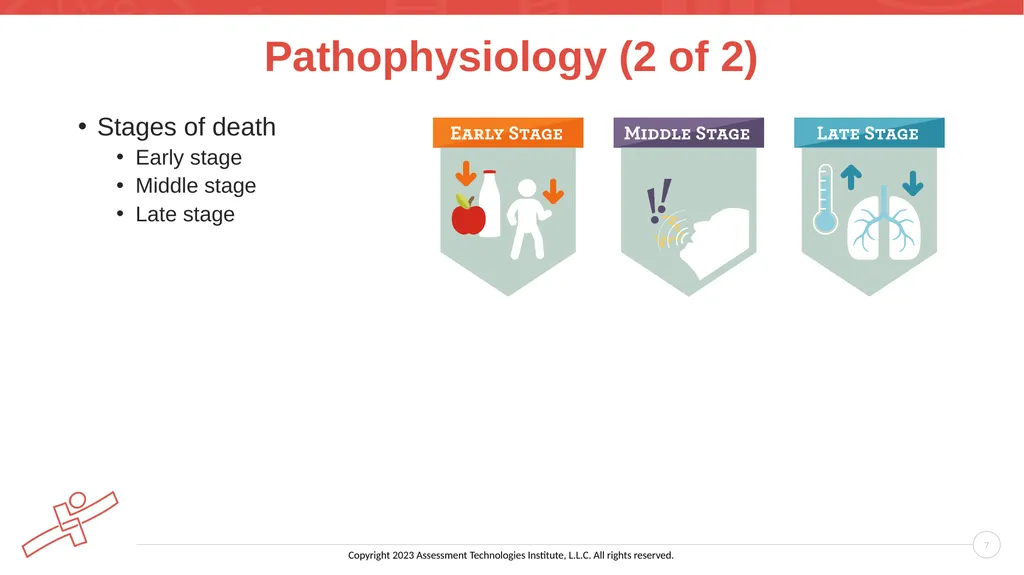
Pathophysiology (2 of 2) Stages of death
Early stage
Middle stage
Late stage<br>
Early stage
Middle stage
Late stage<br>
07
Palliative Care Goal of care
Curative
Quality of life
Interdisciplinary team
Symptom control
Dyspnea
Pain<br>
Curative
Quality of life
Interdisciplinary team
Symptom control
Dyspnea
Pain<br>
08
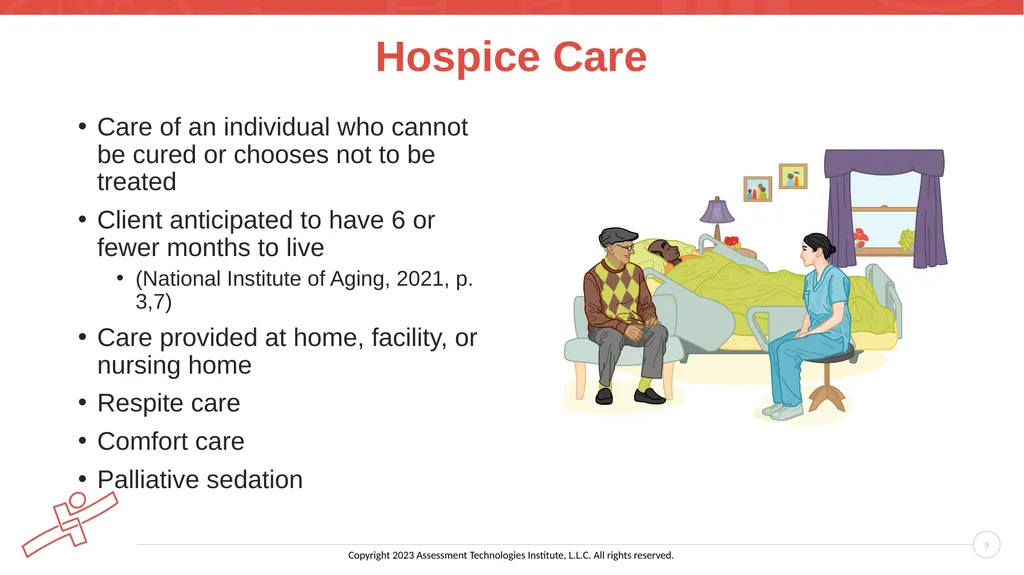
Hospice Care Care of an individual who cannot be cured or chooses not to be treated
Client anticipated to have 6 or fewer months to live
(National Institute of Aging, 2021, p. 3,7)
Care provided at home, facility, or nursing home
Respite care
Comfort care
Palliative sedation<br>
Client anticipated to have 6 or fewer months to live
(National Institute of Aging, 2021, p. 3,7)
Care provided at home, facility, or nursing home
Respite care
Comfort care
Palliative sedation<br>
09
Hospice Care: Discussion Question (1 of 2) What differences would the nurse need to consider for a client receiving palliative care versus hospice care?<br>
10
Hospice Care: Discussion Question (2 of 2) What would you consider to be a priority for a client receiving hospice care?<br>
11
Cultural and Spiritual Needs Cultural affiliations can affect how clients view illnesses, which includes the end of life.
Cultural assessments
Spiritual assessments
Therapeutic communication<br>
Cultural assessments
Spiritual assessments
Therapeutic communication<br>
12
Cultural Care Cultural needs
View of end-of-life care
Cultural rituals
Spiritual needs
Religious staff
HOPE
Therapeutic communication
Open-ended questions<br>
View of end-of-life care
Cultural rituals
Spiritual needs
Religious staff
HOPE
Therapeutic communication
Open-ended questions<br>
13
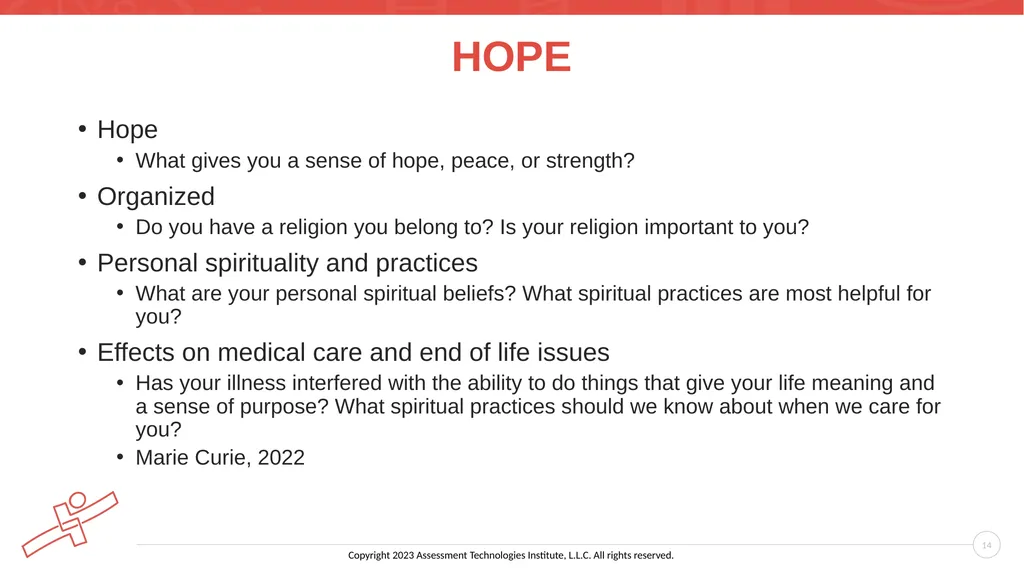
HOPE Hope
What gives you a sense of hope, peace, or strength?
Organized
Do you have a religion you belong to? Is your religion important to you?
Personal spirituality and practices
What are your personal spiritual beliefs? What spiritual practices are most helpful for you?
Effects on medical care and end of life issues
Has your illness interfered with the ability to do things that give your life meaning and a sense of purpose? What spiritual practices should we know about when we care for you?
Marie Curie, 2022<br>
14
Spiritual Needs: Discussion Question What types of resources would be beneficial for the spiritual needs of an actively dying client?<br>
15
Ethical Considerations Justice
Nonmaleficence
Beneficence
Fidelity<br>
Nonmaleficence
Beneficence
Fidelity<br>
16
Legal Considerations Terminal sedation
Physician-assisted suicide
Advanced directives
Living will
Durable power of attorney for health care<br>
Physician-assisted suicide
Advanced directives
Living will
Durable power of attorney for health care<br>
17
Terminal Sedation Clients at the end of life with do not resuscitate order
Used when clients have intolerable suffering not responding to other treatment efforts<br>
Used when clients have intolerable suffering not responding to other treatment efforts<br>
18
Provider-Assisted Suicide Provider-assisted suicide
Legal in 11 states in the United States
Also referred to as physician-assisted death (PAD)
Involves a prescription from a licensed physician approved by the state
Patient must be a resident of the state
Terminal diagnosis<br>
Legal in 11 states in the United States
Also referred to as physician-assisted death (PAD)
Involves a prescription from a licensed physician approved by the state
Patient must be a resident of the state
Terminal diagnosis<br>
19
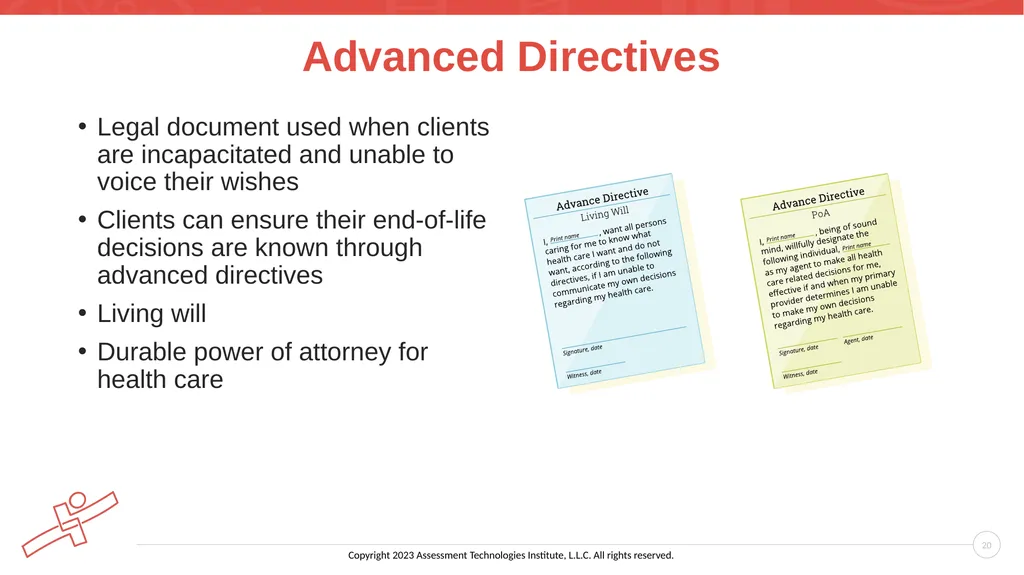
Advanced Directives Legal document used when clients are incapacitated and unable to voice their wishes
Clients can ensure their end-of-life decisions are known through advanced directives
Living will
Durable power of attorney for health care<br>
Clients can ensure their end-of-life decisions are known through advanced directives
Living will
Durable power of attorney for health care<br>
20
Ethical Principles: Discussion Question Go to: https://www.nia.nih.gov/health/making-decisions-someone-end-life and read through Ali and Wadi's story.
What types of ethical principles would guide health care providers supporting a client's decision to refuse treatment and choose hospice care?<br>
What types of ethical principles would guide health care providers supporting a client's decision to refuse treatment and choose hospice care?<br>
21
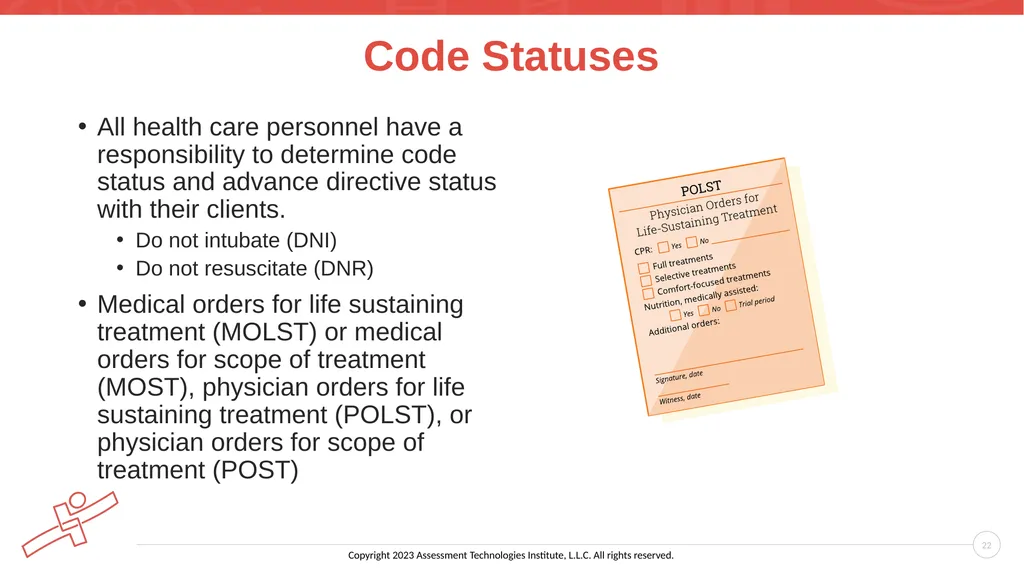
Code Statuses All health care personnel have a responsibility to determine code status and advance directive status with their clients.
Do not intubate (DNI)
Do not resuscitate (DNR)
Medical orders for life sustaining treatment (MOLST) or medical orders for scope of treatment (MOST), physician orders for life sustaining treatment (POLST), or physician orders for scope of treatment (POST)<br>
Do not intubate (DNI)
Do not resuscitate (DNR)
Medical orders for life sustaining treatment (MOLST) or medical orders for scope of treatment (MOST), physician orders for life sustaining treatment (POLST), or physician orders for scope of treatment (POST)<br>
22
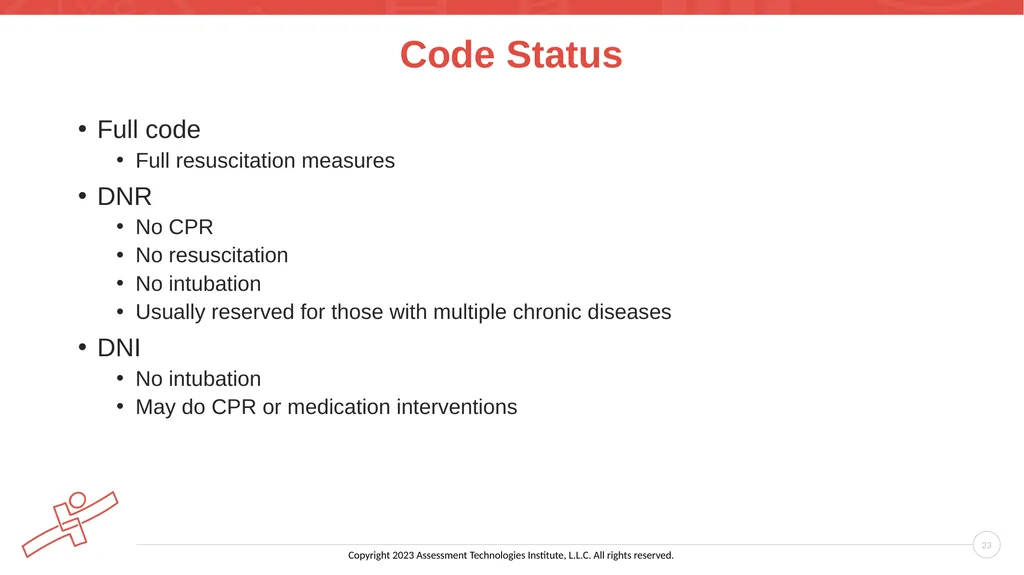
Code Status Full code
Full resuscitation measures
DNR
No CPR
No resuscitation
No intubation
Usually reserved for those with multiple chronic diseases
DNI
No intubation
May do CPR or medication interventions<br>
Full resuscitation measures
DNR
No CPR
No resuscitation
No intubation
Usually reserved for those with multiple chronic diseases
DNI
No intubation
May do CPR or medication interventions<br>
23
Code Status: Discussion Question A family is conflicted regarding their loved one's desire regarding code status. What might the family take into consideration when making a decision regarding code status?<br>
24
Withdrawal of Care The American Nurse Association (2016) states that "there is no ethical, moral, or legal difference between stopping a therapy and never starting it. Providers should never start a therapy they are not willing to discontinue" (pg 3).
Nurses are often involved in supporting families and loved ones through the difficult decisions related to end of life and stopping treatment.
Nursing care continues even when withdrawing or withholding medical interventions.
Medically administered nutrition and hydration (MANH)<br>
Nurses are often involved in supporting families and loved ones through the difficult decisions related to end of life and stopping treatment.
Nursing care continues even when withdrawing or withholding medical interventions.
Medically administered nutrition and hydration (MANH)<br>
25
Health Care Proxy Clients unable to make end-of-life decisions
A person must be named if no designated proxy listed.
Person named according to local, state, and facility regulations
Children under the age of 18
Parent or guardian has legal authority to make decisions about treatment.
Child's treatment preference may be considered in the decision-making process.<br>
26
Withdrawal of Care: Discussion Question A 16-year-old with a terminal cancer diagnosis does not wish to receive any additional treatment. What considerations would the health care team need to take into account prior to stopping treatment?<br>
27
Role of the Nurse Identifying client’s symptoms
Perform nursing interventions within their scope of practice
Nurses are obligated to provide care that includes relieving pain and other symptoms, to promote comfort, and support clients, families, and other individuals close to the client. (American Nurses Association, 2016, p. 1, 2)<br>
Perform nursing interventions within their scope of practice
Nurses are obligated to provide care that includes relieving pain and other symptoms, to promote comfort, and support clients, families, and other individuals close to the client. (American Nurses Association, 2016, p. 1, 2)<br>
28
Recognize Cues Client's diagnosis
Risks for distressing symptoms at the end of life
Gaps in knowledge
End-of-life care
Withdraw of treatment<br>
Risks for distressing symptoms at the end of life
Gaps in knowledge
End-of-life care
Withdraw of treatment<br>
29
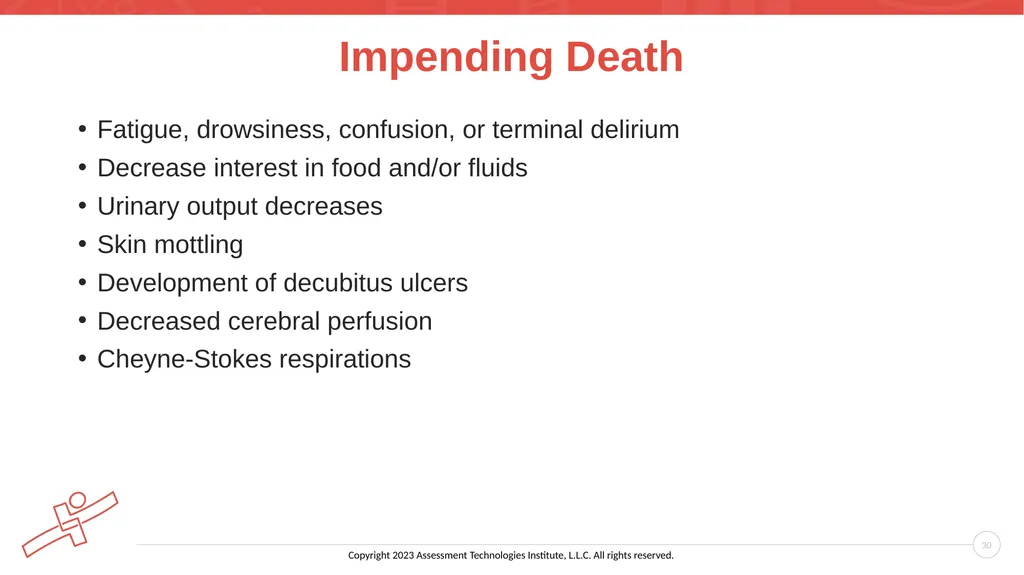
Impending Death Fatigue, drowsiness, confusion, or terminal delirium
Decrease interest in food and/or fluids
Urinary output decreases
Skin mottling
Development of decubitus ulcers
Decreased cerebral perfusion
Cheyne-Stokes respirations<br>
Decrease interest in food and/or fluids
Urinary output decreases
Skin mottling
Development of decubitus ulcers
Decreased cerebral perfusion
Cheyne-Stokes respirations<br>
30
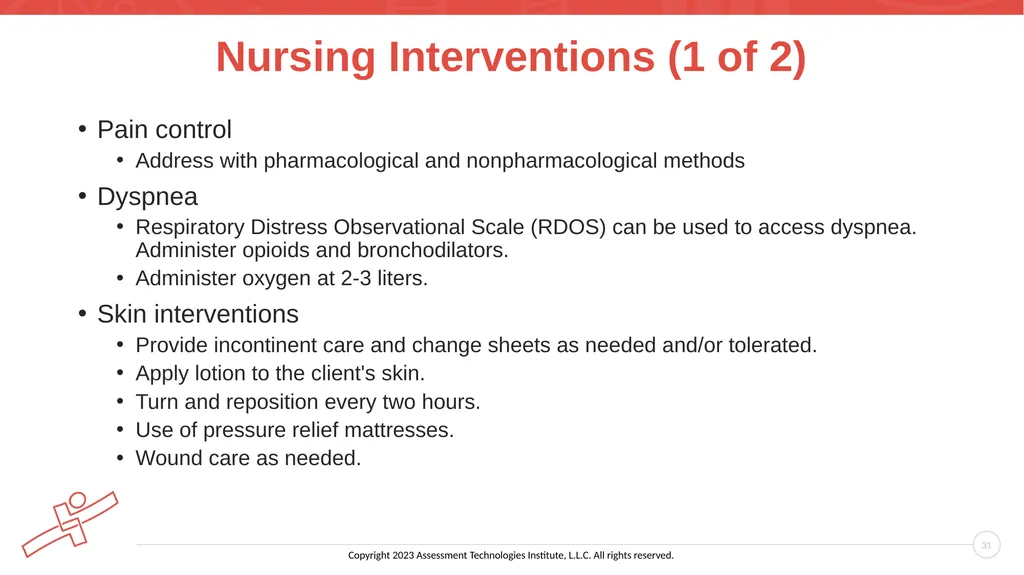
Nursing Interventions (1 of 2) Pain control
Address with pharmacological and nonpharmacological methods
Dyspnea
Respiratory Distress Observational Scale (RDOS) can be used to access dyspnea. Administer opioids and bronchodilators.
Administer oxygen at 2-3 liters.
Skin interventions
Provide incontinent care and change sheets as needed and/or tolerated.
Apply lotion to the client's skin.
Turn and reposition every two hours.
Use of pressure relief mattresses.
Wound care as needed.<br>
31
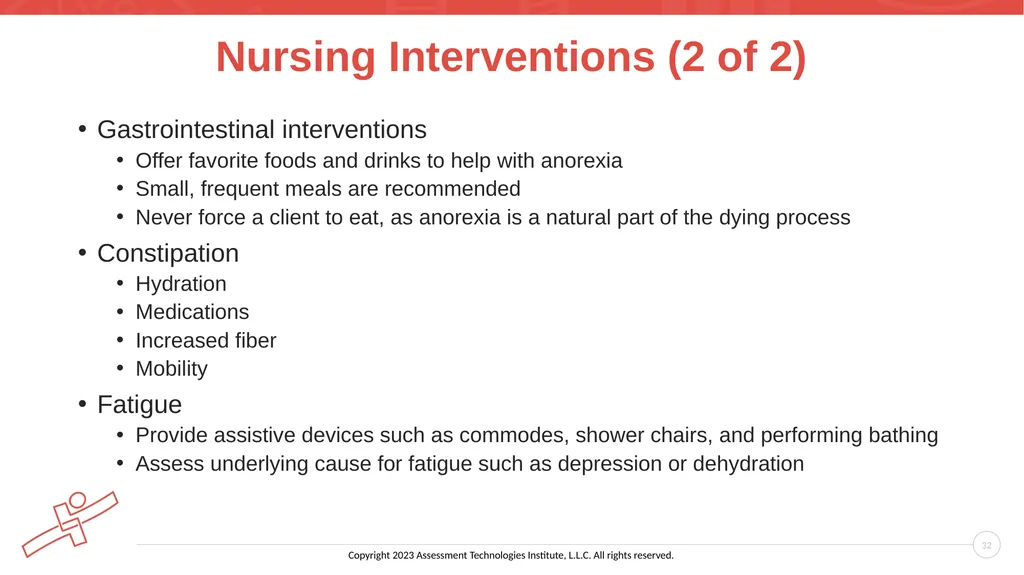
Nursing Interventions (2 of 2) Gastrointestinal interventions
Offer favorite foods and drinks to help with anorexia
Small, frequent meals are recommended
Never force a client to eat, as anorexia is a natural part of the dying process
Constipation
Hydration
Medications
Increased fiber
Mobility
Fatigue
Provide assistive devices such as commodes, shower chairs, and performing bathing
Assess underlying cause for fatigue such as depression or dehydration<br>
32
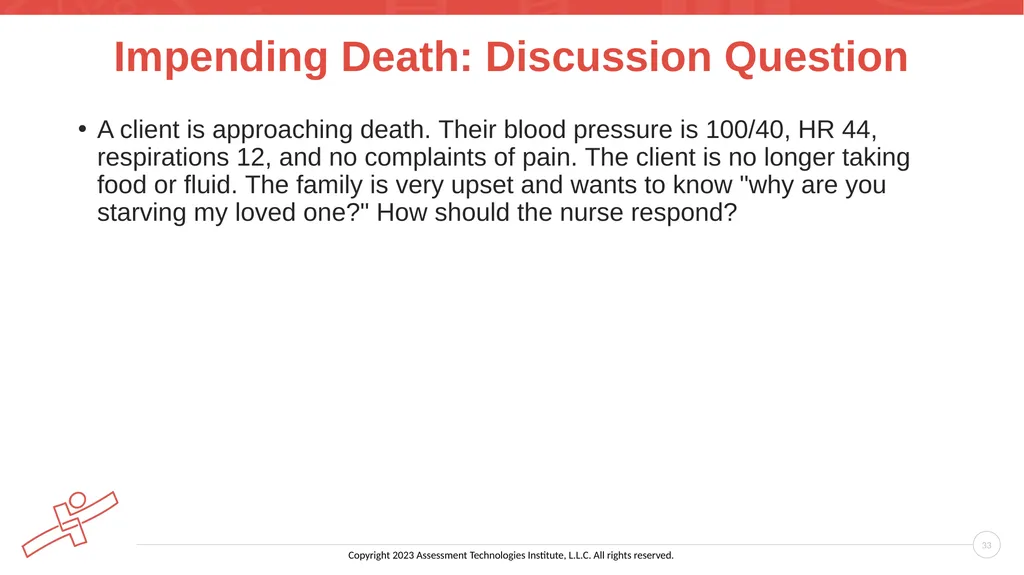
Impending Death: Discussion Question A client is approaching death. Their blood pressure is 100/40, HR 44, respirations 12, and no complaints of pain. The client is no longer taking food or fluid. The family is very upset and wants to know "why are you starving my loved one?" How should the nurse respond?<br>
33
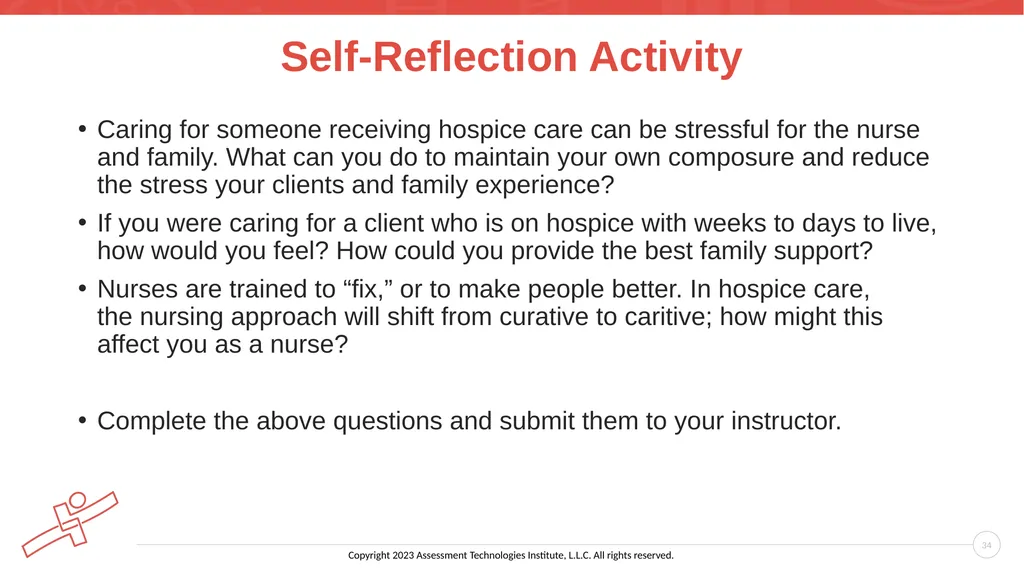
Self-Reflection Activity Caring for someone receiving hospice care can be stressful for the nurse and family. What can you do to maintain your own composure and reduce the stress your clients and family experience?
If you were caring for a client who is on hospice with weeks to days to live, how would you feel? How could you provide the best family support?
Nurses are trained to “fix,” or to make people better. In hospice care, the nursing approach will shift from curative to caritive; how might this affect you as a nurse?
Complete the above questions and submit them to your instructor.<br>
34
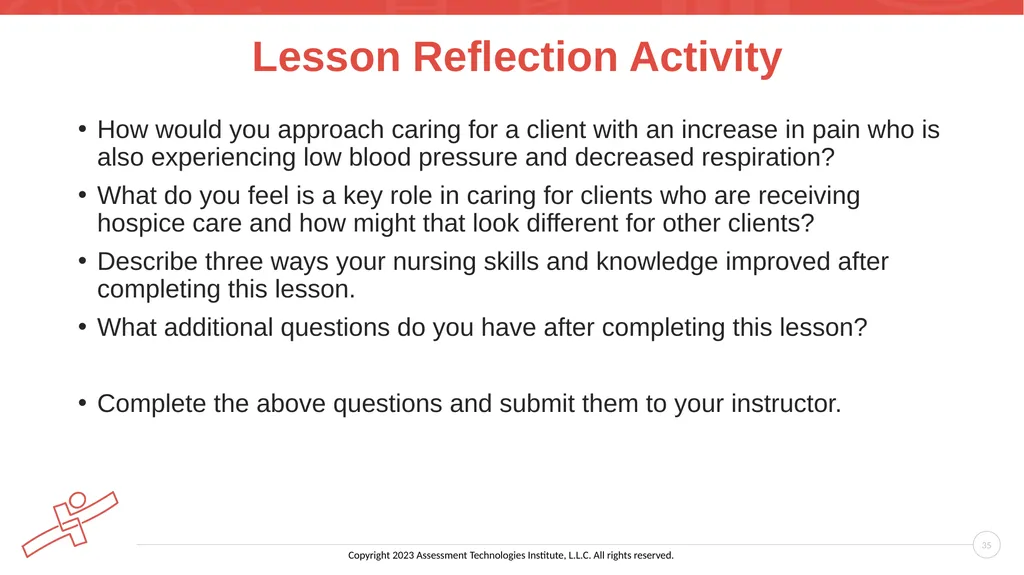
Lesson Reflection Activity How would you approach caring for a client with an increase in pain who is also experiencing low blood pressure and decreased respiration?
What do you feel is a key role in caring for clients who are receiving hospice care and how might that look different for other clients?
Describe three ways your nursing skills and knowledge improved after completing this lesson.
What additional questions do you have after completing this lesson?
Complete the above questions and submit them to your instructor.<br>
35
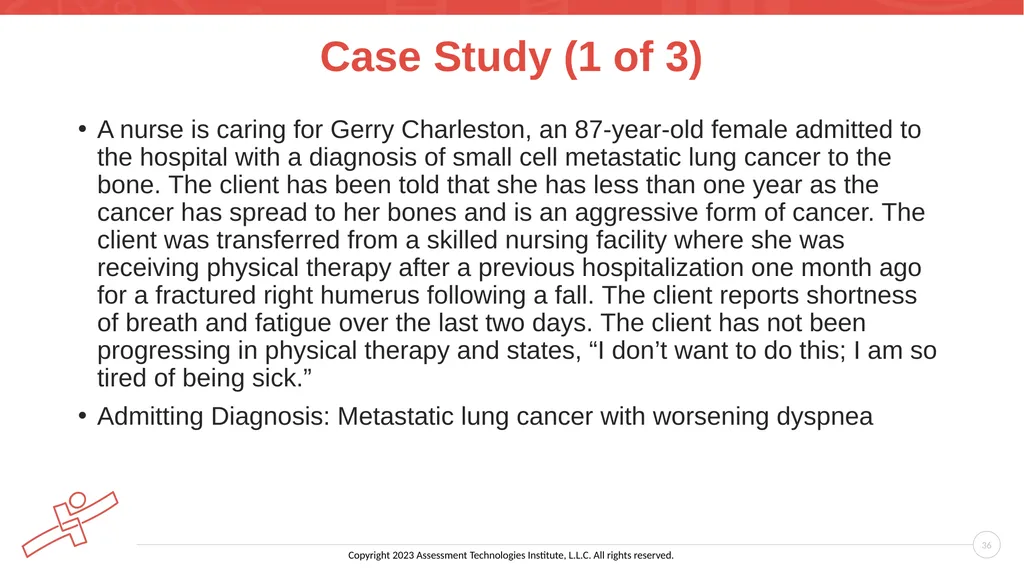
Case Study (1 of 3) A nurse is caring for Gerry Charleston, an 87-year-old female admitted to the hospital with a diagnosis of small cell metastatic lung cancer to the bone. The client has been told that she has less than one year as the cancer has spread to her bones and is an aggressive form of cancer. The client was transferred from a skilled nursing facility where she was receiving physical therapy after a previous hospitalization one month ago for a fractured right humerus following a fall. The client reports shortness of breath and fatigue over the last two days. The client has not been progressing in physical therapy and states, “I don’t want to do this; I am so tired of being sick.”
Admitting Diagnosis: Metastatic lung cancer with worsening dyspnea<br>
Admitting Diagnosis: Metastatic lung cancer with worsening dyspnea<br>
36
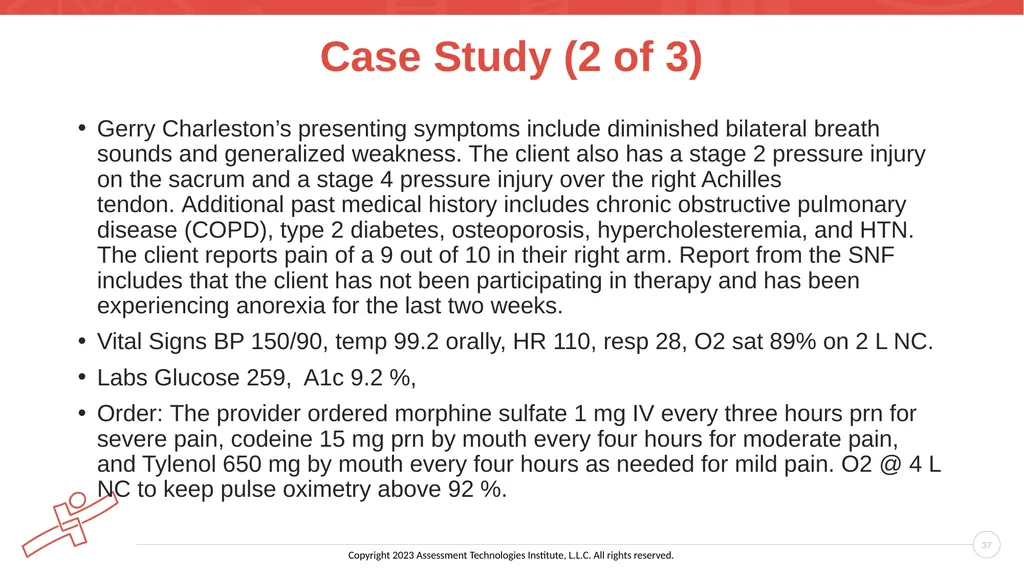
Case Study (2 of 3) Gerry Charleston’s presenting symptoms include diminished bilateral breath sounds and generalized weakness. The client also has a stage 2 pressure injury on the sacrum and a stage 4 pressure injury over the right Achilles tendon. Additional past medical history includes chronic obstructive pulmonary disease (COPD), type 2 diabetes, osteoporosis, hypercholesteremia, and HTN. The client reports pain of a 9 out of 10 in their right arm. Report from the SNF includes that the client has not been participating in therapy and has been experiencing anorexia for the last two weeks.
Vital Signs BP 150/90, temp 99.2 orally, HR 110, resp 28, O2 sat 89% on 2 L NC.
Labs Glucose 259, A1c 9.2 %,
Order: The provider ordered morphine sulfate 1 mg IV every three hours prn for severe pain, codeine 15 mg prn by mouth every four hours for moderate pain, and Tylenol 650 mg by mouth every four hours as needed for mild pain. O2 @ 4 L NC to keep pulse oximetry above 92 %.<br>
37
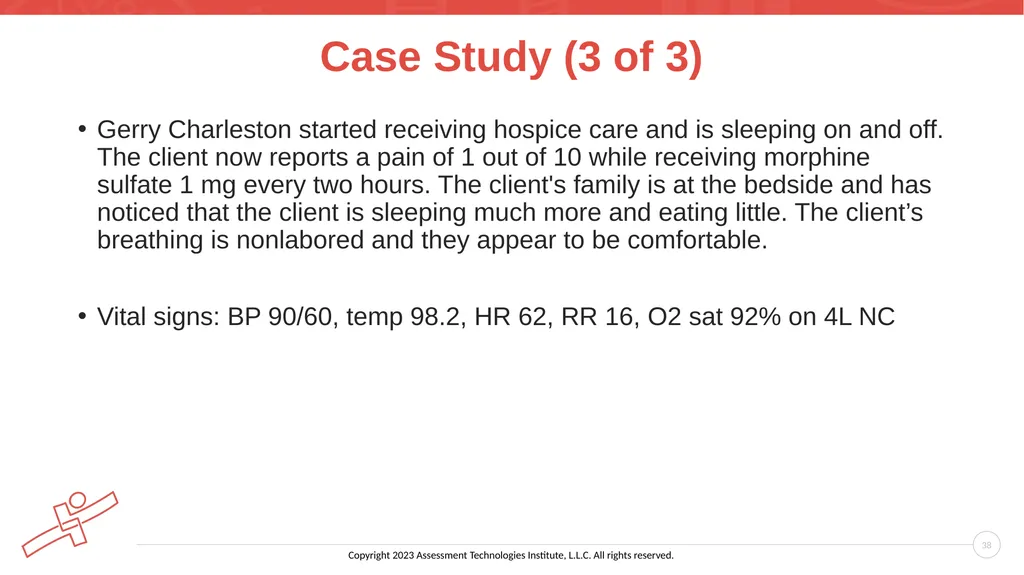
Case Study (3 of 3) Gerry Charleston started receiving hospice care and is sleeping on and off. The client now reports a pain of 1 out of 10 while receiving morphine sulfate 1 mg every two hours. The client's family is at the bedside and has noticed that the client is sleeping much more and eating little. The client’s breathing is nonlabored and they appear to be comfortable.
Vital signs: BP 90/60, temp 98.2, HR 62, RR 16, O2 sat 92% on 4L NC<br>
Vital signs: BP 90/60, temp 98.2, HR 62, RR 16, O2 sat 92% on 4L NC<br>