
Infant and Toddler Nutrition Continuity Clinic
CP
Published · 22 slides · 0 views

1 / 1





Description
Infant and Toddler Nutrition Continuity Clinic Module Lisa Mondzelewski, MD, FAAP Objectives To recognize when an infant is ready to start solid foods To discuss strategies for introducing solid and finger foods To be able to explain what
Related Topics
Share
Embed code
Download this presentation From Below
"Infant and Toddler Nutrition Continuity Clinic" is the property of its rightful owner. Permission is granted to download and print the materials on this website for personal, non-commercial use only, and to display it on your personal computer provided you do not modify the materials and that you retain all copyright notices contained in the materials. By downloading content from our website, you accept the terms of this agreement.
Presentation Transcript
01
Infant and Toddler Nutrition Continuity Clinic Module
Lisa Mondzelewski, MD, FAAP<br>
Lisa Mondzelewski, MD, FAAP<br>
02
Objectives To recognize when an infant is ready to start solid foods
To discuss strategies for introducing solid and finger foods
To be able to explain what an appropriate serving size is for a toddler
To discuss strategies for managing picky eaters and avoiding “food fights”
To introduce the concept of intuitive eating<br>
To discuss strategies for introducing solid and finger foods
To be able to explain what an appropriate serving size is for a toddler
To discuss strategies for managing picky eaters and avoiding “food fights”
To introduce the concept of intuitive eating<br>
03
The first 6 months… The AAP recommends breastfeeding as the sole source of nutrition for infants up to 6 months of age.
When solid foods are introduced around 6 months, breastfeeding should continue until at least 12 months (and longer as desired by mother and baby).<br>
When solid foods are introduced around 6 months, breastfeeding should continue until at least 12 months (and longer as desired by mother and baby).<br>
04
Ryan, 6 months Ryan’s mom brings him in to clinic for his 6 month well baby visit. He is a healthy boy, growing well and has met all developmental milestones at his past well visits. Mom is breastfeeding and would like to start solid foods, but isn’t sure if Ryan is ready.
What are three developmental clues that an infant is ready to begin solid foods?<br>
What are three developmental clues that an infant is ready to begin solid foods?<br>
05
When can my baby begin solids foods? Does he hold his head up? He should be able to sit in a high chair with good head control.
Does he open his mouth when food comes near? He should be interested in your food and seem eager to eat.
Can he move food from a spoon to the back of his throat? If he is pushing it all out of his mouth and dribbling down his chin, it may be reasonable to wait two weeks and try again.<br>
Does he open his mouth when food comes near? He should be interested in your food and seem eager to eat.
Can he move food from a spoon to the back of his throat? If he is pushing it all out of his mouth and dribbling down his chin, it may be reasonable to wait two weeks and try again.<br>
06
Which food should Ryan be given first? By tradition, single grain cereals are usually offered first, but there is no medical evidence that giving foods in any particular order has any advantage.
Cereals should be specifically made for babies and iron-fortified.
The AAP recommends starting iron supplements for exclusively breastfed infants at 4 months of age, up until appropriate, iron-containing complementary foods are introduced.
Be careful with large amounts of rice/rice cereal due to heavy metal content of rice products
Offering green vegetables before fruits or orange veggies will not necessarily overcome the natural preference for sweetness that all babies are born with!<br>
07
How quickly should new foods be introduced? Babies should be given one food at a time, with a waiting period of 2 to 3 days before starting another.
Signs of allergic reaction: diarrhea, rash, vomiting, wheezing
There is no current, convincing evidence to suggest delaying introduction of solids beyond 6 months of age is protective against the development of atopy
In fact, early introduction of allergenic foods (peanut products, eggs, etc…), one solid foods are tolerated is protective against developing food allergies<br>
08
Can I make my own baby food? Yes– but be aware that spinach, beets, green beans, squash and carrots are not good choices for young infants because they can contain large amounts of nitrates.
Nitrate poisoning results in methemoglobinemia
Peas, corn and sweet potatoes are better choices for homemade foods.
Commercial baby foods are safe because they test for nitrates.<br>
Nitrate poisoning results in methemoglobinemia
Peas, corn and sweet potatoes are better choices for homemade foods.
Commercial baby foods are safe because they test for nitrates.<br>
09
What about finger foods? If your baby can sit up and bring his hands to his mouth, you can give finger foods.
Should be soft, cut into small pieces.
Good examples: small pieces of banana, well-cooked pasta, wafer-type crackers<br>
Should be soft, cut into small pieces.
Good examples: small pieces of banana, well-cooked pasta, wafer-type crackers<br>
10
A different diaper… When babies start solids, stools usually become more solid, varied in color (beets may turn stool or urine red!)
May have stronger odor
Contain undigested pieces of food
These changes should be addressed as anticipatory guidance to parents of 4-6 month old infants<br>
May have stronger odor
Contain undigested pieces of food
These changes should be addressed as anticipatory guidance to parents of 4-6 month old infants<br>
11
Ryan, 18 months Ryan is back to see you for his 18 month well visit. His father is frustrated because Ryan has become such a picky eater since his first birthday. “He used to eat everything we put in front of him, and now he turns his head away after just a few bites or refuses to even come to the table!”
How do you counsel Ryan’s parents regarding this change in eating behaviors?<br>
How do you counsel Ryan’s parents regarding this change in eating behaviors?<br>
12
Feeding Your 1-Year-Old Picky eating is common at this age
Ryan’s growth rate has slowed since infancy, and he actually doesn’t require as much food now
Eating habits can be erratic and unpredictable
May eat everything in sight at breakfast and nothing the rest of the day
May eat the same food three days in a row and then reject it completely on the fourth day<br>
13
Sample Daily Menu: 1 year A 1-year-old needs about 1,000 calories per day to meet his needs for growth
Breakfast: ½ cup breakfast cereal, ½ cup milk, ½ banana, 2-3 large strawberries
Snack: 1 slice toast with peanut butter
Lunch: ½ turkey sandwich, ½ cup cooked veggies, ½ cup milk
Snack: 1-2 oz cheese, or 2-3 tablespoons berries
Dinner: 2-3 oz cooked meat, ½ cup veggies, ½ cup rice or pasta, 1 cup milk<br>
14
Don’t start a food fight! Mealtimes should not turn into battles over food
The harder parents push, the more likely a toddler is to reject foods
Offer a variety of nutritious selections at each mealtime and let your child choose what he wants; vary tastes and consistencies<br>
The harder parents push, the more likely a toddler is to reject foods
Offer a variety of nutritious selections at each mealtime and let your child choose what he wants; vary tastes and consistencies<br>
15
But what if he rejects everything?? Save the plate for later
DO NOT fill him up with sweets and high-calorie, nutrient-deficient foods
Diet will balance out over a few days if a wide array of wholesome foods are continually offered<br>
DO NOT fill him up with sweets and high-calorie, nutrient-deficient foods
Diet will balance out over a few days if a wide array of wholesome foods are continually offered<br>
16
Children and Intuitive Eating What is intuitive eating?
Eating in response to physiologic cues regarding hunger and satiety, rather than emotional or environmental triggers
Children are born with an innate ability to eat intuitively!
Messages they receive in early infancy and childhood often hinder their ability to make intuitive choices about food<br>
Eating in response to physiologic cues regarding hunger and satiety, rather than emotional or environmental triggers
Children are born with an innate ability to eat intuitively!
Messages they receive in early infancy and childhood often hinder their ability to make intuitive choices about food<br>
17
Intuitive Eating in the Literature Parental restrictive feeding practices can lead to development of children who are more food responsive and have a tendency to overeat
Maternal restriction and pressure on their children to eat during mealtime has been associated with increased childhood BMI Lewis and Worobey, 2011; Rodgers et al., 2013, Webber, Cooke, Hill
& Wardle, 2010<br>
Maternal restriction and pressure on their children to eat during mealtime has been associated with increased childhood BMI Lewis and Worobey, 2011; Rodgers et al., 2013, Webber, Cooke, Hill
& Wardle, 2010<br>
18
Division of Feeding Responsibility Parents schedule regular meals and provide a variety of choices for their children
Children get to decide “how much” and “what” they eat
This division of responsibility has been associated with children who eat more fruits and veggies and consume fewer unhealthy snacks Kremers, Brug, de Vries, & Engels, 2003<br>
Children get to decide “how much” and “what” they eat
This division of responsibility has been associated with children who eat more fruits and veggies and consume fewer unhealthy snacks Kremers, Brug, de Vries, & Engels, 2003<br>
19
A few final thoughts… Don’t become frustrated with picky eaters! Continue to offer a variety of foods- it may take 10-15 introductions (or more!) before a child decides he likes something.
Meals don’t have to be elaborate to be nutritious- setting out ½ of a turkey sandwich, apple slices and milk takes less time than driving through a fast food restaurant and it is much more nutritious!<br>
Meals don’t have to be elaborate to be nutritious- setting out ½ of a turkey sandwich, apple slices and milk takes less time than driving through a fast food restaurant and it is much more nutritious!<br>
20
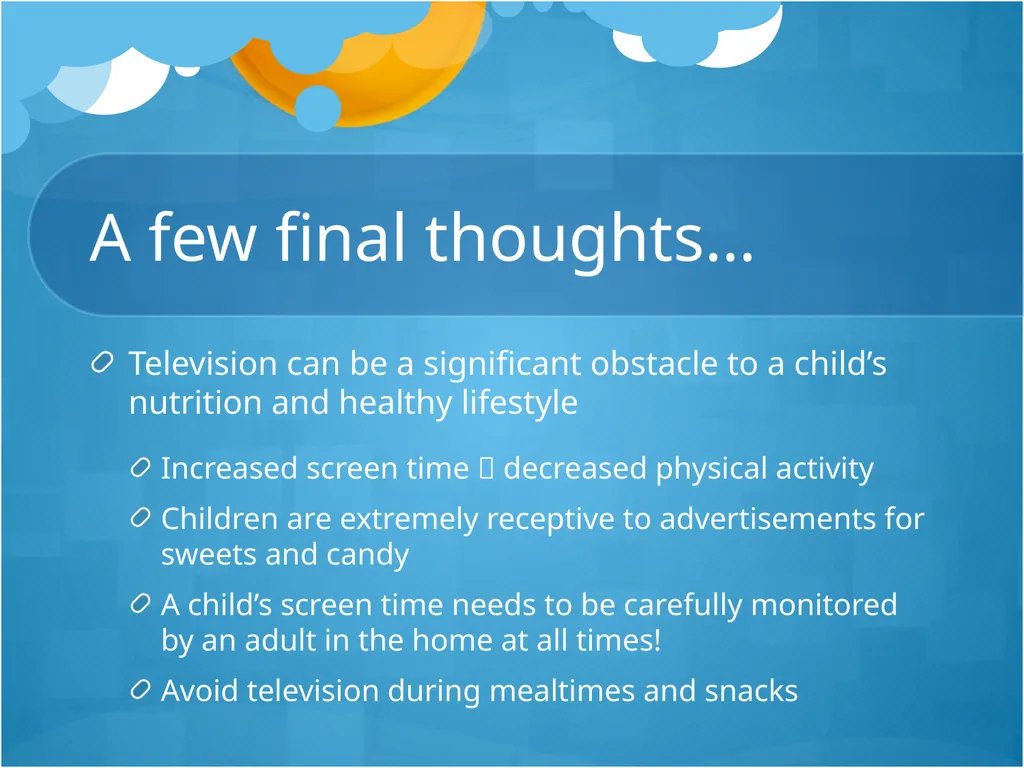
A few final thoughts… Television can be a significant obstacle to a child’s nutrition and healthy lifestyle
Increased screen time decreased physical activity
Children are extremely receptive to advertisements for sweets and candy
A child’s screen time needs to be carefully monitored by an adult in the home at all times!
Avoid television during mealtimes and snacks<br>
Increased screen time decreased physical activity
Children are extremely receptive to advertisements for sweets and candy
A child’s screen time needs to be carefully monitored by an adult in the home at all times!
Avoid television during mealtimes and snacks<br>
21
References www.healthychildren.org
Baker, R. D., & Greer, F. R. (2010). Diagnosis and Prevention of Iron Deficiency and Iron-Deficiency Anemia in Infants and Young Children (0–3 Years of Age). Pediatrics, 126(5), 1040–1050. doi:10.1542/peds.2010-2576
Greer, F. R., Sicherer, S. H., & Burks, A. W. (2008). Effects of Early Nutritional Interventions on the Development of Atopic Disease in Infants and Children: The Role of Maternal Dietary Restriction, Breastfeeding, Timing of Introduction of Complementary Foods, and Hydrolyzed Formulas. Pediatrics, 121(1), 183–191. doi:10.1542/peds.2007-3022
Kremers, S. P. J., Brug, J., De Vries, H., & Engels, R. C. M. E. (2003). Parenting style and adolescent fruit consumption. Appetite, 41(1), 43–50.
Lewis, M., & Worobey, J. (2011). Mothers and toddlers lunch together. The relation between observed and reported behavior. Appetite, 56(3), 732–736. doi:10.1016/j.appet.2011.02.011Kremers, S. P. J., Brug, J., De Vries, H., & Engels, R. C. M. E. (2003). Parenting style and adolescent fruit consumption. Appetite, 41(1), 43–50.
Rodgers, R. F., Paxton, S. J., Massey, R., Campbell, K. J., Wertheim, E. H., Skouteris, H., & Gibbons, K. (2013). Maternal feeding practices predict weight gain and obesogenic eating behaviors in young children: a prospective study. The International Journal of Behavioral Nutrition and Physical Activity, 10, 24. doi:10.1186/1479-5868-10-24
Tribole, E., & Resch, E. (2003). Intuitive eating: a revolutionary program that works. New York: St. Martin’s Griffin.
Webber, L., Cooke, L., Hill, C., & Wardle, J. (2010). Associations between children’s appetitive traits and maternal feeding practices. Journal of the American Dietetic Association, 110(11), 1718–1722. doi:10.1016/j.jada.2010.08.007<br>
22
Questions and Discussion<br>