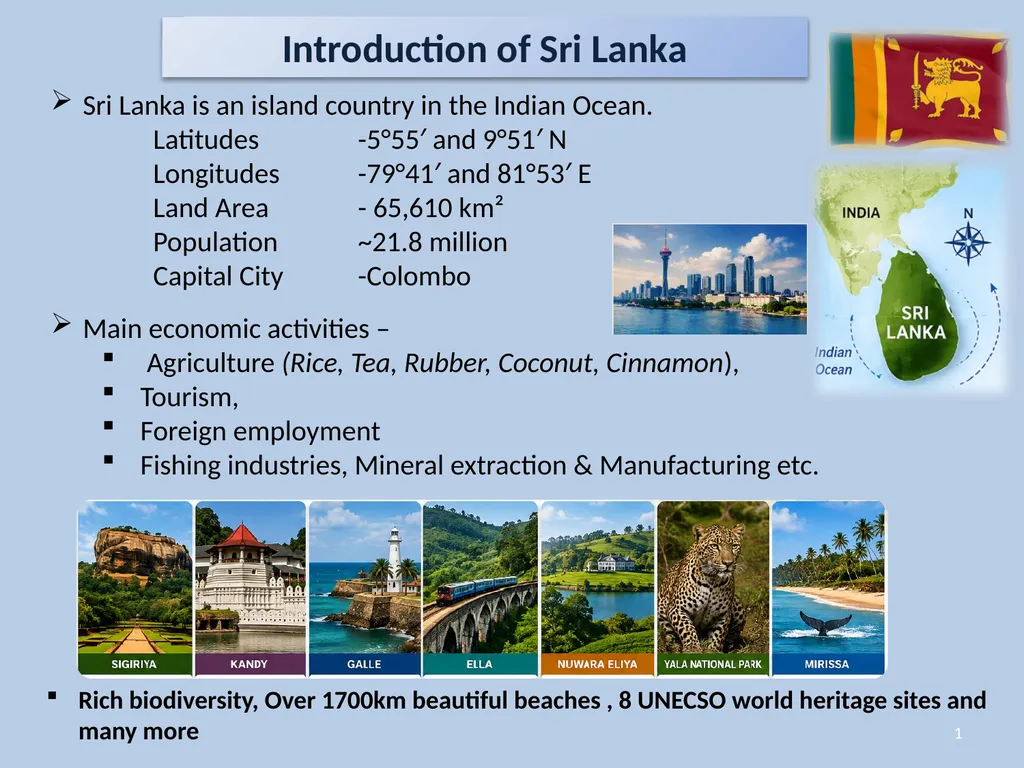
Introduction of Sri Lanka 1 Sri Lanka is an island country in the Indian Ocean. Latitudes -555 and 951 N Longitudes -7941 and 8153 E Land Area - 65,610 km² Population 21.8 million Capital City -Colombo Main economic activities
"Introduction of Sri Lanka 1 Sri Lanka is an island" is the property of its rightful owner. Permission is granted to
download and print the materials on this website for personal, non-commercial use only, and to display it
on your personal computer provided you do not modify the materials and that you retain all copyright
notices contained in the materials. By downloading content from our website, you accept the terms of this
agreement.
Presentation Transcript
01
Introduction of Sri Lanka 1 Sri Lanka is an island country in the Indian Ocean.
Latitudes -5°55′ and 9°51′ N
Longitudes -79°41′ and 81°53′ E
Land Area - 65,610 km²
Population ~21.8 million
Capital City -Colombo
Main economic activities –
Agriculture (Rice, Tea, Rubber, Coconut, Cinnamon),
Tourism,
Foreign employment
Fishing industries, Mineral extraction & Manufacturing etc. Rich biodiversity, Over 1700km beautiful beaches , 8 UNECSO world heritage sites and many more<br>
02
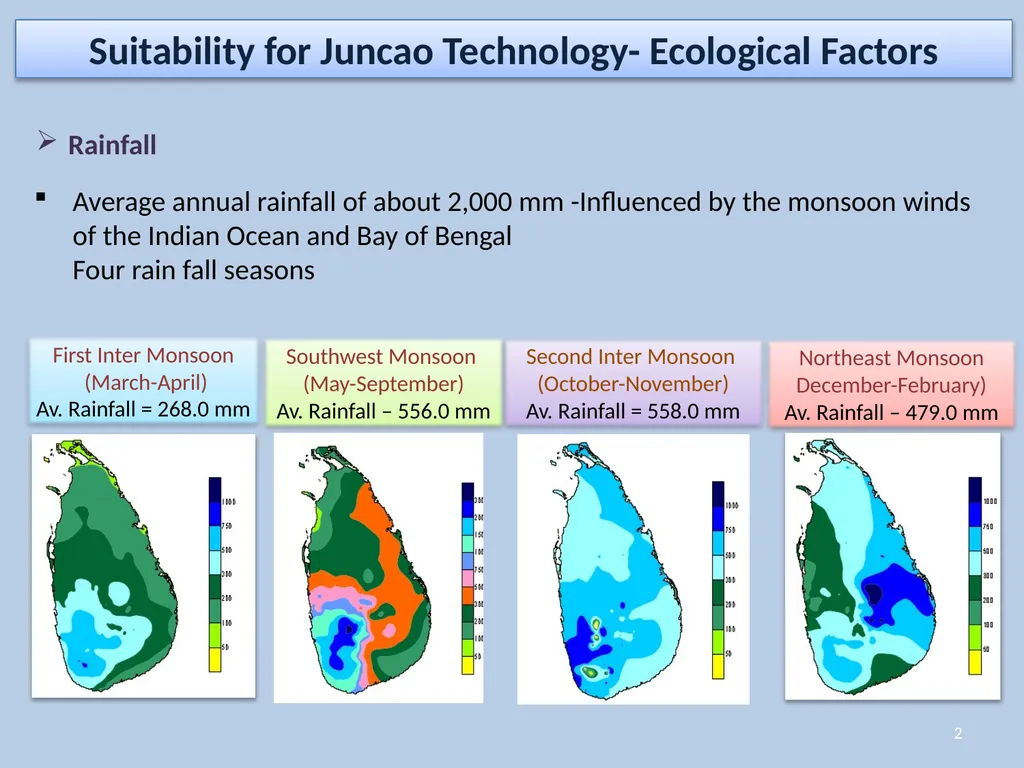
Average annual rainfall of about 2,000 mm -Influenced by the monsoon winds of the Indian Ocean and Bay of Bengal Four rain fall seasons First Inter Monsoon
(March-April)
Av. Rainfall = 268.0 mm Southwest Monsoon
(May-September)
Av. Rainfall – 556.0 mm Second Inter Monsoon
(October-November)
Av. Rainfall = 558.0 mm Northeast Monsoon
December-February)
Av. Rainfall – 479.0 mm 2 Suitability for Juncao Technology- Ecological Factors Rainfall<br>
03
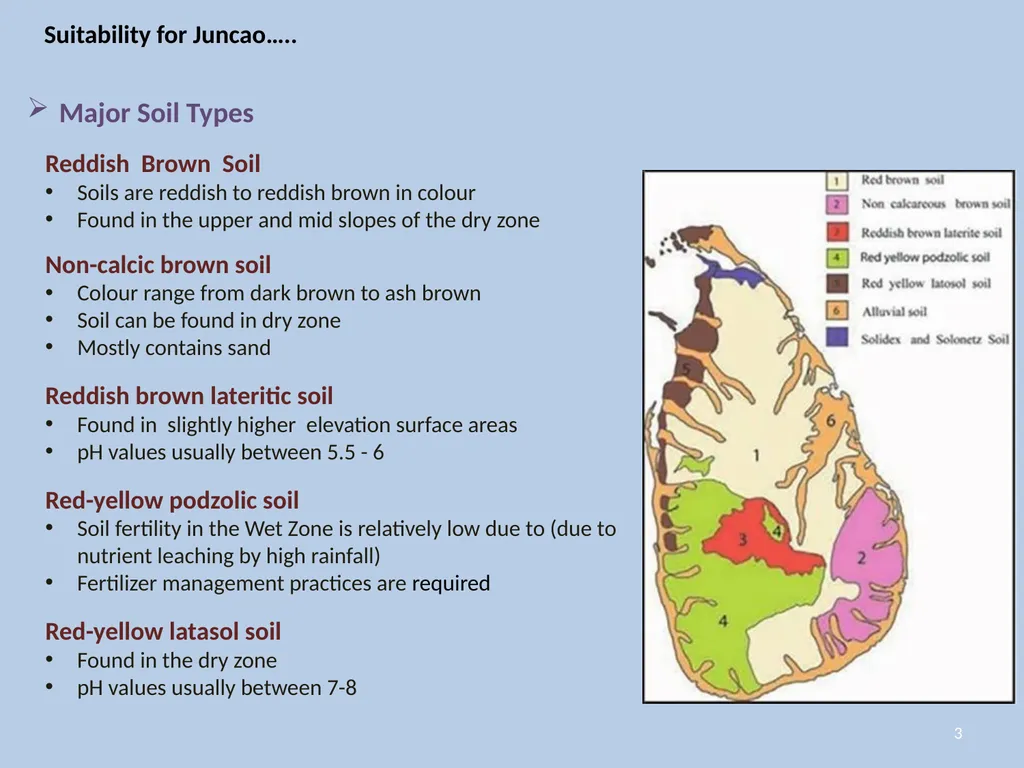
Reddish Brown Soil
Soils are reddish to reddish brown in colour
Found in the upper and mid slopes of the dry zone
Non-calcic brown soil
Colour range from dark brown to ash brown
Soil can be found in dry zone
Mostly contains sand
Reddish brown lateritic soil
Found in slightly higher elevation surface areas
pH values usually between 5.5 - 6
Red-yellow podzolic soil
Soil fertility in the Wet Zone is relatively low due to (due to nutrient leaching by high rainfall)
Fertilizer management practices are required
Red-yellow latasol soil
Found in the dry zone
pH values usually between 7-8 3 Major Soil Types Suitability for Juncao…..<br>
04
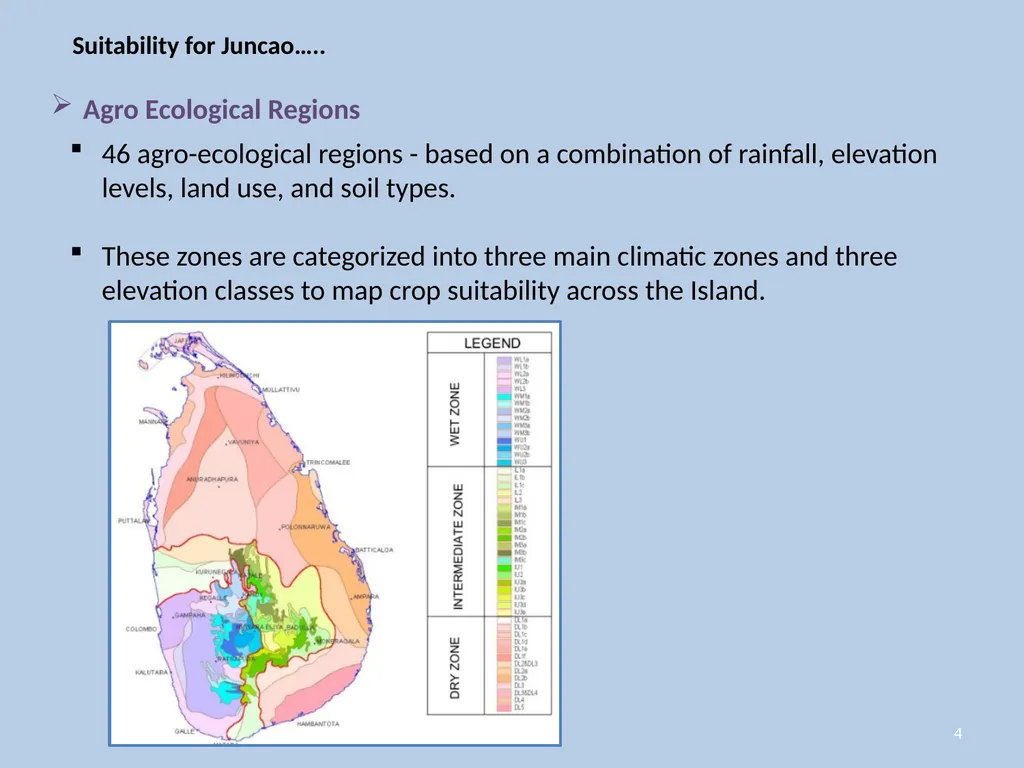
4 Agro Ecological Regions 46 agro-ecological regions - based on a combination of rainfall, elevation levels, land use, and soil types.
These zones are categorized into three main climatic zones and three elevation classes to map crop suitability across the Island. Suitability for Juncao…..<br>
05
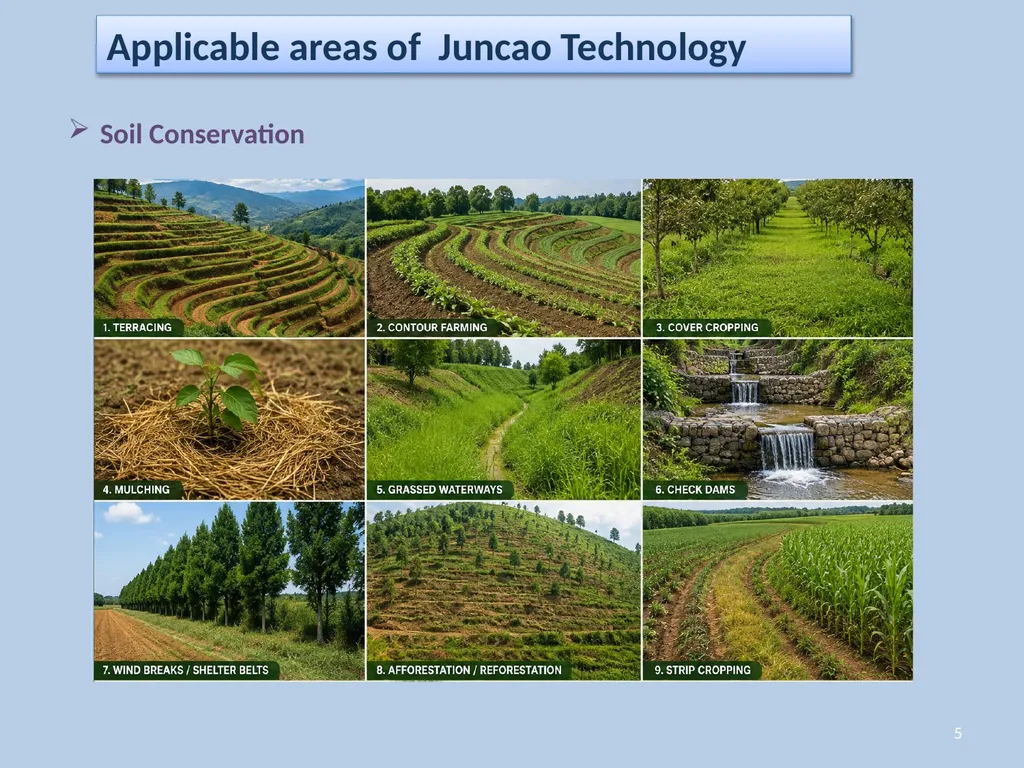
5 Soil Conservation Applicable areas of Juncao Technology<br>
06
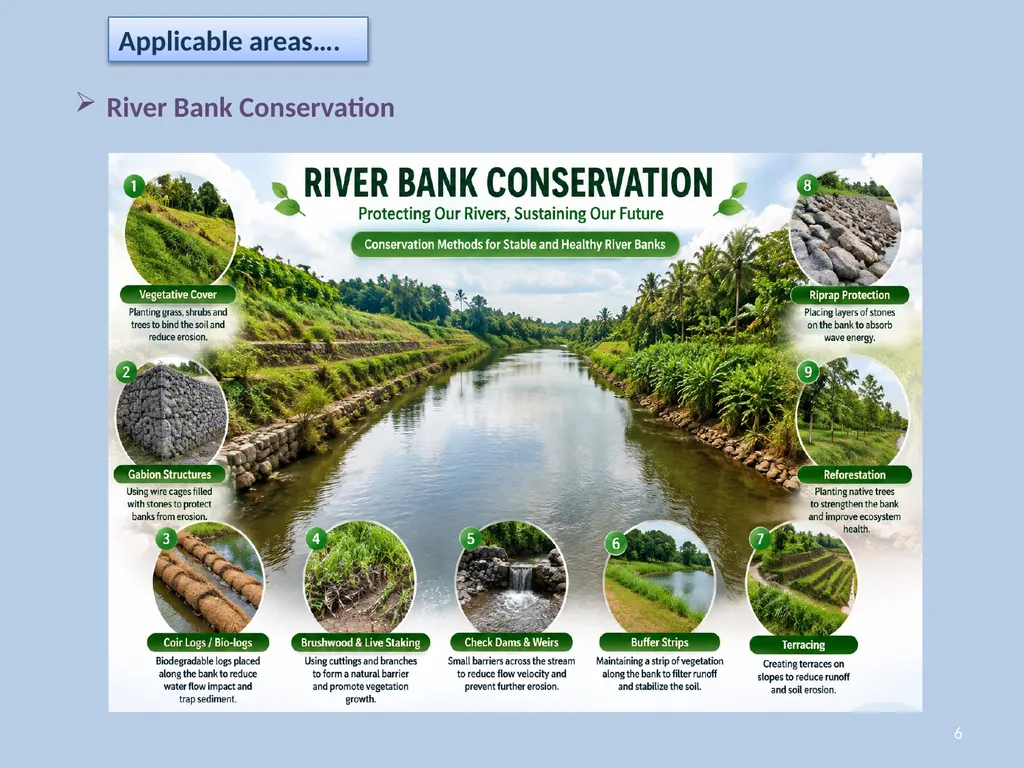
6 River Bank Conservation Applicable areas….<br>
07
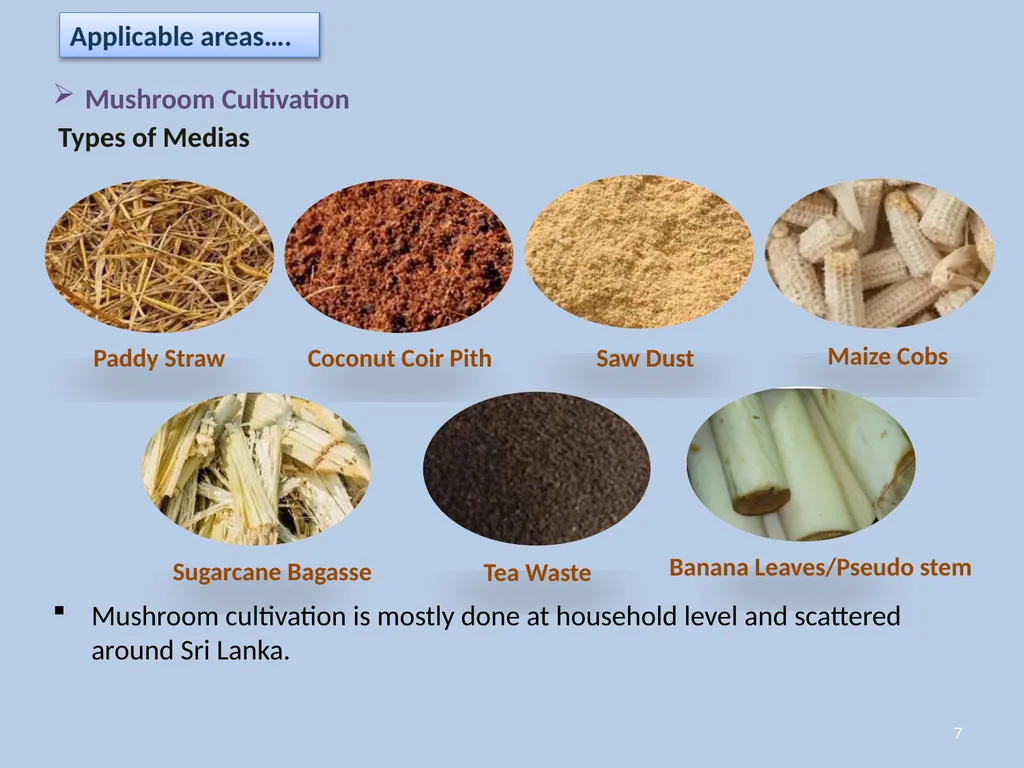
Paddy Straw Coconut Coir Pith Saw Dust Maize Cobs Sugarcane Bagasse Tea Waste Banana Leaves/Pseudo stem Types of Medias Mushroom cultivation is mostly done at household level and scattered around Sri Lanka. 7 Mushroom Cultivation Applicable areas….<br>
08
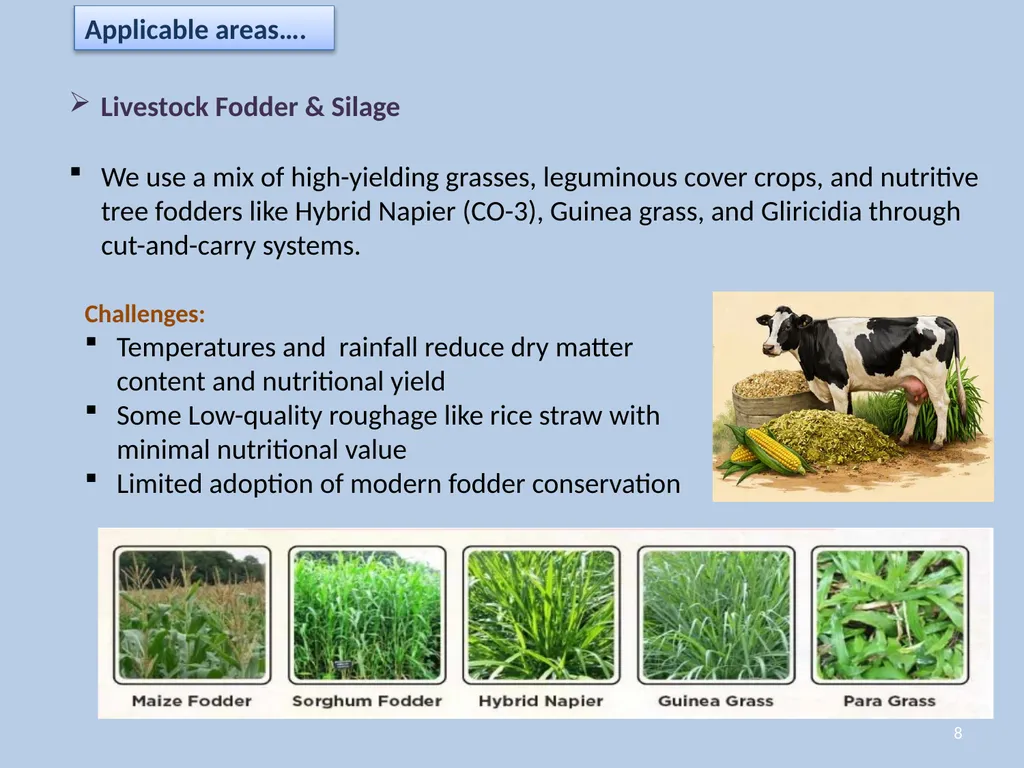
8 Livestock Fodder & Silage We use a mix of high-yielding grasses, leguminous cover crops, and nutritive tree fodders like Hybrid Napier (CO-3), Guinea grass, and Gliricidia through cut-and-carry systems. Challenges:
Temperatures and rainfall reduce dry matter content and nutritional yield
Some Low-quality roughage like rice straw with minimal nutritional value
Limited adoption of modern fodder conservation Applicable areas….<br>
09
International Knowledge Exchange
Learn best practices from other countries
Adapt solutions to Sri Lankan conditions
Multi-Stakeholder Collaboration
Engage government, universities & private sector
Coordinate implementation & knowledge sharing
Working Body Establishment
Form Juncao Technology Committee
Coordinate and monitor projects
FAFU Technical Cooperation
Invite FAFU experts to Sri Lanka
Conduct assessments & plan pilot sites.
Technical & Financial Support (UNDESA & FAFU)
Technology transfer, capacity building & training
Financial support for the project implementation. 9 Way forward ….<br>