
Jenny Siegel, MD Carl G Streed Jr., MD, MPH Ann
AS
Published · 21 slides · 0 views

1 / 1



Description
Jenny Siegel, MD Carl G Streed Jr., MD, MPH Ann Zumwalt, PhD Integrating LGBTQGSD Topics into the BUSM Curriculum Gender and Sexually Diverse (GSD) Individuals 2 People whose gender identity andor sexual identityorientation fall outside
Related Topics
Share
Embed code
Download this presentation From Below
"Jenny Siegel, MD Carl G Streed Jr., MD, MPH Ann" is the property of its rightful owner. Permission is granted to download and print the materials on this website for personal, non-commercial use only, and to display it on your personal computer provided you do not modify the materials and that you retain all copyright notices contained in the materials. By downloading content from our website, you accept the terms of this agreement.
Presentation Transcript
01
Jenny Siegel, MD
Carl G Streed Jr., MD, MPH
Ann Zumwalt, PhD Integrating LGBTQ/GSD Topics into the BUSM Curriculum<br>
Carl G Streed Jr., MD, MPH
Ann Zumwalt, PhD Integrating LGBTQ/GSD Topics into the BUSM Curriculum<br>
02
Gender and Sexually Diverse (GSD) Individuals 2 People whose gender identity and/or sexual identity/orientation fall outside the scope of cisgender heterosexuality
Traditionally referred to as LGBTQ+ but this is not as inclusive as needed:
Lesbian
Gay
Bisexual
Transgender
Queer
Let’s break down the terminology!<br>
Traditionally referred to as LGBTQ+ but this is not as inclusive as needed:
Lesbian
Gay
Bisexual
Transgender
Queer
Let’s break down the terminology!<br>
03
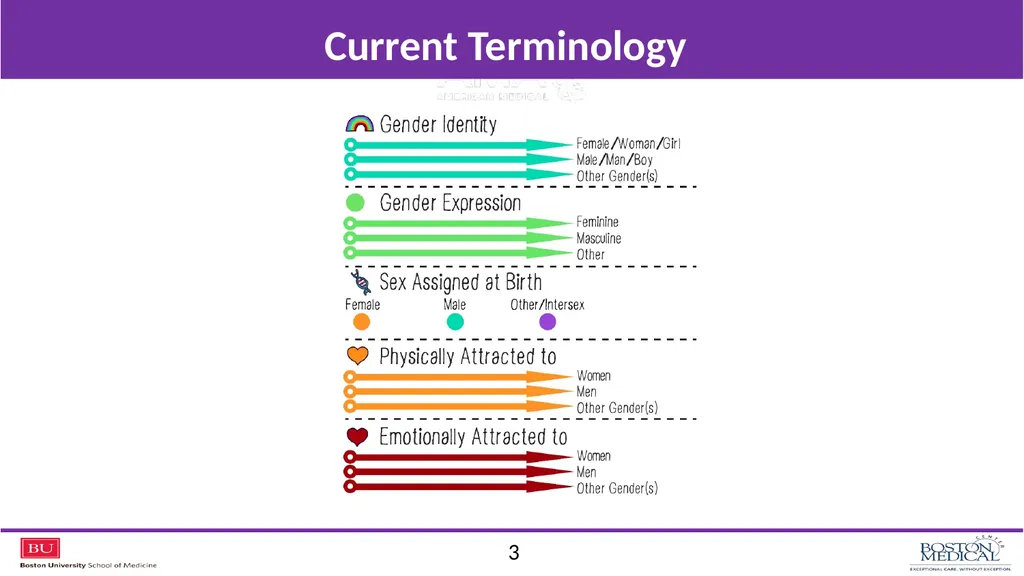
Current Terminology 3<br>
04
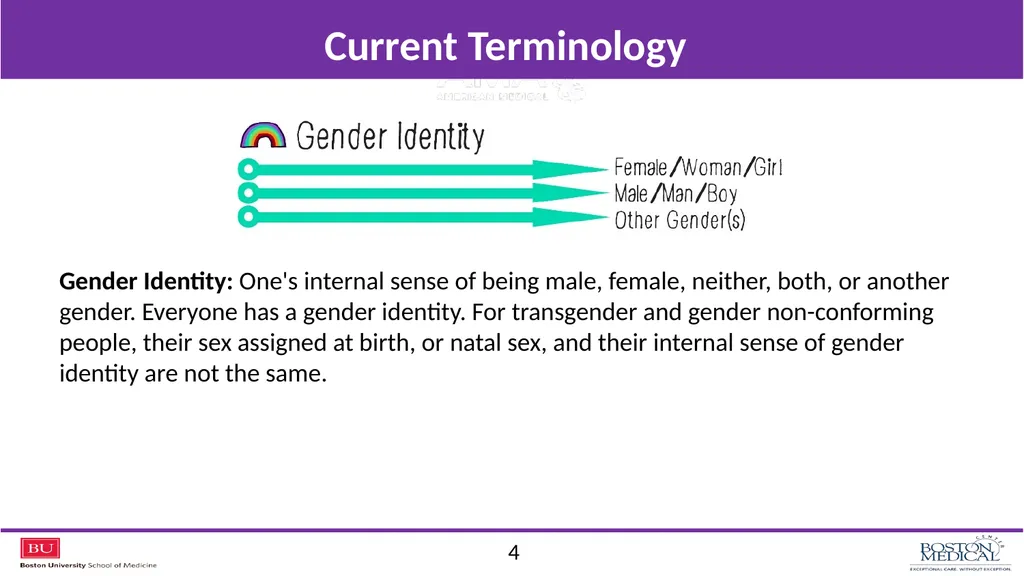
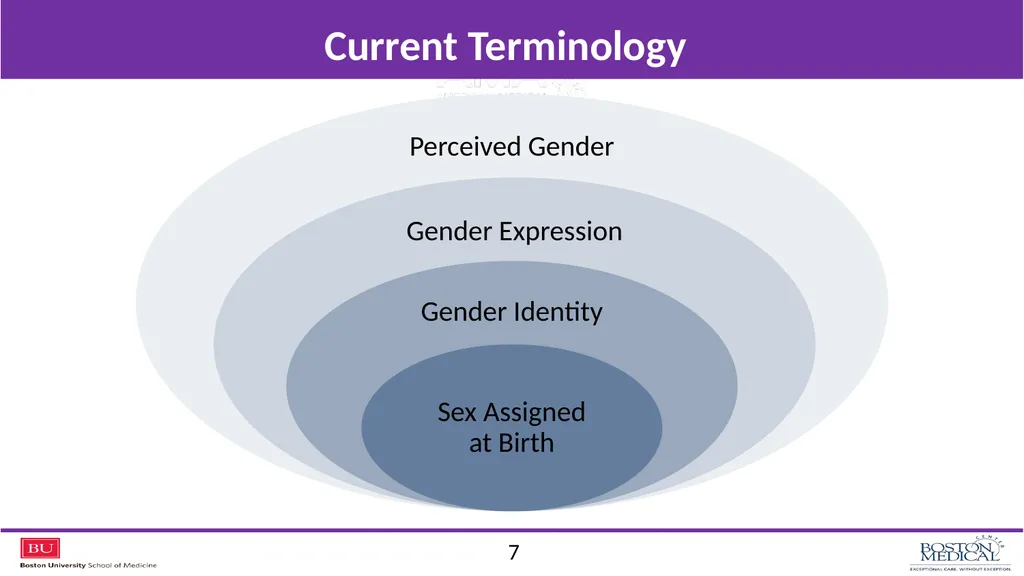
Current Terminology 4 Gender Identity: One's internal sense of being male, female, neither, both, or another gender. Everyone has a gender identity. For transgender and gender non-conforming people, their sex assigned at birth, or natal sex, and their internal sense of gender identity are not the same.<br>
05
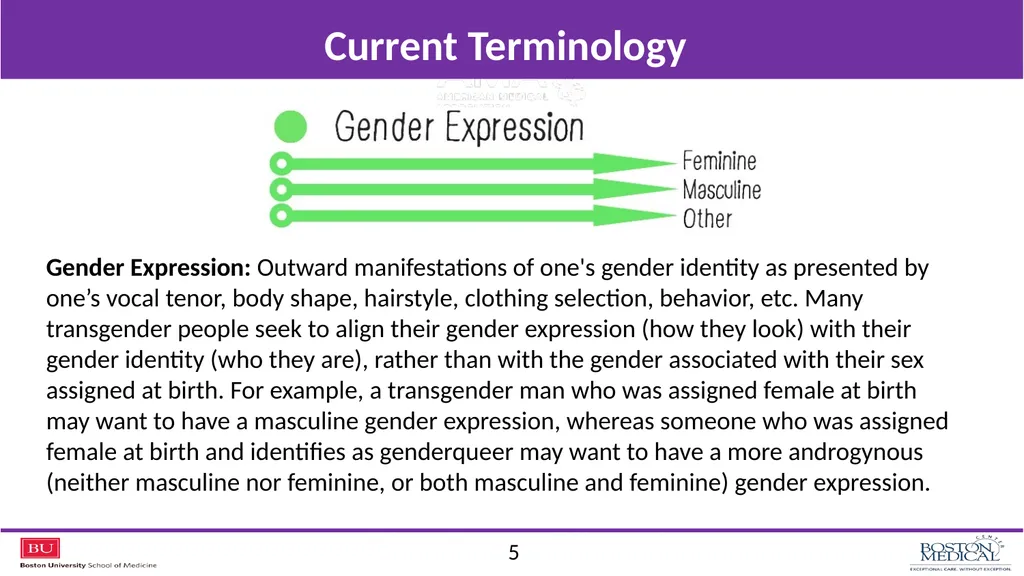
Current Terminology 5 Gender Expression: Outward manifestations of one's gender identity as presented by one’s vocal tenor, body shape, hairstyle, clothing selection, behavior, etc. Many transgender people seek to align their gender expression (how they look) with their gender identity (who they are), rather than with the gender associated with their sex assigned at birth. For example, a transgender man who was assigned female at birth may want to have a masculine gender expression, whereas someone who was assigned female at birth and identifies as genderqueer may want to have a more androgynous (neither masculine nor feminine, or both masculine and feminine) gender expression.<br>
06
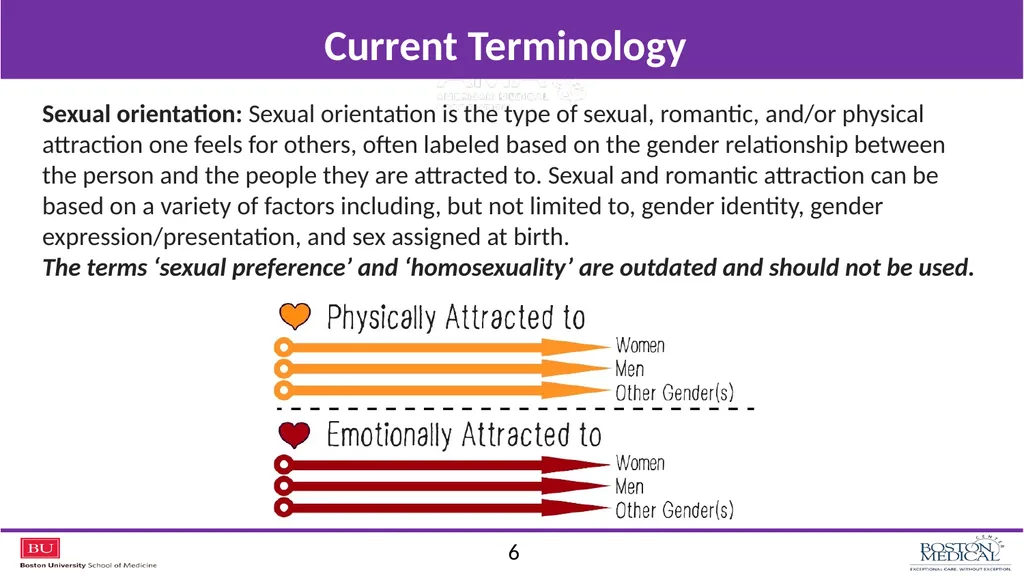
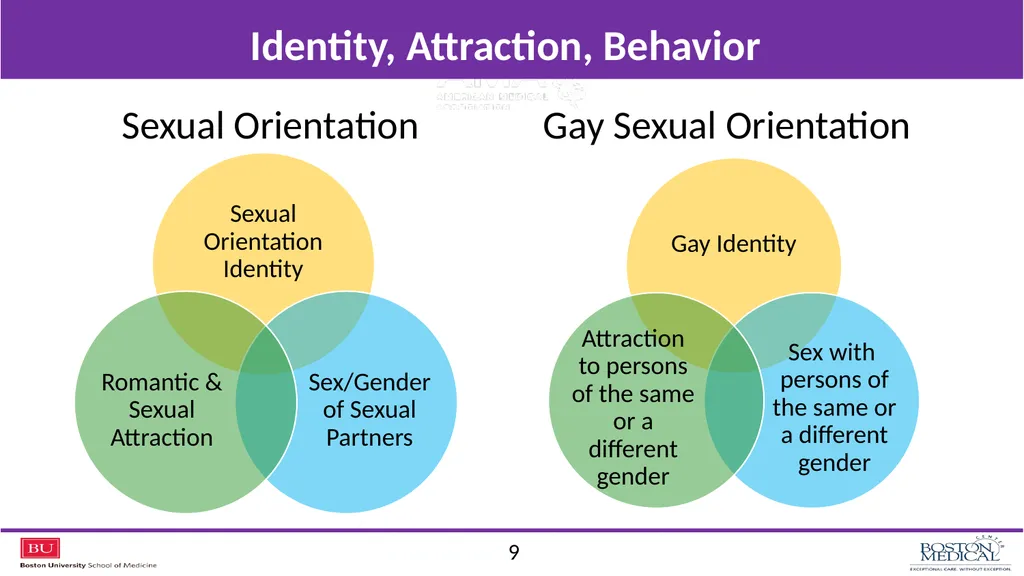
Current Terminology 6 Sexual orientation: Sexual orientation is the type of sexual, romantic, and/or physical attraction one feels for others, often labeled based on the gender relationship between the person and the people they are attracted to. Sexual and romantic attraction can be based on a variety of factors including, but not limited to, gender identity, gender expression/presentation, and sex assigned at birth.
The terms ‘sexual preference’ and ‘homosexuality’ are outdated and should not be used.<br>
The terms ‘sexual preference’ and ‘homosexuality’ are outdated and should not be used.<br>
07
Current Terminology 7 Gender Identity Gender Expression Perceived Gender<br>
08
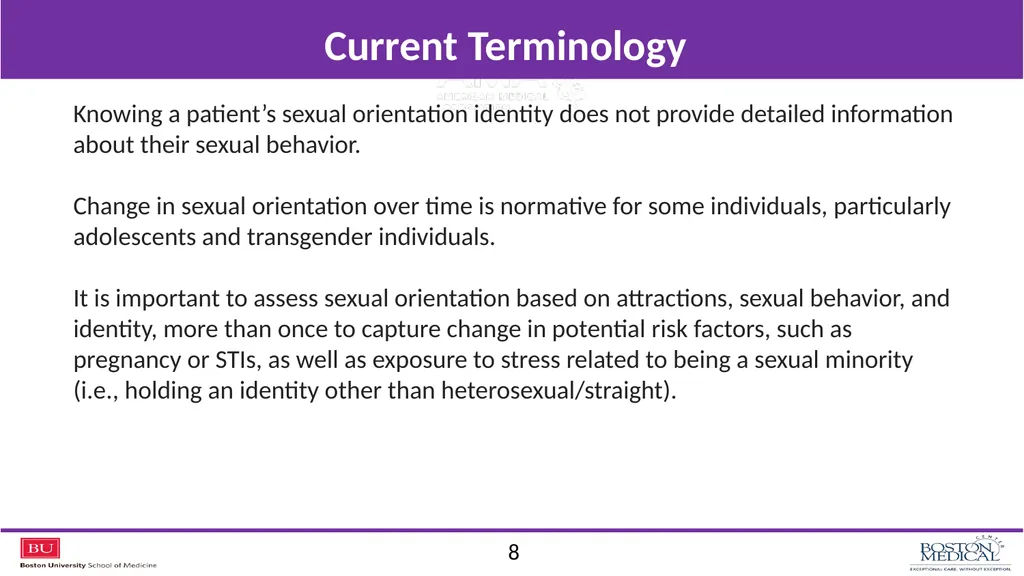
Current Terminology 8 Knowing a patient’s sexual orientation identity does not provide detailed information about their sexual behavior.
Change in sexual orientation over time is normative for some individuals, particularly adolescents and transgender individuals.
It is important to assess sexual orientation based on attractions, sexual behavior, and identity, more than once to capture change in potential risk factors, such as pregnancy or STIs, as well as exposure to stress related to being a sexual minority (i.e., holding an identity other than heterosexual/straight).<br>
09
Identity, Attraction, Behavior Sexual Orientation Gay Sexual Orientation Institute of Medicine, 2011 9<br>
10
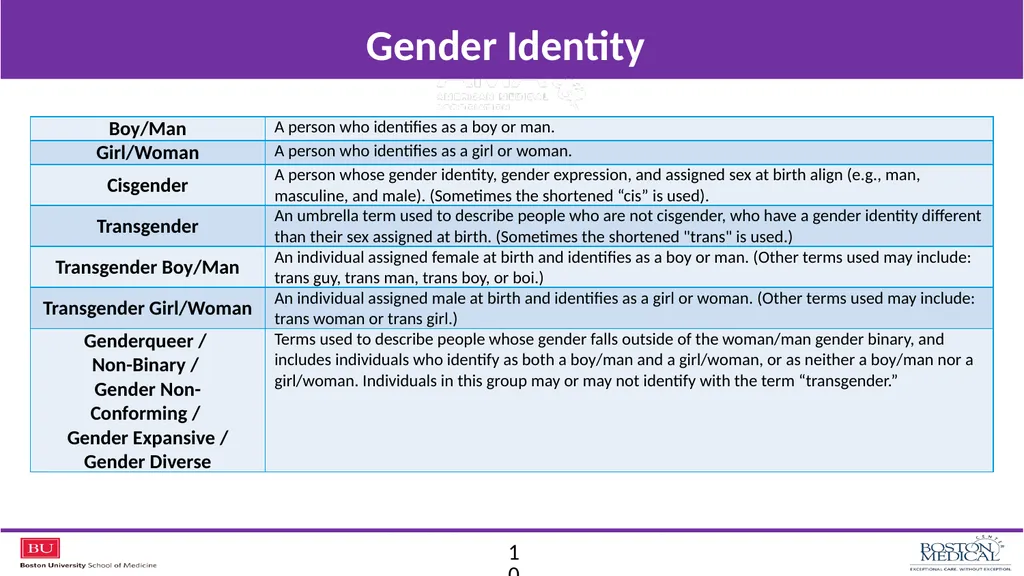
Gender Identity 10<br>
11
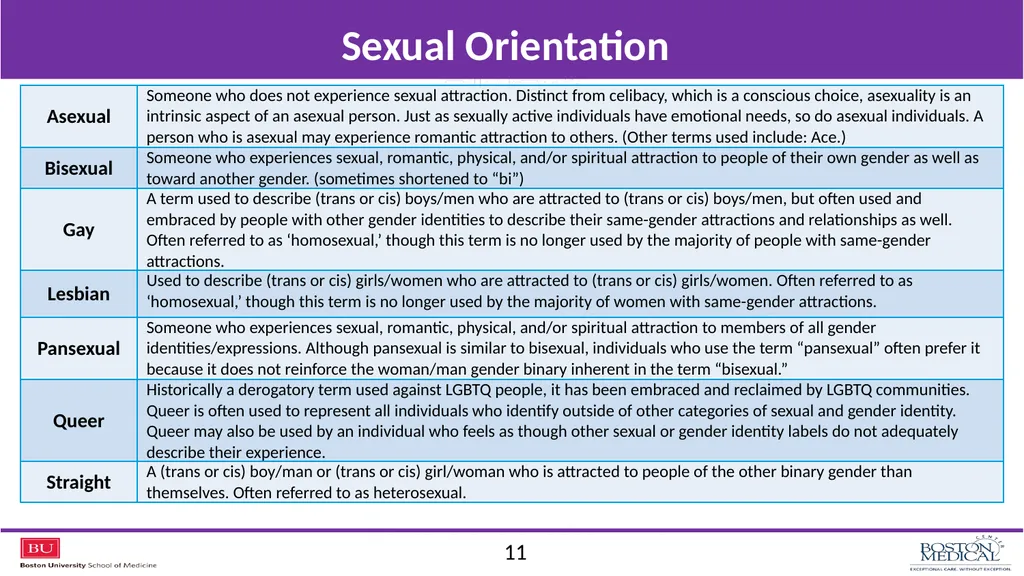
Sexual Orientation 11<br>
12
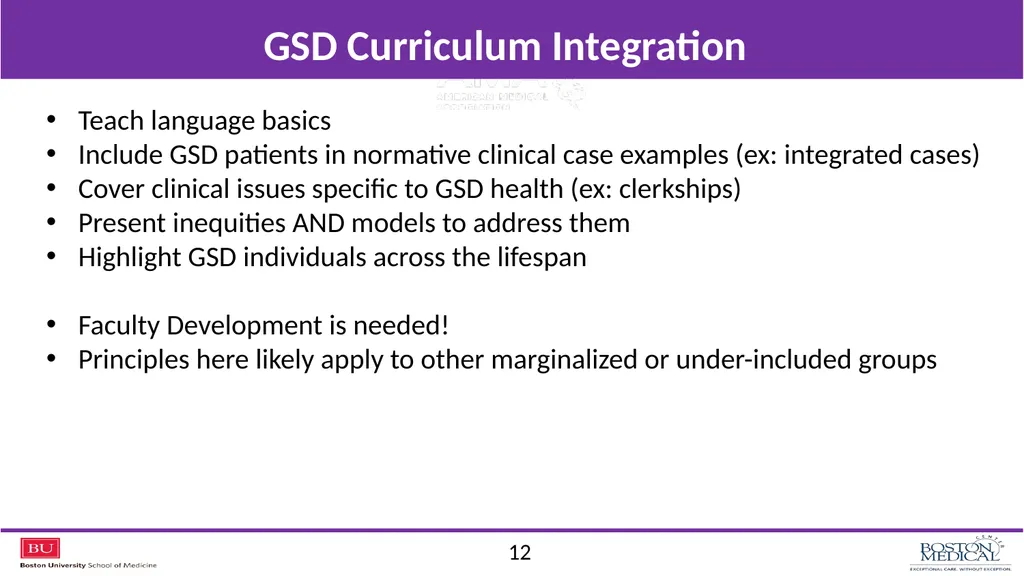
GSD Curriculum Integration 12 Teach language basics
Include GSD patients in normative clinical case examples (ex: integrated cases)
Cover clinical issues specific to GSD health (ex: clerkships)
Present inequities AND models to address them
Highlight GSD individuals across the lifespan
Faculty Development is needed!
Principles here likely apply to other marginalized or under-included groups<br>
13
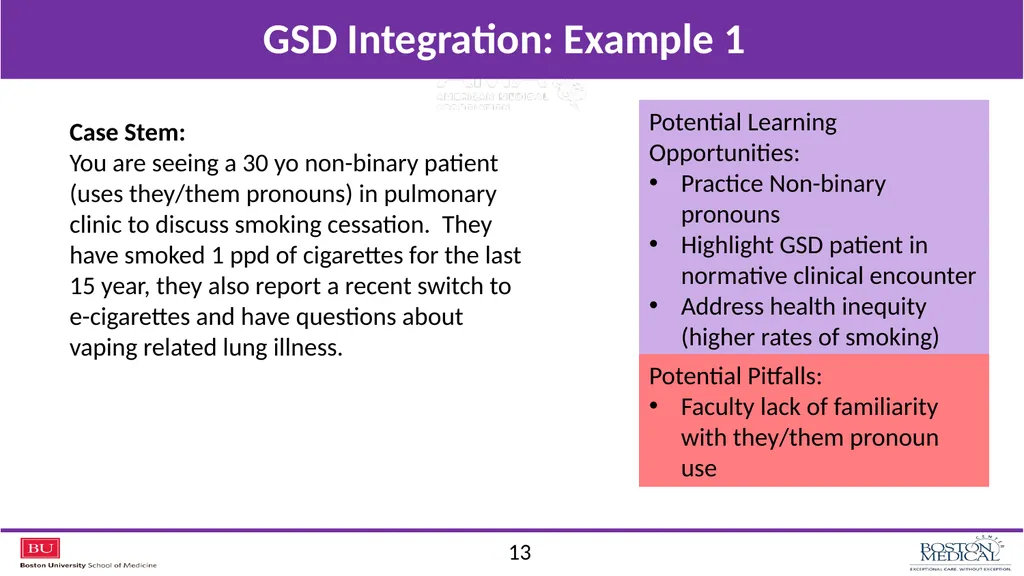
GSD Integration: Example 1 13 Case Stem:
You are seeing a 30 yo non-binary patient (uses they/them pronouns) in pulmonary clinic to discuss smoking cessation. They have smoked 1 ppd of cigarettes for the last 15 year, they also report a recent switch to e-cigarettes and have questions about vaping related lung illness. Potential Learning Opportunities:
Practice Non-binary pronouns
Highlight GSD patient in normative clinical encounter
Address health inequity (higher rates of smoking) Potential Pitfalls:
Faculty lack of familiarity with they/them pronoun use<br>
14
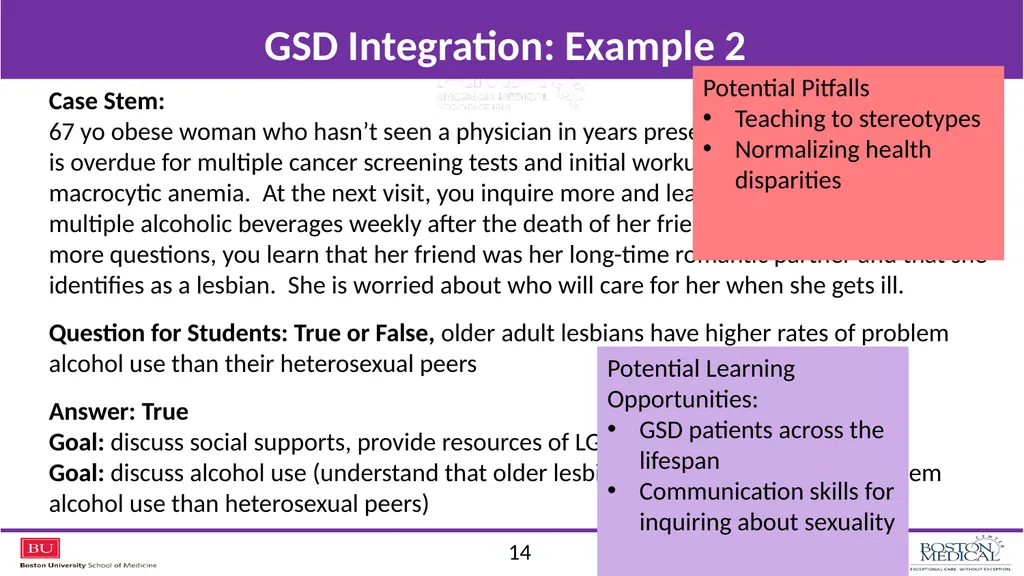
GSD Integration: Example 2 14 Case Stem:
67 yo obese woman who hasn’t seen a physician in years presents to geriatrics clinic. She is overdue for multiple cancer screening tests and initial workup reveals transaminitis and macrocytic anemia. At the next visit, you inquire more and learn that she is drinking multiple alcoholic beverages weekly after the death of her friend two years ago. With more questions, you learn that her friend was her long-time romantic partner and that she identifies as a lesbian. She is worried about who will care for her when she gets ill.
Question for Students: True or False, older adult lesbians have higher rates of problem alcohol use than their heterosexual peers
Answer: True
Goal: discuss social supports, provide resources of LGBT elders
Goal: discuss alcohol use (understand that older lesbians have higher rates of problem alcohol use than heterosexual peers) Potential Learning Opportunities:
GSD patients across the lifespan
Communication skills for inquiring about sexuality Potential Pitfalls
Teaching to stereotypes
Normalizing health disparities<br>
15
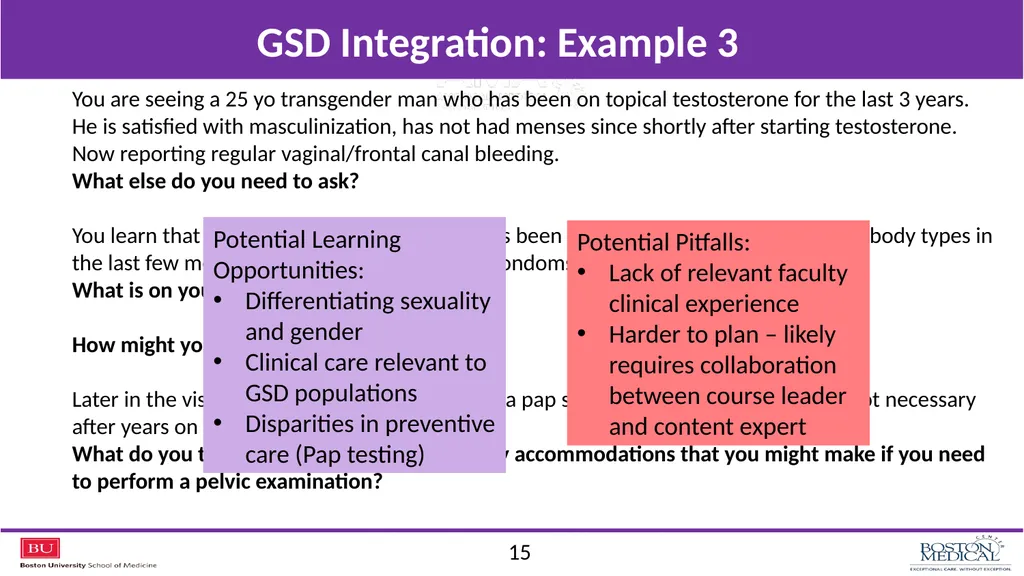
GSD Integration: Example 3 15 You are seeing a 25 yo transgender man who has been on topical testosterone for the last 3 years. He is satisfied with masculinization, has not had menses since shortly after starting testosterone. Now reporting regular vaginal/frontal canal bleeding.
What else do you need to ask?
You learn that he identifies as sexual and he has been sexually active with people of all body types in the last few months. He does not always use condoms.
What is on your initial differential?
How might you stop the bleeding?
Later in the visit, he wonders aloud if he needs a pap smear? He has read that this is not necessary after years on testosterone.
What do you think? Does he need a pap? Any accommodations that you might make if you need to perform a pelvic examination? Potential Learning Opportunities:
Differentiating sexuality and gender
Clinical care relevant to GSD populations
Disparities in preventive care (Pap testing) Potential Pitfalls:
Lack of relevant faculty clinical experience
Harder to plan – likely requires collaboration between course leader and content expert<br>
16
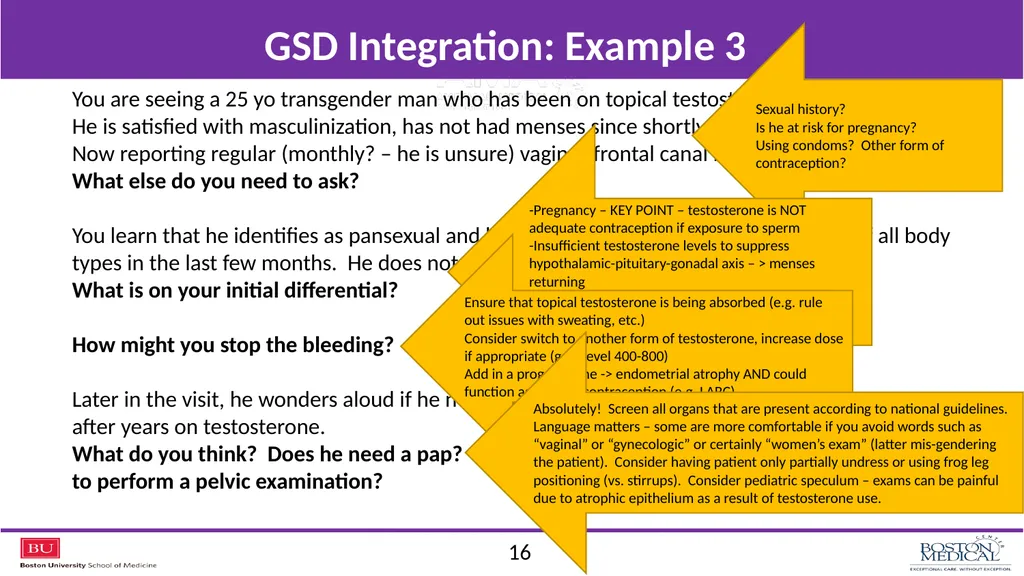
GSD Integration: Example 3 16 You are seeing a 25 yo transgender man who has been on topical testosterone for the last 3 years. He is satisfied with masculinization, has not had menses since shortly after starting testosterone. Now reporting regular (monthly? – he is unsure) vaginal/frontal canal bleeding.
What else do you need to ask?
You learn that he identifies as pansexual and he has been sexually active with people of all body types in the last few months. He does not always use condoms.
What is on your initial differential?
How might you stop the bleeding?
Later in the visit, he wonders aloud if he needs a pap smear? He has read that this is not necessary after years on testosterone.
What do you think? Does he need a pap? Any accommodations that you might make if you need to perform a pelvic examination? Sexual history?
Is he at risk for pregnancy?
Using condoms? Other form of contraception? -Pregnancy – KEY POINT – testosterone is NOT adequate contraception if exposure to sperm
-Insufficient testosterone levels to suppress hypothalamic-pituitary-gonadal axis – > menses returning
-Post-coital bleeding from atrophic vaginitis
-Usual gynecology differential – e.g. fibroids, endometrial hyperplasia, etc. Ensure that topical testosterone is being absorbed (e.g. rule out issues with sweating, etc.)
Consider switch to another form of testosterone, increase dose if appropriate (goal level 400-800)
Add in a progesterone -> endometrial atrophy AND could function as needed contraception (e.g. LARC) Absolutely! Screen all organs that are present according to national guidelines.
Language matters – some are more comfortable if you avoid words such as “vaginal” or “gynecologic” or certainly “women’s exam” (latter mis-gendering the patient). Consider having patient only partially undress or using frog leg positioning (vs. stirrups). Consider pediatric speculum – exams can be painful due to atrophic epithelium as a result of testosterone use.<br>
17
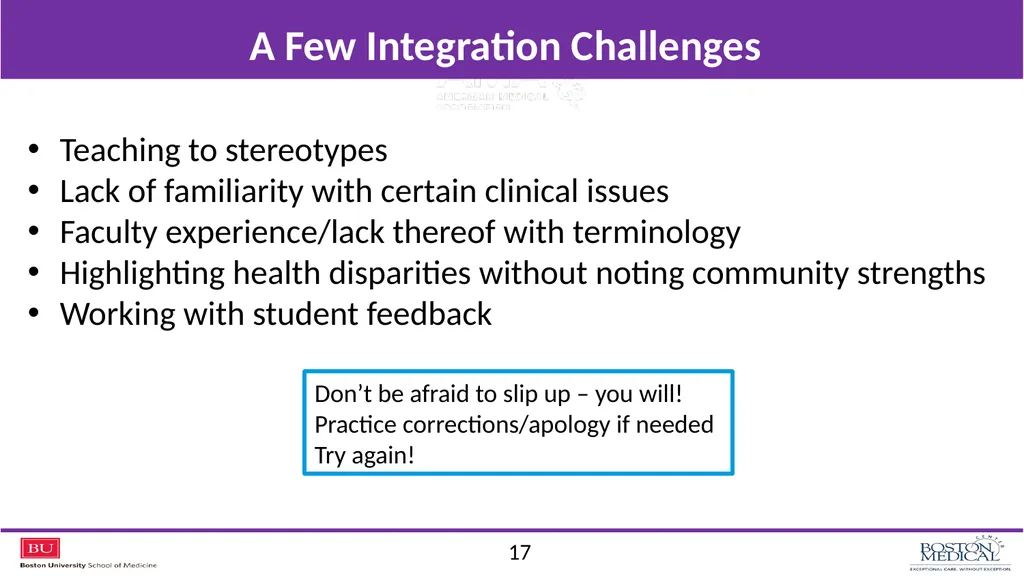
A Few Integration Challenges 17 Teaching to stereotypes
Lack of familiarity with certain clinical issues
Faculty experience/lack thereof with terminology
Highlighting health disparities without noting community strengths
Working with student feedback Don’t be afraid to slip up – you will!
Practice corrections/apology if needed
Try again!<br>
Lack of familiarity with certain clinical issues
Faculty experience/lack thereof with terminology
Highlighting health disparities without noting community strengths
Working with student feedback Don’t be afraid to slip up – you will!
Practice corrections/apology if needed
Try again!<br>
18
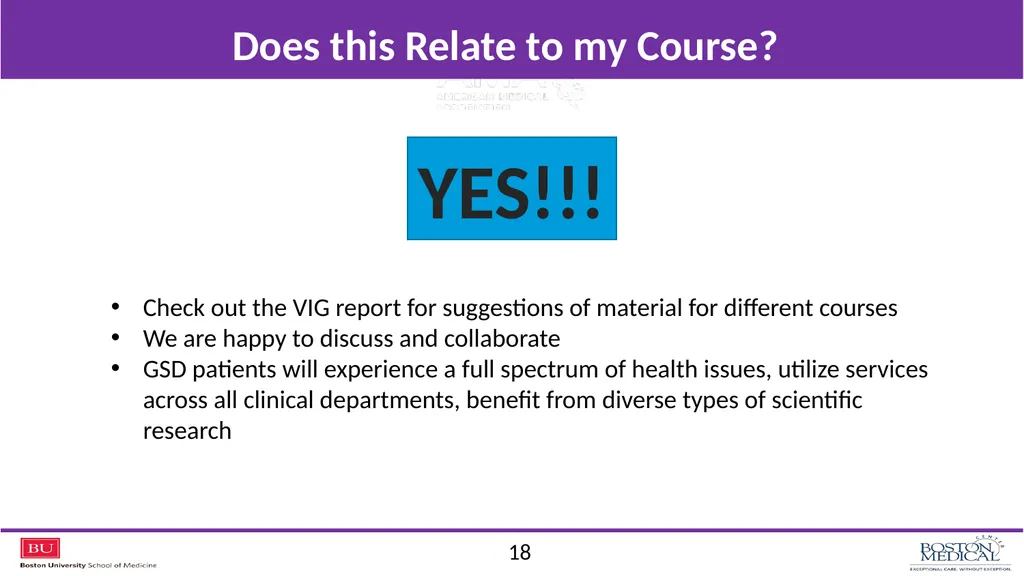
Does this Relate to my Course? 18 Check out the VIG report for suggestions of material for different courses
We are happy to discuss and collaborate
GSD patients will experience a full spectrum of health issues, utilize services across all clinical departments, benefit from diverse types of scientific research YES!!!<br>
We are happy to discuss and collaborate
GSD patients will experience a full spectrum of health issues, utilize services across all clinical departments, benefit from diverse types of scientific research YES!!!<br>
19
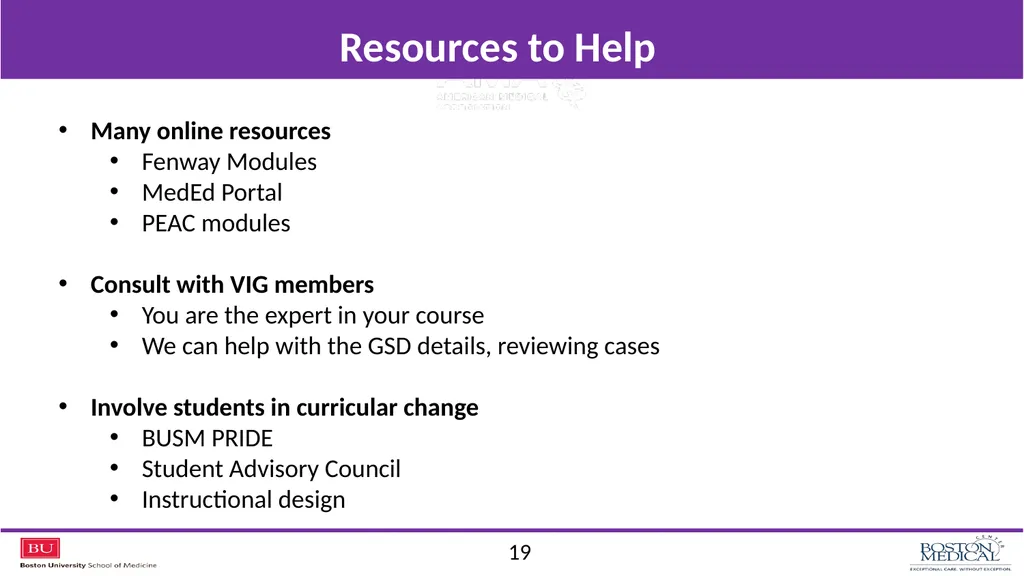
Resources to Help 19 Many online resources
Fenway Modules
MedEd Portal
PEAC modules
Consult with VIG members
You are the expert in your course
We can help with the GSD details, reviewing cases
Involve students in curricular change
BUSM PRIDE
Student Advisory Council
Instructional design<br>
Fenway Modules
MedEd Portal
PEAC modules
Consult with VIG members
You are the expert in your course
We can help with the GSD details, reviewing cases
Involve students in curricular change
BUSM PRIDE
Student Advisory Council
Instructional design<br>
20
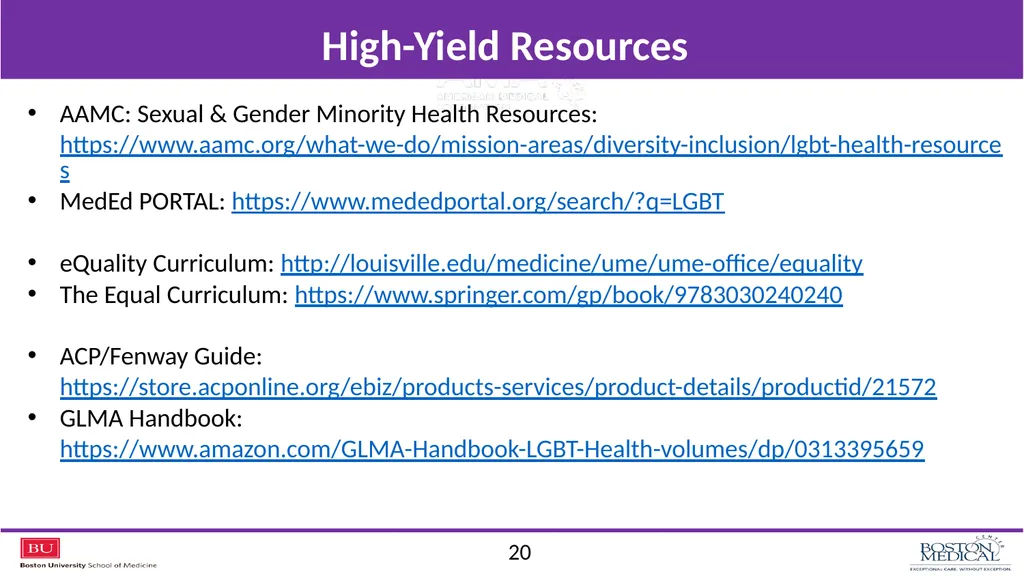
High-Yield Resources 20 AAMC: Sexual & Gender Minority Health Resources: https://www.aamc.org/what-we-do/mission-areas/diversity-inclusion/lgbt-health-resources
MedEd PORTAL: https://www.mededportal.org/search/?q=LGBT
eQuality Curriculum: http://louisville.edu/medicine/ume/ume-office/equality
The Equal Curriculum: https://www.springer.com/gp/book/9783030240240
ACP/Fenway Guide: https://store.acponline.org/ebiz/products-services/product-details/productid/21572
GLMA Handbook: https://www.amazon.com/GLMA-Handbook-LGBT-Health-volumes/dp/0313395659<br>
21
References 21<br>