
June 2021 | ReInventing Diversity by Howard Ross
DJ
Published · 23 slides · 0 views

1 / 1
Description
June 2021 ReInventing Diversity by Howard Ross Presented by Jerry Edgley About the Book Club In this monthly CliffsNotes club, a presenter shares highlights from a book related to leadership, business, neuroscience, or coaching.
Related Topics
Share
Embed code
Download this presentation From Below
"June 2021 | ReInventing Diversity by Howard Ross" is the property of its rightful owner. Permission is granted to download and print the materials on this website for personal, non-commercial use only, and to display it on your personal computer provided you do not modify the materials and that you retain all copyright notices contained in the materials. By downloading content from our website, you accept the terms of this agreement.
Presentation Transcript
01
June 2021 | ReInventing Diversity by Howard Ross
Presented by Jerry Edgley
About the Book Club In this monthly ‘CliffsNotes’ club, a presenter shares highlights from a book related to leadership, business, neuroscience, or coaching. Membership is not required, and there’s no obligation to pre-read the book. This discussion summary is intended to provide a recap of the conversation at Book Club, rather than serve as a thorough book summary. Register here for upcoming events. For the full set of discussion summaries, click here. 1<br>
02
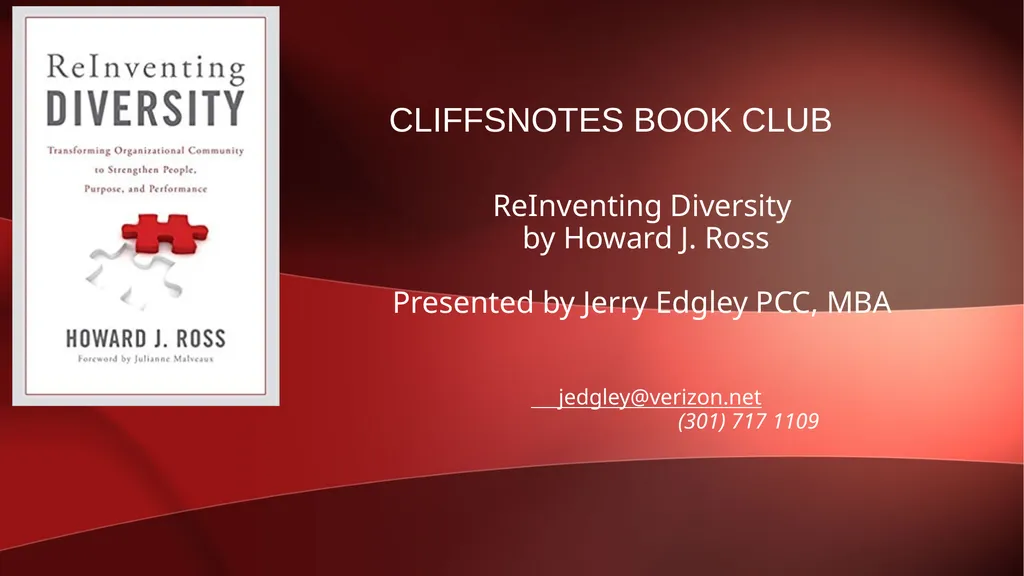
CliffsNotes book club ReInventing Diversity
by Howard J. Ross
Presented by Jerry Edgley PCC, MBA
jedgley@verizon.net
(301) 717 1109<br>
by Howard J. Ross
Presented by Jerry Edgley PCC, MBA
jedgley@verizon.net
(301) 717 1109<br>
03
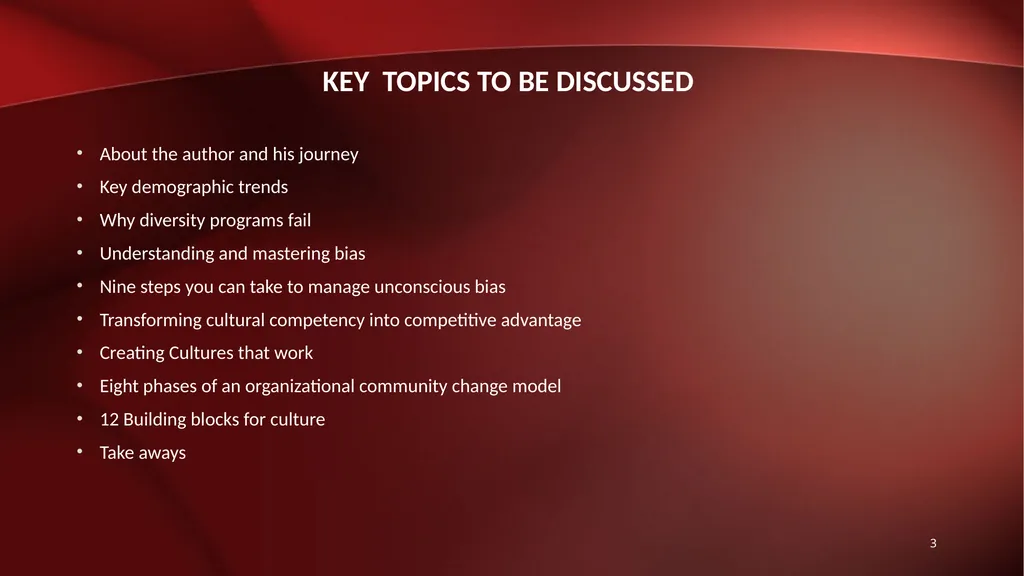
Key Topics to be Discussed About the author and his journey
Key demographic trends
Why diversity programs fail
Understanding and mastering bias
Nine steps you can take to manage unconscious bias
Transforming cultural competency into competitive advantage
Creating Cultures that work
Eight phases of an organizational community change model
12 Building blocks for culture
Take aways 3<br>
04
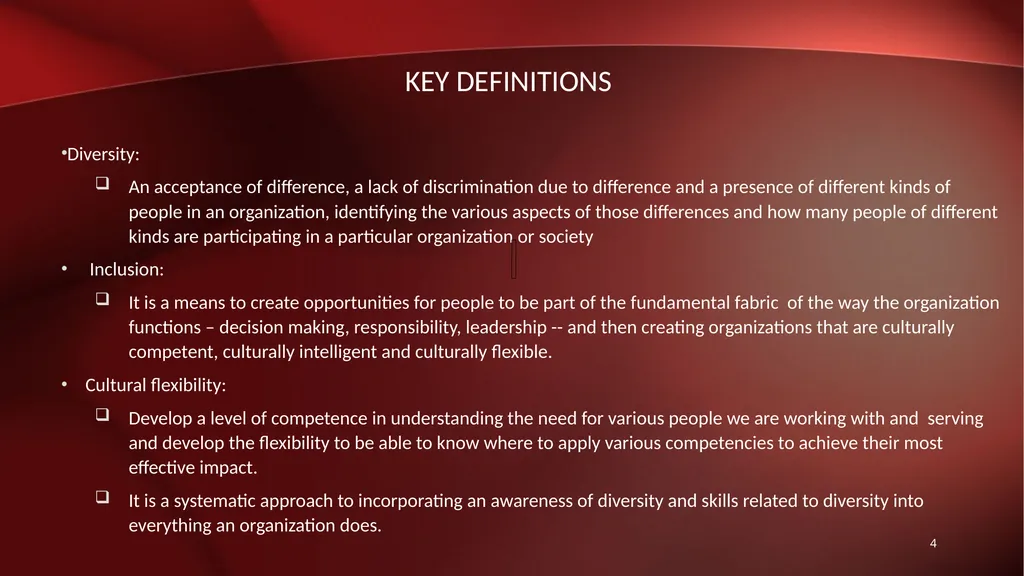
Key Definitions Diversity:
An acceptance of difference, a lack of discrimination due to difference and a presence of different kinds of people in an organization, identifying the various aspects of those differences and how many people of different kinds are participating in a particular organization or society
Inclusion:
It is a means to create opportunities for people to be part of the fundamental fabric of the way the organization functions – decision making, responsibility, leadership -- and then creating organizations that are culturally competent, culturally intelligent and culturally flexible.
Cultural flexibility:
Develop a level of competence in understanding the need for various people we are working with and serving and develop the flexibility to be able to know where to apply various competencies to achieve their most effective impact.
It is a systematic approach to incorporating an awareness of diversity and skills related to diversity into everything an organization does. 4<br>
05
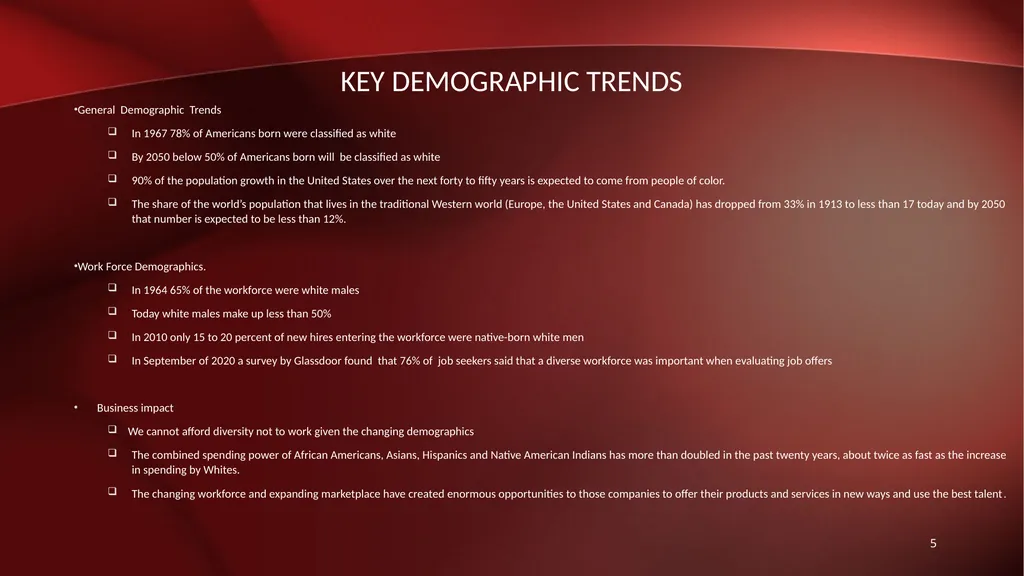
Key Demographic trends General Demographic Trends
In 1967 78% of Americans born were classified as white
By 2050 below 50% of Americans born will be classified as white
90% of the population growth in the United States over the next forty to fifty years is expected to come from people of color.
The share of the world’s population that lives in the traditional Western world (Europe, the United States and Canada) has dropped from 33% in 1913 to less than 17 today and by 2050 that number is expected to be less than 12%.
Work Force Demographics.
In 1964 65% of the workforce were white males
Today white males make up less than 50%
In 2010 only 15 to 20 percent of new hires entering the workforce were native-born white men
In September of 2020 a survey by Glassdoor found that 76% of job seekers said that a diverse workforce was important when evaluating job offers
Business impact
We cannot afford diversity not to work given the changing demographics
The combined spending power of African Americans, Asians, Hispanics and Native American Indians has more than doubled in the past twenty years, about twice as fast as the increase in spending by Whites.
The changing workforce and expanding marketplace have created enormous opportunities to those companies to offer their products and services in new ways and use the best talent. 5<br>
06
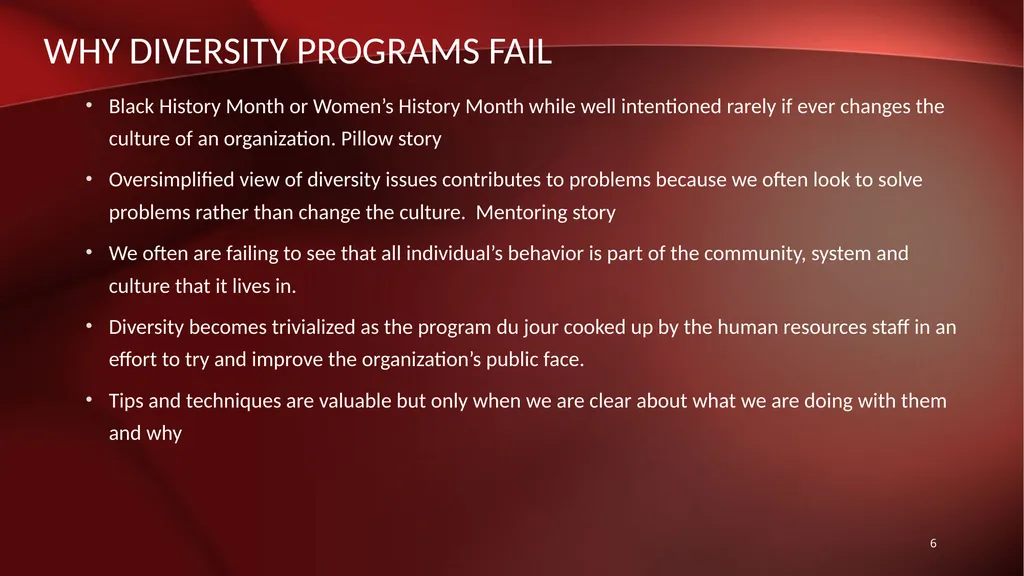
Why diversity programS fail Black History Month or Women’s History Month while well intentioned rarely if ever changes the culture of an organization. Pillow story
Oversimplified view of diversity issues contributes to problems because we often look to solve problems rather than change the culture. Mentoring story
We often are failing to see that all individual’s behavior is part of the community, system and culture that it lives in.
Diversity becomes trivialized as the program du jour cooked up by the human resources staff in an effort to try and improve the organization’s public face.
Tips and techniques are valuable but only when we are clear about what we are doing with them and why 6<br>
07
Group Discussion Questions From Your Experience
What factors aid in making Diversity Programs successful?
Why do Diversity Programs not meet their full potential? 7<br>
What factors aid in making Diversity Programs successful?
Why do Diversity Programs not meet their full potential? 7<br>
08
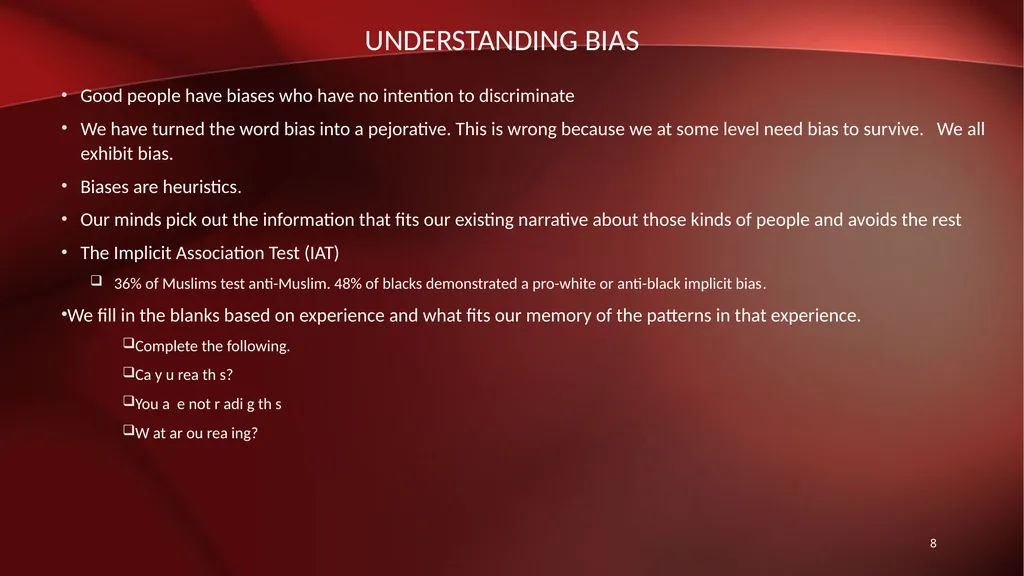
Understanding Bias Good people have biases who have no intention to discriminate
We have turned the word bias into a pejorative. This is wrong because we at some level need bias to survive. We all exhibit bias.
Biases are heuristics.
Our minds pick out the information that fits our existing narrative about those kinds of people and avoids the rest
The Implicit Association Test (IAT)
36% of Muslims test anti-Muslim. 48% of blacks demonstrated a pro-white or anti-black implicit bias.
We fill in the blanks based on experience and what fits our memory of the patterns in that experience.
Complete the following.
Ca y u rea th s?
You a e not r adi g th s
W at ar ou rea ing? 8<br>
09
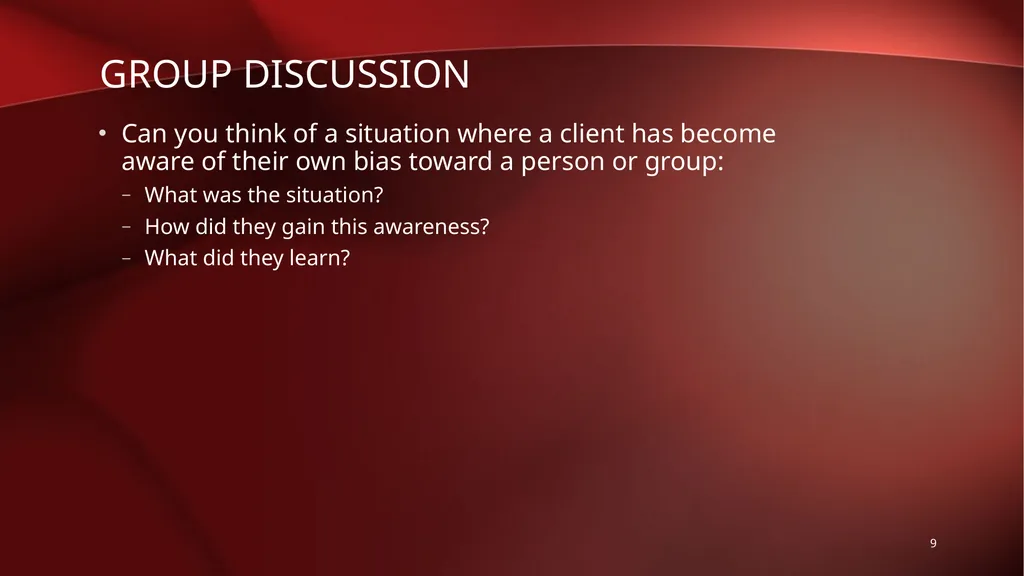
Group Discussion Can you think of a situation where a client has become aware of their own bias toward a person or group:
What was the situation?
How did they gain this awareness?
What did they learn? 9<br>
What was the situation?
How did they gain this awareness?
What did they learn? 9<br>
10
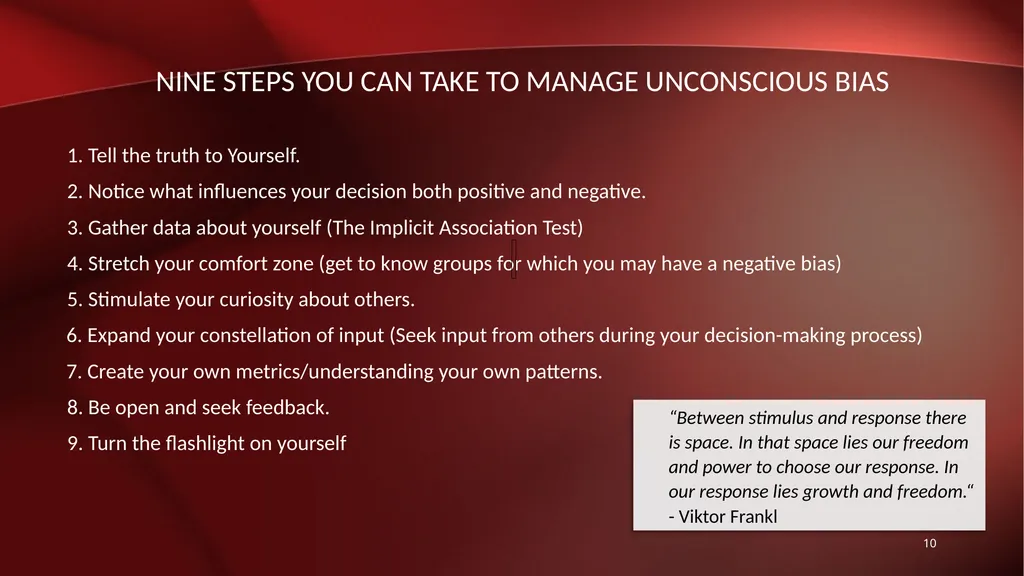
Nine Steps You Can Take to Manage Unconscious Bias 1. Tell the truth to Yourself.
2. Notice what influences your decision both positive and negative.
3. Gather data about yourself (The Implicit Association Test)
4. Stretch your comfort zone (get to know groups for which you may have a negative bias)
5. Stimulate your curiosity about others.
6. Expand your constellation of input (Seek input from others during your decision-making process)
7. Create your own metrics/understanding your own patterns.
8. Be open and seek feedback.
9. Turn the flashlight on yourself “Between stimulus and response there is space. In that space lies our freedom and power to choose our response. In our response lies growth and freedom.“ - Viktor Frankl 10<br>
11
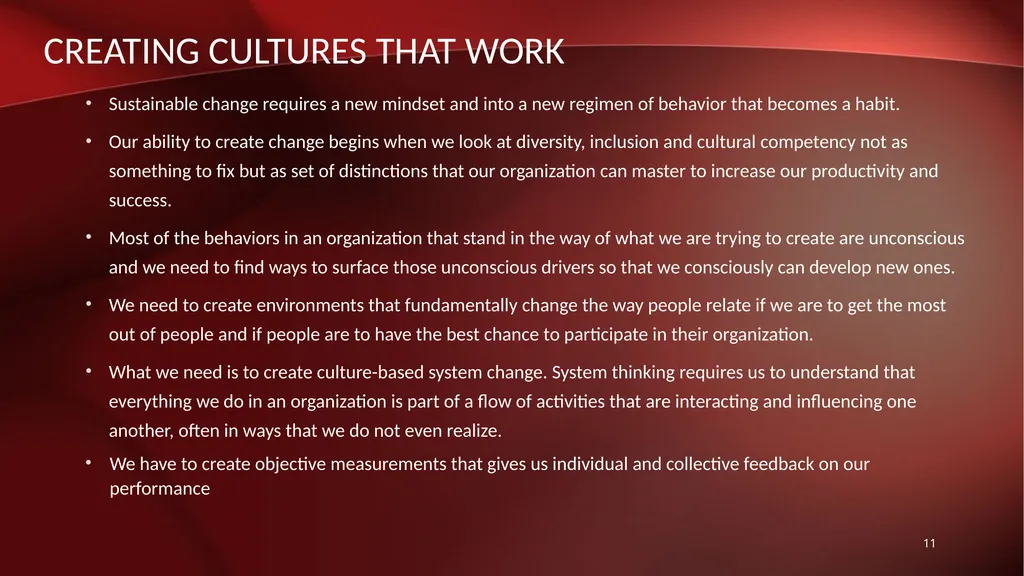
Creating Cultures that work Sustainable change requires a new mindset and into a new regimen of behavior that becomes a habit.
Our ability to create change begins when we look at diversity, inclusion and cultural competency not as something to fix but as set of distinctions that our organization can master to increase our productivity and success.
Most of the behaviors in an organization that stand in the way of what we are trying to create are unconscious and we need to find ways to surface those unconscious drivers so that we consciously can develop new ones.
We need to create environments that fundamentally change the way people relate if we are to get the most out of people and if people are to have the best chance to participate in their organization.
What we need is to create culture-based system change. System thinking requires us to understand that everything we do in an organization is part of a flow of activities that are interacting and influencing one another, often in ways that we do not even realize.
We have to create objective measurements that gives us individual and collective feedback on our performance 11<br>
12
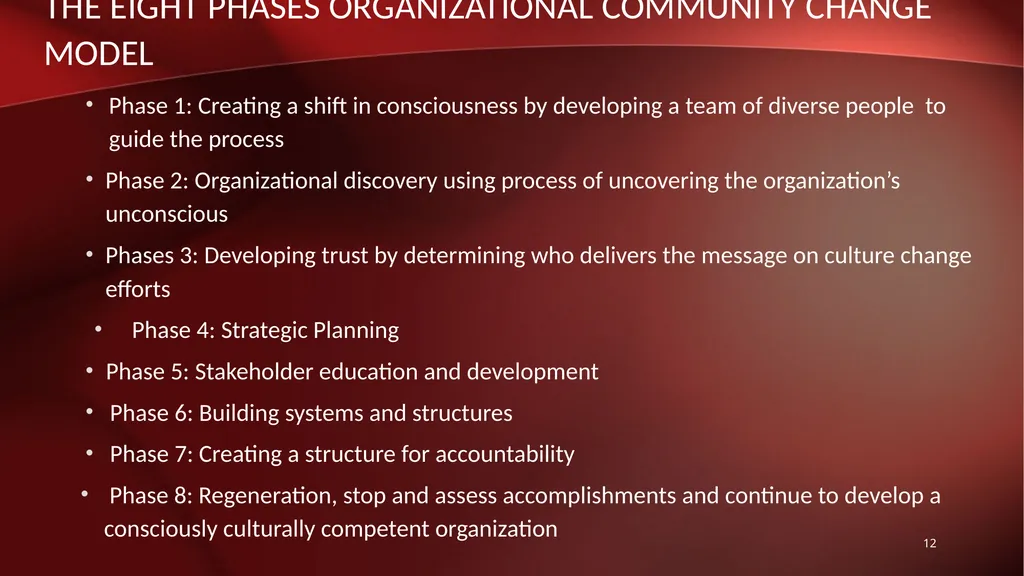
The Eight PhaseS Organizational Community Change Model Phase 1: Creating a shift in consciousness by developing a team of diverse people to guide the process
Phase 2: Organizational discovery using process of uncovering the organization’s unconscious
Phases 3: Developing trust by determining who delivers the message on culture change efforts
Phase 4: Strategic Planning
Phase 5: Stakeholder education and development
Phase 6: Building systems and structures
Phase 7: Creating a structure for accountability
Phase 8: Regeneration, stop and assess accomplishments and continue to develop a consciously culturally competent organization 12<br>
13
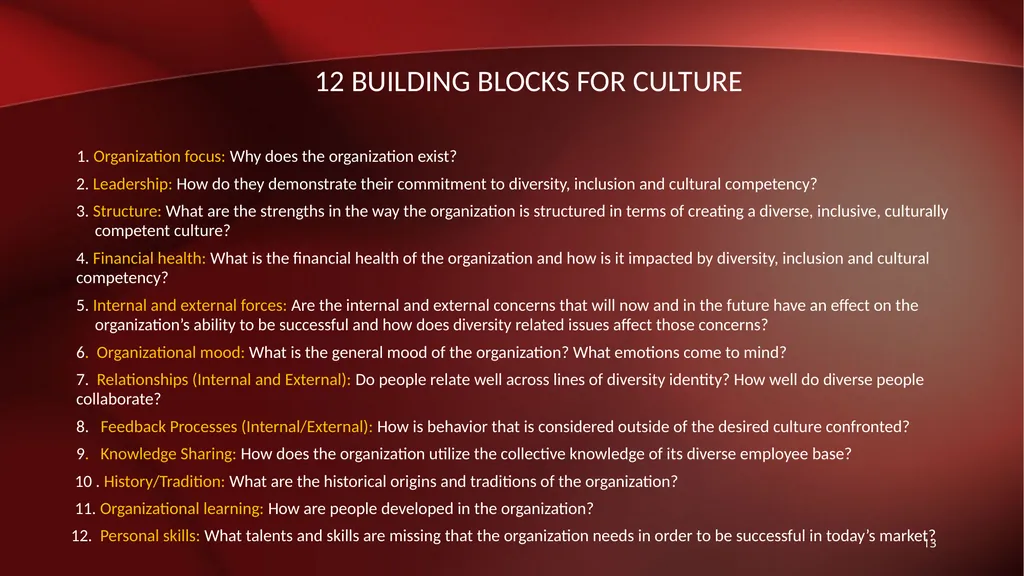
12 Building Blocks for Culture 1. Organization focus: Why does the organization exist?
2. Leadership: How do they demonstrate their commitment to diversity, inclusion and cultural competency?
3. Structure: What are the strengths in the way the organization is structured in terms of creating a diverse, inclusive, culturally competent culture?
4. Financial health: What is the financial health of the organization and how is it impacted by diversity, inclusion and cultural competency?
5. Internal and external forces: Are the internal and external concerns that will now and in the future have an effect on the organization’s ability to be successful and how does diversity related issues affect those concerns?
6. Organizational mood: What is the general mood of the organization? What emotions come to mind?
7. Relationships (Internal and External): Do people relate well across lines of diversity identity? How well do diverse people collaborate?
8. Feedback Processes (Internal/External): How is behavior that is considered outside of the desired culture confronted?
9. Knowledge Sharing: How does the organization utilize the collective knowledge of its diverse employee base?
10 . History/Tradition: What are the historical origins and traditions of the organization?
11. Organizational learning: How are people developed in the organization?
12. Personal skills: What talents and skills are missing that the organization needs in order to be successful in today’s market? 13<br>
14
Key take aways What is one idea you came away with or stood out for you from today’s discussion ? 14<br>
15
Appendix 15<br>
16
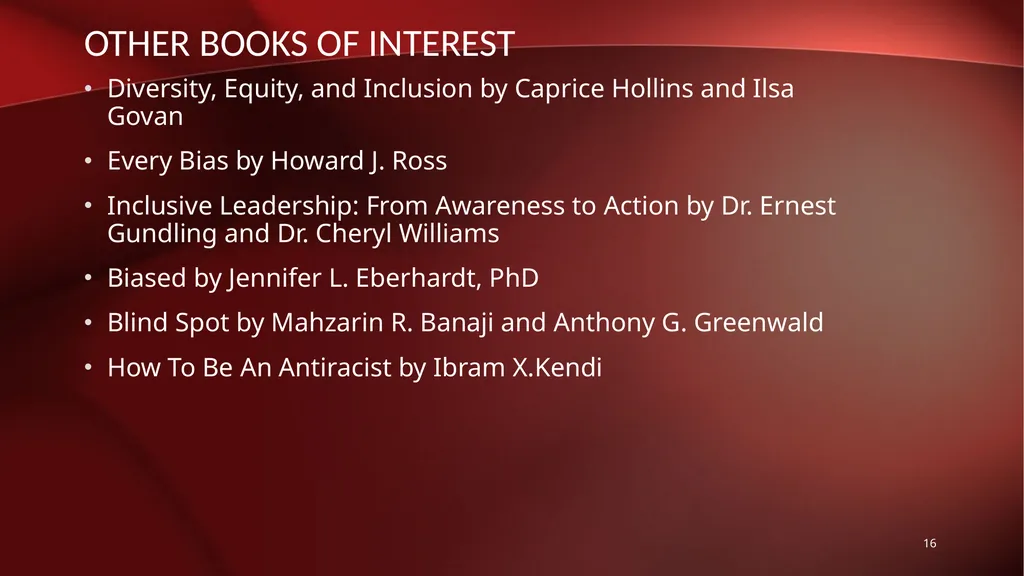
Other books of interest Diversity, Equity, and Inclusion by Caprice Hollins and Ilsa Govan
Every Bias by Howard J. Ross
Inclusive Leadership: From Awareness to Action by Dr. Ernest Gundling and Dr. Cheryl Williams
Biased by Jennifer L. Eberhardt, PhD
Blind Spot by Mahzarin R. Banaji and Anthony G. Greenwald
How To Be An Antiracist by Ibram X.Kendi 16<br>
Every Bias by Howard J. Ross
Inclusive Leadership: From Awareness to Action by Dr. Ernest Gundling and Dr. Cheryl Williams
Biased by Jennifer L. Eberhardt, PhD
Blind Spot by Mahzarin R. Banaji and Anthony G. Greenwald
How To Be An Antiracist by Ibram X.Kendi 16<br>
17
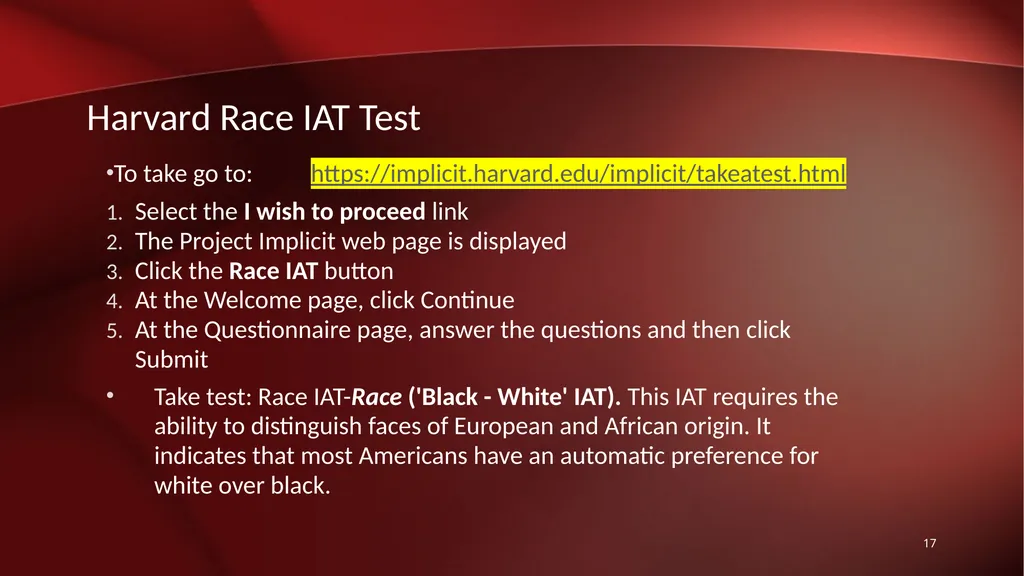
Harvard Race IAT Test To take go to: https://implicit.harvard.edu/implicit/takeatest.html
Select the I wish to proceed link
The Project Implicit web page is displayed
Click the Race IAT button
At the Welcome page, click Continue
At the Questionnaire page, answer the questions and then click Submit
Take test: Race IAT-Race ('Black - White' IAT). This IAT requires the ability to distinguish faces of European and African origin. It indicates that most Americans have an automatic preference for white over black. 17<br>
18
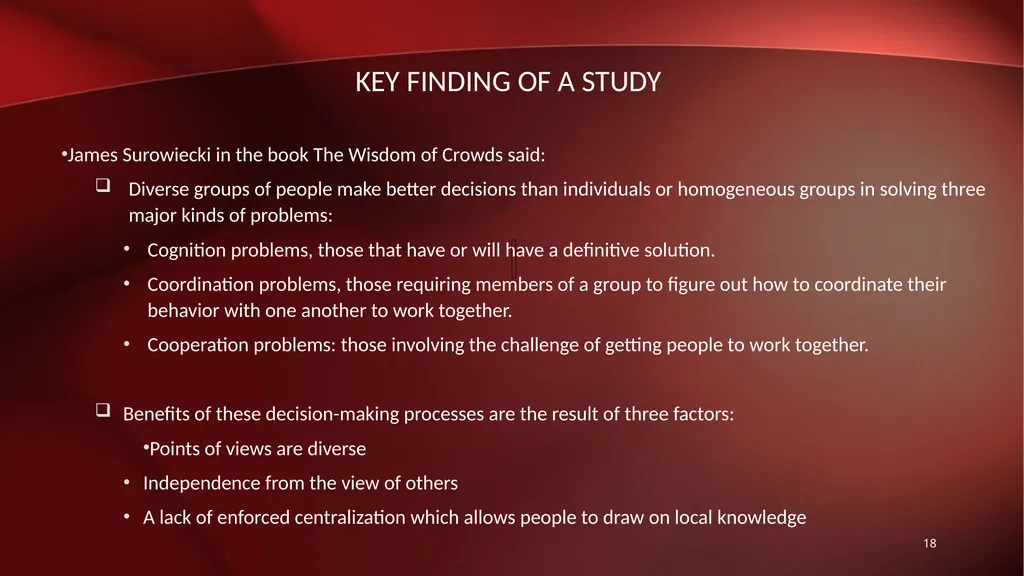
Key finding of a study James Surowiecki in the book The Wisdom of Crowds said:
Diverse groups of people make better decisions than individuals or homogeneous groups in solving three major kinds of problems:
Cognition problems, those that have or will have a definitive solution.
Coordination problems, those requiring members of a group to figure out how to coordinate their behavior with one another to work together.
Cooperation problems: those involving the challenge of getting people to work together.
Benefits of these decision-making processes are the result of three factors:
Points of views are diverse
Independence from the view of others
A lack of enforced centralization which allows people to draw on local knowledge 18<br>
19
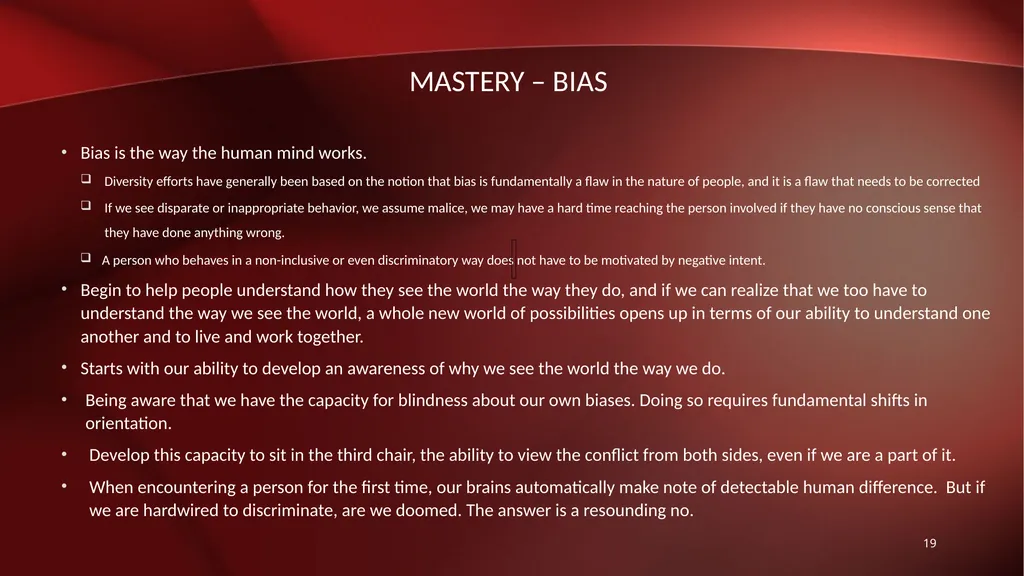
Mastery – Bias Bias is the way the human mind works.
Diversity efforts have generally been based on the notion that bias is fundamentally a flaw in the nature of people, and it is a flaw that needs to be corrected
If we see disparate or inappropriate behavior, we assume malice, we may have a hard time reaching the person involved if they have no conscious sense that they have done anything wrong.
A person who behaves in a non-inclusive or even discriminatory way does not have to be motivated by negative intent.
Begin to help people understand how they see the world the way they do, and if we can realize that we too have to understand the way we see the world, a whole new world of possibilities opens up in terms of our ability to understand one another and to live and work together.
Starts with our ability to develop an awareness of why we see the world the way we do.
Being aware that we have the capacity for blindness about our own biases. Doing so requires fundamental shifts in orientation.
Develop this capacity to sit in the third chair, the ability to view the conflict from both sides, even if we are a part of it.
When encountering a person for the first time, our brains automatically make note of detectable human difference. But if we are hardwired to discriminate, are we doomed. The answer is a resounding no. 19<br>
20
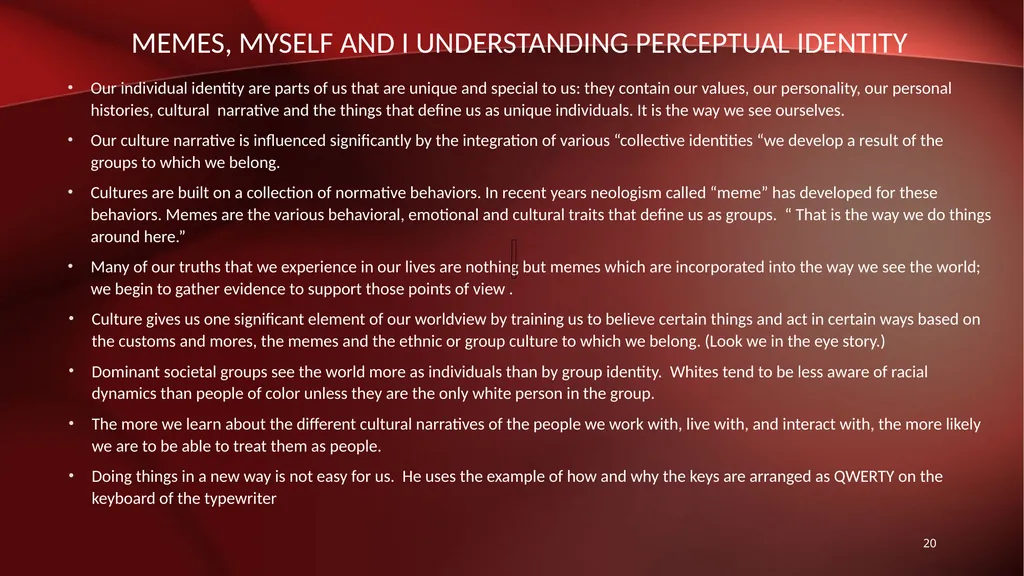
Memes, Myself and I Understanding Perceptual Identity Our individual identity are parts of us that are unique and special to us: they contain our values, our personality, our personal histories, cultural narrative and the things that define us as unique individuals. It is the way we see ourselves.
Our culture narrative is influenced significantly by the integration of various “collective identities “we develop a result of the groups to which we belong.
Cultures are built on a collection of normative behaviors. In recent years neologism called “meme” has developed for these behaviors. Memes are the various behavioral, emotional and cultural traits that define us as groups. “ That is the way we do things around here.”
Many of our truths that we experience in our lives are nothing but memes which are incorporated into the way we see the world; we begin to gather evidence to support those points of view .
Culture gives us one significant element of our worldview by training us to believe certain things and act in certain ways based on the customs and mores, the memes and the ethnic or group culture to which we belong. (Look we in the eye story.)
Dominant societal groups see the world more as individuals than by group identity. Whites tend to be less aware of racial dynamics than people of color unless they are the only white person in the group.
The more we learn about the different cultural narratives of the people we work with, live with, and interact with, the more likely we are to be able to treat them as people.
Doing things in a new way is not easy for us. He uses the example of how and why the keys are arranged as QWERTY on the keyboard of the typewriter 20<br>
21
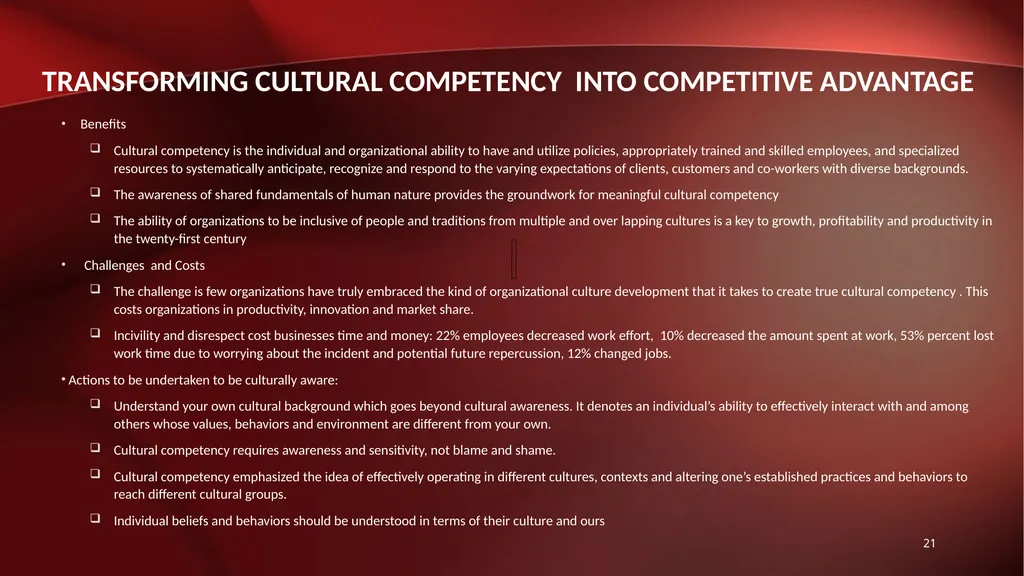
Transforming Cultural Competency Into Competitive Advantage Benefits
Cultural competency is the individual and organizational ability to have and utilize policies, appropriately trained and skilled employees, and specialized resources to systematically anticipate, recognize and respond to the varying expectations of clients, customers and co-workers with diverse backgrounds.
The awareness of shared fundamentals of human nature provides the groundwork for meaningful cultural competency
The ability of organizations to be inclusive of people and traditions from multiple and over lapping cultures is a key to growth, profitability and productivity in the twenty-first century
Challenges and Costs
The challenge is few organizations have truly embraced the kind of organizational culture development that it takes to create true cultural competency . This costs organizations in productivity, innovation and market share.
Incivility and disrespect cost businesses time and money: 22% employees decreased work effort, 10% decreased the amount spent at work, 53% percent lost work time due to worrying about the incident and potential future repercussion, 12% changed jobs.
Actions to be undertaken to be culturally aware:
Understand your own cultural background which goes beyond cultural awareness. It denotes an individual’s ability to effectively interact with and among others whose values, behaviors and environment are different from your own.
Cultural competency requires awareness and sensitivity, not blame and shame.
Cultural competency emphasized the idea of effectively operating in different cultures, contexts and altering one’s established practices and behaviors to reach different cultural groups.
Individual beliefs and behaviors should be understood in terms of their culture and ours 21<br>
22
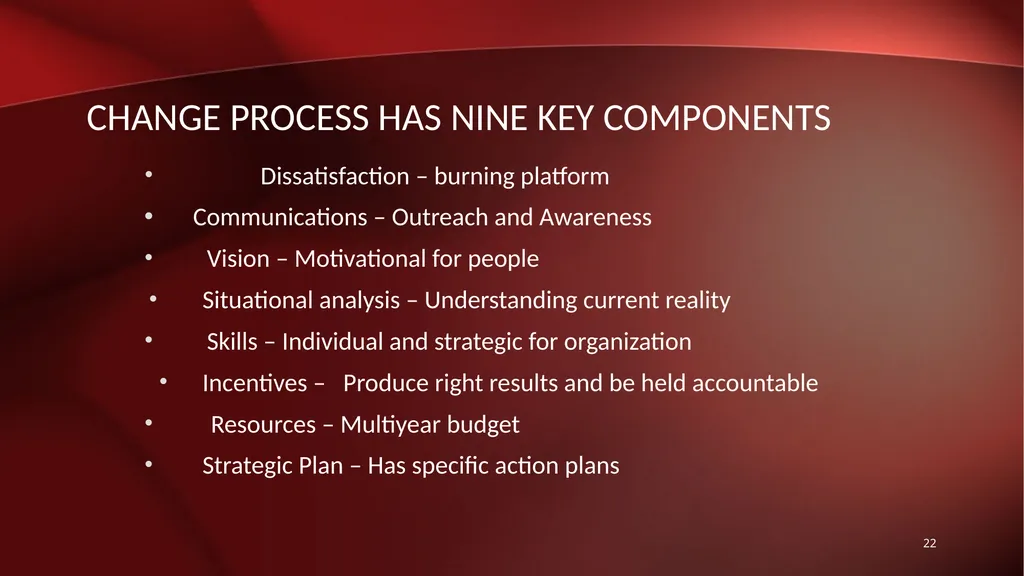
Change process has Nine key components Dissatisfaction – burning platform
Communications – Outreach and Awareness
Vision – Motivational for people
Situational analysis – Understanding current reality
Skills – Individual and strategic for organization
Incentives – Produce right results and be held accountable
Resources – Multiyear budget
Strategic Plan – Has specific action plans 22<br>
23
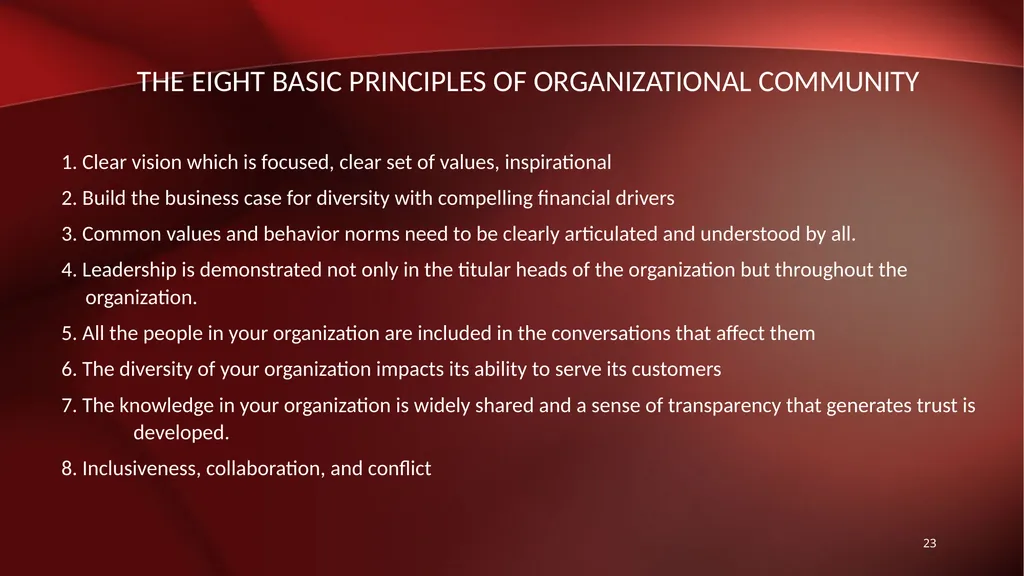
The Eight Basic Principles of Organizational Community 1. Clear vision which is focused, clear set of values, inspirational
2. Build the business case for diversity with compelling financial drivers
3. Common values and behavior norms need to be clearly articulated and understood by all.
4. Leadership is demonstrated not only in the titular heads of the organization but throughout the organization.
5. All the people in your organization are included in the conversations that affect them
6. The diversity of your organization impacts its ability to serve its customers
7. The knowledge in your organization is widely shared and a sense of transparency that generates trust is developed.
8. Inclusiveness, collaboration, and conflict 23<br>