
L1-L2 Functional Skills English writing Skills
LD
Published · 24 slides · 0 views

1 / 1
Description
L1-L2 Functional Skills English writing Skills Building Lesson 8 Write emails using appropriate structure, detail and formality L1L2 Functional English writing content descriptors. L2 extra content in square brackets. Scope: L1 (L2) -
Related Topics
Share
Embed code
Download this presentation From Below
"L1-L2 Functional Skills English writing Skills" is the property of its rightful owner. Permission is granted to download and print the materials on this website for personal, non-commercial use only, and to display it on your personal computer provided you do not modify the materials and that you retain all copyright notices contained in the materials. By downloading content from our website, you accept the terms of this agreement.
Presentation Transcript
01
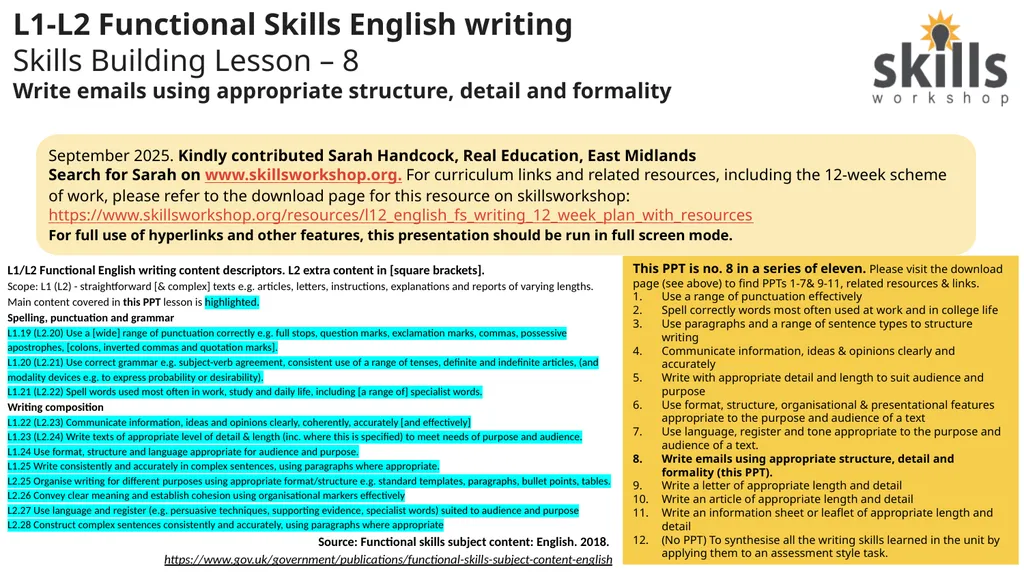
L1-L2 Functional Skills English writing
Skills Building Lesson – 8
Write emails using appropriate structure, detail and formality L1/L2 Functional English writing content descriptors. L2 extra content in [square brackets].
Scope: L1 (L2) - straightforward [& complex] texts e.g. articles, letters, instructions, explanations and reports of varying lengths.
Main content covered in this PPT lesson is highlighted.
Spelling, punctuation and grammar
L1.19 (L2.20) Use a [wide] range of punctuation correctly e.g. full stops, question marks, exclamation marks, commas, possessive apostrophes, [colons, inverted commas and quotation marks].
L1.20 (L2.21) Use correct grammar e.g. subject-verb agreement, consistent use of a range of tenses, definite and indefinite articles, (and modality devices e.g. to express probability or desirability).
L1.21 (L2.22) Spell words used most often in work, study and daily life, including [a range of] specialist words.
Writing composition
L1.22 (L2.23) Communicate information, ideas and opinions clearly, coherently, accurately [and effectively]
L1.23 (L2.24) Write texts of appropriate level of detail & length (inc. where this is specified) to meet needs of purpose and audience.
L1.24 Use format, structure and language appropriate for audience and purpose.
L1.25 Write consistently and accurately in complex sentences, using paragraphs where appropriate.
L2.25 Organise writing for different purposes using appropriate format/structure e.g. standard templates, paragraphs, bullet points, tables.
L2.26 Convey clear meaning and establish cohesion using organisational markers effectively
L2.27 Use language and register (e.g. persuasive techniques, supporting evidence, specialist words) suited to audience and purpose
L2.28 Construct complex sentences consistently and accurately, using paragraphs where appropriate
Source: Functional skills subject content: English. 2018.
https://www.gov.uk/government/publications/functional-skills-subject-content-english September 2025. Kindly contributed Sarah Handcock, Real Education, East Midlands
Search for Sarah on www.skillsworkshop.org. For curriculum links and related resources, including the 12-week scheme of work, please refer to the download page for this resource on skillsworkshop:
https://www.skillsworkshop.org/resources/l12_english_fs_writing_12_week_plan_with_resources
For full use of hyperlinks and other features, this presentation should be run in full screen mode. This PPT is no. 8 in a series of eleven. Please visit the download page (see above) to find PPTs 1-7& 9-11, related resources & links.
Use a range of punctuation effectively
Spell correctly words most often used at work and in college life
Use paragraphs and a range of sentence types to structure writing
Communicate information, ideas & opinions clearly and accurately
Write with appropriate detail and length to suit audience and purpose
Use format, structure, organisational & presentational features appropriate to the purpose and audience of a text
Use language, register and tone appropriate to the purpose and audience of a text.
Write emails using appropriate structure, detail and formality (this PPT).
Write a letter of appropriate length and detail
Write an article of appropriate length and detail
Write an information sheet or leaflet of appropriate length and detail
(No PPT) To synthesise all the writing skills learned in the unit by applying them to an assessment style task.<br>
02
L1 & 2 English Functional Skills Writing Lesson 8 Learning Outcome: To write emails using appropriate structure, detail and formality<br>
03
Last lesson recap:
Last lesson, you developed your ability to write in the correct tone and register and write effectively to fit a text’s audience and purpose.
Name 3 language features you could use in your writing and for each one identify the type of text you might find it in and the effect it would have on the reader.
Link to today’s lesson:
Today, you are going to apply all your writing skills to writing formal and informal emails.<br>
04
Key Vocabulary subject line
recipient<br>
recipient<br>
05
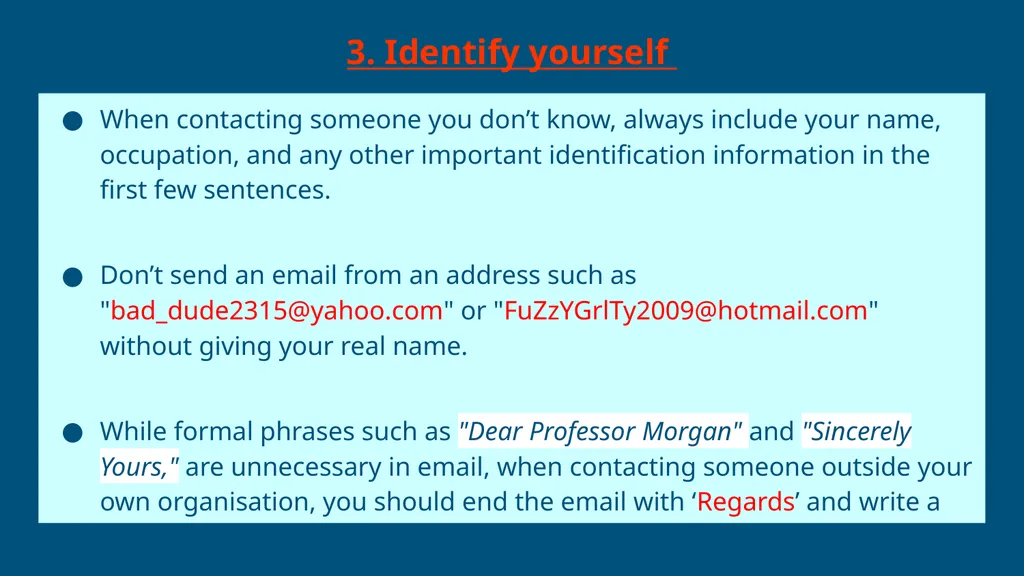
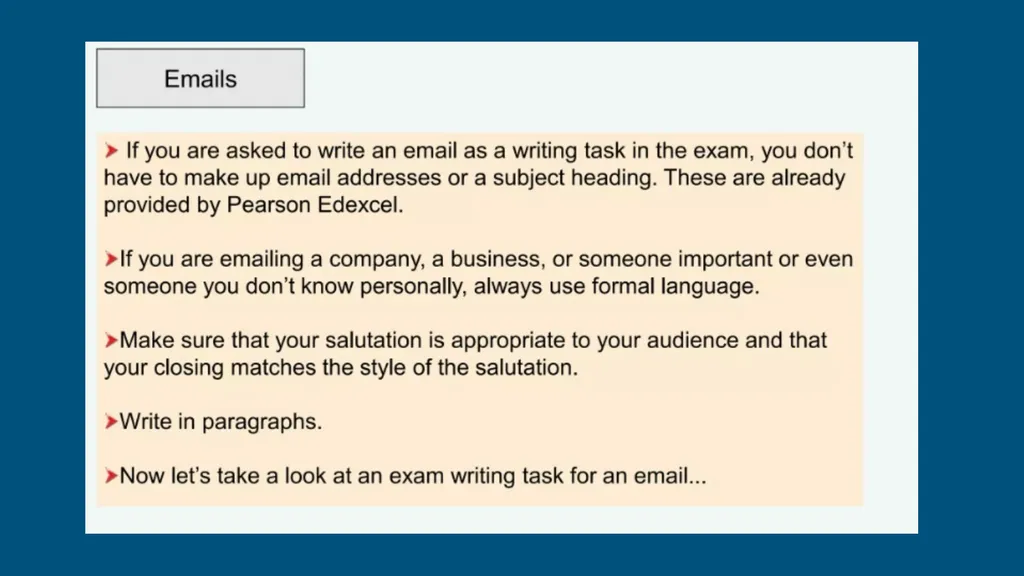
Before we have a look at writing an email for your assessment, let’s look at some rules you should follow when emailing in your day-to-day life.<br>
06
1. The subject line Recipients scan the subject line in order to decide whether to open, forward, file, or trash a message. Before you hit "send," take a moment to write a subject line that accurately describes the content:
Subject: [Blank] If you don't put a subject line on your email, you are sending the message that your name in the "From" line is all your recipient should need in order to make it a top priority. That could come across as arrogant, or at the very least, thoughtless.
"Important! Read Immediately!!"What is important to you may not be important to your reader. Rather than brashly announcing that the secret contents of your message are important, write an informative headline that communicates at least the core of what you feel is so important:
"Emergency: All Cars in the Car Park Will Be Clamped in 1 Hour."
The more specific you are, the more likely your recipient's spam-blocker will let your message through.<br>
07
2 .Stay Focused Keep your message readable.
Use standard capitalisation and spelling, especially when your message asks your recipient to do work for you.
u want ur prof r ur boss 2 think u cant spl? LOL ;-)
Skip lines between paragraphs.
Use standard capitalisation. All-caps comes across as shouting, and no caps invokes the image of a lazy teenager. Regardless of your intention, people will respond accordingly.<br>
08
3. Identify yourself When contacting someone you don’t know, always include your name, occupation, and any other important identification information in the first few sentences.
Don’t send an email from an address such as "bad_dude2315@yahoo.com" or "FuZzYGrlTy2009@hotmail.com" without giving your real name.
While formal phrases such as "Dear Professor Morgan" and "Sincerely Yours," are unnecessary in email, when contacting someone outside your own organisation, you should end the email with ‘Regards’ and write a signature line that includes your full name.<br>
09
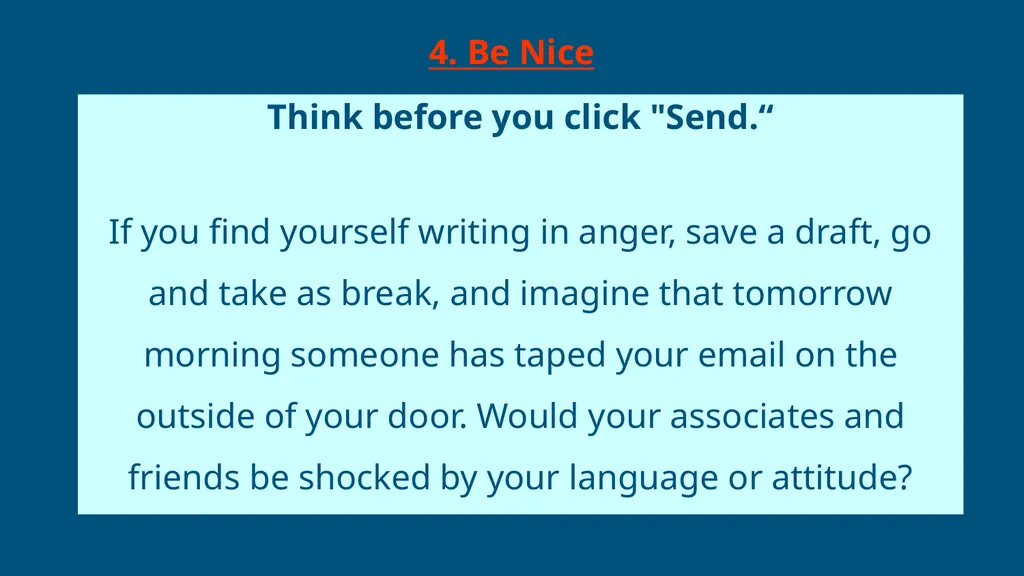
4. Be Nice Think before you click "Send.“
If you find yourself writing in anger, save a draft, go and take as break, and imagine that tomorrow morning someone has taped your email on the outside of your door. Would your associates and friends be shocked by your language or attitude?<br>
If you find yourself writing in anger, save a draft, go and take as break, and imagine that tomorrow morning someone has taped your email on the outside of your door. Would your associates and friends be shocked by your language or attitude?<br>
10
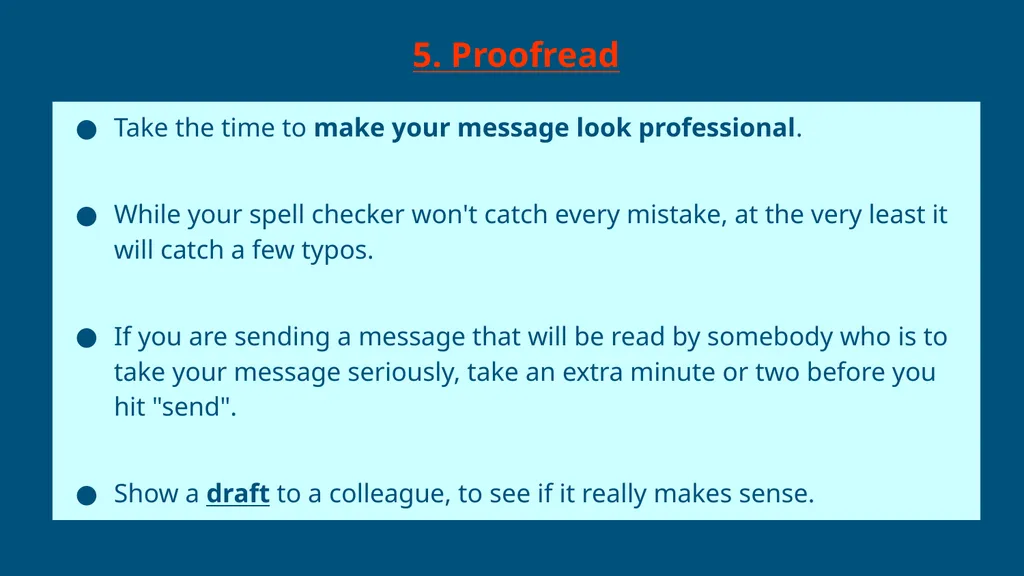
5. Proofread Take the time to make your message look professional.
While your spell checker won't catch every mistake, at the very least it will catch a few typos.
If you are sending a message that will be read by somebody who is to take your message seriously, take an extra minute or two before you hit "send".
Show a draft to a colleague, to see if it really makes sense.<br>
11
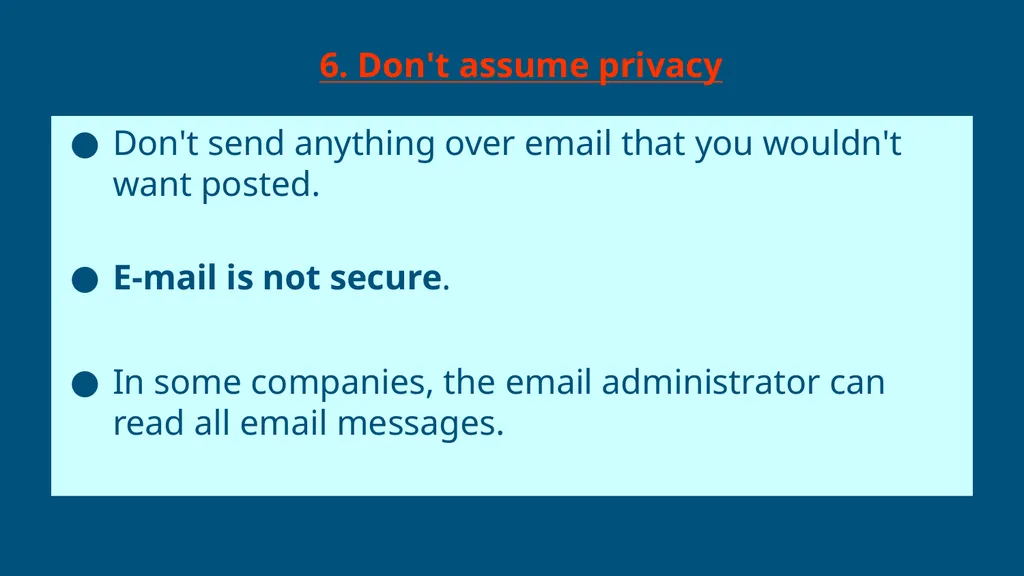
6. Don't assume privacy Don't send anything over email that you wouldn't want posted.
E-mail is not secure.
In some companies, the email administrator can read all email messages.<br>
E-mail is not secure.
In some companies, the email administrator can read all email messages.<br>
12
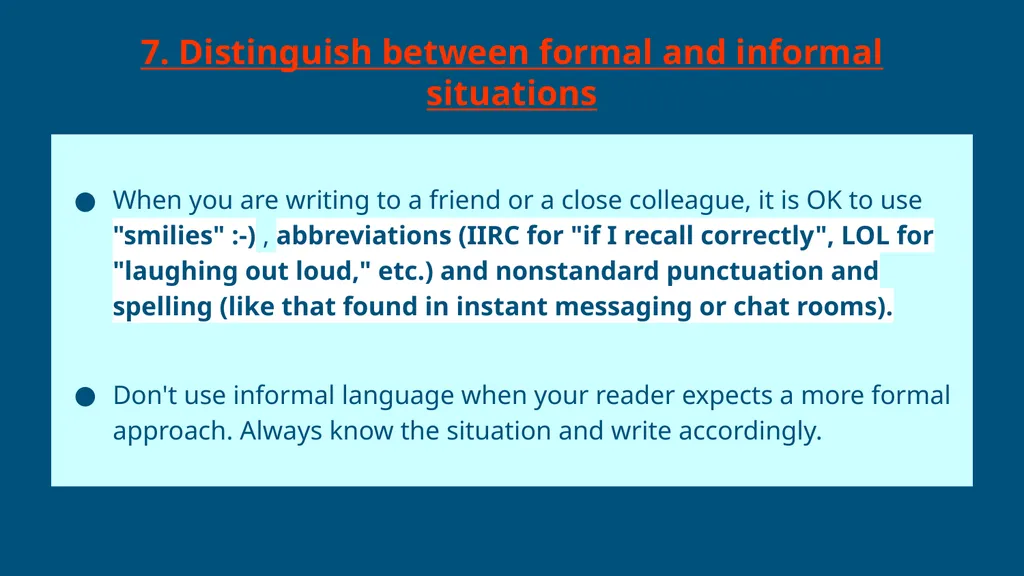
7. Distinguish between formal and informal situations When you are writing to a friend or a close colleague, it is OK to use "smilies" :-) , abbreviations (IIRC for "if I recall correctly", LOL for "laughing out loud," etc.) and nonstandard punctuation and spelling (like that found in instant messaging or chat rooms).
Don't use informal language when your reader expects a more formal approach. Always know the situation and write accordingly.<br>
Don't use informal language when your reader expects a more formal approach. Always know the situation and write accordingly.<br>
13
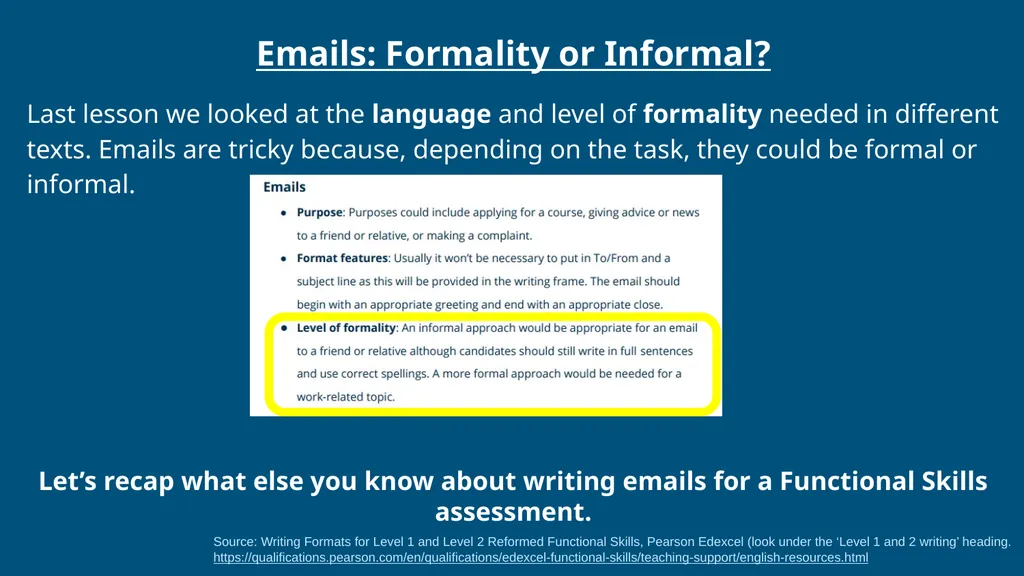
Emails: Formality or Informal?
Last lesson we looked at the language and level of formality needed in different texts. Emails are tricky because, depending on the task, they could be formal or informal. Let’s recap what else you know about writing emails for a Functional Skills assessment. Source: Writing Formats for Level 1 and Level 2 Reformed Functional Skills, Pearson Edexcel (look under the ‘Level 1 and 2 writing’ heading.
https://qualifications.pearson.com/en/qualifications/edexcel-functional-skills/teaching-support/english-resources.html<br>
14
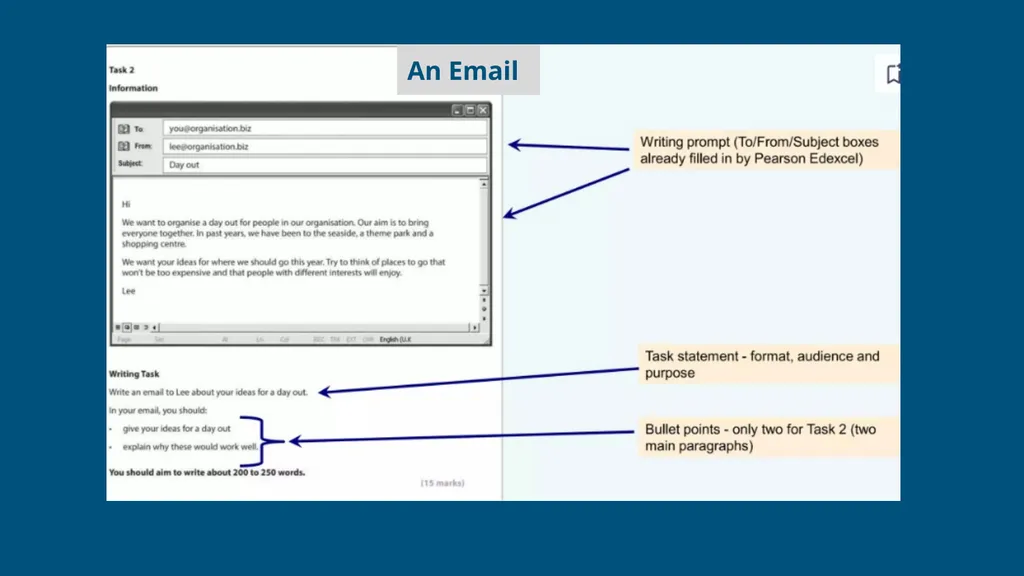
An Email<br>
15
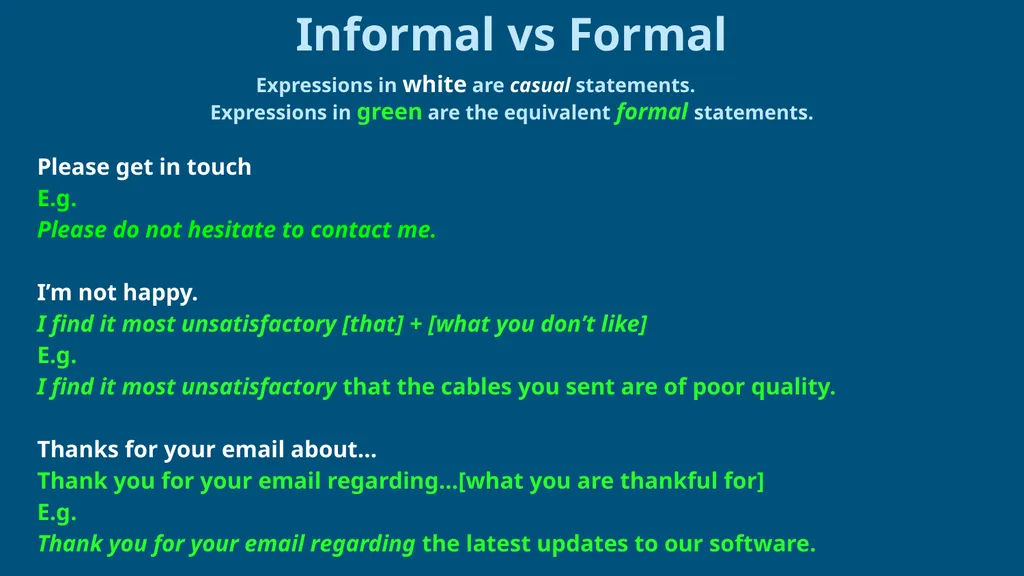
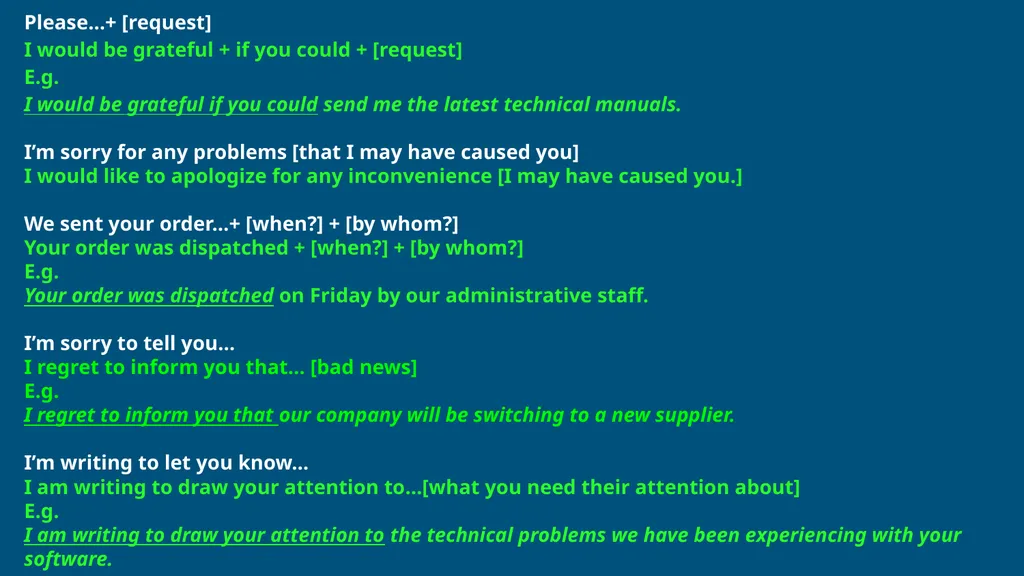
Expressions in white are casual statements.
Expressions in green are the equivalent formal statements.
Please get in touch
E.g.
Please do not hesitate to contact me.
I’m not happy.
I find it most unsatisfactory [that] + [what you don’t like]
E.g.
I find it most unsatisfactory that the cables you sent are of poor quality.
Thanks for your email about…
Thank you for your email regarding...[what you are thankful for]
E.g.
Thank you for your email regarding the latest updates to our software. Informal vs Formal<br>
16
Please…+ [request]
I would be grateful + if you could + [request]
E.g.
I would be grateful if you could send me the latest technical manuals.
I’m sorry for any problems [that I may have caused you]
I would like to apologize for any inconvenience [I may have caused you.]
We sent your order…+ [when?] + [by whom?]
Your order was dispatched + [when?] + [by whom?]
E.g.
Your order was dispatched on Friday by our administrative staff.
I’m sorry to tell you…
I regret to inform you that… [bad news]
E.g.
I regret to inform you that our company will be switching to a new supplier.
I’m writing to let you know…
I am writing to draw your attention to…[what you need their attention about]
E.g.
I am writing to draw your attention to the technical problems we have been experiencing with your software.<br>
17
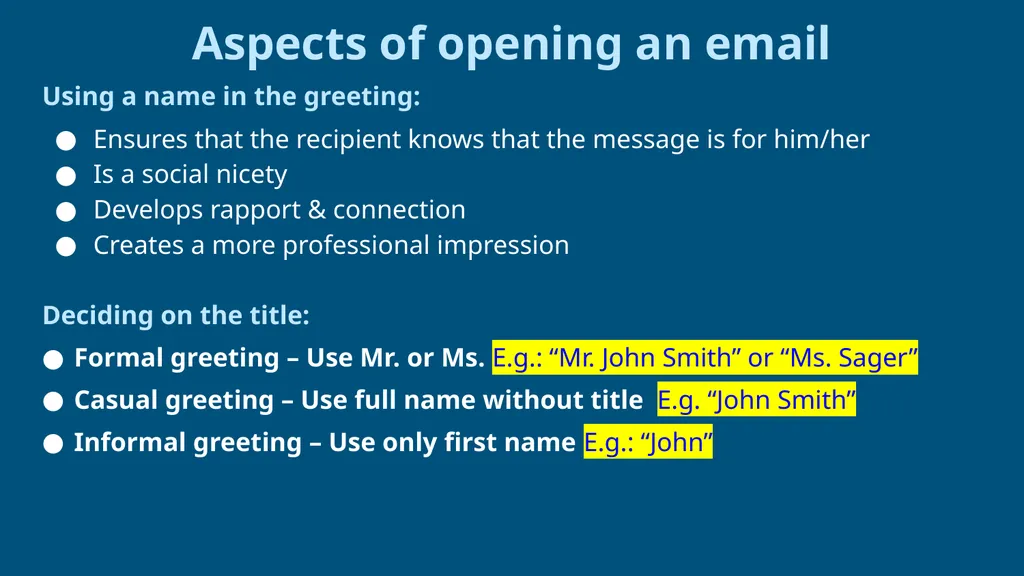
Aspects of opening an email Using a name in the greeting:
Ensures that the recipient knows that the message is for him/her
Is a social nicety
Develops rapport & connection
Creates a more professional impression
Deciding on the title:
Formal greeting – Use Mr. or Ms. E.g.: “Mr. John Smith” or “Ms. Sager”
Casual greeting – Use full name without title E.g. “John Smith”
Informal greeting – Use only first name E.g.: “John”<br>
18
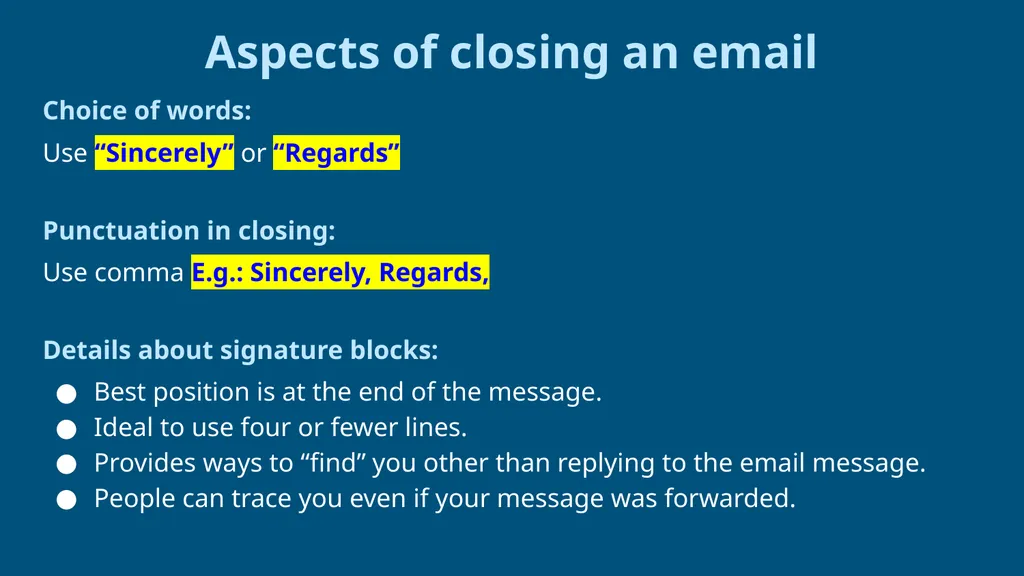
Aspects of closing an email Choice of words:
Use “Sincerely” or “Regards”
Punctuation in closing:
Use comma E.g.: Sincerely, Regards,
Details about signature blocks:
Best position is at the end of the message.
Ideal to use four or fewer lines.
Provides ways to “find” you other than replying to the email message.
People can trace you even if your message was forwarded.<br>
19
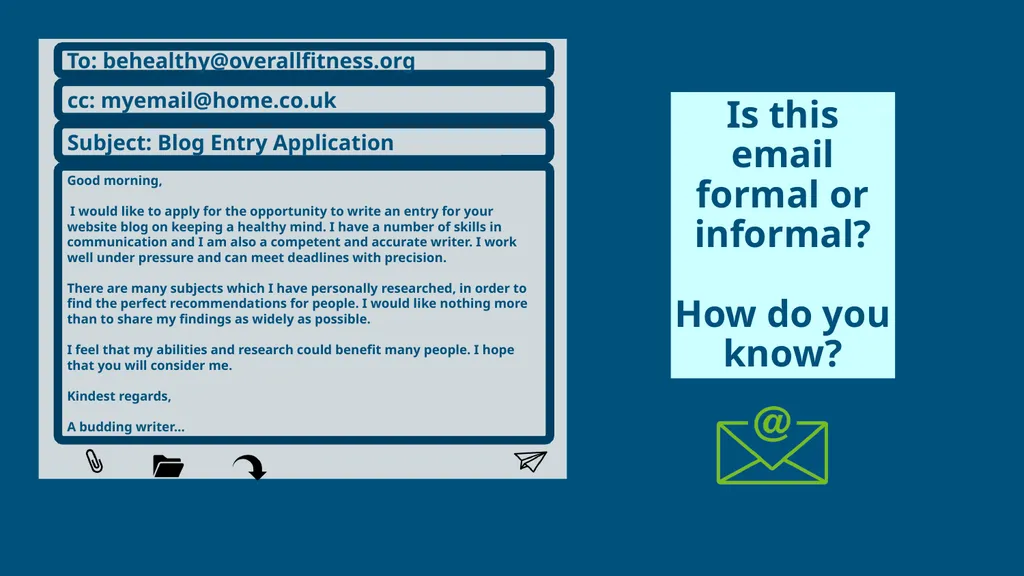
Is this email formal or informal?
How do you know? To: behealthy@overallfitness.org cc: myemail@home.co.uk Good morning,
I would like to apply for the opportunity to write an entry for your website blog on keeping a healthy mind. I have a number of skills in communication and I am also a competent and accurate writer. I work well under pressure and can meet deadlines with precision.
There are many subjects which I have personally researched, in order to find the perfect recommendations for people. I would like nothing more than to share my findings as widely as possible.
I feel that my abilities and research could benefit many people. I hope that you will consider me.
Kindest regards,
A budding writer… Subject: Blog Entry Application<br>
20
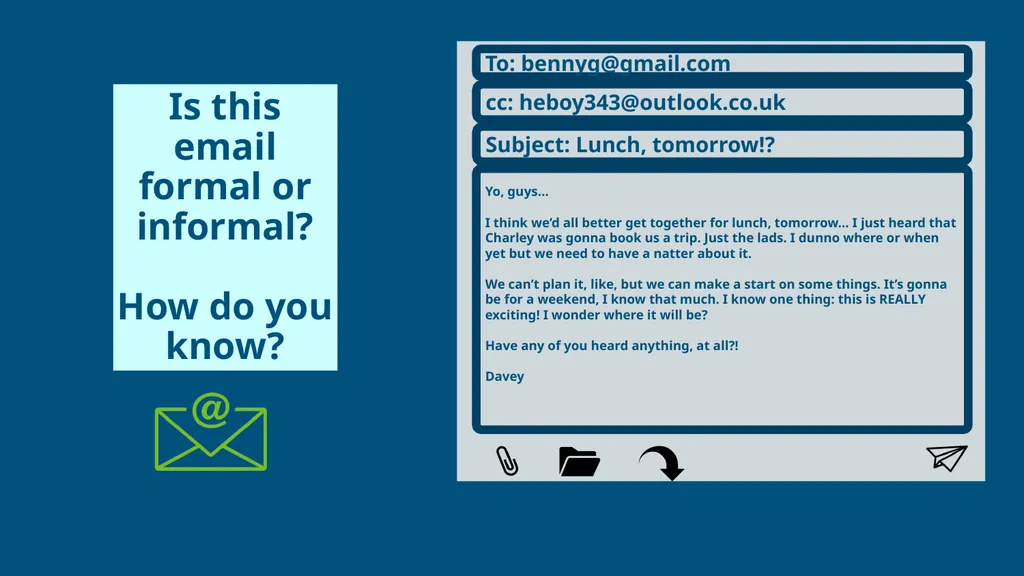
To: bennyg@gmail.com cc: heboy343@outlook.co.uk Yo, guys…
I think we’d all better get together for lunch, tomorrow… I just heard that Charley was gonna book us a trip. Just the lads. I dunno where or when yet but we need to have a natter about it.
We can’t plan it, like, but we can make a start on some things. It’s gonna be for a weekend, I know that much. I know one thing: this is REALLY exciting! I wonder where it will be?
Have any of you heard anything, at all?!
Davey Subject: Lunch, tomorrow!? Is this email formal or informal?
How do you know?<br>
21
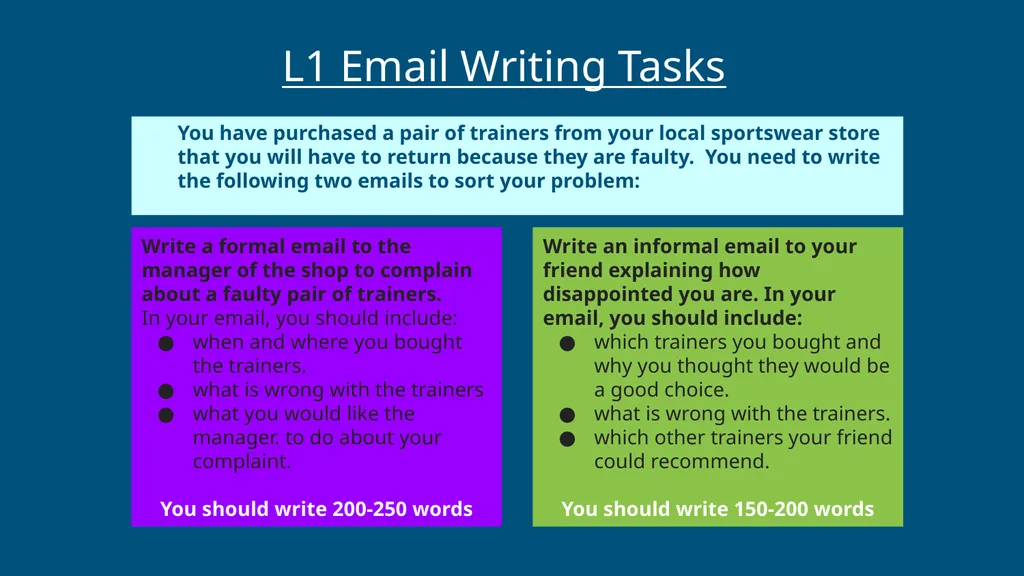
L1 Email Writing Tasks You have purchased a pair of trainers from your local sportswear store that you will have to return because they are faulty. You need to write the following two emails to sort your problem: Write a formal email to the manager of the shop to complain about a faulty pair of trainers.
In your email, you should include:
when and where you bought the trainers.
what is wrong with the trainers
what you would like the manager. to do about your complaint.
You should write 200-250 words Write an informal email to your friend explaining how disappointed you are. In your email, you should include:
which trainers you bought and why you thought they would be a good choice.
what is wrong with the trainers.
which other trainers your friend could recommend.
You should write 150-200 words<br>
22
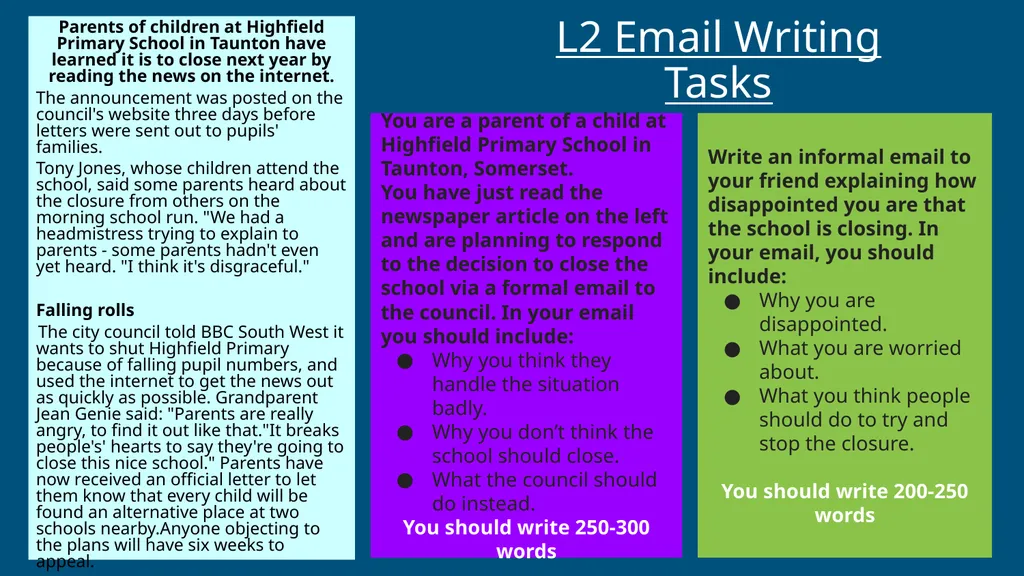
L2 Email Writing Tasks Parents of children at Highfield Primary School in Taunton have learned it is to close next year by reading the news on the internet.
The announcement was posted on the council's website three days before letters were sent out to pupils' families.
Tony Jones, whose children attend the school, said some parents heard about the closure from others on the morning school run. "We had a headmistress trying to explain to parents - some parents hadn't even yet heard. "I think it's disgraceful."
Falling rolls
The city council told BBC South West it wants to shut Highfield Primary because of falling pupil numbers, and used the internet to get the news out as quickly as possible. Grandparent Jean Genie said: "Parents are really angry, to find it out like that."It breaks people's' hearts to say they're going to close this nice school." Parents have now received an official letter to let them know that every child will be found an alternative place at two schools nearby.Anyone objecting to the plans will have six weeks to appeal. You are a parent of a child at Highfield Primary School in Taunton, Somerset.
You have just read the newspaper article on the left and are planning to respond to the decision to close the school via a formal email to the council. In your email you should include:
Why you think they handle the situation badly.
Why you don’t think the school should close.
What the council should do instead.
You should write 250-300 words Write an informal email to your friend explaining how disappointed you are that the school is closing. In your email, you should include:
Why you are disappointed.
What you are worried about.
What you think people should do to try and stop the closure.
You should write 200-250 words<br>
23
Plenary: Have you achieved the objective?
Learning Objective: To write emails using appropriate structure, detail and formality Complete the quiz on the link to test your email writing knowledge! Source: https://www.proprofs.com/quiz-school/story.php?title=mta0ndy4mg==0hw1 ProProfs quizzes<br>
Learning Objective: To write emails using appropriate structure, detail and formality Complete the quiz on the link to test your email writing knowledge! Source: https://www.proprofs.com/quiz-school/story.php?title=mta0ndy4mg==0hw1 ProProfs quizzes<br>