LEARning about Literacy for Families Series Series Introduction Office of Learning Equity Academic Recovery (LEAR) 2026 nj.goveducationlear Scarboroughs Reading Rope Scarborough, 2001 Text Version: Scarboroughs Reading Rope The many
"LEARning about Literacy for Families Series Series" is the property of its rightful owner. Permission is granted to
download and print the materials on this website for personal, non-commercial use only, and to display it
on your personal computer provided you do not modify the materials and that you retain all copyright
notices contained in the materials. By downloading content from our website, you accept the terms of this
agreement.
Presentation Transcript
01
LEARning about Literacy for Families Series Series Introduction Office of Learning Equity & Academic Recovery (LEAR) 2026 nj.gov/education/lear<br>
02
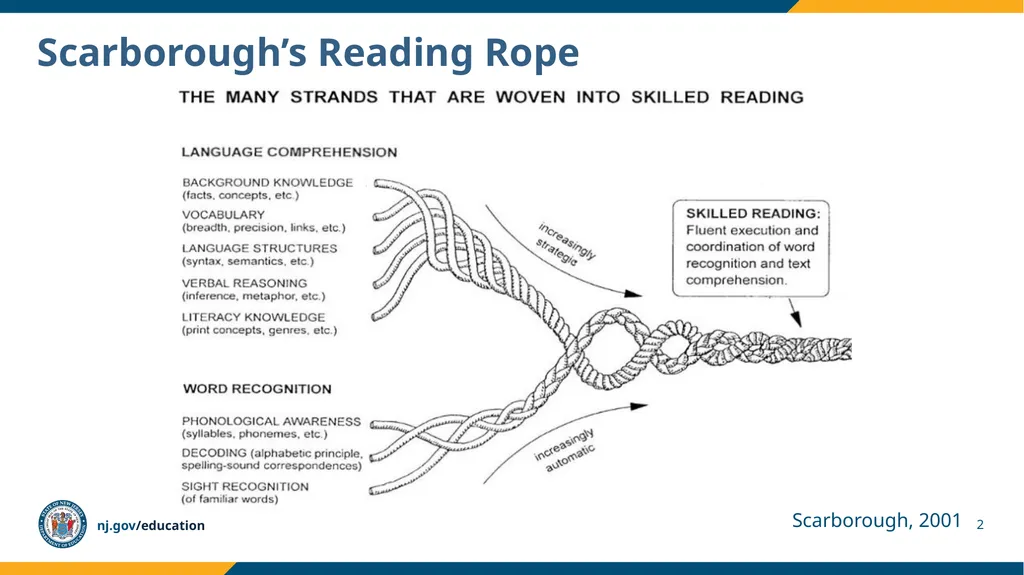
Scarborough’s Reading Rope Scarborough, 2001<br>
03
Text Version: Scarborough’s Reading Rope The many strands that are woven into skilled reading.
The Reading Rope consists of lower and upper strands. The word recognition strands (phonological awareness, decoding, and sight recognition of familiar words) work together as the reader becomes accurate, fluent, and increasingly automatic with repetition and practice. Language Comprehension (Upper Strands)
Strands include:
Background knowledge (facts, concepts, etc.)
Vocabulary (breadth, precision, links, etc.)
Language structures (syntax, semantics, etc.)
Verbal reasoning (inference, metaphor, etc.)
Literacy knowledge (print concepts, genres, etc.)
Word Recognition (Lower Strands)
Strands include:
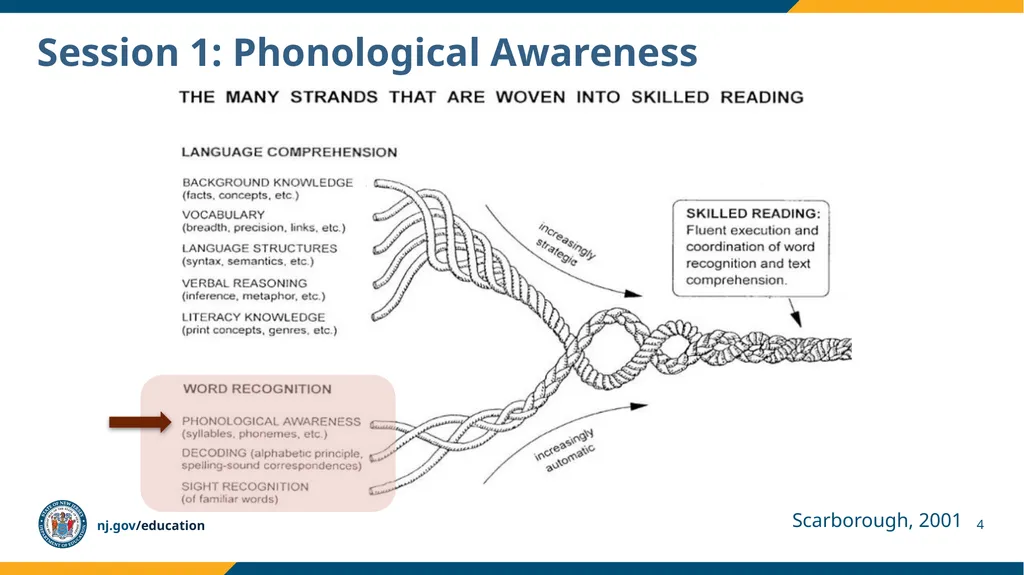
Phonological awareness (syllable, phonemes, etc.).
Decoding (alphabetic principle, spelling-sound correspondences
Sight recognition (of familiar words).
Skilled Reading
Language comprehension becomes increasingly strategic and word recognition becomes increasingly automatic in the progression to becoming a skilled reader.
A skilled reader displays fluent execution and coordination of word recognition and text comprehension.<br>
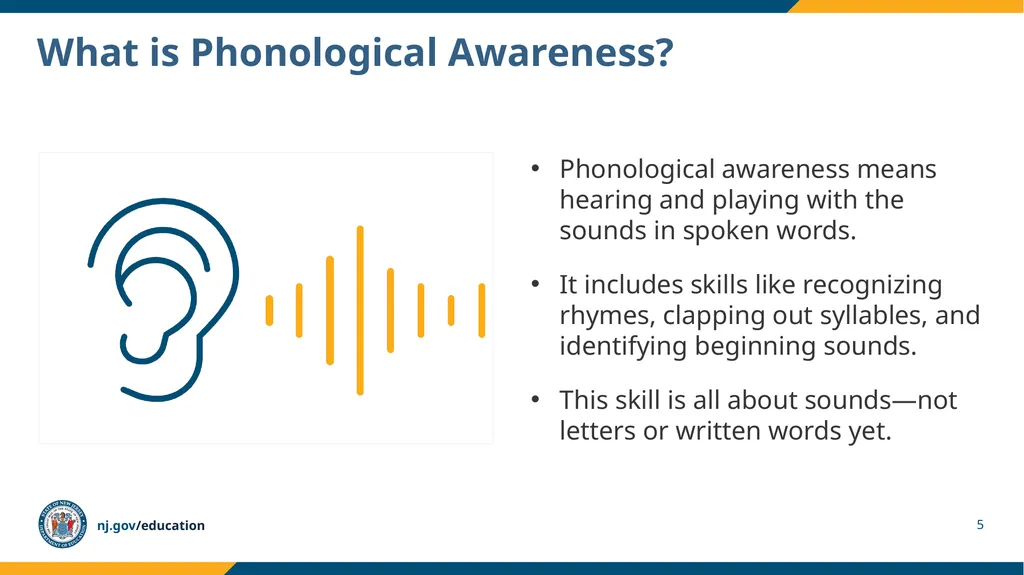
What is Phonological Awareness? Phonological awareness means hearing and playing with the sounds in spoken words.
It includes skills like recognizing rhymes, clapping out syllables, and identifying beginning sounds.
This skill is all about sounds—not letters or written words yet.<br>
06
Why is Phonological Awareness Important? It is a key building block for learning to read.
Children who hear and play with sounds in words find it easier to connect sounds to letters later on.
Strong phonological awareness helps with spelling, reading fluency, and comprehension.<br>
07
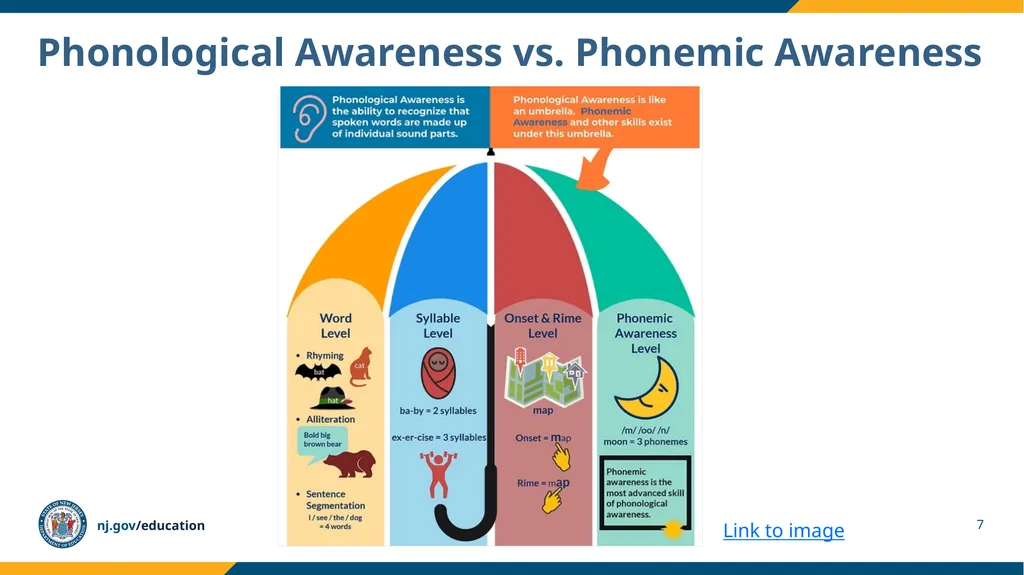
Phonological Awareness vs. Phonemic Awareness Link to image<br>
08
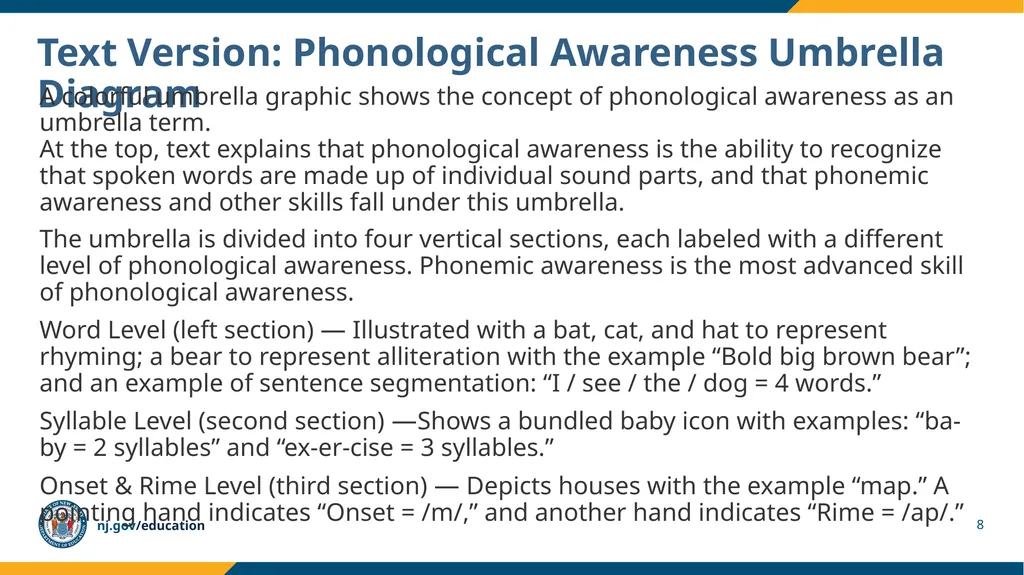
Text Version: Phonological Awareness Umbrella Diagram A colorful umbrella graphic shows the concept of phonological awareness as an umbrella term. At the top, text explains that phonological awareness is the ability to recognize that spoken words are made up of individual sound parts, and that phonemic awareness and other skills fall under this umbrella.
The umbrella is divided into four vertical sections, each labeled with a different level of phonological awareness. Phonemic awareness is the most advanced skill of phonological awareness.
Word Level (left section) — Illustrated with a bat, cat, and hat to represent rhyming; a bear to represent alliteration with the example “Bold big brown bear”; and an example of sentence segmentation: “I / see / the / dog = 4 words.”
Syllable Level (second section) —Shows a bundled baby icon with examples: “ba-by = 2 syllables” and “ex-er-cise = 3 syllables.”
Onset & Rime Level (third section) — Depicts houses with the example “map.” A pointing hand indicates “Onset = /m/,” and another hand indicates “Rime = /ap/.”<br>
09
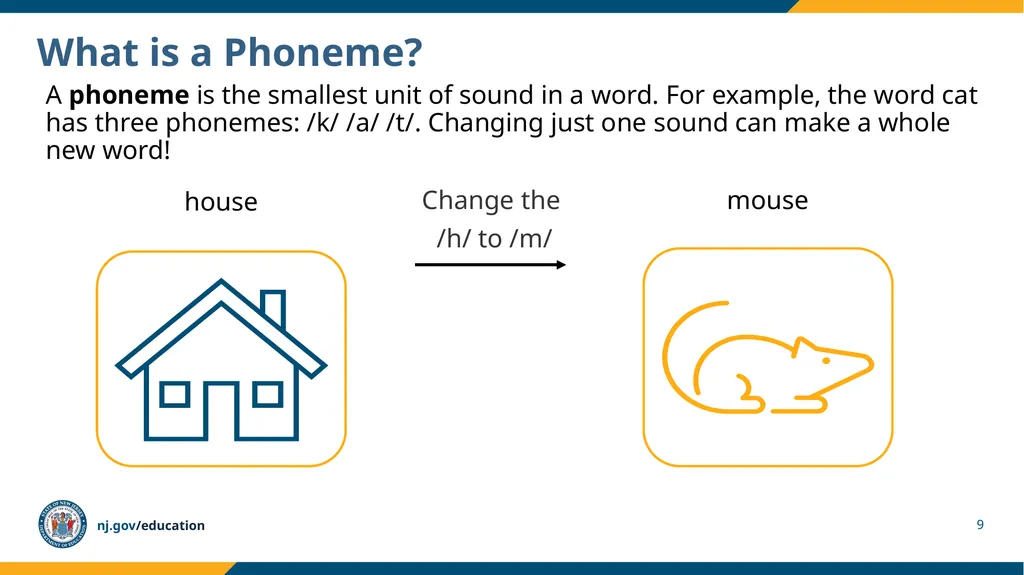
What is a Phoneme? A phoneme is the smallest unit of sound in a word. For example, the word cat has three phonemes: /k/ /a/ /t/. Changing just one sound can make a whole new word! house Change the
/h/ to /m/ mouse<br>
10
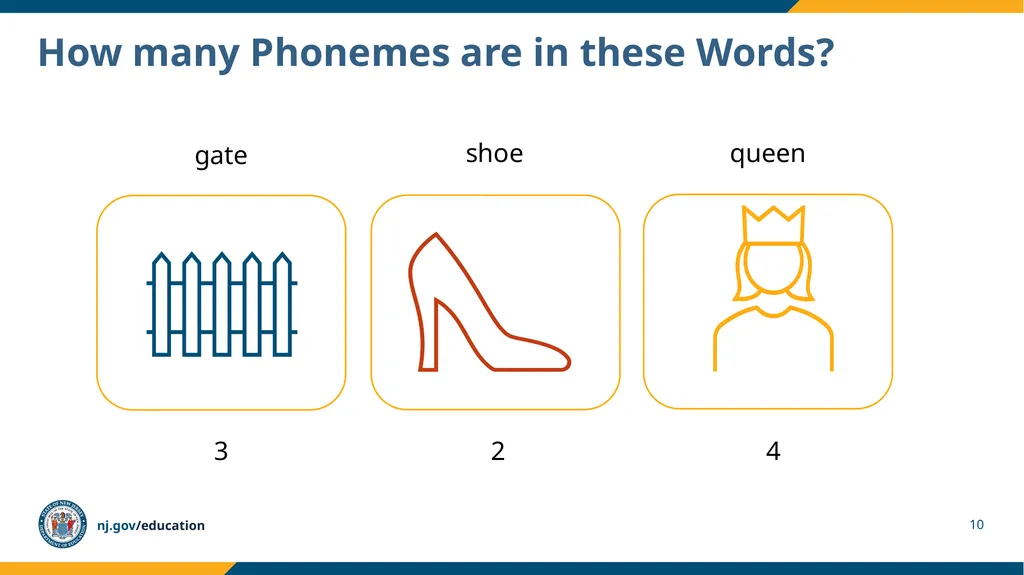
How many Phonemes are in these Words? gate shoe queen 3 2 4<br>
11
Questions to Ask Your Child’s Teacher What phonological awareness skills is my child working on right now?
How do you practice these skills in the classroom?
How do you know if my child is on track with sound awareness?
What specific skills should we practice at home?<br>
12
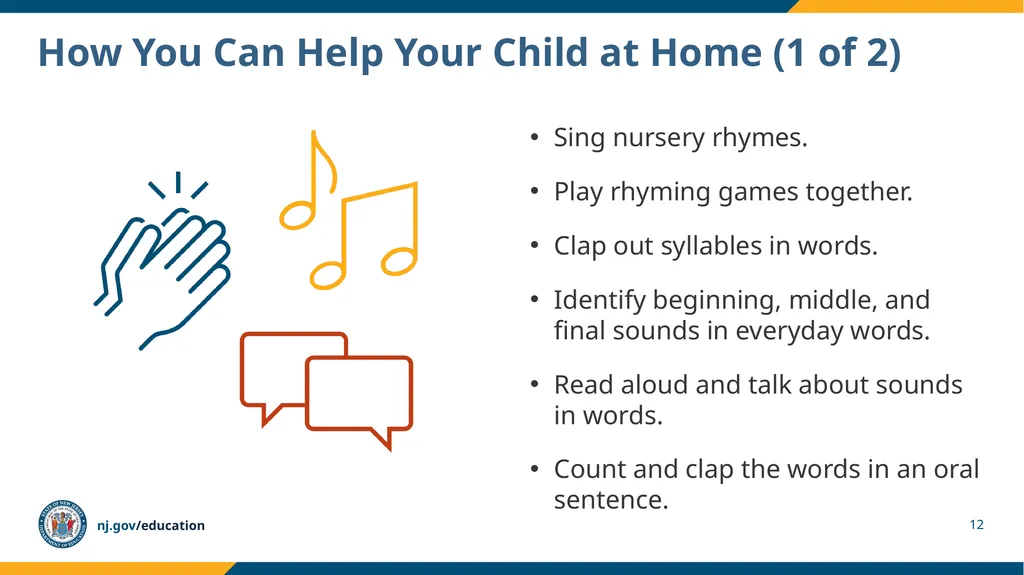
How You Can Help Your Child at Home (1 of 2) Sing nursery rhymes.
Play rhyming games together.
Clap out syllables in words.
Identify beginning, middle, and final sounds in everyday words.
Read aloud and talk about sounds in words.
Count and clap the words in an oral sentence.<br>
13
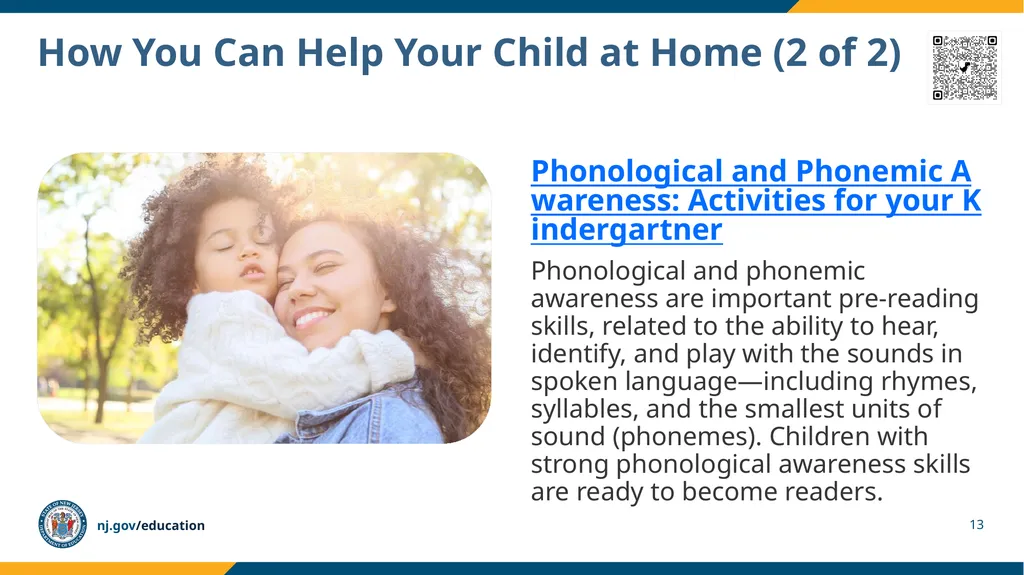
How You Can Help Your Child at Home (2 of 2) Phonological and Phonemic Awareness: Activities for your Kindergartner
Phonological and phonemic awareness are important pre-reading skills, related to the ability to hear, identify, and play with the sounds in spoken language—including rhymes, syllables, and the smallest units of sound (phonemes). Children with strong phonological awareness skills are ready to become readers.<br>
14
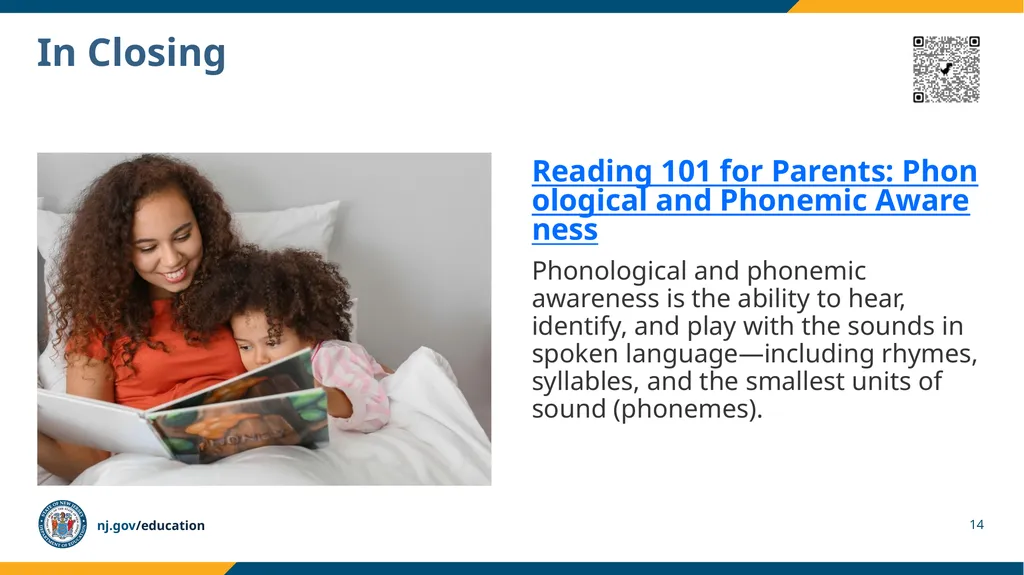
In Closing Reading 101 for Parents: Phonological and Phonemic Awareness
Phonological and phonemic awareness is the ability to hear, identify, and play with the sounds in spoken language—including rhymes, syllables, and the smallest units of sound (phonemes).<br>
15
References (1 of 2) National Center on Improving Literacy. (2022). Phonemic awareness: What is it and why is it important? Retrieved July 1, 2025, from https://www.improvingliteracy.org/resource/phonemic-awareness-what-is-it-and-why-is-it-important
National Center on Improving Literacy. (2022). Phonological awareness: What is it and how does it relate to phonemic awareness? Retrieved July 1, 2025, from https://www.improvingliteracy.org/resource/phonological-awareness-what-is-it-and-how-does-it-relate-to-phonemic-awareness
Read by 4th. (n.d.). Parent workshop on early reading skills. Retrieved July 1, 2025, from https://www.readby4th.org/initiatives-family/parent-workshop-early-reading-skills
Reading Rockets. (n.d.). Phonological and phonemic awareness: Activities for your kindergartener. Retrieved December 10, 2025, from https://www.readingrockets.org/literacy-home/reading-101-guide-parents/your-kindergartener/phonological-and-phonemic-awareness<br>
16
References (2 of 2) Reading Rockets. (n.d.). Phonological and phonemic awareness: Introduction. Retrieved July 1, 2025, from https://www.readingrockets.org/reading-101/reading-101-learning-modules/course-modules/phonological-and-phonemic-awareness
Reading Rockets. (n.d.). Reading 101 for Parents: Phonological and phonemic awareness. Retrieved December 10, 2025, from https://www.readingrockets.org/literacy-home/reading-101-guide-parents/reading-basics/phonological-and-phonemic-awareness
Scarborough, H. S. (2001). Connecting early language and literacy to later reading (dis)abilities: Evidence, theory, and practice. In S. Neuman & D. Dickinson (Eds.), Handbook for research in early literacy (pp. 97-110). New York: Guilford Press.<br>
17
Follow the New Jersey Department of Education Facebook @njdeptofed Instagram @newjerseydoe Threads @newjerseydoe nj.gov/education X @newjerseydoe LinkedIn New Jersey Department of Education YouTube @newjerseydepartmentofeduca6565<br>