Lecture 1: What is historiography and why is it important? Two Meanings of Historiography: It can describe the body of work written on a specific topic such as the history of war, the history of the Weimar Republic and Nazi Germany, the
"Lecture 1: What is historiography and why is it" is the property of its rightful owner. Permission is granted to
download and print the materials on this website for personal, non-commercial use only, and to display it
on your personal computer provided you do not modify the materials and that you retain all copyright
notices contained in the materials. By downloading content from our website, you accept the terms of this
agreement.
Presentation Transcript
01
Lecture 1:
What is historiography and why is it important?<br>
02
Two Meanings of ‘Historiography’:
It can describe the body of work written on a specific topic such as the history of war, the history of the Weimar Republic and Nazi Germany, the history of fashion, etc... as well as different approaches and genres, such as political history or social history.
refers to both the study of the methodology of historians and development of history as a discipline. This differs of course from country to country.<br>
03
How to explain human agency and human experience?
What is historical change and what causes it?
What is the relationship between historical ‘facts’ found in the archive/texts etc. and their wider meaning?
What is a historical ‘fact’? Is there such a thing?
The role of moral judgement: What is the role of the historian in the production of history? Should s/he be neutral and objective? Should s/he measure the past against the values and norms of the present? Or, should we use the past ‘to critique’ the present?
Is history writing a ‘science’ (in the sense of a natural science discovering ‘laws’) or an ‘art’ (a form of fiction)? Questions in regard to the purpose and practice of history writing which emerged from the Enlightenment and continue to be important:<br>
04
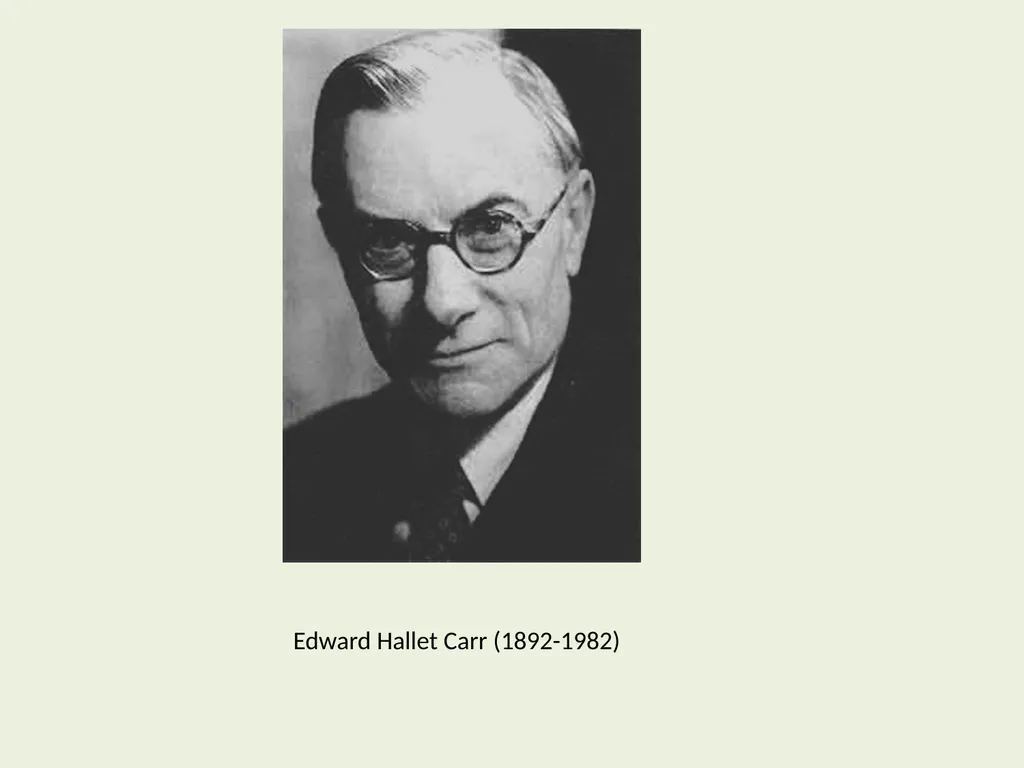
Edward Hallet Carr (1892-1982)<br>
05
Charles Percy Snow (1905-1980)
Reed Lectures: The Two Cultures (1959)
Thesis: ‘The intellectual life of the whole of western society’ was split into the titular two cultures – namely the sciences and the humanities – and that this was a major hindrance to solving the world's problems.
Carr:
‘Scientist, social scientists and historians are all engaged in the same study: The study of man and his environment, of the effects of man on his environment and of his environment on man. The object of the study is the same: to increase man’s understanding of, and mastery over, his environment…..The presuppositions and the methods of the physicist, the geologist, the psychologist and the historian differ widely in detail….But historians and physical scientists are united in the fundamental purpose of seeking to explain, and in the fundamental procedure of question and answer.’ (What is History? p. 80)<br>
06
The belief in a hard core of historical facts existing objectively and independently of the interpretation of the historian is a preposterous fallacy, but one which it is very hard to eradicate. Against ‘philosophical history’ and ‘empicrical history:<br>
07
...between …. of an untenable theory of history as an objective compilation of facts, of the unqualified primacy of fact over interpretation, and ….of an equally untenable theory of history as the subjective product of the mind of the historian who establishes the facts of history and masters them through the processes of interpretation, between a view of history having the centre of gravity in the past and a view having the centre of gravity in the present.
(What is History?, p. 29) Carr’s middle ground:<br>
08
Two ‘facts’:
a) ‘Facts’ of the past: that is historical information that historians deem unimportant
b) Historical ‘facts’: that is information that historians decide is important. How did he get to this middle ground?<br>
09
Claim: historians arbitrarily determine which of the ‘facts of the past’ to turn into ‘historical facts’ according to their own biases and agendas.
The fact speaks only when the historian calls on them: it is he who decides to which facts to give the floor, and in what order or context….It is the historian who has decided for his own reason that Cesar’s crossing of that petty stream, the Rubicon, is a fact of history, whereas the crossing of the Rubicon by millions of other people…interest nobody at all.
(What is History? 11)<br>
10
...between …. of an untenable theory of history as an objective compilation of facts, of the unqualified primacy of fact over interpretation, and ….of an equally untenable theory of history as the subjective product of the mind of the historian who establishes the facts of history and masters them through the processes of interpretation, between a view of history having the centre of gravity in the past and a view having the centre of gravity in the present.
(What is History?, p. 29) Carr’s middle ground:<br>
11
‘The past, present, and future are linked together in an endless chain of history.’
(What is History? 129)<br>
12
‘Before you study the historian, study his historical and social environment. The historian, being an individual, is also a product of history and of society: and it is in this twofold light that the student of history has to learn to regard him.’ (What is History? 38)<br>