04
Branches Of Psychology Abnormal
Biological
Clinical
Cognitive
Counseling
Developmental
Educational Psychology<br>
05
Scientific Method Involves formulating theories and deriving testable hypotheses based on theories
Designing controlled experiments or observational studies to test hypotheses and gather data
Analyzing data using statistical techniques to identify significant patterns and relationships
Drawing conclusions about whether findings support or refute the original hypotheses
Results are peer-reviewed and published so other researchers can scrutinize and replicate studies<br>
06
Merits Of An Education In Psychology Develops strong analytical, research, data analysis, and communication skills valued across careers
Cultivates scientific literacy, objectivity, and critical thinking to evaluate claims/evidence
Provides understanding of factors influencing human behavior, cognition, emotion, and development
Applicable to fields like marketing, human resources, social services, education, and healthcare
Prepares students for psychology careers in clinical practice, counseling, and research<br>
07
Group Activity Discuss in a small group why you each decided to take a psychology course. What do you hope to get out of it?<br>
08
History Of Psychology Questions about the mind were historically studied through philosophy and physiology.
Wilhelm Wundt and William James established psychology as an independent empirical science.
Empirical: grounded in objective, tangible evidence that can be observed time and time again, regardless of who is observing
Early psychological perspectives include structuralism, functionalism, psychoanalysis, behaviorism, Gestalt, humanism.
Psychology was transformed by the cognitive revolution, neuroscience, evolutionary/cross-cultural approaches.<br>
09
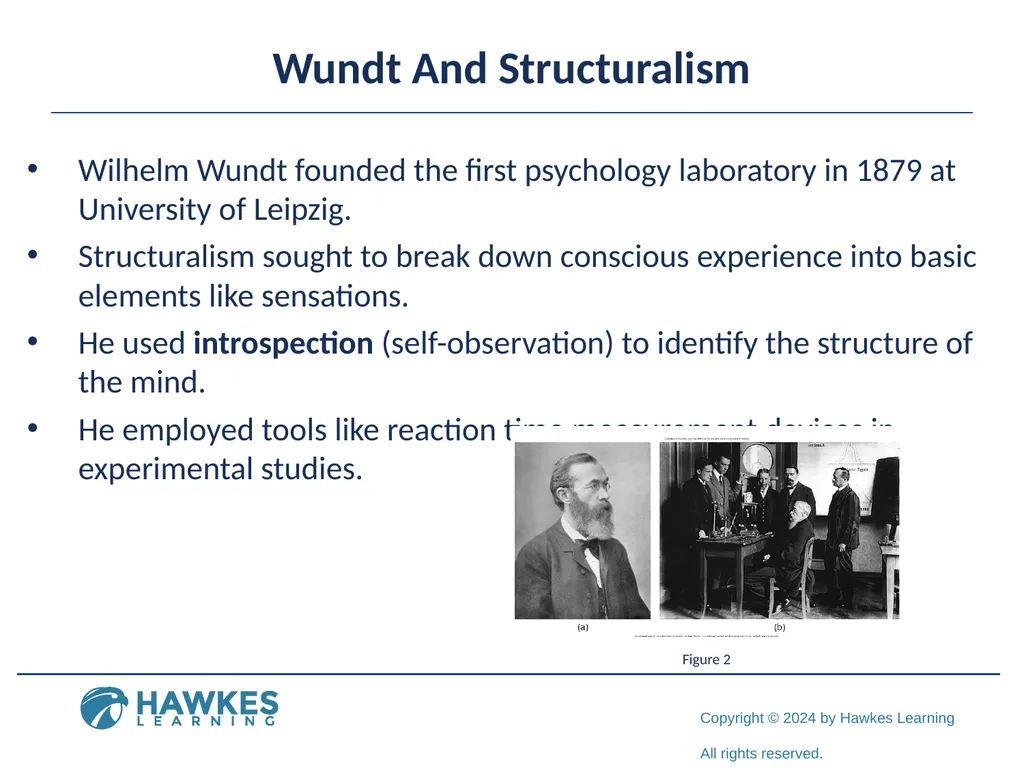
Wundt And Structuralism Wilhelm Wundt founded the first psychology laboratory in 1879 at University of Leipzig.
Structuralism sought to break down conscious experience into basic elements like sensations.
He used introspection (self-observation) to identify the structure of the mind.
He employed tools like reaction time measurement devices in experimental studies. Figure 2<br>
10
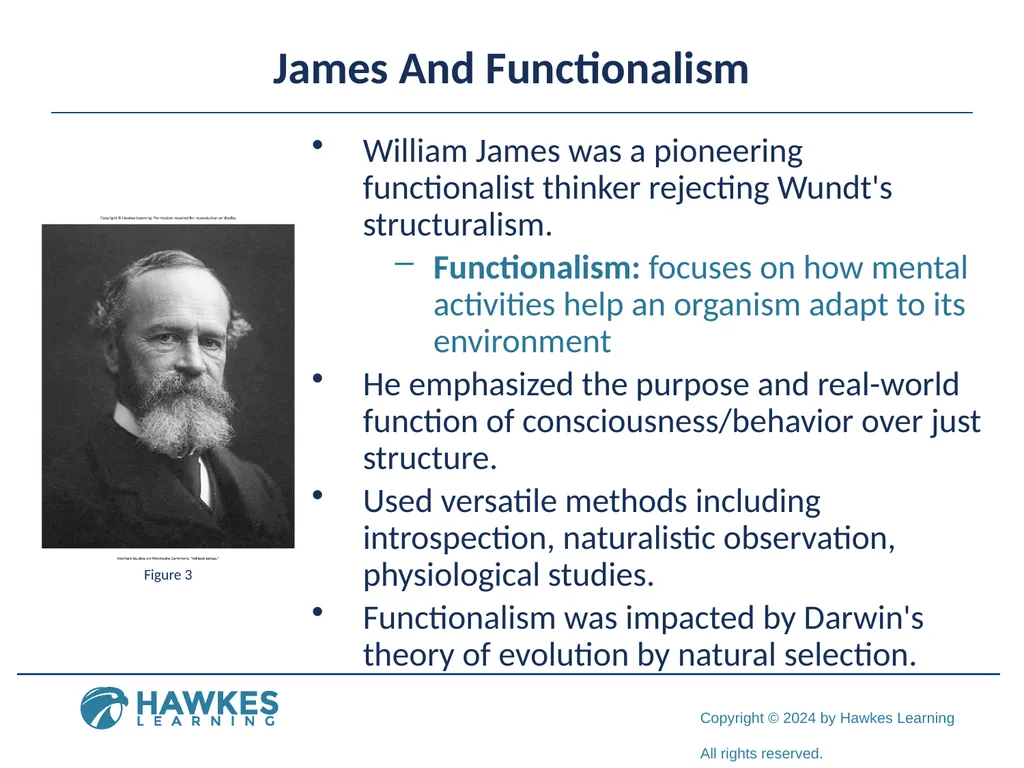
James And Functionalism Figure 3 William James was a pioneering functionalist thinker rejecting Wundt's structuralism.
Functionalism: focuses on how mental activities help an organism adapt to its environment
He emphasized the purpose and real-world function of consciousness/behavior over just structure.
Used versatile methods including introspection, naturalistic observation, physiological studies.
Functionalism was impacted by Darwin's theory of evolution by natural selection.<br>
11
Pioneering Women Mary Whiton Calkins completed Harvard requirements but was denied PhD due to gender.
Became first female APA president in 1905, contributing concept of the self
Margaret Floy Washburn was the first woman to earn a PhD in psychology in 1894.
Made early influential work in area of comparative/animal psychology
Inez Prosser studied effects of racial segregation despite systemic racism barriers.
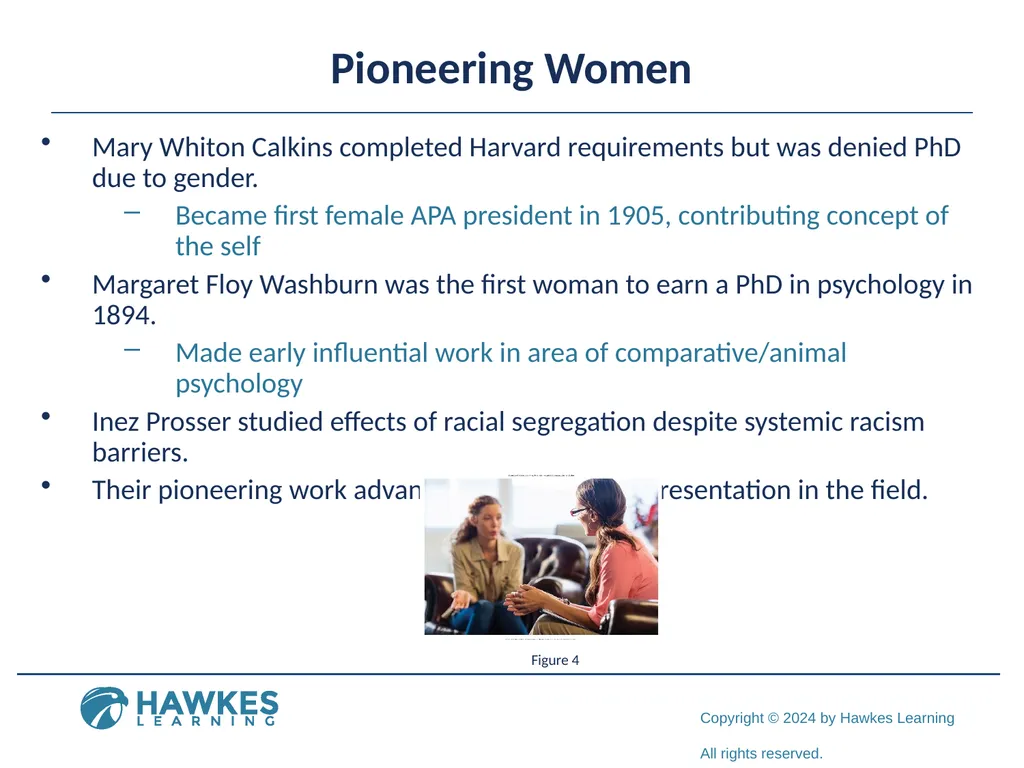
Their pioneering work advanced equality and representation in the field. Figure 4<br>
12
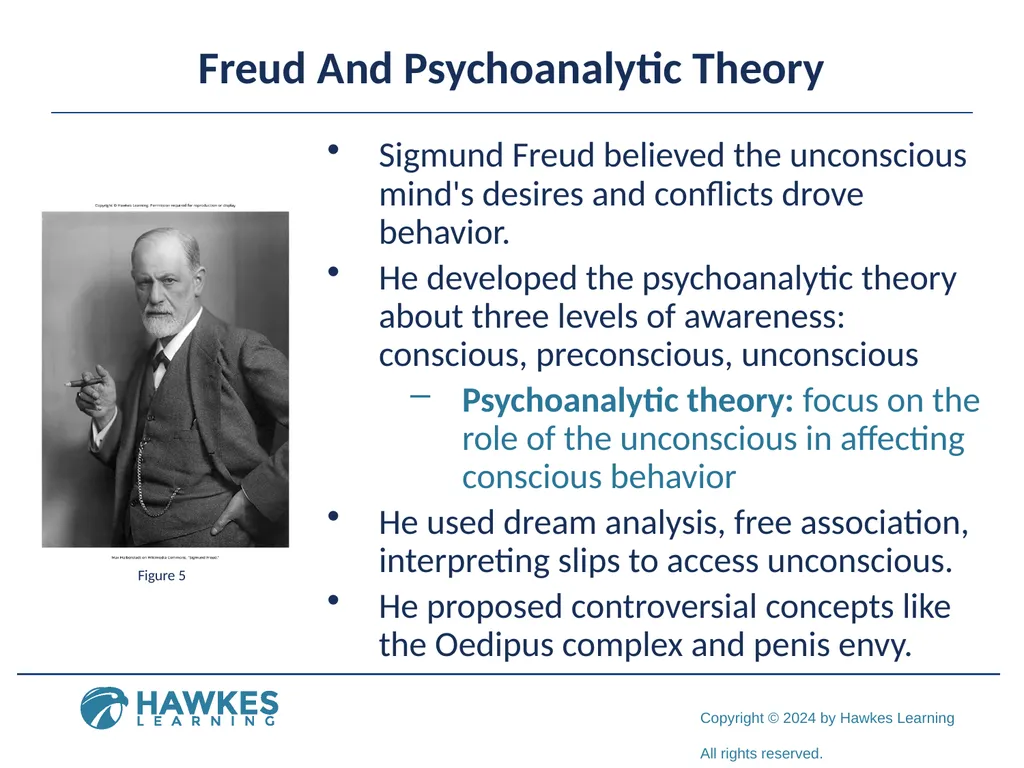
Freud And Psychoanalytic Theory Figure 5 Sigmund Freud believed the unconscious mind's desires and conflicts drove behavior.
He developed the psychoanalytic theory about three levels of awareness: conscious, preconscious, unconscious
Psychoanalytic theory: focus on the role of the unconscious in affecting conscious behavior
He used dream analysis, free association, interpreting slips to access unconscious.
He proposed controversial concepts like the Oedipus complex and penis envy.<br>
13
Reflection Question2 Do you agree with Freud that dreams have meaning in your day-to-day life? Why or why not?<br>
14
Wertheimer, Koffka, Kohler, And Gestalt Psychology Gestalt psychology focused on how the mind perceives complete patterns/configurations.
Köhler showcased insightful learning in problem-solving.
They studied perceptual organization principles like figure-ground, closure, and proximity.
Provided holistic counter to Wundt's elementalism, though limited in reach.<br>
15
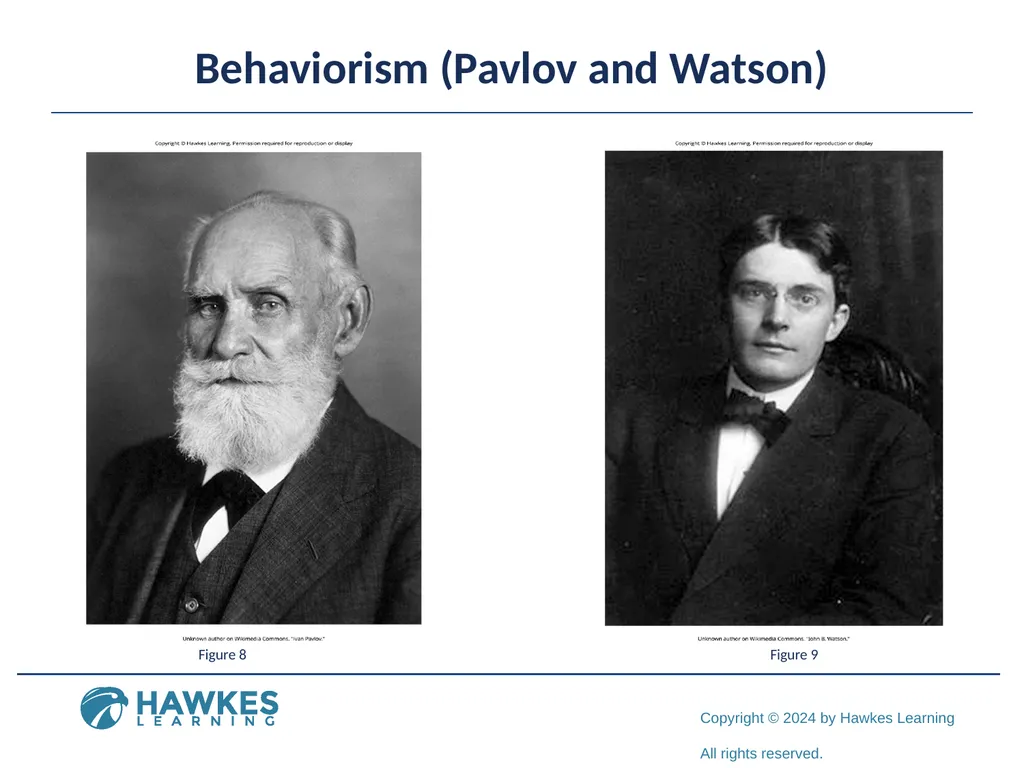
Ivan Pavlov, Watson, Skinner, And Behaviorism Ivan Pavlov discovered principles of classical conditioning through his work on dogs.
John B. Watson founded behaviorism, rejecting study of unobservable mental states.
Behaviorism: the study of observing and controlling behavior
B.F. Skinner pioneered study of operant conditioning using reinforcement schedules.
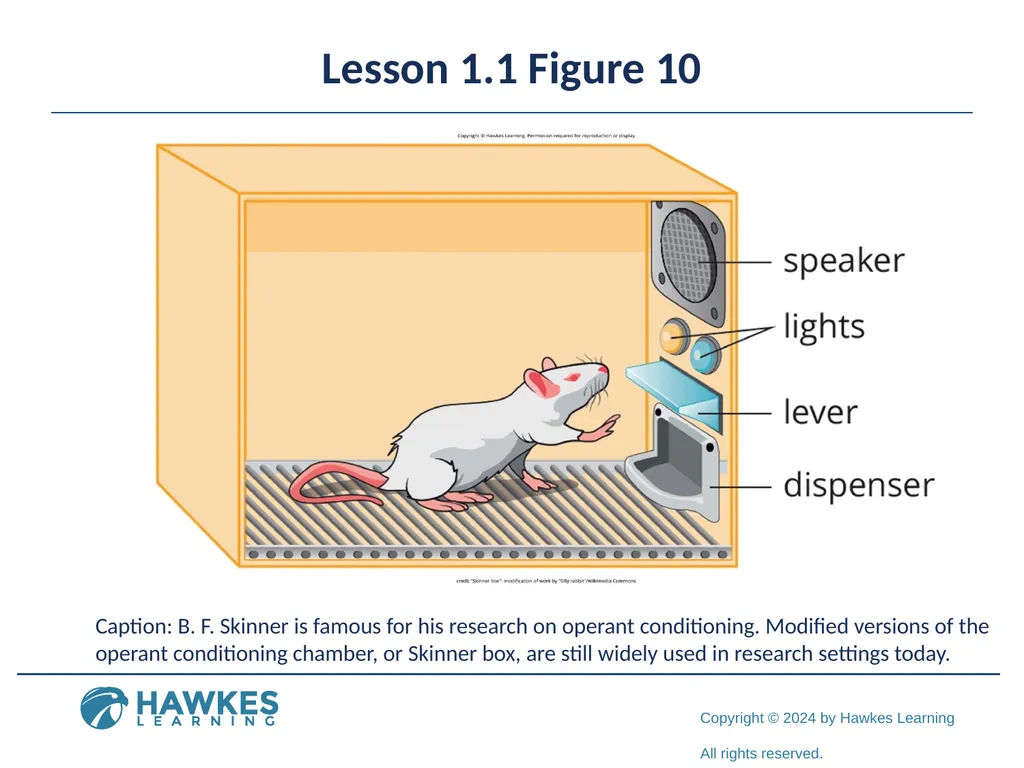
The Skinner box (Figure 10) allowed for careful study of modifying behavior through reinforcement/punishment.
Behaviorism established psychology as an objective experimental science.<br>
16
Behaviorism (Pavlov and Watson) Figure 8 Figure 9<br>
17
Lesson 1.1 Figure 10 Caption: B. F. Skinner is famous for his research on operant conditioning. Modified versions of the operant conditioning chamber, or Skinner box, are still widely used in research settings today.<br>
18
Reflection Question3 What factors do you think led Watson to believe that analysis of the mind of impossible?<br>
19
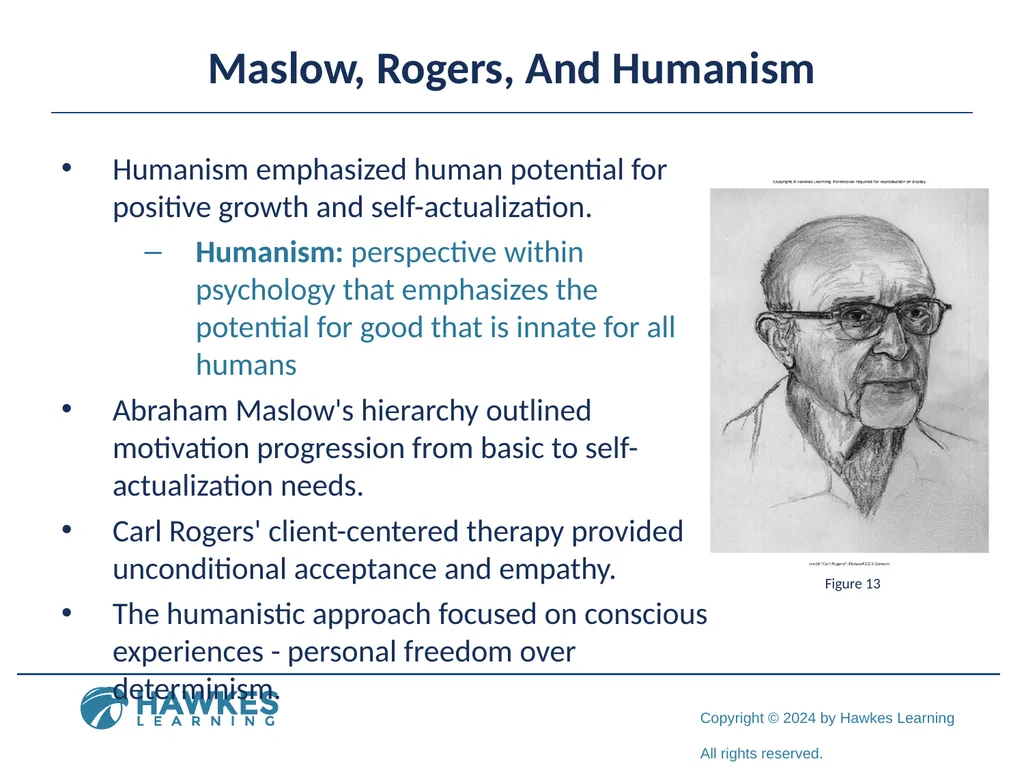
Maslow, Rogers, And Humanism Humanism emphasized human potential for positive growth and self-actualization.
Humanism: perspective within psychology that emphasizes the potential for good that is innate for all humans
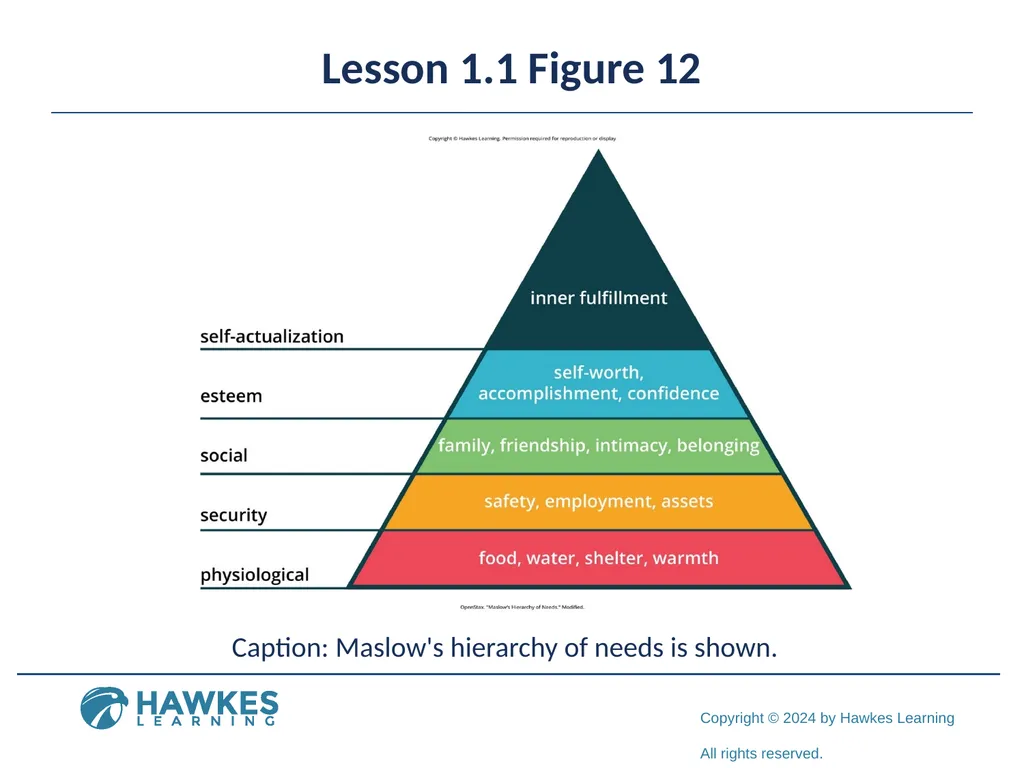
Abraham Maslow's hierarchy outlined motivation progression from basic to self-actualization needs.
Carl Rogers' client-centered therapy provided unconditional acceptance and empathy.
The humanistic approach focused on conscious experiences - personal freedom over determinism. Figure 13<br>
20
Lesson 1.1 Figure 12 Caption: Maslow's hierarchy of needs is shown.<br>
21
Reflection Question4 Do you favor humanism over psychoanalysis and behaviorism? Why or why not?<br>
22
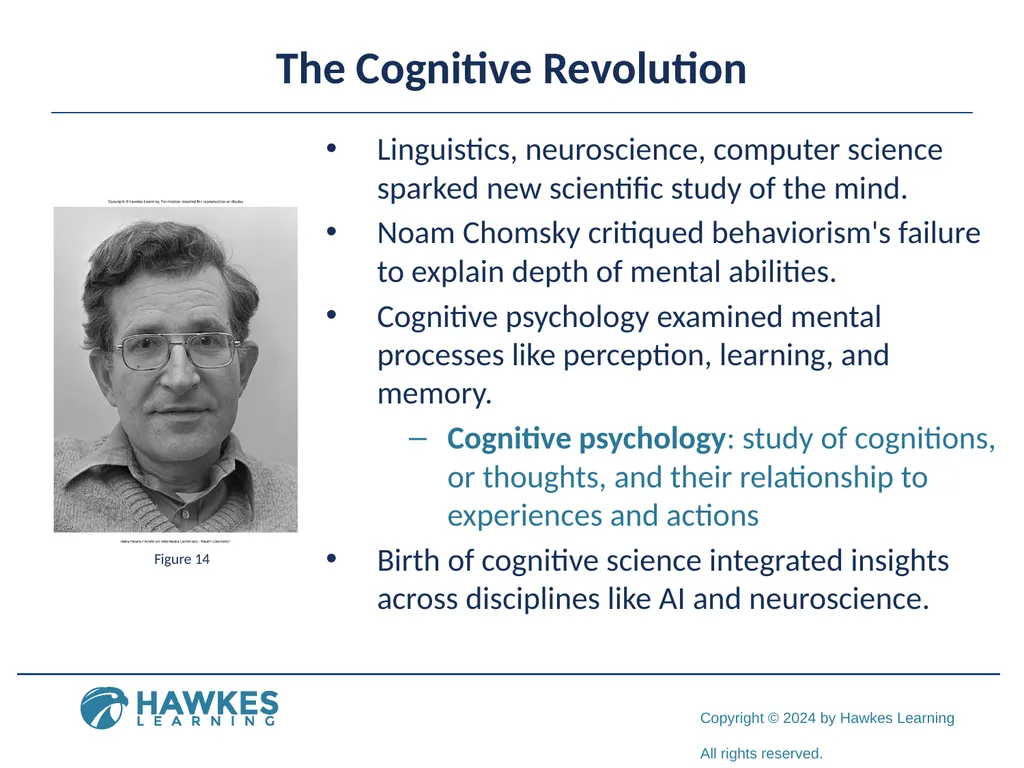
The Cognitive Revolution Figure 14 Linguistics, neuroscience, computer science sparked new scientific study of the mind.
Noam Chomsky critiqued behaviorism's failure to explain depth of mental abilities.
Cognitive psychology examined mental processes like perception, learning, and memory.
Cognitive psychology: study of cognitions, or thoughts, and their relationship to experiences and actions
Birth of cognitive science integrated insights across disciplines like AI and neuroscience.<br>
23
Multicultural Psychology Cultural differences impact psychology but have been relatively neglected.
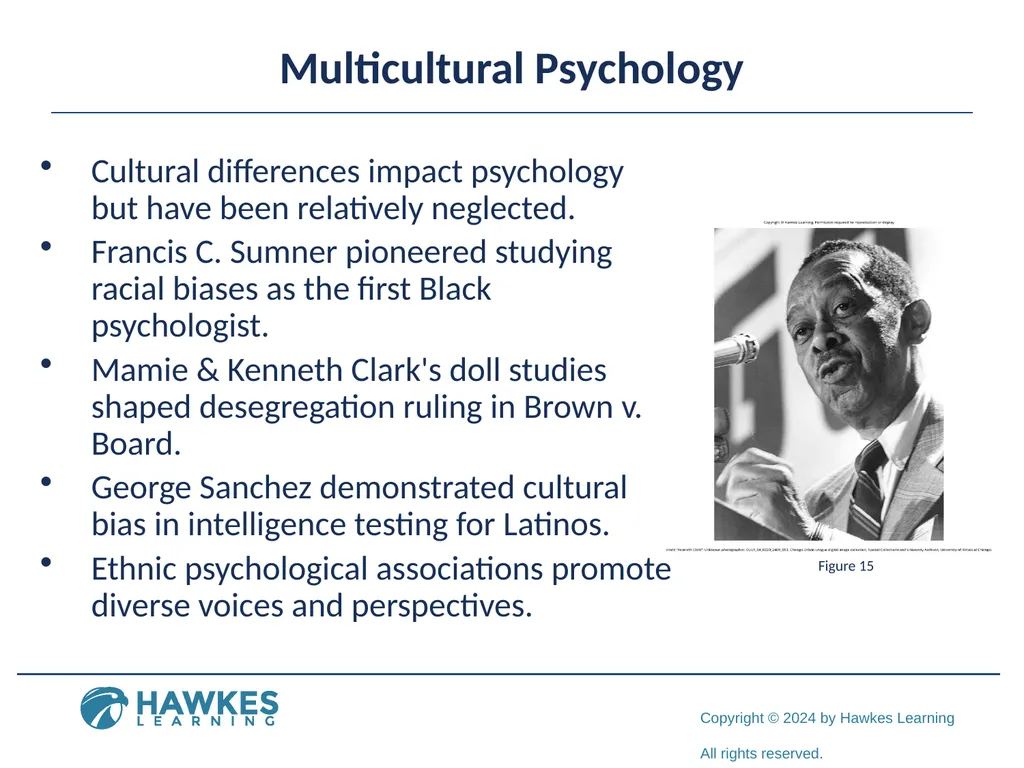
Francis C. Sumner pioneered studying racial biases as the first Black psychologist.
Mamie & Kenneth Clark's doll studies shaped desegregation ruling in Brown v. Board.
George Sanchez demonstrated cultural bias in intelligence testing for Latinos.
Ethnic psychological associations promote diverse voices and perspectives. Figure 15<br>
24
Summary Psychology is the comprehensive science studying behavior and the mind.
Psychology emerged from philosophy and was shaped by major historical perspectives and new insights.
It is increasingly interdisciplinary and represents the diversity of human experiences.
Contemporary subfields analyze biological, cognitive, social, and cultural influences.<br>
25
End of Hawkes Learning PowerPoint<br>