
Lesson 1: The Nature of the Holy Spirit—His
TG
Published · 14 slides · 0 views

1 / 1
Description
Lesson 1: The Nature of the Holy SpiritHis Personality Divinity A Biblically Correct Understanding of the Holy Spirit Is Essential! There is much misunderstanding, misinformation misleading re: the Holy Spirit Some view the Holy Spirit
Related Topics
Share
Embed code
Download this presentation From Below
"Lesson 1: The Nature of the Holy Spirit—His" is the property of its rightful owner. Permission is granted to download and print the materials on this website for personal, non-commercial use only, and to display it on your personal computer provided you do not modify the materials and that you retain all copyright notices contained in the materials. By downloading content from our website, you accept the terms of this agreement.
Presentation Transcript
01
Lesson 1: The Nature of the Holy Spirit—His Personality & Divinity<br>
02
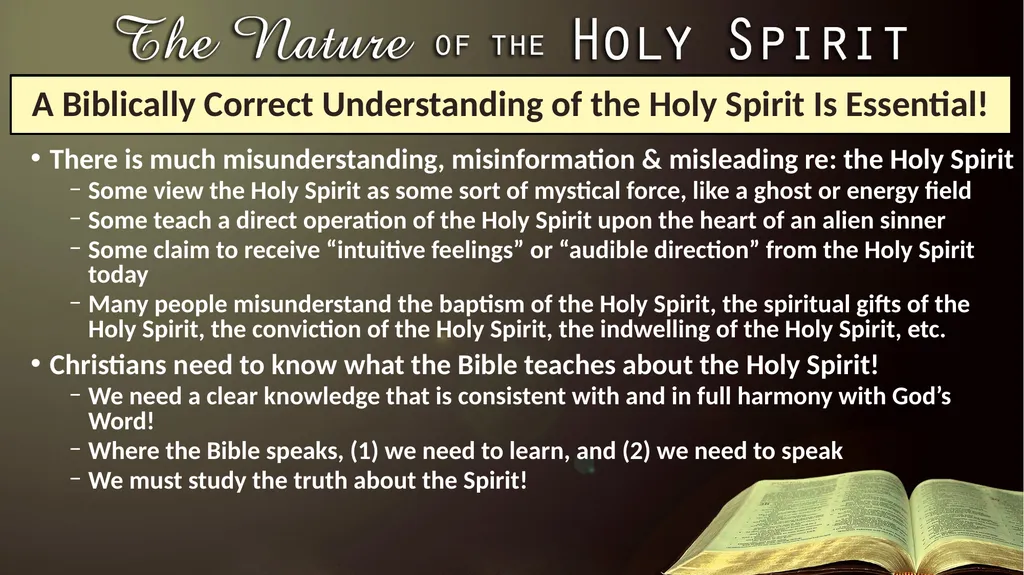
A Biblically Correct Understanding of the Holy Spirit Is Essential! There is much misunderstanding, misinformation & misleading re: the Holy Spirit
Some view the Holy Spirit as some sort of mystical force, like a ghost or energy field
Some teach a direct operation of the Holy Spirit upon the heart of an alien sinner
Some claim to receive “intuitive feelings” or “audible direction” from the Holy Spirit today
Many people misunderstand the baptism of the Holy Spirit, the spiritual gifts of the Holy Spirit, the conviction of the Holy Spirit, the indwelling of the Holy Spirit, etc.
Christians need to know what the Bible teaches about the Holy Spirit!
We need a clear knowledge that is consistent with and in full harmony with God’s Word!
Where the Bible speaks, (1) we need to learn, and (2) we need to speak
We must study the truth about the Spirit!<br>
03
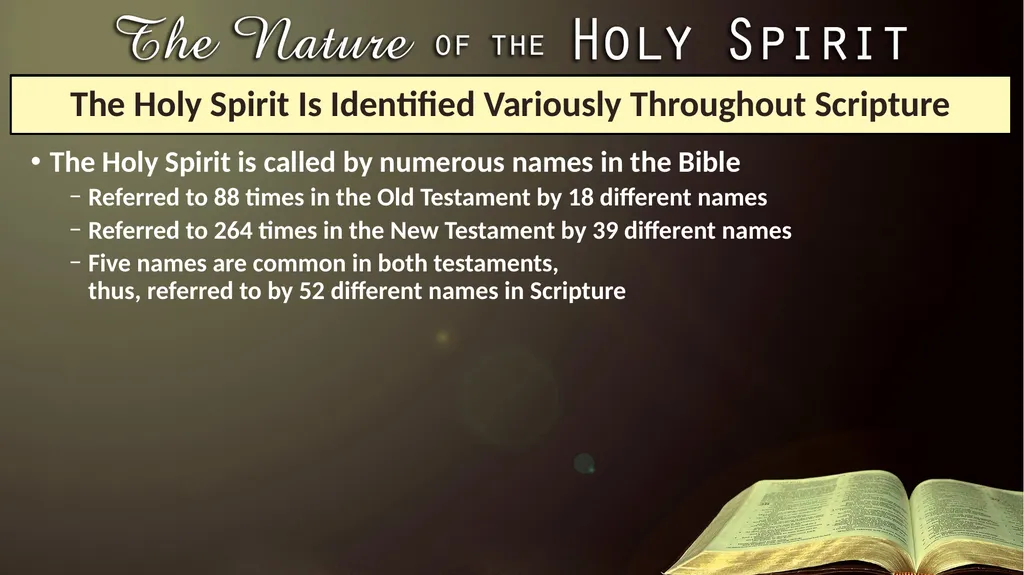
The Holy Spirit Is Identified Variously Throughout Scripture The Holy Spirit is called by numerous names in the Bible
Referred to 88 times in the Old Testament by 18 different names
Referred to 264 times in the New Testament by 39 different names
Five names are common in both testaments, thus, referred to by 52 different names in Scripture<br>
Referred to 88 times in the Old Testament by 18 different names
Referred to 264 times in the New Testament by 39 different names
Five names are common in both testaments, thus, referred to by 52 different names in Scripture<br>
04
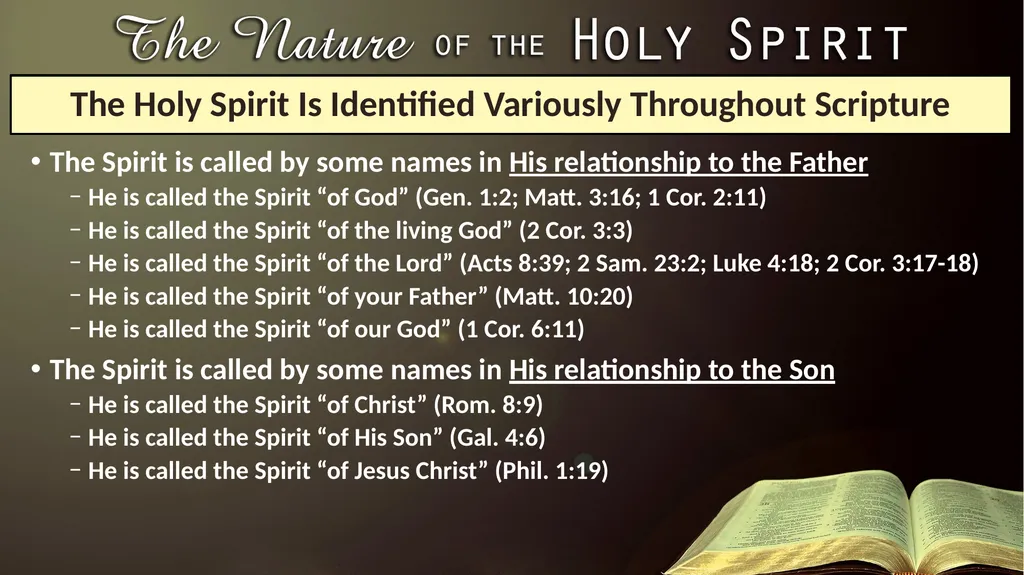
The Holy Spirit Is Identified Variously Throughout Scripture The Spirit is called by some names in His relationship to the Father
He is called the Spirit “of God” (Gen. 1:2; Matt. 3:16; 1 Cor. 2:11)
He is called the Spirit “of the living God” (2 Cor. 3:3)
He is called the Spirit “of the Lord” (Acts 8:39; 2 Sam. 23:2; Luke 4:18; 2 Cor. 3:17-18)
He is called the Spirit “of your Father” (Matt. 10:20)
He is called the Spirit “of our God” (1 Cor. 6:11)
The Spirit is called by some names in His relationship to the Son
He is called the Spirit “of Christ” (Rom. 8:9)
He is called the Spirit “of His Son” (Gal. 4:6)
He is called the Spirit “of Jesus Christ” (Phil. 1:19)<br>
05
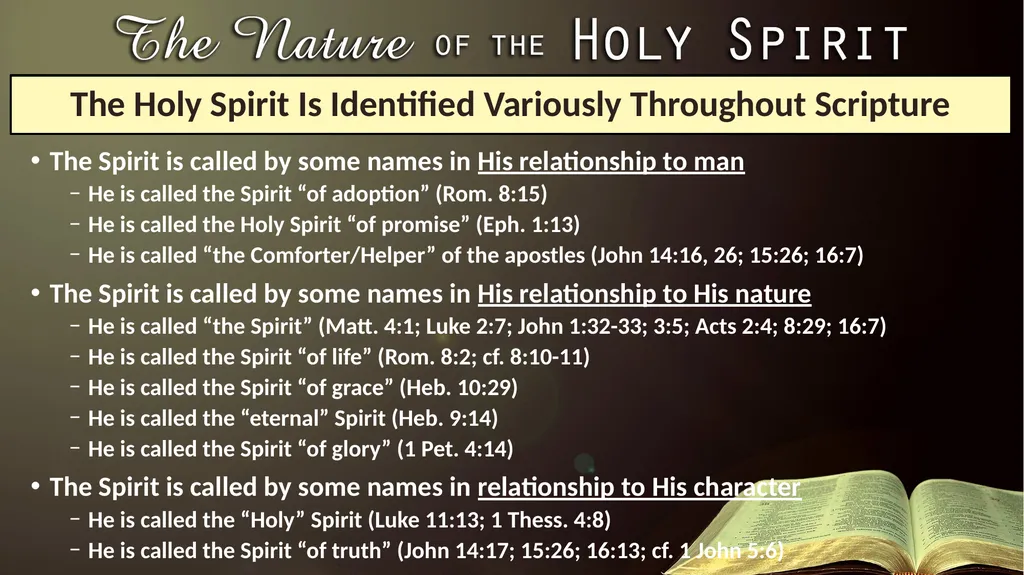
The Holy Spirit Is Identified Variously Throughout Scripture The Spirit is called by some names in His relationship to man
He is called the Spirit “of adoption” (Rom. 8:15)
He is called the Holy Spirit “of promise” (Eph. 1:13)
He is called “the Comforter/Helper” of the apostles (John 14:16, 26; 15:26; 16:7)
The Spirit is called by some names in His relationship to His nature
He is called “the Spirit” (Matt. 4:1; Luke 2:7; John 1:32-33; 3:5; Acts 2:4; 8:29; 16:7)
He is called the Spirit “of life” (Rom. 8:2; cf. 8:10-11)
He is called the Spirit “of grace” (Heb. 10:29)
He is called the “eternal” Spirit (Heb. 9:14)
He is called the Spirit “of glory” (1 Pet. 4:14)
The Spirit is called by some names in relationship to His character
He is called the “Holy” Spirit (Luke 11:13; 1 Thess. 4:8)
He is called the Spirit “of truth” (John 14:17; 15:26; 16:13; cf. 1 John 5:6)<br>
06
The Holy Spirit Is “a Person” The personal, masculine pronouns applied to the Holy Spirit show that He is “a person”
Jesus used eight personal pronouns for the Holy Spirit in John 16:13-14 alone
The Holy Spirit is not an “it” or a mystical force – He is a “He”<br>
Jesus used eight personal pronouns for the Holy Spirit in John 16:13-14 alone
The Holy Spirit is not an “it” or a mystical force – He is a “He”<br>
07
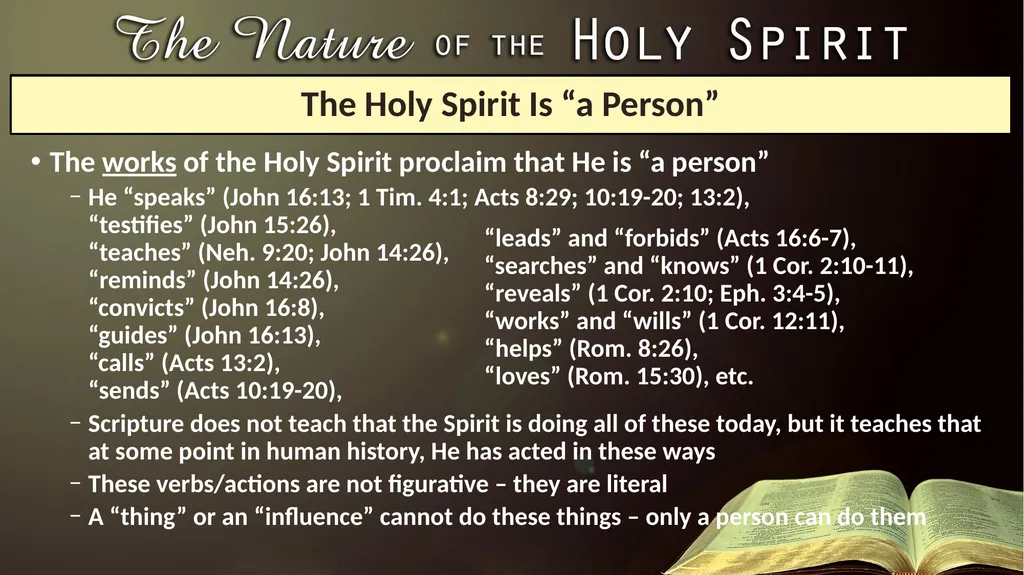
The Holy Spirit Is “a Person” The works of the Holy Spirit proclaim that He is “a person”
He “speaks” (John 16:13; 1 Tim. 4:1; Acts 8:29; 10:19-20; 13:2), “testifies” (John 15:26), “teaches” (Neh. 9:20; John 14:26), “reminds” (John 14:26), “convicts” (John 16:8), “guides” (John 16:13), “calls” (Acts 13:2), “sends” (Acts 10:19-20),
Scripture does not teach that the Spirit is doing all of these today, but it teaches that at some point in human history, He has acted in these ways
These verbs/actions are not figurative – they are literal
A “thing” or an “influence” cannot do these things – only a person can do them “leads” and “forbids” (Acts 16:6-7), “searches” and “knows” (1 Cor. 2:10-11), “reveals” (1 Cor. 2:10; Eph. 3:4-5), “works” and “wills” (1 Cor. 12:11), “helps” (Rom. 8:26), “loves” (Rom. 15:30), etc.<br>
08
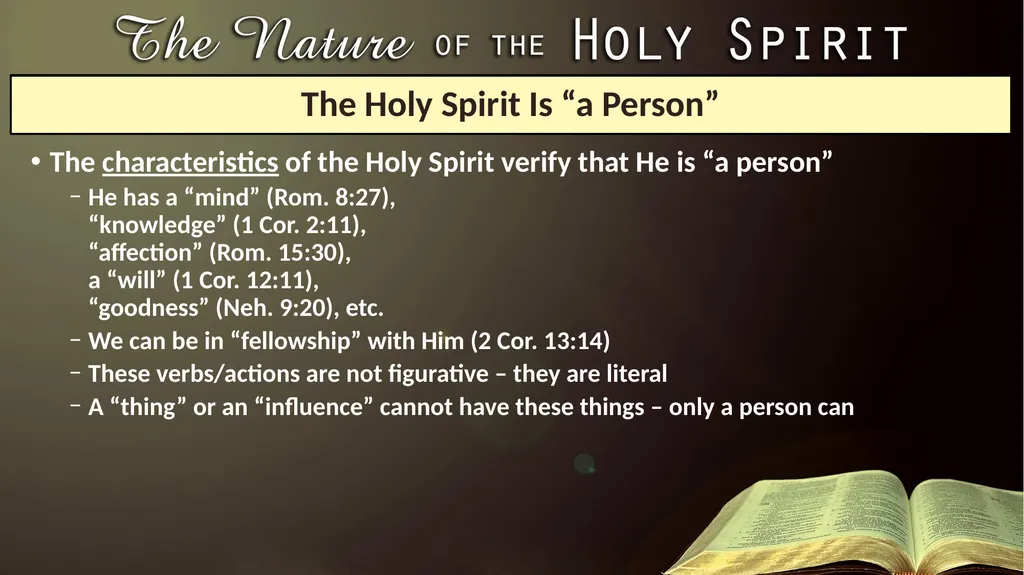
The Holy Spirit Is “a Person” The characteristics of the Holy Spirit verify that He is “a person”
He has a “mind” (Rom. 8:27), “knowledge” (1 Cor. 2:11), “affection” (Rom. 15:30), a “will” (1 Cor. 12:11), “goodness” (Neh. 9:20), etc.
We can be in “fellowship” with Him (2 Cor. 13:14)
These verbs/actions are not figurative – they are literal
A “thing” or an “influence” cannot have these things – only a person can<br>
09
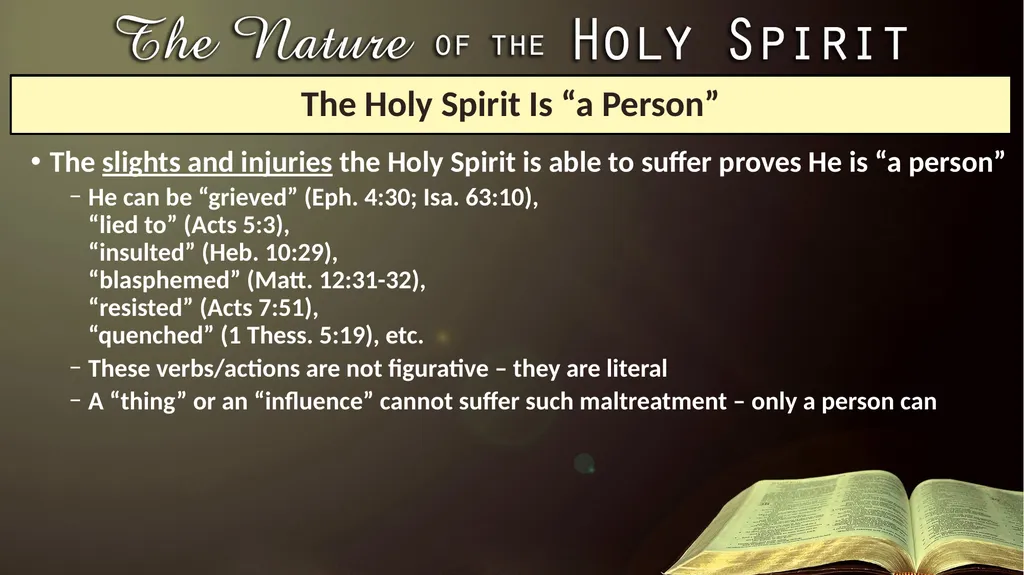
The Holy Spirit Is “a Person” The slights and injuries the Holy Spirit is able to suffer proves He is “a person”
He can be “grieved” (Eph. 4:30; Isa. 63:10), “lied to” (Acts 5:3), “insulted” (Heb. 10:29), “blasphemed” (Matt. 12:31-32), “resisted” (Acts 7:51), “quenched” (1 Thess. 5:19), etc.
These verbs/actions are not figurative – they are literal
A “thing” or an “influence” cannot suffer such maltreatment – only a person can<br>
10
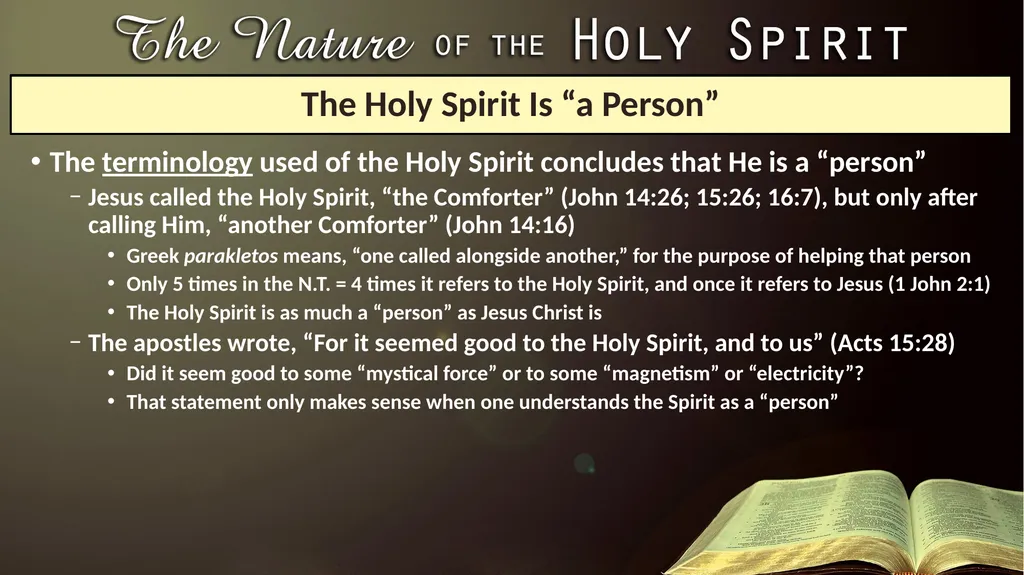
The Holy Spirit Is “a Person” The terminology used of the Holy Spirit concludes that He is a “person”
Jesus called the Holy Spirit, “the Comforter” (John 14:26; 15:26; 16:7), but only after calling Him, “another Comforter” (John 14:16)
Greek parakletos means, “one called alongside another,” for the purpose of helping that person
Only 5 times in the N.T. = 4 times it refers to the Holy Spirit, and once it refers to Jesus (1 John 2:1)
The Holy Spirit is as much a “person” as Jesus Christ is
The apostles wrote, “For it seemed good to the Holy Spirit, and to us” (Acts 15:28)
Did it seem good to some “mystical force” or to some “magnetism” or “electricity”?
That statement only makes sense when one understands the Spirit as a “person”<br>
11
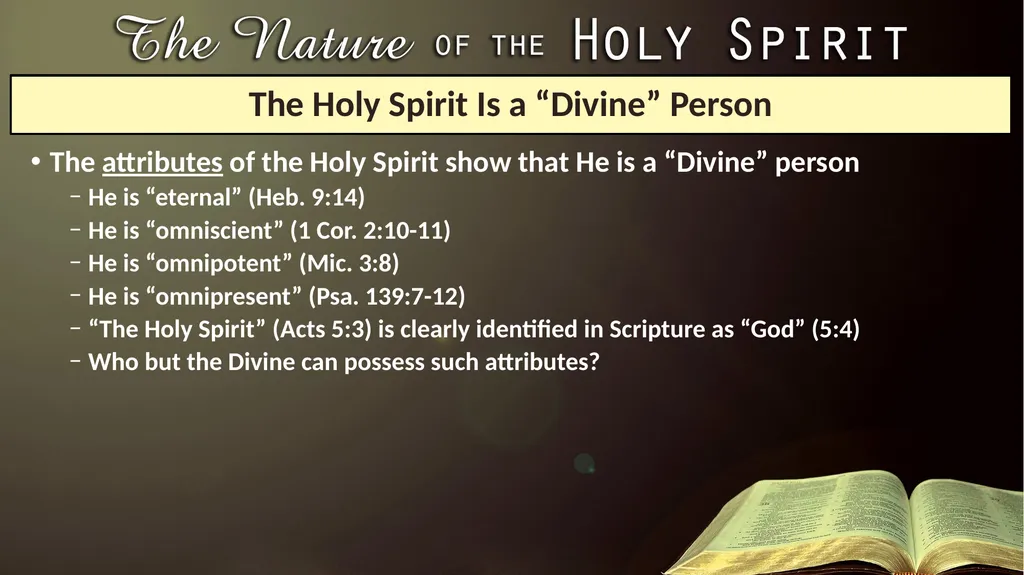
The Holy Spirit Is a “Divine” Person The attributes of the Holy Spirit show that He is a “Divine” person
He is “eternal” (Heb. 9:14)
He is “omniscient” (1 Cor. 2:10-11)
He is “omnipotent” (Mic. 3:8)
He is “omnipresent” (Psa. 139:7-12)
“The Holy Spirit” (Acts 5:3) is clearly identified in Scripture as “God” (5:4)
Who but the Divine can possess such attributes?<br>
He is “eternal” (Heb. 9:14)
He is “omniscient” (1 Cor. 2:10-11)
He is “omnipotent” (Mic. 3:8)
He is “omnipresent” (Psa. 139:7-12)
“The Holy Spirit” (Acts 5:3) is clearly identified in Scripture as “God” (5:4)
Who but the Divine can possess such attributes?<br>
12
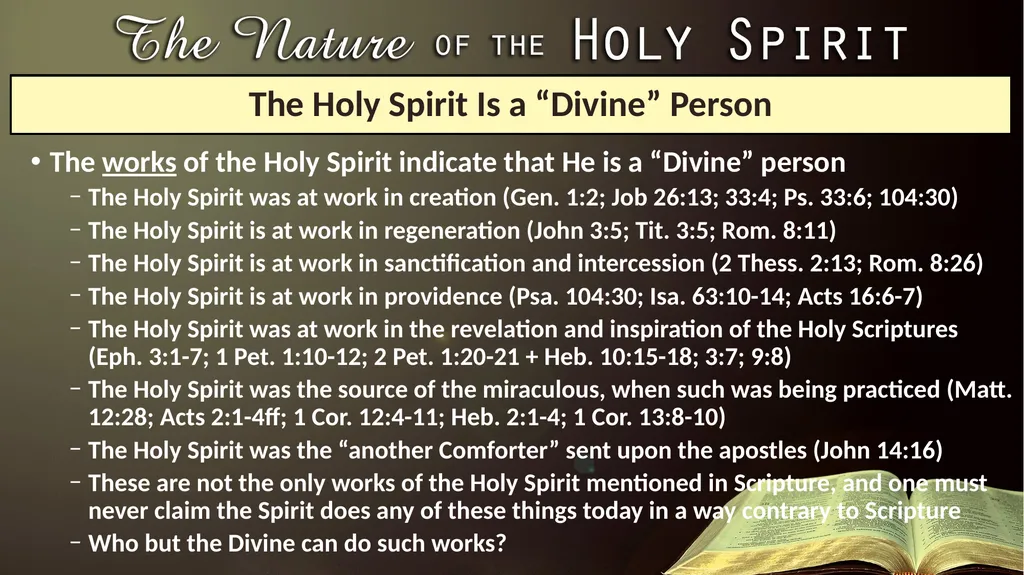
The Holy Spirit Is a “Divine” Person The works of the Holy Spirit indicate that He is a “Divine” person
The Holy Spirit was at work in creation (Gen. 1:2; Job 26:13; 33:4; Ps. 33:6; 104:30)
The Holy Spirit is at work in regeneration (John 3:5; Tit. 3:5; Rom. 8:11)
The Holy Spirit is at work in sanctification and intercession (2 Thess. 2:13; Rom. 8:26)
The Holy Spirit is at work in providence (Psa. 104:30; Isa. 63:10-14; Acts 16:6-7)
The Holy Spirit was at work in the revelation and inspiration of the Holy Scriptures (Eph. 3:1-7; 1 Pet. 1:10-12; 2 Pet. 1:20-21 + Heb. 10:15-18; 3:7; 9:8)
The Holy Spirit was the source of the miraculous, when such was being practiced (Matt. 12:28; Acts 2:1-4ff; 1 Cor. 12:4-11; Heb. 2:1-4; 1 Cor. 13:8-10)
The Holy Spirit was the “another Comforter” sent upon the apostles (John 14:16)
These are not the only works of the Holy Spirit mentioned in Scripture, and one must never claim the Spirit does any of these things today in a way contrary to Scripture
Who but the Divine can do such works?<br>
13
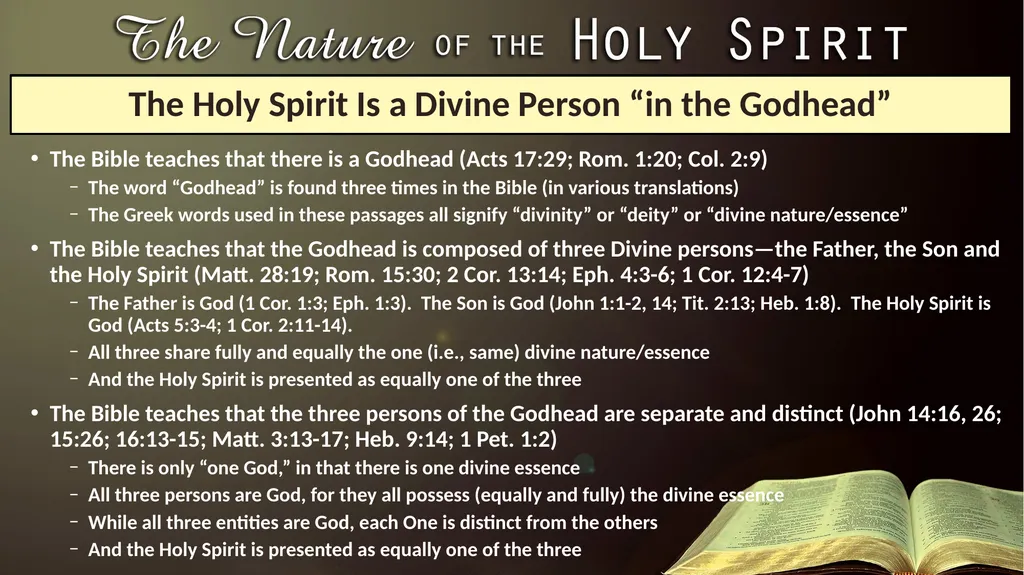
The Holy Spirit Is a Divine Person “in the Godhead” The Bible teaches that there is a Godhead (Acts 17:29; Rom. 1:20; Col. 2:9)
The word “Godhead” is found three times in the Bible (in various translations)
The Greek words used in these passages all signify “divinity” or “deity” or “divine nature/essence”
The Bible teaches that the Godhead is composed of three Divine persons—the Father, the Son and the Holy Spirit (Matt. 28:19; Rom. 15:30; 2 Cor. 13:14; Eph. 4:3-6; 1 Cor. 12:4-7)
The Father is God (1 Cor. 1:3; Eph. 1:3). The Son is God (John 1:1-2, 14; Tit. 2:13; Heb. 1:8). The Holy Spirit is God (Acts 5:3-4; 1 Cor. 2:11-14).
All three share fully and equally the one (i.e., same) divine nature/essence
And the Holy Spirit is presented as equally one of the three
The Bible teaches that the three persons of the Godhead are separate and distinct (John 14:16, 26; 15:26; 16:13-15; Matt. 3:13-17; Heb. 9:14; 1 Pet. 1:2)
There is only “one God,” in that there is one divine essence
All three persons are God, for they all possess (equally and fully) the divine essence
While all three entities are God, each One is distinct from the others
And the Holy Spirit is presented as equally one of the three<br>
14
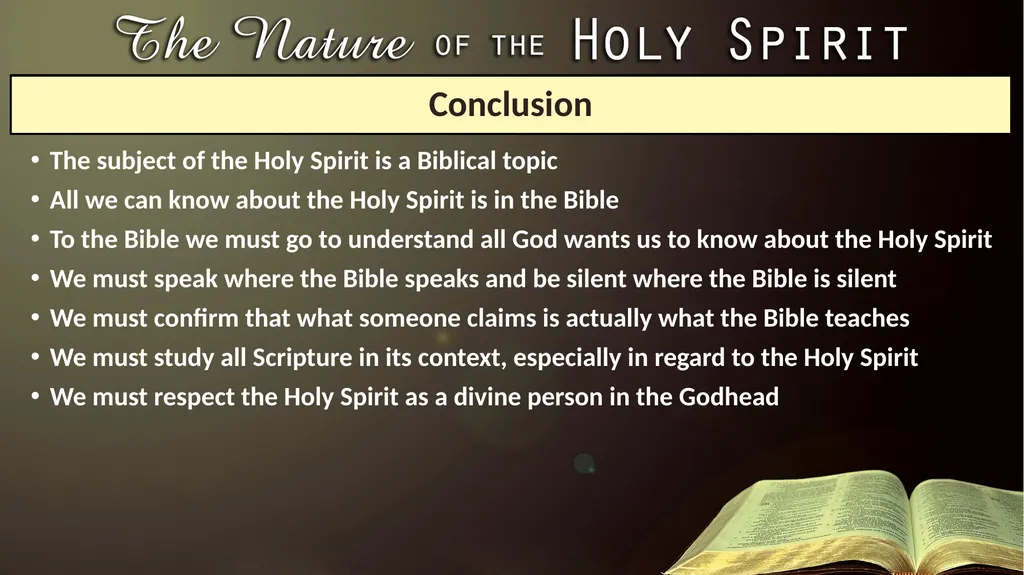
Conclusion The subject of the Holy Spirit is a Biblical topic
All we can know about the Holy Spirit is in the Bible
To the Bible we must go to understand all God wants us to know about the Holy Spirit
We must speak where the Bible speaks and be silent where the Bible is silent
We must confirm that what someone claims is actually what the Bible teaches
We must study all Scripture in its context, especially in regard to the Holy Spirit
We must respect the Holy Spirit as a divine person in the Godhead<br>