Living things and their habitats Comparing the life cycle of a range of animals Year 5 Age 9-10 For parents Thank you for supporting your childs learning in science. Before the session: Please read slide 2 so you know what your child
"Living things and their habitats Comparing the" is the property of its rightful owner. Permission is granted to
download and print the materials on this website for personal, non-commercial use only, and to display it
on your personal computer provided you do not modify the materials and that you retain all copyright
notices contained in the materials. By downloading content from our website, you accept the terms of this
agreement.
Presentation Transcript
01
Living things and their habitats Comparing the life cycle of a range of animals Year 5 Age 9-10 For parents
Thank you for supporting your child’s learning in science.
Before the session:
Please read slide 2 so you know what your child learning and what you need to get ready.
As an alternative to lined paper, slide 5 may be printed for your child to record on.
During the session:
Share the learning intentions on slide 2.
Support your child with the main activities on slides 3-5, as needed.
Slides 6-7 is a further, optional activity.
Slide 8 has a glossary of key terms.
Reviewing with your child:
Slide 9 gives an idea of what your child may produce.<br>
02
Key Learning
As part of their life cycle, plants and animals reproduce.
Most animals reproduce sexually. This involves two parents where the sperm from the male fertilises the female egg.
Some young undergo a further change before becoming adults (e.g. caterpillars to butterflies). This is called a metamorphosis. Activities (pages 3-5): 40 - 50 mins
Use lined paper, ruler and pencil.
Alternatively, print page 5 as a worksheet.
Find out more… (page 6-7)
Compare the life cycles of more animals. I can…
use secondary sources to find out about the life cycles of animals.
describe some differences between the life cycles of different animals. Livings things and their habitats Comparing the life cycles of a range of animals Logo for section to sit inside roundel 2<br>
03
Watch these two clips:
https://www.bbc.co.uk/bitesize/clips/zp62tfr
https://www.bbc.co.uk/bitesize/clips/zdfpyrd
Which animals lay eggs?
Which animals give birth to live young?
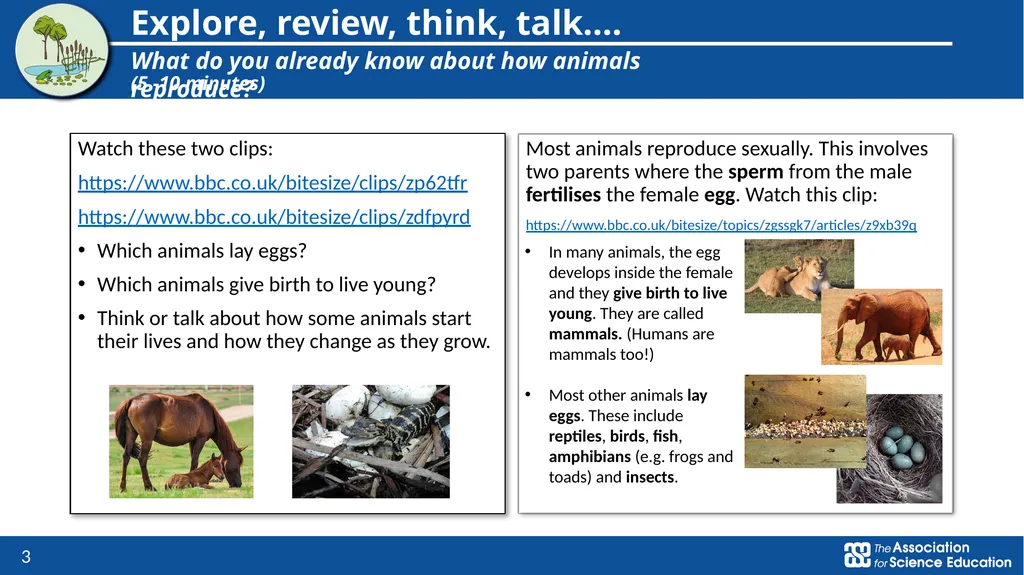
Think or talk about how some animals start their lives and how they change as they grow. Most animals reproduce sexually. This involves two parents where the sperm from the male fertilises the female egg. Watch this clip:
https://www.bbc.co.uk/bitesize/topics/zgssgk7/articles/z9xb39q 3 Explore, review, think, talk…. What do you already know about how animals reproduce? (5 -10 minutes) Logo for section to sit inside roundel 3 In many animals, the egg develops inside the female and they give birth to live young. They are called mammals. (Humans are mammals too!)
Most other animals lay eggs. These include reptiles, birds, fish, amphibians (e.g. frogs and toads) and insects.<br>
04
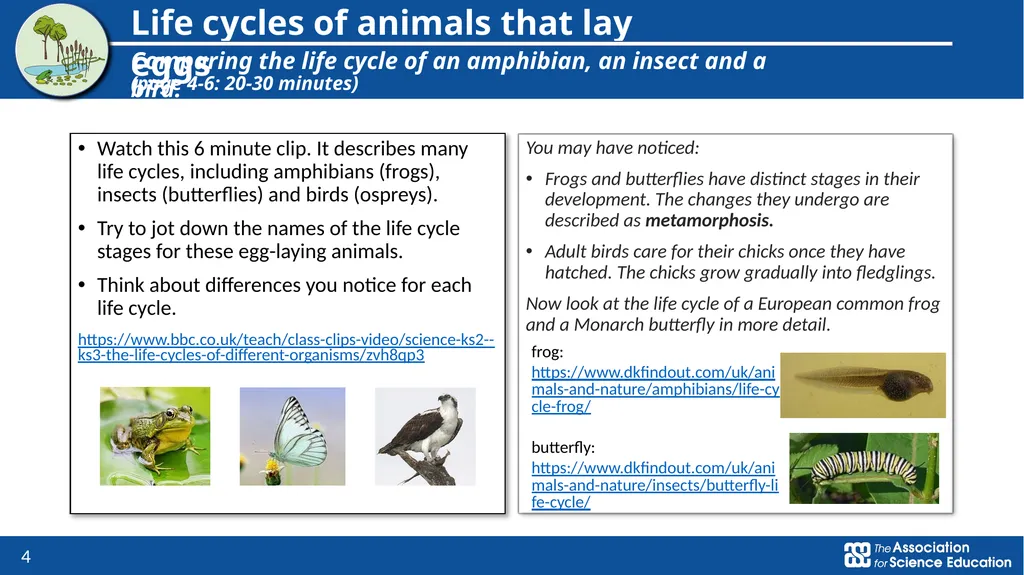
Watch this 6 minute clip. It describes many life cycles, including amphibians (frogs), insects (butterflies) and birds (ospreys).
Try to jot down the names of the life cycle stages for these egg-laying animals.
Think about differences you notice for each life cycle.
https://www.bbc.co.uk/teach/class-clips-video/science-ks2--ks3-the-life-cycles-of-different-organisms/zvh8qp3 You may have noticed:
Frogs and butterflies have distinct stages in their development. The changes they undergo are described as metamorphosis.
Adult birds care for their chicks once they have hatched. The chicks grow gradually into fledglings.
Now look at the life cycle of a European common frog and a Monarch butterfly in more detail. 4 Life cycles of animals that lay eggs Comparing the life cycle of an amphibian, an insect and a bird. (page 4-6: 20-30 minutes) Logo for section to sit inside roundel 4 frog: https://www.dkfindout.com/uk/animals-and-nature/amphibians/life-cycle-frog/
butterfly: https://www.dkfindout.com/uk/animals-and-nature/insects/butterfly-life-cycle/<br>
05
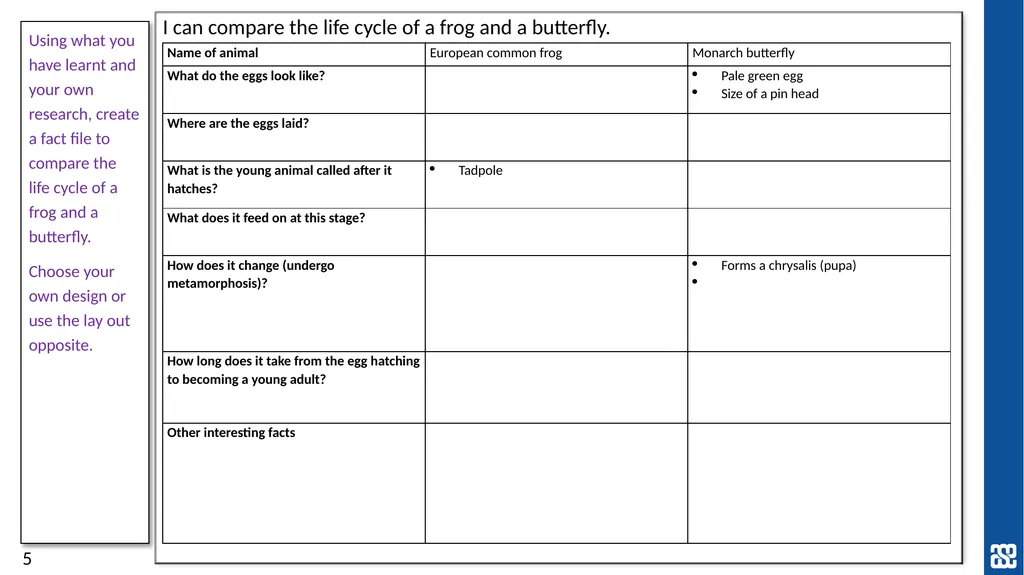
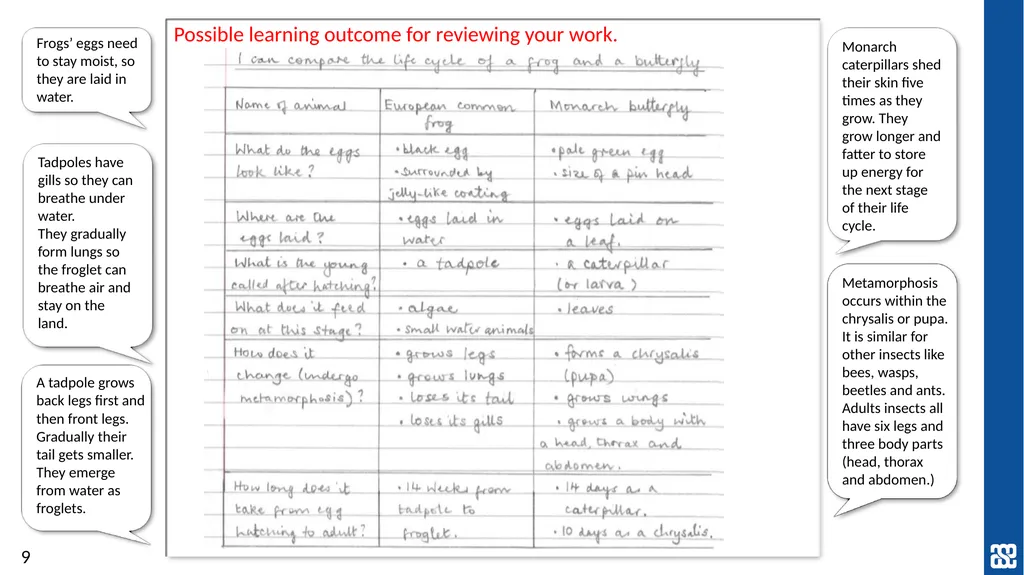
Using what you have learnt and your own research, create a fact file to compare the life cycle of a frog and a butterfly.
Choose your own design or use the lay out opposite. I can compare the life cycle of a frog and a butterfly. 5<br>
06
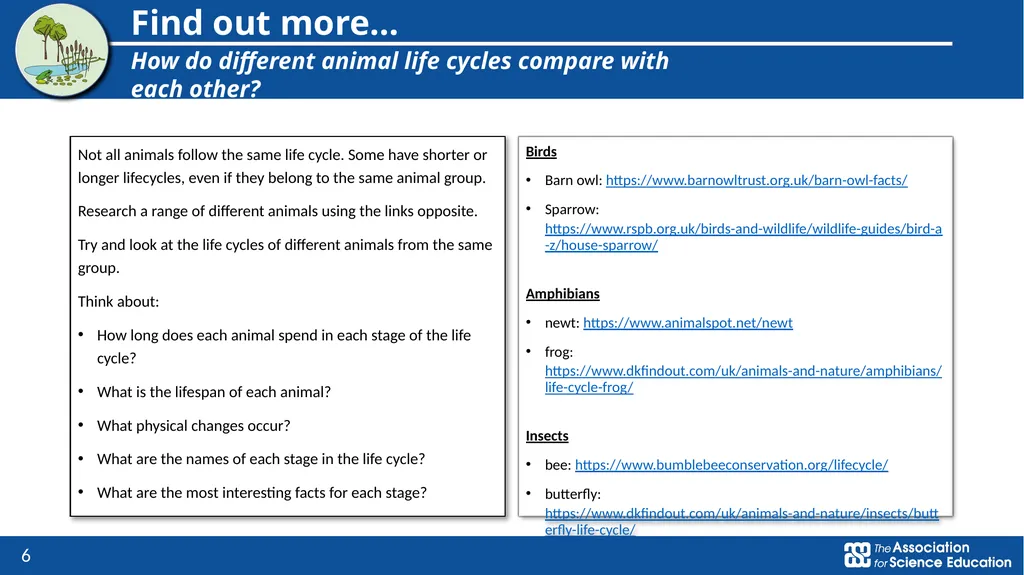
Not all animals follow the same life cycle. Some have shorter or longer lifecycles, even if they belong to the same animal group.
Research a range of different animals using the links opposite.
Try and look at the life cycles of different animals from the same group.
Think about:
How long does each animal spend in each stage of the life cycle?
What is the lifespan of each animal?
What physical changes occur?
What are the names of each stage in the life cycle?
What are the most interesting facts for each stage? Birds
Barn owl: https://www.barnowltrust.org.uk/barn-owl-facts/
Sparrow: https://www.rspb.org.uk/birds-and-wildlife/wildlife-guides/bird-a-z/house-sparrow/
Amphibians
newt: https://www.animalspot.net/newt
frog: https://www.dkfindout.com/uk/animals-and-nature/amphibians/life-cycle-frog/
Insects
bee: https://www.bumblebeeconservation.org/lifecycle/
butterfly: https://www.dkfindout.com/uk/animals-and-nature/insects/butterfly-life-cycle/ Find out more… How do different animal life cycles compare with each other? Logo for section to sit inside roundel 6<br>
07
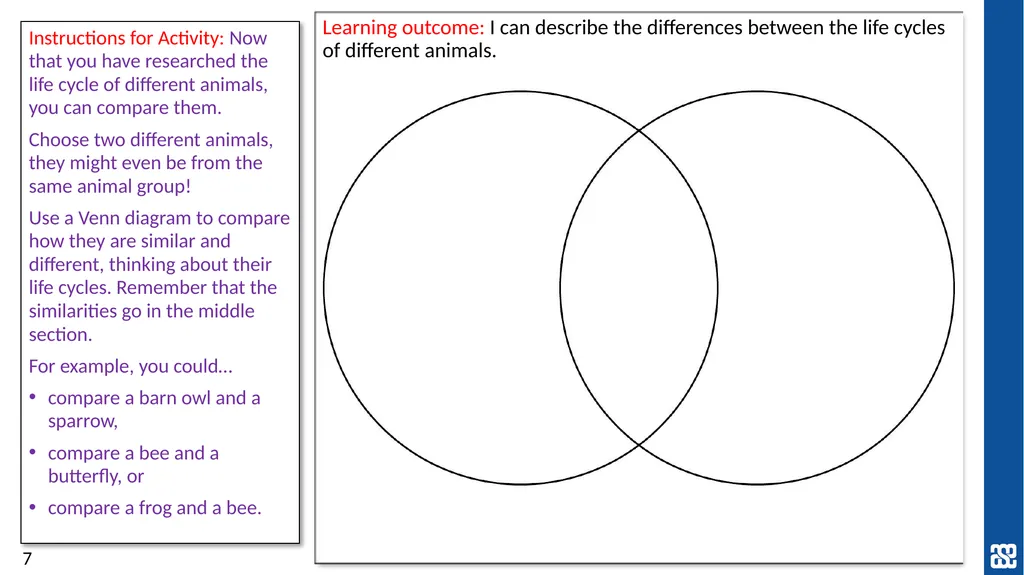
Instructions for Activity: Now that you have researched the life cycle of different animals, you can compare them.
Choose two different animals, they might even be from the same animal group!
Use a Venn diagram to compare how they are similar and different, thinking about their life cycles. Remember that the similarities go in the middle section.
For example, you could…
compare a barn owl and a sparrow,
compare a bee and a butterfly, or
compare a frog and a bee. Learning outcome: I can describe the differences between the life cycles of different animals. 7<br>
08
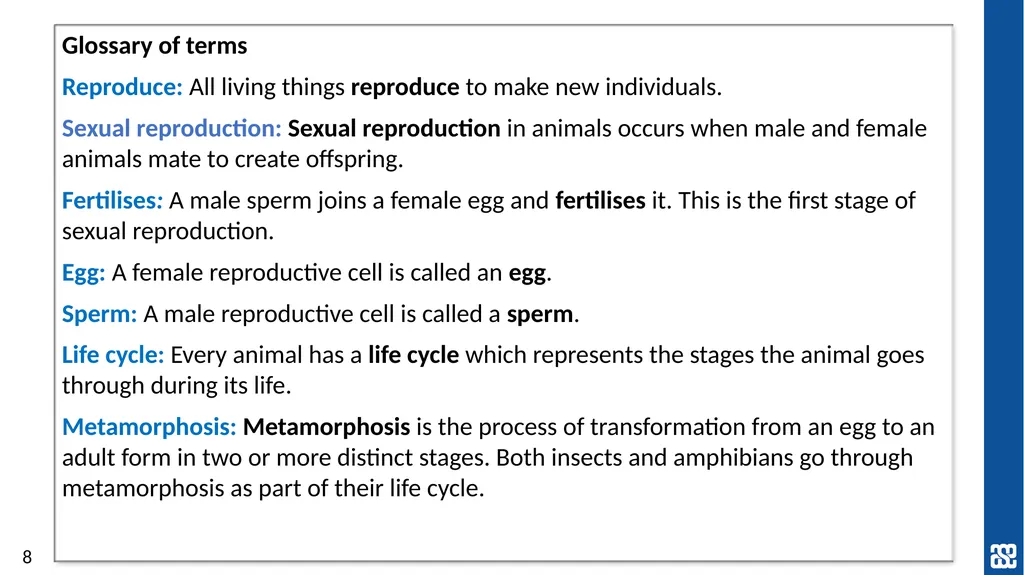
Glossary of terms
Reproduce: All living things reproduce to make new individuals.
Sexual reproduction: Sexual reproduction in animals occurs when male and female animals mate to create offspring.
Fertilises: A male sperm joins a female egg and fertilises it. This is the first stage of sexual reproduction.
Egg: A female reproductive cell is called an egg.
Sperm: A male reproductive cell is called a sperm.
Life cycle: Every animal has a life cycle which represents the stages the animal goes through during its life.
Metamorphosis: Metamorphosis is the process of transformation from an egg to an adult form in two or more distinct stages. Both insects and amphibians go through metamorphosis as part of their life cycle. 8<br>
09
Possible learning outcome for reviewing your work. 9<br>