Living things and their habitats Food chains in woodland habitats Year 4 Age 8-9 For parents Thank you for supporting your childs learning in science. Before the session: Please read slide 2 so you know what your child is learning and what
"Living things and their habitats Food chains in" is the property of its rightful owner. Permission is granted to
download and print the materials on this website for personal, non-commercial use only, and to display it
on your personal computer provided you do not modify the materials and that you retain all copyright
notices contained in the materials. By downloading content from our website, you accept the terms of this
agreement.
Presentation Transcript
01
Living things and their habitats Food chains in woodland habitats Year 4
Age 8-9 For parents
Thank you for supporting your child’s learning in science.
Before the session:
Please read slide 2 so you know what your child is learning and what you need to get ready.
As an alternative to lined paper, slide 5 may be printed for your child to record on.
During the session:
Share the learning intentions on slide 2.
Support your child with the main activities on slides 3 to 6, as needed.
Slide 7 is a further, optional activity.
Slide 8 has a glossary of key terms.
Reviewing with your child:
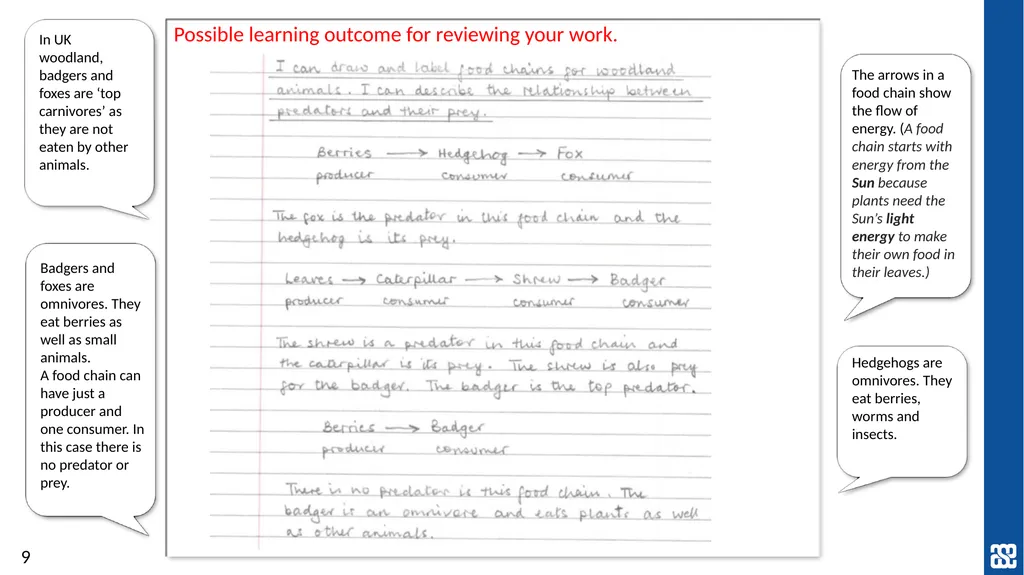
Slide 9 gives an idea of what your child may produce.<br>
02
Key Learning
A food chain shows the links between different living things and where they get their energy from.
Living things can be classified as producers or consumers according to their place in the food chain.
A predator is an animal that feeds on other animals (its prey).
Animals can be described as carnivores, herbivores or omnivores. Activities (pages 3-6): 30 - 40 mins
Use lined paper, a ruler and a pencil.
Alternatively, print page 6 as a worksheet.
Find out more… (page 7): 30 - 60 mins
You may like to explore more about predators and their prey. I can…
Draw food chains for woodland plants and animals.
Describe the relationship between predators and their prey. Living things and their habitats Food chains in a woodland habitat Logo for section to sit inside roundel 2<br>
03
All animals need to eat food to survive.
Talk about what you already know about the kind of food different animals eat.
What is the name of an animal that only eats plants?
What is the name of an animal that only eats other animals?
What is the name of an animal that eats both plants and other animals? 3 Explore, review, think, talk…. What do you already know about how animals feed? (5 minutes) Logo for section to sit inside roundel 3 Watch this clip about birds. What kind of food do they eat? https://www.bbc.co.uk/bitesize/clips/z9nhfg8<br>
04
Watch this clip describing a food chain. https://www.bbc.co.uk/bitesize/clips/zjshfg8
Think about these questions as you watch
Where does a food chain start?
Which animals are herbivores?
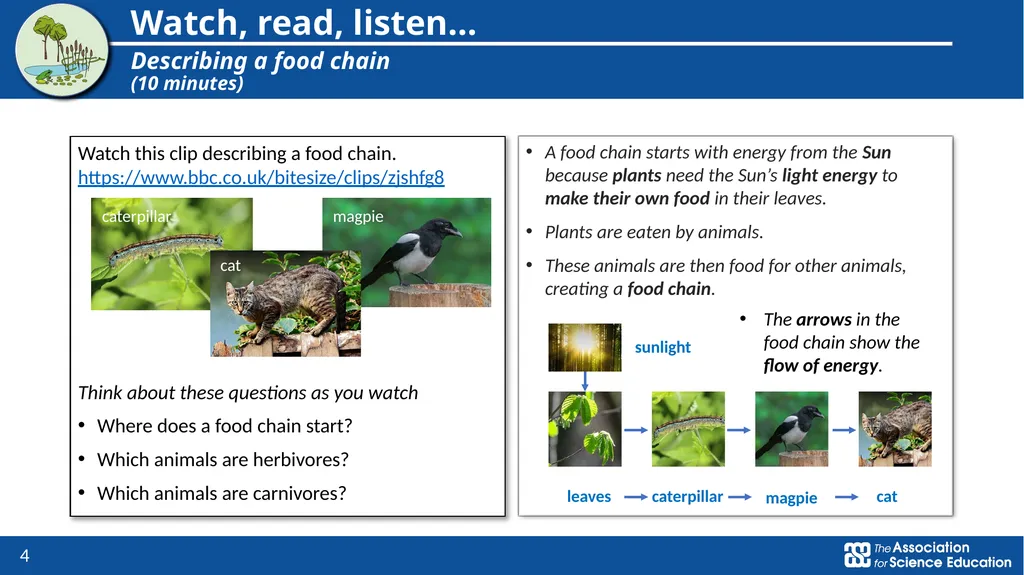
Which animals are carnivores? A food chain starts with energy from the Sun because plants need the Sun’s light energy to make their own food in their leaves.
Plants are eaten by animals.
These animals are then food for other animals, creating a food chain. Watch, read, listen… Describing a food chain (10 minutes) Logo for section to sit inside roundel 4 caterpillar cat magpie The arrows in the food chain show the flow of energy.<br>
05
All plants make their own food. They are called producers.
Animals eat plants or other animals to survive. They are called consumers.
Play this food chain game to identify some woodland producers and consumers. https://www.bbc.co.uk/bitesize/topics/zbnnb9q/articles/zsphrwx Animals which hunt and kill other animals to eat are called predators.
The animals they eat are called prey.
Write down a list of predators and their prey from the food chain game. Building food chains Describe producers, consumers, predators and prey in a food chain (page 5-6: 30 minutes) Logo for section to sit inside roundel 4<br>
06
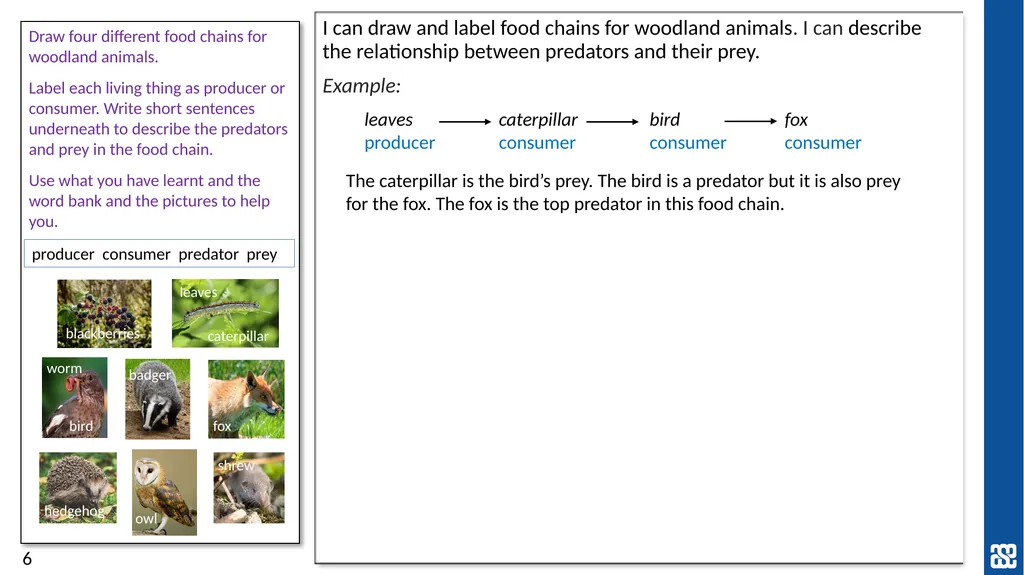
Draw four different food chains for woodland animals.
Label each living thing as producer or consumer. Write short sentences underneath to describe the predators and prey in the food chain.
Use what you have learnt and the word bank and the pictures to help you. I can draw and label food chains for woodland animals. I can describe the relationship between predators and their prey.
Example: 6 The caterpillar is the bird’s prey. The bird is a predator but it is also prey for the fox. The fox is the top predator in this food chain. producer consumer predator prey blackberries bird shrew leaves caterpillar badger hedgehog owl fox worm<br>
07
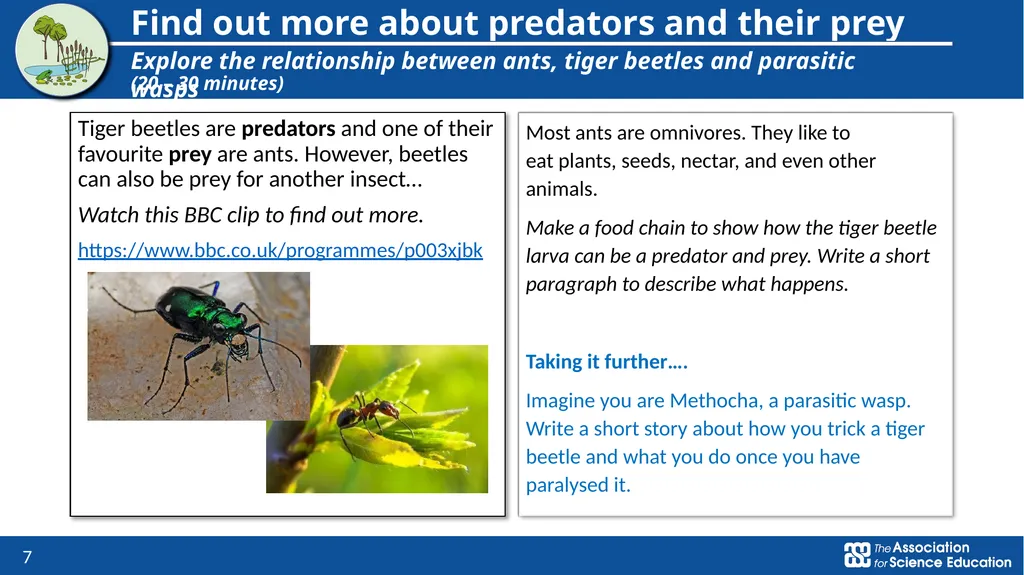
Tiger beetles are predators and one of their favourite prey are ants. However, beetles can also be prey for another insect…
Watch this BBC clip to find out more.
https://www.bbc.co.uk/programmes/p003xjbk Most ants are omnivores. They like to eat plants, seeds, nectar, and even other animals.
Make a food chain to show how the tiger beetle larva can be a predator and prey. Write a short paragraph to describe what happens.
Taking it further….
Imagine you are Methocha, a parasitic wasp. Write a short story about how you trick a tiger beetle and what you do once you have paralysed it. Find out more about predators and their prey Explore the relationship between ants, tiger beetles and parasitic wasps (20 – 30 minutes) Logo for section to sit inside roundel 7<br>
08
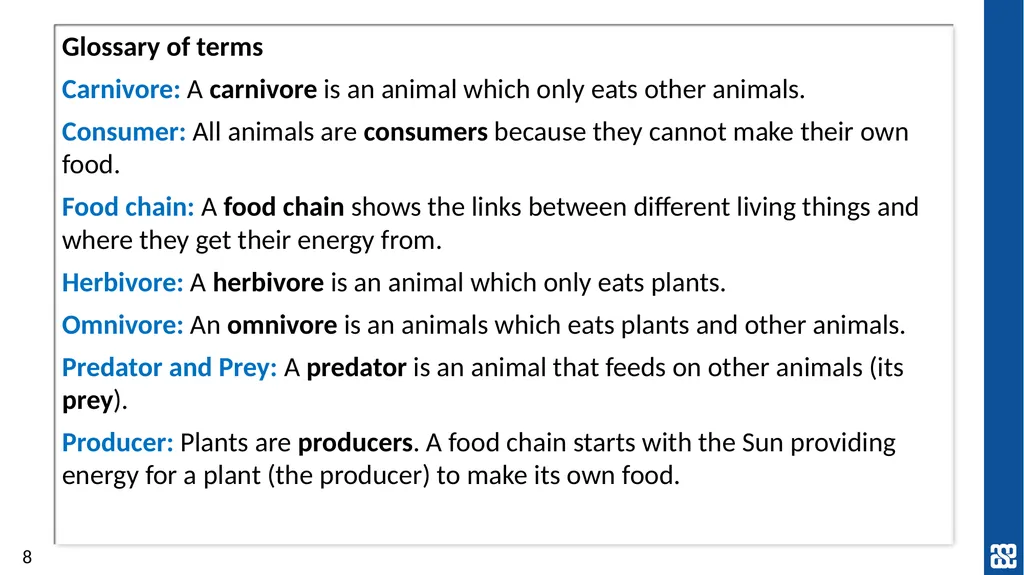
Glossary of terms
Carnivore: A carnivore is an animal which only eats other animals.
Consumer: All animals are consumers because they cannot make their own food.
Food chain: A food chain shows the links between different living things and where they get their energy from.
Herbivore: A herbivore is an animal which only eats plants.
Omnivore: An omnivore is an animals which eats plants and other animals.
Predator and Prey: A predator is an animal that feeds on other animals (its prey).
Producer: Plants are producers. A food chain starts with the Sun providing energy for a plant (the producer) to make its own food. 8<br>
09
Possible learning outcome for reviewing your work. 9 In UK woodland, badgers and foxes are ‘top carnivores’ as they are not eaten by other animals.<br>