02
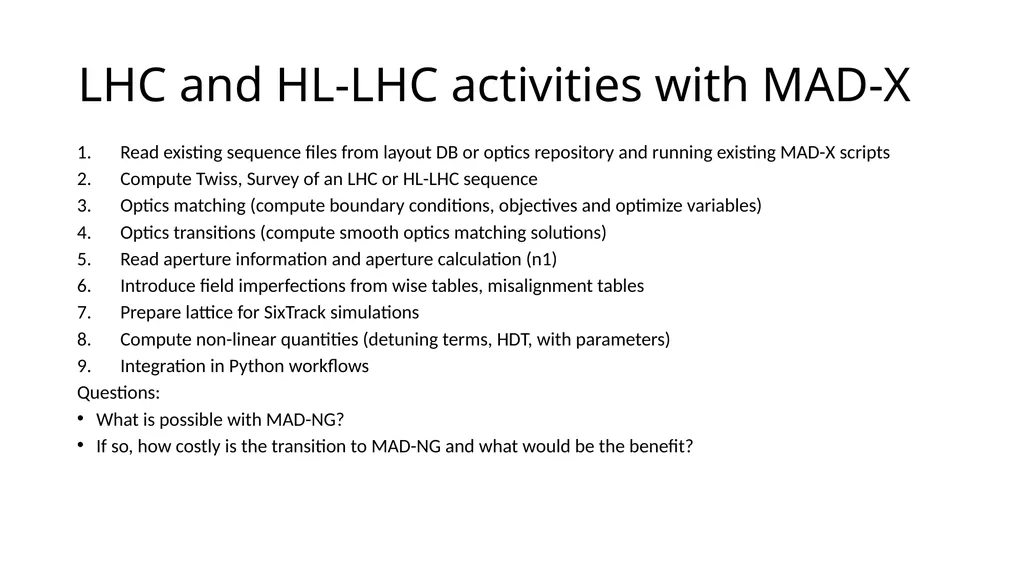
LHC and HL-LHC activities with MAD-X Read existing sequence files from layout DB or optics repository and running existing MAD-X scripts
Compute Twiss, Survey of an LHC or HL-LHC sequence
Optics matching (compute boundary conditions, objectives and optimize variables)
Optics transitions (compute smooth optics matching solutions)
Read aperture information and aperture calculation (n1)
Introduce field imperfections from wise tables, misalignment tables
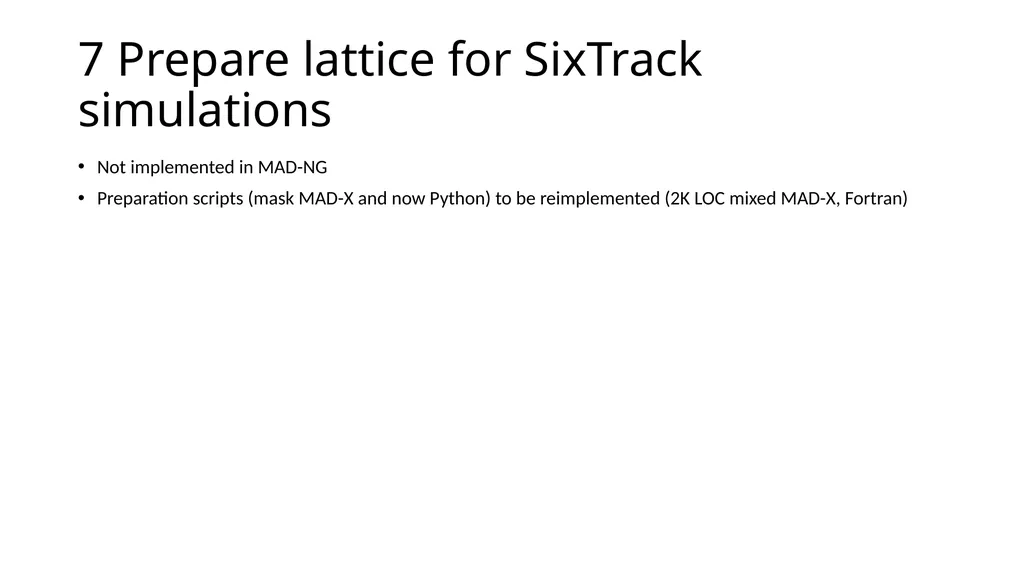
Prepare lattice for SixTrack simulations
Compute non-linear quantities (detuning terms, HDT, with parameters)
Integration in Python workflows
Questions:
What is possible with MAD-NG?
If so, how costly is the transition to MAD-NG and what would be the benefit?<br>
04
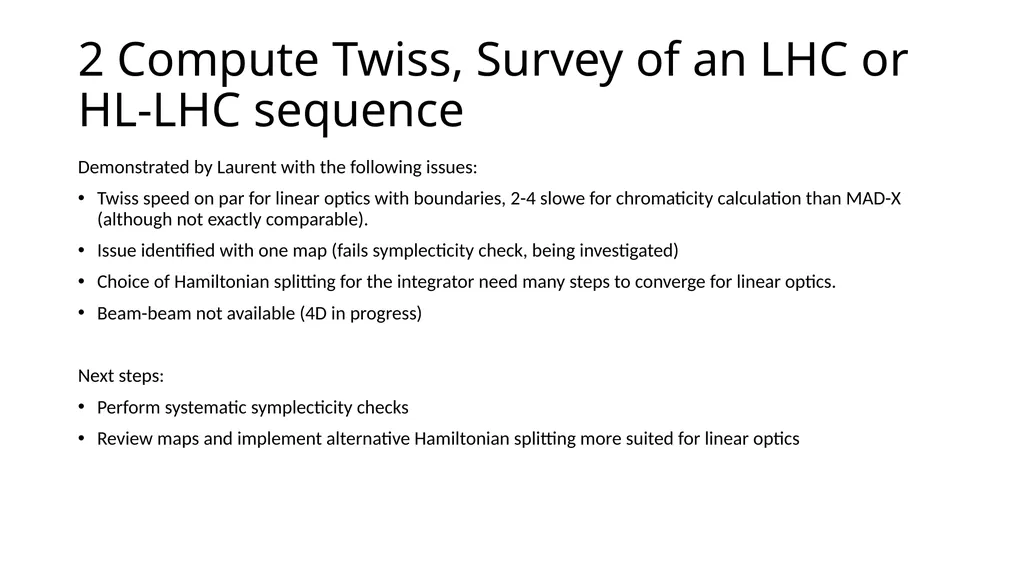
2 Compute Twiss, Survey of an LHC or HL-LHC sequence Demonstrated by Laurent with the following issues:
Twiss speed on par for linear optics with boundaries, 2-4 slowe for chromaticity calculation than MAD-X (although not exactly comparable).
Issue identified with one map (fails symplecticity check, being investigated)
Choice of Hamiltonian splitting for the integrator need many steps to converge for linear optics.
Beam-beam not available (4D in progress)
Next steps:
Perform systematic symplecticity checks
Review maps and implement alternative Hamiltonian splitting more suited for linear optics<br>
05
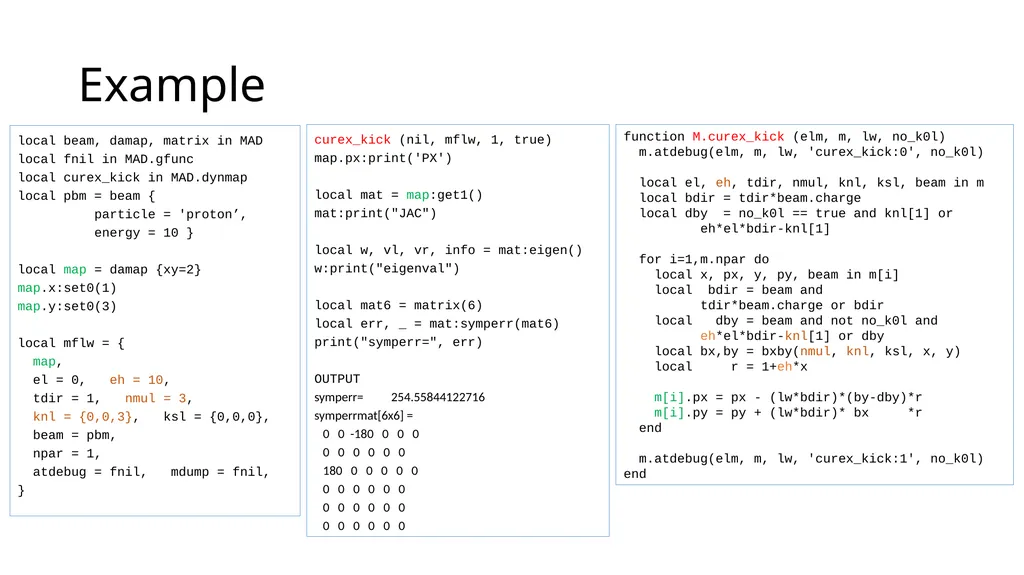
Example local beam, damap, matrix in MAD
local fnil in MAD.gfunc
local curex_kick in MAD.dynmap
local pbm = beam {
particle = 'proton’,
energy = 10 }
local map = damap {xy=2}
map.x:set0(1)
map.y:set0(3)
local mflw = {
map,
el = 0, eh = 10,
tdir = 1, nmul = 3,
knl = {0,0,3}, ksl = {0,0,0},
beam = pbm,
npar = 1,
atdebug = fnil, mdump = fnil,
} curex_kick (nil, mflw, 1, true)
map.px:print('PX')
local mat = map:get1()
mat:print("JAC")
local w, vl, vr, info = mat:eigen()
w:print("eigenval")
local mat6 = matrix(6)
local err, _ = mat:symperr(mat6)
print("symperr=", err)
OUTPUT
symperr= 254.55844122716
symperrmat[6x6] =
0 0 -180 0 0 0
0 0 0 0 0 0
180 0 0 0 0 0
0 0 0 0 0 0
0 0 0 0 0 0
0 0 0 0 0 0 function M.curex_kick (elm, m, lw, no_k0l)
m.atdebug(elm, m, lw, 'curex_kick:0', no_k0l)
local el, eh, tdir, nmul, knl, ksl, beam in m
local bdir = tdir*beam.charge
local dby = no_k0l == true and knl[1] or eh*el*bdir-knl[1]
for i=1,m.npar do
local x, px, y, py, beam in m[i]
local bdir = beam and
tdir*beam.charge or bdir
local dby = beam and not no_k0l and eh*el*bdir-knl[1] or dby
local bx,by = bxby(nmul, knl, ksl, x, y)
local r = 1+eh*x
m[i].px = px - (lw*bdir)*(by-dby)*r
m[i].py = py + (lw*bdir)* bx *r
end
m.atdebug(elm, m, lw, 'curex_kick:1', no_k0l)
end<br>
06
3 Optics matching (compute boundary conditions, objectives and optimize strengths) Matching demonstrated on an LHC example by Laurent
It should be possible to exploit the increased MAD-NG flexibility
For the HL-LHC, one needs to translate all the macro to compute ATS constraints, matching constraints (14k LOC in MAD-X equal to twiss.f90+trrun.f90).
All the ingredients in MAD-NG are available for porting the code, but clearly not doable in a short time scale.<br>
07
4 Optics transitions (compute smooth optics matching solutions) This is a specialized application of matching.
Testing has not done yet, but we expect it should be ok either out of box or with some tweaking as MAD-NG has a “jacobian-like” solver.<br>
08
5. Read aperture information and aperture margin calculations Aperture data can be read. Octagon needs conversion from MAD-X, although some reflections might be needed
Aperture n1 calculation is not implemented in MAD-NG.<br>
09
6. Introduce field imperfections and misalignment from TFS tables and error table Tested in unit tests.
MAD-NG has the functionality to accept the data.
Error routines written in MAD-X needs to be re-written (5K LOC mixed MAD-X, Fortran)<br>
10
7 Prepare lattice for SixTrack simulations Not implemented in MAD-NG
Preparation scripts (mask MAD-X and now Python) to be reimplemented (2K LOC mixed MAD-X, Fortran)<br>
11
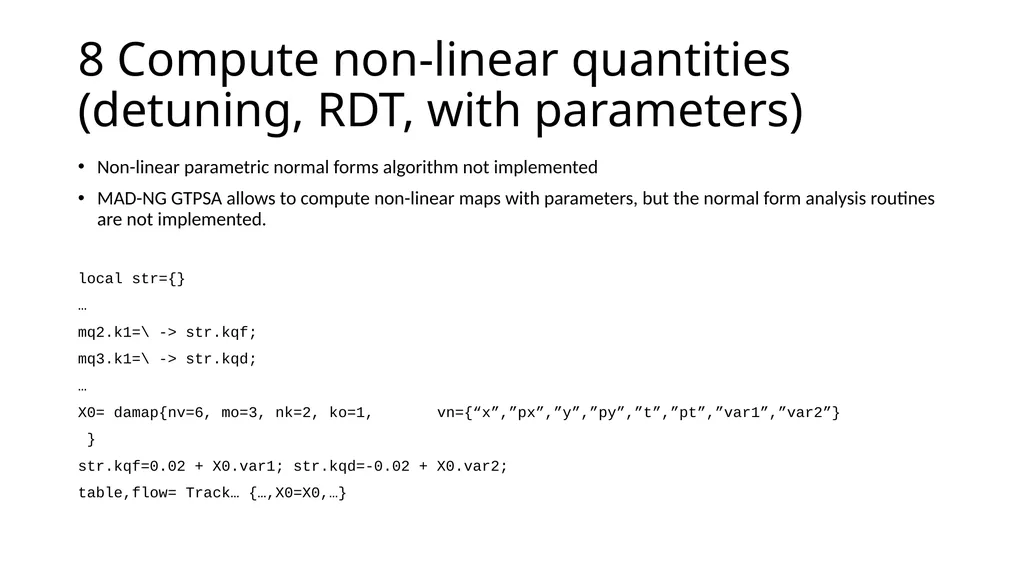
8 Compute non-linear quantities (detuning, RDT, with parameters) Non-linear parametric normal forms algorithm not implemented
MAD-NG GTPSA allows to compute non-linear maps with parameters, but the normal form analysis routines are not implemented.
local str={}
…
mq2.k1=\ -> str.kqf;
mq3.k1=\ -> str.kqd;
…
X0= damap{nv=6, mo=3, nk=2, ko=1, vn={“x”,”px”,”y”,”py”,”t”,”pt”,”var1”,”var2”}
}
str.kqf=0.02 + X0.var1; str.kqd=-0.02 + X0.var2;
table,flow= Track… {…,X0=X0,…}<br>
12
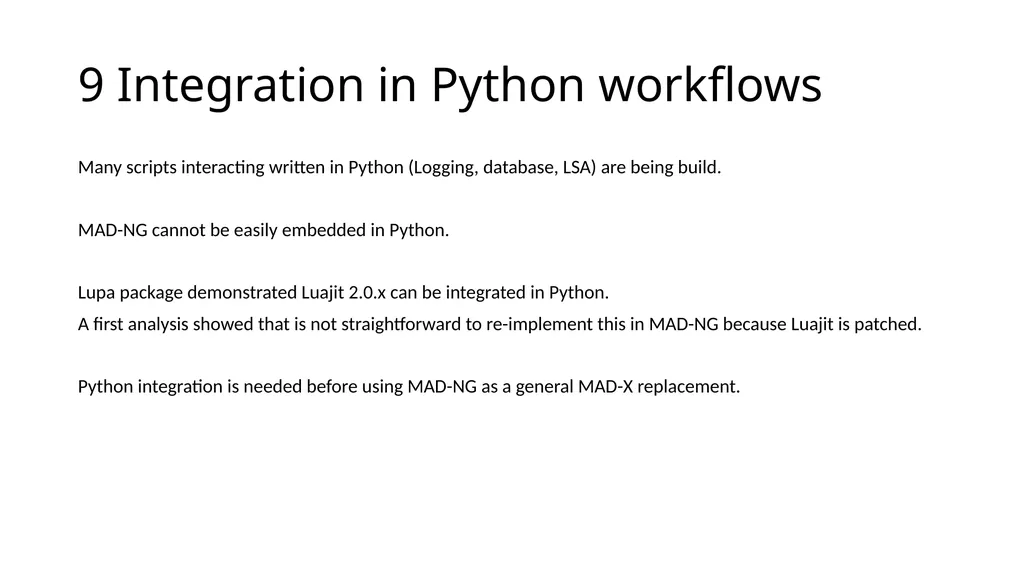
9 Integration in Python workflows Many scripts interacting written in Python (Logging, database, LSA) are being build.
MAD-NG cannot be easily embedded in Python.
Lupa package demonstrated Luajit 2.0.x can be integrated in Python.
A first analysis showed that is not straightforward to re-implement this in MAD-NG because Luajit is patched.
Python integration is needed before using MAD-NG as a general MAD-X replacement.<br>
13
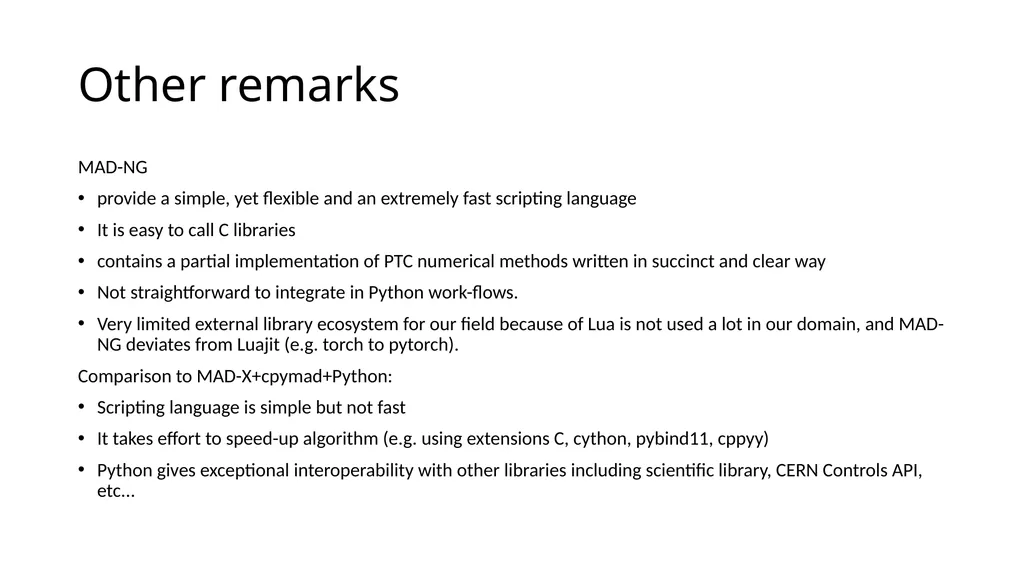
Other remarks MAD-NG
provide a simple, yet flexible and an extremely fast scripting language
It is easy to call C libraries
contains a partial implementation of PTC numerical methods written in succinct and clear way
Not straightforward to integrate in Python work-flows.
Very limited external library ecosystem for our field because of Lua is not used a lot in our domain, and MAD-NG deviates from Luajit (e.g. torch to pytorch).
Comparison to MAD-X+cpymad+Python:
Scripting language is simple but not fast
It takes effort to speed-up algorithm (e.g. using extensions C, cython, pybind11, cppyy)
Python gives exceptional interoperability with other libraries including scientific library, CERN Controls API, etc...<br>
14
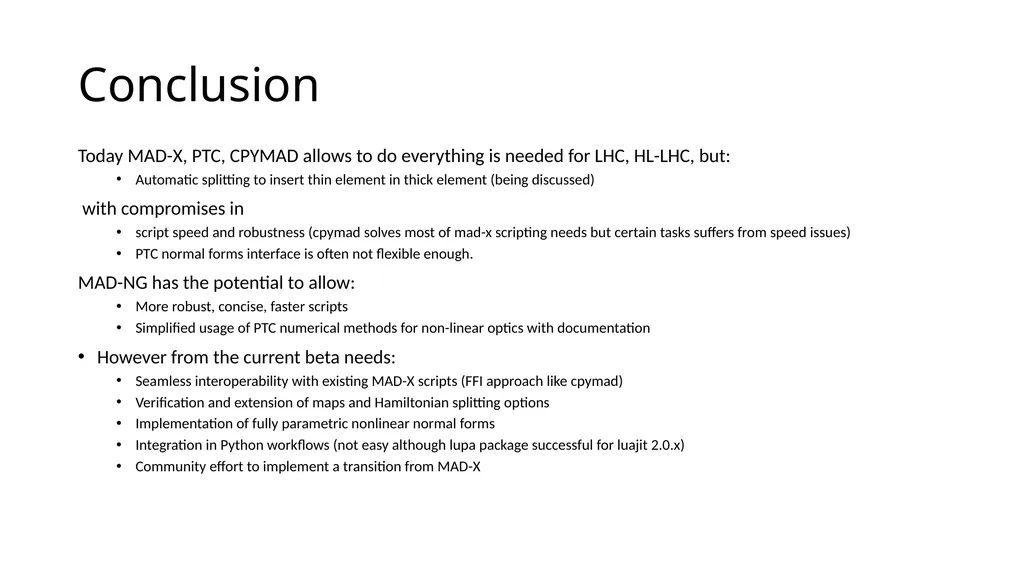
Conclusion Today MAD-X, PTC, CPYMAD allows to do everything is needed for LHC, HL-LHC, but:
Automatic splitting to insert thin element in thick element (being discussed)
with compromises in
script speed and robustness (cpymad solves most of mad-x scripting needs but certain tasks suffers from speed issues)
PTC normal forms interface is often not flexible enough.
MAD-NG has the potential to allow:
More robust, concise, faster scripts
Simplified usage of PTC numerical methods for non-linear optics with documentation
However from the current beta needs:
Seamless interoperability with existing MAD-X scripts (FFI approach like cpymad)
Verification and extension of maps and Hamiltonian splitting options
Implementation of fully parametric nonlinear normal forms
Integration in Python workflows (not easy although lupa package successful for luajit 2.0.x)
Community effort to implement a transition from MAD-X<br>