
Making Heads and Tails of Service, Emotional
TF
Published · 33 slides · 0 views

1 / 1



Description
Making Heads and Tails of Service, Emotional Support and Therapy Dogs Sara R. Simeonidis, Esq. Jackson Lewis P.C. www.jacksonlewis.com 2019 Jackson Lewis P.C. Agenda Understand the differences between service, emotional support, and
Related Topics
Share
Embed code
Download this presentation From Below
"Making Heads and Tails of Service, Emotional" is the property of its rightful owner. Permission is granted to download and print the materials on this website for personal, non-commercial use only, and to display it on your personal computer provided you do not modify the materials and that you retain all copyright notices contained in the materials. By downloading content from our website, you accept the terms of this agreement.
Presentation Transcript
01
Making Heads and Tails of Service, Emotional Support and Therapy Dogs Sara R. Simeonidis, Esq.
Jackson Lewis P.C.
www.jacksonlewis.com ©2019 Jackson Lewis P.C.<br>
Jackson Lewis P.C.
www.jacksonlewis.com ©2019 Jackson Lewis P.C.<br>
02
Agenda Understand the differences between service, emotional support, and therapy animals
ADA requirements for places of public accommodation
Accommodating animals in the workplace
Recent case law
Best practices ©2019 Jackson Lewis P.C. 2<br>
ADA requirements for places of public accommodation
Accommodating animals in the workplace
Recent case law
Best practices ©2019 Jackson Lewis P.C. 2<br>
03
Why It’s IMPORTANT Understanding the Differences Between Service, Emotional Support and Therapy Dogs ©2019 Jackson Lewis P.C. 3<br>
04
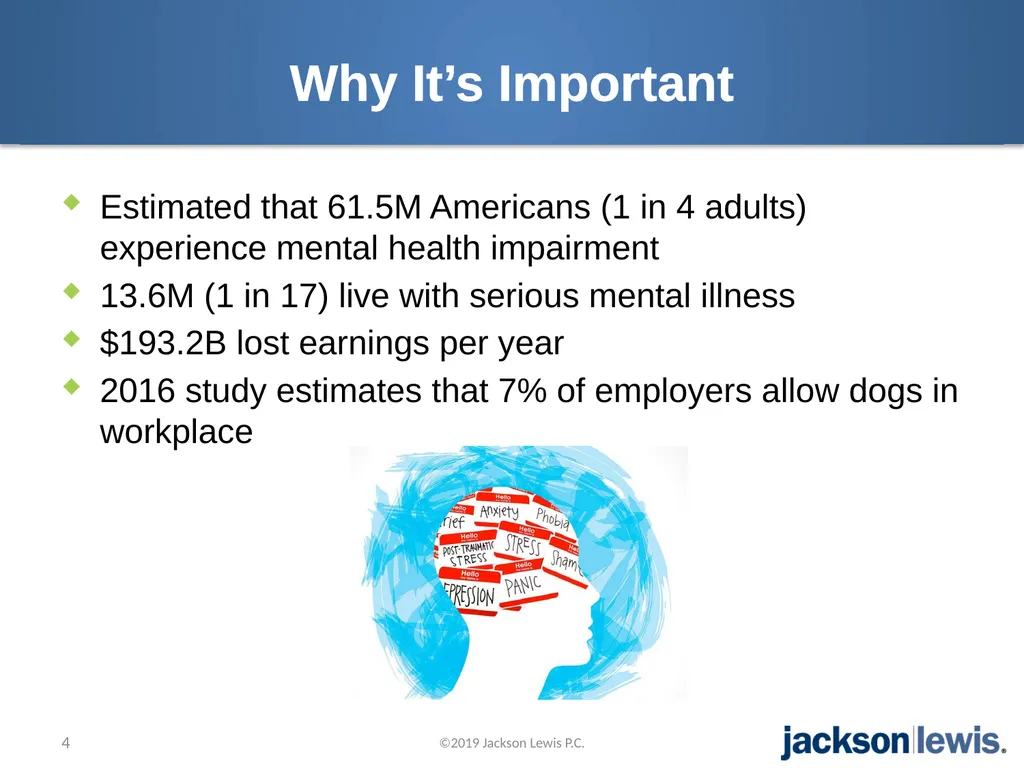
Why It’s Important Estimated that 61.5M Americans (1 in 4 adults) experience mental health impairment
13.6M (1 in 17) live with serious mental illness
$193.2B lost earnings per year
2016 study estimates that 7% of employers allow dogs in workplace ©2019 Jackson Lewis P.C. 4<br>
13.6M (1 in 17) live with serious mental illness
$193.2B lost earnings per year
2016 study estimates that 7% of employers allow dogs in workplace ©2019 Jackson Lewis P.C. 4<br>
05
guidance FROM AMERICANS WITH DISABILITIeS ACT Understanding the Differences Between Service, Emotional Support and Therapy Dogs ©2018 Jackson Lewis P.C. 5<br>
06
Americans With Disabilities Act Title I
Prevents discrimination against disabled applicants and employees
Applies to private employers
Requires employers to provide reasonable accommodations
Title II
Obligations for state and local governments
Title III
Prohibits discrimination in places of public accommodation ©2019 Jackson Lewis P.C. 6<br>
07
Americans With Disabilities Act Titles II and III
Explicitly require that service animals be allowed to accompany individuals with disabilities in publically accessible areas
Title I
Silent regarding service animals or emotional support animals as a form of accommodation ©2019 Jackson Lewis P.C. 7<br>
Explicitly require that service animals be allowed to accompany individuals with disabilities in publically accessible areas
Title I
Silent regarding service animals or emotional support animals as a form of accommodation ©2019 Jackson Lewis P.C. 7<br>
08
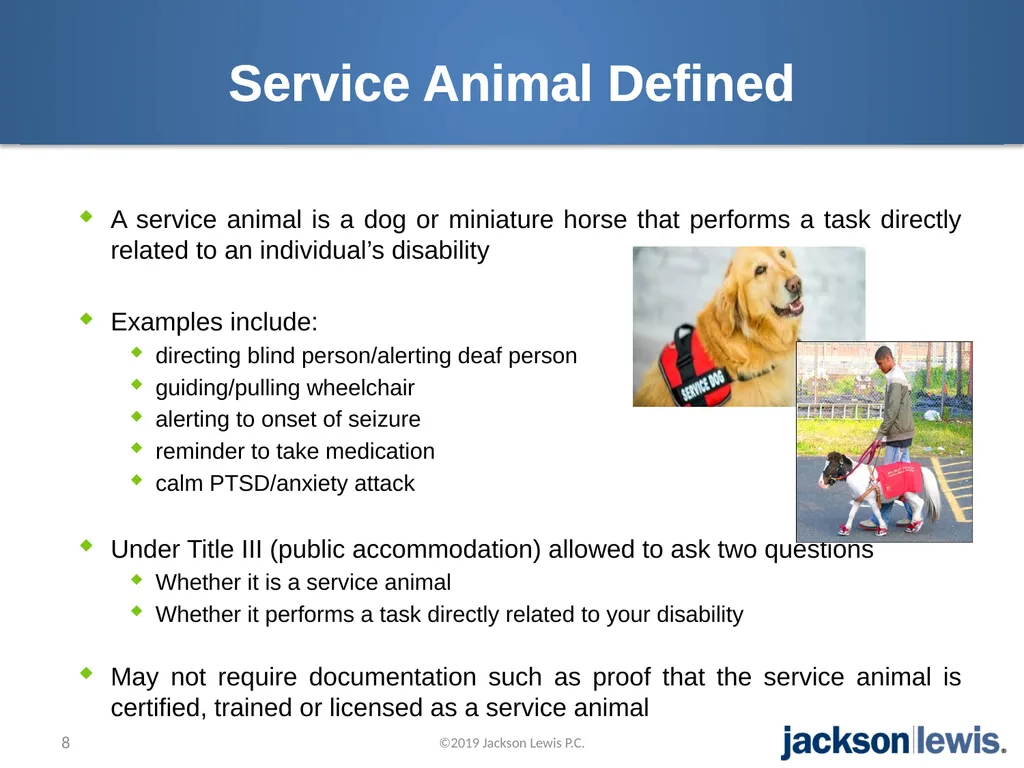
Service Animal Defined A service animal is a dog or miniature horse that performs a task directly related to an individual’s disability
Examples include:
directing blind person/alerting deaf person
guiding/pulling wheelchair
alerting to onset of seizure
reminder to take medication
calm PTSD/anxiety attack
Under Title III (public accommodation) allowed to ask two questions
Whether it is a service animal
Whether it performs a task directly related to your disability
May not require documentation such as proof that the service animal is certified, trained or licensed as a service animal ©2019 Jackson Lewis P.C. 8<br>
09
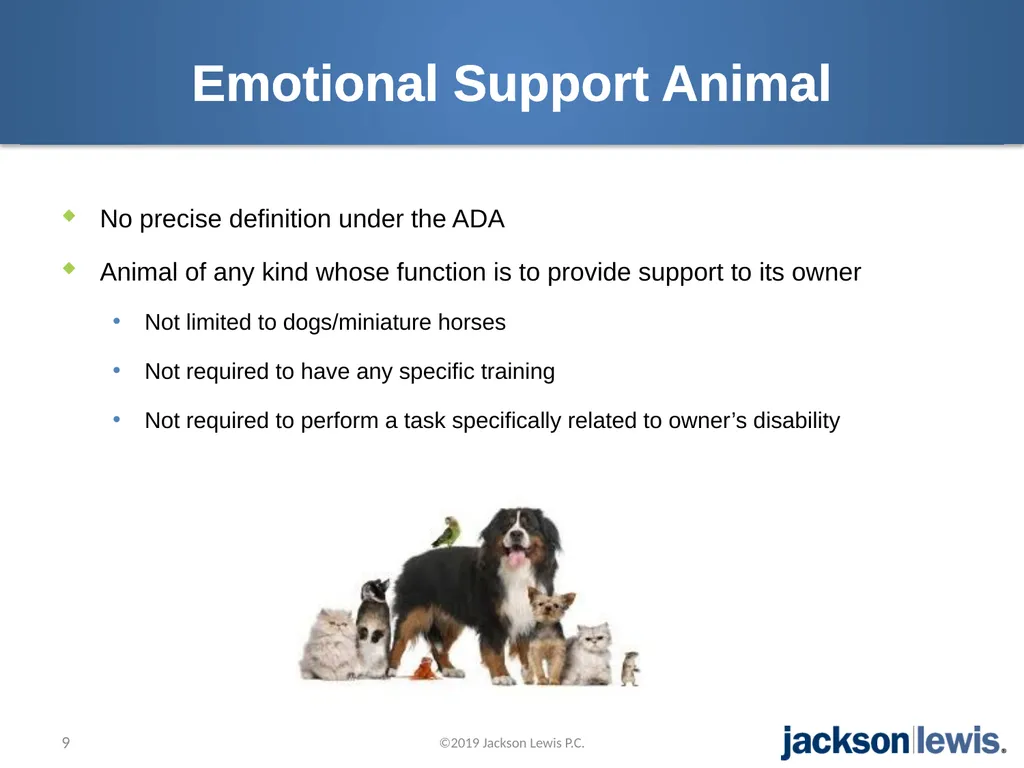
Emotional Support Animal No precise definition under the ADA
Animal of any kind whose function is to provide support to its owner
Not limited to dogs/miniature horses
Not required to have any specific training
Not required to perform a task specifically related to owner’s disability ©2019 Jackson Lewis P.C. 9<br>
Animal of any kind whose function is to provide support to its owner
Not limited to dogs/miniature horses
Not required to have any specific training
Not required to perform a task specifically related to owner’s disability ©2019 Jackson Lewis P.C. 9<br>
10
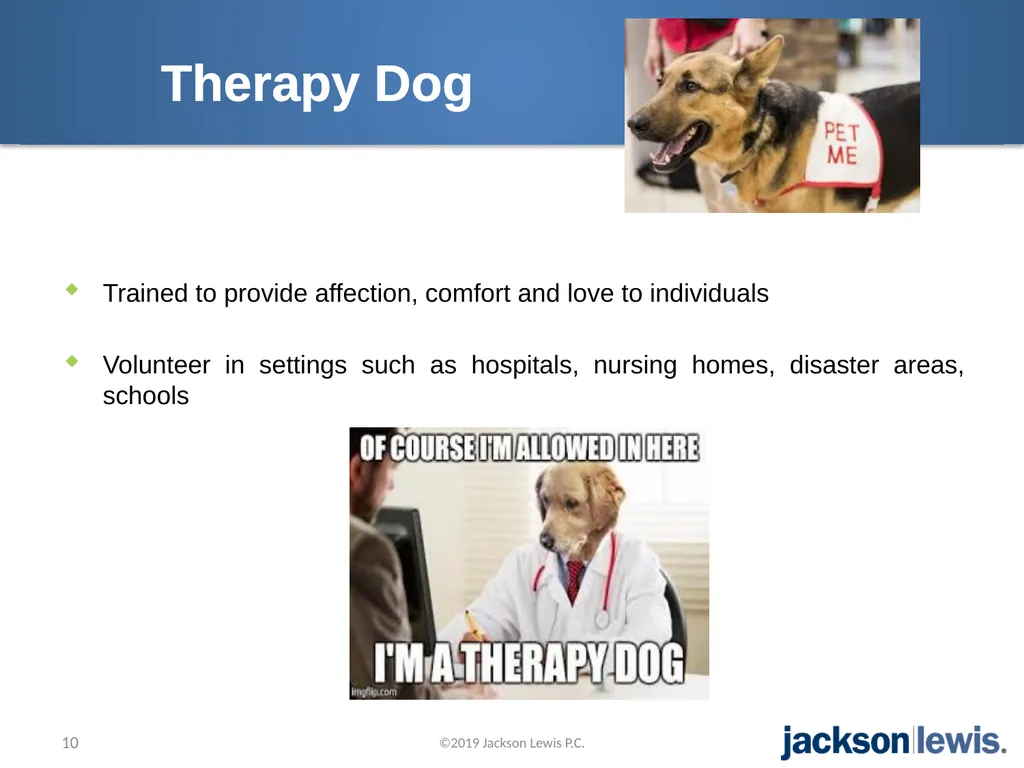
Therapy Dog Trained to provide affection, comfort and love to individuals
Volunteer in settings such as hospitals, nursing homes, disaster areas, schools ©2019 Jackson Lewis P.C. 10<br>
Volunteer in settings such as hospitals, nursing homes, disaster areas, schools ©2019 Jackson Lewis P.C. 10<br>
11
Service vs. Emotional Support Emotional support animals generally do not qualify as service animals under because they are not trained to perform a specific task related to owner’s disability
Places of public accommodation are not required to permit emotional support dogs on premises (unless required by state law—CT law does not require it) ©2019 Jackson Lewis P.C. 11<br>
Places of public accommodation are not required to permit emotional support dogs on premises (unless required by state law—CT law does not require it) ©2019 Jackson Lewis P.C. 11<br>
12
OBLIGATIONS FOR EMPLOYERS Understanding the Differences Between Service, Emotional Support and Therapy Dogs ©2019 Jackson Lewis P.C. 12<br>
13
What are Your Obligations? Title I silent on service or emotional support animals
EEOC position—service and emotional support animals must be allowed as a reasonable accommodation
Employers cannot impose a blanket prohibition
Should treat as any other requested accommodation ©2019 Jackson Lewis P.C. 13<br>
EEOC position—service and emotional support animals must be allowed as a reasonable accommodation
Employers cannot impose a blanket prohibition
Should treat as any other requested accommodation ©2019 Jackson Lewis P.C. 13<br>
14
To Accommodate or Not to Accommodate Is the applicant/employee disabled
Is applicant/employee qualified under the ADA—i.e. able to perform the essential functions of the job with or without a reasonable accommodation
Would the requested accommodation allow employee to perform job duties
Would the requested accommodation create an undue hardship to employer and if so is there another reasonable accommodation that can be implemented ©2019 Jackson Lewis P.C. 14<br>
15
Interactive Process Interactive process between employee and
employer may be necessary to determine an
appropriate reasonable accommodation
Goal is to identify the precise limitations from the disability and potential accommodations to overcome limitations
Both parties must participate in good faith interactive process
ADA does not require the accommodation of employee’s choice
Employer can choose between effective accommodations
Where disability and need for accommodation is not obvious—Employer may request reasonable medical information to demonstrate employee has disability and needs accommodation ©2019 Jackson Lewis P.C. 15<br>
16
Undue Hardship Poses a direct threat, i.e. significant risk to health or safety of others
Disruptive
Not properly controlled by owner ©2019 Jackson Lewis P.C. 16<br>
Disruptive
Not properly controlled by owner ©2019 Jackson Lewis P.C. 16<br>
17
Additional Considerations Workplace could be dangerous for animals—for example manufacturing setting
Workplace may require sterile environment—for example a hospital
Other employees may be adversely affected—for example allergies, phobias
Impacts on insurance ©2019 Jackson Lewis P.C. 17<br>
Workplace may require sterile environment—for example a hospital
Other employees may be adversely affected—for example allergies, phobias
Impacts on insurance ©2019 Jackson Lewis P.C. 17<br>
18
Animals in Housing Fair Housing Act prohibits discrimination
Landlord’s obligations:
Can’t use “no pet” policy to deny housing to disabled person
Must grant reasonable accommodation
2 threshold questions:
Does person have a disability
Is there a disability-related need for the animal—either service or emotional support
Unless:
Animal would cause direct threat to health/safety to other
Substantial physical damage to property of others ©2016 Jackson Lewis P.C. 18<br>
19
Lessons from case law Understanding the Differences Between Service, Emotional Support and Therapy Dogs ©2018 Jackson Lewis P.C. 19<br>
20
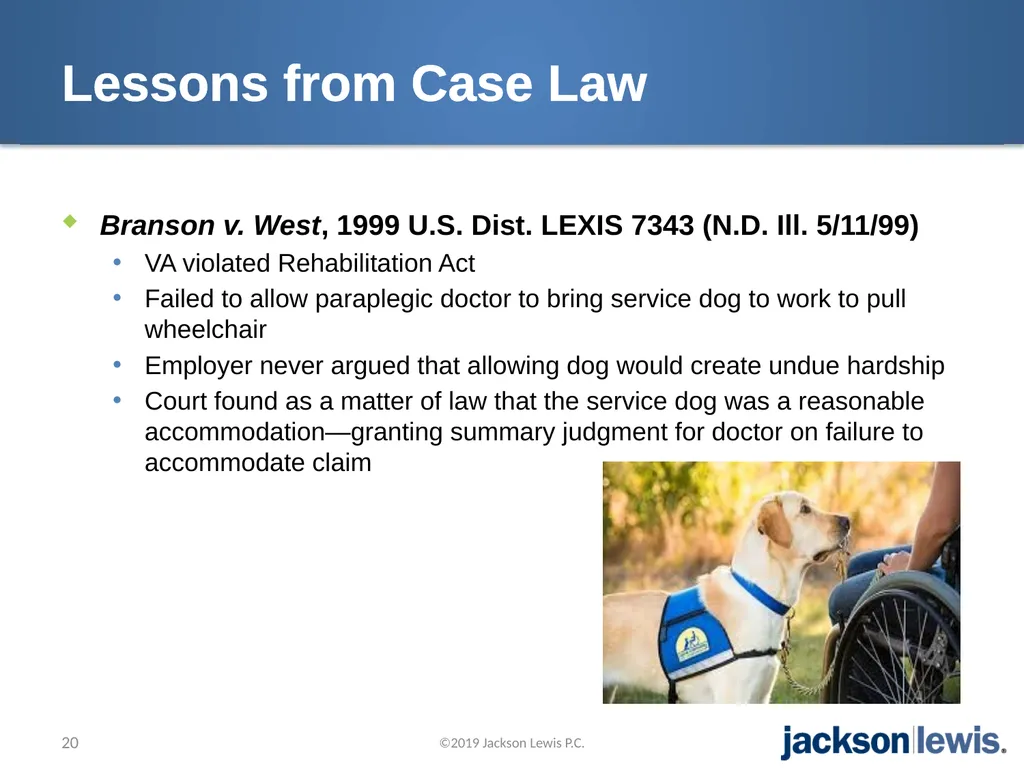
Lessons from Case Law Branson v. West, 1999 U.S. Dist. LEXIS 7343 (N.D. Ill. 5/11/99)
VA violated Rehabilitation Act
Failed to allow paraplegic doctor to bring service dog to work to pull wheelchair
Employer never argued that allowing dog would create undue hardship
Court found as a matter of law that the service dog was a reasonable accommodation—granting summary judgment for doctor on failure to accommodate claim ©2019 Jackson Lewis P.C. 20<br>
21
Lessons from Case Law Arndt v. Ford Motor Co., 247 F. Supp. 3d 832 (E.D. Mich. 2017)
Employee with PTSD requested to bring service animal as accommodation
Employee quit before interactive process completed
Court noted that safety concerns with a dog in manufacturing area was a legitimate concern that Ford could consider ©2019 Jackson Lewis P.C. 21<br>
Employee with PTSD requested to bring service animal as accommodation
Employee quit before interactive process completed
Court noted that safety concerns with a dog in manufacturing area was a legitimate concern that Ford could consider ©2019 Jackson Lewis P.C. 21<br>
22
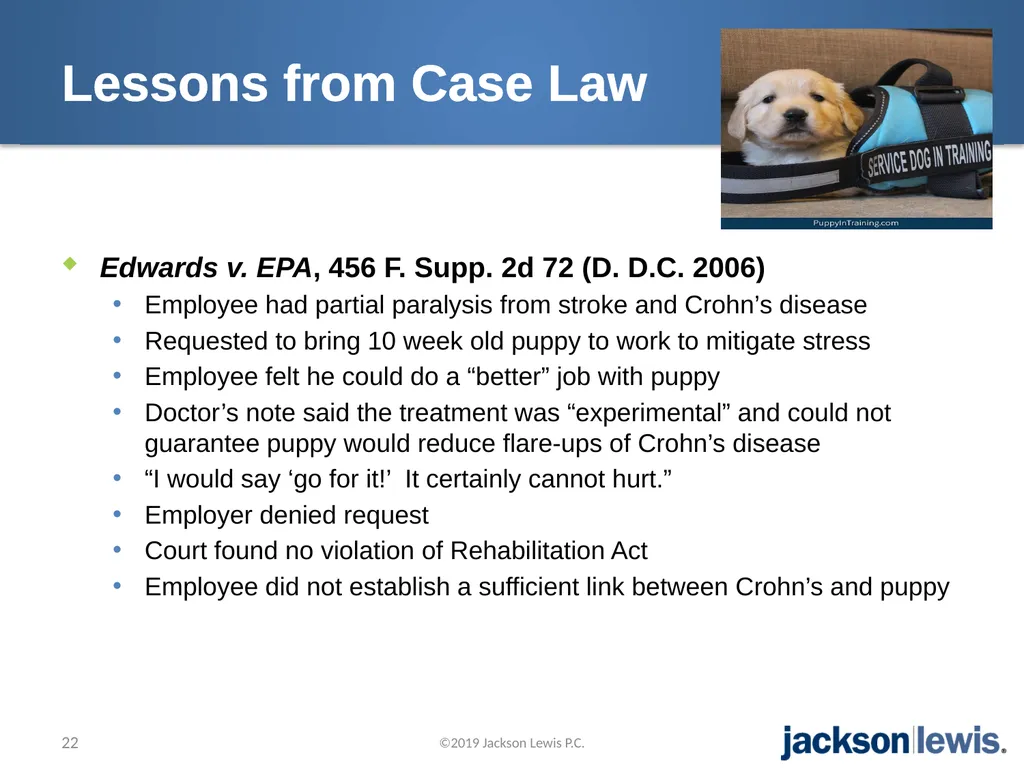
Lessons from Case Law Edwards v. EPA, 456 F. Supp. 2d 72 (D. D.C. 2006)
Employee had partial paralysis from stroke and Crohn’s disease
Requested to bring 10 week old puppy to work to mitigate stress
Employee felt he could do a “better” job with puppy
Doctor’s note said the treatment was “experimental” and could not guarantee puppy would reduce flare-ups of Crohn’s disease
“I would say ‘go for it!’ It certainly cannot hurt.”
Employer denied request
Court found no violation of Rehabilitation Act
Employee did not establish a sufficient link between Crohn’s and puppy ©2019 Jackson Lewis P.C. 22<br>
23
Lessons from Case Law EEOC v. Autozone, 2008 U.S. Dist. LEXIS 75350 (D. Ariz. 9/29/08)
Employee was legally blind
Worked for about 18 months and was physically able to perform most of his job duties. Job performance was good and supervisor said he “worked two times harder than anyone else”
Requested LOA for service animal training school--granted
Asked permission to bring service dog to work—needed dog to get to/from work
HR commenced interactive process—requested information from doctor and training certificate
Employee eventually terminated for failure to return to work
Dispute regarding whether HR ever got training certificate, but never followed up with employee even after employee inquired about status
Issues of fact precluded summary judgment 23 ©2019 Jackson Lewis P.C.<br>
24
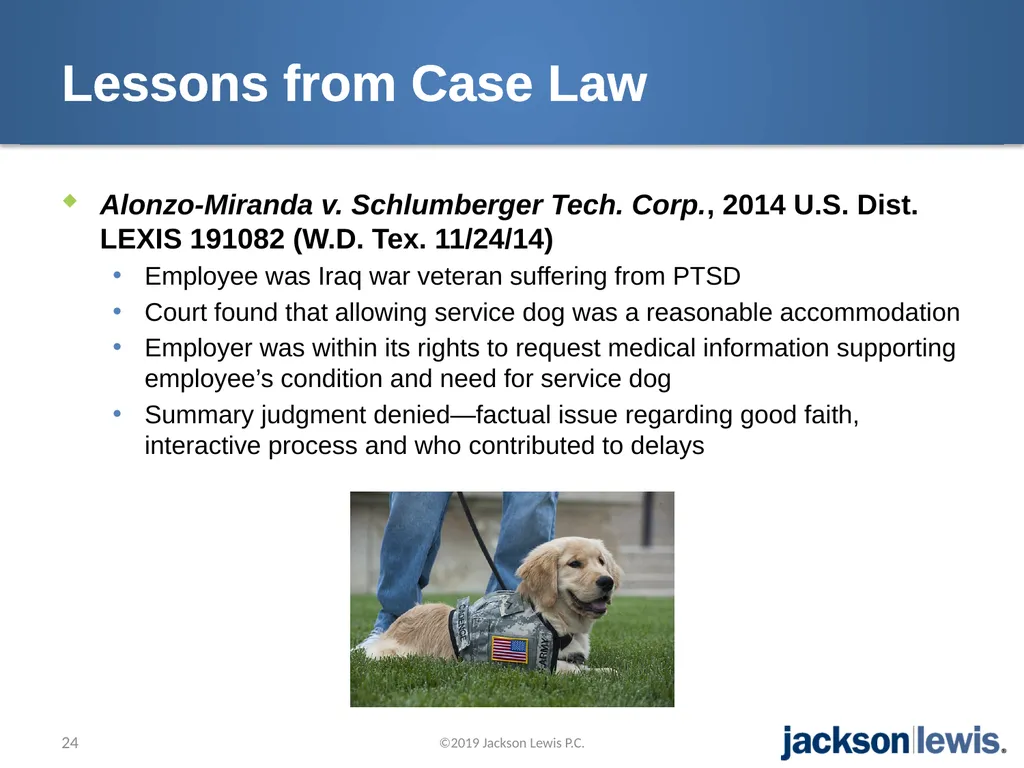
Lessons from Case Law Alonzo-Miranda v. Schlumberger Tech. Corp., 2014 U.S. Dist. LEXIS 191082 (W.D. Tex. 11/24/14)
Employee was Iraq war veteran suffering from PTSD
Court found that allowing service dog was a reasonable accommodation
Employer was within its rights to request medical information supporting employee’s condition and need for service dog
Summary judgment denied—factual issue regarding good faith, interactive process and who contributed to delays ©2019 Jackson Lewis P.C. 24<br>
25
Lessons from Case Law McDonald v. Dep’t of Envtl. Quality, 214 P3d 749 (Mont. 2009)
Leg injury hindered employee ability to walk/navigate stairs
Had dissociative identity disorder—episodes of inattentiveness/lost track of time/forgot interactions and events
Service dog assisted with walking and trained to bring employee back from episodes
Employer permitted dog to come to work
Dog would slip in hallways and get injured which made dog less effective—asked employer to carpet hallways—employer denied request
Employee brought suit alleging failure to accommodate
Court likened service dog to any other assistive device
“Duty to accommodate does not end in allowing the device through the door. Employer required to remove barriers to employee’s ability to actually use the device.” ©2016 Jackson Lewis P.C. 25<br>
26
Lessons from Case Law Bonnette v. Shinseki, 907 F. Supp. 2d 54 (D. D.C. 2012)
Blind employee requested to bring service animal to work
Employer granted accommodation and implemented certain requirements to minimize contact with allergic co-worker
Employee was required to use single-stall bathroom rather than ladies room and to use different entrance
Employer also installed special $800 air filter to minimize allergens
Court granted summary judgment to employer ©2019 Jackson Lewis P.C. 26<br>
27
Lessons from Case Law Maubach v. City of Fairfax, 2018 U.S. Dist. LEXIS 73815 (E.D. Va. 4/30/18)
Emergency dispatcher requested to bring emotional support dog for panic attacks
HR agreed on trial basis
Supervisor was allergic to dogs—returned from vacation to find clumps of dog hair and dander, dog beg left in dispatch center
Another employee also complained about allergic reaction to dog
Employee left dispatch center to walk dog—left untrained police officer
Summary judgment for employer on failure to accommodate claim—dog not a reasonable accommodation under these circumstances
Employee failed to engage in interactive process in good faith and refused to consider other possible accommodations ©2019 Jackson Lewis P.C. 27<br>
28
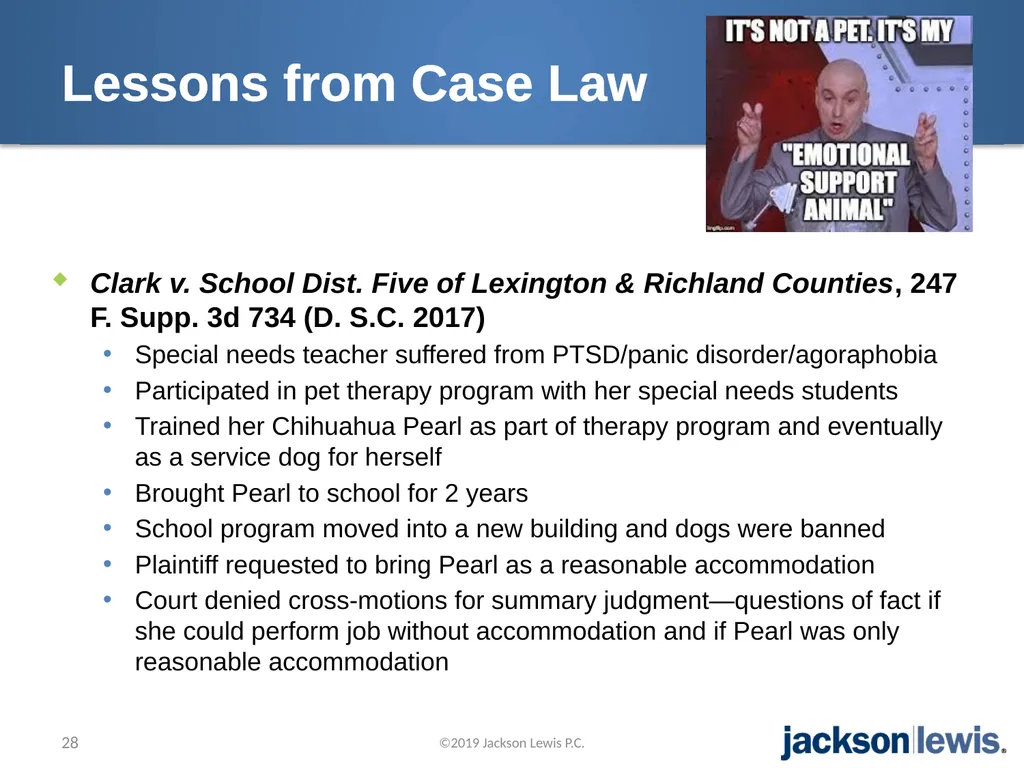
Lessons from Case Law Clark v. School Dist. Five of Lexington & Richland Counties, 247 F. Supp. 3d 734 (D. S.C. 2017)
Special needs teacher suffered from PTSD/panic disorder/agoraphobia
Participated in pet therapy program with her special needs students
Trained her Chihuahua Pearl as part of therapy program and eventually as a service dog for herself
Brought Pearl to school for 2 years
School program moved into a new building and dogs were banned
Plaintiff requested to bring Pearl as a reasonable accommodation
Court denied cross-motions for summary judgment—questions of fact if she could perform job without accommodation and if Pearl was only reasonable accommodation ©2019 Jackson Lewis P.C. 28<br>
29
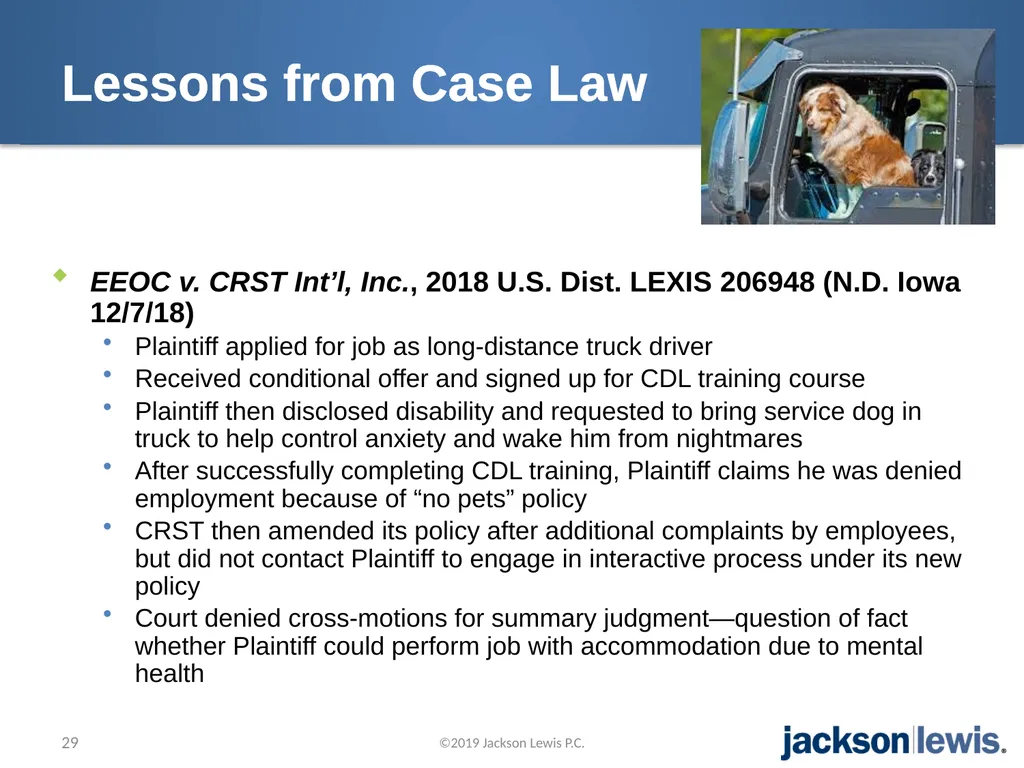
Lessons from Case Law EEOC v. CRST Int’l, Inc., 2018 U.S. Dist. LEXIS 206948 (N.D. Iowa 12/7/18)
Plaintiff applied for job as long-distance truck driver
Received conditional offer and signed up for CDL training course
Plaintiff then disclosed disability and requested to bring service dog in truck to help control anxiety and wake him from nightmares
After successfully completing CDL training, Plaintiff claims he was denied employment because of “no pets” policy
CRST then amended its policy after additional complaints by employees, but did not contact Plaintiff to engage in interactive process under its new policy
Court denied cross-motions for summary judgment—question of fact whether Plaintiff could perform job with accommodation due to mental health ©2019 Jackson Lewis P.C. 29<br>
30
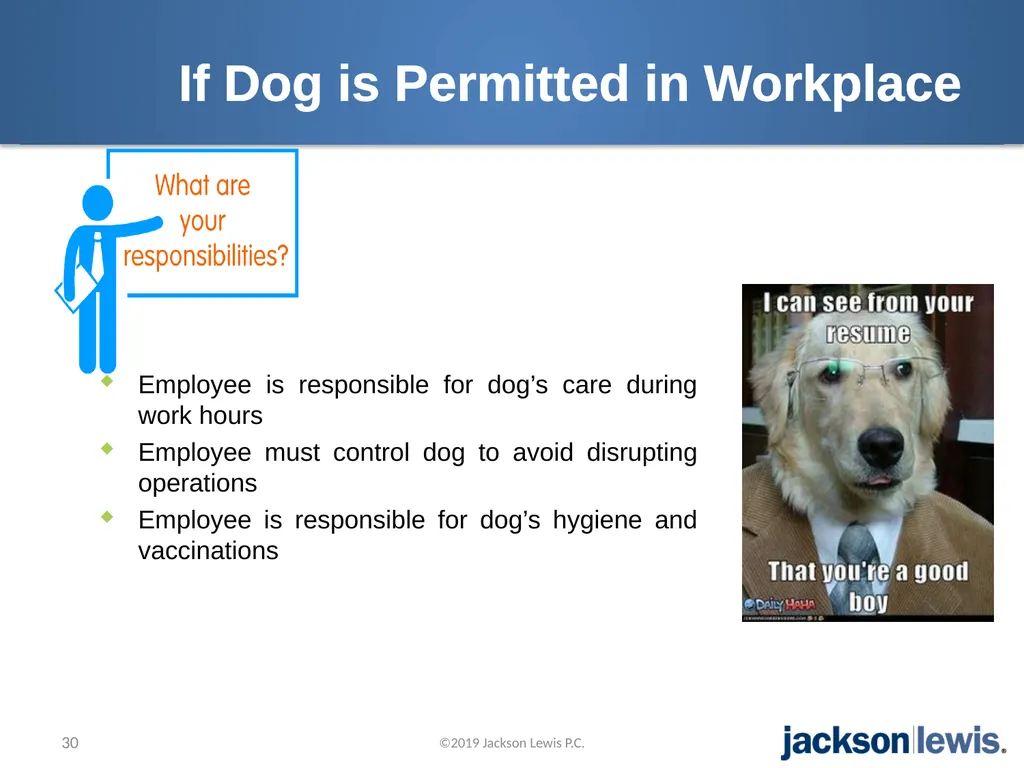
If Dog is Permitted in Workplace Employee is responsible for dog’s care during work hours
Employee must control dog to avoid disrupting operations
Employee is responsible for dog’s hygiene and vaccinations ©2019 Jackson Lewis P.C. 30<br>
Employee must control dog to avoid disrupting operations
Employee is responsible for dog’s hygiene and vaccinations ©2019 Jackson Lewis P.C. 30<br>
31
Best Practices Understand that service and emotional support animals may be a reasonable accommodation
Treat request like you would any other request for accommodation
Consider whether allowing animal is reasonable/feasible
Consider whether any adjustments need to be made to accommodate the animal
Consider if adjustments need to be made for other employees in workplace ©2019 Jackson Lewis P.C. 31<br>
32
Questions?
credits? Sara.Simeonidis@jacksonlewis.com ©2019 Jackson Lewis P.C. 32<br>
33
Thank You! 33<br>