
MANAGEMENT OF NORMAL PUERPERIUM Mrs. Preeti
YM
Published · 42 slides · 0 views

1 / 1




Description
MANAGEMENT OF NORMAL PUERPERIUM Mrs. Preeti Bahuguna Principal of management To restore the health of the mother To prevent infection To take care of the breast including promotion of breast feeding To motivate the mother for contraception
Related Topics
Share
Embed code
Download this presentation From Below
"MANAGEMENT OF NORMAL PUERPERIUM Mrs. Preeti" is the property of its rightful owner. Permission is granted to download and print the materials on this website for personal, non-commercial use only, and to display it on your personal computer provided you do not modify the materials and that you retain all copyright notices contained in the materials. By downloading content from our website, you accept the terms of this agreement.
Presentation Transcript
01
MANAGEMENT OF NORMAL PUERPERIUM Mrs. Preeti Bahuguna<br>
02
Principal of management To restore the health of the mother
To prevent infection
To take care of the breast including promotion of breast feeding
To motivate the mother for contraception<br>
To prevent infection
To take care of the breast including promotion of breast feeding
To motivate the mother for contraception<br>
03
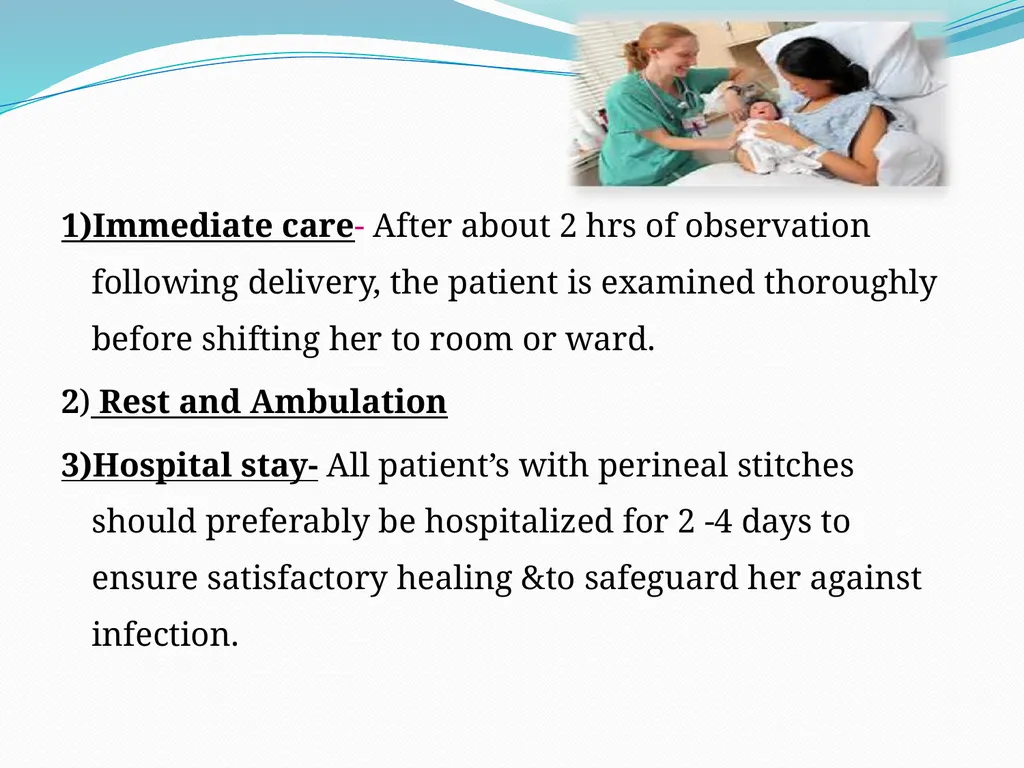
1)Immediate care- After about 2 hrs of observation following delivery, the patient is examined thoroughly before shifting her to room or ward.
2) Rest and Ambulation
3)Hospital stay- All patient’s with perineal stitches should preferably be hospitalized for 2 -4 days to ensure satisfactory healing &to safeguard her against infection.<br>
2) Rest and Ambulation
3)Hospital stay- All patient’s with perineal stitches should preferably be hospitalized for 2 -4 days to ensure satisfactory healing &to safeguard her against infection.<br>
04
4)Diet- Encourage the patient to drink lots of fluids &to take simple easy to digest diet. Fatty foods should be restricted.
5)Sleep- it is important to ensure adequate rest and sleep .it is good restrict visiting hours and to prescribe mild hypnotics to ensure sound restful sleep.<br>
5)Sleep- it is important to ensure adequate rest and sleep .it is good restrict visiting hours and to prescribe mild hypnotics to ensure sound restful sleep.<br>
05
6)Care of the bladder- The patient is encouraged to pass urine following delivery,if fails than catheterization should be done.
7)Care of perineum - Perineal wound should receive proper surgical attention to promote healing & prevent infection. Perineal wound should be kept clean & dry.<br>
7)Care of perineum - Perineal wound should receive proper surgical attention to promote healing & prevent infection. Perineal wound should be kept clean & dry.<br>
06
9)Well baby care- care of the baby should be explained and direct her to the pediatrician.
10)Contraception- couples should be provided with necessary information & counseled to adopt the method of their choice. Oral contraceptives should be avoided as it may reduce breast milk flow. Multi parous women who have completed their family may be offered the option of surgical sterilization
11) care of bowel-<br>
07
12) Care of episiotomy-
-REEDA ASSESSMENT
13) Care of breast
14) Immunization<br>
-REEDA ASSESSMENT
13) Care of breast
14) Immunization<br>
08
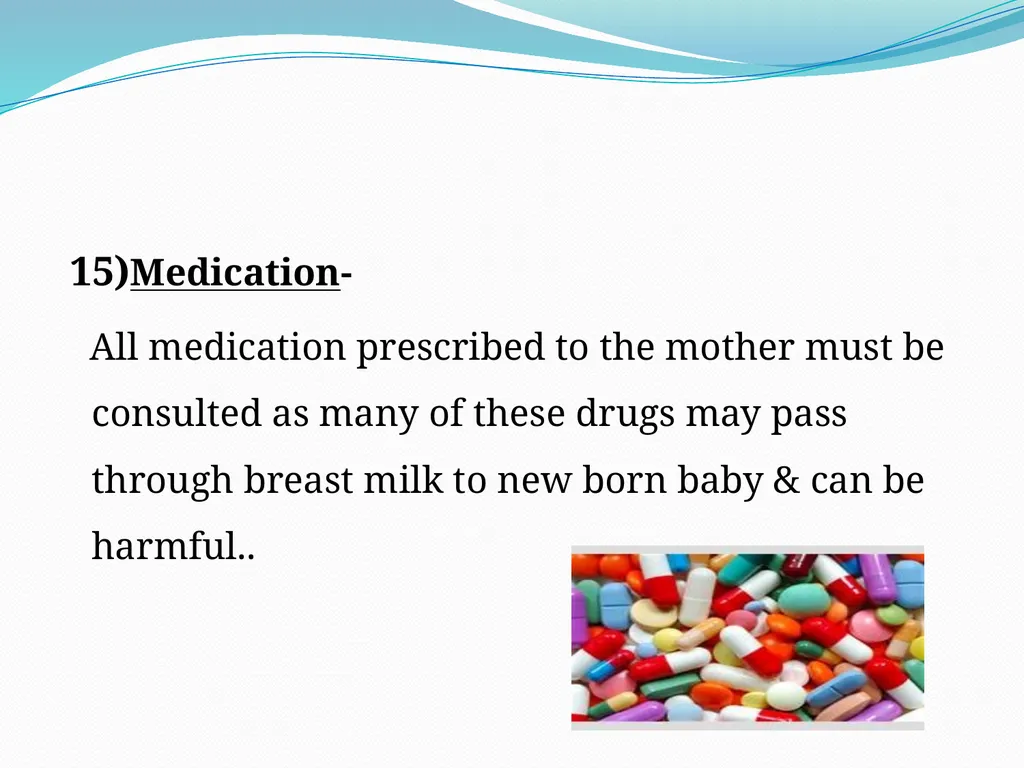
15)Medication-
All medication prescribed to the mother must be consulted as many of these drugs may pass through breast milk to new born baby & can be harmful..<br>
All medication prescribed to the mother must be consulted as many of these drugs may pass through breast milk to new born baby & can be harmful..<br>
09
Advice on discharge- Thorough examination of the mother and child is to be taken before discharge
Gradual return to normal activity at home.
Care of the newborn & breast feeding .
Iron and vitamin supplements to improve mother’s health.
Contraception.
For regular follow up.<br>
Gradual return to normal activity at home.
Care of the newborn & breast feeding .
Iron and vitamin supplements to improve mother’s health.
Contraception.
For regular follow up.<br>
10
MANAGEMENT OF AILMENTS After pains
Pain at site of perineum
Engorgement of breast
Treatment of Anaemia
Hypertension<br>
Pain at site of perineum
Engorgement of breast
Treatment of Anaemia
Hypertension<br>
11
Health and nutrition education Family planning advise
Sexual intercourse can be resumed till to 6 weeks after delivery
Breast feeding is best
Immunization of child
Calorie need per day-2200+700 =2900
Role of post natal exercises<br>
Sexual intercourse can be resumed till to 6 weeks after delivery
Breast feeding is best
Immunization of child
Calorie need per day-2200+700 =2900
Role of post natal exercises<br>
12
Postnatal exercise Objectives –
To improve the muscle tone which are stretch during pregnancy and labour specially the abdominal and perineal muscles
To educate about correct posture to be attained when the patient is getting up from her bed
This also include the correct principal of lifting & working position day to day activities<br>
13
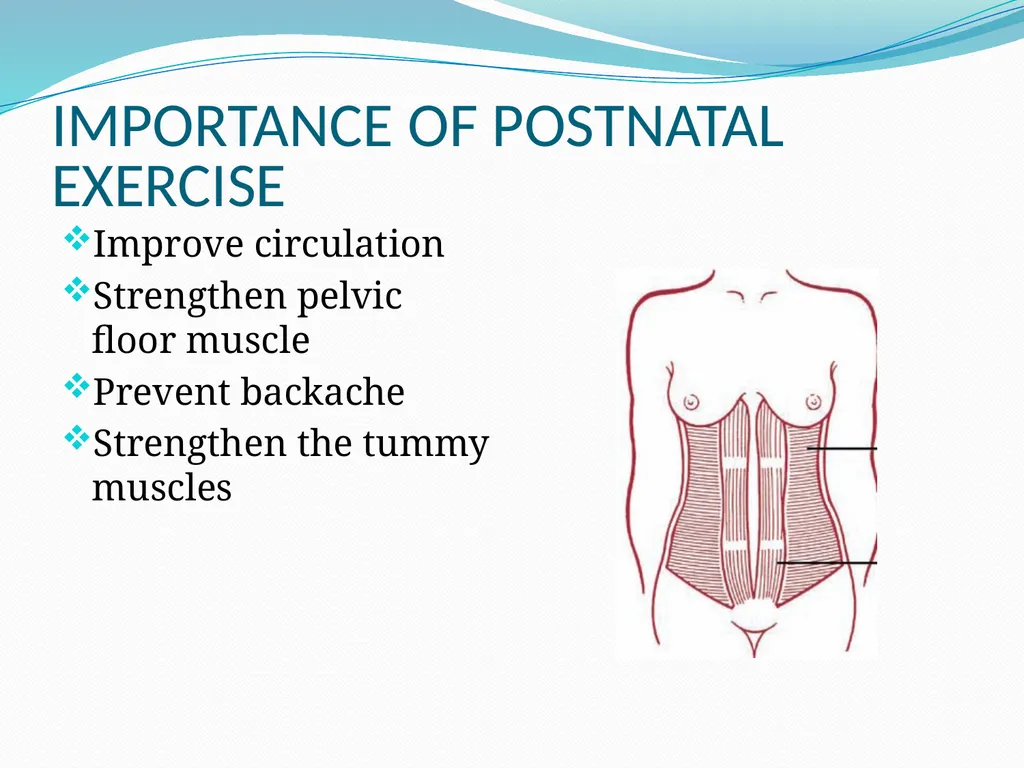
IMPORTANCE OF POSTNATAL EXERCISE Improve circulation
Strengthen pelvic floor muscle
Prevent backache
Strengthen the tummy muscles<br>
Strengthen pelvic floor muscle
Prevent backache
Strengthen the tummy muscles<br>
14
IMPORTANT INFORMATION Wear loose supportive clothing
Environment-stable environment
Nutrition-do not exercise on full stomach
Safety-do not exercise alone in the dark
Low impact exercise is preferable during postnatal period.<br>
Environment-stable environment
Nutrition-do not exercise on full stomach
Safety-do not exercise alone in the dark
Low impact exercise is preferable during postnatal period.<br>
15
PRINCIPLE OF EXERCISE Frequency
Intensity- mild to moderate exercise are recommended
Duration-30 minutes of exercise per day<br>
Intensity- mild to moderate exercise are recommended
Duration-30 minutes of exercise per day<br>
16
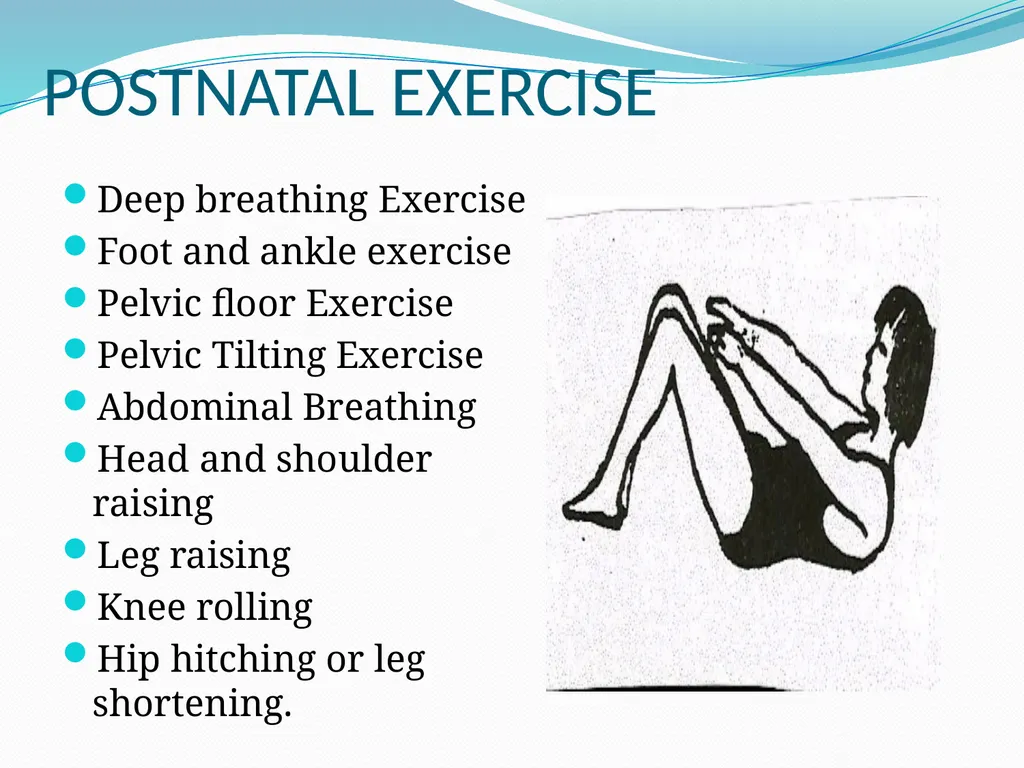
POSTNATAL EXERCISE Deep breathing Exercise
Foot and ankle exercise
Pelvic floor Exercise
Pelvic Tilting Exercise
Abdominal Breathing
Head and shoulder raising
Leg raising
Knee rolling
Hip hitching or leg shortening.<br>
Foot and ankle exercise
Pelvic floor Exercise
Pelvic Tilting Exercise
Abdominal Breathing
Head and shoulder raising
Leg raising
Knee rolling
Hip hitching or leg shortening.<br>
17
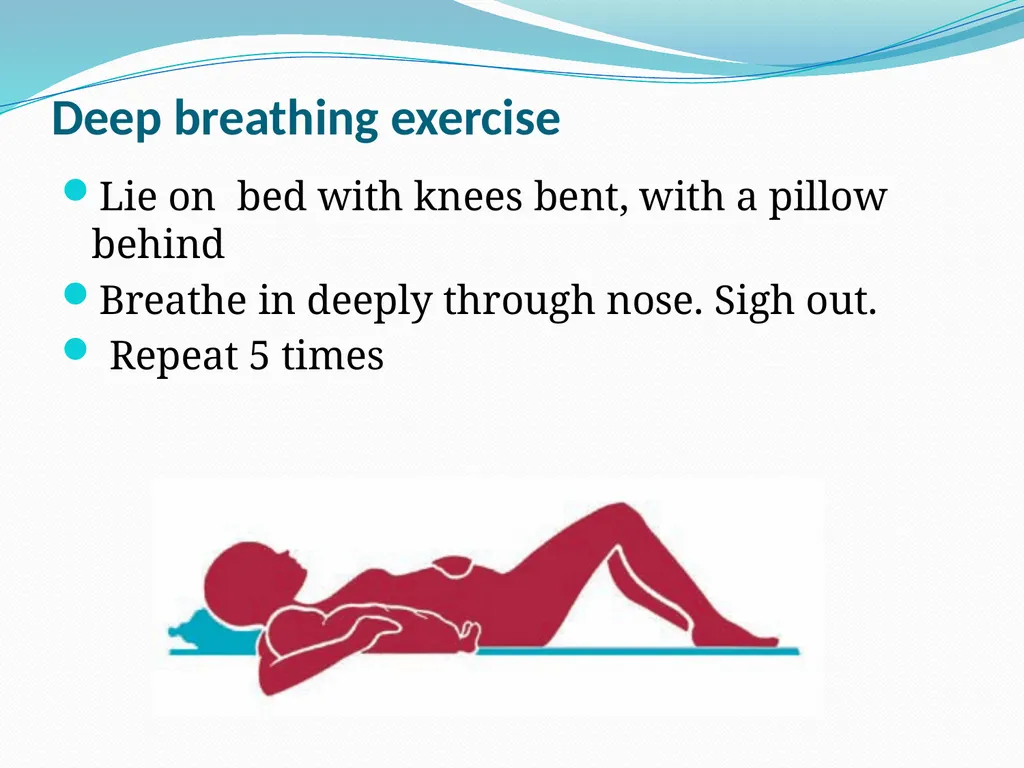
Deep breathing exercise Lie on bed with knees bent, with a pillow behind
Breathe in deeply through nose. Sigh out.
Repeat 5 times<br>
Breathe in deeply through nose. Sigh out.
Repeat 5 times<br>
18
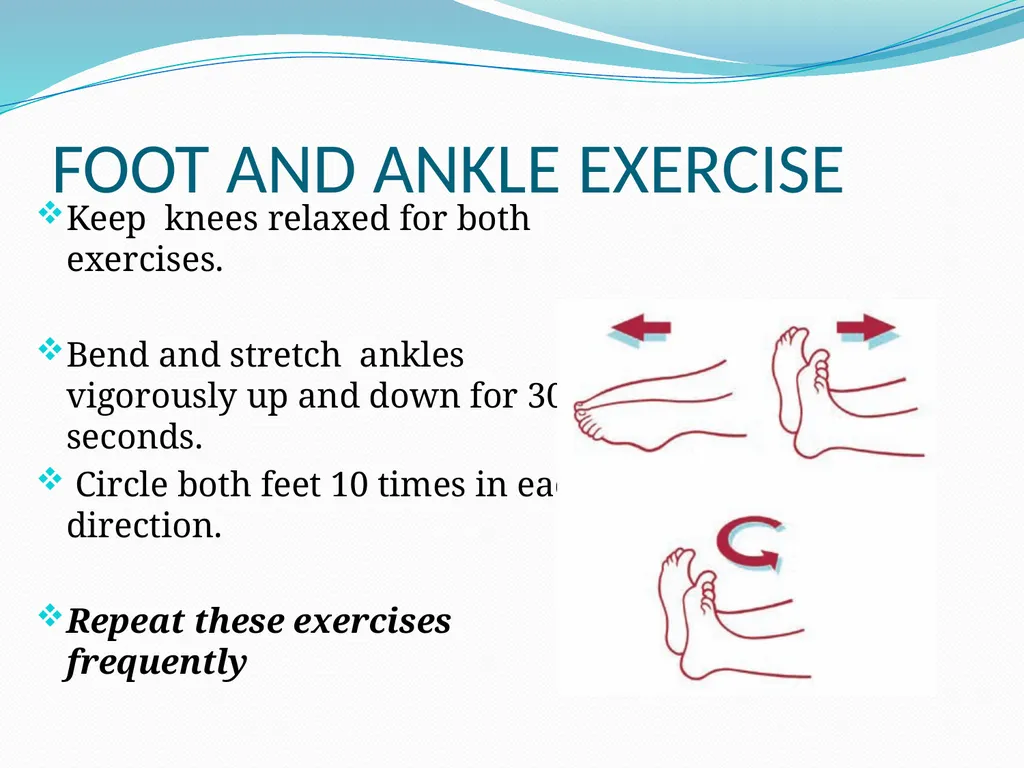
FOOT AND ANKLE EXERCISE Keep knees relaxed for both exercises.
Bend and stretch ankles vigorously up and down for 30 seconds.
Circle both feet 10 times in each direction.
Repeat these exercises frequently<br>
Bend and stretch ankles vigorously up and down for 30 seconds.
Circle both feet 10 times in each direction.
Repeat these exercises frequently<br>
19
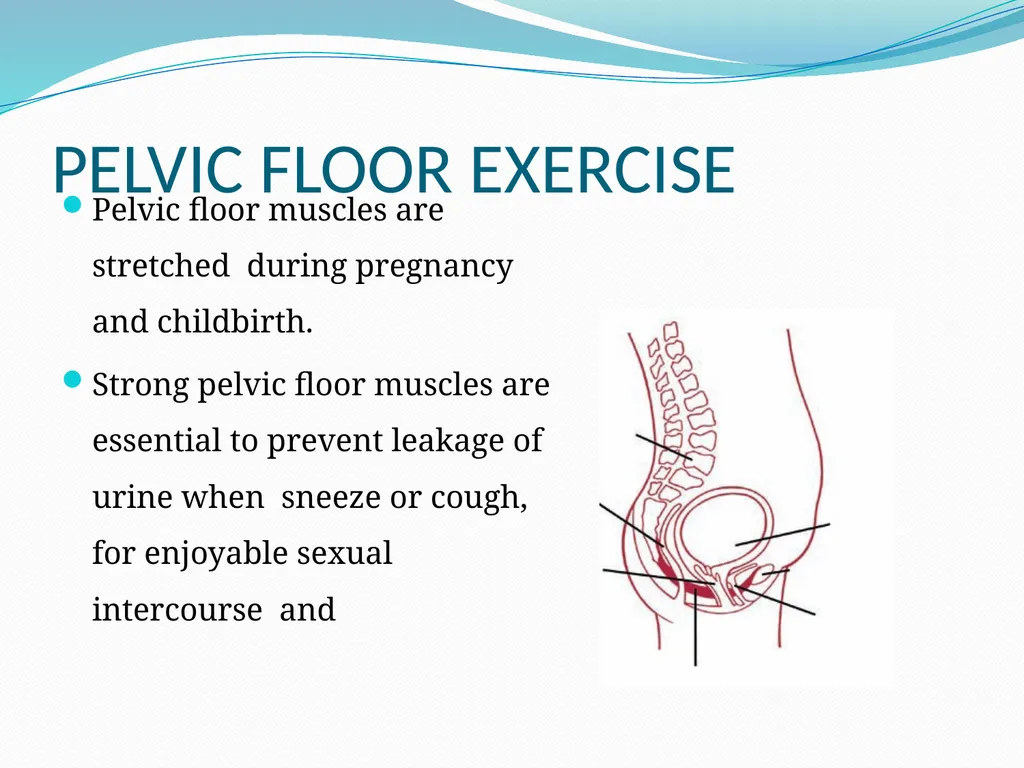
PELVIC FLOOR EXERCISE Pelvic floor muscles are stretched during pregnancy and childbirth.
Strong pelvic floor muscles are essential to prevent leakage of urine when sneeze or cough, for enjoyable sexual intercourse and<br>
Strong pelvic floor muscles are essential to prevent leakage of urine when sneeze or cough, for enjoyable sexual intercourse and<br>
20
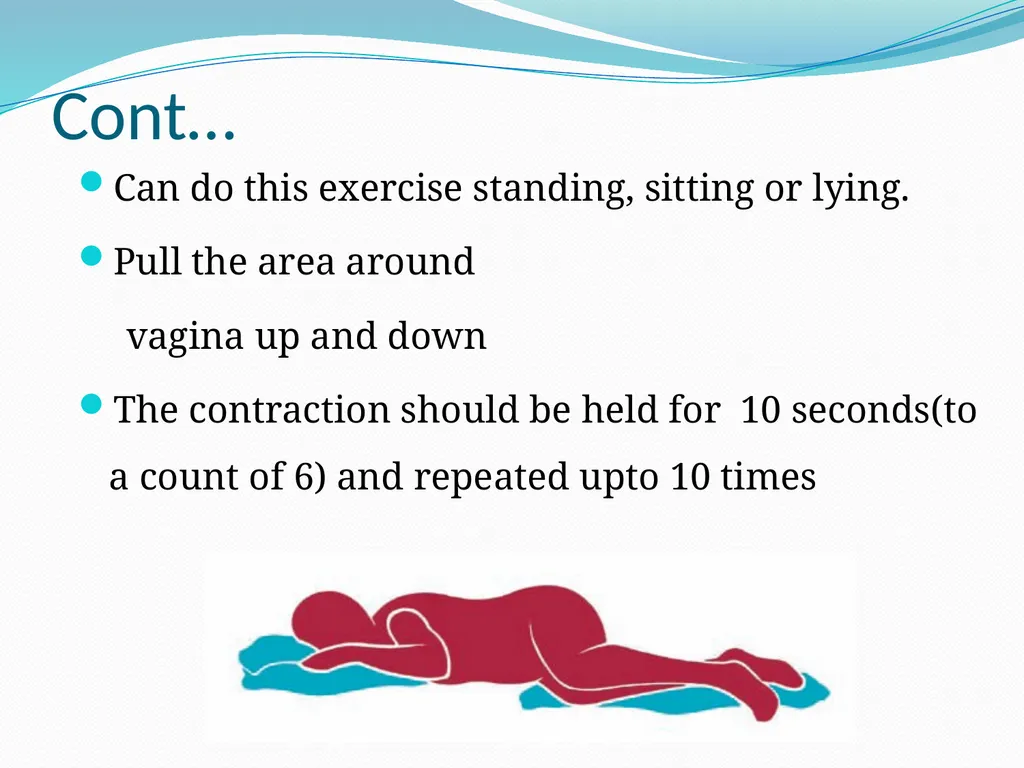
Cont… Can do this exercise standing, sitting or lying.
Pull the area around
vagina up and down
The contraction should be held for 10 seconds(to a count of 6) and repeated upto 10 times<br>
Pull the area around
vagina up and down
The contraction should be held for 10 seconds(to a count of 6) and repeated upto 10 times<br>
21
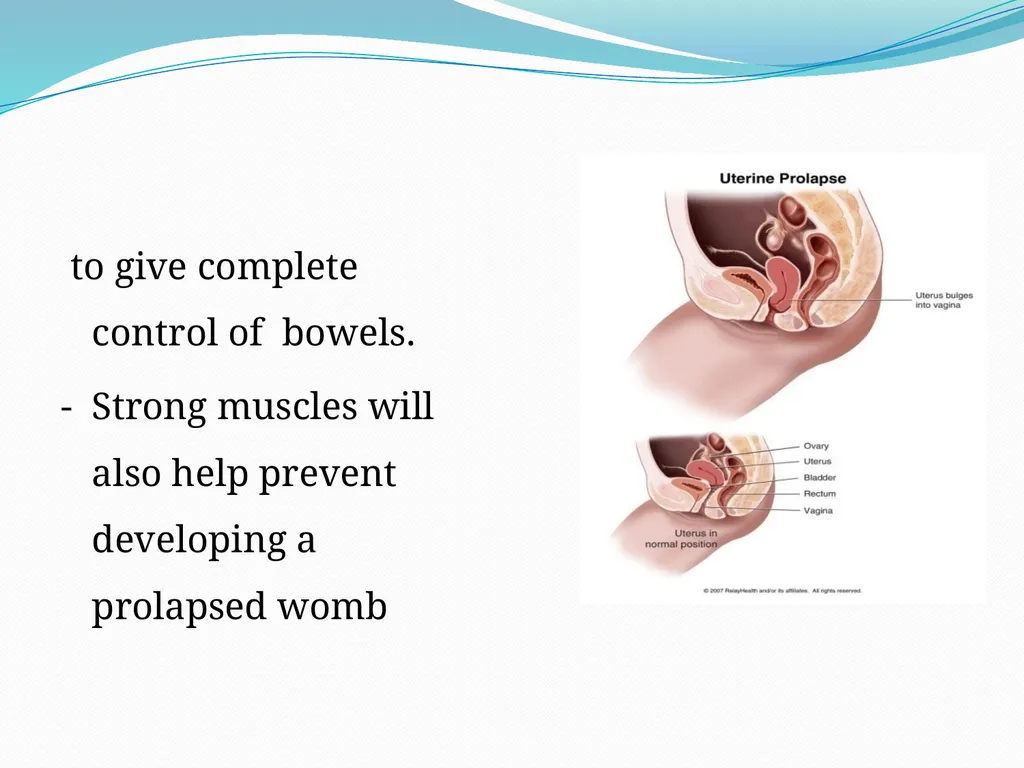
to give complete control of bowels.
- Strong muscles will also help prevent developing a prolapsed womb<br>
- Strong muscles will also help prevent developing a prolapsed womb<br>
22
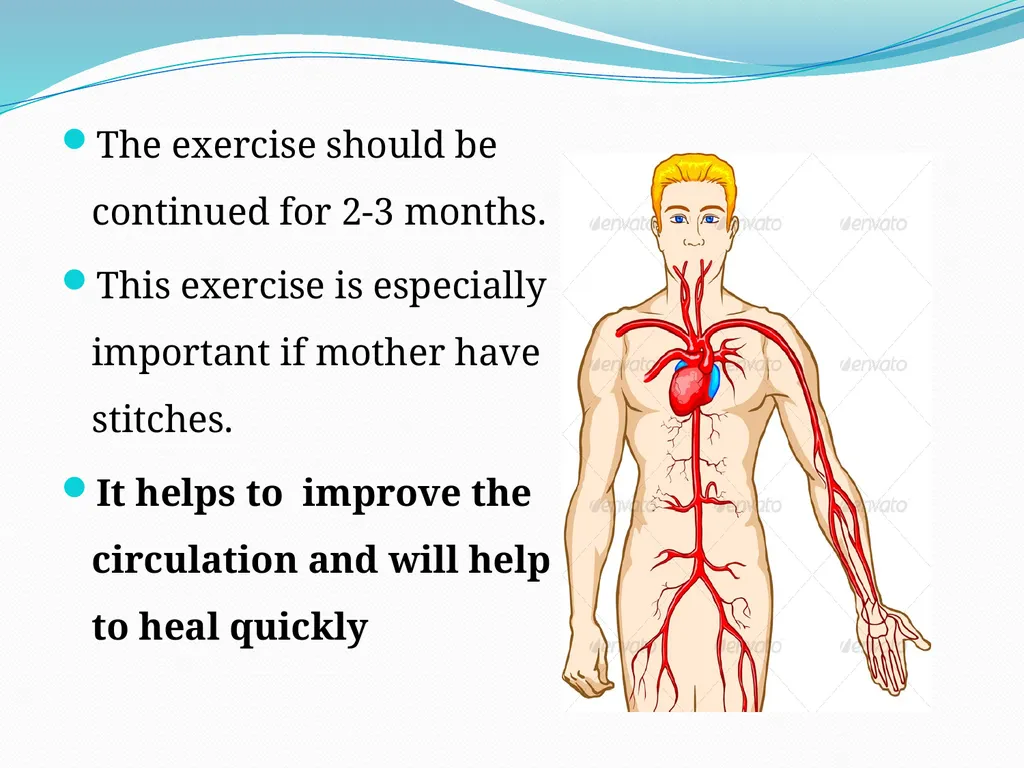
The exercise should be continued for 2-3 months.
This exercise is especially important if mother have stitches.
It helps to improve the circulation and will help to heal quickly<br>
This exercise is especially important if mother have stitches.
It helps to improve the circulation and will help to heal quickly<br>
23
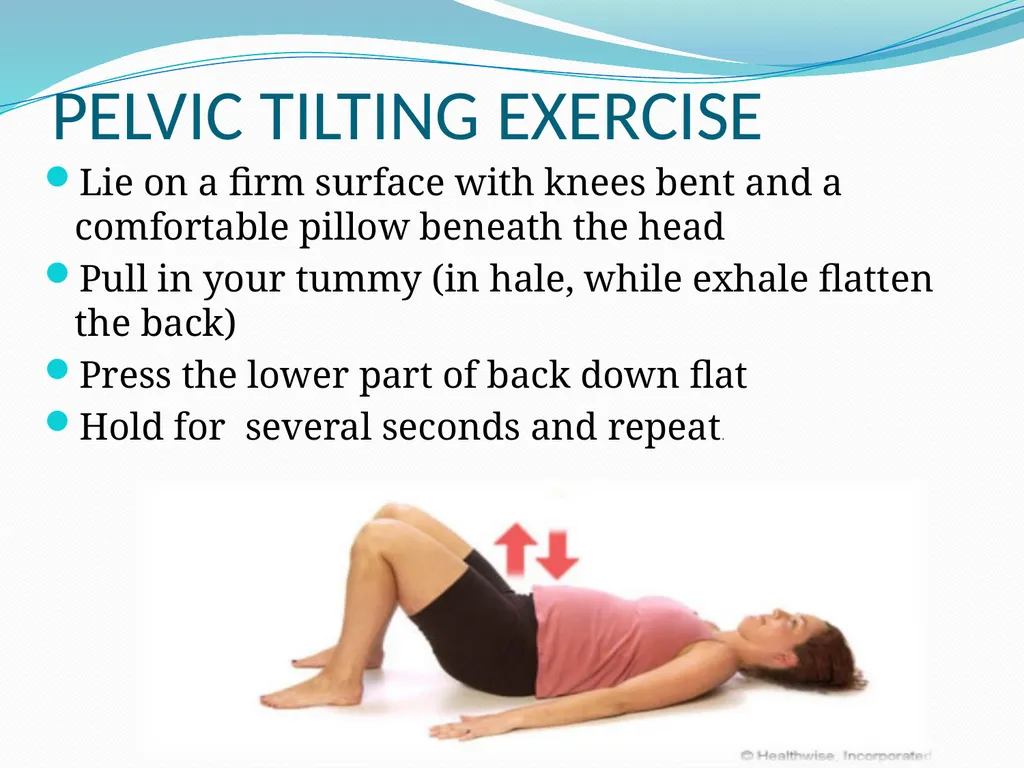
PELVIC TILTING EXERCISE Lie on a firm surface with knees bent and a comfortable pillow beneath the head
Pull in your tummy (in hale, while exhale flatten the back)
Press the lower part of back down flat
Hold for several seconds and repeat.<br>
Pull in your tummy (in hale, while exhale flatten the back)
Press the lower part of back down flat
Hold for several seconds and repeat.<br>
24
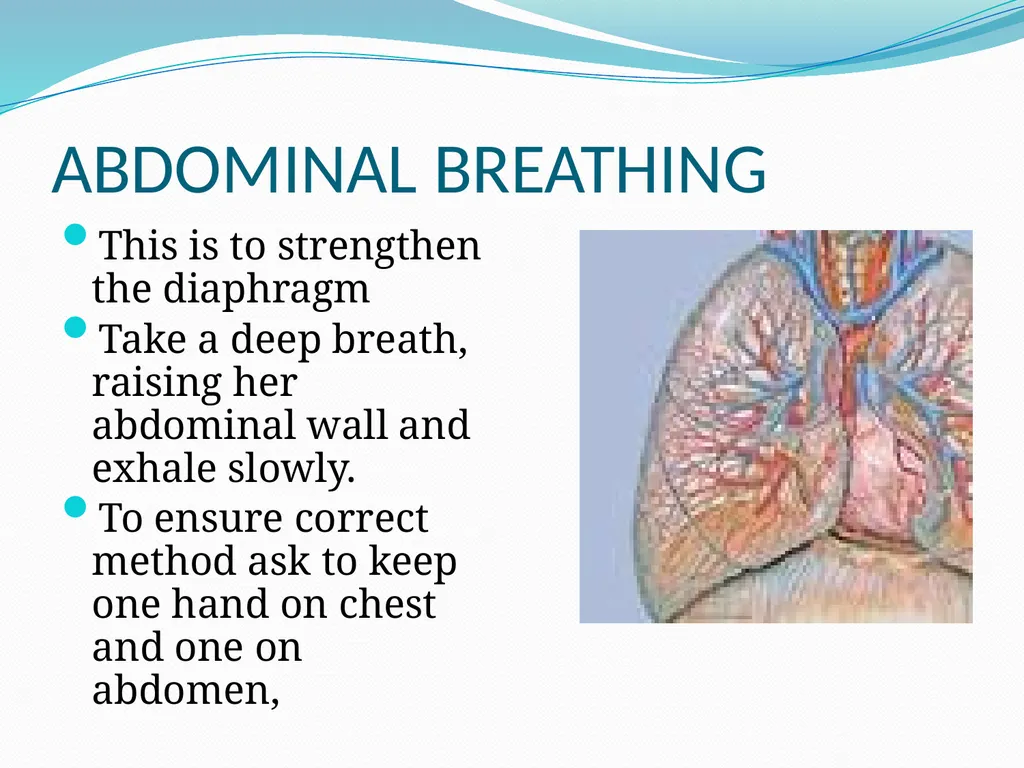
ABDOMINAL BREATHING This is to strengthen the diaphragm
Take a deep breath, raising her abdominal wall and exhale slowly.
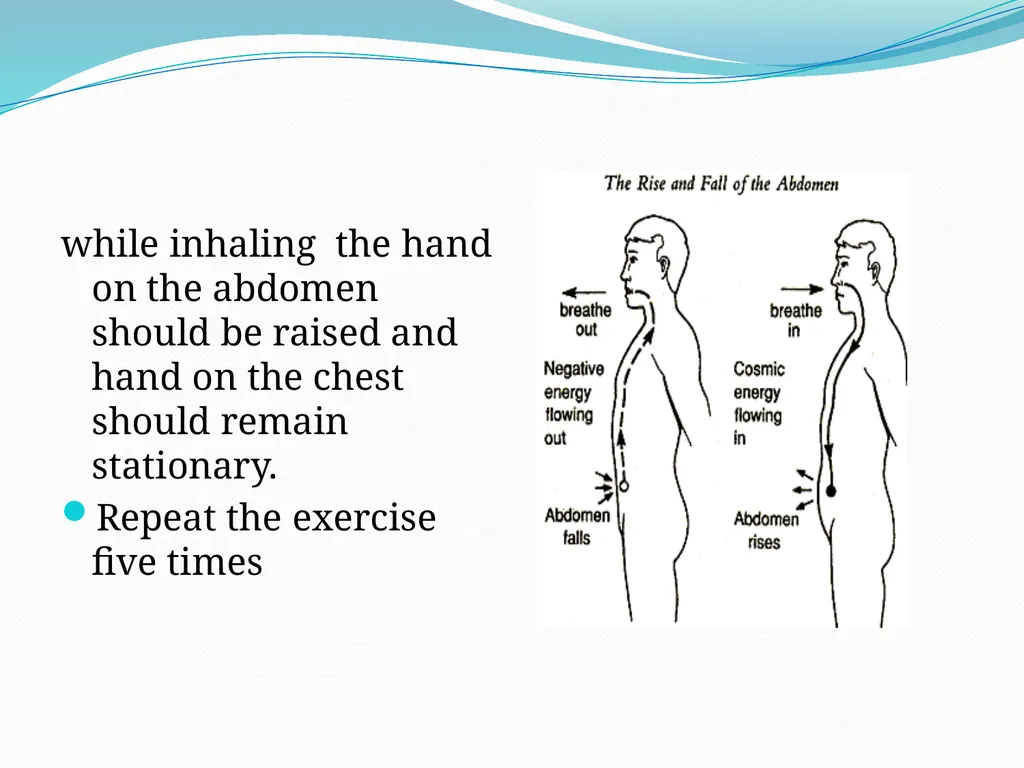
To ensure correct method ask to keep one hand on chest and one on abdomen,<br>
Take a deep breath, raising her abdominal wall and exhale slowly.
To ensure correct method ask to keep one hand on chest and one on abdomen,<br>
25
while inhaling the hand on the abdomen should be raised and hand on the chest should remain stationary.
Repeat the exercise five times<br>
Repeat the exercise five times<br>
26
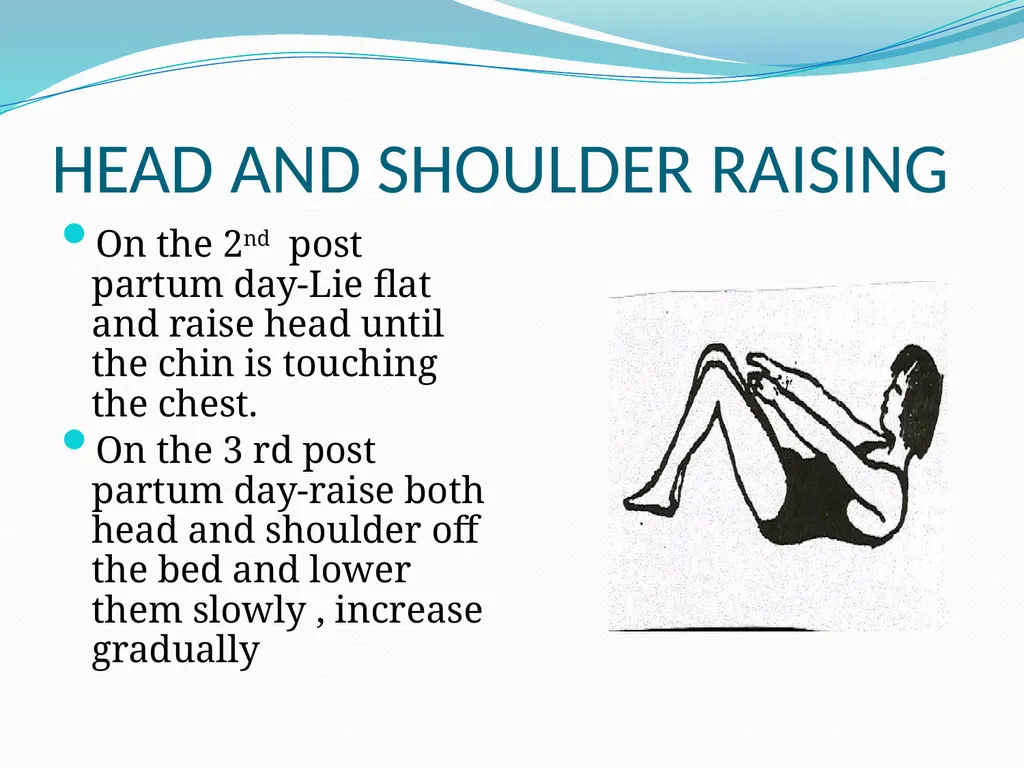
HEAD AND SHOULDER RAISING On the 2nd post partum day-Lie flat and raise head until the chin is touching the chest.
On the 3 rd post partum day-raise both head and shoulder off the bed and lower them slowly , increase gradually<br>
On the 3 rd post partum day-raise both head and shoulder off the bed and lower them slowly , increase gradually<br>
27
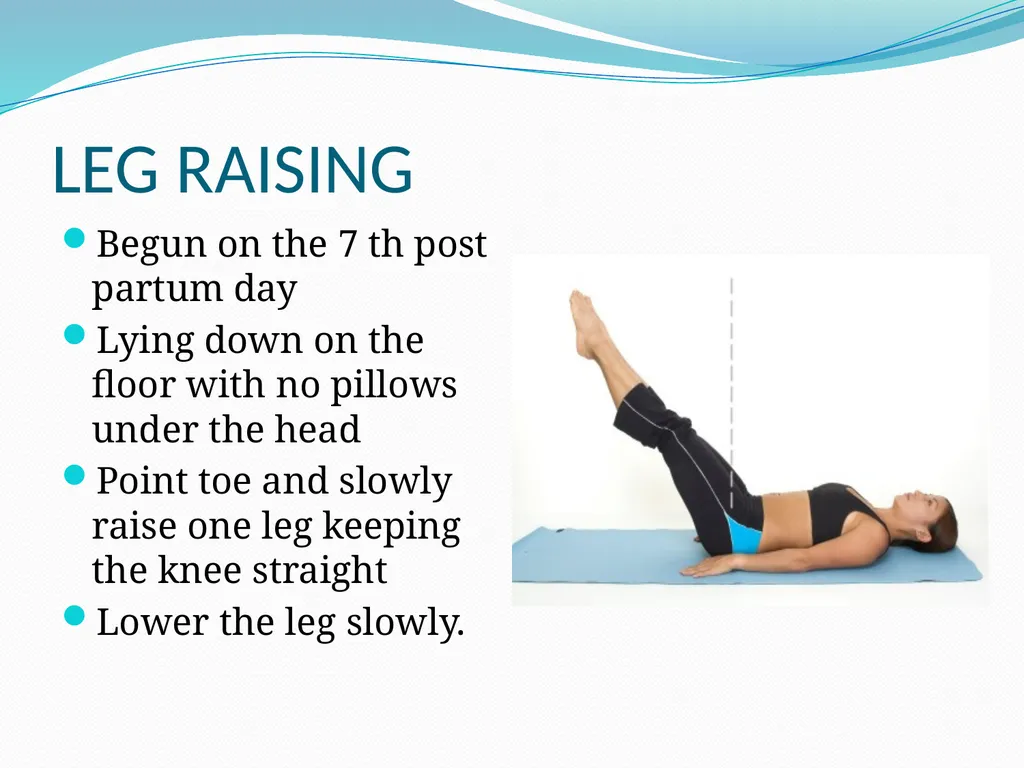
LEG RAISING Begun on the 7 th post partum day
Lying down on the floor with no pillows under the head
Point toe and slowly raise one leg keeping the knee straight
Lower the leg slowly.<br>
Lying down on the floor with no pillows under the head
Point toe and slowly raise one leg keeping the knee straight
Lower the leg slowly.<br>
28
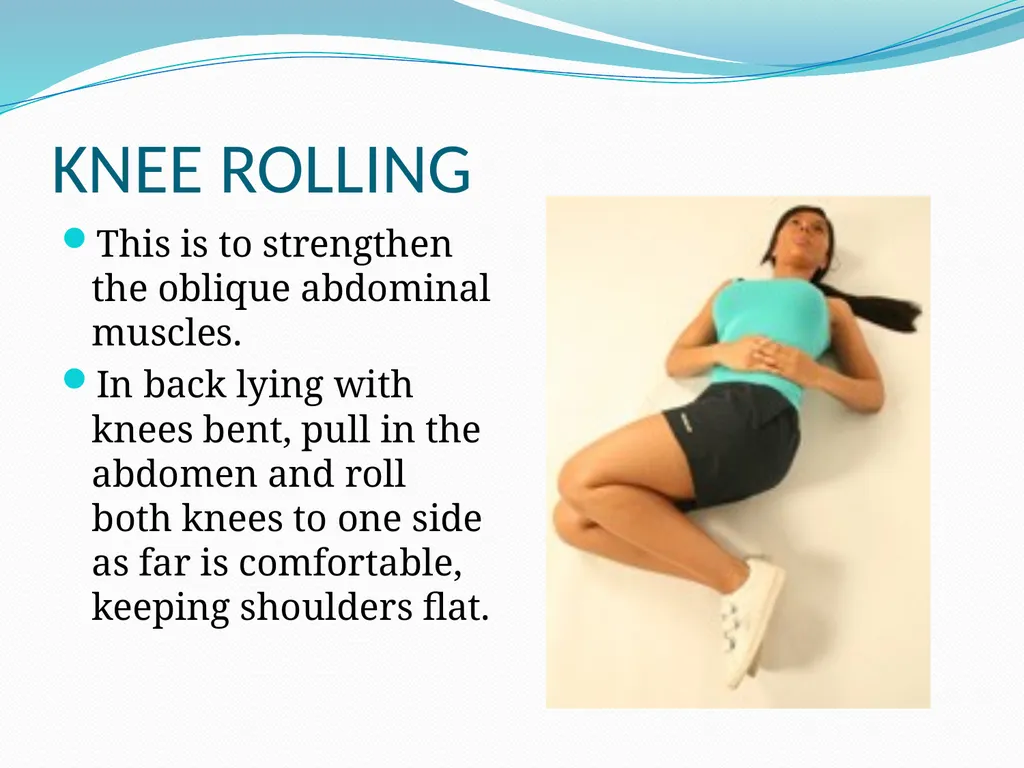
KNEE ROLLING This is to strengthen the oblique abdominal muscles.
In back lying with knees bent, pull in the abdomen and roll both knees to one side as far is comfortable, keeping shoulders flat.<br>
In back lying with knees bent, pull in the abdomen and roll both knees to one side as far is comfortable, keeping shoulders flat.<br>
29
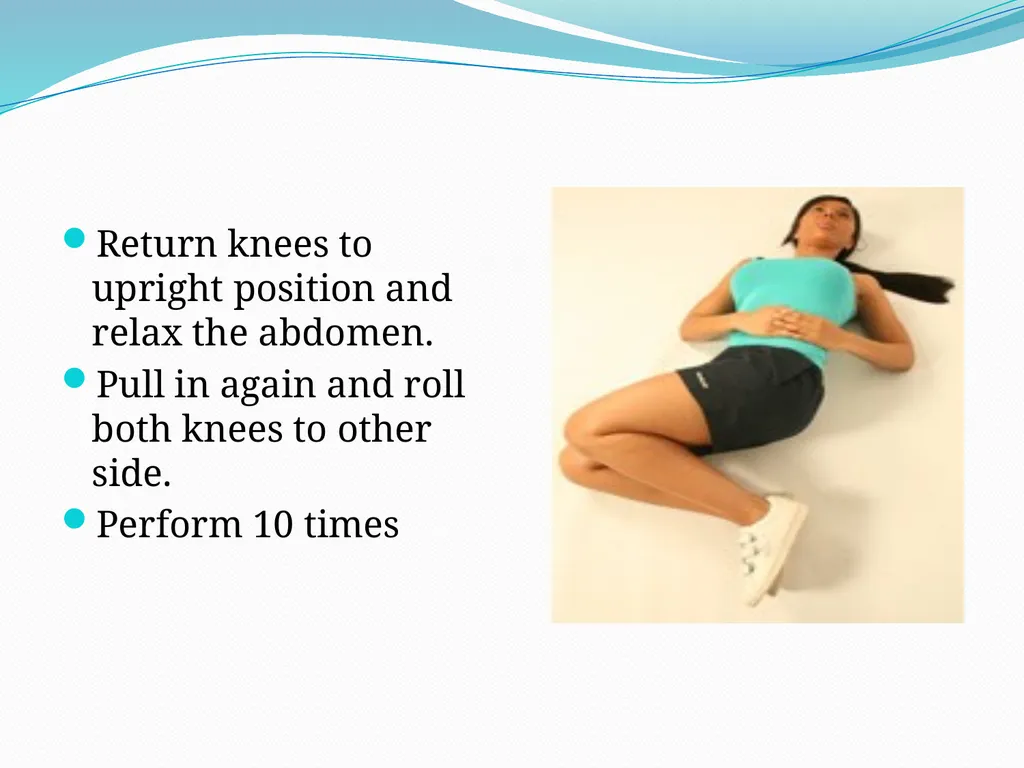
Return knees to upright position and relax the abdomen.
Pull in again and roll both knees to other side.
Perform 10 times<br>
Pull in again and roll both knees to other side.
Perform 10 times<br>
30
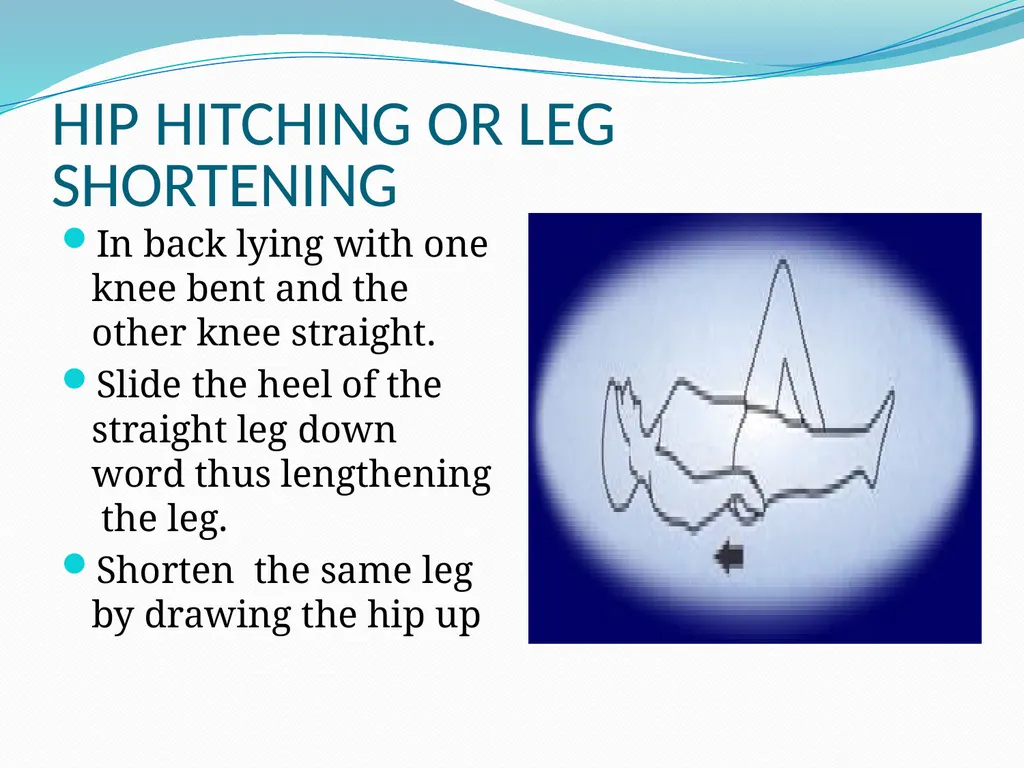
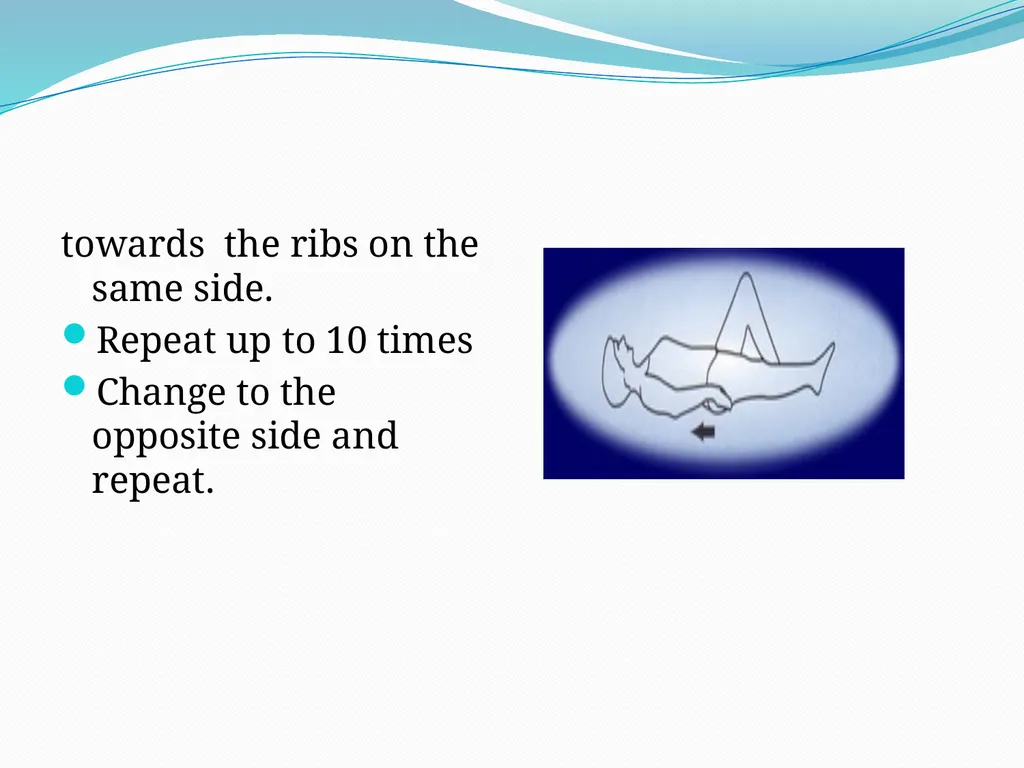
HIP HITCHING OR LEG SHORTENING In back lying with one knee bent and the other knee straight.
Slide the heel of the straight leg down word thus lengthening the leg.
Shorten the same leg by drawing the hip up<br>
Slide the heel of the straight leg down word thus lengthening the leg.
Shorten the same leg by drawing the hip up<br>
31
towards the ribs on the same side.
Repeat up to 10 times
Change to the opposite side and repeat.<br>
Repeat up to 10 times
Change to the opposite side and repeat.<br>
32
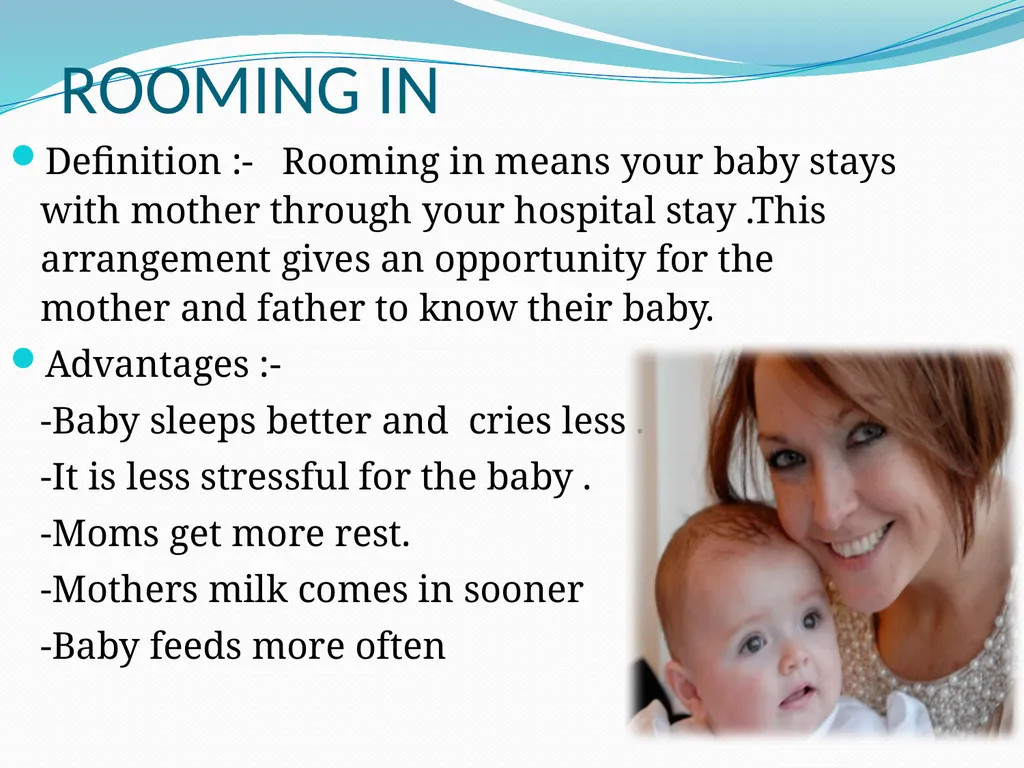
ROOMING IN Definition :- Rooming in means your baby stays with mother through your hospital stay .This arrangement gives an opportunity for the mother and father to know their baby.
Advantages :-
-Baby sleeps better and cries less .
-It is less stressful for the baby .
-Moms get more rest.
-Mothers milk comes in sooner
-Baby feeds more often<br>
Advantages :-
-Baby sleeps better and cries less .
-It is less stressful for the baby .
-Moms get more rest.
-Mothers milk comes in sooner
-Baby feeds more often<br>
33
Baby gain weight more better.
Baby develops less jaundice
You can get to know your baby better .
Women exclusively breastfeed longer and continue to breastfeed longer.
You are better prepared to take care of your baby .
You can recognise your baby’s feeding cues .<br>
Baby develops less jaundice
You can get to know your baby better .
Women exclusively breastfeed longer and continue to breastfeed longer.
You are better prepared to take care of your baby .
You can recognise your baby’s feeding cues .<br>
34
BONDING Bonding is the formation of a mutual emotional and psychological closeness between parents and their newborn child .Babies usually bond with their parents in the minutes ,hours,or days following birth .<br>
35
BONDING WITH BABY Mother can create and strengthen the emotional bond with baby by:-
Making frequent eye contact, such as during feeding times. Young babies love to look at your face and eyes. Cuddling baby in the crook of your arm is about the perfect distance for your baby to see you well.
Smiling ,talking ,and singing to your baby.
Responding promptly to crying .Your baby will learn to trust that when he or she is need ,you will consistently come to give comfort.<br>
36
WARM CHAIN Baby must be kept warm at all times right from birth . Satisfactory control of temperature demands both prevention of heat loss and promotion of heat gain.<br>
37
Definition The warm chain is a set of interlinked procedures to be taken at birth and during the next few hours and days in order to minimize heat loss in all newborn.<br>
38
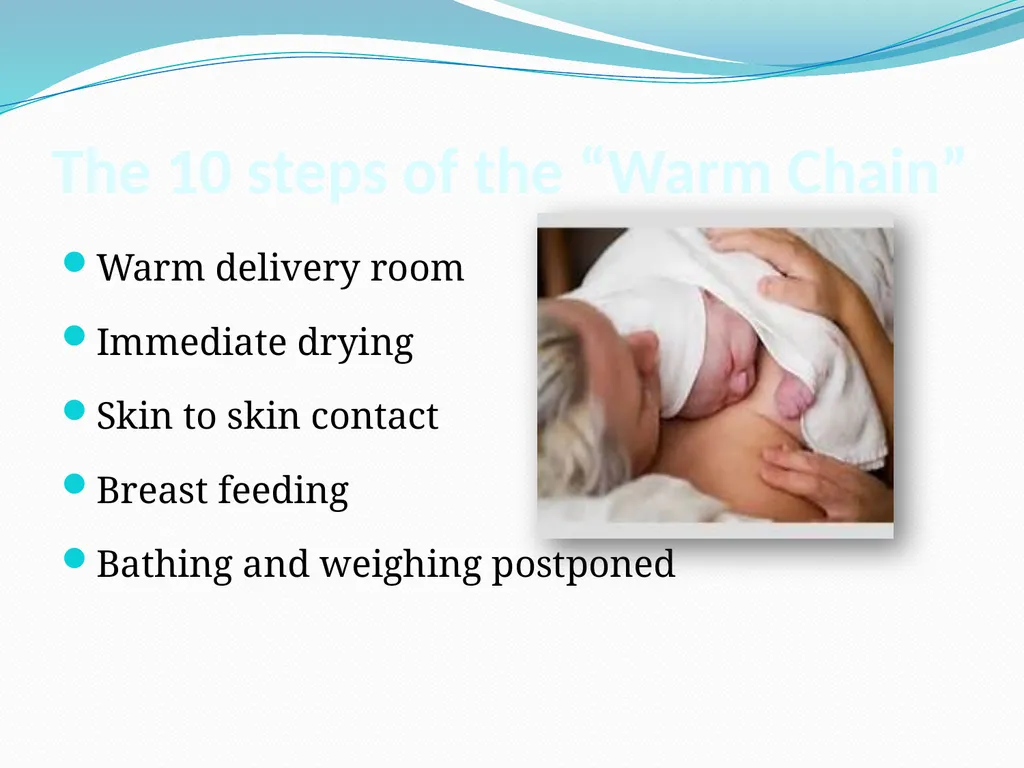
The 10 steps of the “Warm Chain” Warm delivery room
Immediate drying
Skin to skin contact
Breast feeding
Bathing and weighing postponed<br>
Immediate drying
Skin to skin contact
Breast feeding
Bathing and weighing postponed<br>
39
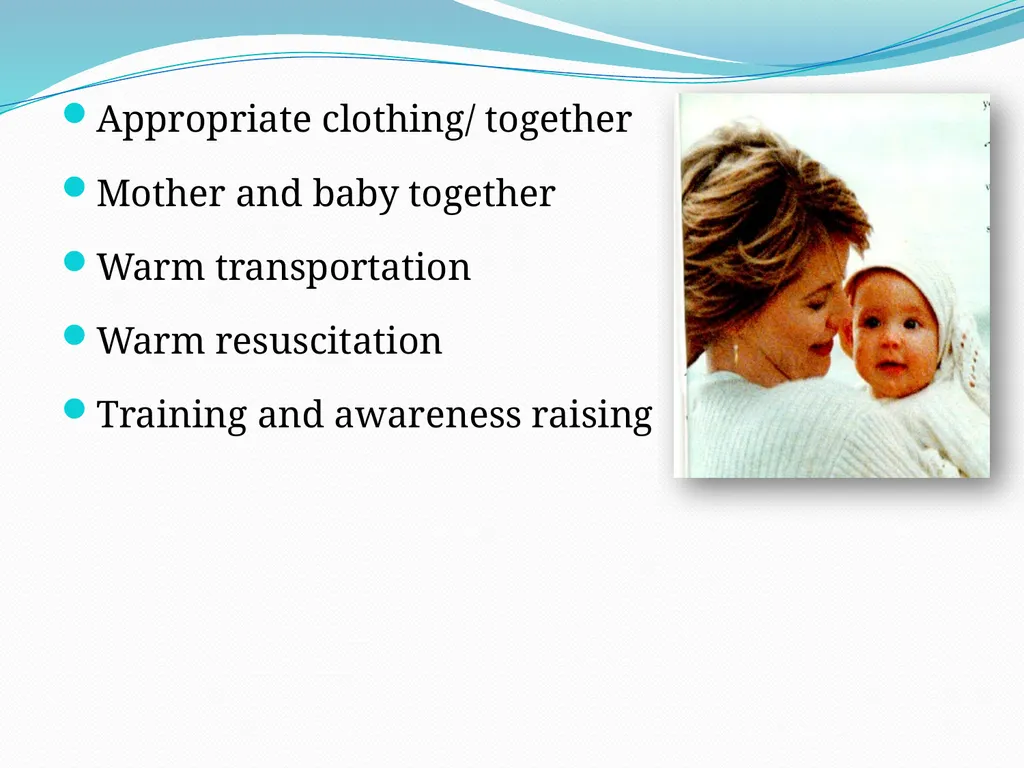
Appropriate clothing/ together
Mother and baby together
Warm transportation
Warm resuscitation
Training and awareness raising<br>
Mother and baby together
Warm transportation
Warm resuscitation
Training and awareness raising<br>
40
WARM CHAIN PRINCIPLE IN POSTNANTAL CARE The mother should understand that keeping the baby warm is not a one time job ,it is rather a continous job which means adhering to the warm chain principle . A warm chain is a system of keeping a baby warm immediately after delivery.Whenever it occurs during transportation and while feeding and caring for the baby.<br>
41
BIBLIOGRAPHY “Rimple Sharma” Essential of pediatric Nursing, First edition, published by Jaypee brothers, page no. 231-240.
Dr.B.T Basavanthapa, “Child health nursing , First edition,published Ahuja Publishing house no., Pageno.222-225.
Parul Dutta :Pediatic Nursing 2nd edition ,Published by Jaypee Brothers ,Pg no.75-77.
Dutta DC: textbook of obstetric 7th edition jaypee brothers publication<br>
Dr.B.T Basavanthapa, “Child health nursing , First edition,published Ahuja Publishing house no., Pageno.222-225.
Parul Dutta :Pediatic Nursing 2nd edition ,Published by Jaypee Brothers ,Pg no.75-77.
Dutta DC: textbook of obstetric 7th edition jaypee brothers publication<br>
42
Thank you<br>