Marriage and divorce registration in Africa: Status, best practices, challenges and strategies for accelerating progress Experts Group Meeting of the 6th Conference of African Ministers Responsible for Civil Registration and Vital
"Marriage and divorce registration in Africa:" is the property of its rightful owner. Permission is granted to
download and print the materials on this website for personal, non-commercial use only, and to display it
on your personal computer provided you do not modify the materials and that you retain all copyright
notices contained in the materials. By downloading content from our website, you accept the terms of this
agreement.
Presentation Transcript
01
Marriage and divorce registration in Africa: Status, best practices, challenges and strategies for accelerating progress Experts Group Meeting of the 6th Conference of African Ministers Responsible for Civil Registration and Vital Statistics, Addis Ababa, 24–28 October, 2022<br>
02
The importance of marriage and divorce registration
Marriage and divorce registration: a landscape overview
Some illustrative cases
Challenges and opportunities
Strategies for accelerating progress Outline<br>
03
Marriage – the act, ceremony or process by which the legal relationship of spouses is constituted (UN, 2014).
Divorce – the final legal dissolution of a marriage which confers on the parties the right to remarriage (UN, 2014).
The legality of marriage may be established by civil, religious or other means as recognized by the laws of each country.
Vital event records and certificates are used as legal documents to protect individuals’ human and civil rights and for accessing basic social services. Marriage and divorce definitions<br>
04
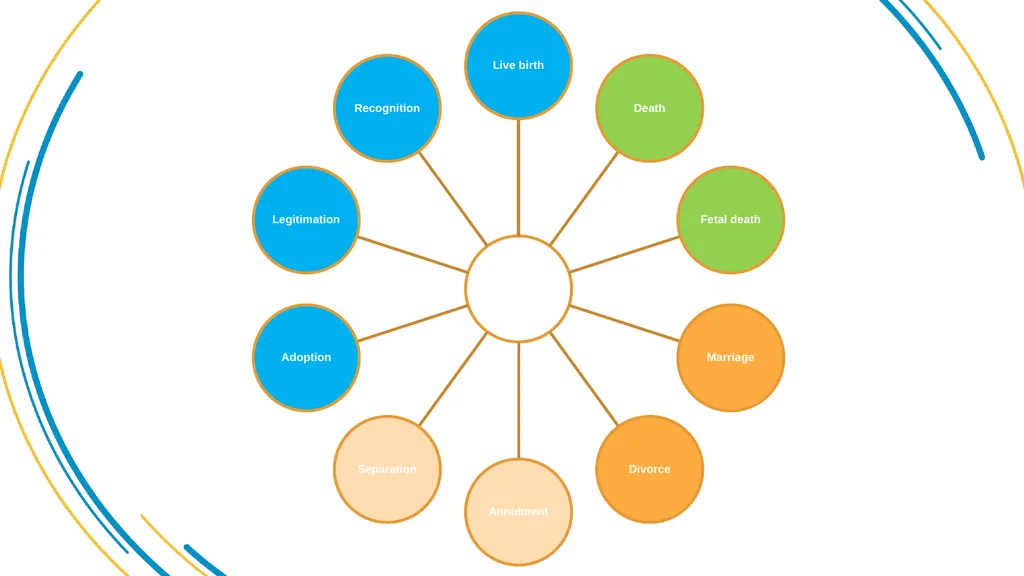
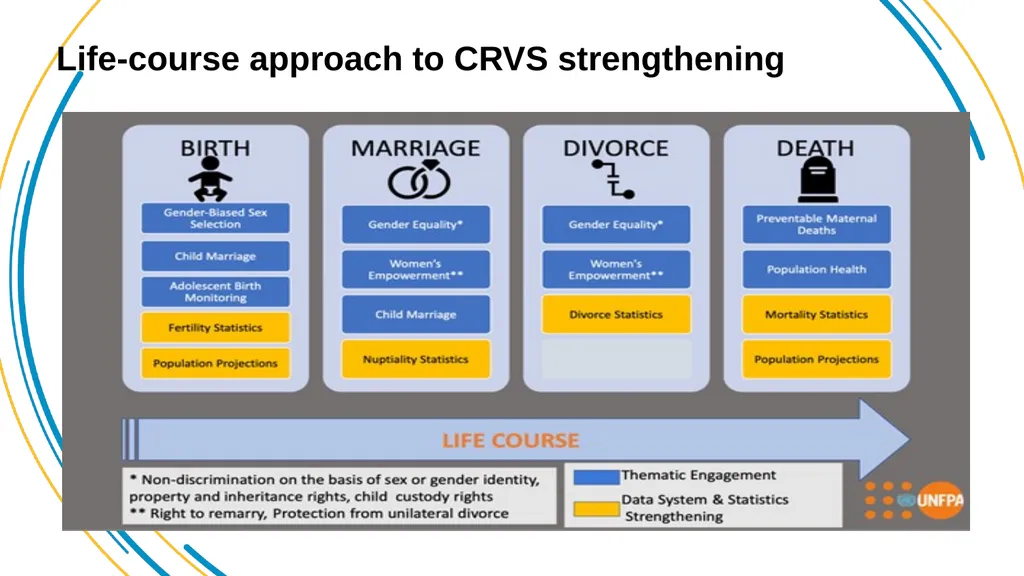
Life-course approach to CRVS strengthening<br>
05
The uses of marriage registration
Prevention of marriage fraud, bigamy, and child marriage.
Facilitating the realization of certain rights – rights to inheritance, family benefits, marriage allowances, access to pension and insurance of a deceased spouse, and the right for a spouse to acquire a nationality, among others.
The uses of divorce registration
Demonstrates a person's right to remarry.
Provides evidence of termination of rights of a former spouse.
A legal basis for the distribution of parental responsibilities.
Ensures a fair division of assets acquired in the marriage or union.
Marriage and divorce certificates are important facilitators of gender equality and the SDGs through the protection of rights of women and children. The uses of marriage and divorce registration<br>
06
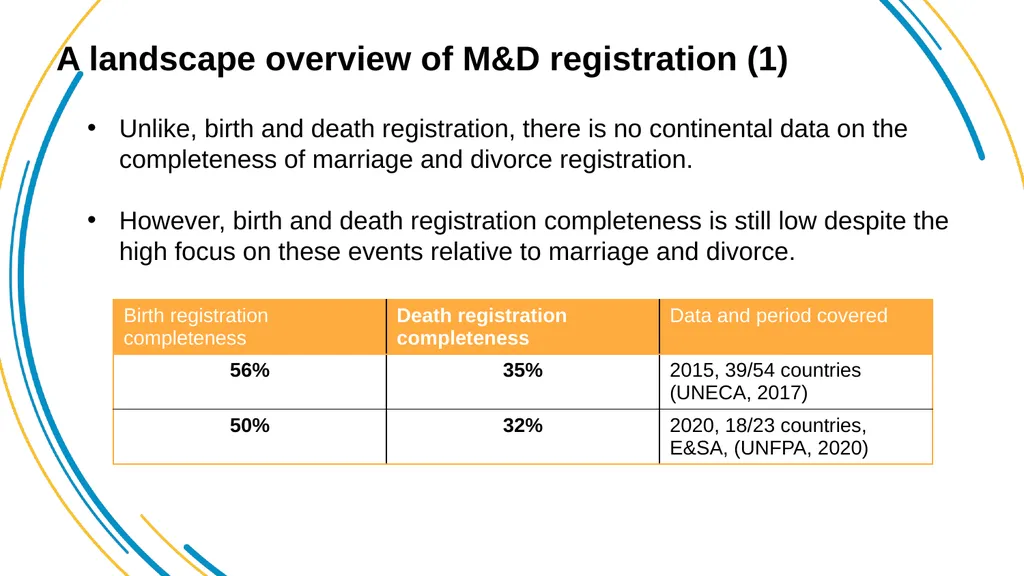
Unlike, birth and death registration, there is no continental data on the completeness of marriage and divorce registration.
However, birth and death registration completeness is still low despite the high focus on these events relative to marriage and divorce. A landscape overview of M&D registration (1)<br>
07
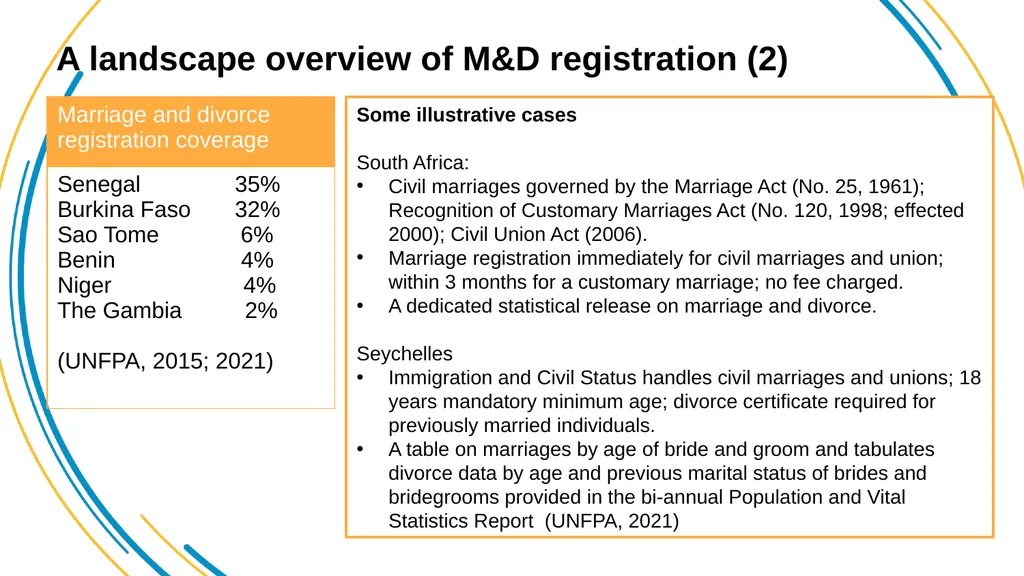
A landscape overview of M&D registration (2) Some illustrative cases
South Africa:
Civil marriages governed by the Marriage Act (No. 25, 1961); Recognition of Customary Marriages Act (No. 120, 1998; effected 2000); Civil Union Act (2006).
Marriage registration immediately for civil marriages and union; within 3 months for a customary marriage; no fee charged.
A dedicated statistical release on marriage and divorce.
Seychelles
Immigration and Civil Status handles civil marriages and unions; 18 years mandatory minimum age; divorce certificate required for previously married individuals.
A table on marriages by age of bride and groom and tabulates divorce data by age and previous marital status of brides and bridegrooms provided in the bi-annual Population and Vital Statistics Report (UNFPA, 2021)<br>
08
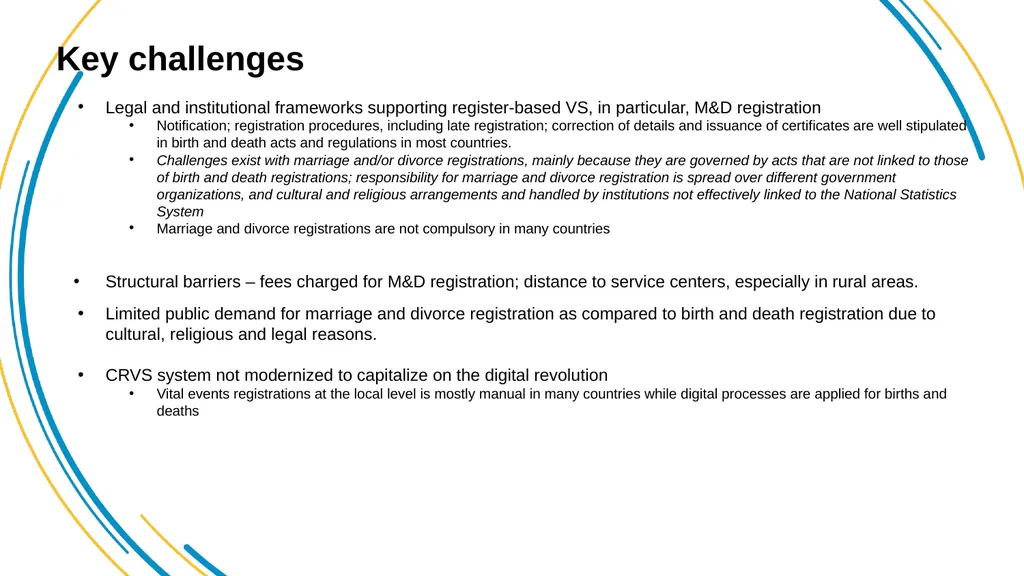
Legal and institutional frameworks supporting register-based VS, in particular, M&D registration
Notification; registration procedures, including late registration; correction of details and issuance of certificates are well stipulated in birth and death acts and regulations in most countries.
Challenges exist with marriage and/or divorce registrations, mainly because they are governed by acts that are not linked to those of birth and death registrations; responsibility for marriage and divorce registration is spread over different government organizations, and cultural and religious arrangements and handled by institutions not effectively linked to the National Statistics System
Marriage and divorce registrations are not compulsory in many countries
Structural barriers – fees charged for M&D registration; distance to service centers, especially in rural areas.
Limited public demand for marriage and divorce registration as compared to birth and death registration due to cultural, religious and legal reasons.
CRVS system not modernized to capitalize on the digital revolution
Vital events registrations at the local level is mostly manual in many countries while digital processes are applied for births and deaths Key challenges<br>
09
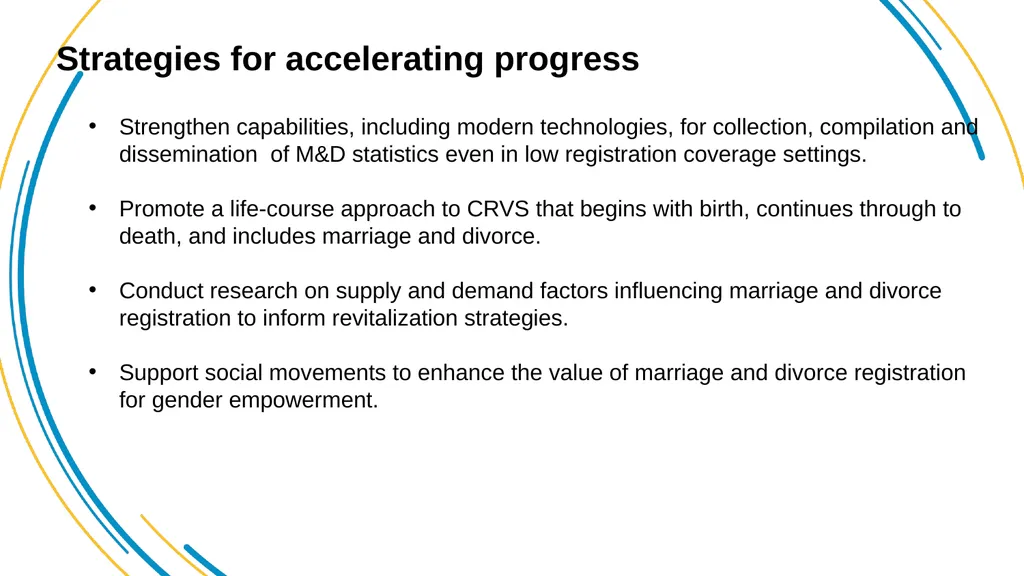
Strengthen capabilities, including modern technologies, for collection, compilation and dissemination of M&D statistics even in low registration coverage settings.
Promote a life-course approach to CRVS that begins with birth, continues through to death, and includes marriage and divorce.
Conduct research on supply and demand factors influencing marriage and divorce registration to inform revitalization strategies.
Support social movements to enhance the value of marriage and divorce registration for gender empowerment. Strategies for accelerating progress<br>