Measurement of Heat Release Rate, Aerosol, and Gas Products During Lithium-Ion Battery Thermal Runaway in Devices 54th International Conference on Environmental Systems National Aeronautics and Space Administration www.nasa.gov Authors John
"Measurement of Heat Release Rate, Aerosol, and Gas" is the property of its rightful owner. Permission is granted to
download and print the materials on this website for personal, non-commercial use only, and to display it
on your personal computer provided you do not modify the materials and that you retain all copyright
notices contained in the materials. By downloading content from our website, you accept the terms of this
agreement.
Presentation Transcript
01
Measurement of Heat Release Rate, Aerosol, and Gas Products During Lithium-Ion Battery Thermal Runaway in Devices 54th International Conference on Environmental Systems National Aeronautics and Space Administration www.nasa.gov<br>
02
Authors John Easton and Ya-Ting Liao, Case Western Reserve University
Rosa Padilla, Gordon Berger, and Jay Owens, Universities Space Research Association
Claire Fortenberry, David Urban*, Daniel Dietrich, Thomas Miller, and Thomas DeMichael, NASA Glenn Research Center
* Presenting author Measurement of Heat Release Rate, Aerosol, and Gas Products During Lithium-Ion Battery Thermal Runaway in Devices 2<br>
03
Overview Lithium-ion battery thermal runaway a known threat for space habitats
Produces heat, toxic gas, aerosol
Vehicle design, environmental design, mission design and contingencies must plan for this possibility
Current work measures major gas species, aerosol, heat release with two batteries
Initial tests with ethanol pools to verify performance
Single prismatic cell, 9-10 Wh in size
What’s unique – impact on spacecraft habitability in realistic situation
Allow full size flames to enable realistic products
Use a flow through system – avoid limitations of closed-volume test chambers
Toxicity Limits:
Carbon dioxide: 1 hr – 3 mmHg (NASA-STD-3001)
Carbon monoxide: 1 hr – 425 ppm; 24 hr – 100 ppm (JSC-20584) Measurement of Heat Release Rate, Aerosol, and Gas Products During Lithium-Ion Battery Thermal Runaway in Devices 3<br>
04
Test Method Build inner, outer enclosure to contain experiment and capture gas and aerosol produced
Continuous flow system vents inner enclosure, capturing products
Estimate flow rate using orifice plate flow meter
Sample gas products measuring using Testo 350 (Testo, Inc., West Chester, PA) and Combustion Product Monitor developed by Jet Propulsion Lab
Oxygen consumption calorimetry provides estimate of heat release rate
Use both oxygen-only and oxygen-carbon monoxide-carbo dioxide based estimates
Measure aerosol size distribution with ELPI+ (Dekati Ltd., Kangasala, Finland) Measurement of Heat Release Rate, Aerosol, and Gas Products During Lithium-Ion Battery Thermal Runaway in Devices 4<br>
05
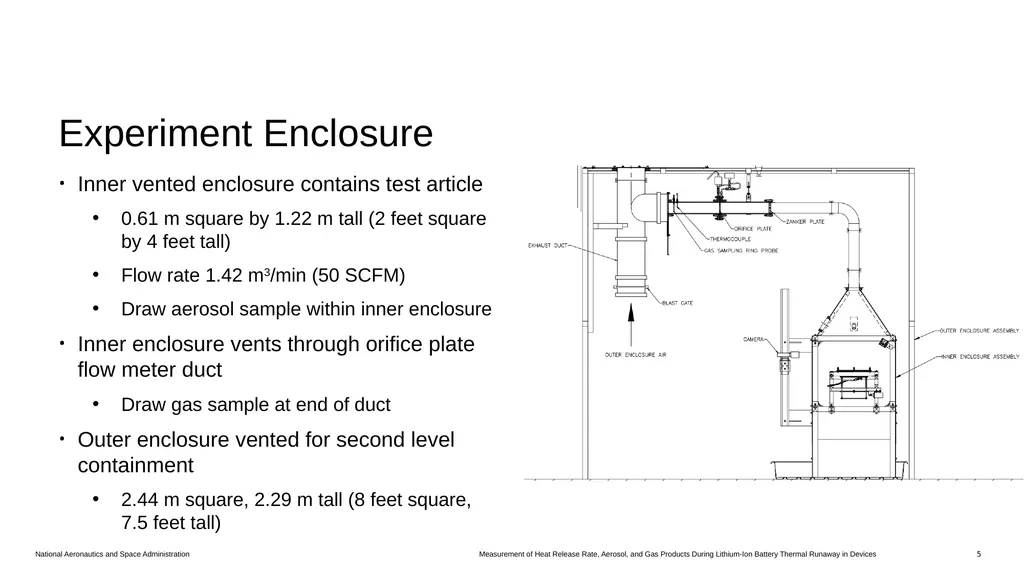
Experiment Enclosure Inner vented enclosure contains test article
0.61 m square by 1.22 m tall (2 feet square by 4 feet tall)
Flow rate 1.42 m3/min (50 SCFM)
Draw aerosol sample within inner enclosure
Inner enclosure vents through orifice plate flow meter duct
Draw gas sample at end of duct
Outer enclosure vented for second level containment
2.44 m square, 2.29 m tall (8 feet square, 7.5 feet tall) Measurement of Heat Release Rate, Aerosol, and Gas Products During Lithium-Ion Battery Thermal Runaway in Devices 5<br>
06
Ethanol Pool Validation Tests Validate the flow system and oxygen consumption calorimetry estimates by comparison with heat of combustion and mass loss
Perform two sets of tests
100 mm (4 inch) diameter, 50 mL ethanol
200 mm (8 inch) diameter, 300 mL ethanol
Each pan (0.75 inch) deep, filled with 3 mm glass beads
Record mass of pan at 10 Hz
Calculate heat release rate using mass, Heat of combustion based on oxygen consumed
12.3 MJ/kg-O2 consumed (25.6 MJ/kg-ethanol, adjusted by stoichiometry) Measurement of Heat Release Rate, Aerosol, and Gas Products During Lithium-Ion Battery Thermal Runaway in Devices 6<br>
07
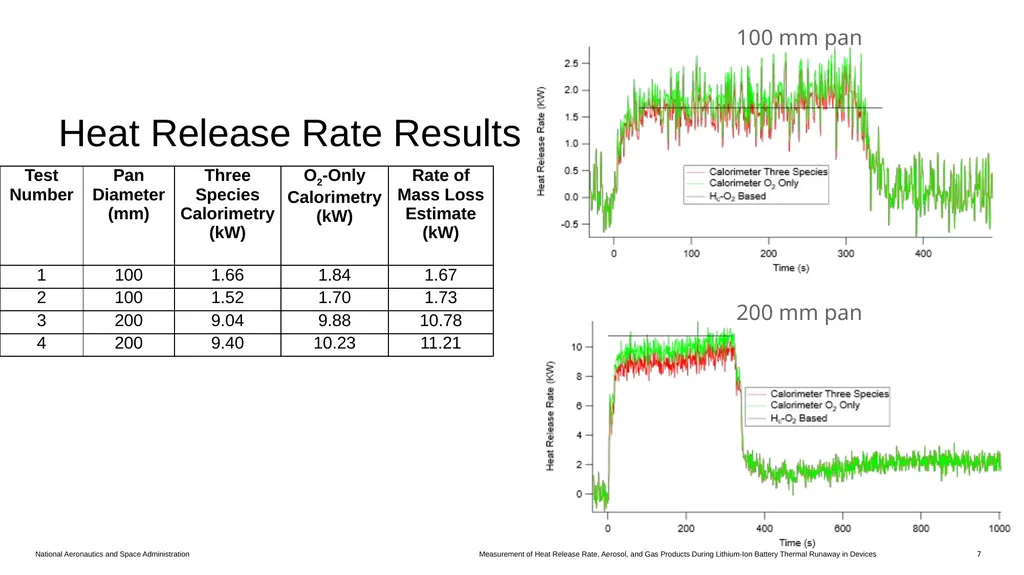
Heat Release Rate Results Measurement of Heat Release Rate, Aerosol, and Gas Products During Lithium-Ion Battery Thermal Runaway in Devices 7 100 mm pan 200 mm pan<br>
08
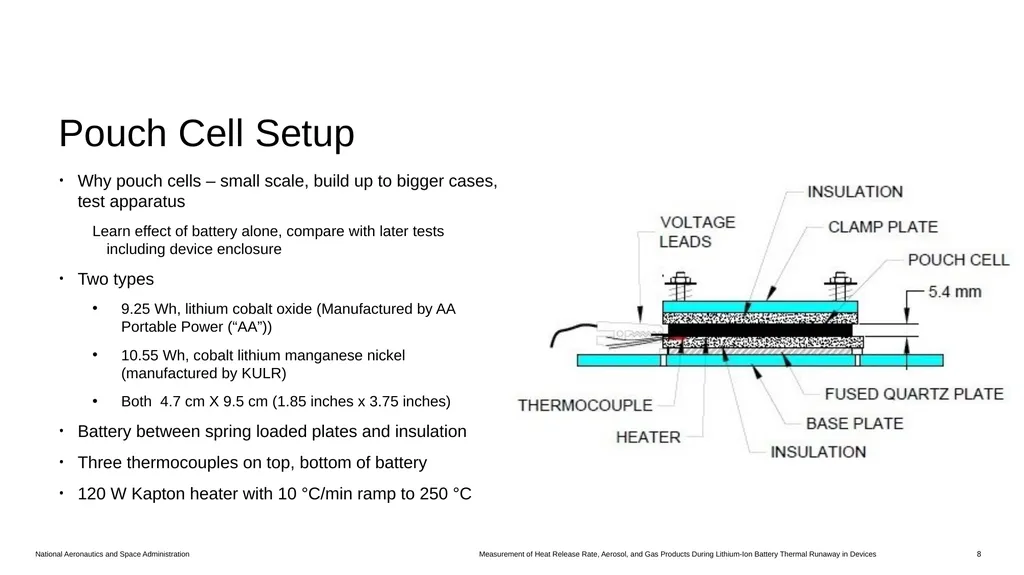
Pouch Cell Setup Why pouch cells – small scale, build up to bigger cases, test apparatus
Learn effect of battery alone, compare with later tests including device enclosure
Two types
9.25 Wh, lithium cobalt oxide (Manufactured by AA Portable Power (“AA”))
10.55 Wh, cobalt lithium manganese nickel (manufactured by KULR)
Both 4.7 cm X 9.5 cm (1.85 inches x 3.75 inches)
Battery between spring loaded plates and insulation
Three thermocouples on top, bottom of battery
120 W Kapton heater with 10 °C/min ramp to 250 °C Measurement of Heat Release Rate, Aerosol, and Gas Products During Lithium-Ion Battery Thermal Runaway in Devices 8<br>
09
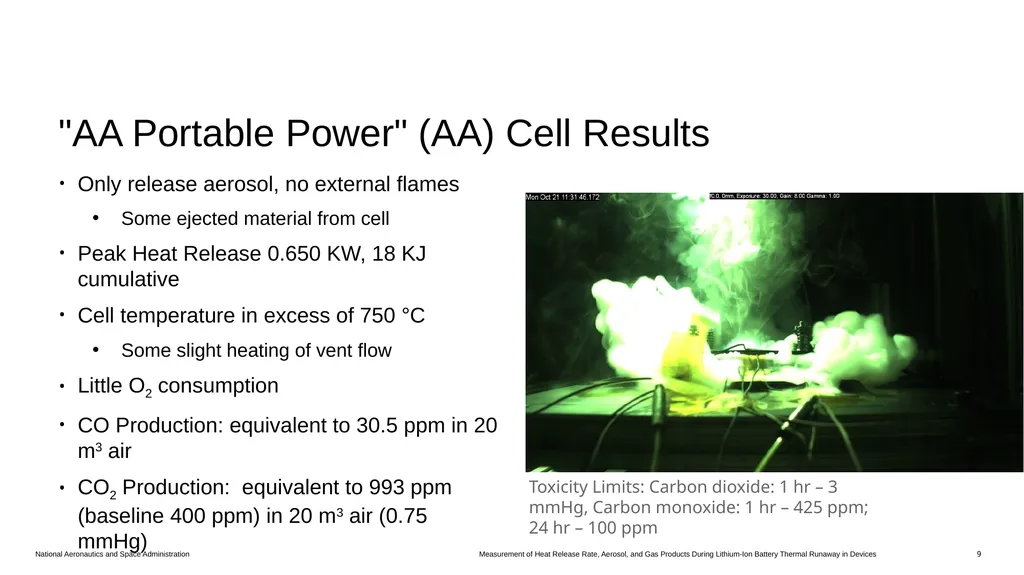
"AA Portable Power" (AA) Cell Results Only release aerosol, no external flames
Some ejected material from cell
Peak Heat Release 0.650 KW, 18 KJ cumulative
Cell temperature in excess of 750 °C
Some slight heating of vent flow
Little O2 consumption
CO Production: equivalent to 30.5 ppm in 20 m3 air
CO2 Production: equivalent to 993 ppm (baseline 400 ppm) in 20 m3 air (0.75 mmHg) Measurement of Heat Release Rate, Aerosol, and Gas Products During Lithium-Ion Battery Thermal Runaway in Devices 9 Toxicity Limits: Carbon dioxide: 1 hr – 3 mmHg, Carbon monoxide: 1 hr – 425 ppm; 24 hr – 100 ppm<br>
10
AA Cell Results: Heat Release and Cell Temperature Heat Release Cell Temperature Measurement of Heat Release Rate, Aerosol, and Gas Products During Lithium-Ion Battery Thermal Runaway in Devices 10<br>
11
AA Cell Results: Gas Species O2 CO and CO2 Measurement of Heat Release Rate, Aerosol, and Gas Products During Lithium-Ion Battery Thermal Runaway in Devices 11<br>
12
AA Cell Results: Aerosols Measure size distribution using ELPI+
Used dilution (topmost graph) to protect device, DF is ratio of dilution to sample flow
Can see particle concentration change and increase during heating, thermal runaway
Size distribution changes as well
Initially small particles
Larger particle closer to thermal runaway
Bimodal, largest particles at thermal runaway
Particle smaller after thermal runaway Measurement of Heat Release Rate, Aerosol, and Gas Products During Lithium-Ion Battery Thermal Runaway in Devices 12<br>
13
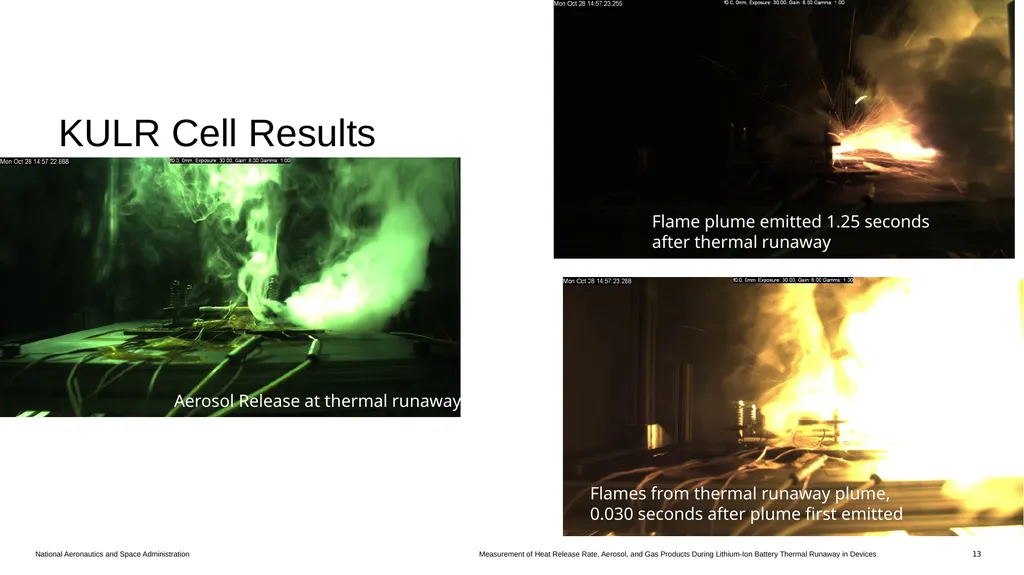
KULR Cell Results Measurement of Heat Release Rate, Aerosol, and Gas Products During Lithium-Ion Battery Thermal Runaway in Devices 13 Aerosol Release at thermal runaway Flame plume emitted 1.25 seconds after thermal runaway Flames from thermal runaway plume, 0.030 seconds after plume first emitted<br>
14
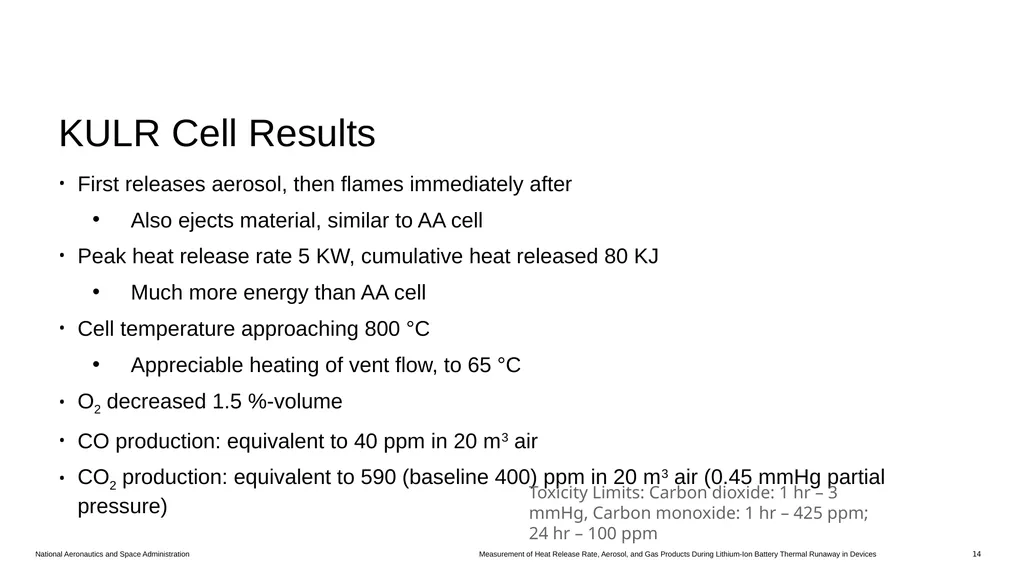
KULR Cell Results First releases aerosol, then flames immediately after
Also ejects material, similar to AA cell
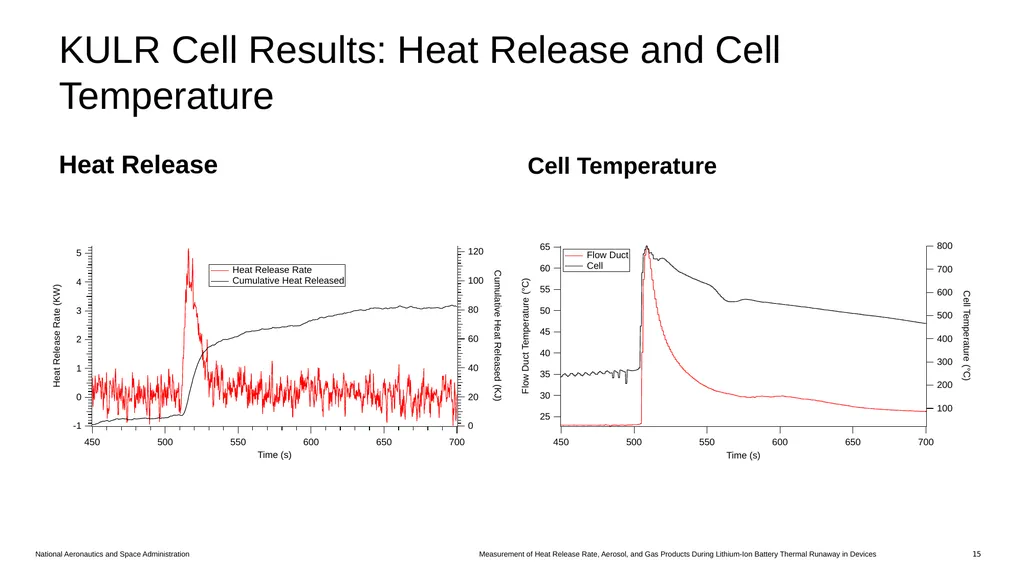
Peak heat release rate 5 KW, cumulative heat released 80 KJ
Much more energy than AA cell
Cell temperature approaching 800 °C
Appreciable heating of vent flow, to 65 °C
O2 decreased 1.5 %-volume
CO production: equivalent to 40 ppm in 20 m3 air
CO2 production: equivalent to 590 (baseline 400) ppm in 20 m3 air (0.45 mmHg partial pressure) Measurement of Heat Release Rate, Aerosol, and Gas Products During Lithium-Ion Battery Thermal Runaway in Devices 14 Toxicity Limits: Carbon dioxide: 1 hr – 3 mmHg, Carbon monoxide: 1 hr – 425 ppm; 24 hr – 100 ppm<br>
15
KULR Cell Results: Heat Release and Cell Temperature Heat Release Cell Temperature Measurement of Heat Release Rate, Aerosol, and Gas Products During Lithium-Ion Battery Thermal Runaway in Devices 15<br>
16
KULR Cell Results: Gas Species O2 CO, CO2 Measurement of Heat Release Rate, Aerosol, and Gas Products During Lithium-Ion Battery Thermal Runaway in Devices 16<br>
17
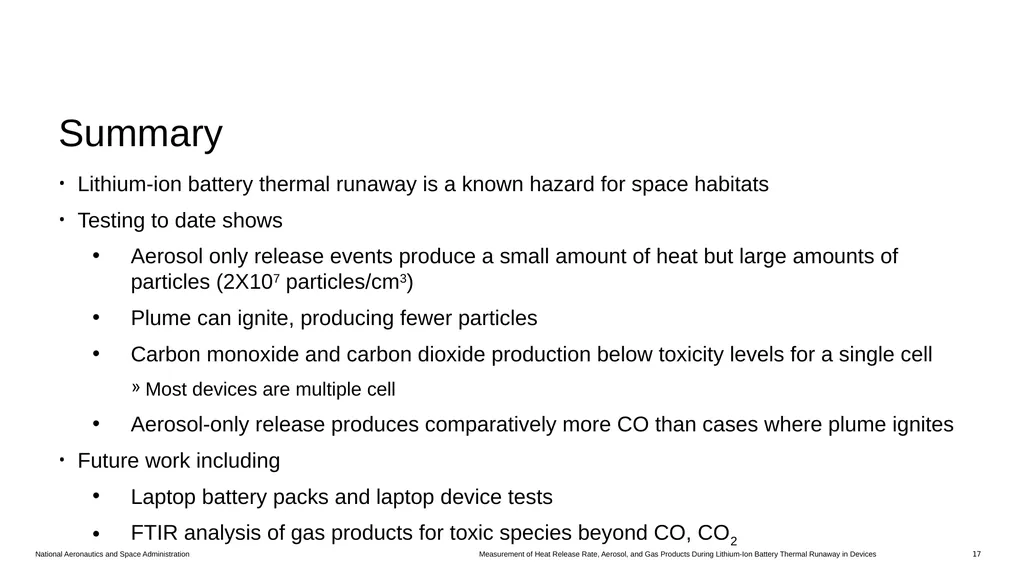
Summary Lithium-ion battery thermal runaway is a known hazard for space habitats
Testing to date shows
Aerosol only release events produce a small amount of heat but large amounts of particles (2X10⁷ particles/cm3)
Plume can ignite, producing fewer particles
Carbon monoxide and carbon dioxide production below toxicity levels for a single cell
Most devices are multiple cell
Aerosol-only release produces comparatively more CO than cases where plume ignites
Future work including
Laptop battery packs and laptop device tests
FTIR analysis of gas products for toxic species beyond CO, CO2 Measurement of Heat Release Rate, Aerosol, and Gas Products During Lithium-Ion Battery Thermal Runaway in Devices 17<br>
18
Measurement of Heat Release Rate, Aerosol, and Gas Products During Lithium-Ion Battery Thermal Runaway in Devices 18 SignOffPage<br>