MICROBIAL FOOD SAFETY A FOOD SYSTEMS APPROACH Charlene Wolf-Hall and William Nganje Chapter 6: Gram-Positive Bacteria What Gram-positive bacteria are of most concern for microbial food safety? What are the mechanisms by which these
"MICROBIAL FOOD SAFETY A FOOD SYSTEMS APPROACH" is the property of its rightful owner. Permission is granted to
download and print the materials on this website for personal, non-commercial use only, and to display it
on your personal computer provided you do not modify the materials and that you retain all copyright
notices contained in the materials. By downloading content from our website, you accept the terms of this
agreement.
Presentation Transcript
01
MICROBIAL FOOD SAFETY A FOOD SYSTEMS APPROACH Charlene Wolf-Hall and William Nganje<br>
02
Chapter 6: Gram-Positive Bacteria<br>
03
What Gram-positive bacteria are of most concern for microbial food safety?
What are the mechanisms by which these Gram-positive bacteria cause illness?
What are the hazards these Gram-positive bacteria present to consumers?
What controls to prevent foodborne illness due to these Gram-positive bacteria? Key Questions<br>
04
Gram Positive Bacteria – Bacteria that contain more peptidoglycan in their cell membranes able to retain the crystal violet stain in the Gram stain procedure.
Gram Negative Bacteria - Bacteria that contain less peptidoglycan in their cell membranes and are unable to retain the crystal violet stain after a destaining step of Gram stain procedure.
Gram Stain - a preliminary test used on bacterial cultures to give clues to the identity of the species. The Difference Between Gram-Positive and Gram-Negative Bacteria<br>
05
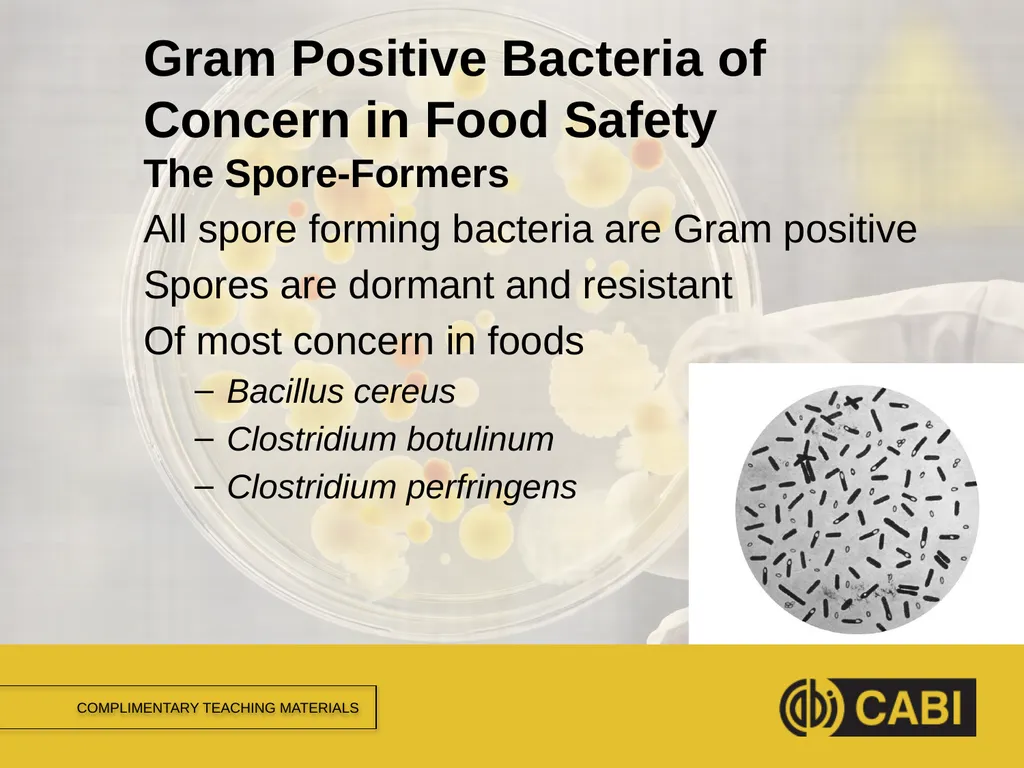
The Spore-Formers
All spore forming bacteria are Gram positive
Spores are dormant and resistant
Of most concern in foods
Bacillus cereus
Clostridium botulinum
Clostridium perfringens Gram Positive Bacteria of Concern in Food Safety<br>
06
Gram-positive rod
Common in environment
Thermoduric mesophile
Aerobe
Inhibited in high acid foods (pH < 4.9)
Intoxication
Diarrheal toxin, similar to that caused by Clostridium perfringens
Emetic toxin, similar to that caused by Staphylococcus aureus
US stats
Causes 63,000 illnesses, 20 hospitalizations, and zero deaths per year
Average cost per case - $234
Controls
Sanitation
Temperature and Time
Acidity
Preservatives Bacillus cereus<br>
07
Gram-positive rod
Common in environment
Thermoduric mesophile
Strict Anaerobe
Inhibited in high acid foods (pH < 4.5)
Intoxication
Potent Neurotoxin, preformed in food
US stats
Cause 55 illnesses, 42 hospitalizations, and nine deaths per year
Average cost per case - $1,680,903
Controls
Sanitation
Temperature and Time
Acidity
Preservatives Clostridium botulinum<br>
08
Gram-positive rod
Common in environment
Thermoduric mesophile
Anaerobe
Inhibited in high acid foods (pH < 5)
Intoxication/toxin mediated infection
Diarrheal
US stats
965,958 illnesses, 438 hospitalizations, and 26 deaths per year
Average cost per case - $482
Controls
Sanitation
Temperature and Time
Acidity
Preservatives Clostridium perfringens<br>
09
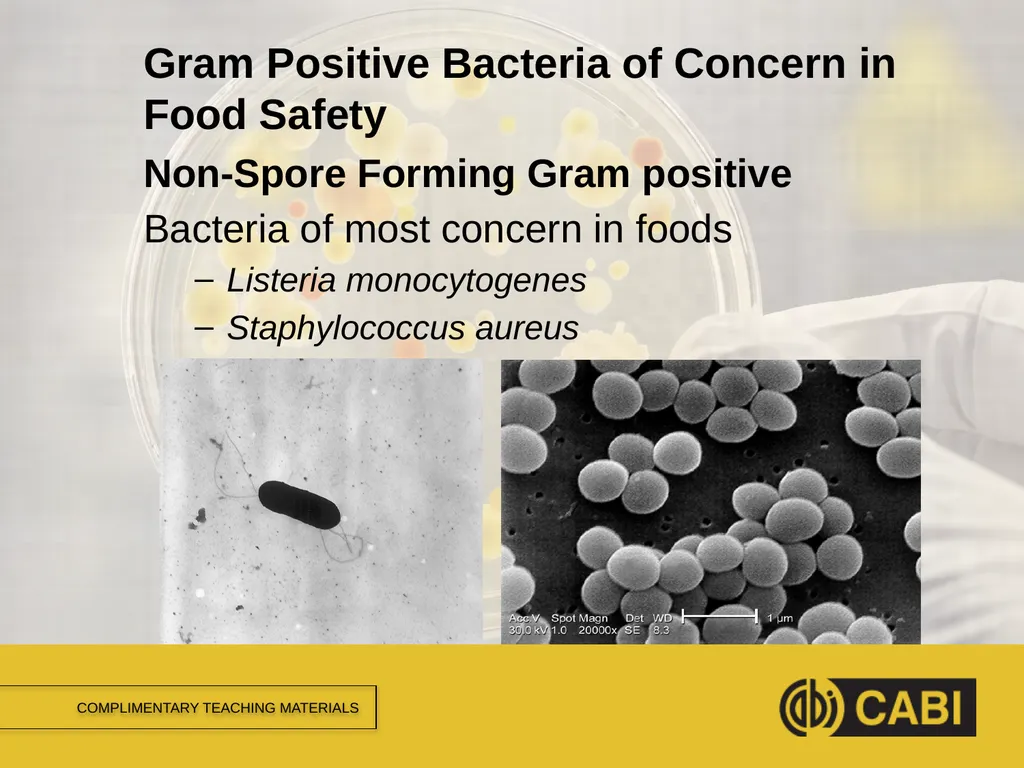
Non-Spore Forming Gram positive
Bacteria of most concern in foods
Listeria monocytogenes
Staphylococcus aureus Gram Positive Bacteria of Concern in Food Safety<br>
10
Gram-positive short rod
Common in environment and mammals
Psychrotroph
Facultative Anaerobe
Inhibited in high acid foods (pH < 4.1)
Infection
Higher risk for immunocompromised hosts
Invades immune cells and travels throughout system
US stats
1,591 illnesses, 1,455 hospitalizations, and 255 deaths per year
Average cost per case - $1,282,069
Controls
Sanitation
Temperature and Time
Educate high risk populations to avoid certain ready to eat foods
GAP, GMP and HACCP
Environmental testing in food processing facilities Listeria monocytogenes<br>
11
THANK YOU Name: Charlene Wolf-Hall & William Nganje
Email: charlene.hall@ndsu.edu & William.Nganje@ndsu.edu<br>