Minding Ps Qs of Natural Capital Accounting: Sorting out Prices and Sustainability Concepts Eli P. Fenichel Knobloch Family Professor of Natural Resource Economics Yale University eli.fenichelyale.edu Carl Obst Institute for the
"Minding Ps & Qs of Natural Capital Accounting:" is the property of its rightful owner. Permission is granted to
download and print the materials on this website for personal, non-commercial use only, and to display it
on your personal computer provided you do not modify the materials and that you retain all copyright
notices contained in the materials. By downloading content from our website, you accept the terms of this
agreement.
Presentation Transcript
01
Minding Ps & Qs of Natural Capital Accounting: Sorting out Prices and Sustainability Concepts
Eli P. Fenichel
Knobloch Family Professor of Natural Resource Economics
Yale University
eli.fenichel@yale.edu
Carl Obst
Institute for the Development of Environmental-Economic Accounting
carl.obst@ideeagroup.com
Scott A. Wentland
U.S. Bureau of Economic Analysis
(standard BEA disclaimer for Scott – not official position of BEA / USG) Presented to the UNSW-ESCoE Conference on Economic Measurement, 25-26 November 2024<br>
02
Motivation
Change in real wealth is a leading candidate for a headline sustainability measure
Discussions in the context of the SEEA in terms of linking to longstanding economic research on wealth accounting have raised three questions:
What price concept should be used?
How do measurements for change in real wealth relate to the national accounts?
What concept of sustainability does a change in real wealth measure?<br>
03
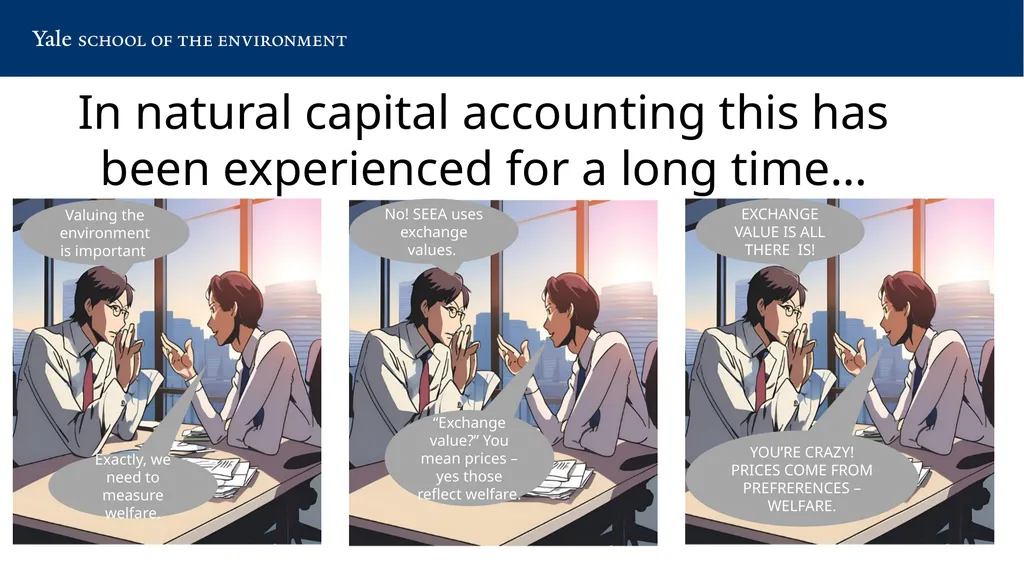
In natural capital accounting this has been experienced for a long time… Valuing the environment is important Exactly, we need to measure welfare. No! SEEA uses exchange values. “Exchange value?” You mean prices – yes those reflect welfare. EXCHANGE VALUE IS ALL THERE IS! YOU’RE CRAZY! PRICES COME FROM PREFRERENCES – WELFARE.<br>
04
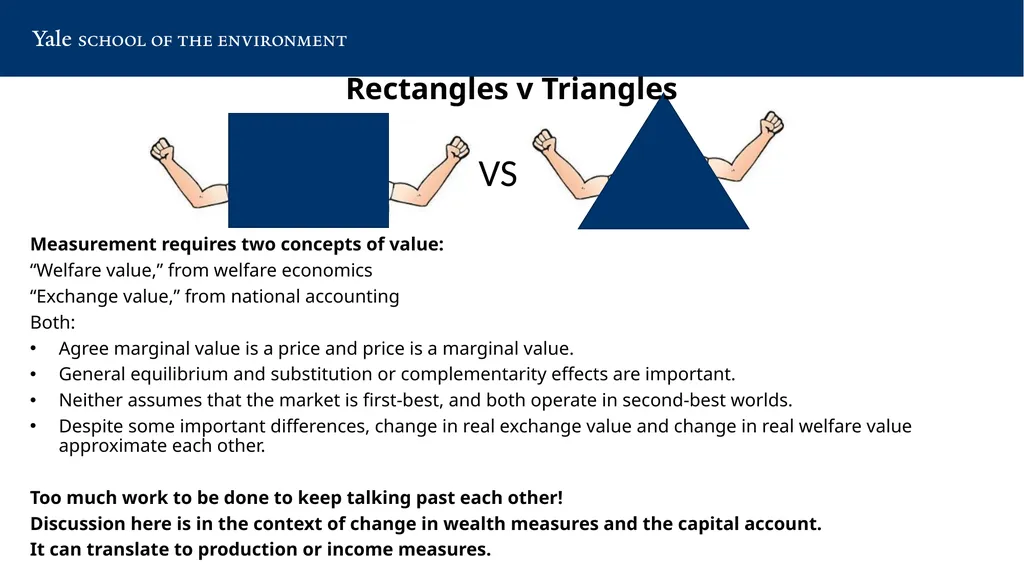
Measurement requires two concepts of value:
“Welfare value,” from welfare economics
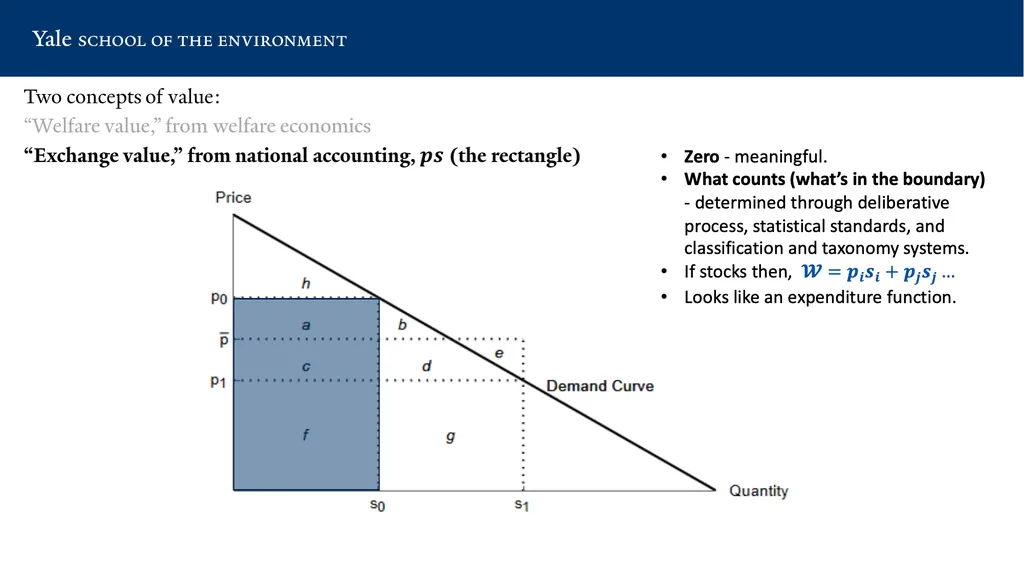
“Exchange value,” from national accounting
Both:
Agree marginal value is a price and price is a marginal value.
General equilibrium and substitution or complementarity effects are important.
Neither assumes that the market is first-best, and both operate in second-best worlds.
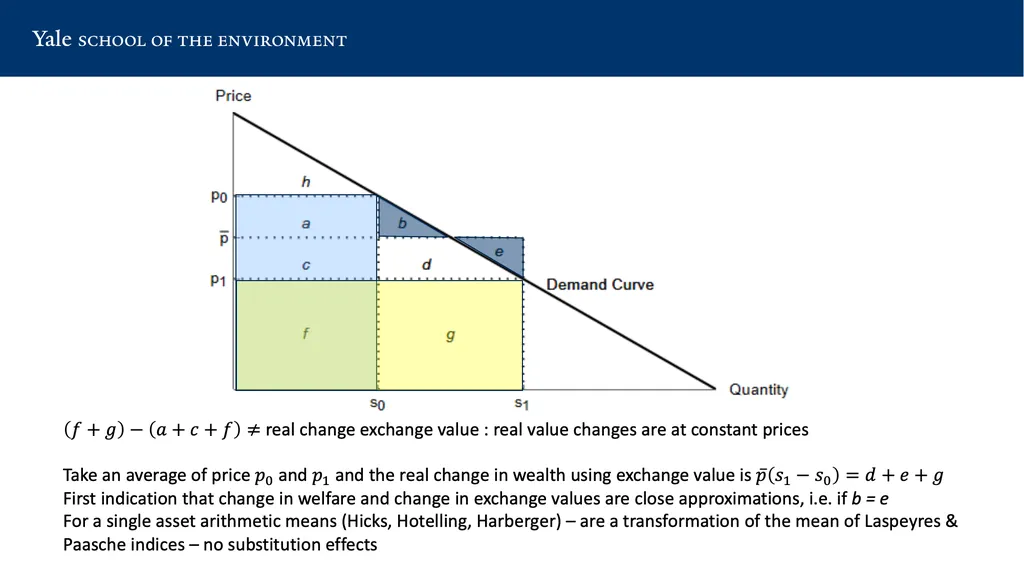
Despite some important differences, change in real exchange value and change in real welfare value approximate each other.
Too much work to be done to keep talking past each other!
Discussion here is in the context of change in wealth measures and the capital account.
It can translate to production or income measures. VS Rectangles v Triangles<br>
05
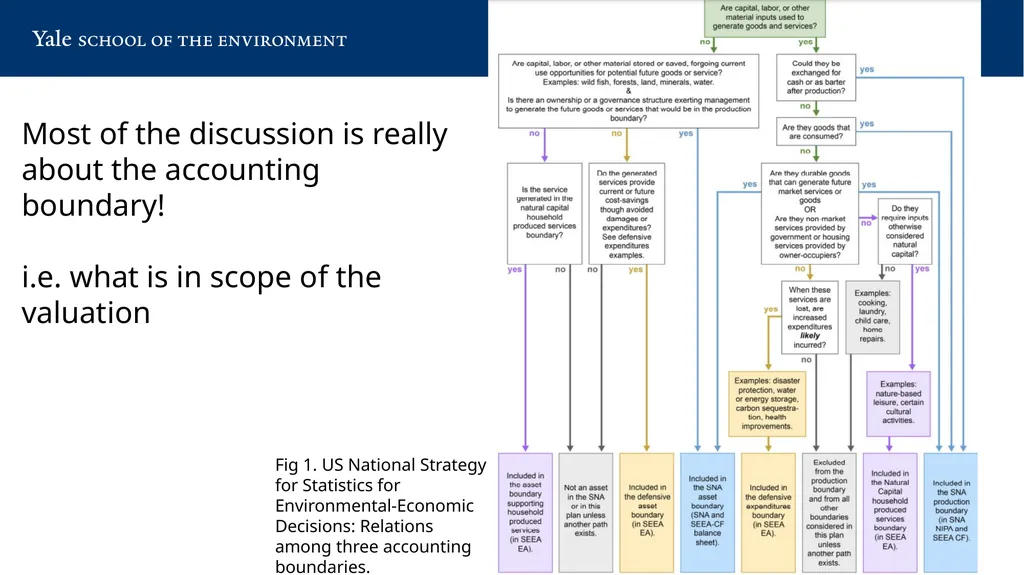
Practical “Intermediate” Uses Fig 1. US National Strategy for Statistics for Environmental-Economic Decisions: Relations among three accounting boundaries. Most of the discussion is really about the accounting boundary!
i.e. what is in scope of the valuation<br>
06
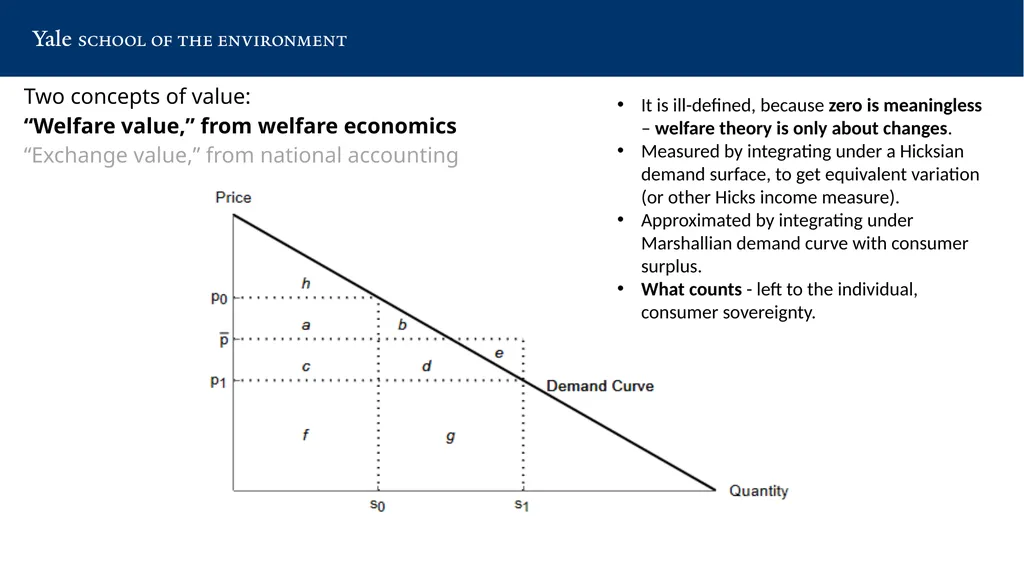
Two concepts of value:
“Welfare value,” from welfare economics
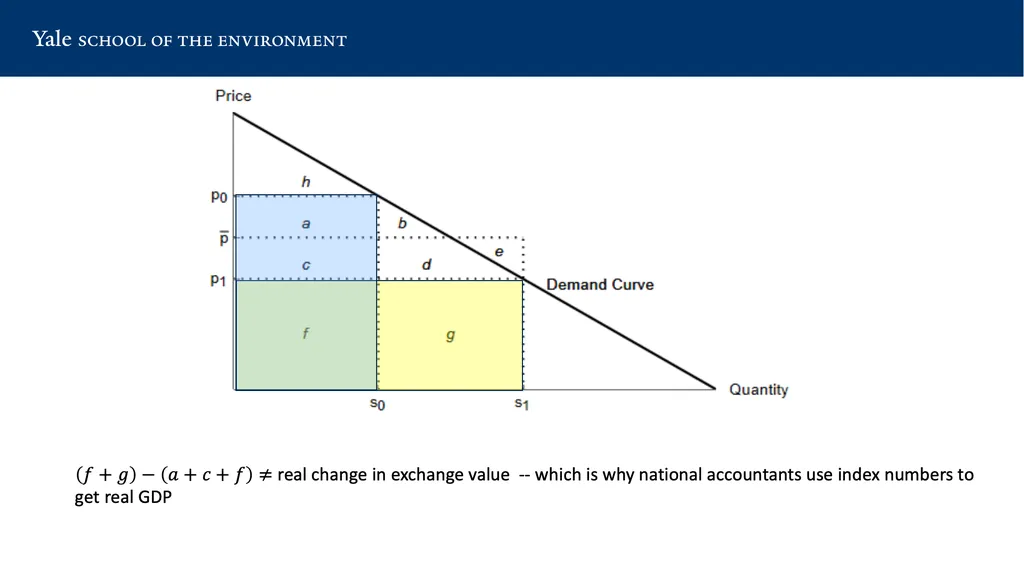
“Exchange value,” from national accounting It is ill-defined, because zero is meaningless – welfare theory is only about changes.
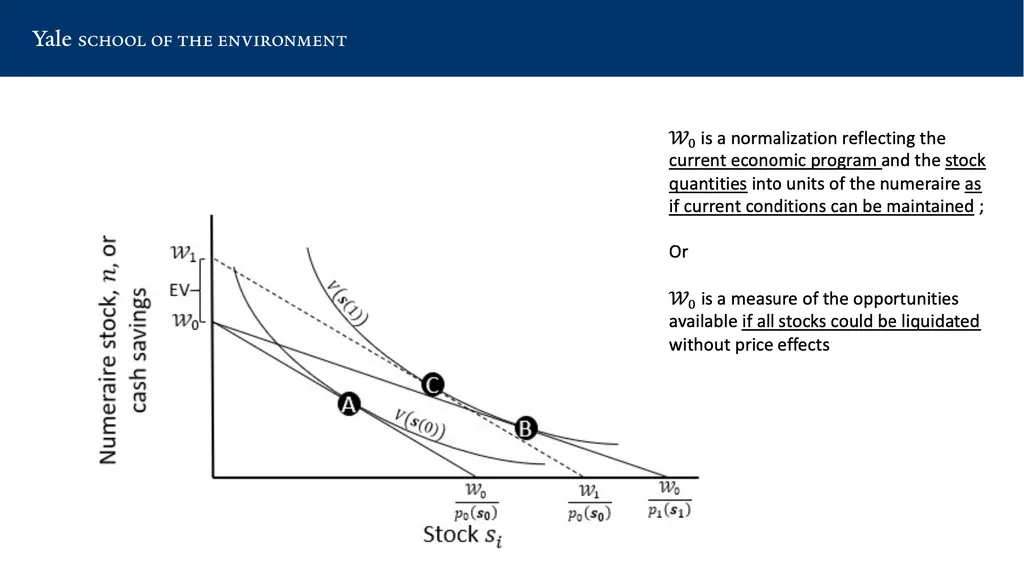
Measured by integrating under a Hicksian demand surface, to get equivalent variation (or other Hicks income measure).
Approximated by integrating under Marshallian demand curve with consumer surplus.
What counts - left to the individual, consumer sovereignty.<br>
07
Two concepts of value:
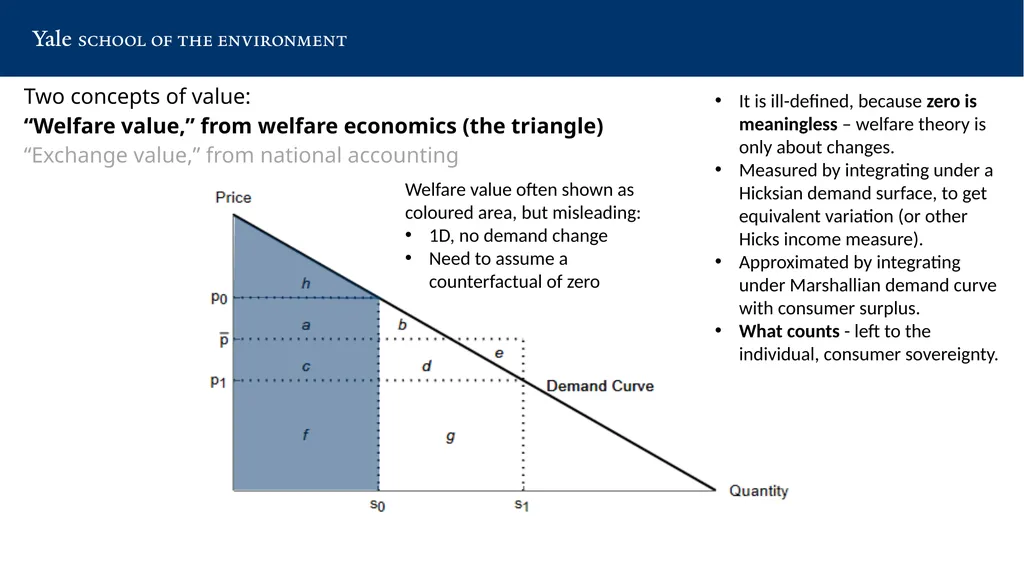
“Welfare value,” from welfare economics (the triangle)
“Exchange value,” from national accounting It is ill-defined, because zero is meaningless – welfare theory is only about changes.
Measured by integrating under a Hicksian demand surface, to get equivalent variation (or other Hicks income measure).
Approximated by integrating under Marshallian demand curve with consumer surplus.
What counts - left to the individual, consumer sovereignty. Welfare value often shown as coloured area, but misleading:
1D, no demand change
Need to assume a counterfactual of zero<br>
08
Actual demand shifts – very important in GE, substitutes or complements<br>
09
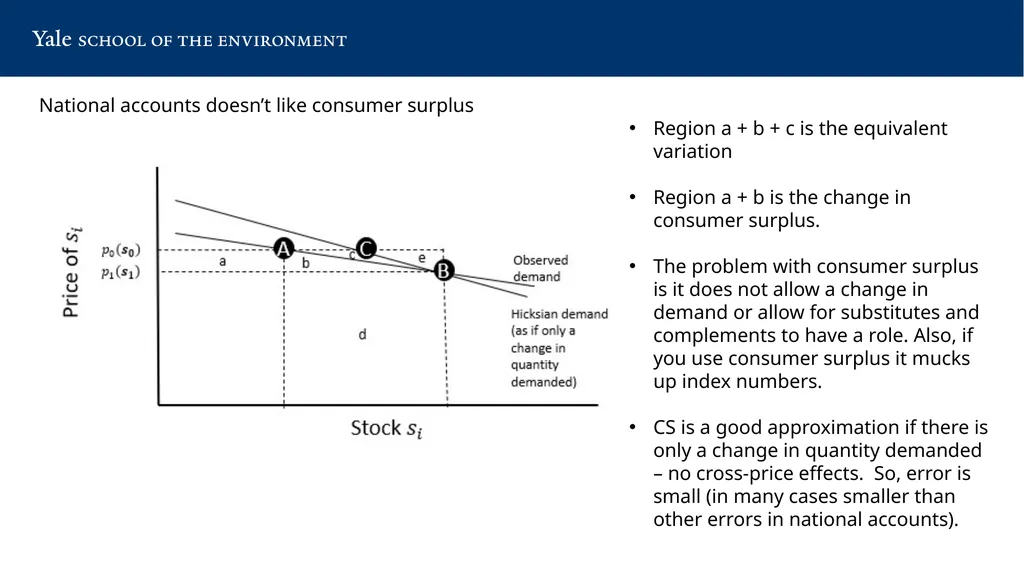
National accounts doesn’t like consumer surplus Region a + b + c is the equivalent variation
Region a + b is the change in consumer surplus.
The problem with consumer surplus is it does not allow a change in demand or allow for substitutes and complements to have a role. Also, if you use consumer surplus it mucks up index numbers.
CS is a good approximation if there is only a change in quantity demanded – no cross-price effects. So, error is small (in many cases smaller than other errors in national accounts).<br>
10
Implications for national accounts valuation (and connection to benefit-cost analysis measures)
Most non-market valuation (natural resource or environmental) is in a BCA context
Wealth accounting is ex-post benefit-cost assessment over a poorly defined set of changes, where the last period is used as the counterfactual for the current period.
If you do a non-market valuation at time 1, then if it is a Hick’s compensated measure or consumer surplus your demand curve should go through point B.
Core question is does a study provide a price-quantity pair at the observed stock quantity Caveats
Are services generated from capital in the accounting boundary? What counts?
Scope, scale, or selection effects – typical benefits-transfer concerns: solution – need to think about research to production<br>
11
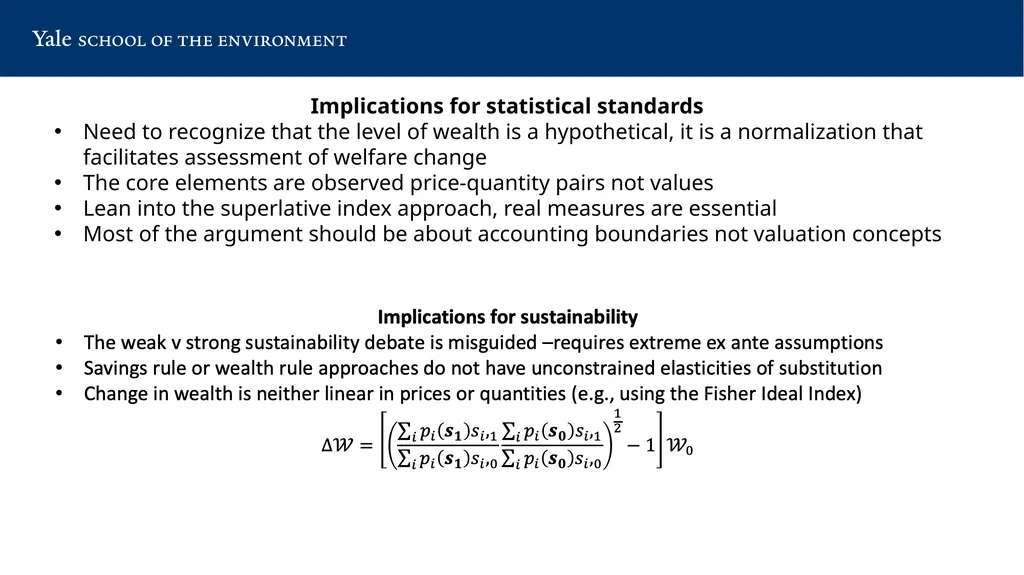
Implications for statistical standards
Need to recognize that the level of wealth is a hypothetical, it is a normalization that facilitates assessment of welfare change
The core elements are observed price-quantity pairs not values
Lean into the superlative index approach, real measures are essential
Most of the argument should be about accounting boundaries not valuation concepts<br>
12
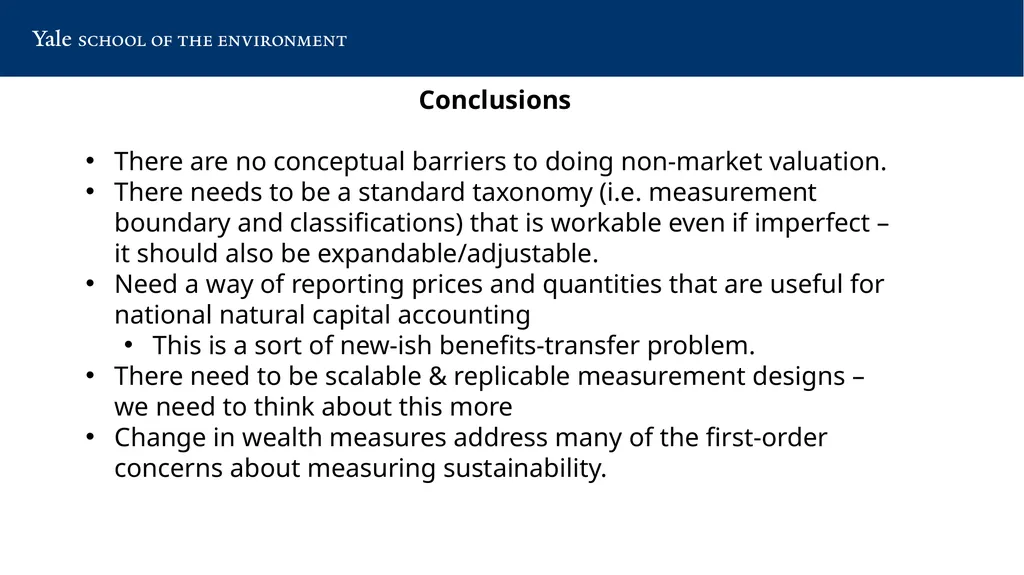
Conclusions
There are no conceptual barriers to doing non-market valuation.
There needs to be a standard taxonomy (i.e. measurement boundary and classifications) that is workable even if imperfect – it should also be expandable/adjustable.
Need a way of reporting prices and quantities that are useful for national natural capital accounting
This is a sort of new-ish benefits-transfer problem.
There need to be scalable & replicable measurement designs – we need to think about this more
Change in wealth measures address many of the first-order concerns about measuring sustainability.<br>