Modernity and Postmodernity in Latin America Discussion of Terms The terms modern and postmodern generally refer to Western trends in culture and thought that peaked in the 1920s and 1990s respectively. Broadly speaking, Modernism was
"Modernity and Postmodernity in Latin America" is the property of its rightful owner. Permission is granted to
download and print the materials on this website for personal, non-commercial use only, and to display it
on your personal computer provided you do not modify the materials and that you retain all copyright
notices contained in the materials. By downloading content from our website, you accept the terms of this
agreement.
Presentation Transcript
01
Modernity and Postmodernity in Latin America<br>
02
Discussion of Terms The terms “modern” and “postmodern” generally refer to Western trends in culture and thought that peaked in the 1920s and 1990s respectively.
Broadly speaking, Modernism was the product of the catastrophic loss of identity faced by the West in the wake of WWI.
Postmodernism was a product of the Cold War and the social transformations of the late 1960s.<br>
03
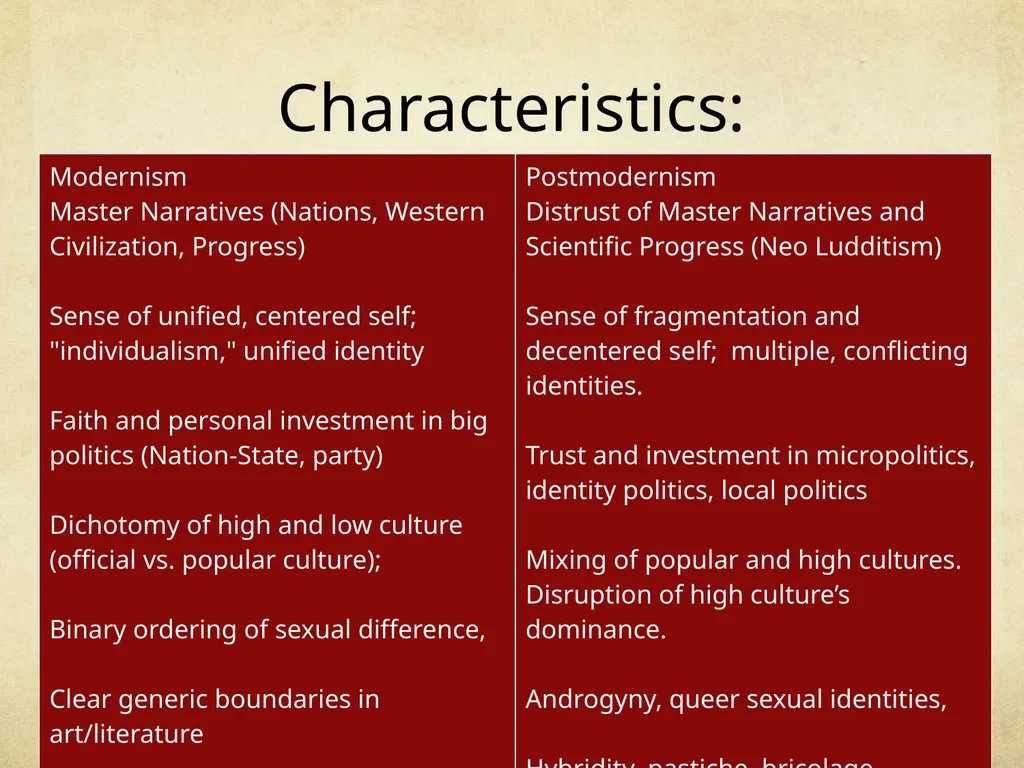
Characteristics:<br>
04
Modernism in Latin America Many cultural theorists (Angel Rama, Nestor Garcia Canclini, J.J. Brunner) describe cultural modernization in Latin America as an irregular or uneven process.
There are several theories behind this “irregular modernity”, mass illiteracy, lack of media and cultural infrastructure, the predominance of religiosity over secularism and the dependent economic/cultural relationship between Latin America and Europe/USA
Both Brunner and Garcia Canclini, however suggest other possible interpretations<br>
05
Nestor Garcia Canclini In Hybrid Cultures: Strategies for Entering and Leaving Modernity. Garcia Canclini questions the premises of the “belated modernity” theory.
Garcia- Canclini argues that the artistic movements of Modernism didn’t emerge in the industrialized parts of Europe, but in places such as France, Italy and Spain. Places where “The old order, precisely with what it still possessed of the aristocratic, offered a set of codes from which intellectuals and artists, even the innovators, saw it possible to resist the devastations as the organizing principle of culture and society” (45)<br>
06
Canclini applies this idea to Latin American societies, created by what he calls the “sedimentation, juxtaposition and interweaving of indigenous traditions, of Catholic colonial hispanism, and of modern political, educational and communicational actions.” (45)
As in continental Europe, the educated classes in Latin America both were attracted to modernization but also rooted in their Hispanic-Catholic traditions as a bulwark against modernism’s tendency toward mechanization.
The result is what he calls a “multitemporal heterogeneity”, the coexistence of cultural artifacts from various time periods “In houses of the bourgeoisie and of middle classes with a high educational level in Santiago, Lima, Bogota, Mexico City, and many other cities, there coexist multilingual libraries and indigenous crafts, cable TV and parabolic antennas with colonial furniture, and magazines with centuries-old family and religious rituals “ (46)
Canclini suggests, this “multitemporal heterogeneity” is a product of the ruptures created by rapid urbanization, rather than by modernity abolishing and replacing traditional culture. Some countries such as Argentina modernized more quickly than some parts of Europe.<br>
07
JJ. Brunner Brunner’s essay further discusses the nature of Latin America’s modernity, also calling into question the “belated modernity” theory
Like Canclini, he calls into question the idea of a “technocratic” modernity, tied exclusively to rationalism, scientific progress and the function of the market. This “modernity” is the type promoted the Economic Commission for Latin America (CEPAL)<br>
08
Brunner suggests that modernity itself does not consist of a single rationalism but multiple, (politics, values and philosophies as well as economics). And that there is no single, homogeneous rational culture.
Latin American modernity is itself a heterogeneous process, what he calls a “regional postmodernism avant la lettre”. This is because of two main features: it’s origin in and participation in North American markets and its deconstruction and de-centering of Western modern culture by its varied reception among different groups.<br>
09
Latin America’s participation in international markets produces a “multiplicity of logics” rather than a single synthesized logic of modernity.
Contemporary (as of 1990) strategies of development seem to be recognizing this, opting for promoting smaller-scale projects of rationalization rather than grand visions
These “small scale” projects focus on modernizing individual industries, organizations and fields of study, creating a network of relationships.<br>
10
The role of Religion Brunner notes that many thinkers tend to see Catholicism as a force resistant to modernization in LA culture.
He unpacks this, suggesting both that there is a general global trend towards uncoupling ethics from the market
And that cultural Catholicism also performs a multiplicity of functions, even revolutionary ones. (As in Nicaragua)<br>
11
“In many societies of the continent, a prophetic, testimonial, and revolutionary current is nourished by religion, around which are continually renewed ties of solidarity, seeds of communal life, and the principle of rebellion against the established order.” (301)
Catholicism is often used as a brake on the reifying and dehumanizing practices of modernity. I.e. Darío’s poem “A Roosevelt”:
“eres el futuro invasor
de la América ingenua que tiene sangre indígena,
que aún reza a Jesucristo y aún habla en español”<br>
12
Consensus and Secularization Brunner, based on Germani’s work questions whether secularism exacerbates the heterogeneity of LA culture problematizing attempts at democratic unity.
Some theorists even argue that LA’s political problems of the 20th Century were caused by the “ideological inflation” of political movements that occurred in the sixties as the result of this loss of consensus.
Brunner suggests that a possible solution to this fragmentation is a “disenchantment with politics” an uncoupling of politics from identities and values, building a consensus of interests.<br>
13
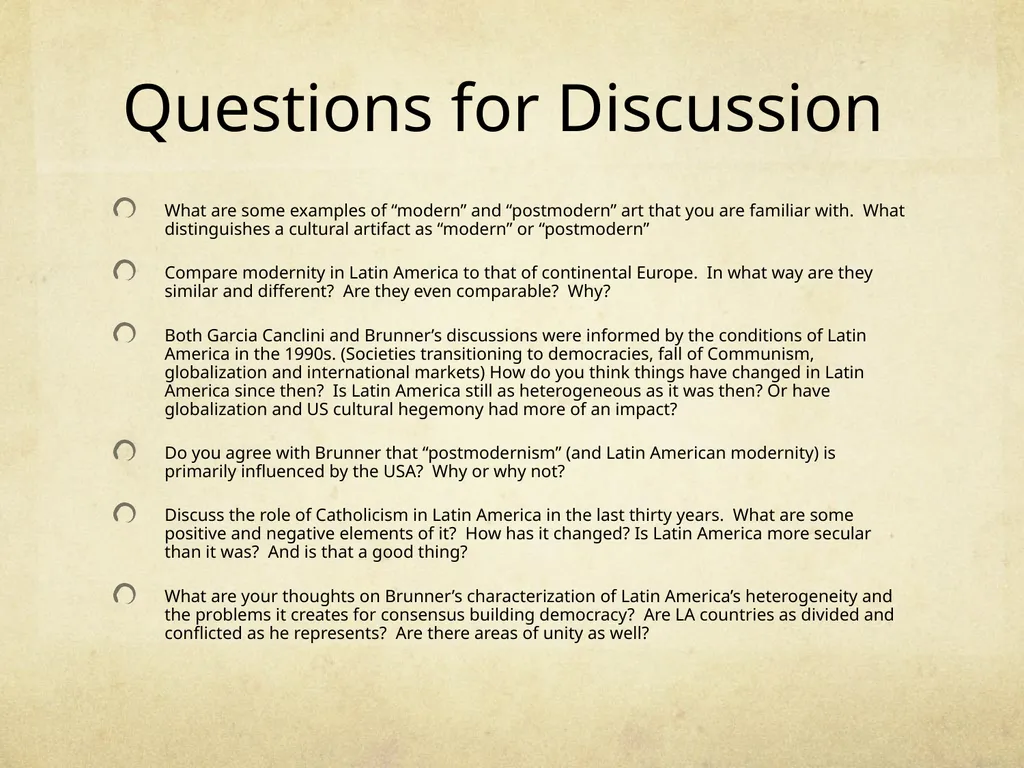
Questions for Discussion What are some examples of “modern” and “postmodern” art that you are familiar with. What distinguishes a cultural artifact as “modern” or “postmodern”
Compare modernity in Latin America to that of continental Europe. In what way are they similar and different? Are they even comparable? Why?
Both Garcia Canclini and Brunner’s discussions were informed by the conditions of Latin America in the 1990s. (Societies transitioning to democracies, fall of Communism, globalization and international markets) How do you think things have changed in Latin America since then? Is Latin America still as heterogeneous as it was then? Or have globalization and US cultural hegemony had more of an impact?
Do you agree with Brunner that “postmodernism” (and Latin American modernity) is primarily influenced by the USA? Why or why not?
Discuss the role of Catholicism in Latin America in the last thirty years. What are some positive and negative elements of it? How has it changed? Is Latin America more secular than it was? And is that a good thing?
What are your thoughts on Brunner’s characterization of Latin America’s heterogeneity and the problems it creates for consensus building democracy? Are LA countries as divided and conflicted as he represents? Are there areas of unity as well?<br>