04
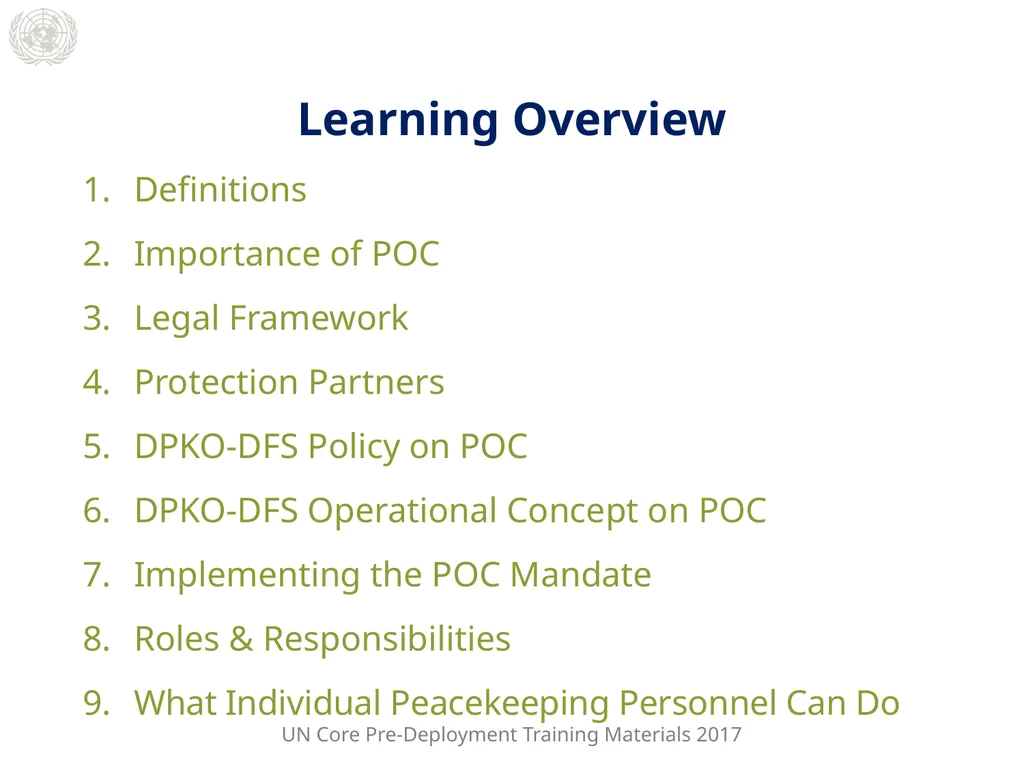
Learning Overview
Definitions
Importance of POC
Legal Framework
Protection Partners
DPKO-DFS Policy on POC
DPKO-DFS Operational Concept on POC
Implementing the POC Mandate
Roles & Responsibilities
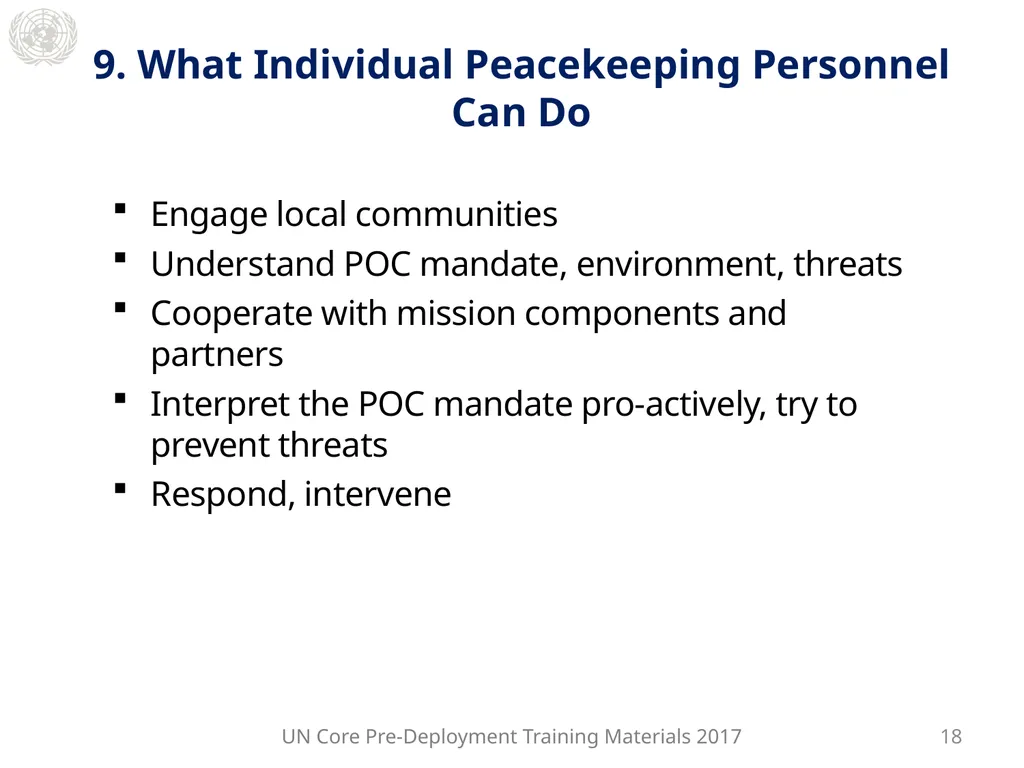
What Individual Peacekeeping Personnel Can Do UN Core Pre-Deployment Training Materials 2017<br>
05
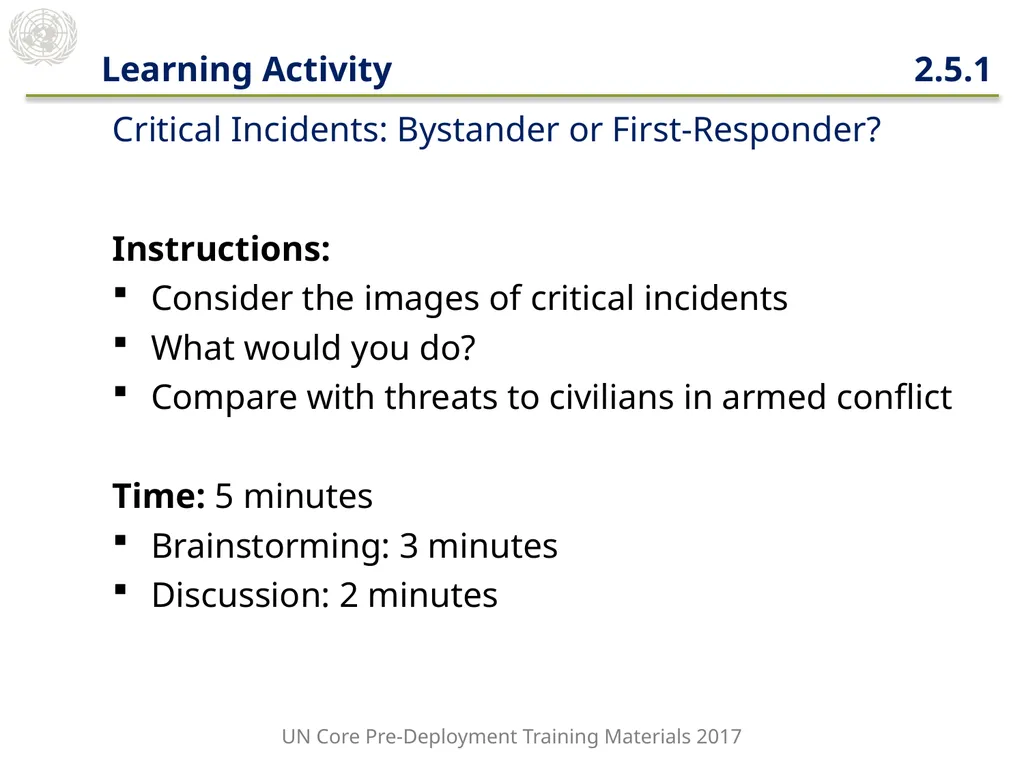
UN Core Pre-Deployment Training Materials 2017 Instructions:
Consider the images of critical incidents
What would you do?
Compare with threats to civilians in armed conflict
Time: 5 minutes
Brainstorming: 3 minutes
Discussion: 2 minutes Learning Activity 2.5.1 Critical Incidents: Bystander or First-Responder?<br>
06
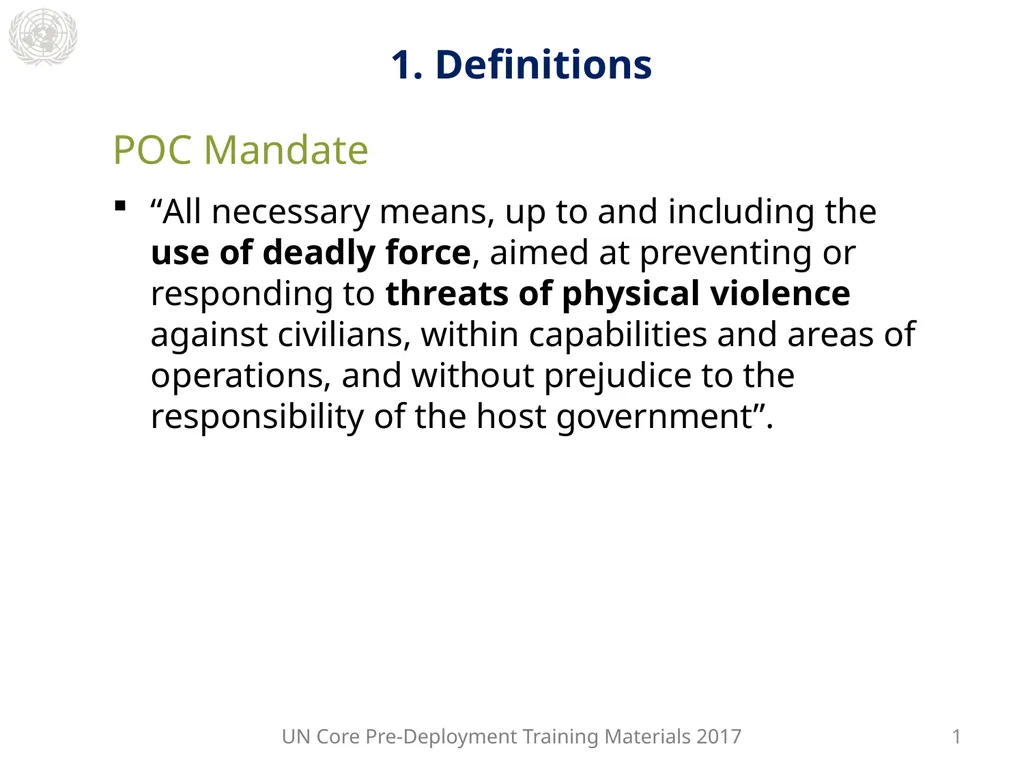
POC Mandate
“All necessary means, up to and including the use of deadly force, aimed at preventing or responding to threats of physical violence against civilians, within capabilities and areas of operations, and without prejudice to the responsibility of the host government”. UN Core Pre-Deployment Training Materials 2017 1 1. Definitions<br>
07
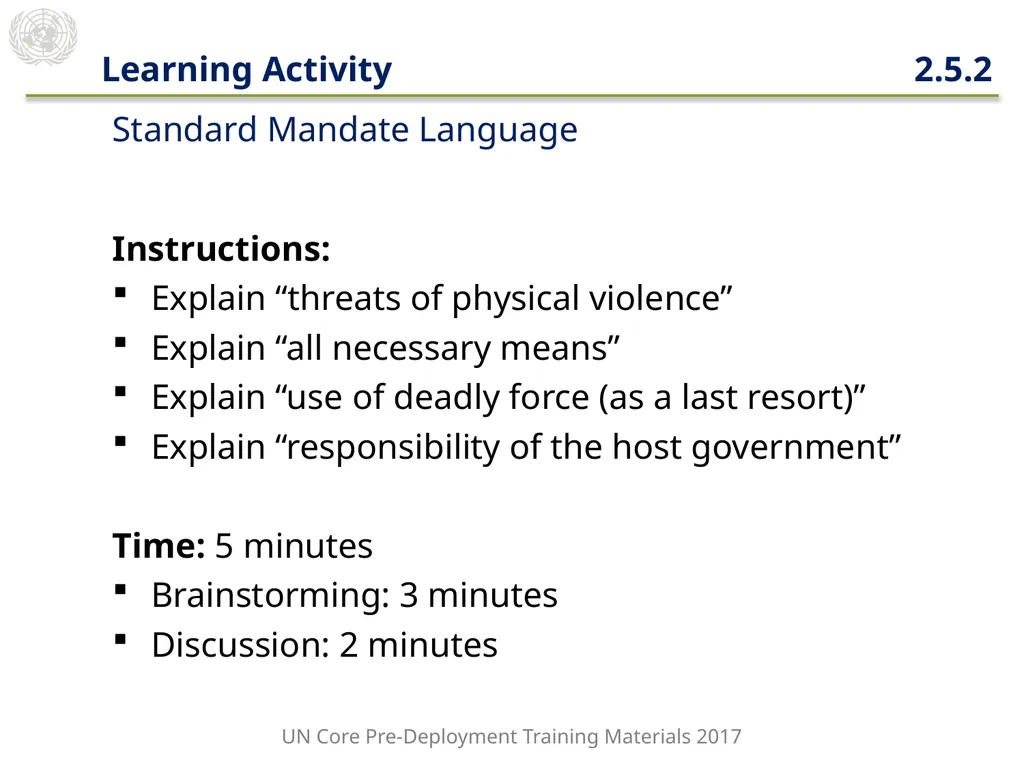
UN Core Pre-Deployment Training Materials 2017 Instructions:
Explain “threats of physical violence”
Explain “all necessary means”
Explain “use of deadly force (as a last resort)”
Explain “responsibility of the host government”
Time: 5 minutes
Brainstorming: 3 minutes
Discussion: 2 minutes Learning Activity 2.5.2 Standard Mandate Language<br>
08
Civilian
Any person who is not or is no longer directly participating in hostilities or other acts of violence UN Core Pre-Deployment Training Materials 2017 2<br>
09
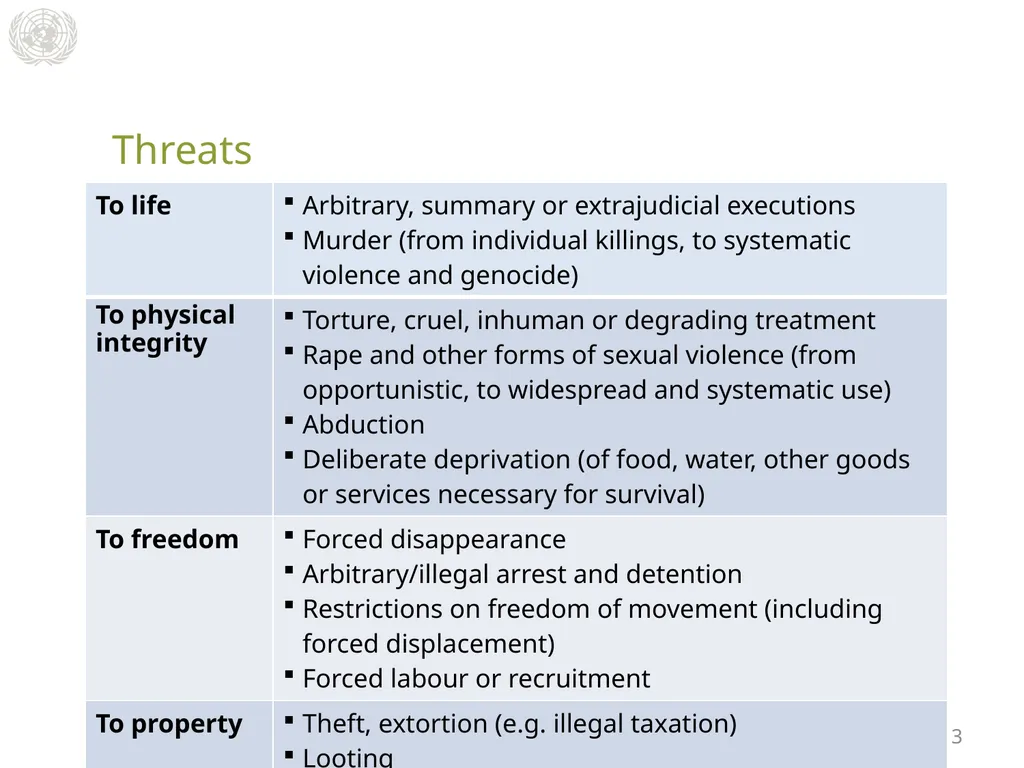
Threats UN Core Pre-Deployment Training Materials 2017 3<br>
10
UN Core Pre-Deployment Training Materials 2017 4 Vulnerability Factors
Individual, community factors
Environmental factors
Access to assistance
Self-sufficiency<br>
11
UN Core Pre-Deployment Training Materials 2017 Instructions:
Consider the case study
Identify the threats
Identify vulnerabilities of the civilian population
Which civilians are most vulnerable?
Time: 10 minutes
Group work: 5-7 minutes
Discussion: 3 minutes Learning Activity 2.5.3 Vulnerability and Threats<br>
12
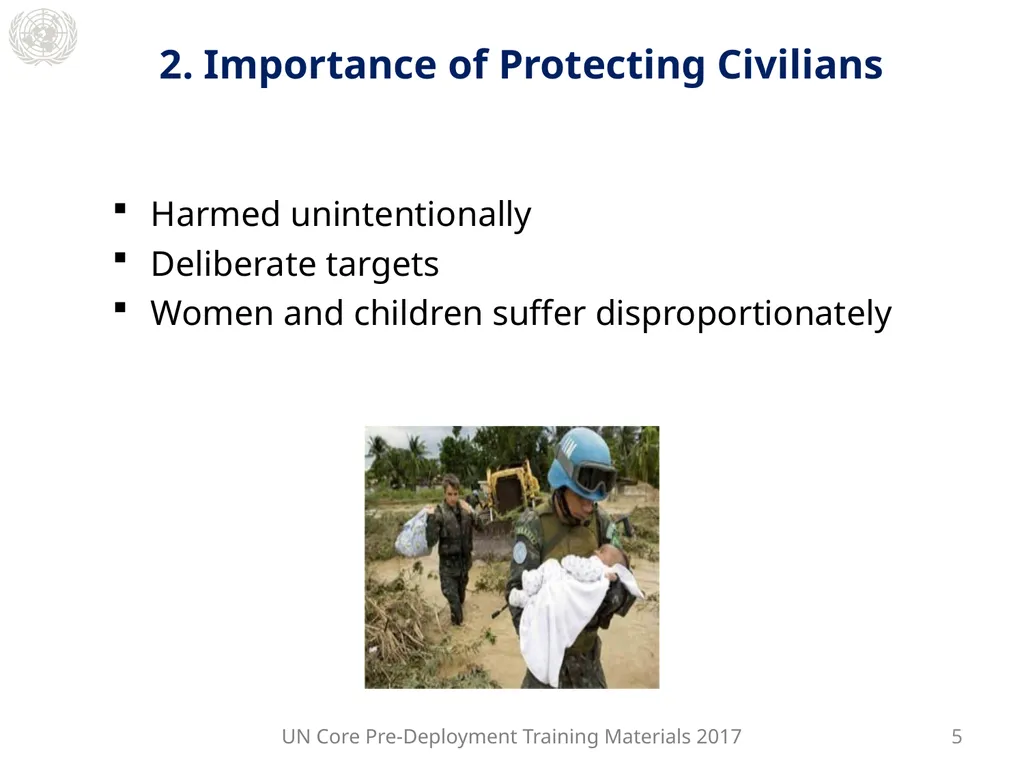
2. Importance of Protecting Civilians Harmed unintentionally
Deliberate targets
Women and children suffer disproportionately UN Core Pre-Deployment Training Materials 2017 5<br>
13
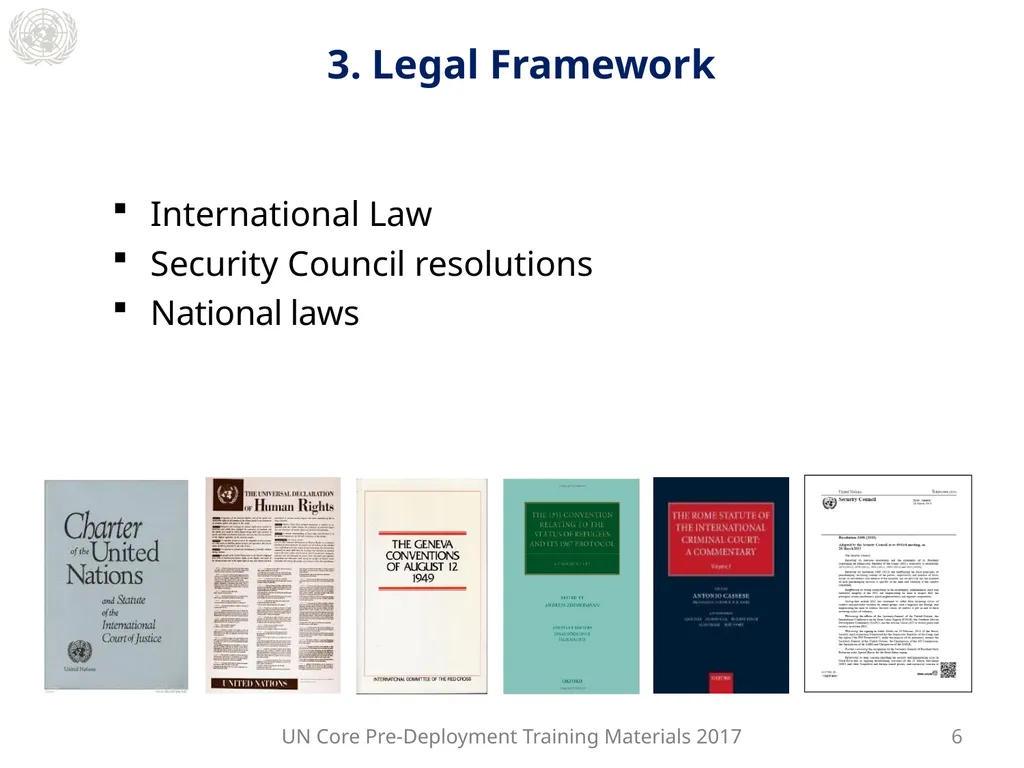
3. Legal Framework International Law
Security Council resolutions
National laws UN Core Pre-Deployment Training Materials 2017 6<br>
14
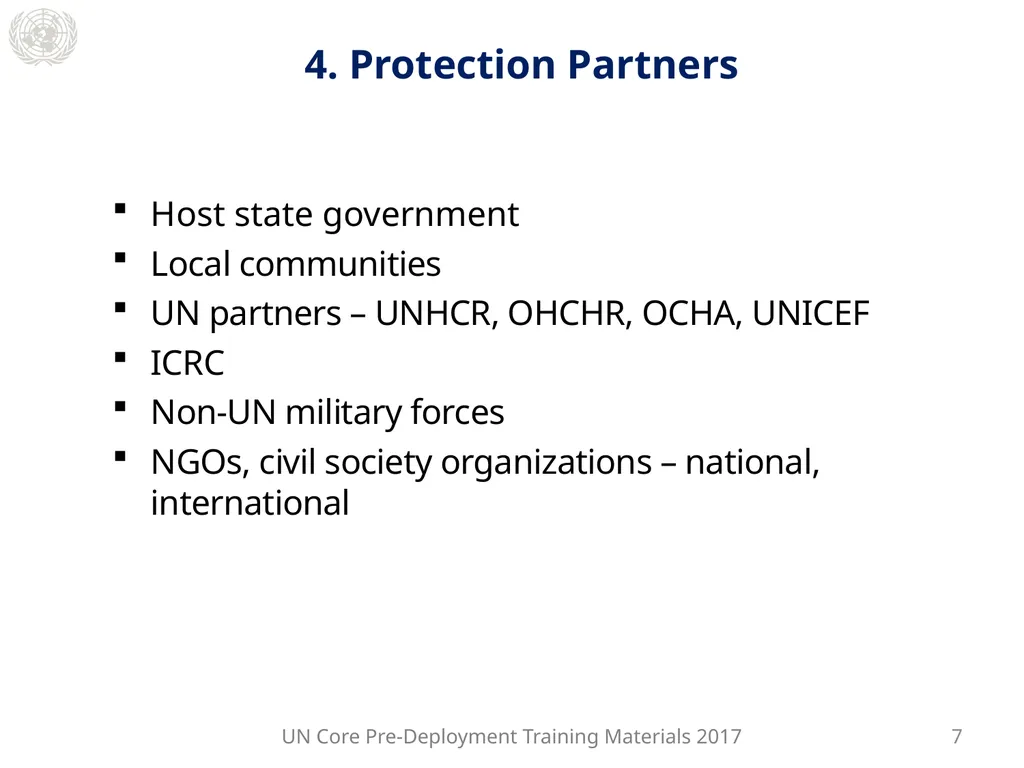
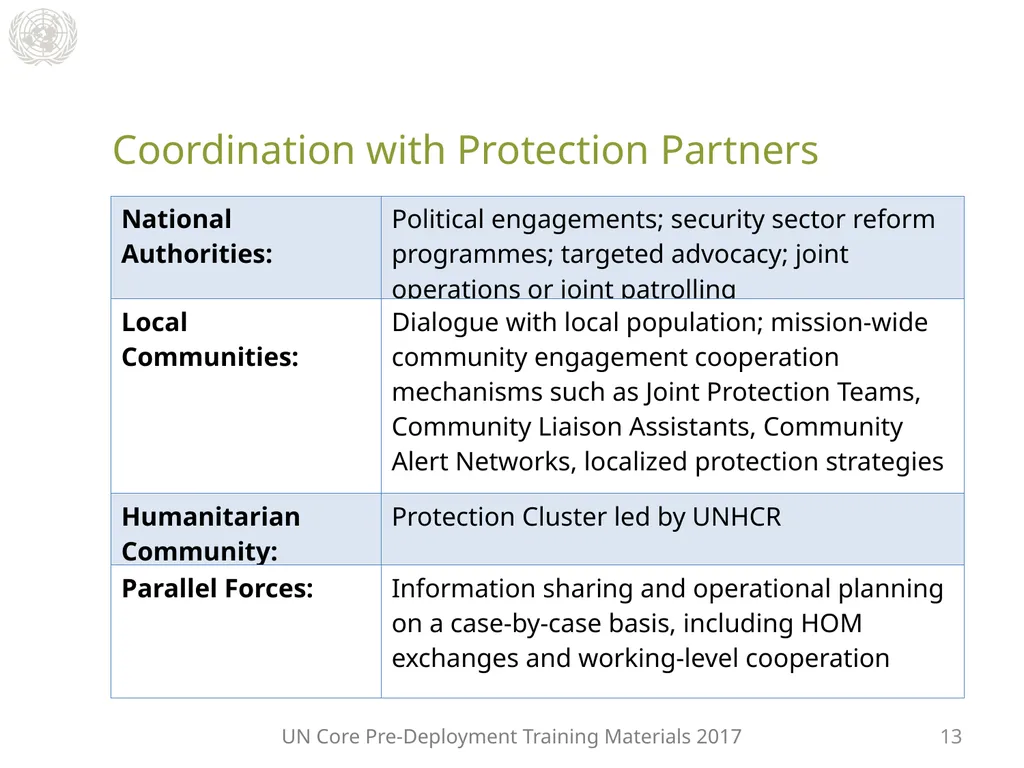
4. Protection Partners Host state government
Local communities
UN partners – UNHCR, OHCHR, OCHA, UNICEF
ICRC
Non-UN military forces
NGOs, civil society organizations – national, international 7 UN Core Pre-Deployment Training Materials 2017<br>
15
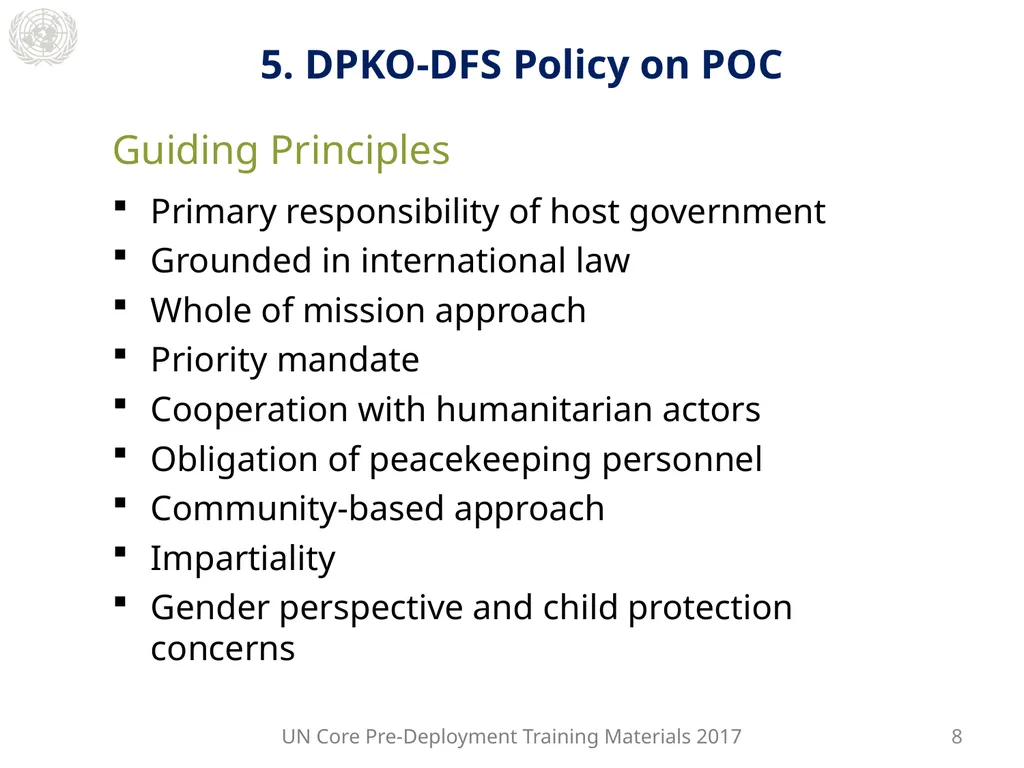
Guiding Principles
Primary responsibility of host government
Grounded in international law
Whole of mission approach
Priority mandate
Cooperation with humanitarian actors
Obligation of peacekeeping personnel
Community-based approach
Impartiality
Gender perspective and child protection concerns UN Core Pre-Deployment Training Materials 2017 5. DPKO-DFS Policy on POC 8<br>
16
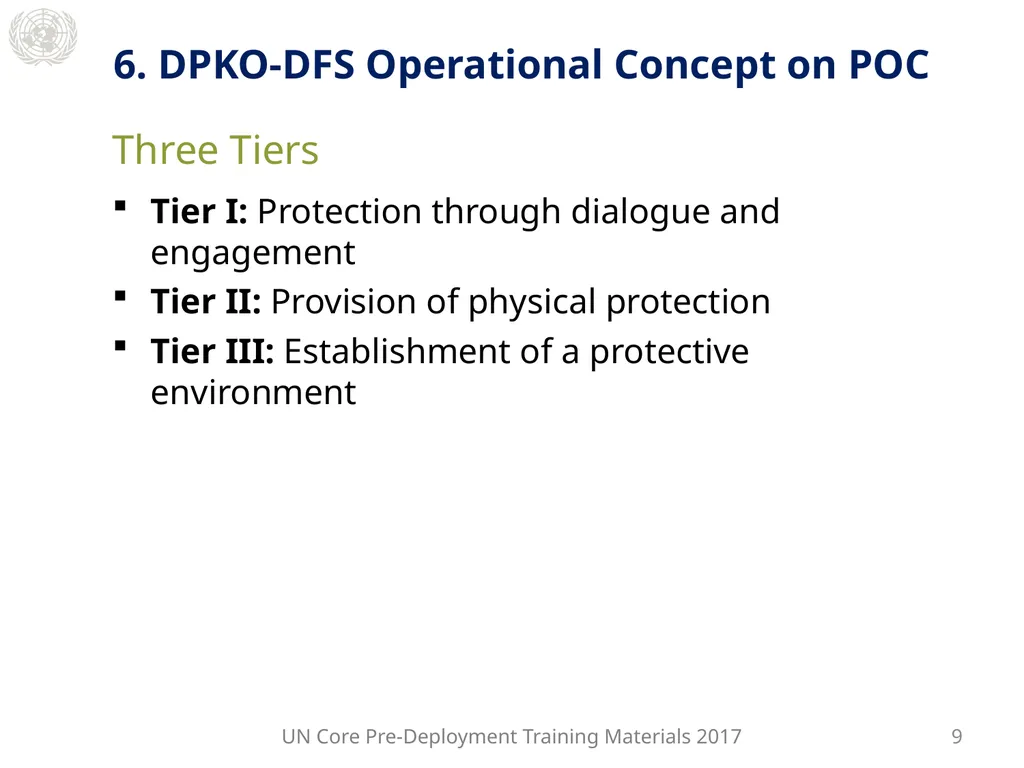
Three Tiers
Tier I: Protection through dialogue and engagement
Tier II: Provision of physical protection
Tier III: Establishment of a protective environment UN Core Pre-Deployment Training Materials 2017 6. DPKO-DFS Operational Concept on POC 9<br>
17
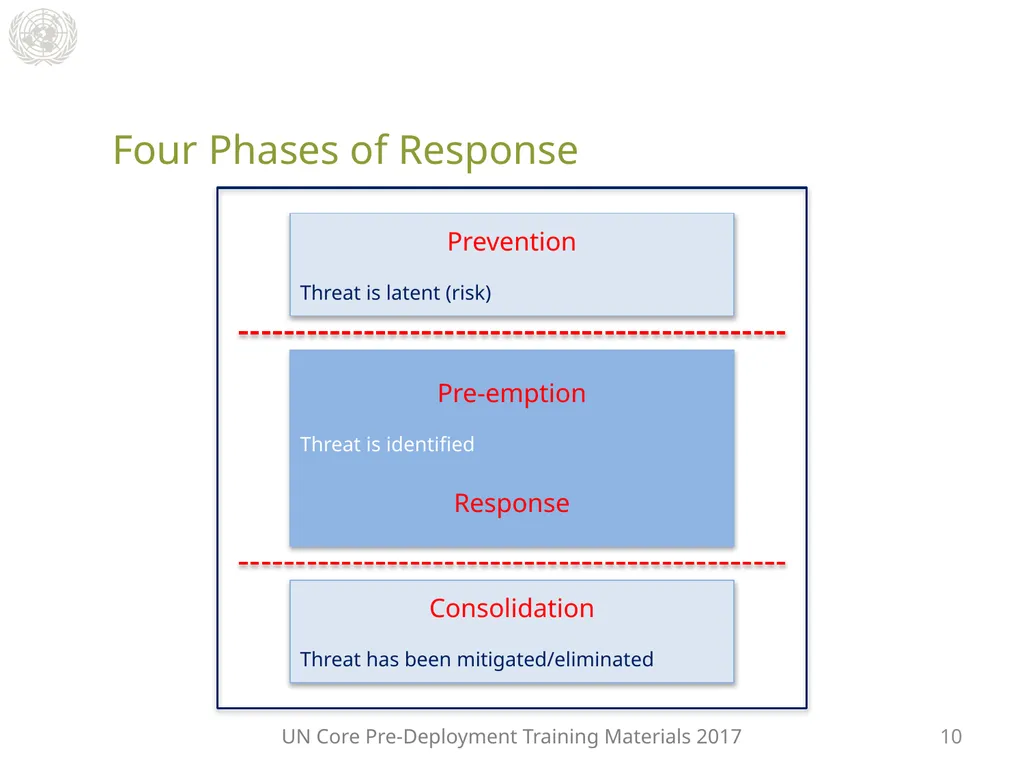
Four Phases of Response UN Core Pre-Deployment Training Materials 2017 Prevention
Threat is latent (risk) Pre-emption
Threat is identified
Response Consolidation
Threat has been mitigated/eliminated 10<br>
18
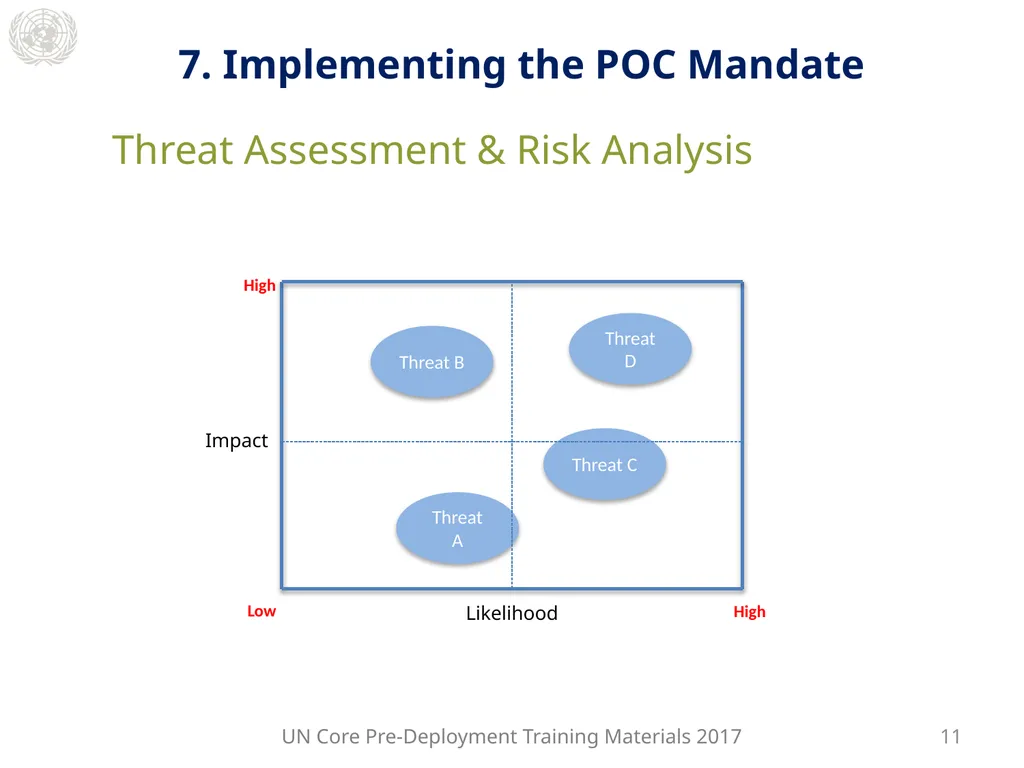
Impact Likelihood Threat B Threat A Threat D Threat C Low High High Threat Assessment & Risk Analysis UN Core Pre-Deployment Training Materials 2017 11 7. Implementing the POC Mandate<br>
19
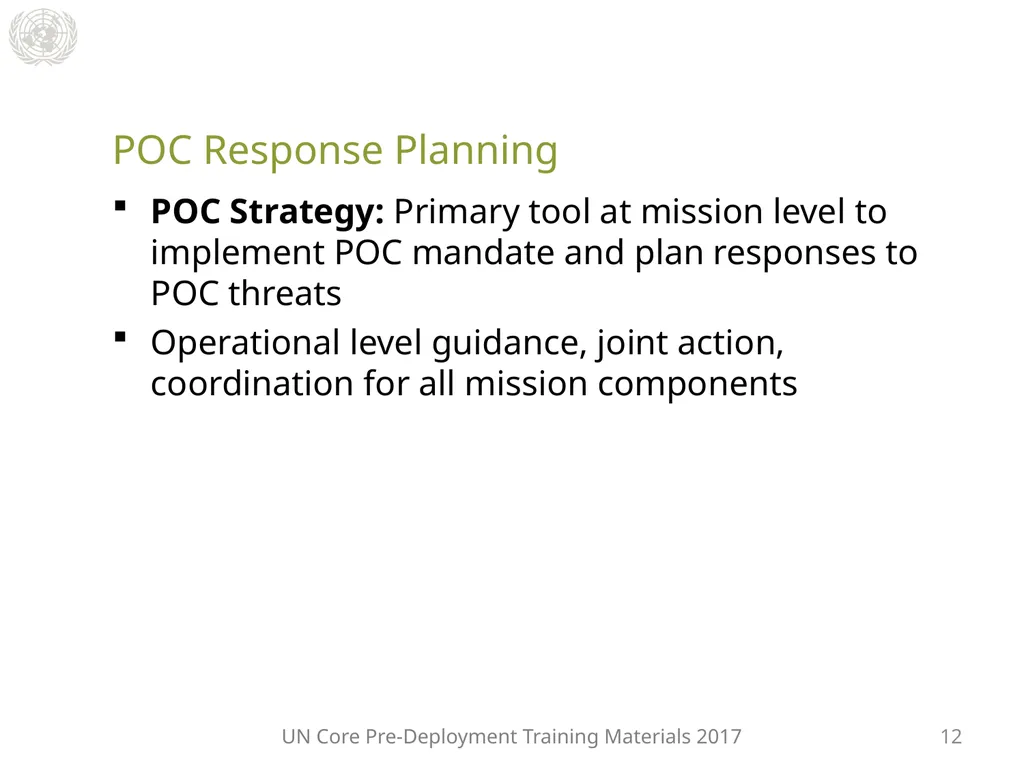
POC Response Planning
POC Strategy: Primary tool at mission level to implement POC mandate and plan responses to POC threats
Operational level guidance, joint action, coordination for all mission components 12 UN Core Pre-Deployment Training Materials 2017<br>
20
Coordination with Protection Partners 13 UN Core Pre-Deployment Training Materials 2017<br>
21
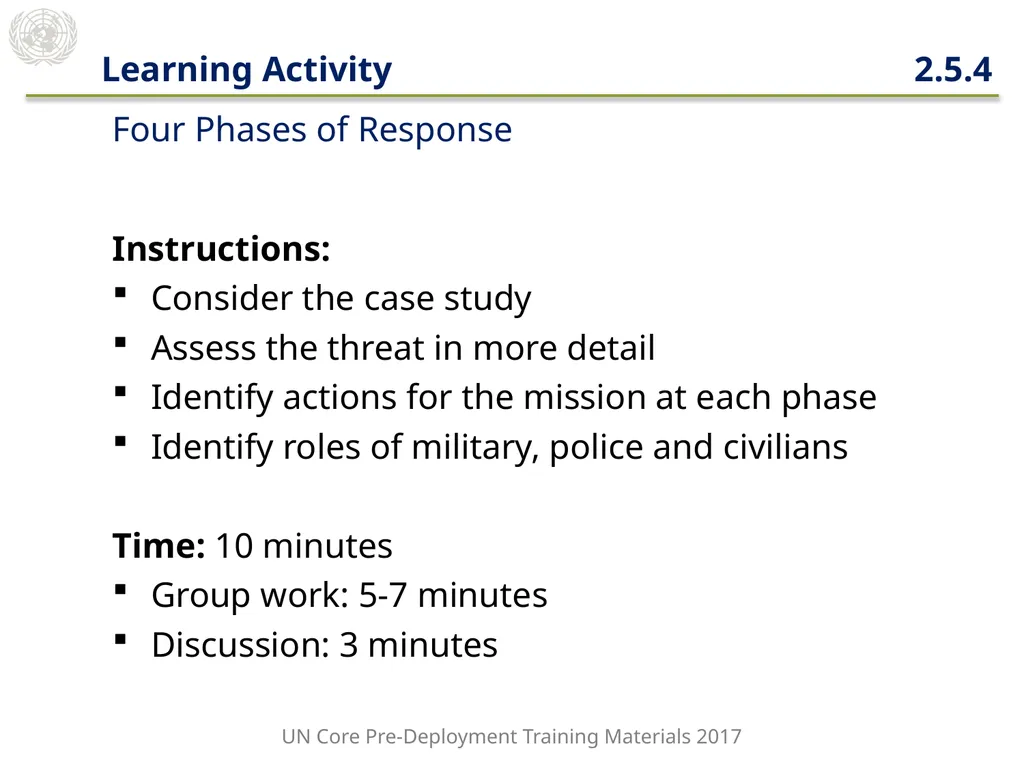
UN Core Pre-Deployment Training Materials 2017 Instructions:
Consider the case study
Assess the threat in more detail
Identify actions for the mission at each phase
Identify roles of military, police and civilians
Time: 10 minutes
Group work: 5-7 minutes
Discussion: 3 minutes Learning Activity 2.5.4 Four Phases of Response<br>
22
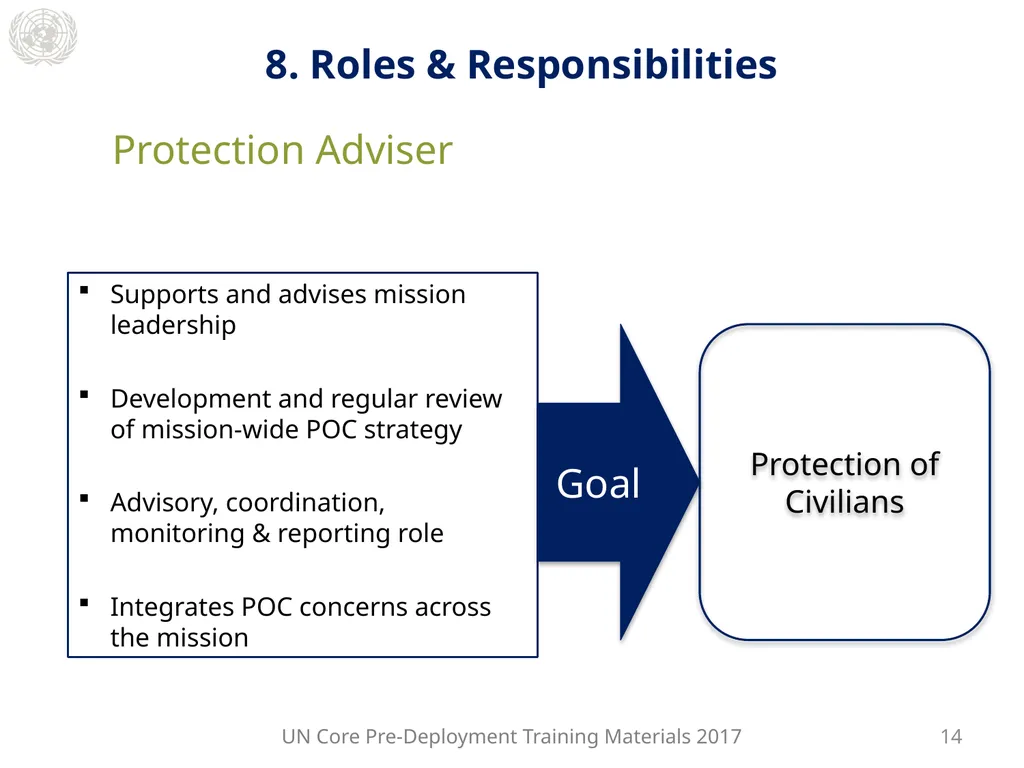
Protection Adviser 14 UN Core Pre-Deployment Training Materials 2017 8. Roles & Responsibilities Goal Protection of Civilians Supports and advises mission leadership
Development and regular review of mission-wide POC strategy
Advisory, coordination, monitoring & reporting role
Integrates POC concerns across the mission<br>
23
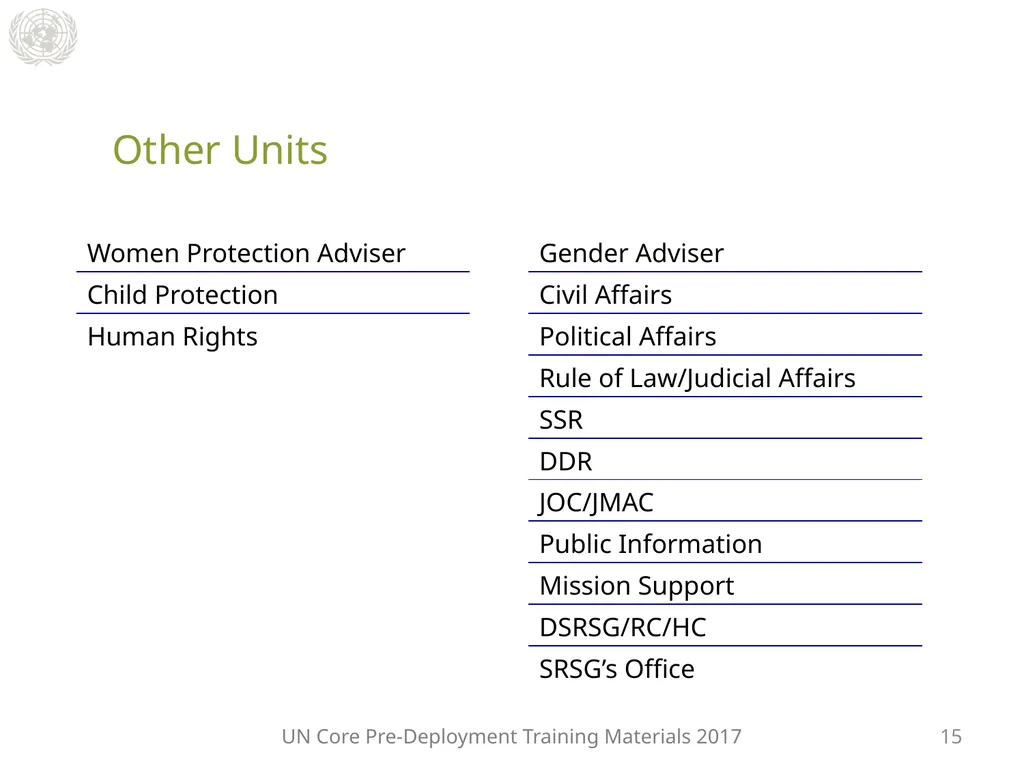
15 UN Core Pre-Deployment Training Materials 2017 Other Units<br>
24
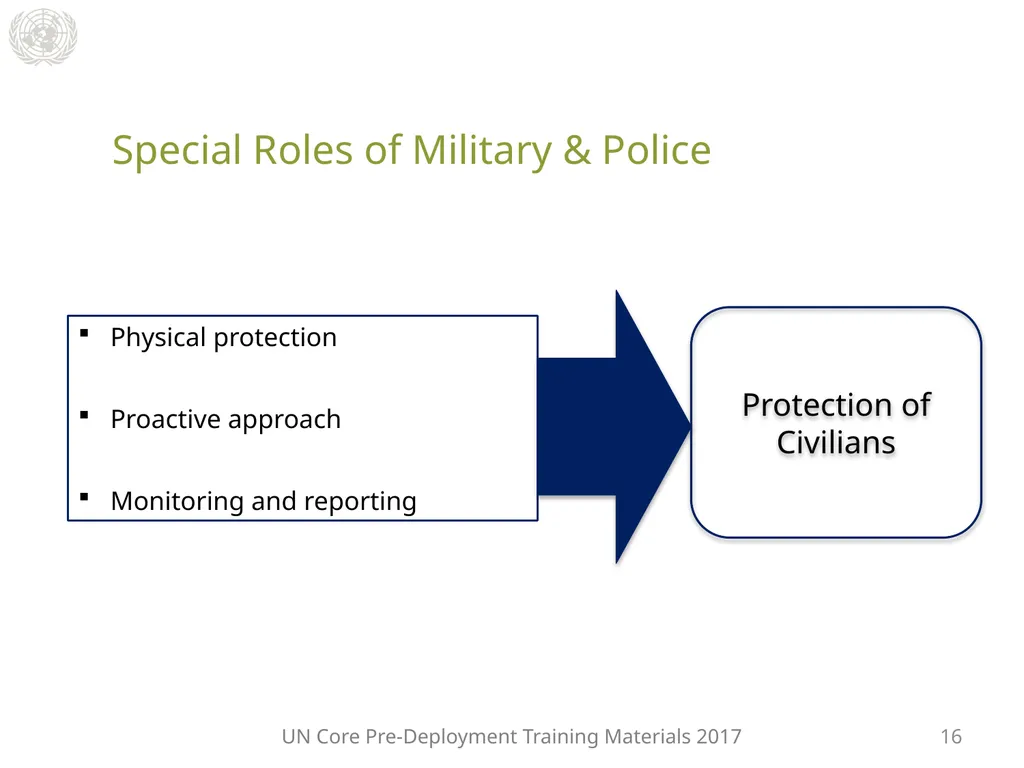
16 UN Core Pre-Deployment Training Materials 2017 Special Roles of Military & Police Protection of Civilians Physical protection
Proactive approach
Monitoring and reporting<br>
25
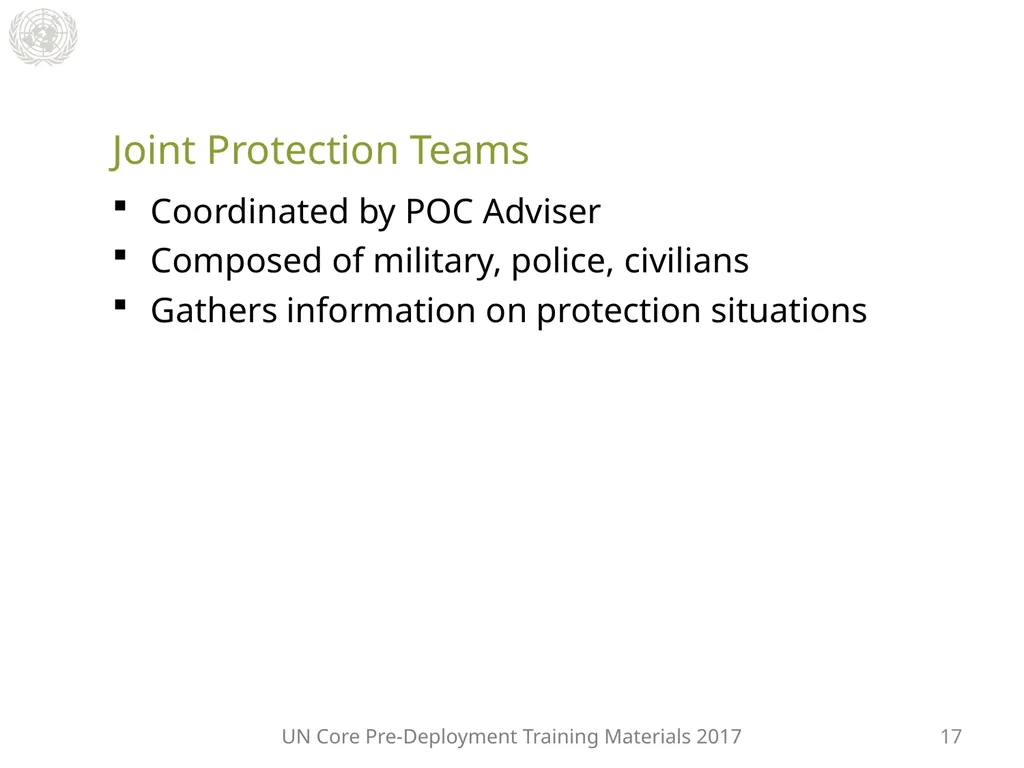
17 UN Core Pre-Deployment Training Materials 2017 Joint Protection Teams
Coordinated by POC Adviser
Composed of military, police, civilians
Gathers information on protection situations<br>
26
9. What Individual Peacekeeping Personnel Can Do Engage local communities
Understand POC mandate, environment, threats
Cooperate with mission components and partners
Interpret the POC mandate pro-actively, try to prevent threats
Respond, intervene 18 UN Core Pre-Deployment Training Materials 2017<br>
27
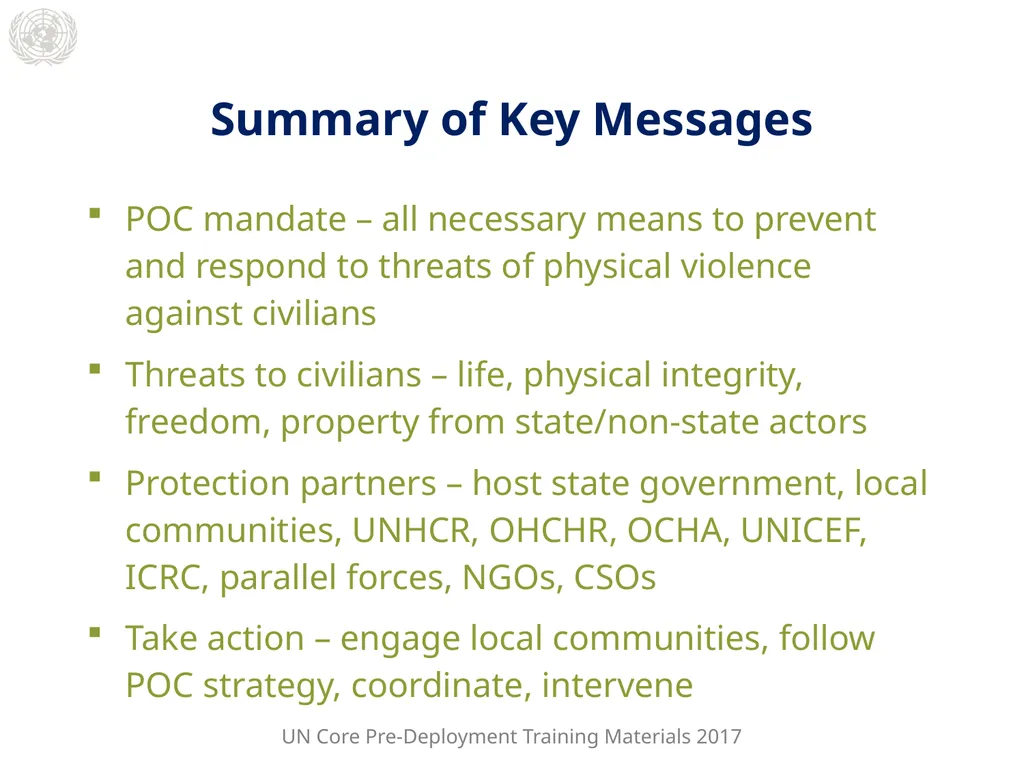
Summary of Key Messages
POC mandate – all necessary means to prevent and respond to threats of physical violence against civilians
Threats to civilians – life, physical integrity, freedom, property from state/non-state actors
Protection partners – host state government, local communities, UNHCR, OHCHR, OCHA, UNICEF, ICRC, parallel forces, NGOs, CSOs
Take action – engage local communities, follow POC strategy, coordinate, intervene UN Core Pre-Deployment Training Materials 2017<br>
28
Questions UN Core Pre-Deployment Training Materials 2017<br>
29
Learning Activity
Learning Evaluation UN Core Pre-Deployment Training Materials 2017<br>