
National Deworming Day- February 2018 Training of
AS
Published · 26 slides · 0 views

1 / 1
Description
National Deworming Day- February 2018 Training of Frontline Workers from ICDS National Deworming Day - August 2017 Ministry of Health and Family Welfare, Government of India Session Details 1 Ministry of Health and Family Welfare
Related Topics
Share
Embed code
Download this presentation From Below
"National Deworming Day- February 2018 Training of" is the property of its rightful owner. Permission is granted to download and print the materials on this website for personal, non-commercial use only, and to display it on your personal computer provided you do not modify the materials and that you retain all copyright notices contained in the materials. By downloading content from our website, you accept the terms of this agreement.
Presentation Transcript
01
National Deworming Day- February 2018 Training of Frontline Workers
from ICDS National Deworming Day - August 2017 |Ministry of Health and Family Welfare, Government of India<br>
from ICDS National Deworming Day - August 2017 |Ministry of Health and Family Welfare, Government of India<br>
02
Session Details 1 Ministry of Health and Family Welfare | National Deworming Day (February 2018)<br>
03
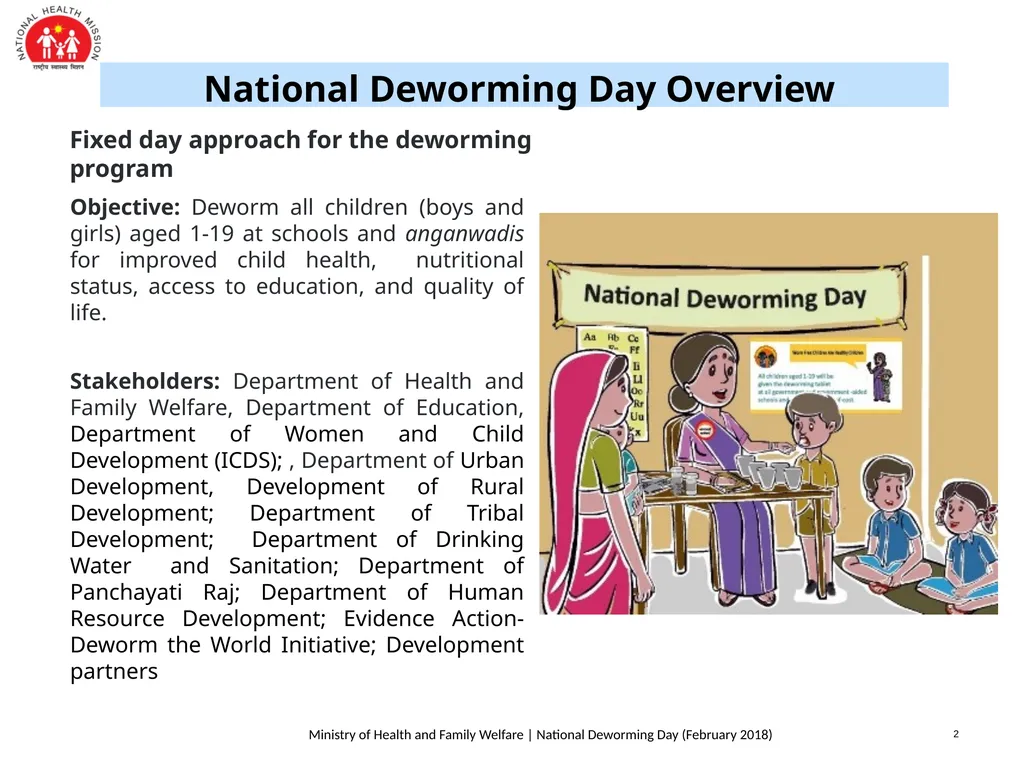
National Deworming Day Overview Objective: Deworm all children (boys and girls) aged 1-19 at schools and anganwadis for improved child health, nutritional status, access to education, and quality of life.
Stakeholders: Department of Health and Family Welfare, Department of Education, Department of Women and Child Development (ICDS); , Department of Urban Development, Development of Rural Development; Department of Tribal Development; Department of Drinking Water and Sanitation; Department of Panchayati Raj; Department of Human Resource Development; Evidence Action-Deworm the World Initiative; Development partners 2 Fixed day approach for the deworming program Ministry of Health and Family Welfare | National Deworming Day (February 2018)<br>
Stakeholders: Department of Health and Family Welfare, Department of Education, Department of Women and Child Development (ICDS); , Department of Urban Development, Development of Rural Development; Department of Tribal Development; Department of Drinking Water and Sanitation; Department of Panchayati Raj; Department of Human Resource Development; Evidence Action-Deworm the World Initiative; Development partners 2 Fixed day approach for the deworming program Ministry of Health and Family Welfare | National Deworming Day (February 2018)<br>
04
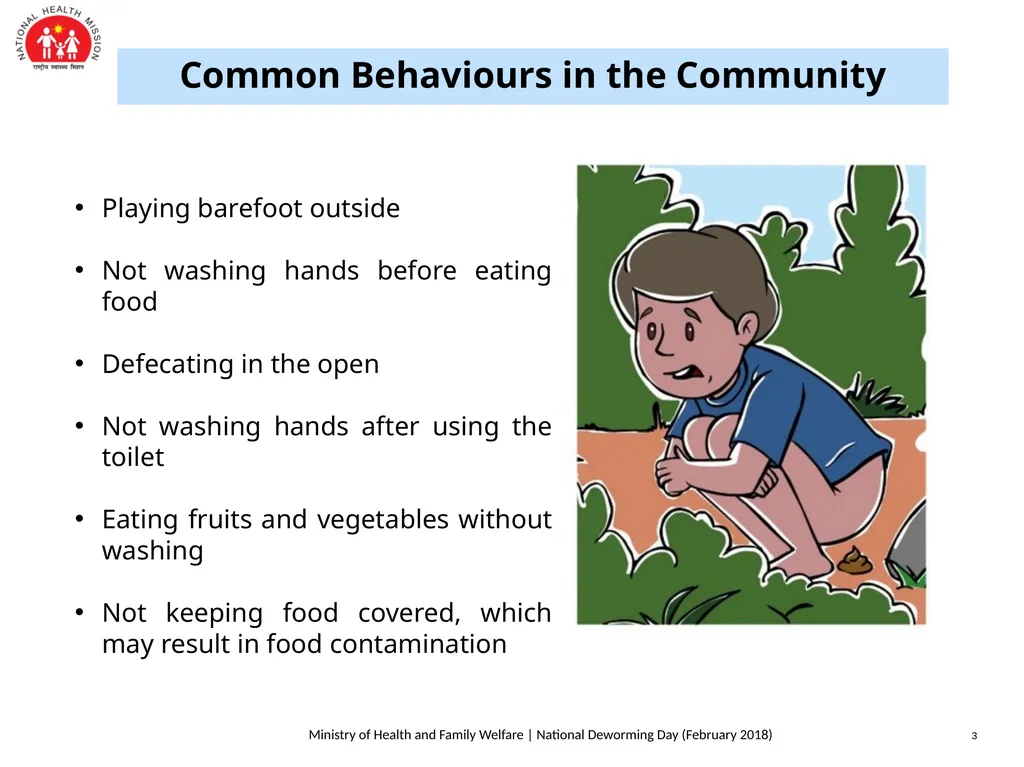
Playing barefoot outside
Not washing hands before eating food
Defecating in the open
Not washing hands after using the toilet
Eating fruits and vegetables without washing
Not keeping food covered, which may result in food contamination Common Behaviours in the Community 3 Ministry of Health and Family Welfare | National Deworming Day (February 2018)<br>
05
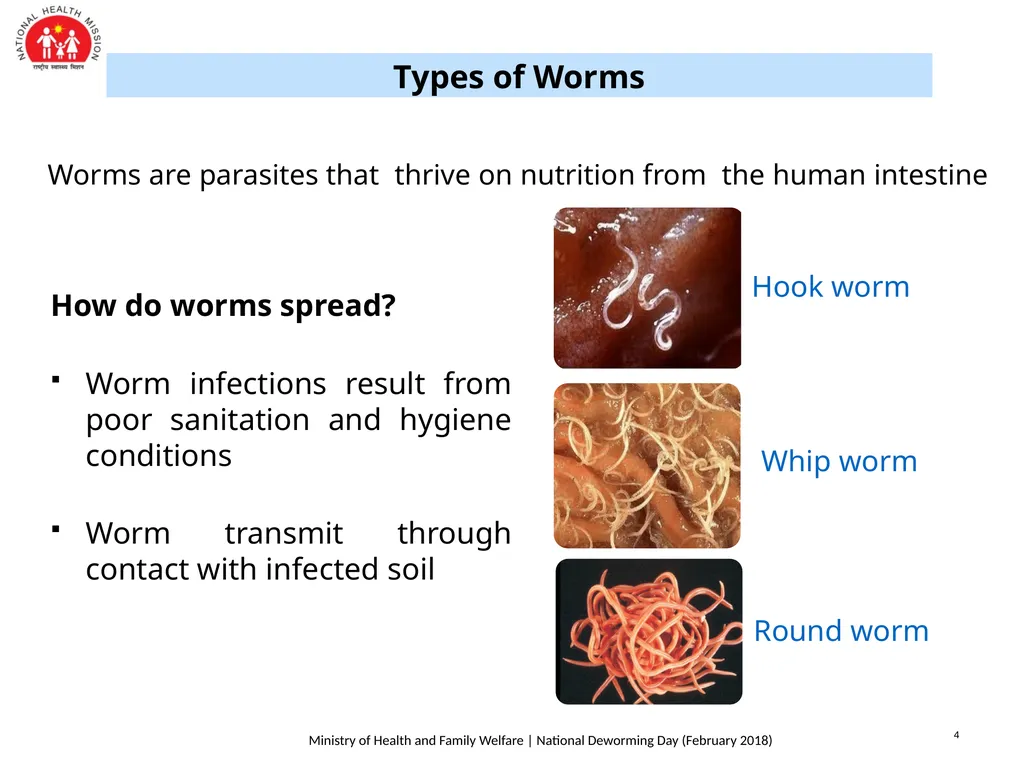
Types of Worms How do worms spread?
Worm infections result from poor sanitation and hygiene conditions
Worm transmit through contact with infected soil Hook worm Whip worm Round worm Worms are parasites that thrive on nutrition from the human intestine 4 Ministry of Health and Family Welfare | National Deworming Day (February 2018)<br>
06
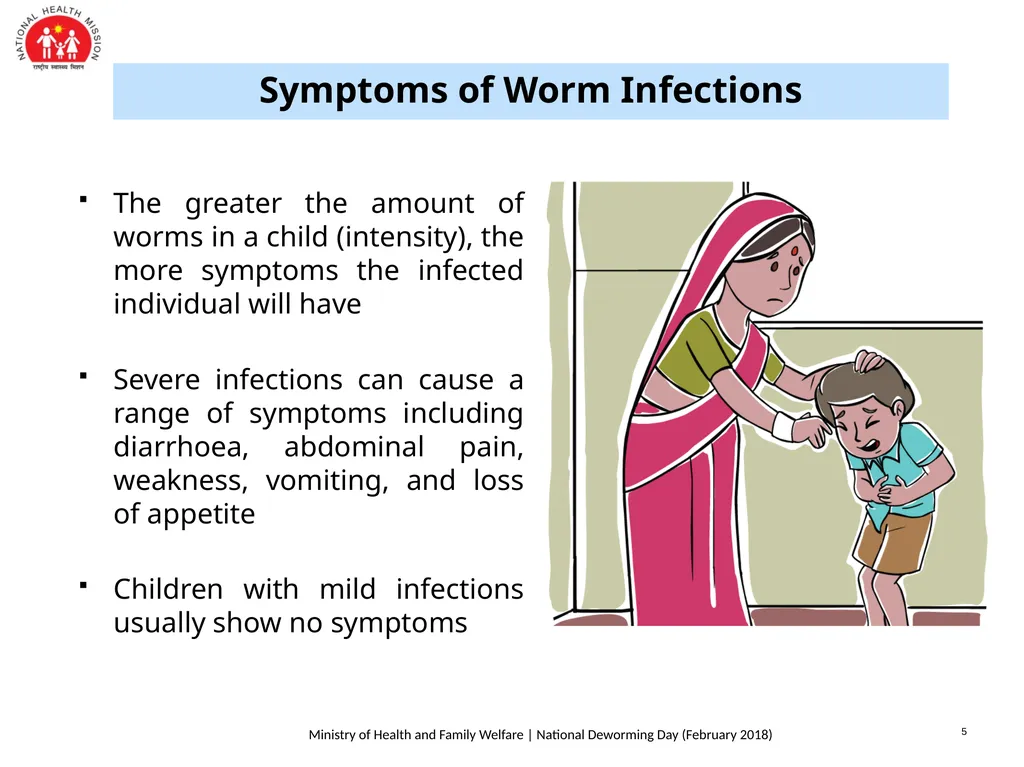
Symptoms of Worm Infections The greater the amount of worms in a child (intensity), the more symptoms the infected individual will have
Severe infections can cause a range of symptoms including diarrhoea, abdominal pain, weakness, vomiting, and loss of appetite
Children with mild infections usually show no symptoms 5 Ministry of Health and Family Welfare | National Deworming Day (February 2018)<br>
Severe infections can cause a range of symptoms including diarrhoea, abdominal pain, weakness, vomiting, and loss of appetite
Children with mild infections usually show no symptoms 5 Ministry of Health and Family Welfare | National Deworming Day (February 2018)<br>
07
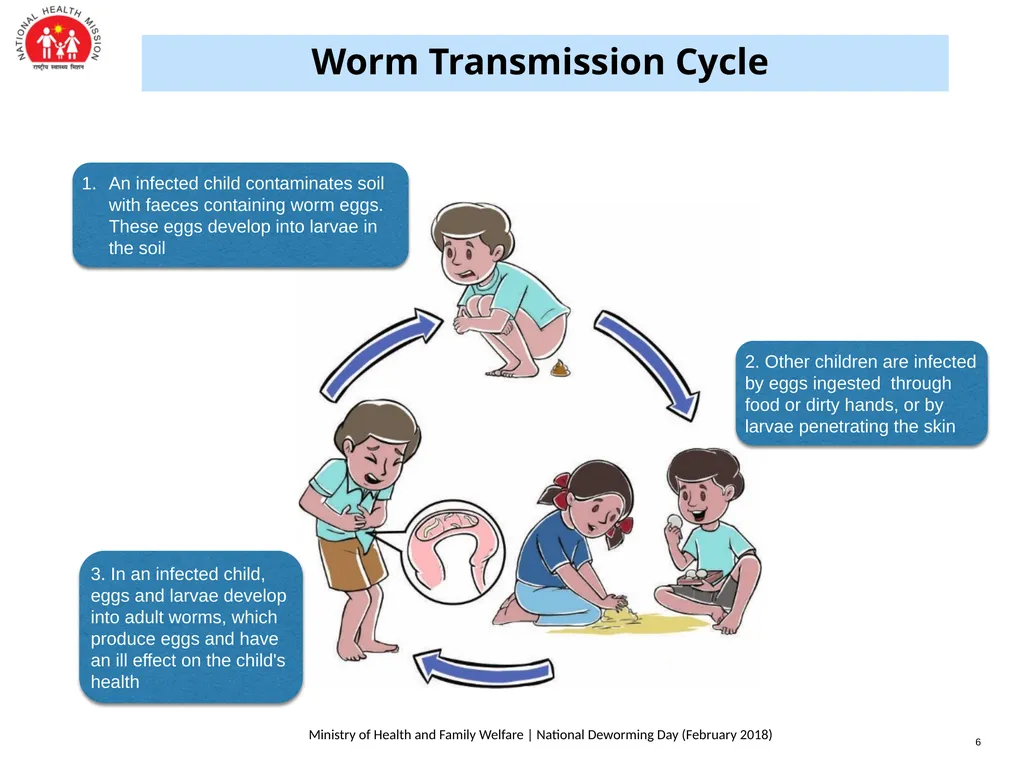
Worm Transmission Cycle An infected child contaminates soil with faeces containing worm eggs. These eggs develop into larvae in the soil 2. Other children are infected by eggs ingested through food or dirty hands, or by
larvae penetrating the skin 3. In an infected child,
eggs and larvae develop into adult worms, which produce eggs and have an ill effect on the child's health 6 Ministry of Health and Family Welfare | National Deworming Day (February 2018)<br>
larvae penetrating the skin 3. In an infected child,
eggs and larvae develop into adult worms, which produce eggs and have an ill effect on the child's health 6 Ministry of Health and Family Welfare | National Deworming Day (February 2018)<br>
08
Impact of Worms on Health and Nutrition Worm infections impair the nutritional status of the people they infect in multiple ways:
Worms feed on host tissues, including blood, which leads to anemia.
The nutritional impairment has significant impact on growth and physical development.
Worms consume nutrients meant for the human body and cause blood loss, poor nutrition and stunted growth.
Roundworm may compete for vitamin A in the intestine. 7 Ministry of Health and Family Welfare | National Deworming Day (February 2018)<br>
09
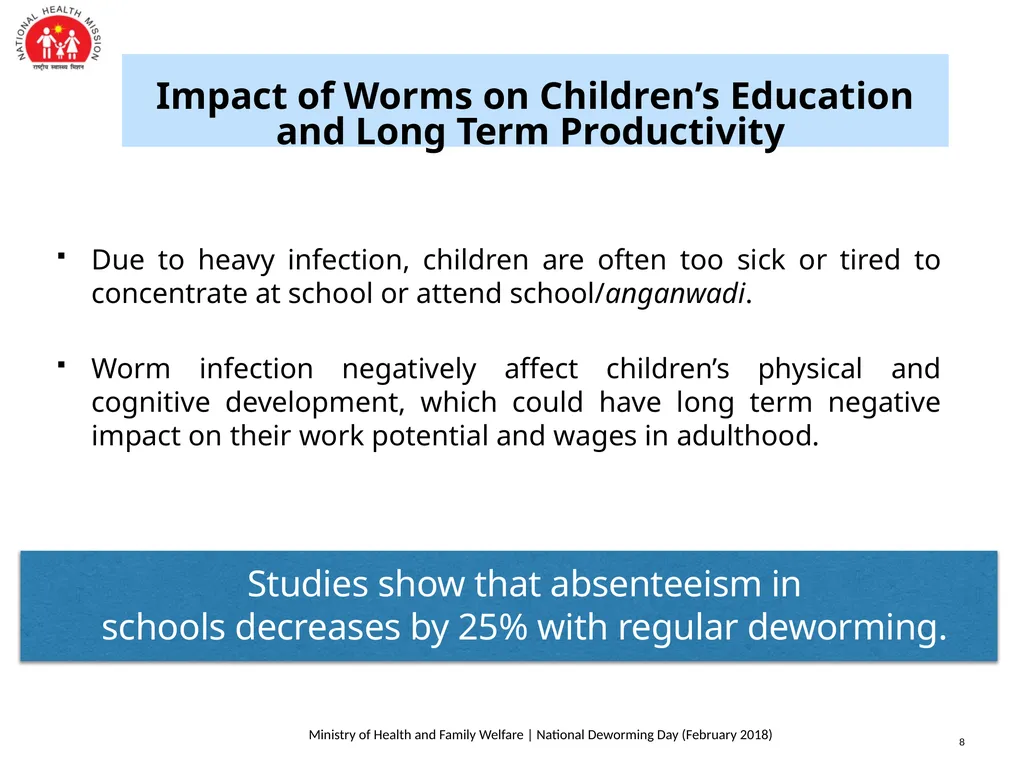
Impact of Worms on Children’s Education and Long Term Productivity Due to heavy infection, children are often too sick or tired to concentrate at school or attend school/anganwadi.
Worm infection negatively affect children’s physical and cognitive development, which could have long term negative impact on their work potential and wages in adulthood. Studies show that absenteeism in schools decreases by 25% with regular deworming. 8 Ministry of Health and Family Welfare | National Deworming Day (February 2018)<br>
Worm infection negatively affect children’s physical and cognitive development, which could have long term negative impact on their work potential and wages in adulthood. Studies show that absenteeism in schools decreases by 25% with regular deworming. 8 Ministry of Health and Family Welfare | National Deworming Day (February 2018)<br>
10
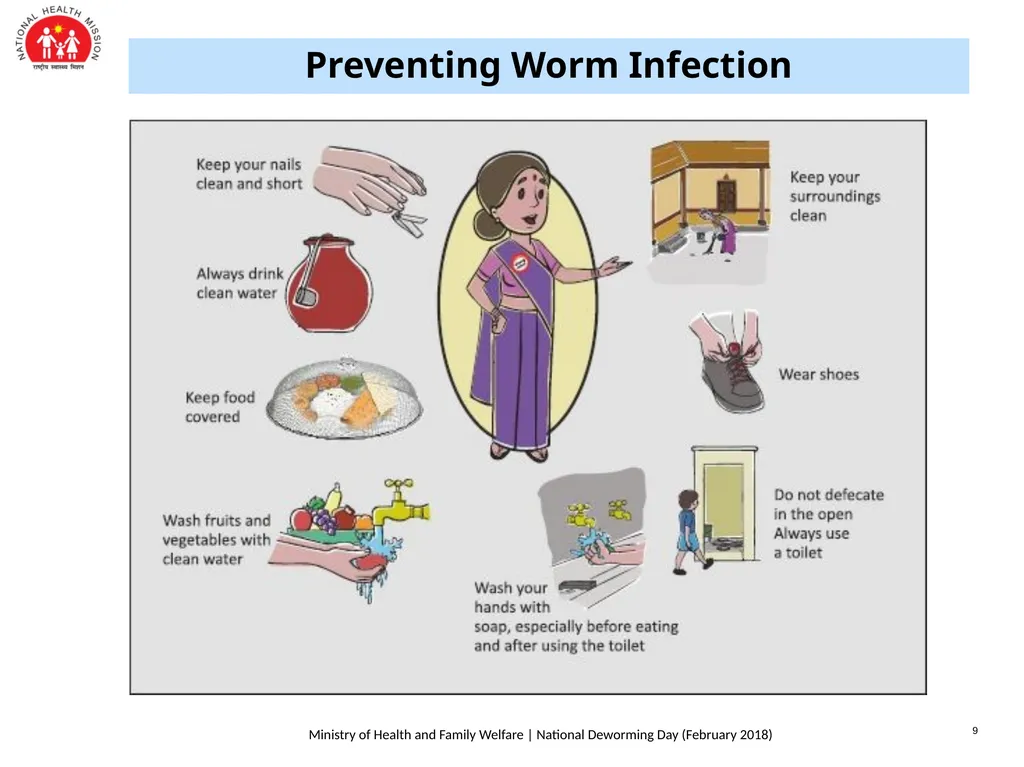
Preventing Worm Infection 9 Ministry of Health and Family Welfare | National Deworming Day (February 2018)<br>
11
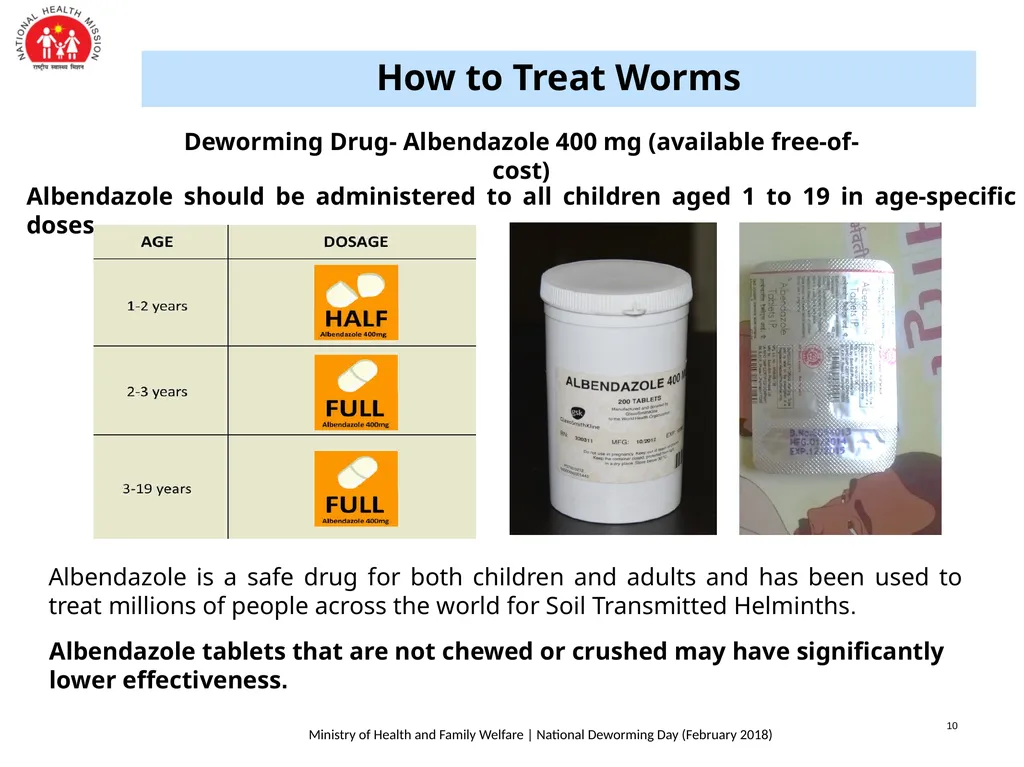
How to Treat Worms Deworming Drug- Albendazole 400 mg (available free-of-cost) Albendazole should be administered to all children aged 1 to 19 in age-specific doses. 10 Albendazole is a safe drug for both children and adults and has been used to treat millions of people across the world for Soil Transmitted Helminths. Albendazole tablets that are not chewed or crushed may have significantly lower effectiveness. Ministry of Health and Family Welfare | National Deworming Day (February 2018)<br>
12
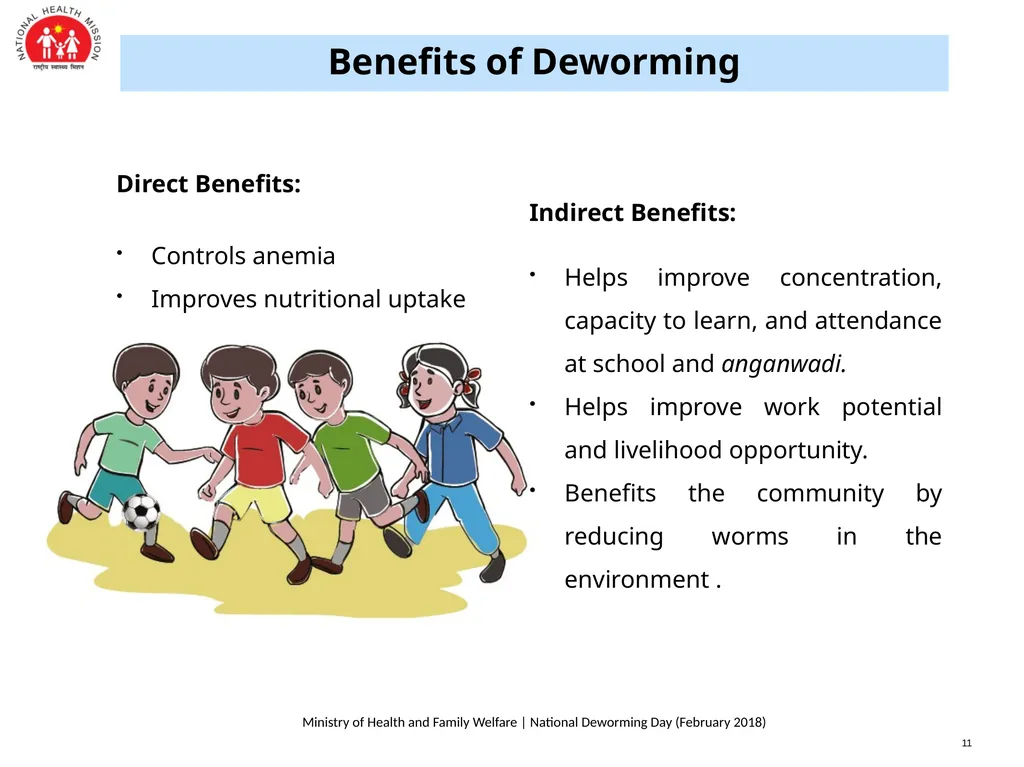
Benefits of Deworming Direct Benefits:
Controls anemia
Improves nutritional uptake
Indirect Benefits:
Helps improve concentration, capacity to learn, and attendance at school and anganwadi.
Helps improve work potential and livelihood opportunity.
Benefits the community by reducing worms in the environment . 11 Ministry of Health and Family Welfare | National Deworming Day (February 2018)<br>
13
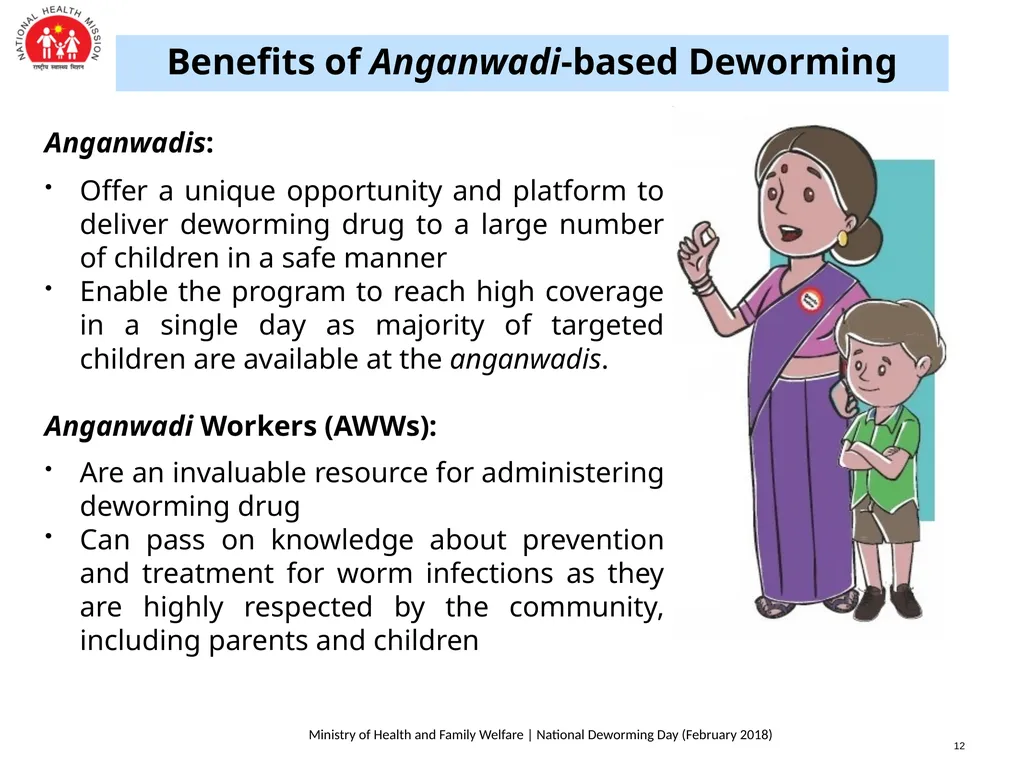
Benefits of Anganwadi-based Deworming Anganwadis:
Offer a unique opportunity and platform to deliver deworming drug to a large number of children in a safe manner
Enable the program to reach high coverage in a single day as majority of targeted children are available at the anganwadis.
Anganwadi Workers (AWWs):
Are an invaluable resource for administering deworming drug
Can pass on knowledge about prevention and treatment for worm infections as they are highly respected by the community, including parents and children 12 Ministry of Health and Family Welfare | National Deworming Day (February 2018)<br>
14
National Deworming Day and Mop-up Day Albendazole will be administered on National Deworming Day (NDD), 10 February 2018, across all schools and anganwadis for all children aged 1 to 19.
Teachers will administer Albendazole to all school-enrolled children aged 6-19 years at the school.
AWWs will administer Albendazole to all children aged 1-5 years and unregistered, out-of-school children aged 1-19 years at the anganwadis.
Unregistered and non-enrolled children will be mobilized to the nearest anganwadi for deworming with support from the ASHA.
Children who are sick or are on medication should not be administered the tablet. These children should be advised to have the Albendazole upon recovery.
Children who could not be dewormed on NDD must be administered the drug on mop-up day (MUD) on 15 February 2018. 13 Ministry of Health and Family Welfare | National Deworming Day (February 2018)<br>
15
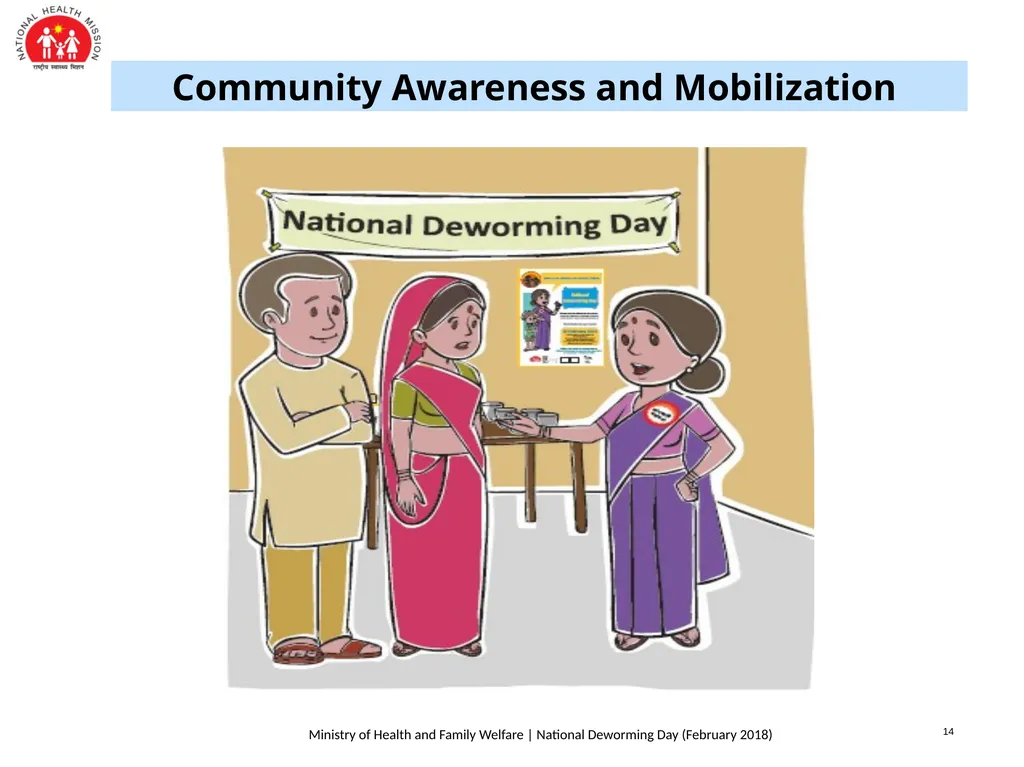
Community Awareness and Mobilization 14 Ministry of Health and Family Welfare | National Deworming Day (February 2018)<br>
16
Community Awareness and Mobilization Anganwadi workers should -
Inform community about the benefits of deworming and dates of deworming
Motivate parents and relatives who come to the centre, to bring their children to the anganwadi on NDD
Provide adequate information to the parents or children on how the tablet should be administered and consumed
Inform children about deworming and NDD when they come to the centre
Support/guide ASHAs to mobilize community members through Gram Panchayats and at VHSNC meeting
Inform community members about deworming messages appearing in newspapers, radio, and TV that they should watch/listen to carefully 15 Ministry of Health and Family Welfare | National Deworming Day (February 2018)<br>
17
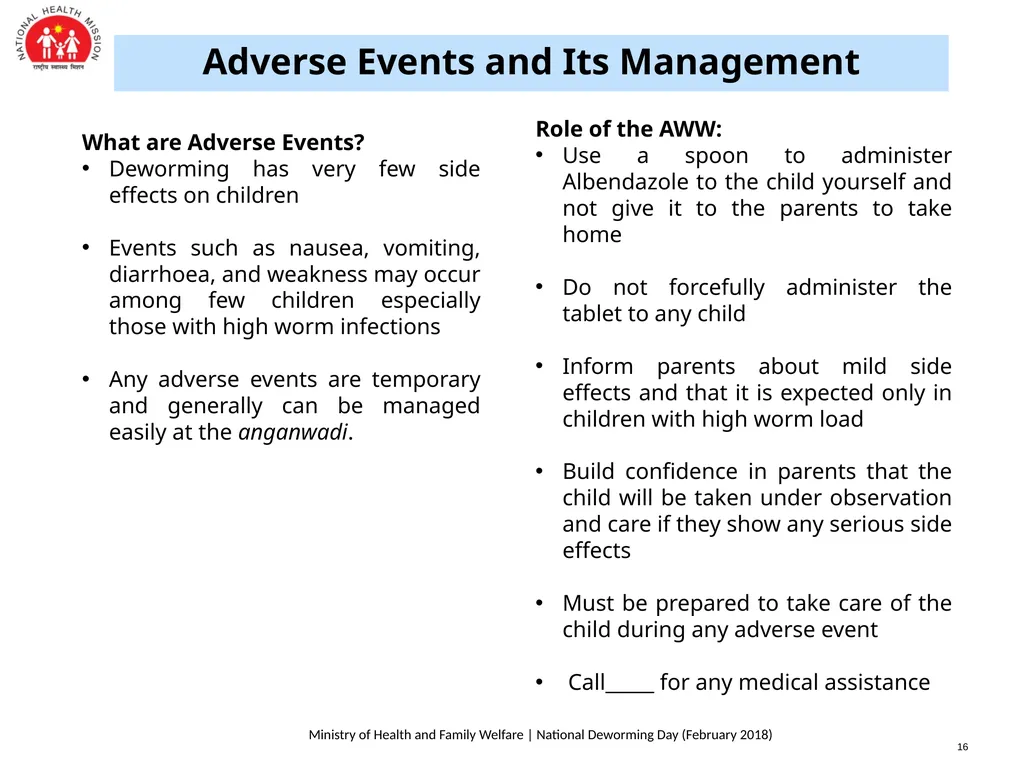
Adverse Events and Its Management What are Adverse Events?
Deworming has very few side effects on children
Events such as nausea, vomiting, diarrhoea, and weakness may occur among few children especially those with high worm infections
Any adverse events are temporary and generally can be managed easily at the anganwadi. Role of the AWW:
Use a spoon to administer Albendazole to the child yourself and not give it to the parents to take home
Do not forcefully administer the tablet to any child
Inform parents about mild side effects and that it is expected only in children with high worm load
Build confidence in parents that the child will be taken under observation and care if they show any serious side effects
Must be prepared to take care of the child during any adverse event
Call_____ for any medical assistance 16 Ministry of Health and Family Welfare | National Deworming Day (February 2018)<br>
18
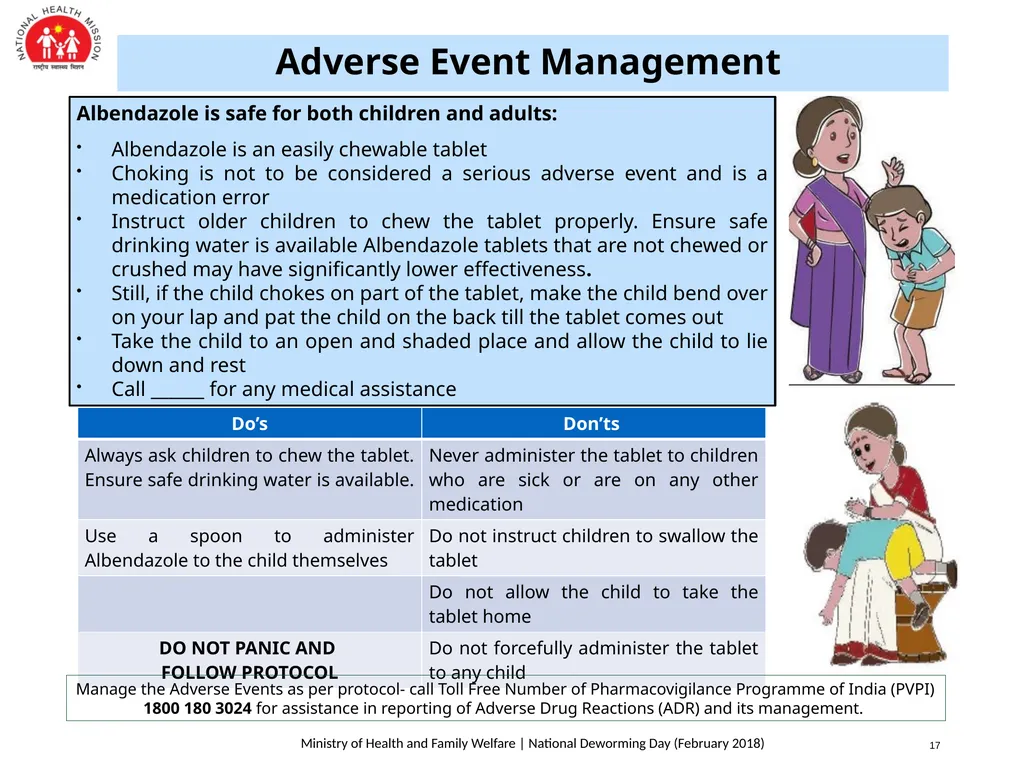
Adverse Event Management Albendazole is safe for both children and adults:
Albendazole is an easily chewable tablet
Choking is not to be considered a serious adverse event and is a medication error
Instruct older children to chew the tablet properly. Ensure safe drinking water is available Albendazole tablets that are not chewed or crushed may have significantly lower effectiveness.
Still, if the child chokes on part of the tablet, make the child bend over on your lap and pat the child on the back till the tablet comes out
Take the child to an open and shaded place and allow the child to lie down and rest
Call ______ for any medical assistance 17 Manage the Adverse Events as per protocol- call Toll Free Number of Pharmacovigilance Programme of India (PVPI) 1800 180 3024 for assistance in reporting of Adverse Drug Reactions (ADR) and its management. Ministry of Health and Family Welfare | National Deworming Day (February 2018)<br>
19
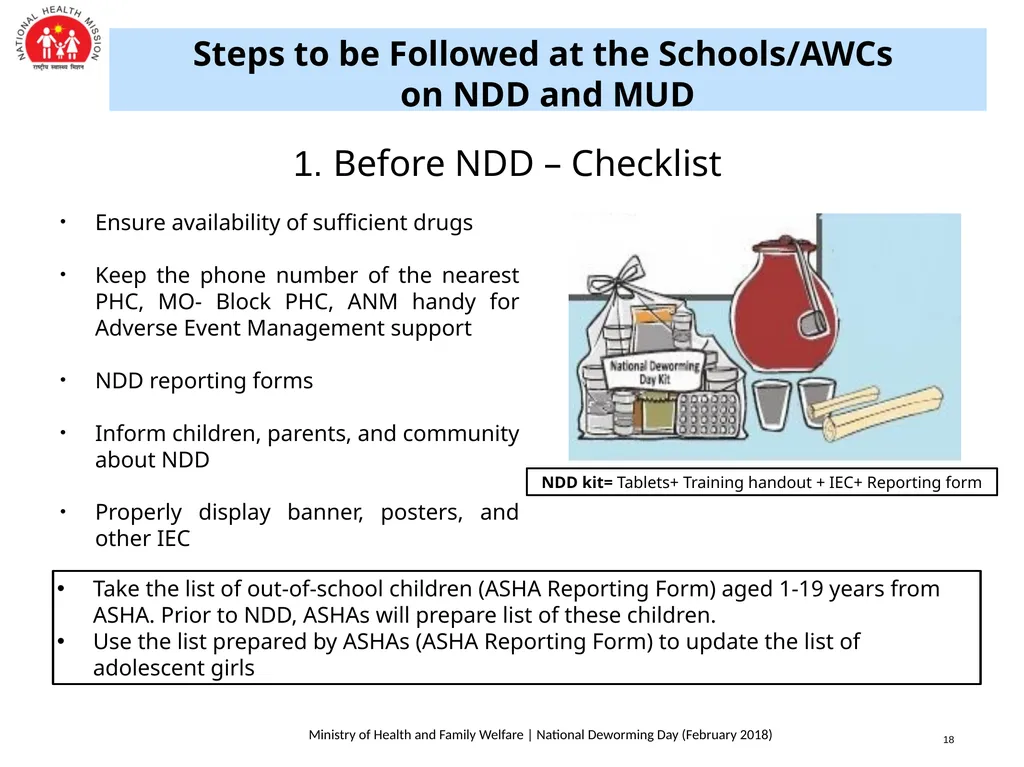
Steps to be Followed at the Schools/AWCs
on NDD and MUD Ensure availability of sufficient drugs
Keep the phone number of the nearest PHC, MO- Block PHC, ANM handy for Adverse Event Management support
NDD reporting forms
Inform children, parents, and community about NDD
Properly display banner, posters, and other IEC 1. Before NDD – Checklist Take the list of out-of-school children (ASHA Reporting Form) aged 1-19 years from ASHA. Prior to NDD, ASHAs will prepare list of these children.
Use the list prepared by ASHAs (ASHA Reporting Form) to update the list of adolescent girls 18 NDD kit= Tablets+ Training handout + IEC+ Reporting form Ministry of Health and Family Welfare | National Deworming Day (February 2018)<br>
20
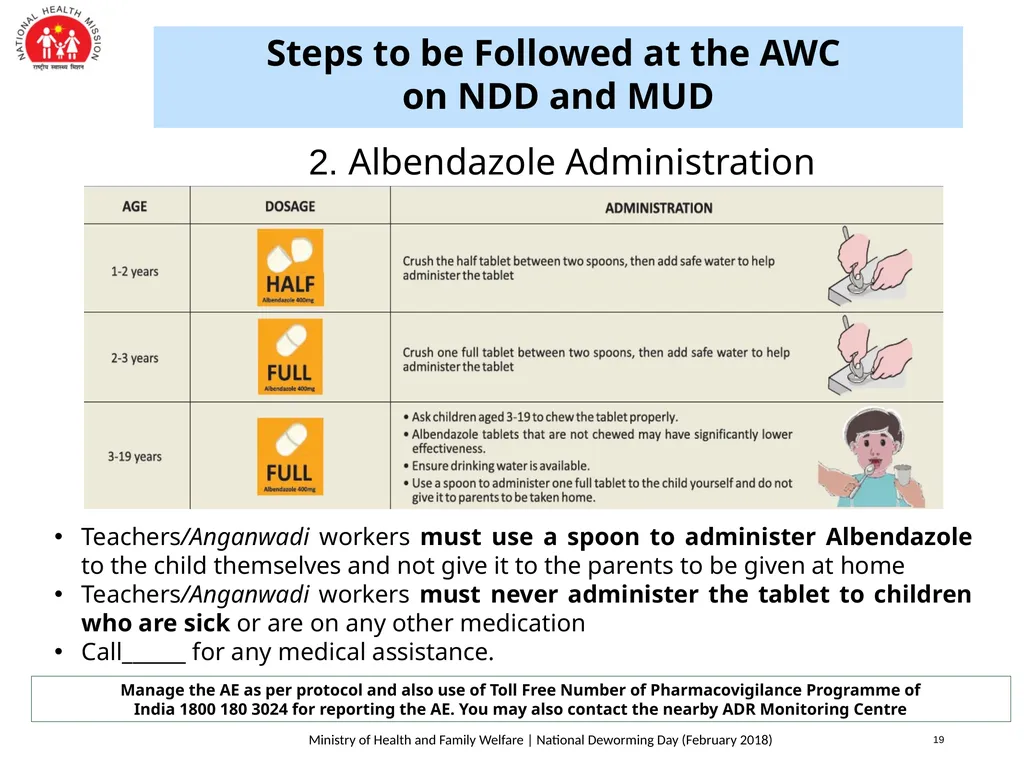
Steps to be Followed at the AWC
on NDD and MUD 2. Albendazole Administration Teachers/Anganwadi workers must use a spoon to administer Albendazole to the child themselves and not give it to the parents to be given at home
Teachers/Anganwadi workers must never administer the tablet to children who are sick or are on any other medication
Call______ for any medical assistance. 19 Manage the AE as per protocol and also use of Toll Free Number of Pharmacovigilance Programme of
India 1800 180 3024 for reporting the AE. You may also contact the nearby ADR Monitoring Centre Ministry of Health and Family Welfare | National Deworming Day (February 2018)<br>
21
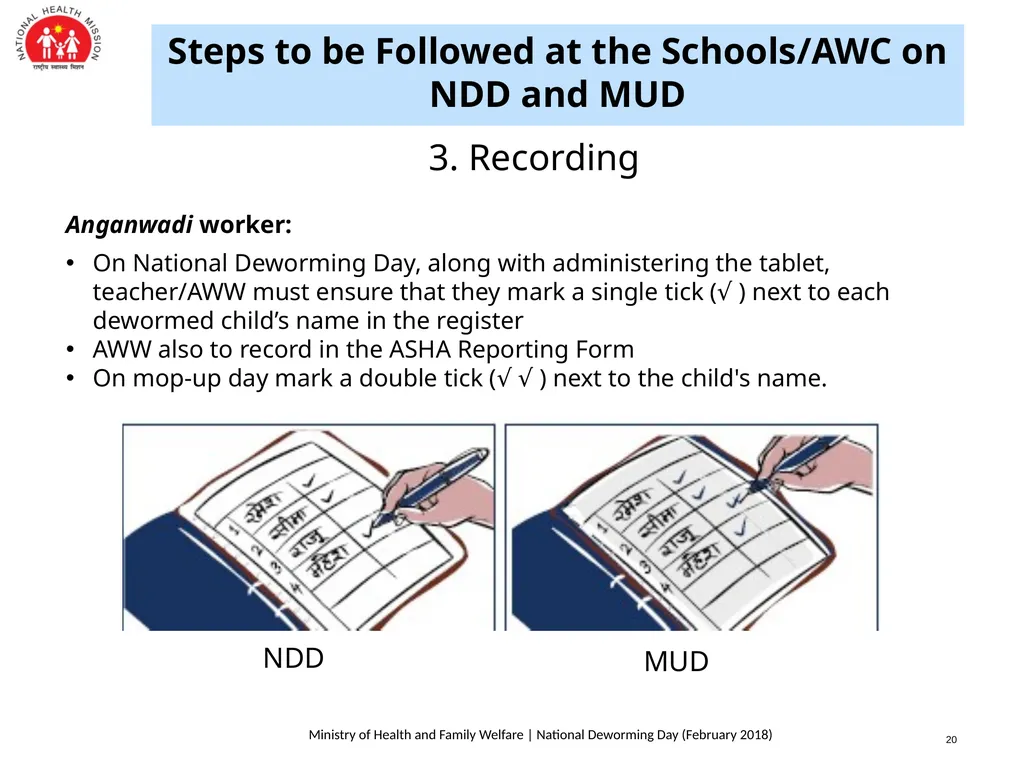
Steps to be Followed at the Schools/AWC on NDD and MUD Anganwadi worker:
On National Deworming Day, along with administering the tablet, teacher/AWW must ensure that they mark a single tick (√ ) next to each dewormed child’s name in the register
AWW also to record in the ASHA Reporting Form
On mop-up day mark a double tick (√ √ ) next to the child's name. 3. Recording NDD MUD 20 Ministry of Health and Family Welfare | National Deworming Day (February 2018)<br>
22
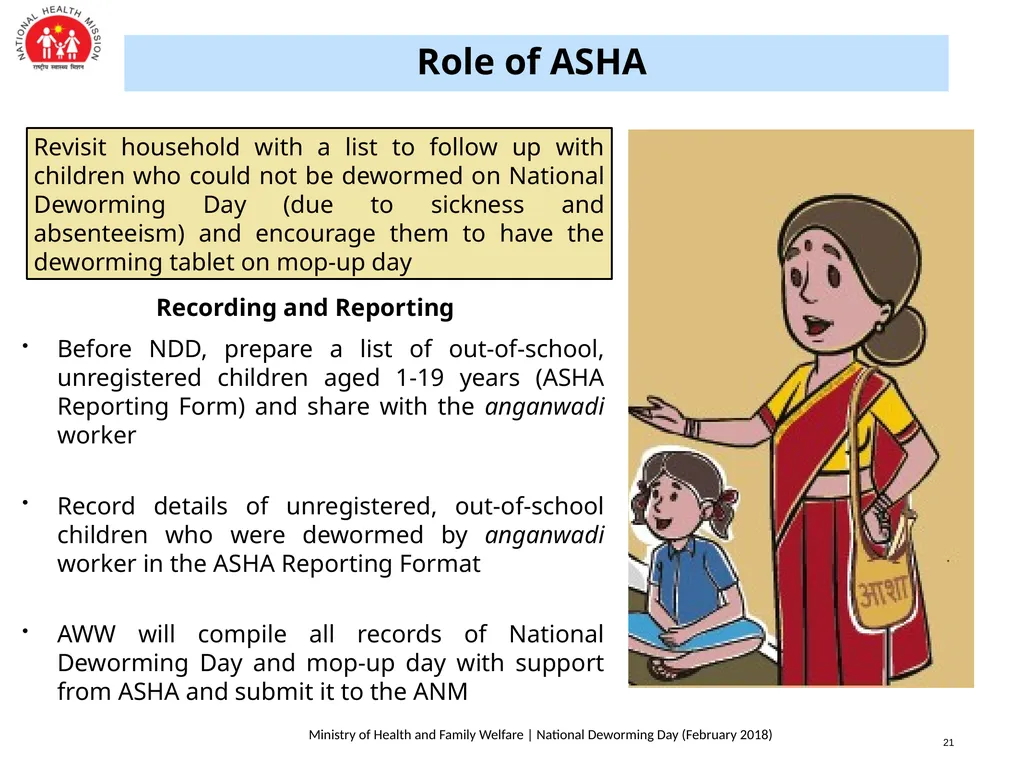
Role of ASHA Revisit household with a list to follow up with children who could not be dewormed on National Deworming Day (due to sickness and absenteeism) and encourage them to have the deworming tablet on mop-up day Before NDD, prepare a list of out-of-school, unregistered children aged 1-19 years (ASHA Reporting Form) and share with the anganwadi worker
Record details of unregistered, out-of-school children who were dewormed by anganwadi worker in the ASHA Reporting Format
AWW will compile all records of National Deworming Day and mop-up day with support from ASHA and submit it to the ANM Recording and Reporting 21 Ministry of Health and Family Welfare | National Deworming Day (February 2018)<br>
23
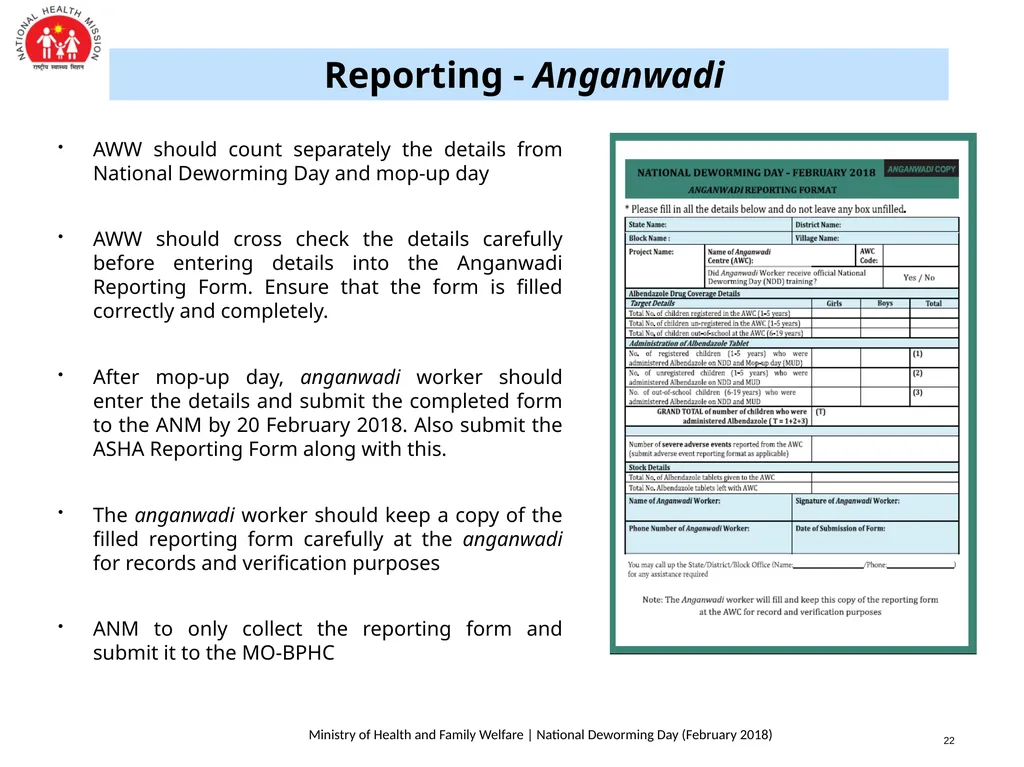
Reporting - Anganwadi AWW should count separately the details from National Deworming Day and mop-up day
AWW should cross check the details carefully before entering details into the Anganwadi Reporting Form. Ensure that the form is filled correctly and completely.
After mop-up day, anganwadi worker should enter the details and submit the completed form to the ANM by 20 February 2018. Also submit the ASHA Reporting Form along with this.
The anganwadi worker should keep a copy of the filled reporting form carefully at the anganwadi for records and verification purposes
ANM to only collect the reporting form and submit it to the MO-BPHC 22 Ministry of Health and Family Welfare | National Deworming Day (February 2018)<br>
24
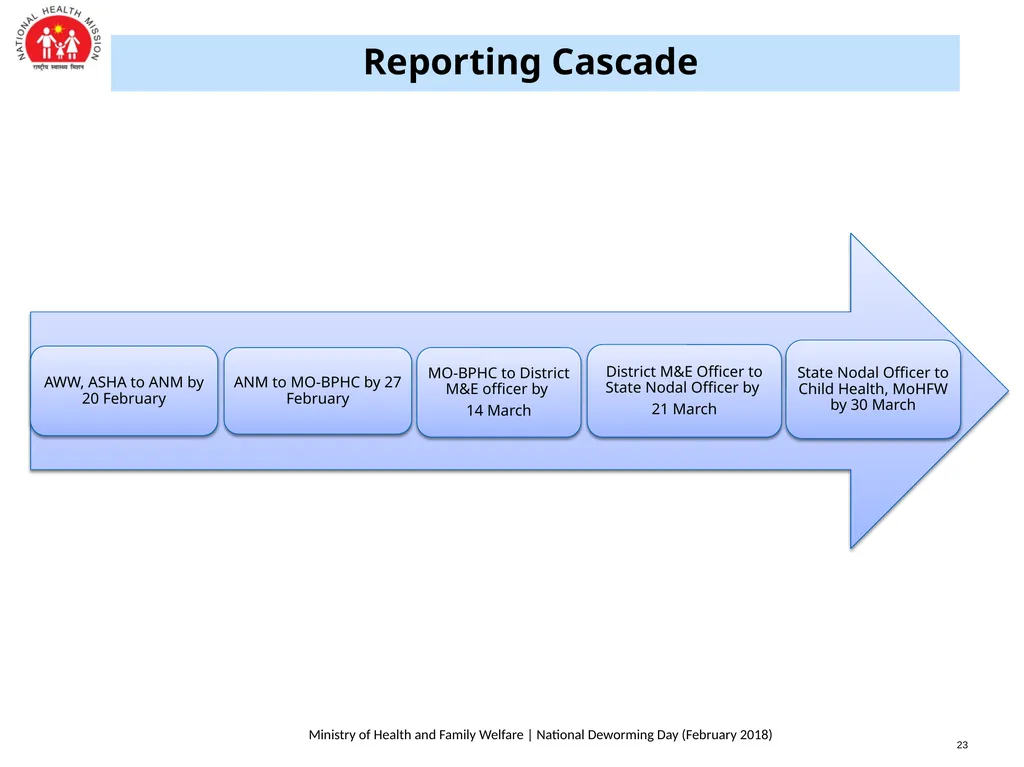
Reporting Cascade 23 Ministry of Health and Family Welfare | National Deworming Day (February 2018)<br>
25
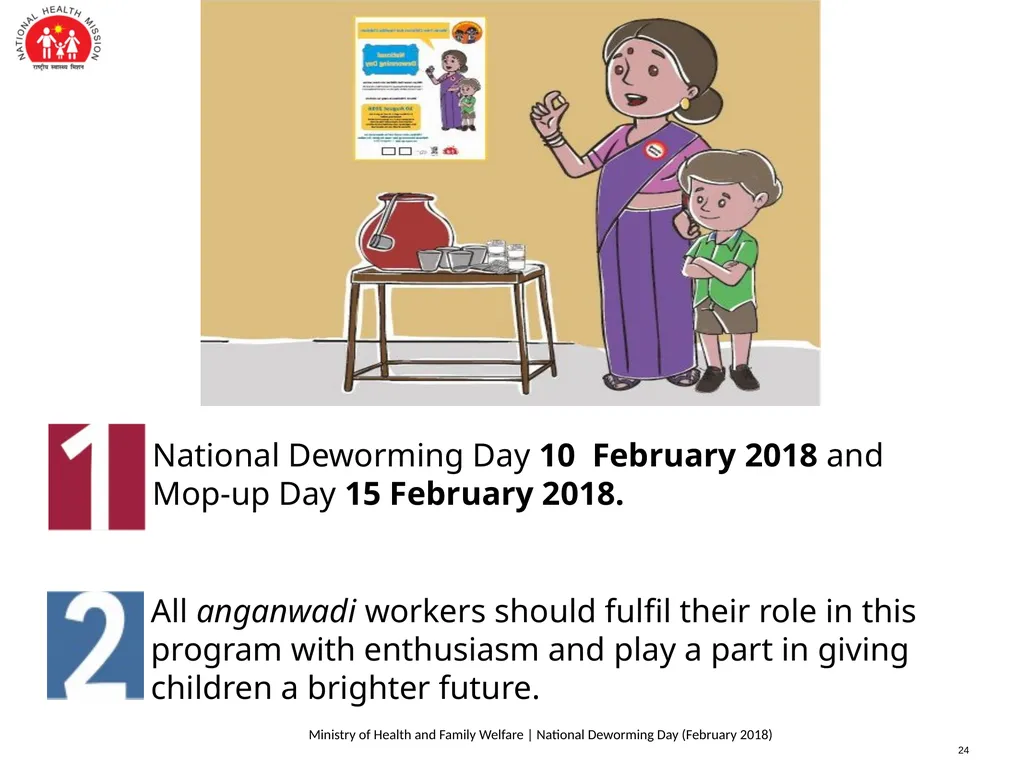
All anganwadi workers should fulfil their role in this program with enthusiasm and play a part in giving children a brighter future. National Deworming Day 10 February 2018 and
Mop-up Day 15 February 2018. 24 Ministry of Health and Family Welfare | National Deworming Day (February 2018)<br>
Mop-up Day 15 February 2018. 24 Ministry of Health and Family Welfare | National Deworming Day (February 2018)<br>
26
Thank You 25 Ministry of Health and Family Welfare | National Deworming Day (February 2018)<br>