04
Introduction to Philosophy
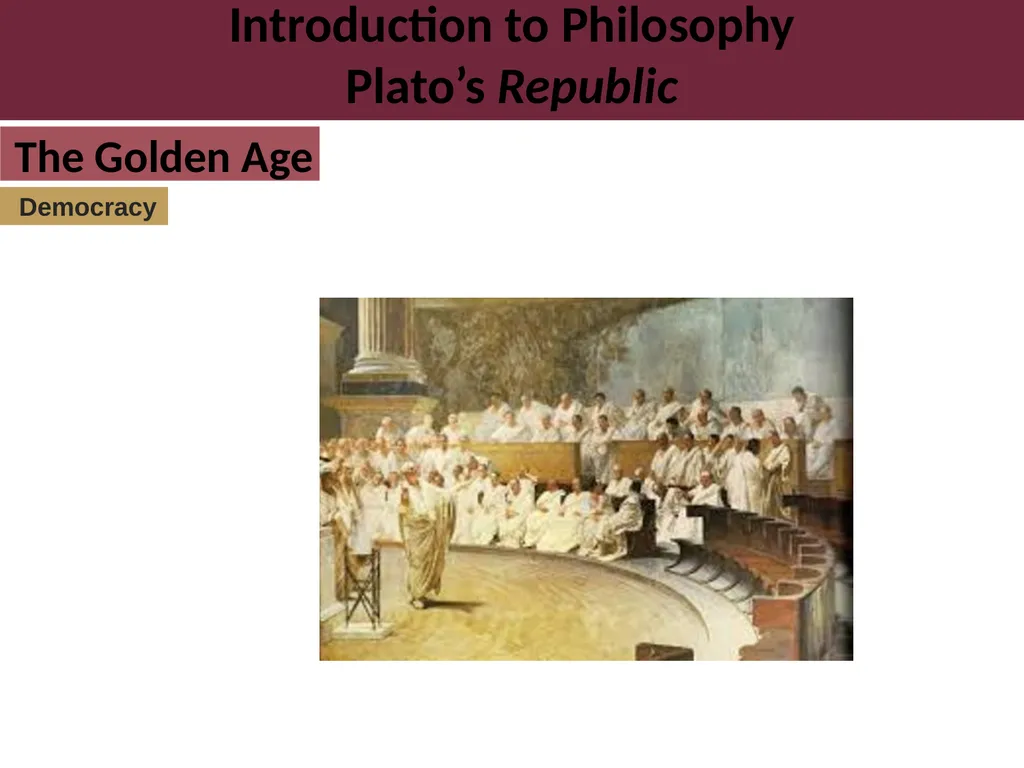
Plato’s Republic The Golden Age Democracy<br>
05
Introduction to Philosophy
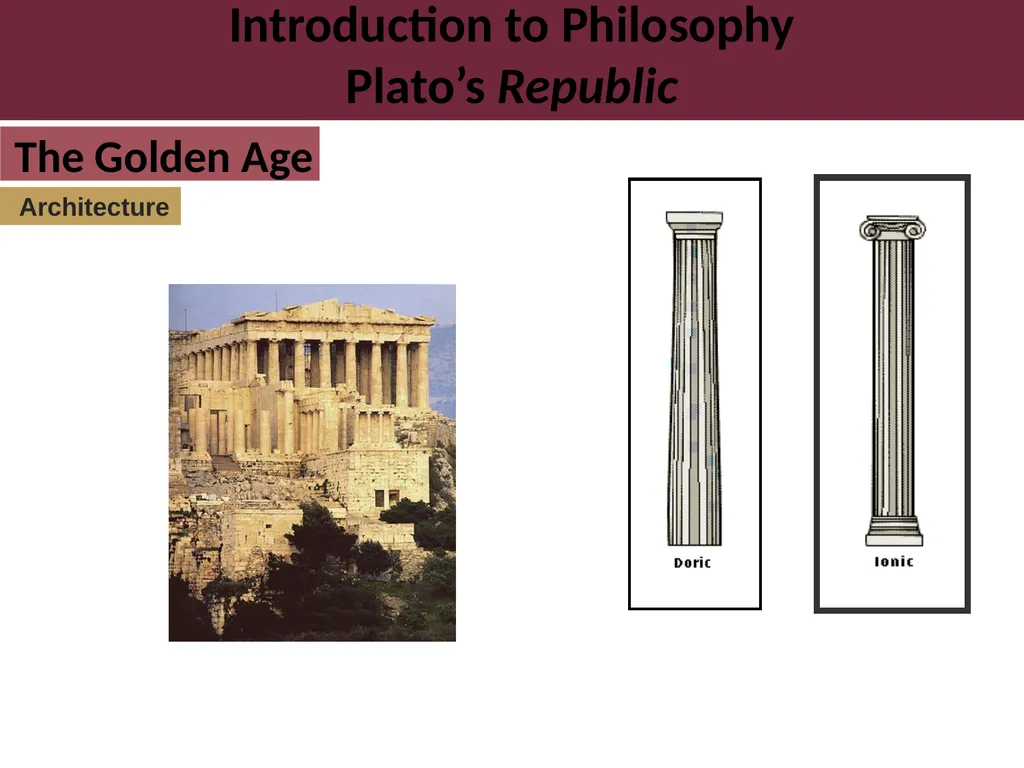
Plato’s Republic The Golden Age Architecture<br>
06
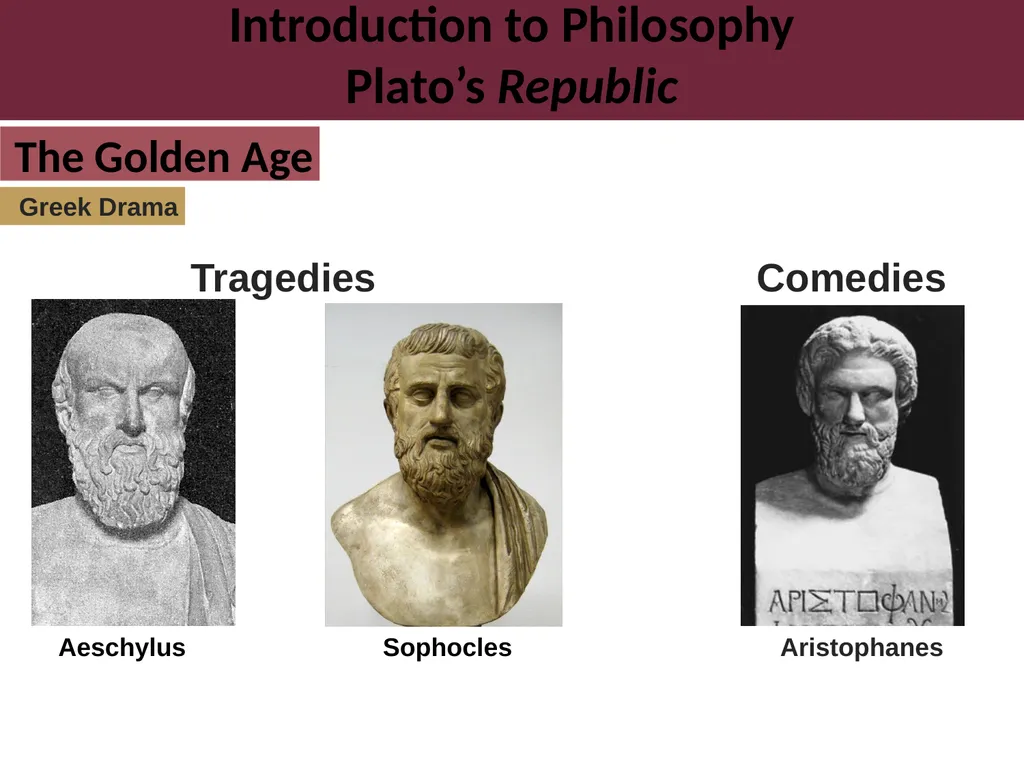
Aristophanes Comedies Tragedies Sophocles Introduction to Philosophy
Plato’s Republic The Golden Age Greek Drama Aeschylus<br>
07
Comedies Tragedies Introduction to Philosophy
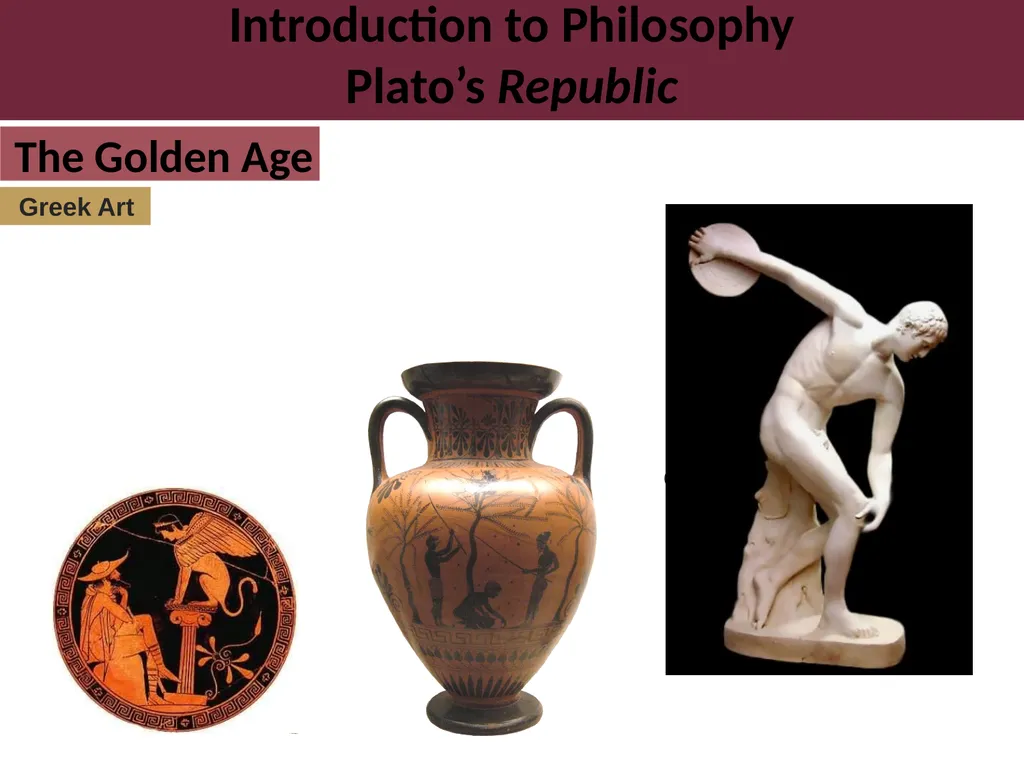
Plato’s Republic The Golden Age Greek Art<br>
08
History
Herodotus
“father of history”
Medicine
Hippocrates
Hippocratic Oath – all patients must be treated regardless of class
Mathematics
Euclid
Archimedes Introduction to Philosophy
Plato’s Republic The Golden Age History, Medicine, Mathematics<br>
09
Introduction to Philosophy
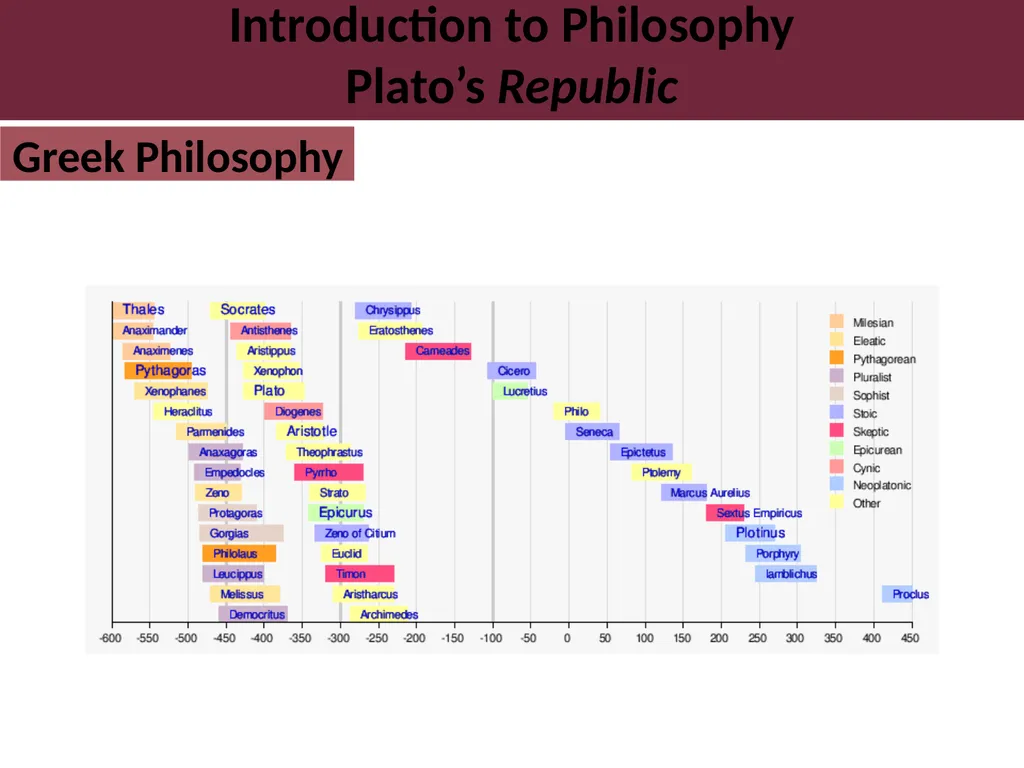
Plato’s Republic Greek Philosophy<br>
10
Introduction to Philosophy
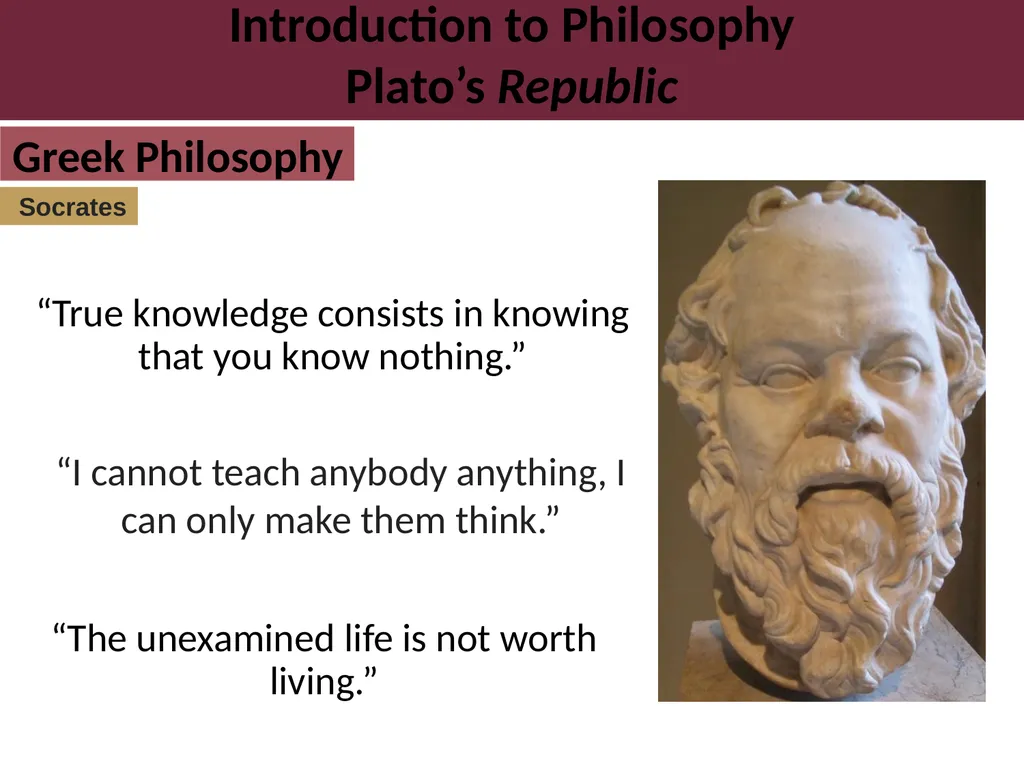
Plato’s Republic Greek Philosophy Socrates “The unexamined life is not worth living.” “True knowledge consists in knowing that you know nothing.” “I cannot teach anybody anything, I can only make them think.”<br>
11
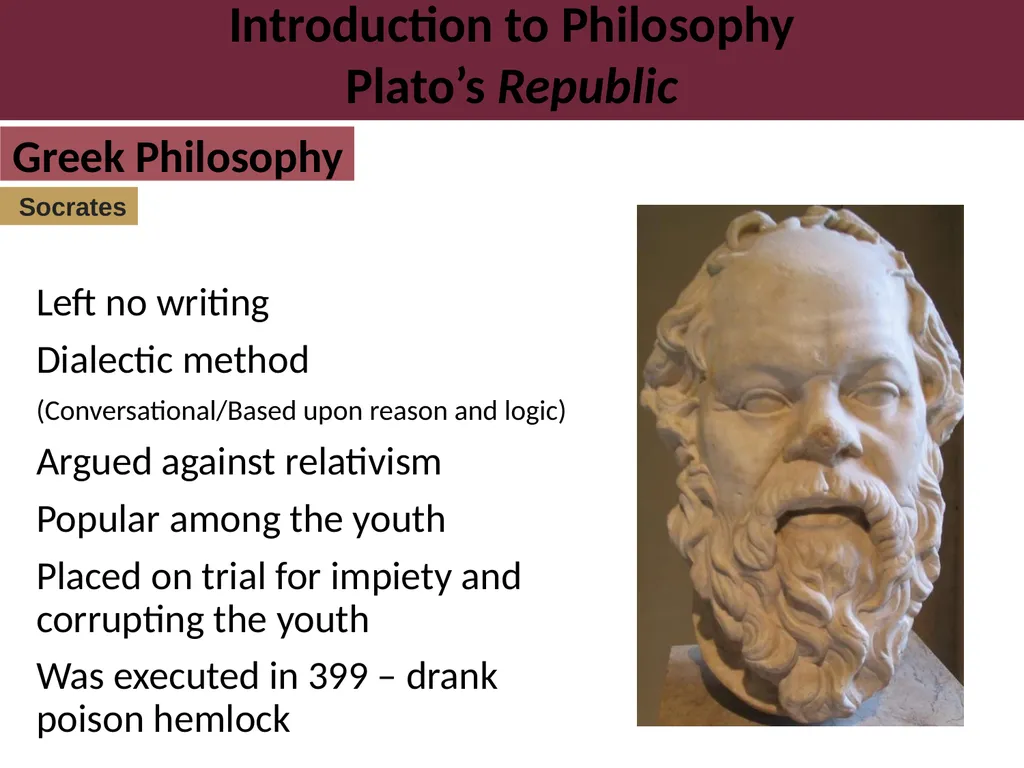
Left no writing
Dialectic method
(Conversational/Based upon reason and logic)
Argued against relativism
Popular among the youth
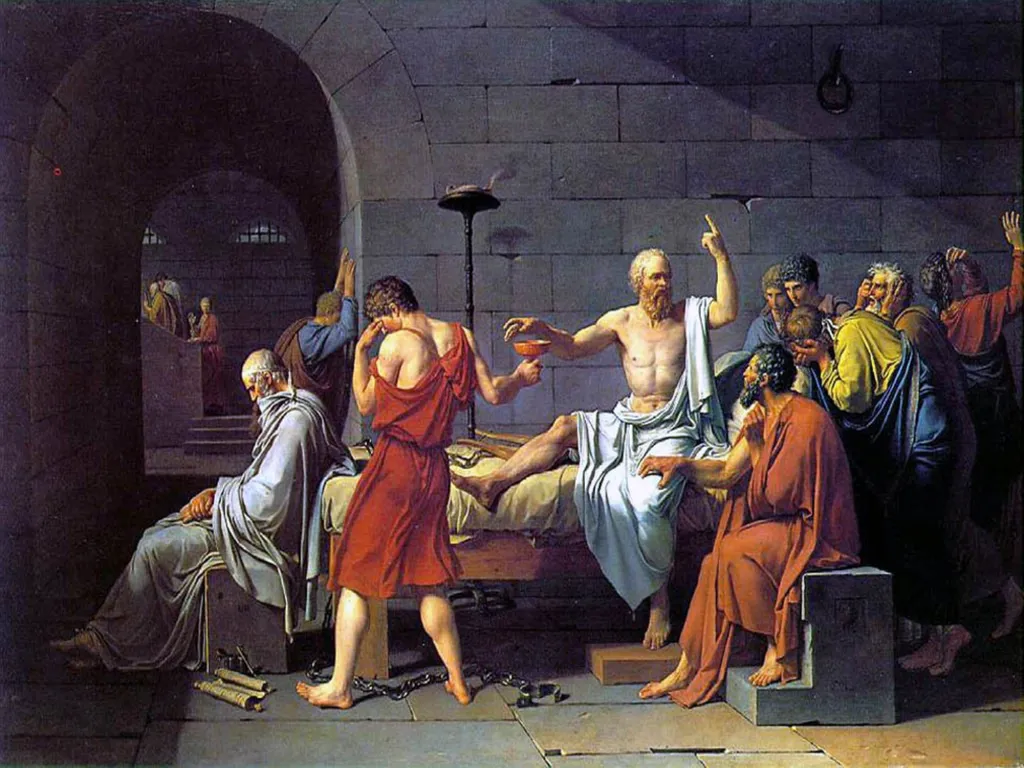
Placed on trial for impiety and corrupting the youth
Was executed in 399 – drank poison hemlock Introduction to Philosophy
Plato’s Republic Greek Philosophy Socrates<br>
12
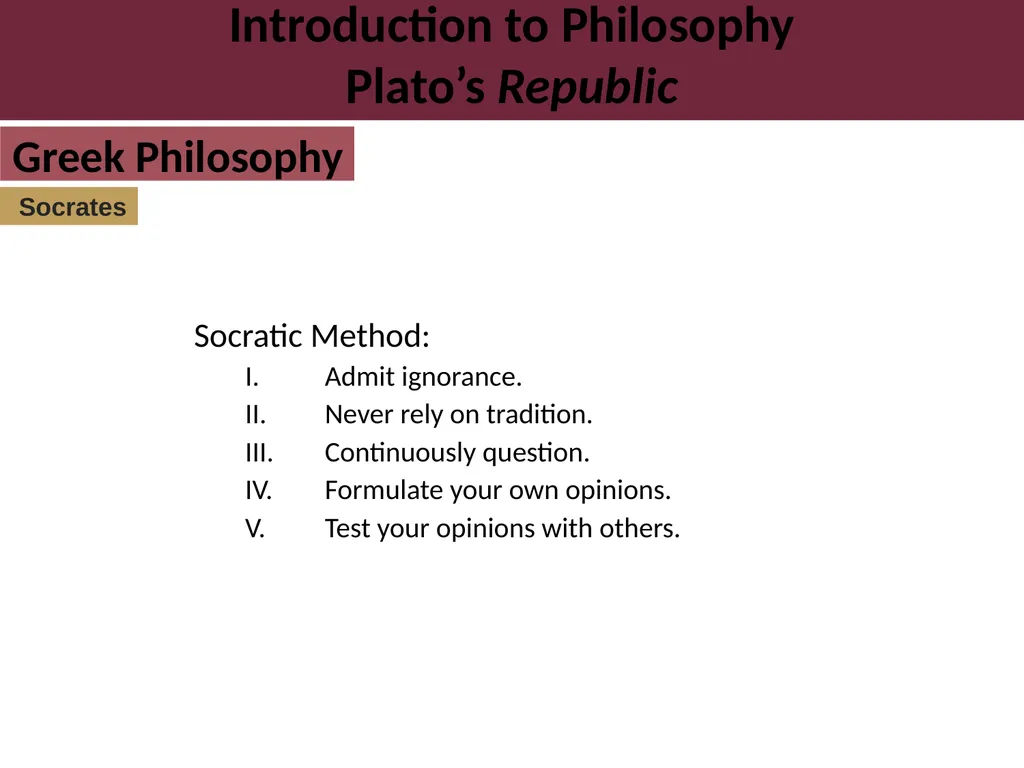
Socratic Method:
Admit ignorance.
Never rely on tradition.
Continuously question.
Formulate your own opinions.
Test your opinions with others. Introduction to Philosophy
Plato’s Republic Greek Philosophy Socrates<br>
13
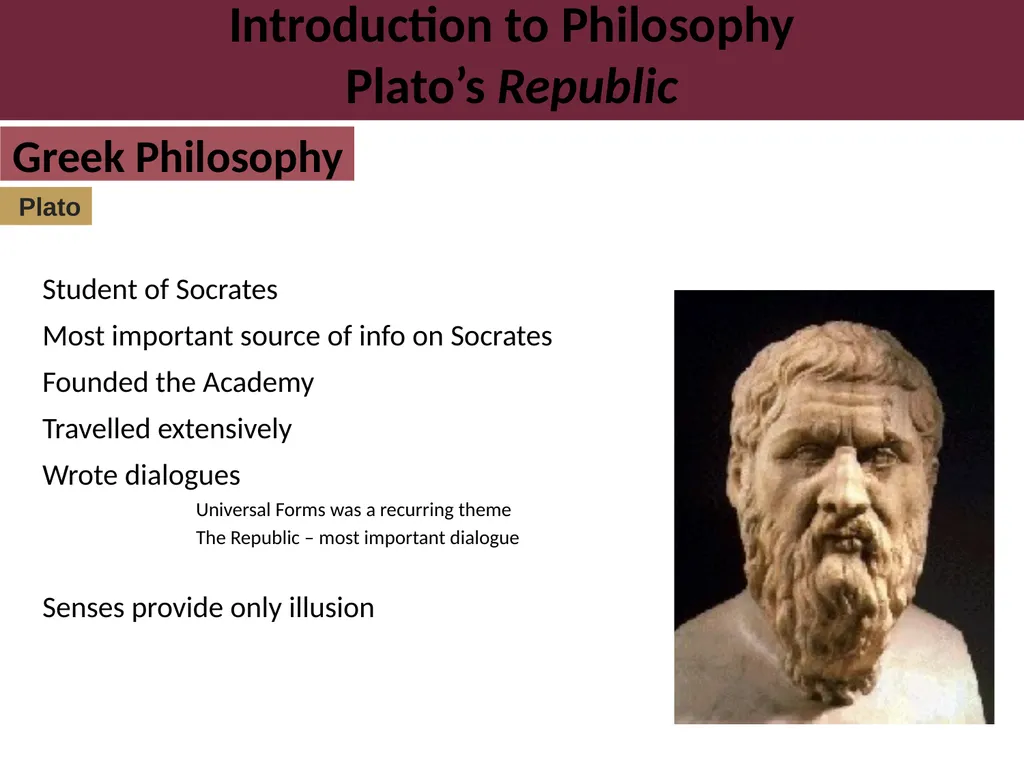
Student of Socrates
Most important source of info on Socrates
Founded the Academy
Travelled extensively
Wrote dialogues
Universal Forms was a recurring theme
The Republic – most important dialogue
Senses provide only illusion Introduction to Philosophy
Plato’s Republic Greek Philosophy Plato<br>
14
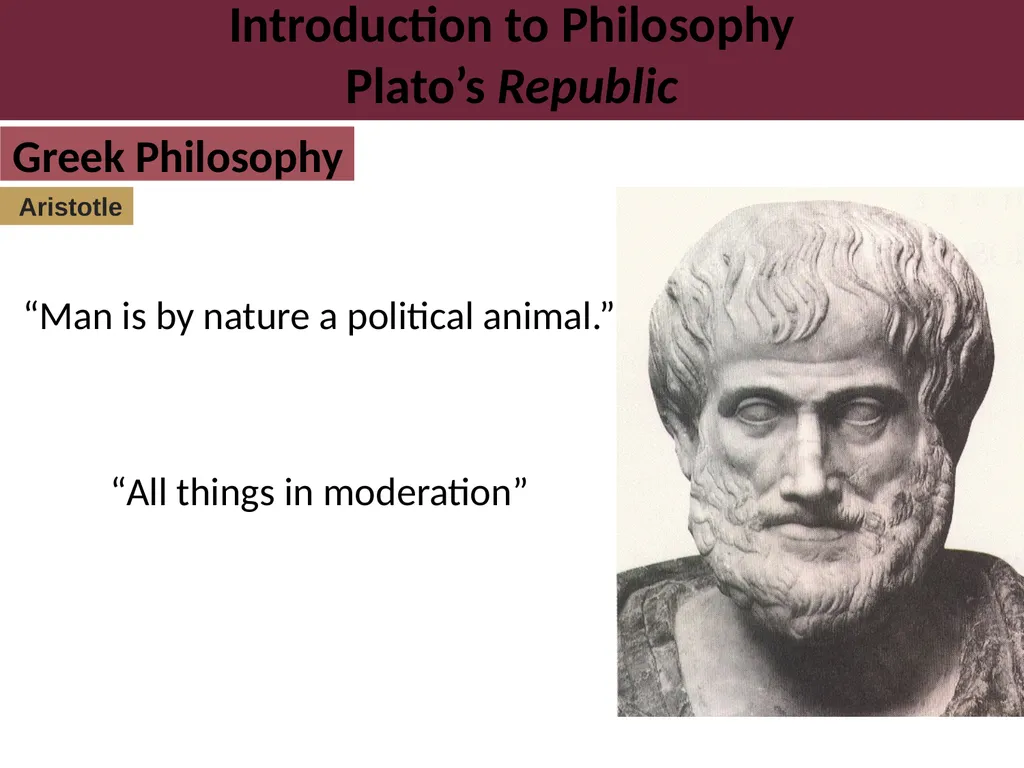
“All things in moderation” “Man is by nature a political animal.” Greek Philosophy Aristotle Introduction to Philosophy
Plato’s Republic<br>
15
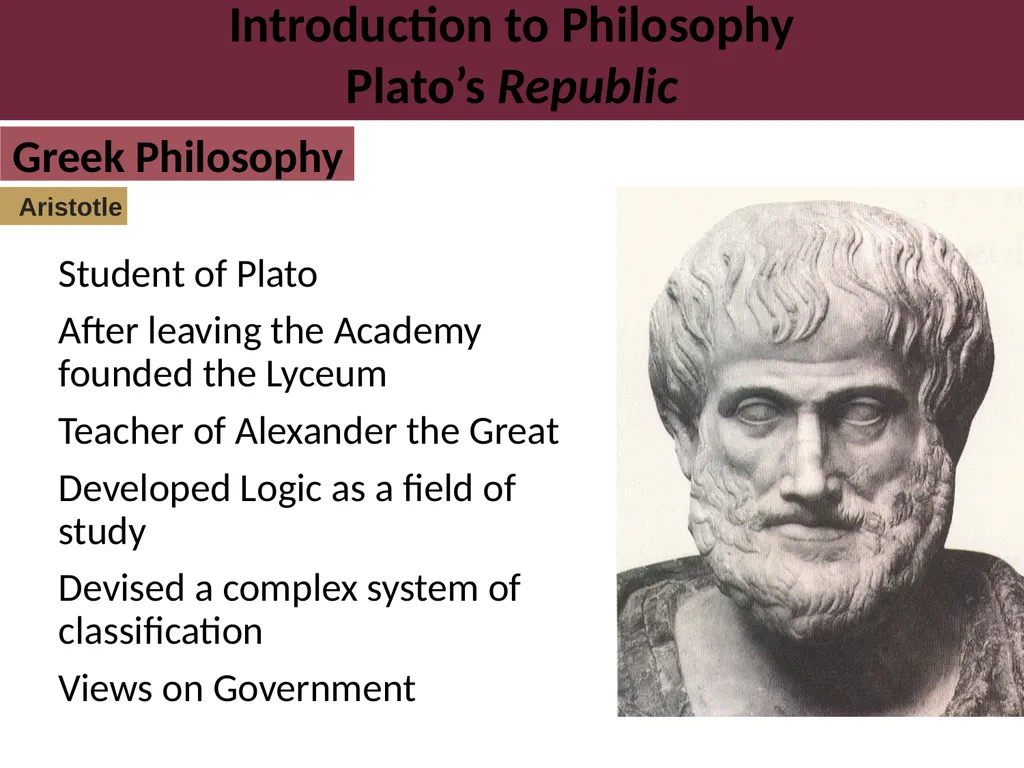
Student of Plato
After leaving the Academy founded the Lyceum
Teacher of Alexander the Great
Developed Logic as a field of study
Devised a complex system of classification
Views on Government Greek Philosophy Aristotle Introduction to Philosophy
Plato’s Republic<br>
16
Plato – essences (truths) could be found in forms that existed independently of nature by looking inward (introspection).
Aristotle – essences could be known only by studying nature.
Plato – primary principles come from pure thought; all knowledge existed independently of nature.
Aristotle – primary principles (premises) were attained by examining nature; nature and knowledge were inseparable. Greek Philosophy Aristotle Introduction to Philosophy
Plato’s Republic<br>
17
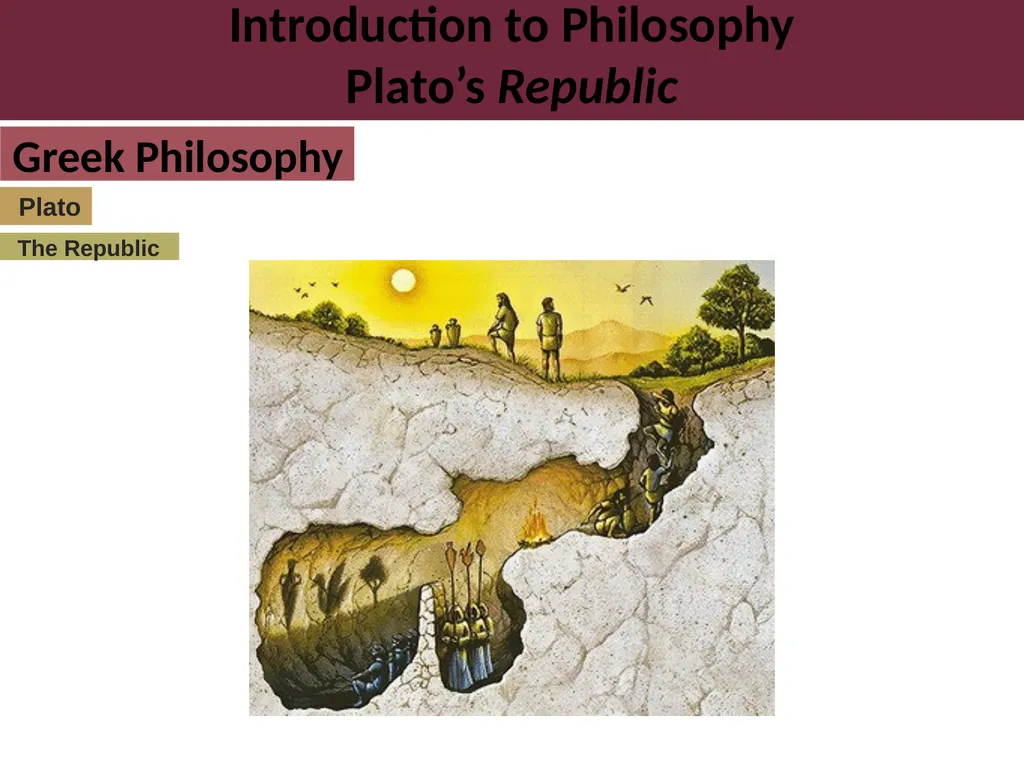
Greek Philosophy Plato The Republic In the Republic, Plato imagines a utopia or perfect society.��The central element of this society is that it is ruled by philosophers.��Plato advances numerous arguments for his ideal state but one is important to bear in mind:� Plato thinks ruling is a specialised skill no less than, say, making shoes or building a ship.�� Therefore, he thinks it no more sensible to have unskilled non-specialists ruling than making ships or shoes. Introduction to Philosophy
Plato’s Republic<br>
18
In the book's dialogue, Socrates discusses the meaning of justice and whether or not the just man is happier than the unjust man with various Athenians and foreigners.
They consider the natures of existing regimes and then propose a series of different, hypothetical cities in comparison. This culminates in the discussion of a hypothetical city-state ruled by a philosopher king.
They also discuss the theory of forms, the immortality of the soul, and the role of the philosopher and that of poetry in society.
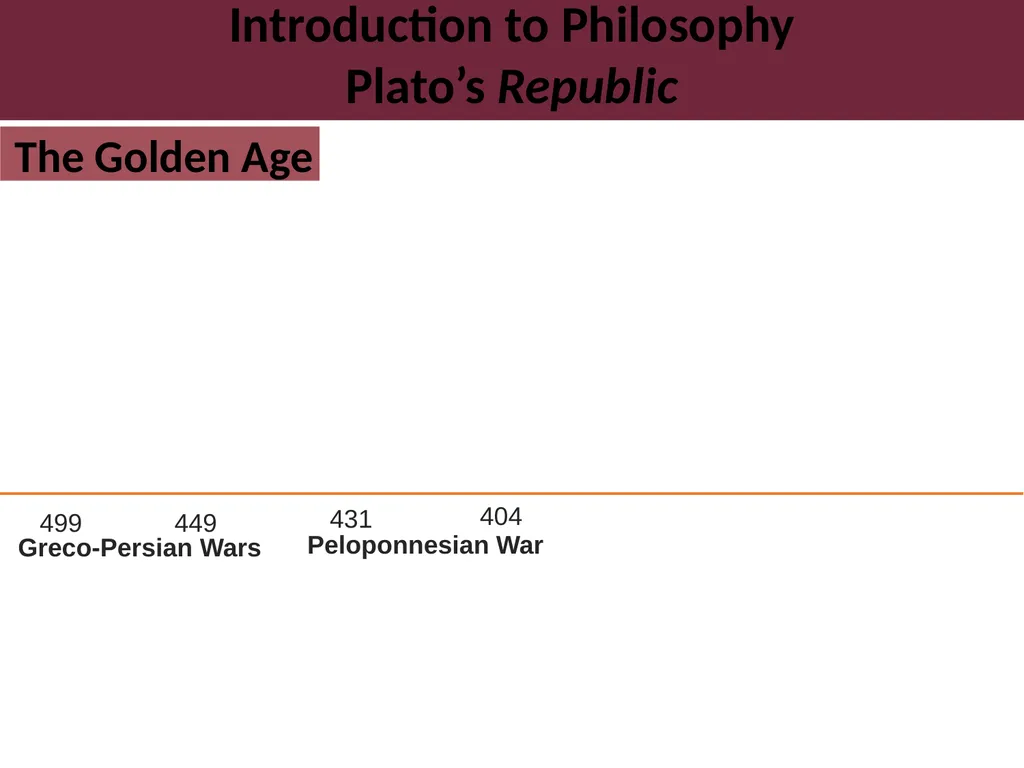
The dialogues may have taken place during the Peloponnesian War. Greek Philosophy Plato The Republic Introduction to Philosophy
Plato’s Republic<br>
19
Greek Philosophy Plato The Republic Introduction to Philosophy
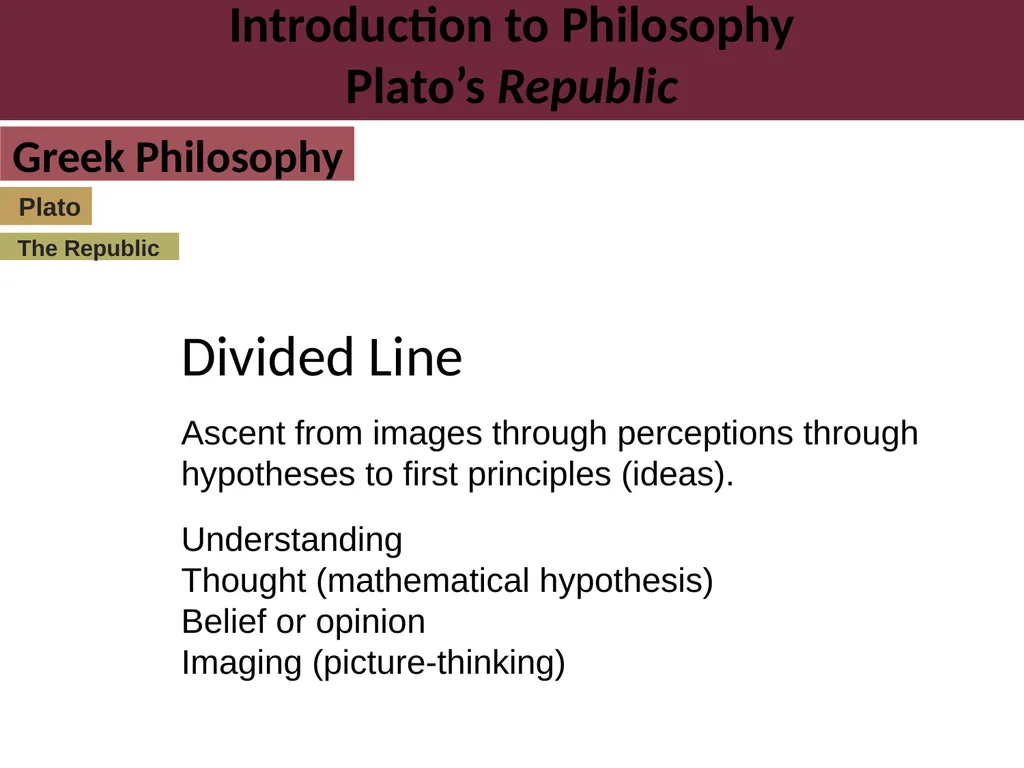
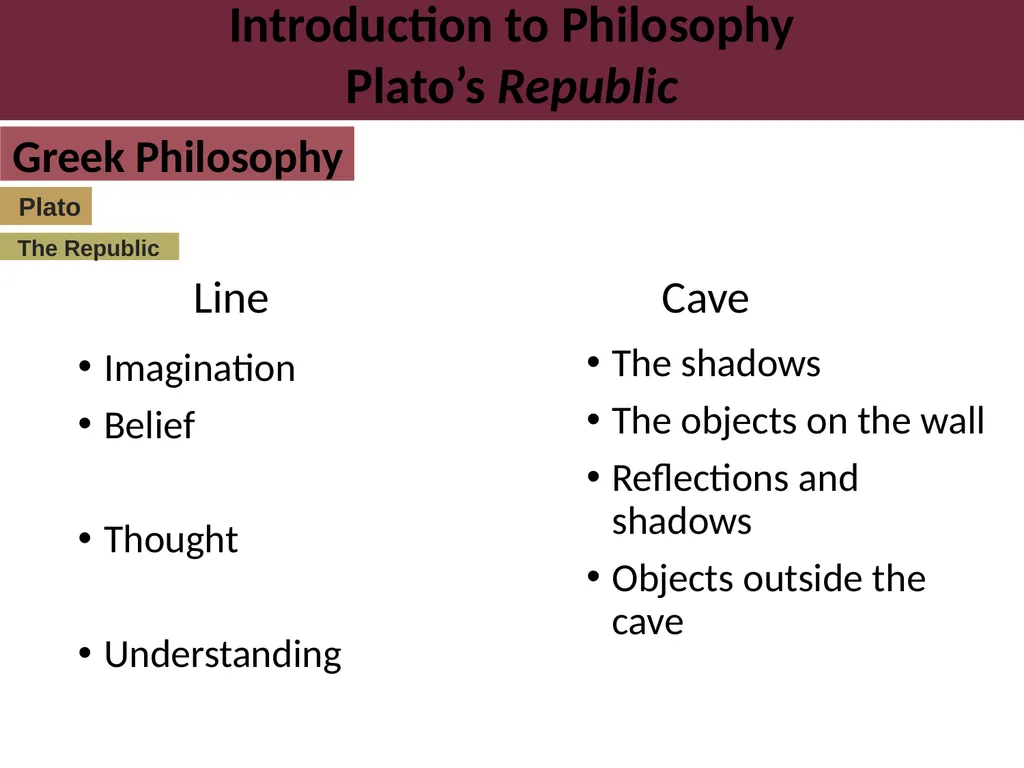
Plato’s Republic Divided Line Ascent from images through perceptions through hypotheses to first principles (ideas). Understanding
Thought (mathematical hypothesis)
Belief or opinion
Imaging (picture-thinking)<br>
20
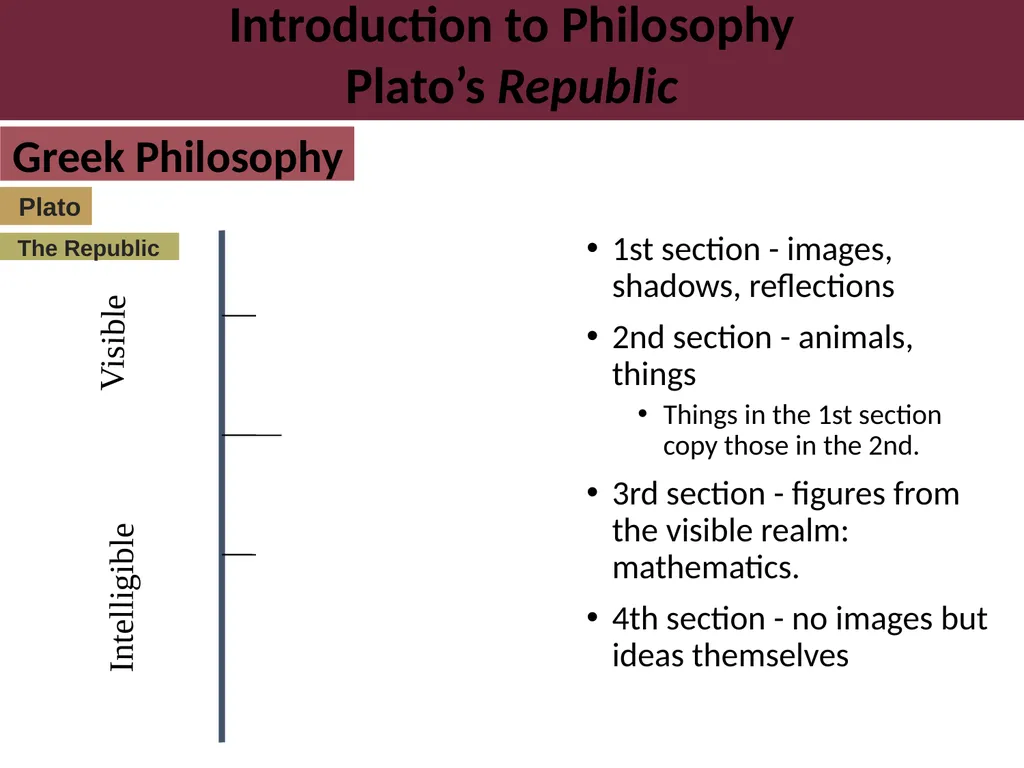
1st section - images, shadows, reflections
2nd section - animals, things
Things in the 1st section copy those in the 2nd.
3rd section - figures from the visible realm: mathematics.
4th section - no images but ideas themselves Visible Intelligible Greek Philosophy Plato The Republic Introduction to Philosophy
Plato’s Republic<br>
21
Greek Philosophy Plato The Republic Introduction to Philosophy
Plato’s Republic<br>
22
Imagination
Belief
Thought
Understanding The shadows
The objects on the wall
Reflections and shadows
Objects outside the cave Line Cave Greek Philosophy Plato The Republic Introduction to Philosophy
Plato’s Republic<br>
23
The Republic Book V 476c-e “He, then, who believes in beautiful things, but neither believes in beauty itself nor is able to follow when someone tries to guide him to the knowledge of it—do you think that his life is a dream or a waking?
Just consider. Is not the dream state, whether the man is asleep or awake, just this: the mistaking of resemblance for identity?”
“I should certainly call that dreaming,” he said.
“Well, then, take the opposite case: the man whose thought recognizes a beauty in itself, and is able to distinguish that self-beautiful and the things that participate in it, and neither supposes the participants to be it nor it the participants—is his life, in your opinion, a waking or a dream state?”
“He is very much awake,” he replied.
“Could we not rightly, then, call the mental state of the one as knowing, knowledge, and that of the other as opining, opinion?”
“Assuredly.” “Suppose, now, he who we say opines but does not know should be angry and challenge our statement as not true. Can we find any way of soothing him and gently winning him over, without telling him too plainly that he is not in his right mind?”
“We must try,” he said.
“Come, then, consider what we are to say to him, or would you have us question him in this fashion—premising that if he knows anything, nobody grudges it him, but we should be very glad to see him knowing something—but tell us this: Does he who knows know something or nothing? Do you reply in his behalf.”
“I will reply,” he said, “that he knows something.”
“Is it something that is or is not?”
“That is.”<br>
24
Socrates explains what distinguishes the lover of sights and sounds, the pseudo-intellectual, from the true philosopher. The lover of sights and sounds takes the sensible objects around him for the most real things, not recognizing that there is a higher level of reality in the intelligible realm. In particular, he goes around talking about beauty, billing himself as an expert on beauty, and yet he does not even realize that there is such a thing as the Form of the Beautiful, which is the cause of all sensible beauty.<br>
25
The result, then, is that more plentiful and better-quality goods are more easily produced if each person does one thing for which he is naturally suited, does it at the right time, and is released from having to do any of the others.<br>